Question 1
Which two characteristics of living organisms are demonstrated by gravitropism?
A. growth and nutrition
B. growth and sensitivity
C. respiration and nutrition
D. respiration and sensitivity
Most-appropriate topic codes (Cambridge IGCSE Co-ordinated Sciences 0654):
▶️ Answer/Explanation
Growth occurs because the plant produces new cells and elongates towards or away from gravity.
Sensitivity is shown because the plant detects the gravitational stimulus and responds to it.
✅ Answer: (B)
Question 2
By which process does oxygen pass from the alveoli to the blood capillaries in the lungs?
A. diffusion
B. active transport
C. osmosis
D. filtration
Most-appropriate topic codes (Cambridge IGCSE Co-ordinated Sciences 0654):
▶️ Answer/Explanation
Molecules move down their concentration gradient without using energy.
This passive movement of oxygen into the blood is diffusion.
✅ Answer: (A)
Question 3
What are the products when oils are digested?
A. amino acids and glycerol
B. fats and amino acids
C. fatty acids and glycerol
D. fatty acids and sugars
Most-appropriate topic codes (Cambridge IGCSE Co-ordinated Sciences 0654):
▶️ Answer/Explanation
The enzyme lipase catalyses the hydrolysis of lipids during digestion.
This breaks the lipid down into its building blocks, fatty acids and glycerol.
✅ Answer: (C)
Question 4
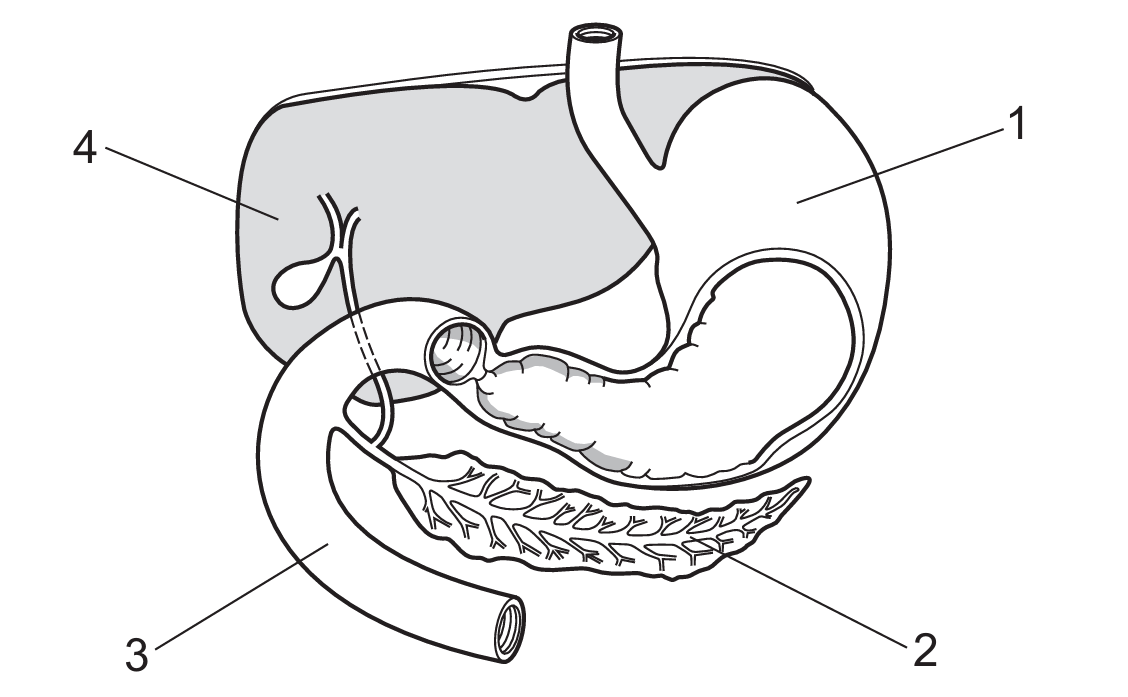
The diagram shows part of the human alimentary canal and associated organs.

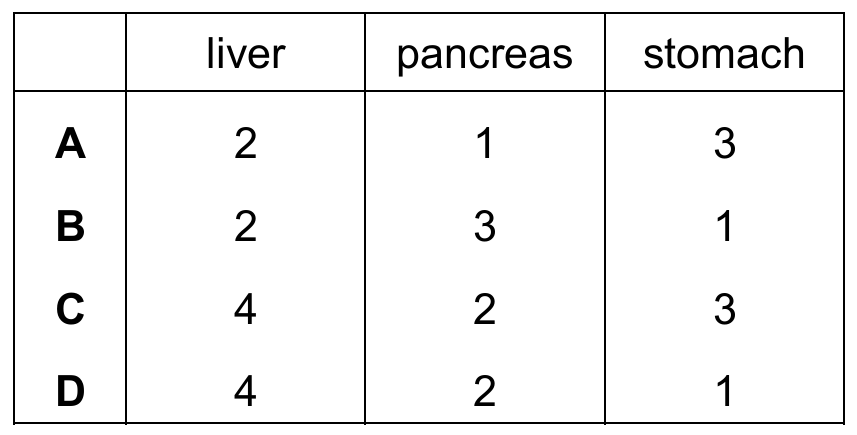
Which labels identify the liver, pancreas and stomach?

Most-appropriate topic codes (Cambridge IGCSE Co-ordinated Sciences 0654):
▶️ Answer/Explanation
The liver is the large organ above and to the side of the stomach, while the pancreas lies behind the stomach near the small intestine.
Matching each labelled structure to its position in the alimentary canal gives the correct set for liver, pancreas and stomach.
✅ Answer: (D)
Question 5
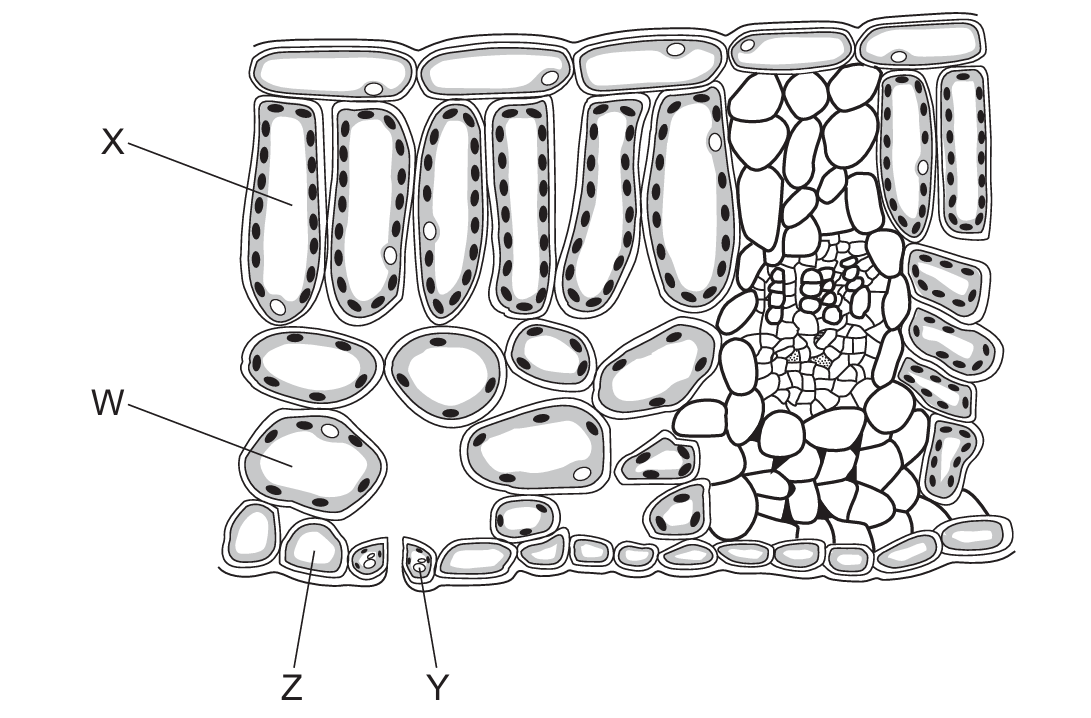
The diagram shows the cross-section of part of a leaf with cells labelled W, X, Y and Z.

Which cells lose most water and which cells absorb most carbon dioxide during the daytime?
A. W and X
B. X and Y
C. Y and Z
D. W and Z
Most-appropriate topic codes (Cambridge IGCSE Co-ordinated Sciences 0654):
▶️ Answer/Explanation
Carbon dioxide for photosynthesis also enters through the stomata and diffuses to the palisade and spongy mesophyll cells.
The labelled cells closest to the stomatal pore and air spaces are responsible for the most water loss and carbon dioxide uptake.
✅ Answer: (A)
Question 6
A scientist places equal volumes of starch and saliva into a test-tube. After 30 minutes, the mixture in the test-tube is tested with iodine solution.
The iodine solution remains brown.
Which process does this experiment demonstrate?
A. absorption
B. assimilation
C. digestion
D. ingestion
Most-appropriate topic codes (Cambridge IGCSE Co-ordinated Sciences 0654):
▶️ Answer/Explanation
Saliva contains amylase, an enzyme that breaks starch down into sugars.
Since the iodine stays brown, the starch has been chemically broken down, which is digestion.
✅ Answer: (C)
Question 7
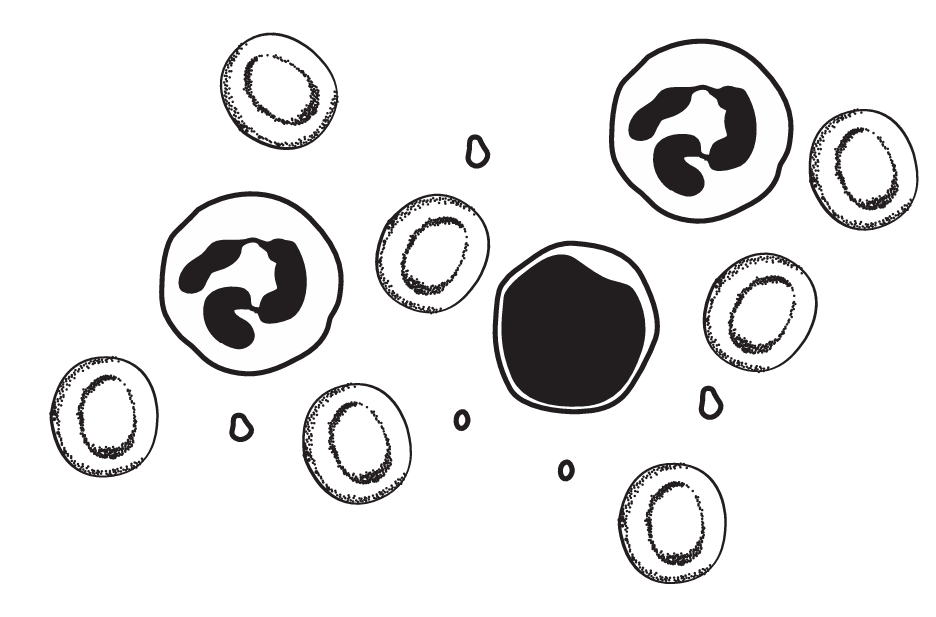
The diagram shows some blood viewed under a light microscope.

How many red blood cells are shown?
A. 1
B. 2
C. 5
D. 7
Most-appropriate topic codes (Cambridge IGCSE Co-ordinated Sciences 0654):
▶️ Answer/Explanation
They are distinguished from the larger, nucleus-containing white blood cells also visible in the field of view.
Counting only the red, disc-shaped cells in the diagram gives the total number present.
✅ Answer: (D)
Question 8
Which statement about the composition of expired air, compared with inspired air, is correct?
A. The percentage of carbon dioxide is decreased and the percentage of water vapour is increased.
B. The percentage of carbon dioxide is increased and the percentage of water vapour is increased.
C. The percentage of oxygen is decreased and the percentage of carbon dioxide is decreased.
D. The percentage of oxygen is increased and the percentage of carbon dioxide is decreased.
Most-appropriate topic codes (Cambridge IGCSE Co-ordinated Sciences 0654):
▶️ Answer/Explanation
Expired air therefore has less oxygen and more carbon dioxide than inspired air.
Expired air is also saturated with water vapour from the moist lung surfaces, so water vapour increases.
✅ Answer: (B)
Question 9
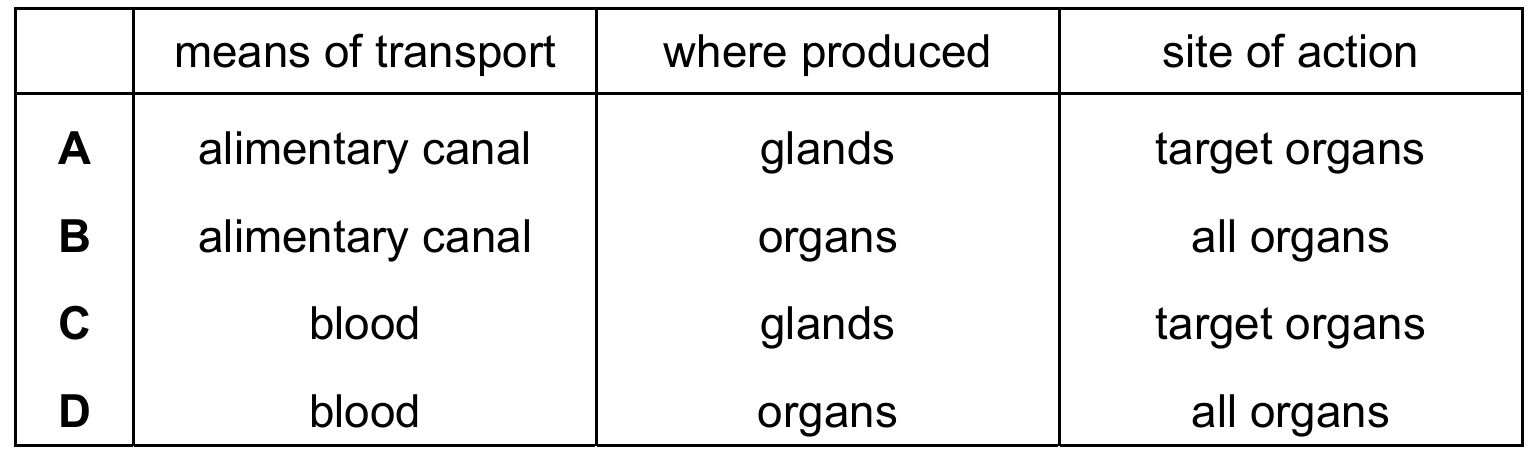
Which row about hormones is correct?

Most-appropriate topic codes (Cambridge IGCSE Co-ordinated Sciences 0654):
▶️ Answer/Explanation
Each correct row must match a named hormone with both its true gland of secretion and its true effect on the body.
Checking each row against known hormone facts, such as insulin from the pancreas lowering blood glucose, identifies the only fully correct combination.
✅ Answer: (C)
Question 10
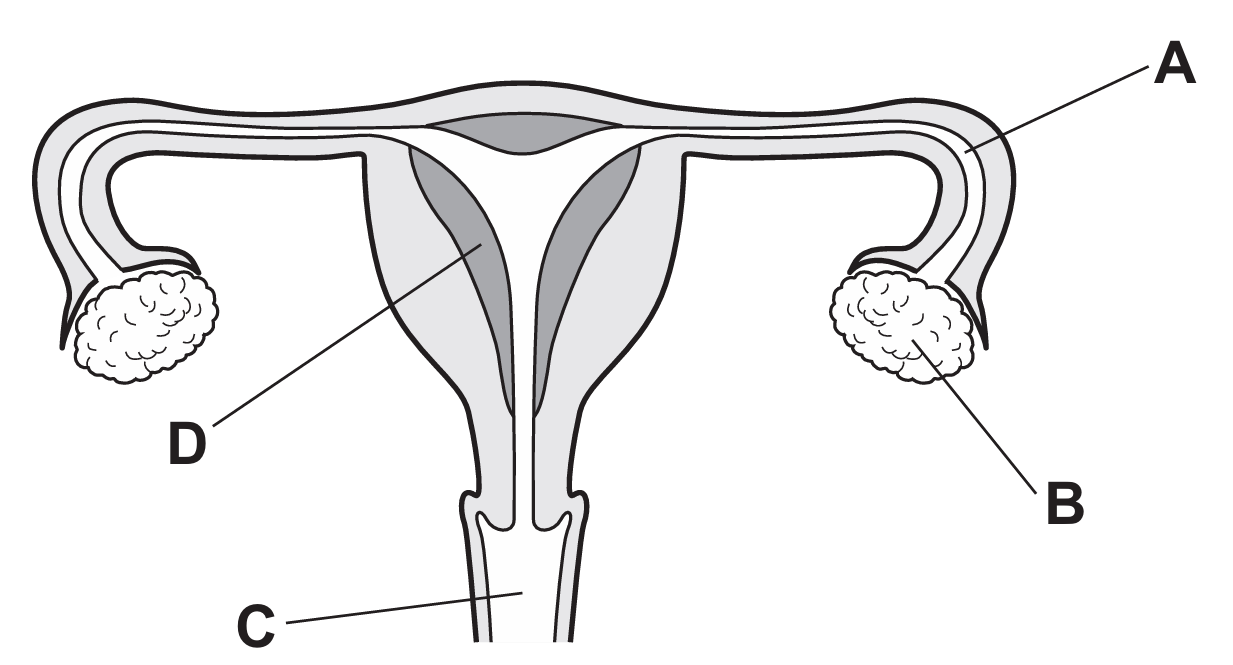
The diagram shows the human female reproductive system.
Where is the embryo normally implanted to enable it to develop into a healthy fetus?

Most-appropriate topic codes (Cambridge IGCSE Co-ordinated Sciences 0654):
▶️ Answer/Explanation
Normal implantation occurs in the lining (endometrium) of the uterus wall, which is thick and well supplied with blood vessels.
This lining provides nutrients and support needed for the embryo to develop into a healthy fetus.
✅ Answer: (D)
Question 11
Which statement describes a heterozygous genotype?
A. not pure breeding with two different alleles
B. not pure breeding with two identical alleles
C. pure breeding with two different alleles
D. pure breeding with two identical alleles
Most-appropriate topic codes (Cambridge IGCSE Co-ordinated Sciences 0654):
▶️ Answer/Explanation
Because the alleles differ, the organism is not pure breeding, as it can pass on either allele.
This is different from a homozygous genotype, which has two identical alleles and is pure breeding.
✅ Answer: (A)
Question 12
Which statement about organisms in a food chain is correct?
A. A carnivore is an organism that gets its energy by eating plants.
B. A consumer is an organism that gets its energy by eating other organisms.
C. A herbivore is an organism that gets its energy by eating animals.
D. A producer is an organism that gets its energy from dead or waste matter.
Most-appropriate topic codes (Cambridge IGCSE Co-ordinated Sciences 0654):
▶️ Answer/Explanation
Carnivores eat animals, not plants, so option A is incorrect.
Herbivores eat plants, not animals, so option C is incorrect, and producers make their own food rather than feeding on dead matter, so option D is incorrect.
✅ Answer: (B)
Question 13
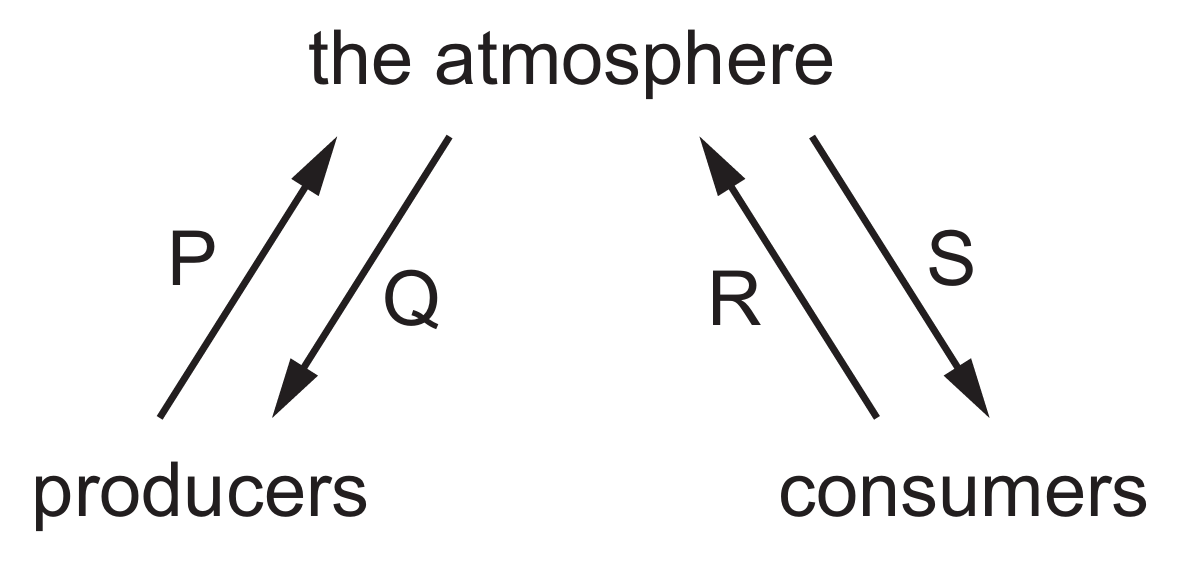
The diagram shows gas exchange by two groups of organisms during the hours of darkness.

Which letters represent gases that are part of the carbon cycle?
A. P and Q
B. P and R
C. P and S
D. Q and S
Most-appropriate topic codes (Cambridge IGCSE Co-ordinated Sciences 0654):
▶️ Answer/Explanation
Respiration takes in oxygen and releases carbon dioxide, so the carbon cycle gas involved is carbon dioxide, not oxygen.
Identifying the arrows that represent carbon dioxide being released by both groups of organisms gives the gases that are part of the carbon cycle.
✅ Answer: (B)
Question 14
Which statement about atoms is correct?
A. All atoms contain equal numbers of neutrons and protons.
B. All atoms of the same element have the same number of neutrons.
C. The Periodic Table lists atoms in order of increasing mass number.
D. The smallest unit of an element is an atom.
Most-appropriate topic codes (Cambridge IGCSE Co-ordinated Sciences 0654):
▶️ Answer/Explanation
Atoms of the same element can have different numbers of neutrons, called isotopes, so B is wrong.
Protons and neutrons are not always equal in number, and the Periodic Table is ordered by proton number, not mass number, so A and C are wrong.
✅ Answer: (D)
Question 15
Which substances exist as covalent molecules?
- helium
- chlorine
- sodium chloride
- ethanol
A. 1 and 2
B. 1 and 3
C. 2 and 4
D. 3 and 4
Most-appropriate topic codes (Cambridge IGCSE Co-ordinated Sciences 0654):
▶️ Answer/Explanation
Chlorine exists as a covalent diatomic molecule, \(Cl_2\), and ethanol is a covalent molecular compound.
Sodium chloride is an ionic compound, not a covalent molecule, so it is excluded.
✅ Answer: (C)
Question 16
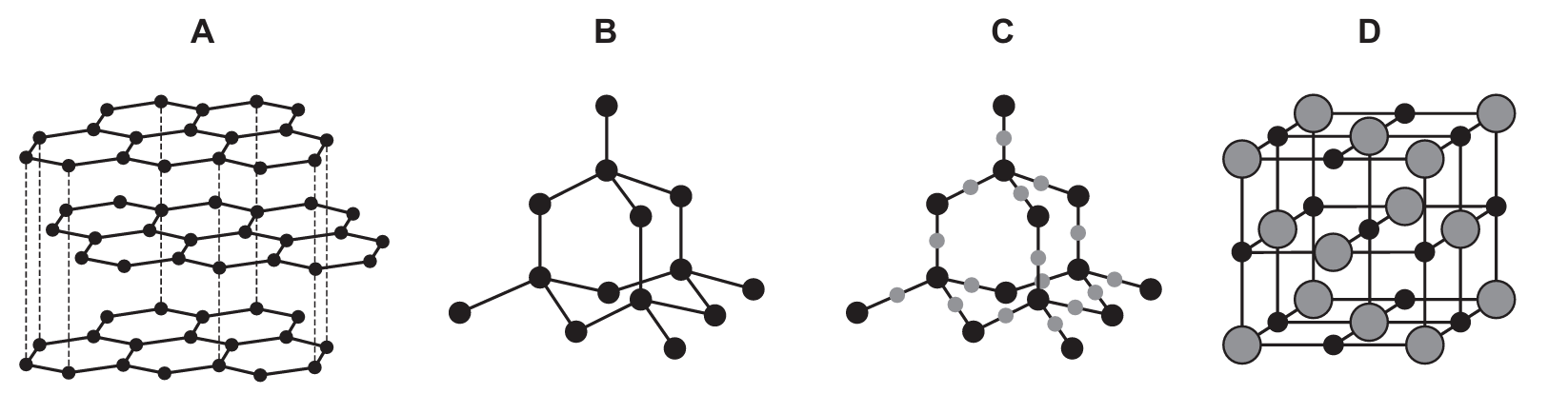
Which diagram shows the structure of graphite?

Most-appropriate topic codes (Cambridge IGCSE Co-ordinated Sciences 0654):
▶️ Answer/Explanation
Each carbon atom is covalently bonded to three others within its layer, leaving weak forces between separate layers.
The diagram showing this layered hexagonal sheet structure, rather than a 3D tetrahedral lattice, represents graphite.
✅ Answer: (A)
Question 17
Which oxides of nitrogen have the same ratio of nitrogen atoms to oxygen atoms?
- \(N_2O\)
- \(NO\)
- \(NO_2\)
- \(N_2O_4\)
A. 1 and 2
B. 1 and 3
C. 2 and 4
D. 3 and 4
Most-appropriate topic codes (Cambridge IGCSE Co-ordinated Sciences 0654):
▶️ Answer/Explanation
\(N_2O_4\) simplifies to the same ratio, \(1:2\), when divided by 2.
\(N_2O\) has a ratio of \(2:1\) and \(NO\) has a ratio of \(1:1\), so neither matches.
✅ Answer: (D)
Question 18
Hydrogen gas is given off when zinc reacts with dilute sulfuric acid.
Which piece of apparatus is used to collect the hydrogen gas and measure its volume?
A. balance
B. gas syringe
C. pipette
D. test-tube
Most-appropriate topic codes (Cambridge IGCSE Co-ordinated Sciences 0654):
▶️ Answer/Explanation
A balance measures mass, a pipette measures small liquid volumes, and a test-tube does not measure gas volume.
Only the gas syringe is designed to both collect and measure gas volume accurately.
✅ Answer: (B)
Question 19
The equation for the reaction between iron(III) oxide, \(Fe_2O_3\), and carbon is shown.
\(2Fe_2O_3 + 3C \to 4Fe + 3CO_2\)
Which statement about this reaction is correct?
A. C is oxidised.
B. \(CO_2\) is reduced.
C. Fe is oxidised.
D. \(Fe_2O_3\) is oxidised.
Most-appropriate topic codes (Cambridge IGCSE Co-ordinated Sciences 0654):
▶️ Answer/Explanation
Gaining oxygen means carbon has been oxidised.
Meanwhile \(Fe_2O_3\) loses oxygen to form Fe, so it is reduced, not oxidised, ruling out C and D.
✅ Answer: (A)
Question 20
The waste from a factory is acidic. The factory treats the waste with limestone.
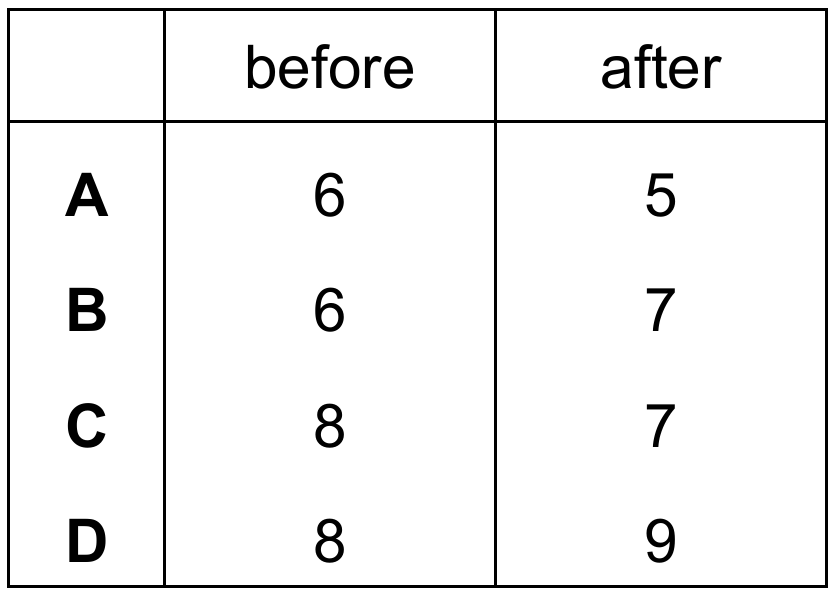
Which row shows the pH of the waste before and after treatment?

Most-appropriate topic codes (Cambridge IGCSE Co-ordinated Sciences 0654):
▶️ Answer/Explanation
Limestone is a base (calcium carbonate) that neutralises the acid in the waste.
After treatment, the pH rises towards 7, so the correct row shows a low pH before and a higher, closer-to-neutral pH after.
✅ Answer: (B)
Question 21
White solid X reacts with dilute hydrochloric acid. A gas is produced which turns limewater milky.
A flame test is done on solid X and produces a red coloured flame.
What is X?
A. lithium carbonate
B. lithium chloride
C. potassium carbonate
D. potassium chloride
Most-appropriate topic codes (Cambridge IGCSE Co-ordinated Sciences 0654):
▶️ Answer/Explanation
This rules out the chlorides, leaving lithium carbonate or potassium carbonate.
A red flame test is characteristic of lithium ions, not the lilac flame of potassium.
✅ Answer: (A)
Question 22
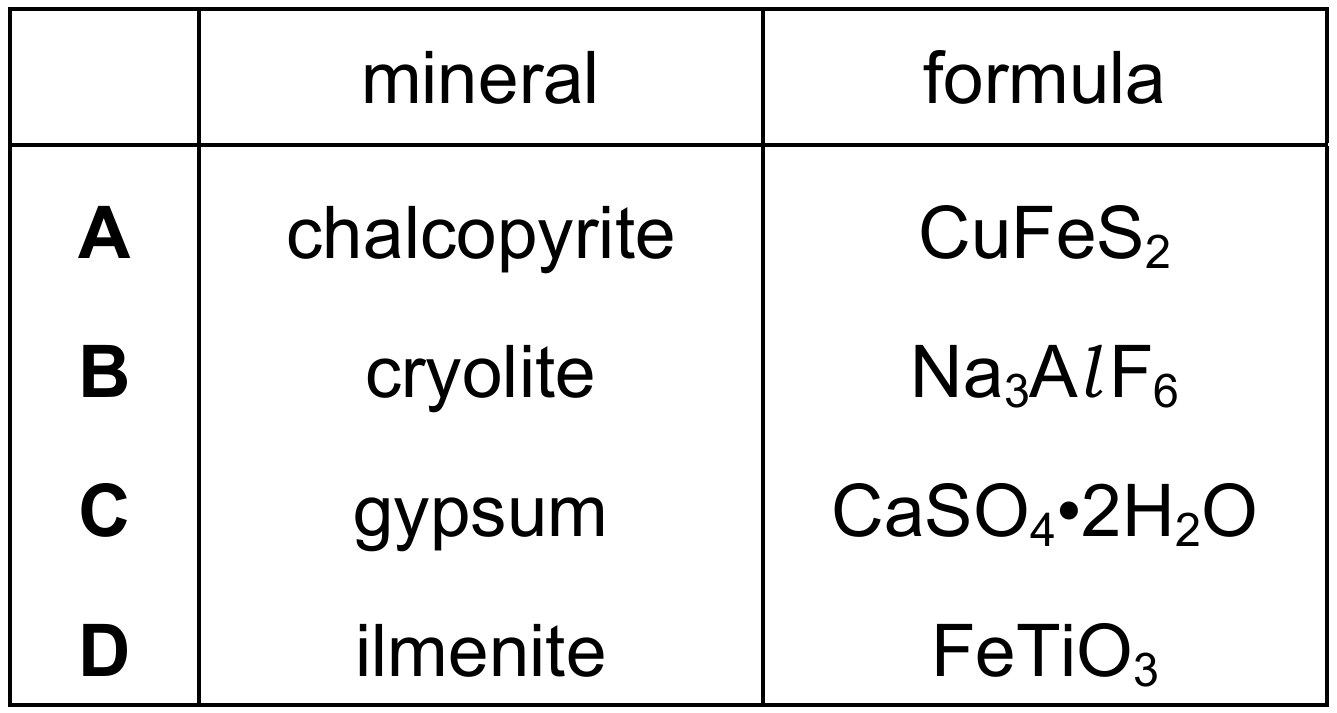
Different minerals contain different elements.
Which mineral contains three non-metallic elements?

Most-appropriate topic codes (Cambridge IGCSE Co-ordinated Sciences 0654):
▶️ Answer/Explanation
Metals are mostly found on the left and centre of the Periodic Table, while non-metals are on the right.
Only one listed mineral has all three of its elements positioned among the non-metals.
✅ Answer: (C)
Question 23
Manganese is a transition element.
What is a property of manganese?
A. high melting point
B. low density
C. thermal insulator
D. transparent
Most-appropriate topic codes (Cambridge IGCSE Co-ordinated Sciences 0654):
▶️ Answer/Explanation
This strong bonding gives them high melting points and high densities.
They are good thermal conductors, not insulators, and are opaque, not transparent, ruling out C and D.
✅ Answer: (A)
Question 24
Which process is used to increase the hardness of a metal?
A. Mix the metal with a gas.
B. Mix the metal with another element.
C. Mix the metal with a polymer.
D. Mix the metal with its ore.
Most-appropriate topic codes (Cambridge IGCSE Co-ordinated Sciences 0654):
▶️ Answer/Explanation
Atoms of different sizes prevent layers of atoms from sliding over each other easily.
This makes the alloy harder than the pure metal.
✅ Answer: (B)
Question 25
Which compound contains two of the three elements needed in a fertiliser used for plant growth?
A. potassium carbonate
B. potassium chloride
C. potassium nitrate
D. potassium sulfate
Most-appropriate topic codes (Cambridge IGCSE Co-ordinated Sciences 0654):
▶️ Answer/Explanation
Potassium nitrate, \(KNO_3\), contains both potassium and nitrogen.
The other compounds (carbonate, chloride, sulfate) only supply potassium plus a non-fertiliser element.
✅ Answer: (C)
Question 26
Which type of reaction is used to manufacture lime from limestone?
A. addition polymerisation
B. cracking
C. neutralisation
D. thermal decomposition
Most-appropriate topic codes (Cambridge IGCSE Co-ordinated Sciences 0654):
▶️ Answer/Explanation
Heating breaks it down into calcium oxide (lime) and carbon dioxide.
Breaking down one compound into simpler substances using heat is thermal decomposition.
✅ Answer: (D)
Question 27
Poly(ethene) is made from ethene by addition polymerisation.
Which word describes ethene in this process?
A. fuel
B. catalyst
C. monomer
D. solvent
Most-appropriate topic codes (Cambridge IGCSE Co-ordinated Sciences 0654):
▶️ Answer/Explanation
These small repeating units that join together are called monomers.
Here, ethene molecules are the monomers that link to form poly(ethene).
✅ Answer: (C)
Question 28
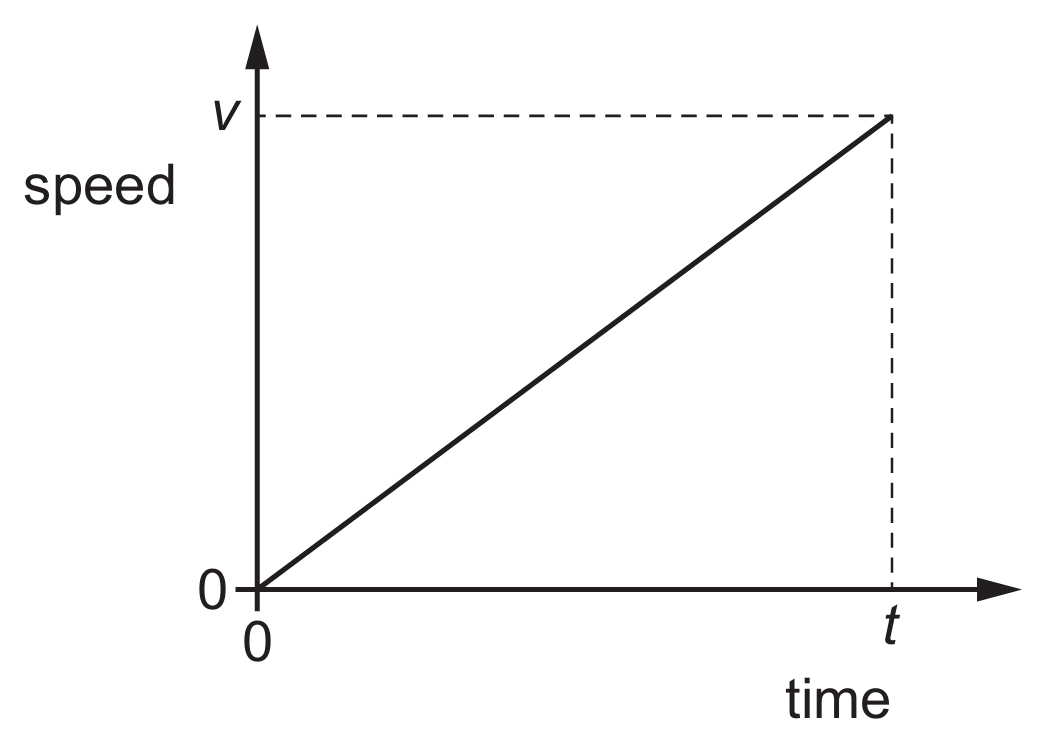
The graph shows how the speed of an object varies with time. The speed of the object is v at time t.

Which expression gives the distance travelled by the object in time t?
A. \(\frac{1}{2}\left(\frac{v}{t}\right)\)
B. \(\frac{v}{t}\)
C. \(\frac{1}{2}vt\)
D. \(vt\)
Most-appropriate topic codes (Cambridge IGCSE Co-ordinated Sciences 0654):
▶️ Answer/Explanation
For an object accelerating uniformly from rest to speed \(v\) over time \(t\), this area is a triangle.
The area of this triangle is \(\frac{1}{2}vt\).
✅ Answer: (C)
Question 29
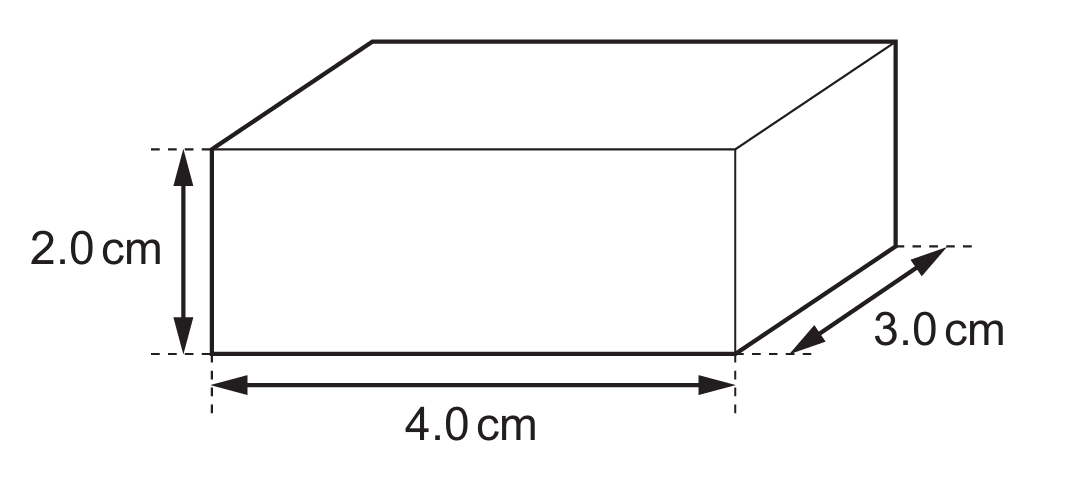
The diagram shows a block of metal of mass 72 g.

What is the density of the metal?
A. 3.0 g/cm3
B. 6.0 g/cm3
C. 9.0 g/cm3
D. 12 g/cm3
Most-appropriate topic codes (Cambridge IGCSE Co-ordinated Sciences 0654):
▶️ Answer/Explanation
The volume of the block is found by multiplying its three dimensions shown in the diagram, giving \(24\ \text{cm}^3\).
Dividing the mass by this volume, \(\frac{72}{24} = 3.0\), gives the density of the metal.
✅ Answer: (A)
Question 30
Which statement about a resultant force is correct?
A. An object must have a resultant force acting on it if it is moving.
B. An object must have a resultant force acting on it if it is slowing down.
C. Two forces must be in the same direction to produce a resultant force.
D. Two forces must have the same magnitude to produce a resultant force.
Most-appropriate topic codes (Cambridge IGCSE Co-ordinated Sciences 0654):
▶️ Answer/Explanation
Slowing down means the velocity is changing, which requires a resultant force to cause deceleration.
Forces in different directions, or of different sizes, can still combine to give a resultant, so C and D are wrong.
✅ Answer: (B)
Question 31
What is the energy source for a wind turbine that is producing electricity?
A. chemical potential energy of wind
B. gravitational potential energy of wind
C. kinetic energy of wind
D. thermal energy of wind
Most-appropriate topic codes (Cambridge IGCSE Co-ordinated Sciences 0654):
▶️ Answer/Explanation
Moving air has kinetic energy due to its motion.
The turbine blades are turned by this kinetic energy, which a generator then converts into electrical energy.
✅ Answer: (C)
Question 32
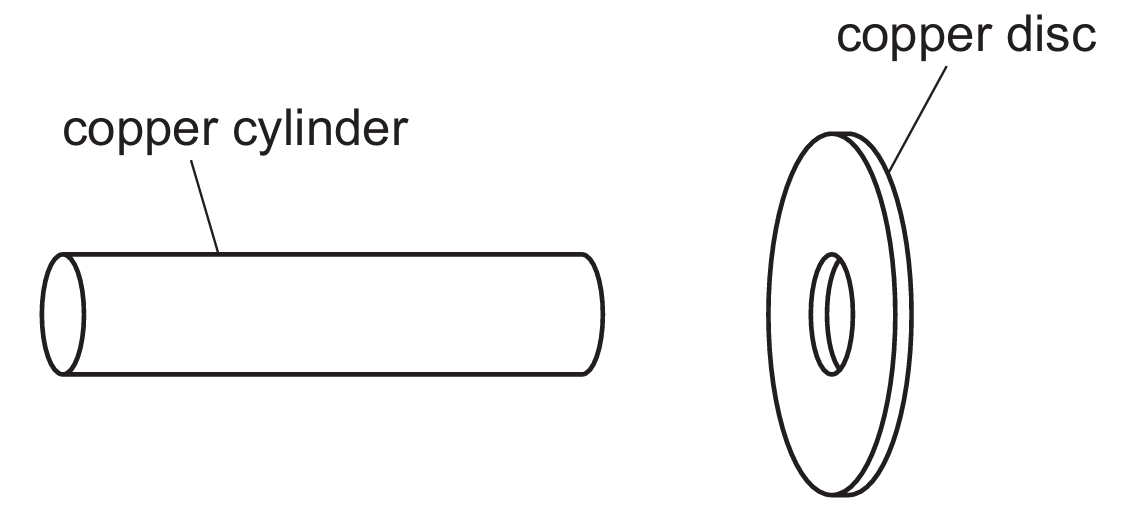
A copper disc has a hole at its centre that is slightly too small to fit over a copper cylinder.

How can the disc be fitted over the cylinder?
A. Cool the disc and then fit it over the cylinder.
B. Cool the disc, heat the cylinder and then fit the disc over the cylinder.
C. Heat the cylinder and then fit it through the hole in the disc.
D. Heat the disc and then fit it over the cylinder.
Most-appropriate topic codes (Cambridge IGCSE Co-ordinated Sciences 0654):
▶️ Answer/Explanation
Heating the disc makes the hole in its centre expand, becoming large enough for the cylinder.
Cooling the disc would shrink the hole further, making it harder, not easier, to fit.
✅ Answer: (D)
Question 33
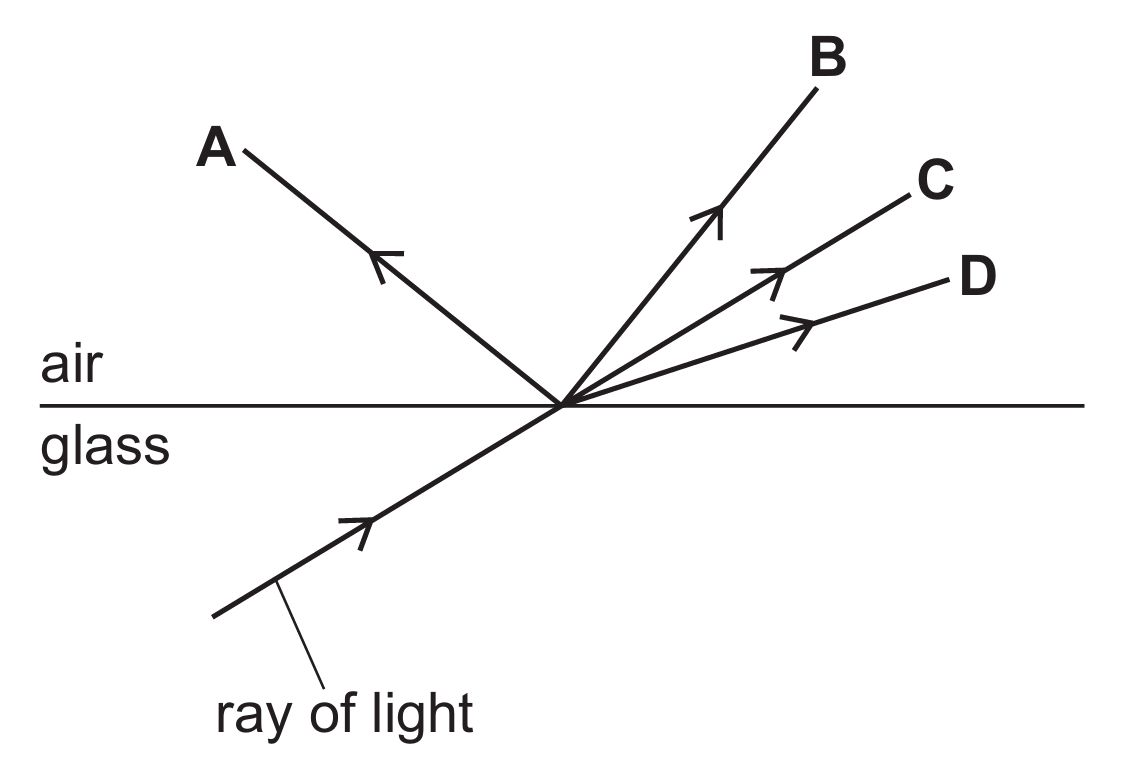
The diagram shows a ray of light travelling from glass into air.
Which labelled arrow shows the path of the light in the air?

Most-appropriate topic codes (Cambridge IGCSE Co-ordinated Sciences 0654):
▶️ Answer/Explanation
When light passes from glass into the less dense air, it speeds up and bends away from the normal.
The arrow that bends away from the normal line at the glass-air boundary shows the correct refracted path.
✅ Answer: (D)
Question 34
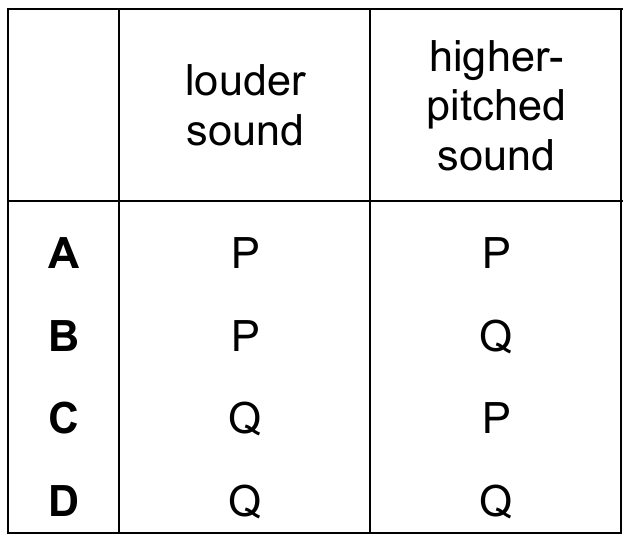
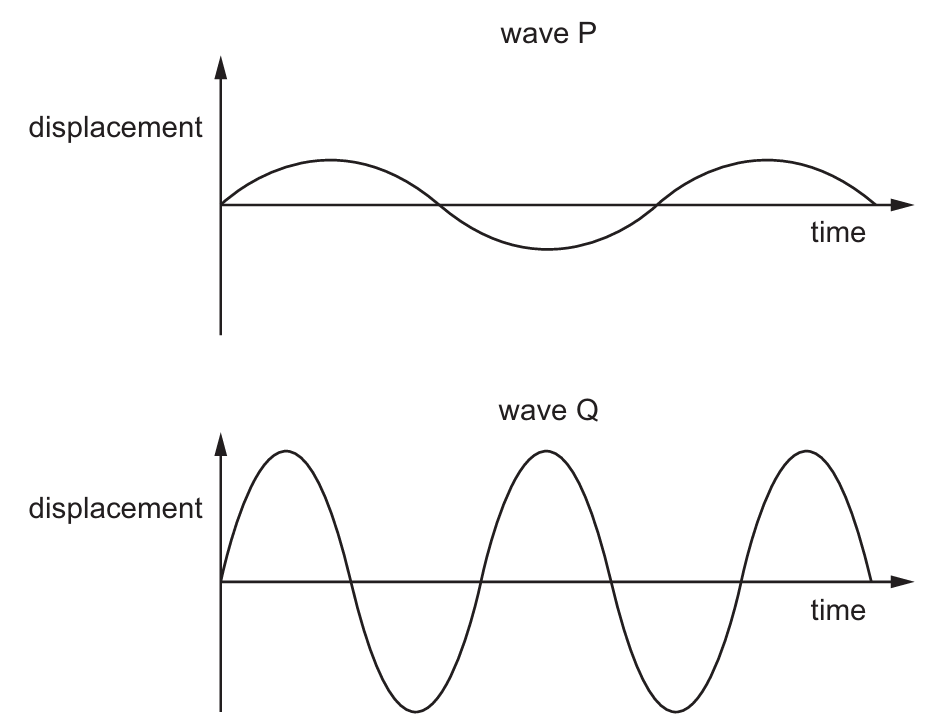
The diagrams represent two different sound waves, P and Q, drawn to the same scale.

How do the loudness and the pitch of the sounds compare?

Most-appropriate topic codes (Cambridge IGCSE Co-ordinated Sciences 0654):
▶️ Answer/Explanation
Comparing waves P and Q drawn to the same scale shows differences in their amplitude and/or wavelength.
The statement that correctly links these differences to changes in loudness and pitch is the correct one.
✅ Answer: (D)
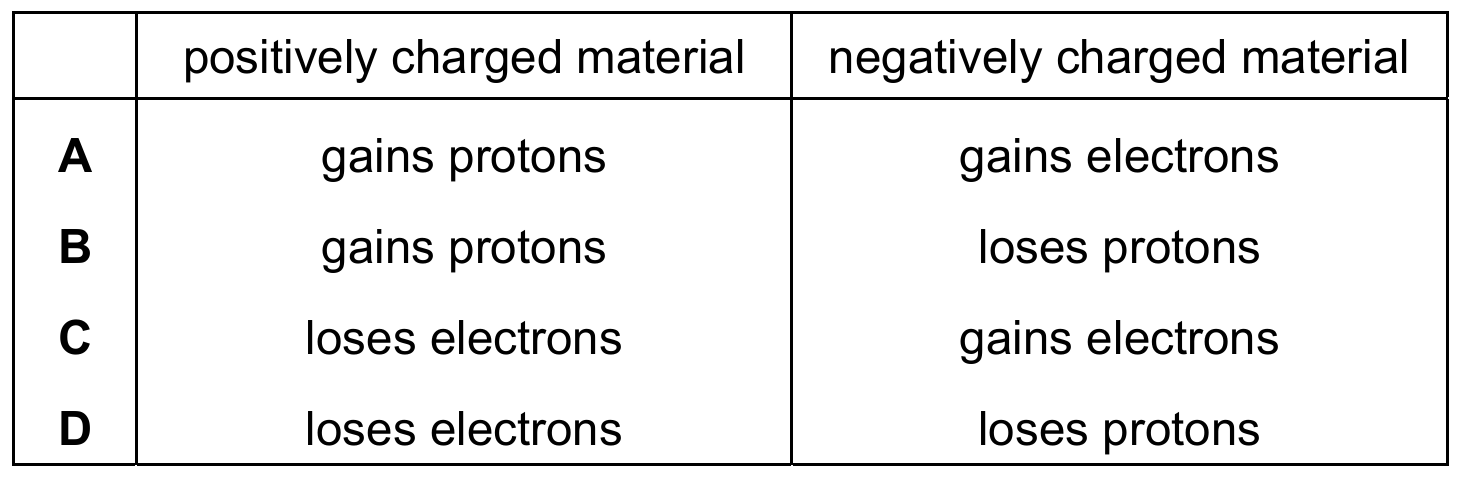
Question 35
When two different, uncharged, insulating materials are rubbed together, one becomes positively charged and the other becomes negatively charged.
What happens to cause the materials to become charged?

Most-appropriate topic codes (Cambridge IGCSE Co-ordinated Sciences 0654):
▶️ Answer/Explanation
The material that loses electrons becomes positively charged, since it now has more protons than electrons.
The material that gains those electrons becomes negatively charged, since it now has more electrons than protons.
✅ Answer: (C)
Question 36
For which quantities is the unit the volt?
A. current and potential difference (p.d.)
B. electromotive force (e.m.f.) and potential difference (p.d.)
C. electromotive force (e.m.f.) and resistance
D. potential difference (p.d.) and resistance
Most-appropriate topic codes (Cambridge IGCSE Co-ordinated Sciences 0654):
▶️ Answer/Explanation
Electromotive force (e.m.f.) describes the energy supplied per unit charge by a source, measured in volts.
Potential difference (p.d.) describes energy transferred per unit charge across a component, also measured in volts.
✅ Answer: (B)
Question 37
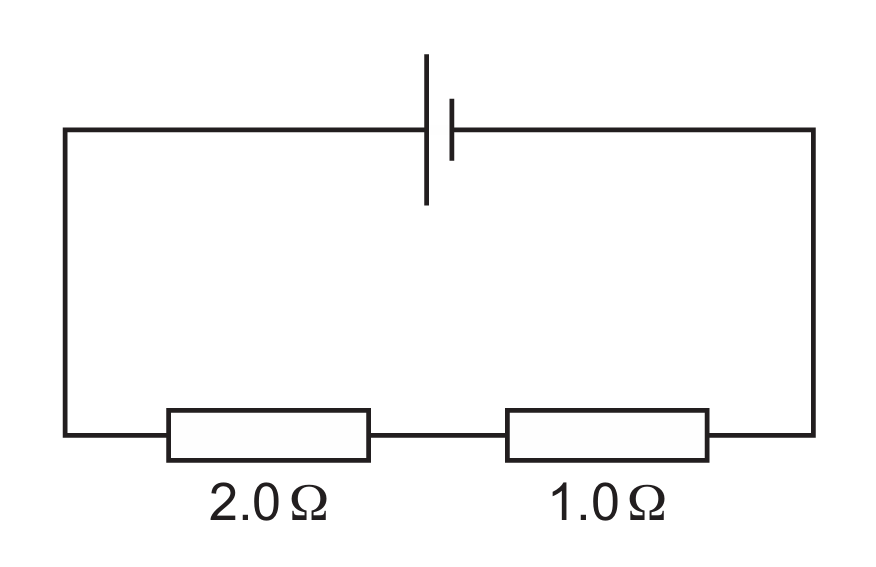
A 2.0Ω resistor and a 1.0Ω resistor are connected in series with a cell.

Which statement about current in the circuit is correct?
A. The current in the 2.0Ω resistor is double the current in the 1.0Ω resistor.
B. The current in the 2.0Ω resistor is equal to the current in the 1.0Ω resistor.
C. The current in the 2.0Ω resistor is half the current in the 1.0Ω resistor.
D. The current in the cell is larger than the current in either resistor.
Most-appropriate topic codes (Cambridge IGCSE Co-ordinated Sciences 0654):
▶️ Answer/Explanation
This means the current must be the same at every point in the circuit, including through both resistors and the cell.
The resistor values do not split the current in series, ruling out options A, C and D.
✅ Answer: (B)
Question 38
A coil lies between the poles of a magnet. There is a current in the coil and this causes a turning effect.
Which change does not increase the turning effect on the coil?
A. changing the direction of the current
B. increasing the current
C. using a stronger magnet
D. using more turns in the coil
Most-appropriate topic codes (Cambridge IGCSE Co-ordinated Sciences 0654):
▶️ Answer/Explanation
Reversing the current direction only reverses the direction of rotation of the coil.
The magnitude of the turning effect itself stays the same when only the current direction is reversed.
✅ Answer: (A)
Question 39
An atom of an isotope of strontium (Sr) has a proton number of 38 and contains 52 neutrons.
What is the nuclide notation for this isotope?
A. \(^{52}_{38}\textrm{Sr}\)
B. \(^{90}_{38}\textrm{Sr}\)
C. \(^{38}_{52}\textrm{Sr}\)
D. \(^{90}_{52}\textrm{Sr}\)
Most-appropriate topic codes (Cambridge IGCSE Co-ordinated Sciences 0654):
▶️ Answer/Explanation
The mass number (top number) equals protons plus neutrons, so \(38 + 52 = 90\).
Nuclide notation places the mass number above the proton number, giving \(^{90}_{38}\textrm{Sr}\).
✅ Answer: (B)
Question 40
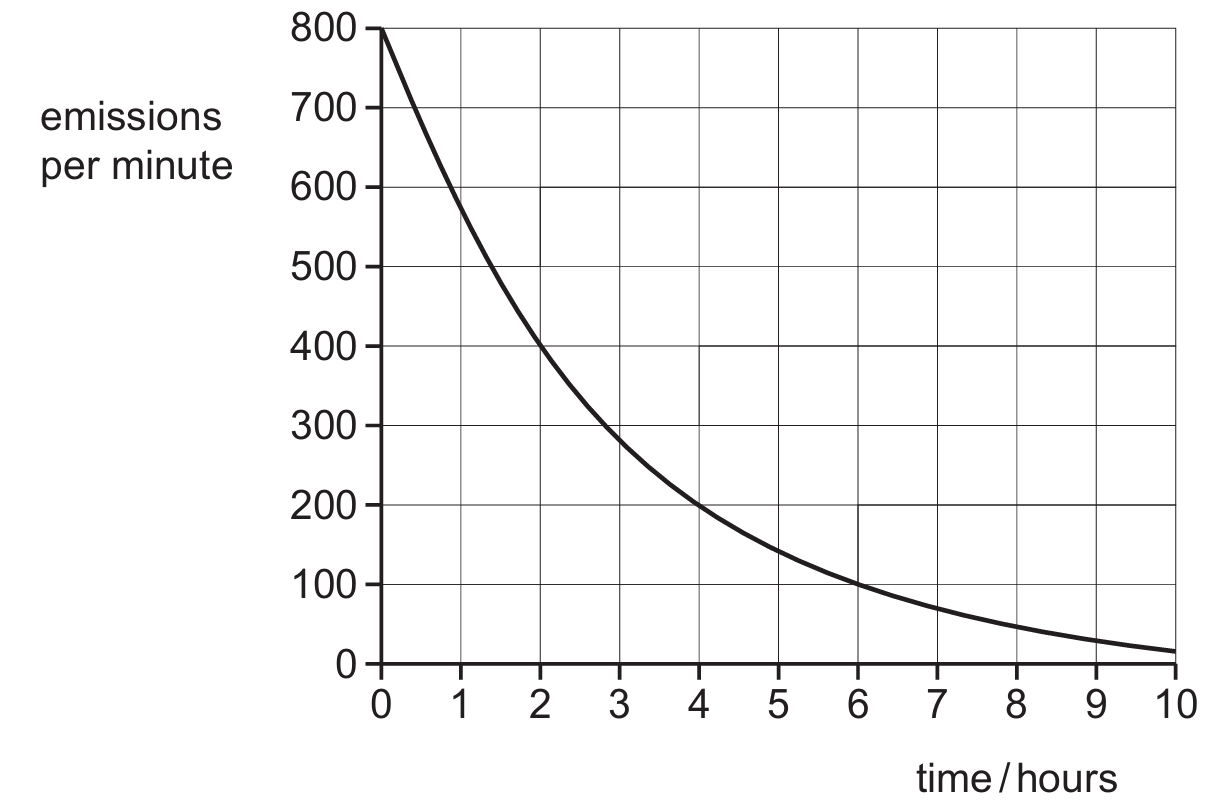
The graph shows the decay curve for a radioactive substance.

What is the half-life of this substance?
A. 2.0 hours
B. 3.2 hours
C. 5.0 hours
D. 10 hours
Most-appropriate topic codes (Cambridge IGCSE Co-ordinated Sciences 0654):
▶️ Answer/Explanation
Reading the graph, the activity drops from its starting value to half that value over a certain time interval.
This time interval read off the graph is the half-life of the substance.
✅ Answer: (A)