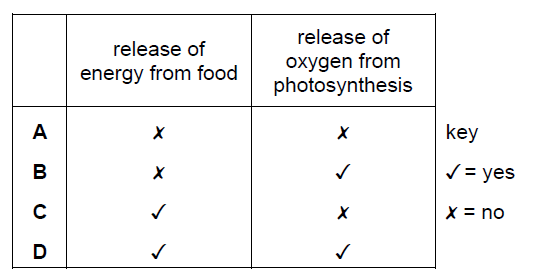
Question 1
Which processes are examples of excretion?

Most-appropriate topic codes (Cambridge IGCSE Co-ordinated Sciences 0654):
▶️ Answer/Explanation
Release of oxygen from photosynthesis is not excretion, since oxygen is a useful product, not a waste product of the organism’s own metabolism in this context.
✅ Answer: (B)
Question 2
What are all living organisms made from?
A. cells
B. eggs
C. mesophyll
D. sperm
Most-appropriate topic codes (Cambridge IGCSE Co-ordinated Sciences 0654):
▶️ Answer/Explanation
Eggs and sperm are specific cell types (gametes), and mesophyll is a specific plant tissue — neither describes all organisms.
✅ Answer: (A)
Question 3
Analysis of a large food molecule shows that it contains the elements carbon, hydrogen and oxygen only.
Which food groups could this molecule be from?
A. carbohydrates and fats only
B. carbohydrates and proteins only
C. fats and proteins only
D. carbohydrates, fats and proteins
Most-appropriate topic codes (Cambridge IGCSE Co-ordinated Sciences 0654):
▶️ Answer/Explanation
Proteins also contain nitrogen (and often sulfur), so a molecule with only C, H and O cannot be a protein.
✅ Answer: (A)
Question 4
The graph shows the mass of product produced by an enzyme-controlled reaction over time when the reaction mixture is placed separately at 37 °C and at 60 °C. The starting concentration of the substrate and the concentration of the enzyme used are kept constant.

What can be concluded from the graph?
A. At point X on the graph, the enzyme has run out of substrate.
B. The enzyme denatures at point Y on the graph.
C. The reaction mixture has a higher kinetic energy at 37 °C.
D. The reaction mixture has a higher initial rate of reaction when placed at 60 °C.
Most-appropriate topic codes (Cambridge IGCSE Co-ordinated Sciences 0654):
▶️ Answer/Explanation
This means the curve at 60 °C rises more steeply at the start, so it has the higher initial rate, even though it later plateaus early due to denaturation.
✅ Answer: (D)
Question 5
How many molecules of carbon dioxide are needed to produce six molecules of glucose?
A. 1
B. 2
C. 3
D. 36
Most-appropriate topic codes (Cambridge IGCSE Co-ordinated Sciences 0654):
▶️ Answer/Explanation
To make 6 molecules of glucose, you need \(6 \times 6 = 36\) molecules of \(CO_2\).
✅ Answer: (D)
Question 6
A student investigates the effect of size of gelatine cubes on the rate of digestion by protease.
The student places a cube of gelatine with a volume of 8 cm³ into a beaker of protease. The time taken for the cube to be digested is recorded.
A second 8 cm³ cube of gelatine is cut up into eight 1 cm³ cubes to represent mechanical digestion and the experiment is repeated.
The results are shown.

Which statements are correct?
- Cutting up the 8 cm³ cube increases the surface area exposed to the enzyme.
- Chemical digestion cannot occur unless mechanical digestion also occurs.
- Mechanical digestion increases the rate of chemical digestion.
A. 1, 2 and 3
B. 1 and 2 only
C. 1 and 3 only
D. 2 and 3 only
Most-appropriate topic codes (Cambridge IGCSE Co-ordinated Sciences 0654):
▶️ Answer/Explanation
Statement 2 is false: chemical digestion can still occur on the whole cube, just more slowly — mechanical digestion is not essential for it to happen at all; statement 3 is correct since the faster digestion time directly shows mechanical digestion speeds up chemical digestion.
✅ Answer: (C)
Question 7
Which graph shows the effect of humidity on the rate of transpiration?

Most-appropriate topic codes (Cambridge IGCSE Co-ordinated Sciences 0654):
▶️ Answer/Explanation
This reduces the rate of diffusion of water vapour out of the stomata, so the rate of transpiration falls as humidity rises — a downward-sloping line.
✅ Answer: (C)
Question 8
A student places a mixture of yeast and glucose in a boiling tube, as shown in the diagram.
They cover the mixture with a layer of oil.
A delivery tube is used to bubble gas produced by the yeast through limewater.
After 10 minutes, the limewater is milky.

Why does the limewater go milky?
A. The yeast produces carbon dioxide by anaerobic respiration.
B. The yeast produces lactic acid by anaerobic respiration.
C. The yeast produces carbon dioxide by photosynthesis.
D. The yeast produces oxygen by aerobic respiration.
Most-appropriate topic codes (Cambridge IGCSE Co-ordinated Sciences 0654):
▶️ Answer/Explanation
Carbon dioxide gas bubbles through the limewater and reacts to form insoluble calcium carbonate, turning it milky; yeast cannot photosynthesise and no oxygen is involved here.
✅ Answer: (A)
Question 9
A person touches a hot object and pulls their hand away. This is a reflex action. What is the pathway for the reflex action?
A. stimulus → motor neurone → relay neurone → sensory neurone → response
B. stimulus → relay neurone → motor neurone → sensory neurone → response
C. stimulus → sensory neurone → relay neurone → motor neurone → response
D. stimulus → sensory neurone → motor neurone → relay neurone → response
Most-appropriate topic codes (Cambridge IGCSE Co-ordinated Sciences 0654):
▶️ Answer/Explanation
There it passes through a relay neurone, then a motor neurone, to the effector (muscle), producing the response.
✅ Answer: (C)
Question 10
The diagram shows the human male reproductive system.

Which row identifies structures X, Y and Z?

Most-appropriate topic codes (Cambridge IGCSE Co-ordinated Sciences 0654):
▶️ Answer/Explanation
Matching X, Y, Z in the diagram to this order (urethra, sperm duct, prostate gland) gives the sequence Z, Y, X.
✅ Answer: (D)
Question 11
Which row about the nucleus of human cells is correct?

Most-appropriate topic codes (Cambridge IGCSE Co-ordinated Sciences 0654):
▶️ Answer/Explanation
Gametes (sperm and egg cells) are haploid and contain only 23 chromosomes, one of each pair.
✅ Answer: (B)
Question 12
What is an ecosystem?
A. a chart showing the flow of energy from one organism to another
B. a diagram giving the energy level of an organism in its environment
C. a network of interconnected food chains
D. a unit containing all of the organisms and their environment
Most-appropriate topic codes (Cambridge IGCSE Co-ordinated Sciences 0654):
▶️ Answer/Explanation
A food web is a network of food chains, and energy flow diagrams describe processes within an ecosystem — neither is the definition of the ecosystem itself.
✅ Answer: (D)
Question 13
Which line shows how the oxygen concentration of the water changes after excess fertiliser has entered a stream?

Most-appropriate topic codes (Cambridge IGCSE Co-ordinated Sciences 0654):
▶️ Answer/Explanation
Further downstream, as the nutrients are diluted and used up, oxygen levels gradually recover towards normal.
✅ Answer: (B)
Question 14
W, X, Y and Z are diagrams representing atoms and molecules.

Which statement is correct?
A. W and Z are molecules and X and Y are atoms.
B. W, X and Z are molecules and Y is an atom.
C. W, Y and Z are molecules and X is an atom.
D. X, Y and Z are molecules and W is an atom.
Most-appropriate topic codes (Cambridge IGCSE Co-ordinated Sciences 0654):
▶️ Answer/Explanation
In the diagrams, W, Y and Z each show atoms bonded in groups (molecules), while X shows a single unjoined particle (an atom).
✅ Answer: (C)
Question 15
Which row describes the properties of a covalent compound?

Most-appropriate topic codes (Cambridge IGCSE Co-ordinated Sciences 0654):
▶️ Answer/Explanation
They contain no free ions or delocalised electrons, so they do not conduct electricity even when molten — giving high volatility and no conductivity.
✅ Answer: (A)
Question 16
The equation for the reaction of sodium with water is shown.
\(2Na(s) + 2H_2O(l) \rightarrow 2NaOH(aq) + H_2(g)\)
Which mass of sodium produces 30 cm³ of hydrogen?
A. 0.0288 g
B. 0.0575 g
C. 28.8 g
D. 57.5 g
Most-appropriate topic codes (Cambridge IGCSE Co-ordinated Sciences 0654):
▶️ Answer/Explanation
From the equation, moles of \(Na\) = \(2 \times 0.00125 = 0.0025\ mol\), so mass of \(Na\) = \(0.0025 \times 23 = 0.0575\ g\).
✅ Answer: (B)
Question 17
Aqueous copper(II) sulfate is electrolysed using carbon electrodes.
What is the ionic half-equation for the reaction at the cathode?
A. \(Cu^{2+} + 2e^- \rightarrow Cu\)
B. \(2H^+ + 2e^- \rightarrow H_2\)
C. \(Cu \rightarrow Cu^{2+} + 2e^-\)
D. \(4OH^- \rightarrow O_2 + 2H_2O + 4e^-\)
Most-appropriate topic codes (Cambridge IGCSE Co-ordinated Sciences 0654):
▶️ Answer/Explanation
Copper is less reactive than hydrogen, so \(Cu^{2+}\) ions are reduced in preference to \(H^+\) ions: \(Cu^{2+} + 2e^- \rightarrow Cu\).
✅ Answer: (A)
Question 18
The energy level diagram for a reaction is shown.

The diagram represents an ……1…… reaction. Heat is ……2…… during this reaction.
Which words complete gaps 1 and 2?

Most-appropriate topic codes (Cambridge IGCSE Co-ordinated Sciences 0654):
▶️ Answer/Explanation
A reaction in which energy is taken in from the surroundings (causing a temperature drop) is endothermic.
✅ Answer: (B)
Question 19
In which equation is the underlined substance acting as an oxidising agent?
A. AgNO₃ + NaCl → AgCl + NaNO₃
B. Cl₂ + 2KBr → Br₂ + 2KCl
C. Fe₂O₃ + 3CO → 2Fe + 3CO₂
D. H₂ + PbO → Pb + H₂O
Most-appropriate topic codes (Cambridge IGCSE Co-ordinated Sciences 0654):
▶️ Answer/Explanation
In option D, PbO loses its oxygen and is reduced to Pb, while it supplies that oxygen to oxidise \(H_2\) to \(H_2O\) — so PbO is the oxidising agent.
✅ Answer: (D)
Question 20
Universal indicator solution is added to test-tubes W, X and Y.

What are the colours of the universal indicator?

Most-appropriate topic codes (Cambridge IGCSE Co-ordinated Sciences 0654):
▶️ Answer/Explanation
Sodium hydroxide is a strong alkali, turning it purple.
✅ Answer: (D)
Question 21
Copper is a transition element.
Which row shows two properties of copper?

Most-appropriate topic codes (Cambridge IGCSE Co-ordinated Sciences 0654):
▶️ Answer/Explanation
They also typically form coloured compounds (e.g. blue copper(II) sulfate), unlike most other metals which form white compounds.
✅ Answer: (A)
Question 22
Metal X reacts with aqueous metal Y²⁺ ions. The ionic equation for the reaction is shown.
\(X + Y^{2+} \rightarrow X^{2+} + Y\)
What are metals X and Y?

Most-appropriate topic codes (Cambridge IGCSE Co-ordinated Sciences 0654):
▶️ Answer/Explanation
Zinc is more reactive than copper, so zinc metal displaces copper from aqueous copper ions, matching X = zinc and Y = copper.
✅ Answer: (C)
Question 23
Ammonia is displaced from its salts by reaction with substance Z.
Which row identifies substance Z and the test for ammonia?

Most-appropriate topic codes (Cambridge IGCSE Co-ordinated Sciences 0654):
▶️ Answer/Explanation
Ammonia is an alkaline gas, identified because it turns damp red litmus paper blue.
✅ Answer: (C)
Question 24
Four equations are listed.
- \(H_2S_2O_7 + H_2O \rightarrow H_2SO_4 + SO_3 + H_2O\)
- \(2S + 3O_2 \rightarrow 2SO_3\)
- \(H_2SO_4 + SO_3 \rightarrow H_2S_2O_7\)
- \(2SO_2 + O_2 \rightarrow 2SO_3\)
Which equations represent reactions that are involved in the Contact process?
A. 1 and 2
B. 1 and 3
C. 2 and 4
D. 3 and 4
▶️ Answer/Explanation
The sulfur trioxide is then absorbed into concentrated sulfuric acid to form oleum, \(H_2S_2O_7\) (equation 3), which is later diluted with water to give more sulfuric acid.
✅ Answer: (D)
Question 25
Which substance is produced by the thermal decomposition of limestone?
A. calcium
B. calcium carbonate
C. calcium hydroxide
D. calcium oxide
Most-appropriate topic codes (Cambridge IGCSE Co-ordinated Sciences 0654):
▶️ Answer/Explanation
Heating it strongly causes thermal decomposition: \(CaCO_3 \rightarrow CaO + CO_2\), producing calcium oxide and carbon dioxide.
✅ Answer: (D)
Question 26
A gasoline fraction from the fractional distillation of petroleum includes compounds with the formulas C₆H₁₄ and C₁₂H₂₆.
Which statements about these compounds are correct?
- C₁₂H₂₆ has a higher boiling point than C₆H₁₄.
- C₁₂H₂₆ has a lower relative molecular mass than C₆H₁₄.
- C₆H₁₄ and C₁₂H₂₆ are members of different homologous series.
- C₆H₁₄ and C₁₂H₂₆ both undergo complete combustion to form carbon dioxide and water.
A. 1 and 3
B. 1 and 4
C. 2 and 3
D. 2 and 4
Most-appropriate topic codes (Cambridge IGCSE Co-ordinated Sciences 0654):
▶️ Answer/Explanation
Both are hydrocarbons, so both undergo complete combustion to carbon dioxide and water, making statement 4 correct.
✅ Answer: (B)
Question 27
The molecule shown contains some amide linkages, 

How many amide linkages are present in this molecule?
A. 4
B. 5
C. 6
D. 9
Most-appropriate topic codes (Cambridge IGCSE Co-ordinated Sciences 0654):
▶️ Answer/Explanation
Counting each occurrence of this exact grouping in the displayed structure gives 4 amide linkages.
✅ Answer: (A)
Question 28
A ball is moving at a speed of 3.0 m/s.
The ball now accelerates with a constant acceleration of 2.0 m/s² in the direction that it is moving.
What is the speed of the ball 5.0 s after it begins to accelerate?
A. 10 m/s
B. 13 m/s
C. 17 m/s
D. 30 m/s
Most-appropriate topic codes (Cambridge IGCSE Co-ordinated Sciences 0654):
▶️ Answer/Explanation
Final speed = \(u + \Delta v = 3.0 + 10 = 13\ m/s\).
✅ Answer: (B)
Question 29
What is meant by the moment of a force?
A. the speed of an object moved by a force
B. the time taken for a force to move an object
C. the turning effect of a force
D. the work done by a force
Most-appropriate topic codes (Cambridge IGCSE Co-ordinated Sciences 0654):
▶️ Answer/Explanation
This quantity measures how much turning effect the force produces about a pivot — not speed, time, or work done.
✅ Answer: (C)
Question 30
A paralympic athlete of mass 70 kg uses a wheelchair of mass 10 kg in a race.
What is the kinetic energy of the athlete and wheelchair when they are moving at 6.0 m/s?
A. 240 J
B. 480 J
C. 1440 J
D. 2880 J
Most-appropriate topic codes (Cambridge IGCSE Co-ordinated Sciences 0654):
▶️ Answer/Explanation
\(E_k = \frac{1}{2}mv^2 = \frac{1}{2} \times 80 \times 6.0^2 = \frac{1}{2} \times 80 \times 36 = 1440\ J\).
✅ Answer: (C)
Question 31
The table shows four sources of energy used to generate electricity.
Which row about the energy source is correct?

Most-appropriate topic codes (Cambridge IGCSE Co-ordinated Sciences 0654):
▶️ Answer/Explanation
Coal is also non-renewable and unreliable in the sense its supply is finite, while wind and tides are renewable but weather/tide-dependent (not reliable at all times) — so only the nuclear row (no, yes) is fully correct.
✅ Answer: (B)
Question 32
Which region of the electromagnetic spectrum is often involved in heat transfer by radiation?
A. infrared
B. radio
C. ultraviolet
D. X-rays
Most-appropriate topic codes (Cambridge IGCSE Co-ordinated Sciences 0654):
▶️ Answer/Explanation
Radio, ultraviolet and X-rays are not the main carriers of heat transfer by radiation in everyday contexts.
✅ Answer: (A)
Question 33
The diagram shows the direction of a wave that passes a particle. The particle is made to vibrate by the wave. The direction of vibration of the particle is shown.

Which row states the type of wave that passes the particle and gives an example of this type of wave?

Most-appropriate topic codes (Cambridge IGCSE Co-ordinated Sciences 0654):
▶️ Answer/Explanation
A wave where vibration is parallel to the direction of travel is longitudinal, and sound is the classic example of a longitudinal wave.
✅ Answer: (B)
Question 34
A plane mirror is fixed to a vertical wall and forms an image of an object.
What are the characteristics of the image?
A. enlarged and upright
B. enlarged and inverted
C. same size as the object and upright
D. same size as the object and inverted
Most-appropriate topic codes (Cambridge IGCSE Co-ordinated Sciences 0654):
▶️ Answer/Explanation
The image is upright (top-to-bottom orientation unchanged), only laterally (left–right) inverted, not “inverted” in the upside-down sense.
✅ Answer: (C)
Question 35
The diagram shows two soft-iron rods JK and LM placed between the poles of two magnets.

Which row shows the poles induced in the soft-iron rods?

Most-appropriate topic codes (Cambridge IGCSE Co-ordinated Sciences 0654):
▶️ Answer/Explanation
Applying this rule to both rods, sitting between the two magnets, gives the induced pole sequence S, N, S, N at J, K, L and M.
✅ Answer: (D)
Question 36
The graph shows how the resistance of a thermistor changes with temperature. There is a potential difference (p.d.) of 6.0 V across the thermistor.

What is the current in the thermistor when it is at a temperature of 50 °C?
A. 0.0020 A
B. 0.50 A
C. 2.0 A
D. 500 A
Most-appropriate topic codes (Cambridge IGCSE Co-ordinated Sciences 0654):
▶️ Answer/Explanation
Rearranging \(R = \frac{V}{I}\) gives \(I = \frac{V}{R} = \frac{6.0}{3000} = 0.0020\ A\).
✅ Answer: (A)
Question 37
A kettle is connected to a 230 V mains supply. The current in the kettle is 10 A.
How much energy is transferred in 3.0 minutes?
A. 12.8 J
B. 767 J
C. 6900 J
D. 414 000 J
Most-appropriate topic codes (Cambridge IGCSE Co-ordinated Sciences 0654):
▶️ Answer/Explanation
\(E = IVt = 10 \times 230 \times 180 = 414\,000\ J\).
✅ Answer: (D)
Question 38
What is the function of a fuse in a circuit?
A. It decreases the resistance of the circuit.
B. It ensures a constant current in the circuit.
C. It ensures a constant resistance in the circuit.
D. It prevents the cables from overheating.
Most-appropriate topic codes (Cambridge IGCSE Co-ordinated Sciences 0654):
▶️ Answer/Explanation
This protects the circuit by switching it off before excess current causes the cables to overheat and become a fire hazard.
✅ Answer: (D)
Question 39
What is the purpose of the commutator in a direct current (d.c.) motor?
A. It reverses the direction of the current in the coil every half turn.
B. It reverses the direction of rotation of the coil every complete turn.
C. It reverses the direction of rotation of the coil every half turn.
D. It reverses the magnetic field due to the permanent magnet every complete turn.
Most-appropriate topic codes (Cambridge IGCSE Co-ordinated Sciences 0654):
▶️ Answer/Explanation
This ensures that the forces on the two sides of the coil always act to produce a torque in the same rotational direction, so the motor continues to spin smoothly. It does not reverse the rotation or the magnetic field.
✅ Answer: (A)
Question 40
A uranium nucleus decays by emitting an alpha (∝)-particle. The nuclide equation shows this decay.
\( _{92}^{X}\textrm{U} \to _{Y}^{234}\textrm{Th}\) + ∝-particle
What are the numbers X and Y?

Most-appropriate topic codes (Cambridge IGCSE Co-ordinated Sciences 0654):
▶️ Answer/Explanation
Therefore, when uranium (atomic number 92) emits an alpha particle, the daughter nucleus has atomic number \(92 – 2 = 90\) and mass number \(X – 4 = 234\), so \(X = 238\).
Hence, \(X = 238\) and \(Y = 90\), which corresponds to option C.
✅ Answer: (C)
