Home / 0654_s24_qp_23

Question 1

What do both animals and plants need to meet their nutritional requirements?

A. carbon dioxide
B. ions
C. light
D. organic compounds

Most-appropriate topic codes (Cambridge IGCSE Co-ordinated Sciences 0654):

Topic B7.1: Diet — Both animals and plants require mineral ions (e.g. nitrates, magnesium) for healthy growth and metabolic functions.
▶️ Answer/Explanation
Both animals and plants require mineral ions such as nitrate ions \((\text{NO}_3^-)\) and magnesium ions \((\text{Mg}^{2+})\) to meet essential metabolic needs.
Plants absorb ions from the soil via roots, while animals obtain them through diet — neither group can substitute ions with carbon dioxide, light, or organic compounds alone.
Answer: B

Question 2

Oxygen produced in palisade mesophyll cells by photosynthesis diffuses into the air spaces in the leaf.

What causes this movement?

A. osmosis between the leaf cells
B. evaporation of water from mesophyll cells
C. difference in oxygen concentration inside and outside the cells
D. wind blowing over the leaves

Most-appropriate topic codes (Cambridge IGCSE Co-ordinated Sciences 0654):

Topic B6.1: Photosynthesis — Gases move in and out of leaf cells by diffusion down a concentration gradient.
▶️ Answer/Explanation
Photosynthesis produces oxygen \((\text{O}_2)\) inside palisade mesophyll cells, raising the \(\text{O}_2\) concentration inside the cells above that of the surrounding air spaces.
This concentration gradient causes oxygen to diffuse from a region of higher concentration (inside the cell) to a region of lower concentration (air spaces), following Fick’s law of diffusion.
Answer: C

Question 3

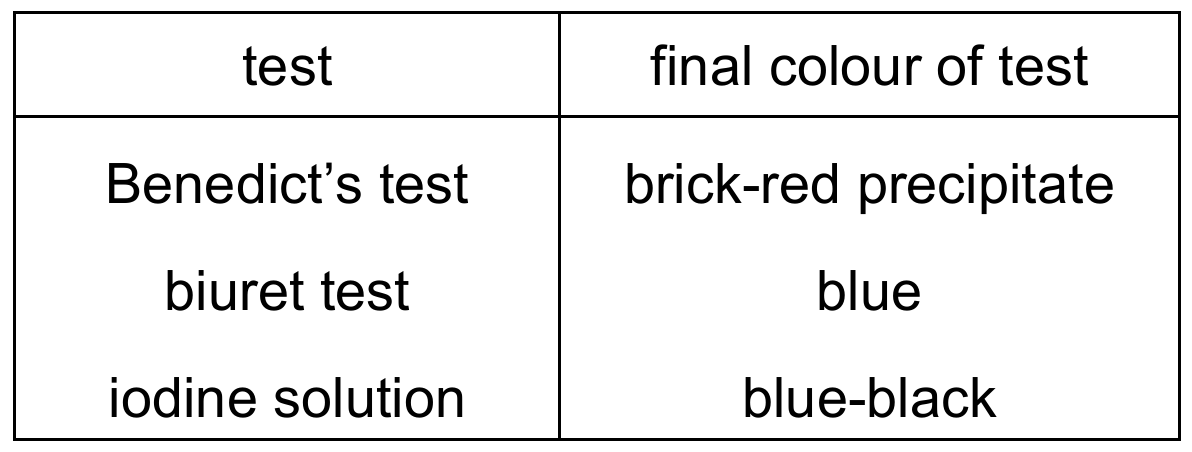
A student tests a sample of food to identify its composition.

The results are shown.

Which substances are shown to be present in the food sample?

A. protein, reducing sugar and starch
B. protein and starch only
C. reducing sugar and starch only
D. reducing sugar and protein only

Most-appropriate topic codes (Cambridge IGCSE Co-ordinated Sciences 0654):

Topic B4.1: Biological Molecules — Food tests include Benedict’s test for reducing sugars (brick-red positive), iodine solution for starch (blue-black positive), and Biuret test for protein (purple positive).
▶️ Answer/Explanation
The table shows a positive Benedict’s test (brick-red precipitate), indicating a reducing sugar is present, and a positive iodine test (blue-black colour), indicating starch is present.
The Biuret test result is negative (solution remains blue), meaning no protein is detected in the sample.
Answer: C

Question 4

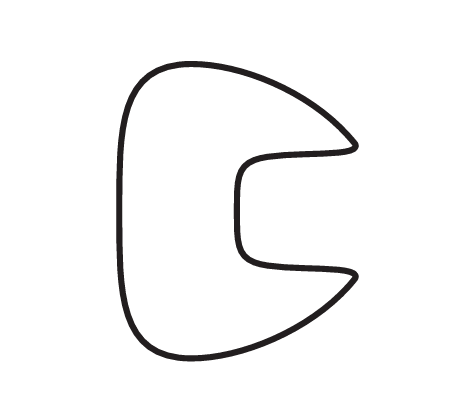
The diagram shows a functional human enzyme at 37 °C.

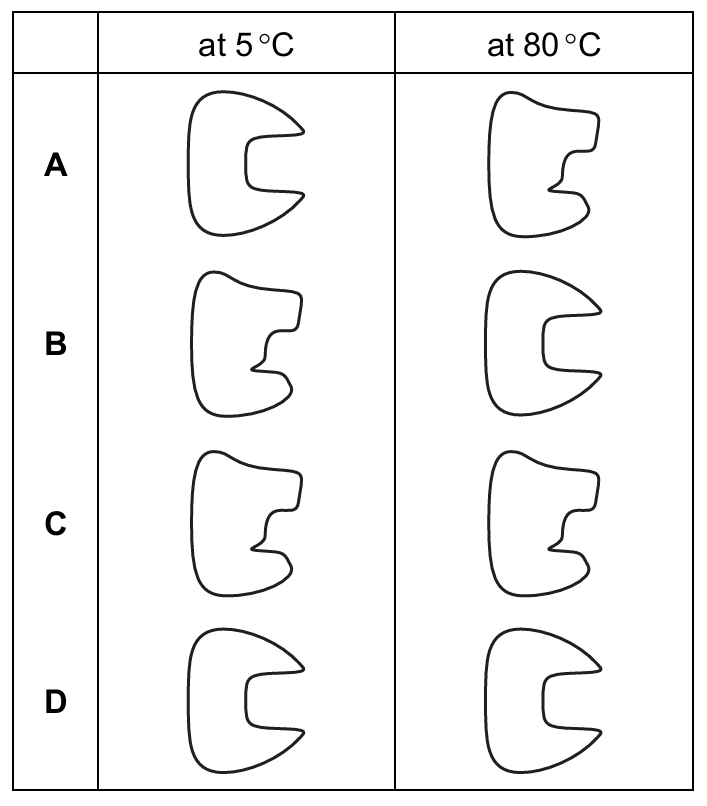
Which row shows the likely shape of this enzyme at 5 °C and 80 °C?

Most-appropriate topic codes (Cambridge IGCSE Co-ordinated Sciences 0654):

Topic B5.1: Enzymes — Enzyme activity is temperature-dependent; at very low temperatures the active site shape is retained but activity slows, while at very high temperatures the enzyme denatures and the active site changes shape permanently.
▶️ Answer/Explanation
At \(5°C\), the enzyme is not denatured — it retains its normal active site shape but functions very slowly due to reduced kinetic energy of molecules.
At \(80°C\), the high temperature breaks the hydrogen bonds and other interactions holding the enzyme’s tertiary structure together, causing denaturation — the active site changes shape permanently and the enzyme can no longer function.
Answer: A

Question 5

What is the manufacture of carbohydrates from raw materials using light energy called?

A. growth
B. photosynthesis
C. respiration
D. reproduction

Most-appropriate topic codes (Cambridge IGCSE Co-ordinated Sciences 0654):

Topic B6.1: Photosynthesis — The process by which plants use light energy, carbon dioxide, and water to synthesise glucose and oxygen.
▶️ Answer/Explanation
Photosynthesis is the process in which plants manufacture carbohydrates (such as glucose) from the raw materials \(\text{CO}_2\) and \(\text{H}_2\text{O}\) using light energy trapped by chlorophyll.
The overall equation is: \(6\text{CO}_2 + 6\text{H}_2\text{O} \xrightarrow{\text{light}} \text{C}_6\text{H}_{12}\text{O}_6 + 6\text{O}_2\).
Answer: B

Question 6

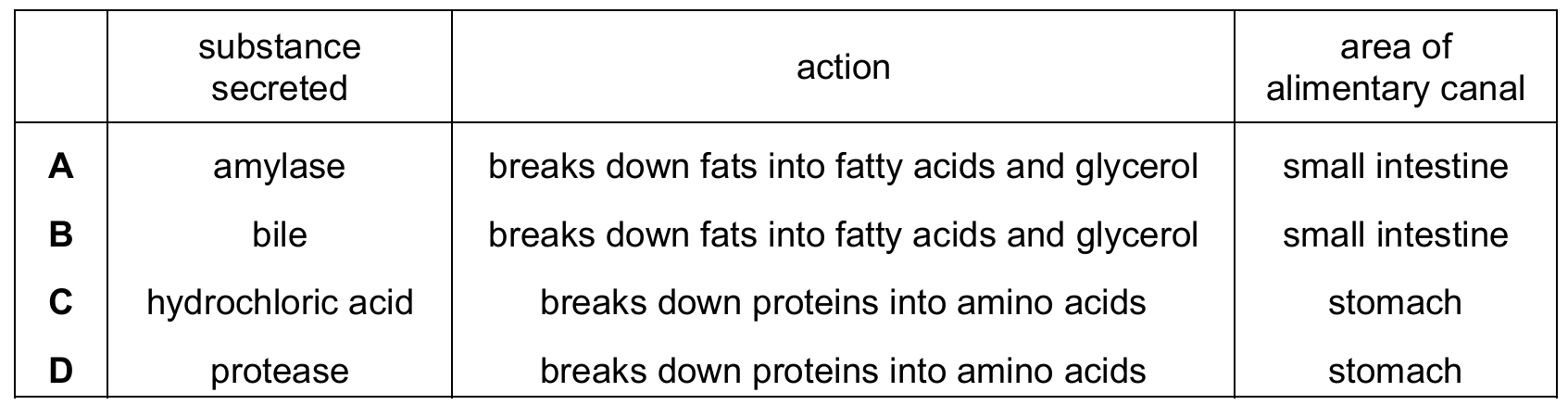
Which row about secretions in the alimentary canal is correct?

Most-appropriate topic codes (Cambridge IGCSE Co-ordinated Sciences 0654):

Topic B7.3: Digestion — Different regions of the alimentary canal secrete specific enzymes and substances (e.g. the stomach secretes protease and hydrochloric acid; the small intestine receives bile from the liver and pancreatic enzymes).
▶️ Answer/Explanation
The stomach secretes protease (pepsin) and hydrochloric acid \((\text{HCl})\), while the pancreas secretes amylase, protease, and lipase into the small intestine; bile (produced by the liver, stored in the gall bladder) emulsifies fats in the small intestine.
Row D correctly matches each secretion to the right location and function in the alimentary canal.
Answer: D

Question 7

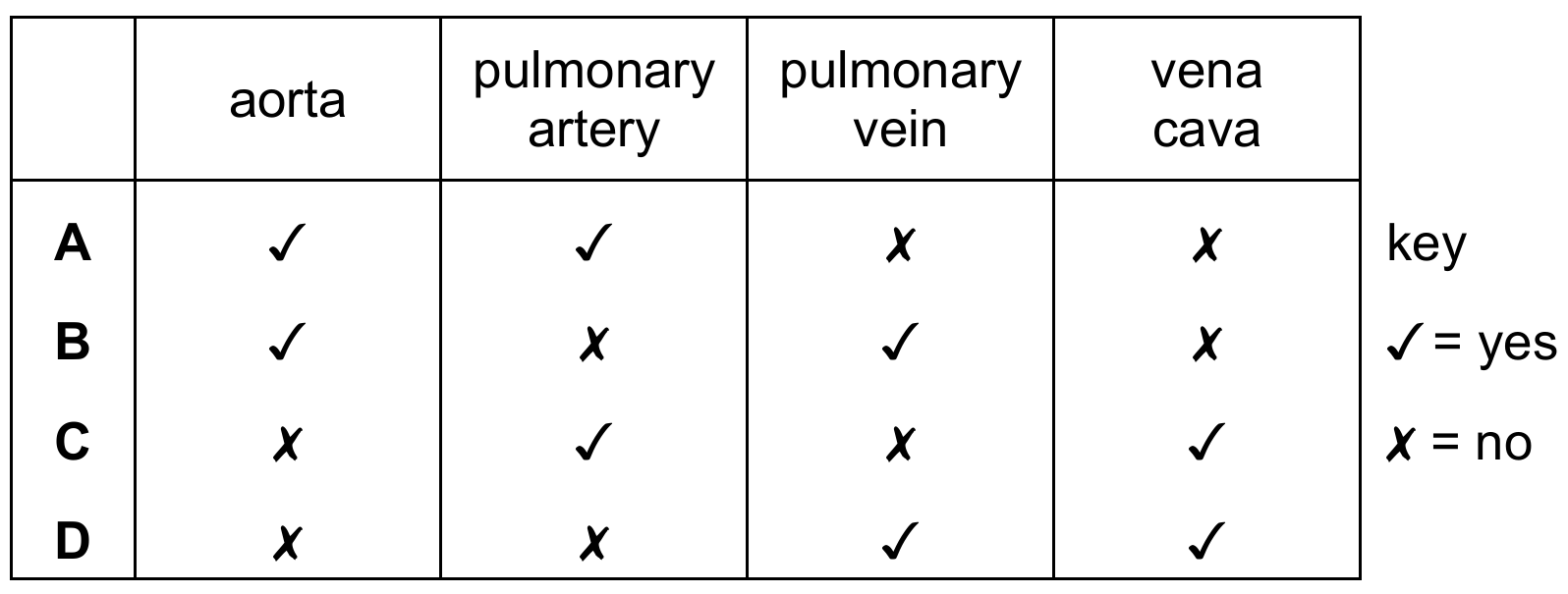
Which vessels carry blood towards the heart?

Most-appropriate topic codes (Cambridge IGCSE Co-ordinated Sciences 0654):

Topic B9.3: Blood Vessels — Veins carry blood towards the heart; arteries carry blood away from the heart; capillaries connect arteries and veins at the tissue level.
▶️ Answer/Explanation
Veins are the blood vessels that carry blood back towards the heart; they have valves to prevent backflow and thinner walls than arteries due to lower blood pressure.
Arteries carry blood away from the heart under high pressure, while capillaries are the site of exchange between blood and tissues — neither arteries nor capillaries carry blood toward the heart.
Answer: D

Question 8

Which process releases the most energy?

A. carbon dioxide + water → glucose + oxygen
B. glucose + oxygen → carbon dioxide + water
C. glucose → alcohol + carbon dioxide
D. glucose → lactic acid

Most-appropriate topic codes (Cambridge IGCSE Co-ordinated Sciences 0654):

Topic B12.1: Respiration — Aerobic respiration releases significantly more energy per glucose molecule than anaerobic respiration; photosynthesis (option A) requires energy input rather than releasing it.
▶️ Answer/Explanation
Aerobic respiration \((\text{glucose} + \text{O}_2 \rightarrow \text{CO}_2 + \text{H}_2\text{O})\) completely oxidises glucose and releases the maximum amount of energy, producing approximately \(2870 \text{ kJ}\) per mole of glucose.
Anaerobic processes (options C and D) only partially break down glucose and release far less energy, while option A (photosynthesis) is an energy-requiring process, not an energy-releasing one.
Answer: B

Question 9

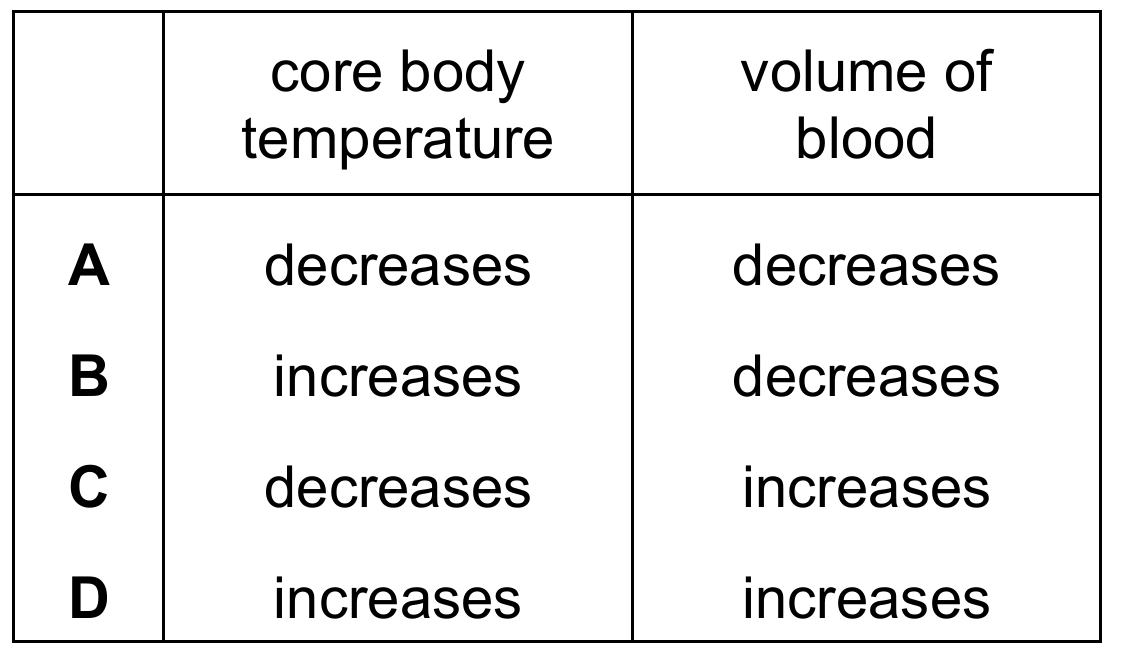
The arterioles that supply blood to the skin’s surface capillaries undergo vasodilation.

Which row describes the effect of this on the core body temperature and the volume of blood passing through these capillaries?

Most-appropriate topic codes (Cambridge IGCSE Co-ordinated Sciences 0654):

Topic B13.3: Homeostasis — Vasodilation of skin arterioles increases blood flow to the skin surface, promoting heat loss by radiation and reducing core body temperature.
▶️ Answer/Explanation
Vasodilation widens the diameter of arterioles supplying the skin capillaries, allowing a greater volume of blood to flow through them — this brings more heat to the skin surface where it is lost to the environment by radiation.
As more heat is lost through the skin, the core body temperature decreases, returning the body towards its set point of approximately \(37°C\).
Answer: C

Question 10

Which statements about human egg and sperm cells are correct?

  1. The egg cell’s membrane changes to prevent other sperm from entering it after fertilisation.
  2. The egg and sperm cells have a diploid nucleus.
  3. The sperm’s enzymes allow it to penetrate the egg to fertilise it.
  4. The process of fertilisation occurs in the ovary.

A. 1 and 3    
B. 1 and 4    
C. 2 and 3    
D. 2 and 4

Most-appropriate topic codes (Cambridge IGCSE Co-ordinated Sciences 0654):

Topic B15.4: Sexual Reproduction in Humans — Egg and sperm are haploid gametes; fertilisation occurs in the oviduct (fallopian tube); the egg membrane undergoes a cortical reaction after fertilisation to block polyspermy; acrosomal enzymes in sperm allow penetration of the egg.
▶️ Answer/Explanation
Statement 1 is correct — after one sperm fertilises the egg, the egg membrane changes (cortical reaction) to form a fertilisation membrane that blocks further sperm entry; statement 3 is correct — the acrosome at the tip of the sperm head releases enzymes that digest through the zona pellucida to allow fertilisation.
Statement 2 is incorrect because egg and sperm are haploid \((n)\), not diploid \((2n)\); statement 4 is incorrect because fertilisation occurs in the oviduct (fallopian tube), not the ovary.
Answer: A

Question 11

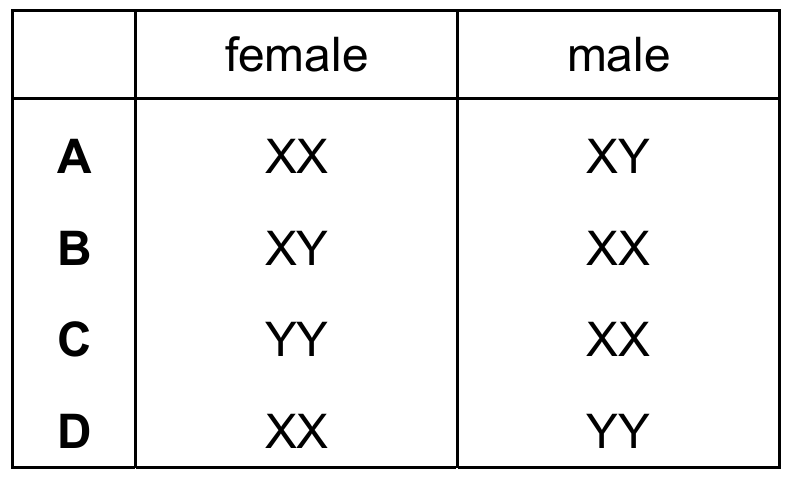
Which row shows the sex chromosomes in humans?

Most-appropriate topic codes (Cambridge IGCSE Co-ordinated Sciences 0654):

Topic B16.1: Chromosomes and Genes — In humans, females have the sex chromosome combination \(\text{XX}\) and males have \(\text{XY}\); each gamete (egg or sperm) contributes one sex chromosome.
▶️ Answer/Explanation
In humans, sex is determined by the sex chromosomes: females carry two X chromosomes \((\text{XX})\) and males carry one X and one Y chromosome \((\text{XY})\).
All eggs produced by females carry one X chromosome, while sperm produced by males carry either an X or a Y chromosome — it is the sperm that determines the sex of the offspring at fertilisation.
Answer: A

Question 12

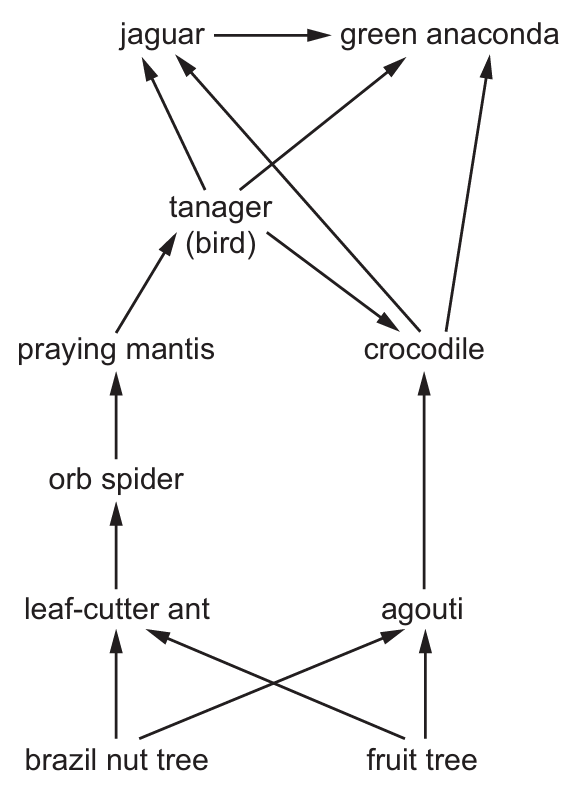
The diagram shows part of a food web in a rainforest.

Which animals are feeding as quaternary consumers?

A. crocodile and green anaconda
B. crocodile and jaguar
C. green anaconda and tanager
D. jaguar and tanager

Most-appropriate topic codes (Cambridge IGCSE Co-ordinated Sciences 0654):

Topic B18.2: Food Chains and Food Webs — A quaternary consumer feeds at the fifth trophic level (producer → primary → secondary → tertiary → quaternary consumer).
▶️ Answer/Explanation
A quaternary consumer occupies the fifth trophic level: producer → primary consumer → secondary consumer → tertiary consumer → quaternary consumer; tracing the food web, the green anaconda and tanager can each be found feeding at this level in at least one food chain.
The crocodile and jaguar, while top predators, occupy the quaternary consumer level in fewer of the web’s chains compared to the green anaconda and tanager as identified in the diagram.
Answer: C

Question 13

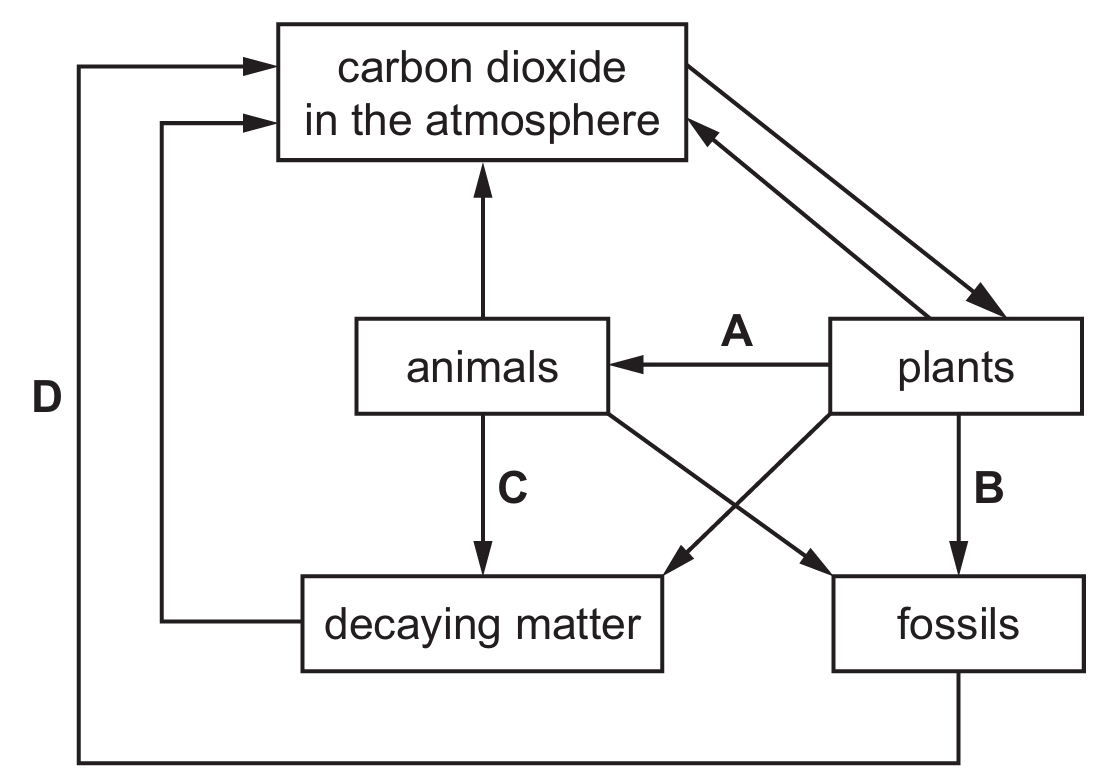
The diagram shows part of the carbon cycle.

Which process, due to human activities, has increased the concentration of carbon dioxide in the atmosphere?

Most-appropriate topic codes (Cambridge IGCSE Co-ordinated Sciences 0654):

Topic B18.3: Carbon Cycle — Human activities such as burning fossil fuels and deforestation release additional \(\text{CO}_2\) into the atmosphere, disrupting the natural carbon cycle and contributing to climate change.
▶️ Answer/Explanation
Process D in the diagram represents combustion of fossil fuels — a major human activity that releases carbon stored in coal, oil, and gas back into the atmosphere as \(\text{CO}_2\), directly increasing atmospheric concentrations.
Other processes shown (such as photosynthesis and natural respiration) are part of the natural carbon cycle and are not primarily driven by human activity in the same way.
Answer: D

Question 14

Which process is used to obtain water from a salt solution?

A. chromatography
B. crystallisation
C. distillation
D. filtration

Most-appropriate topic codes (Cambridge IGCSE Co-ordinated Sciences 0654):

Topic C12.4: Separation and Purification — Distillation separates a liquid from a dissolved solid by boiling and condensing the vapour; it is the appropriate method when the liquid (water) is the desired product.
▶️ Answer/Explanation
Distillation is used to separate and collect the solvent (water) from a solution — the solution is heated until water boils and evaporates, the steam is then cooled in a condenser and collected as pure liquid water.
Crystallisation would be used to obtain the salt (solute) not the water; filtration separates insoluble solids; chromatography separates mixtures of dissolved substances — neither of these yields pure water from a salt solution.
Answer: C

Question 15

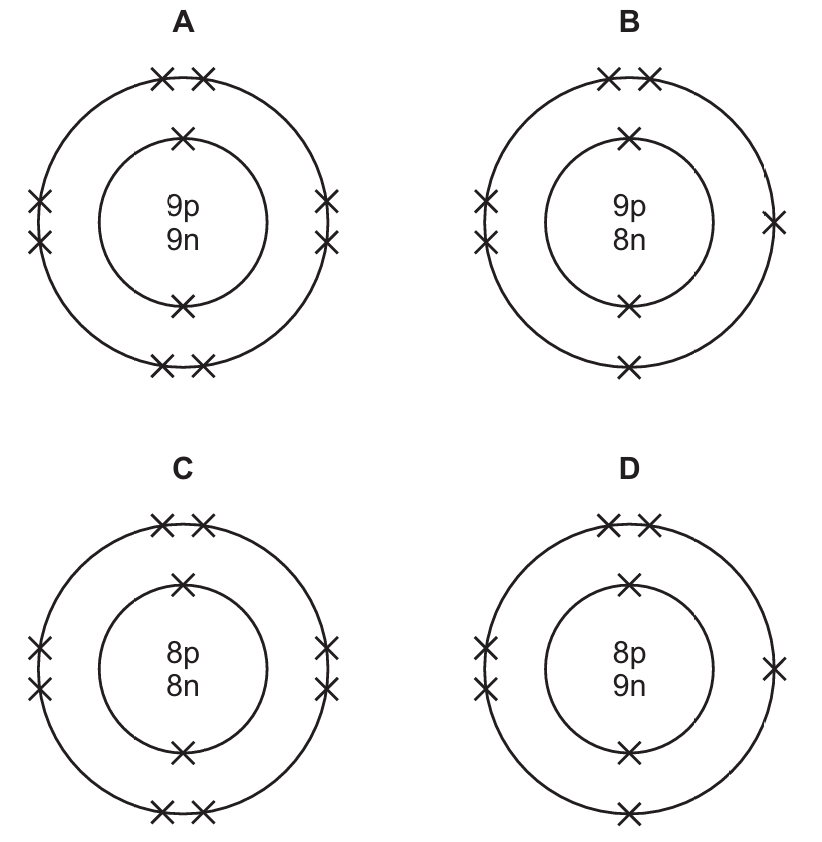
One isotope of oxygen is represented by \( {}_{8}^{16}\text{O} \).

Which diagram represents a different isotope of oxygen?

Most-appropriate topic codes (Cambridge IGCSE Co-ordinated Sciences 0654):

Topic C2.3: Isotopes — Isotopes are atoms of the same element with the same number of protons (same atomic number) but a different number of neutrons (different mass number).
▶️ Answer/Explanation
The given isotope \({}_{8}^{16}\text{O}\) has 8 protons and \(16 – 8 = 8\) neutrons; a different isotope of oxygen must still have 8 protons (same element) but a different number of neutrons, such as \({}_{8}^{18}\text{O}\) with 10 neutrons.
Option D shows an atom with 8 protons and a different neutron count, which is the definition of an isotope of the same element — all other options either change the number of protons (making them different elements) or are identical to the original.
Answer: D

Question 16

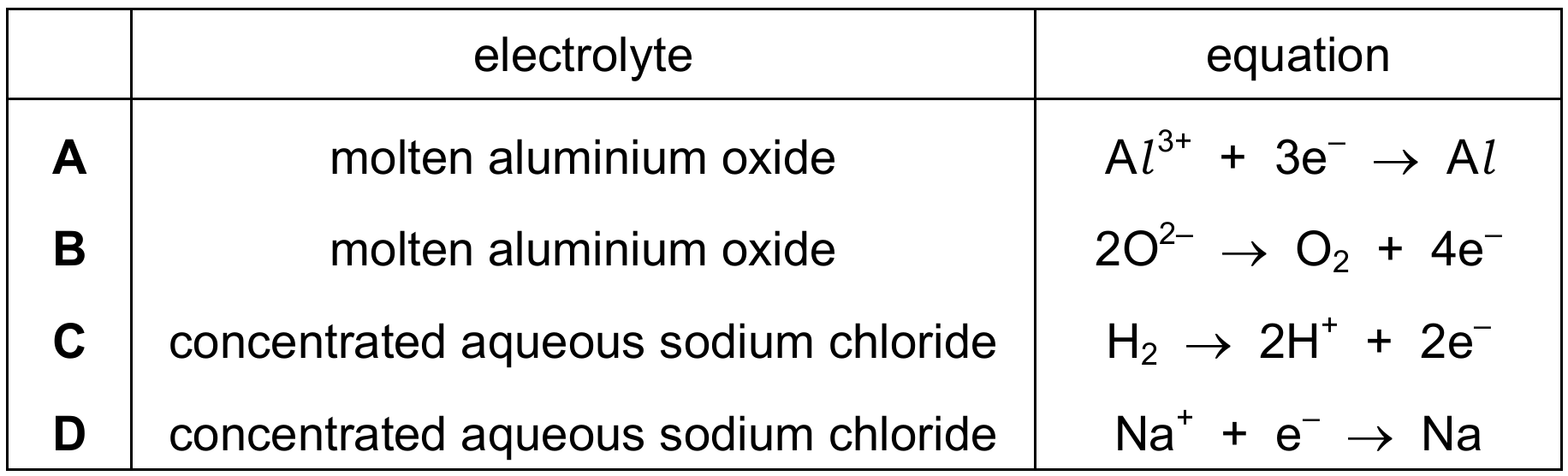
Which row shows the ionic half-equation for the reaction at the cathode during the electrolysis of the named electrolyte?

Most-appropriate topic codes (Cambridge IGCSE Co-ordinated Sciences 0654):

Topic C4.1: Electrolysis — At the cathode (negative electrode), cations gain electrons (reduction); the specific product depends on the electrolyte used and the relative positions of ions in the reactivity/discharge series.
▶️ Answer/Explanation
The cathode is the negative electrode where reduction (gain of electrons) occurs; for example, during electrolysis of molten lead(II) bromide, lead ions are reduced: \(\text{Pb}^{2+} + 2e^- \rightarrow \text{Pb}\); during electrolysis of aqueous copper(II) sulfate with copper electrodes, copper ions are reduced: \(\text{Cu}^{2+} + 2e^- \rightarrow \text{Cu}\).
Row A correctly pairs the electrolyte with the half-equation showing reduction at the cathode, consistent with the discharge of the less reactive cation in each case.
Answer: A

Question 17

When dilute hydrochloric acid reacts with calcium carbonate, carbon dioxide is produced.

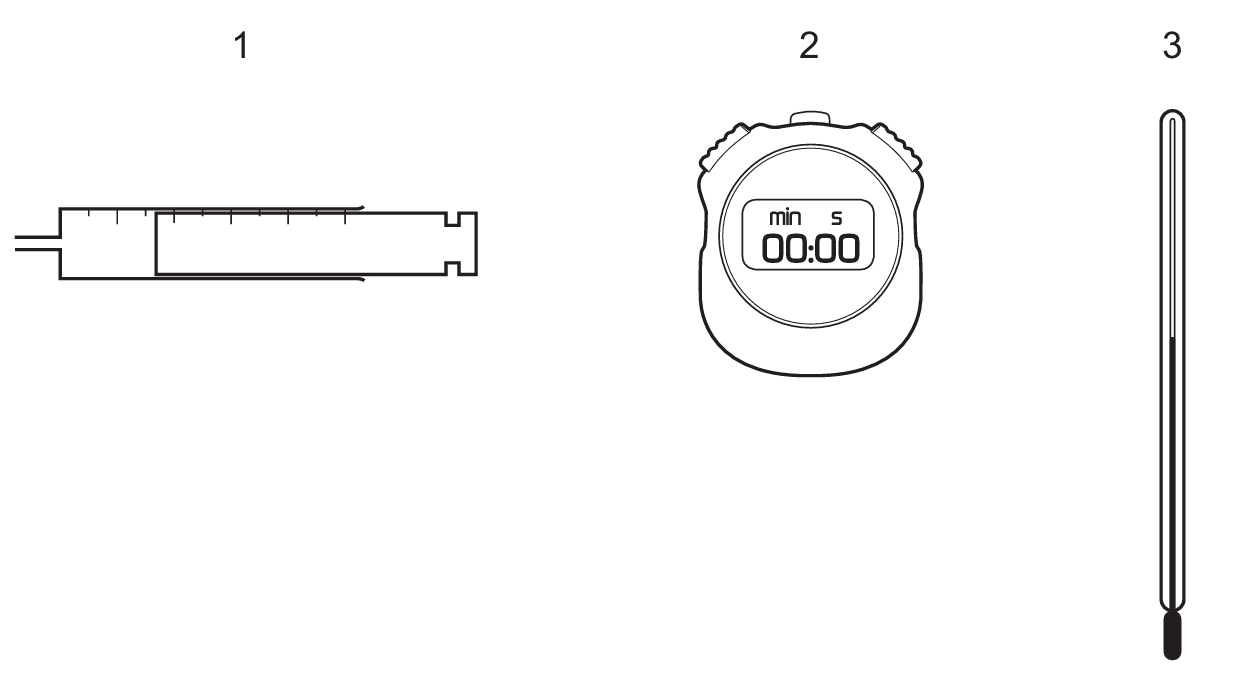
Which pieces of apparatus are used to investigate the effect of temperature on the rate of this reaction?

A. 1, 2 and 3    
B. 1 and 2 only    
C. 1 and 3 only    
D. 2 and 3 only

Most-appropriate topic codes (Cambridge IGCSE Co-ordinated Sciences 0654):

Topic C6.2: Rate of Reaction — To investigate the effect of temperature, a thermometer (to measure temperature), a conical flask with delivery tube (to collect gas), and a measuring cylinder or gas syringe (to measure volume of \(\text{CO}_2\) produced) are all required.
▶️ Answer/Explanation
To investigate the effect of temperature on rate of reaction, all three pieces of apparatus are needed: apparatus 1 (conical flask/reaction vessel with delivery tube) to carry out the reaction and collect gas, apparatus 2 (thermometer) to monitor and control the temperature, and apparatus 3 (gas syringe or measuring cylinder over water) to measure the volume of \(\text{CO}_2\) produced over time.
Without all three, you cannot independently vary temperature, carry out the reaction, and measure the rate — so all must be used together.
Answer: A

Question 18

Solid zinc reacts with aqueous copper(II) sulfate. The ionic equation for the reaction is shown.

\(\text{Zn} + \text{Cu}^{2+} \rightarrow \text{Zn}^{2+} + \text{Cu}\)

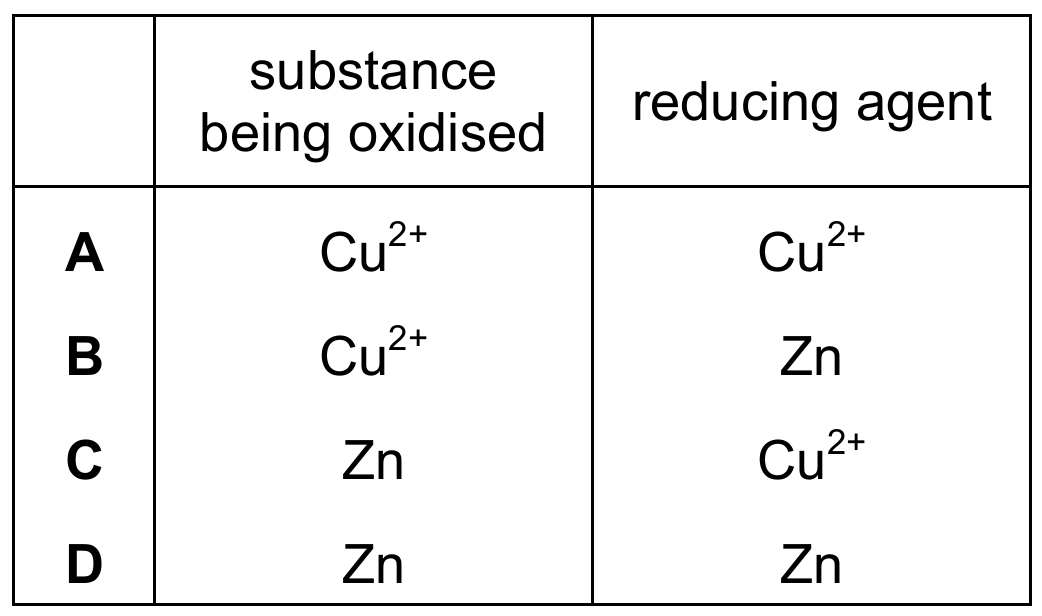
Which row identifies the substance being oxidised and the reducing agent?

Most-appropriate topic codes (Cambridge IGCSE Co-ordinated Sciences 0654):

Topic C6.3: Redox — Oxidation is loss of electrons (OIL); reduction is gain of electrons (RIG); the reducing agent is the substance that loses electrons (and is itself oxidised); the oxidising agent is the substance that gains electrons (and is itself reduced).
▶️ Answer/Explanation
In the reaction \(\text{Zn} \rightarrow \text{Zn}^{2+} + 2e^-\), zinc loses electrons and is therefore oxidised; simultaneously \(\text{Cu}^{2+} + 2e^- \rightarrow \text{Cu}\) shows copper ions being reduced by gaining electrons.
Since zinc loses electrons (is oxidised), zinc is the reducing agent — the reducing agent is always the species that is itself oxidised and causes reduction in the other species.
Answer: D

Question 19

Chromium(III) oxide reacts with dilute hydrochloric acid and with aqueous sodium hydroxide.

Which word describes chromium(III) oxide?

A. acidic
B. amphoteric
C. basic
D. neutral

Most-appropriate topic codes (Cambridge IGCSE Co-ordinated Sciences 0654):

Topic C7.2: Oxides — An amphoteric oxide reacts with both acids and bases (alkalis); examples include aluminium oxide \((\text{Al}_2\text{O}_3)\) and chromium(III) oxide \((\text{Cr}_2\text{O}_3)\).
▶️ Answer/Explanation
Chromium(III) oxide \((\text{Cr}_2\text{O}_3)\) reacts with dilute \(\text{HCl}\) (an acid) to form a salt and water, showing basic character; it also reacts with aqueous \(\text{NaOH}\) (a base) to form a chromate salt, showing acidic character.
An oxide that reacts with both acids and alkalis is described as amphoteric — it exhibits dual behaviour depending on what it reacts with.
Answer: B

Question 20

Gas X turns limewater milky.

What is X?

A. carbon dioxide
B. chlorine
C. hydrogen
D. oxygen

Most-appropriate topic codes (Cambridge IGCSE Co-ordinated Sciences 0654):

Topic C12.5: Identification of Ions and Gases — Carbon dioxide is identified by its reaction with limewater \((\text{Ca(OH)}_2)\) to form a white precipitate of calcium carbonate, turning the solution milky.
▶️ Answer/Explanation
Carbon dioxide reacts with limewater (calcium hydroxide solution) according to: \(\text{CO}_2 + \text{Ca(OH)}_2 \rightarrow \text{CaCO}_3 + \text{H}_2\text{O}\); the insoluble white precipitate of calcium carbonate \((\text{CaCO}_3)\) makes the limewater appear milky.
No other common gas (chlorine, hydrogen, or oxygen) produces this characteristic milky appearance with limewater — they have different test methods entirely.
Answer: A

Question 21

Which statements about the elements in Group VII of the Periodic Table are correct?

  1. Bromine is lighter in colour than chlorine.
  2. Chlorine is more reactive than bromine.
  3. Chlorine displaces iodide ions from aqueous solution.
  4. Iodine displaces bromide ions from aqueous solution.

A. 1 and 2    
B. 1 and 4    
C. 2 and 3    
D. 3 and 4

Most-appropriate topic codes (Cambridge IGCSE Co-ordinated Sciences 0654):

Topic C8.3: Group VII Properties — Reactivity decreases down Group VII; a more reactive halogen can displace a less reactive halogen from its salt solution; chlorine (pale green) is lighter in colour than bromine (orange-brown) which is lighter than iodine (grey-black).
▶️ Answer/Explanation
Statement 2 is correct — chlorine is more reactive than bromine because reactivity decreases down Group VII as the atoms get larger and gain electrons less easily; statement 3 is correct — since chlorine is more reactive than iodine, it can displace iodide ions from solution: \(\text{Cl}_2 + 2\text{I}^- \rightarrow 2\text{Cl}^- + \text{I}_2\).
Statement 1 is incorrect (bromine is darker orange-brown, not lighter than pale green chlorine); statement 4 is incorrect because iodine is less reactive than bromine and therefore cannot displace bromide ions from solution.
Answer: C

Question 22

Neon is in Group VIII of the Periodic Table.

Which row about neon is correct?

Most-appropriate topic codes (Cambridge IGCSE Co-ordinated Sciences 0654):

Topic C8.5: Noble Gases — Noble gases (Group VIII/0) are monatomic, chemically inert due to their full outer electron shells, exist as single atoms (not molecules), and have very low boiling points; they do not form compounds under normal conditions.
▶️ Answer/Explanation
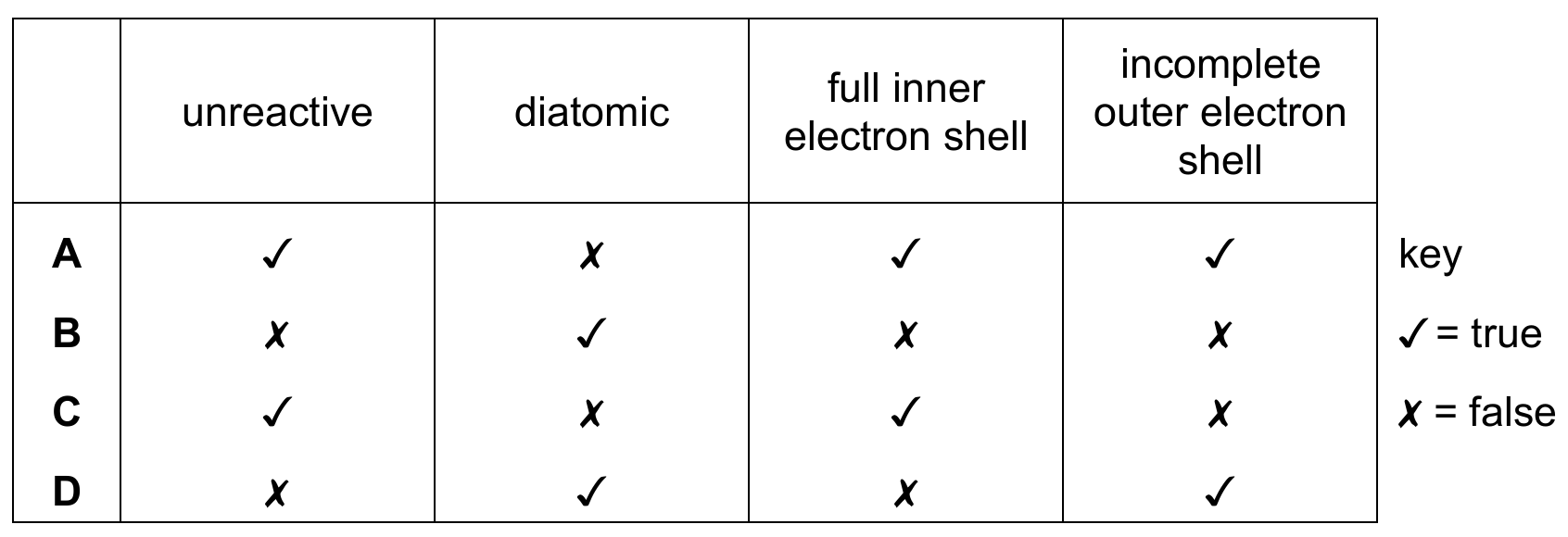
Neon is a noble gas with a full outer shell of 8 electrons, making it chemically unreactive (inert) — it does not form compounds under normal conditions and exists as individual atoms (monatomic), not as molecules.
Row C correctly states that neon is monatomic and chemically unreactive — the other rows incorrectly suggest it forms diatomic molecules or reacts chemically.
Answer: C

Question 23

Which row identifies an ore of aluminium and the method of extraction of aluminium from its ore?

Most-appropriate topic codes (Cambridge IGCSE Co-ordinated Sciences 0654):

Topic C9.6: Extraction of Metals — Aluminium is extracted from bauxite (its ore, mainly \(\text{Al}_2\text{O}_3\)) by electrolysis of molten aluminium oxide; it cannot be extracted by reduction with carbon because aluminium is too high in the reactivity series.
▶️ Answer/Explanation
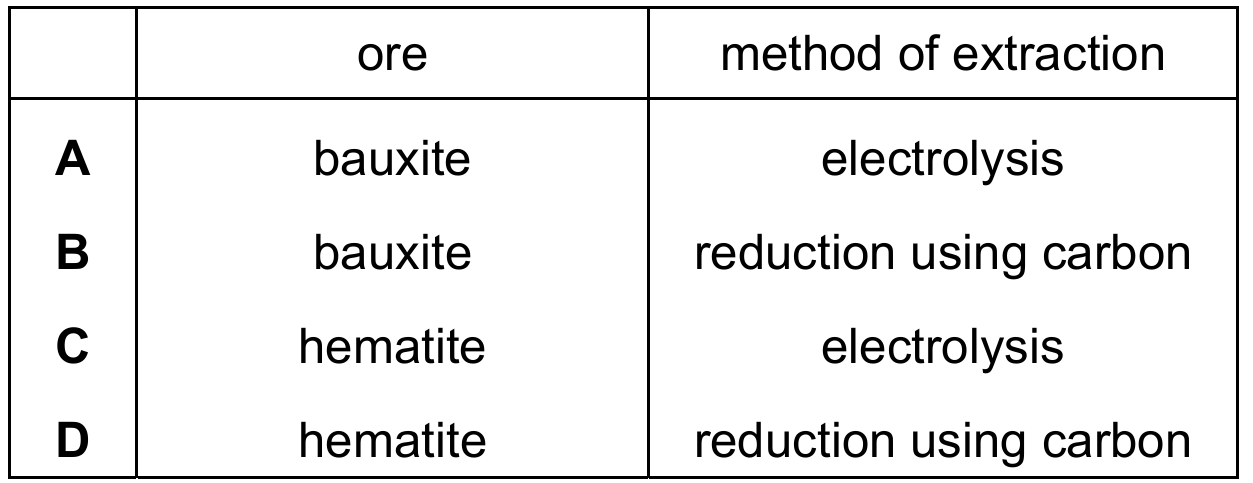
Aluminium’s ore is bauxite, which contains aluminium oxide \((\text{Al}_2\text{O}_3)\); because aluminium is above carbon in the reactivity series, it cannot be extracted by reduction with carbon and must instead be extracted by electrolysis of molten aluminium oxide (dissolved in cryolite to lower the melting point).
Row A correctly pairs bauxite as the ore with electrolysis as the extraction method — this is the only industrially viable method for obtaining aluminium from its ore.
Answer: A

Question 24

Copper(II) sulfate and cobalt(II) chloride are used to test for water.

Which rows show the colour changes for these two substances?

A. 1 and 2    
B. 1 and 4    
C. 2 and 3    
D. 3 and 4

Most-appropriate topic codes (Cambridge IGCSE Co-ordinated Sciences 0654):

Topic C10.1: Water — Anhydrous copper(II) sulfate changes from white to blue in the presence of water; cobalt(II) chloride paper changes from blue to pink in the presence of water; both are standard tests for the presence of water.
▶️ Answer/Explanation
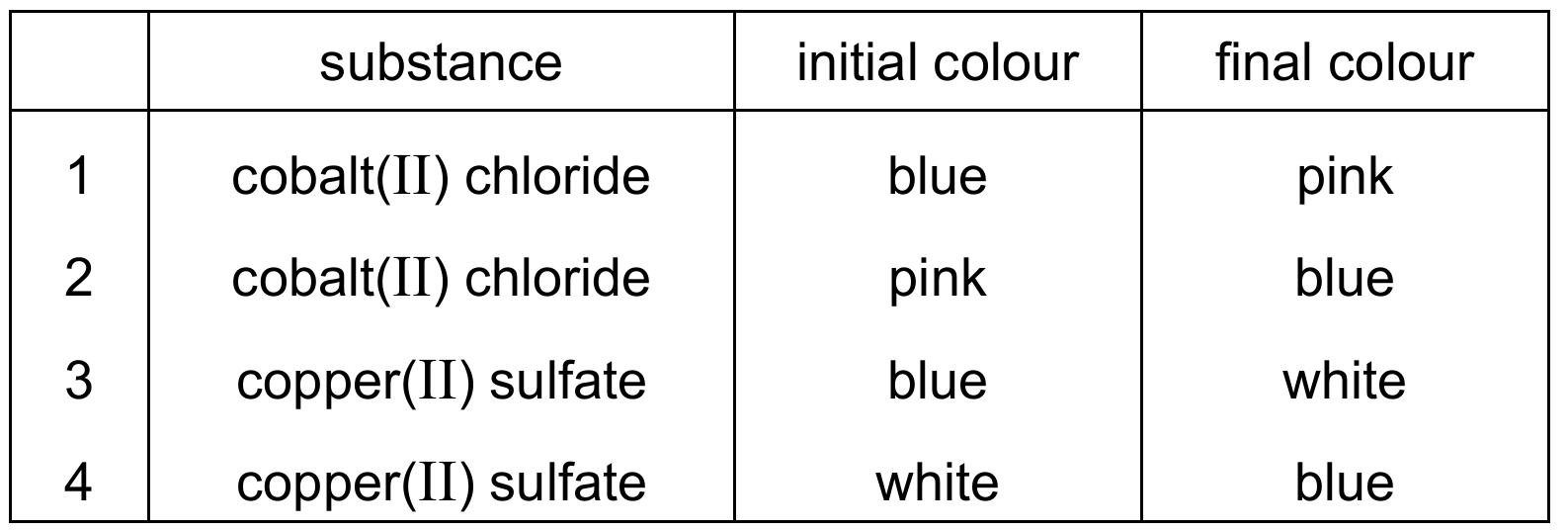
Anhydrous copper(II) sulfate \((\text{CuSO}_4)\) is white and turns blue when water is added, forming the hydrated salt \(\text{CuSO}_4 \cdot 5\text{H}_2\text{O}\); cobalt(II) chloride paper is blue when dry and turns pink when it absorbs water.
Row 1 (white → blue for \(\text{CuSO}_4\)) and Row 4 (blue → pink for cobalt chloride) are both correct — these are the two standard colour changes used to test for the presence of water.
Answer: B

Question 25

Sulfuric acid is manufactured by the Contact process.

Which reaction in this process uses a catalyst?

A. \(\text{S} + \text{O}_2 \rightarrow \text{SO}_2\)
B. \(2\text{SO}_2 + \text{O}_2 \rightarrow 2\text{SO}_3\)
C. \(\text{SO}_3 + \text{H}_2\text{SO}_4 \rightarrow \text{H}_2\text{S}_2\text{O}_7\)
D. \(\text{H}_2\text{S}_2\text{O}_7 + \text{H}_2\text{O} \rightarrow 2\text{H}_2\text{SO}_4\)

Most-appropriate topic codes (Cambridge IGCSE Co-ordinated Sciences 0654):

Topic C6.2: Rate of Reaction / Contact Process — In the Contact process, the key catalytic step is the oxidation of \(\text{SO}_2\) to \(\text{SO}_3\) using a vanadium(V) oxide \((\text{V}_2\text{O}_5)\) catalyst at approximately \(450°C\).
▶️ Answer/Explanation
The conversion of \(\text{SO}_2\) to \(\text{SO}_3\) — \(2\text{SO}_2 + \text{O}_2 \rightarrow 2\text{SO}_3\) — is the step that uses a vanadium(V) oxide \((\text{V}_2\text{O}_5)\) catalyst; this is the critical and rate-limiting step in the Contact process, carried out at around \(450°C\) and 1–2 atm pressure.
The other reactions in the process (burning of sulfur, absorption in sulfuric acid, and dilution of oleum) do not require a catalyst.
Answer: B

Question 26

What is the main constituent of clean air and of natural gas?

Most-appropriate topic codes (Cambridge IGCSE Co-ordinated Sciences 0654):

Topic C10.2: Air Quality and Climate — Clean, dry air is approximately 78% nitrogen \((\text{N}_2)\) and 21% oxygen \((\text{O}_2)\); natural gas is predominantly methane \((\text{CH}_4)\).
▶️ Answer/Explanation
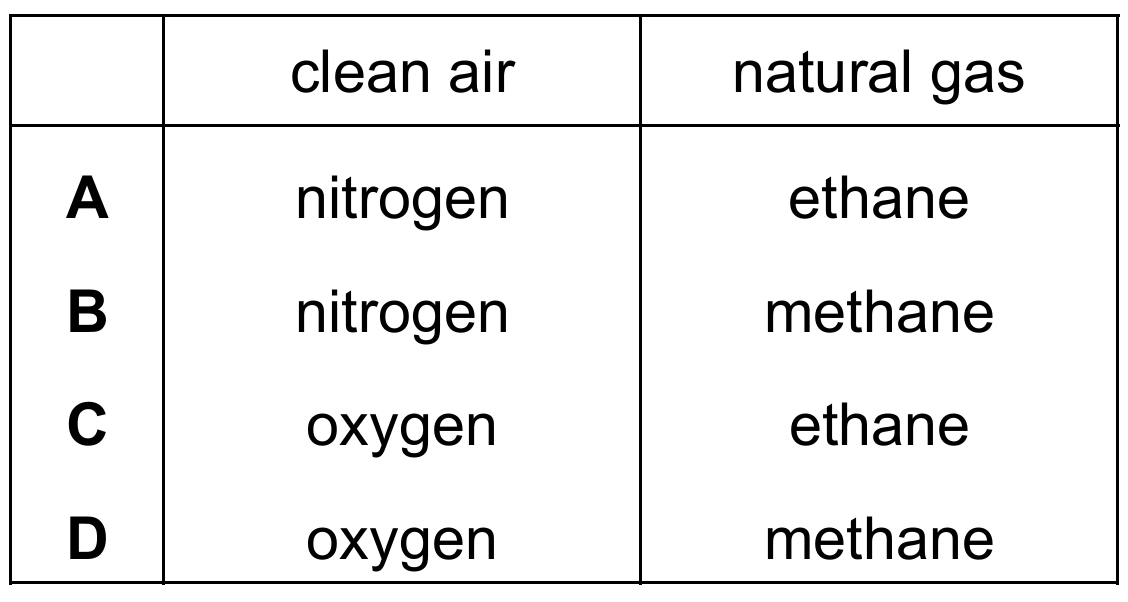
Clean dry air is approximately \(78\%\) nitrogen \((\text{N}_2)\) by volume, making nitrogen its main constituent; natural gas is approximately \(90\%\) or more methane \((\text{CH}_4)\), making methane its main constituent.
Row B correctly pairs nitrogen as the main component of clean air with methane as the main component of natural gas — the other rows incorrectly assign these components.
Answer: B

Question 27

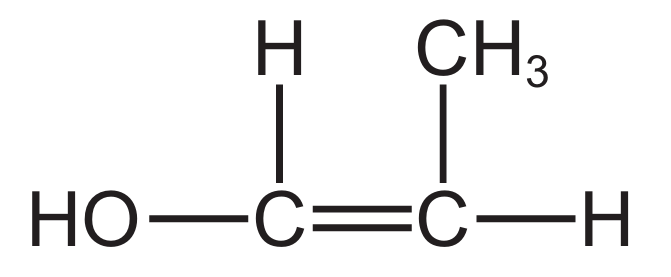
The structure of a monomer is shown.

Which structure represents a section of the addition polymer that is formed from this monomer?

Most-appropriate topic codes (Cambridge IGCSE Co-ordinated Sciences 0654):

Topic C11.7: Polymers — In addition polymerisation, the C=C double bond in each monomer unit opens up and the monomers join end-to-end to form a long chain with no atoms lost; the repeating unit in the polymer retains all atoms from the monomer but with single bonds only.
▶️ Answer/Explanation
In addition polymerisation the \(\text{C=C}\) double bond in the monomer breaks open, and each monomer unit bonds to the next in a chain — no small molecules are lost, and the polymer repeating unit contains the same atoms as the monomer but with only single \(\text{C-C}\) bonds in the backbone.
Option D shows the correct repeating unit structure derived from this monomer, with the substituent groups preserved and the carbon backbone correctly connected with single bonds and enclosed in square brackets with a subscript \(n\).
Answer: D

Question 28

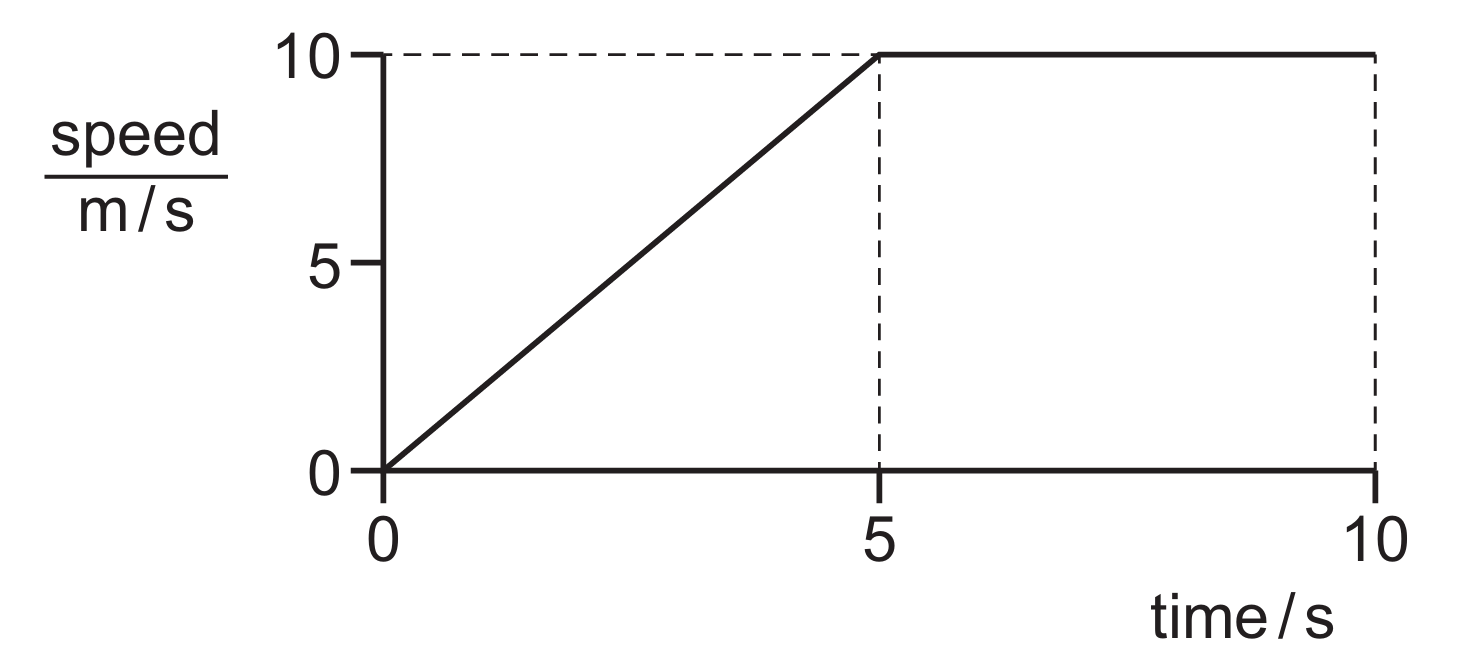
The speed–time graph represents the motion of a vehicle during the first 10 s of a journey.

How far does the vehicle travel during the 10 s?

A. 25 m    
B. 50 m    
C. 75 m    
D. 100 m

Most-appropriate topic codes (Cambridge IGCSE Co-ordinated Sciences 0654):

Topic P1.2: Motion — The distance travelled is equal to the area under a speed–time graph; for a triangle or trapezium shape, calculate the area using the appropriate geometric formula.
▶️ Answer/Explanation
The distance travelled equals the area under the speed–time graph; the graph shows the vehicle accelerating from \(0\) to \(10 \text{ m/s}\) over the first \(5\text{ s}\) (triangle: area \(= \frac{1}{2} \times 5 \times 10 = 25 \text{ m}\)) and then travelling at a constant \(10 \text{ m/s}\) for the remaining \(5\text{ s}\) (rectangle: area \(= 5 \times 10 = 50 \text{ m}\)).
Total distance \(= 25 + 50 = 75 \text{ m}\).
Answer: C

Question 29

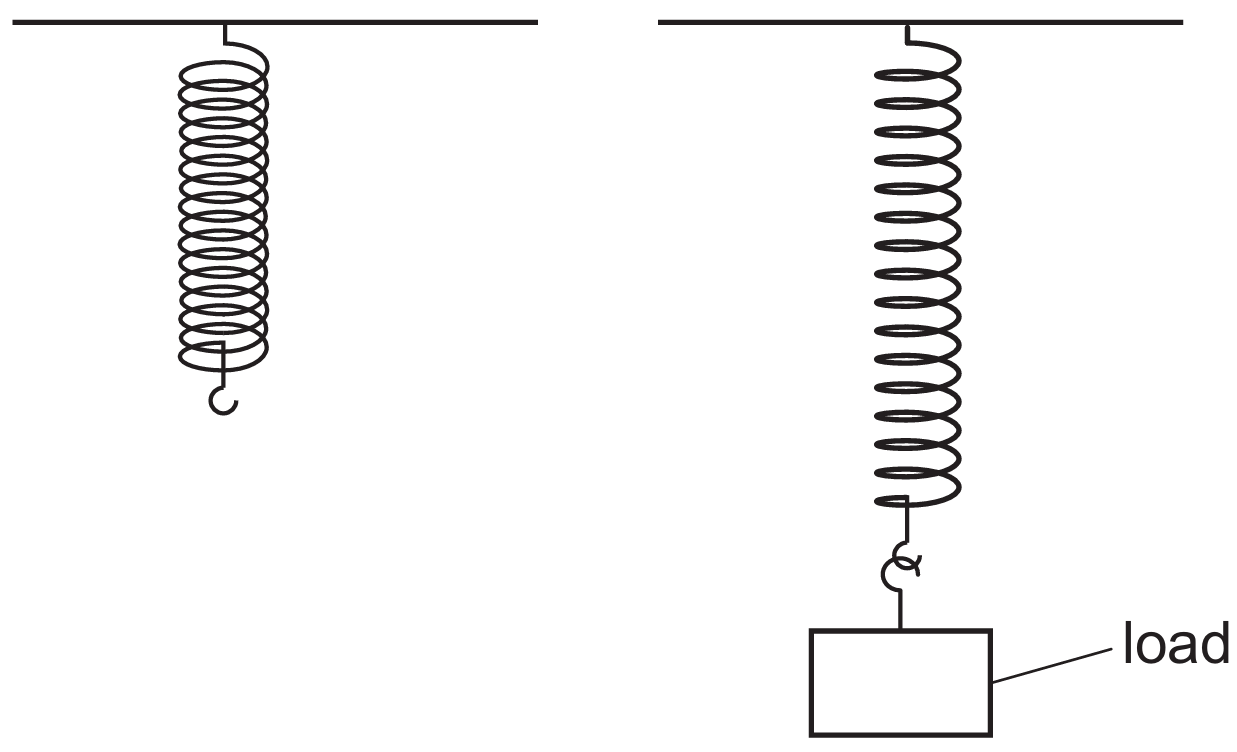
The diagram shows a spring without a load and then with a load of mass 500 g suspended from the same spring. The spring obeys Hooke’s law.

The length of the unloaded spring is 30 cm.

When the 500 g load is suspended from the spring, the spring extends to a new length of 35 cm.

The gravitational field strength \(g\) is 10 N/kg.

Which calculation gives the spring constant of the spring?

A. \(\dfrac{0.5 \times 10}{35 – 30} \text{ N/cm}\)

B. \(\dfrac{0.5}{10 \times (35-30)} \text{ N/cm}\)

C. \(\dfrac{10 \times (35-30)}{0.5} \text{ N/cm}\)

D. \(0.5 \times 10 \times (35-30) \text{ N/cm}\)

Most-appropriate topic codes (Cambridge IGCSE Co-ordinated Sciences 0654):

Topic P1.5: Forces / Hooke’s Law — The spring constant \(k\) is calculated using \(k = \frac{F}{x}\), where \(F\) is the applied force (in N) and \(x\) is the extension (not the total length).
▶️ Answer/Explanation
The force applied is \(F = m \times g = 0.5 \times 10 = 5 \text{ N}\) and the extension is \(x = 35 – 30 = 5 \text{ cm}\); using Hooke’s law \(k = \frac{F}{x}\), the spring constant is \(k = \frac{0.5 \times 10}{35 – 30} \text{ N/cm}\).
Option A correctly expresses this calculation — the numerator gives the force in newtons and the denominator gives the extension in cm, yielding the spring constant in N/cm.
Answer: A

Question 30

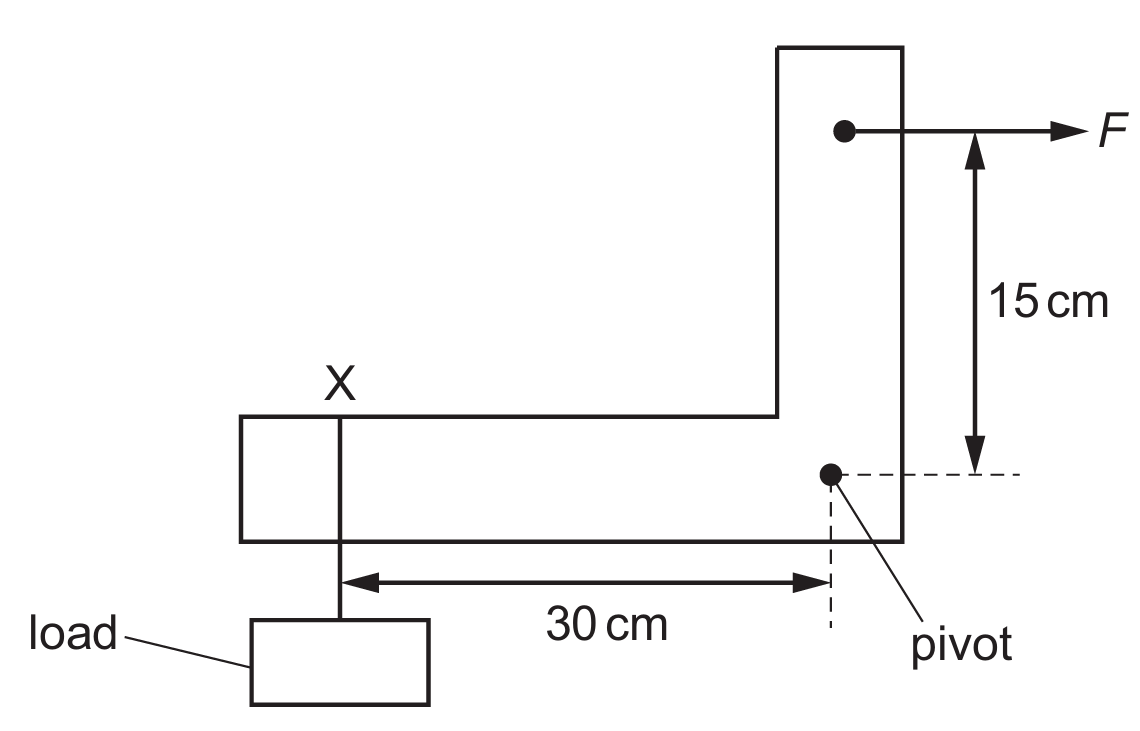
A weightless L-shaped beam is pivoted as shown.

A load of mass 2.4 kg is suspended from the beam at point X. The beam is held in equilibrium by a horizontal force F acting at the point shown.

The gravitational field strength \(g\) is 10 N/kg.

What is F?

A. 4.8 N    
B. 48 N    
C. 72 N    
D. 720 N

Most-appropriate topic codes (Cambridge IGCSE Co-ordinated Sciences 0654):

Topic P1.5: Forces / Moments — For a body in equilibrium, the sum of clockwise moments about the pivot equals the sum of anticlockwise moments; moment = force × perpendicular distance from pivot.
▶️ Answer/Explanation
The weight of the load is \(W = 2.4 \times 10 = 24 \text{ N}\); applying the principle of moments about the pivot, the clockwise moment due to \(W\) equals the anticlockwise moment due to \(F\): \(24 \times 0.20 = F \times 0.10\), giving \(F = \frac{24 \times 0.20}{0.10} = 48 \text{ N}\) (using the perpendicular distances from the diagram).
For equilibrium, the total clockwise moment must equal the total anticlockwise moment — only option B gives the correct value of 48 N.
Answer: B

Question 31

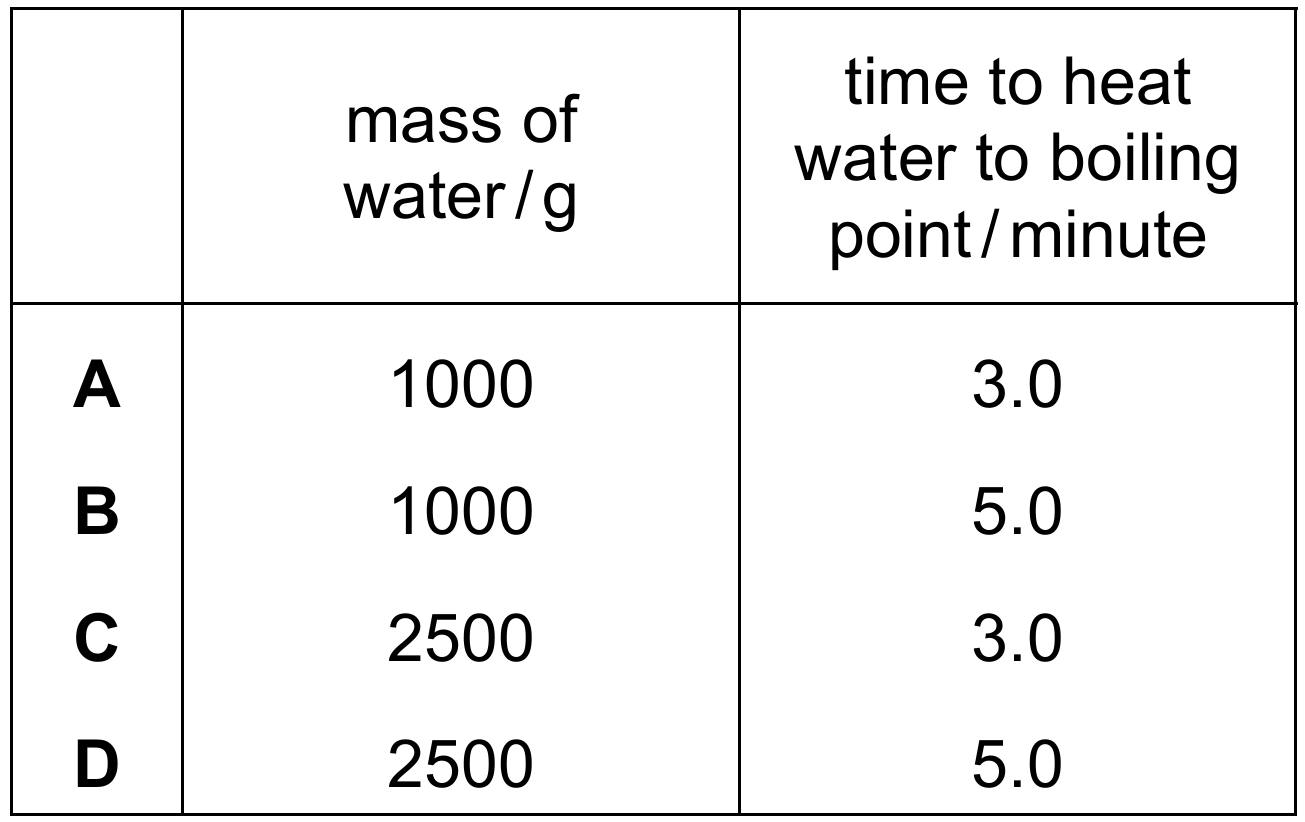
Four different kettles contain different masses of water.

They are used to heat the water from room temperature to boiling point.

The kettles take different times to do this.

Which kettle has the lowest useful power output?

Most-appropriate topic codes (Cambridge IGCSE Co-ordinated Sciences 0654):

Topic P1.6: Energy, Work, and Power — Power is the rate of doing work (or transferring energy): \(P = \frac{E}{t}\); thermal energy transferred is \(E = mc\Delta T\), so power \(= \frac{mc\Delta T}{t}\); the kettle with the smallest ratio of mass to time gives the lowest power output.
▶️ Answer/Explanation
Since \(\Delta T\) and specific heat capacity \(c\) are the same for all kettles, power is proportional to \(\frac{m}{t}\); comparing the ratio \(\frac{m}{t}\) for each kettle (A: \(\frac{1.5}{3}=0.5\), B: \(\frac{0.5}{2}=0.25\), C: \(\frac{2.0}{4}=0.5\), D: \(\frac{1.0}{1}=1.0\)), kettle B has the smallest ratio and therefore the lowest useful power output.
Lowest power means the same temperature rise is achieved with the least energy per second — kettle B heats a small mass slowly, using the least power.
Answer: B

Question 32

A gas in a balloon is heated at constant pressure.

What happens to the gas?

A. Its density decreases.
B. Its mass decreases.
C. Its temperature decreases.
D. Its volume decreases.

Most-appropriate topic codes (Cambridge IGCSE Co-ordinated Sciences 0654):

Topic P2.1: Kinetic Particle Model of Matter — At constant pressure, heating a gas causes its particles to move faster and further apart, so the gas expands (volume increases); since the same mass occupies a greater volume, density decreases.
▶️ Answer/Explanation
At constant pressure, Charles’s Law states that the volume of a gas is directly proportional to its absolute temperature: \(V \propto T\); heating the gas causes it to expand, increasing its volume while the mass remains the same.
Since density \(= \frac{\text{mass}}{\text{volume}}\) and mass stays constant while volume increases, the density of the gas decreases.
Answer: A

Question 33

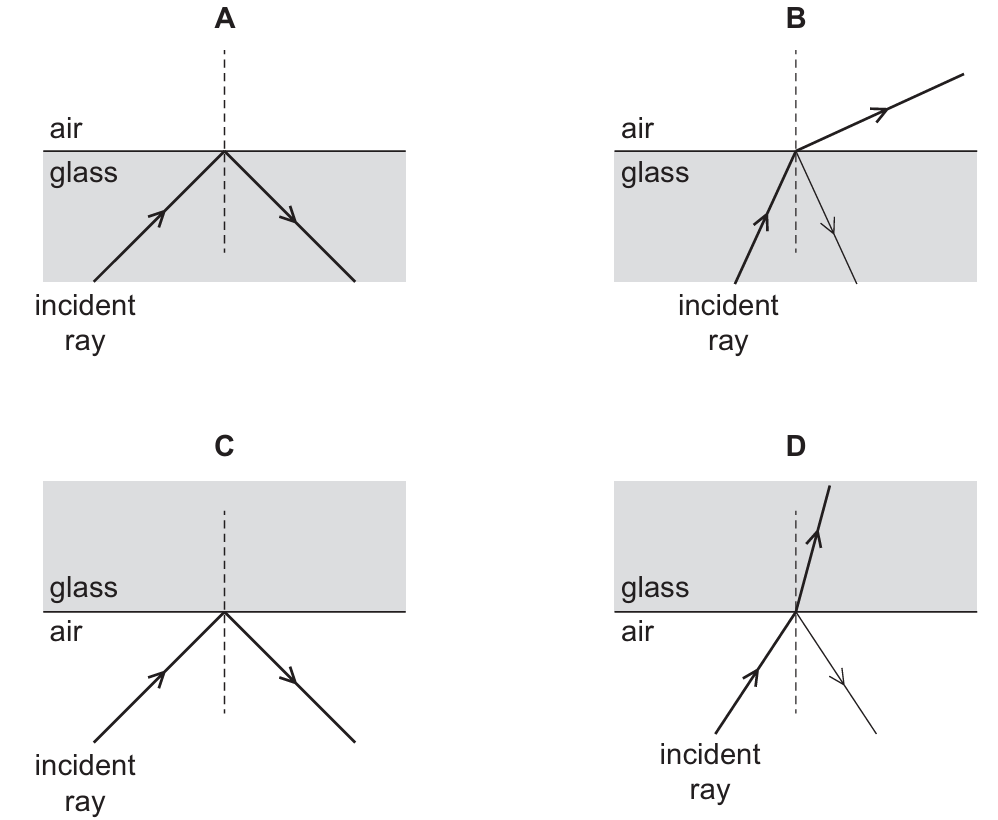
Which diagram shows a ray of light undergoing total internal reflection?

Most-appropriate topic codes (Cambridge IGCSE Co-ordinated Sciences 0654):

Topic P3.2: Light — Total internal reflection occurs when light travels from a denser medium to a less dense medium and the angle of incidence exceeds the critical angle; the ray is entirely reflected back into the denser medium with no refracted ray emerging.
▶️ Answer/Explanation
Total internal reflection requires two conditions: the light must be travelling from a denser medium (e.g. glass or water) to a less dense medium (e.g. air), and the angle of incidence must be greater than the critical angle; when both conditions are met, no light is refracted out — it is all reflected back inside the denser medium.
Diagram A shows this correctly: the ray travels inside the glass, hits the boundary at an angle greater than the critical angle, and reflects back entirely into the glass with no transmitted ray — the angle of reflection equals the angle of incidence.
Answer: A

Question 34

Which two types of wave cannot travel at the same speed as each other in a vacuum?

A. infrared and gamma
B. ultraviolet and X-rays
C. light and microwaves
D. radio waves and sound

Most-appropriate topic codes (Cambridge IGCSE Co-ordinated Sciences 0654):

Topic P3.3: Electromagnetic Spectrum — All electromagnetic waves travel at the same speed in a vacuum \((3 \times 10^8 \text{ m/s})\); sound is a mechanical (longitudinal) wave and cannot travel through a vacuum at all, so it has no speed in a vacuum.
▶️ Answer/Explanation
All electromagnetic waves (infrared, gamma, ultraviolet, X-rays, visible light, microwaves, radio waves) travel at the same speed in a vacuum: \(c = 3 \times 10^8 \text{ m/s}\).
Sound, however, is a mechanical wave that requires a medium (such as air or water) to travel through — it cannot propagate through a vacuum at all, so radio waves and sound cannot travel at the same speed in a vacuum.
Answer: D

Question 35

The electromotive force (e.m.f.) of a battery is 2.0 V.

Which statement is correct?

A. The battery supplies 0.50 J of energy for every 1.0 C of charge driven around a circuit.
B. The battery supplies 0.50 J of energy for every 2.0 C of charge driven around a circuit.
C. The battery supplies 2.0 J of energy for every 1.0 C of charge driven around a circuit.
D. The battery supplies 2.0 J of energy for every 2.0 C of charge driven around a circuit.

Most-appropriate topic codes (Cambridge IGCSE Co-ordinated Sciences 0654):

Topic P4.2: Electrical Quantities — E.m.f. is defined as the energy transferred per unit charge: \(\varepsilon = \frac{W}{Q}\), where \(W\) is energy in joules and \(Q\) is charge in coulombs; an e.m.f. of 2.0 V means 2.0 J of energy is supplied per coulomb of charge.
▶️ Answer/Explanation
E.m.f. is defined as \(\varepsilon = \frac{W}{Q}\), so \(W = \varepsilon \times Q = 2.0 \times 1.0 = 2.0 \text{ J}\) for every \(1.0 \text{ C}\) of charge; this means the battery transfers 2.0 J of electrical energy to each coulomb of charge it drives around the circuit.
Option C is therefore the only correct statement — the others either invert the relationship or use incorrect values for energy or charge.
Answer: C

Question 36

The potential difference (p.d.) across a 60 Ω resistor is 12 V.

How much time does it take for a charge of 100 C to pass through the resistor?

A. 0.0020 s    
B. 0.050 s    
C. 20 s    
D. 500 s

Most-appropriate topic codes (Cambridge IGCSE Co-ordinated Sciences 0654):

Topic P4.2: Electrical Quantities — Use Ohm’s law \(V = IR\) to find current, then use \(Q = It\) rearranged to \(t = \frac{Q}{I}\) to find time.
▶️ Answer/Explanation
First, find the current using Ohm’s law: \(I = \frac{V}{R} = \frac{12}{60} = 0.2 \text{ A}\); then use the charge equation: \(t = \frac{Q}{I} = \frac{100}{0.2} = 500 \text{ s}\).
It takes 500 seconds for 100 C of charge to flow through the resistor at a current of 0.2 A.
Answer: D

Question 37

A heater circuit is protected by a 10 A fuse.

How does the fuse protect the circuit?

A. It cuts off the current when the current in the heater is greater than 10 A.
B. It decreases the current in the heater to 10 A when the current is more than 10 A.
C. It increases the current in the heater to 10 A when the current is less than 10 A.
D. It maintains a constant temperature in the heater.

Most-appropriate topic codes (Cambridge IGCSE Co-ordinated Sciences 0654):

Topic P4.4: Electrical Safety — A fuse contains a thin wire that melts and breaks the circuit when the current exceeds its rated value, cutting off the electrical supply and protecting the circuit and connected appliances from damage due to excessive current.
▶️ Answer/Explanation
A fuse contains a thin wire with a low melting point; when the current through the circuit exceeds 10 A, the fuse wire heats up rapidly, melts, and breaks the circuit — this completely cuts off the current, protecting the wiring and appliance from overheating or catching fire.
The fuse does not regulate or adjust the current to any level — it is a one-time protection device that simply disconnects the circuit when the rated current is exceeded.
Answer: A

Question 38

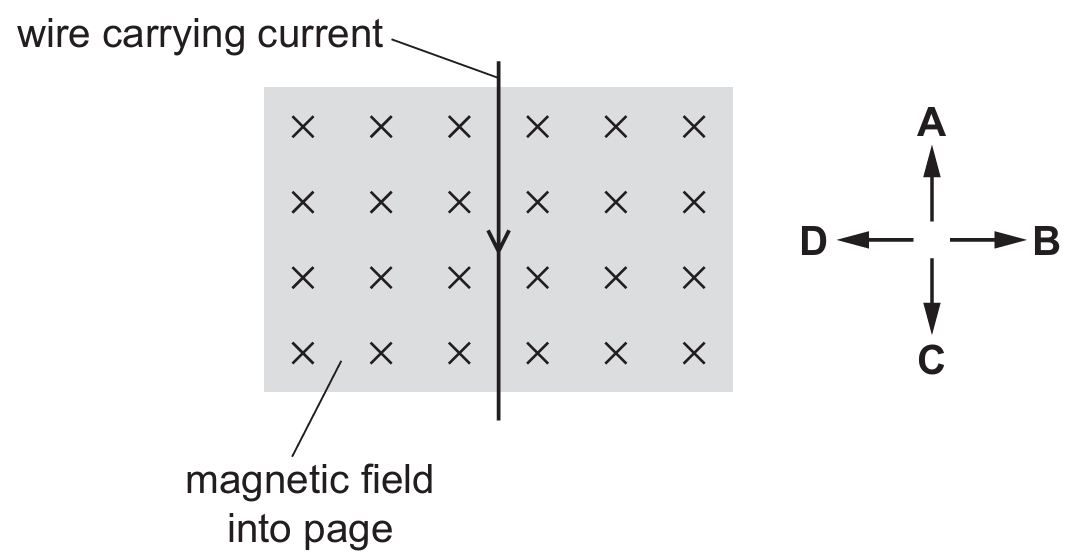
The diagram shows a wire carrying an electric current in the direction shown (towards the bottom of the page). The wire is at right angles to a magnetic field that is directed into the page.

A force acts on the wire because of the current and the magnetic field.

In which labelled direction does this force act?

Most-appropriate topic codes (Cambridge IGCSE Co-ordinated Sciences 0654):

Topic P4.5: Electromagnetic Effects — Fleming’s Left-Hand Rule determines the direction of the force on a current-carrying conductor in a magnetic field: the thumb points in the direction of the force (motion), the index finger in the direction of the field, and the middle finger in the direction of the conventional current.
▶️ Answer/Explanation
Applying Fleming’s Left-Hand Rule: the middle finger points downward (conventional current direction — towards the bottom of the page), the index finger points into the page (magnetic field direction), and the thumb (force direction) points to the left — which corresponds to direction B in the diagram.
The motor effect force is always perpendicular to both the current and the magnetic field, so the wire experiences a sideways force in direction B.
Answer: B

Question 39

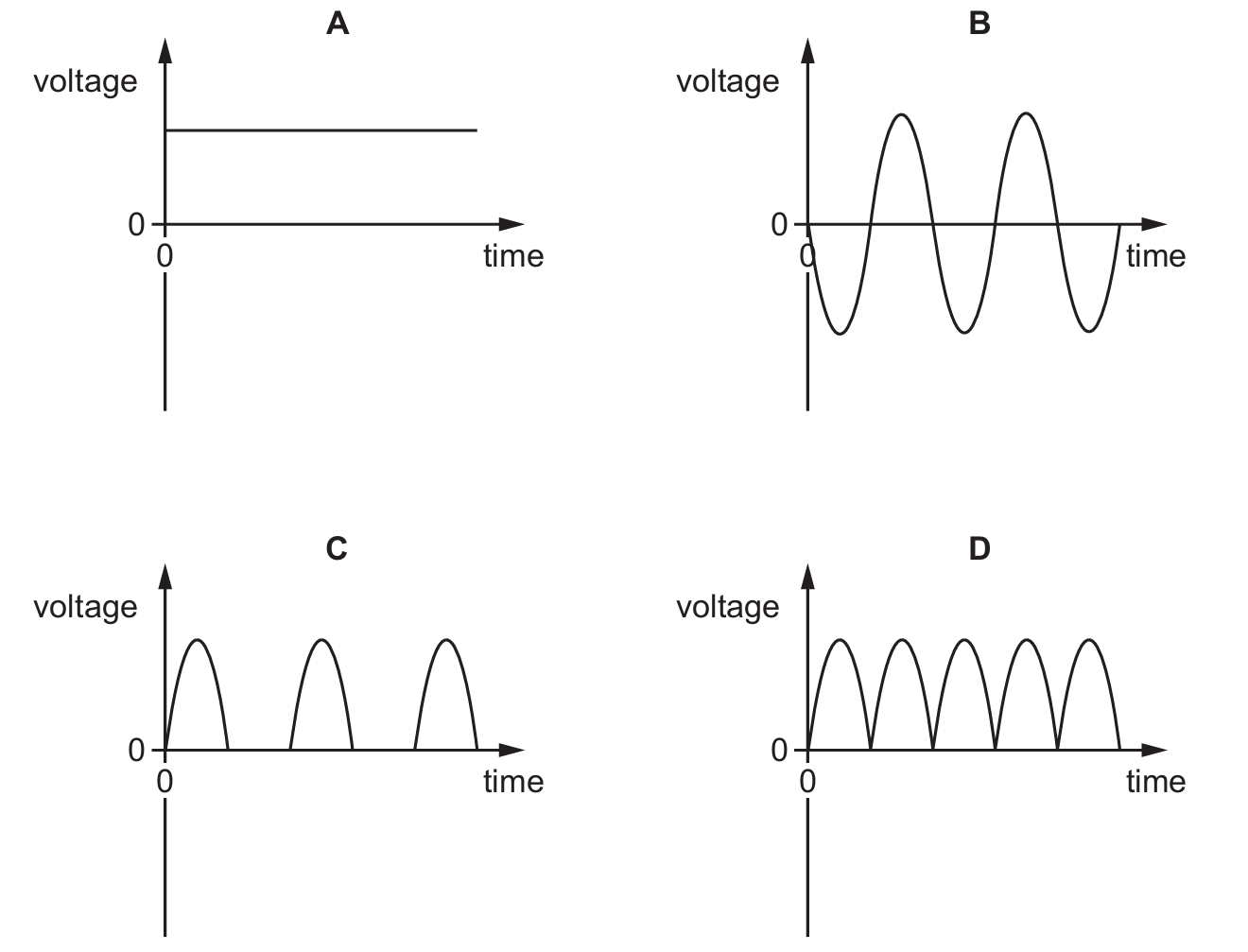
Which voltage–time graph shows the output voltage of a simple a.c. generator?

Most-appropriate topic codes (Cambridge IGCSE Co-ordinated Sciences 0654):

Topic P4.5: Electromagnetic Effects / A.C. Generator — A simple a.c. generator produces a sinusoidal (sine wave) output voltage that alternates symmetrically above and below zero; it continuously changes direction as the coil rotates in the magnetic field.
▶️ Answer/Explanation
A simple a.c. generator (alternator) produces an alternating voltage as the coil rotates in a magnetic field — the rate of cutting of field lines varies sinusoidally, so the output is a smooth, continuously repeating sine wave that is symmetrically positive and negative.
Graph B shows the correct sinusoidal waveform — the other graphs show either d.c. output, half-wave patterns, or square waves, none of which are produced by a simple a.c. generator.
Answer: B

Question 40

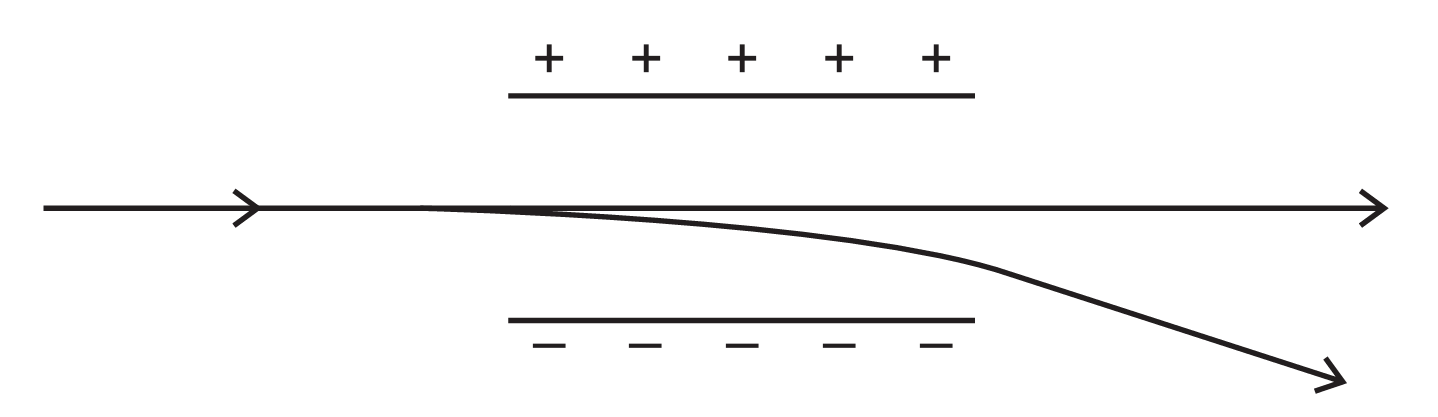
A beam of different types of ionising radiation passes through an electric field between two metal plates. The diagram shows the direction of each type of radiation as it passes through the field.

What does the beam contain?

A. alpha \((\alpha)\)-particles, beta \((\beta)\)-particles and gamma \((\gamma)\)-rays
B. alpha \((\alpha)\)-particles and beta \((\beta)\)-particles only
C. alpha \((\alpha)\)-particles and gamma \((\gamma)\)-rays only
D. beta \((\beta)\)-particles and gamma \((\gamma)\)-rays only

Most-appropriate topic codes (Cambridge IGCSE Co-ordinated Sciences 0654):

Topic P5.2: Radioactivity — In an electric field: alpha particles \((\alpha\), charge \(+2)\) deflect towards the negative plate; beta particles \((\beta\), charge \(-1)\) deflect towards the positive plate; gamma rays \((\gamma)\) carry no charge and travel straight through undeflected.
▶️ Answer/Explanation
The diagram shows two deflected paths and one undeflected path: the path deflecting towards the negative plate is \(\alpha\)-particles (positively charged, \(+2\)); the undeflected straight path is \(\gamma\)-rays (no charge, not affected by electric fields); if no path deflects towards the positive plate, then no \(\beta\)-particles (charge \(-1\)) are present.
Since only \(\alpha\)-particles and \(\gamma\)-rays are shown in the diagram (two paths: one deflected, one straight), the beam contains alpha particles and gamma rays only.
Answer: C
Scroll to Top