
Question 1
Most-appropriate topic codes (Cambridge IGCSE Co-ordinated Sciences 0654):
• Topic B7.3 — Digestion (Part (a))
• Topic B7.3 — Digestion / data interpretation skills (Part (b))
• Topic B9.4 — Blood (Part (c))
▶️ Answer/Explanation
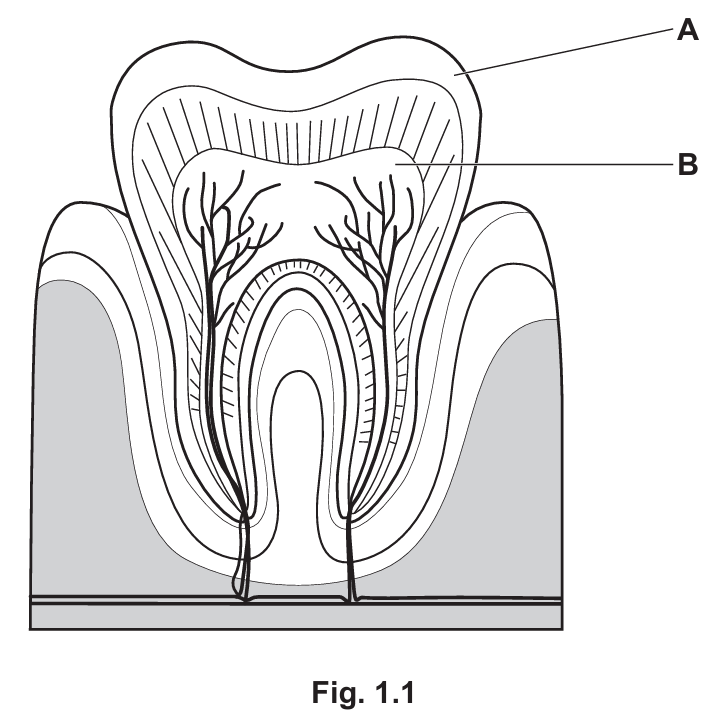
(a)(i) A — enamel; B — pulp (cavity)
Label A points to the hard white outer covering of the crown, which is enamel.
Label B points to the soft central region containing nerves and blood vessels, which is the pulp (cavity).
(a)(ii) Mechanical (physical) digestion
Teeth break food into smaller pieces by a physical/mechanical action.
No chemical change to the food molecules occurs, so this is mechanical (physical) digestion.
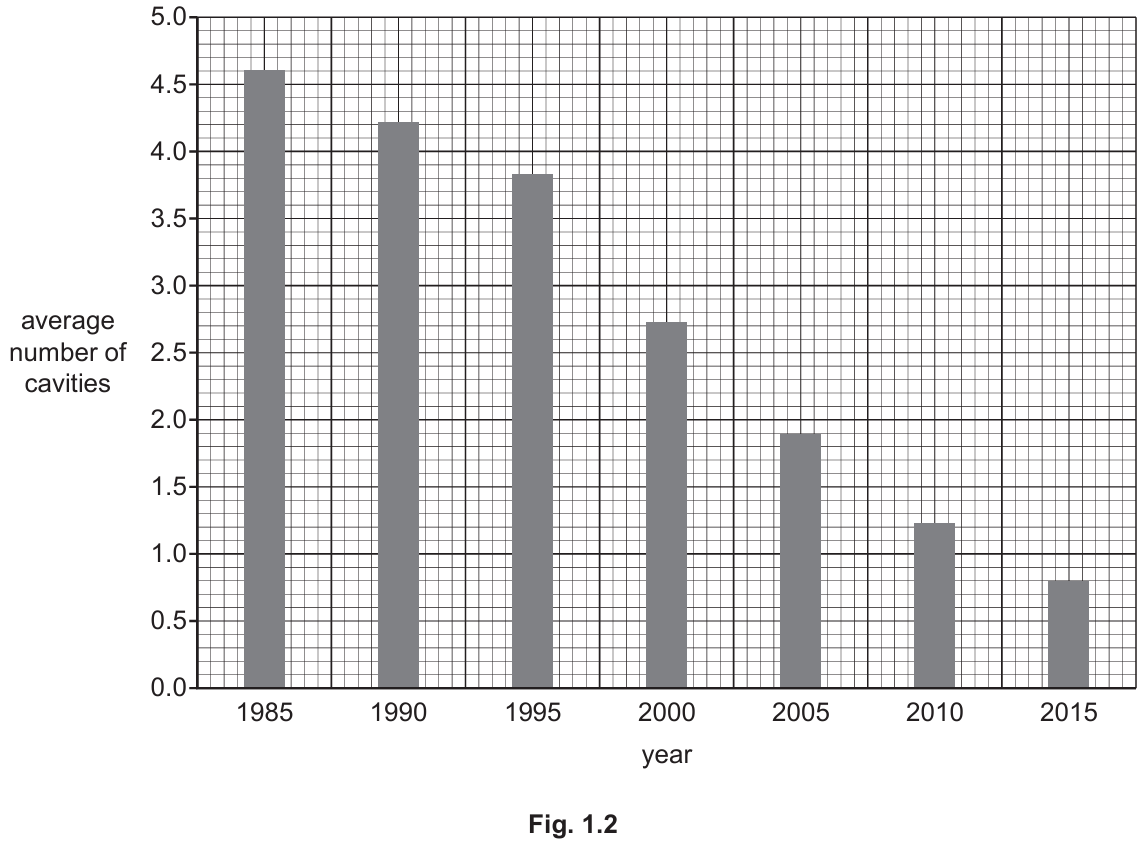
(b)(i) Average number of cavities in 1985 = 4.6; in 2015 = 0.8; percentage decrease ≈ 83%
Percentage decrease is calculated using \(\text{percentage decrease} = \dfrac{\text{decrease in value}}{\text{original value}} \times 100\).
Decrease in value \(= 4.6 – 0.8 = 3.8\).
Percentage decrease \(= \dfrac{3.8}{4.6} \times 100 \approx 83\%\).
(b)(ii) Any three from: improved dental care/technology; reduced sugar consumption / more calcium in diet; better dental health education; fluoride added to water/toothpaste
Better access to dentists and modern dental treatments reduces cavity formation.
Lower sugar intake and improved diet reduce the substrate available for cavity-causing bacteria.
Increased public health education and fluoride use (in water or toothpaste) strengthen enamel and improve oral hygiene.
(c) Any two from: red blood cells; white blood cells; plasma; platelets
Blood is made up of four main components.
These are red blood cells, white blood cells, platelets, and plasma.
Any two of these components score full marks.
Question 2
Most-appropriate topic codes (Cambridge IGCSE Co-ordinated Sciences 0654):
• Topic C8.2 — Group I properties (Part (a)(i))
• Topic C9.1/C9.3 — Properties of metals / Alloys (Parts (a)(ii)–(iii))
• Topic C4.1 — Electrolysis (Part (a)(iv))
• Topic C9.4 — Reactivity series (Part (b)(i)–(ii))
• Topic C6.2 — Rate of reaction (Part (b)(iii))
• Topic C3.1 — Stoichiometry / chemical equations (Part (b)(iv))
▶️ Answer/Explanation
(a)(i) Sodium
Group I metals are the alkali metals.
Sodium is the only metal from the list found in Group I of the Periodic Table.
(a)(ii) Aluminium
Bauxite is the ore from which aluminium is extracted.
Aluminium oxide is obtained from bauxite and then reduced by electrolysis.
(a)(iii) Iron
Steel is an alloy of iron with carbon and other elements.
Iron is therefore the main metal present in steel.
(a)(iv) Platinum
Inert electrodes do not react during electrolysis.
Platinum (like carbon/graphite) is unreactive and so is used as an inert electrode.
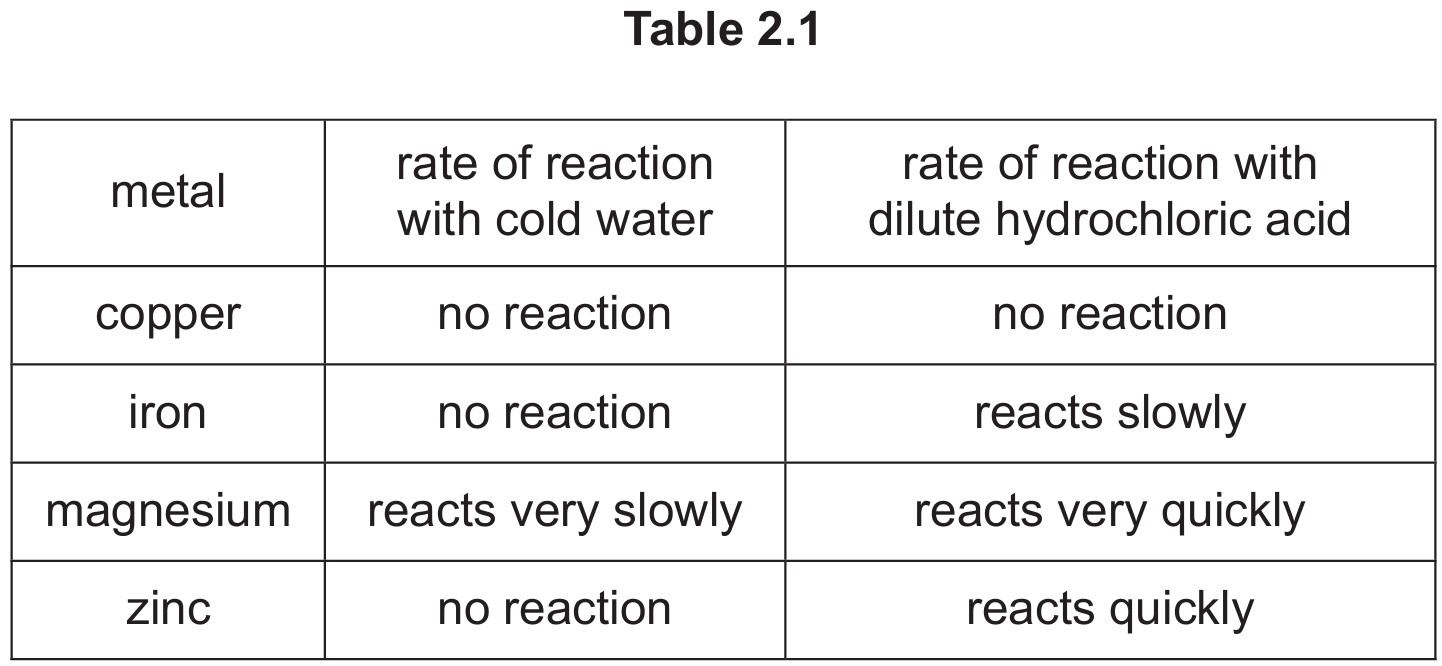
(b)(i) Most reactive: magnesium → zinc → iron → copper: least reactive
Magnesium reacts with both cold water and acid, so it is the most reactive.
Zinc and iron do not react with cold water but react with acid (zinc faster than iron).
Copper does not react with either, so it is the least reactive.
(b)(ii) Lithium, sodium, or potassium
Metals more reactive than magnesium react quickly with cold water.
Examples include lithium, sodium, and potassium (Group I metals).
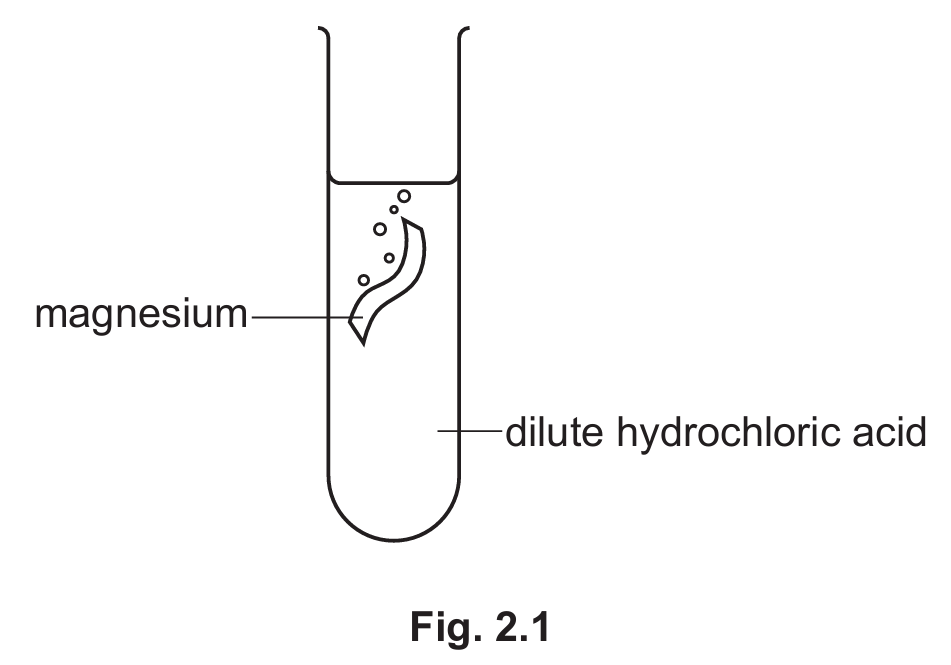
(b)(iii) Increase the concentration of the acid; increase the temperature of the acid
A higher concentration increases the number of acid particles per unit volume, increasing collision frequency.
A higher temperature gives particles more kinetic energy, increasing the frequency and energy of successful collisions.
(b)(iv) Mg + 2HCl → MgCl₂ + H₂
The equation must be balanced for both chlorine and hydrogen atoms.
Two HCl molecules supply the two chlorine atoms needed for \(\text{MgCl}_2\) and the two hydrogen atoms needed for \(\text{H}_2\).
Question 3
Complete the sentence:
The e.m.f. of an electrical source of energy is measured in …………….. .
Most-appropriate topic codes (Cambridge IGCSE Co-ordinated Sciences 0654):
• Topic P4.3.1 — Circuit diagrams and circuit components (Parts (a)(i)–(ii))
• Topic P4.2.3 — Voltage (e.m.f. and p.d.) (Parts (a)(iii), (v))
• Topic P4.2.4 — Resistance (Part (a)(iv))
• Topic P3.2.1 — Reflection of light (Part (b))
▶️ Answer/Explanation
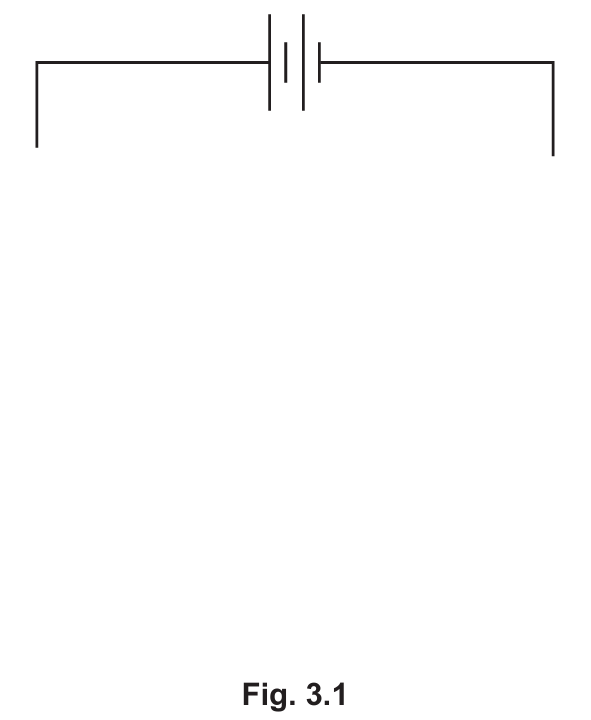
(a)(i) Correct symbols for lamp and switch, all connected in series
A complete series circuit needs a lamp symbol (circle with a cross/filament) and a switch symbol added in line with the two cells.
All components must be connected in a single loop with no branches, since the components are in series.
(a)(ii) Voltmeter connected in parallel across the lamp, using the correct circle-V symbol
A voltmeter measures potential difference, so it must be connected across (in parallel with) the lamp, not in series with it.
The correct symbol is a circle containing the letter V.
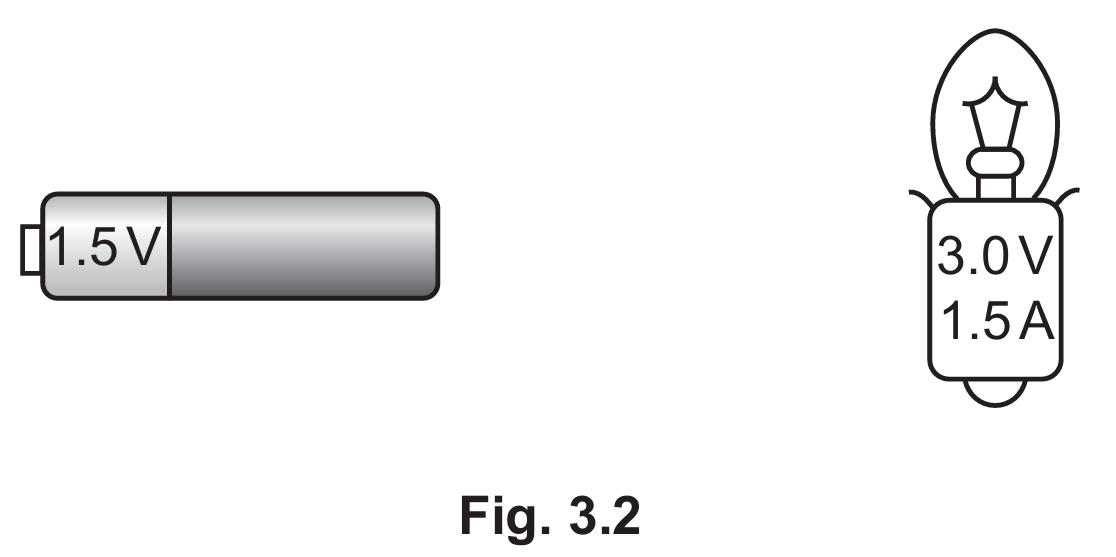
(a)(iii) The lamp needs 3.0 V to light normally, but one cell only supplies 1.5 V, so two 1.5 V cells in series are needed to provide 3.0 V
In a series circuit, the e.m.f.s of the cells add together.
Two 1.5 V cells in series give \(1.5 + 1.5 = 3.0\,\text{V}\), matching the lamp’s rated voltage.
(a)(iv) Resistance = 2.0 Ω
Resistance is calculated using \(R = \dfrac{V}{I}\).
Using the lamp’s rated values, \(R = \dfrac{3.0}{1.5} = 2.0\,\Omega\).
(a)(v) Volts (V)
The e.m.f. of a source, like potential difference, is a measure of energy transferred per unit charge.
It is therefore measured in the same unit as potential difference: volts (V).
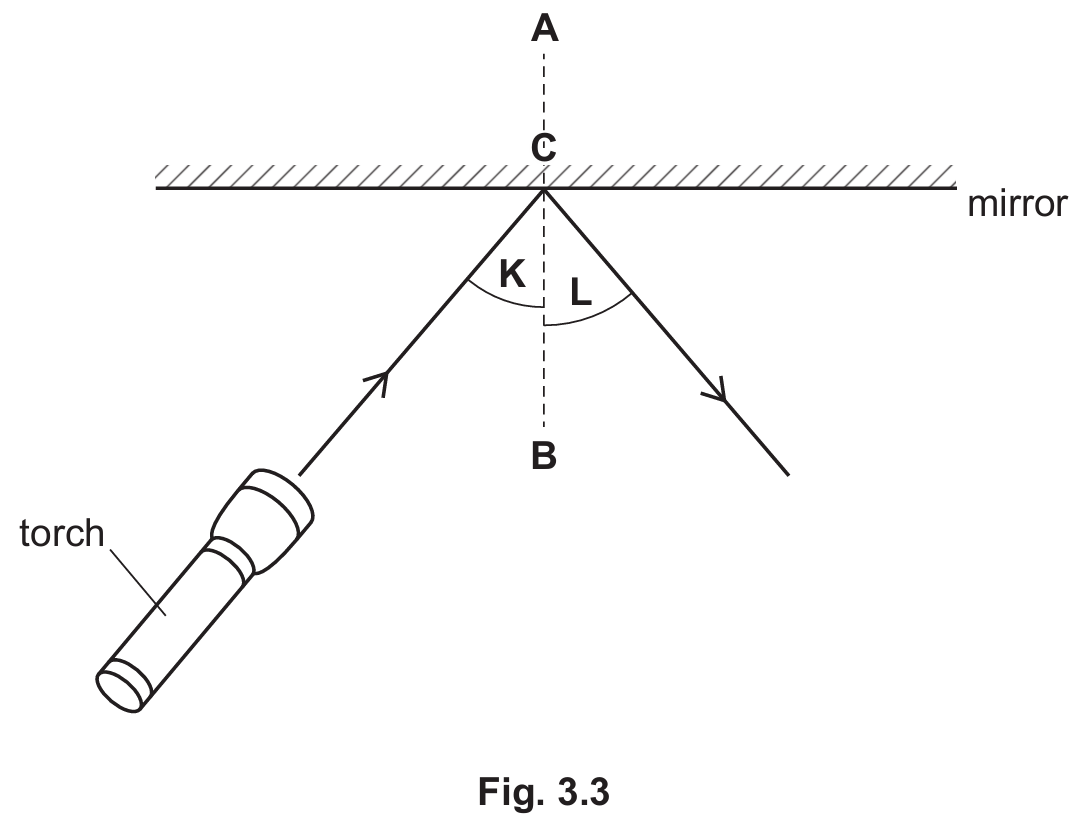
(b)(i) Angle K is equal to angle L
This is the law of reflection.
The angle of incidence (K) always equals the angle of reflection (L) when measured from the normal.
(b)(ii) Normal
Line AB is drawn perpendicular to the mirror surface at the point of incidence.
This perpendicular reference line is called the normal.
(b)(iii) The ray of light is reflected (reflection occurs)
At point C, the light ray meets the mirror surface and changes direction.
This change of direction at the surface is called reflection.
Question 4
- herbivore
- tertiary consumer
Most-appropriate topic codes (Cambridge IGCSE Co-ordinated Sciences 0654):
• Topic B18.2 — Food chains and food webs (Parts (a)(i)–(ii), (c))
• Topic B19.1 — Habitat destruction (Part (a)(iii))
• Topic B6.1 — Photosynthesis (Part (b))
• Topic B18.2 — Decomposers (Part (d))
▶️ Answer/Explanation
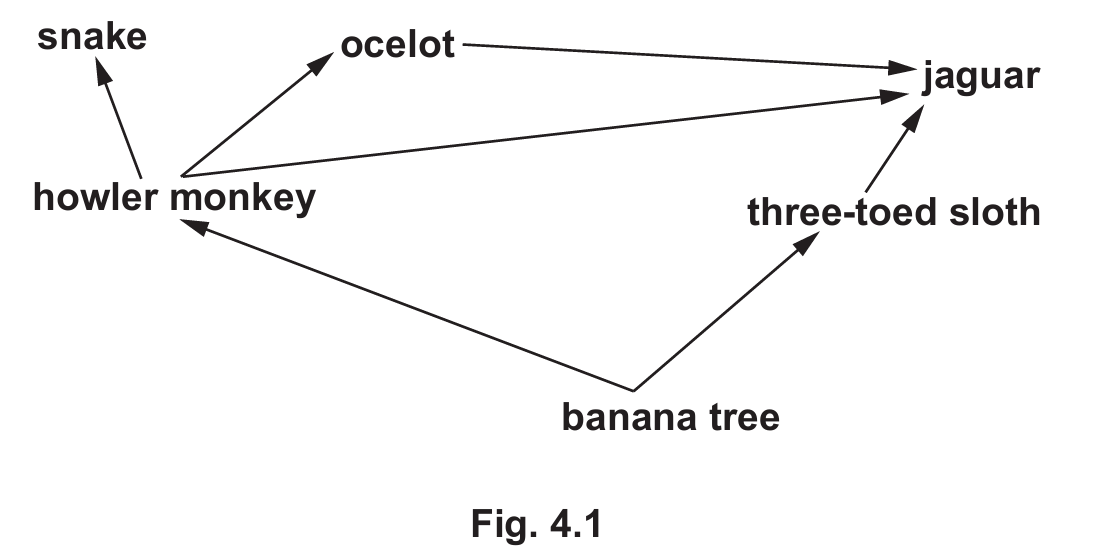
(a)(i) banana tree → howler monkey → snake
A food chain must follow the arrows in Fig. 4.1 and begin with a producer.
Following the arrows from banana tree to howler monkey to snake gives a valid chain that includes the snake.
(a)(ii) Herbivore: howler monkey or three-toed sloth; Tertiary consumer: jaguar
A herbivore feeds only on plants — both the howler monkey and the three-toed sloth feed directly on the banana tree.
A tertiary consumer is three feeding levels above the producer; the jaguar occupies this position by feeding on secondary consumers such as the ocelot and three-toed sloth.
(a)(iii) Any two from: loss of soil/soil erosion; flooding; increase of carbon dioxide in the atmosphere; habitat destruction/animals displaced; decreased biodiversity
Removing trees exposes soil to erosion and removes roots that absorb water, increasing the risk of flooding.
Fewer trees also means less carbon dioxide is removed from the atmosphere by photosynthesis, contributing to its build-up, while habitats and biodiversity are also reduced.
(b) Carbon dioxide and water
Producers make carbohydrates by photosynthesis.
The raw materials required are carbon dioxide and water, which combine using light energy to form glucose.
(c) Consumers get their energy from eating other organisms (plants or animals), so consumers can be herbivores; carnivores get their energy only from eating animals
Consumers is a broad category that includes herbivores, carnivores, and omnivores.
Since carnivores only eat animals, they are always consumers, but herbivores (which only eat plants) are consumers that are not carnivores — explaining why the reverse statement is false.
(d) Decomposer
Decomposers break down dead organisms and waste material.
They obtain their energy from this dead organic matter rather than from living producers or prey.
Question 5
After a few hours, no water is left in the cup.
State the name of the process that has occurred.
State the pH number of pure water.
Define the terms solute and solvent.
Most-appropriate topic codes (Cambridge IGCSE Co-ordinated Sciences 0654):
• Topic P2.1.2 — Particle model of matter (Part (a))
• Topic P2.1.1 — States of matter / evaporation (Part (b))
• Topic C7.1 — Acids, bases and pH (Part (c))
• Topic C10.1 — Water treatment (Part (d))
• Topic C2.5 — Simple molecules and covalent bonds (Part (e))
• Topic C12.1 — Experimental design: solute and solvent (Part (f))
▶️ Answer/Explanation
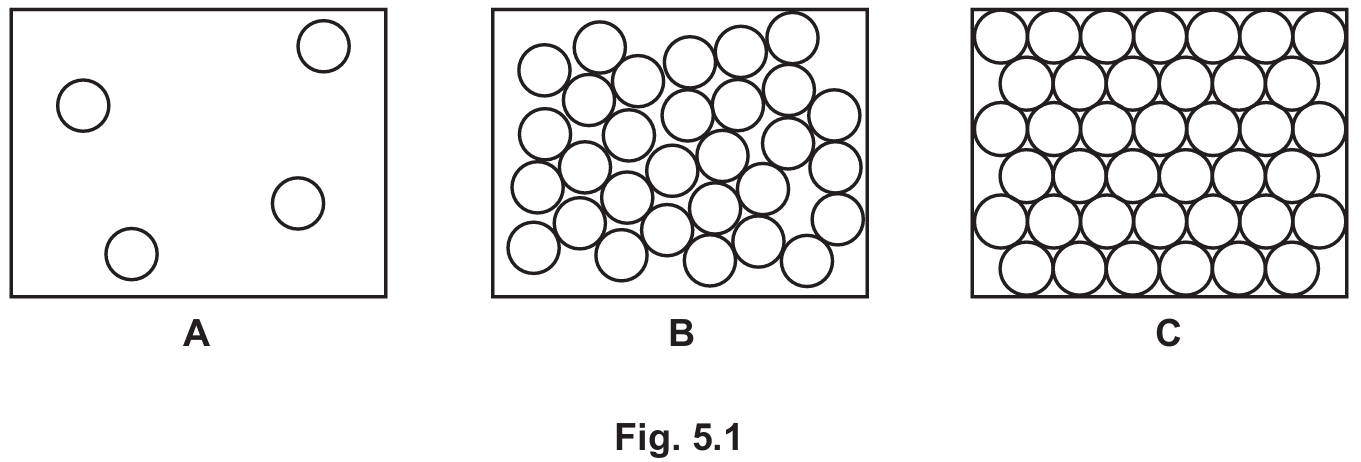
(a) Ice is diagram C; water is diagram B; steam is diagram A
In ice (a solid), particles are closely packed in a regular, fixed arrangement, shown by diagram C.
In water (a liquid), particles are close together but in an irregular, more loosely packed arrangement, shown by diagram B.
In steam (a gas), particles are widely spaced and move randomly, shown by diagram A.
(b) Evaporation
The water changes from a liquid to a gas (water vapour) at a temperature below its boiling point.
This change of state at the surface of a liquid is called evaporation.
(c) pH = 7
A neutral substance has a pH value that is neither acidic nor alkaline.
Pure water has a pH of exactly 7.
(d) Chlorine kills harmful microorganisms/bacteria/pathogens in the water
Drinking water can contain disease-causing microorganisms.
Chlorine is added because it kills these microbes, making the water safe to drink.
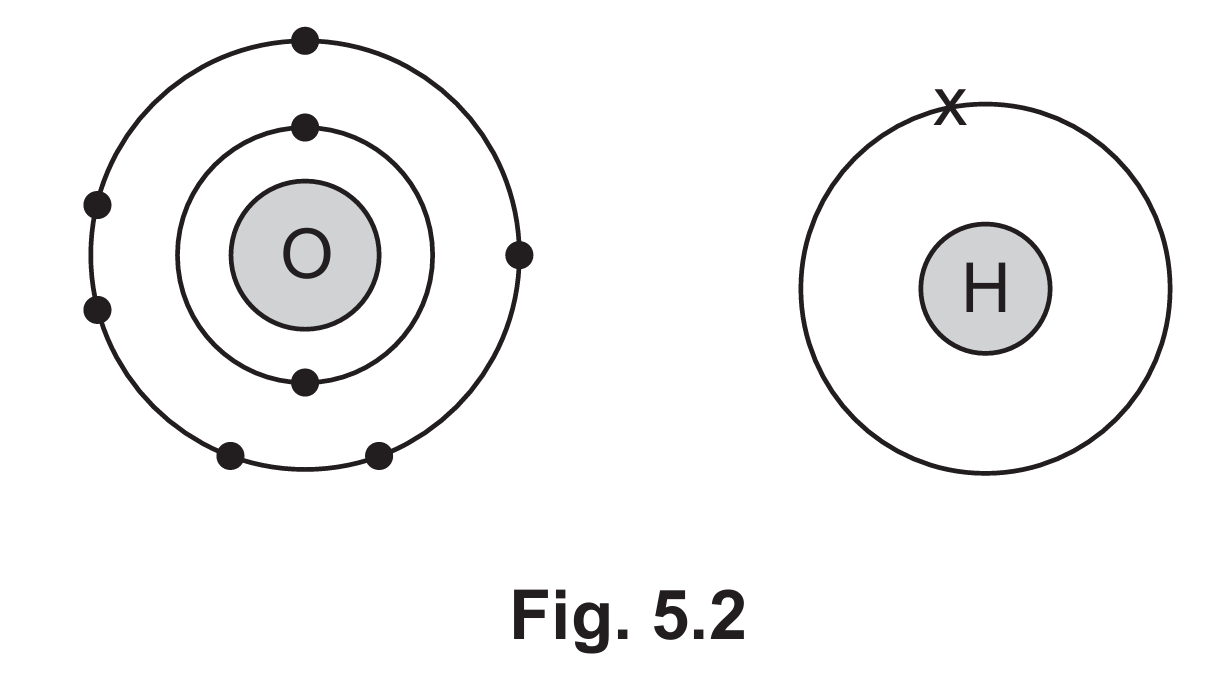
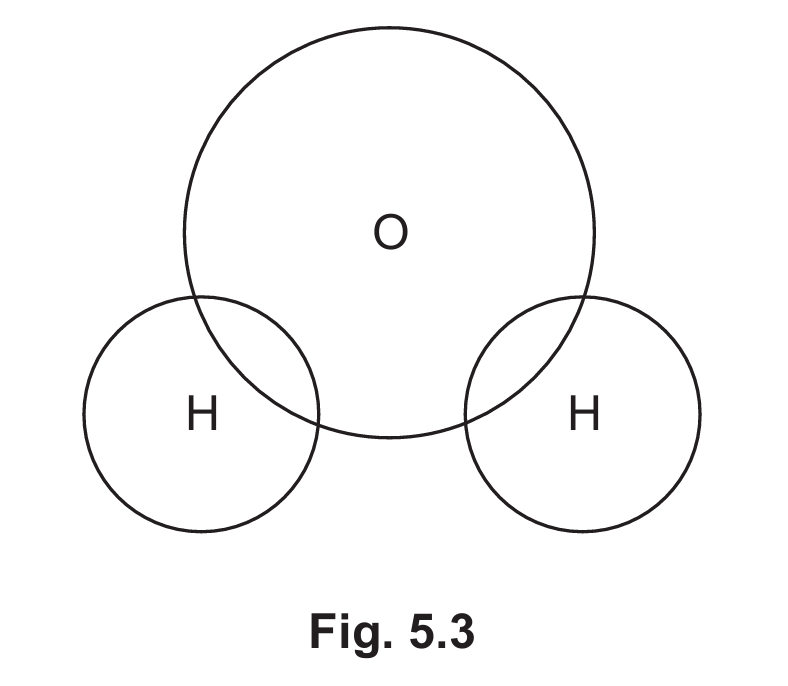
(e) One shared (bonding) pair of electrons drawn between O and each H, with all other electrons shown correctly around O
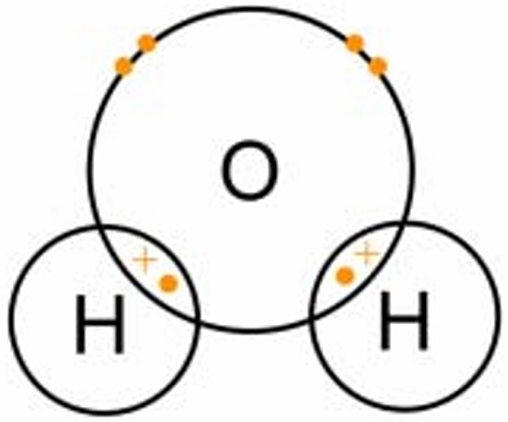
Each hydrogen atom shares its single electron with one of oxygen’s outer-shell electrons, forming a covalent bond.
Two covalent bonds are formed in total (one O–H bond to each hydrogen), giving oxygen a full outer shell of eight electrons.
(f) Solute — a substance that is dissolved in a solvent; Solvent — a substance/liquid that dissolves a solute
A solute is the substance present in smaller amount that gets dissolved, such as sodium chloride.
A solvent is the substance, usually a liquid such as water, that does the dissolving.
Question 6
The density of steel is \(7870\,\text{kg/m}^3\).
Calculate the volume of steel used to make the steel rail.
The gravitational force \(g\) on unit mass is \(10\,\text{N/kg}\).
Most-appropriate topic codes (Cambridge IGCSE Co-ordinated Sciences 0654):
• Topic P1.2 — Motion: speed-time graphs and area under graph (Part (a))
• Topic P2.2.1 — Thermal expansion of solids (Part (b)(i))
• Topic P1.3/P1.4 — Weight and Density (Part (b)(ii))
▶️ Answer/Explanation
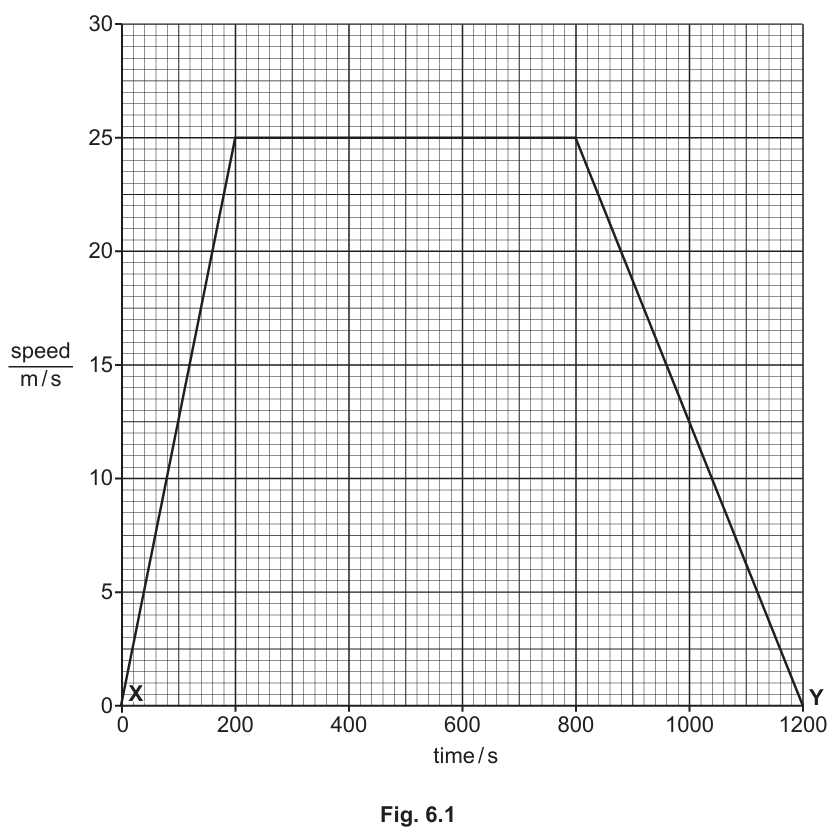
(a)(i) 1200 s
The time taken for the journey is read directly from the graph.
The graph runs from \(t = 0\,\text{s}\) at X to \(t = 1200\,\text{s}\) at Y.
(a)(ii) Any point marked C on the flat (horizontal) section of the graph, between 200 s and 800 s
A horizontal section of a speed–time graph represents an unchanging speed.
Between 200 s and 800 s the speed stays constant at 25 m/s, so any point in this region is valid.
(a)(iii) Distance = 22 500 m
Distance travelled is found from the area under the speed–time graph.
Area \(= \left(\tfrac{1}{2} \times 200 \times 25\right) + (600 \times 25) + \left(\tfrac{1}{2} \times 400 \times 25\right) = 2500 + 15\,000 + 5000 = 22\,500\,\text{m}\).
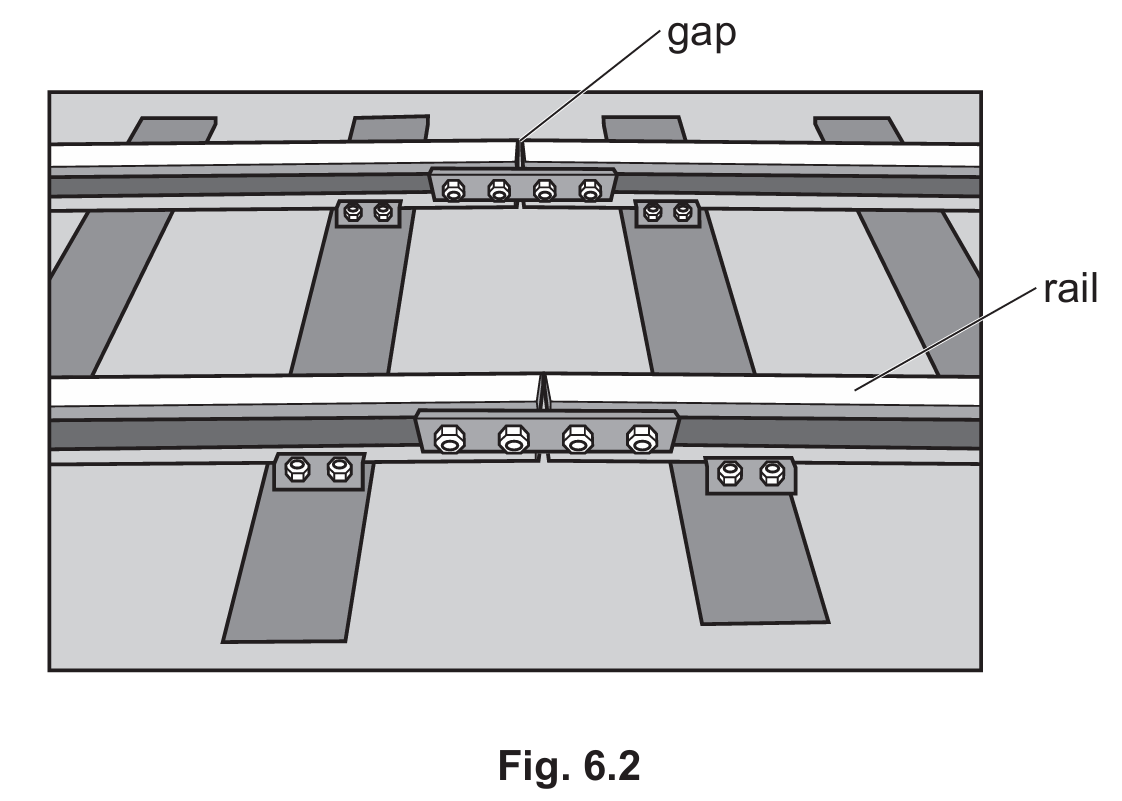
(b)(i) The gaps allow the rails to expand in hot weather without buckling
In hot weather, the steel rails expand due to thermal expansion.
The gaps provide space for this expansion, preventing the rails from bending or buckling.
(b)(ii) Volume = 0.13 m³
First find the mass of the rail using \(W = mg\), so \(m = \dfrac{W}{g} = \dfrac{10270}{10} = 1027\,\text{kg}\).
Then use \(\rho = \dfrac{m}{V}\), rearranged to \(V = \dfrac{m}{\rho} = \dfrac{1027}{7870} \approx 0.13\,\text{m}^3\).
Question 7
A whale has a fat layer in the skin of 50 cm.
Explain why whales are better adapted to a cold environment.
Most-appropriate topic codes (Cambridge IGCSE Co-ordinated Sciences 0654):
• Topic B13.3 — Homeostasis: skin structure and temperature control (Parts (a), (b))
• Topic B13.3 — Homeostasis (Part (c))
▶️ Answer/Explanation
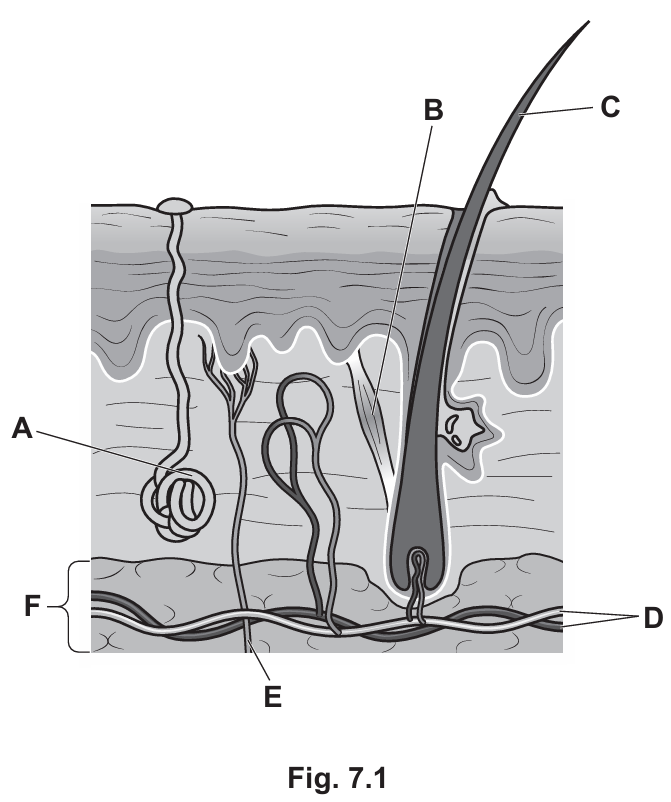
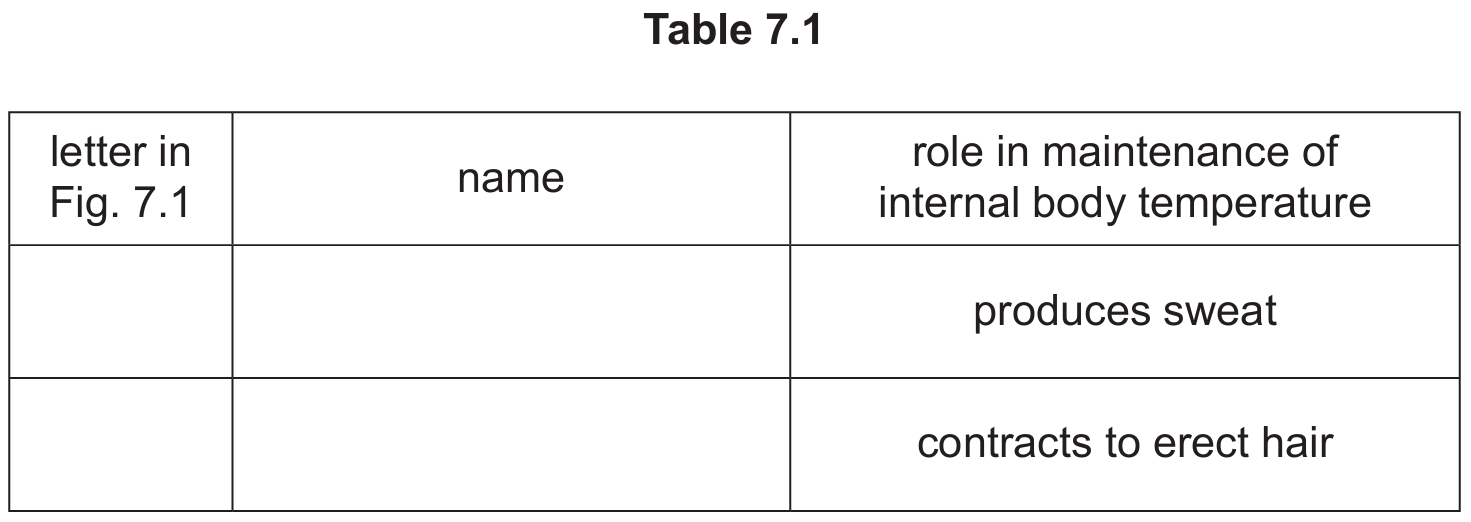
(a)(i)

Label A points to the coiled gland in the lower skin layer, which is the sweat gland responsible for producing sweat.
Label B points to the small muscle attached to the hair follicle, the hair erector muscle, which contracts to make the hair stand up.
(a)(ii) Whales have a much thicker fat layer, which provides better insulation, reducing heat loss to the cold surroundings
Fat is a poor conductor of heat and acts as an insulating layer.
Since the whale’s fat layer (50 cm) is far thicker than the human’s (3 cm), it insulates much more effectively, reducing heat loss in cold water.
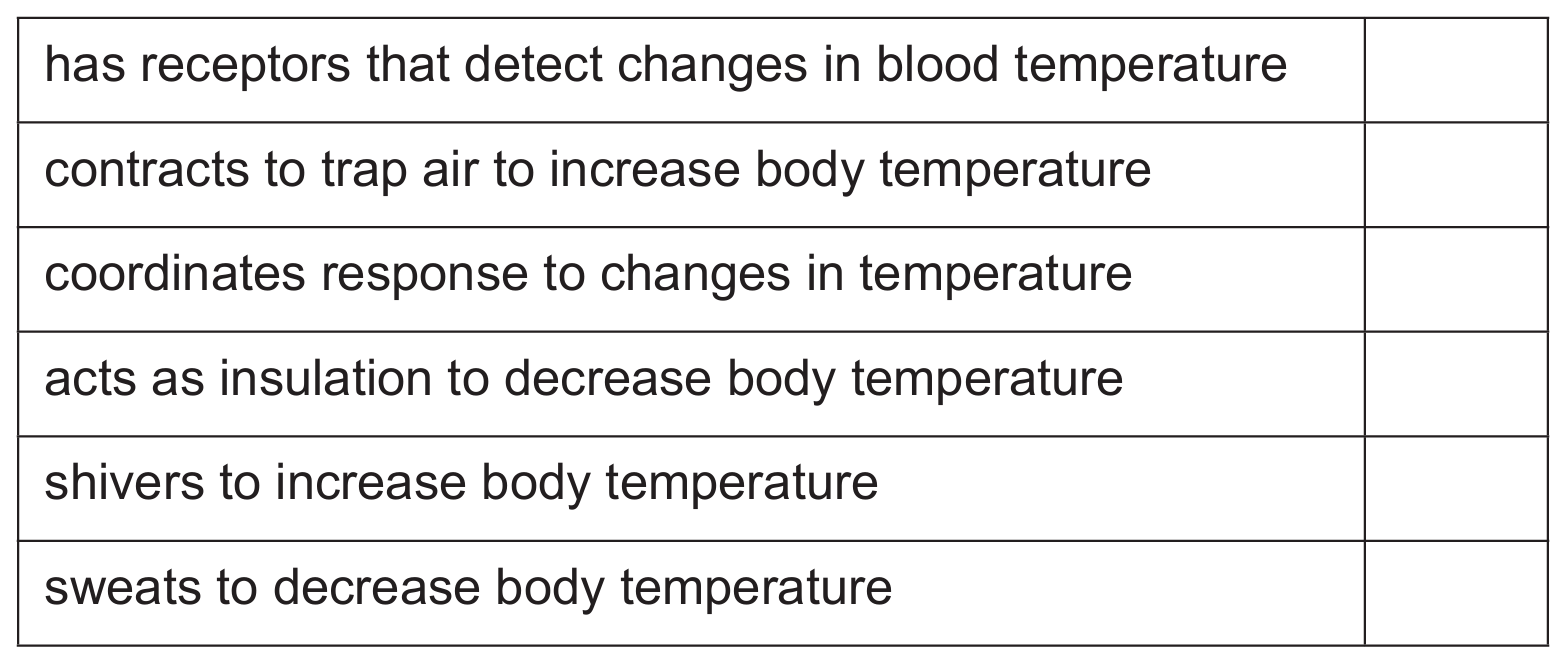
(b) Tick:
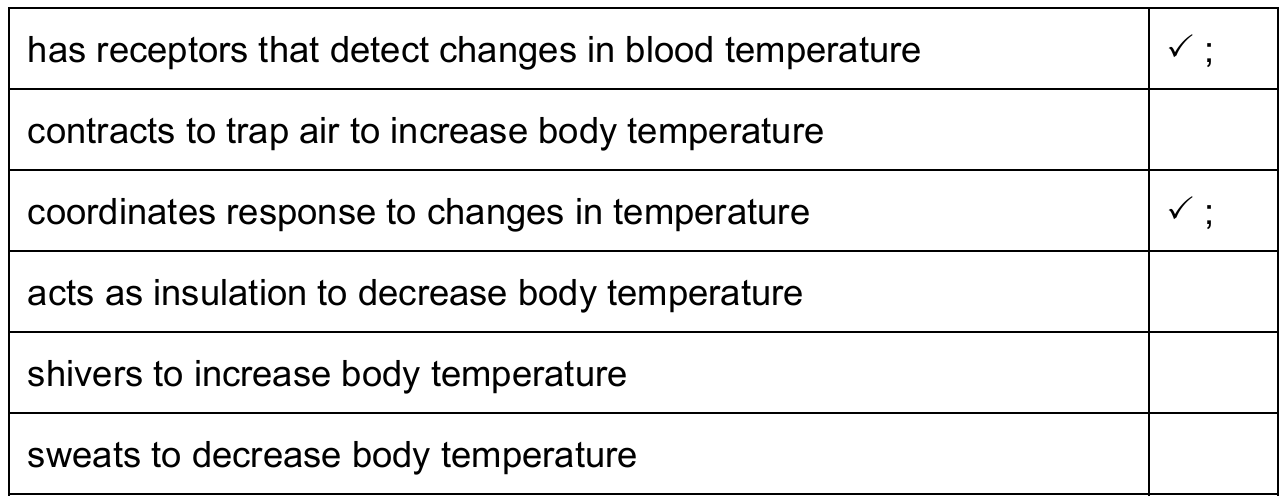
The brain (hypothalamus) detects changes in blood temperature using its own receptors.
It also coordinates the body’s responses (such as sweating or shivering) to restore normal temperature, so these are the two roles directly performed by the brain.
(c) Homeostasis
The maintenance of a constant internal environment in the body is given a specific term.
This term is homeostasis.
Question 8
Most-appropriate topic codes (Cambridge IGCSE Co-ordinated Sciences 0654):
• Topic C11.3 — Fuels: fractional distillation of petroleum (Part (a))
• Topic C11.3 — Fossil fuels (Part (b)(i))
• Topic C10.2 — Air quality: greenhouse gases (Part (b)(ii))
• Topic C6.1 — Physical and chemical changes (Part (b)(iii))
▶️ Answer/Explanation
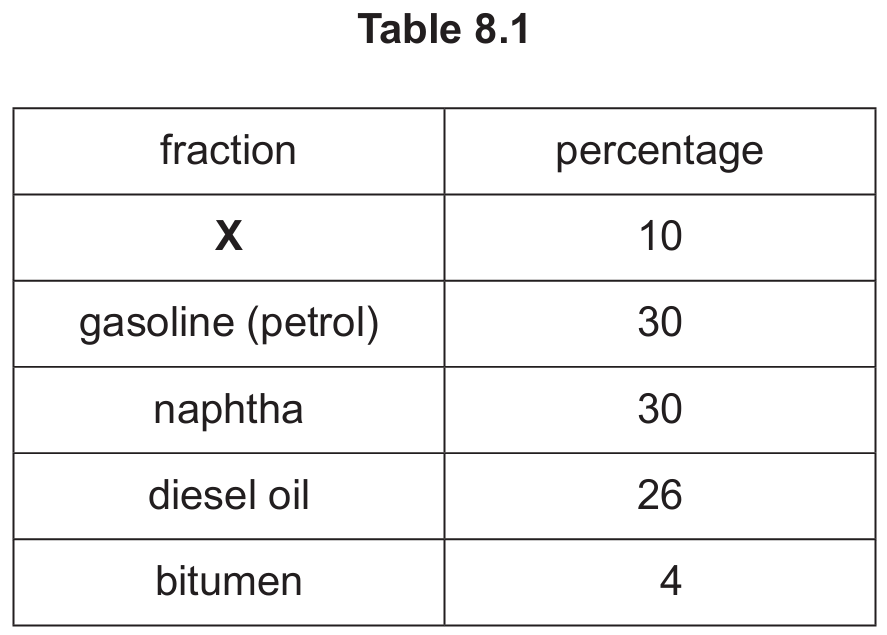
(a)(i) Refinery gas
Fraction X has the lowest boiling point and is collected at the top of the fractionating column.
This fraction is refinery gas, used for heating and cooking.
(a)(ii) Used as a chemical feedstock for making other chemicals
Naphtha is not only burned as a fuel.
It is also used as a feedstock to manufacture other chemical products, such as plastics.
(a)(iii) Fractional distillation
Petroleum is a mixture of hydrocarbons with different boiling points.
Fractional distillation separates these hydrocarbons into useful fractions based on their boiling point ranges.
(a)(iv) Mass of diesel oil = 130 kg
Diesel oil makes up 26% of the 500 kg sample.
Mass \(= \dfrac{26}{100} \times 500 = 130\,\text{kg}\).
(a)(v) Carbon and hydrogen
Petroleum fractions are hydrocarbons.
Hydrocarbons are compounds that contain only the elements carbon and hydrogen.
(b)(i) Coal or natural gas
The three fossil fuels are coal, natural gas, and petroleum.
Since petroleum is already given, either coal or natural gas is an acceptable answer.
(b)(ii) Methane
Methane is a common greenhouse gas released from sources such as decomposing vegetation and animal digestion.
It is therefore an acceptable alternative answer to carbon dioxide.
(b)(iii) Chemical change cannot easily be reversed by physical means; chemical change produces new substances
In a chemical change, new substances with different properties are formed, and the change is usually difficult to reverse.
In a physical change, no new substance is formed and the change can usually be reversed easily, for example by cooling or condensing.
Question 9
In the nuclear reactor, energy is released by the nuclear fission of an isotope of uranium.
Suggest why the nuclear reactor is surrounded by a thick layer made of lead.
A pulse of ultrasound is sent through the water and reaches the sea floor after 0.8 s.
Ultrasound waves travel through seawater at a speed of 1550 m/s.
Calculate the distance of the sea floor below the submarine.
State the name of one region of the electromagnetic spectrum and give one use for waves in this region.
Most-appropriate topic codes (Cambridge IGCSE Co-ordinated Sciences 0654):
• Topic P1.5.1 — Effects of forces / equilibrium (Part (a))
• Topic P5.1 — The nucleus: nuclear fission (Part (b)(i))
• Topic P5.2.5 — Applications and safety precautions (Part (b)(ii))
• Topic P3.1 — Wave speed equation (Part (c)(i))
• Topic P3.3 — Electromagnetic spectrum (Part (c)(ii))
▶️ Answer/Explanation
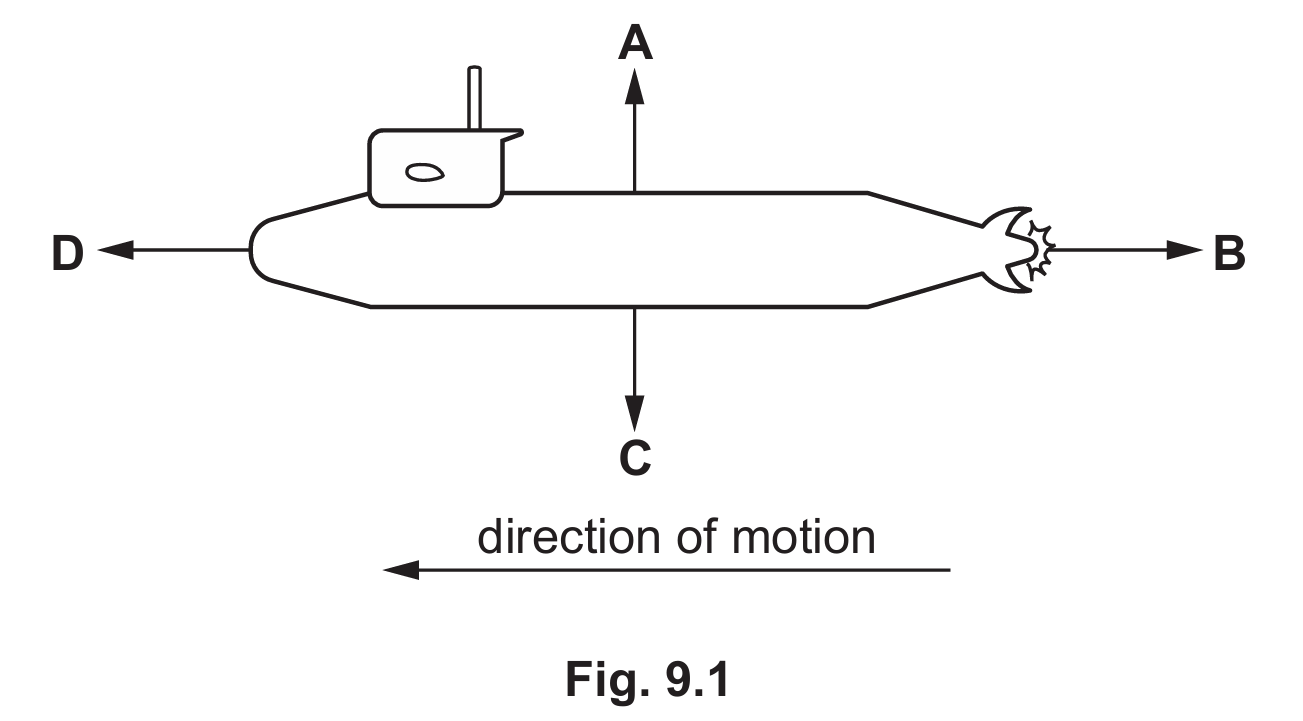
(a)(i) Force C
Weight always acts vertically downwards, towards the centre of the Earth.
Force C is the only one of the four forces pointing straight down, so it represents the weight.
(a)(ii) The submarine moves at constant speed
Forces B and D act horizontally in opposite directions along the direction of motion.
Since they are equal in magnitude, they cancel out, giving no resultant horizontal force, so the submarine moves at constant speed.
(b)(i) The nucleus (of the uranium atom) splits into two smaller nuclei (releasing energy)
In nuclear fission, a large, unstable nucleus, such as uranium, absorbs a neutron.
It then splits into two smaller nuclei, releasing a large amount of energy along with more neutrons.
(b)(ii) To stop/reduce the escape of ionising radiation, providing better shielding (protecting people from radiation)
Lead is a dense material that strongly absorbs ionising radiation.
A thick layer of lead therefore shields people outside the reactor from harmful radiation released during fission.
(c)(i) Distance = 1240 m
Distance is calculated using \(\text{distance} = \text{speed} \times \text{time}\).
Distance \(= 1550 \times 0.8 = 1240\,\text{m}\).
(c)(ii) Example: X-rays — used for medical scanning/imaging
The electromagnetic spectrum contains several regions, including radio waves, microwaves, infrared, visible light, ultraviolet, X-rays, and gamma rays.
X-rays are commonly used for medical scanning to view bones and internal structures (any correctly matched region and use is acceptable).
Question 10
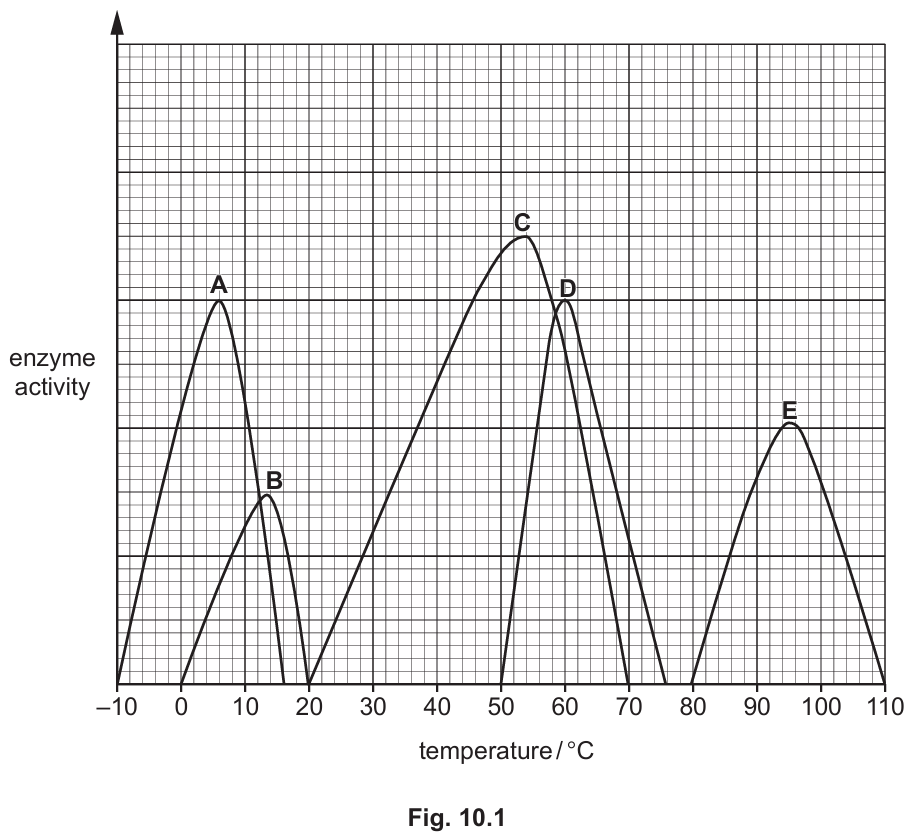
The only two enzymes active at 60°C are enzymes ………………… and ………………… .
The greatest activity for enzyme E is at ………………… °C.
The enzyme active over the greatest range of temperatures is enzyme ………………… .
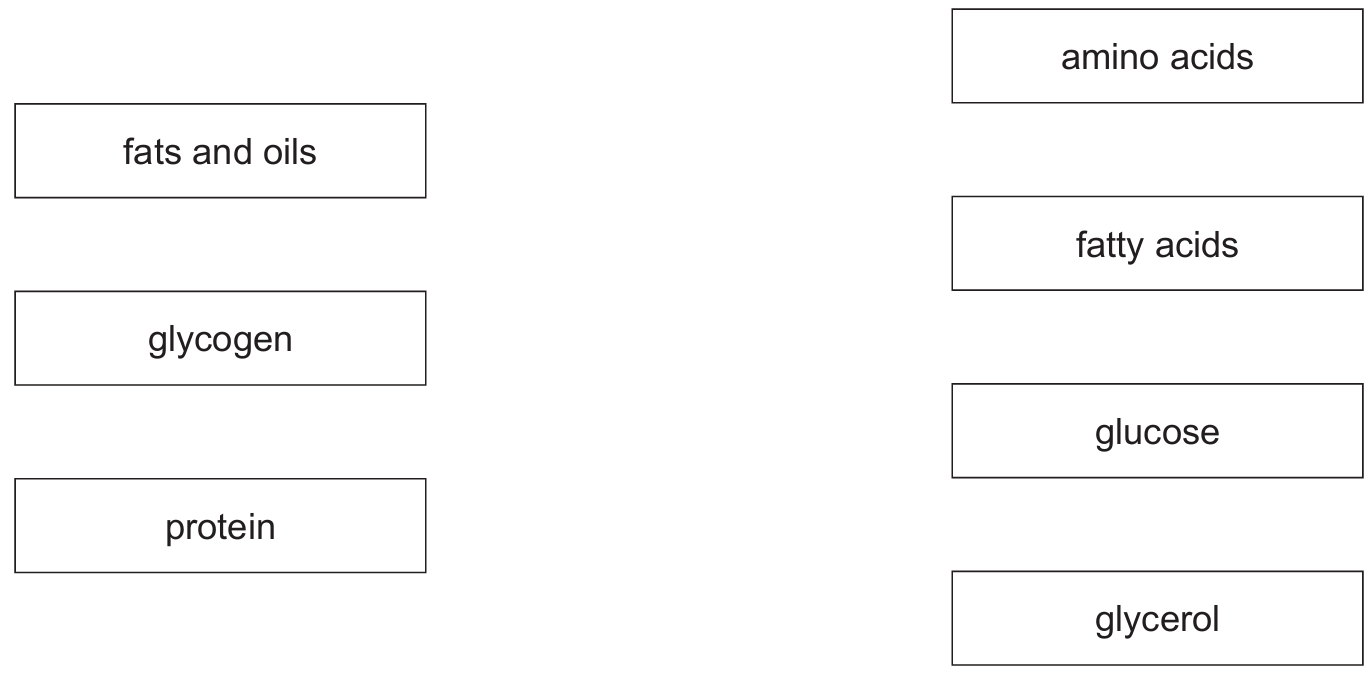
The boxes on the right show the smaller molecules they are made from.
Draw lines to link each biological molecule to all the smaller molecules they are made from.
Most-appropriate topic codes (Cambridge IGCSE Co-ordinated Sciences 0654):
• Topic B5.1 — Enzymes: effect of temperature and pH (Parts (a), (b))
• Topic B4.1 — Biological molecules: elements and tests (Parts (c), (d))
• Topic B4.1 — Biological molecules: building blocks (Part (e))
▶️ Answer/Explanation
(a) Enzymes active at 60°C: C and D; greatest activity for E at 95°C; enzyme active over greatest range: C
Reading the graph at 60°C, only curves C and D show enzyme activity (non-zero) at that temperature.
Curve E peaks at 95°C, the highest point of that curve.
Curve C spans the widest range of temperatures on the x-axis before falling back to zero activity, making it the enzyme active over the greatest range.
(b) pH
Enzyme activity depends on the shape of the enzyme’s active site.
Changes in pH can alter this shape and therefore affect how well the enzyme works.
(c) Carbon, hydrogen, oxygen and nitrogen (all four circled)
Proteins are made of amino acids, which contain these four elements.
Calcium is not a constituent element of proteins, so it should not be circled.
(d) Biuret (solution)
The biuret test is used to detect the presence of protein in a sample.
A colour change from blue to purple/violet indicates a positive result for protein.
(e)
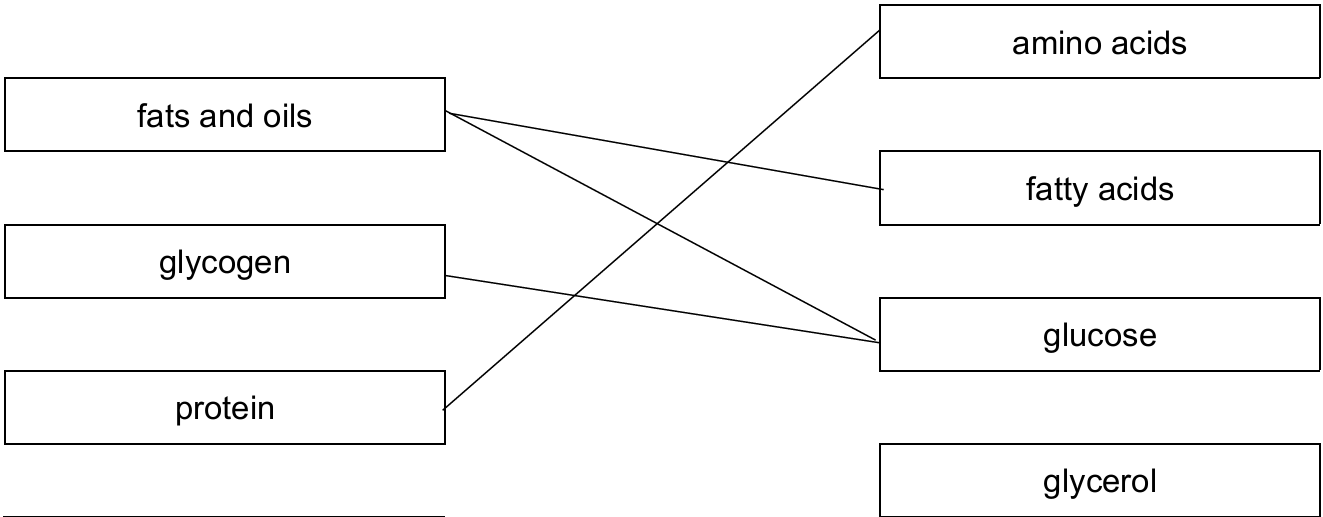
Proteins are built from chains of amino acids linked together.
Fats and oils are made from fatty acids and glycerol, while glycogen (like starch) is a polymer built from glucose units.
Question 11
Deduce the number of protons, neutrons and electrons in this atom of calcium.
Describe how calcium atoms change into calcium ions.
Most-appropriate topic codes (Cambridge IGCSE Co-ordinated Sciences 0654):
• Topic C2.2 — Atomic structure and the Periodic Table (Part (a))
• Topic C2.4 — Ions and ionic bonds (Part (b))
• Topic C7.2/C9.6 — Oxides / thermal decomposition (Part (c)(i)–(ii))
• Topic C7.1 — Characteristic properties of acids and bases: neutralisation (Part (c)(iii))
• Topic C2.1 — Elements, compounds and mixtures (Part (d))
▶️ Answer/Explanation
(a) Protons = 20; neutrons = 20; electrons = 20
The proton number (20) gives the number of protons, which equals the number of electrons in a neutral atom.
The number of neutrons is found from \(\text{nucleon number} – \text{proton number} = 40 – 20 = 20\).
(b) Calcium atoms lose two electrons to form \(\text{Ca}^{2+}\) ions
A calcium atom has two electrons in its outer shell.
It loses these two electrons, forming a positively charged calcium ion, \(\text{Ca}^{2+}\).
(c)(i) Calcium oxide
Heating calcium carbonate causes it to break down (thermally decompose).
The solid product formed is calcium oxide, commonly known as lime.
(c)(ii) Carbon dioxide
The thermal decomposition of calcium carbonate is represented by \(\text{CaCO}_3 \rightarrow \text{CaO} + \text{CO}_2\).
The gas released in this reaction is carbon dioxide.
(c)(iii) Limestone neutralises acidic soil, making it more suitable for growing crops
Many soils become too acidic for crops to grow well.
Limestone is a base, so it reacts with and neutralises the excess acid in the soil.
(d)(i) 3
The formula \(\text{CaCO}_3\) contains the elements calcium, carbon, and oxygen.
This gives a total of three different elements.
(d)(ii) 5
The formula \(\text{CaCO}_3\) shows 1 calcium atom, 1 carbon atom, and 3 oxygen atoms.
Adding these together gives a total of \(1 + 1 + 3 = 5\) atoms.
Question 12
As the gasoline flows into the fuel tank, the gasoline becomes charged.
The gasoline evaporates and the driver’s hand cools down.
Explain this cooling effect.
Use ideas about molecules in your answer.
State the work done on the car by the car engine.
State the unit of your answer.
Describe what happens to the motion of the air particles in the tyres as the air warms up.
The turning effect on the current-carrying coil in the electric motor can be increased by increasing the magnetic field strength.
Complete the sentence to describe how to calculate the moment of a force:
The moment of a force is calculated by multiplying the ……………………….. by the perpendicular distance from the ………………………… .
Most-appropriate topic codes (Cambridge IGCSE Co-ordinated Sciences 0654):
• Topic P4.2.1 — Electrical charge: charging by friction (Part (a))
• Topic P2.2.2 — Melting, boiling and evaporation (Part (b))
• Topic P1.6.2 — Work (Part (c)(i))
• Topic P2.1.2 — Particle model: motion and temperature (Part (c)(ii))
• Topic P4.5.5 — The d.c. motor (Part (d)(i))
• Topic P1.5.2 — Turning effect of forces / moments (Part (d)(ii))
▶️ Answer/Explanation
(a)(i) Friction
As the gasoline flows and rubs against the surfaces of the pipe and tank, charge is transferred between the surfaces.
This process of charging by rubbing together is called friction.
(a)(ii) Name: electrons; Charge: negative
Charging by friction always involves the transfer of negatively charged particles.
These particles are electrons, which move from one surface to another, leaving one surface positively charged and the other negatively charged.
(b) The most energetic molecules escape from the liquid surface during evaporation, leaving behind molecules with lower average kinetic energy
Evaporation removes the fastest-moving, most energetic molecules from the surface of the gasoline.
This lowers the average kinetic energy (and so the temperature) of the molecules left behind, which is felt as a cooling effect on the hand.
(c)(i) Work done = \(5.8 \times 10^7\) joules (J)
Work done is defined as being equal to the energy transferred.
Since the engine transfers \(5.8 \times 10^7\,\text{J}\) of useful energy, the work done on the car has this same value, measured in joules (J).
(c)(ii) The air particles move faster
As the air in the tyres warms up, the particles gain kinetic energy.
This increase in kinetic energy means the particles move faster (with greater average speed).
(d)(i) Increase the current, or increase the number of turns on the coil
The turning effect on a current-carrying coil depends on several factors.
Besides increasing the magnetic field strength, increasing the current through the coil or increasing the number of turns on the coil will also increase the turning effect.
(d)(ii) The moment of a force is calculated by multiplying the force by the perpendicular distance from the pivot
Moment is a measure of the turning effect of a force about a pivot.
It is calculated using \(\text{moment} = \text{force} \times \text{perpendicular distance from the pivot}\).