
Question 1
Do not include the effect on pulse rate.
This is an example of one of the characteristics of living things.
Most-appropriate topic codes (Cambridge IGCSE Co-ordinated Sciences 0654):
• Topic B13.2 — Hormones (Parts (a), (b), (c))
• Topic B1.1 — Characteristics of living organisms (Part (d))
▶️ Answer/Explanation
(a)(i) B
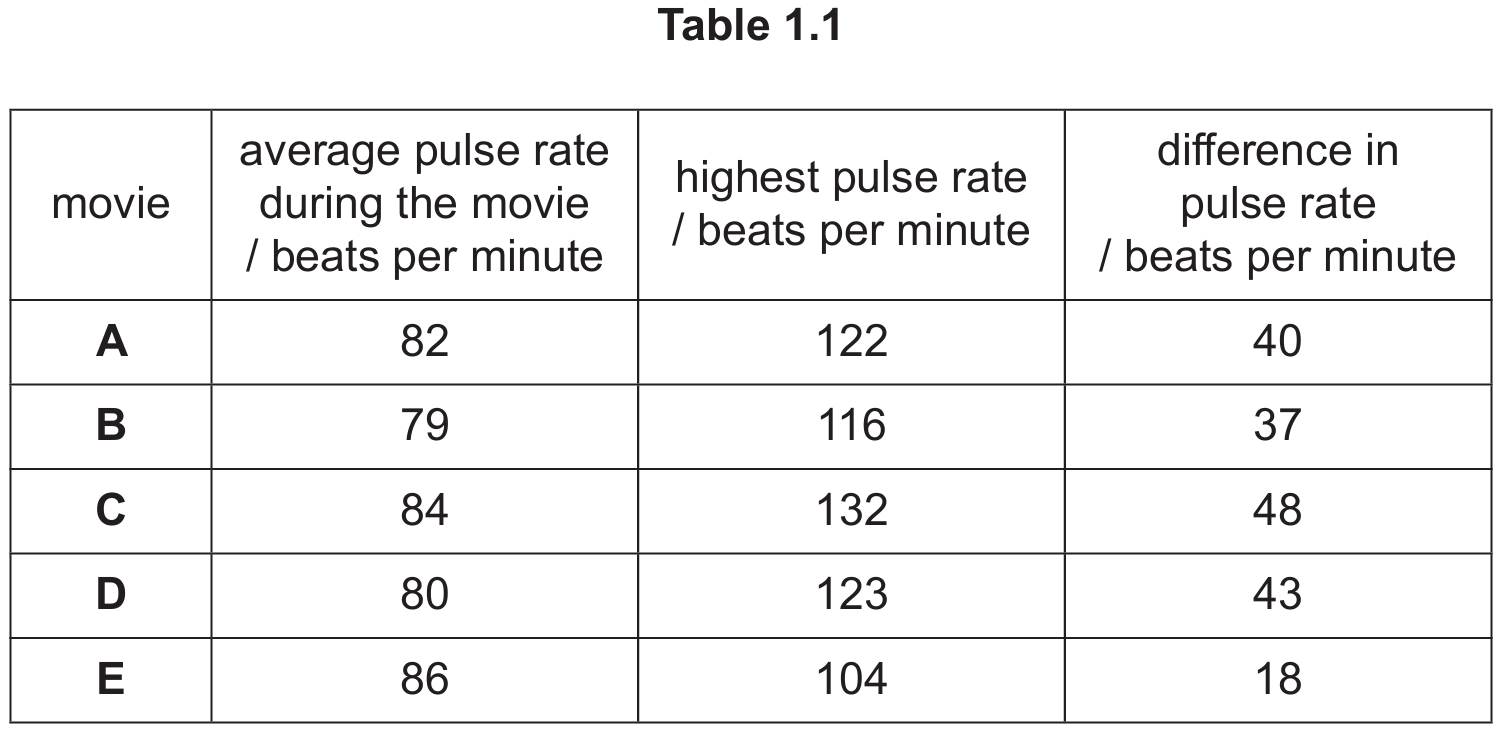
Movie B has the lowest average pulse rate of 79 beats per minute, which is the smallest value in the table.
Comparing all five movies: A = 82, B = 79, C = 84, D = 80, E = 86 beats per minute.
Therefore, movie B gives the lowest average pulse rate.
(a)(ii) C
Greater adrenaline release causes a greater increase in pulse rate, reflected by the largest difference between highest and average pulse rate.
The difference in pulse rate values are: A = 40, B = 37, C = 48, D = 43, E = 18.
Movie C has the largest difference (48 beats per minute), indicating the greatest release of adrenaline.
(a)(iii) 9600 beats
Convert 2 hours to minutes: \(2 \times 60 = 120\) minutes.
Total beats = average pulse rate \(\times\) time = \(80 \times 120 = 9600\) beats.
The average pulse rate for movie D is 80 beats per minute.
(a)(iv) heart
Adrenaline acts on the heart to increase heart rate, which is the effect being measured in the table.
The heart is the target organ of adrenaline responsible for the changes in pulse rate observed.
Other organs listed (kidney, ovary, stomach, skin) do not cause the pulse rate change shown.
(b) Any two from: increased breathing rate; widening of pupils; increased blood flow to muscles.
Adrenaline prepares the body for a ‘fight or flight’ response by increasing breathing rate to supply more oxygen.
It also causes widening (dilation) of the pupils to improve vision in a threatening situation.
Additional effects include increased blood glucose levels and redirection of blood flow to muscles.
(c) plasma
Hormones are chemical messengers transported dissolved in the blood plasma.
Plasma is the liquid component of blood and carries hormones, nutrients, and waste products around the body.
Adrenaline travels from the adrenal glands via the plasma to its target organ, the heart.
(d)(i) sensitivity
Sensitivity is the ability of a living organism to detect and respond to changes in its internal or external environment (stimuli).
The ‘flight or fight’ response is triggered by a stimulus (scary movie) detected by the nervous system.
This response demonstrates that the student can sense and react to environmental changes.
(d)(ii) Any one from: movement; respiration; growth; reproduction; excretion; nutrition.
All living organisms share seven characteristics, often remembered by the acronym MRSGREN.
These include movement, respiration, sensitivity, growth, reproduction, excretion, and nutrition.
Any one of these (other than sensitivity) is an acceptable answer.
Question 2
carbon
copper
oxygen
nitrogen
potassium
sulfur
have a positive charge …………………………….
have the smallest mass. …………………………….
Most-appropriate topic codes (Cambridge IGCSE Co-ordinated Sciences 0654):
• Topic C8.2 — Group I properties (Parts (a)(i), (a)(iv))
• Topic C2.1 — Elements, compounds and mixtures (Parts (a)(ii), (a)(iii), (a)(vi))
• Topic C9.2 — Uses of metals (Part (a)(v))
• Topic C2.2 — Atomic structure and the Periodic Table (Part (b))
▶️ Answer/Explanation
(a)(i) potassium
Potassium (K) has atomic number 19 with electronic structure 2.8.8.1, placing it in Group I (alkali metals).
From the given list, only potassium belongs to Group I of the Periodic Table.
Sodium is also a Group I element but is not in the list.
(a)(ii) carbon
Diamond is one of the allotropes of carbon, consisting of carbon atoms bonded in a giant covalent lattice.
Each carbon atom forms four covalent bonds in a tetrahedral arrangement, giving diamond its extreme hardness.
This is purely a carbon structure — no other element from the list is found in diamond.
(a)(iii) nitrogen
Clean (dry) air is composed of approximately 78% nitrogen \((\text{N}_2)\), 21% oxygen, and 1% other gases.
Nitrogen is the most abundant gas in the atmosphere by volume.
Oxygen makes up the second largest proportion at approximately 21%.
(a)(iv) potassium
The flame test for potassium produces a characteristic lilac (violet) colour.
Sodium gives yellow, calcium gives brick-red, and copper gives blue-green in flame tests.
Potassium’s lilac flame is often observed through blue cobalt glass to filter out any sodium contamination.
(a)(v) copper
Copper is the most commonly used metal in electroplating due to its excellent electrical conductivity and relatively low cost.
In electroplating, copper ions from a copper anode are deposited onto the cathode object.
The equation for copper electroplating involves \(\text{Cu}^{2+} + 2e^- \rightarrow \text{Cu}\) at the cathode.
(a)(vi) sulfur
Sulfur is a key raw material in the manufacture of sulfuric acid \((\text{H}_2\text{SO}_4)\) via the Contact Process.
In the Contact Process, sulfur is first burned to form sulfur dioxide: \(\text{S} + \text{O}_2 \rightarrow \text{SO}_2\).
This is then oxidised to sulfur trioxide and reacted with water to produce sulfuric acid.
(b) electrons; protons; electrons
Electrons occupy shells (energy levels) around the nucleus and are arranged in the order 2, 8, 8, … from the innermost shell.
Protons are found in the nucleus and carry a positive charge of \(+1\); neutrons are also in the nucleus but are neutral.
Electrons have negligible mass (approximately \(\frac{1}{1836}\) of a proton), making them the particles with the smallest mass.
Question 3
(iii) Place alpha (α), beta (β) and gamma (γ) radiations in order of their relative penetrating ability.
most penetrating ……………………………….
least penetrating ……………………………….

Most-appropriate topic codes (Cambridge IGCSE Co-ordinated Sciences 0654):
• Topic P5.2.2 — The three types of nuclear emission (Parts (a)(i)–(iii))
• Topic P3.3 — Electromagnetic spectrum (Parts (a)(iv), (b)(i), (b)(ii))
• Topic P3.4 — Sound (Part (a)(v))
• Topic C2.3 — Isotopes (Part (c))
▶️ Answer/Explanation
(a)(i)
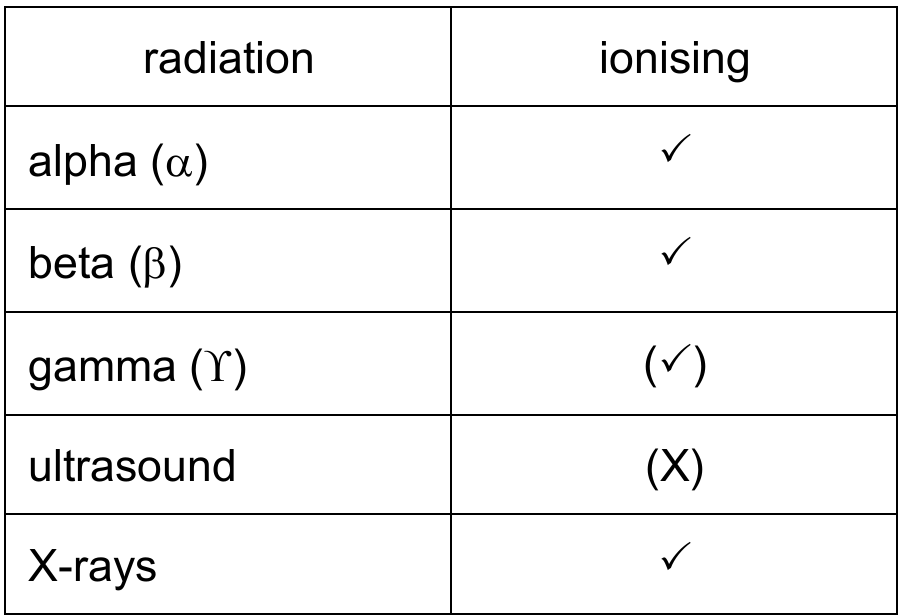
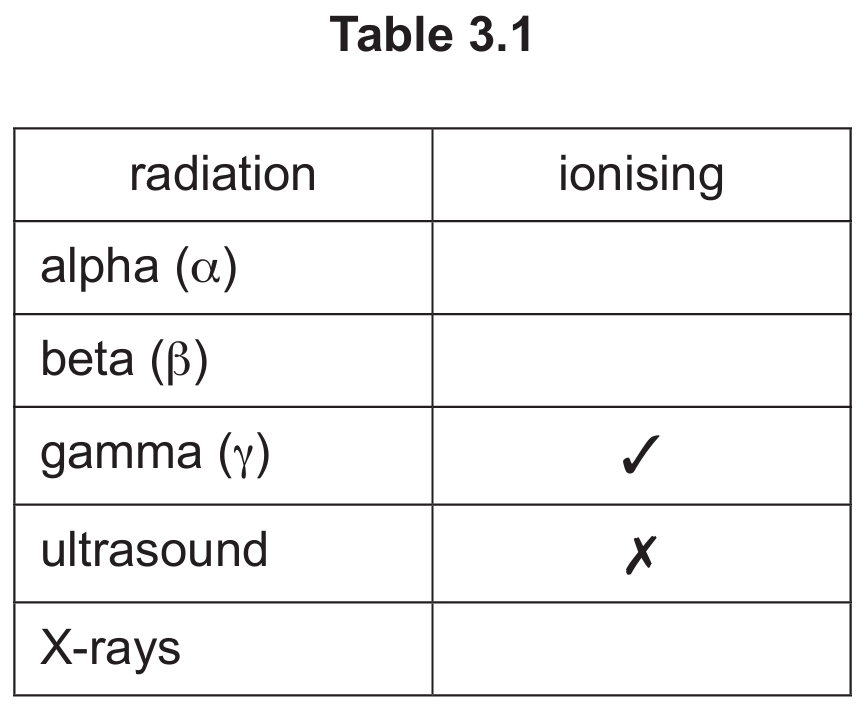
Alpha, beta and gamma radiations are all ionising because they carry sufficient energy to remove electrons from atoms.
Ultrasound is a mechanical wave (not electromagnetic) and does not ionise atoms, so it is non-ionising.
X-rays are high-energy electromagnetic waves and are also ionising, similar to gamma rays.
(a)(ii) Ionising radiation can cause cancer / mutation in cells.
Ionising radiation damages DNA within cells by breaking chemical bonds or causing mutations in the genetic code.
This damage can lead to uncontrolled cell division, resulting in cancer.
It can also destroy cells outright, causing radiation sickness at high doses.
(a)(iii) Most penetrating: gamma (γ); Middle: beta (β); Least penetrating: alpha (α).
Gamma radiation is the most penetrating — it requires several centimetres of lead or metres of concrete to be absorbed.
Beta radiation is stopped by a few millimetres of aluminium, giving it intermediate penetrating power.
Alpha radiation is the least penetrating and is stopped by a few centimetres of air or a sheet of paper.
(a)(iv) To view internal body structures (e.g. to detect broken bones / fractures).
X-rays pass through soft tissue but are absorbed by denser materials such as bone, creating a shadow image.
This allows doctors to examine bones, detect fractures, and identify lung diseases such as pneumonia.
X-rays are also used in dental imaging and for detecting tumours.
(a)(v) Any value greater than 20,000 Hz; unit: Hz.
The upper limit of human hearing is approximately 20,000 Hz (20 kHz), so ultrasound frequencies must exceed this.
Medical ultrasound typically operates between 1 MHz and 20 MHz (i.e. \(1 \times 10^6\) to \(20 \times 10^6\) Hz).
A valid answer could be, for example, 40,000 Hz or 2,000,000 Hz, with unit Hz.
(b)(i) Gamma (γ) radiation is placed to the left of X-rays in the electromagnetic spectrum (higher frequency / shorter wavelength end).
The electromagnetic spectrum in order of decreasing frequency is: gamma → X-rays → ultraviolet → visible → infrared → microwaves → radio waves.
Gamma rays have the highest frequency and shortest wavelength of all electromagnetic waves.
Therefore, gamma radiation belongs in the box immediately to the left of X-rays.
(b)(ii) radio waves
Radio waves are at the far end of the electromagnetic spectrum with the lowest frequency and longest wavelength.
Frequency and wavelength are inversely related: \(v = f\lambda\), so the longest wavelength corresponds to the lowest frequency.
Radio waves can have wavelengths of up to several kilometres.
(c) 123 = nucleon number (mass number / total number of protons + neutrons); 53 = proton number (atomic number / number of protons).
In nuclide notation \(^{A}_{Z}\text{X}\), the top number \(A\) is the nucleon (mass) number — the total number of protons and neutrons in the nucleus.
The bottom number \(Z\) is the proton number (atomic number) — the number of protons in the nucleus.
For iodine-123: it has 53 protons and \(123 – 53 = 70\) neutrons in its nucleus.
Question 4
Most-appropriate topic codes (Cambridge IGCSE Co-ordinated Sciences 0654):
• Topic B15.4 — Sexual reproduction in humans (Parts (a), (b), (c), (d))
• Topic B15.3 — Sexual reproduction in plants (Part (e))
▶️ Answer/Explanation
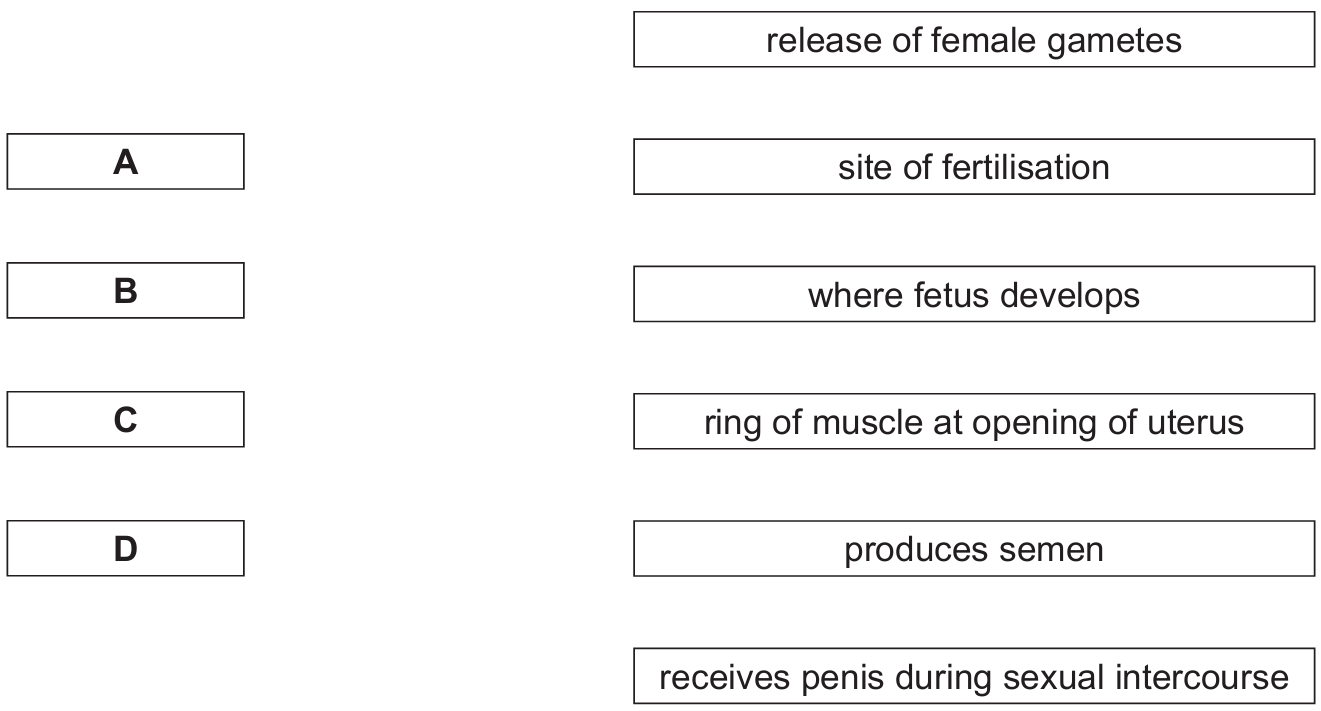
(a) 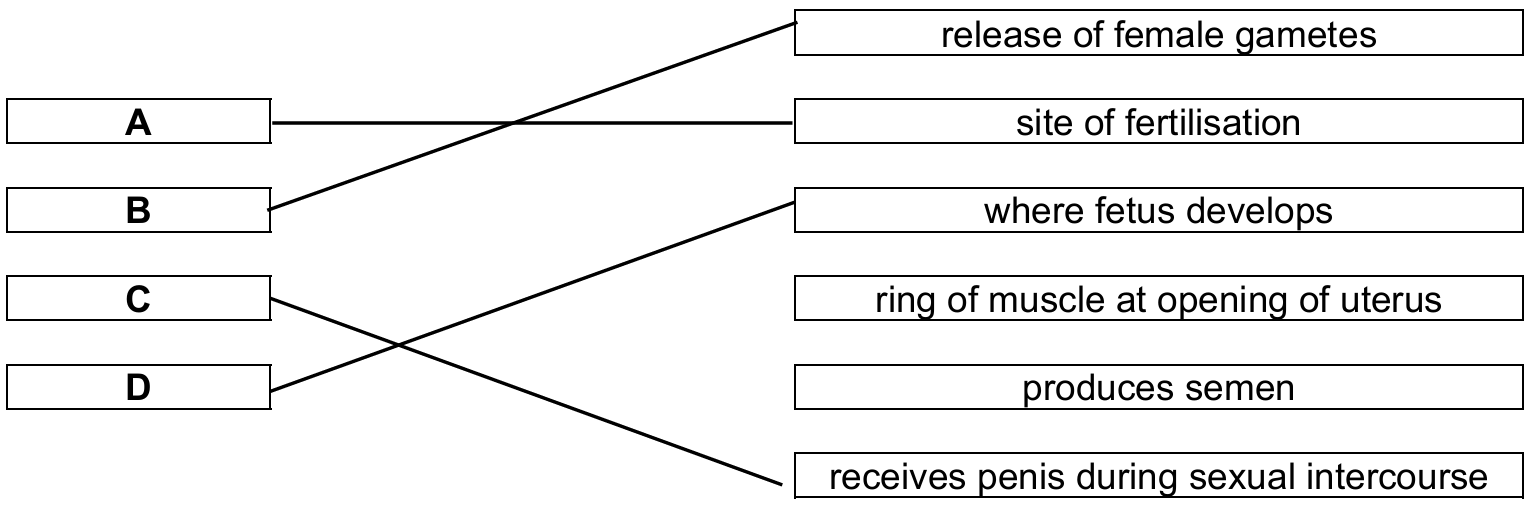
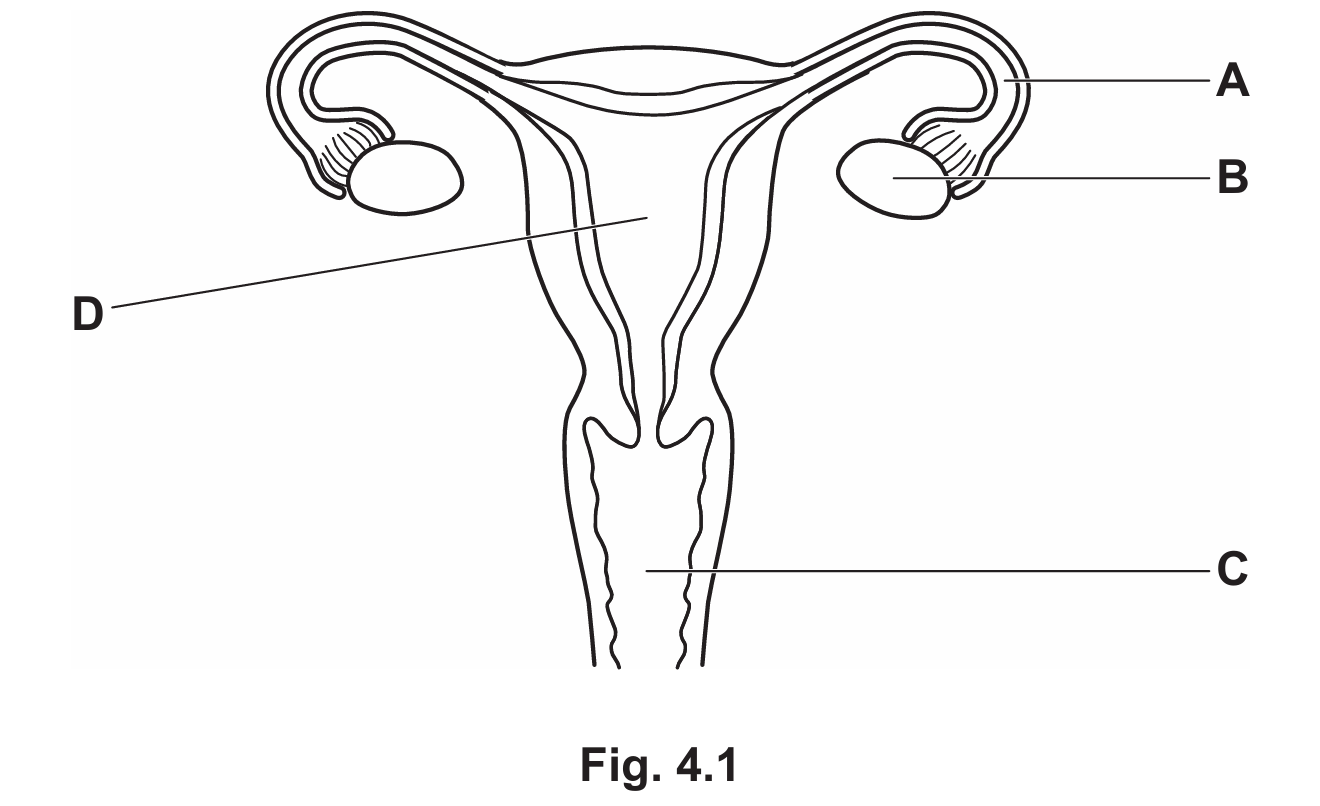
A is the ovary, which releases eggs (female gametes) during ovulation each menstrual cycle.
B is the oviduct (fallopian tube), where fertilisation of the egg by sperm normally takes place.
C is the vagina, which receives the penis during sexual intercourse; D is the uterus, where the fetus develops after implantation.
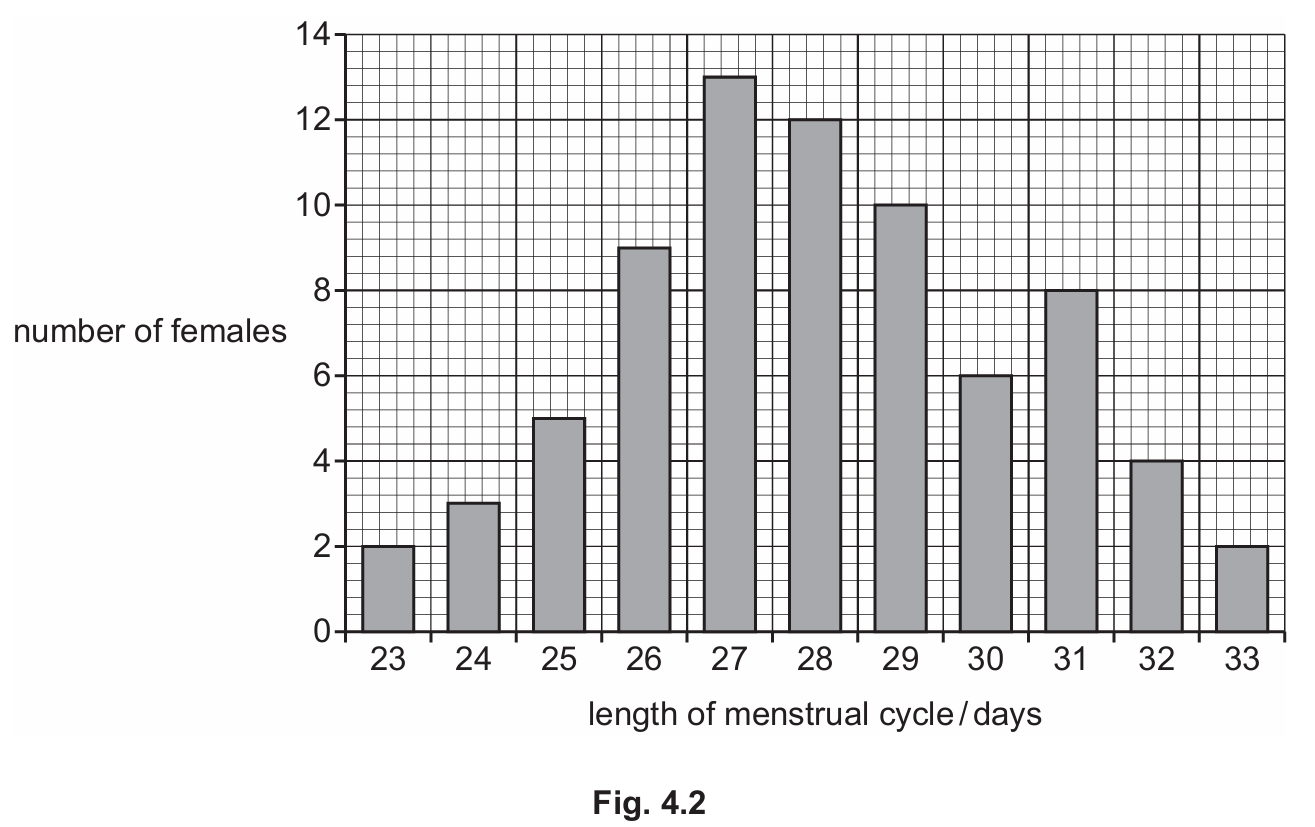
(b)(i) 27 days
The tallest bar in Fig. 4.2 corresponds to the most frequently occurring menstrual cycle length.
Reading the bar chart, the highest bar is at 28 days — wait, the mark scheme states 27 days.
The most frequent length of the menstrual cycle shown is 27 days, as this bar has the greatest number of females.
(b)(ii) 9
Reading the bar chart at the 26-day position on the x-axis, the bar reaches up to 9 on the y-axis.
Therefore, 9 females in the sample have a menstrual cycle of 26 days.
This value is read directly from the height of the bar above the 26-day label.
(c) egg / ovum
The female gamete in humans is called the egg cell or ovum (plural: ova).
It is produced in the ovaries and released during ovulation approximately once every 28 days.
The ovum is much larger than the sperm cell and contains a haploid nucleus with 23 chromosomes.
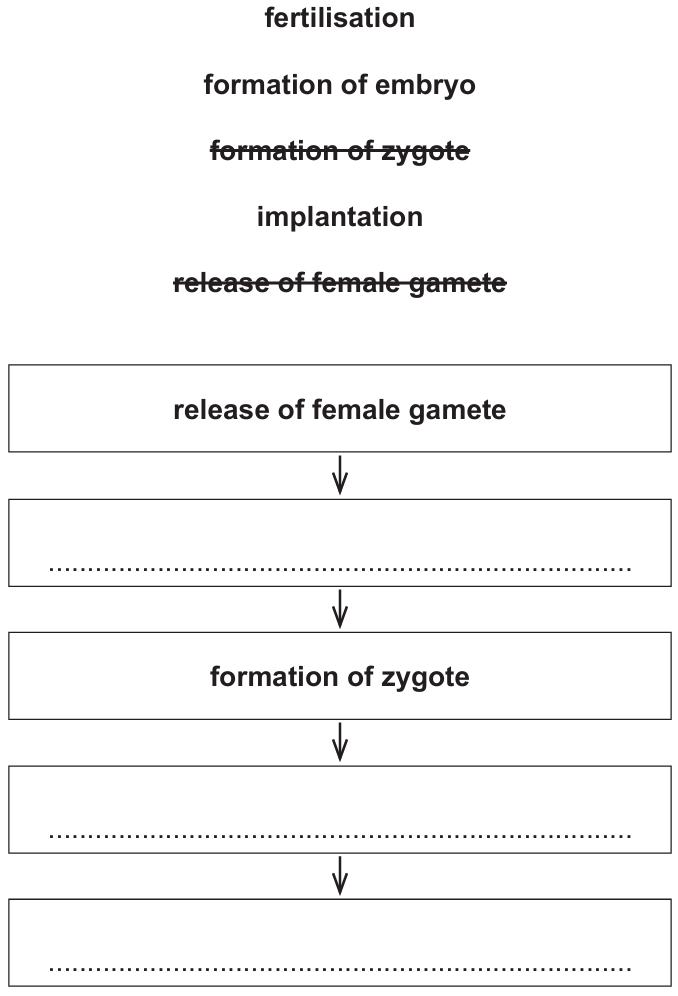
(d) Correct order: release of female gamete → fertilisation → formation of zygote → formation of embryo → implantation.
After the female gamete is released, fertilisation occurs when a sperm fuses with the egg to form a zygote.
The zygote then undergoes cell division (mitosis) to form an embryo.
Implantation follows when the embryo embeds itself into the lining of the uterus (endometrium).
(e) ovule
In flowering plants, fertilisation occurs inside the ovule, which is located within the ovary of the flower.
A pollen tube grows from the pollen grain down through the style to deliver the male gamete to the ovule.
After fertilisation, the ovule develops into a seed and the ovary develops into a fruit.
Question 5
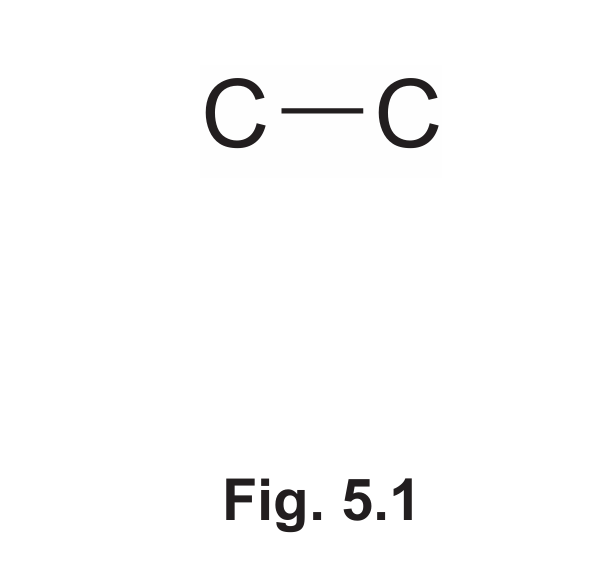
(ii) Write the word equation for the complete combustion of ethanol.
…………………… + …………………… → …………………… + ……………………
State what is meant by an exothermic reaction.
(d) Ethanol is a liquid at room temperature.
Describe the motion and separation of the particles in ethanol.
Most-appropriate topic codes (Cambridge IGCSE Co-ordinated Sciences 0654):
• Topic C11.6 — Alcohols (Parts (a), (b)(i)–(b)(ii), (c))
• Topic C5.1 — Exothermic and endothermic reactions (Part (b)(iii))
• Topic C1.1 — Solids, liquids and gases (Part (d))
▶️ Answer/Explanation
(a) 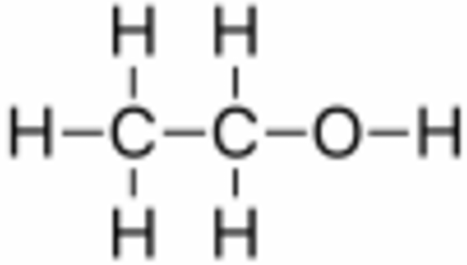
The left carbon has 3 H atoms attached, and the right carbon has 2 H atoms and the –OH group.
The structural formula is: \(\text{H}_3\text{C} – \text{CH}_2 – \text{OH}\), with the C–O–H linkage clearly drawn.
Two marks are awarded: one for the correct C–O–H group, one for all remaining H atoms correctly placed.
(b)(i) solvent (e.g. in perfumes, medicines, cleaning products)
Ethanol is widely used as a solvent because it dissolves many substances that water cannot.
It is also used as an antiseptic and as an ingredient in alcoholic beverages.
Other acceptable answers include: antiseptic, or as a raw material in the chemical industry.
(b)(ii) ethanol + oxygen → carbon dioxide + water
Complete combustion requires excess oxygen and produces only carbon dioxide and water as products.
The word equation is: \(\text{ethanol} + \text{oxygen} \rightarrow \text{carbon dioxide} + \text{water}\).
One mark for correct reactants (ethanol and oxygen), one mark for correct products (carbon dioxide and water).
(b)(iii) A reaction that releases thermal energy (to the surroundings) / the products have less energy than the reactants.
In an exothermic reaction, energy is released to the surroundings, typically causing a temperature rise.
The energy released comes from the formation of new bonds in the products being greater than the energy required to break bonds in the reactants.
Examples include combustion, neutralisation, and respiration.
(c)(i) steam / water
Ethanol is manufactured from ethene by the addition of steam (water) in the presence of a phosphoric acid catalyst.
The reaction is: \(\text{C}_2\text{H}_4 + \text{H}_2\text{O} \rightarrow \text{C}_2\text{H}_5\text{OH}\).
High temperature (~300°C) and high pressure (~60–70 atm) are used to increase the rate and yield.
(c)(ii) A catalyst increases the rate of reaction (without being used up / without being consumed).
A catalyst provides an alternative reaction pathway with a lower activation energy, allowing more particles to react.
The catalyst is not consumed in the reaction and can be recovered unchanged at the end.
This means a small amount of catalyst can speed up a large quantity of reaction.
(c)(iii) fermentation
Ethanol can also be made by fermentation of glucose using yeast in the absence of oxygen (anaerobic conditions).
The equation is: \(\text{C}_6\text{H}_{12}\text{O}_6 \rightarrow 2\text{C}_2\text{H}_5\text{OH} + 2\text{CO}_2\).
Fermentation is carried out at approximately 25–37°C and produces a dilute solution of ethanol.
(d) motion: random; separation: touching (close together / particles in contact).
In a liquid, particles move randomly in all directions but are not completely free as in a gas.
The particles are close together and touching (in contact), with very little space between them, unlike gas particles.
This is why liquids have a definite volume but take the shape of their container.
Question 6
Most-appropriate topic codes (Cambridge IGCSE Co-ordinated Sciences 0654):
• Topic P1.5.1 — Effects of forces (Part (a))
• Topic P1.2 — Motion (Part (b))
• Topic P1.4 — Density (Part (c))
• Topic P1.6.3 — Energy resources (Part (d))
▶️ Answer/Explanation
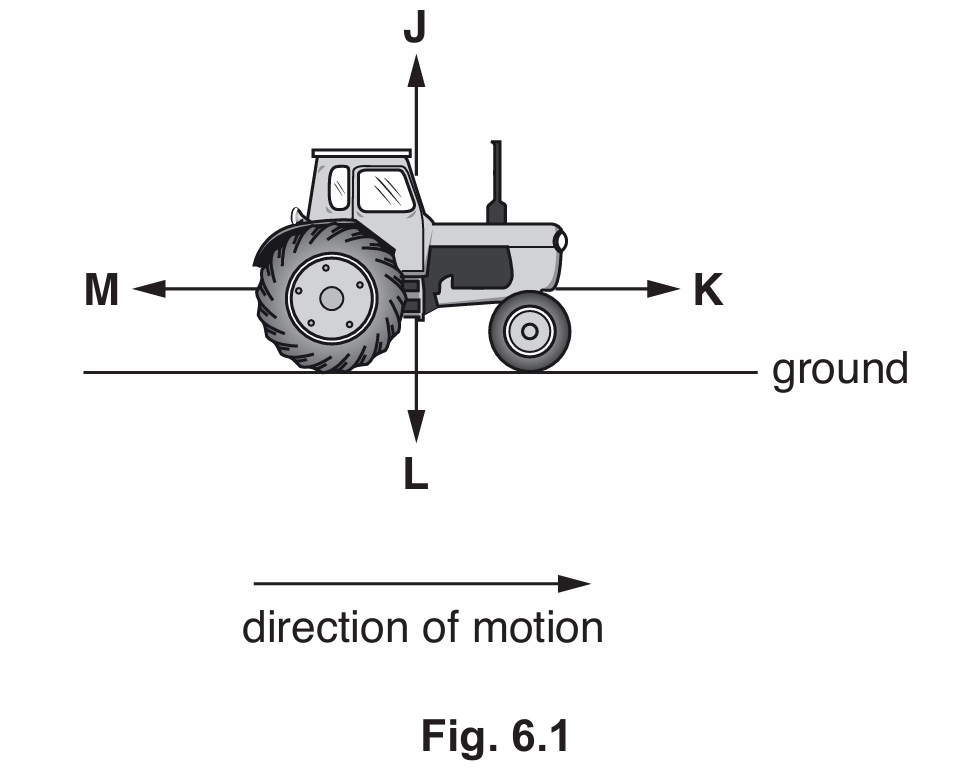
(a)(i) L
Weight is a downward force due to gravity acting on the mass of the tractor.
In Fig. 6.1, force L points downward, which is the direction of the gravitational pull on the tractor.
Force J (upward) is the normal reaction from the ground; K and M are horizontal driving and friction forces respectively.
(a)(ii) A resultant force is needed to cause acceleration; since the tractor accelerates to the right, K must be greater than M.
By Newton’s Second Law, \(F = ma\), a net (resultant) force in the direction of motion is required for acceleration.
The tractor is accelerating to the right, so the net horizontal force must act to the right: \(K – M > 0\), meaning \(K > M\).
If K equalled M, the resultant force would be zero and the tractor would move at constant speed, not accelerate.
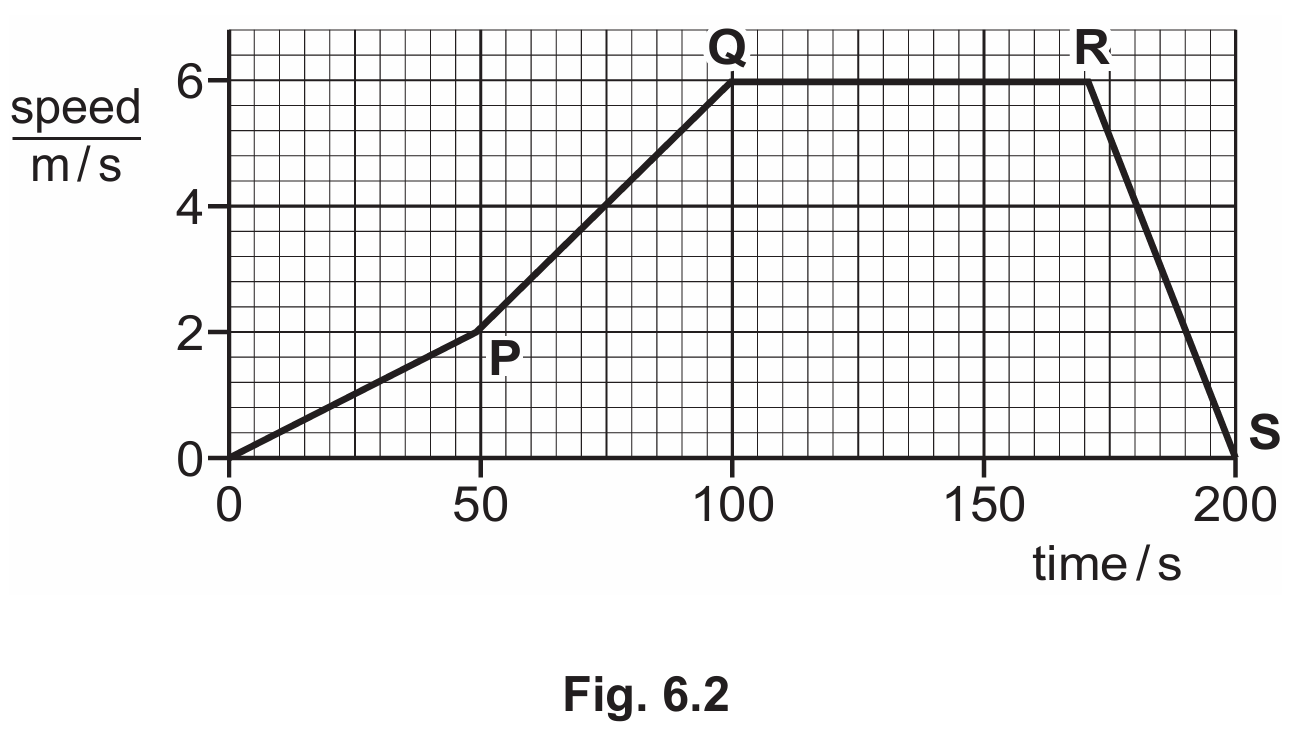
(b)(i) The tractor has constant acceleration (uniformly accelerating / speed increases at a constant rate).
Section PQ is a straight line with positive gradient on the speed-time graph, indicating constant acceleration.
The speed increases steadily from approximately 2 m/s to 6 m/s over the time interval PQ.
A straight line on a speed-time graph always represents uniform (constant) acceleration.
(b)(ii) 420 m
Section QR is a horizontal line on the speed-time graph at 6 m/s, meaning the tractor travels at constant speed.
Distance = speed × time = \(6 \, \text{m/s} \times 70 \, \text{s} = 420 \, \text{m}\).
The time interval for QR is from \(t = 100\) s to \(t = 170\) s — wait, reading from the mark scheme: \(6 \times 70 = 420 \, \text{m}\), so QR spans 70 seconds.
(c) 2.5 m³
Using the formula: \(\text{volume} = \frac{\text{mass}}{\text{density}} = \frac{2500}{1000} = 2.5 \, \text{m}^3\).
Density is defined as mass per unit volume: \(\rho = \frac{m}{V}\), rearranged to \(V = \frac{m}{\rho}\).
The volume of water in the tank is therefore \(2.5 \, \text{m}^3\).
(d) Any two from: wind (energy); solar (energy); hydroelectric; tidal; geothermal; wave.
Renewable energy sources are those that are naturally replenished and will not run out on a human timescale.
Wind turbines and solar panels are the most practical renewable energy sources for a farm setting.
These do not produce carbon dioxide during electricity generation, unlike fossil fuels.
Question 7
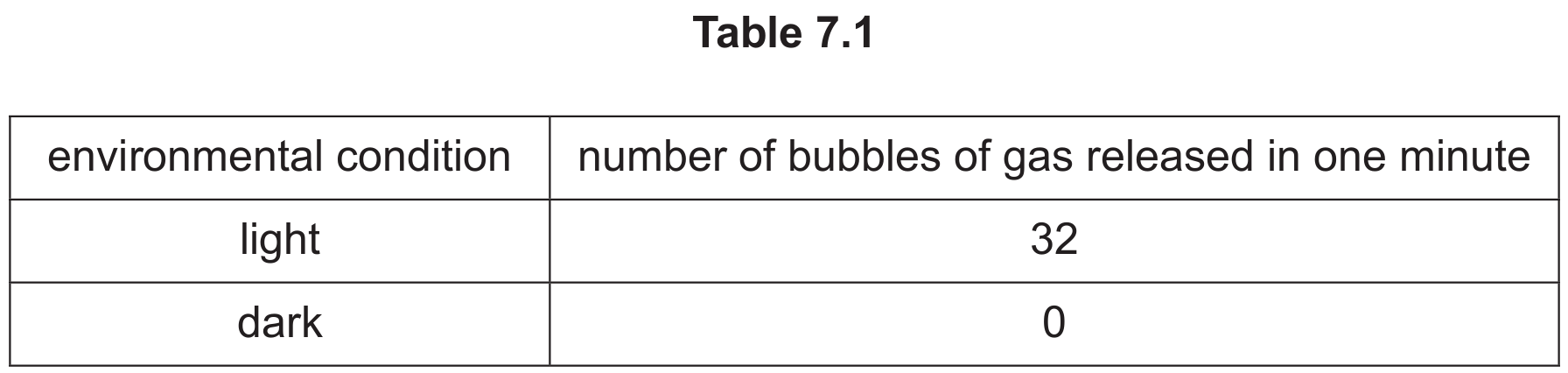
(i) Complete the sentences to explain the results shown in Table 7.1:
The aquatic plant releases more bubbles of ……………… gas when kept in the light.
This is because the process of ……………… requires energy from light.
This energy is used to react the raw materials ……………… and ……………… .
This process takes place in plant cell structures called ……………… .
Most-appropriate topic codes (Cambridge IGCSE Co-ordinated Sciences 0654):
• Topic B6.1 — Photosynthesis (Part (a)(i))
• Topic B13.1 — Coordination and response — tropisms (Part (a)(ii))
• Topic B6.2 — Leaf structure (Part (b)(i))
• Topic B8.1 — Xylem and phloem (Part (b)(ii))
• Topic B6.1 — Photosynthesis, mineral requirements (Part (c))
▶️ Answer/Explanation
(a)(i) oxygen; photosynthesis; carbon dioxide and water; chloroplasts.
The bubbles released are oxygen gas, a product of photosynthesis that occurs only in the light.
Photosynthesis uses light energy to convert carbon dioxide and water into glucose and oxygen: \(6\text{CO}_2 + 6\text{H}_2\text{O} \rightarrow \text{C}_6\text{H}_{12}\text{O}_6 + 6\text{O}_2\).
This process takes place in the chloroplasts, which contain the green pigment chlorophyll that absorbs light energy.
(a)(ii) phototropism
Phototropism is the directional growth response of a plant in response to the stimulus of light.
Shoots grow towards the light (positive phototropism), controlled by the redistribution of the hormone auxin.
Auxin accumulates on the shaded side, causing cells there to elongate more, bending the shoot towards the light.
(b)(i) (upper) epidermis
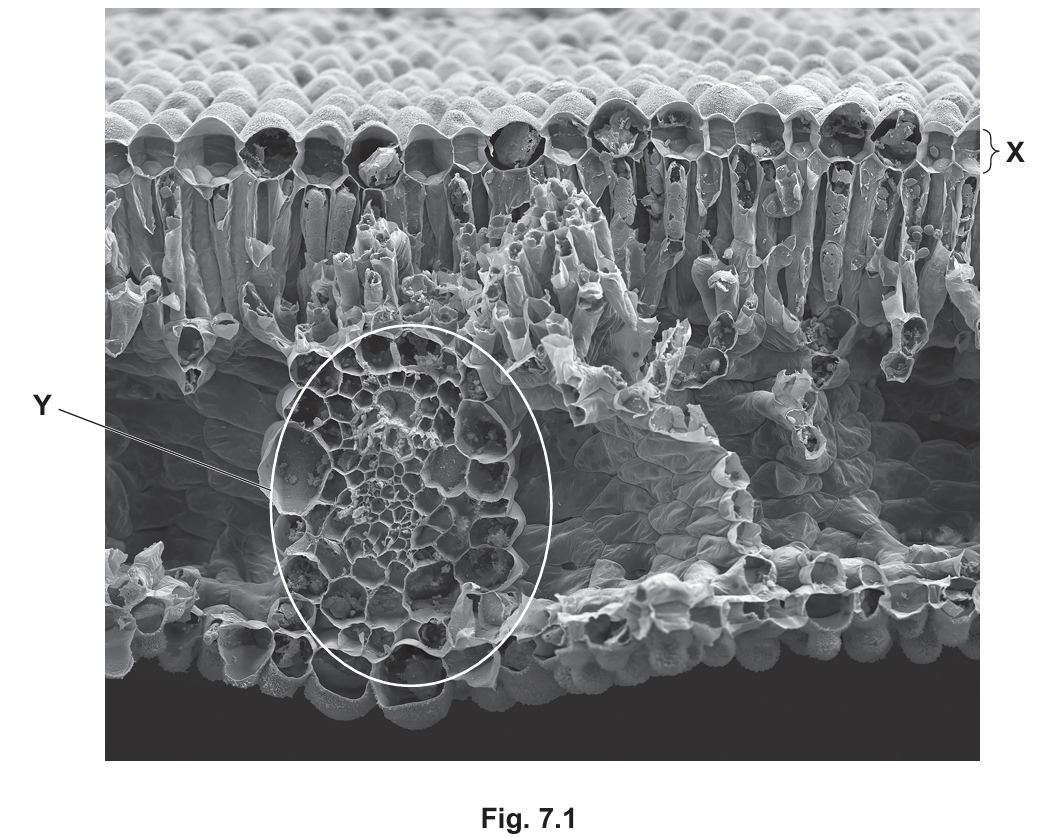
The upper epidermis is the outermost layer of cells on the upper surface of the leaf, labelled X in Fig. 7.1.
It is usually one cell thick and transparent, allowing light to pass through to the photosynthetic mesophyll cells below.
It is covered by a waxy cuticle that reduces water loss by evaporation from the leaf surface.
(b)(ii) name 1: xylem — function: transports water (and mineral ions) from roots to leaves / provides support;
name 2: phloem — function: transports dissolved sugars (from leaves to other parts of the plant / translocation).
Xylem is made of hollow dead cells forming tubes that carry water and dissolved minerals upward from the roots.
Phloem consists of living sieve tube cells and companion cells that transport dissolved organic substances (mainly sucrose) to all parts of the plant.
Both tissues are found together in vascular bundles (labelled Y), which run throughout the leaf blade.
(c) Nitrates are required to synthesise amino acids (which are then used to make proteins).
Plants absorb nitrate ions \((\text{NO}_3^-)\) from the soil through their roots by active transport.
Nitrate ions provide the nitrogen atoms needed to convert glucose (from photosynthesis) into amino acids.
Amino acids are the building blocks of proteins, which are essential for growth, enzyme production, and cell structure.
Question 8
Describe the reaction between potassium and water.
Explain your answer.
- the electronic structure of a sodium atom is 2.8.1
- the electronic structure of a chlorine atom is 2.8.7
Most-appropriate topic codes (Cambridge IGCSE Co-ordinated Sciences 0654):
• Topic C8.2 — Group I properties (Parts (a), (c))
• Topic C7.1 — The characteristic properties of acids and bases (Part (b))
• Topic C2.4 — Ions and ionic bonds (Part (d))
• Topic C4.1 — Electrolysis (Part (e))
▶️ Answer/Explanation
(a) \(2\text{Na} + 2\text{H}_2\text{O} \rightarrow 2\text{NaOH} + \text{H}_2\)
To balance, count atoms on both sides: 2 Na on the left requires 2 NaOH on the right.
With 2 NaOH on the right, there are 2 O atoms, requiring 2 H₂O on the left.
Hydrogen check: 4 H from 2 H₂O = 2 H in 2 NaOH + 2 H in H₂ ✓. Balanced coefficients: 2, 2, 2, 1.
(b)(i) pH = 7
Pure water is neutral, meaning the concentration of \(\text{H}^+\) ions equals the concentration of \(\text{OH}^-\) ions.
Neutral solutions have a pH of exactly 7 on the pH scale (which runs from 0 to 14).
Values below 7 are acidic; values above 7 are alkaline.
(b)(ii) pH = 8–14 (any value above 7)
Sodium hydroxide is an alkali, so the solution has a pH greater than 7.
Concentrated sodium hydroxide solutions can have a pH as high as 13–14.
Any value in the range 8–14 is acceptable as sodium hydroxide is a strong alkali.
(c) The reaction between potassium and water is even more violent/explosive than sodium with water. This is because reactivity increases down Group I, so potassium is more reactive than sodium.
Potassium reacts more vigorously with water than sodium — it fizzes rapidly and ignites the hydrogen gas produced, burning with a lilac flame.
As you go down Group I, the outer electron is further from the nucleus and more easily lost, increasing reactivity.
Potassium is below sodium in Group I, so it has a greater tendency to lose its outer electron and react more violently.
(d)(i) Electronic structure of sodium ion \((\text{Na}^+)\): 2.8
A sodium atom (2.8.1) loses its one outer electron to form a sodium ion \(\text{Na}^+\).
Losing one electron from the third shell removes the entire third shell, giving the electronic structure 2.8.
This gives sodium the same electronic structure as the noble gas neon.
(d)(ii) Electronic structure of chloride ion \((\text{Cl}^-)\): 2.8.8
A chlorine atom (2.8.7) gains one electron to complete its outer shell, forming the chloride ion \(\text{Cl}^-\).
Gaining one electron fills the third shell to 8 electrons, giving the structure 2.8.8.
This gives chloride the same electronic structure as the noble gas argon.
(e) gas at cathode: hydrogen; gas at anode: chlorine.
At the cathode (negative electrode), \(\text{H}^+\) ions from water are discharged: \(2\text{H}^+ + 2e^- \rightarrow \text{H}_2\).
At the anode (positive electrode), \(\text{Cl}^-\) ions are preferentially discharged over \(\text{OH}^-\) ions because the solution is concentrated: \(2\text{Cl}^- \rightarrow \text{Cl}_2 + 2e^-\).
Sodium hydroxide solution is also produced in the solution during this electrolysis (used industrially in the chlor-alkali process).
Question 9
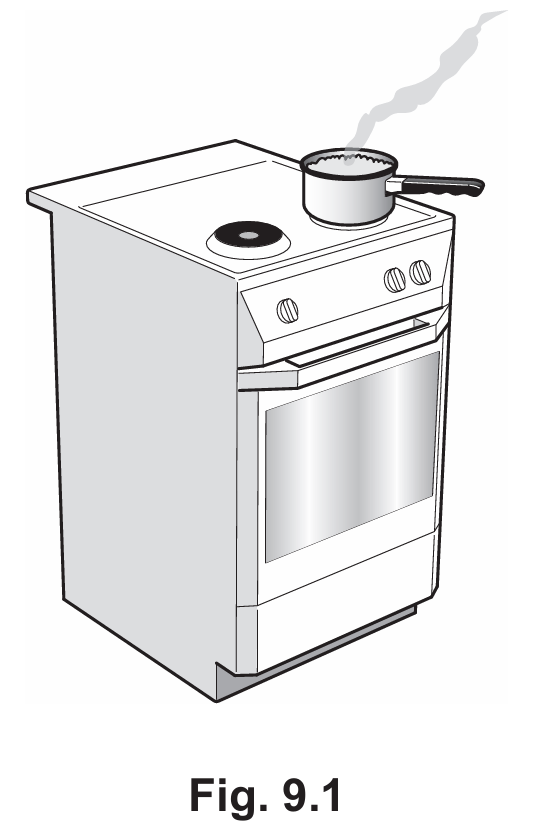
the water ……………………………..
the saucepan. …………………………
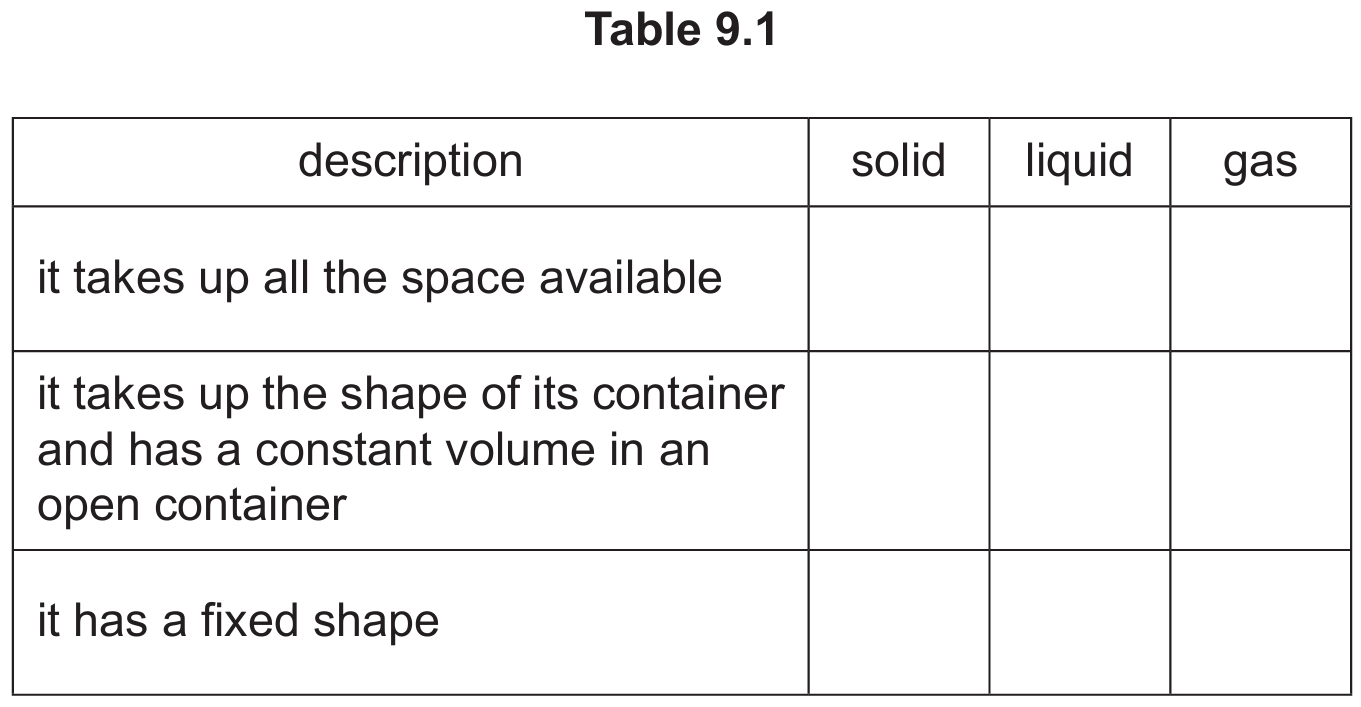
Complete Table 9.1 by placing ticks (✓) in the correct boxes to show which description describes a solid, a liquid and a gas.
Describe one difference between the magnetic properties of steel and the magnetic properties of soft iron.
Calculate the mass of the saucepan in grams.
The gravitational force on unit mass, \(g = 10 \, \text{N/kg}\).
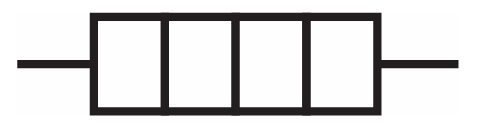 to represent the hotplates.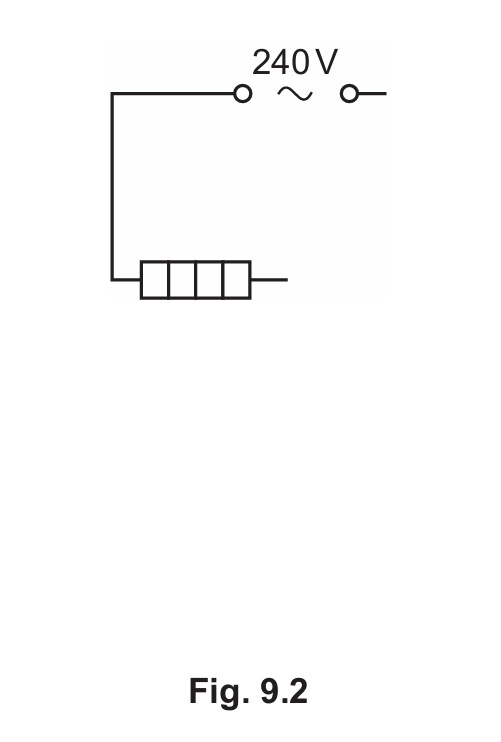
Most-appropriate topic codes (Cambridge IGCSE Co-ordinated Sciences 0654):
• Topic P2.3.4 — Consequences of thermal energy transfer (Parts (a)(i)–(a)(ii))
• Topic P2.2.2 — Melting, boiling and evaporation (Part (a)(iii))
• Topic P2.1.1 — States of matter (Part (a)(iv))
• Topic P4.1 — Simple phenomena of magnetism (Part (b))
• Topic P1.3 — Mass and weight (Part (c))
• Topic P4.3.2 — Series and parallel circuits (Part (d))
▶️ Answer/Explanation
(a)(i) through the water: convection; through the saucepan: conduction.
In liquids, thermal energy is transferred mainly by convection — heated water near the bottom becomes less dense, rises, and cooler water sinks to replace it.
In solids such as the steel saucepan, thermal energy is transferred by conduction — vibrating particles pass energy to neighbouring particles without bulk movement of material.
Radiation can also occur from the outer surface of the pan, but convection and conduction are the main methods here.
(a)(ii) The temperature remains constant / stays at 100 °C while the water is boiling.
During boiling, all the energy supplied is used to overcome the intermolecular forces and convert liquid water to steam.
No energy goes into increasing the kinetic energy of the particles, so the temperature does not rise.
This energy used during a change of state is called latent heat of vaporisation.
(a)(iii) 100 °C
The boiling point of pure water at standard atmospheric pressure (101 325 Pa) is exactly 100 °C.
At higher pressures, the boiling point is higher; at lower pressures (e.g. at altitude), the boiling point is lower.
This fixed boiling point is used as one of the calibration points on the Celsius temperature scale.
(a)(iv) 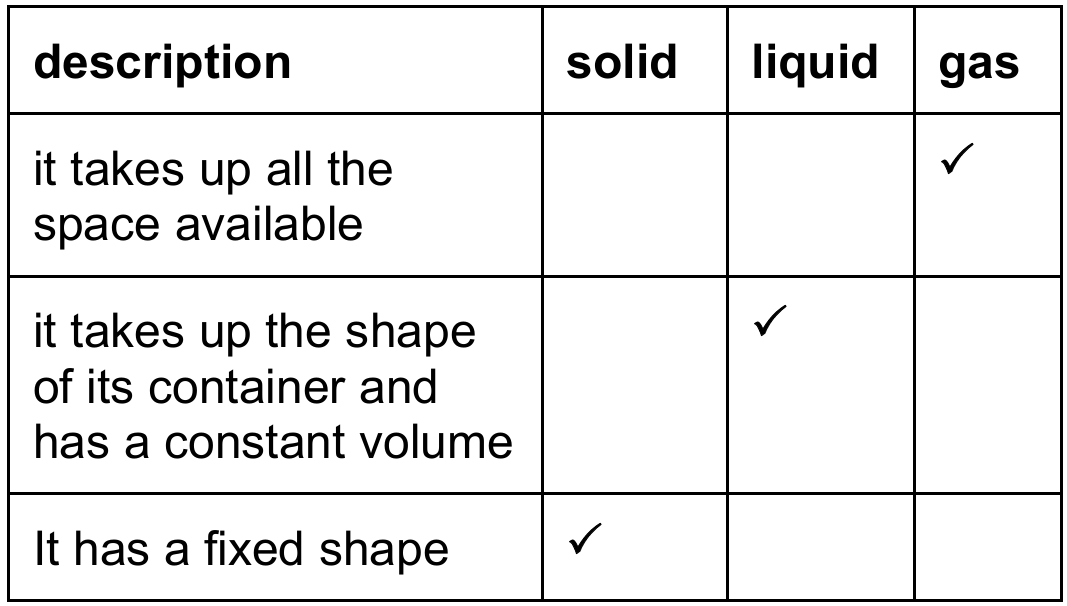
A gas expands to fill any container completely, so “takes up all the space available” describes a gas.
A liquid takes the shape of its container but has a definite volume, so the second description applies to a liquid.
A solid has a fixed shape and volume because its particles are held in fixed positions by strong intermolecular forces.
(b) Steel retains its magnetism better (is a permanent magnet); soft iron loses its magnetism more readily (is a temporary magnet).
Steel is a hard magnetic material — once magnetised it remains magnetised, making it suitable for permanent magnets.
Soft iron is an easy magnetic material — it is easily magnetised but loses its magnetism quickly when the external field is removed.
This makes soft iron suitable for electromagnet cores (e.g. in transformers and electric bells) where magnetism must be switched on and off.
(c) 1500 g
Using \(W = mg\), rearranged to \(m = \frac{W}{g} = \frac{15}{10} = 1.5 \, \text{kg}\).
Converting to grams: \(1.5 \, \text{kg} \times 1000 = 1500 \, \text{g}\).
The question specifically asks for the mass in grams, so the conversion from kg to g is essential for full marks.
(d) The completed circuit has: the 240 V supply connected to two branches in parallel, each branch containing a switch in series with a heater symbol. Correct symbol for switch; second heater connected in parallel; each heater controlled by a separate switch.
In a parallel circuit, each branch operates independently so each hotplate can be switched on or off without affecting the other.
A switch must be placed in series with each heater so that it can control that heater individually.
The circuit symbol for a heater is a rectangle with slanted lines inside (resembling a heating element).
Question 10
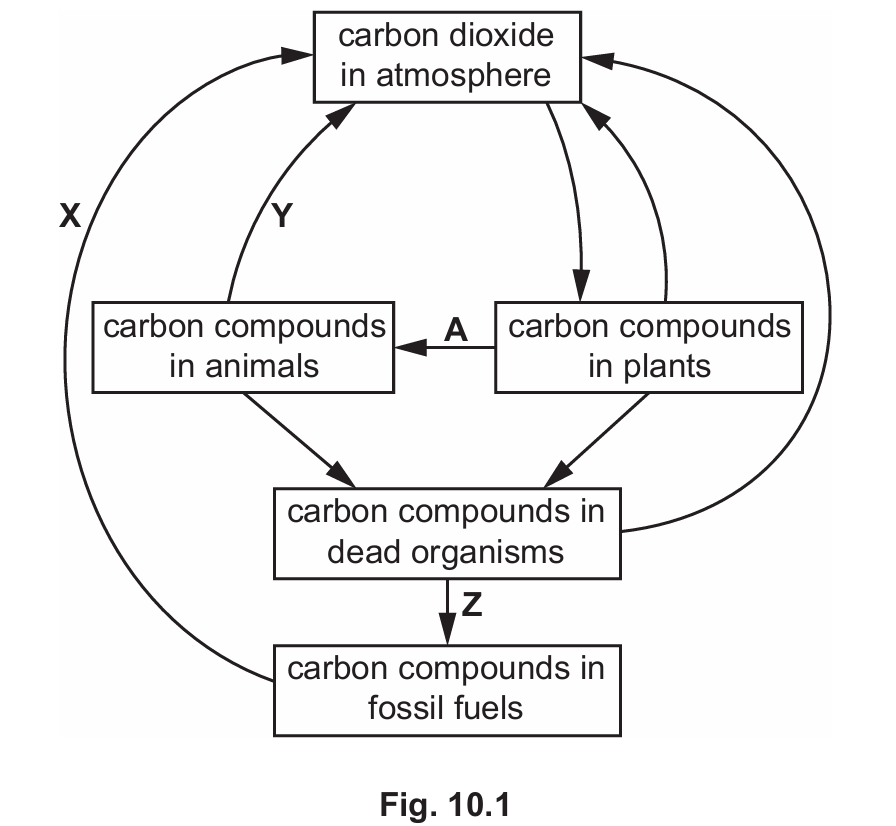
Use Fig. 10.1 to state two ways humans could increase the removal of carbon dioxide from the atmosphere.
Complete the sentences to define the term food chain.
A food chain is the transfer of ……………… from one organism to the next, beginning with a ……………… .
State two sources of water pollution.
Most-appropriate topic codes (Cambridge IGCSE Co-ordinated Sciences 0654):
• Topic B18.3 — Carbon cycle (Parts (a), (b))
• Topic B18.2 — Food chains and food webs (Part (c))
• Topic B19.1 — Habitat destruction / water pollution (Part (d))
▶️ Answer/Explanation
(a) X = combustion; Y = respiration; Z = fossilisation.
X represents combustion — burning of fossil fuels or organic matter releases \(\text{CO}_2\) from carbon compounds in animals back to the atmosphere.
Y represents respiration — animals and plants release \(\text{CO}_2\) back into the atmosphere through aerobic respiration: \(\text{C}_6\text{H}_{12}\text{O}_6 + 6\text{O}_2 \rightarrow 6\text{CO}_2 + 6\text{H}_2\text{O}\).
Z represents fossilisation — over millions of years, dead organisms are compressed and transformed into fossil fuels (coal, oil, natural gas).
(b) Any two from: plant more trees (reforestation / afforestation); prevent deforestation.
Planting more trees increases the number of plants carrying out photosynthesis, which removes \(\text{CO}_2\) from the atmosphere.
Preventing deforestation stops the loss of trees that are currently absorbing \(\text{CO}_2\) through photosynthesis.
Both methods increase the uptake of carbon dioxide by plants, reducing atmospheric concentrations.
(c) energy; producer.
A food chain shows the transfer of energy from one organism to the next, beginning with a producer.
Producers are photosynthetic organisms (usually plants or algae) that convert light energy into chemical energy stored in organic molecules.
Energy is transferred along the food chain as organisms eat and are eaten, but some energy is lost at each stage as heat.
(d) Any two from: chemical waste; discarded rubbish; untreated sewage; fertilisers (nitrates/phosphates causing eutrophication).
Untreated sewage introduces harmful bacteria and excess nutrients into water bodies, reducing oxygen levels and harming aquatic life.
Fertilisers washed from agricultural land cause eutrophication — algal blooms deplete oxygen when they decompose, killing fish.
Industrial chemical waste and rubbish (plastics) also contaminate water, making it toxic to aquatic organisms and unsafe for drinking.
Question 11
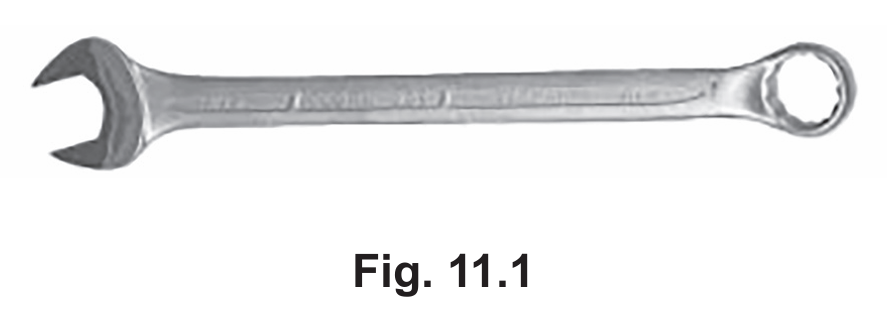
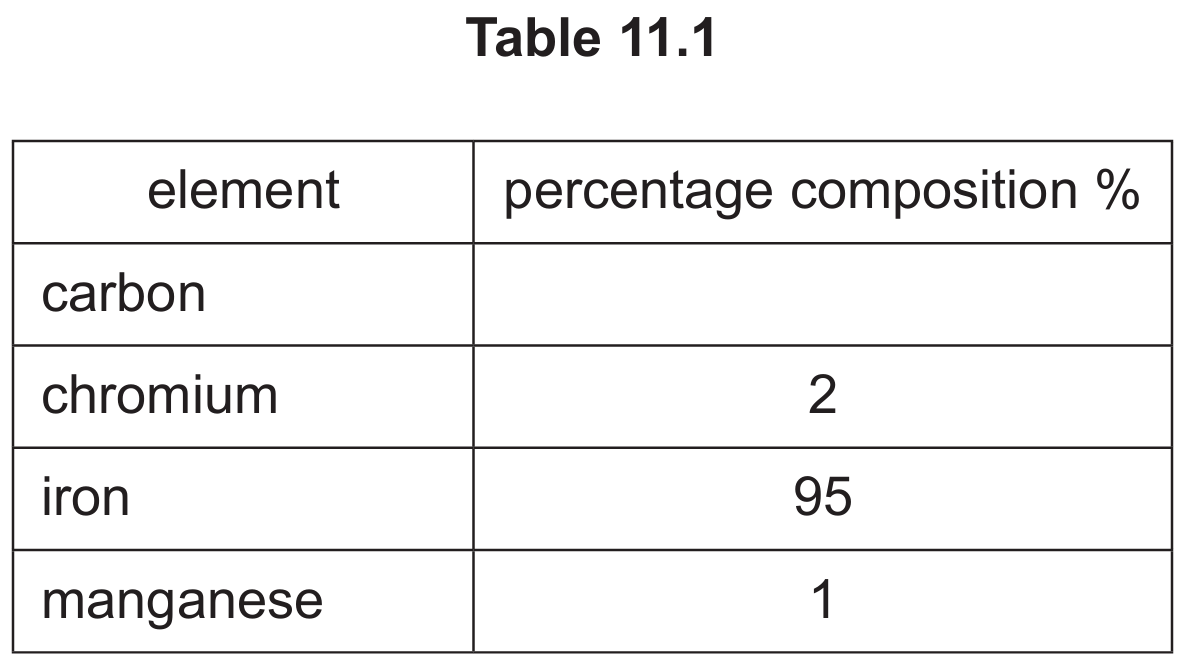
Calculate the mass of chromium contained in the spanner.
Name one substance used in a barrier method of rust prevention.
Suggest one other reason why iron needs to be recycled.
Most-appropriate topic codes (Cambridge IGCSE Co-ordinated Sciences 0654):
• Topic C9.1 — Properties of metals (Part (a))
• Topic C9.3 — Alloys and their properties (Part (b))
• Topic C6.3 — Redox (Part (c))
• Topic C9.5 — Corrosion of metals (Part (d))
• Topic C9.6 — Extraction of metals (Part (e))
▶️ Answer/Explanation
(a) good electrical conductor; high melting point; malleable.
Metals are good electrical conductors because they have delocalised electrons that can move freely through the metallic lattice.
Metals generally have high melting points due to the strong metallic bonds between positive ions and the sea of delocalised electrons.
Metals are malleable — they can be hammered or rolled into sheets without breaking, because layers of ions can slide over each other.
(b)(i) 2%
The total percentage must add up to 100%: carbon% = \(100 – 95 – 2 – 1 = 2\%\).
Carbon makes up 2% of the alloy composition, with iron (95%), chromium (2%), and manganese (1%) accounting for the rest.
This is a stainless steel-type alloy, with carbon improving hardness.
(b)(ii) 1.6 g
Mass of chromium = \(\frac{2}{100} \times 80 \, \text{g} = 1.6 \, \text{g}\).
Chromium makes up 2% of the alloy, so in an 80 g spanner: \(0.02 \times 80 = 1.6 \, \text{g}\).
This small amount of chromium significantly improves the alloy’s resistance to corrosion.
(b)(iii) The alloy is stronger than pure iron (alloys are harder/more resistant to deformation than pure metals).
In a pure metal, layers of atoms can slide over each other easily, making it soft and easily deformed.
In an alloy, atoms of different sizes disrupt the regular lattice, preventing layers from sliding, making the alloy harder and stronger.
A spanner needs to be strong to apply torque without bending or breaking.
(c) iron oxide
In this reaction, iron oxide loses oxygen to form iron — this is reduction (loss of oxygen).
Simultaneously, carbon monoxide gains oxygen to form carbon dioxide — this is oxidation (gain of oxygen).
Iron oxide is the substance that is reduced; carbon monoxide is the reducing agent.
(d)(i) element: oxygen; compound: water.
Rusting is a specific form of corrosion that requires both oxygen \((\text{O}_2)\) and water \((\text{H}_2\text{O})\) to be present simultaneously.
If either oxygen or water is absent, rusting will not occur — this is demonstrated by classic rusting experiments with dry air or boiled water.
Rust is hydrated iron(III) oxide: \(\text{Fe}_2\text{O}_3 \cdot n\text{H}_2\text{O}\).
(d)(ii) paint / oil / grease (any barrier coating that physically prevents contact with oxygen and water).
Barrier methods work by coating the iron surface with a layer that prevents oxygen and water from reaching the metal.
Paint is the most common barrier method, used on cars, bridges, and railings to prevent rusting.
Oil and grease are used on machine parts, while plastic coatings are used on some metal items.
(e) Iron is a finite resource (iron ore will eventually run out / iron ore reserves are limited).
Iron ore is a non-renewable resource — once extracted and used, it cannot be replaced on a human timescale.
Recycling iron reduces the rate at which iron ore reserves are depleted, extending their availability for future generations.
Recycling also reduces the energy consumption and carbon emissions associated with smelting new iron from ore.
Question 12
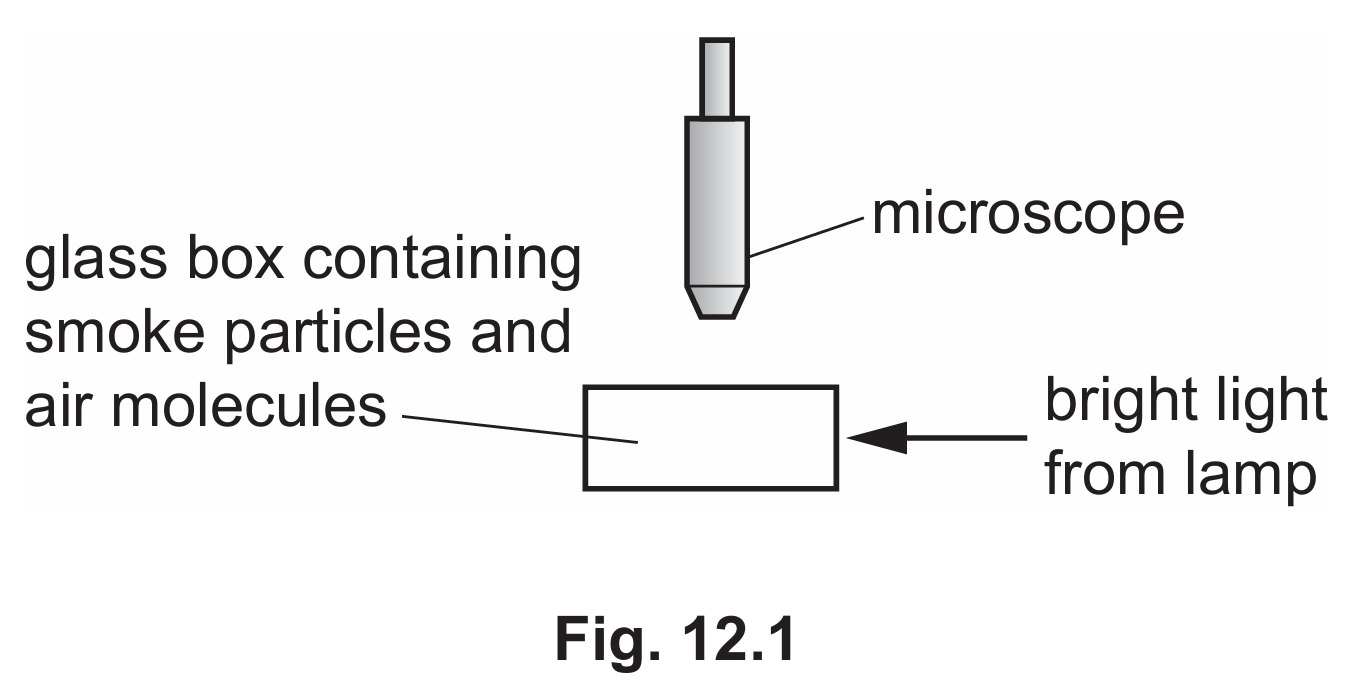

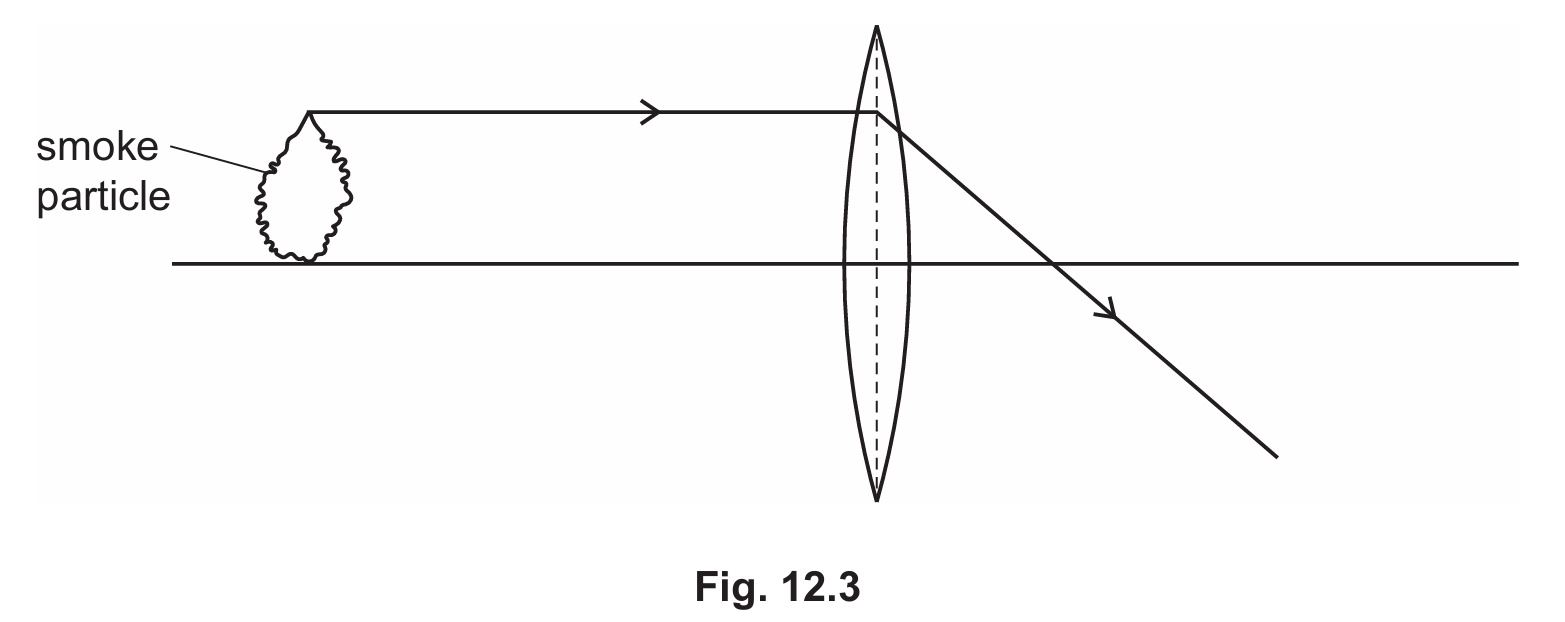
(iv) Circle the two correct words or phrases that describe the image.
diminished enlarged inverted same size upright
Most-appropriate topic codes (Cambridge IGCSE Co-ordinated Sciences 0654):
• Topic P2.1.2 — Particle model (Part (a))
• Topic P4.2.4 — Resistance (Part (b))
• Topic P3.2.3 — Thin converging lens (Parts (c)(i)–(c)(iv))
▶️ Answer/Explanation
(a) Brownian motion
Brownian motion is the random, erratic movement of small particles (such as smoke particles) caused by unequal bombardment by the surrounding molecules.
Air molecules are in constant random motion and collide with the smoke particles from all sides; when the collisions are unequal, the smoke particle is pushed in a random direction.
This observation provided early evidence for the existence of atoms and molecules and their random thermal motion.
(b) 7.5 Ω
Using Ohm’s Law: \(R = \frac{V}{I} = \frac{3.0 \, \text{V}}{0.40 \, \text{A}} = 7.5 \, \Omega\).
Resistance is the ratio of potential difference (voltage) across a component to the current flowing through it.
The unit of resistance is the ohm (Ω), named after Georg Simon Ohm.
(c)(i) A second ray drawn through the centre of the lens (undeviated) from the top of the smoke particle; the image I is located where this ray intersects the refracted ray on the other side of the lens.
To locate an image, draw a ray through the optical centre of the lens — this ray passes straight through without bending.
The intersection of this ray with the ray that was refracted through the lens (already given in Fig. 12.3) locates the top of the image I.
Since the object is beyond the focal point, the image formed is real and inverted.
(c)(ii) F is labelled at the point on the principal axis on the right side of the lens where parallel rays converge (the focal point).
The principal focus (F) of a converging lens is the point on the principal axis where rays parallel to the axis converge after refraction.
In Fig. 12.3, the refracted ray shown crosses the principal axis at the focal point — this is where F should be labelled.
A converging lens has a real focal point on the same side as the refracted light.
(c)(iii) The focal length is shown by a double-headed arrow from the optical centre of the lens to the principal focus F, along the principal axis.
Focal length is defined as the distance from the optical centre of the lens to the principal focus F.
It is measured along the principal axis and is a fixed property of the lens (shorter focal length = more powerful lens).
The double-headed arrow \(\leftrightarrow\) should span exactly from the lens centre to the labelled point F.
(c)(iv) diminished; inverted
When the object is placed beyond twice the focal length (\(u > 2f\)) of a converging lens, the image formed is real, inverted, and diminished.
Diminished means the image is smaller than the object; inverted means the image is upside down relative to the object.
This is the principle used in a camera, where a converging lens forms a smaller, inverted image of a distant scene on the film/sensor.