
Question 1

meiosis occurs
fertilisation occurs
implantation occurs.

number of chromosomes ……………………………………..
arrangement of chromosomes ………………………………..

Most-appropriate topic codes (Cambridge IGCSE Co-ordinated Sciences 0654):
• Topic B15.4 — Sexual reproduction in humans (Parts (a), (b), (c), (d))
▶️ Answer/Explanation
(a) meiosis – B; fertilisation – A; implantation – E
Meiosis (reduction division to form gametes) occurs in the ovary, labelled B.
Fertilisation (fusion of sperm and egg nuclei) occurs in the oviduct, labelled A.
Implantation (embedding of the embryo into the uterus lining) occurs in the uterus, labelled E.
(b)(i) 46 chromosomes; arranged in pairs
Cell \(Z\) is the zygote, formed when a haploid sperm (23 chromosomes) fuses with a haploid egg (23 chromosomes).
\(23 + 23 = 46\) chromosomes, restoring the diploid number.
These 46 chromosomes are arranged as 23 homologous pairs.
(b)(ii) XX
Human females have two X chromosomes as their sex chromosomes.
Males instead have one X and one Y chromosome.
(b)(iii) Jelly coat
The jelly coat surrounding the egg cell changes its structure immediately after fertilisation.
This thickens/hardens the coat, acting as a barrier that prevents any further sperm from entering (polyspermy block).
(c) Shock absorber / protection from mechanical harm or infection / stabilises temperature
Amniotic fluid surrounds the fetus inside the amniotic sac.
It cushions the fetus against physical knocks, helps maintain a stable temperature, and provides some protection from infection.
(d) 
Carbon dioxide actually diffuses from the fetal blood to the mother’s blood (the statement as written reverses this), so it is not ticked.
The blood of the mother and fetus never mix in the placenta — exchange occurs by diffusion across a thin barrier, so this statement is not ticked.
The mother does not provide the fetus with excretory products — instead the fetus’s excretory products diffuse into the mother’s blood, so this is not ticked.
The placenta does act as a barrier to many toxins, and the umbilical cord does connect the fetus to the placenta — both of these statements are correct and should be ticked.
Question 2
Magnesium chloride, \(MgCl_{2}\), and hydrogen gas are made.
Most-appropriate topic codes (Cambridge IGCSE Co-ordinated Sciences 0654):
• Topic C2.4 — Ions and ionic bonds (Part (a))
• Topic C3.2 — Relative masses of atoms and molecules (Part (b)(ii))
• Topic C6.3 — Redox (Part (b)(iii))
▶️ Answer/Explanation
(a)(i) \(MgSO_4\)
\(Mg^{2+}\) carries a charge of \(+2\) and \(SO_4^{2-}\) carries a charge of \(-2\).
These charges balance in a 1:1 ratio, giving the formula \(MgSO_4\).
(a)(ii) Magnesium has free (delocalised) electrons that can move; magnesium sulfate’s ions are fixed in position in the solid lattice
In solid magnesium, the metallic bonding means electrons are delocalised and free to move through the structure, carrying charge.
In solid magnesium sulfate, the ions are held in fixed positions by strong ionic bonds and cannot move to carry charge.
Conduction only becomes possible for magnesium sulfate once it is molten or dissolved, freeing the ions to move.
(b)(i) Test: lighted splint; Observation: a squeaky pop
A lighted splint is held at the mouth of the test tube containing the gas.
Hydrogen gas ignites rapidly with a characteristic squeaky “pop” sound, confirming its identity.
(b)(ii) 4.75 g (≈ 4.8 g)
Moles of Mg \(= \dfrac{1.2}{24} = 0.05\) mol.
From the equation, moles of \(MgCl_2\) = moles of Mg = 0.05 mol (1:1 ratio).
\(M_r(MgCl_2) = 24 + (2 \times 35.5) = 95\), so mass \(= 0.05 \times 95 = 4.75\) g ≈ 4.8 g.
(b)(iii) Mg is oxidised (loses electrons); H⁺ is reduced (gains electrons)
Magnesium atoms lose two electrons each to form \(Mg^{2+}\), meaning magnesium is oxidised.
Hydrogen ions, \(H^+\), each gain one electron to form \(H_2\) molecules, meaning the hydrogen ions are reduced.
Since oxidation and reduction occur simultaneously, this is classified as a redox reaction.
Question 3
This is used to investigate water waves.
An electric motor causes the board to vibrate.
At a constant speed of rotation, the motor produces waves at a constant rate.
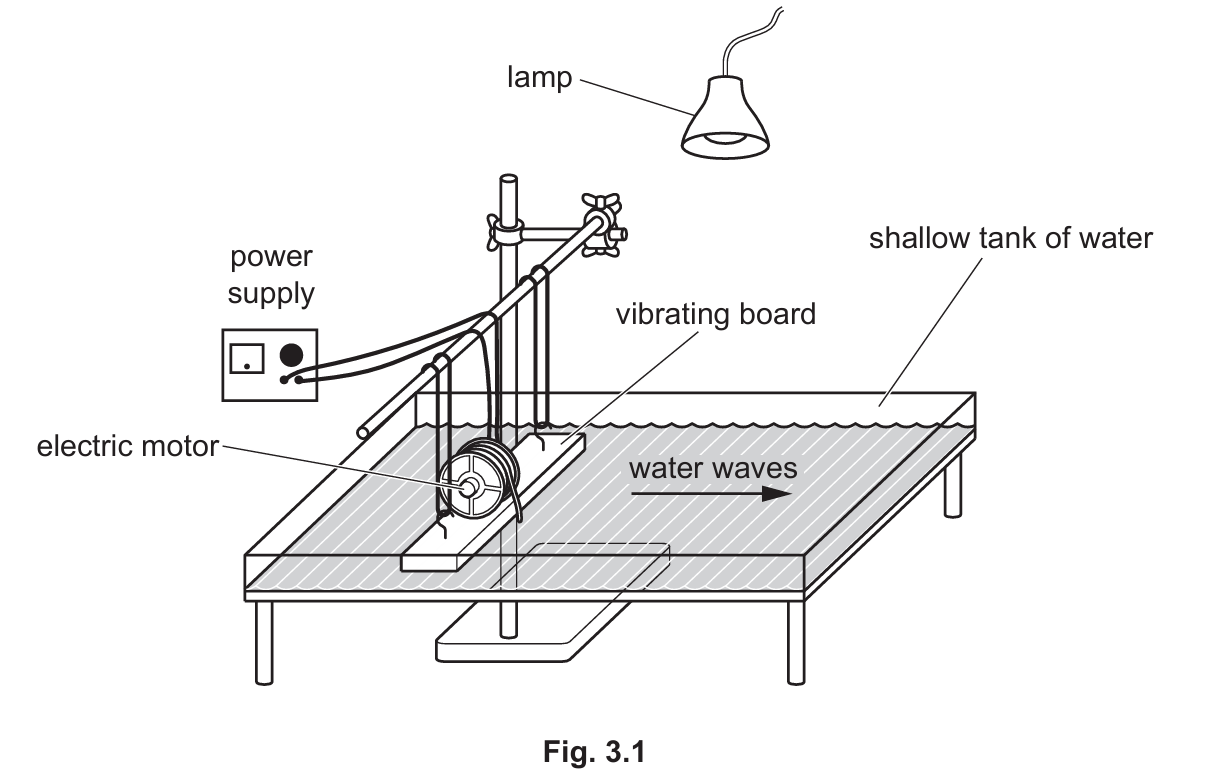
This produces water waves with the same frequency.
Calculate the wavelength of the water waves.
Include a description of what is observed.
You may draw a diagram to help with your answer.
Complete the sentences to explain how the motor rotates.
The current-carrying coil experiences a force because it is in a …………………………. field.
The force on one side of the coil is upwards and the force on the other side of the coil is …………………………., causing a turning effect.
During the demonstration, the filament lamp uses 24000 J of electrical energy.
Calculate how much charge passes through the filament lamp during the demonstration.
State the unit of your answer.
Most-appropriate topic codes (Cambridge IGCSE Co-ordinated Sciences 0654):
• Topic P3.1 — General properties of waves (Part (a))
• Topic P4.5.3 — Magnetic effect of current (Part (b))
• Topic P4.2..1 — Electrical charge (Part (c))
▶️ Answer/Explanation
(a)(i) The number of vibrations (oscillations) passing a point per unit time / second
Frequency describes how many complete wave cycles are produced or pass a fixed point each second.
It is measured in hertz (Hz), where 1 Hz = 1 oscillation per second.
(a)(ii) 0.04 m
Using the wave equation \(v = f\lambda\), rearranged to \(\lambda = \dfrac{v}{f}\).
\(\lambda = \dfrac{0.20}{5.0} = 0.04\) m.
(a)(iii) Place an obstacle with a gap similar in size to the wavelength in the ripple tank; circular waves are produced after the gap
When straight wavefronts meet a narrow gap (comparable to the wavelength), the waves spread out into the space beyond the gap.
The waves emerging from the gap appear as circular (curved) wavefronts, demonstrating diffraction.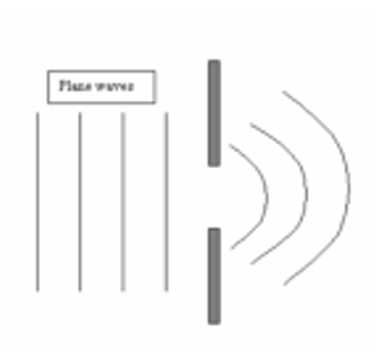
(b) Magnetic field; downwards
The current-carrying coil sits in a magnetic field, so each side of the coil experiences a force (the motor effect).
Since the current flows in opposite directions on each side of the coil, the force on one side is upwards while the force on the other side is downwards.
These opposite forces create a turning effect (couple) that rotates the coil.
(c)(i) Circuit symbol: a circle with a cross (✕) inside it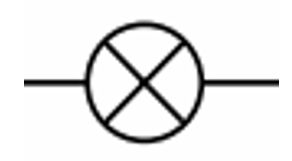
The standard IGCSE circuit symbol for a filament lamp is a circle with an “X” drawn inside it.
(c)(ii) 2000 C
Using \(E = QV\), rearranged to \(Q = \dfrac{E}{V}\).
\(Q = \dfrac{24000}{12} = 2000\) coulombs (C).
Question 4
Transpiration is estimated by recording the loss in mass.
The student keeps one plant at 20°C and one plant at 40°C.
The student records the mass of each plant every day for 5 days.
Fig. 4.1 shows the apparatus the student uses.


The mass of the plant kept at 40°C decreased in mass by ……………… g between day 1 and day 5.
As temperature increases, the water molecules gain more ……………… energy.
This increases the rate of evaporation from the surfaces of the ……………… cells.
There is also an increase in the rate of diffusion of ……………… through the ……………… into the atmosphere.
Most-appropriate topic codes (Cambridge IGCSE Co-ordinated Sciences 0654):
• Topic B8.3 — Transpiration (Part (a))
• Topic B8.1 — Xylem and phloem (Part (b))
▶️ Answer/Explanation
(a)(i) 62 g; kinetic; (spongy) mesophyll; water vapour; stomata
From the graph, mass falls from 90 g (day 1) to 28 g (day 5) at 40°C, a decrease of 62 g.
Higher temperature gives water molecules more kinetic energy, increasing the rate of evaporation from the spongy mesophyll cell surfaces.
Water vapour then diffuses faster out through the stomata into the atmosphere.
(a)(ii) Both plants would lose mass more slowly (less mass would be lost)
A higher humidity reduces the concentration gradient of water vapour between the leaf air spaces and the surrounding atmosphere.
This slows the rate of diffusion of water vapour out of the stomata, so transpiration (and mass loss) decreases.
(b)(i) Cohesion (hydrogen bonding between water molecules)
Water molecules are polar and form hydrogen bonds with each other.
This cohesion allows them to be pulled upward as a continuous column inside the narrow xylem vessels.
(b)(ii) Support
The lignin in xylem vessel walls makes them rigid, helping support the plant stem and leaves.
(b)(iii) Phloem
Phloem is the other plant transport tissue, responsible for translocation of sugars (e.g. sucrose) made during photosynthesis.
Question 5

Explain why lithium chloride has a high melting point.

Use ideas about structure and bonding.


Most-appropriate topic codes (Cambridge IGCSE Co-ordinated Sciences 0654):
• Topic C2.4 — Ions and ionic bonds (Part (a))
• Topic C2.6 — Giant covalent structures (Part (b))
• Topic C2.3 — Isotopes / C1.1 — Solids, liquids and gases (Part (c))
▶️ Answer/Explanation
(a)(i) \(LiCl\)
\(Li^+\) and \(Cl^-\) ions carry equal and opposite single charges, so they combine in a 1:1 ratio.
(a)(ii) Strong electrostatic forces of attraction between oppositely charged ions need a lot of energy to overcome
Lithium chloride is held together by strong ionic bonds — electrostatic attractions between \(Li^+\) and \(Cl^-\) ions throughout the giant lattice.
Breaking the lattice (melting) requires a large amount of thermal energy to overcome these strong forces, giving a high melting point.
(b)(i) Giant covalent structure arranged in layers, with each carbon atom covalently bonded to three others
Graphite consists of carbon atoms arranged in hexagonal sheets (layers).
Each carbon atom forms three strong covalent bonds within its layer.
(b)(ii) Weak forces between the layers allow them to slide over each other
There are only weak intermolecular forces holding the layers of graphite together.
These weak forces let the layers slide easily past one another, which is why graphite is slippery and used as a lubricant.
(c)(i) –39°C and 357°C
Mercury is liquid at 25°C, so its melting point must be below 25°C and its boiling point above 25°C.
Only the row showing –39°C (melting point) and 357°C (boiling point) satisfies this and matches the real values for mercury.
(c)(ii) 
Number of neutrons = nucleon number − proton number \(= 201 – 80 = 121\).
In a neutral atom, the number of electrons equals the number of protons, so electrons = 80.
Question 6
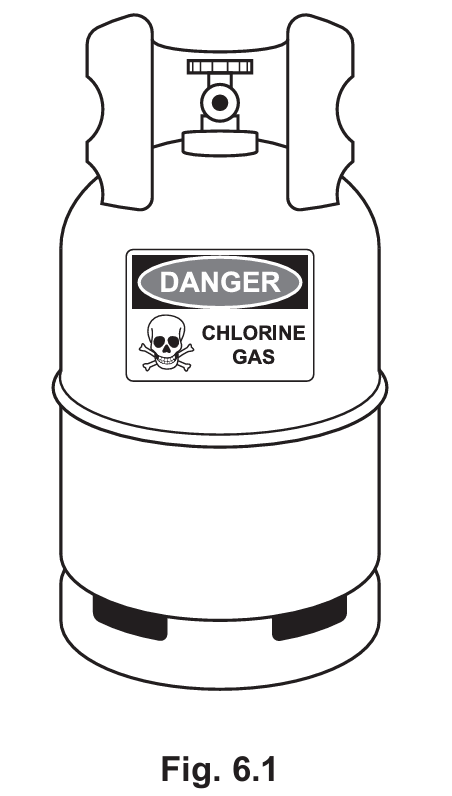
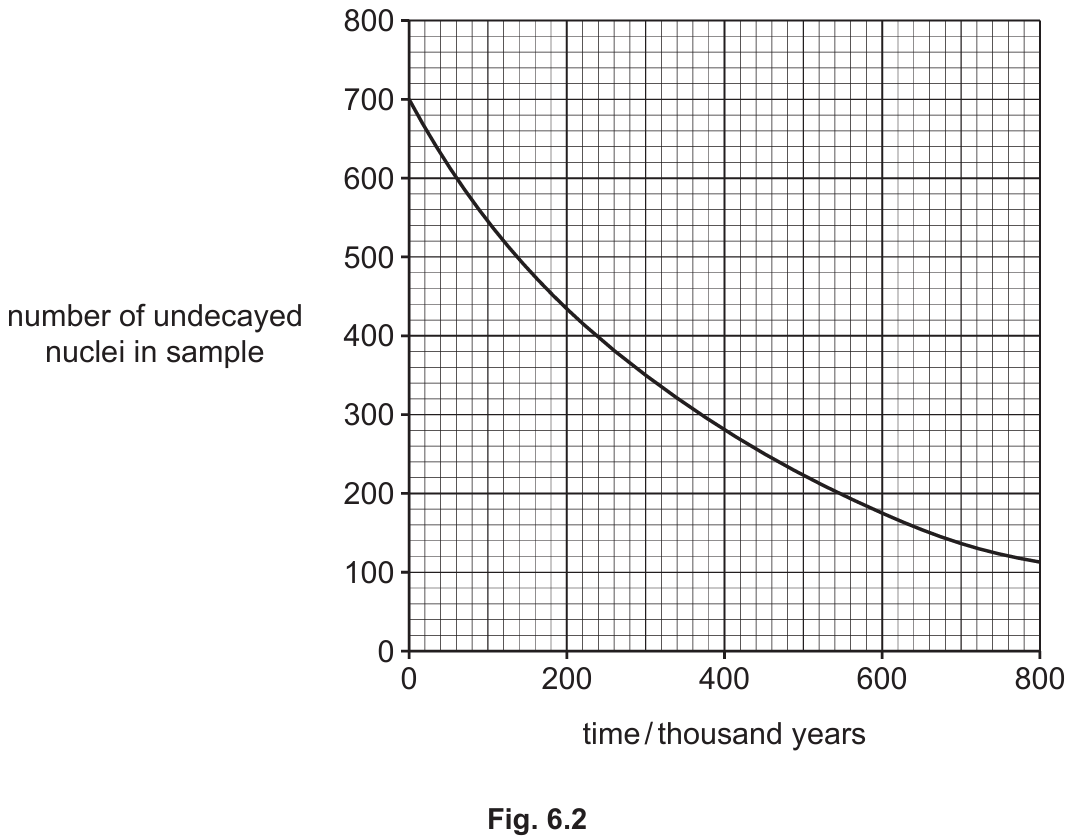
Fig. 6.2 shows how the number of undecayed nuclei in a sample changes over time.
Use the correct nuclide notation to complete the decay equation.

Most-appropriate topic codes (Cambridge IGCSE Co-ordinated Sciences 0654):
• Topic C1.1 — Solids, liquids and gases (Part (a))
• Topic C2.3 — Isotopes (Part (b)(i))
• Topic P5.2.1 — Detection of radioactivity (Part (b)(ii)–(iii))
• Topic P1.4 — Density (Part (c))
▶️ Answer/Explanation
(a)(i) Liquid: random arrangement, molecules touching/close together. Gas: random arrangement, molecules far apart
In both liquids and gases the particles are arranged randomly (no regular pattern), unlike in a solid.
However, liquid particles remain close together and touching, while gas particles are spread far apart with large spaces between them.
(a)(ii) Liquid molecules move around/slide past each other (slower); gas molecules move freely and rapidly in all directions
Liquid particles can flow over one another but stay relatively close, moving with less kinetic energy than gas particles.
Gas particles move completely freely at high speed, only interacting when they collide.
(b)(i) Similarity: same number of protons (17). Difference: different number of neutrons
Both isotopes have the same proton (atomic) number, 17, since they are both chlorine atoms.
Chlorine-35 has 18 neutrons while chlorine-37 has 20 neutrons — they differ in nucleon number/mass.
(b)(ii) 300 thousand years
From the decay graph, the number of undecayed nuclei falls from about 700 to 350 (half) over roughly 300 thousand years.
This time taken for the activity (or undecayed nuclei) to halve is, by definition, the half-life.
(b)(iii) \({}^{36}_{17}Cl \rightarrow {}^{36}_{18}Ar + {}^{\;\;0}_{-1}\beta\)
Mass (nucleon) number is conserved: \(36 = 36 + 0\).
Charge (proton number) is conserved: \(17 = 18 + (-1)\), confirming the emitted particle is a beta particle.
(c) 1.6 kg
Mass of liquid chlorine \(= \rho V = 570 \times 0.020 = 11.4\) kg.
Mass of empty canister \(= 13 – 11.4 = 1.6\) kg.
Question 7

Gases are exchanged by the process of diffusion.
Explain the advantage, in terms of diffusion, of the alveoli being thin and well ventilated.
Most-appropriate topic codes (Cambridge IGCSE Co-ordinated Sciences 0654):
• Topic B11.1 — Gas exchange in humans (Parts (a), (c), (d))
• Topic B14.1 — Drugs (Part (b))
▶️ Answer/Explanation
(a)(i) Cilia are shorter in smokers, so less mucus (which traps pathogens) is moved; pathogens multiply/remain in the airway
In smokers, the cilia lining the bronchi become shorter and less effective.
This means mucus — which normally traps bacteria and other pathogens — is not swept away as efficiently.
Pathogens therefore build up and multiply in the airways, increasing the risk of lung infection.
(a)(ii) Goblet cell
The cell labelled X secretes mucus and is known as a goblet cell.
(b)(i) Any two from: chronic obstructive pulmonary disease (COPD); coronary heart disease (CHD)
Long-term smoking damages the lungs and blood vessels, leading to conditions such as COPD (chronic bronchitis/emphysema) and coronary heart disease.
(b)(ii) Tar
Tar in tobacco smoke contains carcinogens that damage DNA in lung cells, leading to cancer.
(b)(iii) A mutation is a change in the structure or sequence of a gene or chromosome
A mutation alters the genetic material, which can change the protein produced or how cell division is controlled, potentially leading to cancer.
(c) Thin — shorter diffusion distance; well ventilated — maintains a steep concentration gradient
A thin alveolar wall means gases have a shorter path to diffuse across, increasing the rate of diffusion.
Good ventilation constantly refreshes the air in the alveoli, maintaining a steep concentration gradient for oxygen and carbon dioxide, which also speeds up diffusion.
(d) Any two from: trachea; bronchus/bronchi; bronchiole
Air travels from the mouth through the trachea, then into the bronchi/bronchioles, before reaching the alveoli.
Question 8


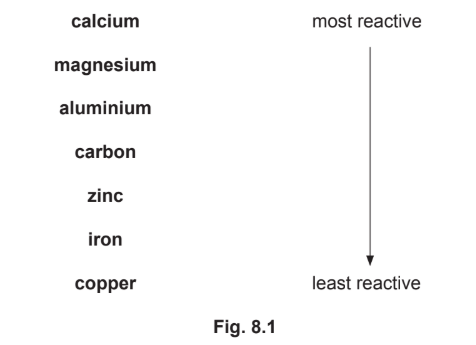
Use Fig. 8.1 to state and explain how copper is extracted from copper ore.
This is called sacrificial protection.
Use Fig. 8.1 to explain how sacrificial protection with zinc stops iron from rusting.
Iron metal reacts with aqueous copper chloride, \(CuCl_2\).
Iron(II) chloride is made.
Choose from the list.
displacement
neutralisation
thermal decomposition
Most-appropriate topic codes (Cambridge IGCSE Co-ordinated Sciences 0654):
• Topic C9.4 — Reactivity series (Parts (a), (b)(ii), (c))
• Topic C9.6 — Extraction of metals (Part (b)(i))
• Topic C9.5 — Corrosion of metals (Parts (b)(iii), (d))
▶️ Answer/Explanation
(a) Most reactive: Z, X, W, Y least reactive
Z reacted fastest and completely dissolved, so it is the most reactive.
X reacted quickly leaving little metal, W reacted moderately, and Y barely reacted, making Y the least reactive.
(b)(i) Heat the ore with carbon, since carbon is more reactive than copper and displaces it
Copper lies below carbon in the reactivity series, so carbon can displace copper from its ore by heating (unlike aluminium, which is above carbon and must be extracted by electrolysis).
(b)(ii) Calcium atoms lose electrons (form positive ions) more easily than magnesium atoms
Reactivity of metals depends on how readily their atoms lose outer-shell electrons to form positive ions.
Calcium atoms achieve this more easily than magnesium atoms, making calcium more reactive.
(b)(iii) Zinc is more reactive than iron, so zinc corrodes/oxidises (loses electrons) instead of iron
Because zinc is higher in the reactivity series, it reacts with oxygen and water in preference to iron.
Zinc is therefore corroded “sacrificially,” protecting the iron underneath from rusting.
(c)(i) \(Fe + CuCl_2 \rightarrow FeCl_2 + Cu\)
Iron displaces copper from copper(II) chloride solution, forming iron(II) chloride and solid copper, with correctly balanced formulae on both sides.
(c)(ii) Displacement
A more reactive metal (iron) displaces a less reactive metal (copper) from its compound — this is a displacement reaction.
(d) Aluminium forms a thin, adherent oxide layer that prevents oxygen/water reaching the metal beneath
Aluminium reacts instantly with oxygen in air to form a tough aluminium oxide layer on its surface.
This layer sticks firmly to the metal and is impermeable, preventing further oxygen or water reaching the aluminium underneath, despite aluminium’s high reactivity.
Question 9

Use your answer to (a)(ii) to calculate the acceleration of the skydiver when the air resistance force is 760 N.

Most-appropriate topic codes (Cambridge IGCSE Co-ordinated Sciences 0654):
• Topic P1.3 — Mass and weight (Part (a)(i)–(ii))
• Topic P1.5.1 — Effects of forces (Parts (a)(iii), (b))
• Topic P1.6.1 — Energy (Part (c))
▶️ Answer/Explanation
(a)(i) Weight (gravitational force)
Force \(Q\) acts downwards on the skydiver due to gravity, so it is the skydiver’s weight.
(a)(ii) 840 N
Using \(W = mg\): \(W = 84 \times 10 = 840\) N.
(a)(iii) 0.95 m/s²
Resultant force \(= 840 – 760 = 80\) N (downward, since weight exceeds air resistance).
Using \(a = \dfrac{F}{m} = \dfrac{80}{84} \approx 0.95\) m/s².
(b) 140–180 s: decelerates (non-constant deceleration) as air resistance exceeds weight; after 180 s: constant speed (terminal velocity) as air resistance equals weight
Once the parachute opens, air resistance suddenly becomes much greater than the skydiver’s weight, producing a net upward resultant force that decelerates the skydiver — the deceleration is non-constant as air resistance changes with speed.
After about 180 s, the skydiver reaches a new (lower) terminal velocity, where air resistance again exactly balances weight, giving zero resultant force and constant speed.
(c) 6 300 000 J = 6.3 MJ
Using \(GPE = mgh\): \(GPE = 84 \times 10 \times 7500 = 6\,300\,000\) J = 6.3 MJ, as required.
Question 10
Most-appropriate topic codes (Cambridge IGCSE Co-ordinated Sciences 0654):
• Topic B18.3 — Carbon cycle (Part (a))
• Topic B19.1 — Habitat destruction (Parts (b), (c))
▶️ Answer/Explanation
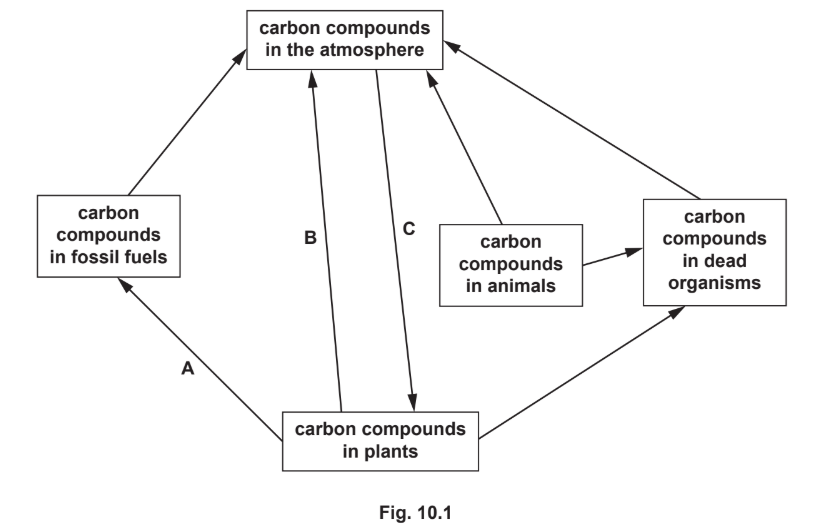
(a)(i) Fossilisation
Carbon compounds in dead organisms can, over millions of years under heat and pressure, be converted into fossil fuels — this process is fossilisation.
(a)(ii) \(C_6H_{12}O_6 + 6O_2 \rightarrow 6CO_2 + 6H_2O\)
Process B represents respiration, releasing carbon dioxide from plants back into the atmosphere as glucose is broken down using oxygen.
(a)(iii) An arrow drawn from “carbon compounds in plants” to “carbon compounds in animals”
Feeding transfers carbon compounds from plants into animals when animals eat plant material.
(a)(iv) Chloroplast
Process C represents photosynthesis, which takes place inside the chloroplasts of plant cells.
(b) 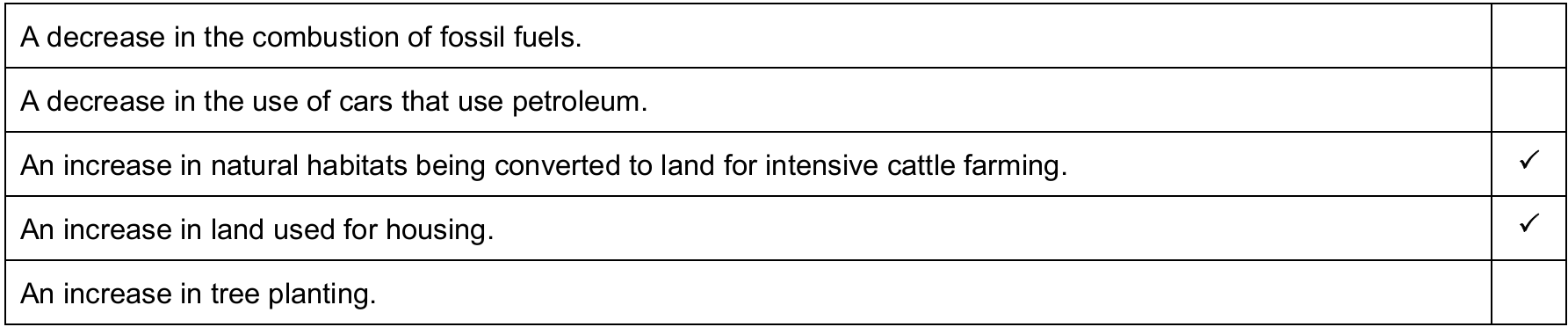
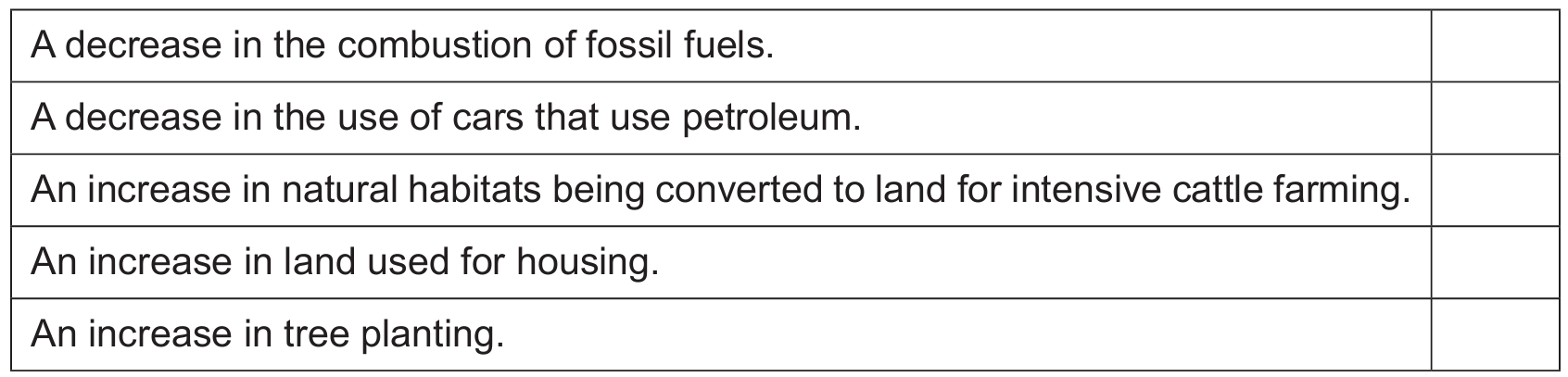
Converting natural habitats to farmland or housing usually involves burning or removing vegetation, releasing stored carbon and reducing the number of plants available to absorb \(CO_2\), so atmospheric \(CO_2\) rises.
The other statements (decreased fossil fuel combustion, decreased car use, increased tree planting) all act to lower atmospheric \(CO_2\), so they are not ticked.
(c) Any two from: removal of habitat/shelter/breeding grounds; removal of food source
Deforestation destroys the shelter and breeding sites animals depend on, and removes the plants many animals rely on for food.
Both effects can reduce population sizes to the point where species can no longer survive, leading to extinction.
Question 11
hydrogen
negative
neutral
non-metals
positive
The investigation is done using different currents, each for the same length of time.

Most-appropriate topic codes (Cambridge IGCSE Co-ordinated Sciences 0654):
• Topic C4.1 — Electrolysis (Parts (a), (b))
▶️ Answer/Explanation
(a) hydrogen; positive; non-metals
At the cathode (negative electrode), metals or hydrogen are formed by reduction.
The anode is the positive electrode, where non-metals are formed by oxidation.
(b)(i) Copper electrodes: copper ions (\(Cu^{2+}\)) dissolve into solution. Graphite electrodes: oxygen gas (\(O_2\))
With reactive copper electrodes, the anode itself dissolves to form \(Cu^{2+}\) ions in solution.
With inert graphite electrodes, hydroxide ions are oxidised at the anode to release oxygen gas.
(b)(ii) –0.10 g (the mass decreases by 0.10 g)
From the linear graph, a current of 0.25 A corresponds to a cathode mass gain of 0.10 g (interpolated between the plotted points).
Since copper electrodes are used, the anode loses the same mass that the cathode gains, so the anode mass decreases by 0.10 g.
(b)(iii) \(Cu^{2+} + 2e^{-} \rightarrow Cu\)
Copper ions are still preferentially reduced at the cathode (gaining electrons to form copper metal), regardless of whether the electrode material is copper or inert graphite.
Question 12
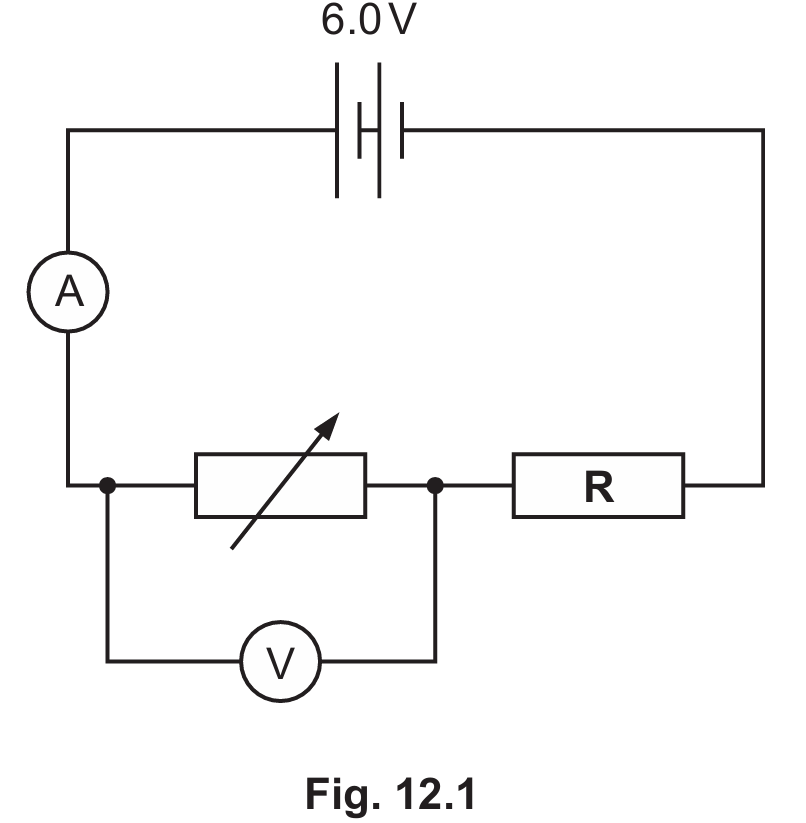
Most-appropriate topic codes (Cambridge IGCSE Co-ordinated Sciences 0654):
• Topic P4.3.1 — Circuit diagrams and circuit components (Part (a))
• Topic P4.2.1 — Electrical charge (Part (a)(i))
• Topic P1.6.1 — Energy (Part (b))
▶️ Answer/Explanation
(a)(i) 8.0 Ω
Since the battery, variable resistor and \(R\) are in series, the voltage across \(R\) \(= 6.0 – 2.0 = 4.0\) V.
Using \(R = \dfrac{V}{I} = \dfrac{4.0}{0.50} = 8.0\) Ω.
(a)(ii) Increase the resistance of the variable resistor to decrease the current flowing through R
Since the variable resistor is in series with \(R\), increasing its resistance reduces the total current in the circuit.
A lower current through \(R\) means less heat is generated, preventing it from overheating.
(b) 50 W
Efficiency \(= \dfrac{\text{power output}}{\text{power input}} \times 100\%\).
Power input \(= \dfrac{\text{power output}}{\text{efficiency}} = \dfrac{8.0}{0.16} = 50\) W.