Question 1
Which characteristic of living organisms involves chemical reactions that break down nutrient molecules to release energy?
A. excretion
B. nutrition
C. reproduction
D. respiration
Most-appropriate topic codes (Cambridge IGCSE Co-ordinated Sciences 0654):
▶️ Answer/Explanation
Excretion is removal of waste, nutrition is taking in materials, and reproduction is making more organisms — none involve energy release from breakdown of nutrients.
✅ Answer: (D)
Question 2
What is the formula for magnification?
A. \( \dfrac{\text{actual size}}{\text{image size}} \)
B. \( \dfrac{\text{actual size}}{\text{image size}} \times 100 \)
C. \( \dfrac{\text{image size}}{\text{actual size}} \)
D. \( \dfrac{\text{image size}}{\text{actual size}} \) mm
Most-appropriate topic codes (Cambridge IGCSE Co-ordinated Sciences 0654):
▶️ Answer/Explanation
It is defined as \( \text{magnification} = \dfrac{\text{image size}}{\text{actual size}} \), a ratio with no units.
✅ Answer: (C)
Question 3
Glycerol is a component of which large molecules?
A. fats
B. glycogen
C. proteins
D. starch
Most-appropriate topic codes (Cambridge IGCSE Co-ordinated Sciences 0654):
▶️ Answer/Explanation
Glycogen and starch are polysaccharides made of glucose units, and proteins are made of amino acids, so none contain glycerol.
✅ Answer: (A)
Question 4
Which elements can be found in an enzyme molecule?
- carbon
- nitrogen
- oxygen
A. 1, 2 and 3
B. 1 and 3 only
C. 1 only
D. 2 only
Most-appropriate topic codes (Cambridge IGCSE Co-ordinated Sciences 0654):
▶️ Answer/Explanation
Amino acids contain carbon, hydrogen, oxygen and nitrogen, so all three listed elements (carbon, nitrogen, oxygen) are present.
✅ Answer: (A)
Question 5
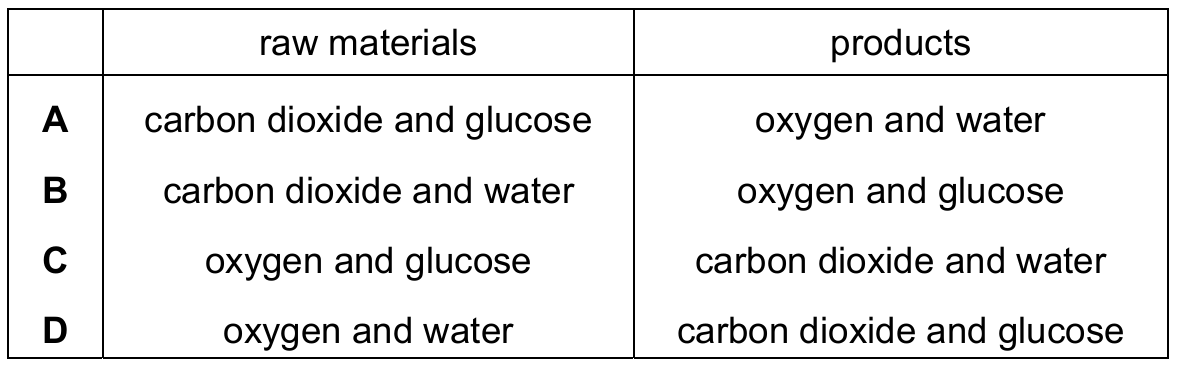
Which row is correct for photosynthesis?

Most-appropriate topic codes (Cambridge IGCSE Co-ordinated Sciences 0654):
▶️ Answer/Explanation
The products are glucose and oxygen: \( 6CO_2 + 6H_2O \rightarrow C_6H_{12}O_6 + 6O_2 \).
✅ Answer: (B)
Question 6
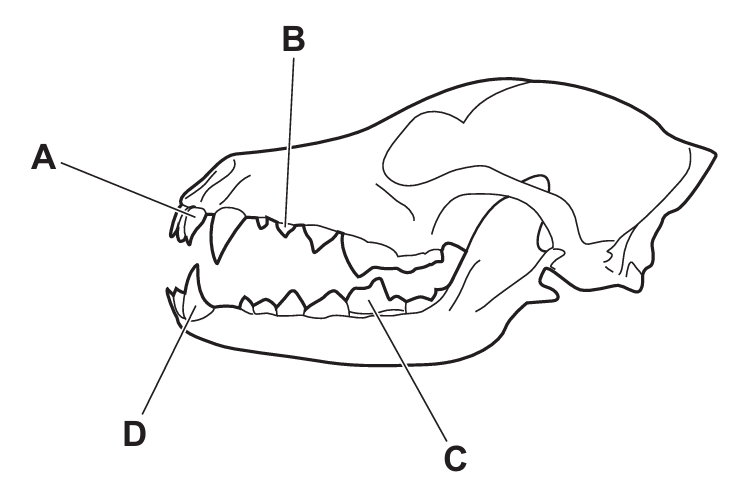
Dogs are mammals and have the same types of teeth as humans.
Which tooth is a canine?

▶️ Answer/Explanation
Option D shows this pointed shape, distinct from the flat incisors, wide premolars and molars in the other options.
✅ Answer: (D)
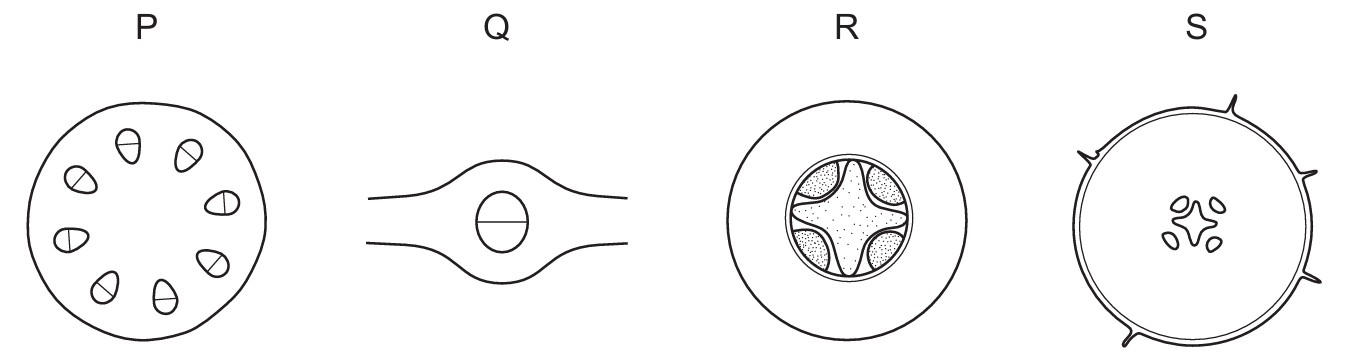
Question 7
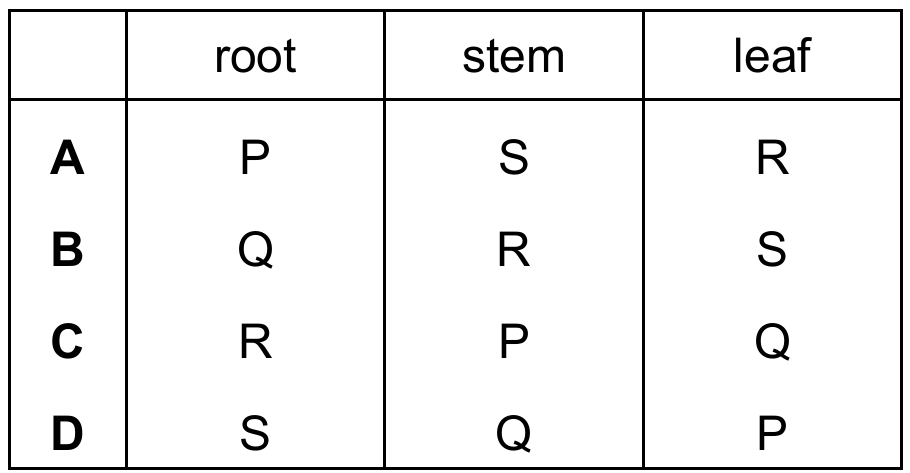
The diagrams represent sections through a root, a stem and a leaf mid-rib, not drawn to the same scale.

In which row are the sections correctly identified?

Most-appropriate topic codes (Cambridge IGCSE Co-ordinated Sciences 0654):
▶️ Answer/Explanation
Matching each section shape to these known arrangements gives root = R, stem = P, leaf = Q.
✅ Answer: (C)
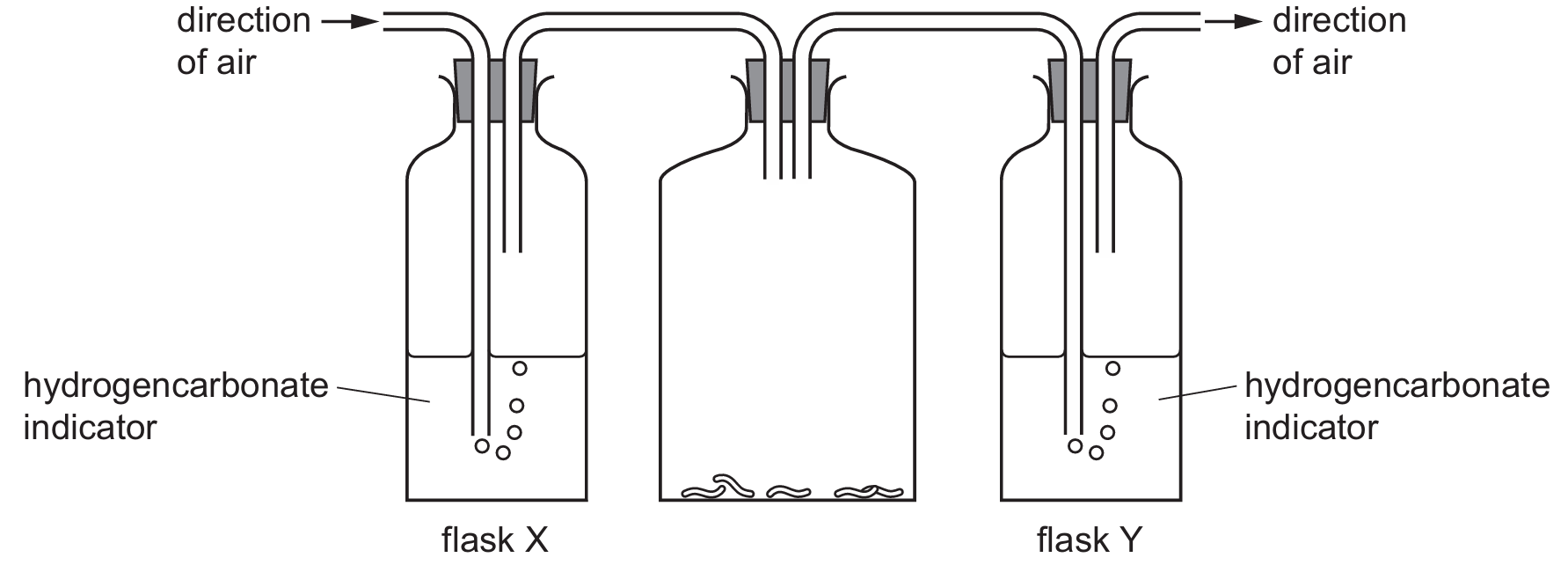
Question 8
The diagram shows apparatus used to investigate respiration of blowfly larvae.
Air is sucked through the solutions of hydrogencarbonate indicator as shown.
Hydrogencarbonate indicator turns orange with carbon dioxide at atmospheric concentration. It turns yellow with high carbon dioxide concentration.

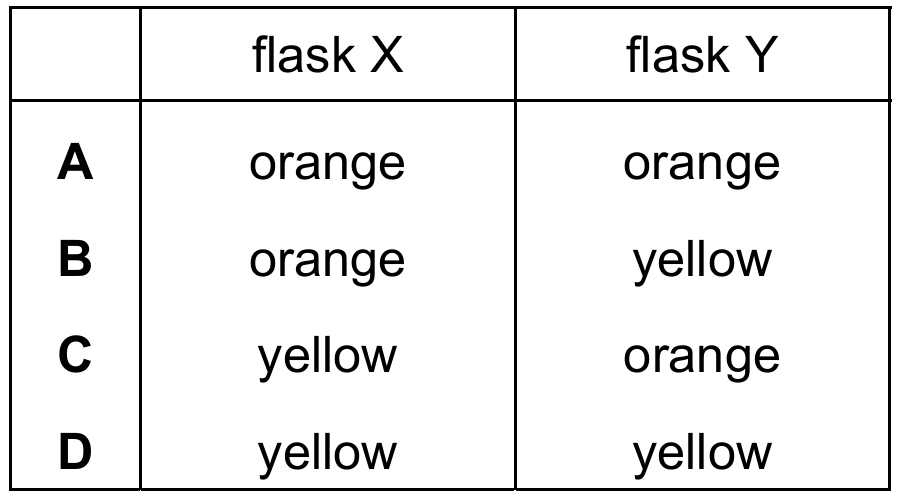
What are the colours of the hydrogencarbonate indicator in the flasks after 24 hours?

Most-appropriate topic codes (Cambridge IGCSE Co-ordinated Sciences 0654):
▶️ Answer/Explanation
Flask Y (control, no larvae) has indicator at atmospheric carbon dioxide level, so it stays orange.
✅ Answer: (B)
Question 9
When a seed germinates in the soil, the root grows downwards.
Which type of response is the root exhibiting?
A. negative gravitropism
B. negative phototropism
C. positive gravitropism
D. positive phototropism
Most-appropriate topic codes (Cambridge IGCSE Co-ordinated Sciences 0654):
▶️ Answer/Explanation
Since the root grows towards (in the direction of) gravity, this is a positive gravitropic response.
✅ Answer: (C)
Question 10
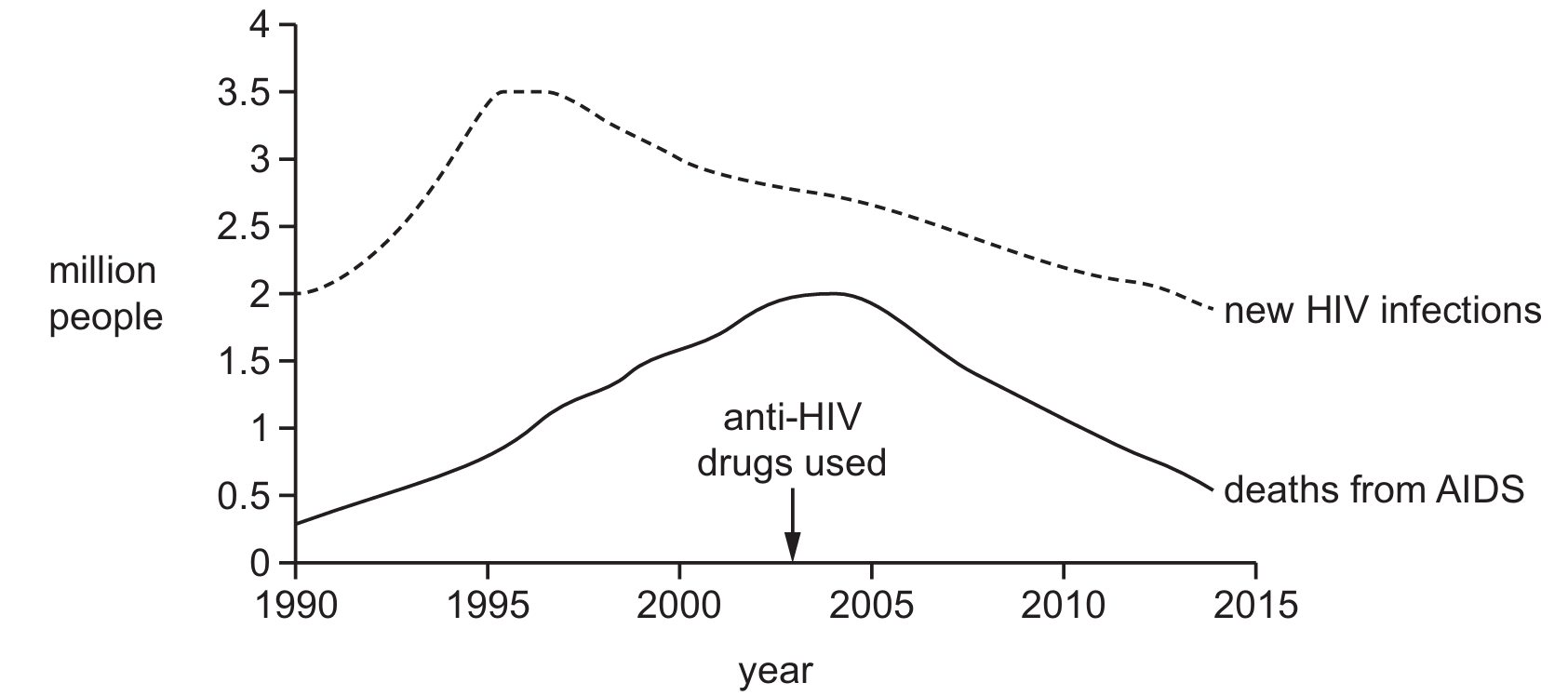
The graph shows the change in number of new HIV infections and deaths from AIDS between 1990 and 2014.

What does the graph show?
- The number of new HIV infections fell after condom use was promoted.
- The use of anti-HIV drugs has led to a decrease in deaths from AIDS.
- The highest rate of deaths from AIDS occurred in 1995.
A. 1 and 2 only
B. 3 only
C. 1, 2 and 3
D. 2 only
Most-appropriate topic codes (Cambridge IGCSE Co-ordinated Sciences 0654):
▶️ Answer/Explanation
Deaths from AIDS fall after anti-HIV drugs are introduced, supporting statement 2, while deaths actually peak later than 1995, so statement 3 is false.
✅ Answer: (D)
Question 11
Which sex chromosomes are found in a healthy male human?
A. XO
B. XX
C. XY
D. YY
Most-appropriate topic codes (Cambridge IGCSE Co-ordinated Sciences 0654):
▶️ Answer/Explanation
Males have one X chromosome and one Y chromosome (XY), while females have two X chromosomes (XX).
✅ Answer: (C)
Question 12
Which type of organism gets its energy from the remains of dead organisms or other organic waste?
A. a carnivore
B. a decomposer
C. a herbivore
D. a producer
Most-appropriate topic codes (Cambridge IGCSE Co-ordinated Sciences 0654):
▶️ Answer/Explanation
Carnivores, herbivores and producers obtain energy from living prey, plants, or sunlight respectively, not dead matter.
✅ Answer: (B)
Question 13
What is an undesirable effect of deforestation?
A. It increases the oxygen concentration of the atmosphere.
B. It leads to erosion and loss of soil.
C. It makes land available for agriculture.
D. It pollutes the air with methane.
Most-appropriate topic codes (Cambridge IGCSE Co-ordinated Sciences 0654):
▶️ Answer/Explanation
Removing trees exposes soil to wind and rain, leading to erosion and loss of fertile topsoil.
✅ Answer: (B)
Question 14
Which properties are used to distinguish between solids and gases?
- compressibility
- melting point
- flammability
A. 1 and 2 only
B. 1 and 3 only
C. 2 and 3 only
D. 1, 2 and 3
Most-appropriate topic codes (Cambridge IGCSE Co-ordinated Sciences 0654):
▶️ Answer/Explanation
Solids and gases also have very different melting points, but flammability is a chemical property unrelated to physical state.
✅ Answer: (A)
Question 15
An atom of fluorine is represented by \( ^{19}_{9}\text{F} \).
How many electrons does this atom contain?
A. 9
B. 10
C. 19
D. 28
Most-appropriate topic codes (Cambridge IGCSE Co-ordinated Sciences 0654):
▶️ Answer/Explanation
A neutral atom has equal numbers of protons and electrons, so it contains 9 electrons.
✅ Answer: (A)
Question 16
Hydrogen reacts with oxygen to produce water.
What is the balanced equation for this reaction?
A. \( H_2 + O_2 \rightarrow H_2O \)
B. \( H_2 + O_2 \rightarrow 2H_2O \)
C. \( H_2 + O \rightarrow H_2O \)
D. \( 2H_2 + O_2 \rightarrow 2H_2O \)
Most-appropriate topic codes (Cambridge IGCSE Co-ordinated Sciences 0654):
▶️ Answer/Explanation
\( 2H_2 + O_2 \rightarrow 2H_2O \) gives 4 hydrogen atoms and 2 oxygen atoms on each side, so it is correctly balanced.
✅ Answer: (D)
Question 17
Which process is used to produce sodium and chlorine from the compound sodium chloride?
A. chromatography
B. cracking
C. distillation
D. electrolysis
Most-appropriate topic codes (Cambridge IGCSE Co-ordinated Sciences 0654):
▶️ Answer/Explanation
Passing an electric current through molten sodium chloride produces sodium at the cathode and chlorine at the anode.
✅ Answer: (D)
Question 18
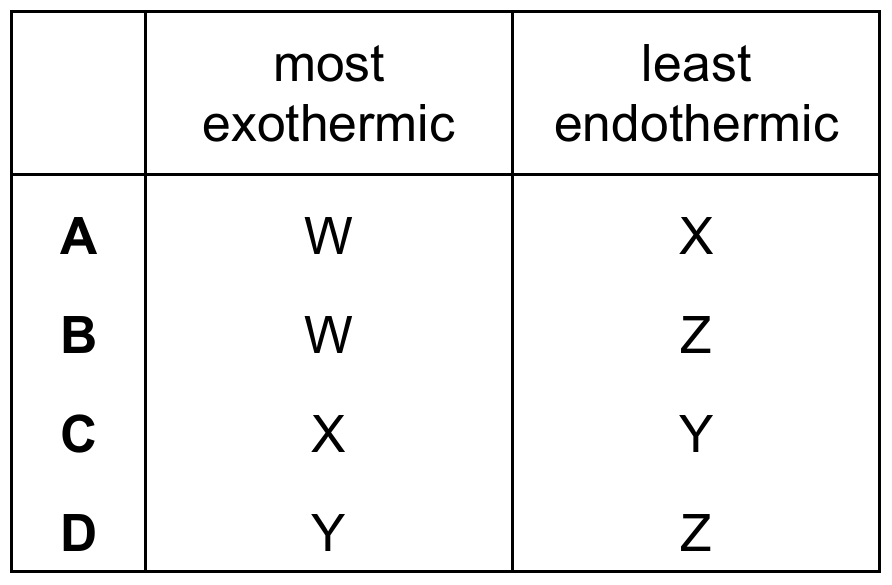
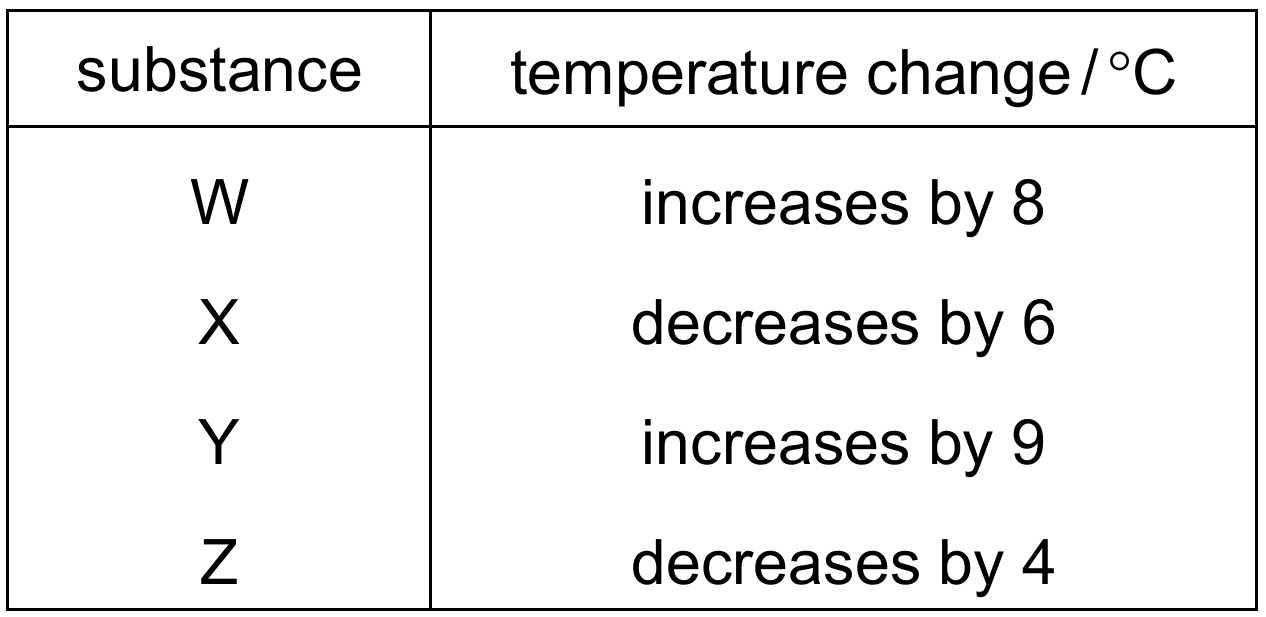
Equal amounts of substances W, X, Y and Z are reacted separately with equal amounts of dilute acid. The following temperature changes are recorded.

Which substances produce the most exothermic and the least endothermic reactions?

Most-appropriate topic codes (Cambridge IGCSE Co-ordinated Sciences 0654):
▶️ Answer/Explanation
A temperature decrease means endothermic; the smallest decrease (Z, −4 °C) is the least endothermic.
✅ Answer: (D)
Question 19
The rate of a reaction between a powdered metal and a dilute acid is investigated by measuring the volume of hydrogen gas produced per minute.
The investigation is repeated using a catalyst. The same mass of powdered metal and the same volume and concentration of acid is used.
Which statement about the second investigation is correct?
A. The rate of the reaction is higher and a greater total volume of hydrogen is produced.
B. The rate of the reaction is higher and the same total volume of hydrogen is produced.
C. The rate of the reaction is lower and a smaller total volume of hydrogen is produced.
D. The rate of the reaction is lower and the same total volume of hydrogen is produced.
Most-appropriate topic codes (Cambridge IGCSE Co-ordinated Sciences 0654):
▶️ Answer/Explanation
Since the same amounts of metal and acid are used, the same total volume of hydrogen is eventually produced, just faster.
✅ Answer: (B)
Question 20
Copper carbonate is reacted with dilute hydrochloric acid.
Which gas is given off?
A. carbon dioxide
B. hydrogen
C. nitrogen
D. sulfur dioxide
Most-appropriate topic codes (Cambridge IGCSE Co-ordinated Sciences 0654):
▶️ Answer/Explanation
Here, \( CuCO_3 + 2HCl \rightarrow CuCl_2 + H_2O + CO_2 \), so carbon dioxide gas is released.
✅ Answer: (A)
Question 21
Which statement about the halogens is not correct?
A. Iodine has a darker colour than chlorine.
B. They all exist as diatomic molecules.
C. They are all gases at room temperature.
D. They are all non-metals.
Most-appropriate topic codes (Cambridge IGCSE Co-ordinated Sciences 0654):
▶️ Answer/Explanation
However, their physical state changes down the group — chlorine is a gas, bromine a liquid, and iodine a solid — so not all are gases at room temperature.
✅ Answer: (C)
Question 22
Filament lamps require an inert atmosphere.
Which gas is used to fill these lamps?
A. argon
B. helium
C. hydrogen
D. oxygen
Most-appropriate topic codes (Cambridge IGCSE Co-ordinated Sciences 0654):
▶️ Answer/Explanation
Argon is the noble gas commonly used to fill filament lamps, stopping the filament from burning away.
✅ Answer: (A)
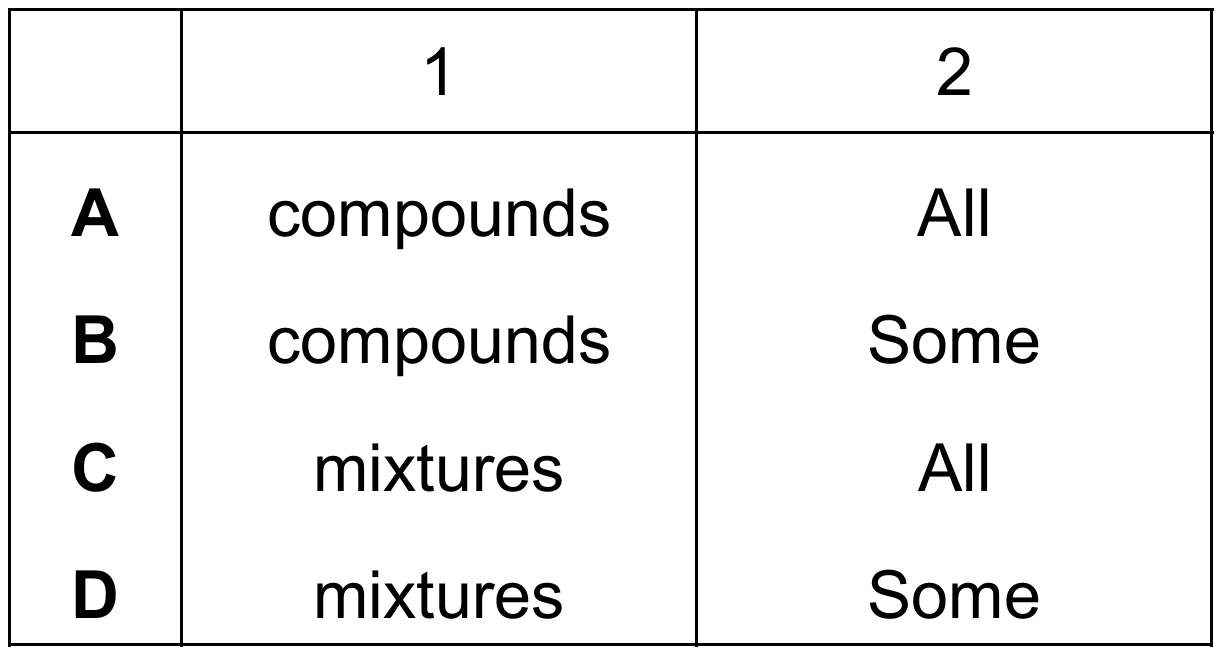
Question 23
Alloys are formed by dissolving one metal in another.
Alloys are ……1…… .
……2…… alloys conduct electricity.
Which words complete gaps 1 and 2?

Most-appropriate topic codes (Cambridge IGCSE Co-ordinated Sciences 0654):
▶️ Answer/Explanation
Because all alloys retain metallic bonding with delocalised electrons, all alloys conduct electricity.
✅ Answer: (C)
Question 24
Metal X is extracted from its ore by heating the ore with carbon.
Which statement explains why carbon is used?
A. Carbon is a non-metal.
B. Carbon is more reactive than X.
C. Carbon reacts with oxygen in the air.
D. Carbon is less reactive than X.
Most-appropriate topic codes (Cambridge IGCSE Co-ordinated Sciences 0654):
▶️ Answer/Explanation
This displacement reduces the metal oxide to the free metal, releasing carbon dioxide.
✅ Answer: (B)
Question 25
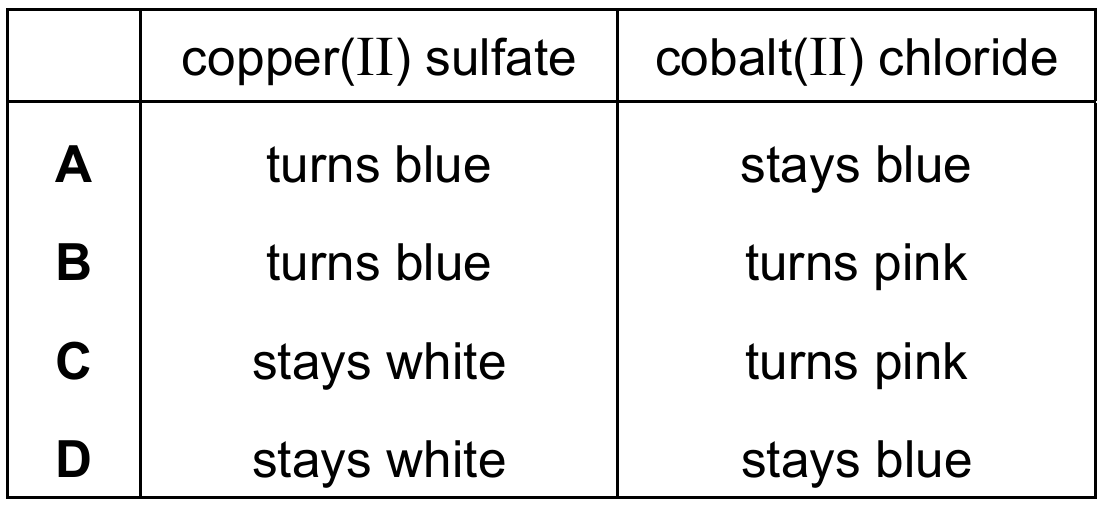
Water is tested with white copper(II) sulfate powder and with blue cobalt(II) chloride paper.
Which row shows the results of the tests?

Most-appropriate topic codes (Cambridge IGCSE Co-ordinated Sciences 0654):
▶️ Answer/Explanation
Blue cobalt(II) chloride paper turns pink in the presence of water.
✅ Answer: (B)
Question 26
What is not a use of limestone?
A. manufacture of calcium oxide
B. neutralising industrial waste products
C. purifying water
D. treating acidic soil
Most-appropriate topic codes (Cambridge IGCSE Co-ordinated Sciences 0654):
▶️ Answer/Explanation
It is not used to purify water — that process typically uses filtration and chlorination instead.
✅ Answer: (C)
Question 27
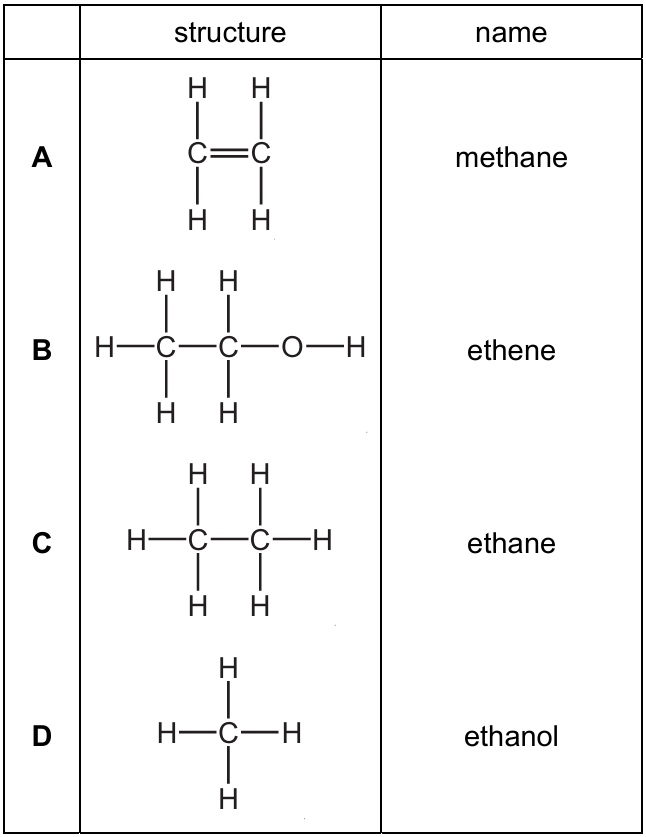
In which row is the name of the structure correct?

Most-appropriate topic codes (Cambridge IGCSE Co-ordinated Sciences 0654):
▶️ Answer/Explanation
Row C correctly shows the saturated two-carbon structure \( C_2H_6 \) labelled as ethane, matching its structure and name.
✅ Answer: (C)
Question 28
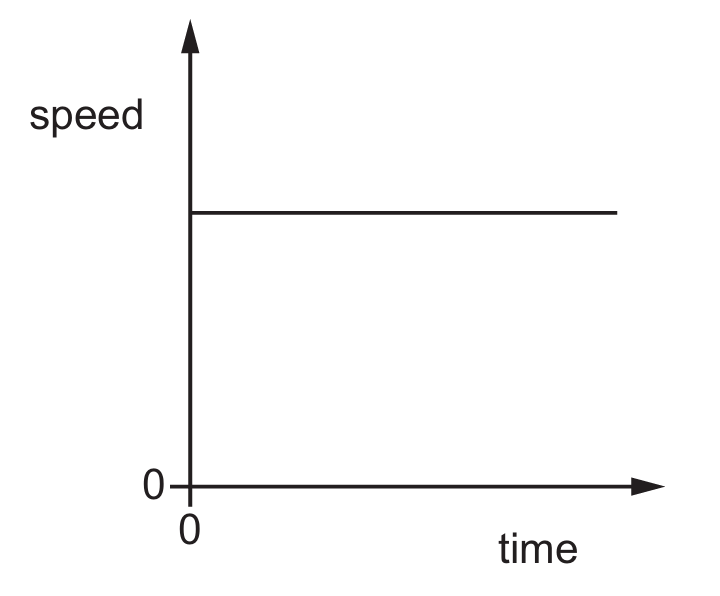
The graph shows how the speed of an object varies with time.

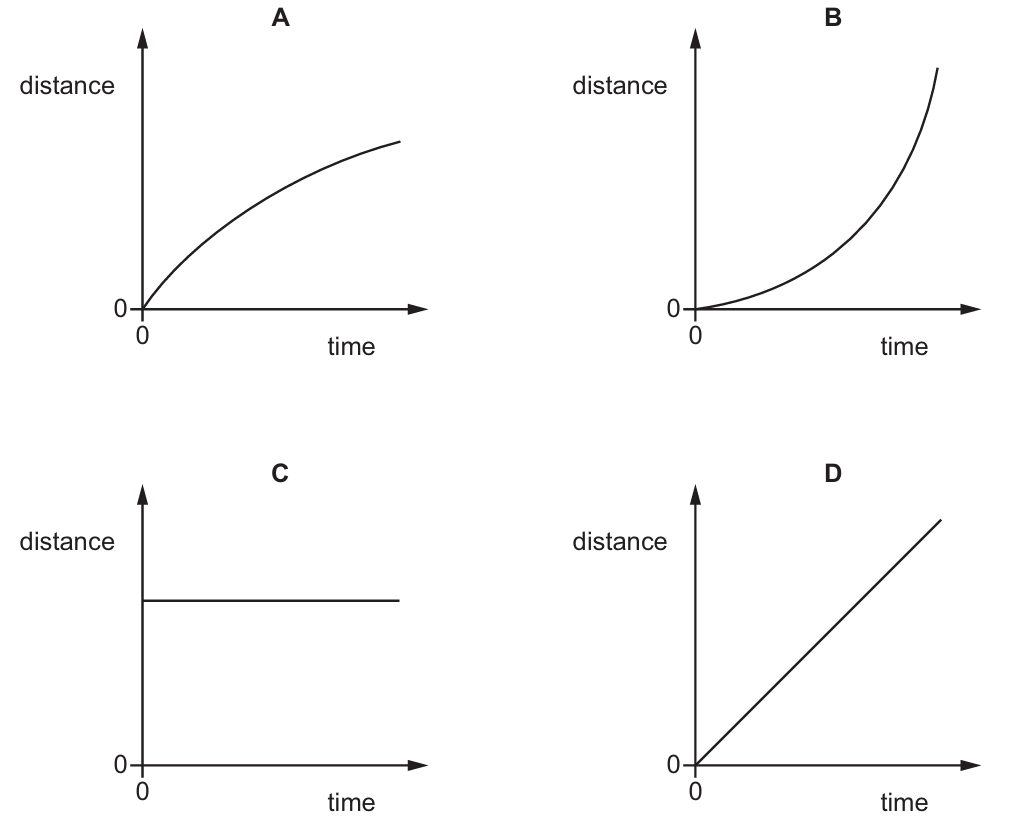
Which graph is the distance–time graph for this object?

Most-appropriate topic codes (Cambridge IGCSE Co-ordinated Sciences 0654):
▶️ Answer/Explanation
Since distance covered per unit time grows as speed increases, the distance–time graph must curve with an increasing gradient.
✅ Answer: (D)
Question 29
Five identical solid glass balls, each of mass 5.0 g, are put into a measuring cylinder containing water.
The water level in the measuring cylinder rises from the 30 cm³ mark to the 40 cm³ mark.
What is the density of the glass from which the balls are made?
A. 0.50 g/cm³
B. 1.2 g/cm³
C. 1.6 g/cm³
D. 2.5 g/cm³
Most-appropriate topic codes (Cambridge IGCSE Co-ordinated Sciences 0654):
▶️ Answer/Explanation
Density is \( \dfrac{25}{10} = 2.5\text{ g/cm}^3 \).
✅ Answer: (D)
Question 30
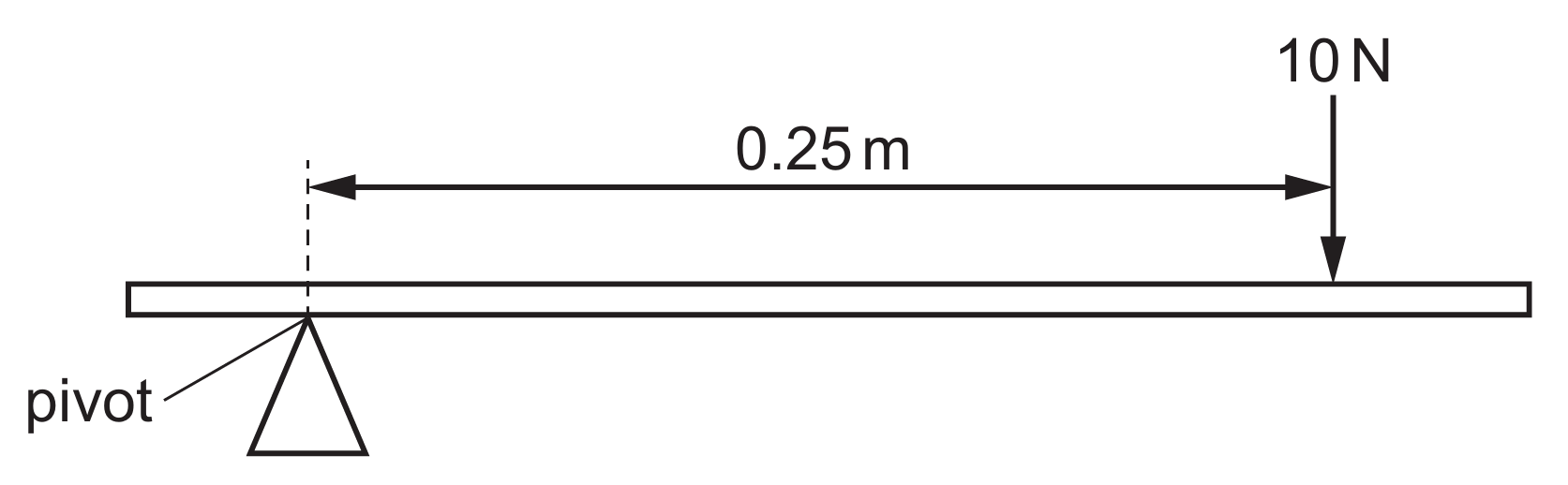
A force of 10 N is applied to a beam at a distance of 0.25 m from a pivot.

Which calculation gives the moment of the force about the pivot in N m?
A. \( 10 \times 0.25 \)
B. \( \dfrac{10}{0.25} \)
C. \( 10 + 0.25 \)
D. \( 10 – 0.25 \)
Most-appropriate topic codes (Cambridge IGCSE Co-ordinated Sciences 0654):
▶️ Answer/Explanation
Here, \( \text{moment} = 10 \times 0.25 \).
✅ Answer: (A)
Question 31
Which electrical device transfers chemical energy into electrical energy?
A. battery
B. lamp
C. electric motor
D. television
Most-appropriate topic codes (Cambridge IGCSE Co-ordinated Sciences 0654):
▶️ Answer/Explanation
When connected in a circuit, this chemical energy is converted into electrical energy to drive a current.
✅ Answer: (A)
Question 32
From which type of energy is electrical energy transferred in a hydroelectric power station?
A. chemical potential energy
B. elastic potential (strain) energy
C. gravitational potential energy
D. nuclear energy
Most-appropriate topic codes (Cambridge IGCSE Co-ordinated Sciences 0654):
▶️ Answer/Explanation
As it falls and turns turbines, this gravitational potential energy is converted into electrical energy.
✅ Answer: (C)
Question 33
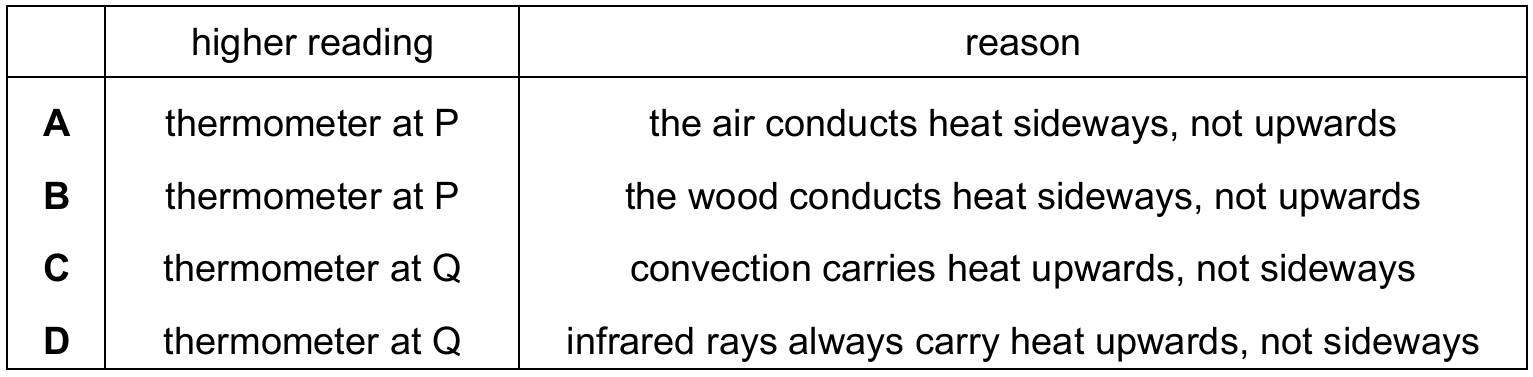
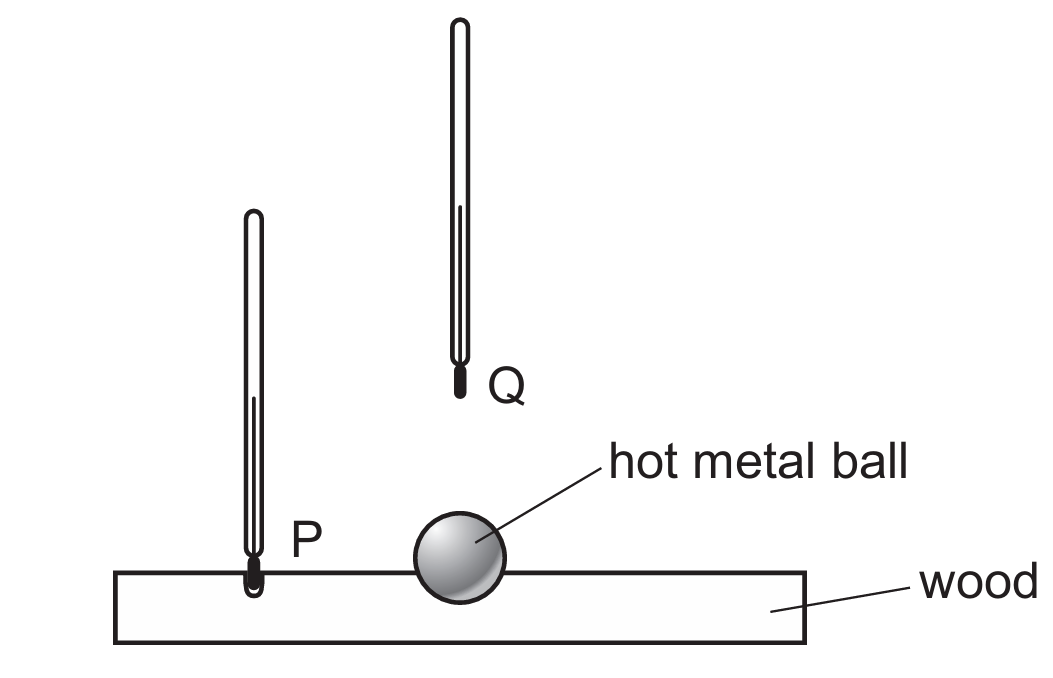
A hot metal ball is placed in a small hollow in a piece of wood. Two thermometers are placed equal distances from the ball, one at position P and one at position Q.

Which thermometer gives the higher reading and why?

Most-appropriate topic codes (Cambridge IGCSE Co-ordinated Sciences 0654):
▶️ Answer/Explanation
This carries thermal energy upwards to Q rather than sideways to P, so Q reads higher.
✅ Answer: (C)
Question 34
Which description is correct for the image of an object formed by a vertical plane mirror?
A. upright and larger than the object
B. upright and the same size as the object
C. upside down and smaller than the object
D. upside down and the same size as the object
Most-appropriate topic codes (Cambridge IGCSE Co-ordinated Sciences 0654):
▶️ Answer/Explanation
The image also appears the right way up (upright) and the same distance behind the mirror as the object is in front.
✅ Answer: (B)
Question 35
Two students conduct an experiment to determine the speed of sound in air.
They stand 639 m apart.
One student hits two blocks of wood together while the other uses a stop-watch to time how long it takes for the sound to reach him.
It takes 1.80 s for the sound to reach the second student.
What is the speed of sound in air, calculated using these results?
A. 330 m/s
B. 355 m/s
C. 710 m/s
D. 1150 m/s
Most-appropriate topic codes (Cambridge IGCSE Co-ordinated Sciences 0654):
▶️ Answer/Explanation
Substituting the values, \( \dfrac{639}{1.80} = 355\text{ m/s} \).
✅ Answer: (B)
Question 36
Which type of magnet can be switched on and off many times per second?
A. an electromagnet only
B. a permanent magnet only
C. both electromagnets and permanent magnets
D. neither electromagnets or permanent magnets
Most-appropriate topic codes (Cambridge IGCSE Co-ordinated Sciences 0654):
▶️ Answer/Explanation
Switching the current on and off rapidly switches the magnetism on and off, unlike a permanent magnet which is always magnetic.
✅ Answer: (A)
Question 37
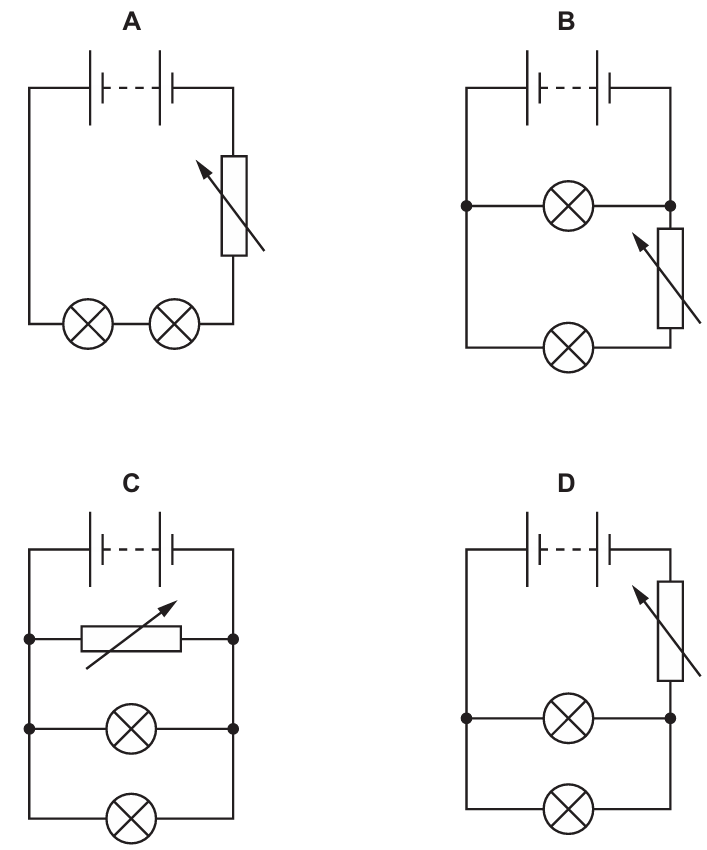
In which circuit is it possible to change the brightness of one lamp without changing the brightness of the other lamp?

Most-appropriate topic codes (Cambridge IGCSE Co-ordinated Sciences 0654):
▶️ Answer/Explanation
Only a parallel branch with its own variable resistor lets one lamp’s brightness change independently of the other, which is the arrangement shown in option B.
✅ Answer: (B)
Question 38
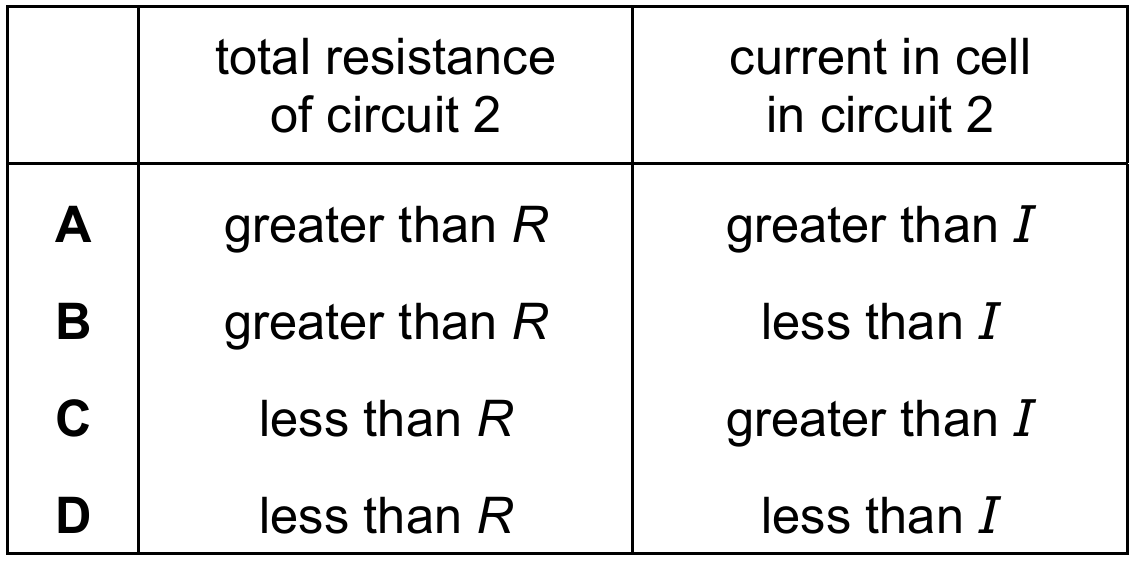
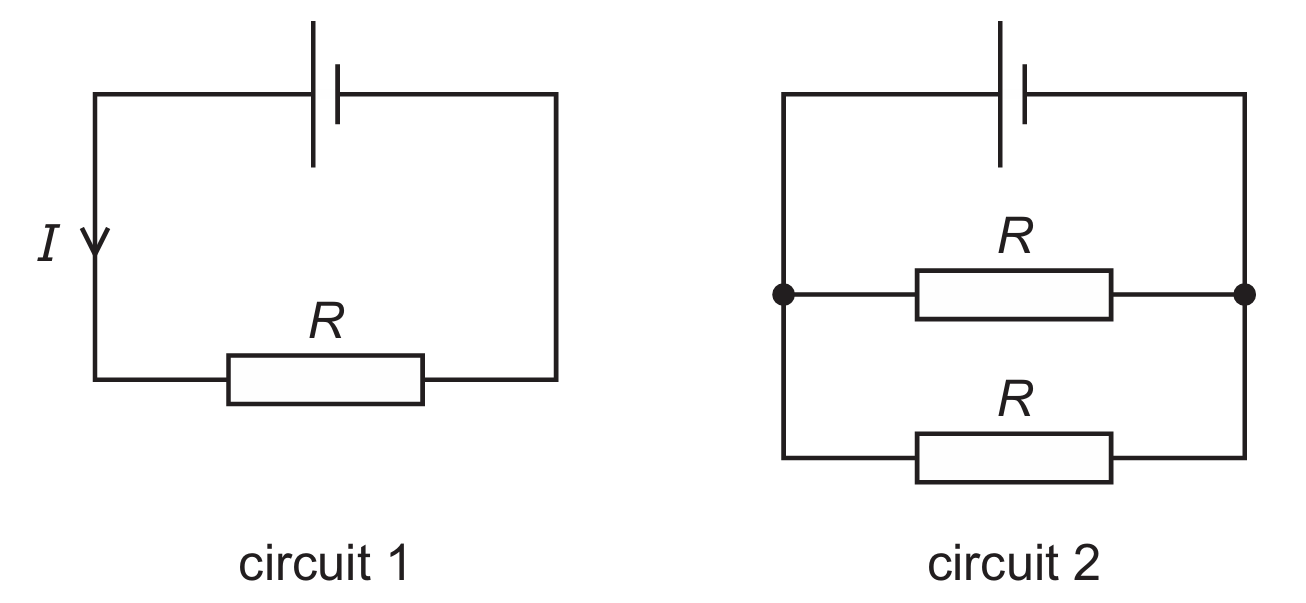
Circuits 1 and 2 contain identical cells and identical resistors. Each resistor has the same resistance R. The current in the cell in circuit 1 is I.

How do the total resistance of circuit 2 and the current in the cell in circuit 2 compare with R and I?

Most-appropriate topic codes (Cambridge IGCSE Co-ordinated Sciences 0654):
▶️ Answer/Explanation
Since the cell’s voltage is unchanged and total resistance has decreased, by \( I = \dfrac{V}{R} \) the current must be greater than I.
✅ Answer: (C)
Question 39
The current in an electric heater during normal use is 11 A.
What is an appropriate rating for a fuse to protect the heater?
A. 3 A
B. 10 A
C. 13 A
D. 36 A
Most-appropriate topic codes (Cambridge IGCSE Co-ordinated Sciences 0654):
▶️ Answer/Explanation
A 10 A fuse would blow at 11 A, while 13 A is the next standard rating that safely allows normal operation and still protects the circuit.
✅ Answer: (C)
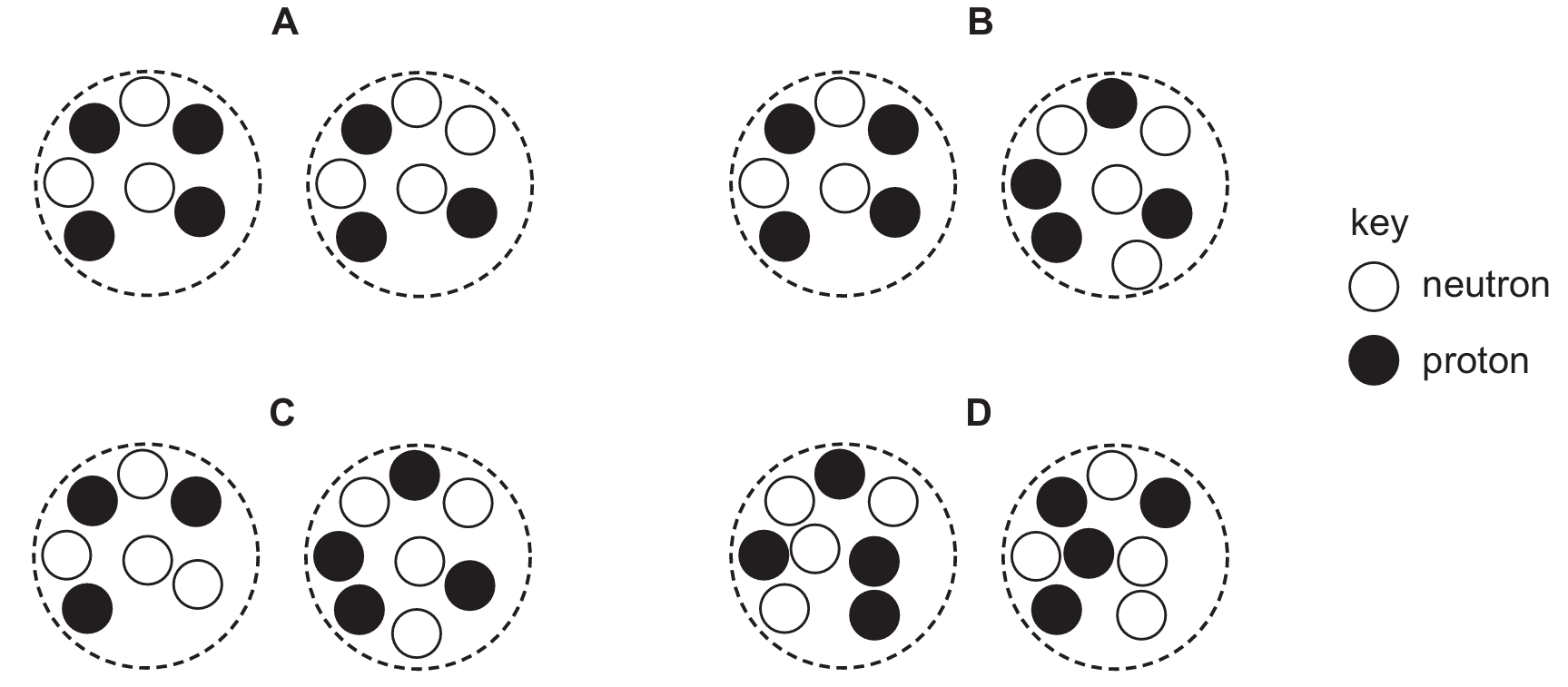
Question 40
The diagrams represent pairs of nuclei of some atoms.
Which pair shows nuclei of different isotopes of the same element?

Most-appropriate topic codes (Cambridge IGCSE Co-ordinated Sciences 0654):
▶️ Answer/Explanation
Option B is the pair where both nuclei have identical proton counts but differing neutron counts.
✅ Answer: (B)