
Question 1
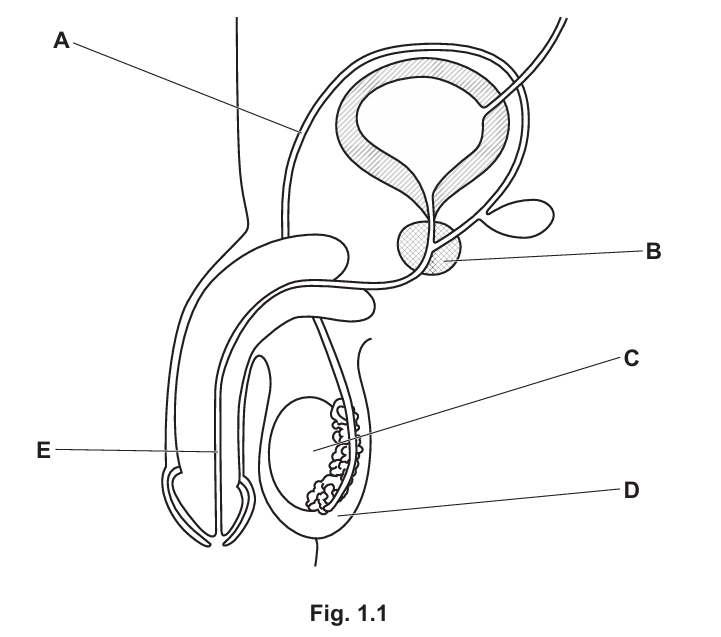
- where meiosis occurs ………………………
- which secretes fluid for sperm to swim in ………………………
- which carries urine ………………………
- which produces sperm. ………………………
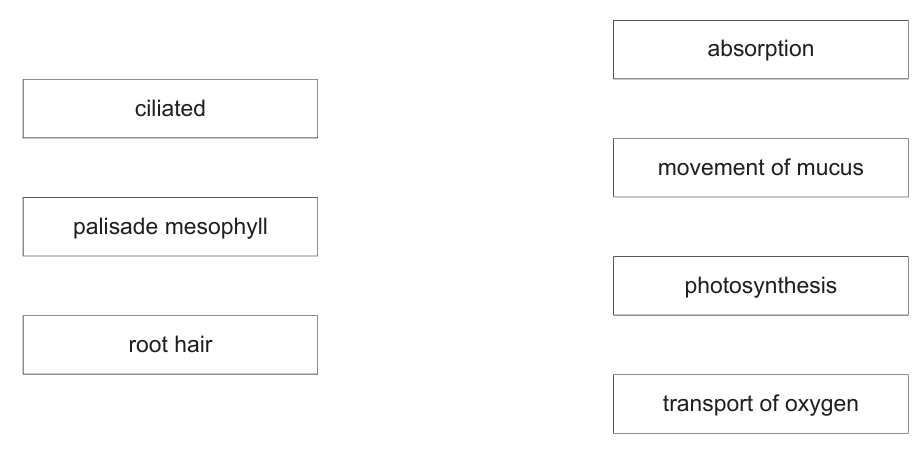
The boxes on the left show some other specialised cells.
The boxes on the right show some functions.
Draw lines to link each specialised cell with its function.
Most-appropriate topic codes (Cambridge IGCSE Co-ordinated Sciences 0654):
• Topic B15.4 — Sexual reproduction in humans (Parts (a)–(c))
• Topic B2.1 — Cell structure and organisation (Part (d))
▶️ Answer/Explanation
(a)
Where meiosis occurs: C (the testis, where sperm are produced by meiotic division).
Which secretes fluid for sperm to swim in: B (the seminal vesicle).
Which carries urine: E (the urethra).
Which produces sperm: C (the testis).
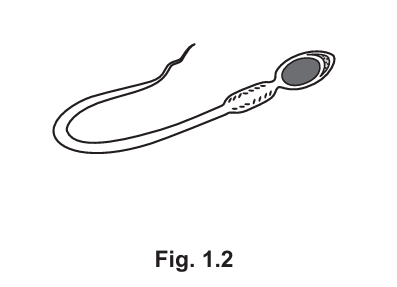
(b) Flagellum and haploid nucleus
The flagellum (tail) is labelled to show it enables the sperm to swim towards the egg.
The haploid nucleus is labelled to show it carries a single set of chromosomes for fertilisation.
Any two valid features (e.g. enzymes in the acrosome) are also accepted.
(c) Sperm has unpaired chromosomes; zygote has paired chromosomes
Sperm nuclei are haploid, containing a single, unpaired set of chromosomes.
The zygote nucleus is diploid, containing chromosomes in pairs, since it is formed by the fusion of sperm and egg.
(d)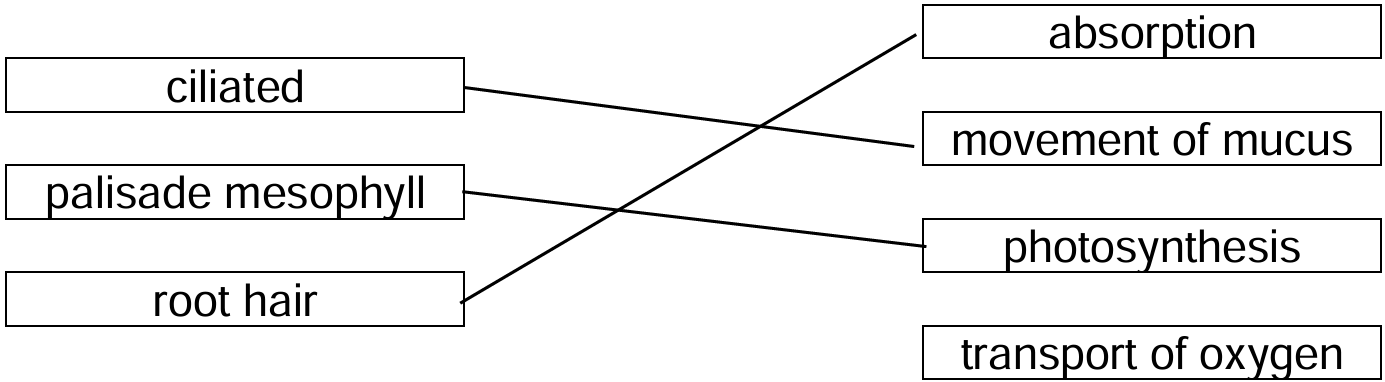
Ciliated cells link to \( \text{movement of mucus} \), since cilia beat to move mucus along a surface.
Palisade mesophyll cells link to \( \text{photosynthesis} \), since they are packed with chloroplasts.
Root hair cells link to \( \text{absorption} \), since their large surface area increases water and mineral uptake.
Question 2
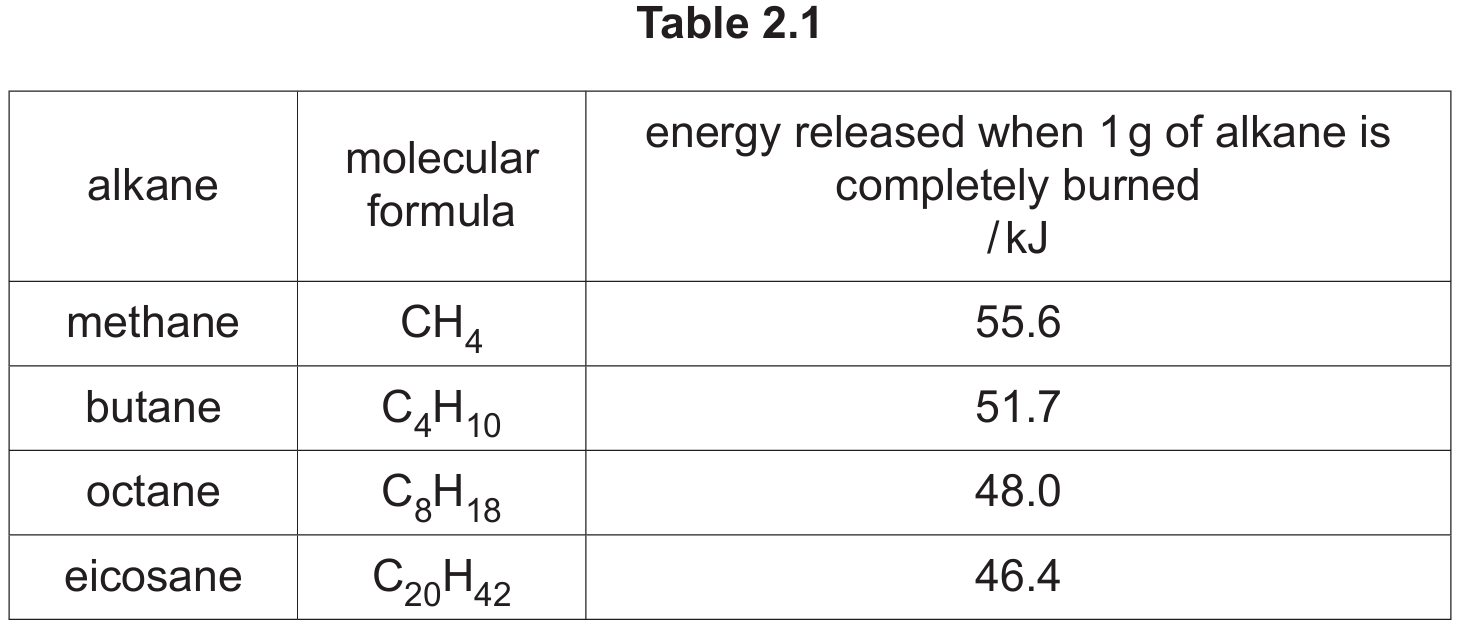
State how the amount of energy released changes.
Write the molecular formula for tetradecane.
Use the general formula \( \text{C}_n\text{H}_{2n+2} \) to show that decene is not an alkane.
Carbon dioxide and water are made.
Construct the balanced symbol equation for this reaction.
State what is meant by an exothermic reaction.
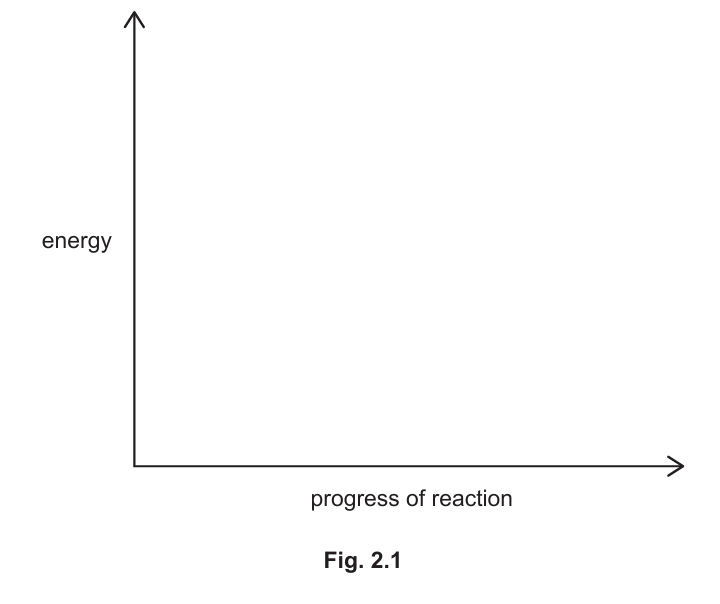
- the energy of the reactants and the products
- the energy change in the reaction
- the activation energy of the reaction.
Most-appropriate topic codes (Cambridge IGCSE Co-ordinated Sciences 0654):
• Topic C11.1 — Hydrocarbons (Part (a))
• Topic C11.4 — Alkanes (Part (b))
• Topic C6.2 — Combustion equations (Part (c))
• Topic C5.1 — Exothermic and endothermic reactions (Part (d))
▶️ Answer/Explanation
(a) A compound that contains only carbon and hydrogen atoms
A hydrocarbon is defined strictly as a compound made of carbon and hydrogen only.
No other elements, such as oxygen, may be present.
(b)(i) Decreases
The table shows that as \( n \) (and hence molecular mass) increases, the energy released per gram falls from 55.6 kJ to 46.4 kJ.
This is because a larger proportion of the molecule’s mass comes from carbon atoms rather than more energetic C–H bonds.
(b)(ii) \( \text{C}_{14}\text{H}_{30} \)
Using \( \text{C}_n\text{H}_{2n+2} \) with \( n = 14 \): number of H atoms \( = 2(14)+2 = 30 \).
So the molecular formula is \( \text{C}_{14}\text{H}_{30} \).
(b)(iii) For \( n = 10 \), an alkane needs 22 H atoms, but decene has only 20
Using \( \text{C}_n\text{H}_{2n+2} \) with \( n = 10 \): expected H atoms \( = 2(10)+2 = 22 \).
Decene has only 20 hydrogen atoms, so it does not fit the alkane general formula and is therefore not an alkane.
(c) \( 2\text{C}_4\text{H}_{10} + 13\text{O}_2 \rightarrow 8\text{CO}_2 + 10\text{H}_2\text{O} \)
All formulae of reactants and products must be correct.
Coefficients are balanced so that atoms of C, H, and O are equal on both sides.
(d)(i) A reaction in which energy (heat) is given out to the surroundings
In an exothermic reaction, the products have less energy than the reactants.
The excess energy is released, usually as heat, causing the surroundings to warm up.
(d)(ii) 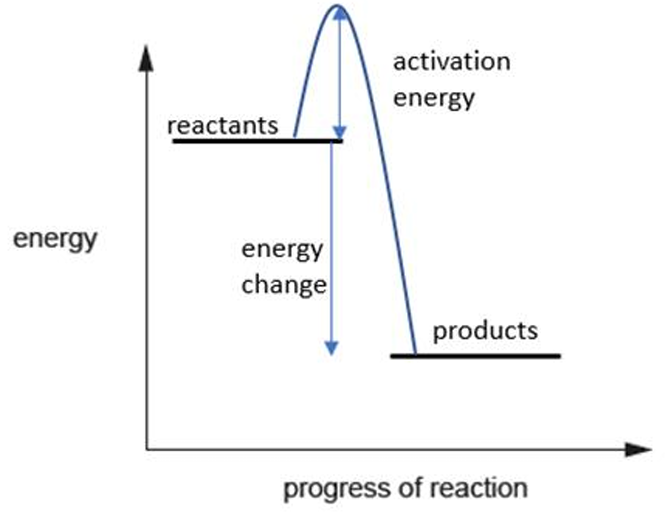
The reactants line is drawn higher than the products line, since the reaction is exothermic.
The activation energy (\( E_a \)) is the initial rise (hump) from reactants to the peak of the curve.
The energy change (\( \Delta H \)) is the vertical drop labelled from the reactants level down to the products level.
Question 3
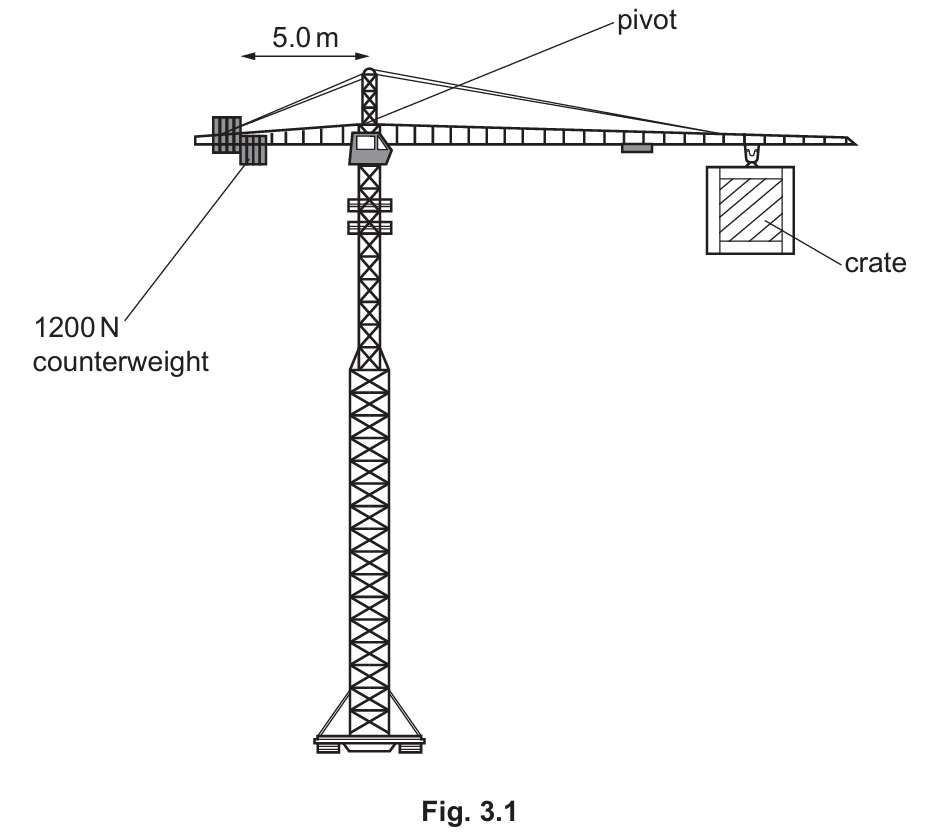
Calculate the moment of the counterweight about the pivot.
The gravitational field strength, \( g \), is \( 10 \, \text{N/kg} \).

Most-appropriate topic codes (Cambridge IGCSE Co-ordinated Sciences 0654):
• Topic P1.5.2 — Moments (Part (a))
• Topic P1.6.1 — Gravitational potential energy (Part (b))
• Topic P4.5.5 — The d.c. motor (Part (c))
▶️ Answer/Explanation
(a)(i) 6000 Nm
Moment = force × distance from pivot.
\( M = F \times d = 1200 \times 5.0 = 6000 \, \text{Nm} \).
(a)(ii) 6000 Nm
Since the crane is in equilibrium, the clockwise and anticlockwise moments about the pivot must be equal.
So the moment of the crate equals the moment of the counterweight, \( 6000 \, \text{Nm} \).
(b) 250 kg
Gravitational potential energy: \( \text{GPE} = m \times g \times h \).
Rearranging: \( m = \dfrac{\text{GPE}}{g \times h} = \dfrac{105000}{10 \times 42} = 250 \, \text{kg} \).
(c)(i) Split-ring commutator
The split-ring commutator reverses the direction of current in the coil every half-turn.
This keeps the coil rotating continuously in the same direction.
(c)(ii) Arrow drawn from N to S
By convention, magnetic field lines point from the north pole to the south pole.
The arrow should therefore run horizontally from the N-labelled pole to the S-labelled pole.
(c)(iii) Increase the current; increase the magnetic field strength (or number of coil turns)
A larger current increases the force on the coil in the magnetic field, per \( F = BIL \).
A stronger magnetic field, or more turns on the coil, similarly increases the turning force, speeding up rotation.
Question 4
State two environmental conditions needed for germination.
Fig. 4.1 shows the growth of the plant shoot.
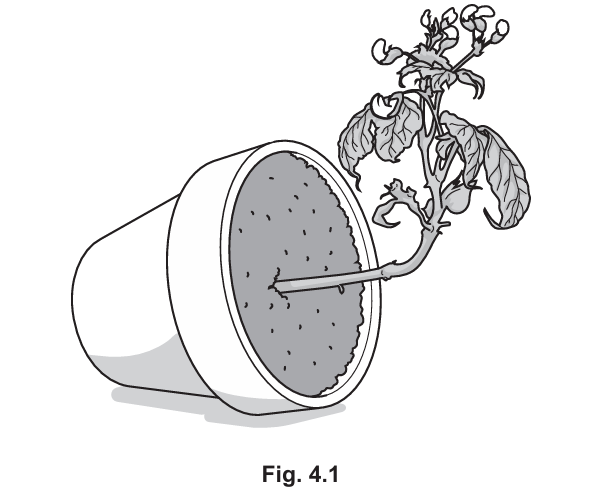
A plant hormone called ………………………………………………. is made in the shoot tip and moves through the plant.
The hormone collects on the ………………………………………………. side of the shoot.
This stimulates growth causing cell ………………………………………………. .
The shoot grows away from the direction of ………………………………………………. .
Most-appropriate topic codes (Cambridge IGCSE Co-ordinated Sciences 0654):
• Topic B15.3 — Germination (Part (a))
• Topic B13.1 — Tropic responses (Part (b))
• Topic B6.1 — Photosynthesis (Part (c))
▶️ Answer/Explanation
(a) Oxygen; water/moisture; warm/suitable temperature (any two)
Germinating seeds need oxygen for aerobic respiration, which releases the energy required for growth.
Water is needed to activate enzymes and swell the seed, while a suitable temperature ensures those enzymes work efficiently.
(b)(i) Gravitropism
In the dark, with no light to influence growth, the shoot’s curved growth is a response to gravity rather than light.
This directional growth response to gravity is called gravitropism (geotropism).
(b)(ii) Auxin; lower; elongation; gravity
Auxin is produced in the shoot tip and diffuses down the shoot.
Under the influence of gravity, auxin accumulates on the lower side of the horizontally growing shoot.
This higher auxin concentration causes greater cell elongation on the lower side, bending the shoot upward, away from the direction of gravity.
(c)(i) \( 6\text{CO}_2 + 6\text{H}_2\text{O} \rightarrow \text{C}_6\text{H}_{12}\text{O}_6 + 6\text{O}_2 \)
Six molecules of carbon dioxide combine with six molecules of water, using light energy, to form glucose and oxygen.
Both sides of the equation must balance for carbon, hydrogen, and oxygen atoms.
(c)(ii) Chlorophyll absorbs light energy needed to drive photosynthesis
Chlorophyll is the pigment in chloroplasts that absorbs light energy, mainly from the red and blue regions of the spectrum.
This absorbed energy is transferred to power the synthesis of carbohydrates (glucose) from carbon dioxide and water.
Question 5
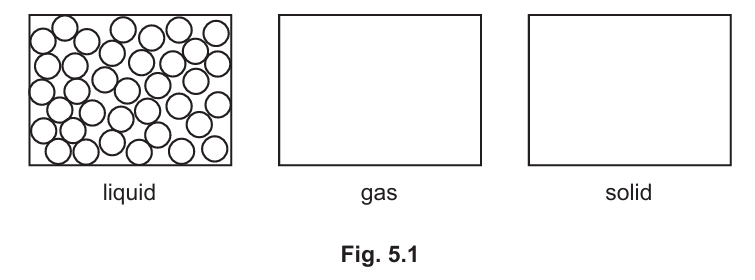
Include:
- how the arrangement of the particles changes
- how the movement of the particles changes.
The reaction is faster if hot water is used.
Explain why. Use ideas about collisions between particles.
Explain why. Use ideas about collisions between particles.
Most-appropriate topic codes (Cambridge IGCSE Co-ordinated Sciences 0654):
• Topic C1.1 — States of matter and the kinetic particle model (Parts (a), (b))
• Topic C6.2 — Rates of reaction (Part (c))
▶️ Answer/Explanation
(a) 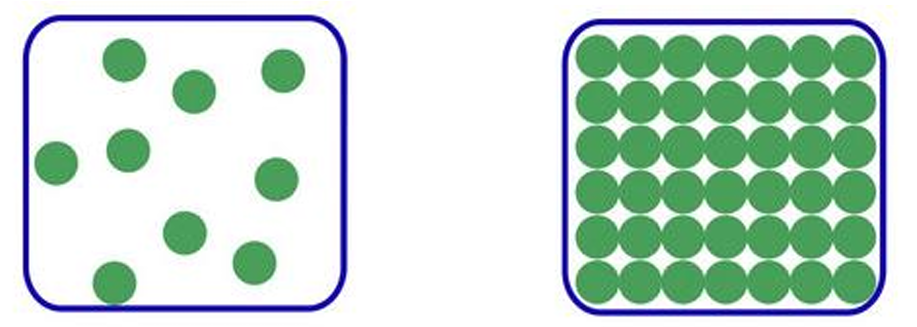
In a gas, particles are far apart and scattered randomly across the box.
In a solid, particles are drawn touching each other in a fixed, regular (ordered) arrangement.
(b)(i) Arrangement: particles move much further apart; Movement: particles move faster and more randomly
As water boils, particles gain enough energy to overcome the attractive forces holding them close together in the liquid.
They spread far apart and move freely and randomly in all directions, forming steam.
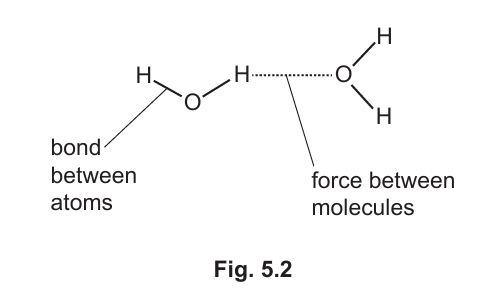
(b)(ii) Covalent bonds between atoms are much stronger than the intermolecular forces
The O–H bonds within each water molecule are strong covalent bonds requiring a large amount of energy to break.
Boiling only supplies enough energy to overcome the weaker forces between separate molecules, not the covalent bonds themselves.
(b)(iii) 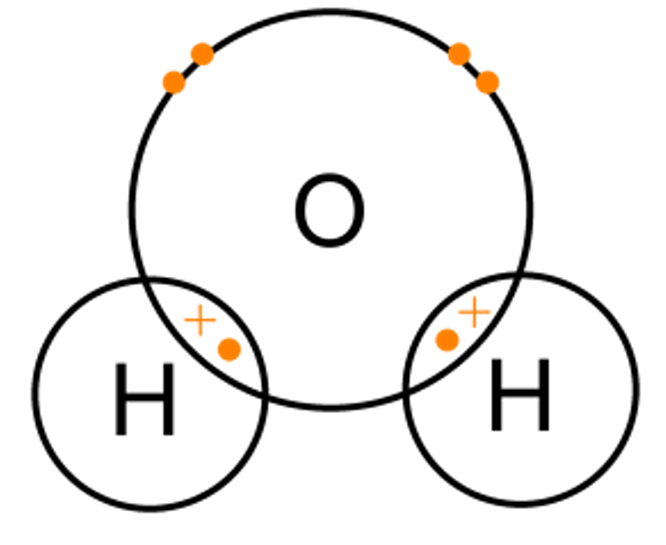
Oxygen shares one electron with each hydrogen atom, forming two covalent O–H bonds.
Only the outer-shell (valence) electrons of oxygen and hydrogen are shown, with two shared pairs between O and each H.
(c)(i) Hot water gives particles more kinetic energy, so collisions are more frequent and more energetic
In hot water, particles move faster, increasing both the frequency of collisions and the proportion with energy above the activation energy.
More successful collisions per second means the reaction rate increases.
(c)(ii) Powdered magnesium has a greater surface area, so collisions occur more frequently
Powdering the magnesium increases its surface area exposed to the water.
This allows more frequent collisions between water particles and magnesium particles per second, speeding up the reaction.
Question 6
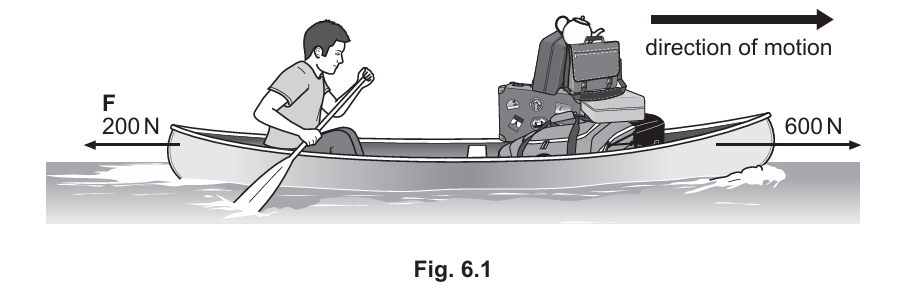
Calculate the acceleration of the canoe.
Calculate the frequency of the waves in Hz.
Use your answer to 6(b)(i) to calculate the speed of the water waves.
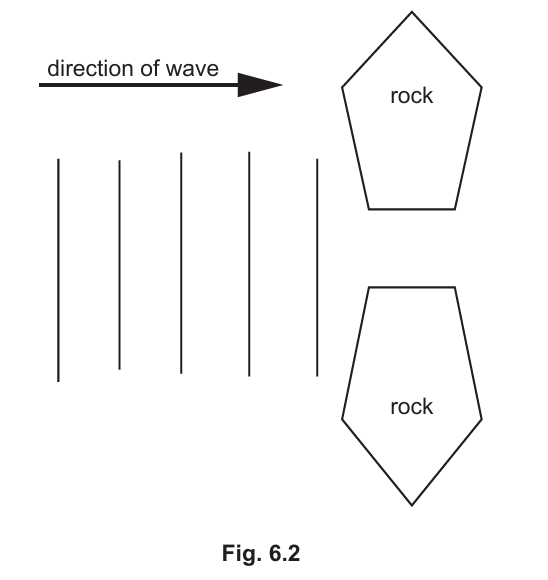
The water waves will diffract as they travel between the two rocks.
The solar panel uses energy from the Sun to generate electricity.
Most-appropriate topic codes (Cambridge IGCSE Co-ordinated Sciences 0654):
• Topic P1.2 — Forces and motion (Part (a))
• Topic P3.1 — General wave properties (Part (b))
• Topic P5.2.1 — Detection of radioactivity (Part (c))
▶️ Answer/Explanation
(a)(i) Friction / drag / water resistance
The force labelled F acts opposite to the direction of motion.
This backward force is caused by drag (friction/resistance) from the water acting on the canoe.
(a)(ii) \( 4 \, \text{m/s}^2 \)
Resultant force \( = 600 – 200 = 400 \, \text{N} \).
Using \( F = ma \): \( a = \dfrac{F}{m} = \dfrac{400}{100} = 4 \, \text{m/s}^2 \).
(b)(i) 0.25 Hz
Frequency is the number of wavefronts per second.
\( f = \dfrac{15}{60} = 0.25 \, \text{Hz} \).
(b)(ii) 0.15 m/s
Wave speed is given by \( v = f\lambda \).
\( v = 0.25 \times 0.6 = 0.15 \, \text{m/s} \).
(b)(iii) Circular wavefronts spreading out beyond the gap
As the wavefronts pass through the gap between the two rocks, they bend around the edges.
The wavefronts become curved (circular) as they spread into the region behind the gap.
(c) Nuclear fusion
The Sun releases energy through nuclear fusion.
In this process, hydrogen nuclei fuse together at extremely high temperatures and pressures to form helium, releasing large amounts of energy.
Question 7

Suggest two other ways to prevent the effects seen in Fig. 7.1.
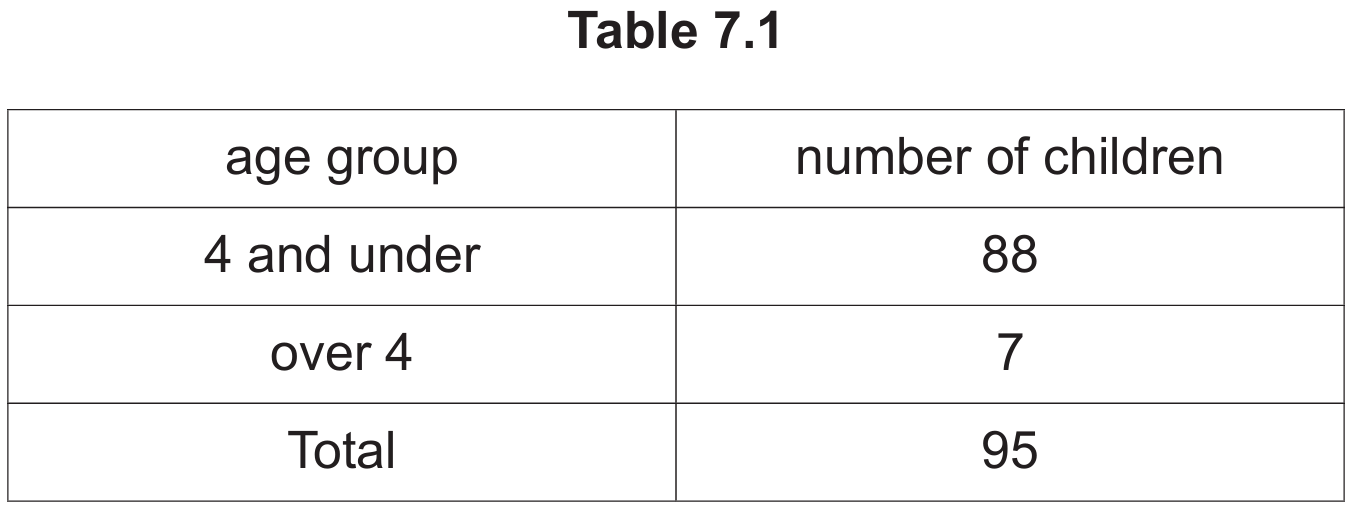
Give your answer to the nearest whole number.
Most-appropriate topic codes (Cambridge IGCSE Co-ordinated Sciences 0654):
• Topic B7.1 — Diet and nutrition/deficiency diseases (Parts (a)–(c))
• Topic B4.1 — Biological molecules (Part (d))
• Topic B5.1 — Enzymes (Part (e))
▶️ Answer/Explanation
(a)(i) Vitamin D
The bowed legs shown are characteristic of rickets.
Rickets is caused by a deficiency of vitamin D, which is needed for calcium absorption and healthy bone growth.
(a)(ii) Exposure to sunlight; eating foods high in vitamin D
Sunlight exposure allows the skin to synthesise vitamin D naturally.
Eating vitamin D-rich foods, such as oily fish or fortified milk, provides an additional dietary source.
(b)(i) 93%
Percentage \( = \dfrac{88}{95} \times 100 = 92.6\% \).
Rounded to the nearest whole number, this is \( 93\% \).
(b)(ii) Children need extra protein for growth
Unlike adults, children are still growing.
Extra protein per kg of body mass is required to build new tissues, muscles, and organs during growth.
(c) Marasmus
Marasmus is another protein-energy malnutrition disease.
It results from a severe overall lack of protein and energy (calories) in the diet, causing extreme wasting.
(d) Carbon, hydrogen, oxygen, nitrogen
All proteins are built from amino acids.
Every amino acid contains carbon, hydrogen, oxygen, and nitrogen atoms.
(e) Protease
Protease enzymes catalyse the breakdown of proteins.
They hydrolyse peptide bonds, breaking proteins down into smaller peptides and amino acids.
Question 8
Table 8.1 shows the mass of pollutant made when 1 kg of petrol or 1 kg of diesel is burnt in a car engine.
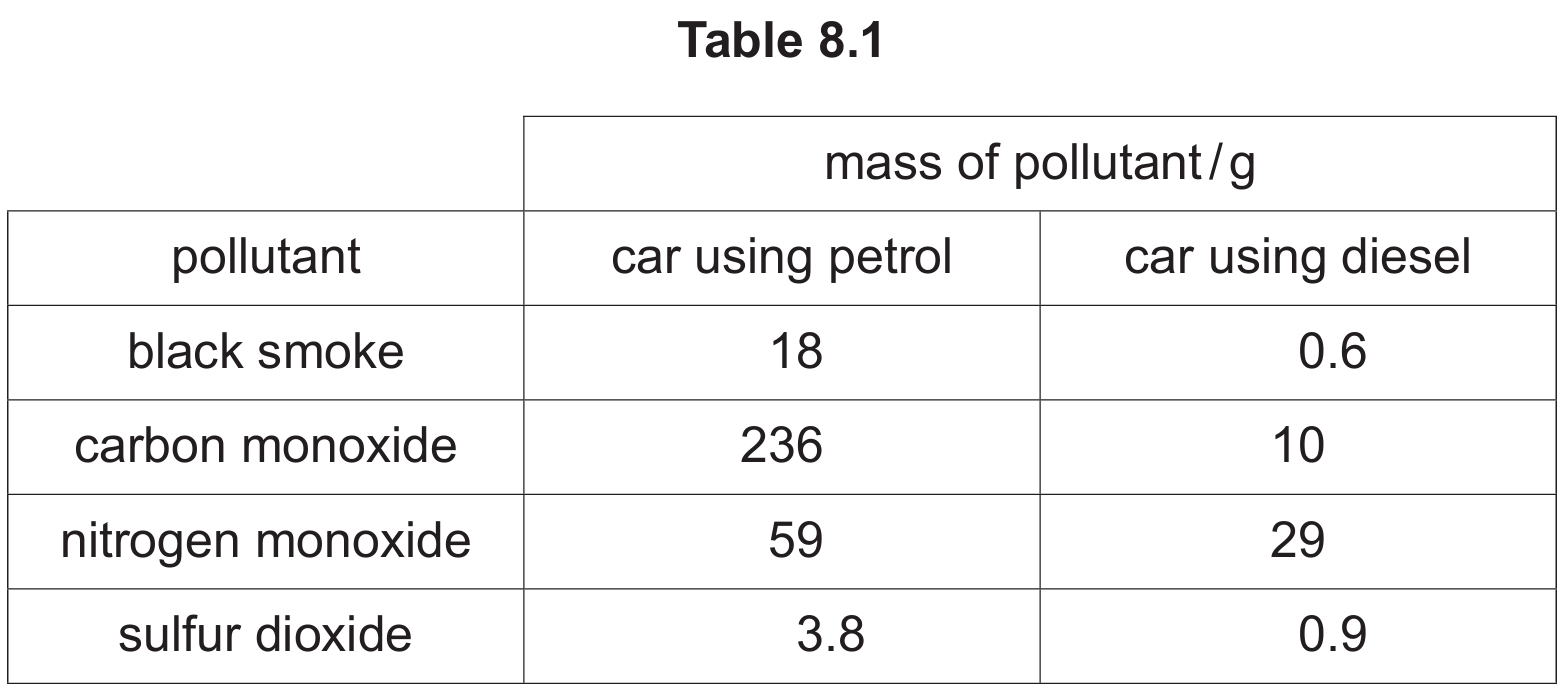
Car B uses 8 kg of diesel fuel for the same journey.
State which car, A or B, makes the most nitrogen monoxide. Explain your answer.
The nitrogen monoxide is turned into nitrogen gas and oxygen gas.
Construct the balanced symbol equation for this reaction.
Sulfur dioxide is not removed from car emissions by a catalytic converter.
Describe one way that emissions of sulfur dioxide by cars can be reduced.
Calculate the volume occupied by 236 g of carbon monoxide gas.
The molar gas volume at room temperature and pressure is \( 24 \, \text{dm}^3 \). Show your working.
Most-appropriate topic codes (Cambridge IGCSE Co-ordinated Sciences 0654):
• Topic C10.2 — Air pollution/catalytic converters (Part (a))
• Topic C2.3 — The mole and gas volumes (Part (b))
• Topic C6.3 — Reversible reactions/Contact process (Part (c))
▶️ Answer/Explanation
(a)(i) Car A, because it makes 295 g compared to Car B’s 232 g
Car A: \( 5 \times 59 = 295 \, \text{g} \) of nitrogen monoxide.
Car B: \( 8 \times 29 = 232 \, \text{g} \) of nitrogen monoxide, so Car A produces more overall.
(a)(ii) \( 2\text{NO} \rightarrow \text{N}_2 + \text{O}_2 \)
Two nitrogen monoxide molecules decompose to give one nitrogen molecule and one oxygen molecule.
The equation is already balanced for nitrogen and oxygen atoms.
(a)(iii) Use low-sulfur fuel (remove sulfur from the fuel before burning)
Removing sulfur compounds from the fuel before combustion prevents sulfur dioxide from forming in the first place.
Using desulfurised or low-sulfur petrol/diesel achieves this reduction in emissions.
(b) 202 dm³
Molar mass of CO \( = 12 + 16 = 28 \, \text{g/mol} \).
Moles of CO \( = \dfrac{236}{28} = 8.43 \, \text{mol} \).
Volume \( = 8.43 \times 24 = 202 \, \text{dm}^3 \).
(c) Temperature of about 450°C; vanadium(V) oxide catalyst (any two conditions)
A temperature of around 450°C is used to give a reasonable rate and yield.
A pressure of about 2 atmospheres (200 kPa) and a vanadium(V) oxide (\( \text{V}_2\text{O}_5 \)) catalyst are also used to speed up the reaction.
Question 9
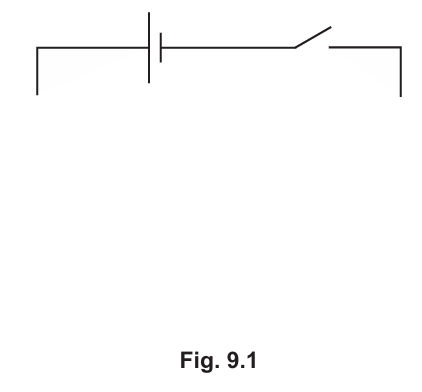
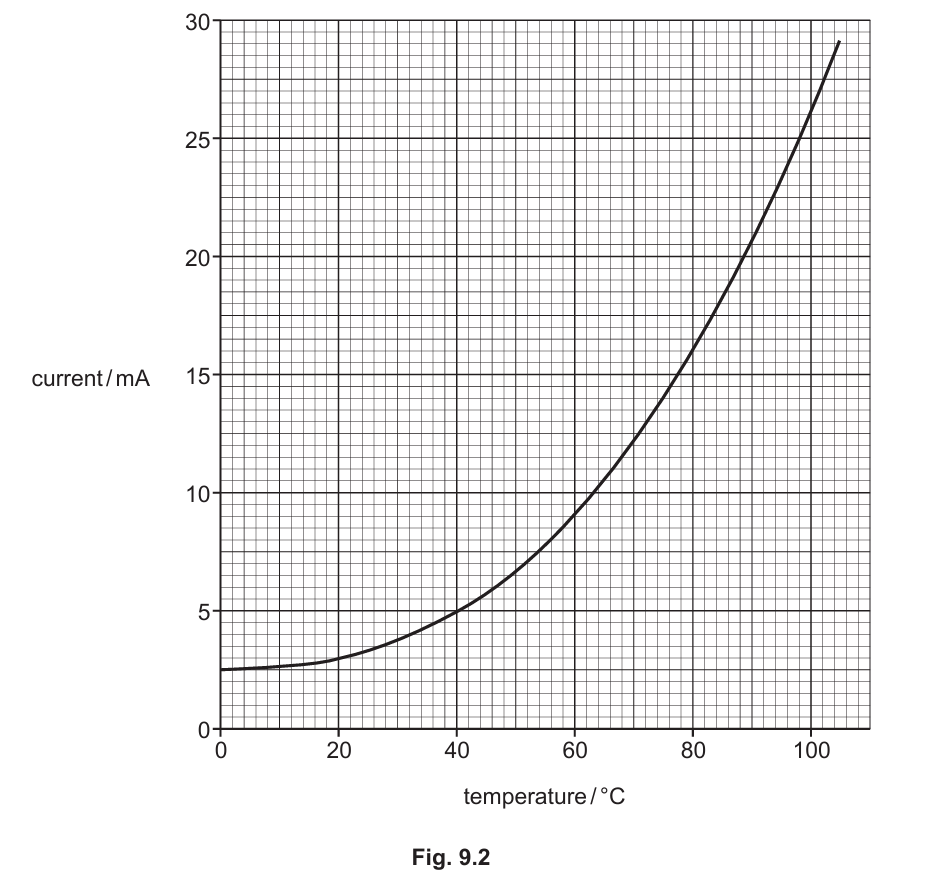
Calculate the time it takes for 1.0 C of charge to flow through the thermistor.
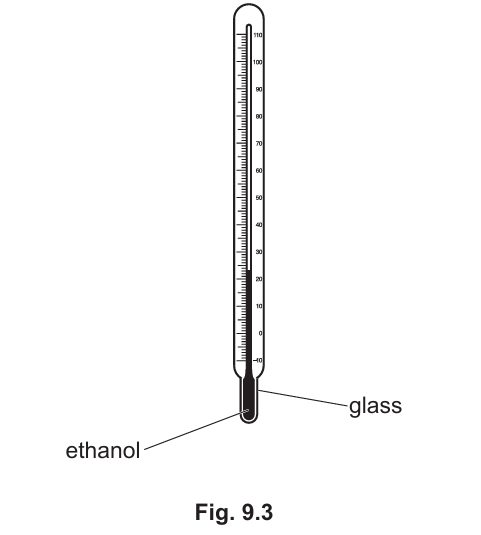
Describe how thermal energy is transferred through glass.
Explain why the ethanol expands as the temperature increases in terms of the motion and arrangement of molecules.
When the thermometer is cooled to 3°C, the volume decreases to \( 1.95 \, \text{cm}^3 \).
Calculate the density of the ethanol at 3°C.
Most-appropriate topic codes (Cambridge IGCSE Co-ordinated Sciences 0654):
• Topic P4.3.1 — Circuit diagrams and components (Part (a))
• Topic P4.2.2 — Electric charge and current (Part (b))
• Topic P2.3.1 — Thermal energy transfer/conduction (Part (c)(i))
• Topic P2.2.2 — Thermal expansion (Part (c)(ii))
• Topic P1.4 — Density (Part (c)(iii))
▶️ Answer/Explanation
(a) 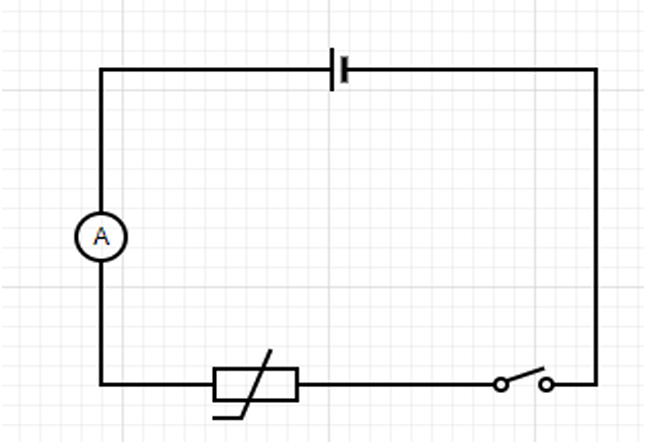
The circuit symbols for the thermistor and ammeter must be added into the loop with correct symbols.
All four components — cell, thermistor, ammeter, switch — must form a single closed series loop.
(b) 200 s
From the graph, the current at 40°C is \( 5 \, \text{mA} = 0.005 \, \text{A} \).
Using \( Q = It \): \( t = \dfrac{Q}{I} = \dfrac{1.0}{0.005} = 200 \, \text{s} \).
(c)(i) Conduction, by vibrations passed from particle to particle
Glass transfers thermal energy by conduction.
Particles in the heated region vibrate more and pass this extra energy to neighbouring particles through collisions.
(c)(ii) Molecules gain kinetic energy, move faster, and spread further apart
As temperature rises, ethanol molecules move faster and vibrate more vigorously.
This increased motion pushes molecules further apart on average, increasing the volume (expansion).
(c)(iii) \( 0.80 \, \text{g/cm}^3 \)
Mass of ethanol (constant): \( m = \rho \times V = 0.78 \times 2.00 = 1.56 \, \text{g} \).
New density: \( \rho = \dfrac{m}{V} = \dfrac{1.56}{1.95} = 0.80 \, \text{g/cm}^3 \).
Question 10
Most-appropriate topic codes (Cambridge IGCSE Co-ordinated Sciences 0654):
• Topic B13.3 — Homeostasis/temperature regulation (Parts (a)–(c))
▶️ Answer/Explanation
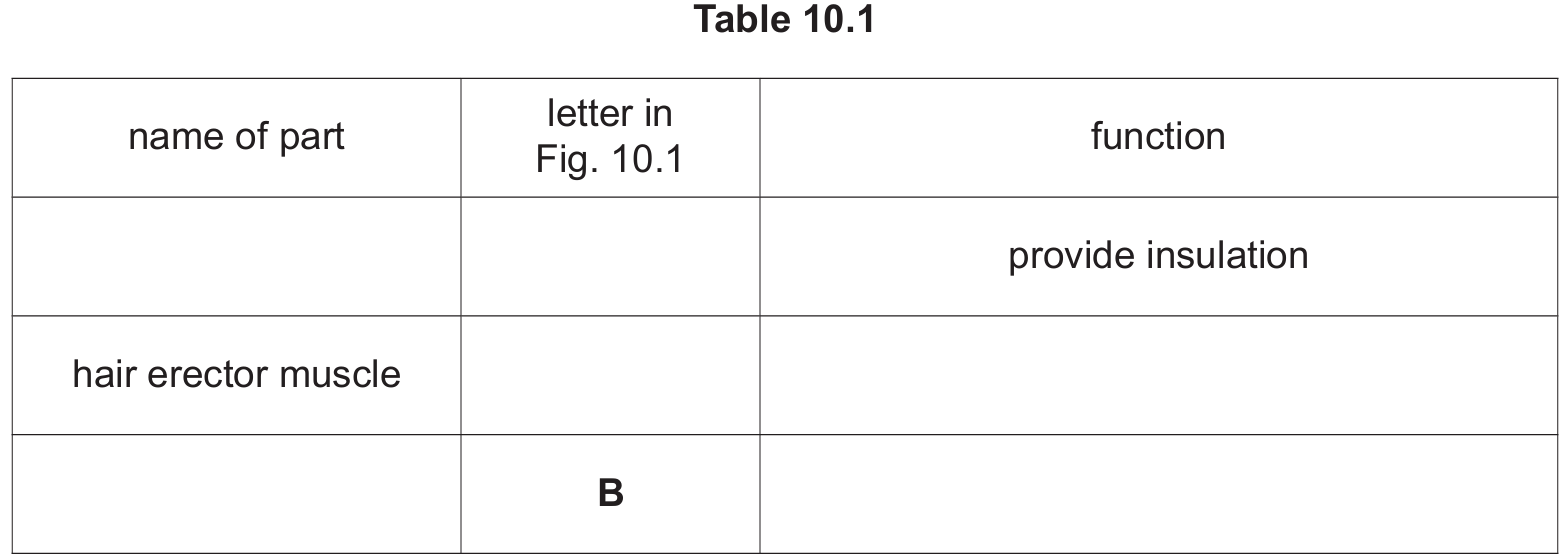
(a) 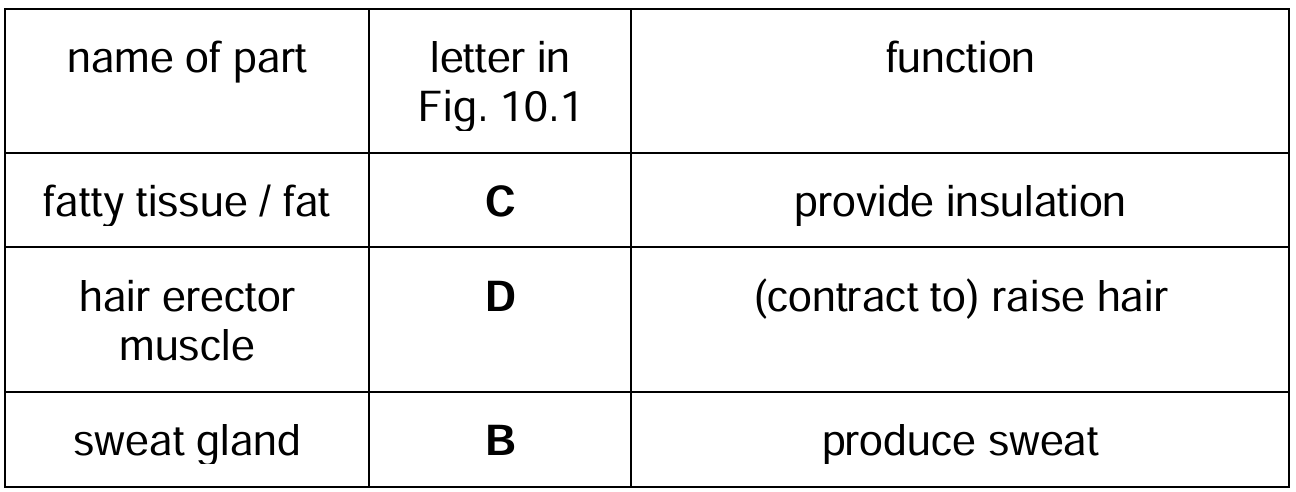
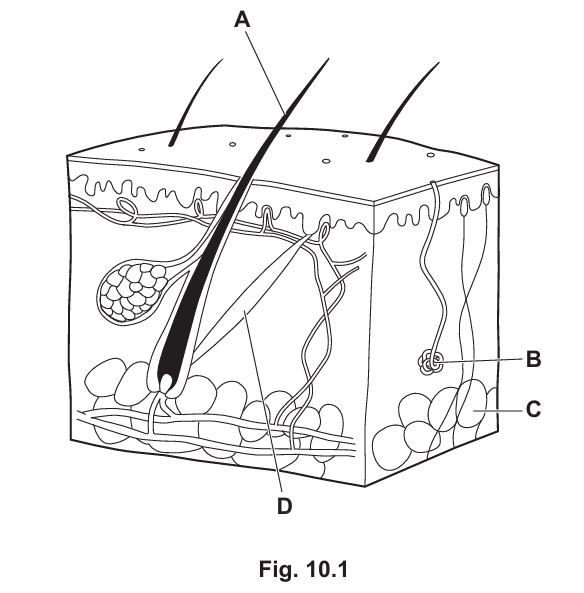
The fatty tissue layer (C) beneath the skin provides insulation by reducing heat loss.
The hair erector muscle (D) contracts to raise hairs and trap an insulating layer of air, while the sweat gland (B) produces sweat to help cool the body through evaporation.
(b) Arterioles vasodilate, increasing blood flow to skin capillaries, so more heat is lost by radiation
When the body overheats, arterioles near the skin surface widen (vasodilation).
This increases blood flow through the capillaries close to the skin, so more heat is lost from the blood to the surroundings by radiation.
(c)(i) A mechanism where a change in a variable triggers a response that reverses/opposes the change, restoring the set point
Negative feedback detects a deviation from a normal set point, such as body temperature rising above normal.
This deviation triggers a corrective response (e.g. sweating, vasodilation) that acts to bring the variable back towards the set point.
(c)(ii) Control of blood glucose concentration (any valid example)
Blood glucose regulation is a classic example of negative feedback.
When glucose levels rise, insulin lowers them; when levels fall, glucagon raises them back towards normal.
Question 11
Copper, Cu, and carbon dioxide, \( \text{CO}_2 \), are made as shown in the equation:
Use the equation to explain what reduction means.

State what the student uses as the cathode.
Use the symbol \( \text{e}^- \) for an electron.
Fig. 11.2 shows the apparatus that is used.

The ionic half-equation for the reaction is:
State the name of this type of reaction.
Most-appropriate topic codes (Cambridge IGCSE Co-ordinated Sciences 0654):
• Topic C6.3 — Redox reactions/reduction (Part (a))
• Topic C4.1 — Electrolysis (Parts (b)–(d))
• Topic C3.3 — Chemical formulae and equations/mole calculations (Part (e))
▶️ Answer/Explanation
(a) Reduction is the loss of oxygen; CuO loses oxygen to form Cu
In the equation, copper oxide is converted into copper.
Since CuO loses its oxygen atom to become Cu, this loss of oxygen is defined as reduction.
(b)(i) Copper(II) sulfate solution
Copper(II) sulfate solution is used as the electrolyte.
It supplies mobile \( \text{Cu}^{2+} \) ions that can be discharged at the cathode.
(b)(ii) Pure copper
A thin strip of pure copper is used as the cathode.
During electrolysis, copper ions from the solution are deposited onto this cathode, building up a layer of pure copper.
(c) \( \text{Cu}^{2+} + 2\text{e}^- \rightarrow \text{Cu} \)
Each copper ion has a 2+ charge, so it must gain two electrons to become a neutral copper atom.
This half-equation shows the gain of electrons (reduction) occurring at the cathode.
(d)(i) Aluminium
Positive aluminium ions (\( \text{Al}^{3+} \)) are attracted to the negative cathode.
At the cathode, these ions gain electrons and are reduced to form molten aluminium metal.
(d)(ii) Oxidation
Oxide ions lose electrons in this half-equation.
The loss of electrons is defined as oxidation, so this process is an oxidation reaction.
(e) 2.55 g
Moles of Al \( = \dfrac{1.35}{27} = 0.05 \, \text{mol} \).
From the equation, 4 mol Al produces 2 mol \( \text{Al}_2\text{O}_3 \), so moles of \( \text{Al}_2\text{O}_3 = 0.025 \, \text{mol} \).
Mass \( = 0.025 \times 102 = 2.55 \, \text{g} \).
Question 12


Most-appropriate topic codes (Cambridge IGCSE Co-ordinated Sciences 0654):
• Topic P5.2.1 — Effects of radiation (Part (a))
• Topic P5.2.2 — Radioactive decay/nuclide notation (Part (b))
• Topic P3.3 — Electromagnetic spectrum (Part (c))
• Topic P3.2.3 — Converging lenses/image formation (Part (d))
▶️ Answer/Explanation
(a) Cancer (damage to living cells/tissue)
Ionising radiation can damage the DNA within living cells.
This damage can lead to mutations, which may result in cancer.
(b) \( \,^{238}_{92}\text{U} \rightarrow \,^{234}_{90}\text{Th} + \,^{4}_{2}\alpha \)
Mass number balances: \( 238 = 234 + 4 \).
Atomic number balances: \( 92 = 90 + 2 \), confirming the emitted particle is an alpha particle (helium nucleus).
(c)(i) \( 3 \times 10^8 \, \text{m/s} \)
Gamma radiation is part of the electromagnetic spectrum.
All electromagnetic waves, including gamma rays, travel at the speed of light in a vacuum, \( 3 \times 10^8 \, \text{m/s} \).
(c)(ii) 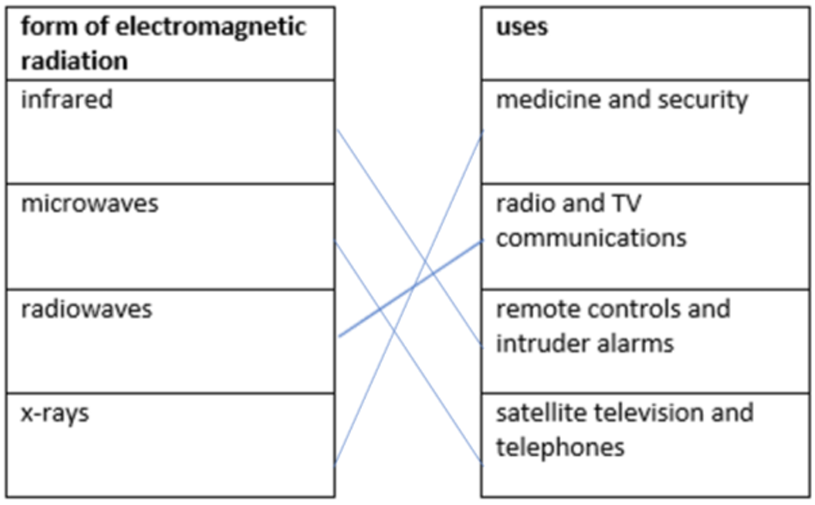
Each type of electromagnetic radiation has a characteristic use based on its wavelength and energy.
Radio waves are used for broadcasting, microwaves for satellite communication, infrared for remote controls, and X-rays for medical imaging and security scanning.
(d)(i) 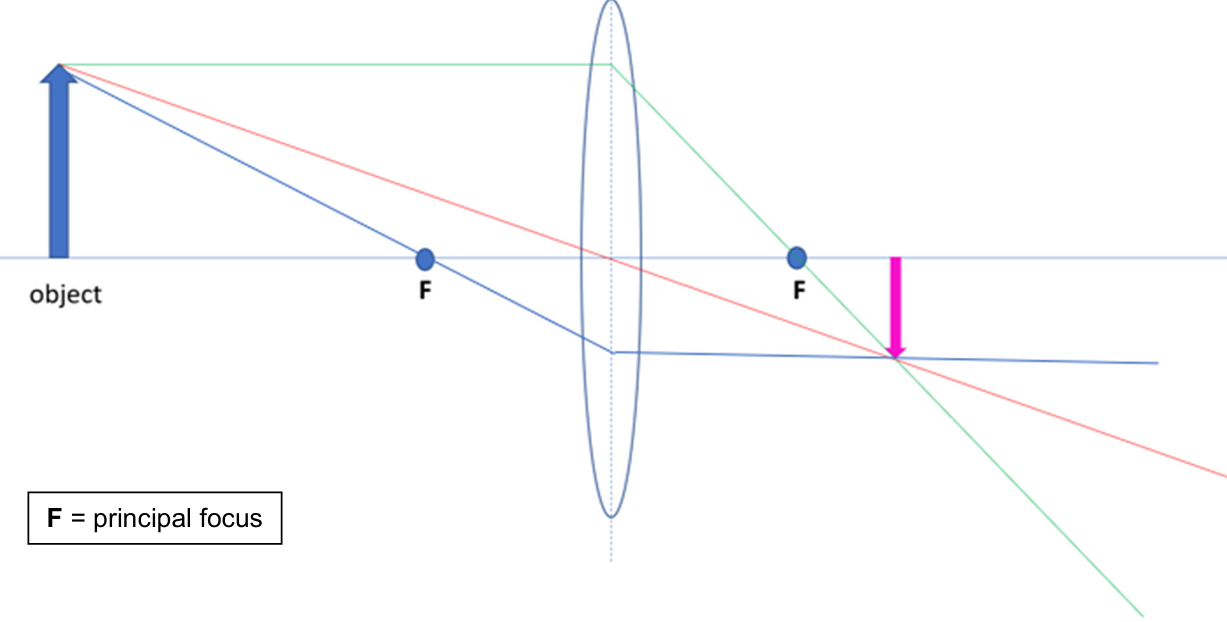
One ray travels parallel to the axis, then refracts through the far principal focus.
A second ray passes through the near principal focus before the lens, then travels parallel to the axis after refraction; where these two rays cross marks the image.
(d)(ii) A real image can be projected onto a screen; a virtual image cannot
A real image forms where light rays actually converge and meet.
A virtual image only appears to come from a point where rays seem to diverge from, so it cannot be captured on a screen.