Home / 0654_w24_qp_11

Question 1

Which characteristic of living things is described as the removal of toxic materials and substances in excess of requirements?

A. excretion
B. homeostasis
C. nutrition
D. respiration

Most-appropriate topic codes (Cambridge IGCSE Co-ordinated Sciences 0654):

Topic B1.1: Characteristics of living organisms — Excretion is defined as the removal of toxic metabolic waste products and substances produced in excess of requirements from the body.
▶️ Answer/Explanation
Excretion is specifically defined as the removal of toxic metabolic waste products and substances that are in excess of what the organism requires.
Homeostasis refers to maintaining a stable internal environment, nutrition refers to obtaining food, and respiration refers to releasing energy — none of these match the description given.
Answer: (A)

Question 2

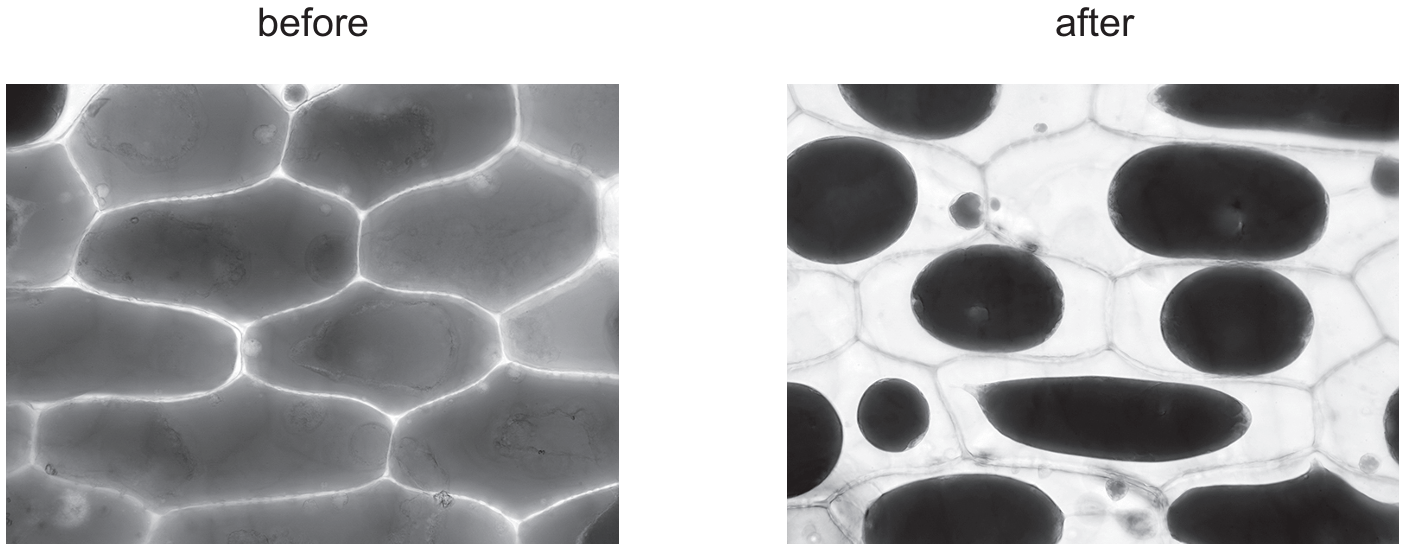
The photographs show some onion cells before and after being placed in a concentrated solution of glucose.

What explains the appearance of the onion cells after placing them into the concentrated solution of glucose?

A. Glucose has entered the cells by osmosis.
B. Glucose has left the cells by diffusion.
C. Water has entered the cells by diffusion.
D. Water has left the cells by osmosis.

Most-appropriate topic codes (Cambridge IGCSE Co-ordinated Sciences 0654):

Topic B3.2: Osmosis — Water moves by osmosis from a region of higher water potential (inside the cell) to a region of lower water potential (the concentrated glucose solution outside), causing cells to plasmolyse.
▶️ Answer/Explanation
The concentrated glucose solution has a lower water potential than the onion cell’s cytoplasm, so water moves out of the cells by osmosis through the partially permeable cell membrane.
This loss of water causes the cell contents (cytoplasm and vacuole) to shrink away from the cell wall — a process called plasmolysis — which is what the “after” photograph shows.
Answer: (D)

Question 3

Three food tests are carried out on a sample of food. The results are shown.

From these results, which nutrient is in the food?

A. reducing sugar
B. protein
C. starch
D. fat

Most-appropriate topic codes (Cambridge IGCSE Co-ordinated Sciences 0654):

Topic B7.2: Food tests — Starch is detected using iodine solution, which turns blue-black in the presence of starch; Benedict’s test (negative = no reducing sugar) and Biuret test (negative = no protein) confirm starch is the only nutrient present.
▶️ Answer/Explanation
The iodine test turning blue-black is a positive result specifically for starch; the Benedict’s test (negative, stays blue) rules out reducing sugars, and the Biuret test (negative, stays blue) rules out protein.
Since the emulsion/grease-spot test for fats also appears negative in the table, starch is the only nutrient confirmed present by this positive iodine result.
Answer: (C)

Question 4

One method of preventing food spoilage is to store it at 4 °C in a refrigerator.
Why does storing food at low temperatures help to prevent food spoilage?

A. It decreases enzyme activity.
B. It denatures enzymes.
C. It increases enzyme production.
D. It kills cells.

Most-appropriate topic codes (Cambridge IGCSE Co-ordinated Sciences 0654):

Topic B5: Enzyme — Lowering temperature reduces the kinetic energy of enzyme and substrate molecules, decreasing the rate of successful enzyme–substrate collisions and thus slowing spoilage reactions.
▶️ Answer/Explanation
At low temperatures (4 °C), the kinetic energy of enzyme and substrate molecules decreases, so they collide less frequently, reducing the rate of enzyme-catalysed reactions that cause food spoilage.
Enzymes are not denatured at 4 °C (denaturation requires high temperatures); they are simply slowed down, which is why refrigerated food can still eventually spoil.
Answer: (A)

Question 5

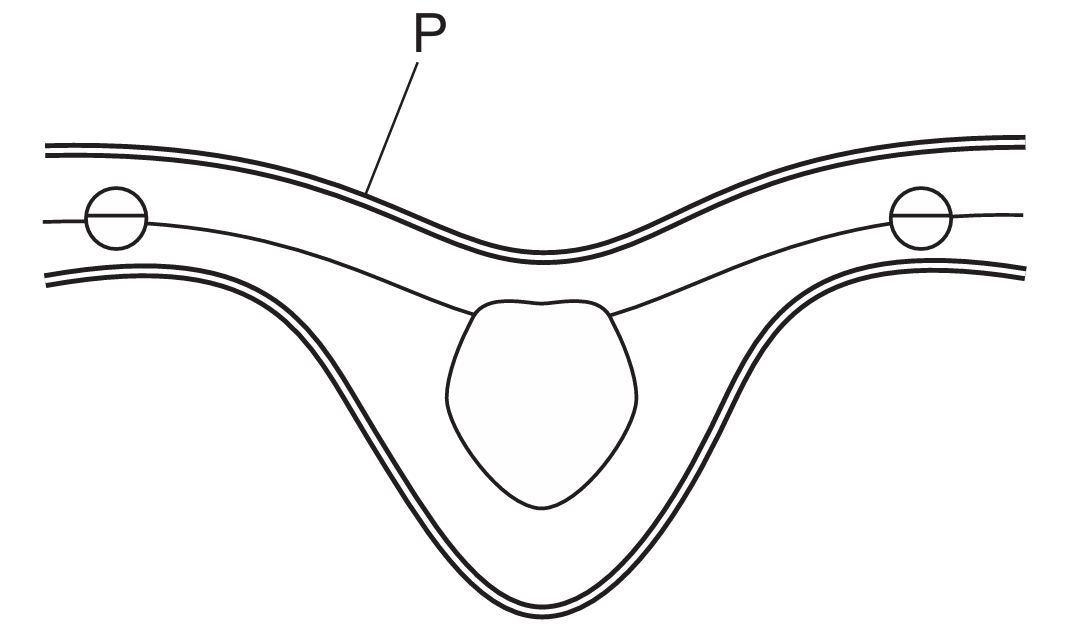
The diagram shows a plan of the cross-section of a dicotyledonous leaf.

What is the name of the part labelled P?

A. palisade mesophyll
B. spongy mesophyll
C. upper epidermis
D. vascular bundle

Most-appropriate topic codes (Cambridge IGCSE Co-ordinated Sciences 0654):

Topic B6.2: Leaf structure — The upper epidermis is the outermost single layer of cells on the top surface of the leaf; it is transparent, has no chloroplasts, and is covered by a waxy cuticle to reduce water loss.
▶️ Answer/Explanation
In a leaf cross-section, the uppermost single-cell layer at the top of the diagram is the upper epidermis; it lacks chloroplasts and is covered by a waxy cuticle to prevent water loss and protect inner tissues.
Below the upper epidermis lies the palisade mesophyll (tightly packed cells with many chloroplasts), then the spongy mesophyll with air spaces, making it easy to identify P as the top layer.
Answer: (C)

Question 6

What is the dietary importance of fibre?

A. It builds and repairs tissue.
B. It builds strong bones and teeth.
C. It helps to prevent constipation.
D. It provides a source of iron.

Most-appropriate topic codes (Cambridge IGCSE Co-ordinated Sciences 0654):

Topic B7.1: Diet — Dietary fibre (roughage) provides bulk to food in the intestine, stimulating peristalsis and ensuring smooth movement of food through the gut, thereby preventing constipation.
▶️ Answer/Explanation
Dietary fibre is indigestible plant material (mainly cellulose) that adds bulk to the gut contents, stimulating the muscular contractions of peristalsis that move food through the intestine.
Without sufficient fibre, food moves too slowly through the large intestine, leading to constipation; fibre does not build tissue, bones, or supply iron — those are roles of protein, calcium/vitamin D, and iron minerals respectively.
Answer: (C)

Question 7

Selexipag is a drug used to treat a condition where the blood pressure going to the lungs is too high. The drug works by widening the blood vessel leading to the lungs to reduce the pressure.
Which blood vessel going to the lungs is selexipag widening?

A. aorta
B. pulmonary artery
C. pulmonary vein
D. vena cava

Most-appropriate topic codes (Cambridge IGCSE Co-ordinated Sciences 0654):

Topic B9.1: Circulatory systems — The pulmonary artery carries deoxygenated blood from the right ventricle of the heart to the lungs; it is the vessel that would carry high blood pressure to the lungs.
▶️ Answer/Explanation
The pulmonary artery is the vessel that carries blood from the heart to the lungs; elevated pressure in this artery is the condition being treated (pulmonary arterial hypertension).
The pulmonary vein carries blood back from the lungs to the heart, while the aorta and vena cava are systemic vessels — none of these carry blood toward the lungs as arteries do.
Answer: (B)

Question 8

The list shows some processes that occur in the body.

  1. cell division
  2. oxygen diffusion
  3. protein synthesis
  4. temperature regulation

Which processes use energy released by respiration?

A. 1, 3 and 4
B. 1 and 2
C. 2, 3 and 4
D. 3 and 4 only

Most-appropriate topic codes (Cambridge IGCSE Co-ordinated Sciences 0654):

Topic B12.1: Respiration — Energy released by respiration is used for processes including cell division, muscle contraction, protein synthesis, active transport, and maintenance of body temperature; diffusion is a passive process requiring no energy.
▶️ Answer/Explanation
Cell division (1), protein synthesis (3), and temperature regulation (4) all require ATP energy from respiration — cell division needs energy to replicate DNA and separate chromosomes, protein synthesis uses ribosomes requiring energy, and maintaining body temperature requires metabolic heat production.
Oxygen diffusion (2) is a passive process driven solely by the concentration gradient and requires no energy input from respiration.
Answer: (A)

Question 9

In which order does an impulse pass along neurones during a reflex action?

A. motor → relay → sensory
B. motor → sensory → relay
C. sensory → motor → relay
D. sensory → relay → motor

Most-appropriate topic codes (Cambridge IGCSE Co-ordinated Sciences 0654):

Topic B13.1: Coordination and response — In a reflex arc, impulses travel from a receptor along a sensory neurone to the spinal cord (relay neurone) and then along a motor neurone to an effector (muscle or gland).
▶️ Answer/Explanation
The reflex arc pathway is: receptor → sensory neuronerelay neurone (in spinal cord/CNS) → motor neurone → effector; this pathway allows a fast, automatic response without involving the brain consciously.
The relay (connector) neurone is always in the middle — between the sensory and motor neurones — so the sequence must be sensory → relay → motor.
Answer: (D)

Question 10

Before fertilisation in flowering plants, which structure must the pollen nucleus pass through to reach the nucleus in the ovule?

A. filament
B. petal
C. stamen
D. style

Most-appropriate topic codes (Cambridge IGCSE Co-ordinated Sciences 0654):

Topic B15.3: Sexual reproduction in plants — After landing on the stigma, pollen germinates and grows a pollen tube down through the style, into the ovary and ovule, delivering the male nucleus for fertilisation.
▶️ Answer/Explanation
After pollination, the pollen grain germinates on the stigma and grows a pollen tube down through the style (the stalk connecting stigma to ovary) to reach the ovule inside the ovary.
The filament supports the anther, petals attract pollinators, and the stamen is the entire male organ — none of these are the channel through which the pollen tube travels.
Answer: (D)

Question 11

Albinism is a genetic condition which results in an absence of pigment in the skin, hair and eyes.
If two black mice produce an albino offspring, which Punnett square shows the correct cross?

Most-appropriate topic codes (Cambridge IGCSE Co-ordinated Sciences 0654):

Topic B16.3: Monohybrid inheritance — Albinism is recessive; two black (pigmented) mice producing an albino offspring must both be heterozygous carriers (\(Bb \times Bb\)), giving a 3:1 ratio of black to albino offspring.
▶️ Answer/Explanation
Since albinism is recessive (let \(b\) = albino allele, \(B\) = black allele), both black parents must carry one hidden \(b\) allele — making them both \(Bb\); the cross \(Bb \times Bb\) produces offspring in the ratio \(BB : Bb : bb = 1:2:1\), giving a \(\frac{1}{4}\) chance of albino (\(bb\)).
Only a heterozygous cross (\(Bb \times Bb\)) can produce an albino offspring from two visibly black parents, which corresponds to Punnett square B in the diagram.
Answer: (B)

Question 12

What is the correct order for the food chain from the information given?

  • beetles are herbivores
  • mice eat the beetles
  • owls are the tertiary consumers
  • the leaves of a plant are the producer

A. beetles → mice → owl → leaves
B. leaves → beetles → mice → owl
C. leaves → beetles → owl → mice
D. owl → mice → beetles → leaves

Most-appropriate topic codes (Cambridge IGCSE Co-ordinated Sciences 0654):

Topic B18.2: Food chains and food webs — A food chain always begins with a producer (plant); energy flows from producer → primary consumer → secondary consumer → tertiary consumer, with arrows showing direction of energy transfer.
▶️ Answer/Explanation
The clues directly establish the chain: leaves (producer) → beetles (primary consumer/herbivore) → mice (secondary consumer, eating beetles) → owl (tertiary consumer).
Food chains always start with the producer and arrows point in the direction of energy flow, so the only correct sequence matching all four clues is: leaves → beetles → mice → owl.
Answer: (B)

Question 13

The diagram shows part of the carbon cycle.

Which process does X represent?

A. combustion
B. decomposition
C. photosynthesis
D. respiration

Most-appropriate topic codes (Cambridge IGCSE Co-ordinated Sciences 0654):

Topic B18.3: Carbon cycle — Photosynthesis is the process by which green plants remove carbon dioxide from the atmosphere and convert it into organic compounds (glucose), using light energy.
▶️ Answer/Explanation
In the carbon cycle diagram, process X shows an arrow from atmospheric \(\text{CO}_2\) into plants/organic compounds; this is photosynthesis — the only process that removes \(\text{CO}_2\) from the atmosphere and fixes it into organic molecules.
Respiration, combustion, and decomposition all release \(\text{CO}_2\) back into the atmosphere (arrows pointing in the opposite direction), so X must be photosynthesis.
Answer: (C)

Question 14

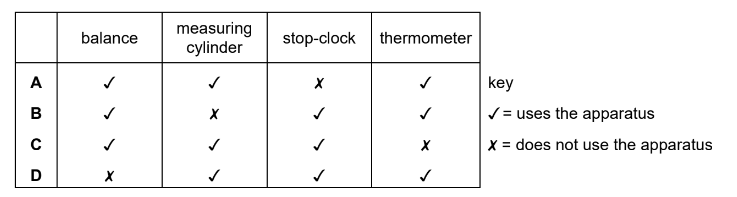
A student adds 5 g of magnesium ribbon to 20 cm³ of dilute hydrochloric acid in a beaker. The student measures how long it takes for the effervescence to stop.
Which pieces of apparatus does the student use in this experiment?

Most-appropriate topic codes (Cambridge IGCSE Co-ordinated Sciences 0654):

Topic C12.1: Experimental techniques — This experiment requires a balance (to measure 5 g of magnesium), a measuring cylinder (to measure 20 cm³ of acid), a beaker (to carry out the reaction), and a stopwatch (to time the reaction).
▶️ Answer/Explanation
The experiment needs: a balance to weigh 5 g of magnesium, a measuring cylinder to measure 20 cm³ of acid, a beaker to hold the reaction mixture, and a stopwatch to time how long effervescence takes to stop.
No thermometer or gas syringe is required since the measurement is only of time (not temperature or gas volume), so the correct apparatus set is the one in option C.
Answer: (C)

Question 15

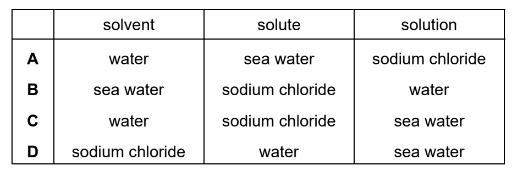
Sea water is a mixture that contains sodium chloride dissolved in water.
Which row describes sea water?

Most-appropriate topic codes (Cambridge IGCSE Co-ordinated Sciences 0654):

Topic C1.2: Diffusion — Sea water is a homogeneous mixture (solution) of sodium chloride and water; its components retain their individual properties and can be separated by physical methods such as distillation or evaporation.
▶️ Answer/Explanation
Sea water is a mixture (not a compound), so its components are not chemically combined and can be separated by physical means; it is a solution (homogeneous mixture), meaning the solute (NaCl) is uniformly distributed throughout the solvent (water).
The components of sea water — sodium chloride and water — each retain their own chemical properties (e.g., water’s boiling point is affected but NaCl can still be recovered), which is characteristic of a mixture rather than a compound.
Answer: (C)

Question 16

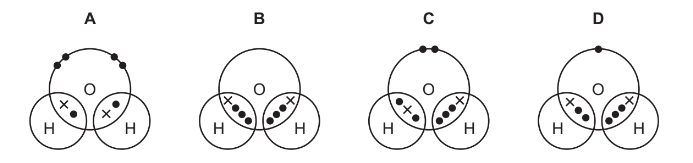
What is the dot-and-cross diagram for a water molecule?

Most-appropriate topic codes (Cambridge IGCSE Co-ordinated Sciences 0654):

Topic C2.5: Simple molecules and covalent bonds — Water (\(\text{H}_2\text{O}\)) has an oxygen atom forming two covalent bonds, one with each hydrogen atom; oxygen has 6 outer electrons (needs 2 more), and each hydrogen has 1 electron (needs 1 more), forming 2 shared pairs.
▶️ Answer/Explanation
In a water molecule, oxygen (with 6 outer-shell electrons) forms two single covalent bonds with two hydrogen atoms (each with 1 electron), resulting in two bonding pairs and two lone pairs on oxygen — giving the characteristic bent shape shown in diagram A.
The correct dot-and-cross diagram must show oxygen with 2 shared pairs (one with each H) and 2 lone pairs, with each hydrogen having a full outer shell of 2 electrons after sharing.
Answer: (A)

Question 17

The electronic structures of carbon and of hydrogen are shown.

What is the formula of a compound formed between carbon and hydrogen?

A. \(CH_2\)
B. \(CH_3\)
C. \(C_4H\)
D. \(CH_4\)

Most-appropriate topic codes (Cambridge IGCSE Co-ordinated Sciences 0654):

Topic C2.5: Simple molecules and covalent bonds — Carbon has 4 outer electrons and needs 4 more to complete its outer shell of 8; it therefore forms 4 covalent bonds, one with each of 4 hydrogen atoms, producing methane (\(\text{CH}_4\)).
▶️ Answer/Explanation
Carbon has the electronic structure 2,4 — it has 4 electrons in its outer shell and needs 4 more to achieve a full outer shell of 8; hydrogen has 1 outer electron and needs 1 more to fill its shell of 2, so each hydrogen can form exactly one covalent bond.
Carbon therefore forms 4 covalent bonds, one with each of 4 hydrogen atoms: \(\text{C} + 4\text{H} \rightarrow \text{CH}_4\) (methane), giving carbon a complete outer shell of 8 electrons and each hydrogen a complete shell of 2 electrons.
Answer: (D)

Question 18

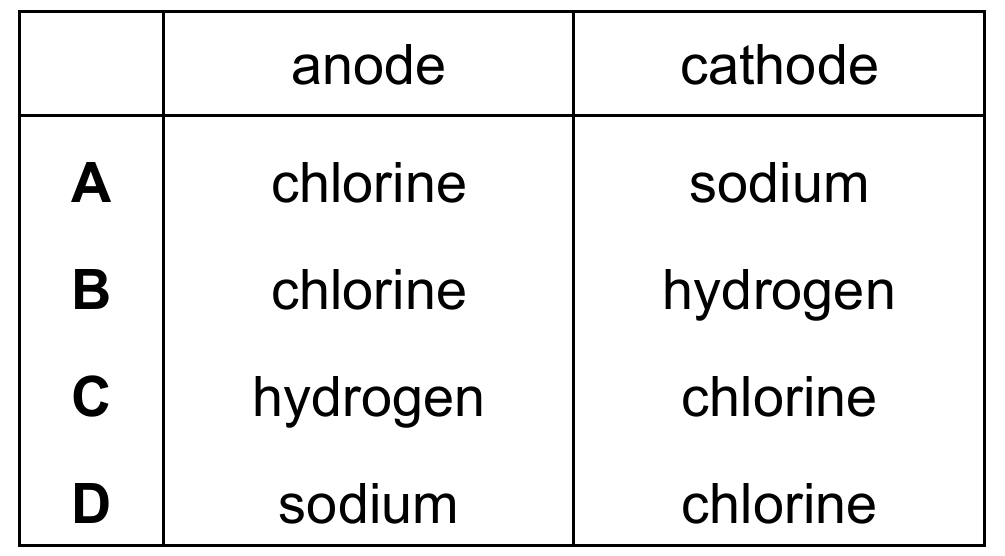
Which elements are formed at the electrodes during the electrolysis of concentrated aqueous sodium chloride?

Most-appropriate topic codes (Cambridge IGCSE Co-ordinated Sciences 0654):

Topic C4.1: Electrolysis — In concentrated aqueous NaCl, chloride ions (\(\text{Cl}^-\)) are preferentially discharged at the anode producing chlorine gas, while hydrogen ions (\(\text{H}^+\)) from water are discharged at the cathode producing hydrogen gas; sodium hydroxide remains in solution.
▶️ Answer/Explanation
At the cathode (negative electrode): \(2\text{H}^+ + 2e^- \rightarrow \text{H}_2\) — hydrogen gas is produced because \(\text{H}^+\) ions from water are preferentially discharged over \(\text{Na}^+\) ions.
At the anode (positive electrode): \(2\text{Cl}^- \rightarrow \text{Cl}_2 + 2e^-\) — chlorine gas is produced because the high concentration of \(\text{Cl}^-\) ions means they are preferentially discharged over \(\text{OH}^-\) ions.
Answer: (B)

Question 19

Four different substances are added to the same acid of the same concentration in reactions W, X, Y and Z.
The initial temperature of the acid before each reaction is 21 °C.
The final temperatures of the mixtures are measured.
The results are shown.

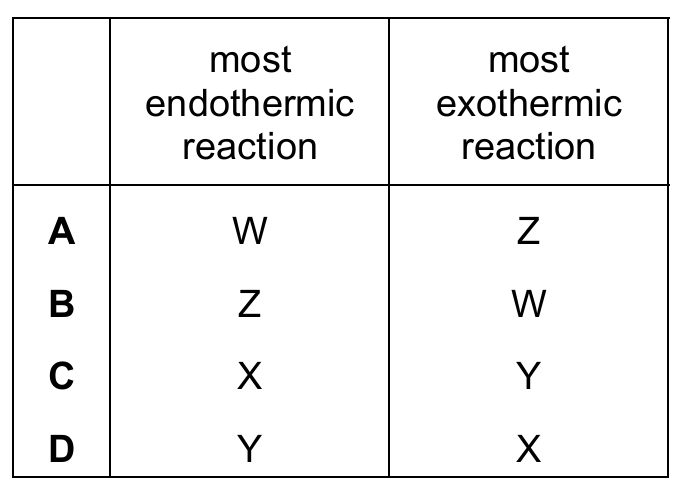
Which row is correct?

Most-appropriate topic codes (Cambridge IGCSE Co-ordinated Sciences 0654):

Topic C6.1: Physical and chemical changes — An exothermic reaction releases heat energy, causing the temperature to rise above the initial temperature (above 21 °C); an endothermic reaction absorbs heat energy, causing the temperature to fall below 21 °C.
▶️ Answer/Explanation
Any reaction with a final temperature above 21 °C is exothermic (heat is released to the surroundings), and any reaction with a final temperature below 21 °C is endothermic (heat is absorbed from the surroundings).
By comparing each reaction’s final temperature to the initial 21 °C, the reactions can be correctly classified as exothermic or endothermic — row B correctly assigns all four reactions based on their temperature changes.
Answer: (B)

Question 20

Dilute hydrochloric acid reacts with solid calcium carbonate.
Which change decreases the rate of the reaction?

A. decreasing the concentration of the hydrochloric acid
B. decreasing the size of the calcium carbonate pieces
C. increasing the surface area of the calcium carbonate
D. increasing the temperature of the acid

Most-appropriate topic codes (Cambridge IGCSE Co-ordinated Sciences 0654):

Topic C5.1: Rate of reaction — The rate of a chemical reaction depends on concentration, surface area, temperature, and catalysts; decreasing concentration reduces the frequency of successful collisions between reactant particles, slowing the reaction.
▶️ Answer/Explanation
Decreasing the concentration of hydrochloric acid means fewer \(\text{H}^+\) ions are present in a given volume, so there are fewer successful collisions per second between acid particles and the calcium carbonate surface — this decreases the rate of reaction.
Options B and C (decreasing piece size / increasing surface area) increase the exposed surface for collision and speed up the reaction; increasing temperature (D) also increases reaction rate by giving particles more kinetic energy.
Answer: (A)

Question 21

Which statement about oxidation is correct?

A. It occurs when an element or compound chemically combines with oxygen.
B. It occurs when an element or compound forms a mixture with oxygen.
C. It occurs when an element or compound is separated from a mixture with oxygen.
D. It occurs when a compound loses oxygen.

Most-appropriate topic codes (Cambridge IGCSE Co-ordinated Sciences 0654):

Topic C6.3: Redox — Oxidation in terms of oxygen transfer is defined as the gain of oxygen by an element or compound through a chemical reaction; the reverse process (loss of oxygen) is reduction.
▶️ Answer/Explanation
Oxidation (in terms of oxygen) is defined as the chemical combination (bonding) of a substance with oxygen — for example, \(\text{2Mg} + \text{O}_2 \rightarrow \text{2MgO}\) is oxidation of magnesium.
Option B describes a physical mixture (not a chemical reaction), option C describes separation, and option D describes reduction (loss of oxygen) — none of these are oxidation.
Answer: (A)

Question 22

Which substance is classified as an acidic oxide?

A. calcium oxide
B. carbon dioxide
C. lithium oxide
D. sodium oxide

Most-appropriate topic codes (Cambridge IGCSE Co-ordinated Sciences 0654):

Topic C7.2: Oxides — Acidic oxides are non-metal oxides that dissolve in water to form acidic solutions or react with bases/alkalis to form a salt and water; carbon dioxide (\(\text{CO}_2\)) dissolves in water to form carbonic acid (\(\text{H}_2\text{CO}_3\)).
▶️ Answer/Explanation
Carbon dioxide (\(\text{CO}_2\)) is a non-metal oxide that reacts with water to form carbonic acid: \(\text{CO}_2 + \text{H}_2\text{O} \rightarrow \text{H}_2\text{CO}_3\), classifying it as an acidic oxide.
Calcium oxide, lithium oxide, and sodium oxide are all metal oxides — they are basic oxides that react with acids to form salts and water, not acidic oxides.
Answer: (B)

Question 23

The results of two tests on compound P are shown.

What is P?

A. lithium bromide
B. lithium chloride
C. sodium bromide
D. sodium chloride

Most-appropriate topic codes (Cambridge IGCSE Co-ordinated Sciences 0654):

Topic C12.2: Identification of ions — A flame test giving a crimson/red flame identifies lithium ions (\(\text{Li}^+\)); a silver nitrate test giving a white precipitate soluble in dilute ammonia identifies chloride ions (\(\text{Cl}^-\)), confirming the compound is lithium chloride.
▶️ Answer/Explanation
The flame test result (crimson/red flame) indicates the presence of lithium ions (\(\text{Li}^+\)), ruling out sodium (yellow flame); the silver nitrate test producing a white precipitate (soluble in dilute \(\text{NH}_3\)) indicates chloride ions (\(\text{Cl}^-\)), ruling out bromide (cream precipitate).
Combining both results — lithium cation + chloride anion — uniquely identifies compound P as lithium chloride (\(\text{LiCl}\)).
Answer: (B)

Question 24

What is not a property of transition elements?

A. form coloured compounds
B. good electrical conductivity
C. high melting point
D. low density

Most-appropriate topic codes (Cambridge IGCSE Co-ordinated Sciences 0654):

Topic C8.4: Transition elements — Transition elements typically have high density, high melting points, good electrical conductivity, and form coloured compounds; low density is a characteristic of Group 1 metals (e.g. lithium, sodium), not transition metals.
▶️ Answer/Explanation
Transition elements (e.g. iron, copper, nickel) are characterised by high density, high melting points (due to strong metallic bonding), good electrical conductivity, and the ability to form compounds with various colours due to their partially filled d-orbitals.
Low density is the opposite of what is expected — transition elements are notably dense metals; low density is a property of alkali metals such as lithium and sodium, not transition metals.
Answer: (D)

Question 25

What is the order of reactivity of metals, from highest to lowest?

A. aluminium → calcium → copper → iron
B. calcium → iron → copper → aluminium
C. calcium → magnesium → iron → copper
D. aluminium → magnesium → iron → copper

Most-appropriate topic codes (Cambridge IGCSE Co-ordinated Sciences 0654):

Topic C9.4: Reactivity series — The reactivity series from highest to lowest includes: potassium, sodium, calcium, magnesium, aluminium, zinc, iron, tin, lead, copper; calcium is above magnesium is incorrect — the correct order places magnesium above aluminium, and calcium above magnesium.
▶️ Answer/Explanation
The standard reactivity series places calcium above magnesium, which is above aluminium, which is above iron, which is above copper — so from highest to lowest: Ca > Mg > Al > Fe > Cu.
Option C (calcium → magnesium → iron → copper) correctly omits aluminium but maintains the right relative order for the four metals listed; only option C places calcium above magnesium and iron above copper without reversing any pair.
Answer: (C)

Question 26

A colourless liquid is tested with blue cobalt(II) chloride paper.
The blue paper turns pink.
What does this test prove that the liquid contains?

A. an acid
B. an alkali
C. ethanol
D. water

Most-appropriate topic codes (Cambridge IGCSE Co-ordinated Sciences 0654):

Topic C12.2: Identification of ions and substances — Anhydrous cobalt(II) chloride paper is blue and turns pink in the presence of water; this is a specific test for water and does not indicate acidity, alkalinity, or the presence of ethanol.
▶️ Answer/Explanation
Anhydrous cobalt(II) chloride paper is blue in the absence of water; when water molecules are absorbed, the cobalt(II) chloride hydrates and changes colour from blue to pink — this reaction is specific to water and is routinely used to test for the presence of water.
This test does not distinguish between acidic, alkaline, or neutral solutions, nor does it identify ethanol; it only confirms the presence of water molecules in the liquid.
Answer: (D)

Question 27

What are the products of the complete combustion of ethanol?

A. carbon and hydrogen
B. carbon dioxide and hydrogen
C. carbon dioxide and water
D. carbon monoxide and water

Most-appropriate topic codes (Cambridge IGCSE Co-ordinated Sciences 0654):

Topic C11.2: Naming organic compounds / combustion — Complete combustion of any hydrocarbon or alcohol in excess oxygen produces only carbon dioxide and water; the balanced equation for ethanol is: \(\text{C}_2\text{H}_5\text{OH} + 3\text{O}_2 \rightarrow 2\text{CO}_2 + 3\text{H}_2\text{O}\).
▶️ Answer/Explanation
Complete combustion means the fuel burns in excess oxygen, so all the carbon is fully oxidised to \(\text{CO}_2\) and all the hydrogen is oxidised to \(\text{H}_2\text{O}\): \(\text{C}_2\text{H}_5\text{OH} + 3\text{O}_2 \rightarrow 2\text{CO}_2 + 3\text{H}_2\text{O}\).
Incomplete combustion (insufficient oxygen) would produce carbon monoxide or carbon soot, but the question specifies complete combustion, so only \(\text{CO}_2\) and \(\text{H}_2\text{O}\) are produced.
Answer: (C)

Question 28

A person runs 5000 m in 1200 s and then walks a further 3000 m in 1800 s.
What is their average speed for this journey?

A. 1.7 m/s
B. 2.7 m/s
C. 2.9 m/s
D. 5.8 m/s

Most-appropriate topic codes (Cambridge IGCSE Co-ordinated Sciences 0654):

Topic P1.2: Motion — Average speed is calculated as total distance divided by total time: \(\text{average speed} = \frac{\text{total distance}}{\text{total time}}\).
▶️ Answer/Explanation
Total distance \(= 5000 + 3000 = 8000\) m; total time \(= 1200 + 1800 = 3000\) s.
Average speed \(= \dfrac{8000}{3000} \approx 2.67 \approx 2.7\) m/s — note that average speed must use the total distance and total time for the whole journey, not the average of the two individual speeds.
Answer: (B)

Question 29

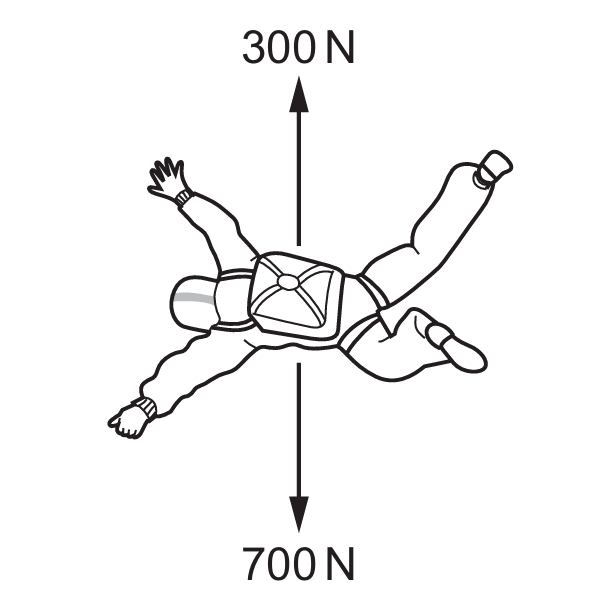
The diagram shows the two forces acting on a skydiver.

What is the resultant force on the skydiver?

A. 400 N downwards
B. 400 N upwards
C. 1000 N downwards
D. 1000 N upwards

Most-appropriate topic codes (Cambridge IGCSE Co-ordinated Sciences 0654):

Topic P1.5: Forces — The resultant force on an object is found by subtracting the smaller force from the larger force when they act in opposite directions; the resultant acts in the direction of the larger force.
▶️ Answer/Explanation
From the diagram, the skydiver has a downward weight of 700 N and an upward air resistance of 300 N; since these forces act in opposite directions, the resultant \(= 700 – 300 = 400\) N, acting downward (in the direction of the larger force).
The resultant force is downward because weight (700 N) is greater than air resistance (300 N), meaning there is a net downward force causing the skydiver to accelerate downward.
Answer: (A)

Question 30

When a ball is kicked vertically upwards, its initial kinetic energy is 12 J. When the ball arrives back at its starting point, its kinetic energy is 8.0 J.
Which statement explains the change in the kinetic energy of the ball?

A. 4.0 J of work is done to increase the gravitational potential energy of the ball.
B. 4.0 J of work is done to overcome air resistance.
C. 20 J of work is done to increase the gravitational potential energy of the ball.
D. 20 J of work is done to overcome air resistance.

Most-appropriate topic codes (Cambridge IGCSE Co-ordinated Sciences 0654):

Topic P1.6: Energy, work and power — When the ball returns to its starting point, its gravitational potential energy change is zero (same height); the only energy loss over the complete journey up and back is due to work done against air resistance.
▶️ Answer/Explanation
Since the ball returns to its original height, the net change in gravitational potential energy is zero — the GPE gained going up equals the GPE lost coming down; the only reason the kinetic energy is less on return is because energy was lost to air resistance throughout the journey.
The energy lost \(= 12 – 8.0 = 4.0\) J, and since GPE is unchanged, all 4.0 J was dissipated as heat by air resistance — not 20 J, which would be the sum (an error in reasoning).
Answer: (B)

Question 31

A motor lifts a load vertically upwards at constant speed. The weight of the load is known.
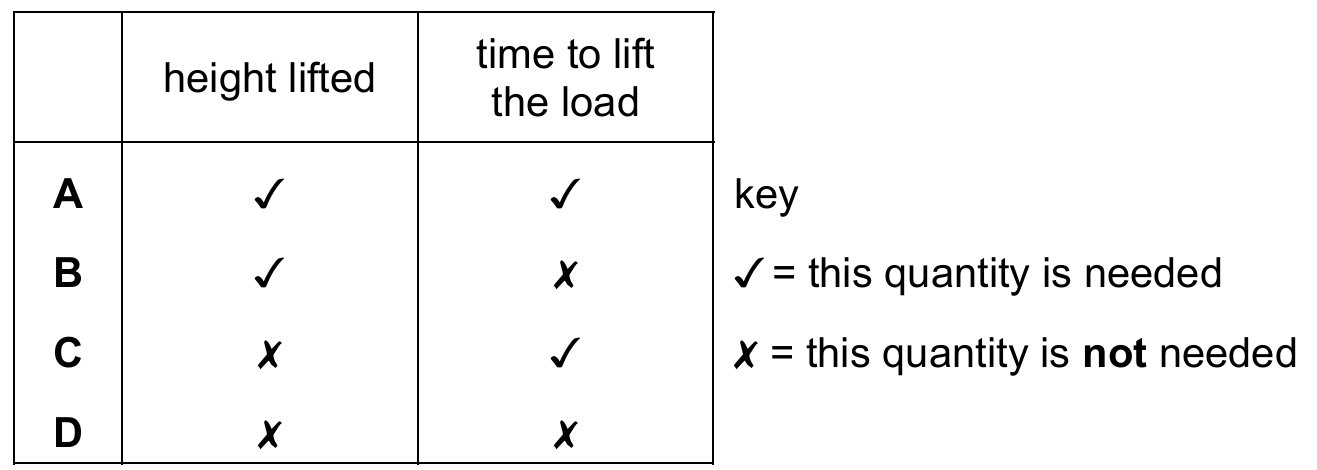
Which of the other quantities in the table must be known to determine the useful power output of the motor?

Most-appropriate topic codes (Cambridge IGCSE Co-ordinated Sciences 0654):

Topic P1.6: Energy, work and power — Useful power output is given by \(P = \frac{W \times d}{t}\), where \(W\) = weight (force), \(d\) = vertical distance lifted, and \(t\) = time taken; both distance and time must be known alongside the weight.
▶️ Answer/Explanation
Useful power \(P = \dfrac{\text{work done}}{\text{time}} = \dfrac{W \times d}{t}\); since weight \(W\) is already known, we additionally need the vertical distance \(d\) (to calculate work done \(= W \times d\)) and the time \(t\) taken to lift it.
Neither the mass (already accounted for by weight) nor the current/voltage of the motor (those give total power input, not useful output) are needed — only distance and time, which corresponds to row A in the table.
Answer: (A)

Question 32

Which material is a poor thermal conductor?

A. air
B. aluminium
C. copper
D. iron

Most-appropriate topic codes (Cambridge IGCSE Co-ordinated Sciences 0654):

Topic P2.3: Transfer of thermal energy — Metals (aluminium, copper, iron) are good thermal conductors because free electrons can transfer kinetic energy rapidly through the material; gases like air are very poor conductors because their particles are too far apart for efficient energy transfer.
▶️ Answer/Explanation
Air is a gas with particles that are very widely spaced and move randomly — there are very few particle-to-particle collisions to transfer thermal energy, making it an excellent thermal insulator (poor conductor).
Aluminium, copper, and iron are all metals containing free electrons that can rapidly carry kinetic energy from hot regions to cold regions, making them good thermal conductors; air has no free electrons and relies on slow molecular collision conduction.
Answer: (A)

Question 33

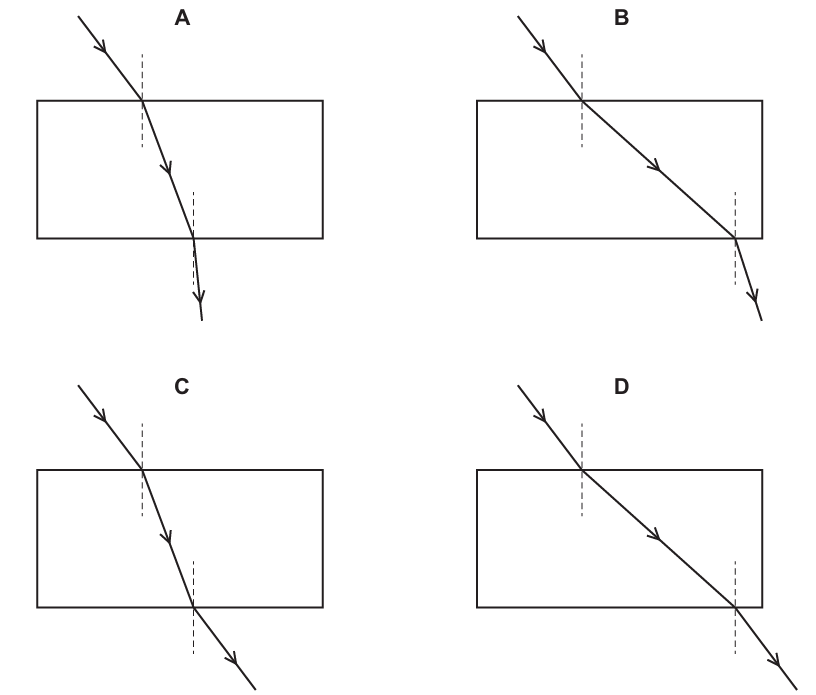
A ray of light travels from air into a parallel-sided glass block and then back into air.
Which diagram shows the path of the light?

Most-appropriate topic codes (Cambridge IGCSE Co-ordinated Sciences 0654):

Topic P3.2.1: Refraction of light — When light enters a denser medium (glass) it bends toward the normal; when it exits back into a less dense medium (air) through a parallel surface, it bends away from the normal by the same angle, emerging parallel to but displaced from the original ray.
▶️ Answer/Explanation
When light enters glass from air, it slows down and refracts toward the normal (angle of refraction < angle of incidence); when it exits through the parallel surface back into air, it speeds up and refracts away from the normal by the same amount.
Because the two surfaces are parallel, the exit ray is parallel to the original entry ray but laterally displaced — diagram C correctly shows this behaviour with the correct direction of bending at each interface.
Answer: (C)

Question 34

Which electromagnetic waves have the lowest frequency?

A. gamma
B. infrared
C. ultraviolet
D. radio

Most-appropriate topic codes (Cambridge IGCSE Co-ordinated Sciences 0654):

Topic P3.3: Electromagnetic spectrum — The electromagnetic spectrum in order of increasing frequency (and decreasing wavelength) is: radio → microwave → infrared → visible → ultraviolet → X-ray → gamma; radio waves have the lowest frequency and longest wavelength.
▶️ Answer/Explanation
Across the electromagnetic spectrum, radio waves occupy the low-frequency, long-wavelength end; gamma rays are at the opposite extreme with the highest frequency and shortest wavelength.
Of the four options given — gamma (highest frequency), ultraviolet, infrared, and radio (lowest frequency) — radio waves have by far the lowest frequency, with wavelengths ranging from millimetres to kilometres.
Answer: (D)

Question 35

Object P is positively charged and object Q is negatively charged.
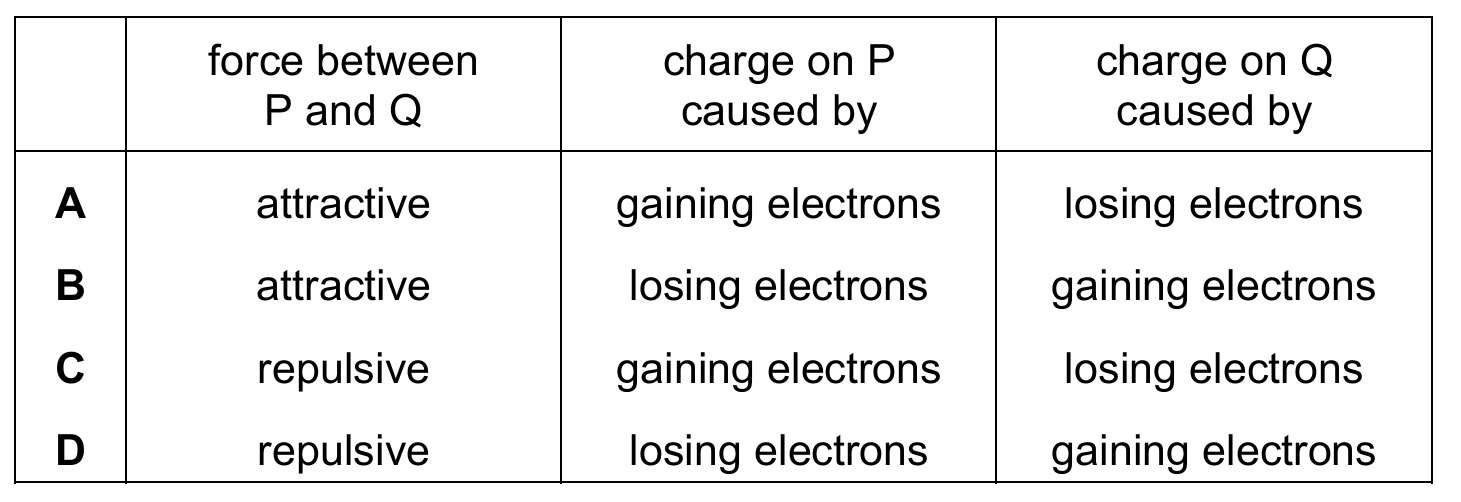
Which row describes the force between P and Q and explains how they became charged?

Most-appropriate topic codes (Cambridge IGCSE Co-ordinated Sciences 0654):

Topic P4.2: Electrical quantities — Opposite charges attract; objects become charged by the transfer of electrons (not protons, which are fixed in the nucleus); P is positive because it has lost electrons, and Q is negative because it has gained electrons.
▶️ Answer/Explanation
Since P is positive and Q is negative, they carry opposite charges and will experience an attractive force between them (unlike charges attract, like charges repel).
Objects become charged by the transfer of electrons only (protons cannot move as they are held in the nucleus); P lost electrons (becoming positive) and Q gained electrons (becoming negative) — row B in the table states attraction and electron transfer, which is correct.
Answer: (B)

Question 36

A lamp is connected to a 3.0 V battery. The resistance of the lamp is 60 Ω.
What is the current in the lamp?

A. 0.050 mA
B. 20 mA
C. 50 mA
D. 180 mA

Most-appropriate topic codes (Cambridge IGCSE Co-ordinated Sciences 0654):

Topic P4.3: Electrical circuits — Ohm’s Law states \(V = IR\), so current \(I = \dfrac{V}{R}\); substituting \(V = 3.0\) V and \(R = 60\ \Omega\) gives \(I = 0.05\) A \(= 50\) mA.
▶️ Answer/Explanation
Using Ohm’s Law: \(I = \dfrac{V}{R} = \dfrac{3.0}{60} = 0.05\ \text{A}\).
Converting to milliamps: \(0.05\ \text{A} \times 1000 = 50\ \text{mA}\); note that option A (0.050 mA) is 1000 times too small — a common unit-conversion error to avoid.
Answer: (C)

Question 37

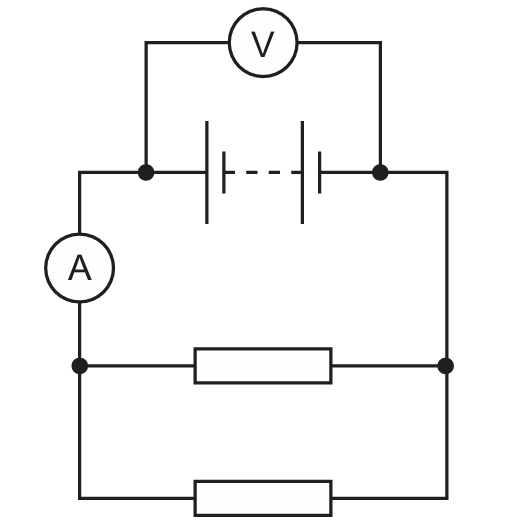
The diagram shows two resistors connected in parallel to a battery. The circuit contains a voltmeter and an ammeter.

A third resistor is now connected in parallel with these two resistors.
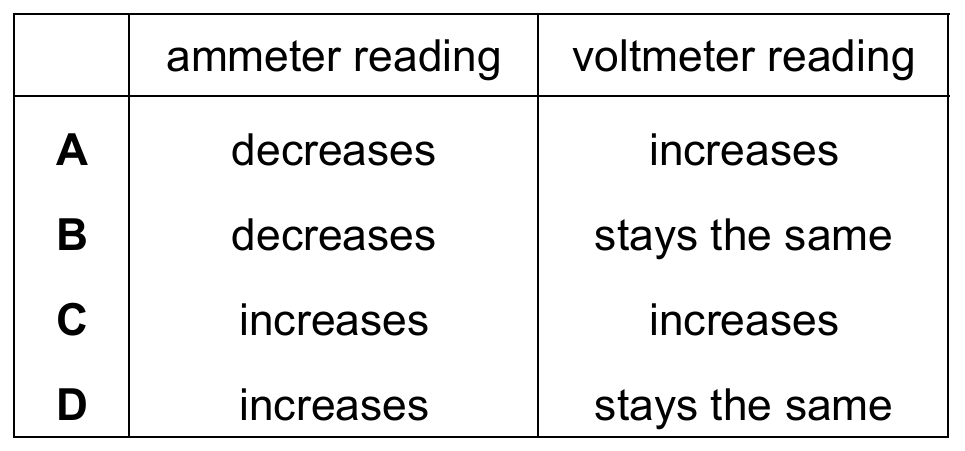
What happens to the voltmeter reading and what happens to the ammeter reading?

Most-appropriate topic codes (Cambridge IGCSE Co-ordinated Sciences 0654):

Topic P4.3: Electrical circuits — In a parallel circuit, voltage across each branch equals the supply voltage (constant); adding more parallel branches decreases total resistance, so total current from the battery increases while voltage stays the same.
▶️ Answer/Explanation
In a parallel circuit, all branches share the same voltage as the battery — adding another parallel resistor does not change the voltage, so the voltmeter reading stays the same.
However, adding a third parallel branch lowers the total resistance \(\left(\frac{1}{R_{total}} = \frac{1}{R_1} + \frac{1}{R_2} + \frac{1}{R_3}\right)\), so the total current drawn from the battery increases — the ammeter reading increases, corresponding to row D.
Answer: (D)

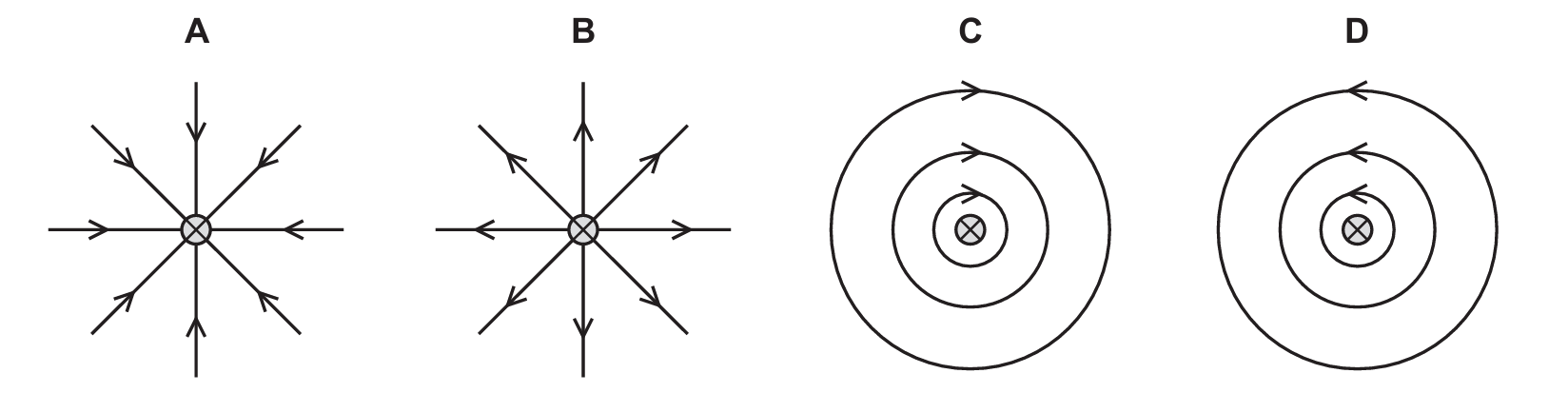
Question 38

Which diagram shows the pattern and the direction of the magnetic field around a straight wire that is carrying a current into the page?

Most-appropriate topic codes (Cambridge IGCSE Co-ordinated Sciences 0654):

Topic P4.5: Electromagnetic effects — The magnetic field around a current-carrying wire forms concentric circles; for current going into the page, the right-hand rule (or Maxwell’s corkscrew rule) gives a clockwise field direction when viewed from the front.
▶️ Answer/Explanation
Using the right-hand rule: point the right thumb in the direction of conventional current; the curled fingers show the direction of the magnetic field — for current into the page (represented by a cross symbol ✕), the field circles are clockwise when viewed from the front.
Diagram C shows concentric circular field lines in the clockwise direction around the wire, which is the correct pattern for a current directed into the page.
Answer: (C)

Question 39

An element has two isotopes.
Which statement about the nuclei of atoms of these isotopes is correct?

A. They have equal numbers of neutrons but different numbers of electrons.
B. They have equal numbers of neutrons but different numbers of protons.
C. They have equal numbers of protons but different numbers of electrons.
D. They have equal numbers of protons but different numbers of neutrons.

Most-appropriate topic codes (Cambridge IGCSE Co-ordinated Sciences 0654):

Topic C2.3: Isotopes — Isotopes are atoms of the same element with the same number of protons (same atomic number) but different numbers of neutrons, giving them different mass numbers; they have the same chemical properties but different physical properties.
▶️ Answer/Explanation
Isotopes are atoms of the same element, so they must have the same atomic number — meaning the same number of protons; they differ only in their number of neutrons, which gives them different mass numbers.
Since both are neutral atoms of the same element, they also have the same number of electrons as protons — options A, B, and C are all incorrect because they change the proton count or electron count, which would make them different elements or ions respectively.
Answer: (D)

Question 40

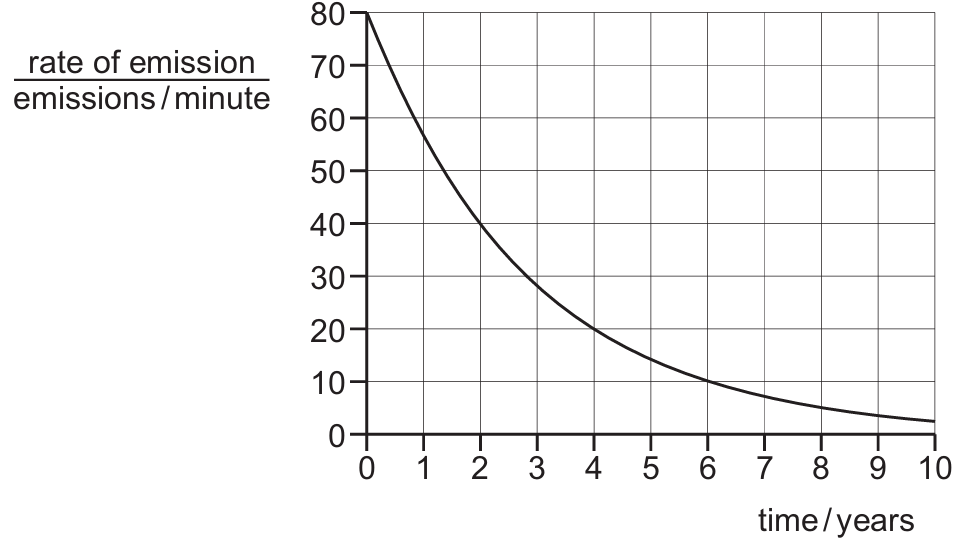
The graph shows how the rate of emission of radiation from a radioactive sample changes with time.

What is the half-life of this sample?

A. 40 minutes
B. 2.0 years
C. 5.0 years
D. 10 years

Most-appropriate topic codes (Cambridge IGCSE Co-ordinated Sciences 0654):

Topic P5.2: Radioactivity — Half-life is the time taken for the activity (or count rate) of a radioactive sample to fall to half its initial value; it is read directly from the decay graph by finding the time interval over which activity halves.
▶️ Answer/Explanation
To find the half-life from the decay graph, identify the initial activity, find the time when it has fallen to half that value, and read off the time elapsed — from the graph, the activity halves every 2.0 years.
This can be verified by checking a second halving: if the activity halves again after another 2.0 years (i.e., at 4.0 years total), the value is one quarter of the original, which should be consistent with the graph curve shown.
Answer: (B)
Scroll to Top