Home / 0654_w24_qp_12

Question 1

What are two of the characteristics of all living organisms?

A. breathing and respiration
B. egestion and excretion
C. movement and sensitivity
D. nutrition and photosynthesis

Most-appropriate topic codes (Cambridge IGCSE Co-ordinated Sciences 0654):

Topic B1.1: Characteristics of living organisms — Define movement, respiration, sensitivity, growth, reproduction, excretion and nutrition as the characteristics shared by all living organisms.
▶️ Answer/Explanation
Breathing is the physical act of ventilation, not the official characteristic — respiration is the chemical process, so option A pairs one correct and one incorrect term.
Egestion is removal of undigested food, which is not one of the seven defined characteristics, so option B is wrong.
Movement and sensitivity are both officially defined characteristics of all living organisms.
Photosynthesis is specific to green plants/algae, not all living organisms, ruling out option D.
Answer: (C)

Question 2

Which statements about cell structure are correct?

  1. Animal cells have cell membranes but no cell walls.
  2. Animal cells have cell membranes and cell walls.
  3. Plant cells have cell walls but no cell membranes.
  4. Plant cells have cell membranes and cell walls.

A. 1 and 3
B. 1 and 4
C. 2 and 3
D. 2 and 4

Most-appropriate topic codes (Cambridge IGCSE Co-ordinated Sciences 0654):

Topic B2.1: Cell structure — Compare the structure of a plant cell with an animal cell, including the presence/absence of a cell wall and cell membrane.
▶️ Answer/Explanation
Animal cells only have a cell membrane and never have a cell wall, so statement 1 is correct and statement 2 is wrong.
Plant cells have both a cell wall and a cell membrane (the membrane lies just inside the wall), so statement 3 is wrong and statement 4 is correct.
The correct pair of true statements is therefore 1 and 4.
Answer: (B)

Question 3

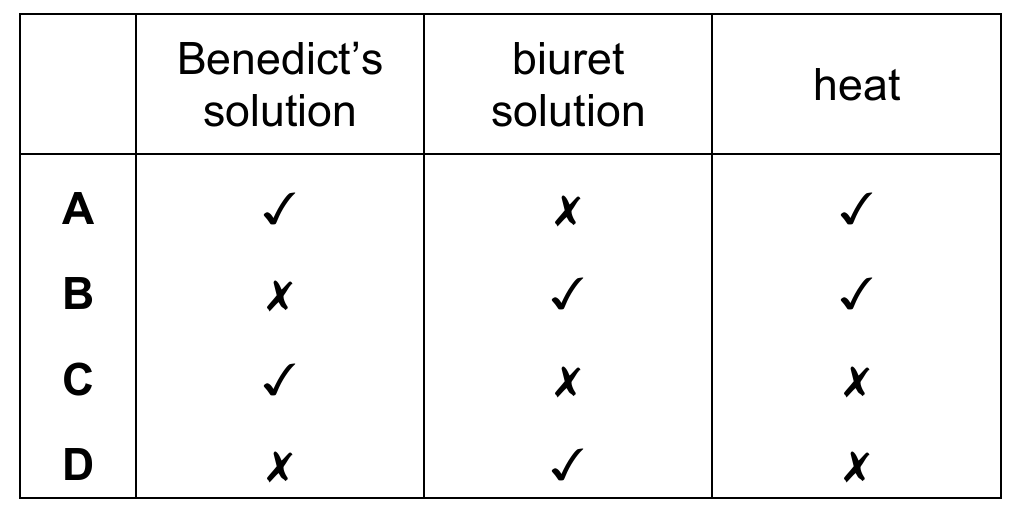
What is required to test for the presence of a reducing sugar?

Most-appropriate topic codes (Cambridge IGCSE Co-ordinated Sciences 0654):

Topic B4.1: Biological molecules — Describe the use of Benedict’s solution to test for reducing sugars.
▶️ Answer/Explanation
The test for a reducing sugar uses Benedict’s solution.
The sample is heated with Benedict’s solution in a water bath at around \(95^{\circ}\text{C}\).
A positive result is a colour change from blue to a brick-red precipitate.
The row in the table that correctly pairs “Benedict’s solution” with “heat” gives the correct reagent/condition combination.
Answer: (A)

Question 4

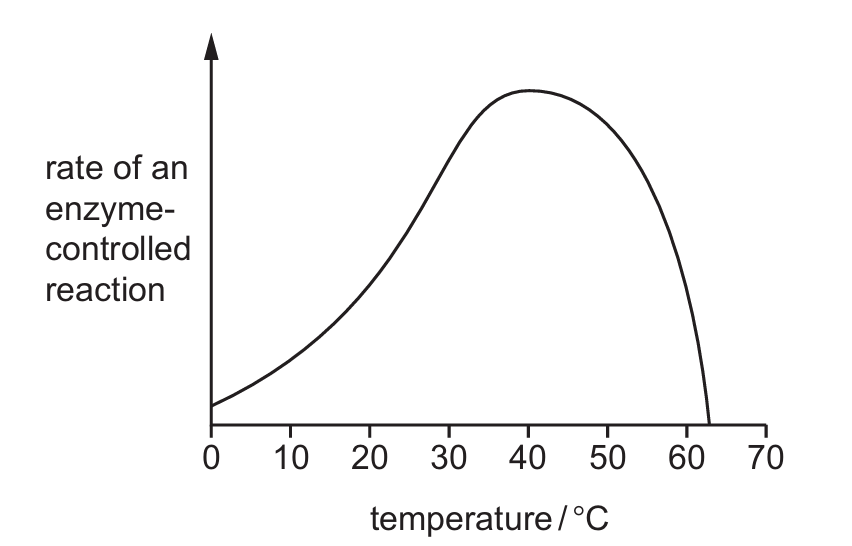
The graph shows the effect of increasing temperature on the rate of an enzyme-controlled reaction.

Which statement describes what is happening between 10 ºC and 30 ºC on the graph?

A. An increase in the rate of reaction increases the temperature of the reaction.
B. An increase in temperature has no effect on the rate of a reaction.
C. As the rate of reaction increases, the temperature has no effect.
D. As the temperature increases, the rate of reaction also increases.

Most-appropriate topic codes (Cambridge IGCSE Co-ordinated Sciences 0654):

Topic B5.1: Enzymes — Investigate and describe the effect of changes in temperature on enzyme activity.
▶️ Answer/Explanation
Below the optimum temperature, rising temperature gives molecules more kinetic energy.
More kinetic energy means more frequent, successful collisions between enzyme and substrate.
This causes the rate of reaction to rise as the temperature rises over the \(10^{\circ}\text{C}\) to \(30^{\circ}\text{C}\) range, before denaturation later reduces it.
Answer: (D)

Question 5

What are the products of photosynthesis in a green plant?

A. carbon dioxide and water
B. glucose and carbon dioxide
C. oxygen and glucose
D. oxygen and water

Most-appropriate topic codes (Cambridge IGCSE Co-ordinated Sciences 0654):

Topic B6.1: Photosynthesis — State the word equation for photosynthesis: carbon dioxide + water → glucose + oxygen.
▶️ Answer/Explanation
The word equation for photosynthesis is \(\text{carbon dioxide} + \text{water} \rightarrow \text{glucose} + \text{oxygen}\).
Carbon dioxide and water are the raw materials (reactants), not the products.
Glucose and oxygen are the two substances made by the plant, so they are the products.
Answer: (C)

Question 6

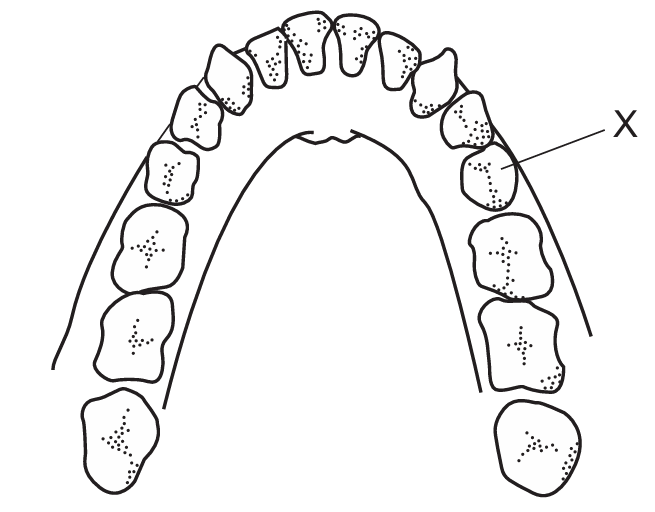
The diagram shows human teeth in the lower jaw.

Which type of tooth is X?

A. canine
B. incisor
C. molar
D. premolar

▶️ Answer/Explanation
In the lower jaw, teeth are arranged from front to back as incisors, then canine, then premolars, then molars.
Tooth X is positioned in the row at the broad, ridged double-cusped tooth located between the canine and the molars.
This shape and position identify it as a premolar.
Answer: (D)

Question 7

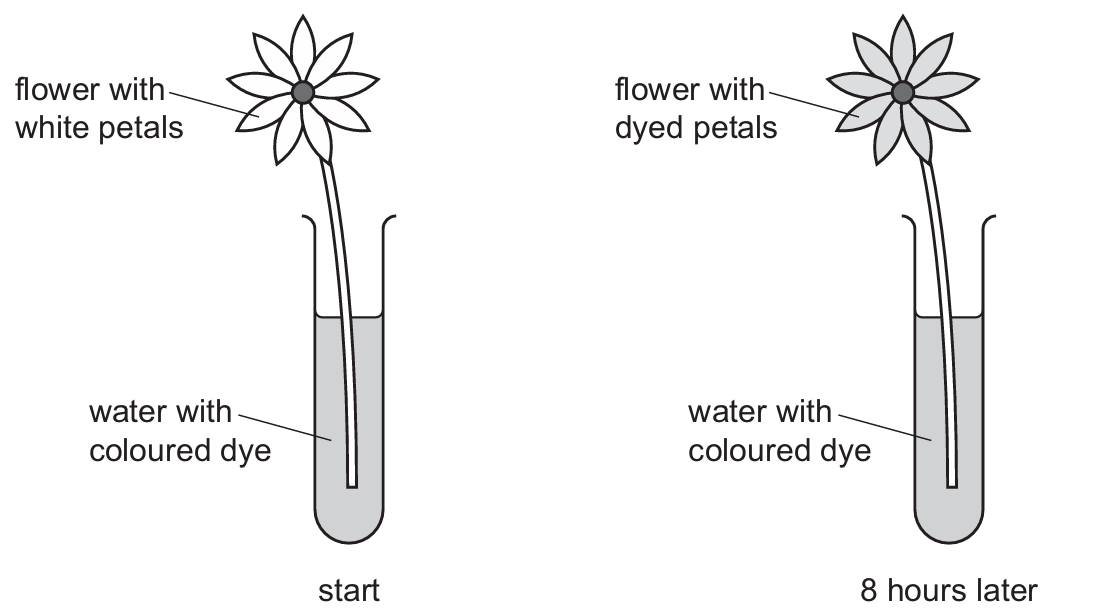
The diagram shows an investigation into water transport in plants.

Which part of the stem transports the coloured dye from the test-tube to the petals of the flower?

A. mesophyll cells
B. phloem
C. root hair cells
D. xylem

Most-appropriate topic codes (Cambridge IGCSE Co-ordinated Sciences 0654):

Topic B8.1: Xylem and phloem — State the function of xylem as transport of water and mineral ions (and support).
▶️ Answer/Explanation
Dye dissolved in water is taken up by the cut stem in the same way as water and mineral ions normally would be.
Water and dissolved substances move upward through the stem exclusively in the xylem vessels.
The dye therefore travels up the xylem and stains the petals at the top.
Answer: (D)

Question 8

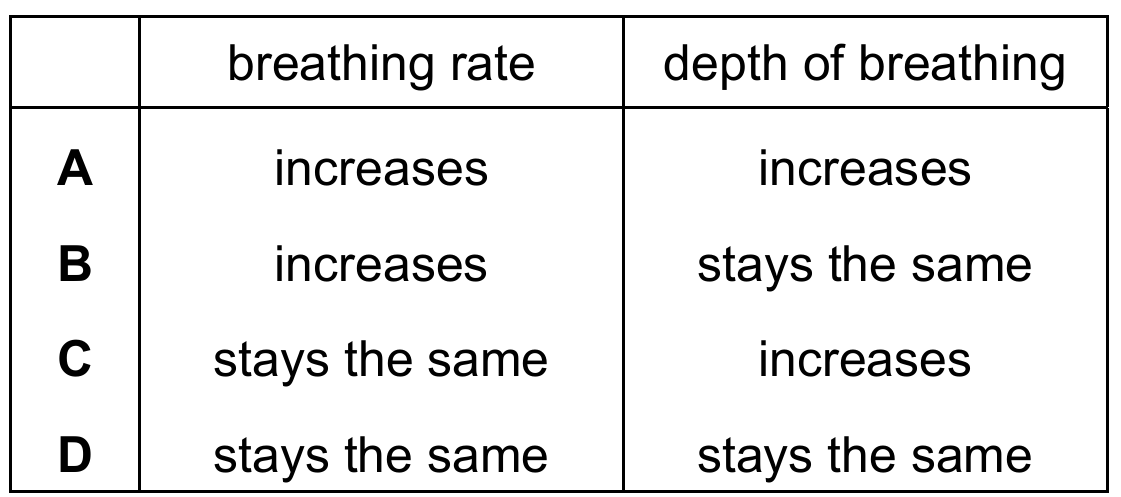
Which row shows the changes that occur during exercise?

Most-appropriate topic codes (Cambridge IGCSE Co-ordinated Sciences 0654):

Topic B12.1: Respiration — State the uses of energy in living organisms (e.g. muscle contraction) and describe how aerobic respiration meets the increased energy demand.
▶️ Answer/Explanation
During exercise, muscles respire faster and need more oxygen delivered and more carbon dioxide removed.
This means breathing rate increases and heart rate increases at the same time.
The correct row is the one in which both breathing rate and heart rate increase together.
Answer: (A)

Question 9

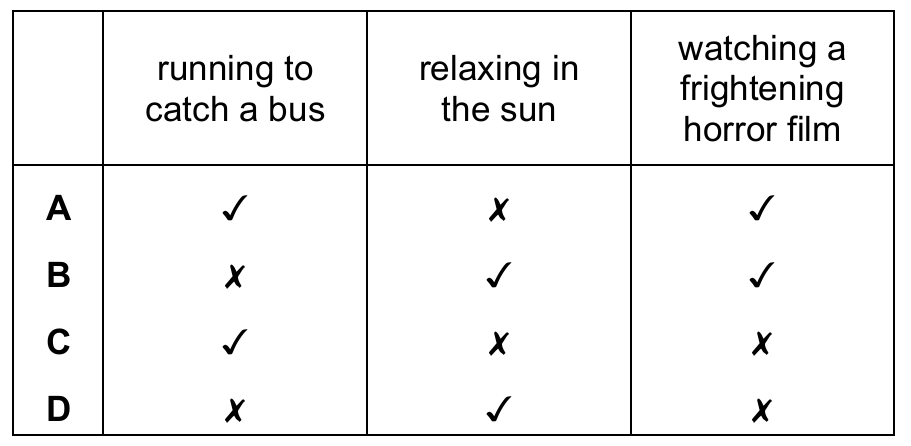
Which activities increase the secretion of adrenaline in the human body?

Most-appropriate topic codes (Cambridge IGCSE Co-ordinated Sciences 0654):

Topic B13.2: Hormones — Describe adrenaline as the hormone secreted in ‘fight or flight’ situations, increasing breathing rate, heart rate and pupil diameter.
▶️ Answer/Explanation
Adrenaline is released by the adrenal glands in stressful or “fight or flight” situations such as fear, excitement or danger.
Calm, routine activities with no element of stress or excitement do not trigger extra adrenaline release.
The correct activities are those representing sudden stress, excitement or danger, matching the listed option.
Answer: (A)

Question 10

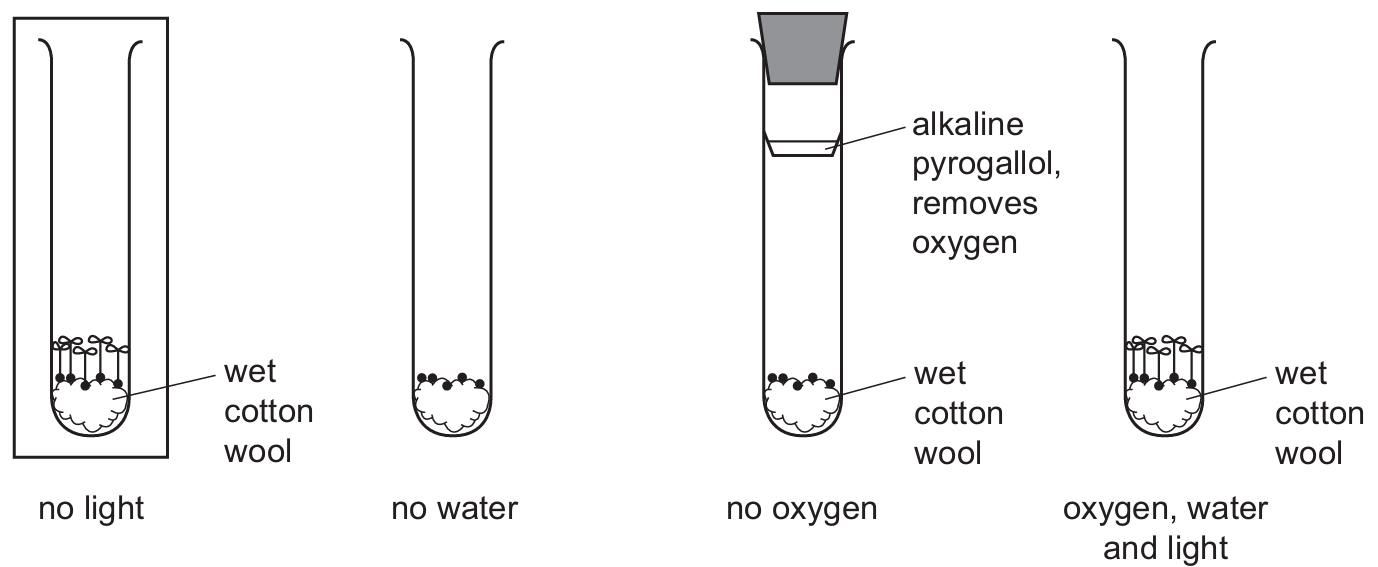
The roles of oxygen, water and light in seed germination are investigated. The results of the experiment are shown.

Which factors are shown to be needed for germination?

A. light and water only
B. light and oxygen only
C. oxygen and water only
D. oxygen, water and light

Most-appropriate topic codes (Cambridge IGCSE Co-ordinated Sciences 0654):

Topic B15.3: Sexual reproduction in plants — Investigate and describe the environmental conditions needed for germination: water, oxygen and a suitable temperature (light is not required).
▶️ Answer/Explanation
Germination requires water to activate enzymes and oxygen for aerobic respiration to release energy.
Light is not a requirement for germination itself, only for the seedling’s later growth by photosynthesis.
The results show seeds germinated whenever water and oxygen were present, regardless of light.
Answer: (C)

Question 11

In a plant, the allele for red flowers is dominant to the allele for yellow flowers. A heterozygous, red-flowered plant is crossed with a homozygous, yellow-flowered plant.

Which statement about the offspring is correct?

A. 25% will have red flowers and 75% will have yellow flowers.
B. 50% will have red flowers and 50% will have yellow flowers.
C. 75% will have red flowers and 25% will have yellow flowers.
D. 100% will have red flowers and 0% will have yellow flowers.

Most-appropriate topic codes (Cambridge IGCSE Co-ordinated Sciences 0654):

Topic B16.3: Monohybrid inheritance — Use genetic diagrams to predict the results of monohybrid crosses and calculate phenotypic ratios, limited to 1:1 and 3:1 ratios.
▶️ Answer/Explanation
Let \(R\) = red (dominant) and \(r\) = yellow (recessive).
The heterozygous red parent is \(Rr\) and the homozygous yellow parent is \(rr\).
The cross \(Rr \times rr\) gives offspring genotypes \(Rr, Rr, rr, rr\), a 1:1 ratio.
This means 50% of offspring are red (\(Rr\)) and 50% are yellow (\(rr\)).
Answer: (B)

Question 12

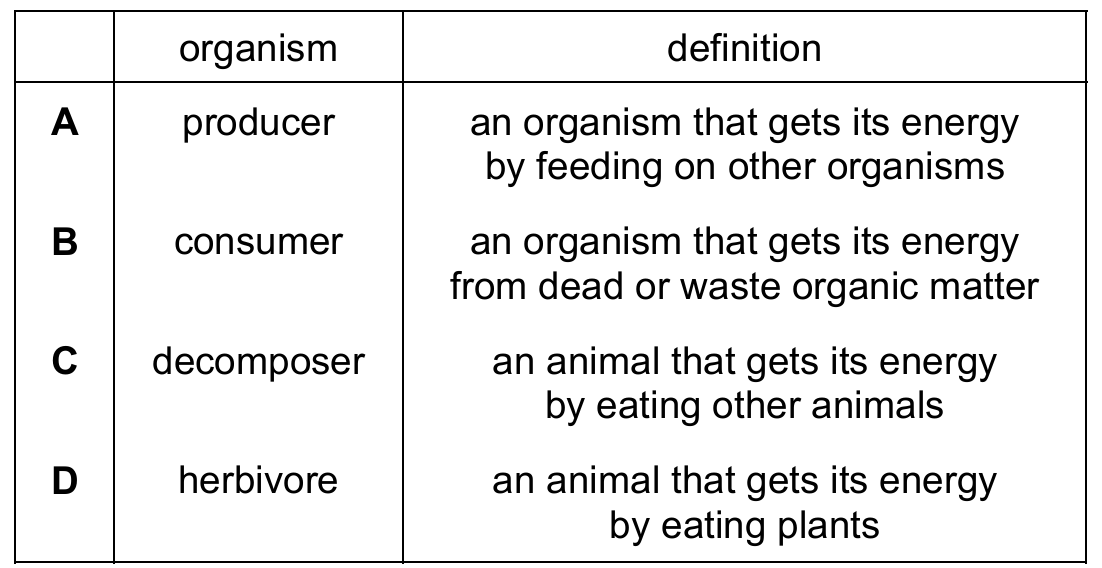
Which definition is correctly matched to a type of organism?

Most-appropriate topic codes (Cambridge IGCSE Co-ordinated Sciences 0654):

Topic B18.2: Food chains and food webs — Describe a producer, consumer, herbivore, carnivore and decomposer in terms of how each organism obtains its energy.
▶️ Answer/Explanation
A producer makes its own organic nutrients using light energy through photosynthesis.
A consumer gets its energy by feeding on other organisms, and a decomposer gets its energy from dead or waste organic material.
Only one row in the table pairs an organism type with its precisely correct definition, with the others mixing up these roles.
Answer: (D)

Question 13

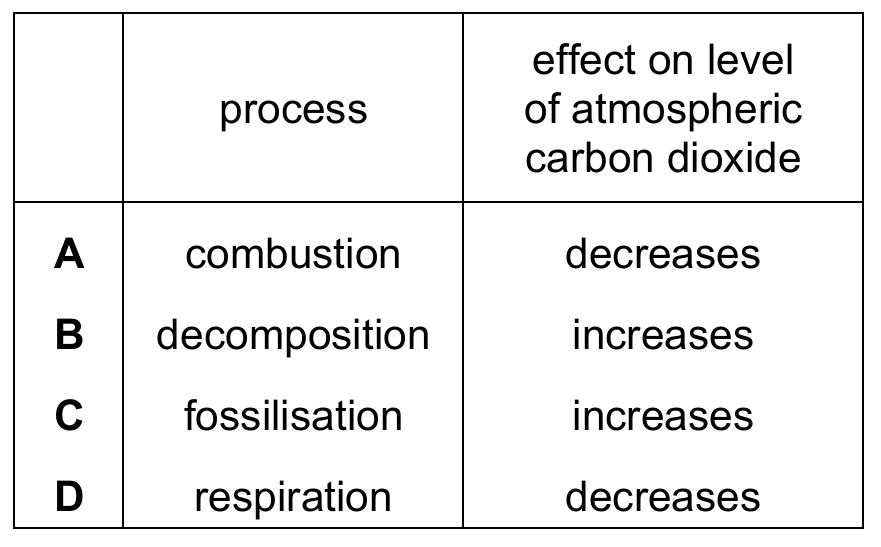
Which row about a process in the carbon cycle is correct?

Most-appropriate topic codes (Cambridge IGCSE Co-ordinated Sciences 0654):

Topic B18.3: Carbon cycle — Describe the carbon cycle, limited to photosynthesis, respiration, feeding, decomposition, formation of fossil fuels and combustion.
▶️ Answer/Explanation
Photosynthesis removes carbon dioxide from the air, while respiration and combustion both release carbon dioxide into the air.
Decomposition releases carbon dioxide as decomposers respire while breaking down dead matter.
Only one row correctly states both the process named and whether it adds or removes atmospheric carbon dioxide.
Answer: (B)

Question 14

Calcium carbonate reacts with dilute hydrochloric acid in a flask. The reaction releases carbon dioxide gas.

The decrease in the mass of the flask and its contents is measured over time.

Which pieces of apparatus must be used?

  1. balance
  2. pipettes
  3. thermometers
  4. stop-clock

A. 1 and 2
B. 1 and 4
C. 2 and 3
D. 3 and 4

Most-appropriate topic codes (Cambridge IGCSE Co-ordinated Sciences 0654):

Topic C6.2: Rate of reaction — Describe practical methods for investigating the rate of a reaction, including change in mass of a reactant or product.
▶️ Answer/Explanation
A balance is essential to record the decreasing mass of the flask and its contents as carbon dioxide escapes.
A stop-clock is essential to record the time at which each mass reading is taken.
Pipettes and thermometers are not needed, since volume transfer and temperature are not being measured here.
Answer: (B)

Question 15

Which process involves a chemical change?

A. burning a wooden splint
B. dissolving sodium chloride in water
C. evaporating water
D. distilling petroleum

Most-appropriate topic codes (Cambridge IGCSE Co-ordinated Sciences 0654):

Topic C6.1: Physical and chemical changes — Identify physical and chemical changes and understand the differences between them.
▶️ Answer/Explanation
Burning a wooden splint converts the wood into new substances such as carbon dioxide, water and ash — a chemical change.
Dissolving, evaporating and distilling are all physical changes because no new substance is formed and the change is reversible.
Only burning permanently produces different chemical substances, so it is the chemical change.
Answer: (A)

Question 16

Which formula contains the most elements?

A. NaOH
B. Rb\(_{2}\)S
C. SiCl\(_{4}\)
D. SnO\(_{2}\)

Most-appropriate topic codes (Cambridge IGCSE Co-ordinated Sciences 0654):

Topic C2.1: Elements, compounds and mixtures — Describe the differences between elements, compounds and mixtures.
▶️ Answer/Explanation
NaOH contains three different elements: sodium (Na), oxygen (O) and hydrogen (H).
Rb\(_{2}\)S, SiCl\(_{4}\) and SnO\(_{2}\) each contain only two different elements, regardless of how many atoms of each are present.
Counting unique element symbols, not subscript numbers, shows NaOH has the most distinct elements.
Answer: (A)

Question 17

What are the products of the electrolysis of dilute sulfuric acid using inert electrodes?

A. hydrogen and sulfur dioxide
B. oxygen and hydrogen
C. oxygen and sulfur
D. oxygen and sulfur dioxide

Most-appropriate topic codes (Cambridge IGCSE Co-ordinated Sciences 0654):

Topic C4.1: Electrolysis — Identify the products formed at the electrodes during the electrolysis of dilute sulfuric acid using inert electrodes.
▶️ Answer/Explanation
In dilute sulfuric acid, the ions present in greatest relevant concentration for discharge are \(H^{+}\) and \(OH^{-}\) (from water).
At the cathode, \(H^{+}\) ions gain electrons to form hydrogen gas.
At the anode, \(OH^{-}\) ions lose electrons to form oxygen gas and water; sulfate ions are not discharged.
Answer: (B)

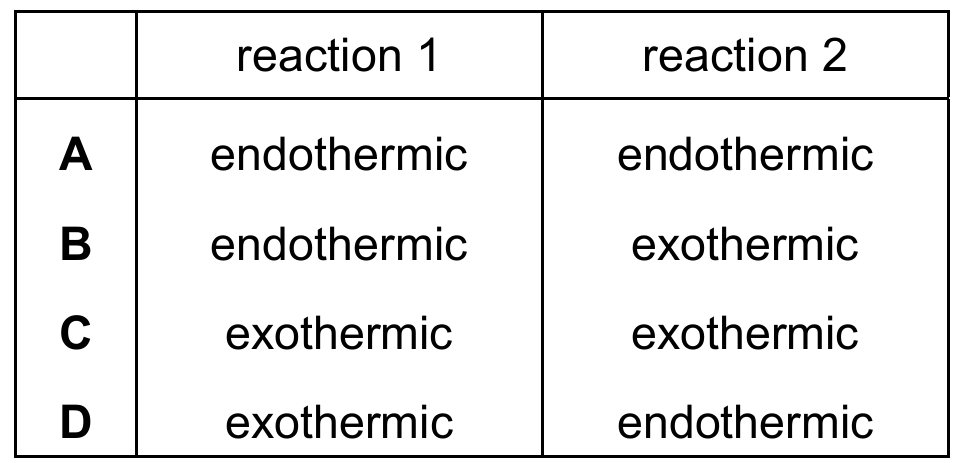
Question 18

Some observations about two reactions are shown.

In reaction 1, heat is taken in from the surroundings.

In reaction 2, heat is released to the surroundings.

Which row describes each reaction?

Most-appropriate topic codes (Cambridge IGCSE Co-ordinated Sciences 0654):

Topic C5.1: Exothermic and endothermic reactions — State that an exothermic reaction releases thermal energy and an endothermic reaction takes in thermal energy from the surroundings.
▶️ Answer/Explanation
Reaction 1 takes in heat from the surroundings, so it is endothermic, and the surrounding temperature falls.
Reaction 2 releases heat to the surroundings, so it is exothermic, and the surrounding temperature rises.
The correct row labels reaction 1 as endothermic (temperature decrease) and reaction 2 as exothermic (temperature increase).
Answer: (B)

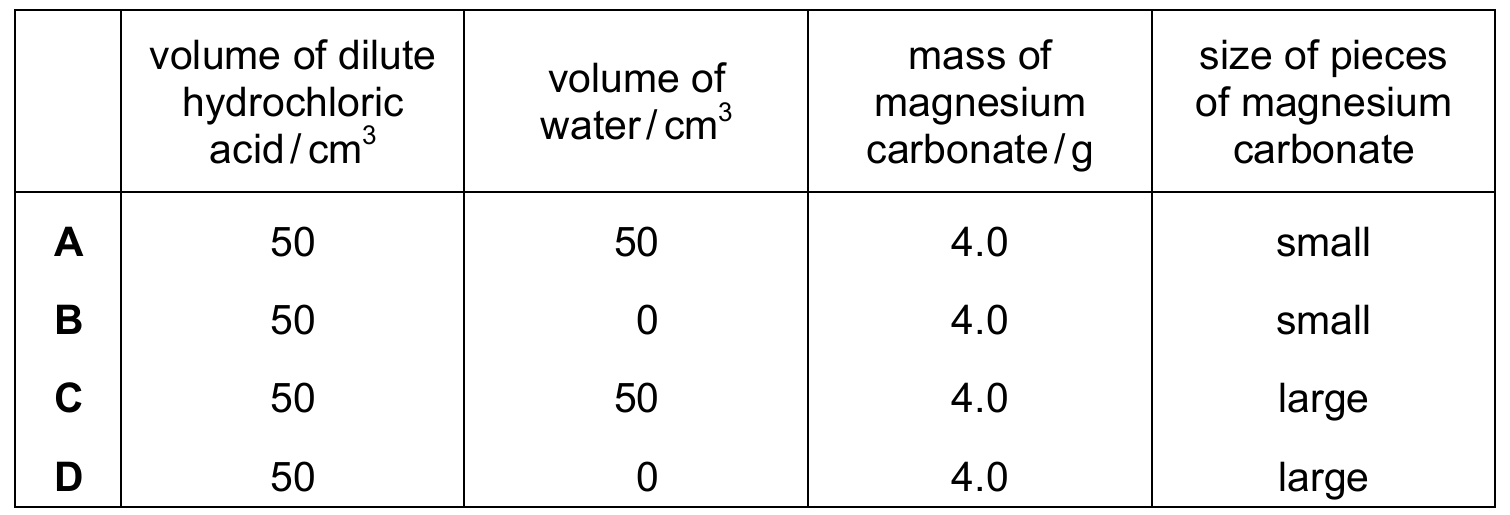
Question 19

Four beakers each contain 50 cm\(^{3}\) dilute hydrochloric acid of equal concentration.

50 cm\(^{3}\) of water is added to two of the beakers. 4.0 g magnesium carbonate is then added to each beaker.

The particle sizes of the magnesium carbonate added to some of the beakers are different.

Which experiment has the lowest rate of reaction?

Most-appropriate topic codes (Cambridge IGCSE Co-ordinated Sciences 0654):

Topic C6.2: Rate of reaction — Describe the effect on the rate of reaction of changing the concentration of solutions and changing the surface area of solids.
▶️ Answer/Explanation
Diluting the acid with water lowers the acid concentration, which reduces collision frequency and slows the reaction.
Using larger lumps of magnesium carbonate gives a smaller surface area, which also reduces collision frequency and slows the reaction.
The slowest experiment is the one combining both the most dilute acid and the largest (least reactive) particle size.
Answer: (C)

Question 20

A piece of magnesium ribbon is placed in dilute hydrochloric acid. The magnesium reacts and bubbles of a colourless gas are formed.

What is the word equation for this reaction?

A. magnesium + hydrochloric acid → magnesium chloride + hydrogen
B. magnesium + hydrochloric acid → magnesium chloride + carbon dioxide + water
C. magnesium + hydrochloric acid → magnesium chloride + carbon dioxide
D. magnesium + hydrochloric acid → magnesium chloride + hydrogen + water

Most-appropriate topic codes (Cambridge IGCSE Co-ordinated Sciences 0654):

Topic C9.4: Reactivity series — Describe the reactions of metals such as magnesium with dilute hydrochloric acid.
▶️ Answer/Explanation
A reactive metal reacting with a dilute acid always produces a salt plus hydrogen gas.
Here magnesium reacts with hydrochloric acid to give the salt magnesium chloride and hydrogen gas, with no carbon-containing or extra water product.
The word equation is \(\text{magnesium} + \text{hydrochloric acid} \rightarrow \text{magnesium chloride} + \text{hydrogen}\).
Answer: (A)

Question 21

Which chemical test does not produce a precipitate?

A. carbon dioxide and limewater
B. carbonate ions and dilute hydrochloric acid
C. chloride ions and aqueous silver nitrate
D. copper(II) ions and aqueous sodium hydroxide

Most-appropriate topic codes (Cambridge IGCSE Co-ordinated Sciences 0654):

Topic C12.5: Identification of ions and gases — Describe tests to identify carbonate, halide and copper(II) ions, and the limewater test for carbon dioxide.
▶️ Answer/Explanation
Carbon dioxide turns limewater milky/cloudy because an insoluble calcium carbonate precipitate forms.
Chloride ions with silver nitrate give a white precipitate, and copper(II) ions with sodium hydroxide give a blue precipitate.
Reacting a carbonate with dilute hydrochloric acid simply releases carbon dioxide gas and forms a soluble salt solution, with no precipitate.
Answer: (B)

Question 22

Which statement about the halogens is correct?

A. They become lighter in colour down the group.
B. They are all gases at room temperature.
C. They are members of the same period of the Periodic Table.
D. They exist as diatomic molecules.

Most-appropriate topic codes (Cambridge IGCSE Co-ordinated Sciences 0654):

Topic C8.3: Group VII properties — Describe the Group VII halogens as diatomic non-metals with general trends in density and reactivity down the group.
▶️ Answer/Explanation
Halogens actually become darker in colour down the group (chlorine pale yellow-green, bromine red-brown, iodine grey-black), so option A is wrong.
They are not all gases at room temperature — bromine is a liquid and iodine is a solid — and they belong to the same group (a column), not the same period, ruling out B and C.
Each halogen exists as a diatomic molecule, e.g. \(\text{Cl}_{2}\), \(\text{Br}_{2}\), \(\text{I}_{2}\), which is the correct statement.
Answer: (D)

Question 23

How is iron oxide converted to iron?

A. oxidation using water
B. reaction with hydrochloric acid
C. reaction with sodium hydroxide
D. reduction using carbon

Most-appropriate topic codes (Cambridge IGCSE Co-ordinated Sciences 0654):

Topic C9.6: Extraction of metals — State that iron from hematite is extracted by reduction of iron(III) oxide in the blast furnace.
▶️ Answer/Explanation
In the blast furnace, carbon (as coke) burns to form carbon monoxide.
Carbon monoxide then removes oxygen from iron(III) oxide: \(\text{Fe}_2\text{O}_3 + 3\text{CO} \rightarrow 2\text{Fe} + 3\text{CO}_2\).
This is a reduction reaction (loss of oxygen from the iron compound), using carbon/carbon monoxide as the reducing agent.
Answer: (D)

Question 24

Which volume of clean air contains 10.5 cm\(^{3}\) of oxygen?

A. 21 cm\(^{3}\)
B. 42 cm\(^{3}\)
C. 50 cm\(^{3}\)
D. 100 cm\(^{3}\)

Most-appropriate topic codes (Cambridge IGCSE Co-ordinated Sciences 0654):

Topic C10.2: Air quality and climate — State the composition of clean, dry air as approximately 78% nitrogen and 21% oxygen.
▶️ Answer/Explanation
Clean air is approximately 21% oxygen by volume.
Let the total volume be \(V\); then \(0.21 \times V = 10.5\), so \(V = \dfrac{10.5}{0.21} = 50\).
A volume of 50 cm\(^{3}\) of clean air contains 10.5 cm\(^{3}\) of oxygen.
Answer: (C)

Question 25

What are two uses of limestone?

  1. as a fertilizer
  2. to decrease the pH of soil
  3. making lime
  4. neutralizing some industrial waste products

A. 1 and 2
B. 1 and 4
C. 2 and 3
D. 3 and 4

Most-appropriate topic codes (Cambridge IGCSE Co-ordinated Sciences 0654):

Topic C9.6: Extraction of metals — Describe the thermal decomposition of limestone to produce lime (calcium oxide) and other uses of limestone-based products.
▶️ Answer/Explanation
Heating (thermally decomposing) limestone produces lime (calcium oxide): \(\text{CaCO}_3 \rightarrow \text{CaO} + \text{CO}_2\), so statement 3 is correct.
Lime is alkaline and is used to neutralise acidic industrial waste, so statement 4 is also correct.
Limestone/lime is used to increase (not decrease) soil pH, and is not itself classed as a fertilizer, ruling out statements 1 and 2.
Answer: (D)

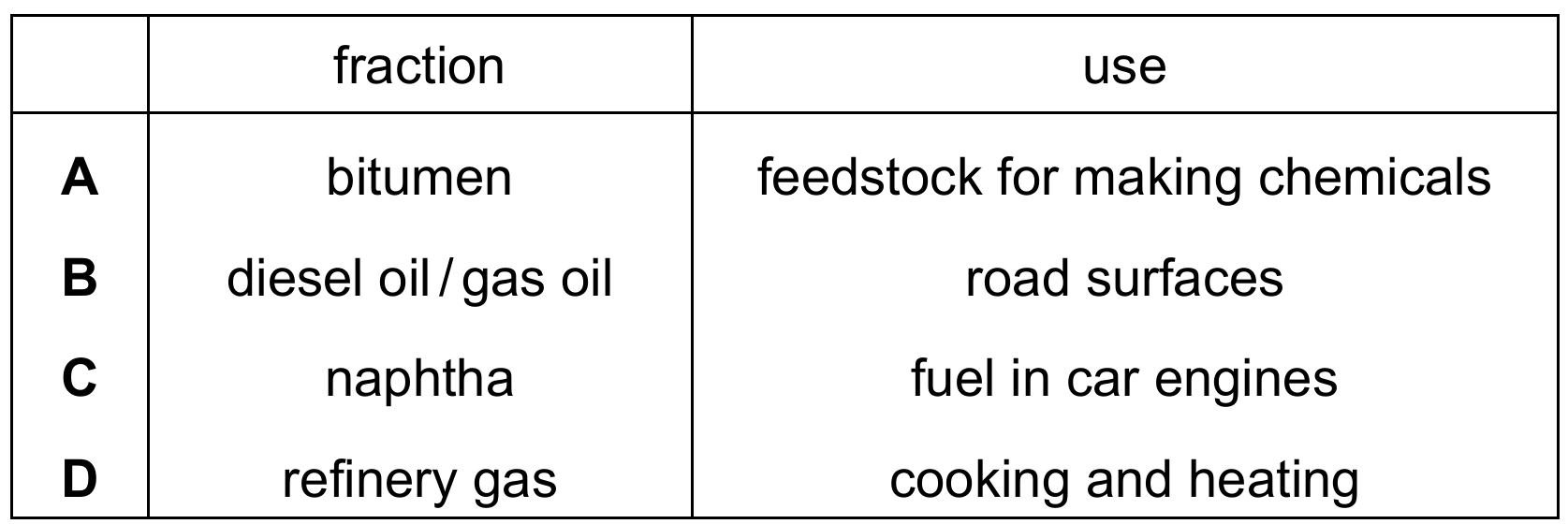
Question 26

Petroleum is separated into fractions by fractional distillation. Which row shows a use for the named fraction?

Most-appropriate topic codes (Cambridge IGCSE Co-ordinated Sciences 0654):

Topic C11.3: Fuels — Name the uses of the petroleum fractions: refinery gas, gasoline/petrol, naphtha, diesel oil/gas oil and bitumen.
▶️ Answer/Explanation
Each fraction of petroleum has one specific named use: refinery gas for heating/cooking, petrol for cars, diesel for diesel engines, and bitumen for roads.
Mixing up these pairings (e.g. bitumen for cars) gives an incorrect row.
Only one row pairs each named fraction with its genuinely correct industrial use.
Answer: (D)

Question 27

Which statement about addition polymerisation is correct?

A. Large monomer units join to form small polymer molecules.
B. Large polymer molecules join to form small monomer units.
C. Small monomer units join to form large polymer molecules.
D. Small polymer molecules join to form large monomer units.

Most-appropriate topic codes (Cambridge IGCSE Co-ordinated Sciences 0654):

Topic C11.7: Polymers — Define polymers as large molecules built up from many smaller molecules called monomers.
▶️ Answer/Explanation
A polymer is, by definition, a very large molecule built from many smaller repeating units called monomers.
In addition polymerisation, small monomer molecules (such as ethene) join together with no other product formed.
This joining produces one large polymer chain, e.g. poly(ethene), from the many small monomers.
Answer: (C)

Question 28

An object has a weight of 2.0 N.

The gravitational field strength g is 10 N/kg.

What is the mass of the object?

A. 0.020 kg
B. 0.20 kg
C. 2.0 kg
D. 20 kg

Most-appropriate topic codes (Cambridge IGCSE Co-ordinated Sciences 0654):

Topic P1.3: Mass and weight — Define gravitational field strength g as the gravitational force per unit mass, and use \(g = \dfrac{W}{m}\).
▶️ Answer/Explanation
Weight and mass are linked by \(g = \dfrac{W}{m}\), so rearranged this gives \(m = \dfrac{W}{g}\).
Substituting the given values: \(m = \dfrac{2.0}{10}\).
This gives \(m = 0.20\ \text{kg}\).
Answer: (B)

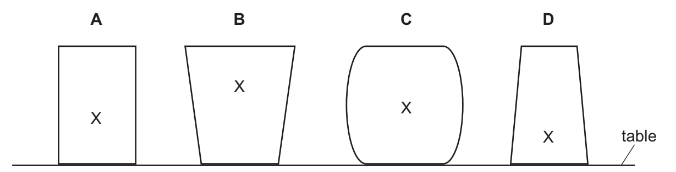
Question 29

The diagram shows four containers resting on a table. The containers have equal masses and square bases of equal areas. The centre of mass of each container is labelled X.

Which container is the most stable?

Most-appropriate topic codes (Cambridge IGCSE Co-ordinated Sciences 0654):

Topic P1.5.3: Centre of gravity — Describe, qualitatively, the effect of the position of the centre of gravity on the stability of simple objects.
▶️ Answer/Explanation
An object is more stable when its centre of mass X is positioned lower and the line down from X stays well within the base.
A lower centre of mass means the container has to be tilted further before X passes outside the base, so it is harder to topple.
The container with the lowest-positioned centre of mass X is therefore the most stable.
Answer: (D)

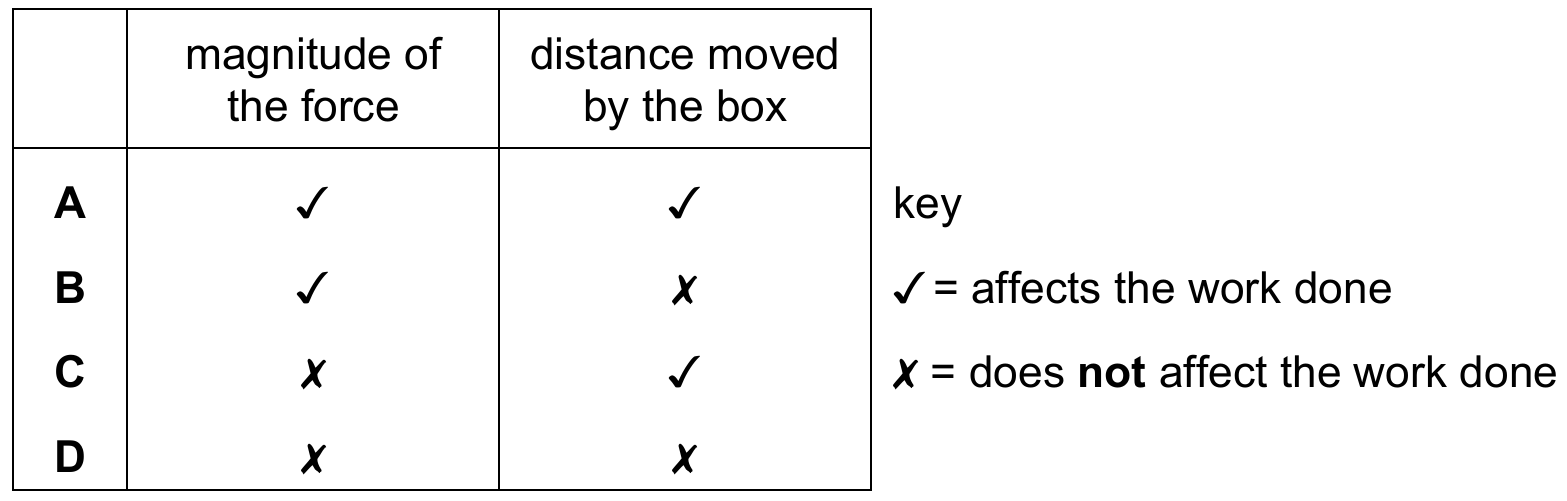
Question 30

A worker exerts a force on a box to move it across a horizontal surface.

Which of the two quantities in the table affect the amount of work done by the force?

Most-appropriate topic codes (Cambridge IGCSE Co-ordinated Sciences 0654):

Topic P1.6.2: Work — Recall and use the equation for mechanical working, \(W = Fd\).
▶️ Answer/Explanation
Work done is calculated using \(W = F \times d\), where \(F\) is the force applied and \(d\) is the distance moved in the direction of the force.
Only quantities that appear in this equation — the size of the force and the distance moved — change the value of the work done.
Quantities such as time taken or the box’s mass do not appear in the work equation, so they do not directly affect work done.
Answer: (A)

Question 31

What is the useful energy transfer in a wind turbine?

A. electrical energy to thermal energy
B. gravitational potential energy to kinetic energy
C. kinetic energy to electrical energy
D. thermal energy to gravitational potential energy

Most-appropriate topic codes (Cambridge IGCSE Co-ordinated Sciences 0654):

Topic P1.6.1: Energy — Describe how useful electrical power may be generated from wind (wind turbines), including reference to the generator.
▶️ Answer/Explanation
Moving air has kinetic energy, which turns the turbine blades.
The spinning blades drive a generator, which is the part of the system that produces electrical energy.
The useful overall transfer is therefore from kinetic energy (of the wind/blades) to electrical energy.
Answer: (C)

Question 32

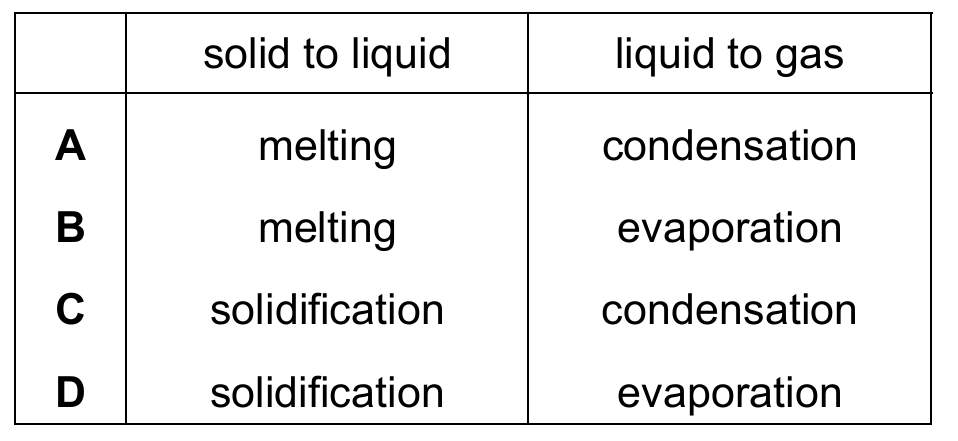
What are the names for the changes of state between solids, liquids and gases?

Most-appropriate topic codes (Cambridge IGCSE Co-ordinated Sciences 0654):

Topic C1.1: Solids, liquids and gases — Describe changes of state in terms of melting, boiling, evaporating, freezing and condensing.
▶️ Answer/Explanation
Solid to liquid is called melting, and liquid to solid is called freezing.
Liquid to gas is called boiling or evaporating, and gas to liquid is called condensing.
Only one row in the table assigns these five terms to the correct state changes without swapping any of them.
Answer: (B)

Question 33

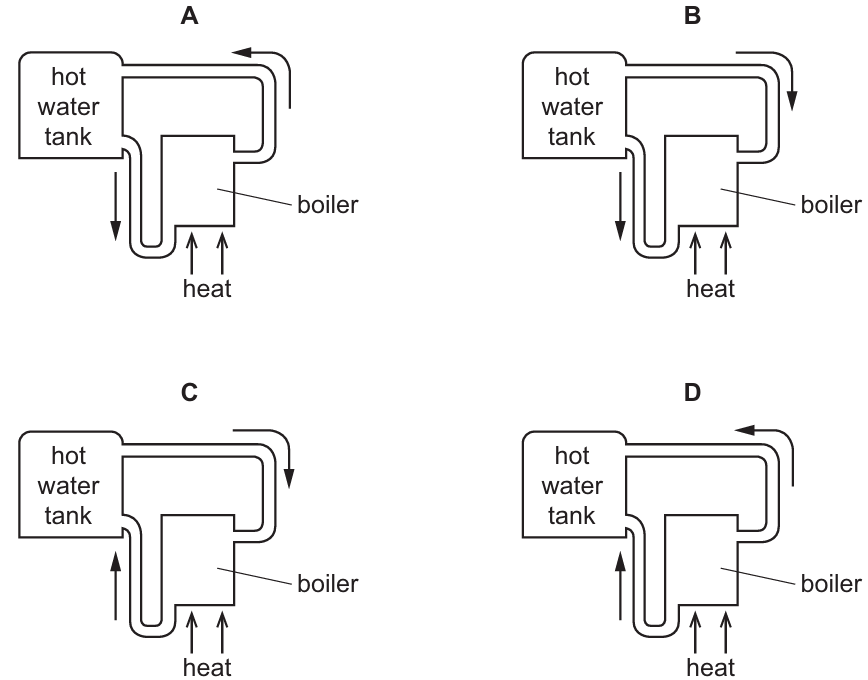
The diagrams show part of a water-heating system which is working by convection.

Which diagram shows the flow of water in the system?

Most-appropriate topic codes (Cambridge IGCSE Co-ordinated Sciences 0654):

Topic P2.3.2: Convection — Describe convection in liquids and gases in terms of density changes caused by heating.
▶️ Answer/Explanation
Water heated near the bottom of the system expands and becomes less dense than the surrounding cooler water.
This warmer, less dense water rises, while cooler, denser water sinks to take its place, setting up a convection current.
The correct diagram shows water rising above the heat source and sinking back down elsewhere to form a continuous loop.
Answer: (A)

Question 34

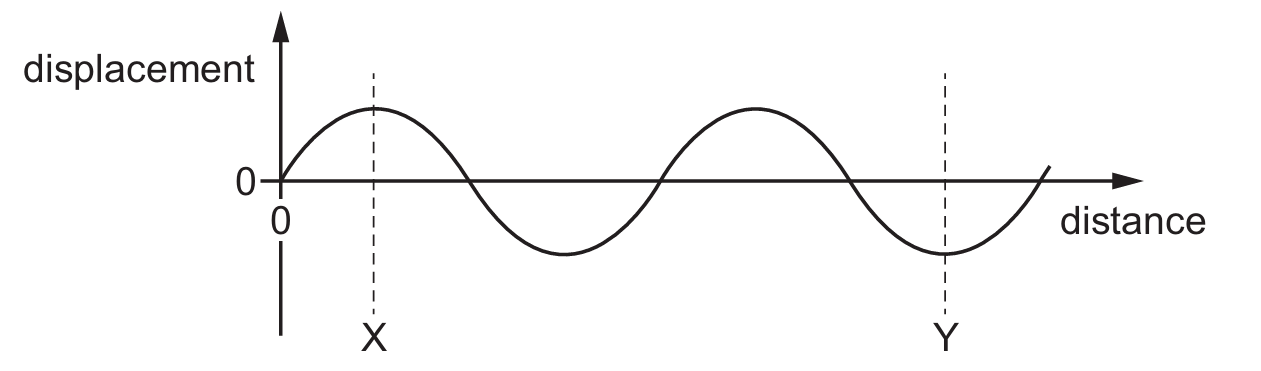
The diagram represents a wave.

How many wavelengths are there between X and Y?

A. \(\dfrac{2}{3}\)
B. 1
C. \(1\dfrac{1}{2}\)
D. 3

Most-appropriate topic codes (Cambridge IGCSE Co-ordinated Sciences 0654):

Topic P3.1: General properties of waves — Describe the features of a wave in terms of wavelength, crest (peak) and trough.
▶️ Answer/Explanation
One full wavelength is the distance between two consecutive identical points on the wave, such as crest to crest.
Counting the crests and troughs shown between X and Y in the diagram corresponds to one and a half complete wave cycles.
Therefore the distance from X to Y spans \(1\dfrac{1}{2}\) wavelengths.
Answer: (C)

Question 35

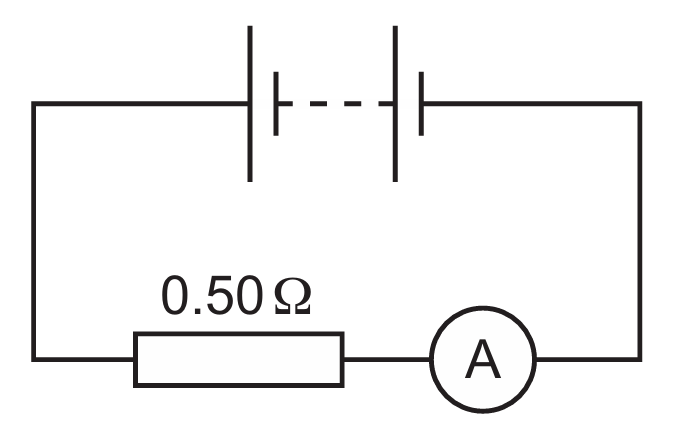
The diagram shows a battery connected to a 0.50 Ω resistor and an ammeter. The reading on the ammeter is 0.20 A.

What is the potential difference (p.d.) across the resistor?

A. 0.10 V
B. 0.40 V
C. 0.70 V
D. 2.5 V

Most-appropriate topic codes (Cambridge IGCSE Co-ordinated Sciences 0654):

Topic P4.2.4: Resistance — Recall and use the equation for resistance, \(R = \dfrac{V}{I}\).
▶️ Answer/Explanation
The resistance equation \(R = \dfrac{V}{I}\) can be rearranged to \(V = IR\).
Substituting the given values: \(V = 0.20 \times 0.50\).
This gives \(V = 0.10\ \text{V}\) across the resistor.
Answer: (A)

Question 36

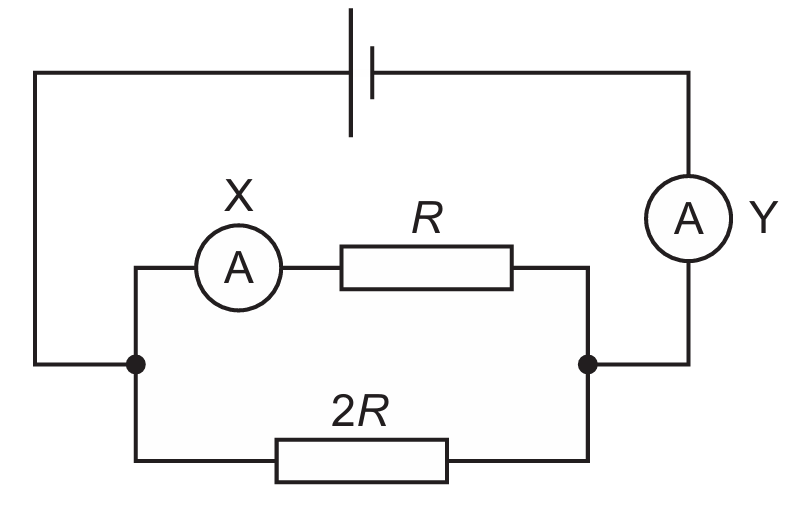
The diagram shows a circuit containing two resistors of resistance R and 2R and two ammeters X and Y.

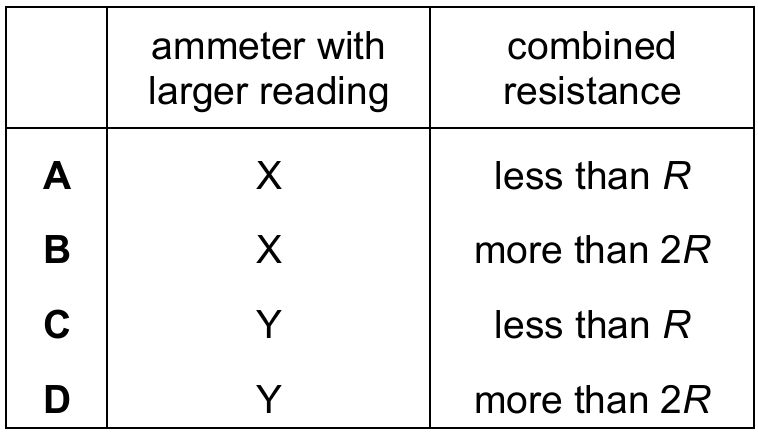
Which ammeter shows the larger reading and what is the combined resistance of the two resistors?

Most-appropriate topic codes (Cambridge IGCSE Co-ordinated Sciences 0654):

Topic P4.3.2: Series and parallel circuits — Calculate the combined resistance of two resistors in parallel, and recall that current divides between parallel branches.
▶️ Answer/Explanation
In a parallel arrangement, the branch with the smaller resistance R carries the larger share of the current, so its ammeter reads the higher value.
The combined resistance of resistors R and 2R in parallel is found from \(\dfrac{1}{R_{total}} = \dfrac{1}{R} + \dfrac{1}{2R}\), giving \(R_{total} = \dfrac{2R}{3}\).
This combined resistance is always smaller than the smallest individual resistor, R.
Answer: (C)

Question 37

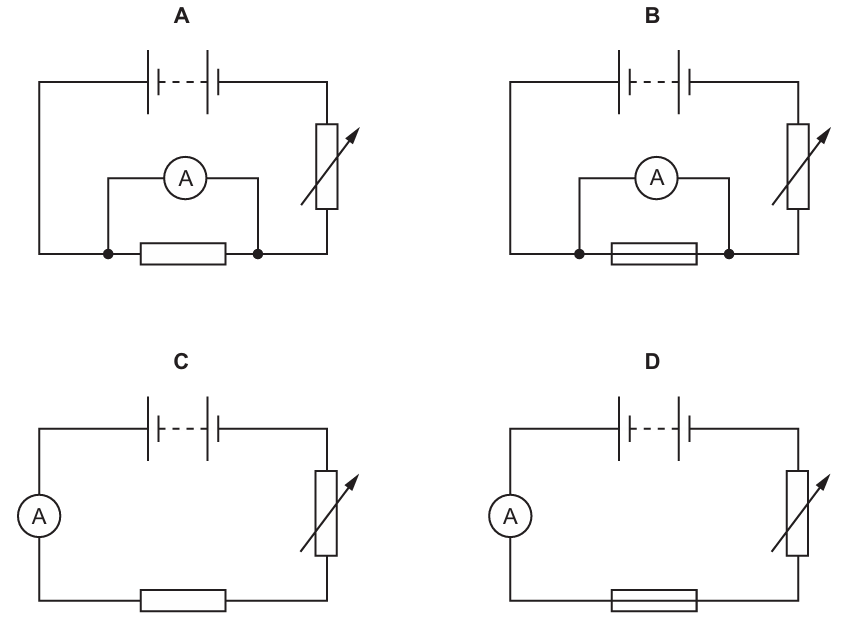
An electrician has a box of identical fuses that do not have their rating marked on them. They decide to test one of the fuses to determine its rating by gradually increasing the current in the fuse until it blows.

Which diagram shows a fuse connected in a suitable circuit?

Most-appropriate topic codes (Cambridge IGCSE Co-ordinated Sciences 0654):

Topic P4.4: Electrical safety — Explain the use and operation of fuses and choose appropriate fuse ratings.
▶️ Answer/Explanation
To gradually increase the current, the circuit needs a variable resistor in series with the fuse to control current smoothly.
An ammeter in series with the fuse is also needed to read off the exact current at the moment the fuse blows.
Only one diagram includes both the fuse, a variable resistor and an ammeter correctly connected in series in a complete circuit.
Answer: (D)

Question 38

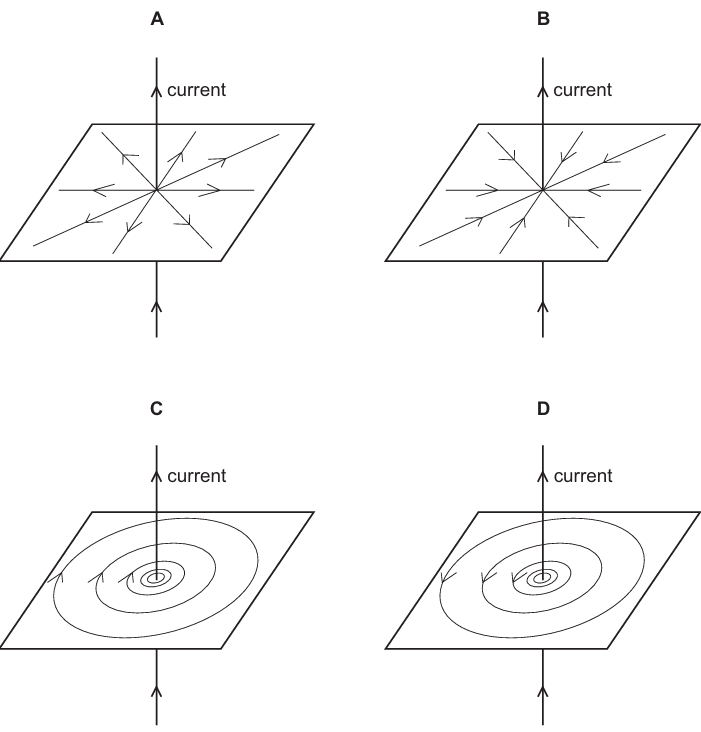
The diagrams show patterns around a wire that is carrying a current in the direction shown.

Which diagram shows the pattern and the direction of the magnetic field caused by the current?

Most-appropriate topic codes (Cambridge IGCSE Co-ordinated Sciences 0654):

Topic P4.5.3: Magnetic effect of current — Describe the pattern and direction of the magnetic field due to currents in straight wires.
▶️ Answer/Explanation
The magnetic field around a straight current-carrying wire forms concentric circles centred on the wire.
The direction of these field circles is given by the right-hand grip rule: thumb pointing along the current, fingers curling in the field direction.
Only one diagram shows both the correct concentric-circle pattern and the field direction consistent with the shown current direction.
Answer: (D)

Question 39

A nucleus has atomic number Z and mass number A.

What is equal to the value of A – Z?

A. the number of electrons orbiting the nucleus
B. the number of neutrons in the nucleus
C. the number of nucleons in the nucleus
D. the number of protons in the nucleus

Most-appropriate topic codes (Cambridge IGCSE Co-ordinated Sciences 0654):

Topic P5.1: The nucleus — Define proton number (atomic number) Z and nucleon number (mass number) A, and calculate the number of neutrons in a nucleus.
▶️ Answer/Explanation
The mass number A counts all nucleons (protons + neutrons), while the atomic number Z counts only protons.
Subtracting A − Z removes the proton count, leaving only the neutrons.
Therefore \(A – Z\) is equal to the number of neutrons in the nucleus.
Answer: (B)

Question 40

A radioactive isotope emits only alpha (α)-particles.

A sample of the isotope emits 2000 α-particles per second.

After 30 minutes, the sample emits 250 α-particles per second.

What is the half-life of the isotope?

A. 7.5 minutes
B. 10 minutes
C. 15 minutes
D. 30 minutes

Most-appropriate topic codes (Cambridge IGCSE Co-ordinated Sciences 0654):

Topic P5.2.4: Half-life — Understand and calculate half-life as the time taken for the activity of a radioactive sample to fall to half its original value.
▶️ Answer/Explanation
The activity falls from 2000 to 250, which is a factor of 8, i.e. \(2000 \rightarrow 1000 \rightarrow 500 \rightarrow 250\), three halvings.
Three half-lives have therefore passed in the 30 minutes given.
Dividing the total time by the number of half-lives: \(\dfrac{30}{3} = 10\) minutes.
Answer: (B)
Scroll to Top