Home / 0654_w24_qp_21

Question 1

Which term describes the ability to detect and respond to changes in the environment?

A. excretion
B. growth
C. movement
D. sensitivity

Most-appropriate topic codes (Cambridge IGCSE Co-ordinated Sciences 0654):

Topic B1.1: Characteristics of living organisms — Recall the life processes: movement, respiration, sensitivity, growth, reproduction, excretion, nutrition (MRSGREN).
▶️ Answer/Explanation
Sensitivity is the characteristic of living organisms that describes the ability to detect changes in the environment (stimuli) and produce an appropriate response.
Excretion is the removal of metabolic waste, growth is an increase in size, and movement is change in position — none of these involve detecting and responding to environmental stimuli.
Answer: (D)

Question 2

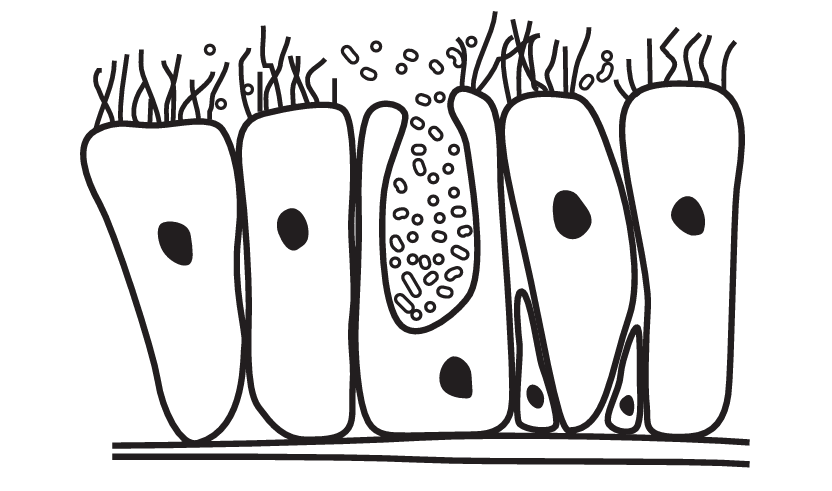
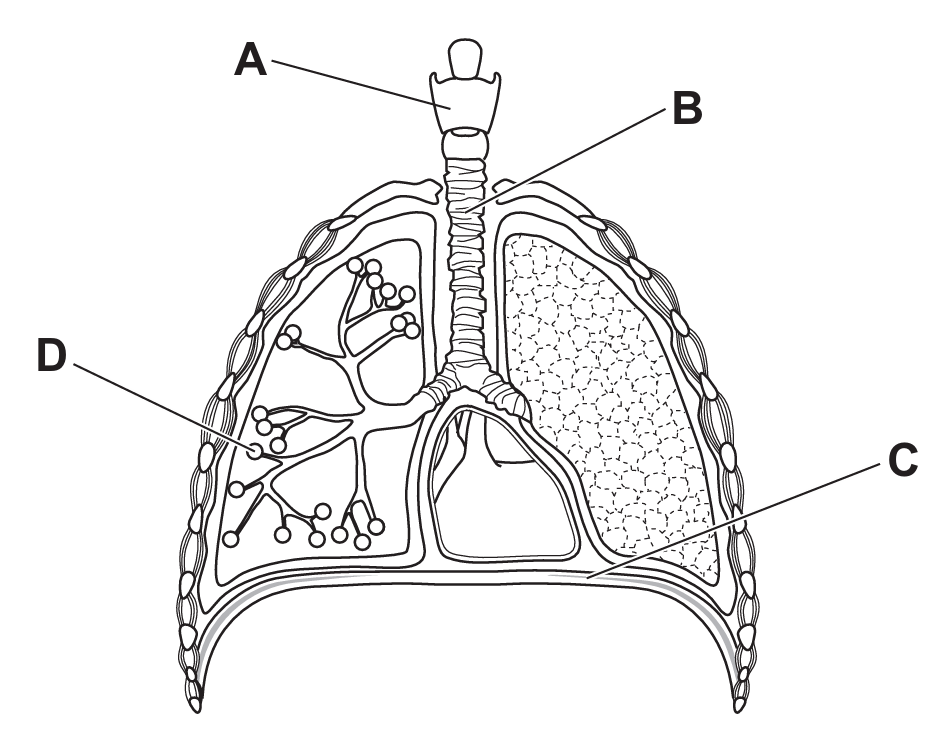
The diagram shows some cells in the gas exchange system.

Which label shows the part of the gas exchange system where these cells are found?

Most-appropriate topic codes (Cambridge IGCSE Co-ordinated Sciences 0654):

Topic B11.1: Gas exchange in humans — Identify the structures of the gas exchange system including alveoli, bronchi, bronchioles, trachea, and associated cells (e.g. goblet cells, ciliated cells).
▶️ Answer/Explanation
The cells shown are ciliated epithelial cells and goblet cells, which are characteristic of the lining of the trachea and bronchi — they produce and sweep mucus to trap pathogens and particles.
These cells are found in the upper airways (trachea/bronchi), not in the alveoli, so the label pointing to those structures is the correct answer (B).
Answer: (B)

Question 3

Which biological molecule contains the elements carbon, hydrogen, nitrogen and oxygen?

A. carbohydrate
B. fat
C. oil
D. protein

Most-appropriate topic codes (Cambridge IGCSE Co-ordinated Sciences 0654):

Topic B4.1: Biological molecules — State the elements present in carbohydrates (C, H, O), fats and oils (C, H, O), and proteins (C, H, O, N — and sometimes S).
▶️ Answer/Explanation
Carbohydrates, fats, and oils all contain only carbon (C), hydrogen (H), and oxygen (O); they do not contain nitrogen.
Proteins are built from amino acids which all contain an amino group \((-NH_2)\), meaning they contain carbon, hydrogen, oxygen, and nitrogen (and sometimes sulfur).
Answer: (D)

Question 4

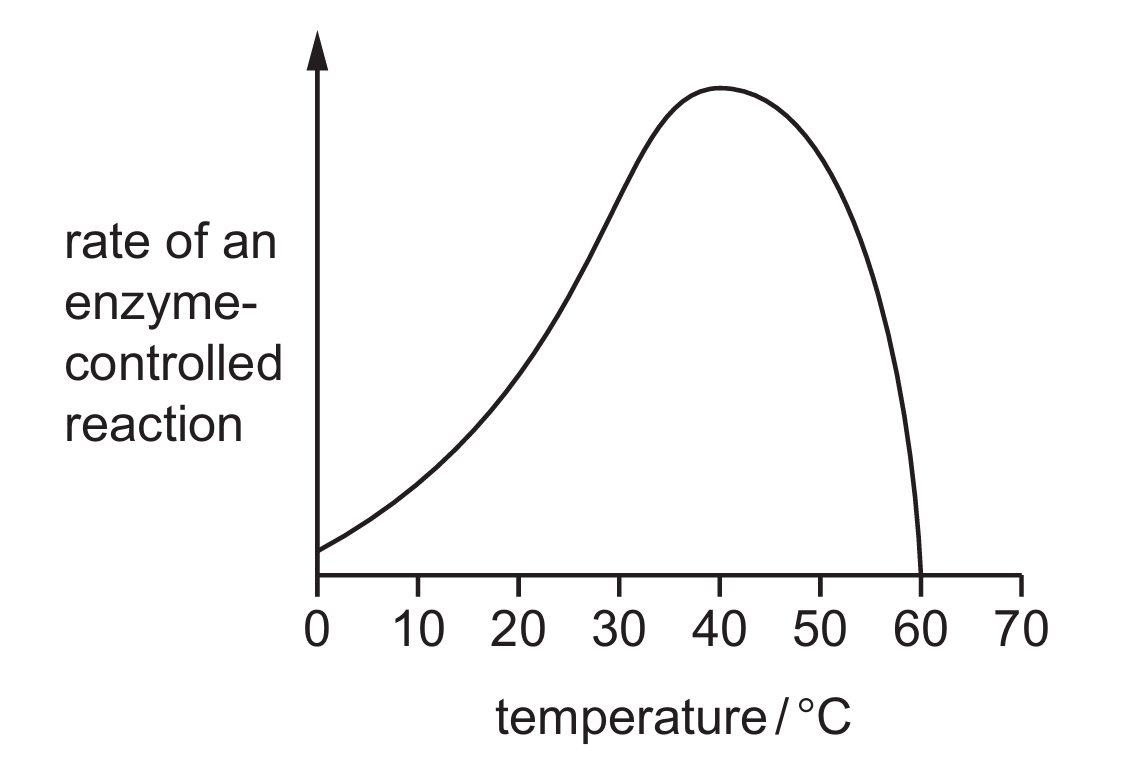
The graph shows the effect of temperature on the rate of an enzyme-controlled reaction.

Which statements are correct?

  1. Enzyme molecules denature above 50 ºC and below 20 ºC.
  2. Increasing the temperature between 10 ºC and 40 ºC increases the kinetic energy of enzyme molecules.
  3. The shape of the active site changes between 40 ºC and 60 ºC.

A. 1, 2 and 3
B. 1 and 2 only
C. 1 and 3 only
D. 2 and 3 only

Most-appropriate topic codes (Cambridge IGCSE Co-ordinated Sciences 0654):

Topic B5.1: Enzymes — Describe the effect of temperature on enzyme activity and explain denaturation: the permanent change in the shape of the active site at high temperatures, reducing enzyme activity to zero.
▶️ Answer/Explanation
Statement 1 is incorrect: the graph shows that the reaction still proceeds below 20 ºC (albeit slowly), so enzymes are not denatured below 20 ºC — they simply have lower kinetic energy and activity.
Statement 2 is correct: increasing temperature gives molecules more kinetic energy, so enzyme-substrate collisions are more frequent between 10 ºC and 40 ºC.
Statement 3 is correct: above 40 ºC the rate falls because heat causes the enzyme’s tertiary structure to break down, changing the shape of the active site (denaturation).
Answer: (D)

Question 5

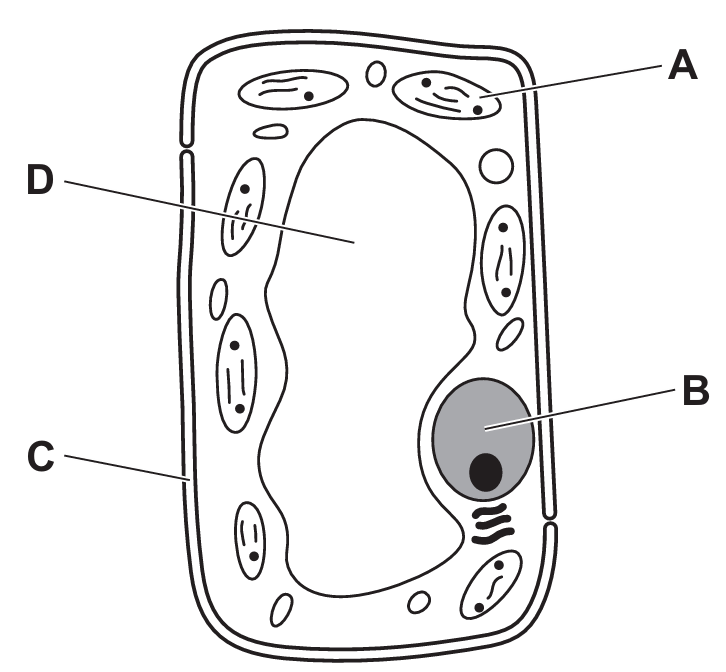
The diagram shows a mesophyll cell.

In which structure does photosynthesis take place?

Most-appropriate topic codes (Cambridge IGCSE Co-ordinated Sciences 0654):

Topic B6.2: Leaf structure — Identify the chloroplast as the organelle in which photosynthesis takes place; describe the internal structure of a mesophyll cell.
▶️ Answer/Explanation
Photosynthesis occurs in the chloroplast, the green organelle found in plant cells that contains the pigment chlorophyll, which absorbs light energy.
The overall equation is \(\text{CO}_2 + \text{H}_2\text{O} \xrightarrow{\text{light}} \text{glucose} + \text{O}_2\); all stages (light-dependent and light-independent reactions) take place within the chloroplast.
Answer: (A)

Question 6

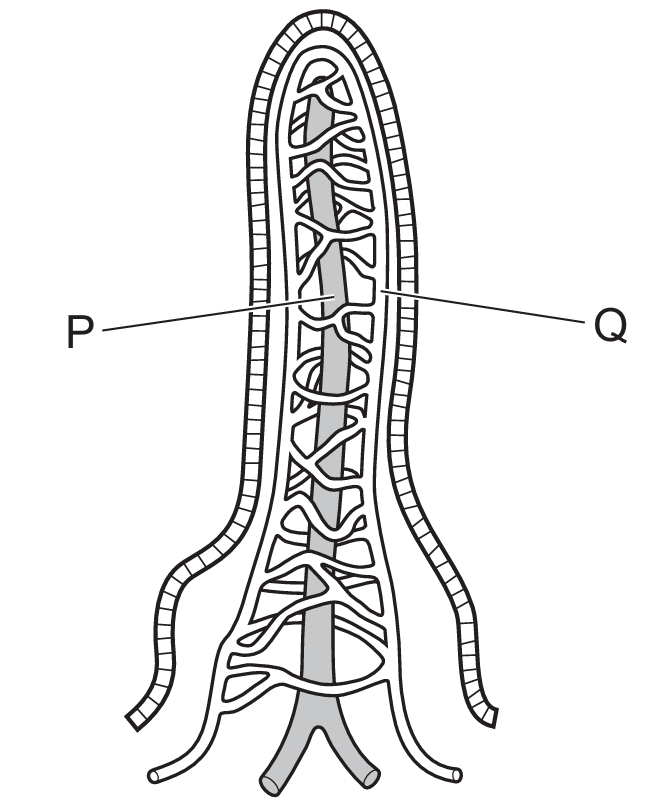
The diagram shows a villus.

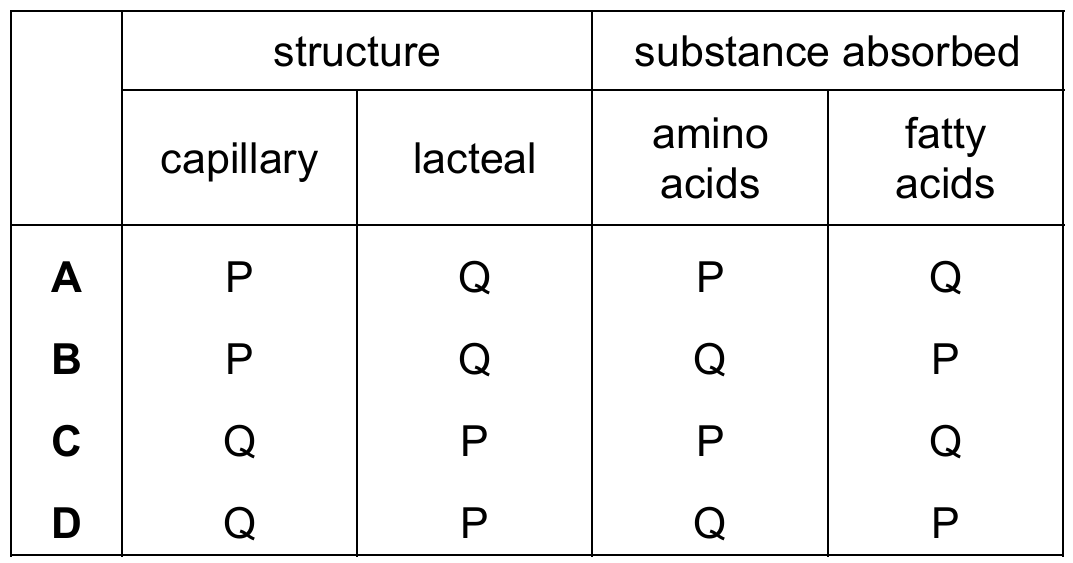
What are structures P and Q and which substances do they absorb?

Most-appropriate topic codes (Cambridge IGCSE Co-ordinated Sciences 0654):

Topic B7.3: Digestion — Describe the role of the villus: blood capillaries (absorbing glucose and amino acids) and lacteals (absorbing fatty acids and glycerol/lipids).
▶️ Answer/Explanation
Inside each villus there are two main absorbing structures: blood capillaries, which absorb the water-soluble products of digestion (glucose and amino acids), and lacteals, which absorb fatty acids and glycerol (the products of fat digestion).
P is the blood capillary (absorbs glucose and amino acids) and Q is the lacteal (absorbs fatty acids and glycerol), making option D the correct row in the table.
Answer: (D)

Question 7

In which weather conditions is the rate of transpiration fastest?

A. cold and dry
B. cold and wet
C. warm and dry
D. warm and wet

Most-appropriate topic codes (Cambridge IGCSE Co-ordinated Sciences 0654):

Topic B8.3: Transpiration — Describe and explain the effects of temperature, humidity, wind speed and light intensity on the rate of transpiration.
▶️ Answer/Explanation
Transpiration is the evaporation of water from plant leaves; it is fastest when the water vapour concentration gradient between the leaf interior and the surrounding air is greatest.
Warm conditions increase evaporation (more kinetic energy), and dry conditions keep the external humidity low, maintaining a steep diffusion gradient — so warm and dry is the fastest combination.
Answer: (C)

Question 8

A student breathed gently in and out of the mouthpiece of the apparatus shown.

What were the results after 10 breaths?

Most-appropriate topic codes (Cambridge IGCSE Co-ordinated Sciences 0654):

Topic C12.1: Experimental design — Plan and interpret experiments to investigate gases in exhaled air, including the use of limewater and hydrogencarbonate indicator to test for carbon dioxide.
▶️ Answer/Explanation
When air is breathed into the apparatus, it bubbles through both flasks; exhaled air contains significantly more \(\text{CO}_2\) than inhaled air, which turns limewater milky (due to formation of \(\text{CaCO}_3\) precipitate).
The flask receiving exhaled air turns milky, while the flask receiving inhaled air (which passes atmospheric air through first) shows little or no change — giving result B where only the exhaled side turns milky.
Answer: (B)

Question 9

A student looks at an object at a distance and then looks at an object close by. This ability to focus on both objects is brought about by changing the shape of the lens. What is this called?

A. accommodation
B. coordination
C. pupil reflex
D. transmission

Most-appropriate topic codes (Cambridge IGCSE Co-ordinated Sciences 0654):

Topic B13.1: Coordination and response — Describe accommodation as the process by which the eye changes the shape of the lens to focus on near or distant objects.
▶️ Answer/Explanation
Accommodation is the ability of the eye to focus on objects at different distances by adjusting the shape of the lens through the action of the ciliary muscles and suspensory ligaments.
For near objects the lens becomes fatter (more convex), and for distant objects it becomes thinner — this automatic adjustment is called accommodation, not the pupil reflex (which controls light intensity).
Answer: (A)

Question 10

Which statement describes one similarity between asexual and sexual reproduction?

A. They both involve gametes.
B. They both involve parent and offspring.
C. They both produce genetically identical individuals.
D. They both require fertilisation to take place.

Most-appropriate topic codes (Cambridge IGCSE Co-ordinated Sciences 0654):

Topic B15.1: Asexual reproduction — Compare asexual and sexual reproduction; identify similarities (both produce offspring from parents) and differences (gametes, fertilisation, genetic variation).
▶️ Answer/Explanation
Both asexual and sexual reproduction involve at least one parent organism producing offspring — this is the one universal similarity between the two types of reproduction.
Gametes and fertilisation are exclusive to sexual reproduction, and genetically identical offspring are a feature of asexual reproduction only (sexual reproduction produces genetic variation).
Answer: (B)

Question 11

Horn development in some cattle is controlled by a pair of alleles. The allele for not developing horns is dominant to the allele for developing horns.

The pedigree diagram shows cattle with and without horns.

How many of the cattle are definitely heterozygous?

A. 2
B. 3
C. 4
D. 5

Most-appropriate topic codes (Cambridge IGCSE Co-ordinated Sciences 0654):

Topic B16.3: Monohybrid inheritance — Interpret pedigree diagrams and determine which individuals must be heterozygous by tracing the inheritance of dominant and recessive alleles.
▶️ Answer/Explanation
Let \(H\) = no horns (dominant) and \(h\) = horns (recessive); any horned animal must be \(hh\). Any hornless parent that produces a horned offspring must carry one recessive allele, so must be \(Hh\) (heterozygous).
By working through the pedigree, 4 animals can be identified as definitely heterozygous — hornless individuals that have produced at least one horned offspring, proving they carry the recessive allele.
Answer: (C)

Question 12

What is an example of an ecosystem?

A. a decomposing log and the organisms in it
B. a food chain
C. the network of burrows in which some rabbits live
D. the oak trees in a forest

Most-appropriate topic codes (Cambridge IGCSE Co-ordinated Sciences 0654):

Topic B18.2: Food chains and food webs — Define an ecosystem as a unit containing all of the organisms (biotic) and their physical (abiotic) environment, interacting together.
▶️ Answer/Explanation
An ecosystem is defined as the combination of all living organisms (the biotic component) and their non-living physical environment (the abiotic component), interacting together as a system.
A decomposing log with the organisms inside it fits this definition perfectly — it has both a physical habitat and a community of organisms (fungi, bacteria, insects, etc.) interacting together; a food chain alone, or only the trees/burrows, are not complete ecosystems.
Answer: (A)

Question 13

Which processes change the amount of carbon dioxide in the air?

Most-appropriate topic codes (Cambridge IGCSE Co-ordinated Sciences 0654):

Topic B18.3: Carbon cycle — Describe the processes that remove \(\text{CO}_2\) from the air (photosynthesis) and those that return it (respiration, combustion, decomposition).
▶️ Answer/Explanation
Photosynthesis removes \(\text{CO}_2\) from the air and locks it in organic molecules, while respiration and combustion release \(\text{CO}_2\) back into the air — all three processes therefore change atmospheric \(\text{CO}_2\) levels.
Processes such as fossilisation or digestion do not directly exchange carbon dioxide with the atmosphere, so the correct combination is photosynthesis, respiration, and combustion — answer A.
Answer: (A)

Question 14

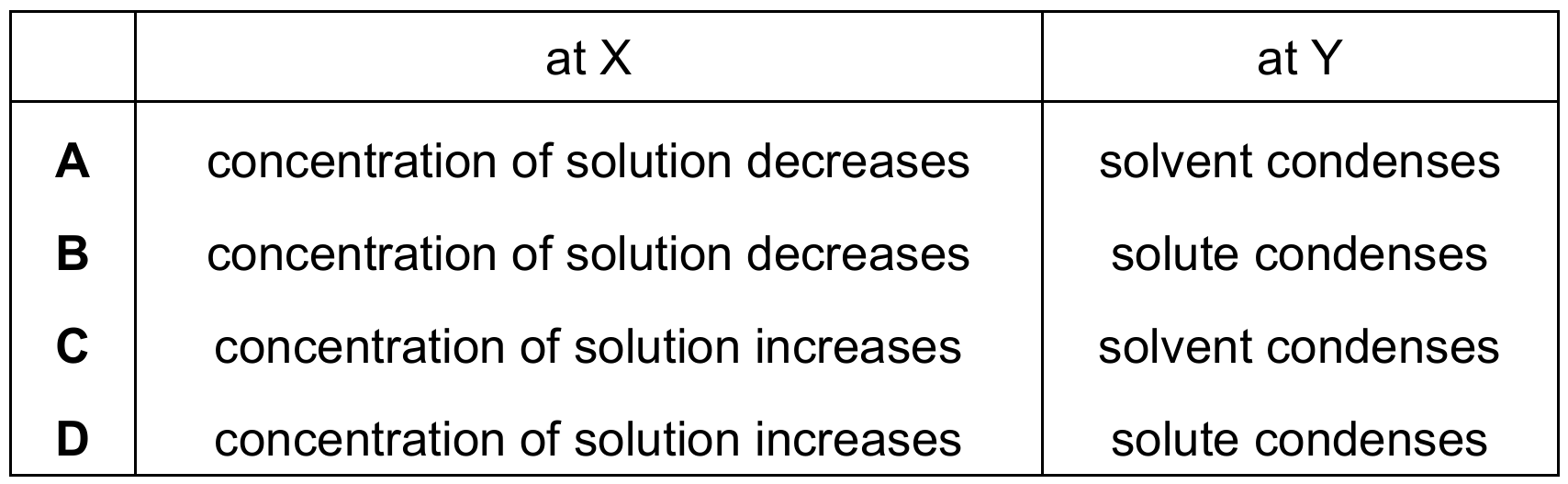
Sea water is heated in the apparatus shown.

Which row describes changes at positions X and Y?

Most-appropriate topic codes (Cambridge IGCSE Co-ordinated Sciences 0654):

Topic C12.1: Experimental design — Describe simple distillation as a method to separate a solvent from a solution; identify where evaporation and condensation occur in the apparatus.
▶️ Answer/Explanation
This is a simple distillation setup for purifying water from sea water: at position X (the heated flask), water evaporates (changes from liquid to gas), while at position Y (the condenser/collection flask), the water vapour condenses (changes from gas to liquid).
The salt remains behind in the flask because it does not evaporate; only pure water vapour travels to the collection vessel — matching row C which shows evaporation at X and condensation at Y.
Answer: (C)

Question 15

An experiment is assembled to measure the rate of reaction between limestone and hydrochloric acid.

In the experiment a gas is released. The volume of gas produced is measured every five seconds.

Which piece of apparatus cannot be used to measure the volume of gas?

A. burette
B. measuring cylinder
C. pipette
D. gas syringe

Most-appropriate topic codes (Cambridge IGCSE Co-ordinated Sciences 0654):

Topic C12.1: Experimental design — Select appropriate apparatus for measuring volumes of gas produced in reactions, including gas syringes, burettes (inverted over water), and measuring cylinders.
▶️ Answer/Explanation
A pipette is designed to deliver a precise, fixed volume of liquid and has a very narrow tip — it cannot collect or measure the volume of a gas produced in a reaction.
A gas syringe directly collects gas, a measuring cylinder (inverted over water) can collect gas by displacement, and a burette can also be used inverted — but a pipette has no mechanism to trap or measure gas volumes.
Answer: (C)

Question 16

What is a property of a typical covalent compound?

A. low electrical conductivity
B. high melting point
C. low volatility
D. soluble in water

Most-appropriate topic codes (Cambridge IGCSE Co-ordinated Sciences 0654):

Topic C2.5: Simple molecules and covalent bonds — Describe and explain the properties of simple covalent molecules: low melting/boiling points, poor electrical conductivity, often volatile, and not necessarily soluble in water.
▶️ Answer/Explanation
Simple covalent molecules have no free electrons or ions in any state, so they do not conduct electricity — low electrical conductivity is a defining property of all simple covalent compounds.
They typically have low melting points (not high), are often volatile (not low volatility), and are generally not soluble in water (unless they can form hydrogen bonds or ionise); so the only universally correct property is low electrical conductivity.
Answer: (A)

Question 17

The formula of an ammonium ion is \(\text{NH}_4^+\).

The formula of a phosphate ion is \(\text{PO}_4^{3-}\).

What is the formula of ammonium phosphate?

A. \((\text{NH}_4)_3\text{PO}_4\)
B. \((\text{NH}_4)_2\text{PO}_4\)
C. \(\text{NH}_4\text{PO}_4\)
D. \(\text{NH}_4(\text{PO}_4)_3\)

Most-appropriate topic codes (Cambridge IGCSE Co-ordinated Sciences 0654):

Topic C2.4: Ions and ionic bonds — Deduce the formula of an ionic compound from the charges of its constituent ions, balancing positive and negative charges to give overall neutrality.
▶️ Answer/Explanation
The ammonium ion has a charge of \(+1\) and the phosphate ion has a charge of \(-3\); to achieve electrical neutrality, 3 ammonium ions are needed for every 1 phosphate ion.
Therefore the formula is \((\text{NH}_4)_3\text{PO}_4\), giving a total charge of \(3(+1) + (-3) = 0\).
Answer: (A)

Question 18

Which statement describes what happens during electrolysis?

A. Covalent compounds produce more complex substances.
B. Covalent compounds produce simpler substances.
C. Ionic compounds produce more complex substances.
D. Ionic compounds produce simpler substances.

Most-appropriate topic codes (Cambridge IGCSE Co-ordinated Sciences 0654):

Topic C4.1: Electrolysis — Define electrolysis as the decomposition of an ionic compound (in molten state or in aqueous solution) by the passage of electricity, producing simpler substances at the electrodes.
▶️ Answer/Explanation
Electrolysis is defined as the decomposition of an ionic compound (when molten or in solution) using an electric current — the compound is broken down into simpler substances at the electrodes.
Covalent compounds generally do not conduct electricity and cannot be electrolysed; only ionic compounds undergo electrolysis, and the products are always simpler than the starting compound.
Answer: (D)

Question 19

When a match burns, heat and light energy are produced.

Which row describes the type of change and the type of reaction taking place?

Most-appropriate topic codes (Cambridge IGCSE Co-ordinated Sciences 0654):

Topic C5.1: Exothermic and endothermic reactions — Classify reactions as exothermic (releasing energy) or endothermic; distinguish chemical changes (new substances formed, irreversible) from physical changes.
▶️ Answer/Explanation
Burning (combustion) is a chemical change because new substances (\(\text{CO}_2\) and \(\text{H}_2\text{O}\)) are formed and the reaction is irreversible — the original match cannot be restored.
It is also an exothermic reaction because energy (heat and light) is released to the surroundings; therefore the correct row is B (chemical change, exothermic).
Answer: (B)

Question 20

The equation for the reaction between sulfur dioxide and oxygen is shown.

\(2\text{SO}_{2(g)} + \text{O}_{2(g)} \rightarrow 2\text{SO}_{3(g)}\)

Which statements explain why the rate of this reaction increases at higher temperatures?

  1. The molecules move closer together so they collide more frequently.
  2. The molecules move more quickly so they collide more frequently.
  3. The activation energy is decreased.
  4. More colliding particles possess the activation energy.

A. 1 and 3
B. 1 and 4
C. 2 and 3
D. 2 and 4

Most-appropriate topic codes (Cambridge IGCSE Co-ordinated Sciences 0654):

Topic C10.2: Air quality and climate — Explain the effect of temperature on reaction rate using collision theory: higher temperature increases kinetic energy, collision frequency, and the proportion of particles exceeding activation energy.
▶️ Answer/Explanation
At higher temperatures gas molecules move faster (higher kinetic energy), so they collide more frequently (statement 2 is correct); temperature does not cause molecules to move closer together, so statement 1 is wrong.
Higher temperature also means a greater proportion of molecules have kinetic energy exceeding the activation energy (statement 4 is correct); the activation energy itself does not change with temperature (statement 3 is wrong).
Answer: (D)

Question 21

All Group I metal compounds and all Group II metal chlorides are soluble in water.

All Group II metal carbonates and barium sulfate are insoluble.

Which method is used to prepare barium sulfate using barium carbonate?

A. direct combination of solid barium carbonate and dilute sulfuric acid
B. reaction of solid barium carbonate and hydrogen chloride gas, followed by reaction with dilute sulfuric acid
C. reaction of aqueous barium carbonate with dilute hydrochloric acid, followed by reaction with aqueous sodium sulfate
D. reaction of solid barium carbonate with dilute hydrochloric acid, followed by reaction with aqueous sodium sulfate

Most-appropriate topic codes (Cambridge IGCSE Co-ordinated Sciences 0654):

Topic C8.1: Arrangement of elements / solubility rules — Apply solubility rules to plan a preparation route for an insoluble salt via a precipitation reaction from a soluble salt.
▶️ Answer/Explanation
Direct addition of sulfuric acid to barium carbonate (option A) would immediately form insoluble \(\text{BaSO}_4\) as a coating that prevents further reaction; instead, the barium carbonate must first be dissolved in dilute \(\text{HCl}\) to form soluble barium chloride solution.
The barium chloride solution is then mixed with aqueous sodium sulfate, causing precipitation: \(\text{BaCl}_2(aq) + \text{Na}_2\text{SO}_4(aq) \rightarrow \text{BaSO}_4(s) + 2\text{NaCl}(aq)\); barium carbonate is a solid (insoluble), so option C (aqueous barium carbonate) is incorrect — the solid must be reacted with acid, matching option D.
Answer: (D)

Question 22

Which electronic structure belongs to a non-metallic element?

A. 2
B. 2,2
C. 2,8,2
D. 2,8,8,2

Most-appropriate topic codes (Cambridge IGCSE Co-ordinated Sciences 0654):

Topic C2.2: Atomic structure and the Periodic Table — Use electronic configurations to identify elements and classify them as metals or non-metals based on their position in the Periodic Table.
▶️ Answer/Explanation
Electronic structure 2 corresponds to helium (He, atomic number 2), which is a noble gas — a non-metal. Structures 2,2 = beryllium (metal), 2,8,2 = magnesium (metal), and 2,8,8,2 = calcium (metal).
All of options B, C, and D have 2 electrons in their outermost shell (Group II), placing them firmly in the metallic block; only helium with just 2 electrons in one shell is a non-metal.
Answer: (A)

Question 23

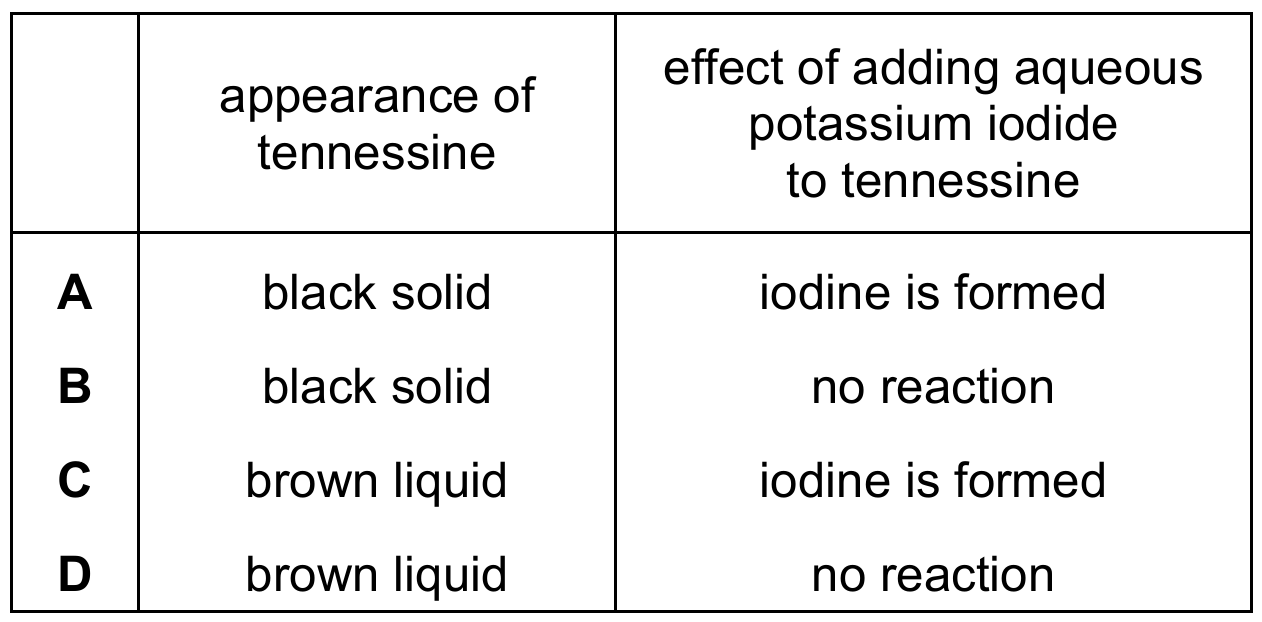
Tennessine is a newly discovered halogen and is below astatine in Group VII of the Periodic Table.

Which row predicts the appearance of tennessine and the effect of adding aqueous potassium iodide?

Most-appropriate topic codes (Cambridge IGCSE Co-ordinated Sciences 0654):

Topic C8.3: Group VII properties — Describe the trend in Group VII: halogens become darker and less reactive down the group; a more reactive halogen displaces a less reactive one from its salt solution.
▶️ Answer/Explanation
Going down Group VII the halogens get darker in colour (F is pale yellow, Cl is yellow-green, Br is red-brown, I is grey/black) so tennessine, below astatine, would be expected to be very dark (black/solid).
Reactivity decreases down the group, so tennessine is less reactive than iodine and cannot displace iodide ions from potassium iodide solution — no reaction occurs, matching row B.
Answer: (B)

Question 24

Which statement about the extraction of metals is correct?

A. Aluminium ore is called hematite.
B. Aluminium is extracted from its ore by heating with carbon.
C. Iron oxide is reduced to iron by heating with carbon monoxide.
D. Limestone is used to remove basic impurities in a blast furnace.

Most-appropriate topic codes (Cambridge IGCSE Co-ordinated Sciences 0654):

Topic C9.6: Extraction of metals — Describe the extraction of iron in the blast furnace (reduction by carbon monoxide) and aluminium by electrolysis; identify the ores: iron from haematite, aluminium from bauxite.
▶️ Answer/Explanation
In the blast furnace, iron oxide (haematite, \(\text{Fe}_2\text{O}_3\)) is reduced to iron by carbon monoxide: \(\text{Fe}_2\text{O}_3 + 3\text{CO} \rightarrow 2\text{Fe} + 3\text{CO}_2\) — this makes statement C correct.
Aluminium ore is bauxite (not haematite); aluminium is extracted by electrolysis (not heating with carbon); and limestone removes acidic impurities (like silica), not basic ones.
Answer: (C)

Question 25

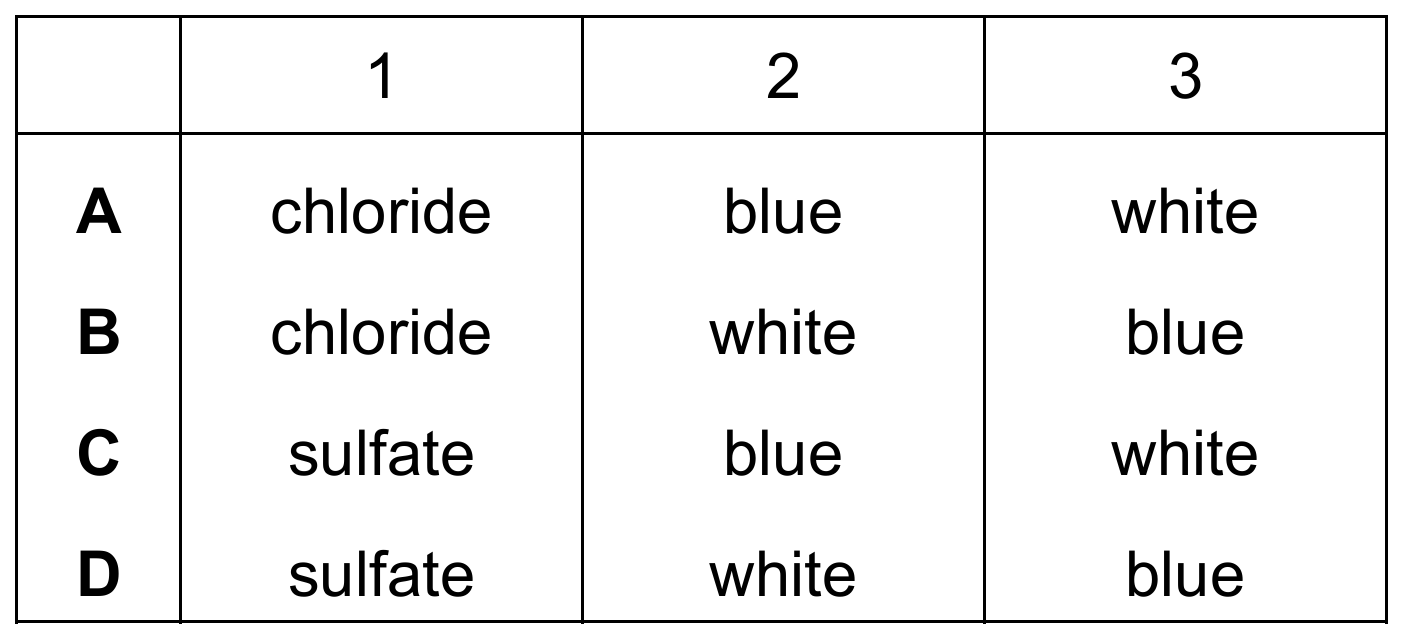
In a test for water, water turns anhydrous copper(II) ……1…… from ……2…… to ……3…… .

Which words complete gaps 1, 2 and 3?

Most-appropriate topic codes (Cambridge IGCSE Co-ordinated Sciences 0654):

Topic C10.1: Water — Describe the test for water using anhydrous copper(II) sulfate (white → blue) and cobalt chloride paper (blue → pink).
▶️ Answer/Explanation
Anhydrous copper(II) sulfate is white; when water is added it becomes hydrated copper(II) sulfate, which is blue — so the sentence reads: “water turns anhydrous copper(II) sulfate from white to blue“.
This is a standard test for the presence of water; the colour change from white to blue is a positive result, matching row D in the table.
Answer: (D)

Question 26

What is a general formula for unsaturated hydrocarbons?

A. \(C_nH_{n+2}\)
B. \(C_{2n}H_{2n+2}\)
C. \(C_nH_{2n}\)
D. \(C_nH_{2n+2}\)

Most-appropriate topic codes (Cambridge IGCSE Co-ordinated Sciences 0654):

Topic C11.1: Organic chemistry — Recall the general formulae of alkanes \((C_nH_{2n+2})\) and alkenes \((C_nH_{2n})\); distinguish saturated (alkanes) from unsaturated (alkenes) hydrocarbons.
▶️ Answer/Explanation
Unsaturated hydrocarbons contain at least one carbon-to-carbon double bond; the simplest homologous series of unsaturated hydrocarbons is the alkenes, which have the general formula \(C_nH_{2n}\).
The formula \(C_nH_{2n+2}\) belongs to alkanes (saturated); \(C_nH_{2n}\) fits ethene (\(C_2H_4\)), propene (\(C_3H_6\)), etc., all of which contain one double bond and are unsaturated.
Answer: (C)

Question 27

Poly(ethene) and nylon are two different types of polymer. Which statement about these polymers is correct?

A. Nylon is an addition polymer.
B. The linkage between monomers in nylon is –CONH–.
C. Poly(ethene) and nylon are made from the same monomers.
D. Poly(ethene) and nylon have the same linkages between their monomers.

Most-appropriate topic codes (Cambridge IGCSE Co-ordinated Sciences 0654):

Topic C11.7: Polymers — Distinguish between addition polymers (e.g. poly(ethene)) and condensation polymers (e.g. nylon); describe the amide linkage (–CONH–) in nylon.
▶️ Answer/Explanation
Nylon is a condensation polymer formed when a diamine and a dicarboxylic acid react together, releasing water molecules and forming an amide linkage (–CONH–) between each pair of monomers.
Poly(ethene) is an addition polymer (no small molecule released); the two polymers use different monomers and have different types of linkages — only statement B is correct.
Answer: (B)

Question 28

A solid, rectangular metal block has the dimensions shown.

The mass of the block is 2700 g. What is the density of the metal?

A. \(\dfrac{25 \times 5}{2700}\) g/cm³
B. \(\dfrac{25 \times 5 \times 8}{2700}\) g/cm³
C. \(\dfrac{2700}{25 \times 5}\) g/cm³
D. \(\dfrac{2700}{25 \times 5 \times 8}\) g/cm³

Most-appropriate topic codes (Cambridge IGCSE Co-ordinated Sciences 0654):

Topic P1.4: Density — Calculate density using \(\rho = \dfrac{m}{V}\); calculate volume of a rectangular block as \(V = l \times w \times h\).
▶️ Answer/Explanation
Density is defined as \(\rho = \dfrac{m}{V}\); the volume of the rectangular block is \(V = 25 \times 5 \times 8\) cm³ and the mass is 2700 g.
Therefore \(\rho = \dfrac{2700}{25 \times 5 \times 8}\) g/cm³, which corresponds to option D; numerically this equals \(\dfrac{2700}{1000} = 2.7\) g/cm³ (the density of aluminium).
Answer: (D)

Question 29

The length of a spring changes when a force is applied to stretch the spring. The table shows how the length of the spring depends on the force.

What is the length of the spring when the limit of proportionality is reached?

A. exactly 22 cm
B. between 31 cm and 35 cm
C. exactly 35 cm
D. between 35 cm and 45 cm

Most-appropriate topic codes (Cambridge IGCSE Co-ordinated Sciences 0654):

Topic P1.5: Forces — State Hooke’s Law and define the limit of proportionality as the point beyond which extension is no longer directly proportional to the applied force.
▶️ Answer/Explanation
Hooke’s Law states that extension is proportional to force up to the limit of proportionality; from the table, equal increases in force produce equal increases in extension up to a certain point, after which the extension per unit force becomes larger (non-proportional).
By examining where the equal-increment pattern breaks down in the table, the limit of proportionality falls between the 31 cm and 35 cm readings — the spring is still obeying Hooke’s Law at 31 cm but not at 35 cm.
Answer: (B)

Question 30

A see-saw (teeter-totter) rests on a pivot at its centre.

A child of weight 250 N sits on one side of the see-saw at a distance of 1.6 m from the pivot. A second child balances the see-saw by sitting on the other side of the pivot at a distance of 1.2 m from the pivot. What is the weight of the second child?

A. 190 N
B. 250 N
C. 330 N
D. 400 N

Most-appropriate topic codes (Cambridge IGCSE Co-ordinated Sciences 0654):

Topic P1.5: Forces — Apply the principle of moments: for a balanced system, the sum of clockwise moments equals the sum of anticlockwise moments about the pivot.
▶️ Answer/Explanation
Applying the principle of moments: clockwise moment = anticlockwise moment, so \(250 \times 1.6 = W_2 \times 1.2\).
Solving: \(W_2 = \dfrac{250 \times 1.6}{1.2} = \dfrac{400}{1.2} \approx 333 \approx 330\) N, which corresponds to option C.
Answer: (C)

Question 31

The Sun is the source of energy for most energy resources.

In which group of resources is energy input from the Sun the only source of energy?

A. coal, geothermal, gasoline
B. hydroelectric, tidal, waves
C. natural gas, solar, wind
D. nuclear, solar, wood

Most-appropriate topic codes (Cambridge IGCSE Co-ordinated Sciences 0654):

Topic P1.6: Energy, work and power — Identify energy resources that are derived from the Sun (solar, wind, fossil fuels, hydroelectric, biomass) and those that are not (nuclear, geothermal, tidal).
▶️ Answer/Explanation
Natural gas is a fossil fuel formed from ancient organisms that stored solar energy; solar panels directly convert sunlight; and wind is driven by temperature differences caused by the Sun — all three are solely solar-derived.
Option A includes geothermal (Earth’s internal heat, not solar); option B includes tidal (gravitational energy from the Moon/Sun, not solely solar); option D includes nuclear (nuclear binding energy, not solar).
Answer: (C)

Question 32

A student observes that a substance X does not flow.

Which statement about substance X is correct?

A. It can be either a gas or a liquid.
B. It can only be a gas.
C. It can only be a liquid.
D. It can only be a solid.

Most-appropriate topic codes (Cambridge IGCSE Co-ordinated Sciences 0654):

Topic P2.1: States of matter — Describe the properties of solids, liquids, and gases; identify that solids do not flow, while liquids and gases both flow.
▶️ Answer/Explanation
The ability to flow (fluidity) is a property shared by both liquids and gases — their particles can move past one another; solids have particles held in fixed positions in a regular lattice, so they cannot flow.
Since substance X does not flow, it must be a solid; it cannot be a gas or liquid because both of those states are defined by their ability to flow and take the shape of their container.
Answer: (D)

Question 33

A ray of light travels from glass into air.

In which direction is the light refracted and how does the speed of the light change?

Most-appropriate topic codes (Cambridge IGCSE Co-ordinated Sciences 0654):

Topic P3.2: Light — Describe refraction at a plane boundary; explain that light bends away from the normal when passing from a denser medium (glass) to a less dense medium (air), and speeds up in the process.
▶️ Answer/Explanation
When light travels from a denser medium (glass) into a less dense medium (air), it refracts away from the normal — the angle of refraction in air is greater than the angle of incidence in glass.
At the same time, the speed of light increases because air is optically less dense than glass (light travels at approximately \(2 \times 10^8\) m/s in glass but \(3 \times 10^8\) m/s in air) — this matches row B.
Answer: (B)

Question 34

Gamma rays and microwaves are both electromagnetic radiations. Which statement about their frequencies and speeds in a vacuum is correct?

A. Gamma rays have greater frequencies than microwaves and travel at a greater speed.
B. Gamma rays have greater frequencies than microwaves and travel at the same speed.
C. Gamma rays have smaller frequencies than microwaves and travel at a greater speed.
D. Gamma rays have smaller frequencies than microwaves and travel at the same speed.

Most-appropriate topic codes (Cambridge IGCSE Co-ordinated Sciences 0654):

Topic P3.3: Electromagnetic spectrum — State that all electromagnetic waves travel at the same speed in a vacuum (\(3 \times 10^8\) m/s); recall the order of the spectrum from radio waves (lowest frequency) to gamma rays (highest frequency).
▶️ Answer/Explanation
All electromagnetic waves travel at the same speed in a vacuum, \(c = 3 \times 10^8\) m/s — speed does not vary across the spectrum in a vacuum.
In the electromagnetic spectrum, gamma rays have the highest frequency (and shortest wavelength), while microwaves have a much lower frequency — so gamma rays have greater frequency than microwaves but both travel at the same speed.
Answer: (B)

Question 35

Which statement about the core of an electromagnet is correct?

A. It is made of soft iron because soft iron is easy to magnetise.
B. It is made of soft iron because soft iron does not lose its magnetism easily.
C. It is made of steel because steel is easy to magnetise.
D. It is made of steel because steel loses its magnetism easily.

Most-appropriate topic codes (Cambridge IGCSE Co-ordinated Sciences 0654):

Topic P4.5: Electromagnetism — Explain why soft iron is used for electromagnet cores: it is easily magnetised and easily demagnetised (temporary magnet), whereas steel is used for permanent magnets.
▶️ Answer/Explanation
An electromagnet needs to be switched on and off rapidly; soft iron is ideal because it is easily magnetised when a current flows and loses its magnetism quickly when the current is switched off.
Steel would retain its magnetism even after the current stops (making it a permanent magnet), which is undesirable for an electromagnet — so the core is soft iron because it is easy to magnetise (and demagnetise).
Answer: (A)

Question 36

A wire of a certain length has a resistance of 8.0 Ω. A second wire made of the same material has double the length and double the cross-sectional area of the first wire. What is the resistance of the second wire?

A. 4.0 Ω
B. 8.0 Ω
C. 16 Ω
D. 32 Ω

Most-appropriate topic codes (Cambridge IGCSE Co-ordinated Sciences 0654):

Topic P4.3: Electrical circuits — Recall that resistance is proportional to length and inversely proportional to cross-sectional area: \(R \propto \dfrac{L}{A}\).
▶️ Answer/Explanation
Using \(R \propto \dfrac{L}{A}\): doubling the length doubles resistance (×2), while doubling the cross-sectional area halves resistance (×½) — the combined effect is \(\times 2 \times \frac{1}{2} = \times 1\), so the resistance stays the same.
Therefore the second wire has the same resistance as the first: \(8.0\) Ω.
Answer: (B)

Question 37

A circuit contains a cell and two resistors connected in parallel. The currents in each part of the circuit are labelled \(I_1\), \(I_2\) and \(I_3\).

What is the relationship between the currents?

A. \(I_1 = I_2\)
B. \(I_1 = I_3\)
C. \(I_1 > I_2 + I_3\)
D. \(I_1 = I_2 + I_3\)

Most-appropriate topic codes (Cambridge IGCSE Co-ordinated Sciences 0654):

Topic P4.3: Electrical circuits — State that in a parallel circuit the total current from the source equals the sum of the currents in each branch: \(I_{\text{total}} = I_1 + I_2 + \ldots\)
▶️ Answer/Explanation
In a parallel circuit, the current from the cell (\(I_1\)) splits at the junction and flows through each branch separately (\(I_2\) and \(I_3\)); by conservation of charge, the total current must equal the sum of the branch currents.
Therefore \(I_1 = I_2 + I_3\); this is Kirchhoff’s current law — charge is neither created nor destroyed at a junction.
Answer: (D)

Question 38

The instructions for a household lamp state that the plug must be fitted with a 3 A fuse. What happens if a 13 A fuse is fitted by mistake?

A. The fuse blows too easily.
B. The lamp lights less brightly.
C. The wires connecting the lamp to the plug overheat if a fault develops.
D. Too much voltage is supplied to the lamp.

Most-appropriate topic codes (Cambridge IGCSE Co-ordinated Sciences 0654):

Topic P4.4: Electrical safety — Explain the function of a fuse: it melts when the current exceeds the rated value, breaking the circuit; an over-rated fuse fails to protect the circuit from overheating.
▶️ Answer/Explanation
A fuse is a safety device that melts and breaks the circuit when the current exceeds its rated value; a 13 A fuse will only blow at currents above 13 A, so if a fault causes a current of, say, 5 A to flow, the 13 A fuse will NOT blow.
This means the wires carry a dangerously high current for which they are not rated — they can overheat, potentially causing a fire; the brightness and voltage of the lamp are unaffected by the fuse rating during normal operation.
Answer: (C)

Question 39

A transformer with an efficiency of 100% has an input current of 10 A. The input voltage is 100 V and the output voltage is 20 V.

What is the output current?

A. 2.0 A
B. 10 A
C. 50 A
D. 200 A

Most-appropriate topic codes (Cambridge IGCSE Co-ordinated Sciences 0654):

Topic P4.5: Electromagnetism — Apply the transformer power equation for a 100% efficient transformer: \(V_p I_p = V_s I_s\), and the turns ratio \(\dfrac{V_p}{V_s} = \dfrac{N_p}{N_s}\).
▶️ Answer/Explanation
For a 100% efficient transformer, input power = output power: \(V_p I_p = V_s I_s\), so \(100 \times 10 = 20 \times I_s\).
Solving: \(I_s = \dfrac{100 \times 10}{20} = \dfrac{1000}{20} = 50\) A; the output voltage is lower (step-down transformer), so the output current must be proportionally higher to conserve power.
Answer: (C)

Question 40

A uranium nucleus decays into a thorium nucleus. The thorium nucleus then decays into a protactinium nucleus.

\({}_{92}^{238}\text{U} \rightarrow {}_{90}^{234}\text{Th} \rightarrow {}_{91}^{234}\text{Pa}\)

Which emissions take place during the decays?

A. an alpha-particle followed by a beta-particle
B. an alpha-particle followed by another alpha-particle
C. a beta-particle followed by an alpha-particle
D. a beta-particle followed by another beta-particle

Most-appropriate topic codes (Cambridge IGCSE Co-ordinated Sciences 0654):

Topic P5.2.3: Radioactive decay — Identify alpha decay (mass number decreases by 4, atomic number decreases by 2) and beta decay (mass number unchanged, atomic number increases by 1) from nuclear equations.
▶️ Answer/Explanation
In the first decay \(({}_{92}^{238}\text{U} \rightarrow {}_{90}^{234}\text{Th})\): mass number decreases by 4 and atomic number decreases by 2 — this is characteristic of alpha (\(\alpha\)) decay (emission of \({}_{2}^{4}\text{He}\)).
In the second decay \(({}_{90}^{234}\text{Th} \rightarrow {}_{91}^{234}\text{Pa})\): mass number stays at 234 but atomic number increases by 1 — this is characteristic of beta (\(\beta^-\)) decay (a neutron converts to a proton, emitting an electron).
Answer: (A)
Scroll to Top