
▶️ Answer/Explanation
In osmosis, water moves from a region of lower solute concentration (higher water potential) to a region of higher solute concentration (lower water potential) through a semi-permeable membrane.
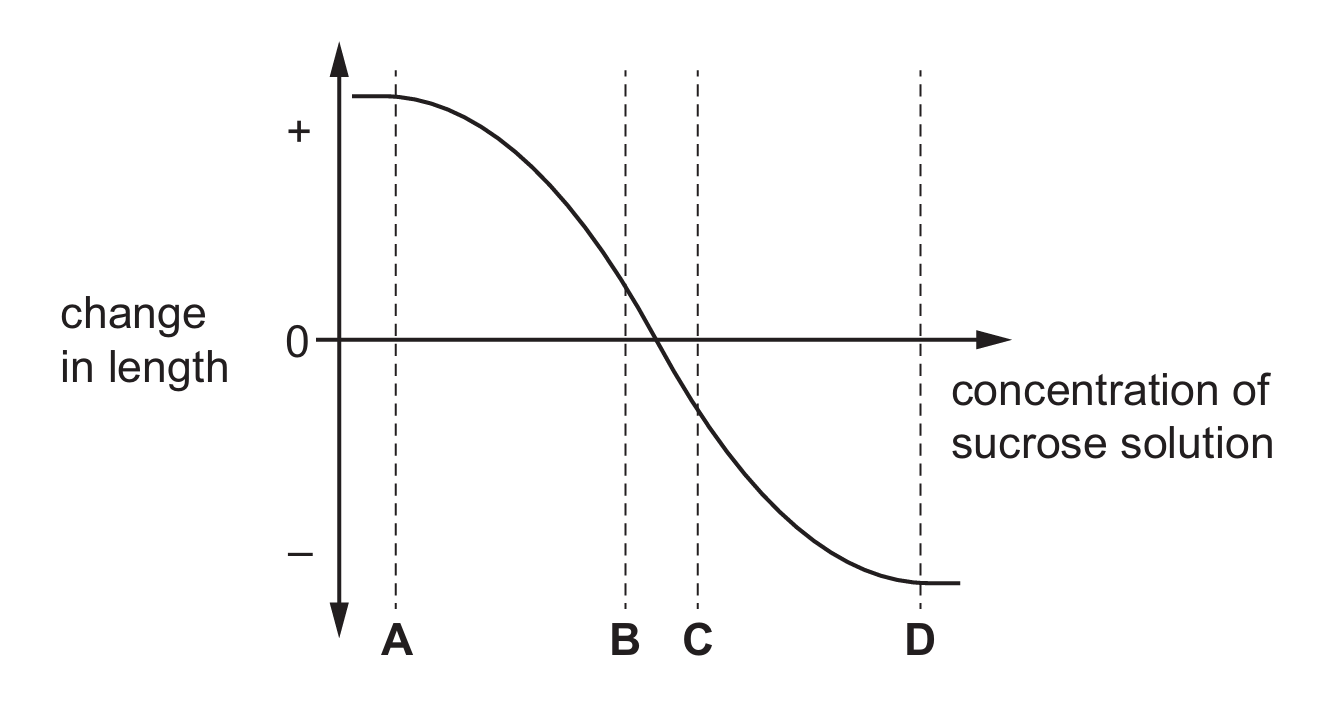
In a high-concentration sucrose solution, water leaves the potato cells by osmosis, causing the cells to lose turgor pressure and become flaccid (shrunken and soft).
The highest sucrose concentration (option D) would cause the greatest water loss, making the potato pieces the most flaccid.
✅ Answer: (D)
In a high-concentration sucrose solution, water leaves the potato cells by osmosis, causing the cells to lose turgor pressure and become flaccid (shrunken and soft).
The highest sucrose concentration (option D) would cause the greatest water loss, making the potato pieces the most flaccid.
✅ Answer: (D)

▶️ Answer/Explanation
Starch is detected using iodine solution (turns blue-black if positive), protein is detected using the Biuret reagent (turns purple/violet if positive), and reducing sugars are detected using Benedict’s solution (turns brick-red/orange if positive).
The food that gives a positive result for starch and protein but a negative result for reducing sugar must be identified from the table — this corresponds to food B.
✅ Answer: (B)
The food that gives a positive result for starch and protein but a negative result for reducing sugar must be identified from the table — this corresponds to food B.
✅ Answer: (B)
▶️ Answer/Explanation
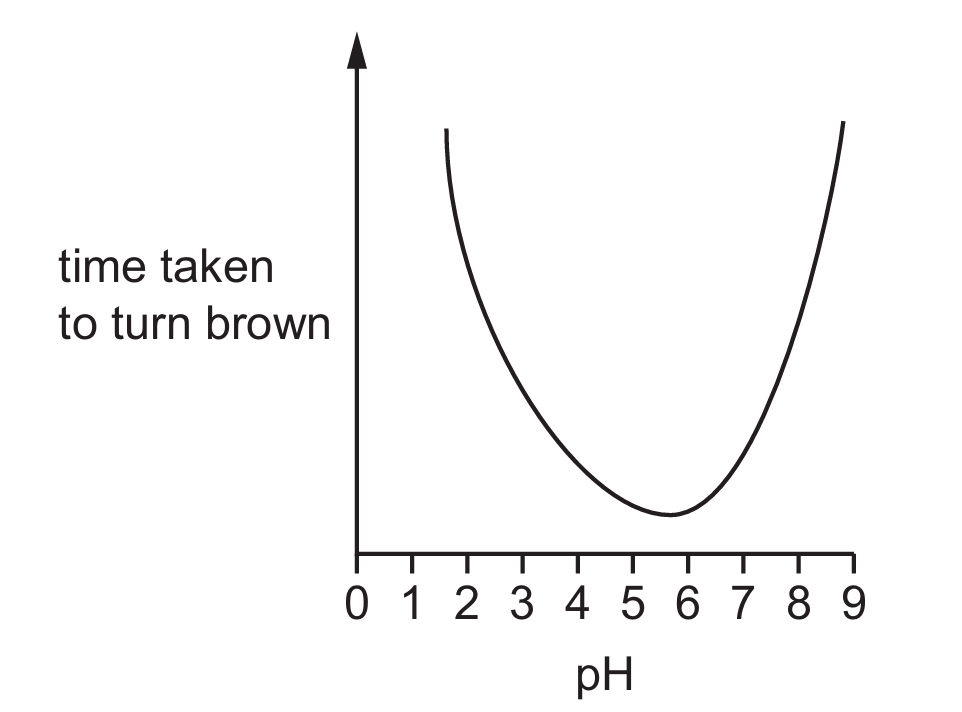
The graph shows the shortest time (fastest reaction) at pH 5–6, confirming that the optimum pH is between 5 and 6 — so statement 1 is correct.
Statement 2 is incorrect: increased molecular speed with rising temperature explains faster reactions, but pH changes do not directly cause enzyme or substrate molecules to move faster — pH affects the shape of the active site, not molecular speed.
Statement 3 is correct: above the optimum pH, the change in \([\text{H}^+]\) concentration alters the ionic interactions within the enzyme, distorting the shape of the active site and reducing enzyme activity (denaturation).
✅ Answer: (C)
Statement 2 is incorrect: increased molecular speed with rising temperature explains faster reactions, but pH changes do not directly cause enzyme or substrate molecules to move faster — pH affects the shape of the active site, not molecular speed.
Statement 3 is correct: above the optimum pH, the change in \([\text{H}^+]\) concentration alters the ionic interactions within the enzyme, distorting the shape of the active site and reducing enzyme activity (denaturation).
✅ Answer: (C)
▶️ Answer/Explanation
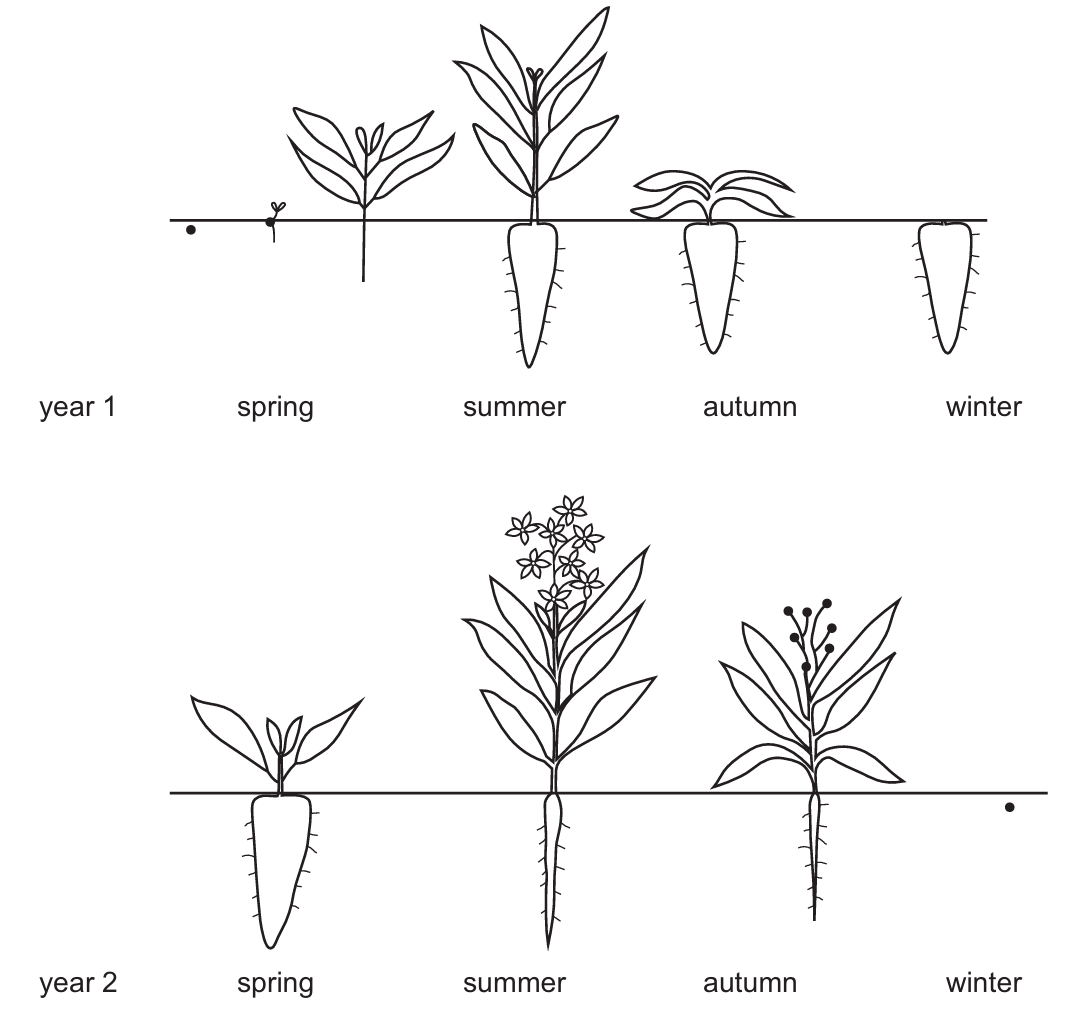
In year 1, the plant stores food (mainly carbohydrates) in its large root, so the root grows and is filled with stored food reserves.
In year 2, the plant uses the stored food in the root to fuel the growth of flowers and seeds for reproduction, so the root shrinks as the reserves are used up.
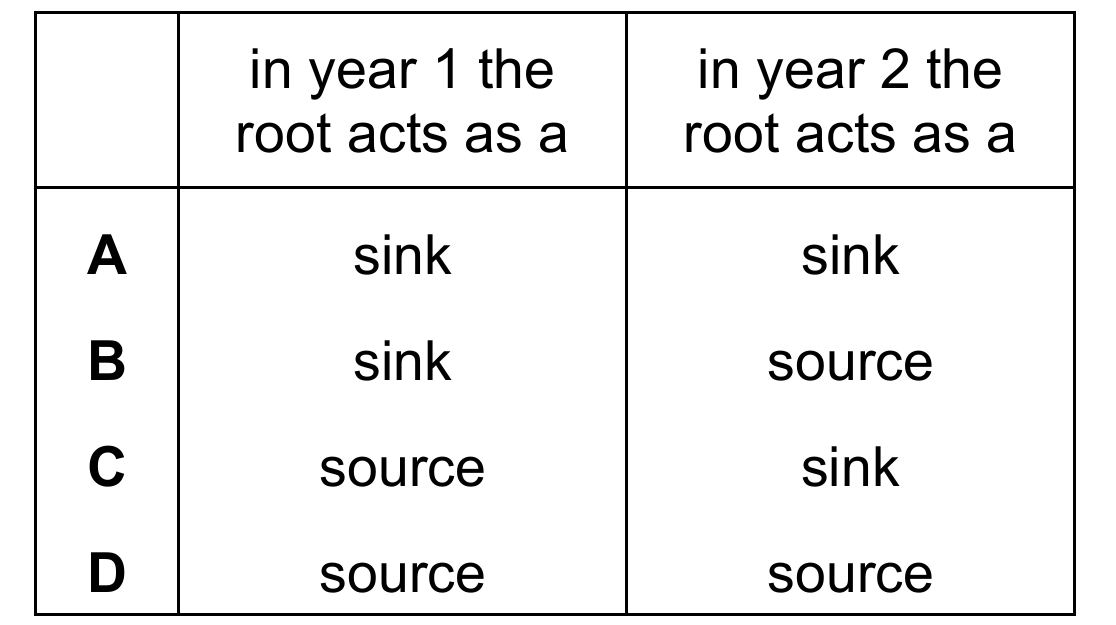
This means in year 1 the root is growing/storing, and in year 2 the root is shrinking/losing stored food — corresponding to row B.
✅ Answer: (B)
In year 2, the plant uses the stored food in the root to fuel the growth of flowers and seeds for reproduction, so the root shrinks as the reserves are used up.
This means in year 1 the root is growing/storing, and in year 2 the root is shrinking/losing stored food — corresponding to row B.
✅ Answer: (B)
▶️ Answer/Explanation
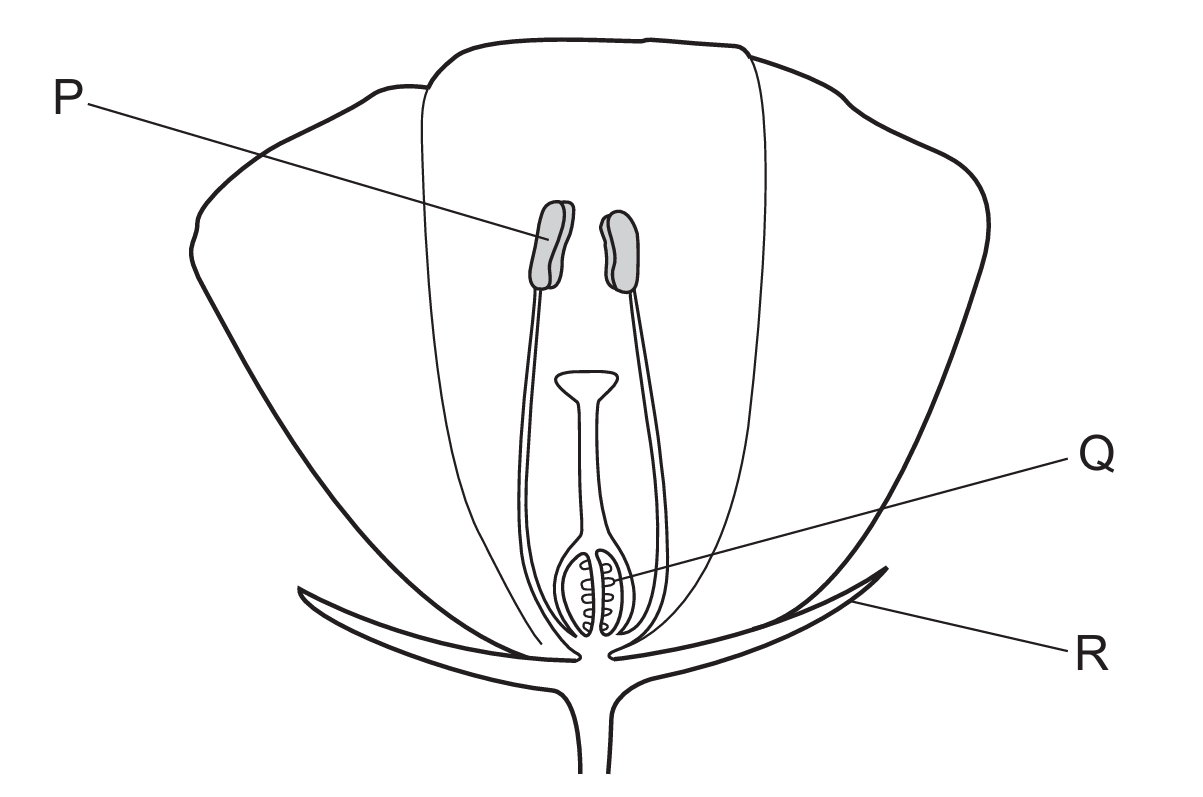
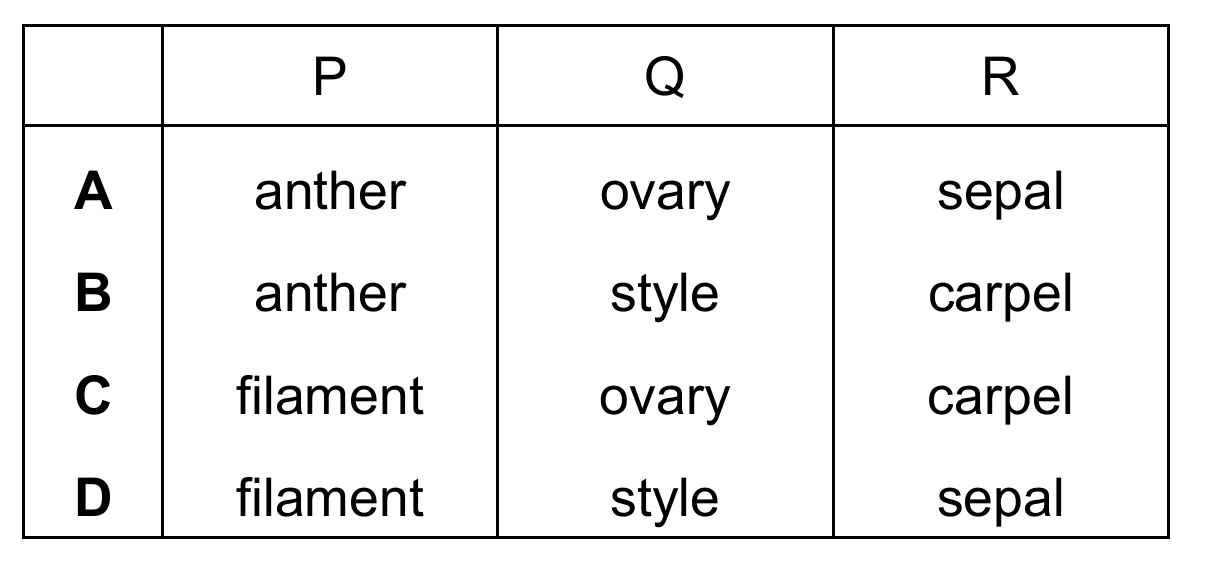
In a typical flower, the anther (part of the stamen) produces pollen, the filament is the stalk supporting the anther, and the stigma is the sticky top of the carpel that receives pollen during pollination.
By identifying the positions of structures P, Q, and R in the diagram — with P at the pollen-producing top, Q as the supporting stalk, and R as the receptive sticky surface — the correct row is A.
✅ Answer: (A)
By identifying the positions of structures P, Q, and R in the diagram — with P at the pollen-producing top, Q as the supporting stalk, and R as the receptive sticky surface — the correct row is A.
✅ Answer: (A)

▶️ Answer/Explanation
Artificial selection begins by identifying individuals with a desirable characteristic (step 4), then selecting and breeding those individuals together (step 2), allowing the offspring to be born (step 1), and finally selecting the offspring with the most desirable traits to breed again (step 3).
This cycle is repeated over many generations to gradually enhance the desired characteristic in the population.
The correct sequence is therefore 4 → 2 → 1 → 3.
✅ Answer: (D)
This cycle is repeated over many generations to gradually enhance the desired characteristic in the population.
The correct sequence is therefore 4 → 2 → 1 → 3.
✅ Answer: (D)
▶️ Answer/Explanation
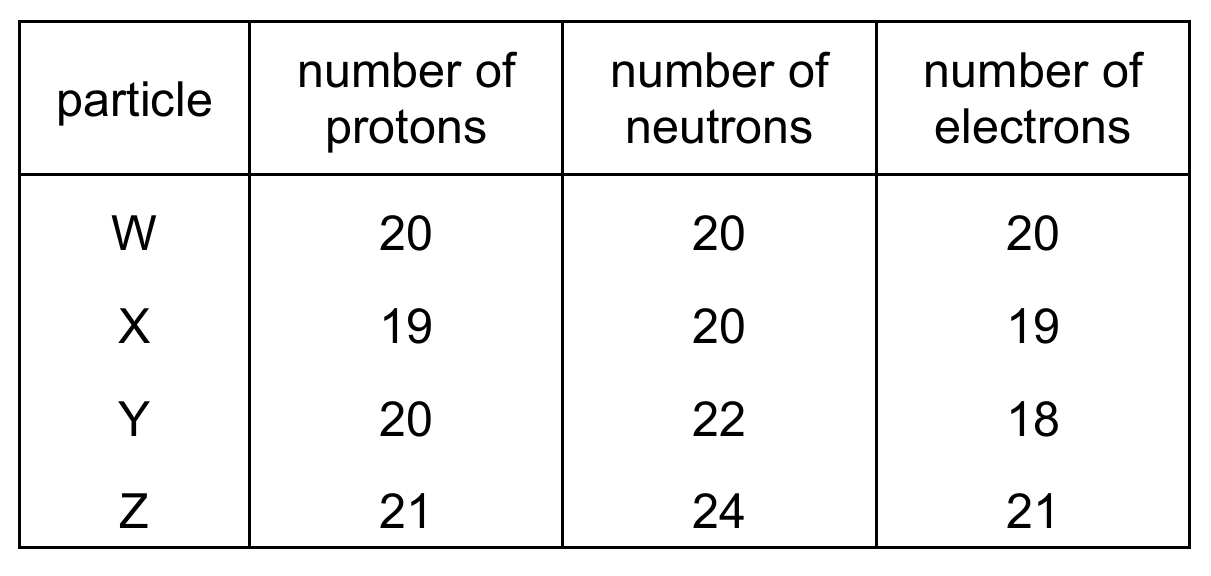
Isotopes are defined as atoms of the same element that have the same number of protons but different numbers of neutrons; the number of protons determines the element’s identity (atomic number).
Particles W and Y share the same number of protons (making them the same element) but differ in their number of neutrons, satisfying the definition of isotopes.
✅ Answer: (B)
Particles W and Y share the same number of protons (making them the same element) but differ in their number of neutrons, satisfying the definition of isotopes.
✅ Answer: (B)
▶️ Answer/Explanation
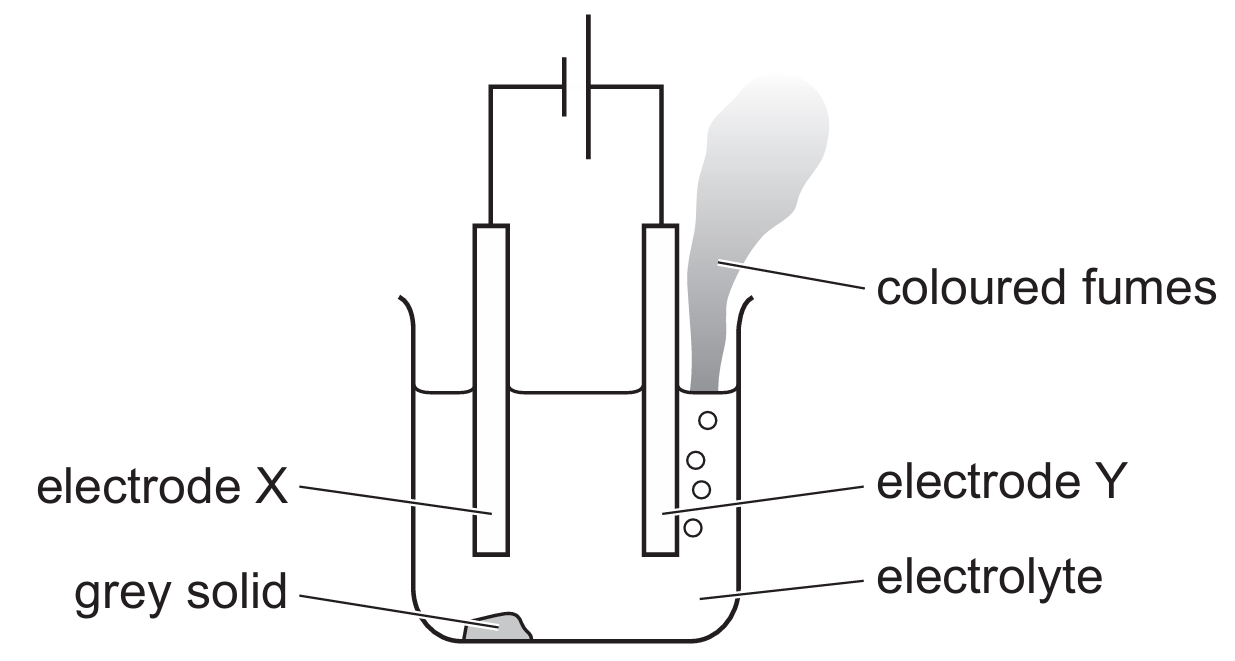
In electrolysis, the electrolyte is the substance that conducts electricity in its molten or dissolved state — here, molten lead(II) bromide is the electrolyte.
At the cathode (negative electrode), \(\text{Pb}^{2+}\) ions are reduced to form a grey solid of lead metal; at the anode (positive electrode), \(\text{Br}^-\) ions are oxidised to produce orange-brown bromine fumes.
Statement C is correct; A and B are false (bromine forms at the positive anode, not the negative electrode), and D is false (the grey solid is elemental lead, not lead(II) bromide).
✅ Answer: (C)
At the cathode (negative electrode), \(\text{Pb}^{2+}\) ions are reduced to form a grey solid of lead metal; at the anode (positive electrode), \(\text{Br}^-\) ions are oxidised to produce orange-brown bromine fumes.
Statement C is correct; A and B are false (bromine forms at the positive anode, not the negative electrode), and D is false (the grey solid is elemental lead, not lead(II) bromide).
✅ Answer: (C)
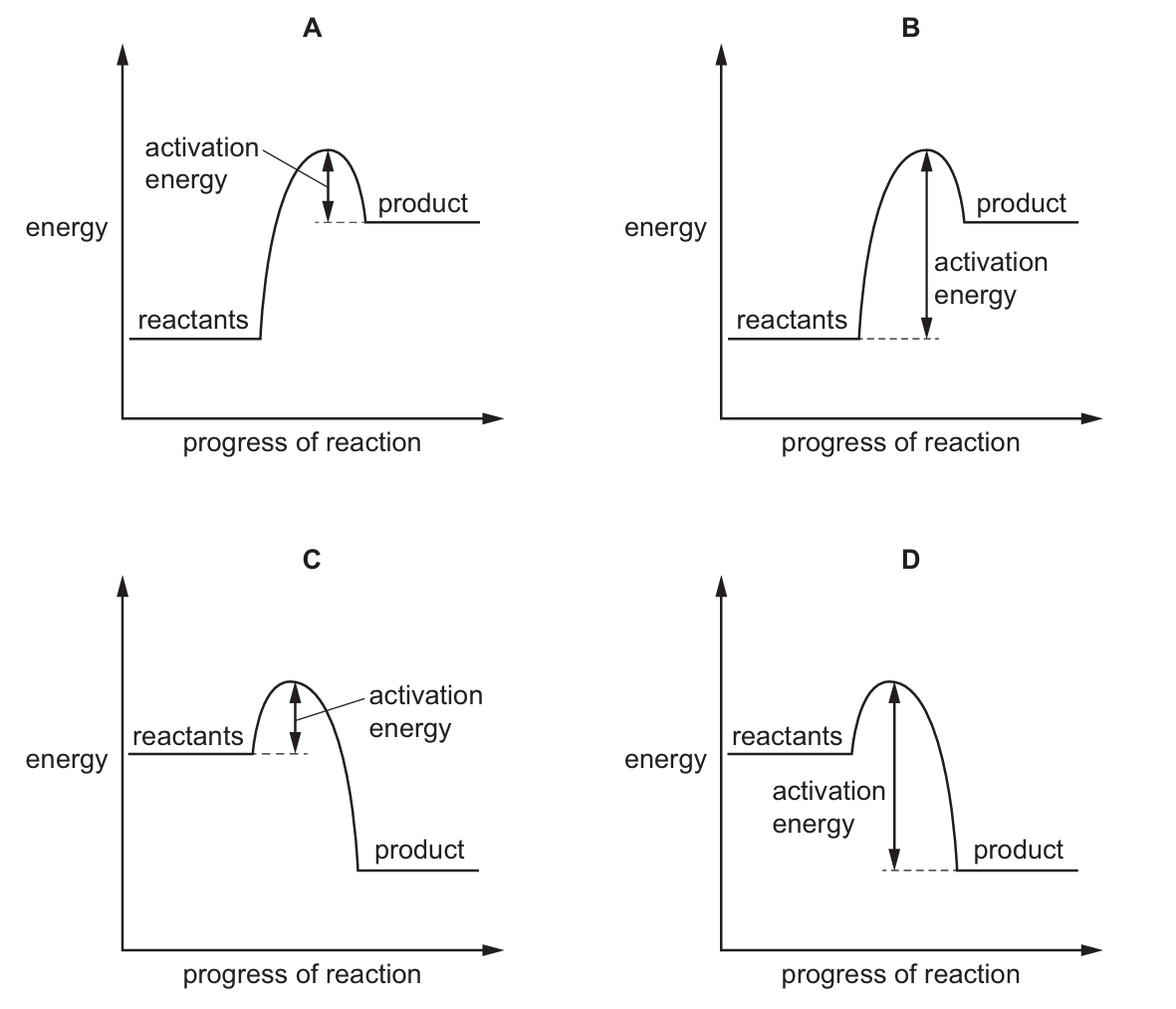
▶️ Answer/Explanation
In an exothermic reaction, the energy of the products is lower than the energy of the reactants, so the overall energy change \(\Delta H\) is negative; the diagram must show products at a lower energy level than reactants.
The activation energy is the energy difference between the reactants’ energy level and the peak (transition state) of the energy profile curve.
Diagram C correctly shows: products at a lower level than reactants (exothermic) and the activation energy arrow pointing from reactants up to the peak of the curve.
✅ Answer: (C)
The activation energy is the energy difference between the reactants’ energy level and the peak (transition state) of the energy profile curve.
Diagram C correctly shows: products at a lower level than reactants (exothermic) and the activation energy arrow pointing from reactants up to the peak of the curve.
✅ Answer: (C)
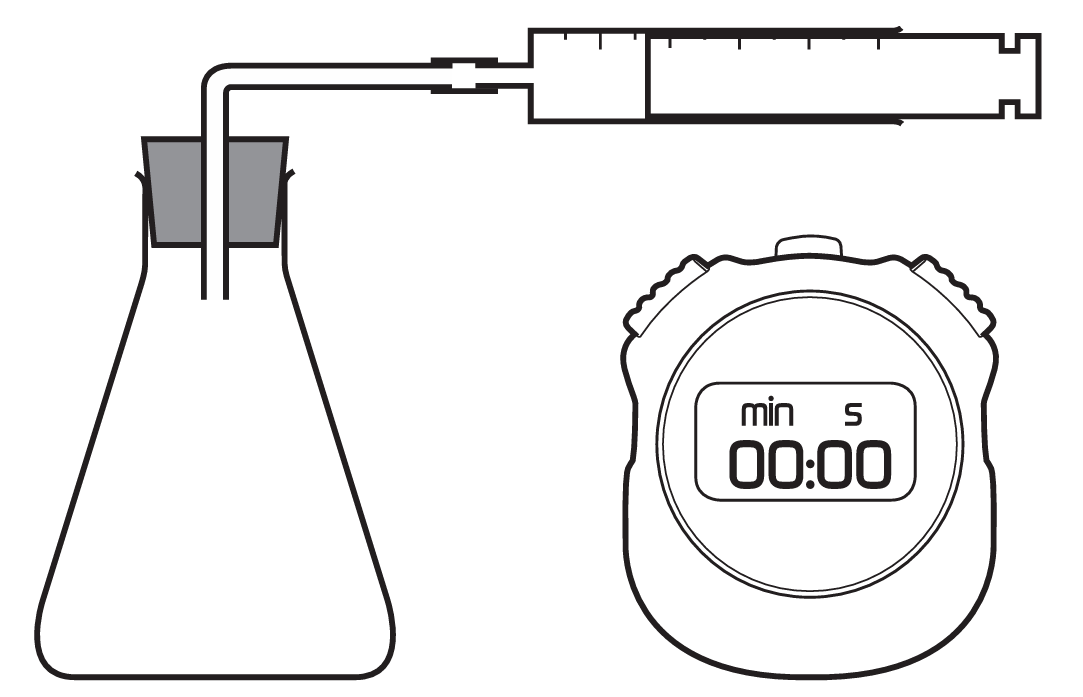
▶️ Answer/Explanation
The apparatus shown collects gas produced by a reaction (gas syringe or inverted measuring cylinder over water), which is used to measure the volume of gas over time.
Reaction C (\(\text{MgCO}_3 + 2\text{HCl}\)) takes place in aqueous solution at room temperature and produces \(\text{CO}_2\) gas that can be collected and measured with this apparatus.
Reactions A and B require high temperatures (not suitable for this apparatus), and reaction D is a displacement reaction in solution producing no gas.
✅ Answer: (C)
Reaction C (\(\text{MgCO}_3 + 2\text{HCl}\)) takes place in aqueous solution at room temperature and produces \(\text{CO}_2\) gas that can be collected and measured with this apparatus.
Reactions A and B require high temperatures (not suitable for this apparatus), and reaction D is a displacement reaction in solution producing no gas.
✅ Answer: (C)
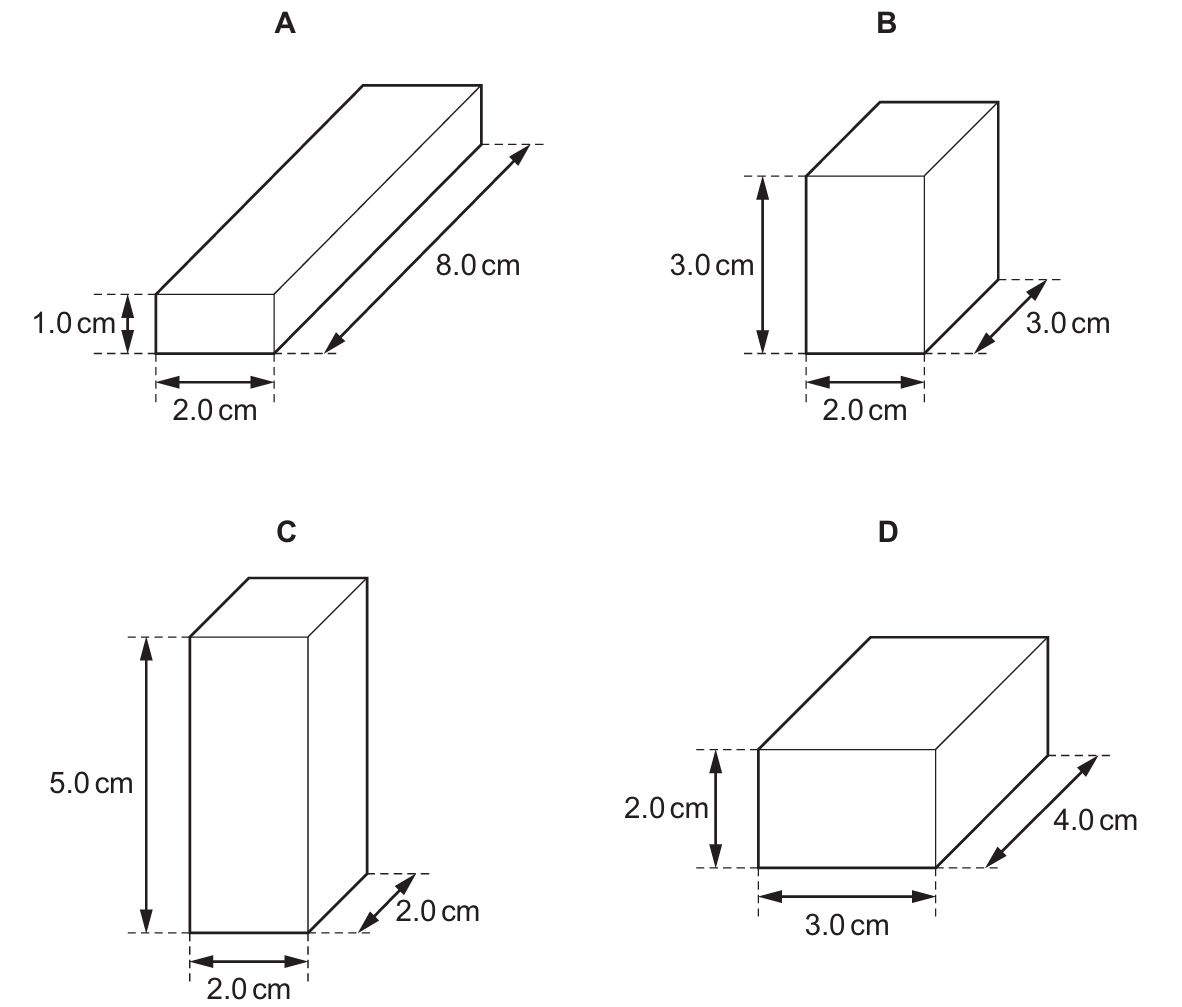
▶️ Answer/Explanation
Density is defined as \(\rho = \dfrac{m}{V}\); since all four blocks have equal mass, the one with the greatest volume has the lowest density.
The block with the largest dimensions (largest volume) among those of equal mass therefore has the least dense material.
From the diagram, block D has the greatest volume for the same mass, making it the least dense.
✅ Answer: (D)
The block with the largest dimensions (largest volume) among those of equal mass therefore has the least dense material.
From the diagram, block D has the greatest volume for the same mass, making it the least dense.
✅ Answer: (D)
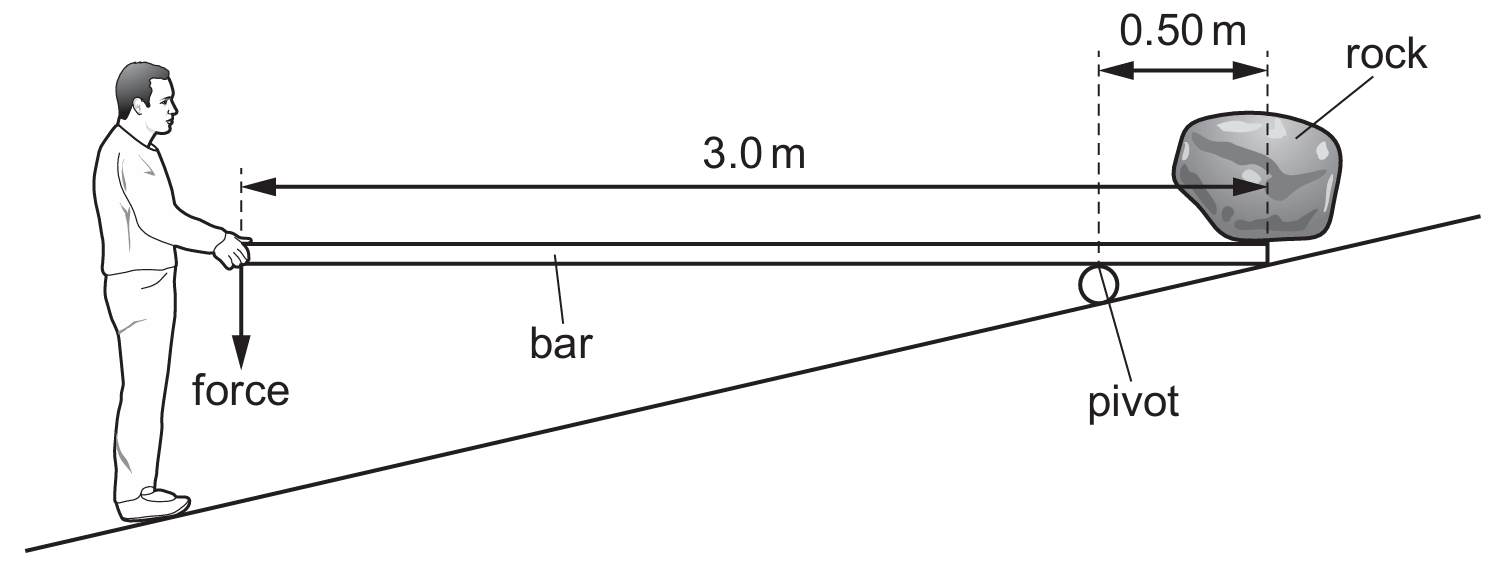
▶️ Answer/Explanation
The pivot is 0.50 m from the rock and \((3.0 – 0.50) = 2.50\) m from where the person pushes.
Applying the principle of moments (clockwise moment = anticlockwise moment): \(F \times 2.50 = 900 \times 0.50\), giving \(F = \dfrac{450}{2.50} = 180 \text{ N}\).
✅ Answer: (B)
Applying the principle of moments (clockwise moment = anticlockwise moment): \(F \times 2.50 = 900 \times 0.50\), giving \(F = \dfrac{450}{2.50} = 180 \text{ N}\).
✅ Answer: (B)
▶️ Answer/Explanation
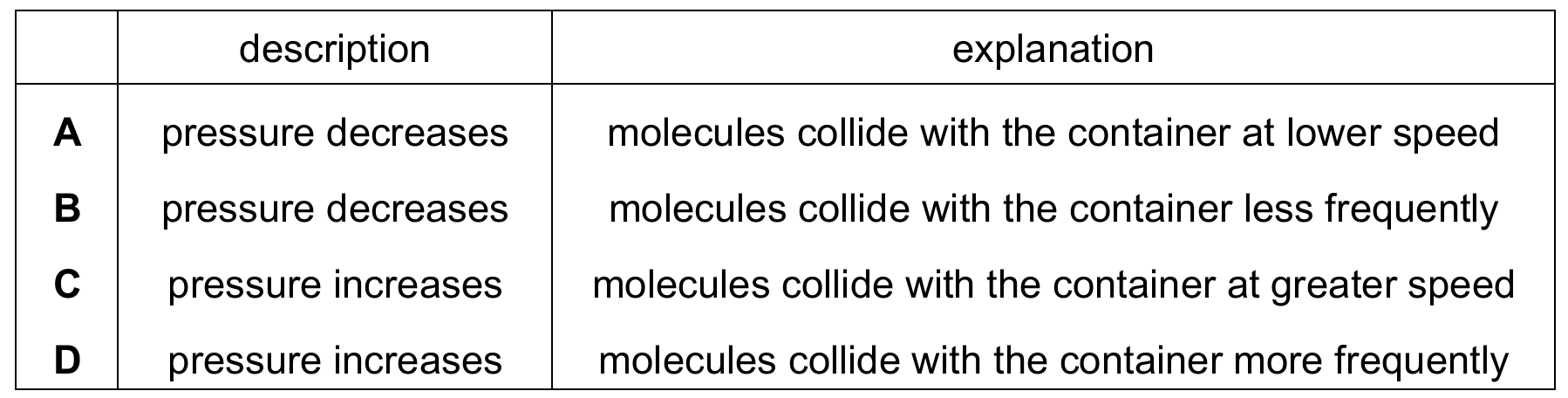
By Boyle’s Law, at constant temperature, pressure and volume are inversely proportional: \(P \propto \dfrac{1}{V}\), so decreasing the volume increases the pressure.
The explanation is that the same number of gas molecules are now confined to a smaller space, so they collide with the container walls more frequently, exerting a greater force per unit area (greater pressure).
Row D correctly states that pressure increases and gives the correct molecular explanation of more frequent collisions.
✅ Answer: (D)
The explanation is that the same number of gas molecules are now confined to a smaller space, so they collide with the container walls more frequently, exerting a greater force per unit area (greater pressure).
Row D correctly states that pressure increases and gives the correct molecular explanation of more frequent collisions.
✅ Answer: (D)
▶️ Answer/Explanation
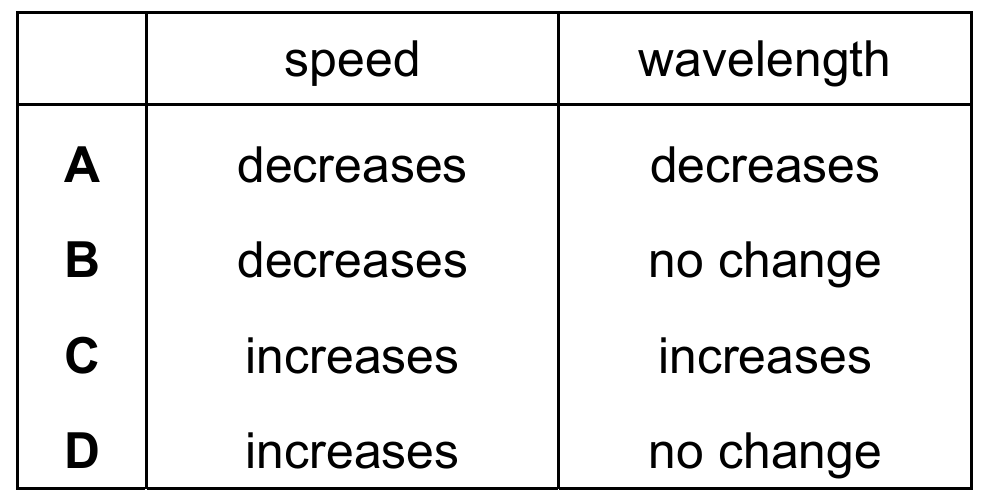
Glass is optically denser than air, so light slows down as it enters the glass block — this is the cause of refraction.
Since frequency remains unchanged (it is determined by the source), and using the wave equation \(v = f\lambda\), a decrease in wave speed \(v\) at constant frequency \(f\) means the wavelength \(\lambda\) also decreases.
Row A correctly shows both speed and wavelength decrease upon entering the glass.
✅ Answer: (A)
Since frequency remains unchanged (it is determined by the source), and using the wave equation \(v = f\lambda\), a decrease in wave speed \(v\) at constant frequency \(f\) means the wavelength \(\lambda\) also decreases.
Row A correctly shows both speed and wavelength decrease upon entering the glass.
✅ Answer: (A)
▶️ Answer/Explanation
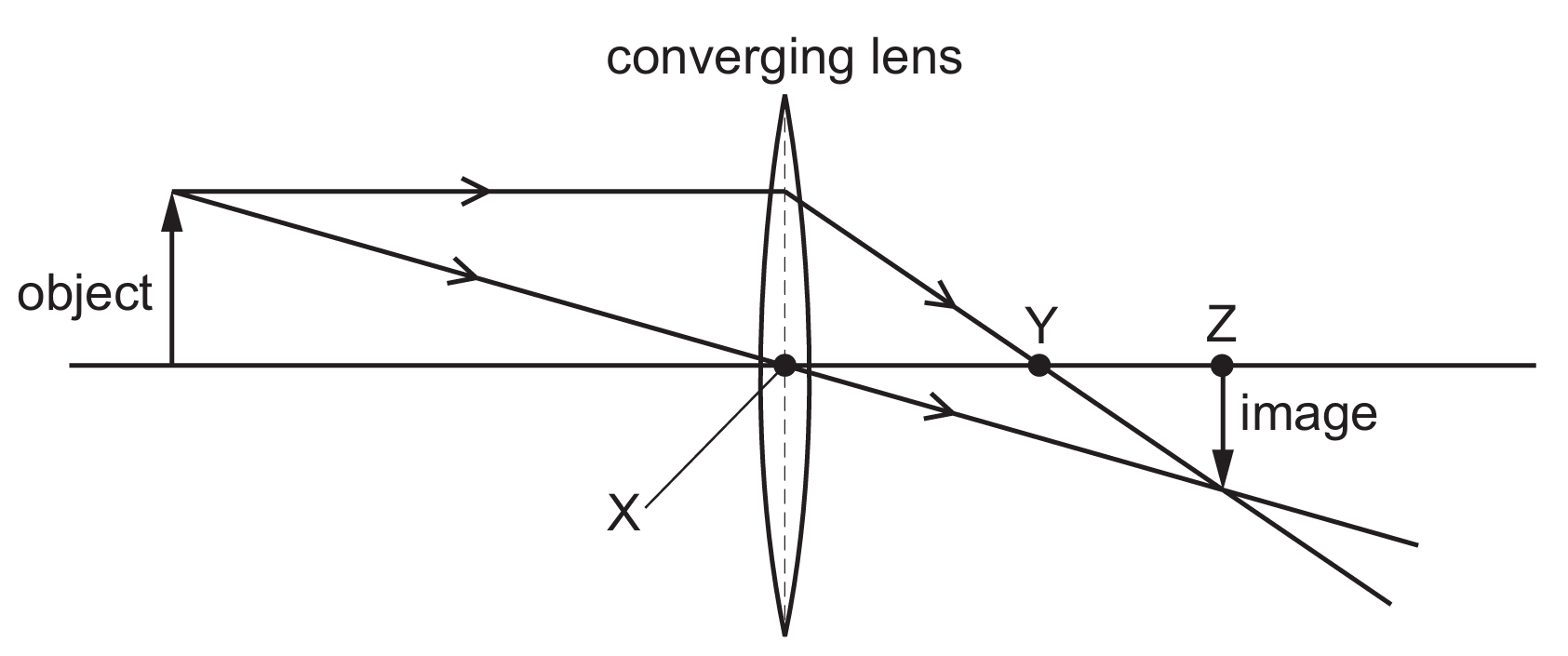
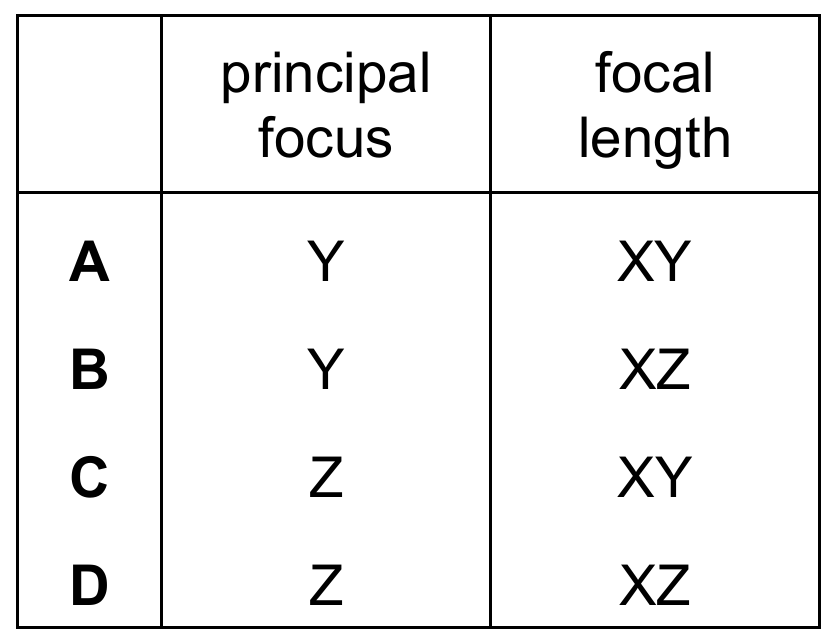
The principal focus of a converging lens is the point on the principal axis where parallel rays of light converge after passing through the lens; it lies between the lens centre and the image for real images.
The focal length is the distance from the optical centre of the lens to the principal focus.
From the diagram, point X is the principal focus (where parallel rays meet) and the distance from the lens centre to X is the focal length — matching row A.
✅ Answer: (A)
The focal length is the distance from the optical centre of the lens to the principal focus.
From the diagram, point X is the principal focus (where parallel rays meet) and the distance from the lens centre to X is the focal length — matching row A.
✅ Answer: (A)
▶️ Answer/Explanation
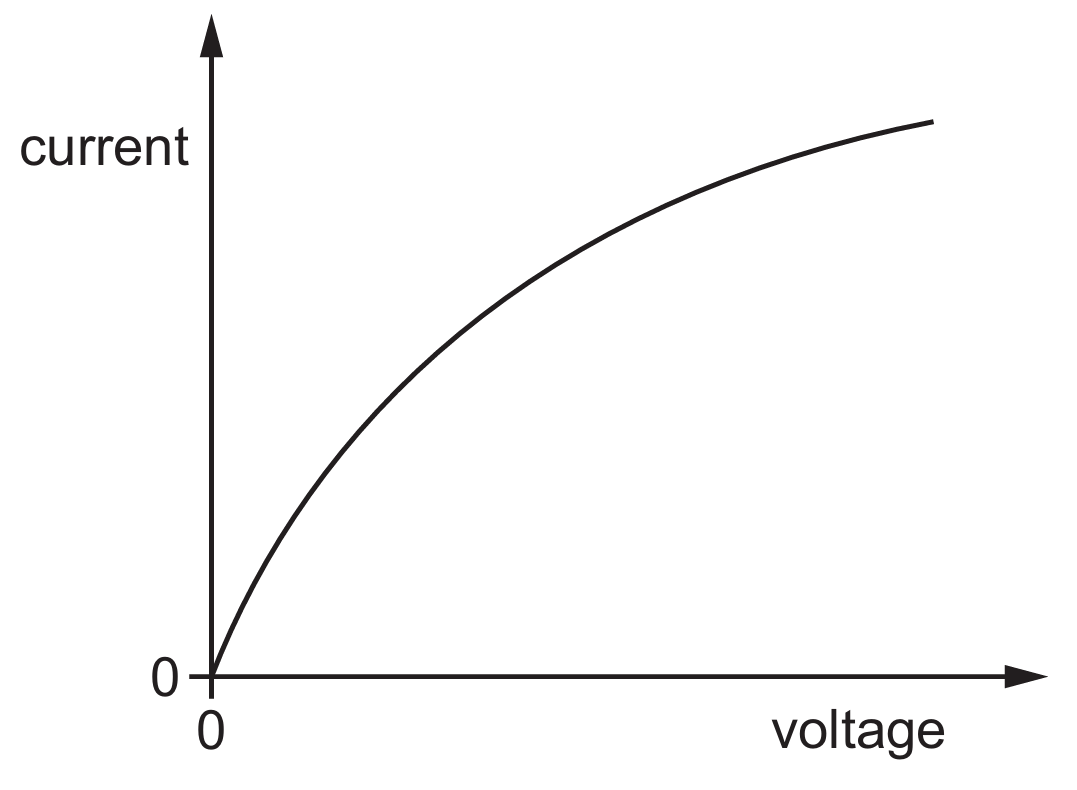
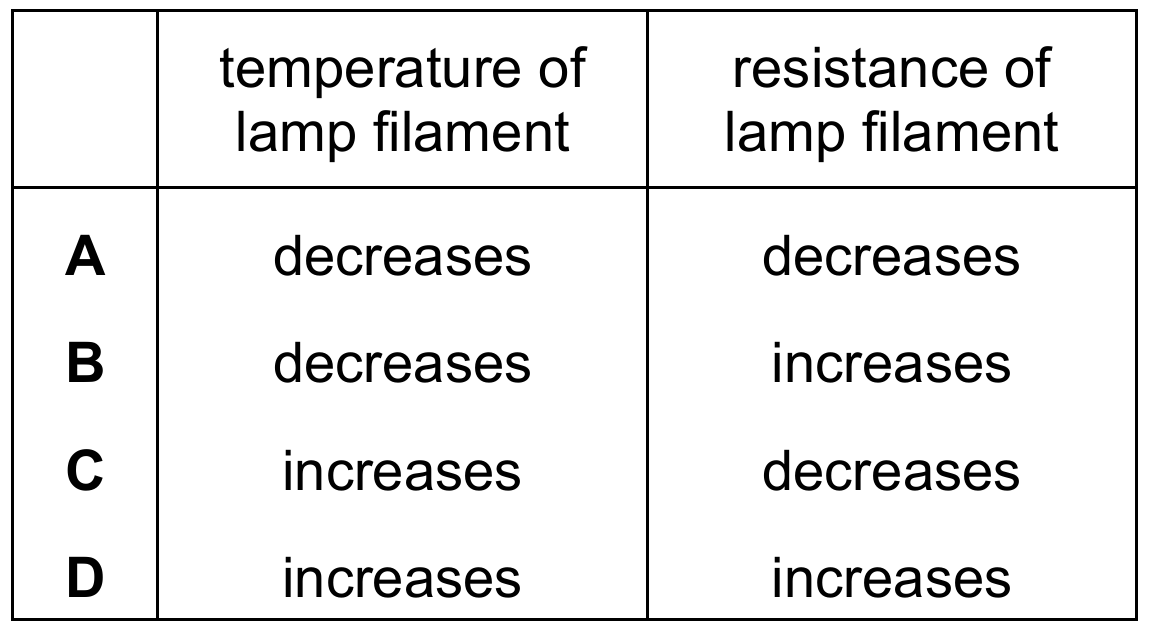
As current increases through the filament lamp, more electrical energy is dissipated as heat, so the filament’s temperature increases.
Higher temperature causes the metal ions in the filament to vibrate more vigorously, increasing the resistance to electron flow — so resistance also increases.
This is confirmed by the curve’s decreasing gradient (the I–V graph curves, meaning more voltage is needed per unit of current as current rises), consistent with row D: temperature increases, resistance increases.
✅ Answer: (D)
Higher temperature causes the metal ions in the filament to vibrate more vigorously, increasing the resistance to electron flow — so resistance also increases.
This is confirmed by the curve’s decreasing gradient (the I–V graph curves, meaning more voltage is needed per unit of current as current rises), consistent with row D: temperature increases, resistance increases.
✅ Answer: (D)
▶️ Answer/Explanation
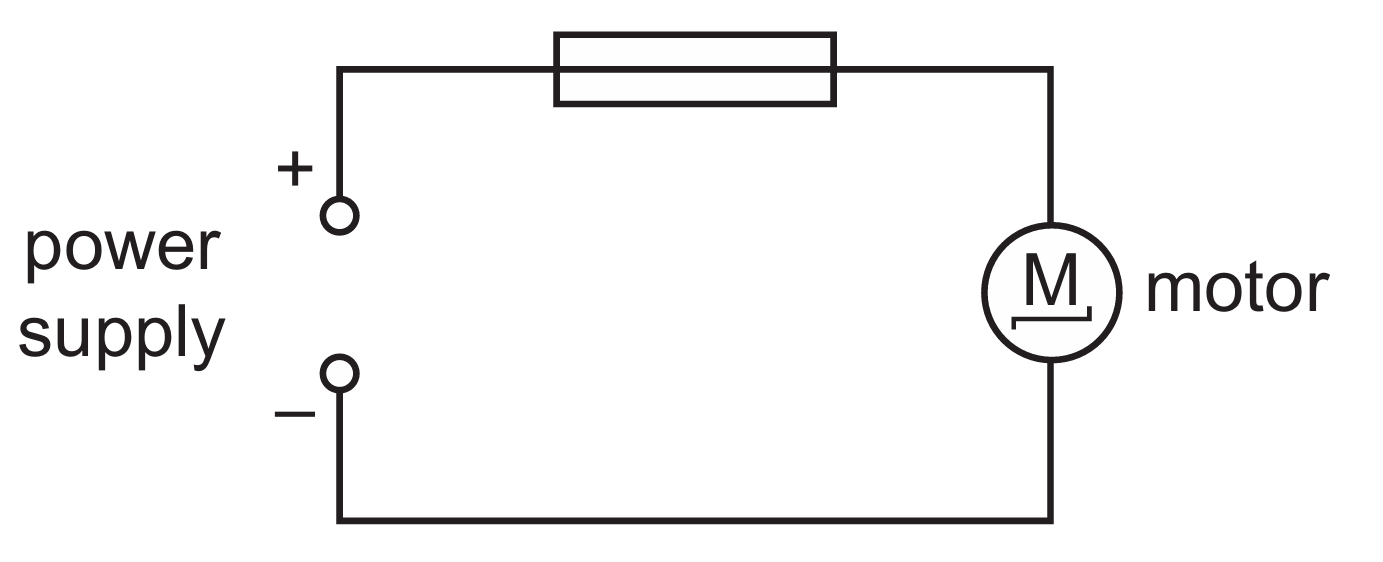
The heating of wires is caused by the power dissipated due to the wire’s resistance: \(P = I^2 R\); a thicker wire has a larger cross-sectional area, giving it a lower resistance \(R\).
Lower resistance means less power is dissipated as heat for the same current, so the wires remain cooler.
Using a higher-rated fuse (option B) is dangerous and does not reduce heating; thicker insulation (option D) traps heat rather than reducing it; adding a second fuse in series (option A) would just increase the chance of blowing a fuse but not reduce wire heating.
✅ Answer: (C)
Lower resistance means less power is dissipated as heat for the same current, so the wires remain cooler.
Using a higher-rated fuse (option B) is dangerous and does not reduce heating; thicker insulation (option D) traps heat rather than reducing it; adding a second fuse in series (option A) would just increase the chance of blowing a fuse but not reduce wire heating.
✅ Answer: (C)
▶️ Answer/Explanation
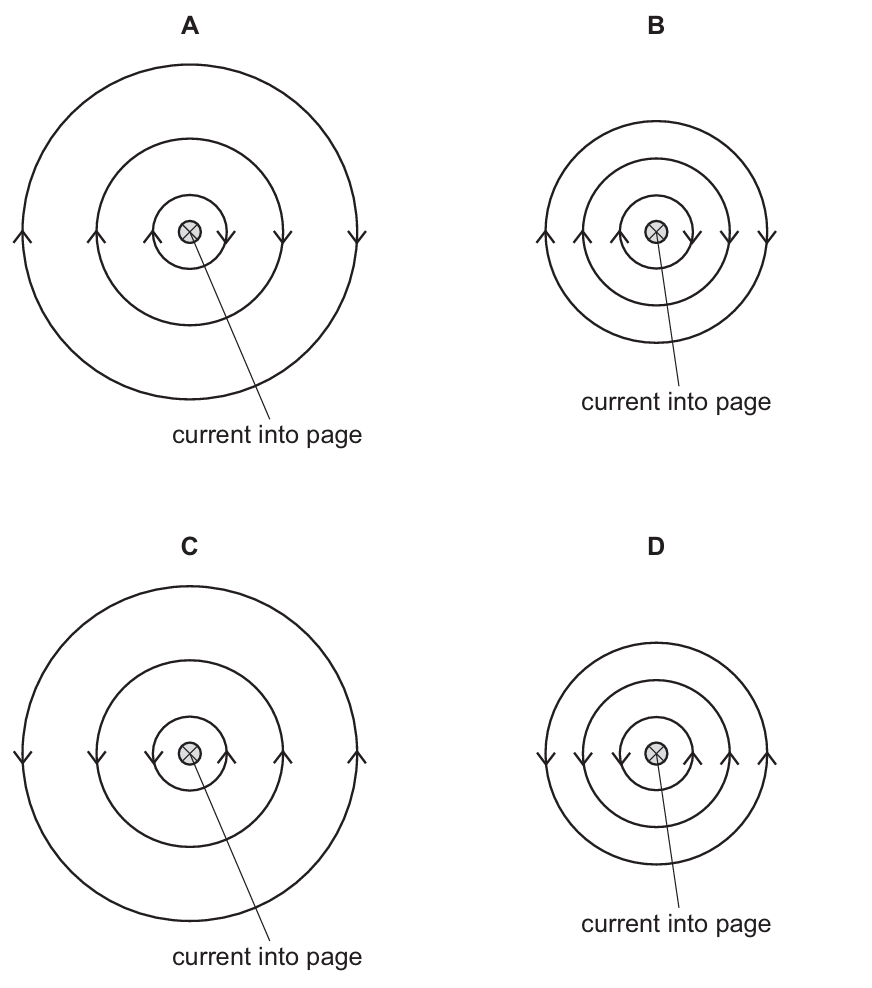
The magnetic field around a straight current-carrying wire forms concentric circles centred on the wire.
Using the right-hand grip rule: if the current goes into the page (represented by a cross ✕), the magnetic field circles the wire in a clockwise direction when viewed from the front.
Diagram A shows concentric circles with a clockwise direction for a current going into the page — this is correct.
✅ Answer: (A)
Using the right-hand grip rule: if the current goes into the page (represented by a cross ✕), the magnetic field circles the wire in a clockwise direction when viewed from the front.
Diagram A shows concentric circles with a clockwise direction for a current going into the page — this is correct.
✅ Answer: (A)
▶️ Answer/Explanation
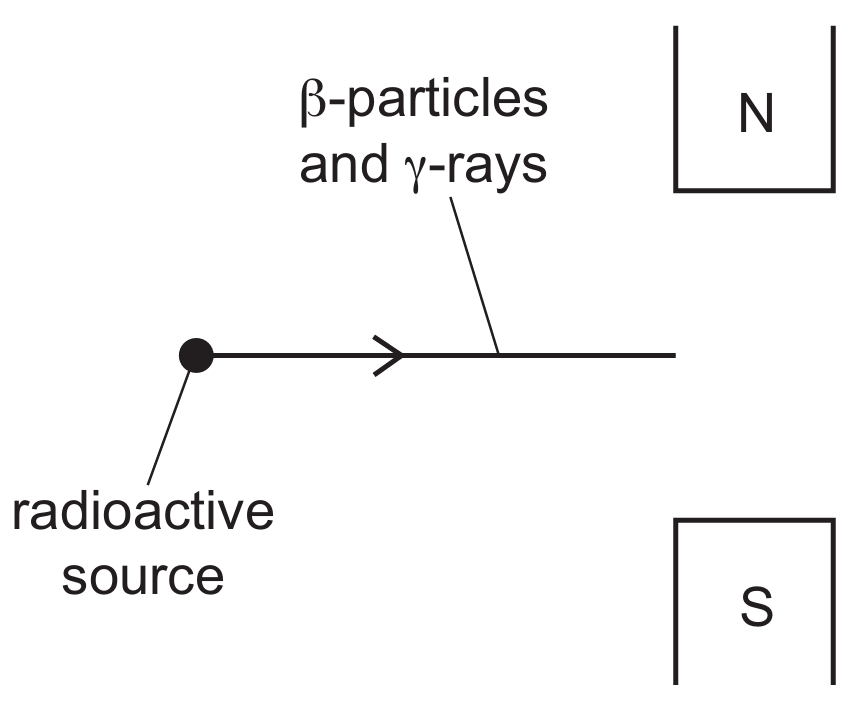
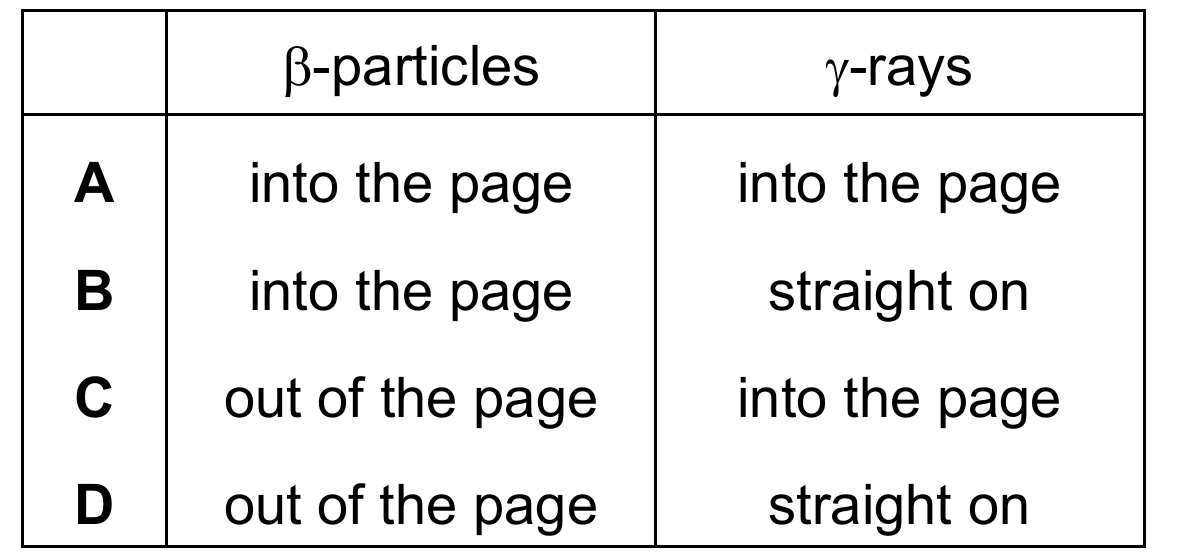
Gamma rays are electromagnetic waves with no charge, so they are not deflected by a magnetic field and continue in a straight line.
Beta particles are fast-moving electrons (charge \(-e\)) and are deflected by the magnetic field; the direction of deflection is given by Fleming’s left-hand rule (or the right-hand rule for negative charges), and beta particles deflect in the opposite direction to positive charges (alpha particles).
Row D correctly shows gamma going straight and beta being deflected — confirming the answer.
✅ Answer: (D)
Beta particles are fast-moving electrons (charge \(-e\)) and are deflected by the magnetic field; the direction of deflection is given by Fleming’s left-hand rule (or the right-hand rule for negative charges), and beta particles deflect in the opposite direction to positive charges (alpha particles).
Row D correctly shows gamma going straight and beta being deflected — confirming the answer.
✅ Answer: (D)