
Question 1
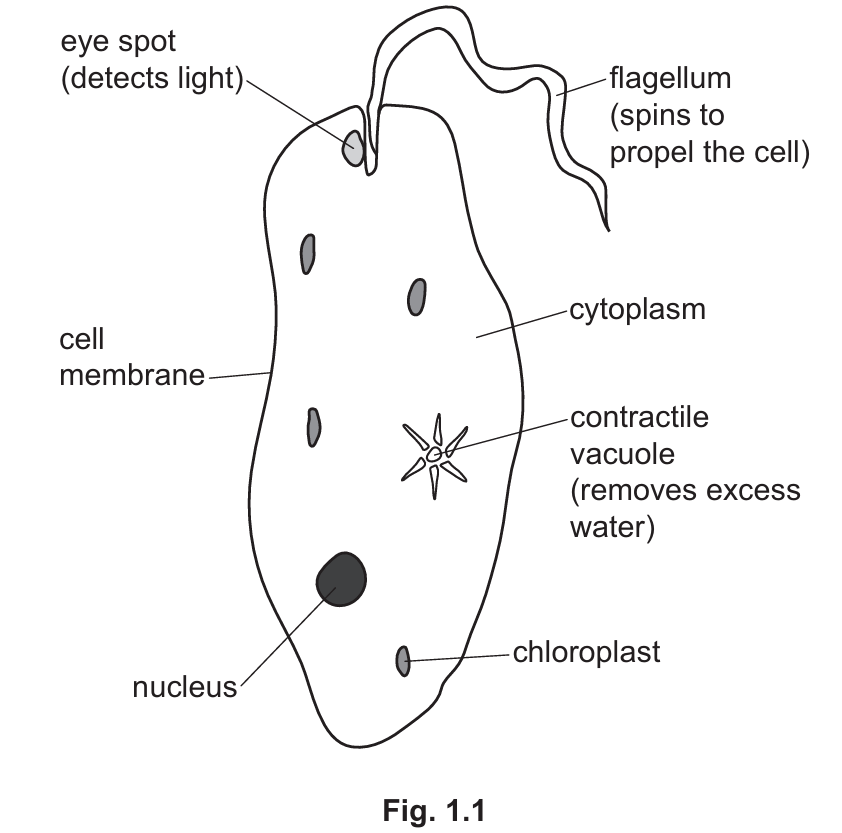
excretion
movement
nutrition
sensitivity
State the function of the cell wall.
(ii) Circle two other larger carbohydrate molecules made from glucose.
Most-appropriate topic codes (Cambridge IGCSE Co-ordinated Sciences 0654):
• Topic B1.1 — Characteristics of living organisms (Parts (a)(i), (a)(ii))
• Topic B2.1 — Cell structure (Parts (a)(iii), (b))
• Topic B4.1 — Biological molecules (Part (c))
▶️ Answer/Explanation
(a)(i)
Excretion → contractile vacuole
The contractile vacuole removes excess water (a waste product), which is the process of excretion in Euglena.
Movement → flagellum
The flagellum spins to propel the cell, enabling movement.
Nutrition → chloroplast
The chloroplast carries out photosynthesis, allowing Euglena to manufacture its own food (nutrition).
Sensitivity → eye spot
The eye spot detects light, enabling the organism to respond to its environment (sensitivity).
(a)(ii)
Any one of: respiration / growth / reproduction
These are all recognised characteristics of living organisms not directly covered by the parts shown in Fig. 1.1.
Each characteristic reflects a fundamental life process shared by all living things.
(a)(iii)
Chloroplast
Chloroplasts are present in plant cells (for photosynthesis) but are absent in animal cells.
Euglena possesses chloroplasts, which is a feature shared with plant cells only.
(b)
The cell wall strengthens (supports / provides rigidity to) the cell.
It prevents the cell from bursting when water enters by osmosis, maintaining cell shape.
This structural support is why plant cells maintain a firm, regular shape unlike animal cells.
(c)(i)
Carbon, hydrogen, oxygen
All carbohydrates are composed exclusively of these three chemical elements.
The general formula for carbohydrates reflects this composition: \( \text{C}_x(\text{H}_2\text{O})_y \).
(c)(ii)
Glycogen and starch (both circled)
Both glycogen and starch are polysaccharides — large carbohydrate molecules built from many glucose units joined together.
Fat, glycerol, oil, and protein are not carbohydrates made from glucose monomers.
Question 2

Most-appropriate topic codes (Cambridge IGCSE Co-ordinated Sciences 0654):
• Topic C3.1 — Formulas (Part (a))
• Topic C6.2 — Rate of reaction (Part (b))
• Topic C12.4 — Separation and purification (Part (c))
▶️ Answer/Explanation
(a)(i) CH₄
Methane (\(\text{CH}_4\)) is the main constituent of natural gas.
It is a simple hydrocarbon compound made of one carbon atom bonded to four hydrogen atoms.
(a)(ii) Cl₂
Chlorine (\(\text{Cl}_2\)) is a greenish-yellow gas that bleaches damp litmus paper.
It reacts with water to form hypochlorous acid, which is the active bleaching agent.
(a)(iii) O₂
Oxygen (\(\text{O}_2\)) makes up approximately 21% of clean, dry air.
The remaining 78% is nitrogen, with small amounts of other gases such as argon and carbon dioxide.
(a)(iv) NaCl
Sodium chloride (NaCl) contains the sodium ion \(\text{Na}^+\), which carries a 1+ charge.
It is an ionic compound formed from Group I sodium and Group VII chlorine.
(a)(v) NH₃
Ammonia (\(\text{NH}_3\)) is produced when an ammonium salt is heated with an alkali (displacement reaction).
For example: \(\text{NH}_4\text{Cl} + \text{NaOH} \rightarrow \text{NaCl} + \text{H}_2\text{O} + \text{NH}_3\)
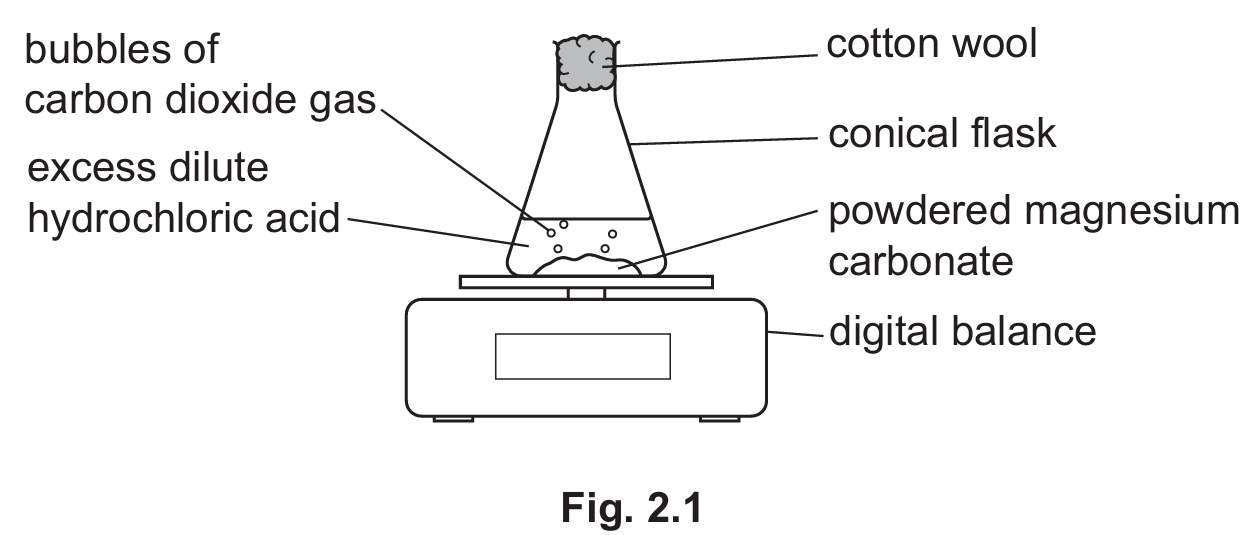
(b)(i) Carbon dioxide gas escapes from the flask into the air.
As the reaction proceeds, \(\text{CO}_2\) gas is produced and leaves the system through the cotton wool plug.
Since the gas is no longer contained within the flask, the total mass of the flask and its contents decreases.
(b)(ii)
1. Increase the temperature of the acid — higher temperature gives particles more kinetic energy, leading to more frequent and more energetic collisions.
2. Increase the concentration of the acid — more particles per unit volume means more frequent collisions between reactant particles.
(b)(iii)
magnesium carbonate + hydrochloric acid → magnesium chloride + carbon dioxide + water
The carbonate reacts with the acid to produce a salt, \(\text{CO}_2\) gas, and water.
(c) Crystallisation
To obtain solid magnesium chloride from its solution, crystallisation is used.
The solution is heated to evaporate water until crystals begin to form, then cooled to allow solid crystals to fully precipitate out.
Question 3
- travels through space
- slows down through the Earth’s atmosphere
- hits the Earth’s surface.
Isotopes are atoms of the same element which have the same …………………… number but a different …………………… number.
Most-appropriate topic codes (Cambridge IGCSE Co-ordinated Sciences 0654):
• Topic P1.2 — Motion (Part (a))
• Topic P1.3 — Mass and weight (Part (b)(i))
• Topic P1.4 — Density (Part (b)(ii))
• Topic P4.1 — Simple phenomena of magnetism (Part (c))
• Topic C2.3 — Isotopes (Part (d))
▶️ Answer/Explanation
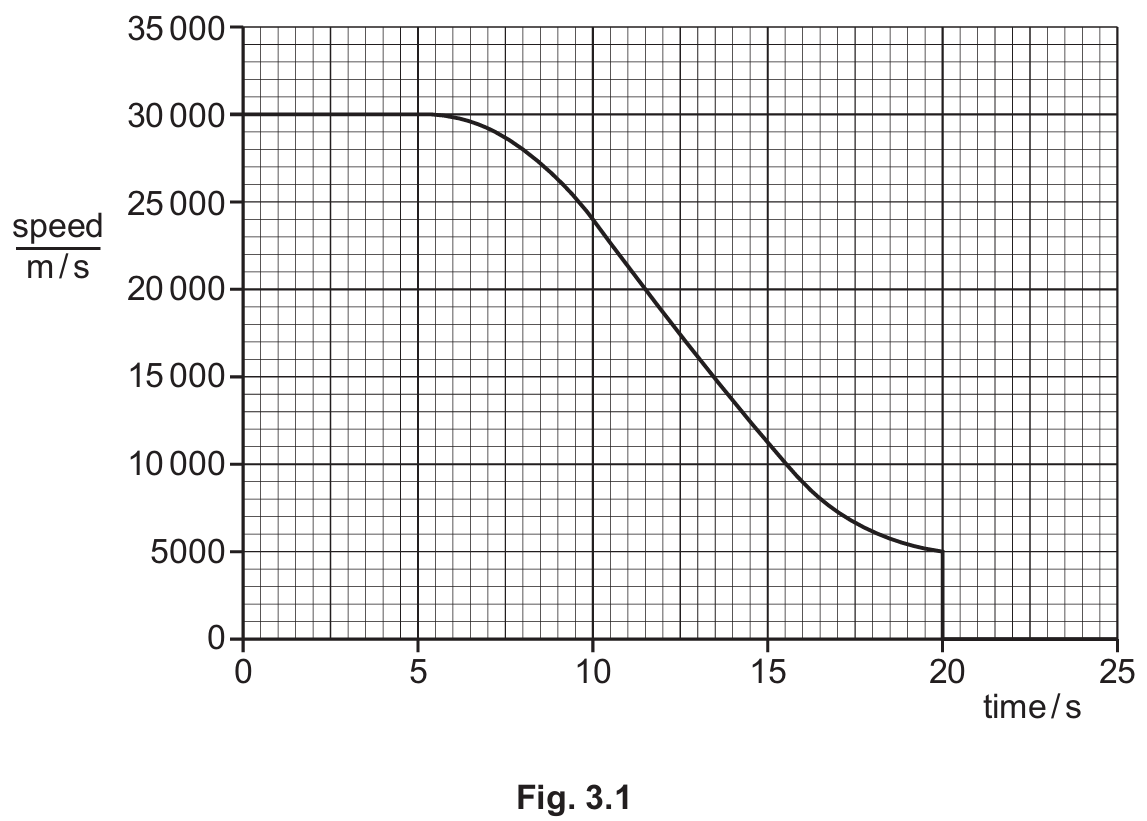
(a)(i) 30,000 m/s
Reading the graph at the flat (constant speed) section before the meteorite enters the atmosphere gives the maximum speed.
The speed remains constant at \(30{,}000 \, \text{m/s}\) while travelling through space where there is no air resistance.
(a)(ii) 20 s
The meteorite hits the surface when its speed reaches zero on the graph.
Reading from the graph, this occurs at \(t = 20 \, \text{s}\).
(a)(iii) Friction / air resistance
As the meteorite passes through the Earth’s atmosphere, air molecules collide with it.
This creates a resistive force (air resistance/friction) that acts opposite to the direction of motion, slowing it down.
(b)(i) \(3.3 \times 10^7 \, \text{kg}\)
Using the formula \(W = mg\), rearranged to: \(m = \dfrac{W}{g}\)
\(m = \dfrac{3.3 \times 10^8}{10} = 3.3 \times 10^7 \, \text{kg}\)
(b)(ii) 7900 kg/m³
Using \(\rho = \dfrac{m}{V}\):
\(\rho = \dfrac{3.3 \times 10^7}{4200} = 7857 \approx 7900 \, \text{kg/m}^3\)
Units: \(\text{kg/m}^3\)
(c) Place the iron in a solenoid (coil) and pass a direct current (d.c.) through the coil.
The magnetic field created by the current-carrying coil aligns the magnetic domains in the iron.
Alternatively, placing the iron in the direction of the Earth’s magnetic field and hammering it gently can also magnetise it.
(d)(i) proton (atomic) number … nucleon (mass) number
Isotopes are atoms of the same element with the same proton/atomic number but a different nucleon/mass number.
They differ only in the number of neutrons in the nucleus.
(d)(ii)
Neutrons = mass number − proton number
Isotope A: \(54 – 26 = \mathbf{28}\) neutrons
Isotope B: \(56 – 26 = \mathbf{30}\) neutrons
Question 4
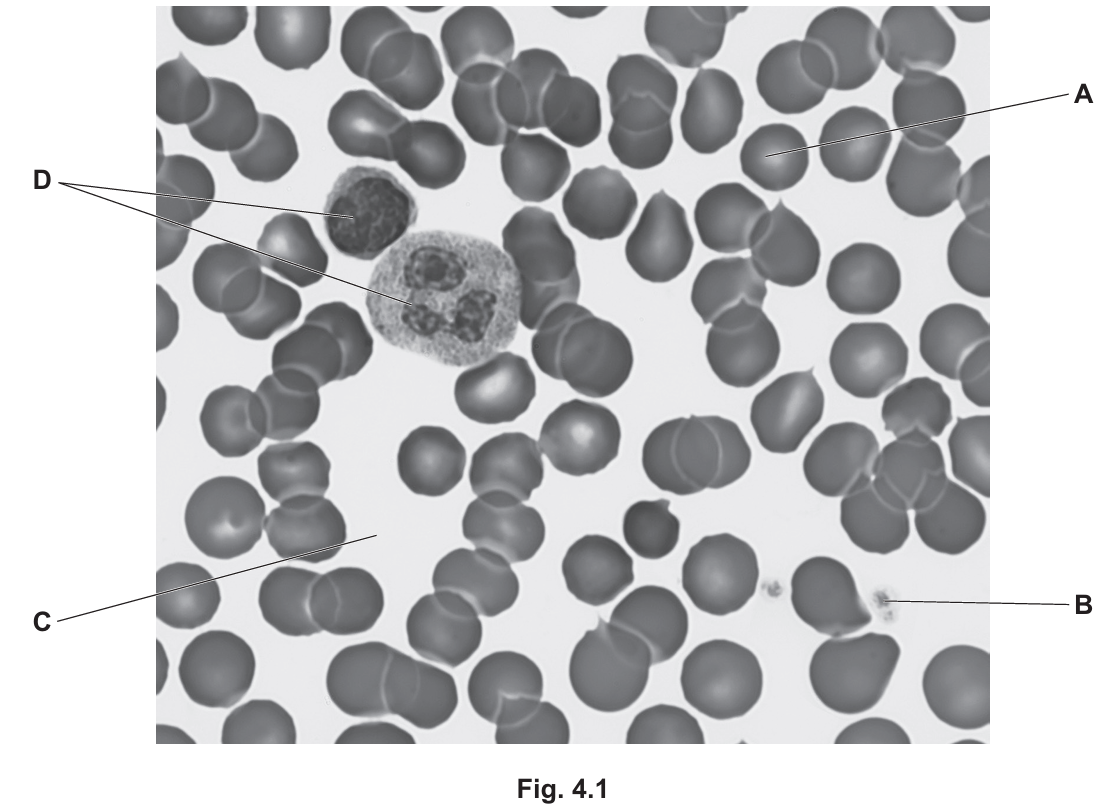
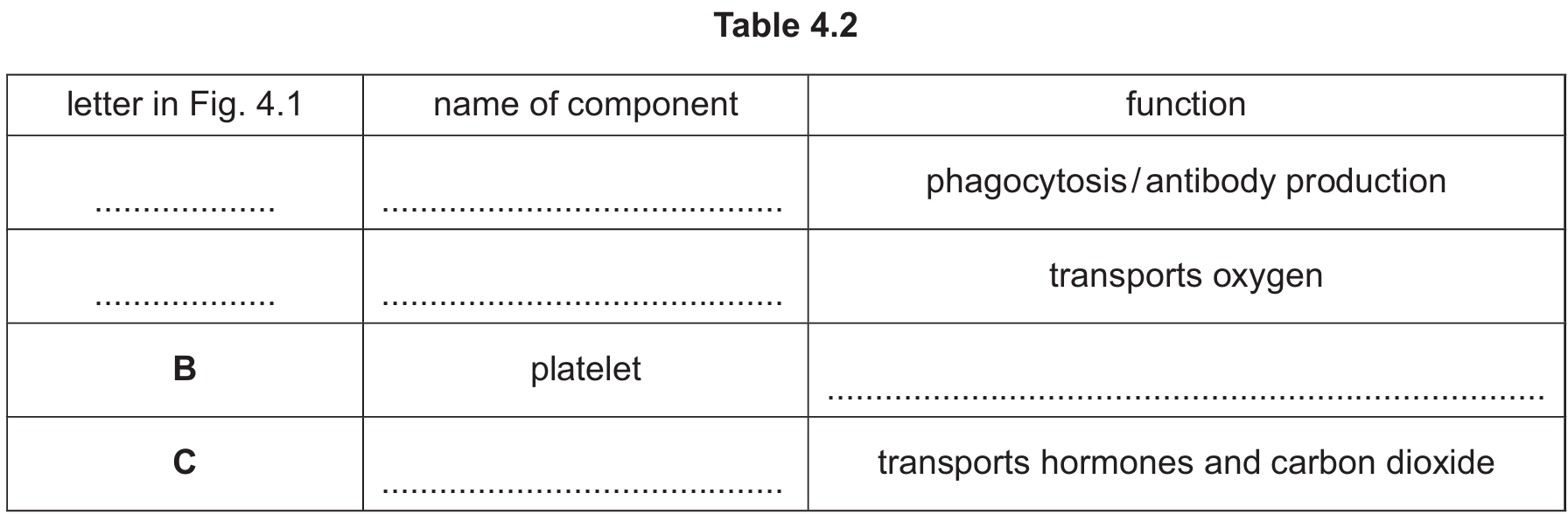
Most-appropriate topic codes (Cambridge IGCSE Co-ordinated Sciences 0654):
• Topic B10.1 — Diseases and immunity (Part (a))
• Topic B2.2 — Size of specimens (Part (b))
▶️ Answer/Explanation
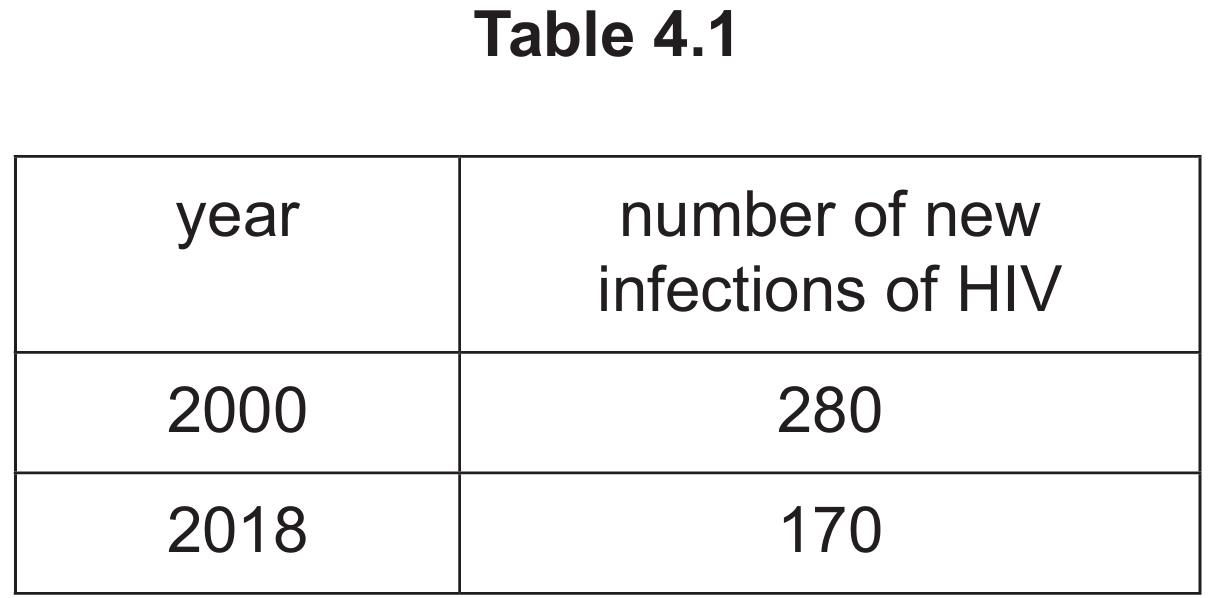
(a)(i) 39.3%
Decrease = \(280 – 170 = 110\)
\(\% \text{ decrease} = \dfrac{110}{280} \times 100 = 39.3\%\)
(a)(ii) Any three from:
1. Education and awareness campaigns about how HIV is transmitted.
2. Increased use of condoms / barrier contraception to prevent transmission.
3. Screening of blood transfusions to prevent spread through contaminated blood.
(Other valid answers: increased testing and monitoring; provision of clean needles; reduced needle-sharing; reduced breastfeeding by infected mothers.)
(a)(iii) Virus
HIV (Human Immunodeficiency Virus) is caused by a virus.
Viruses are non-cellular pathogens that invade host cells and use them to replicate.
(b)(i)
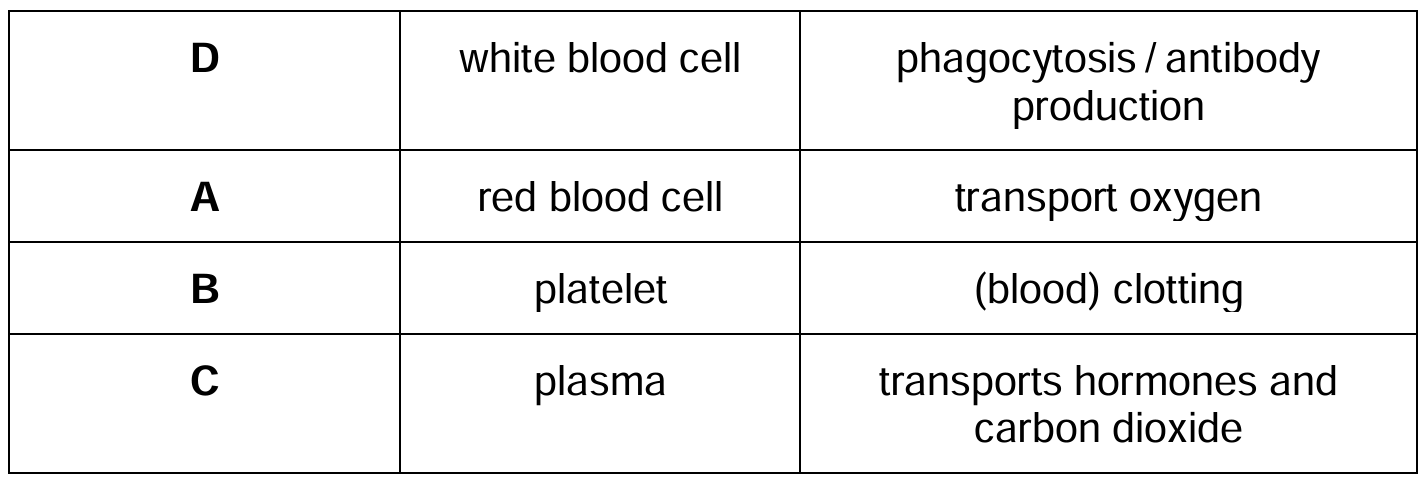
(b)(ii)
Measure the image length of component A in the photomicrograph using a ruler.
Divide this measured image size by the actual (known) size of component A: \(\text{magnification} = \dfrac{\text{image size}}{\text{actual size}}\)
Question 5
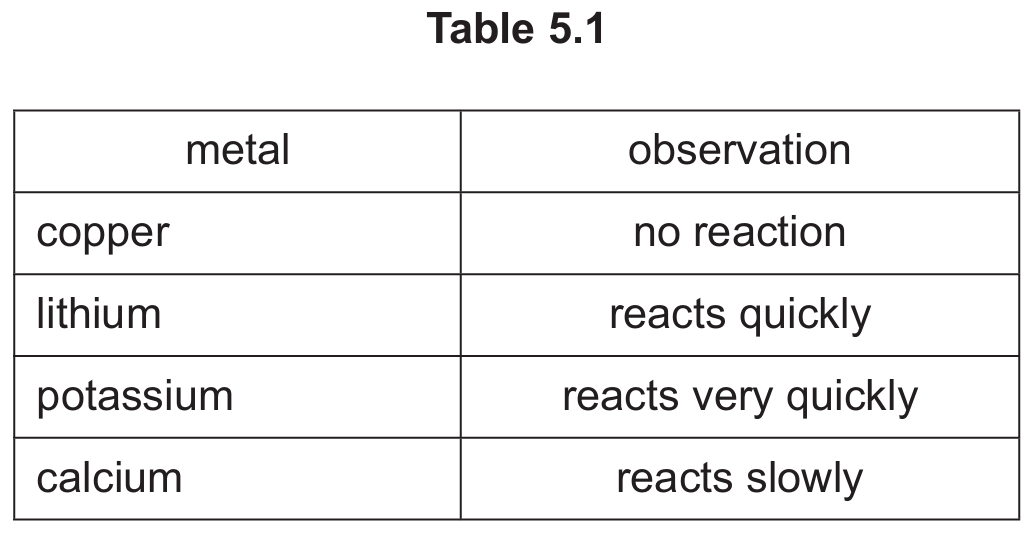
Electrolysis is the breakdown of an ionic compound when …………………… or in aqueous solution by the passage of ……………………
Zinc has a melting point of 420°C.
The brass alloy has a range of melting points from 905°C to 932°C.
Explain why brass does not have a single melting point.
Most-appropriate topic codes (Cambridge IGCSE Co-ordinated Sciences 0654):
• Topic C9.4 — Reactivity series (Part (a))
• Topic C9.6 — Extraction of metals (Part (b))
• Topic C4.1 — Electrolysis (Part (c))
• Topic C9.3 — Alloys and their properties (Part (d))
▶️ Answer/Explanation
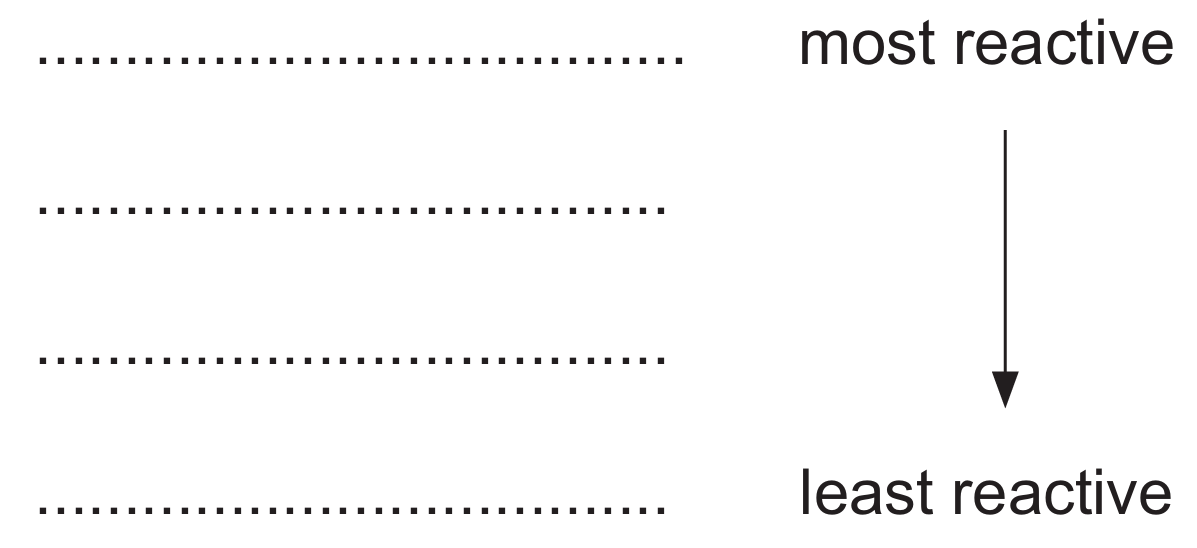
(a)(i) Order of reactivity (most → least reactive):
1. Potassium (reacts very quickly with water)
2. Lithium (reacts quickly with water)
3. Calcium (reacts slowly with water)
4. Copper (no reaction with water)
(a)(ii) Lithium or potassium
Both lithium and potassium are found in Group I (the alkali metals) of the Periodic Table.
Either answer is acceptable.
(a)(iii) Copper
Copper is a transition element, found in the d-block of the Periodic Table between Groups II and III.
Transition metals are typically harder, denser, and less reactive than Group I metals.
(b)(i) An endothermic reaction is one in which thermal energy is absorbed from the surroundings.
This results in the temperature of the surroundings decreasing during the reaction.
The products have more energy than the reactants.
(b)(ii) Copper(II) oxide is described as a basic oxide because it is a metal oxide.
Basic oxides react with acids to form a salt and water only.
For example: \(\text{CuO} + \text{H}_2\text{SO}_4 \rightarrow \text{CuSO}_4 + \text{H}_2\text{O}\)
(c) Electrolysis is the breakdown of an ionic compound when molten / liquid or in aqueous solution by the passage of electricity.
The ionic compound must be molten or dissolved so that the ions are free to move and carry charge.
A direct current (d.c.) is passed through the electrolyte between two electrodes.
(d)(i) Brass is more hardwearing / stronger than pure copper.
Pure copper is a soft metal and would wear down quickly when used as a key.
The addition of zinc to form brass creates an alloy that is significantly harder and more durable.
(d)(ii) Brass does not have a single melting point because it is a mixture.
Pure substances melt at a fixed, single temperature, but mixtures (like alloys) contain atoms of different sizes that disrupt the regular lattice structure.
This disruption means that different amounts of energy are needed to break the bonds throughout the mixture, giving a range of melting points rather than a single value.
Question 6
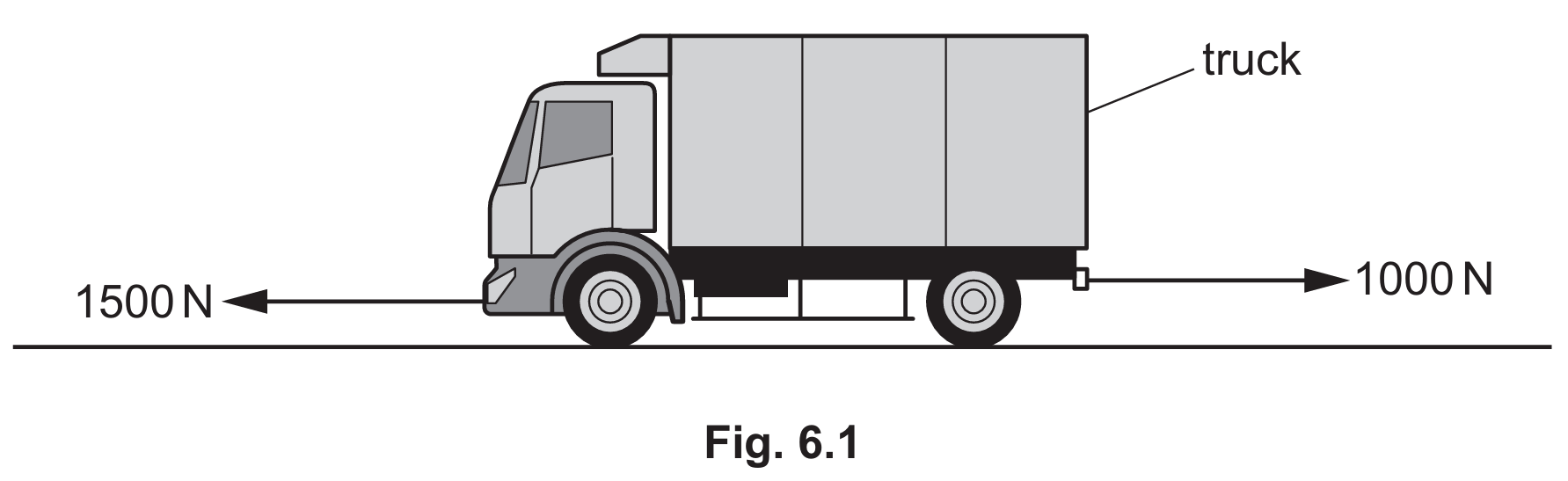
Draw an arrow on the diagram to show the direction of the resultant force.
The purpose of a fuse is to …………………………… the circuit. A large …………………………… in the circuit causes the fuse to get hot and melt, breaking the circuit.
Most-appropriate topic codes (Cambridge IGCSE Co-ordinated Sciences 0654):
• Topic P1.5.1 — Effects of forces (Part (a))
• Topic P4.3.2 — Series and parallel circuits (Part (b))
▶️ Answer/Explanation
(a)(i) 500 N, directed to the left (backwards)
The two forces act in opposite directions: \(1500 \, \text{N}\) to the left and \(1000 \, \text{N}\) to the right.
Resultant = \(1500 – 1000 = 500 \, \text{N}\) to the left (in the direction of the larger force).
(a)(ii) The truck accelerates (in the direction of the resultant force, i.e. backwards / decelerates if it was moving forwards).
A non-zero resultant force always causes a change in velocity (acceleration) in the direction of the net force.
Since the resultant is 500 N to the left, the truck accelerates to the left / decelerates if previously moving to the right.
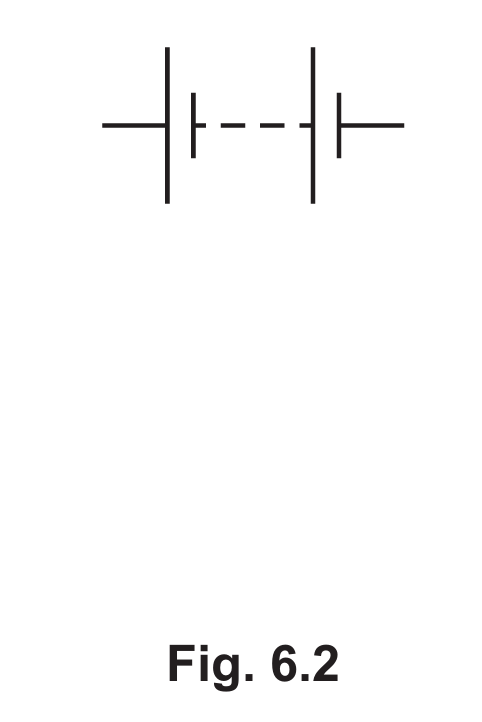
(b)(i) The completed circuit should include: the battery (already shown), a switch in series with the main line, a fuse in series, and two lamp symbols connected in parallel branches.
Standard symbols used: lamp (circle with cross), switch (open gap on a line), fuse (rectangle on the line), battery (long and short lines already given).
Both lamp branches must be connected directly between the same two nodes (parallel arrangement).
(b)(ii) If one lamp stops working (blows), the other lamp continues to work / both lamps receive the full battery voltage.
In a parallel circuit, each branch has an independent path for current, so failure of one component does not break the other.
Each lamp also receives the full 12 V supply, giving maximum brightness.
(b)(iii) The purpose of a fuse is to protect the circuit. A large current in the circuit causes the fuse to get hot and melt, breaking the circuit.
The fuse contains a thin wire that melts when the current exceeds the fuse’s rated value.
This prevents overheating of wires and reduces the risk of fire or damage to components.
Question 7
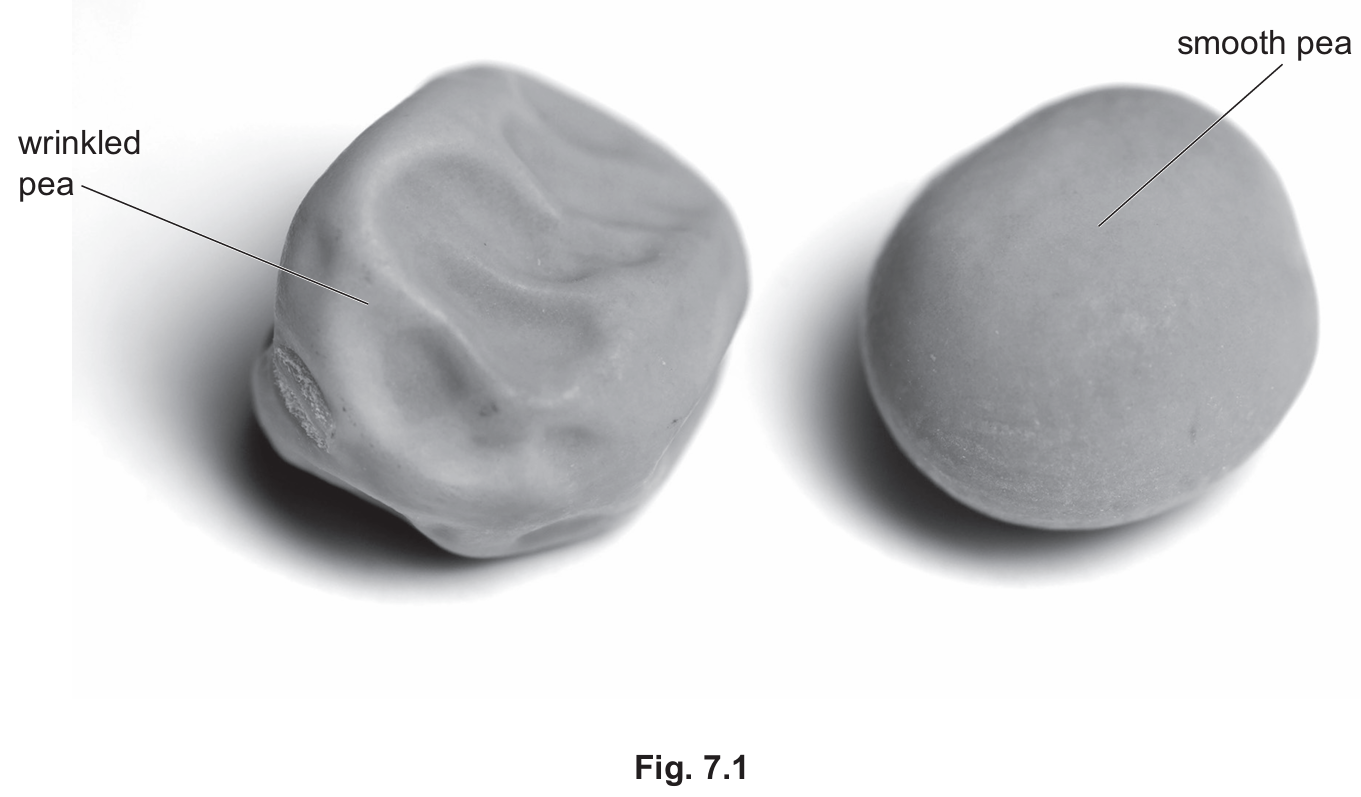
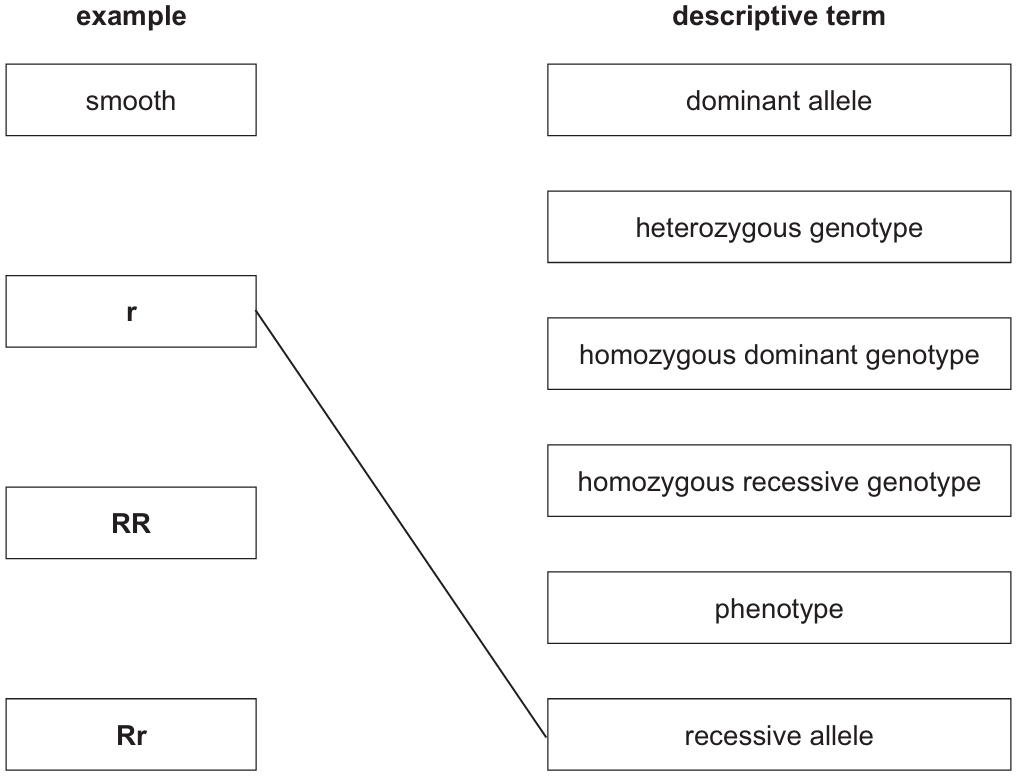
The boxes on the right show descriptive terms.
Draw lines to link each box on the left to its descriptive term on the right.
One has been done for you.
Most-appropriate topic codes (Cambridge IGCSE Co-ordinated Sciences 0654):
• Topic B16.1 — Chromosomes and genes (Part (a), (c))
• Topic B16.3 — Monohybrid inheritance (Part (b))
▶️ Answer/Explanation
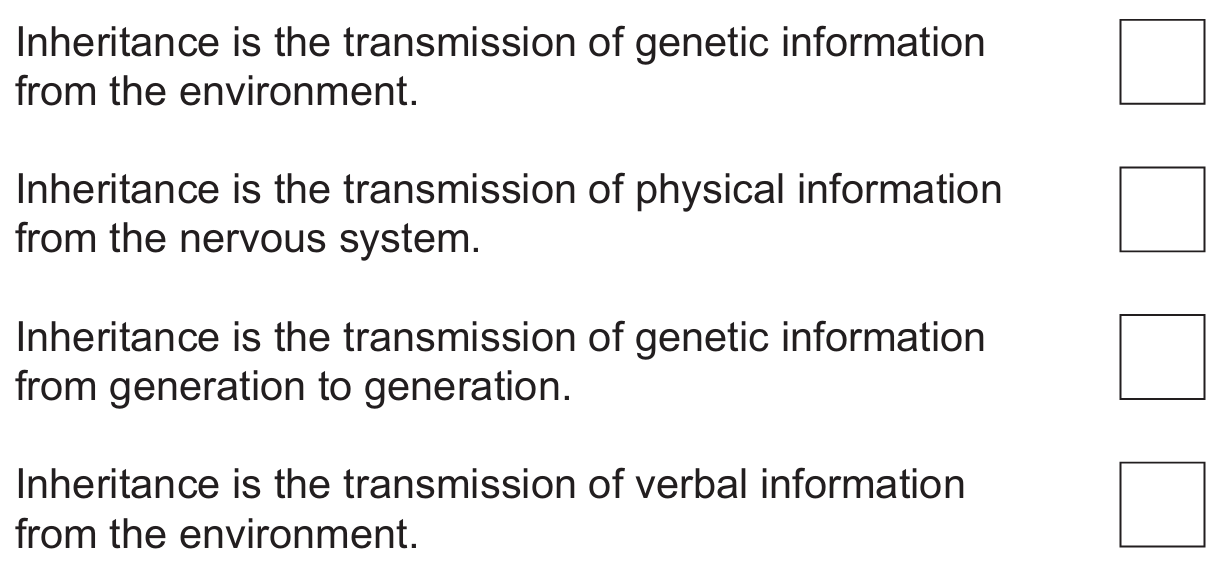
(a) ✓ Inheritance is the transmission of genetic information from generation to generation.
Inheritance refers specifically to the passing of genetic information (DNA) from parents to offspring.
The other options incorrectly describe the source or type of information transmitted.
(b)(i) Correct links:
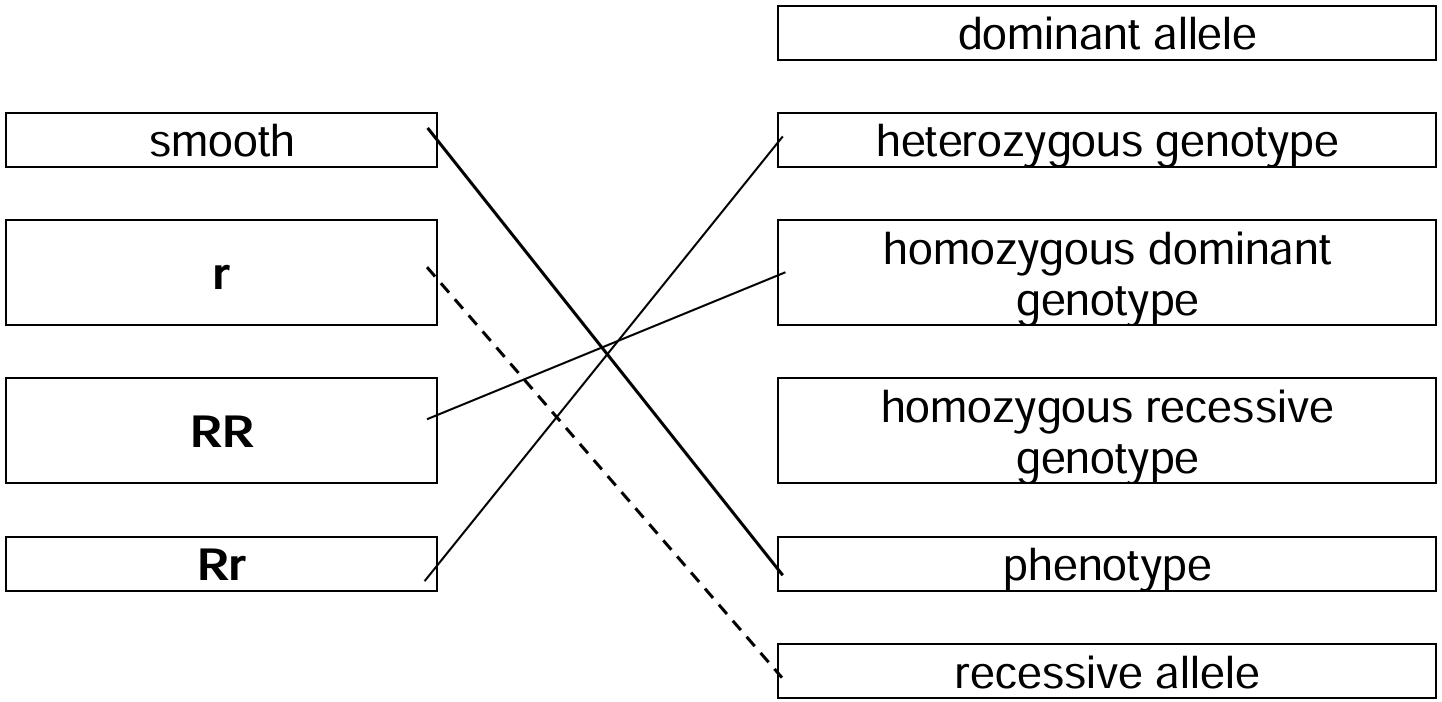
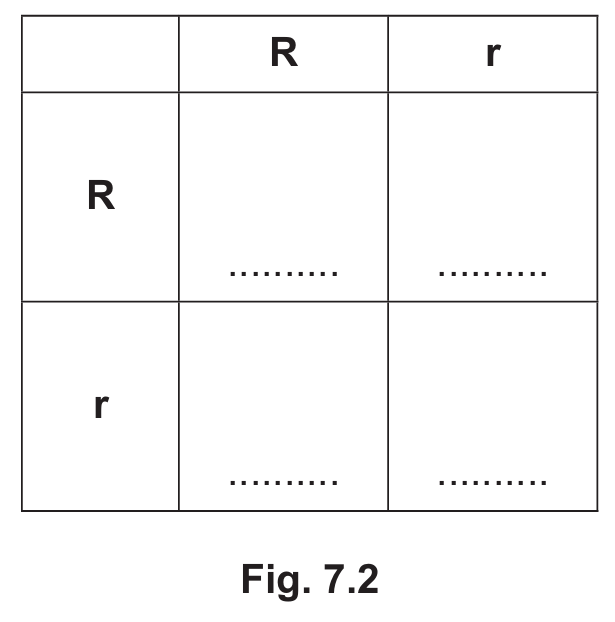
(b)(ii) Completed Punnett square (both parents are Rr × Rr):
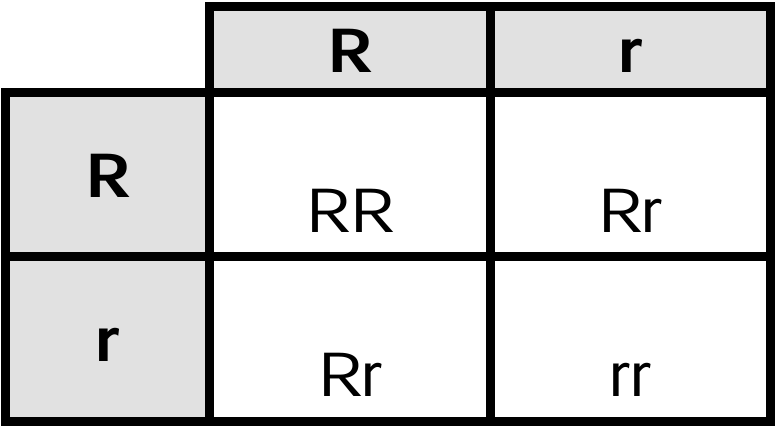
Offspring genotypes: RR : Rr : rr = 1 : 2 : 1
Only rr gives wrinkled shape.
Percentage likelihood = \(\dfrac{1}{4} \times 100 = \mathbf{25\%}\)
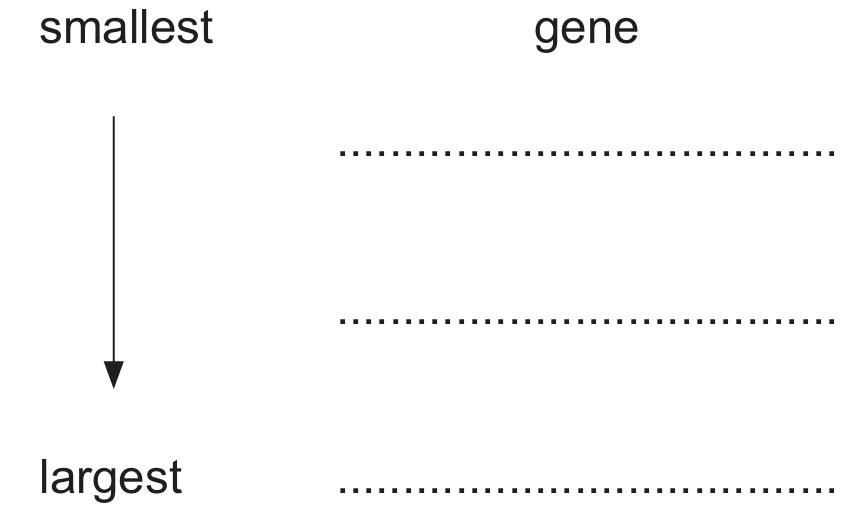
(c) Smallest to largest:
gene → chromosome → nucleus → cell
Genes are segments of DNA on chromosomes; chromosomes are found in the nucleus; the nucleus is contained within the cell.
Question 8
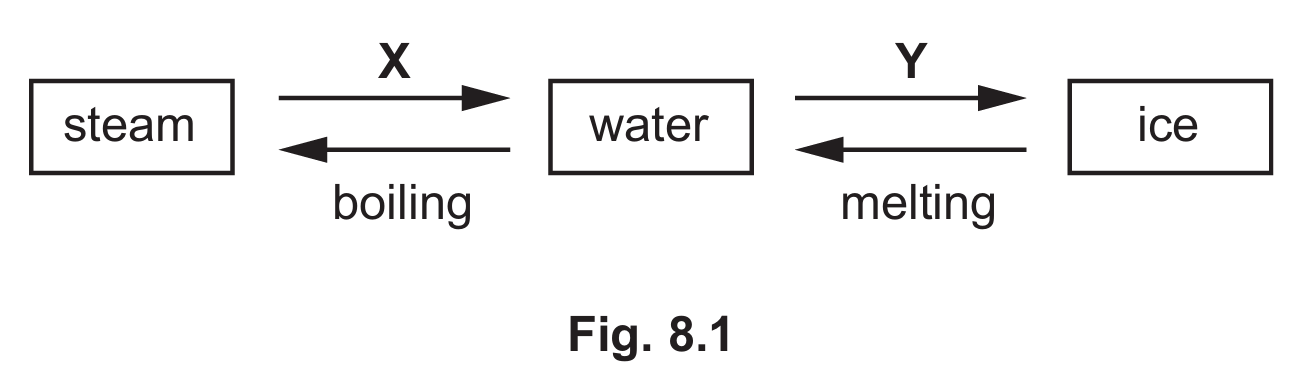
Give a reason for your answer.
\(\ldots \, \text{H}_2 + \text{O}_2 \rightarrow \ldots \, \text{H}_2\text{O}\)
Most-appropriate topic codes (Cambridge IGCSE Co-ordinated Sciences 0654):
• Topic C1.1 — Solids, liquids and gases (Part (a))
• Topic C2.5 — Simple molecules and covalent bonds (Part (b))
• Topic C10.1 — Water (Part (c))
• Topic C3.1 — Formulas (Part (d))
▶️ Answer/Explanation
(a)(i)
X = condensation (steam → water; arrow going from steam to water, reverse of boiling)
Y = solidification / freezing (water → ice; arrow going from water to ice, reverse of melting)
(a)(ii)
change: physical
reason: No new substance is formed during boiling / the process is reversible (water can be condensed back from steam).
Boiling simply changes the state of water from liquid to gas without breaking or forming any chemical bonds between atoms.
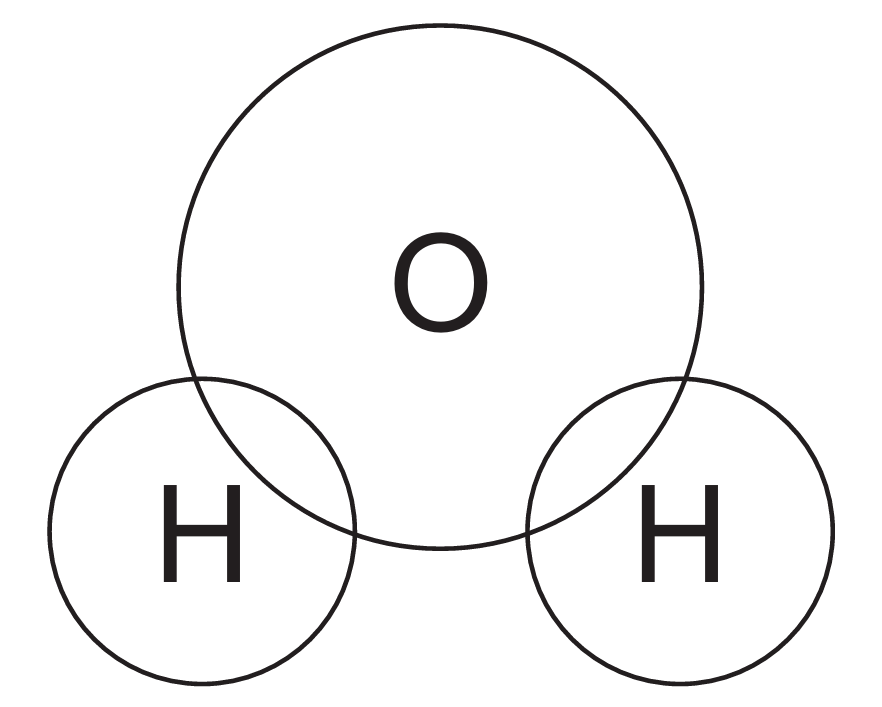
(b)(i) The completed dot-and-cross diagram for water (\(\text{H}_2\text{O}\)):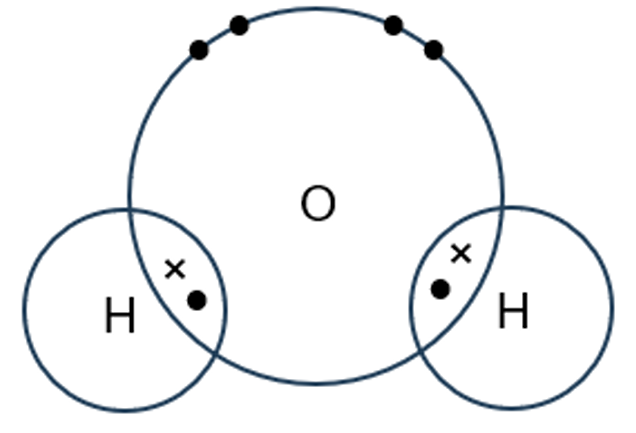
Oxygen has 6 outer-shell electrons; each hydrogen has 1 electron.
Each O–H bond is formed by one shared pair of electrons (one dot from O, one cross from H), placed in the overlapping region of the circles.
Oxygen also has two lone pairs (non-bonding pairs) of electrons in its outer shell.
(b)(ii) Covalent bonds
In a water molecule, each hydrogen atom shares a pair of electrons with the oxygen atom, forming covalent bonds.
Covalent bonds involve the sharing (not transfer) of electron pairs between non-metal atoms.
(c)
filtration: removes solid matter / insoluble particles / suspended solids from the water.
chlorination: kills bacteria / microorganisms in the water to make it safe to drink.
(d)
\(2\text{H}_2 + \text{O}_2 \rightarrow 2\text{H}_2\text{O}\)
Left side: \(2 \times 2 = 4\) H atoms and \(2\) O atoms.
Right side: \(2 \times 2 = 4\) H atoms and \(2 \times 1 = 2\) O atoms. ✓ Balanced.
Question 9
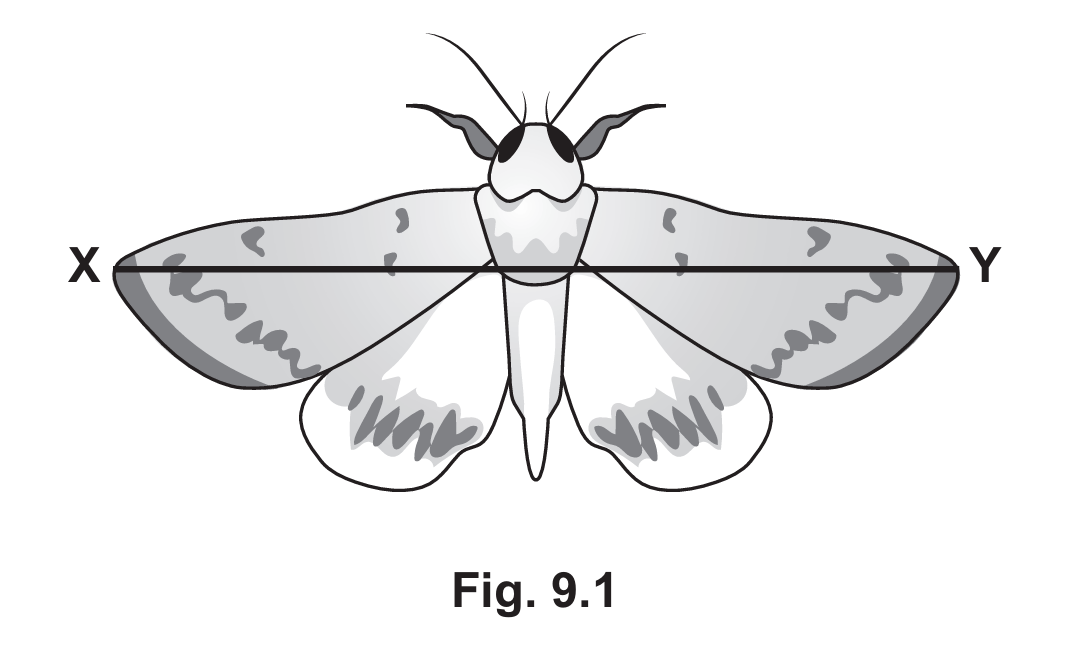
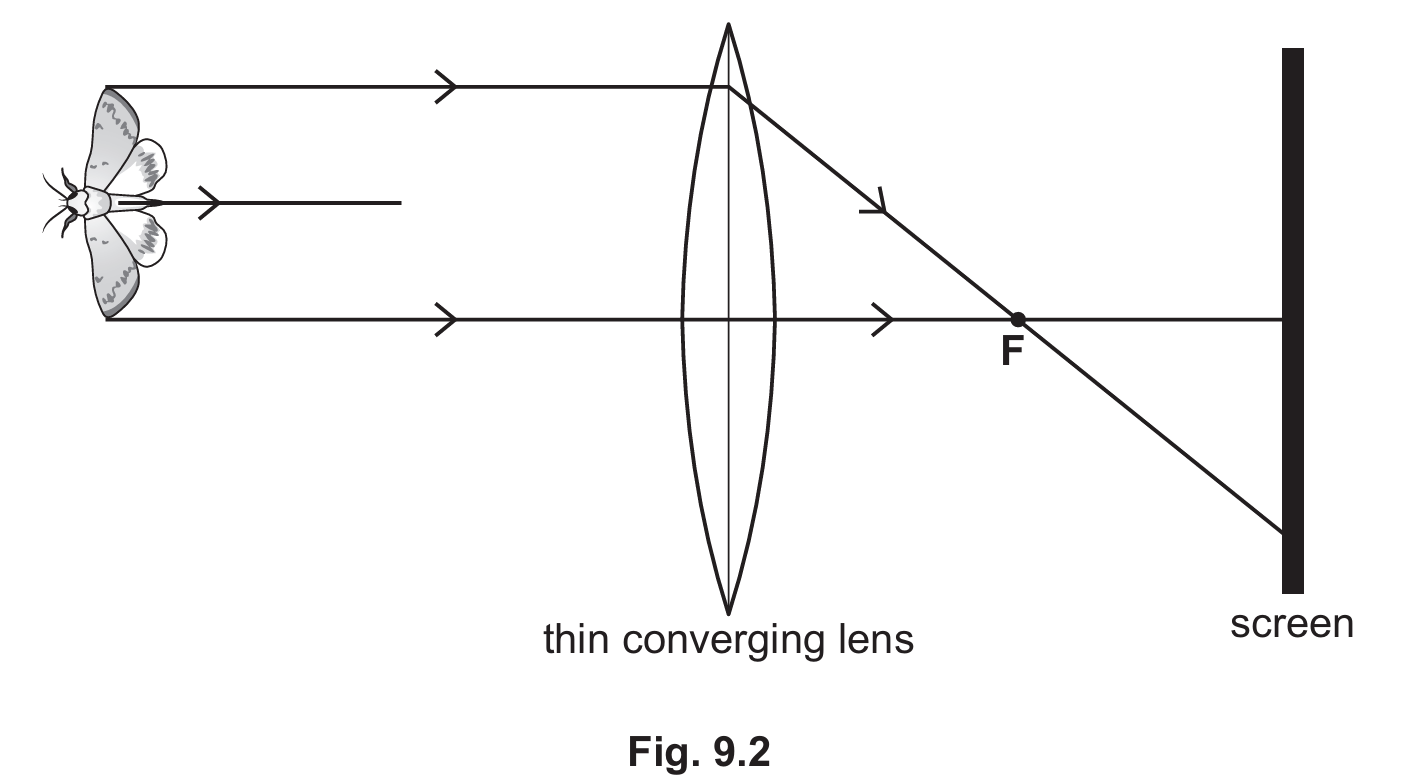
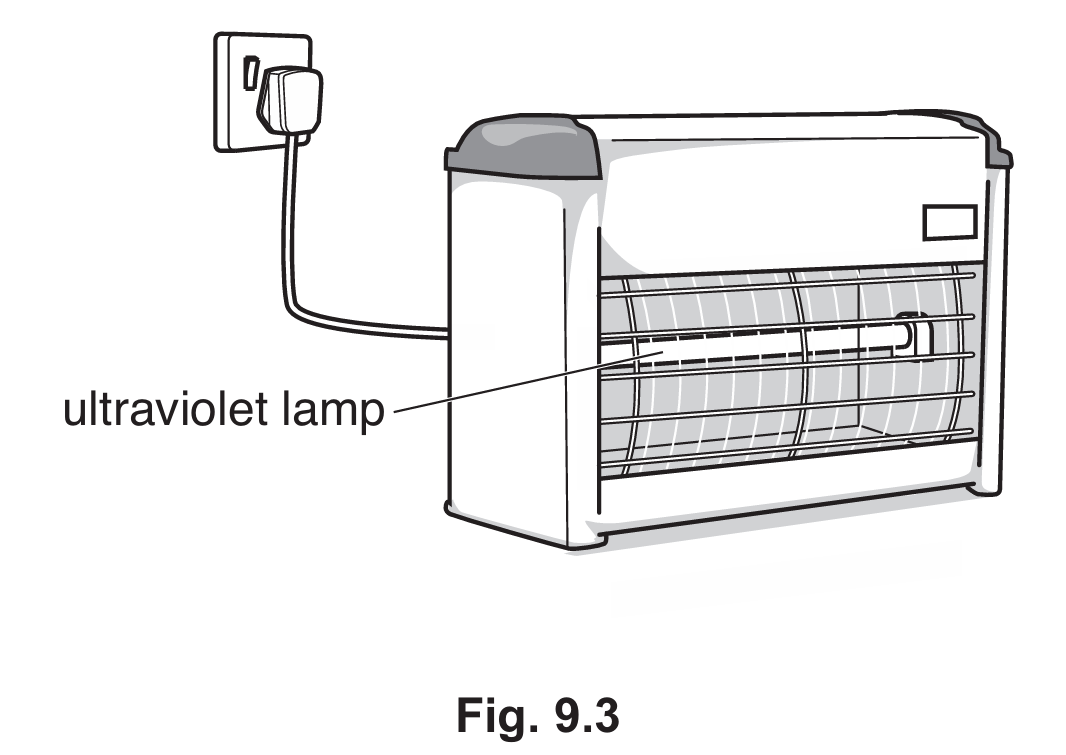
Most-appropriate topic codes (Cambridge IGCSE Co-ordinated Sciences 0654):
• Topic P3.2.3 — Thin converging lens (Part (a))
• Topic P3.4 — Sound (Part (b))
• Topic P4.2.4 — Resistance (Part (c)(i))
• Topic P3.3 — Electromagnetic spectrum (Part (c)(ii))
▶️ Answer/Explanation
(a)(i) The ray from the moth’s body travels horizontally to the lens (parallel to the principal axis), then refracts and passes through the principal focus F on the other side.
A ray passing through the optical centre of the lens continues in a straight line without bending.
The intersection of refracted rays on the screen gives the position of the image point from the body.
(a)(ii) The double-headed arrow (↕) should be drawn on the screen between the image points of the wings (from the existing rays) and the body (from the completed ray).
The image formed by a converging lens with the object beyond 2F is real, inverted, and diminished or same size.
The arrow on the screen is inverted relative to the object (moth).
(a)(iii) Principal focus / focal point
The point F is the principal focus (or focal point) of the converging lens.
All rays travelling parallel to the principal axis converge at this point after passing through the lens.
(b)(i) 20,000 Hz
The maximum audible frequency for a healthy young human ear is approximately \(20{,}000 \, \text{Hz}\) (20 kHz).
This is far lower than the greater wax moth’s limit of 300,000 Hz.
(b)(ii) The frequency of a wave is the number of waves (complete oscillations) that pass a fixed point per unit time.
Frequency is measured in hertz (Hz), where \(1 \, \text{Hz} = 1\) wave per second.
It is related to period \(T\) by the formula \(f = \dfrac{1}{T}\).
(c)(i) 320 Ω
Using \(R = \dfrac{V}{I}\):
\(R = \dfrac{240}{0.75} = 320 \, \Omega\)
(c)(ii) Ultraviolet radiation can cause skin cancer / cataracts and eye damage / premature skin ageing.
UV radiation carries enough energy to damage DNA in skin cells, which can lead to mutations and cancer.
It can also damage the lens of the eye, causing cataracts, or suppress the immune system.
Question 10
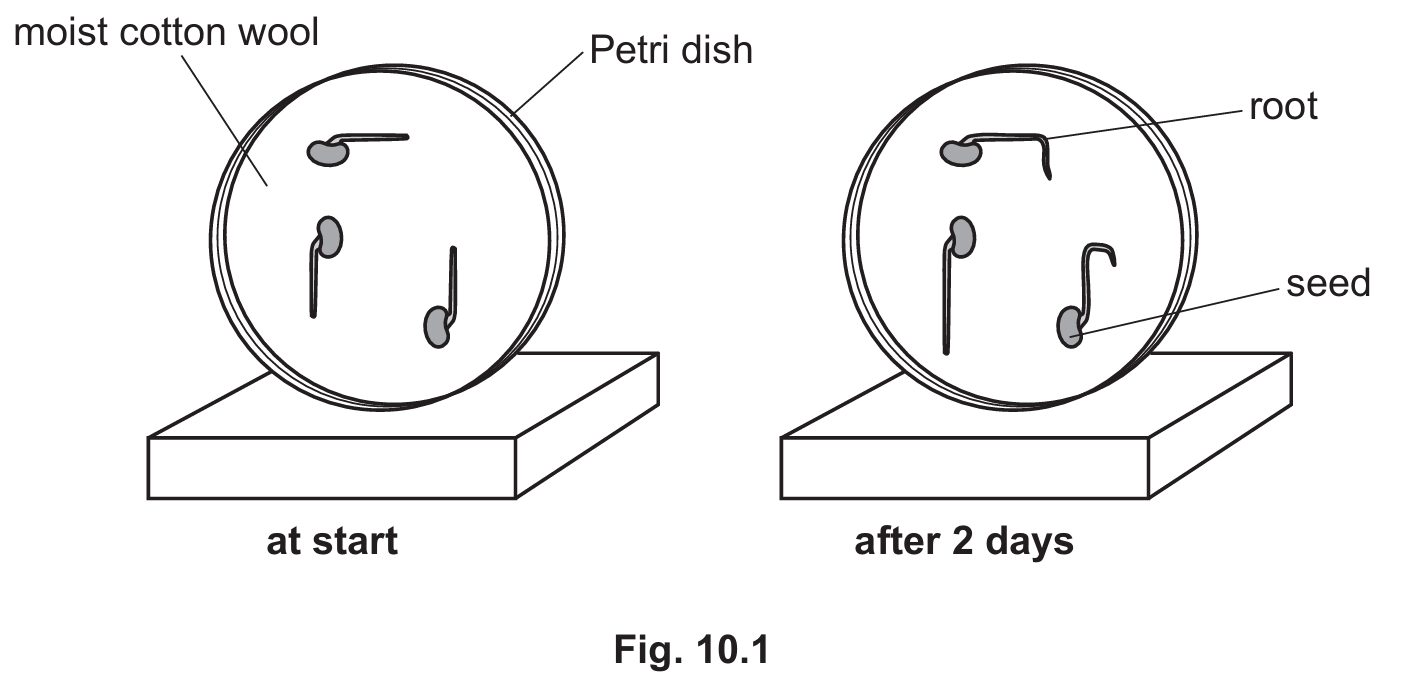
After 2 days the roots have grown downwards.
This is a tropic response called ……………………………
The roots are growing downwards towards …………………………… to receive more water from the soil.
Most-appropriate topic codes (Cambridge IGCSE Co-ordinated Sciences 0654):
• Topic B13.1 — Coordination and response (Part (a)(i))
• Topic B8.2 — Water uptake (Part (a)(ii)–(iv))
• Topic B6.1 — Photosynthesis (Part (b))
• Topic B1.1 — Characteristics of living organisms (Part (c))
▶️ Answer/Explanation
(a)(i)
This is a tropic response called gravitropism (also accepted: geotropism).
The roots are growing downwards towards gravity to receive more water from the soil.
Roots are positively gravitropic — they grow in the direction of gravitational pull, which helps them anchor the plant and absorb water.
(a)(ii) Any two from:
1. Photosynthesis — water is a raw material for making glucose using light energy.
2. Support — water provides turgor pressure to keep plant cells firm and the plant upright.
(Also accepted: as a solvent; for germination; transport of minerals.)
(a)(iii) Root hair cell
Root hair cells have a large surface area due to their long thin extensions (root hairs), maximising water absorption from the soil.
Water enters by osmosis from the soil solution into the root hair cells.
(a)(iv) Xylem (vessels)
Xylem vessels are hollow, dead cells that form continuous tubes from root to leaf.
Water moves up through the xylem by transpiration pull (the movement of water due to evaporation from leaves).
(b) magnesium
Magnesium ions (\(\text{Mg}^{2+}\)) are essential for the synthesis of chlorophyll, the green pigment used in photosynthesis.
A magnesium deficiency causes yellowing of leaves (chlorosis) because chlorophyll cannot be produced.
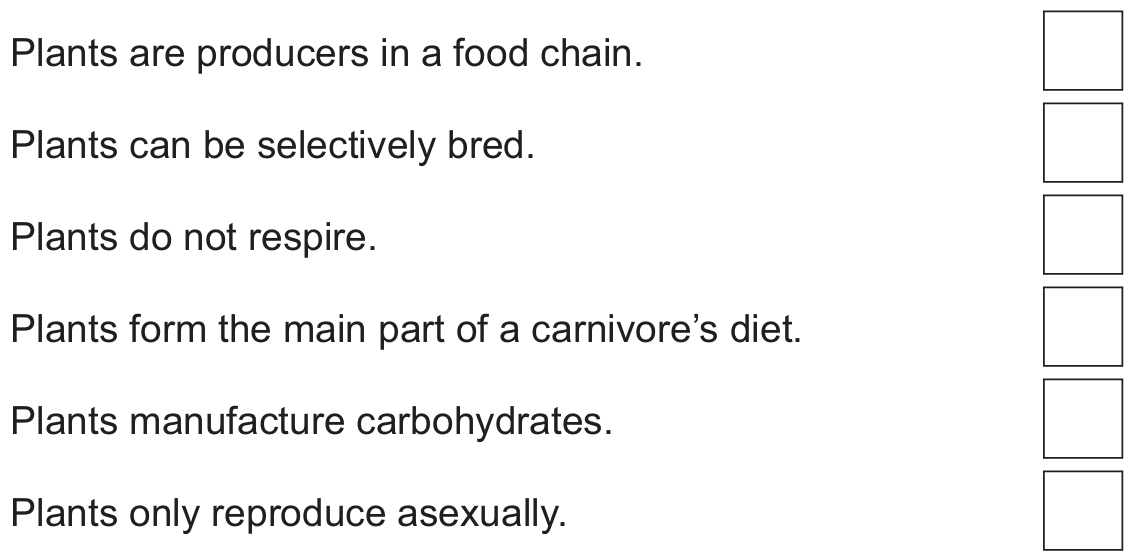
(c) Three correct statements: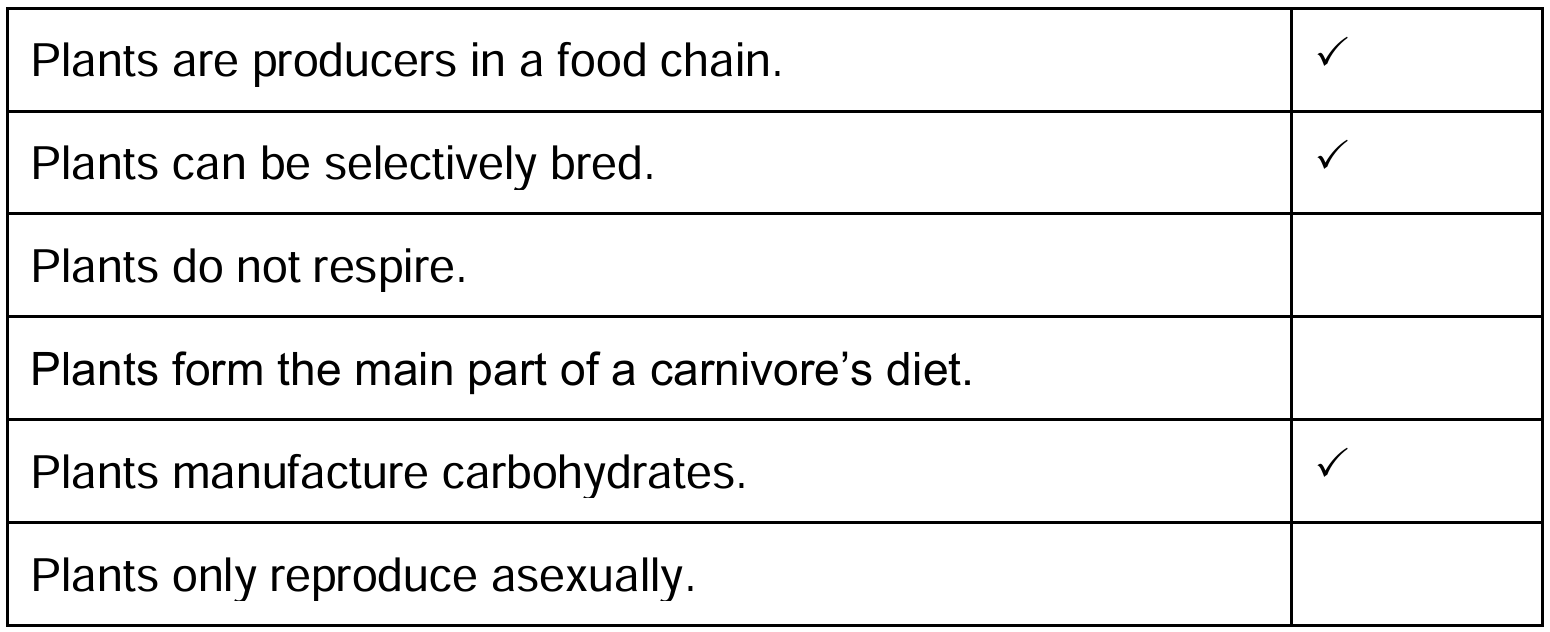
The other statements are incorrect: plants do respire; plants do not form the main part of a carnivore’s diet; and plants can reproduce both sexually and asexually.
Question 11
Most-appropriate topic codes (Cambridge IGCSE Co-ordinated Sciences 0654):
• Topic C11.5 — Alkenes (Part (a))
• Topic C11.7 — Polymers (Part (b)(iii))
• Topic C11.3 — Fuels, combustion (Part (b)(i))
• Topic C11.3 — Fuels, cracking (Part (b)(ii))
▶️ Answer/Explanation
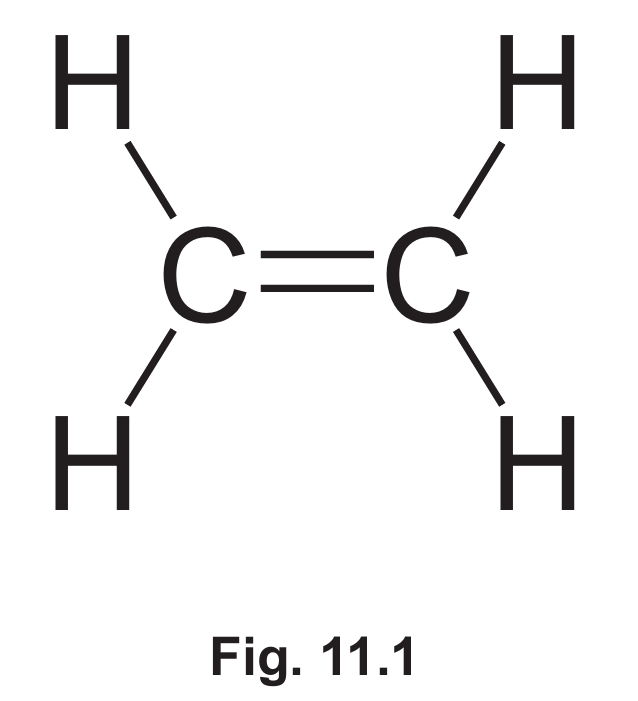
(a)(i) 6 atoms
Ethene contains 2 carbon atoms and 4 hydrogen atoms.
Total atoms = \(2 + 4 = 6\)
(a)(ii) \(\text{C}_2\text{H}_4\)
The molecular formula of ethene is \(\text{C}_2\text{H}_4\), showing 2 carbon atoms and 4 hydrogen atoms per molecule.
It belongs to the alkene homologous series (general formula \(\text{C}_n\text{H}_{2n}\)).
(a)(iii) Ethene contains a C=C double bond.
Unsaturated molecules contain at least one carbon-carbon double bond (\(\text{C=C}\)).
This means not all carbon atoms are bonded to the maximum possible number of hydrogen atoms — they are not fully “saturated” with hydrogen.
(a)(iv)
test: Add aqueous bromine (bromine water).
observations (positive result): The orange/brown bromine water turns colourless.
The \(\text{C=C}\) double bond reacts with bromine in an addition reaction, decolourising the solution.
(b)(i)
1. Carbon dioxide (\(\text{CO}_2\))
2. Water (\(\text{H}_2\text{O}\))
Complete combustion of any hydrocarbon in excess oxygen produces only carbon dioxide and water.
(b)(ii) Cracking
Cracking is the process by which large hydrocarbon molecules from petroleum are broken down into smaller, more useful molecules.
It involves high temperatures (thermal cracking) or catalysts (catalytic cracking) to break C–C bonds.
(b)(iii) During polymerisation, many small ethene molecules (monomers) join together to form a single long-chain molecule (polymer).
The \(\text{C=C}\) double bond in each ethene monomer opens up, allowing the carbon atoms to bond to adjacent monomers.
This addition polymerisation produces poly(ethene), a long-chain polymer with repeating \(-\text{CH}_2\text{CH}_2-\) units.
Question 12
Most-appropriate topic codes (Cambridge IGCSE Co-ordinated Sciences 0654):
• Topic P3.3 — Electromagnetic spectrum (Parts (a), (b), (c))
• Topic P1.6.3 — Energy resources (Part (d))
▶️ Answer/Explanation
(a) 500 s
First, convert distance: \(1.5 \times 10^8 \, \text{km} = 1.5 \times 10^{11} \, \text{m}\)
Using \(t = \dfrac{d}{v} = \dfrac{1.5 \times 10^{11}}{3.0 \times 10^8} = 500 \, \text{s}\)
(b)
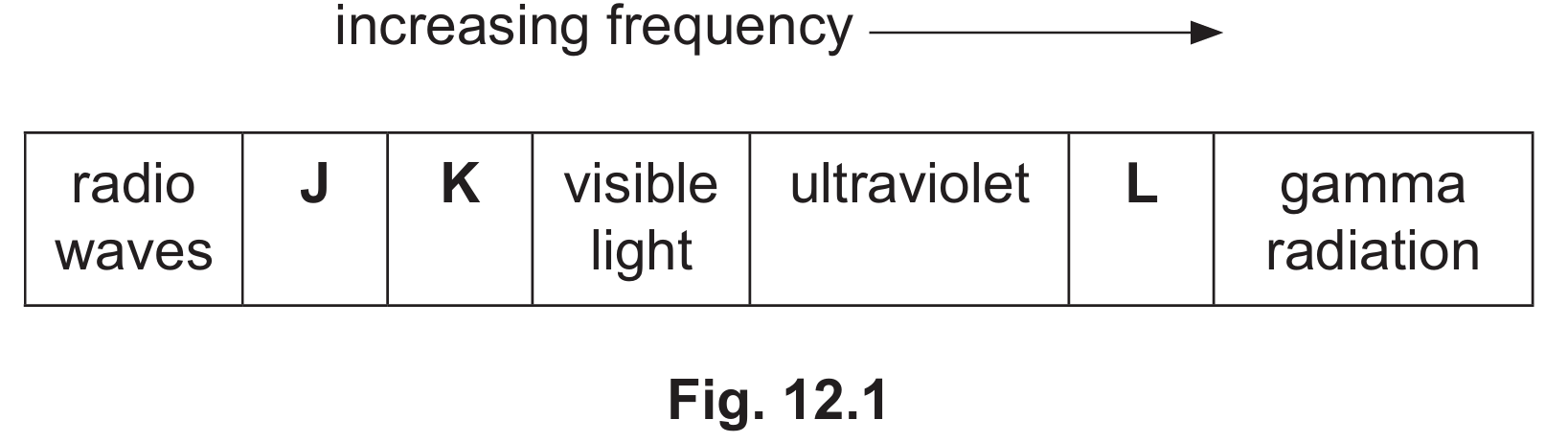
J = microwaves
K = infrared radiation
L = X-rays
The electromagnetic spectrum in order of increasing frequency: radio waves → microwaves → infrared → visible light → ultraviolet → X-rays → gamma radiation.
(c)
Space is a vacuum — there are no particles between the Sun and the Earth.
Conduction and convection both require particles (a medium) to transfer energy, so they cannot operate through the vacuum of space.
Radiation (electromagnetic waves) does not need a medium and can travel through a vacuum.
(d)(i) Any two renewable sources from:
geothermal, hydroelectric, waves, wind
(Renewable energy sources are naturally replenished and will not run out.)
(d)(ii)
coal and natural gas
(Both are fossil fuels formed over millions of years from the remains of ancient organisms; once used they cannot be replaced on a human timescale.)