
Question 1
Most-appropriate topic codes (Cambridge IGCSE Co-ordinated Sciences 0654):
• Topic B7.2 — Digestive system (Part (a))
• Topic B5 — Enzymes (Part (b))
• Topic B7.3 — Digestion (Parts (c), (d))
▶️ Answer/Explanation
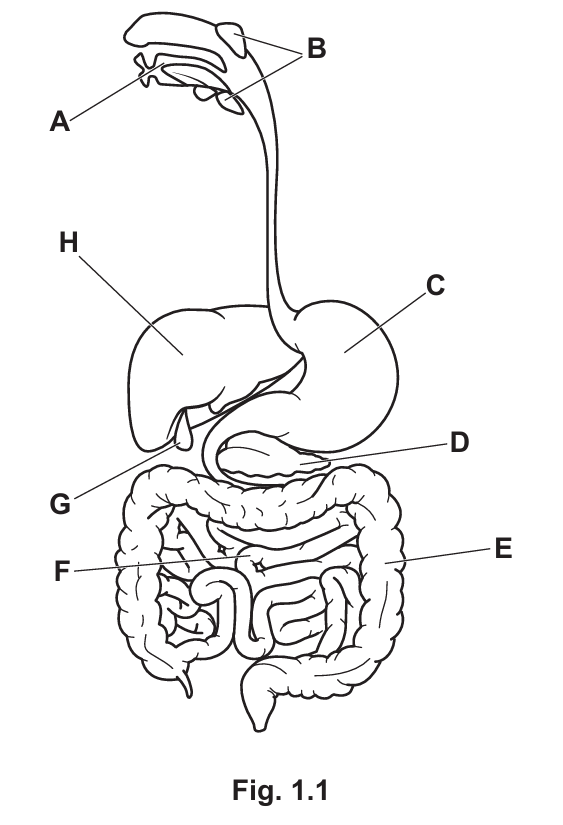
(a) villi: F bile: H insulin: D mechanical digestion: A and/or C
The small intestine (F) has a folded lining covered in villi that increase surface area for absorption.
The liver (H) produces bile, which is stored in the gall bladder and released into the duodenum.
The pancreas (D) contains islet cells that secrete the hormone insulin.
Mechanical digestion (physical breakdown without chemical change) occurs in the mouth (A), where teeth chew food, and/or the stomach (C), where muscular churning breaks food up further.
(b) Salivary amylase; breaks down starch into simpler sugars
Part B is the salivary gland, which secretes the enzyme amylase.
Amylase is a carbohydrase that catalyses the hydrolysis of starch (a carbohydrate) into maltose, a simpler/smaller sugar molecule.
This chemical digestion begins in the mouth and continues until the enzyme is denatured by stomach acid.
(c) Any two of: incisor, canine, pre-molar, molar
Humans have four types of teeth specialised for different jobs: incisors and canines for cutting/tearing, and pre-molars and molars for crushing/grinding food.
Stating any two of these four named types earns full credit.
(d) Any four of: neutralises stomach acid to give a suitable pH; emulsifies fats; increases surface area for chemical digestion; increases the rate of digestion
Bile is alkaline, so it neutralises the acidic chyme arriving from the stomach, creating the optimum pH for intestinal and pancreatic enzymes such as lipase.
Bile also emulsifies fats, breaking large fat droplets into smaller ones.
This increases the surface area of fat exposed to lipase, which speeds up (chemical) fat digestion.
Question 2

\( 2SO_2 + \text{……..} \rightleftharpoons \text{…..} \, SO_3 \)
\( \text{……} + SO_3 \rightarrow H_2S_2O_7 \)
\( H_2S_2O_7 + \text{…….} \rightarrow 2H_2SO_4 \)
Most-appropriate topic codes (Cambridge IGCSE Co-ordinated Sciences 0654):
• Topic C1.1 — Solids, liquids and gases (Parts (a), (b))
• Topic C1.2 — Diffusion (Part (c))
• Topic C10.2 — Air quality and climate (Part (d))
▶️ Answer/Explanation
(a) 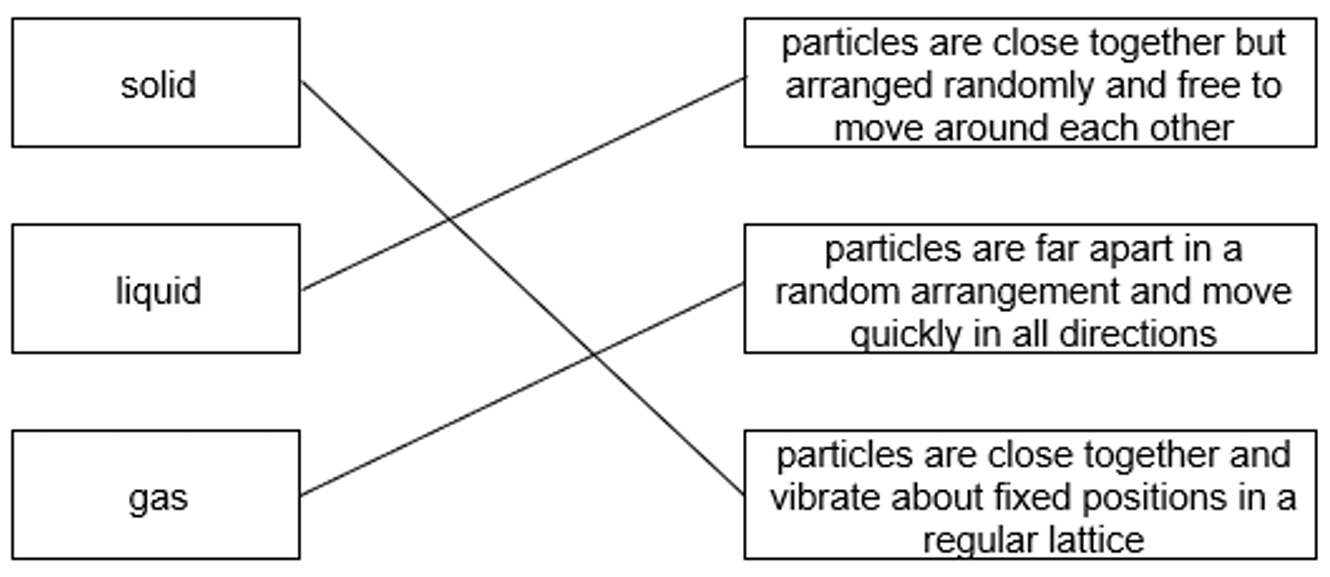
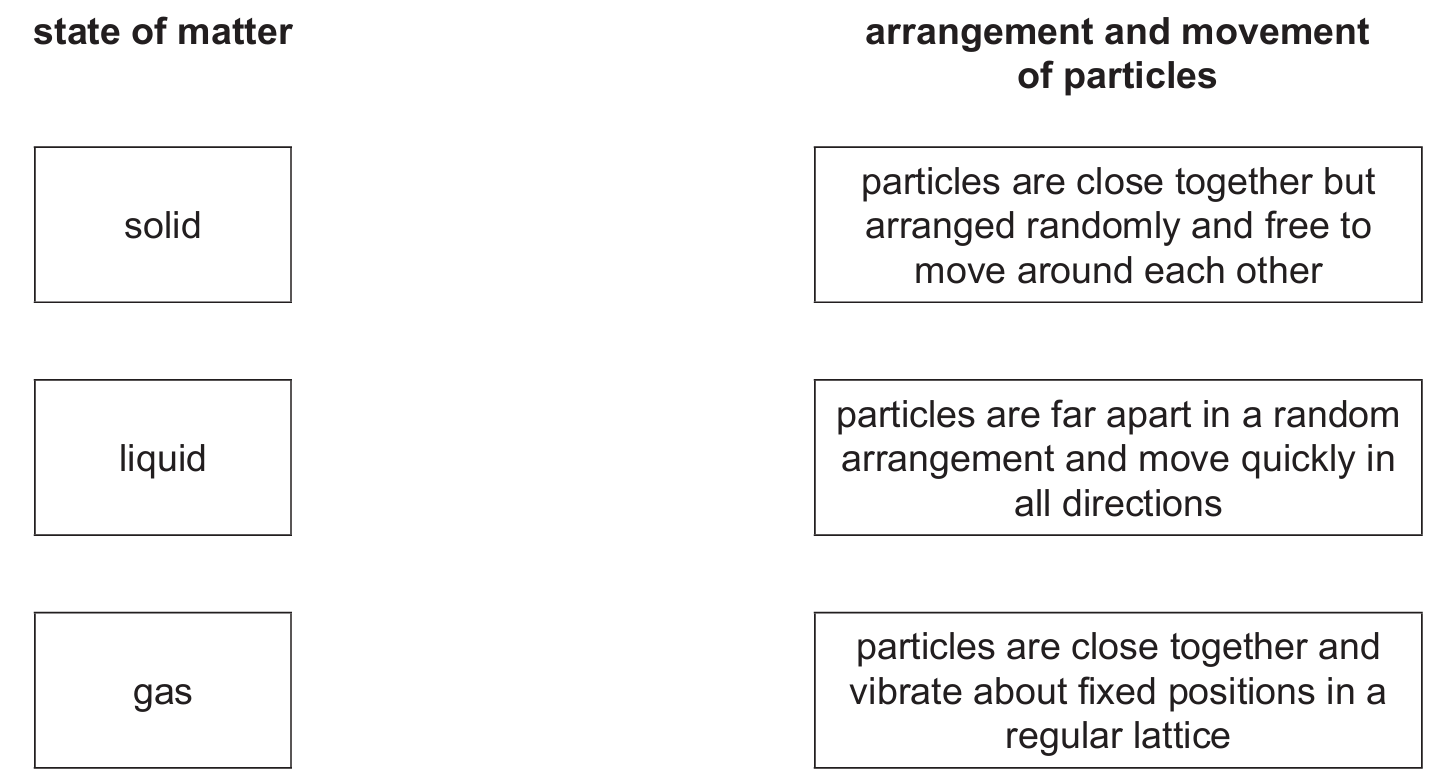
In a solid, strong forces hold particles in fixed positions in a lattice, so they can only vibrate.
In a liquid, particles stay close together but the weaker forces let them move past one another.
In a gas, particles are far apart with negligible forces between them, so they move rapidly and randomly.
(b) Solid B; melts over a range of temperatures rather than at one sharp point
A pure substance melts at one fixed, sharp temperature.
Solid B melts over a range (81–88 °C) instead of at a single value, which is the signature of an impure substance/mixture.
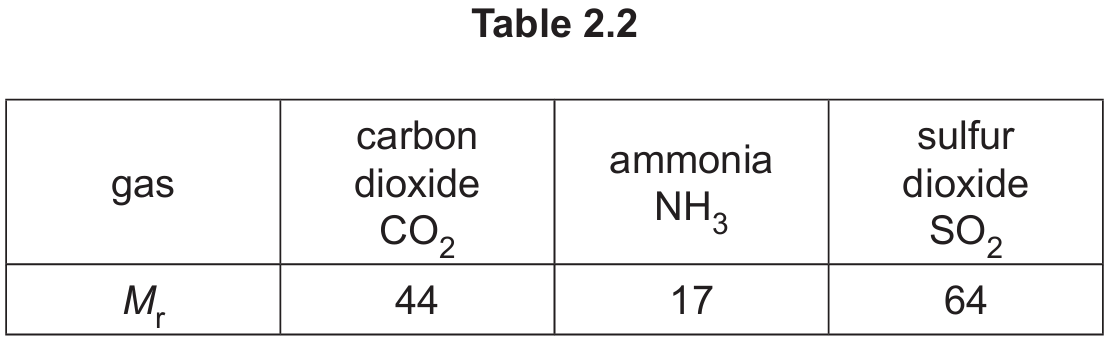
(c) Ammonia, NH\(_3\); it has the lowest \(M_r\) (17), so it is the lightest/fastest-moving gas
Rate of diffusion is inversely related to the mass of the gas particles.
Since NH\(_3\) has the smallest relative molecular mass (17, compared with 44 for CO\(_2\) and 64 for SO\(_2\)), its particles move fastest and diffuse fastest.
(d)(i) Combustion of fossil fuels containing sulfur compounds
Sulfur impurities in coal and oil are oxidised to sulfur dioxide gas when these fuels are burned in power stations, vehicles, and industry.
(d)(ii) Causes acid rain (or causes breathing difficulties such as asthma)
Sulfur dioxide dissolves in atmospheric water to form dilute sulfurous/sulfuric acid, which falls as acid rain and damages buildings, water bodies and vegetation.
It also irritates the respiratory system, worsening conditions such as asthma.
(e) \(2SO_2 + O_2 \rightleftharpoons 2SO_3\); \(H_2SO_4 + SO_3 \rightarrow H_2S_2O_7\); \(H_2S_2O_7 + H_2O \rightarrow 2H_2SO_4\)
Sulfur dioxide is catalytically oxidised to sulfur trioxide in a reversible reaction.
Sulfur trioxide is then dissolved in concentrated sulfuric acid to form oleum (\(H_2S_2O_7\)), since SO\(_3\) reacts too violently with water directly.
The oleum is finally diluted carefully with water to give concentrated sulfuric acid.
Question 3
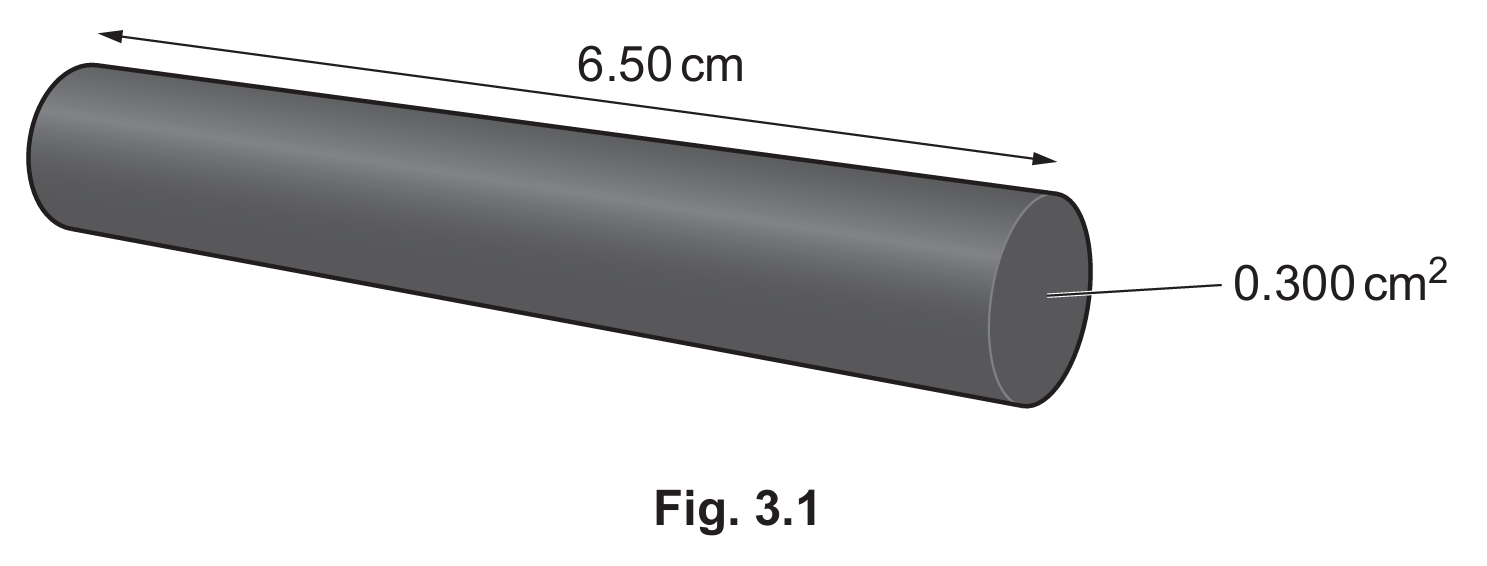
The cylinder is 6.50cm long and has a cross-sectional area of 0.300cm\(^2\).
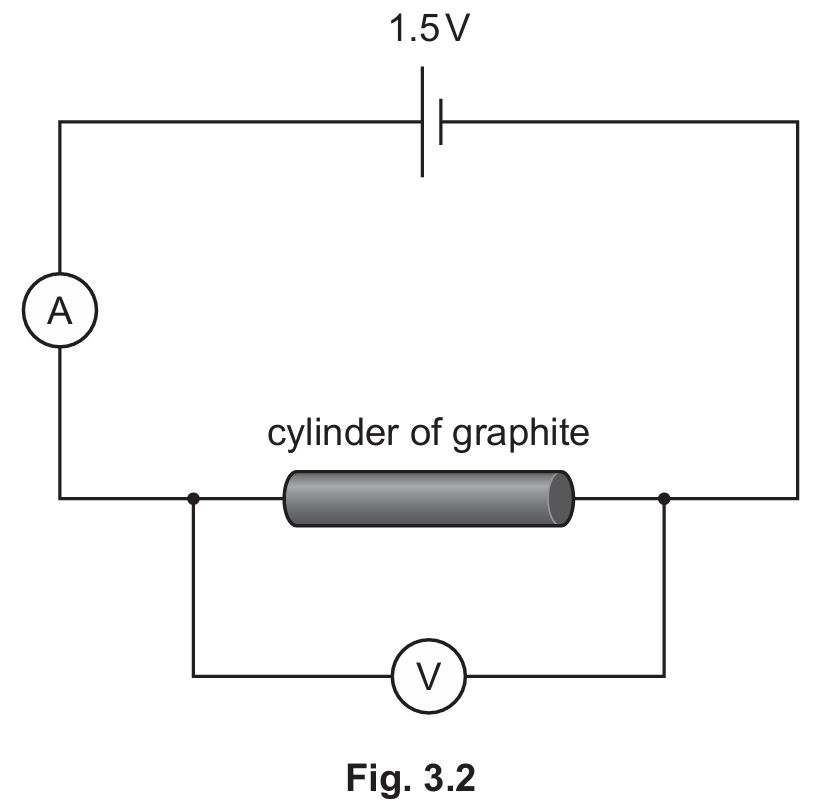
Use your answer to (b)(i) to calculate the resistance of the cylinder of graphite.
Explain why the resistance of both cylinders is the same.
Most-appropriate topic codes (Cambridge IGCSE Co-ordinated Sciences 0654):
• Topic P1.4 — Density (Part (a))
• Topic P4.2.4 — Resistance (Part (b))
• Topic P2.2.1 — Thermal expansion of solids, liquids and gases (conduction) (Part (c))
▶️ Answer/Explanation
(a)(i) Volume = \(6.50 \times 0.300 = 1.95 \, \text{cm}^3\)
Volume of a cylinder/cuboid-style solid here equals cross-sectional area multiplied by length.
\(1.95 \, \text{cm}^3\) confirms the value given in the question, showing the working clearly.
(a)(ii) 2.26 g/cm\(^3\)
Density is calculated using \(\rho = \dfrac{m}{V}\).
\(\rho = \dfrac{4.40}{1.95} = 2.256 \approx 2.26 \, \text{g/cm}^3\).
(b)(i) 1.5 V
In this single-loop circuit the voltmeter reads the same potential difference as the battery, since the graphite cylinder is the only component across it.
(b)(ii) 2.5 Ω
Resistance is found from \(R = \dfrac{V}{I}\).
\(R = \dfrac{1.5}{0.60} = 2.5 \, \Omega\).
(b)(iii) The two changes cancel out
Doubling the length doubles the resistance (longer path for charge carriers).
Doubling the cross-sectional area halves the resistance (more parallel pathways for current).
Since one effect doubles R while the other halves it, the overall resistance stays the same.
(c) Conduction by particle vibration and free electrons
In a solid, atoms vibrate about fixed positions, and these vibrations are passed on to neighbouring atoms, transferring thermal energy through the lattice.
In conductors such as graphite, free (delocalised) electrons also move through the structure, carrying thermal energy rapidly from hotter to cooler regions.
Question 4
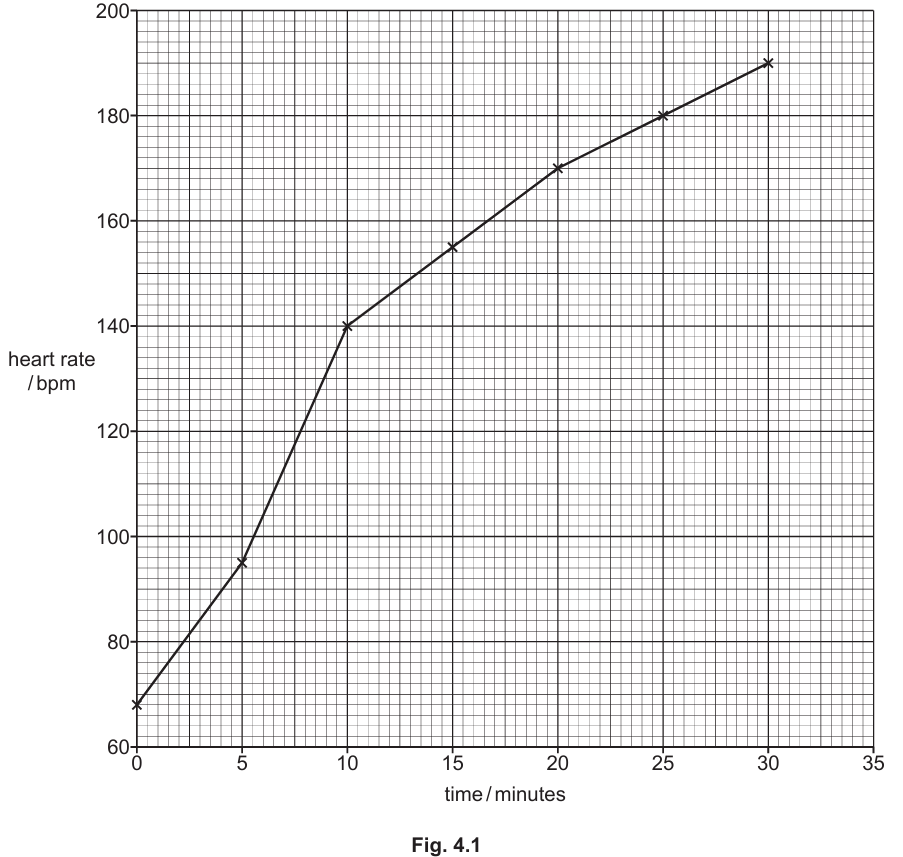
Heart rate increases because the body requires more energy for muscular ……………………… .
Energy is released by the process of aerobic respiration.
The oxygen required for aerobic respiration is transported by ……………………… in red blood cells.
Describe two disadvantages of anaerobic respiration.
Most-appropriate topic codes (Cambridge IGCSE Co-ordinated Sciences 0654):
• Topic B12 — Respiration (Parts (a), (b), (c))
• Topic B9.3 — Blood vessels (Part (d))
• Topic B8.1 — Xylem and phloem (Part (e))
▶️ Answer/Explanation
(a) 190 bpm; contraction; haemoglobin
Reading the graph, the heart rate plateaus/peaks at 190 bpm by 30 minutes.
Muscles need more energy for increased muscular contraction during exercise.
Oxygen is carried bound to haemoglobin inside red blood cells.
(b) \(C_6H_{12}O_6 + 6O_2 \rightarrow 6CO_2 + 6H_2O\)
Aerobic respiration fully oxidises glucose using oxygen.
The balanced equation requires 6 molecules of oxygen, producing 6 of carbon dioxide and 6 of water for every glucose molecule.
(c) Releases much less energy per glucose molecule; produces lactic acid causing an oxygen debt
Anaerobic respiration is incomplete, so far less energy is released from each glucose molecule than in aerobic respiration.
It also produces lactic acid in muscles, which builds up and must later be removed, creating an oxygen debt that causes muscle fatigue.
(d)(i) Veins carry blood at low pressure so need valves to prevent backflow
Blood in veins is at low pressure after passing through the capillaries, so without help it could flow backwards, especially against gravity in the legs.
Valves ensure one-way flow of blood back to the heart, whereas the high pressure generated by the heart in arteries keeps blood flowing forward without needing valves.
(d)(ii) Aorta
The aorta is the main/largest artery leaving the left ventricle, carrying oxygenated blood away from the heart to the rest of the body.
(e) Xylem and phloem
Xylem transports water and dissolved mineral ions from roots to leaves.
Phloem transports dissolved food (sucrose and amino acids) made by photosynthesis around the plant.
Question 5
Most-appropriate topic codes (Cambridge IGCSE Co-ordinated Sciences 0654):
• Topic C2.2 — Atomic structure and the Periodic Table (Part (a))
• Topic C2.3 — Isotopes (Part (b))
• Topic C2.5 — Simple molecules and covalent bonds (Part (c))
• Topic C2.6 — Giant covalent structures (Part (d))
▶️ Answer/Explanation
(a) Protons and neutrons; shells
The nucleus contains the two types of heavy, charged/neutral particles: protons and neutrons.
Electrons surround the nucleus arranged in a series of shells (energy levels).
(b) Atoms of the same element with the same proton (atomic) number but different nucleon (mass) numbers
Isotopes are atoms of one element that all have identical numbers of protons, so they behave chemically the same way.
They differ only in their number of neutrons, giving them different mass numbers.
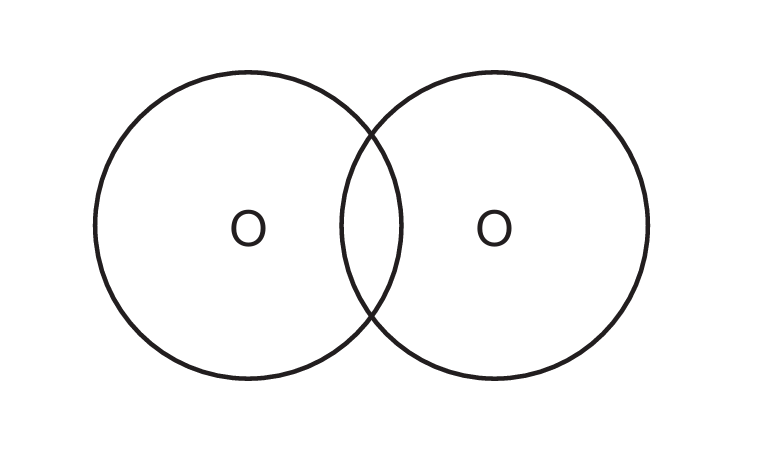
(c) Each oxygen atom shares two pairs of electrons (a double bond)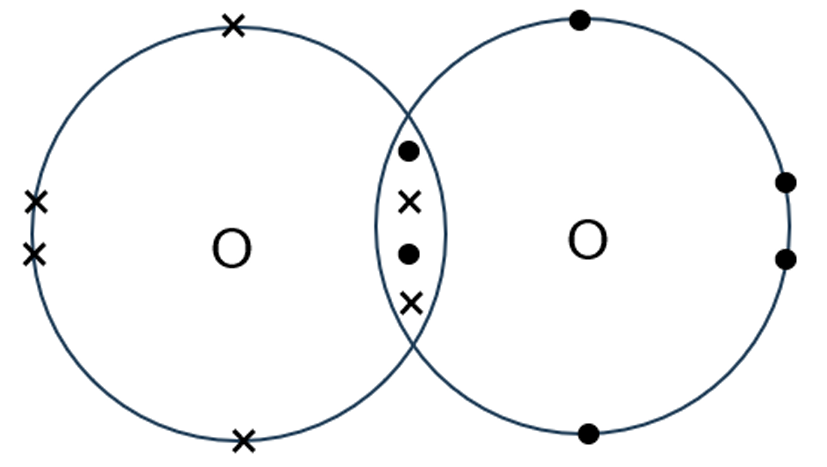
In \(O_2\), each oxygen atom contributes two electrons to a shared pair, forming two shared pairs (a double covalent bond) between the atoms.
The remaining outer-shell electrons are shown as non-bonding (lone) pairs on each oxygen, giving each atom a full outer shell of 8 electrons.
(d) Giant covalent (macromolecular) lattice structure
Silicon(IV) oxide forms a giant covalent/macromolecular lattice rather than simple molecules.
Each silicon atom is covalently bonded to four oxygen atoms, and each oxygen atom is bonded to two silicon atoms, with electrons shared throughout the structure — explaining its high melting point and hardness.
Question 6
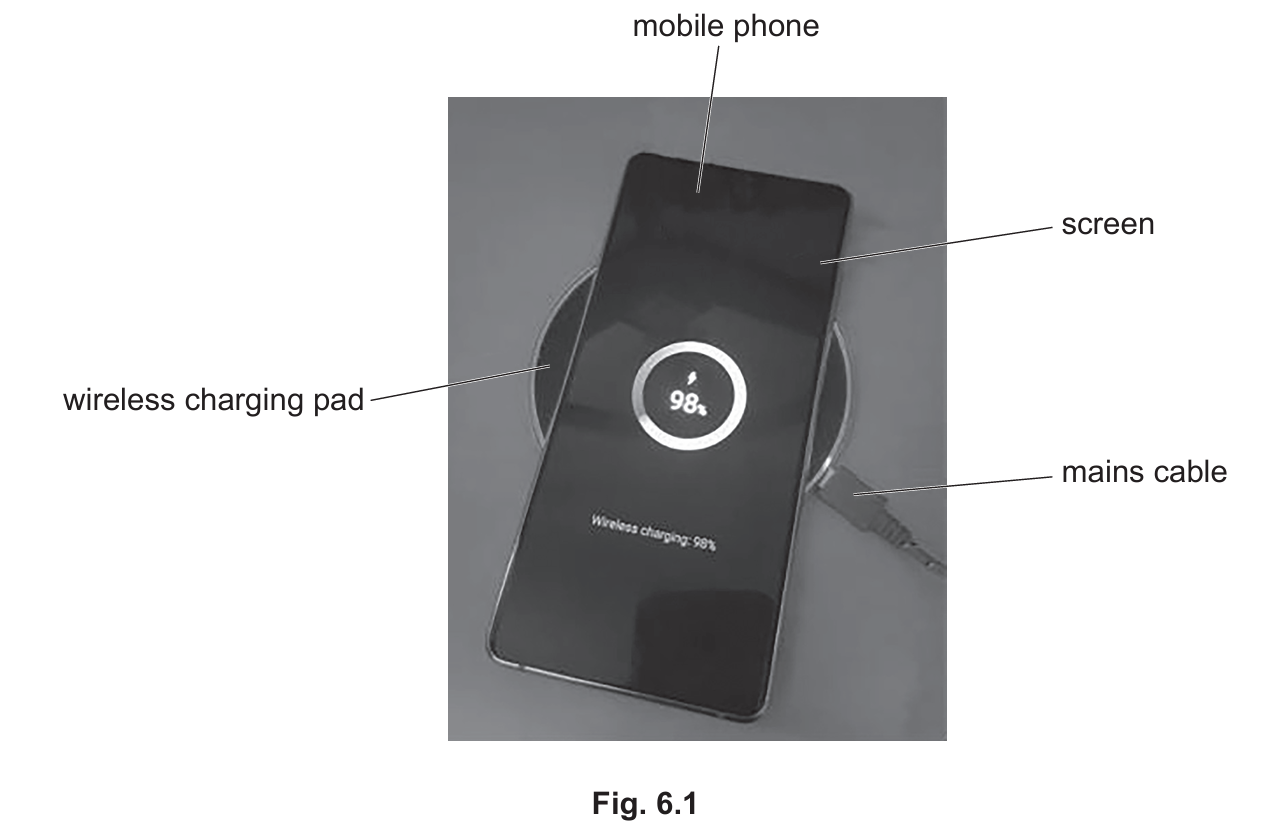
The angle of incidence is 53°.
The refractive index of glass is 1.5.
Calculate the angle of refraction \(r\).
The current used to charge the battery is 0.60A.
Calculate the time taken to fully charge the mobile phone battery.
The mobile phone contains a second coil of wire.
Describe how an electromotive force (e.m.f.) is induced in the second coil of wire when the mobile phone is placed on the charging pad.
Most-appropriate topic codes (Cambridge IGCSE Co-ordinated Sciences 0654):
• Topic P3.2.2 — Refraction of light (Part (a))
• Topic P4.2.2 — Electric current (charge) (Part (b))
• Topic P4.5.1 — Electromagnetic induction (Part (c))
▶️ Answer/Explanation
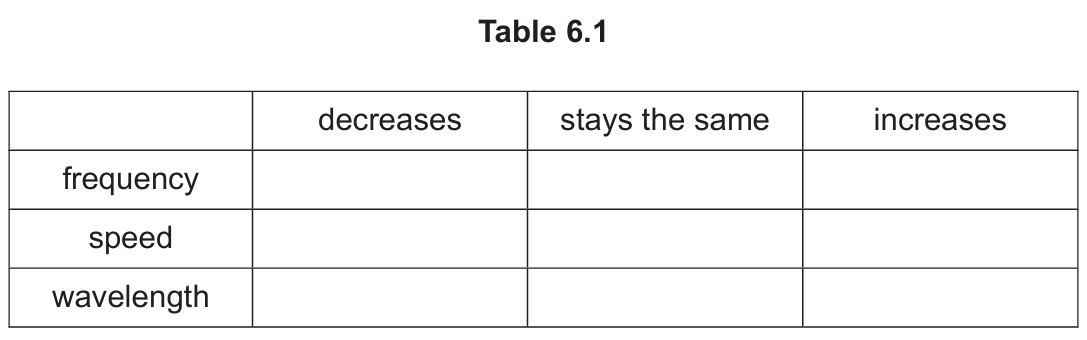
(a)(i) Frequency stays the same; speed decreases; wavelength decreases
Frequency is set by the light source and does not change when entering a new medium.
Glass is denser (optically) than air, so light slows down on entering it, and since \(v = f\lambda\) with f constant, the wavelength must also decrease.
(a)(ii) 32°
Using \(n = \dfrac{\sin i}{\sin r}\): \(1.5 = \dfrac{\sin 53°}{\sin r}\).
\(\sin r = \dfrac{\sin 53°}{1.5} = \dfrac{0.7986}{1.5} = 0.532\), so \(r = 32°\).
(b) 5500 s
Charge is related to current and time by \(Q = It\), so \(t = \dfrac{Q}{I}\).
\(t = \dfrac{3300}{0.60} = 5500 \, \text{s}\).
(c) A changing magnetic field around the first coil induces an e.m.f. in the second coil
The alternating current in the charging-pad coil produces a continuously changing magnetic field around it.
When the phone’s coil is placed within this changing field, the changing magnetic flux through it induces an e.m.f. (electromagnetic induction).
Question 7
Most-appropriate topic codes (Cambridge IGCSE Co-ordinated Sciences 0654):
• Topic B3.2 — Osmosis (Part (a))
• Topic B15.1 — Asexual reproduction (Part (b)(i))
• Topic B17.2 — Selection / variation (Part (b)(ii))
• Topic B6.1 — Photosynthesis (raw materials for growth) (Part (b)(iii))
▶️ Answer/Explanation
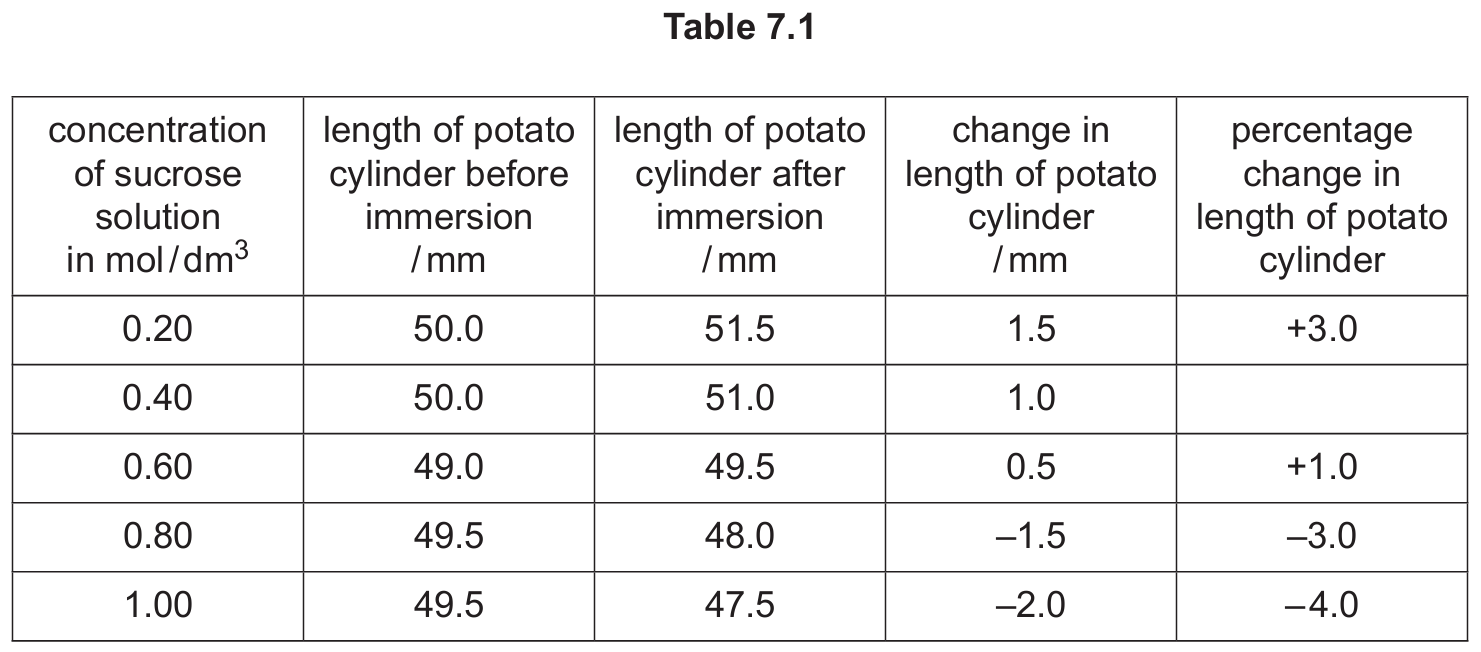
(a)(i) +2.0%
Percentage change is found using \(\dfrac{\text{change in length}}{\text{original length}} \times 100\).
\(\dfrac{1.0}{50.0} \times 100 = +2.0\%\).
(a)(ii) 0.60 mol/dm\(^3\)
The water potential gradient is smallest where the solution’s concentration is closest to the potato cell’s own internal concentration, here shown by the smallest percentage change in length (+1.0%), which occurs at 0.60 mol/dm³.
(a)(iii) 0.20 mol/dm\(^3\)
The most dilute solution (0.20 mol/dm³) has the highest water potential outside the cell, so water enters the cells by osmosis the most, producing the greatest turgor pressure (shown by the largest positive % length change).
(a)(iv) Osmosis
The net movement of water across the partially permeable cell membranes, down a water potential gradient, is osmosis.
(b)(i) Mitosis
Asexual reproduction in plants relies on mitosis, which produces genetically identical daughter cells/offspring.
(b)(ii) Little/no genetic diversity, so all plants share the same vulnerabilities
Because mitosis produces clones, the resulting population has little or no genetic diversity.
All the plants are adapted only to the environment of the parent plant, so if conditions change (e.g. a new disease or different climate), the whole population is equally vulnerable and may not survive.
(b)(iii) Carbon dioxide and water
These are the raw materials needed for photosynthesis, which the plant uses to build the carbohydrates and other molecules required for growth.
Question 8
They use the same mass of zinc granules and the same temperature of nitric acid in each reaction.
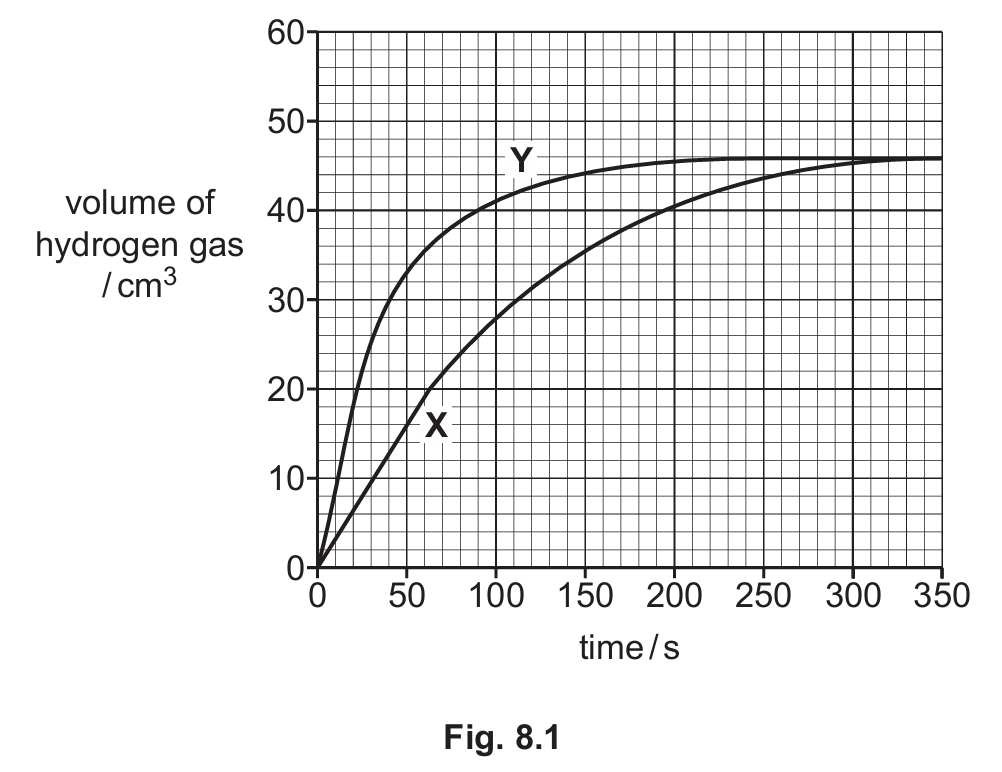
Fig. 8.1 shows a graph of their results.
Most-appropriate topic codes (Cambridge IGCSE Co-ordinated Sciences 0654):
• Topic C3.1 — Formulas (Part (a))
• Topic C6.2 — Rate of reaction (Parts (b), (d))
• Topic C3.3 — The mole and the Avogadro constant (Part (c))
▶️ Answer/Explanation
(a) \(Zn + 2HNO_3 \rightarrow Zn(NO_3)_2 + H_2\)
All formulae (Zn, HNO\(_3\), Zn(NO\(_3\))\(_2\), H\(_2\)) must be correct, and the equation balanced.
Two moles of nitric acid are needed to supply the two nitrate ions in zinc nitrate and the hydrogen released as gas.
(b)(i) Y; its curve has a steeper initial gradient and the reaction finishes sooner
A higher acid concentration means more acid particles per unit volume, increasing collision frequency.
This is shown on the graph by curve Y rising more steeply at the start and reaching its maximum volume of gas faster than X.
(b)(ii) 0.32 cm\(^3\)/s
Average rate is calculated from the gradient: change in volume ÷ change in time.
Reading the graph, roughly 16 cm³ of gas is produced in the first 50 s, giving \(16 \div 50 = 0.32 \, \text{cm}^3/\text{s}\).
(c) 0.0038 g
Convert volume to dm³: \(46 \, \text{cm}^3 = 0.046 \, \text{dm}^3\).
Moles of H\(_2\) \(= \dfrac{0.046}{24} = 0.0019\) mol.
Mass \(= 0.0019 \times 2 = 0.0038\) g.
(d) Rate increases
At a higher temperature, particles have more kinetic energy and move faster, so they collide more frequently.
A greater proportion of these collisions also have energy at or above the activation energy, so more collisions are successful, increasing the rate of reaction.
Question 9

Most-appropriate topic codes (Cambridge IGCSE Co-ordinated Sciences 0654):
• Topic P5.2.2 — Nuclear emissions / nuclide notation (Part (a)(i))
• Topic P5.2.3 — Radioactive decay and half-life (Part (a)(ii))
• Topic P1.2 — Motion (speed/distance) and P5 — Nuclear physics (kinetic energy of beta particle) (Part (b))
▶️ Answer/Explanation
(a)(i) \(^3_1\text{H} \rightarrow \, ^3_2\text{He} + \, ^{\;0}_{-1}\beta\)
In beta decay, a neutron in the nucleus converts to a proton and an electron (beta particle) is emitted.
The mass/nucleon number stays at 3, the proton number increases from 1 (H) to 2 (He), and the beta particle carries proton number −1 and nucleon number 0 to balance the equation.
(a)(ii) 36.9 years
87.5% decayed means 12.5% (i.e. 1/8) of the original sample remains, which corresponds to 3 half-lives (since \((1/2)^3 = 1/8\)).
Time \(= 3 \times 12.3 = 36.9\) years.
(b)(i) 0.070 m
Distance is found from \(d = v \times t\).
\(d = 2.0 \times 10^8 \times 3.5 \times 10^{-10} = 0.070\) m.
(b)(ii) \(9.0 \times 10^{-31}\) kg
Rearranging kinetic energy \(KE = \tfrac{1}{2}mv^2\) gives \(m = \dfrac{2 \times KE}{v^2}\).
\(m = \dfrac{2 \times 1.8 \times 10^{-14}}{(2.0 \times 10^8)^2} = \dfrac{3.6 \times 10^{-14}}{4.0 \times 10^{16}} = 9.0 \times 10^{-31}\) kg.
Question 10
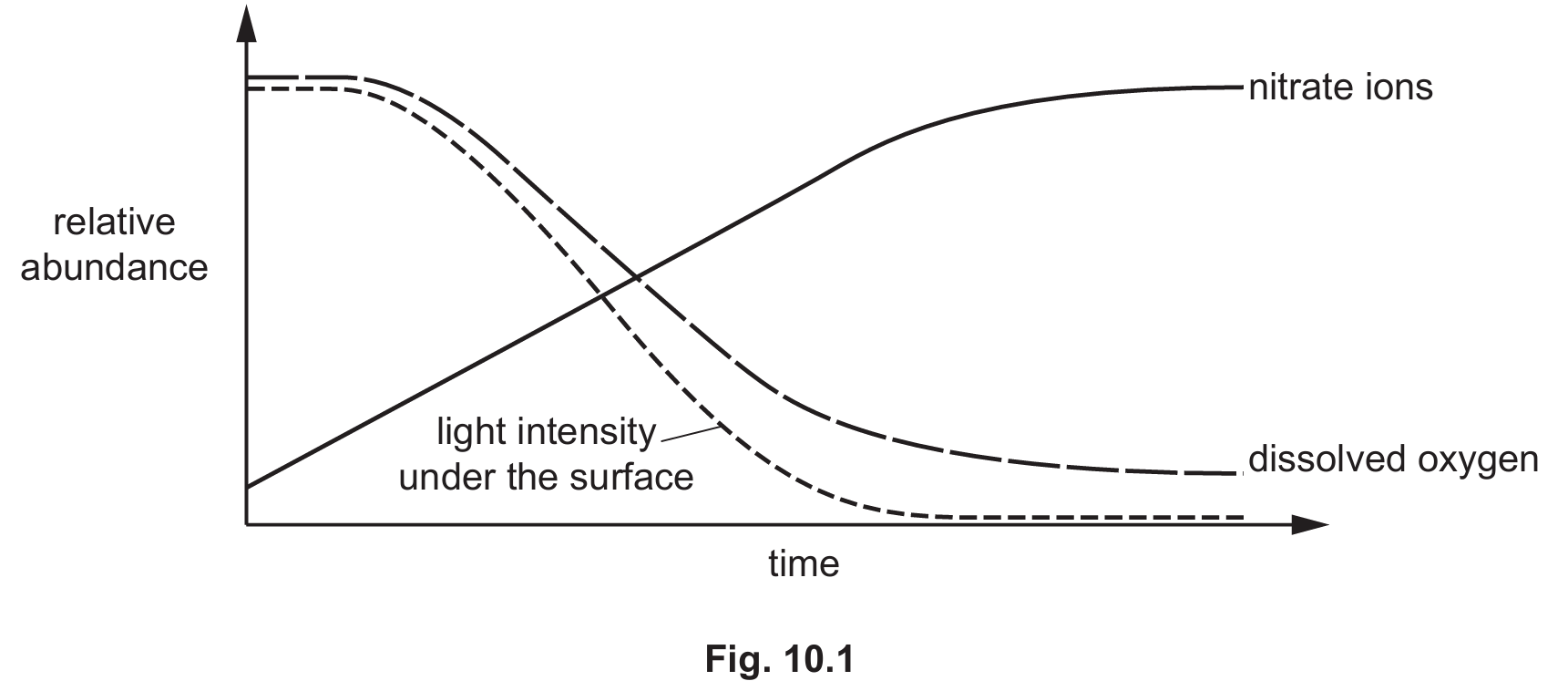
Explain why, using the information in Fig. 10.1.
Explain why, using the information in Fig. 10.1.
Most-appropriate topic codes (Cambridge IGCSE Co-ordinated Sciences 0654):
• Topic B19.1 — Habitat destruction (Parts (a), (b), (c))
▶️ Answer/Explanation
(a) Increased nitrate ions provide more material for amino acid/protein synthesis, boosting growth
As shown on the graph, nitrate ion concentration rises during eutrophication.
This gives surface producers more raw material to make amino acids and proteins, so they grow and reproduce faster.
(b) Reduced light reaching underwater producers prevents adequate photosynthesis
The graph shows light intensity under the surface falling as surface algae/plants grow densely and block sunlight.
With less light, underwater producers cannot photosynthesise sufficiently, so they decline and eventually die.
(c) Bacteria (decomposers)
Decomposing bacteria break down the dead plant material using aerobic respiration, which uses up the dissolved oxygen shown decreasing on the graph.
Question 11
Calculate the maximum mass of aluminium extracted from the aluminium oxide.
Show your working.
[\(A_r\): Al, 27; O, 16]
Explain why aluminium cannot be extracted from aluminium oxide using this method.
Most-appropriate topic codes (Cambridge IGCSE Co-ordinated Sciences 0654):
• Topic C9.6 — Extraction of metals (Parts (a), (b), (c), (d))
• Topic C2.7 — Metallic bonding (Part (e))
▶️ Answer/Explanation
(a) 43.2 g
\(M_r\) of \(Al_2O_3 = (2\times27)+(3\times16) = 102\).
Using the mole ratio \(2Al_2O_3 : 4Al\), mass of Al \(= \dfrac{54 \times 81.6}{102} = 43.2\) g.
(b) Oxidation; electrons are lost
Oxide ions lose electrons (\(4e^-\)) to form neutral oxygen molecules.
Loss of electrons is, by definition, oxidation.
(c) \(Al^{3+} + 3e^- \rightarrow Al\)
At the cathode, positive aluminium ions gain electrons (reduction) to form neutral aluminium metal.
The equation must be balanced for both charge and atoms: three electrons reduce each \(Al^{3+}\) ion.
(d) Aluminium is more reactive than carbon
Carbon can only displace/reduce metals that are less reactive than itself.
Since aluminium is higher than carbon in the reactivity series, carbon cannot reduce aluminium oxide, so electrolysis must be used instead.
(e) Metals have free (delocalised) electrons that can move throughout the structure
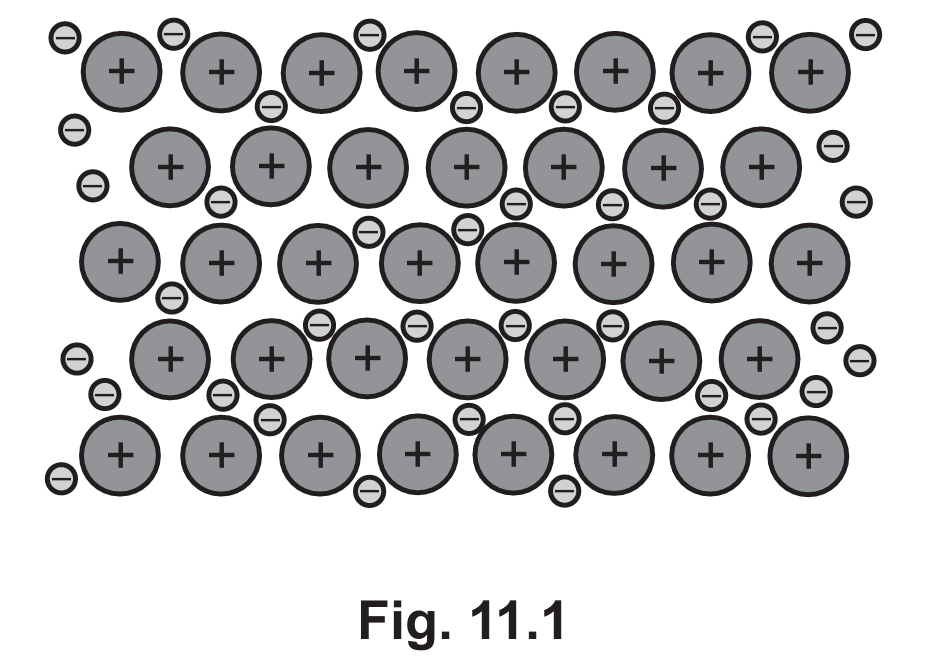
As Fig. 11.1 shows, the positive metal ions are fixed in a lattice, but the outer-shell electrons are delocalised and free to move between them.
These mobile electrons act as charge carriers, allowing current to flow when a potential difference is applied — this is why metals conduct electricity.
Question 12
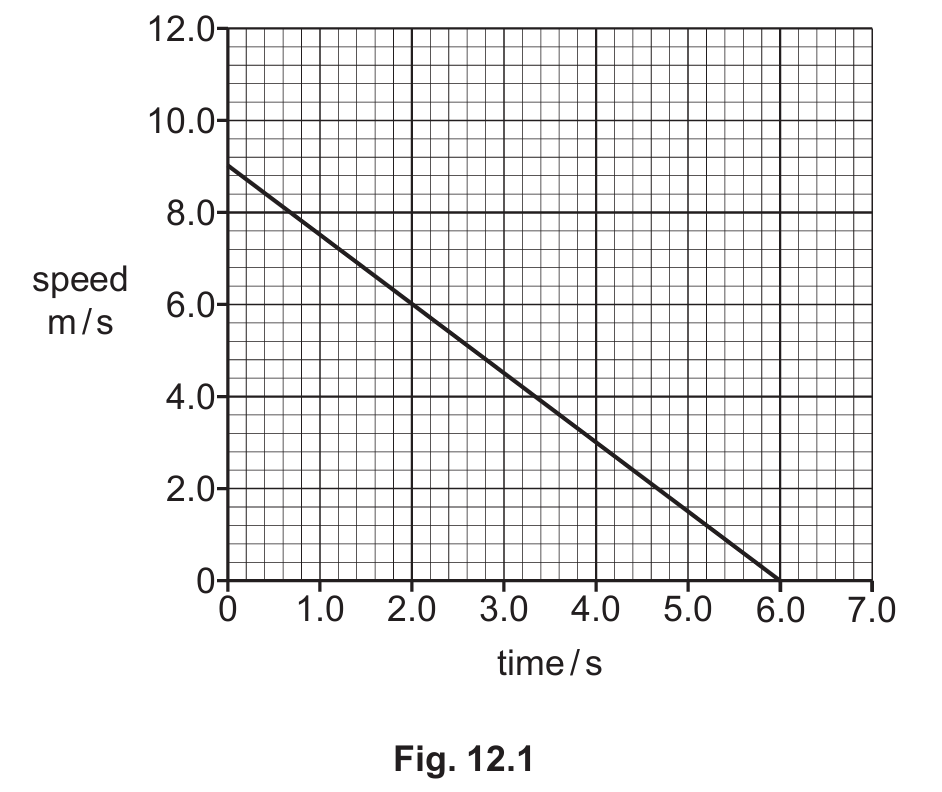
The kinetic energy of the car is transferred to ……………………… energy of the surroundings.
Calculate the work done by the braking force in stopping the car.
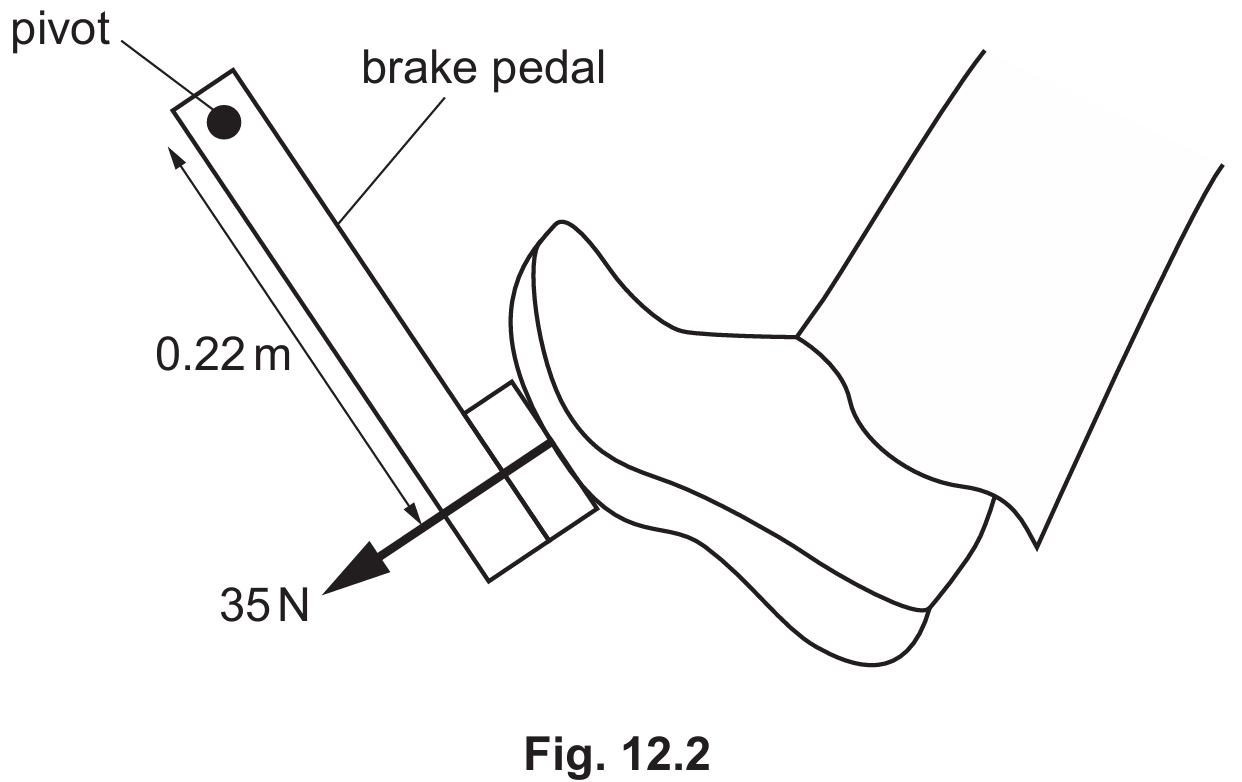
The force is applied 0.22m from the pivot.
Calculate the moment of the force about the pivot.
Calculate the potential difference across the lamp.
Calculate the frequency of the light emitted by the lamp.
State the unit for your answer.
Most-appropriate topic codes (Cambridge IGCSE Co-ordinated Sciences 0654):
• Topic P1.6.2 — Work (Part (a))
• Topic P1.5.2 — Turning effect of forces / moments (Part (b))
• Topic P4.2.5 — Electrical power (Part (c)(i))
• Topic P3.3 — Electromagnetic spectrum (wave speed equation) (Part (c)(ii))
▶️ Answer/Explanation
(a)(i) Thermal energy
Friction between the brakes and wheels converts the car’s kinetic energy into thermal (heat) energy released to the surroundings.
(a)(ii) 68 000 J
Distance travelled is the area under the speed–time graph: \(\tfrac{1}{2} \times 9.0 \times 6.0 = 27\) m.
Work done \(= F \times d = 2500 \times 27 = 68\,000\) J.
(b) 7.7 Nm
Moment \(= F \times d = 35 \times 0.22 = 7.7\) Nm.
(c)(i) 12 V
Power is related to potential difference and current by \(P = VI\), so \(V = \dfrac{P}{I}\).
\(V = \dfrac{36}{3.0} = 12\) V.
(c)(ii) \(4.0 \times 10^{14}\) Hz
Using \(v = f\lambda\) with the speed of light \(v = 3.0 \times 10^8\) m/s, \(f = \dfrac{v}{\lambda} = \dfrac{3.0 \times 10^8}{7.5 \times 10^{-7}}\).
\(f = 4.0 \times 10^{14}\) Hz (the unit for frequency is hertz, Hz).