
Question 1

State two features of an efficient gas exchange surface.


Most-appropriate topic codes (Cambridge IGCSE Co-ordinated Sciences 0654, 2025–2027 syllabus):
• Topic B11 — Gas exchange in humans (Parts (a)(i), (a)(ii), (a)(iii))
• Topic B12 — Respiration (Parts (b)(i), (b)(ii))
▶️ Answer/Explanation
(a)(i) A = trachea, B = diaphragm
A is the tube carrying air down to the lungs, identified as the trachea.
B is the muscular sheet at the base of the thorax, identified as the diaphragm.
(a)(ii) Large surface area; thin walls
Any two of: large surface area, thin (single-cell) walls, good blood supply, or good ventilation with air.
These features all maximise the rate of gas diffusion across the alveolar surface.
(a)(iii) Goblet cells
Goblet cells line the airways and secrete mucus.
The mucus traps dust and microorganisms before they reach the alveoli.
(b)(i) 25 breaths per minute
Difference = breathing rate during exercise − breathing rate at rest.
Difference \( = 40 – 15 = 25\) breaths per minute.
(b)(ii) 
During exercise, muscles respire aerobically at a faster rate to release more energy.
This raises the carbon dioxide concentration in the blood, which stimulates an increased breathing rate.
The other three statements are factually incorrect for exercise (oxygen use, water vapour, and water intake all increase or are unrelated, not decrease).
Question 2

Explain your answer.
State one other use of compound D.
State what is meant by saturated.
Construct the balanced symbol equation for this reaction.
Complete Fig. 2.2 to show the displayed formula of the polymer poly(ethene).

Explain the differences between addition polymerisation and condensation polymerisation.
Most-appropriate topic codes (Cambridge IGCSE Co-ordinated Sciences 0654, 2025–2027 syllabus):
• Topic C11.1 — Formulas and terminology (Part (a))
• Topic C11.5 — Alkenes (Part (b))
• Topic C11.3 — Fuels (Part (c))
• Topic C11.4 — Alkanes (Part (d))
• Topic C6.2 — Rate of reaction / stoichiometry link (Part (e))
• Topic C11.7 — Polymers (Parts (f), (g))
▶️ Answer/Explanation
(a) Compound D
D contains an −OH group, meaning it is made of carbon, hydrogen, and oxygen.
A hydrocarbon must contain only carbon and hydrogen atoms, so D does not qualify.
(b) Compound A
A has a C=C double bond (it is ethene).
Compounds containing a C=C bond decolourise aqueous bromine via an addition reaction.
(c) Solvent
Compound D is ethanol.
Besides being a fuel, ethanol is commonly used as a solvent.
(d) Contains only C–C single bonds
A saturated compound contains only single covalent bonds between carbon atoms.
This means no further addition reactions are possible across a C–C bond.
(e) \(\text{C}_3\text{H}_8 + 5\text{O}_2 \rightarrow 3\text{CO}_2 + 4\text{H}_2\text{O}\)
Balance carbon atoms first: 3 carbons in propane gives \(3\text{CO}_2\).
Balance hydrogen atoms: 8 hydrogens in propane gives \(4\text{H}_2\text{O}\).
Balance oxygen atoms: right side has \( (3\times2) + 4 = 10\) oxygen atoms, so \(5\text{O}_2\) is needed on the left.
(f) 
Ethene’s C=C double bond opens up during addition polymerisation.
Each monomer joins to the next using single C–C bonds, forming a long repeating chain.
(g) Addition vs condensation polymerisation
Addition polymerisation uses monomers containing a C=C bond, joining many identical units with no by-product formed.
Condensation polymerisation uses monomers with two functional groups (one at each end), and a small molecule such as water is released at each linkage.
Question 3
The student also connects a voltmeter to measure the potential difference across the thermistor.
Fig. 3.1 shows an incomplete circuit diagram of the circuit used by the student.
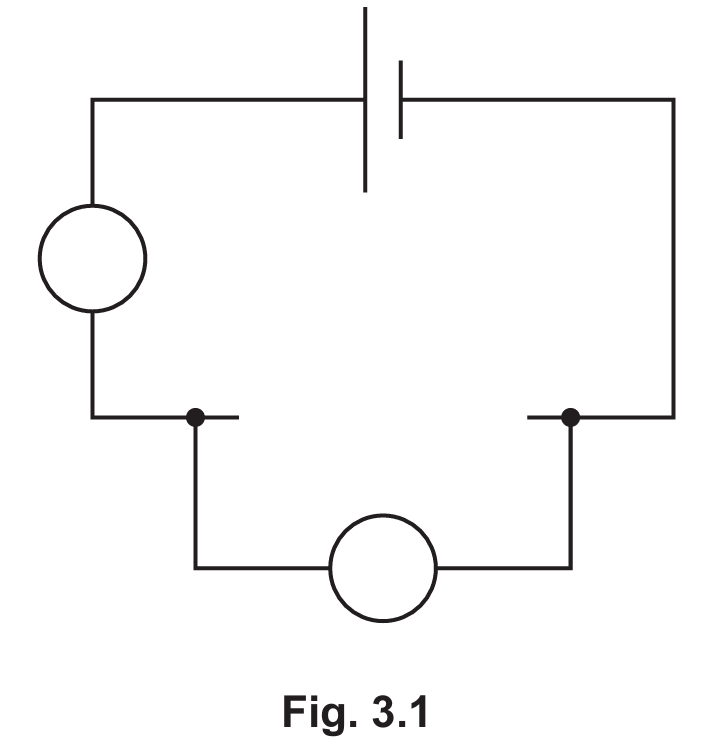
Calculate the charge that flows through the thermistor in \(60\,\text{s}\).
State the unit for your answer.
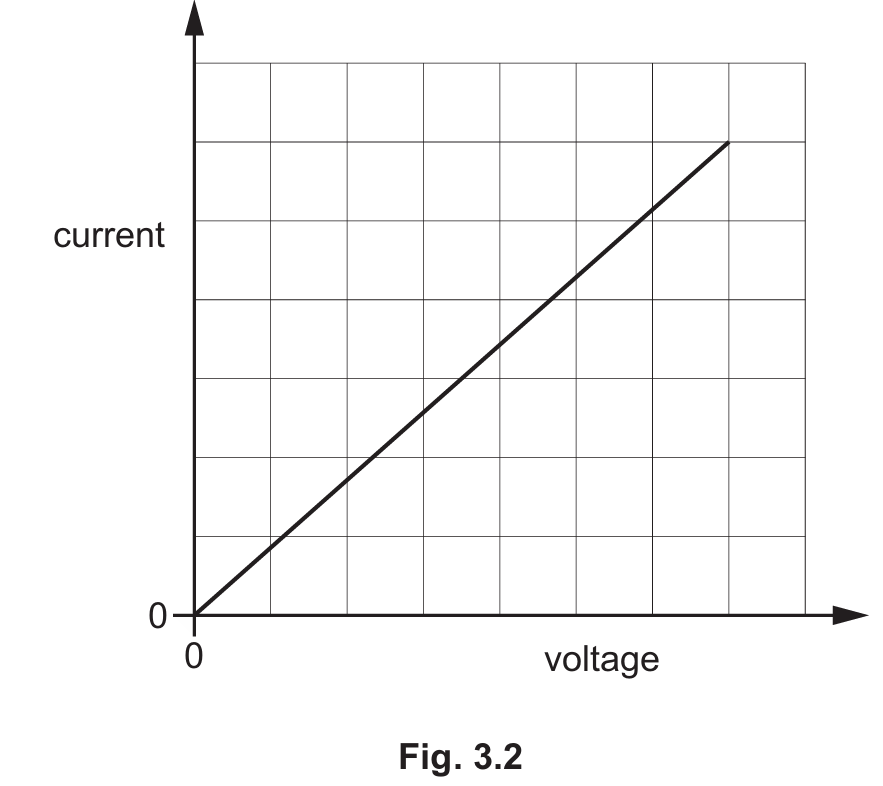
The student records the values shown by the ammeter and the voltmeter as the temperature of the thermistor increases.
Describe how the power output of the thermistor changes as the temperature of the thermistor increases.
Most-appropriate topic codes (Cambridge IGCSE Co-ordinated Sciences 0654, 2025–2027 syllabus):
• Topic P4.3.1 — Circuit diagrams and circuit components (Part (a)(i))
• Topic P4.2.2 — Electric current (Part (a)(ii))
• Topic P4.2.5 — Electrical energy and electrical power (Part (b))
• Topic P4.2.4 — Resistance (Part (c))
▶️ Answer/Explanation
(a)(i) Thermistor symbol added in series; ammeter and voltmeter correctly placed
The thermistor symbol must be drawn in the main series loop with the cell and ammeter.
The voltmeter must be connected in parallel across the thermistor only.
(a)(ii) \(180\,\text{C}\)
Charge is calculated using \(Q = It\).
\(Q = 3.0 \times 60 = 180\,\text{C}\) (coulombs).
(b) Power increases as temperature increases
As temperature rises, the resistance of the NTC thermistor decreases.
A lower resistance at constant voltage causes the current through the thermistor to increase.
Since \(P = IV\), an increase in current (with p.d. roughly maintained) means the power output increases.
(c) Straight line through the origin
The graph is a straight line passing through the origin, showing current is directly proportional to voltage.
This means the resistance of the component stays constant, which is the definition of an ohmic conductor obeying Ohm’s law.
Question 4
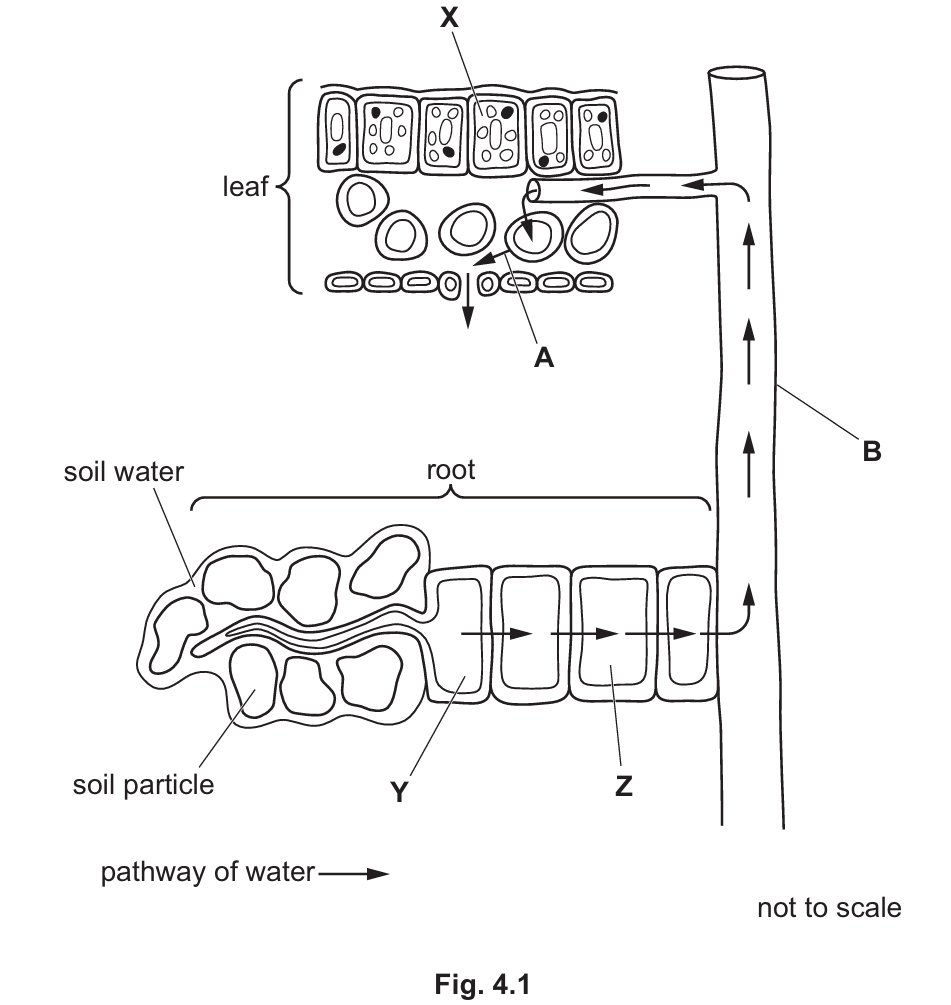
This creates a ………… gradient, drawing up a column of water molecules that are held together by ………… .
Most-appropriate topic codes (Cambridge IGCSE Co-ordinated Sciences 0654, 2025–2027 syllabus):
• Topic B8.2 — Water uptake (Part (a))
• Topic B6.2 — Leaf structure (Part (b))
• Topic B8.3 — Transpiration (Part (c))
• Topic B8.1 — Xylem and phloem (Part (d))
▶️ Answer/Explanation
(a) Y = root hair cell, Z = (root) cortex cell
Y sits at the outer surface of the root in contact with soil water, identifying it as a root hair cell.
Z is positioned further along the water pathway inside the root, identifying it as a cortex cell.
(b) Many chloroplasts; positioned for maximum light absorption
Cell X contains numerous chloroplasts, increasing the chlorophyll available to absorb light.
It is column-shaped and positioned near the top of the leaf, maximising light capture for photosynthesis.
(c) Evaporation decreases
Increased humidity raises the water vapour concentration in the air surrounding the leaf.
This reduces the concentration (diffusion) gradient between the leaf’s air spaces and the atmosphere.
As a result, evaporation from the mesophyll cell surfaces at A decreases.
(d) Transpiration; water potential; cohesion
Water is moved up the xylem (part B) by transpiration pull.
This creates a water potential gradient along the xylem.
The column of water molecules is held together by cohesion (hydrogen bonding between water molecules).
Question 5

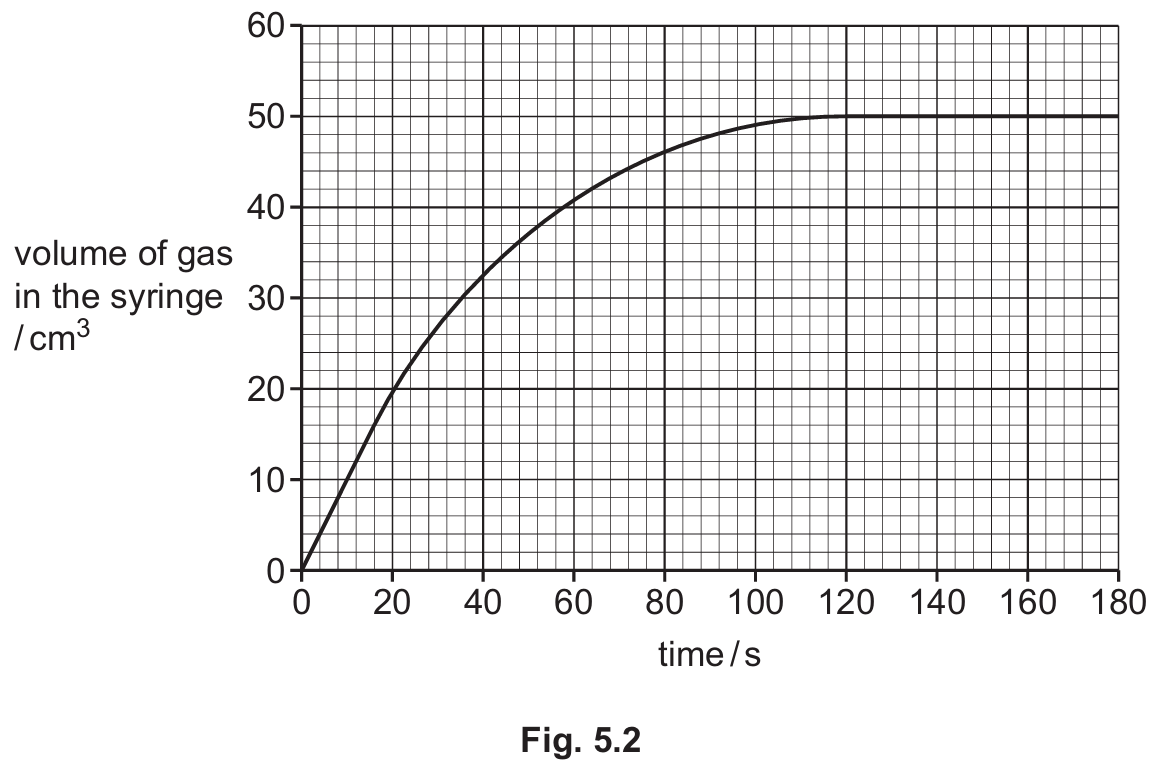 (a) State the name of the gas made in this reaction.
The reaction is fastest between ………… seconds and ………… seconds.
Calculate the total number of moles in \(50\,\text{cm}^3\) of the gas measured at r.t.p.
The volume of one mole of any gas is \(24\,\text{dm}^3\) at r.t.p.
Show your working.
Explain why the reaction is faster.
Use ideas about collisions between particles.

Most-appropriate topic codes (Cambridge IGCSE Co-ordinated Sciences 0654, 2025–2027 syllabus):
• Topic C7.1 — Characteristic properties of acids and bases (Part (a))
• Topic C6.2 — Rate of reaction (Parts (b), (d))
• Topic C3.3 — The mole and the Avogadro constant (Part (c))
• Topic C5.1 — Exothermic and endothermic reactions (Part (e))
▶️ Answer/Explanation
(a) Carbon dioxide
Calcium carbonate reacting with hydrochloric acid produces calcium chloride, water, and carbon dioxide gas.
It is this carbon dioxide that collects in the gas syringe.
(b) Between 0 seconds and 16 seconds
The graph is steepest (gradient is greatest) in the first 16 seconds of the reaction.
A steeper gradient on a volume–time graph indicates a faster rate of gas production.
(c) \(0.0021\) mol (to 2 s.f.)
Convert volume to \(\text{dm}^3\): \(50\,\text{cm}^3 = 0.050\,\text{dm}^3\).
Apply moles \( = \dfrac{\text{volume}}{24}\): moles \( = \dfrac{0.050}{24} = 0.0021\) mol.
(d) Faster due to more frequent successful collisions
At a higher temperature, particles have greater average kinetic energy and move faster.
A larger proportion of particles now possess energy equal to or greater than the activation energy.
This increases the frequency of collisions, and specifically the frequency of successful collisions, speeding up the reaction.
(e)
For an exothermic reaction, the products’ energy level must be drawn lower than the reactants’ energy level.
Activation energy is the energy difference between the reactants and the peak of the curve.
The energy change (ΔH) is the energy difference between the reactants and the products, shown as a downward arrow.
Question 6

Suggest a frequency for ultrasound waves.
Complete the sentences about longitudinal waves.
Longitudinal waves are produced by vibrations occur ………… to the direction of energy transfer
Longitudinal waves travel through air in compressions and ………… .


Most-appropriate topic codes (Cambridge IGCSE Co-ordinated Sciences 0654, 2025–2027 syllabus):
• Topic P1.5.1 — Effects of forces (Part (a))
• Topic P3.4 — Sound (Parts (b)(i), (b)(iii))
• Topic P3.1 — General properties of waves (Part (b)(ii))
▶️ Answer/Explanation
(a) \(25.7\,\text{cm}\)
Find the force per spring: \(F = \dfrac{17000}{4} = 4250\,\text{N}\).
Find the compression using \(F = kx\): \(x = \dfrac{4250}{2500} = 1.7\,\text{cm}\).
Original length = compressed length + compression \( = 24 + 1.7 = 25.7\,\text{cm}\).
(b)(i) \(20\,000\,\text{Hz}\) (or any value above \(20\,000\,\text{Hz}\))
The upper limit of human hearing is approximately \(20\,000\,\text{Hz}\).
Ultrasound, by definition, has a frequency above this audible threshold.
(b)(ii) Parallel; rarefactions
In a longitudinal wave, particle vibrations occur parallel to the direction of energy transfer.
The wave travels through air as a series of compressions and rarefactions.
(b)(iii) \(0.0104\,\text{m}\) (or \(1.04\,\text{cm}\))
From Fig. 6.3, the time delay between transmitted and reflected pulses is \(t = 4.0 \times 10^{-6}\,\text{s}\) (peaks at \(1.0\) and \(5.0 \times 10^{-6}\,\text{s}\)), so the one-way travel time is \(2.0 \times 10^{-6}\,\text{s}\).
Using \(d = v \times t\): \(d = 5200 \times 2.0 \times 10^{-6} = 0.0104\,\text{m}\).
Question 7
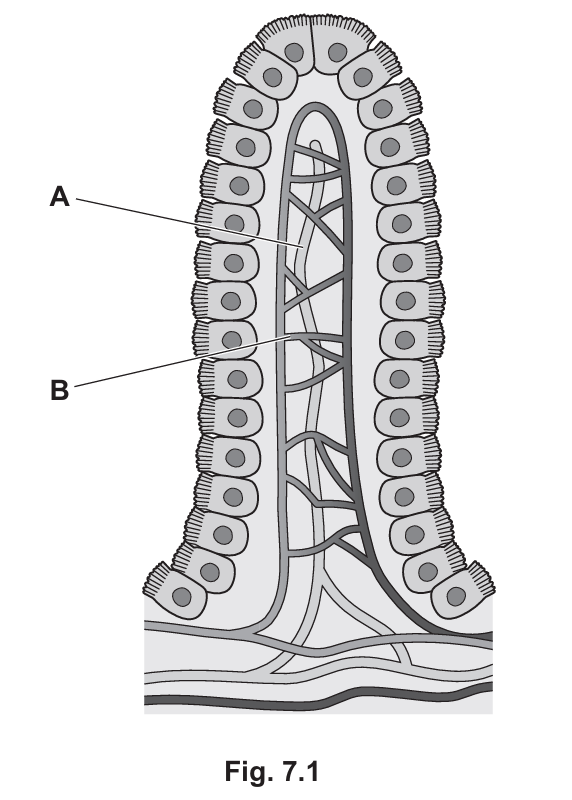
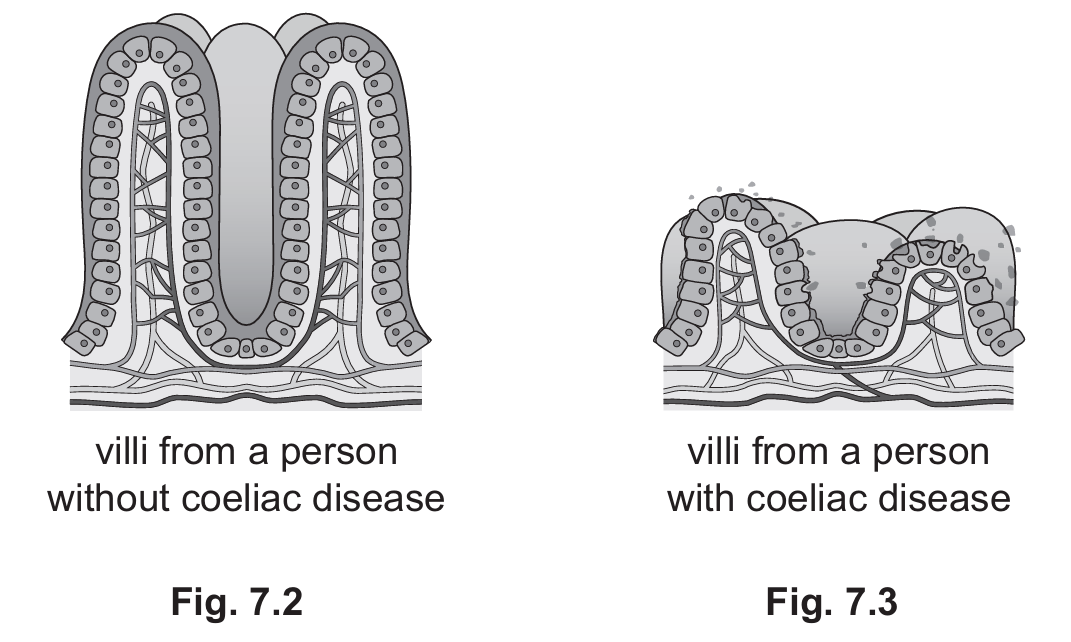
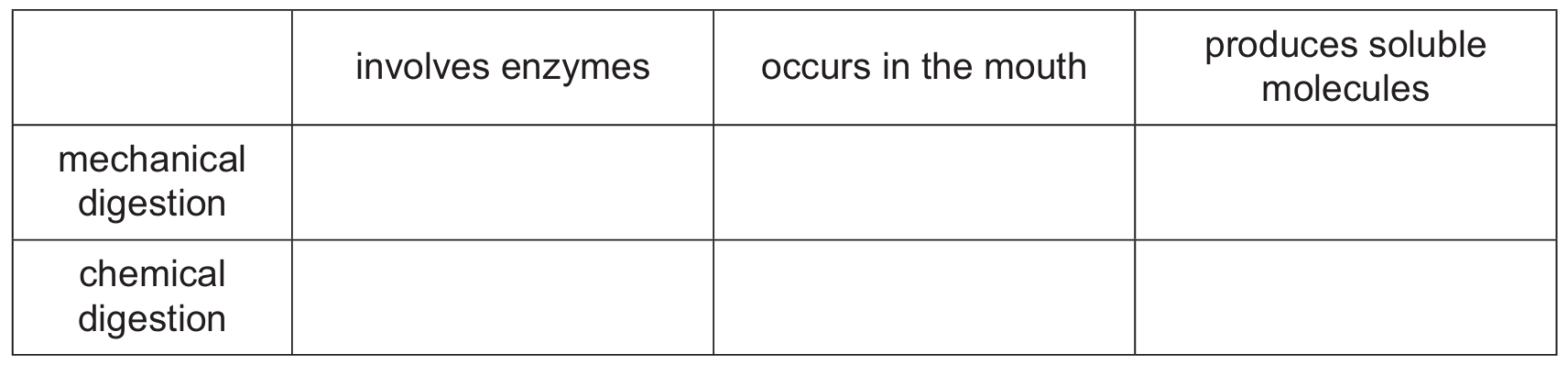
Most-appropriate topic codes (Cambridge IGCSE Co-ordinated Sciences 0654, 2025–2027 syllabus):
• Topic B7.2 — Digestive system (Parts (a), (b))
• Topic B7.1 — Diet (Part (c)(i))
• Topic B4 — Biological molecules (Part (c)(ii))
• Topic B7.3 — Digestion (Part (d))
▶️ Answer/Explanation
(a)(i) Lacteal — absorption/transport of fat
The structure labelled A at the centre of the villus is the lacteal.
Its function is the absorption and transport of digested fats away from the small intestine.
(a)(ii) Thin walls give a short diffusion distance
Part B, the villus surface/wall, is only one cell thick.
This gives a short diffusion distance for the transfer of digested nutrients into the bloodstream.
(b)(i) Shorter / flatter / smaller villi
In Fig. 7.3, the villi appear shorter, flatter, and smaller compared to the tall, finger-like villi in Fig. 7.2.
(b)(ii) Less surface area for absorption of nutrients
Flattened villi have a reduced surface area compared to healthy villi.
This decreases the rate of absorption of digested nutrients into the blood, contributing to malnutrition in coeliac disease.
(c)(i) Marasmus / kwashiorkor
Both marasmus and kwashiorkor are diseases caused by protein-energy malnutrition.
(c)(ii) Biuret solution (biuret test)
The biuret test is used to detect the presence of protein in a sample, giving a purple/lilac colour change when protein is present.
(d) 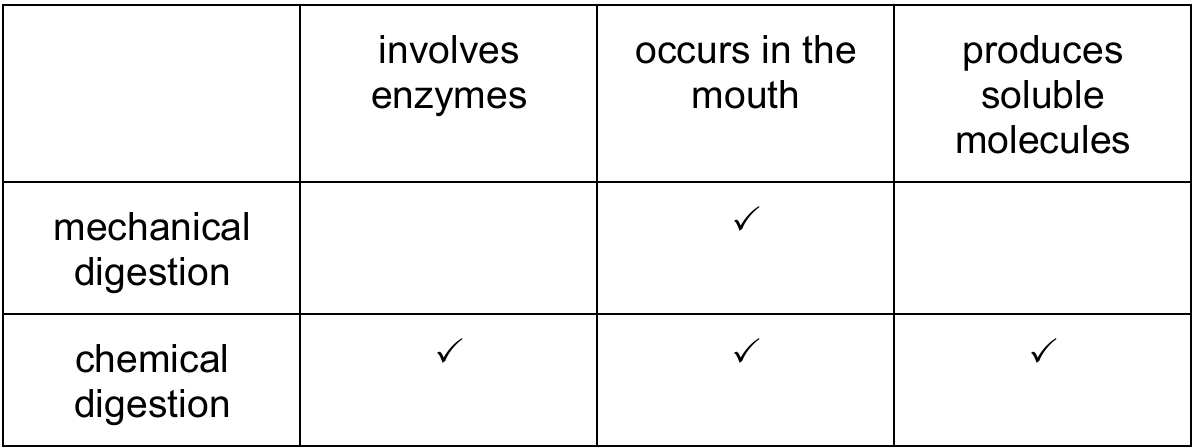
Mechanical digestion (e.g. chewing) physically breaks food into smaller pieces and occurs in the mouth, but does not involve enzymes or directly produce soluble molecules.
Chemical digestion involves enzymes which break down large insoluble molecules into smaller, soluble molecules.
Question 8
Complete Table 8.1.


Explain why graphite is a good conductor of electricity.
Use ideas about structure and bonding.
Two of the isotopes are called carbon-12 and carbon-14.

Carbon is in Group IV of the Periodic Table. Another element, tellurium, is in Group VI of the Periodic Table.
A common compound of tellurium is sodium telluride, \(\text{Na}_2\text{Te}\).
Put a tick (✓) next to the formula of the tellurium ion in sodium telluride, \(\text{Na}_2\text{Te}\).

Most-appropriate topic codes (Cambridge IGCSE Co-ordinated Sciences 0654, 2025–2027 syllabus):
• Topic C2.2 — Atomic structure and the Periodic Table (Part (a))
• Topic C2.6 — Giant covalent structures (Parts (b), (c))
• Topic C2.3 — Isotopes (Part (d))
• Topic C2.4 — Ions and ionic bonds (Part (e))
▶️ Answer/Explanation
(a) 
An electron carries a charge of \(-1\) and has a negligible relative mass (about \(\frac{1}{1835}\) of a proton’s mass).
A neutron is neutral (charge 0) with a relative mass of 1.
A proton carries a charge of \(+1\) with a relative mass of 1.
(b) Giant covalent
Both diamond and graphite consist of carbon atoms held together by a vast network of covalent bonds, making them giant covalent structures.
(c) Free/delocalised electrons that can move
In graphite, each carbon atom forms only three covalent bonds, leaving one delocalised electron per atom.
These free electrons can move through the structure, allowing graphite to conduct electricity.
(d)(i) 
Carbon-12 has a mass number of 12 and atomic number 6, so neutrons \( = 12 – 6 = 6\).
Carbon-14 has a mass number of 14, so neutrons \( = 14 – 6 = 8\), while protons and electrons remain 6 (same element).
(d)(ii) Same number of electrons in the outer shell
Isotopes of the same element have identical electron arrangements (4 electrons in the outer shell for carbon).
Since chemical properties depend on electron configuration, not the number of neutrons, isotopes share the same chemical properties.
(e) \(\text{Te}^{2-}\)
Tellurium is in Group VI, meaning it has 6 outer electrons and gains 2 electrons to achieve a full outer shell.
This forms a \(2-\) ion, consistent with the formula \(\text{Na}_2\text{Te}\) (two \(\text{Na}^+\) ions balance one \(\text{Te}^{2-}\) ion).
Question 9

Use Fig. 9.1 to calculate the kinetic energy of the bicycle during this journey.
Fig. 9.2 shows a diagram of a reflector.

(i) at point X.
(ii) at point Y.
Most-appropriate topic codes (Cambridge IGCSE Co-ordinated Sciences 0654, 2025–2027 syllabus):
• Topic P1.2 — Motion (Parts (a)(i), (a)(ii))
• Topic P1.6.1 — Energy (Part (a)(iii))
• Topic P3.2.2 — Refraction of light (Parts (b)(i), (b)(ii))
▶️ Answer/Explanation
(a)(i) Constant speed for 20 s (250 m), then the car stops
The car travels at a constant speed for the first 20 seconds, covering 250 m.
After this point, the line on the graph becomes horizontal, showing the car is stationary.
(a)(ii) 50 s
The bicycle passes the car at the point where the two distance–time lines intersect, which occurs at \(t = 50\,\text{s}\).
(a)(iii) \(1000\,\text{J}\)
From the graph, the bicycle’s speed is found using \(v = \dfrac{\text{distance}}{\text{time}} = \dfrac{300}{60} = 5.0\,\text{m/s}\).
Kinetic energy is calculated using \(KE = \tfrac{1}{2}mv^2 = 0.5 \times 80 \times 5.0^2 = 1000\,\text{J}\).
(b)(i) The incident ray hits the surface at 90° (along the normal)
At point X, the light ray strikes the surface at a right angle to it, meaning the angle of incidence is \(0°\).
A ray travelling along the normal does not bend, so refraction does not occur.
(b)(ii) Total internal reflection occurs instead
At point Y, the angle of incidence inside the plastic exceeds the critical angle for the plastic-air boundary.
When this happens, all the light is reflected internally (total internal reflection) rather than refracting out of the material.
Question 10
Most-appropriate topic codes (Cambridge IGCSE Co-ordinated Sciences 0654, 2025–2027 syllabus):
• Topic B6.1 — Photosynthesis (Parts (a), (e))
• Topic B13.1 — Coordination and response (Part (b))
• Topic B17.2 — Selection (Part (c))
• Topic B15.3 — Sexual reproduction in plants (Part (d))
▶️ Answer/Explanation
(a) Provides oxygen for germination
Air spaces in the soil allow oxygen to reach the seed.
This oxygen is required for aerobic respiration during germination, releasing the energy needed for growth.
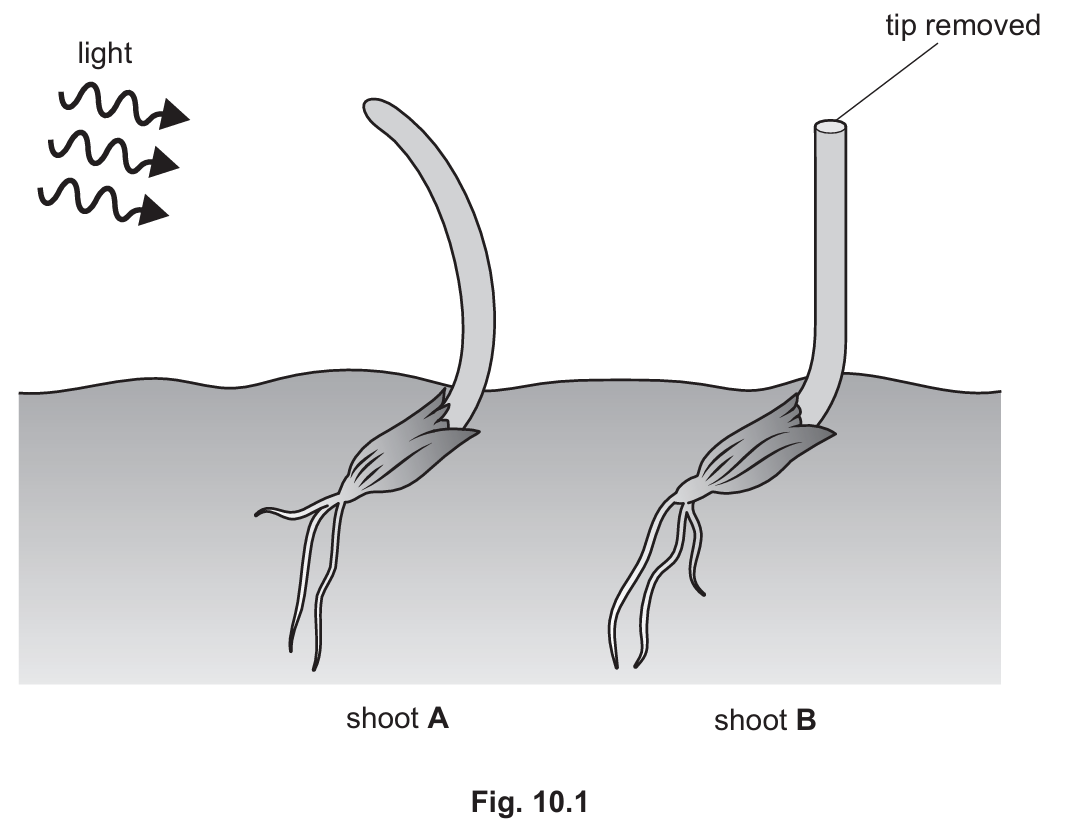
(b)(i) Phototropism
Shoot A bends towards the light source, which is the definition of a positive phototropic response.
(b)(ii) No auxin reaches the growing region
Auxin (the growth hormone) is produced in the tip of the shoot.
Since the tip of shoot B has been removed, no auxin is made, so no unequal cell elongation is stimulated and the shoot does not bend towards the light.
(c) Artificial selection
Artificial selection is the process where a farmer deliberately breeds plants with desirable characteristics to improve crop quality.
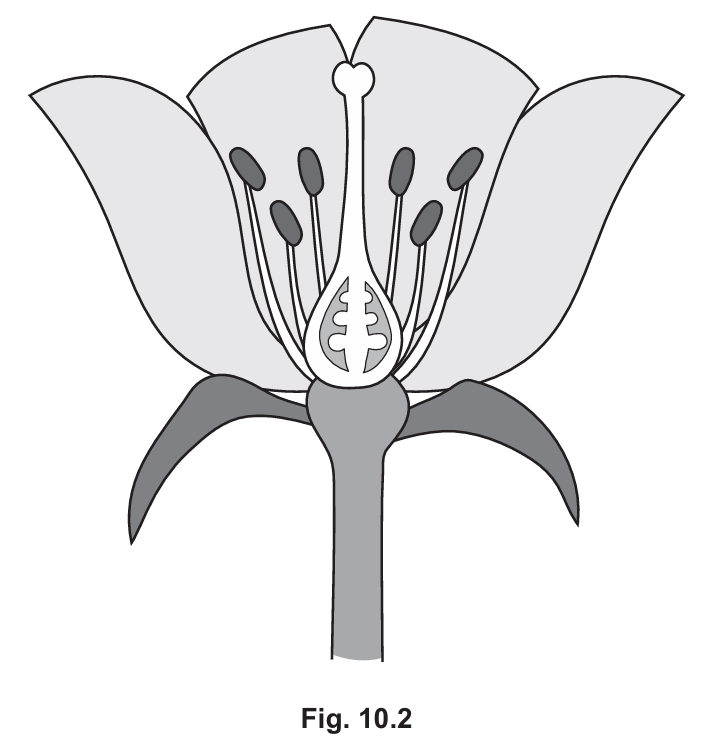
(d)(i) Sepal
The outermost part that encloses and protects the flower bud before it opens is the sepal.
(d)(ii) Large, brightly coloured petals (or anther/stigma positioned inside the flower)
Insect-pollinated flowers typically have large, conspicuous petals to attract insects.
The reproductive parts (anther and stigma) are usually located inside the flower so insects brush against them.
(e) Less chlorophyll is made, causing yellow leaves
Magnesium is needed to synthesise chlorophyll.
A deficiency means less (or no) chlorophyll can be made.
This results in the leaves appearing yellow rather than green.
Question 11

Use Fig. 11.1 to state and explain how magnesium is extracted from magnesium ore.
Most-appropriate topic codes (Cambridge IGCSE Co-ordinated Sciences 0654, 2025–2027 syllabus):
• Topic C9.6 — Extraction of metals (Part (a)(i))
• Topic C9.4 — Reactivity series (Part (a)(ii))
• Topic C3.2 — Relative masses of atoms and molecules (Part (b))
• Topic C3.3 — The mole and the Avogadro constant (Part (c))
• Topic C6.3 — Redox (Parts (d), (e))
▶️ Answer/Explanation
(a)(i) Electrolysis
Magnesium is more reactive than carbon, so carbon cannot displace magnesium from its ore by heating.
Instead, magnesium must be extracted using electrolysis.
(a)(ii) Sodium atoms lose electrons more easily than magnesium atoms
Sodium forms positive ions more readily than magnesium because it loses its single outer electron more easily.
This greater tendency to lose electrons makes sodium more reactive than magnesium.
(b) Relative atomic mass of X \(= 119\)
The relative formula mass of \(\text{CO}_2 = 12 + (2\times16) = 44\).
Relative atomic mass of \(\text{X} = 163 – \text{M}_r(\text{CO}_2) = 163 – 44 = 119\) (working: \(163 – 32 – 12 = 119\)).
(c) Aluminium is the limiting reactant
Moles of \(\text{Fe}_2\text{O}_3 = \dfrac{800}{160} = 5\,\text{mol}\).
Moles of \(\text{Al} = \dfrac{162}{27} = 6\,\text{mol}\).
The equation requires 2 mol Al per 1 mol \(\text{Fe}_2\text{O}_3\), so 5 mol \(\text{Fe}_2\text{O}_3\) needs 10 mol Al, but only 6 mol Al is available, confirming aluminium is the limiting reactant.
(d) Magnesium atoms are oxidised; copper ions are reduced
Oxidation occurs because magnesium atoms lose electrons to form \(\text{Mg}^{2+}\) ions.
Reduction occurs because copper ions gain electrons to form copper atoms.
Since both processes happen simultaneously, the reaction is a redox reaction.
(e) An oxidising agent oxidises another substance; a reducing agent reduces another substance
An oxidising agent causes another substance to lose electrons (oxidises it), while itself being reduced.
A reducing agent causes another substance to gain electrons (reduces it), while itself being oxidised.
Question 12
The Sun is the source of energy for all our energy resources except nuclear, ………… and tidal.
State what happens to the pressure of the steam if the temperature of the steam is increased.
The efficiency of the generator is 75%.
Calculate the kinetic energy required to produce \(3600\,\text{J}\) of electrical energy.

Most-appropriate topic codes (Cambridge IGCSE Co-ordinated Sciences 0654, 2025–2027 syllabus):
• Topic P5.1 — The nucleus (Part (a)(i))
• Topic P1.6.3 — Energy resources (Part (a)(ii))
• Topic P2.1.3 — Pressure changes (Part (b))
• Topic P4.5.2 — The a.c. generator (Part (c)(i))
• Topic P1.6.1 — Energy (Part (c)(ii))
• Topic P5.2.3 — Radioactive decay (Part (d))
▶️ Answer/Explanation
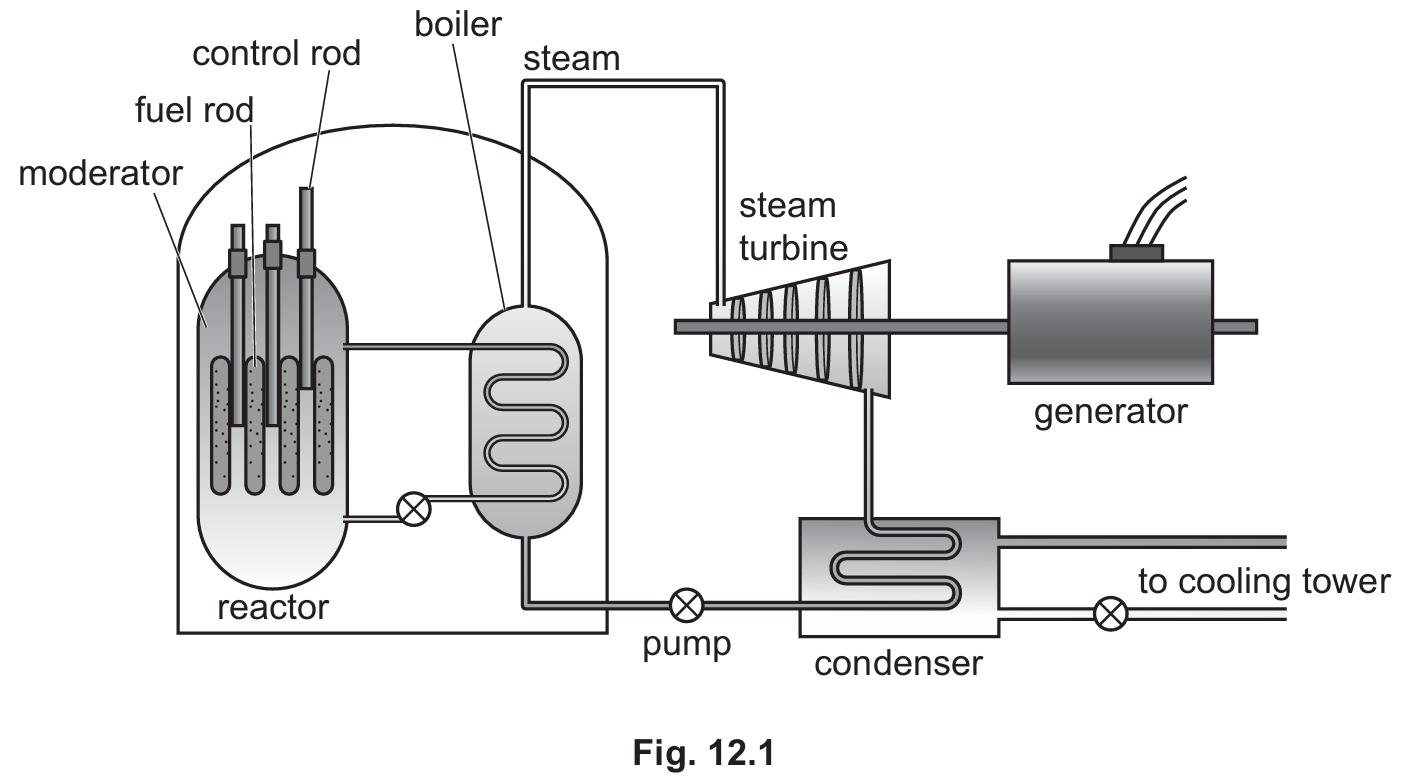
(a)(i) Nuclear fission
In the reactor, uranium nuclei split apart in a process called nuclear fission, releasing large amounts of energy.
(a)(ii) Geothermal
Geothermal energy comes from heat within the Earth, not from the Sun, just like nuclear and tidal energy.
(b)(i) Molecules collide with the walls, exerting a force
Steam molecules move rapidly and randomly within the boiler.
As these molecules collide with the container walls, each collision exerts a small force, and the combined effect of many collisions produces pressure.
(b)(ii) Pressure increases
At constant volume, increasing the temperature increases the average kinetic energy and speed of the molecules.
Faster, more frequent and more forceful collisions with the walls result in increased pressure.
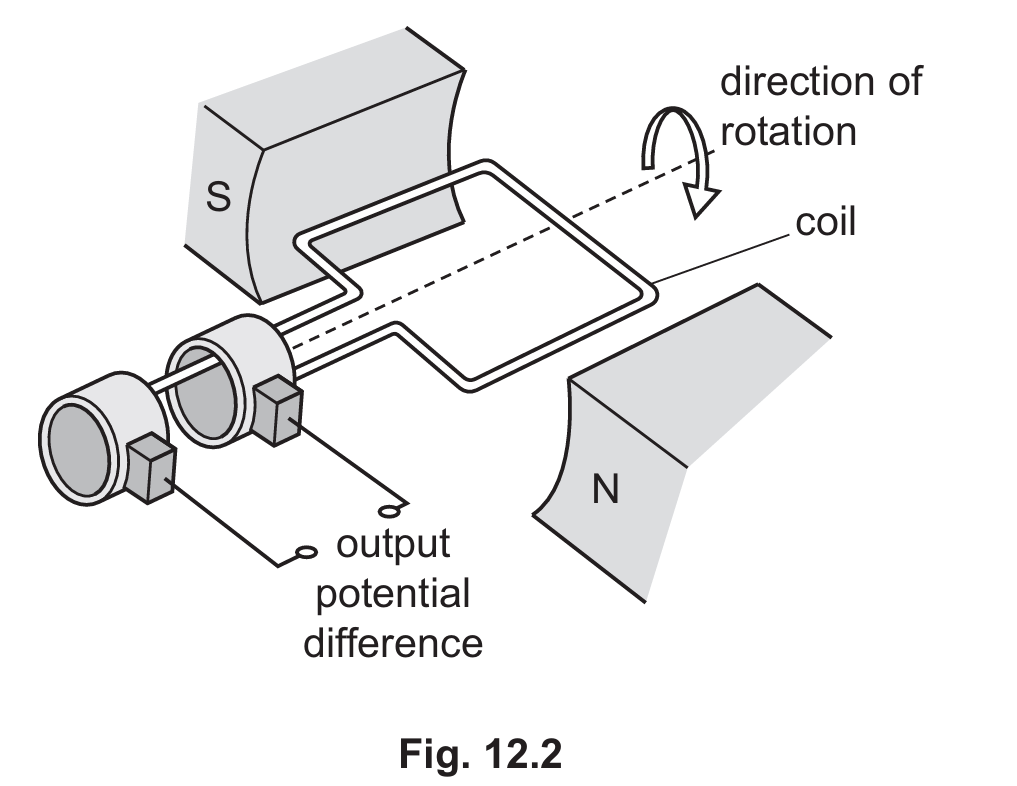
(c)(i) The coil experiences a changing magnetic flux, inducing a p.d.
As the coil rotates within the magnetic field, the magnetic flux passing through it continuously changes.
This changing flux induces an output potential difference across the coil, by electromagnetic induction.
(c)(ii) \(4800\,\text{J}\)
Efficiency \( = \dfrac{\text{output energy}}{\text{input energy}} \times 100\%\).
Rearranging: input (kinetic) energy \( = \dfrac{3600}{75} \times 100 = 4800\,\text{J}\).
(d) \(^{235}_{92}\text{U} \rightarrow\, ^{231}_{90}\text{Th} + \,^{4}_{2}\alpha\)
In alpha decay, the mass number decreases by 4 and the atomic number decreases by 2.
Mass number: \(235 – 4 = 231\); atomic number: \(92 – 2 = 90\), identifying the daughter nuclide as thorium-231.