Home / 4bi1-1b-que-20231107
Question 1

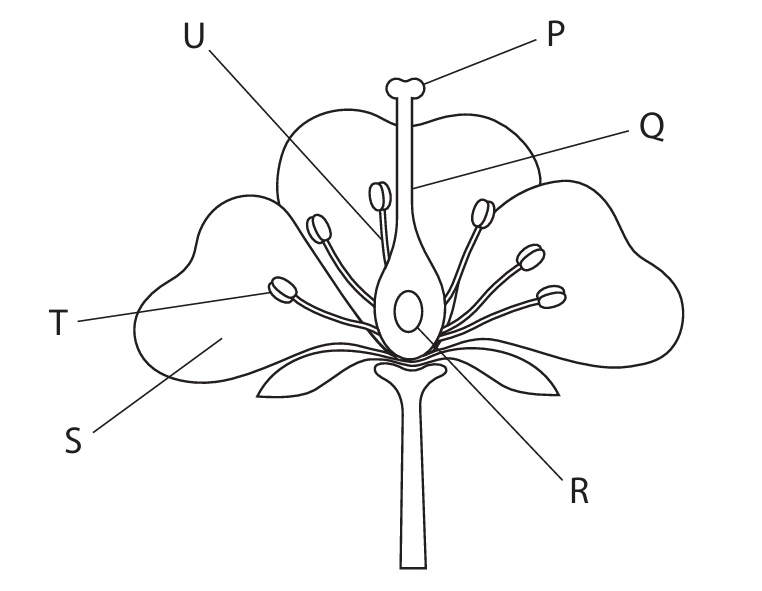
The diagram shows an insect-pollinated flower with some structures labelled.

(a) (i) Which structures are the male parts of the flower?

A) P and Q
B) P and R
C) S and T
D) T and U

(ii) On which structure does the pollen grain germinate?

A) P
B) R
C) S
D) T

(iii) Which structure becomes the seed after fertilisation?

A) P
B) Q
C) R
D) T

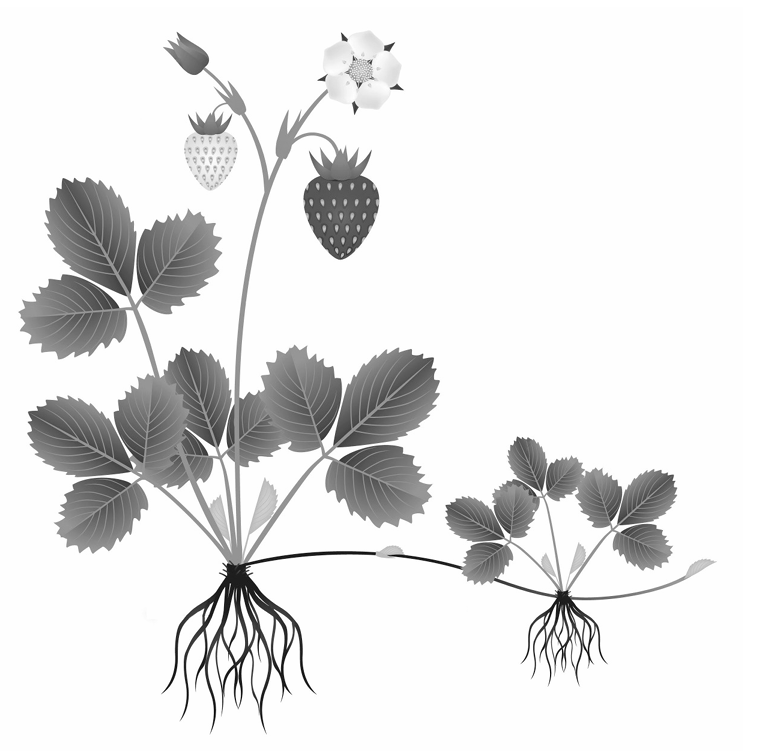
(b) The picture shows a strawberry plant. This plant can reproduce sexually using its flowers, or asexually.

(i) Describe how a strawberry plant reproduces asexually.
(ii) A farmer wants to produce a plant that has strawberries with a different flavour. He then wants to produce large numbers of these plants. Discuss how he can use sexual and asexual reproduction to achieve this.

Most-appropriate topic codes (Edexcel IGCSE Biology):

3(a): Reproduction (Flowering plants) — parts (a)(i), (a)(ii), (a)(iii), (b)(i), (b)(ii)
5(d): Cloning — part (b)(i), (b)(ii)
3(a): Differences between sexual and asexual reproduction — part (b)(ii)
▶️ Answer/Explanation
Solution

(a)(i) D (T and U)
A is not the answer as P and Q are not both the male parts
B is not the answer as P and R are not both the male parts
C is not the answer as S and T are not both the male parts

(a)(ii) A (P)
B is not the answer as pollen grains do not germinate on R
C is not the answer as pollen grains do not germinate on S
D is not the answer as pollen grains do not germinate on T

(a)(iii) C (R)
A is not the answer as P does not become the seed
B is not the answer as Q does not become the seed
D is not the answer as T does not become the seed

(b)(i) A description that makes reference to two of the following:
• uses runners / stolons / eq (1)
• stem / shoot (grows along ground) / eq (1)
• breaks off / grows roots / produces new plant / clone / eq (1)

(b)(ii) An answer that makes reference to four of the following:
1. (use sexual reproduction) cross with different variety / different plant / selective breeding / eq (1)
2. transfer pollen / cross pollinate / eq (1)
3. to produce different flavour / new flavour / desired flavour / variation / eq (1)
4. (use asexual) / runners / cuttings / micropropagation / eq (1)
5. produces genetically identical plants / clones / eq (1)
6. many offspring produced / large numbers / eq (1)

Question 2

Complete the passage about the lungs by writing a suitable word in each blank space.

The organs of gas exchange in humans are the lungs.

A single tube called the          allows air to move towards the lungs.

This tube splits into two tubes called          which then divide into many narrow tubes called         .

At the end of these narrow tubes are air sacs called         .

These are where gas exchange takes place.

The lungs are inflated by the contraction of a muscular sheet called the         .

The          muscles also contract to move the ribs to expand the chest cavity.

(Total for Question 2 = 6 marks)

Most-appropriate topic codes (Edexcel IGCSE Biology):

2(g): Gas exchange (Humans) — all parts
▶️ Answer/Explanation
Solution

The completed passage is as follows:

A single tube called the trachea allows air to move towards the lungs.

This tube splits into two tubes called bronchi which then divide into many narrow tubes called bronchioles.

At the end of these narrow tubes are air sacs called alveoli.

The lungs are inflated by the contraction of a muscular sheet called the diaphragm.

The intercostal muscles also contract to move the ribs to expand the chest cavity.

Mark Scheme:

1. trachea / windpipe (1)
2. bronchi / bronchus (1)
3. bronchiole(s) (1)
4. alveoli / alveolus (1)
5. diaphragm (1)
6. intercostal (1)
(ignore internal / external)

Question 3

The diagram shows the digestive system of a dog with some structures labelled. The digestive system of the dog is similar to that of a human.

(a) (i) Which structure is the oesophagus?

A) P
B) Q
C) R
D) U

(ii) Which structure is part of the large intestine?

A) P
B) Q
C) R
D) T

(iii) Which structure contains villi?

A) Q
B) R
C) S
D) V

(iv) Which structure is the stomach?

A) Q
B) S
C) T
D) V

(b) Describe how food is moved along the gut of the dog.

(c) The table lists some ingredients in food given to young dogs and in food given to adult dogs.

(i) Discuss the differences between the composition of the two foods.
(ii) The diet of wild dogs consists of prey animals and a small amount of plant material contained in the gut of their prey. Domesticated dogs are often given a diet that contains large amounts of carbohydrates such as starch. Explain the possible effects of feeding domestic dogs large quantities of carbohydrates such as starch.

Most-appropriate topic codes (Edexcel IGCSE Biology):

2(e): Nutrition — Humans (Alimentary Canal & Diet) — parts (a), (b), (c)
▶️ Answer/Explanation
Solution

(a)(i) A (P)
B is not the answer as Q is not the oesophagus.
C is not the answer as R is not the oesophagus.
D is not the answer as U is not the oesophagus.

(a)(ii) D (T)
A is not the answer as P is not part of the large intestine.
B is not the answer as Q is not part of the large intestine.
C is not the answer as R is not part of the large intestine.

(a)(iii) C (S)
A is not the answer as Q does not contain villi.
B is not the answer as R does not contain villi.
D is not the answer as V does not contain villi.

(a)(iv) A (Q)
B is not the answer as S is not the stomach.
C is not the answer as T is not the stomach.
D is not the answer as V is not the stomach.

(b) A description that makes reference to the following:

  • peristalsis (1)
  • muscles contract (behind food) / muscles push (food along) / muscles squeeze / eq (1)

(c)(i) An answer that makes reference to four of the following (allow converse for adult):

  1. more protein in young dog food as they are growing more / for growth / eq (1)
  2. amino acids for protein synthesis / eq (1)
  3. more fat in young dog food as more active / for growth / eq (1)
  4. more fat for energy / for respiration / eq (1)
  5. more calcium in young dog food as more bone and teeth growth / eq (1)
  6. more phosphate for bones / ATP / DNA / eq (1)
  7. all components higher in young dog food / total percentage higher / eq (1) (stated not cumulative)

(c)(ii) An answer that makes reference to three of the following:

  1. excess carbohydrates / starch / glucose / energy converted to fat / eq (1)
  2. may gain (too much) mass / become obese / overweight / eq (1) (ignore become fat)
  3. may become diabetic / have heart disease / CHD / eq (1)
  4. may fail to thrive / grow / eq (1)
  5. as lack protein / eq (1)
Question 4

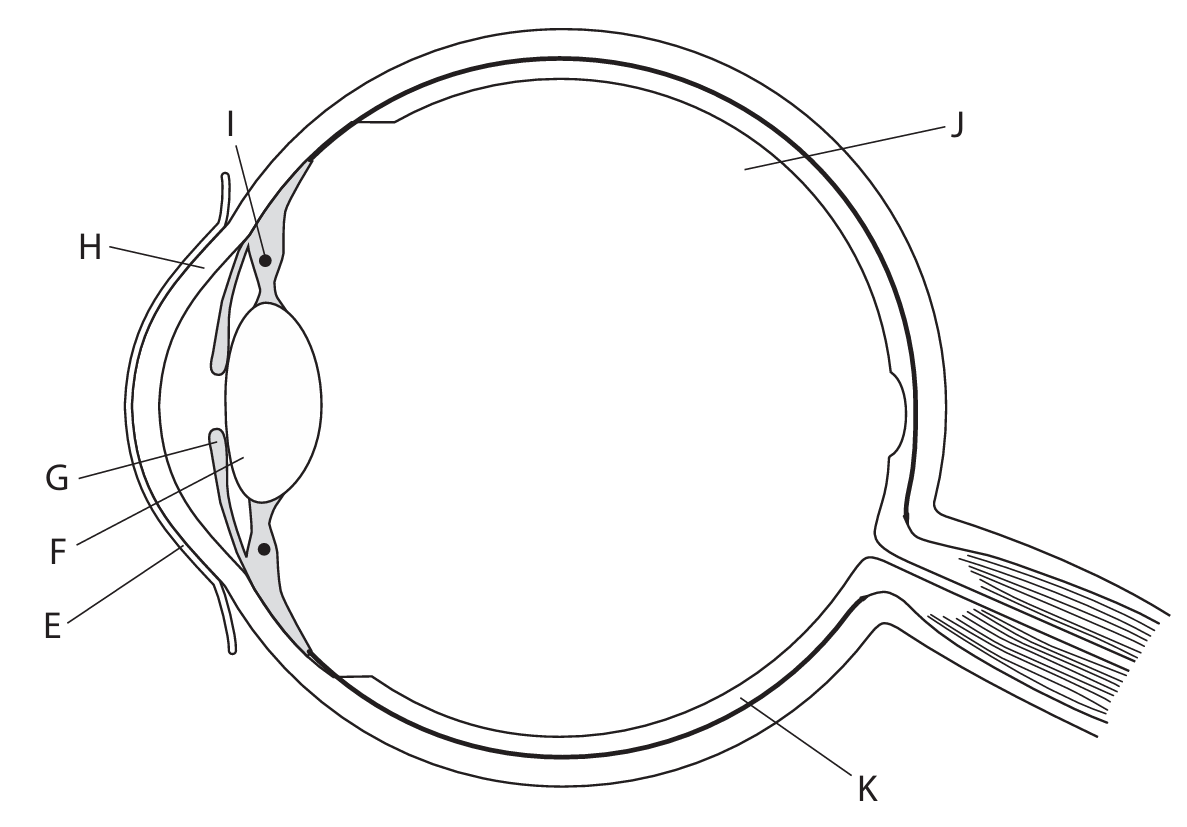
The diagram shows a section through a human eye with some structures labelled.

(a) (i) Which structures refract light onto the retina?

A) E and J
B) F and H
C) G and K
D) I and J

(ii) Which structure controls the amount of light reaching the retina?

A) E
B) F
C) G
D) H

(iii) Which structure contains light sensitive cells?

A) H
B) I
C) J
D) K

(b) The eye can focus on near objects and distant objects.

Describe the changes that take place in the eye when it focuses on a near object.

(c) Some people develop cataracts in their lenses as they get older. The diagram shows how a cataract changes the appearance of a person’s eye.

(i) Explain how cataracts affect a person’s vision.
(ii) The treatment for a person with cataracts is to remove the affected lenses.
Suggest what additional treatment is needed for the person.

Most-appropriate topic codes (Edexcel IGCSE Biology):

2(j): Co-ordination and response — Structure and function of the eye — parts (a)(i), (a)(ii), (a)(iii), (b), (c)(i), (c)(ii)
▶️ Answer/Explanation
Solution

(a)(i) B (F and H)
A is not the answer as E and J do not refract light.
C is not the answer as G and K do not refract light.
D is not the answer as I and J do not refract light.

(a)(ii) C (G)
A is not the answer as E does not control the amount of light.
B is not the answer as F does not control the amount of light.
D is not the answer as H does not control the amount of light.

(a)(iii) D (K)
A is not the answer as H does not contain light sensitive cells.
B is not the answer as I does not contain light sensitive cells.
C is not the answer as J does not contain light sensitive cells.

(b) A description that makes reference to four of the following points:

  1. the ciliary muscle(s) contract / structure I contract(s) / eq (1)
  2. the tension in the suspensory ligament(s) is reduced / loosened / slackens / eq (1)
  3. the lens becomes thick(er) / wide(r) / fat(ter) / round(er) / more convex / eq (1)
  4. the light is refracted more / bent more / eq (1)
  5. accommodation (1)

Ignore relax.

(c)(i) An explanation that makes reference to two of the following points:

  • lens becomes cloudy / opaque / misty / milky / eq (1)
  • less light enters eye / eq (1)
  • image dimmer / not formed / vision blurred / distorted / not clear / blindness / eq (1)

Ignore poor vision.

(c)(ii)

  • glasses / contact lens / new lens inside eye / eye drops / eq (1)

Ignore laser eye surgery.
Question 5

Scientists can investigate the effect of exercise on breathing rate.

An athlete wears a face mask that covers their nose and mouth. The mask contains electronic sensors that measure and record the athlete’s breathing rate as they exercise.

An investigation using this mask produces these results.

Time since start of exercise in minutesBreathing rate in breaths per minute
020
228
435
645
848
1050
1250

(a) (i) Calculate the percentage change in the breathing rate from the start of exercise to the breathing rate at 10 minutes. 
(ii) Plot a line graph to show how breathing rate changes during exercise. Join your points with straight lines. 
(iii) Explain the change in breathing rate during the 12 minutes of exercise. 

(b) Explain why the breathing rate would remain high for a few minutes after the exercise has finished. 

(c) The difficulty with measuring breathing rate during exercise is that wearing a mask may affect breathing rate and performance.

A different method of recording breathing rate is to wear a shirt that contains sensors that record chest movements.

Suggest one advantage and one disadvantage of using a shirt that measures breathing rate by recording chest movements. 

Most-appropriate topic codes (Edexcel IGCSE Biology):

2(g): Gas exchange — parts (a)(i), (a)(ii), (a)(iii), (b)
2(f): Respiration — part (b)
Appendix 3: Mathematical skills — part (a)(i)
Appendix 4: Command word taxonomy — parts (a)(i) (Calculate), (a)(iii) (Explain), (b) (Explain), (c) (Suggest)
3(j): Co-ordination and response (Homeostasis) — part (a)(iii)
▶️ Answer/Explanation
Solution

(a)(i)

Calculation:
Change in rate = 50 – 20 = 30 breaths per minute.
Percentage change = \( \frac{30}{20} \times 100 = 150\% \)

Answer: 150%

(a)(ii)

A correctly plotted line graph should have:
• Time (minutes) on the x-axis.
• Breathing rate (breaths per minute) on the y-axis.
• A linear, appropriate scale (e.g., y-axis starting at 0 or 10).
• All points correctly plotted within half a small square of their true position.
• Points joined with straight lines.
• Both axes labelled with correct units.

(Refer to the mark scheme: 5 marks for correct scale, lines, axis orientation, units, and accurate plotting.)

(a)(iii)

An explanation that makes reference to three of the following points:
1. (The increase is due to the need for) increased intake of oxygen / eq.
2. To release more carbon dioxide / eq.
3. (To provide more oxygen) to red blood cells / for muscles / for (aerobic) respiration / eq.
4. The breathing rate reaches a maximum / plateaus / stops increasing at 10-12 minutes / eq.
5. The chest cannot inflate and deflate any quicker / there is a physical limit / eq.

(b)

An explanation that makes reference to two of the following points:
• (There is a build-up of) lactic acid / lactate (in muscles) / eq.
• Due to anaerobic respiration occurring during intense exercise / eq.
• An oxygen debt / EPOC (Excess Post-exercise Oxygen Consumption) needs to be repaid / eq.
• Oxygen is required to break down / oxidise the lactic acid.

(c)

Advantage:
• Mouth/nose/face is not covered / does not interfere with airflow / allows the subject to breathe normally / more freely / eq.

Disadvantage:
• Muscle movement during exercise may not be due to breathing / other movements may be recorded / it is an indirect measurement / eq.
• The shirt may be heavy/uncomfortable and affect performance / eq.
• Sweat may affect the sensors / eq.

Question 6

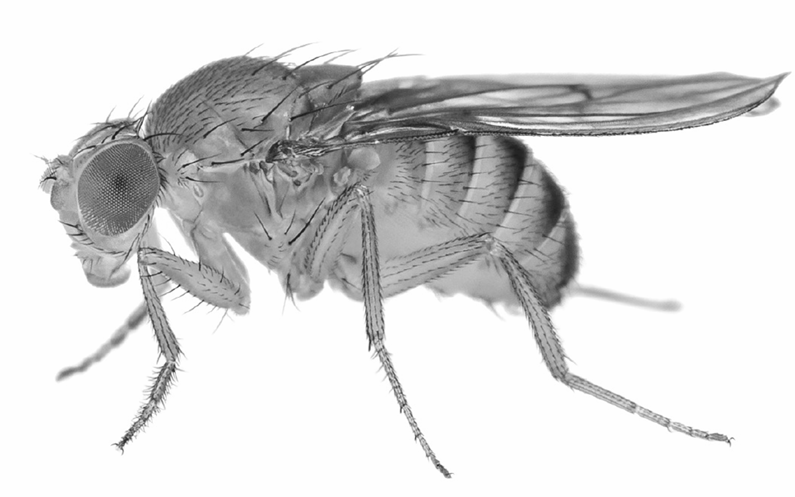
Drosophila melanogaster (fruit fly) is the most commonly used organism for genetic research. They have a life cycle of around 10 days and each female can produce hundreds of offspring.

(a) Explain one reason why Drosophila are a popular choice for scientists to use in genetic studies.

(b) Files normally have long wings, but some files have been found that have short wings.

In a first cross, a scientist mates 10 male files with long wings with 10 female files that have short wings. They have 2810 offspring that all have long wings.

The scientist then sets up a second cross. They mate a male offspring from the first cross with a female offspring from the first cross.

This second cross produces 241 offspring with long wings and 79 offspring with short wings.

(i) Draw a genetic diagram to show the genotypes and phenotypes of the parents in the second cross and the ratio of phenotypes and genotypes of their offspring.

(ii) Calculate the expected probability of a fly being male and having long wings in this second cross.

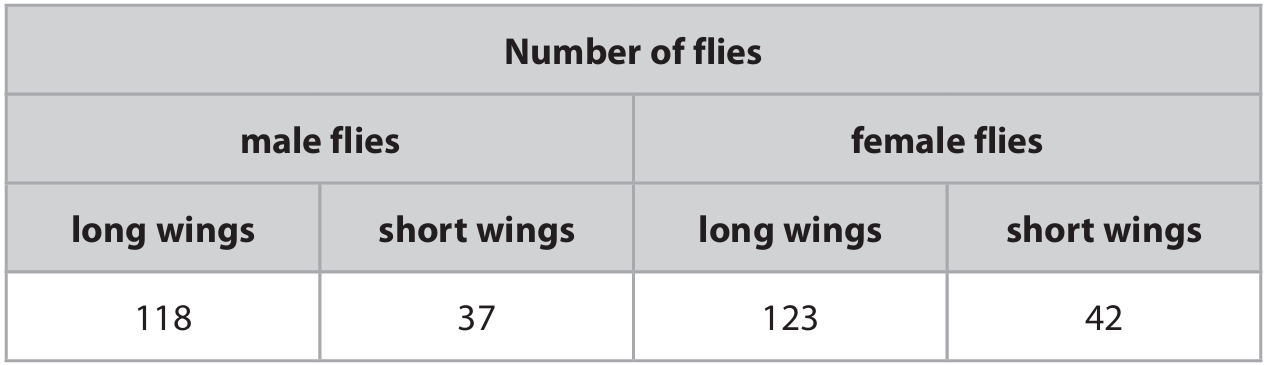
(iii) The scientists counted the number of male and female offspring with long wings or with short wings from this second cross. The table shows their results.

Comment on these results compared with the expected results. In your answer refer to:

  • the number of males and the number of females
  • the number of flies with long wings and the number of flies with short wings

Use data from the table in your answer.

(c) Files with short wings are not found in wild populations of Drosophila. Explain this observation.

Most-appropriate topic codes (Edexcel IGCSE Biology):

3(b): Inheritance — parts (b)(i), (b)(ii), (b)(iii)
3(b): Variation and natural selection — part (c)
Intro/Practical: Characteristics of model organisms — part (a)
▶️ Answer/Explanation
Solution

(a) An explanation that makes reference to two of the following points:

  • Short life span / short generation time / short life cycle / reproduce quickly (1)
  • Can get many repeats / many generations / can get expected / predicted ratios / quick/reliable/valid results (1)
  • Have a range of visible characteristics / traits / phenotypes (1)
  • That are inherited / controlled by genes (1)

(b)(i) An answer that makes reference to:

  • (Parent genotypes) Ll and Ll (1)
  • (Offspring genotypes) LL, Ll, ll (1)
  • (Offspring phenotypes) Long and short (1)
  • (Phenotype ratio) 3 long : 1 short (1)

Example genetic diagram:
Parents: Ll (long) × Ll (long)
Gametes: L, l × L, l
Offspring: LL, Ll, Ll, ll
Phenotype ratio: 3 long : 1 short

(b)(ii)

  • Probability of being male = \(0.5\) (or \(\frac{1}{2}\)) (1)
  • Probability of having long wings (from monohybrid cross) = \(0.75\) (or \(\frac{3}{4}\)) (1)
  • Combined probability = \(0.5 \times 0.75 = 0.375\) (or \(37.5\%\), \(\frac{3}{8}\)) (1 for correct calculation, award 2 marks total)

(b)(iii) An answer that makes reference to four of the following points (using processed data, not raw numbers):

Male to female:

  • Observed: males = 155, females = 165 (or 48% male, 52% female) (1)
  • Expected: 1:1 ratio / 50% each / equal numbers (1)
  • Comparison: almost identical / little difference / slightly fewer males / slightly more females (1)

Long to short wings (overall):

  • Observed: long = 241, short = 79 (or 75% long, 25% short) (1)
  • Expected: 3:1 ratio / 75% long, 25% short (1)
  • Comparison: (almost) 3:1 / little difference (1)

Long/short by sex:

  • Slight difference between male and female ratios: Males ≈ 3.2:1 (76% long), Females ≈ 2.9:1 (75% long) (1)
  • Slightly more long-winged males than expected / slightly fewer long-winged females than expected (1)

(c) An explanation that makes reference to three of the following points:

  • Short-winged files cannot fly / feed / mate / move as well / escape predators (1)
  • Therefore, they do not survive / die out / are less likely to reproduce (1)
  • So, the short-wing allele is not passed on to the next generation / is selected against (1)
  • This is due to natural selection / selective disadvantage (1)
Question 7

This food chain comes from a Swedish lake.

algae → crustacea → perch → pike → osprey

(a) (i) Name the trophic level of the algae in this food chain.
(ii) Name the trophic level of the pike in this food chain.

(b) Some algae are single-celled such as Chlorella whilst other algae are multicellular such as seaweeds.

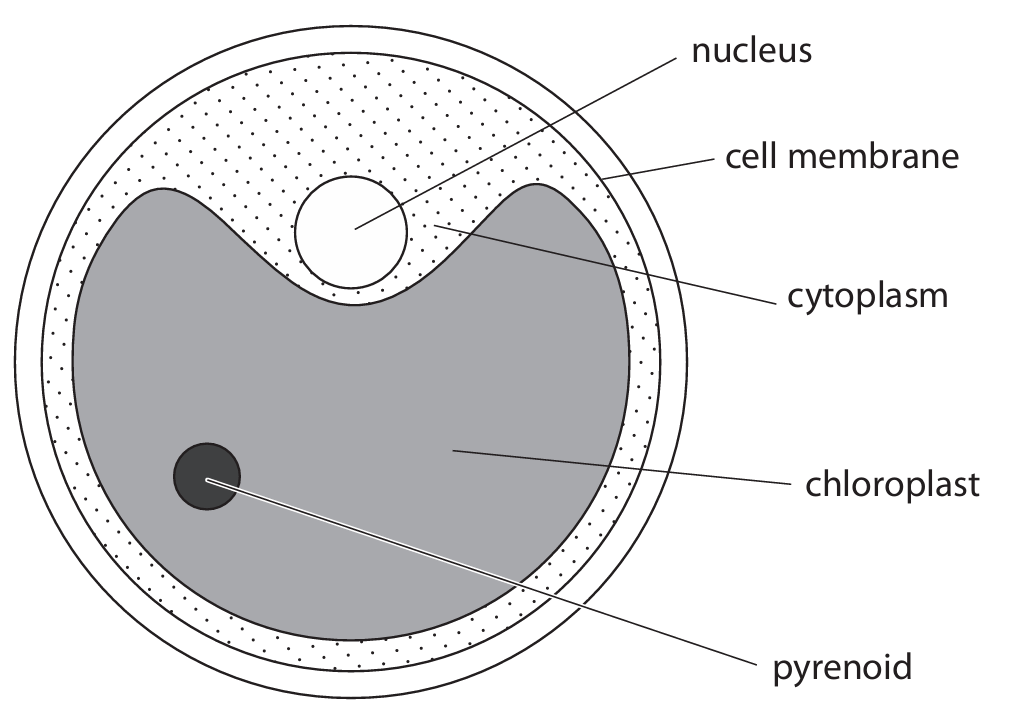
The diagram shows a species of Chlorella.

(i) The actual diameter of the Chlorella is 10 µm.

Calculate the magnification of the diagram. [1 mm = 1000 µm] 

(ii) Calculate the volume of the Chlorella.

Assume Chlorella is a sphere with a radius (r) of 5.00 µm. [volume of sphere = \(\frac{4}{3} \pi r^3\), \(\pi = 3.14\)] (2)

(iii) The cytoplasm contains a very large chloroplast.

Describe the function of the chloroplast.

(iv) Chlorella contains many starch granules.

Describe the function of the starch granules in the organism.

(c) A student wants to compare the number of individuals in seaweed populations on two different beaches.

Describe how the student could carry out this investigation.

Most-appropriate topic codes (Edexcel IGCSE Biology):

4(b): Feeding relationships — parts (a)(i), (a)(ii)
2(b): Cell structure — parts (b)(iii), (b)(iv)
2(e): Nutrition (Photosynthesis) — part (b)(iii)
2(f): Respiration — part (b)(iv)
4(a): The organism in the environment — part (c)
▶️ Answer/Explanation
Solution

(a)(i) • producer / first trophic level (1)

(a)(ii) • tertiary consumer / third consumer / fourth trophic level (1)

(b)(i)

Calculation method (not marking points):

Full marks for correct answer with no working.

Example: Measured length = 75 mm = 75 × 1000 = 75000 µm

Magnification = image size / actual size = 75000 µm / 10 µm = × 7500 (2)

(Allow answers in the range 7400 to 7600 depending on measurement. Ignore units in final answer.)

(b)(ii)

Calculation method (not marking points):

Full marks for correct answer with no working.

Example using formula: \( V = \frac{4}{3} \pi r^3 \)

\( r^3 = 5^3 = 125 \)

\( V = \frac{4}{3} \times 3.14 \times 125 = \frac{4 \times 392.5}{3} = \frac{1570}{3} = 523.33 \)

Volume = 523 µm3 (2) (Allow 522–524). If they round 4/3 to 1.33, answer will be = 522.

(b)(iii) A description that includes two of the following points:
• absorbs / traps (sun)light / light energy (1)
• site of photosynthesis (1)
• produces glucose / carbohydrate / sugar / starch (1)
(Note: Ignore “uses”. “Converts light energy into chemical energy” scores the first and third marking points.) (2)

(b)(iv) A description that includes the following points:
• provides an energy store / energy reservoir / stores carbohydrate (1)
• (can be broken down to release energy in) respiration (1) (2)

(c) A description that includes four of the following points:
• use quadrats (1)
• random sampling (1)
• use coordinates / grid to select sample positions (1)
• count number of individuals / plants in each quadrat (1)
• repeat and (calculate) mean / average (1)
• multiply (mean count) by size of (total) area to estimate population size (1)
(Note: “Use quadrats” scores the first and fifth marking points.) (4)
Question 8

The body has a hormonal control system that coordinates some of the body’s responses.

(a) The table shows the effects of some of the hormones and the gland that produces each hormone. Complete the table by giving the missing information.

EffectName of hormoneName of gland
converts blood glucose into glycogen pancreas
stimulates the development of male secondary sexual characteristics  
increases heart rateadrenaline 
maintains the uterus lining  

(b) Plants also respond to changes in their environment.

(i) Explain how plants benefit from the responses of their roots and stems to the direction of light they receive.
(ii) In many plants, flowering is stimulated by the number of hours of daylight. Suggest why flowering in many plants is stimulated by the number of hours of daylight rather than by temperature. 

Most-appropriate topic codes (Edexcel IGCSE Biology):

2(j): Co-ordination and response (Humans) — part (a)
2(j): Co-ordination and response (Flowering plants) — parts (b)(i), (b)(ii)
3(a): Reproduction (Humans) — part (a)
▶️ Answer/Explanation
Solution

(a)

EffectName of hormoneName of gland
converts blood glucose into glycogeninsulinpancreas
stimulates the development of male secondary sexual characteristicstestosteronetestis
increases heart rateadrenalineadrenal gland
maintains the uterus liningprogesteroneovary / corpus luteum / placenta

(b)(i) An explanation that makes reference to four of the following points:

  1. Stems (grow) towards light / are positively phototropic.
  2. This increases photosynthesis / light absorption.
  3. It allows the plant to grow away from competition / other plants.
  4. Roots (grow) away from light / are negatively phototropic.
  5. This directs them into the soil to absorb water / minerals / for anchorage.
  6. This anchors the plant firmly.

(b)(ii) An explanation that makes reference to two of the following points:

  1. Hours of daylight are a better / more reliable indicator of season / time of year.
  2. Daylight length does not vary (day to day) / is constant for a given date, whereas temperature can vary (day to day) / is less predictable.
  3. More hours of daylight allow insects to see flowers (for pollination).
  4. More insect pollination occurs in daylight / insects pollinate in daylight.
Question 9

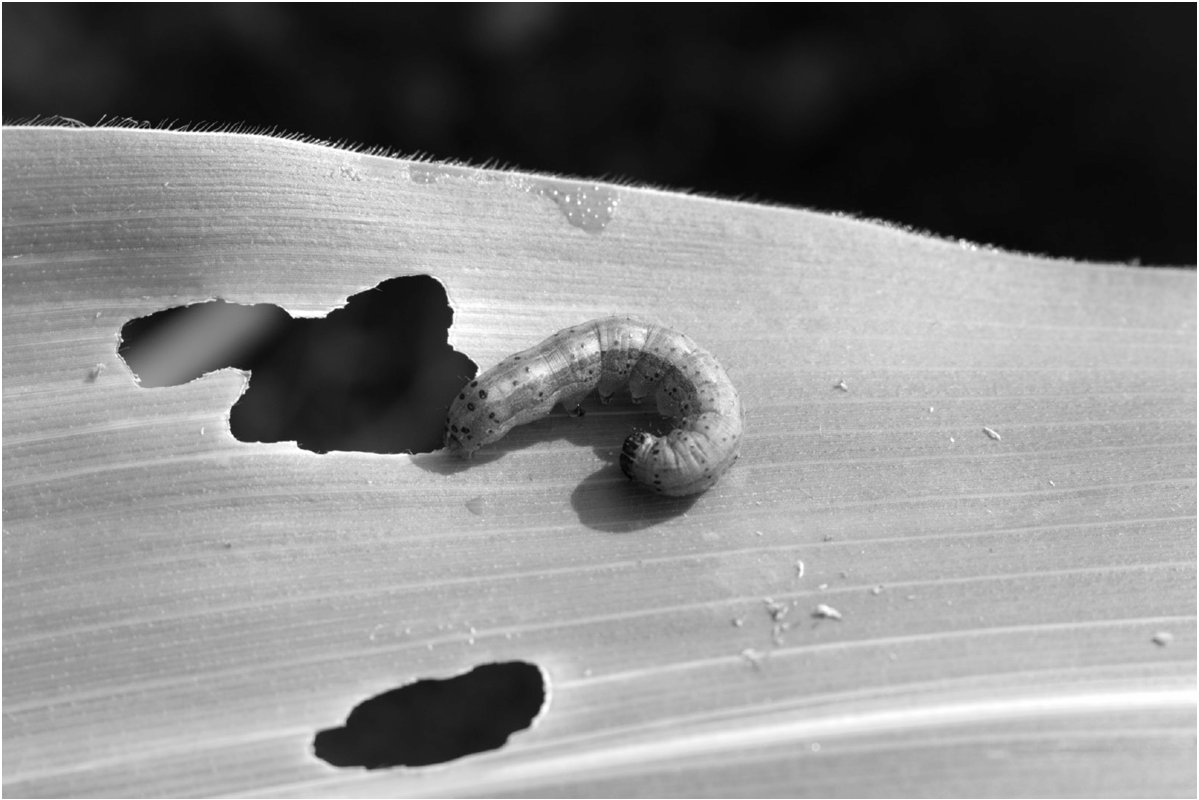
Many insect species damage crop plants. One such pest is the larvae of the Fall Armyworm moth.

The photograph shows a larva of this moth feeding on a leaf of a maize plant.

(a) Explain how the larvae of the moth cause a reduction in the yield of the maize crop.

(b) Biological control involves using a predator species to control the numbers of a pest species. Explain the advantages of using biological control rather than chemical pesticides to control a pest species.

(c) A parasitic wasp is used as a biological control of the larvae of the Fall Armyworm moth. The wasp feeds off the moth larvae.

The graph shows the change in the numbers of the larvae of the Fall Armyworm moth. It also shows the change in the numbers of the parasitic wasp.

(i) Explain the relationship between the number of moths and the number of wasps during the 24-month period.

(ii) The range in moth numbers is the difference between the highest number of moths and the lowest number of moths. Use the graph to determine the maximum range in the number of moths in the period from 6 months to 24 months.

(iii) Suggest why some maize farmers choose not to use biological control to control the moth.

Most-appropriate topic codes (Edexcel IGCSE Biology):

2(e): Nutrition — part (a)
5(a): Food production — parts (b), (c)
4(b): Feeding relationships — part (c)(i)
4(a): The organism in the environment — parts (c)(ii), (c)(iii)
▶️ Answer/Explanation
Solution

(a) An explanation that makes reference to two of the following points:

  • less (leaf) area / surface / fewer leaves
  • fewer chloroplasts / less chlorophyll
  • (less) photosynthesis
  • less carbohydrate / glucose / sugar produced

(b) An explanation that makes reference to four of the following points (advantages of biological control):

  1. lasts longer / does not need reapplication
  2. specific / does not affect food chain / other organisms
  3. no residue on crop / not eaten by humans / does not affect humans
  4. no bioaccumulation / biomagnification
  5. pest does not become resistant

(c)(i) An explanation that makes reference to three of the following points:

  1. moth population rises (up to 6 months)
  2. wasp population also rises as more moths / food is available
  3. (from 6 months) moth population falls as eaten by wasp
  4. wasp population falls as fewer moths to feed on / less food available
  5. moth population recovers / repeats pattern

(c)(ii)

Maximum moth number \( \approx 2150 \) (at ~7 months).
Minimum moth number \( \approx 850 \) (at ~11 months).
Maximum range \( = 2150 – 850 = 1300 \).

(c)(iii) An explanation that makes reference to two of the following points:

  • some moths remain / doesn’t kill all moths
  • delay to act / kill moths / slower (than chemical)
  • numbers vary with time of year / seasons
  • wasps are expensive
  • wasps may become pest / may kill other organisms / may affect food chain / farmers may not want to leave wasps in their fields / may sting farmers
Question 10

Some scientists believe that increasing the temperature by 3°C in a glasshouse will significantly increase crop yield.

Design an investigation to determine whether a small change in temperature in a glasshouse will produce a significant increase in crop yield.

Include experimental details in your answer and write in full sentences.

Most-appropriate topic codes (Pearson Edexcel International GCSE in Biology (Modular)):

5(a): Food production — Glasshouses and crop yield (Specification points 6.1, 6.2)
3: Biology content (AO3): Experimental skills, analysis and evaluation of data and methods — Designing an investigation
▶️ Answer/Explanation
Mark Scheme and Example Answer

Mark Scheme (CORM):

CodeRequirementMark
CUse at least two temperatures differing by 3°C / eq1
OSame species / same plant / age / size / condition / same crop / eq1
RRepeat / calculate mean / use more than one glasshouse (for each temperature) / eq1
M1Measure mass / weight (of crop) / mass / weight of fruit / mass / weight of grain / number of fruits / number of grains / number of leaves / size of leaves / eq1
M2Stated time period (one day plus) / eq1
SSame light (intensity) / light duration / same sun(light) / same time of year / same carbon dioxide concentration / mineral ions / water / soil / pH / humidity / eq (Any two for 1 mark)1

Total: 6 marks

Example Answer (Full Sentences):

To investigate this, I would set up two or more identical glasshouses. The independent variable would be the temperature inside each glasshouse, with one set to a control temperature (e.g., 20°C) and the other(s) set to a temperature 3°C higher (e.g., 23°C).

The dependent variable, the crop yield, would be measured at the end of the growing season by weighing the total mass of the edible parts harvested from each glasshouse.

To ensure a fair test, I would control many variables. I would plant the same species, variety, age, and number of crop plants in each glasshouse. They would be planted in identical soil, receive the same volume and frequency of water, the same concentration of mineral ions as fertiliser, and the same carbon dioxide concentration. The light intensity and photoperiod would also be kept the same, which could be achieved by using artificial lighting or conducting the experiment at the same time of year.

I would repeat the investigation by using multiple glasshouses at each temperature or by repeating the entire experiment over multiple growing seasons. The yield measurements from replicates would be used to calculate a mean yield for each temperature condition. I would then compare the mean yields using a statistical test to determine if any difference is significant.

Scroll to Top