Home / 4bi1-1b-que-20240511-
Question 1

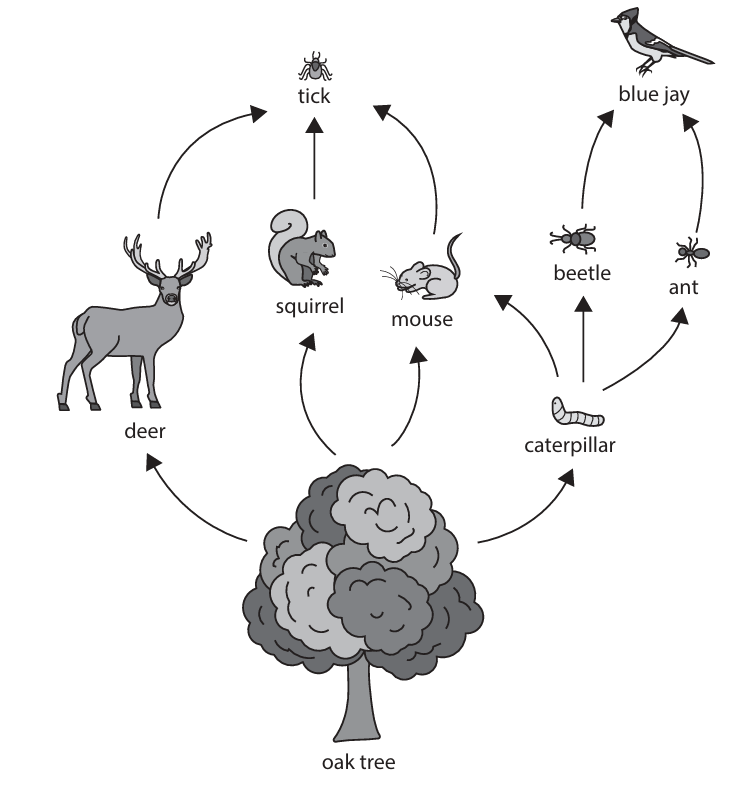
The diagram shows part of a food web from an oak woodland.

(a) (i) Which is the producer in this food web?

A) beetle
B) deer
C) oak tree
D) tick

(ii) Draw a food chain, from this web, that includes the mouse and contains four trophic levels.

(iii) Which one of these organisms is in two different trophic levels in this food web?

A) ant
B) blue jay
C) caterpillar
D) mouse

(b) A tick is a small spider-like organism that bites and then takes in blood from the mammals as it feeds.

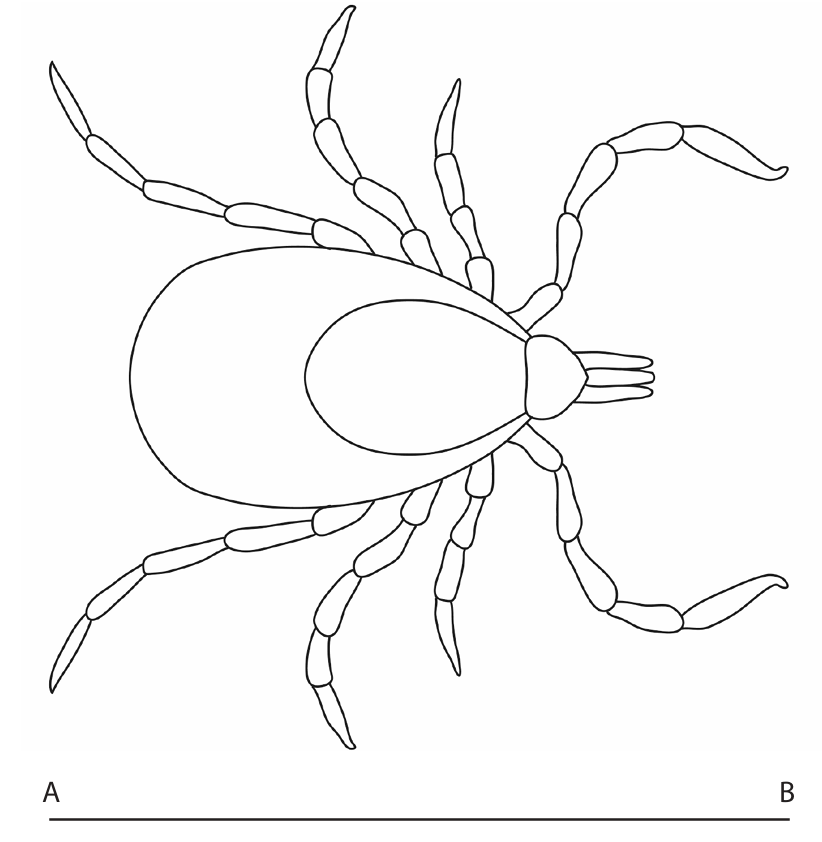
This is a magnified image of a tick.

(i) The actual length of the tick, as shown by line A-B, is 3.5 mm. Calculate the magnification of the image of the tick.

(ii) The tick absorbs substances from the mammal’s blood it has taken in. Give the function of two named substances absorbed by the tick.

(iii) Ticks can pass diseases between organisms. Suggest how ticks can pass diseases from one organism to another.

Most-appropriate topic codes (Edexcel IGCSE Biology):

5(b): Feeding relationships — parts (a)(i), (a)(ii), (a)(iii)
5(a): The organism in the environment — part (a)(i)
Mathematical Skills (Appendix 3): Arithmetic and numerical computation — part (b)(i)
2(e): Nutrition (Humans) — part (b)(ii)
1(b): Variety of living organisms / Pathogens — part (b)(iii)
▶️ Answer/Explanation
Solution

(a)(i) C (oak tree)
A is not the answer as beetle is not the producer
B is not the answer as deer is not the producer
D is not the answer as tick is not the producer

(a)(ii)
oak tree → caterpillar → mouse → tick
Allow 1 mark for correct order. No credit for pyramids.

(a)(iii) D (mouse)
A is not correct as the ant is not at two levels
B is not correct as the blue jay is not at two levels
C is not correct as the caterpillar is not at two levels

(b)(i)
Measurement of line = \(10.4 \text{ cm} = 104 \text{ mm}\)
Magnification = \(\frac{\text{image size}}{\text{actual size}} = \frac{104}{3.5}\)
Magnification = \(29.7\) (range \(29.0 – 30.0\) accepted)
Allow 1 mark for correct measurement of line (10.3-10.5 cm or 103-105 mm) with units.

(b)(ii)
An explanation makes reference to four of the following points (substance + matching function):
• Glucose (1) — for energy / respiration (1)
• Iron (1) — for haemoglobin / red blood cells (1)
• Amino acids (1) — for protein (synthesis) / growth (1)
• Fatty acids / lipids (1) — for energy / insulation (1)
• Water (1) — for keeping body hydrated / transport / solvent (1)
• Vitamin C (1) — for prevents scurvy (1)
Allow named vitamin or mineral for one mark each. Function must match substance.

(b)(iii)
An answer that makes reference to two of the following:
• Tick picks up / bites / sucks up / absorbs blood from infected animal / animal with disease (1)
• Bacteria / virus / pathogen is present in the blood (1)
• Tick then feeds on / bites a new / uninfected animal (1)
• Pathogen is transferred to the new host (1)
Allow ‘transfer’ if reference to biting is included.

Question 2

The diagram shows a flower with some structures labelled.


(a) (i) Which structure is the style?

A) P
B) Q
C) S
D) T

(ii) Which structure releases pollen?

A) P
B) R
C) T
D) U

(iii) On which structure do the pollen grains germinate?

A) P
B) R
C) S
D) U

(b) This flower is insect-pollinated.
Describe how structures P, R and T would be different in a wind-pollinated flower.

(c) Flowering plants can reproduce asexually.

(i) Give an example of a natural method of asexual reproduction in plants.
(ii) Give an example of an artificial method of asexual reproduction in plants.

(d) Give three differences between asexual and sexual reproduction.

(e) A farmer has two varieties of a plant species. One variety has a red flower colour and no scent. The other variety has a white flower colour and a perfumed scent. The farmer wants to produce a variety that has the red flower colour and the perfumed scent.

Explain how the farmer could achieve this. 

Most-appropriate topic codes (Edexcel IGCSE Biology):

4(a): Reproduction — Flowering plants — parts (a), (b), (c), (e)
4(a): Reproduction — Humans (general concepts) — part (d)
4(b): Inheritance — part (e) – selective breeding
6(b): Selective breeding — part (e)
▶️ Answer/Explanation
Solution

(a)(i) B (Q)
A is not the answer as P is not the style
C is not the answer as S is not the style
D is not the answer as T is not the style

(a)(ii) D (U)
A is not the answer as P does not release pollen
B is not the answer as R does not release pollen
C is not the answer as T does not release pollen

(a)(iii) A (P)
B is not correct as pollen grains do not germinate on R
C is not correct as pollen grains do not germinate on S
D is not correct as pollen grains do not germinate on U

(b) A description that makes reference to the following:
• P feathery / large surface area / outside flower / exposed / eq (1)
• R absent / smaller / not coloured / green / eq (1)
• T longer / hinged / outside flower / exposed / eq (1)

(c)(i) • runners / bulbs / corms / tubers / rhizomes / eq (1)

(c)(ii) • cuttings / grafting / layering / tissue culture / micropropagation / eq (1)
Note: Reject ‘cloning’.

(d) An answer that makes reference to the following:
Allow two / three in one numbered line
• no gametes produced in asexual / no meiosis in asexual / gametes produced in sexual / meiosis in sexual / one parent cell (1)
• no fusion or fertilisation in asexual / present in sexual (1)
• offspring are clones / show no genetic variation in asexual / genetic variation in sexual / eq (1)
• asexual faster / shorter time / sexual slower / longer time / eq (1)
Note: Only mitosis in asexual. Ignore reference to number of parents. ‘Sexual involves fusion of gametes’ scores marking point 1 and marking point 2.

(e) An explanation makes reference to three of the following:
• selective breeding / artificial selection (1)
• cross red (flower) / unscented (flower) with white (flower) / scented (flower) / eq (1)
• select / breed / offspring with red and scent / eq (1)
• repeat / for many generations eq (1)
Note: Ignore reference to GM as it is the farmer. ‘Cross varieties / the plants’ is acceptable. Ignore ‘desired characteristics’ alone.
Question 3

The passage describes the process used to produce yoghurt. Complete the passage by writing a suitable word or words in each blank space.

Yoghurt is made by heating              to a high temperature.

This heating process is known as             .

This ensures that bacteria present in the liquid are             .

The liquid is then cooled to between \(40^\circ C\) and \(46^\circ C\).

A type of bacteria called              is then added.

These bacteria use a sugar called              for              respiration.

The pH of the yoghurt decreases because this respiration produces a substance called             .

Most-appropriate topic codes (Edexcel IGCSE Biology):

6(a): Use of biological resources – Food production (Micro-organisms) — specifically 6.7, 6.8
2(f): Respiration — specifically 2.36, 2.38 (anaerobic respiration)
1(b): Variety of living organisms — specifically 1.3 (Bacteria)
▶️ Answer/Explanation
Solution

Completed Passage:

Yoghurt is made by heating milk to a high temperature.

This heating process is known as pasteurisation or sterilisation.

This ensures that bacteria present in the liquid are killed.

The liquid is then cooled to between \(40^\circ C\) and \(46^\circ C\).

A type of bacteria called Lactobacillus (or Streptococcus) is then added.

These bacteria use a sugar called lactose for

anaerobic respiration.

The pH of the yoghurt decreases because this respiration produces a substance called

lactic acid (or lactate).


Topic Mapping:

• 6(a) Food production (Micro-organisms) – 6.7, 6.8: The question directly assesses knowledge of yoghurt production using bacteria (Lactobacillus) and the conditions in a fermenter (heating, cooling).

• 2(f) Respiration – 2.36, 2.38: The question involves the type of respiration (anaerobic) and its product (lactic acid).

• 1(b) Variety of living organisms (Bacteria) – 1.3: Requires naming a specific bacterium used in food production.

Question 4

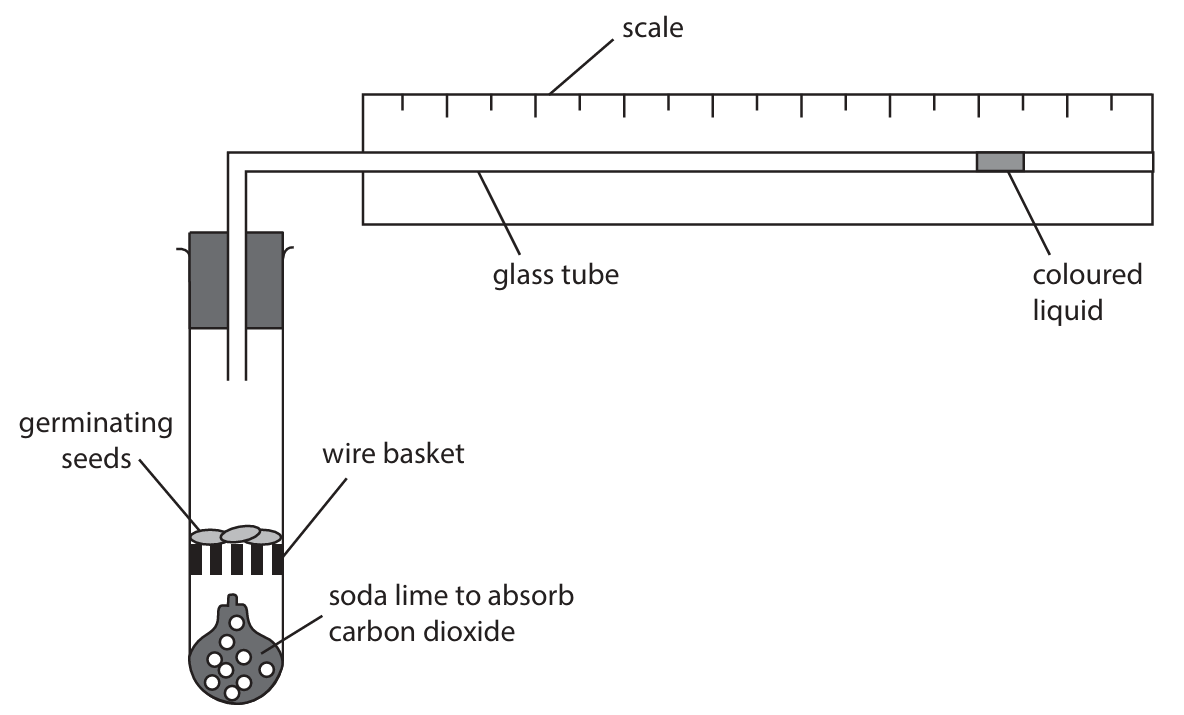
A respirometer is a simple apparatus that can be used to measure the rate of respiration in small organisms.

A student uses the respirometer to investigate the rate of respiration in some germinating seeds.

(a) Give the balanced chemical symbol equation for aerobic respiration. 

(b) The student measures the rate of respiration of 10 g of germinating seeds at 20°C. They then repeat this with another sample of 10 g of germinating seeds at 30°C. The rate of respiration can be measured by recording the distance, in mm, the bubble of coloured liquid moves on the scale in one minute. They measure the rate three times at each temperature.

(i) Explain why carbon dioxide needs to be absorbed by the soda lime when measuring the rate of aerobic respiration.
(ii) State how the student could have changed the temperature in this investigation.

(c) The table shows the student’s results.

Temperature in °CDistance moved by bubble in one minute in mm 
 reading 1reading 2reading 3mean
2014121413
30222524 


(i)
Calculate the mean distance moved by the bubble at 30°C. 

(ii) Explain the effect of increasing the temperature on the movement of the bubble. 

Most-appropriate topic codes (Edexcel IGCSE Biology Modular):

2(f): Respiration — parts (a), (b)(i), (c)(ii)
2(c): Biological molecules — part (c)(ii), specific reference to enzymes
Scientific Skills & Practical Investigation — parts (b)(ii), (c)(i)
▶️ Answer/Explanation
Solution

(a) \( C_6H_{12}O_6 + 6O_2 \rightarrow 6CO_2 + 6H_2O \)

(b)(i) An explanation that makes reference to two of the following:
• The bubble would not move / \( CO_2 \) also moves / shifts the bubble (1)
• Carbon dioxide is produced/released (1)
• Only oxygen consumption is measured (1)

(b)(ii) • Use a water bath (1)

(c)(i) \( 22 + 25 + 24 = 71 \)
\( 71 \div 3 = 23.7 \) (or 24) mm (2)

(c)(ii) An explanation that makes reference to three of the following:
• Increases (kinetic) energy of molecules / molecules move faster (1)
• Collide more frequently / form more enzyme-substrate complexes (1)
• Respiration (rate) increases (1)
• More oxygen consumed / oxygen used faster (1)
• Reference to/nearer to optimum temperature for enzymes (1)

Question 5

(a) Increased release of greenhouse gases are a threat to many ecosystems.

(i) Which of these are greenhouse gases?

  1. CFCs
  2. methane
  3. oxygen
  4. water vapour

A) 1 and 2 only
B) 1, 2 and 3 only
C) 1, 2 and 4 only
D) all of them

(ii) Explain what is meant by the term greenhouse effect.

(b) The graph shows the mass of greenhouse gases emitted from four sources in the United Kingdom from 1990 to 2020.

(i) Calculate the percentage of the total greenhouse gases emitted that came from energy production in 2020.
(ii) Comment on the changes in the four sources of greenhouse gases from 1990 to 2020. Use the information in the graph and your own knowledge to support your answer.

Most-appropriate topic codes (Edexcel IGCSE Biology):

5(d): Human influences on the environment — parts 5(a)(i), 5(a)(ii), 5(b)(i), 5(b)(ii)
5.13: Understand that water vapour, carbon dioxide, nitrous oxide, methane and CFCs are greenhouse gases — part 5(a)(i)
5.14: Understand how human activities contribute to greenhouse gases — part 5(b)(ii)
5.15: Understand how an increase in greenhouse gases results in an enhanced greenhouse effect — part 5(a)(ii)
▶️ Answer/Explanation
Solution

(a)(i) C (1, 2 and 4 only)
A is not correct as water vapour is a greenhouse gas
B is not correct as oxygen is not a greenhouse gas and water vapour is a greenhouse gas
D is not correct as oxygen is not a greenhouse gas
(1 mark)

(a)(ii) An explanation that makes reference to the following:
• IR / long wave radiation is absorbed / traps IR / long wave radiation / traps heat / prevents heat escaping (1)
• (so) increases (global) temperature / earth warms / global warming (1)
(2 marks)

(b)(i)
Calculation:
Readings from the graph (in million tonnes, approximately):
Agriculture ≈ 50, Energy ≈ 110, Business ≈ 118, Transport ≈ 175.
Total = \(50 + 110 + 118 + 175 = 453\).
Percentage from energy = \(\left(\frac{110}{453}\right) \times 100 \approx 24.3\%\) (Allow range: 23.9% – 24.9%).
(3 marks for correct answer with working; 1 mark for correct readings even if unlabelled; 1 mark for dividing 110 by their total if not correct answer)

(b)(ii)
An answer that makes reference to five of the following points (1 mark each):
1. Overall emissions fall / less mass from 1990 to 2020.
2. Energy production had the highest emissions in 1990 and showed the largest fall.
3. The fall in energy emissions is due to a shift to renewable sources (wind, solar) and less use of coal/gas power stations (burning fewer fossil fuels).
4. Transport emissions increased initially, then fell from around 2009/2010.
5. The initial rise in transport was due to more cars/vehicles; the later fall is linked to more electric/hybrid cars and less commuting.
6. Agriculture emissions dropped.
7. This drop may be due to less cattle farming, reducing methane release.
8. Business emissions changed little / dropped slightly.
(5 marks total)
Question 6

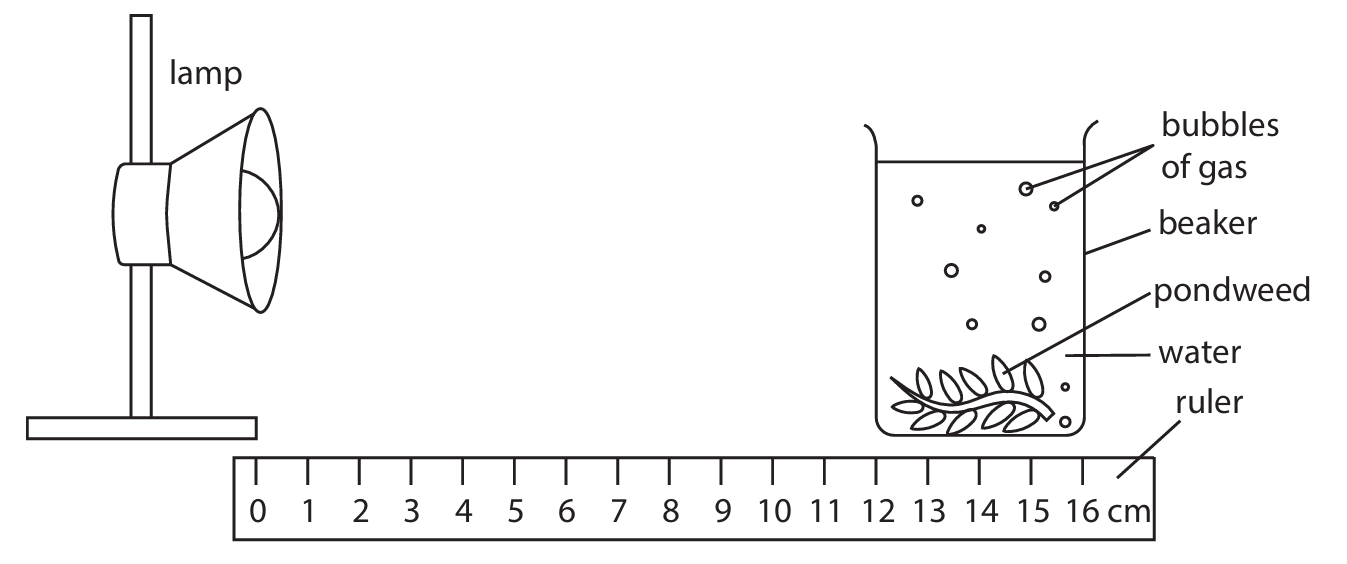
A student uses this apparatus to investigate the effect of light intensity on the rate of photosynthesis in pondweed.

This is the student’s method.

  • put a cut piece of pondweed in a beaker of water
  • put a lamp 12 cm from the beaker
  • count the number of bubbles of gas released from the cut end of the pondweed in one minute
  • repeat this count for two more one-minute periods

The student repeats the method, moving the lamp 2 cm nearer the beaker each time.

(a) (i) Which gas is released by the plant during photosynthesis?

A) carbon dioxide
B) oxygen
C) methane
D) nitrogen

(ii) Which of these is the site of photosynthesis in a plant cell?

A) chloroplast
B) mitochondrion
C) nucleus
D) ribosome

(iii) Give one abiotic variable the student should control in this investigation.

(b) The table shows the student’s results

Distance of lamp from beaker in cmNumber of bubbles released per minute
 count 1count 2count 3mean (average)
220182019
416151515
612141313
810989
108788
125645

(i) Plot a line graph to show the relationship between the distance of the lamp from the beaker and the mean number of bubbles released.
Use a ruler to join your points with straight lines.

(ii) Explain the effect of increasing the distance of the lamp from the beaker on the mean number of bubbles released per minute.

Most-appropriate topic codes (Edexcel IGCSE Biology):

2(e): Nutrition — parts (a)(i), (a)(ii), (a)(iii), (b)(ii)
2(b): Cell structure — part (a)(ii)
Appendix 3: Mathematical skills — part (b)(i) (Plotting graphs, Handling data)
▶️ Answer/Explanation
Solution

(a)(i) B (oxygen)
A is not the answer as carbon dioxide is not released
C is not the answer as methane is not released
D is not the answer as nitrogen is not released

(a)(ii) A (chloroplast)
B mitochondrion is not the site of photosynthesis
C nucleus is not the site of photosynthesis
D ribosome is not the site of photosynthesis

(a)(iii) • temperature / carbon dioxide concentration / pH / background light / same bulb/ lamp / time period / eq (1)

(b)(i) Line graph plotting criteria (from mark scheme):
• scale linear and plot half grid on y (1)
• lines straight and through points (1)
[Note: A full graph is expected here. The mark scheme awards marks for correct scaling, plotting, and straight line connections.]

(b)(ii) An explanation that refers to three of the following:
• as distance increases rate falls / fewer bubbles / eq (1)
• as light intensity reduces / less light energy / light becomes limiting factor (1)
• slower rate of / less photosynthesis (1)
• less oxygen released / fewer oxygen bubbles released (1)
Question 7

(a) Human blood contains red blood cells and white blood cells.

Give three differences in structure between red blood cells and white blood cells.

(b) Scientists collect data from men and women living at different altitudes.

The scientists determine

  • the mean mass of haemoglobin in one litre of blood
  • the mean number of red blood cells in one litre of blood

The table gives the scientists’ results.

Altitude in mMean mass of haemoglobin in 1 litre of blood in gMean number of red blood cells in 1 litre \( \times 10^{12} \)Number of people in sample
menwomenmenwomenmenwomen
0 (sea level)1481385.154.8418 45327 559
18901521475.375.2021753510
22701511425.184.8820232943

(i) The blood volume of a woman living at an altitude of 1890 m is 4.3 litres.

Calculate the total number of red blood cells in this person.

Give your answer in standard form.

(ii) Calculate the percentage difference in mean mass of haemoglobin in 1 litre of blood in men living at 2270 m compared with men living at sea level.

(iii) Discuss the relationship between altitude and mean mass of haemoglobin in 1 litre of blood and the number of red cells in 1 litre of blood in men and women.

Use the data in the table and your own knowledge in your answer.

Most-appropriate topic codes (Edexcel IGCSE Biology):

3(h): Transport — parts (a), (b)(i), (b)(ii), (b)(iii) — Specifically: blood composition, red blood cell structure/function, haemoglobin, adaptations for oxygen transport, and physiological responses to altitude.
▶️ Answer/Explanation
Solution

(a) An answer that refers to three of the following:

  • red cell has no nucleus / white cell has nucleus (1)
  • red cell is a biconcave disc / white cell is not biconcave / has irregular shape (1)
  • red cell is smaller / white cell is larger (1)
  • red cell contains haemoglobin / white cell does not contain haemoglobin (1)

(Award 1 mark for each correct, contrasting difference, up to 3 marks.)


(b)(i) Calculation method (marking points):

• 4.3 × 5.20 × \(10^{12}\) (1)
• = 22.36 × \(10^{12}\) (1)
• = \(2.236 \times 10^{13}\) or \(2.24 \times 10^{13}\) (1 for correct standard form)

Answer: \(2.2 \times 10^{13}\) (allow \(2.24 \times 10^{13}\))

(Award full marks for correct process and final answer in standard form.)


(b)(ii) Calculation method (marking points):

• Difference = 151 – 148 = 3 (1)
• Percentage = \( \left( \frac{3}{148} \right) \times 100 \) = 2.03% (1)

Answer: 2.03% (allow 2.03, 2.0, 2.027)


(b)(iii) An answer that makes reference to five of the following points (1 mark each):

  1. The study involves large numbers of people / provides reliable results.
  2. However, there are fewer people in the study at higher altitudes than at sea level.
  3. There are more women than men in the sample at all altitudes.
  4. No information is given on age, health, or body mass of the subjects.
  5. Haemoglobin (Hb) mass increases from sea level (0 m) to 1890 m altitude.
  6. This is because more red blood cells are produced at higher altitude.
  7. This adaptation occurs due to lower partial pressure / availability of oxygen at altitude.
  8. The increase enables sufficient oxygen transport / uptake for aerobic respiration.
  9. Hb shows little change / a slight reduction from 1890 m to 2270 m.
  10. This may be because the increase in altitude is smaller between these two points.
  11. The number of red cells drops slightly from 1890 m to 2270 m.
  12. Men have more Hb and more red cells than women at every altitude.

(Award up to 5 marks for a coherent discussion that links data to biological knowledge.)

Question 8

Cystic fibrosis (CF) is a condition that affects the mucus produced in the lungs and in other organs.

The condition is caused by a recessive allele.

(a) State what is meant by a recessive allele.

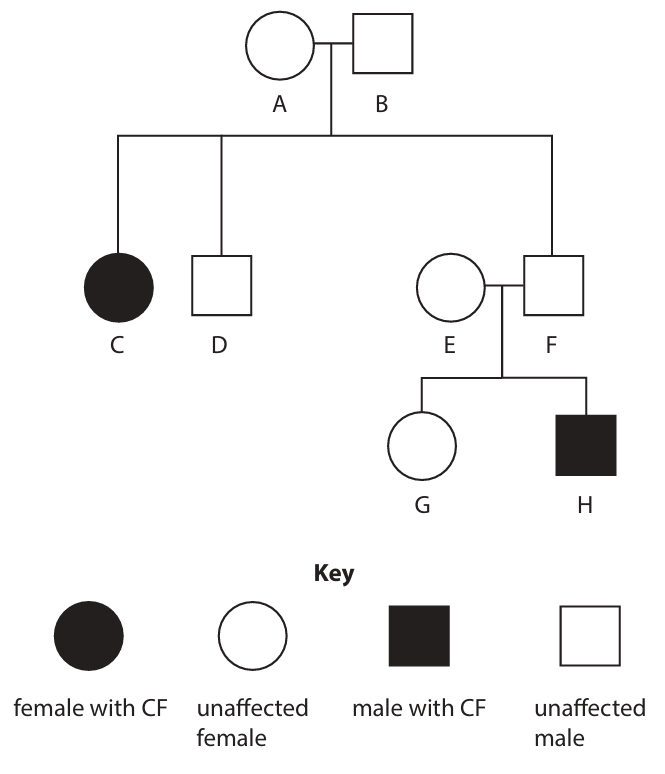
(b) The diagram below shows a family pedigree. Some people in the family have CF.

(i) Use the pedigree to determine the genotypes of individuals A, B and C.
(ii) Individuals E and F have a third child.
Draw a genetic diagram to show the genotypes of E and F, the gametes they produce and the possible genotypes and phenotypes of the offspring.

(c) The gene for cystic fibrosis affects many different body systems including the digestive system and the reproductive system.

(i) The mucus that is produced in the pancreas is much thicker and blocks the pancreatic duct. Explain the effects this would have on human digestion.
(ii) Cystic fibrosis can result in the production of thick mucus which builds up in the cervix. Explain the effect this will have on reproduction.

Most-appropriate topic codes (Edexcel IGCSE Biology):

4(b): Inheritance — parts (a), (b)(i), (b)(ii)
2(e): Nutrition (Humans) — part (c)(i)
4(a): Reproduction (Humans) — part (c)(ii)
3(b): Excretion — part (c)(i) – context of digestion
▶️ Answer/Explanation
Solution

(a) An allele that is only expressed in the homozygote / only shown in phenotype if two copies are present / not expressed in the heterozygote / not expressed if a dominant allele is present. (1 mark)

(b)(i)
A: Ff (heterozygous) (1)
B: Ff (heterozygous) (1)
C: ff (homozygous recessive) (1)
(Total 3 marks)

(b)(ii) A genetic diagram showing:
• Parental genotypes: Ff and Ff (1)
• Gametes: F and f from each parent (1)
• Offspring genotypes and phenotypes: FF (unaffected), Ff (unaffected), Ff (unaffected), ff (affected) OR correct phenotype ratio (1)
(Total 3 marks)

(c)(i) An explanation that refers to three of the following:
• Pancreas produces/releases amylase/proteases/lipases. (1)
• No/less digestion of starch to maltose. (1)
• No/less digestion of proteins to amino acids. (1)
• No/less digestion of lipids to fatty acids and glycerol. (1)
• Less absorption of smaller/soluble molecules (e.g., amino acids, glucose, fatty acids). (1)
(Total 3 marks)

(c)(ii) An explanation that refers to two of the following:
• Reduces likelihood of pregnancy / less likely to conceive. (1)
• Sperm/semen cannot enter the fallopian tube/oviduct. (1)
• Fertilisation less likely / no fusion of gametes. (1)
(Total 2 marks)

Question 9

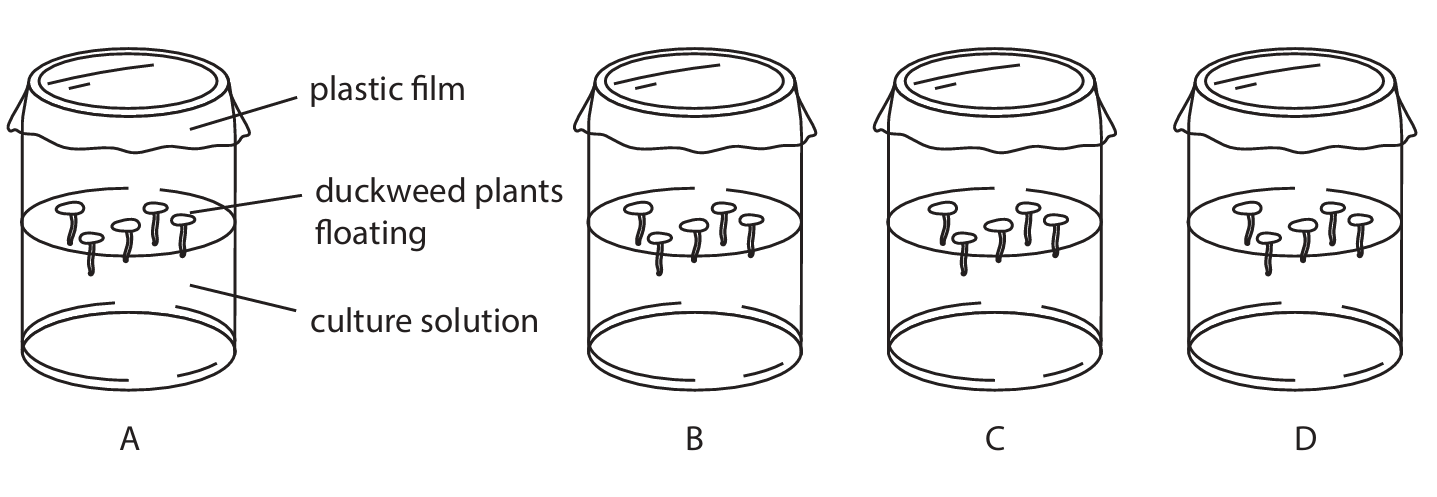
Students investigate the effect of mineral ions on plant growth. They use four solutions A, B, C and D.

  • A is a complete mineral solution that contains all of the mineral ions that a plant needs to grow normally
  • B is a complete mineral solution without nitrate ions
  • C is a complete mineral solution without magnesium ions
  • D is a complete mineral solution without iron ions

The plant they use is duckweed, which grows on the surface of water.

This is the students’ method:

  • place each of the four solutions (A, B, C and D) into separate jars
  • float five plants of duckweed in each jar
  • use plants with the same number of leaves, are the same size and are healthy
  • cover each jar with plastic film

  • put the jars containing the plants in sunlight
  • after four weeks count the total number of leaves in each jar
  • make a note of the size and colour of the leaves in each jar

(a) (i) State two variables the students kept constant in their experiment.
(ii) Explain why the students used complete mineral solution rather than distilled water to compare the effects of lacking a mineral ion.
(iii) Explain why the jars are kept in sunlight.
(iv) State the independent variable in this investigation. 

(b) The students record the total number of leaves in each jar. They classify the leaf size as large, medium and small. They record leaf colour as how green the leaves were between 0 for white to 5 for dark green.

The students’ results are shown in the table.

SolutionMineral lackingTotal number of leavesLeaf sizeLeaf colour
Anone13large4
Bnitrate7small2
Cmagnesium8medium2
Diron9medium1

(i) Some of the observations such as number of leaves are quantitative and some such as leaf size are qualitative. Give the difference between quantitative and qualitative results. 
(ii) Comment on the students’ results. In your answer you should use data from the table and your own knowledge.

Most-appropriate topic codes (Edexcel IGCSE Biology):

2(e): Nutrition — parts (a)(ii), (a)(iii), (b)(ii) — specifically plant mineral requirements (2.22)
Appendix 4: Command word taxonomy — applied to all parts requiring specific command word responses
5(a): The organism in the environment — part (a)(i) — experimental variables (controlled variables)
3: Assessment Information (Experimental Skills):parts (a)(i), (a)(iv) — planning investigations, identifying variables
Appendix 3: Mathematical skills — implicit in quantitative data handling in (b)(ii)
▶️ Answer/Explanation
Solution

(a)(i) An answer that makes reference to two of the following:
• sunlight / light / eq (1)
• volume / mass of solution / eq (1)
• number of plants / number of leaves / size of leaves / size of plant / health of leaves (at start) / eq (1)
• same species / use duckweed / eq (1)
• time / duration / eq (1)
• all jars covered / eq (1)

(a)(ii) An explanation that makes reference to two of the following:
• it (complete solution) (contains all minerals) so produces normal growth / ideal growth / eq (1)
• distilled water contains no minerals / plant would be lacking all minerals / would not grow normally / eq (1)
• so any difference in growth due to missing one mineral / eq (1)

(a)(iii) An explanation that makes reference to two of the following:
• photosynthesis / eq (1)
• to produce glucose (for respiration) / eq (1)
• for growth / to allow normal growth / eq (1)

(a)(iv) • mineral that is missing / absent from solution / minerals present / composition of solution / solution / eq (1)

(b)(i) • (quantitative / number of leaves) uses number / is measured / counted / and (qualitative / size of leaf) is a type / category / uses words / observed / subjective / opinion / eq (1)

(b)(ii) An answer that makes reference to 6 of the following:
1. complete / no minerals lacking / A have most leaves / largest leaves / eq (1)
2. complete / no minerals lacking / A have dark green / greenest leaves / eq (1)
3. minus nitrate / B have few / least / smaller / smallest leaves / less green / yellow / eq (1)
4. nitrate required for amino acid / protein / chlorophyll / chloroplasts / nitrate required for growth / eq (1)
5. minus magnesium / C have few / smaller / less green / yellow / eq (1)
6. magnesium required for chlorophyll / chloroplasts / photosynthesis / eq (1)
7. minus iron / D have few / smaller leaves / less green / least green / yellow / eq (1)
8. iron required for chlorophyll / chloroplasts / photosynthesis / eq (1)
9. Not repeated / not reliable / few plants used / eq (1)

Question 10

Carbon dioxide can be added to a glasshouse to increase the yield of a crop plant.

Design an investigation to find the carbon dioxide concentration needed for maximum crop yield.

Include experimental details in your answer and write in full sentences.

Most-appropriate topic codes (Edexcel IGCSE Biology):

6(a): Use of biological resources — Food production — Glasshouses and crop yield
2(e): Nutrition — Photosynthesis and factors affecting its rate
3: Assessment Information: Experimental skills — Designing investigations, controlling variables, making measurements
▶️ Answer/Explanation
Solution

Answer that makes reference to six of the following points:

O: Use crop plants of the same species / same variety / same age / same initial size / from the same batch / genetic clone / eq. (1)

R: Repeat each concentration / have replicates / repeat the whole investigation / eq. (1)

M1: Measure the yield / mass / kg / amount / number of seeds / number of fruits / size of fruits / biomass / eq. (1) (Not yield alone, not height)

M2: After a stated suitable time / e.g., after the growing season / after flowering / after a set number of weeks / eq. (1)

S1: Control / keep constant: temperature / (sun)light intensity / light wavelength / photoperiod (day length) / same season / eq. (1)

S2: Control / keep constant: same soil type / same volume of water / same watering regime / same humidity / same fertiliser / same mineral ions / same pH / eq. (1)

Core Design Aspect: Use at least three different concentrations of \( CO_2 \) / e.g., high, medium, low, zero / a range of concentrations. (Implied in question, credit for a valid method to vary/measure \( CO_2 \) concentration)

Total: 6 marks

Example full-sentence answer structure:
Use a large number of genetically identical crop plants (e.g., tomato plants) of the same age and initial size. Grow them in separate, identical glasshouse compartments. In each compartment, maintain a different, known concentration of carbon dioxide (e.g., 0.04%, 0.10%, 0.20%). For each \( CO_2 \) concentration, use multiple plants as replicates. Keep all other conditions that affect growth and yield constant: use the same light intensity, temperature, watering regime, soil type, and fertiliser application for all plants. Allow the plants to grow for a full growing season (e.g., 12 weeks). Then, measure the yield by harvesting and weighing the total mass of fruits (or seeds) produced by the plants in each \( CO_2 \) concentration group. The \( CO_2 \) concentration that produces the greatest mass of fruit is the concentration needed for maximum yield.

Scroll to Top