

▶️ Answer/Explanation
(a)
| Change of state | Name of change |
|---|---|
| from liquid to solid | freezing |
| from gas to liquid | condensing |
| from solid to gas | sublimation |
Explanation: Freezing is the change from liquid to solid. Condensing (or condensation) is the change from gas to liquid. Sublimation is the direct change from solid to gas without passing through the liquid state.
(b)(i)
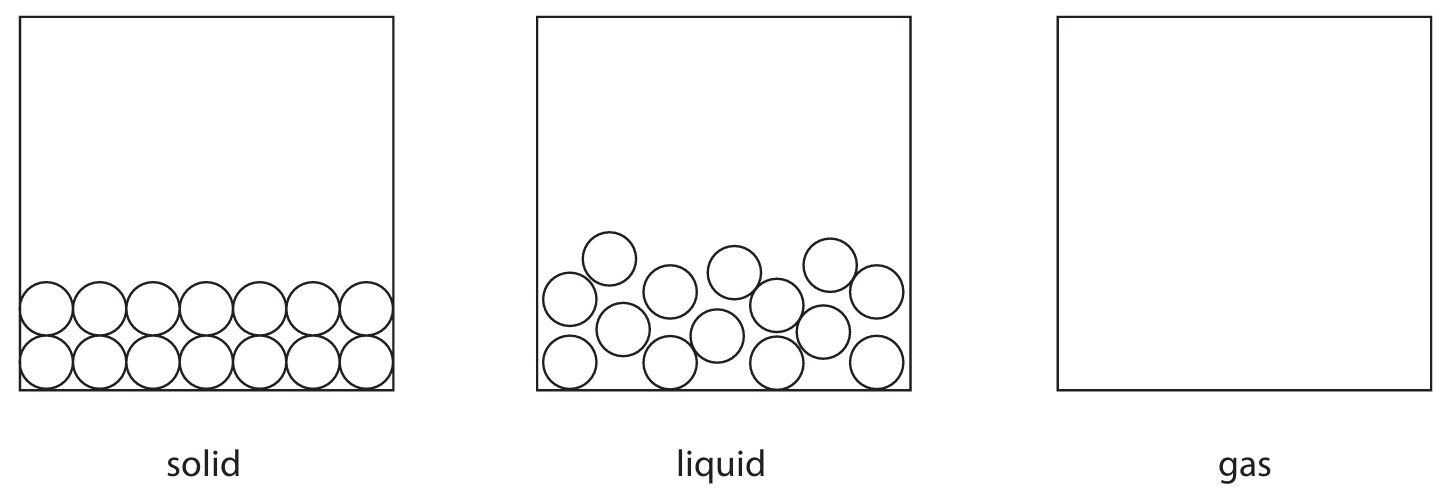
The diagram should show six circles of similar size, randomly arranged and not touching, with at least one circle in the top and bottom of the box to represent gas particles in random motion.
(b)(ii) A (the atoms move randomly in the gas state)
Explanation:
• B is not correct because atoms in a solid vibrate but do not move randomly.
• C is not correct because atoms in a gas are not in fixed positions.
• D is not correct because atoms in a liquid can move past each other and are not in fixed positions.
(c) \[ \text{H}_2\text{O}(l) \rightarrow \text{H}_2\text{O}(s) \]
Explanation: Water in the liquid state (l) freezes to become ice in the solid state (s).
▶️ Answer/Explanation
(a)(i)
1. oxygen (or air, O2)
2. water (or moisture, H2O)
(a)(ii)
(Hydrated) iron(III) oxide (or ferric oxide, Fe2O3·xH2O).
(b)(i)
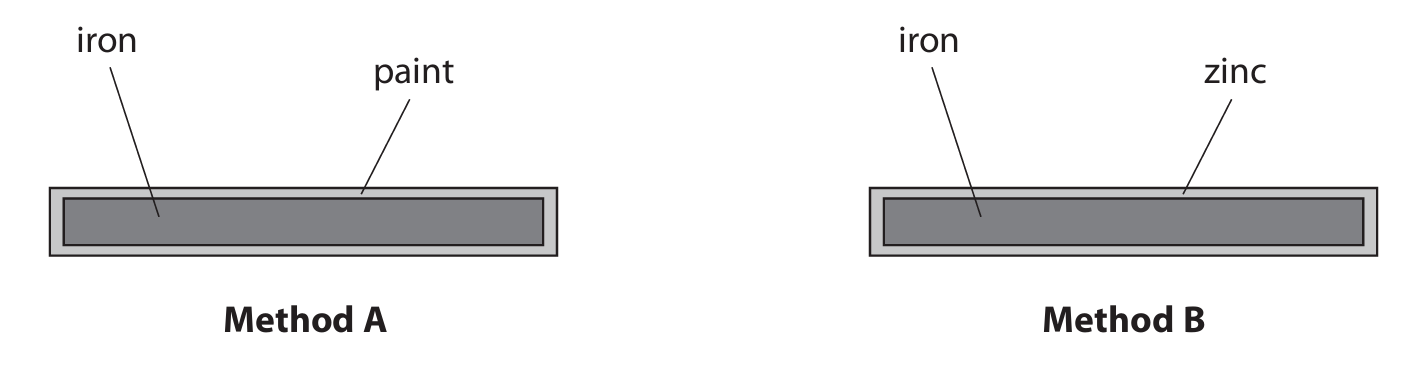
The paint acts as a barrier / protective layer. This prevents water / oxygen / air from reaching the iron surface and reacting with it.
(b)(ii)
Galvanising (or sacrificial protection).
(b)(iii)
Zinc is more reactive than iron / has a greater tendency to lose electrons. When scratched, the zinc oxidises / corrodes instead of the iron, acting as a sacrificial anode. This means the zinc loses electrons (is oxidised) in preference to the iron, protecting the iron from rusting.
▶️ Answer/Explanation
(a) (5 marks)
M1: Draw a line in pencil (just above the bottom of the paper) – the start line.
M2: Put a small spot of each ink on the line (ensuring they do not touch and are above the solvent level initially).
M3: Pour a small amount of the chosen solvent (e.g., water, ethanol) into the beaker.
M4: Place the paper in the beaker so the start line/spots are above the solvent level.
M5: Leave the setup until the solvent has risen up the paper (nearly to the top) – the solvent front.
Note: All marks can be awarded from a clearly labelled diagram showing these steps. The solvent must not touch the spots initially.
(b)(i) (2 marks)
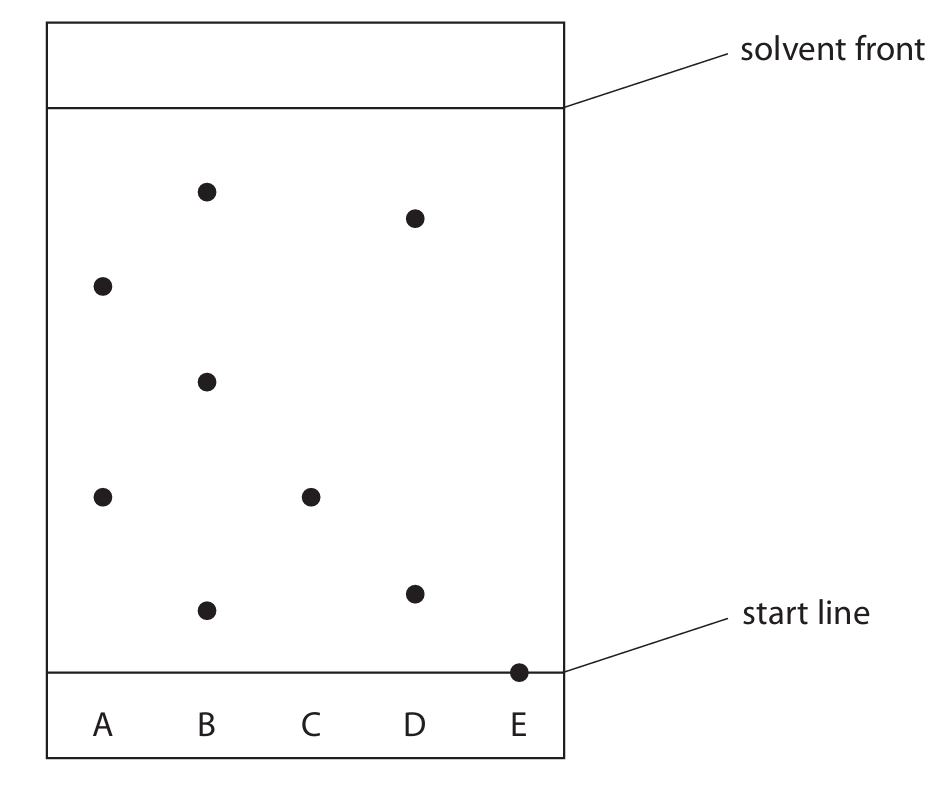
M1: Ink E.
M2: Because its spot remained on the start line / did not travel up the paper / has an \( R_f \) value of 0.
Explanation: A dye that is insoluble in the solvent will not dissolve and cannot be carried up the chromatography paper by the moving solvent.
(b)(ii) (2 marks)
M1: Inks A and C.
M2: Because they both have a spot at the same height / travelled the same distance from the start line / have the same \( R_f \) value.
Explanation: In chromatography, substances that are the same chemical will travel the same distance under identical conditions.
(b)(iii) (2 marks)
M1: Measure the distance from the start line to the centre of the spot for ink C.
M2: Measure the distance from the start line to the solvent front.
M3: The \( R_f \) value is calculated using the formula:
\( R_f = \frac{\text{distance moved by substance (spot C)}}{\text{distance moved by solvent (solvent front)}} \)
Note: The question asks for a description of the method, not a calculation. The student would then substitute their measurements into this formula.
▶️ Answer/Explanation
(a) Oxygen relights a glowing splint.
Explanation: This is the standard chemical test for oxygen gas.
(b)
- A catalyst provides an alternative pathway/route for the reaction. (M1)
- This alternative pathway has a lower activation energy. (M2)
Explanation: By lowering the activation energy, more reactant particles possess sufficient energy to react upon collision, thus increasing the rate of reaction.
(c)(i)
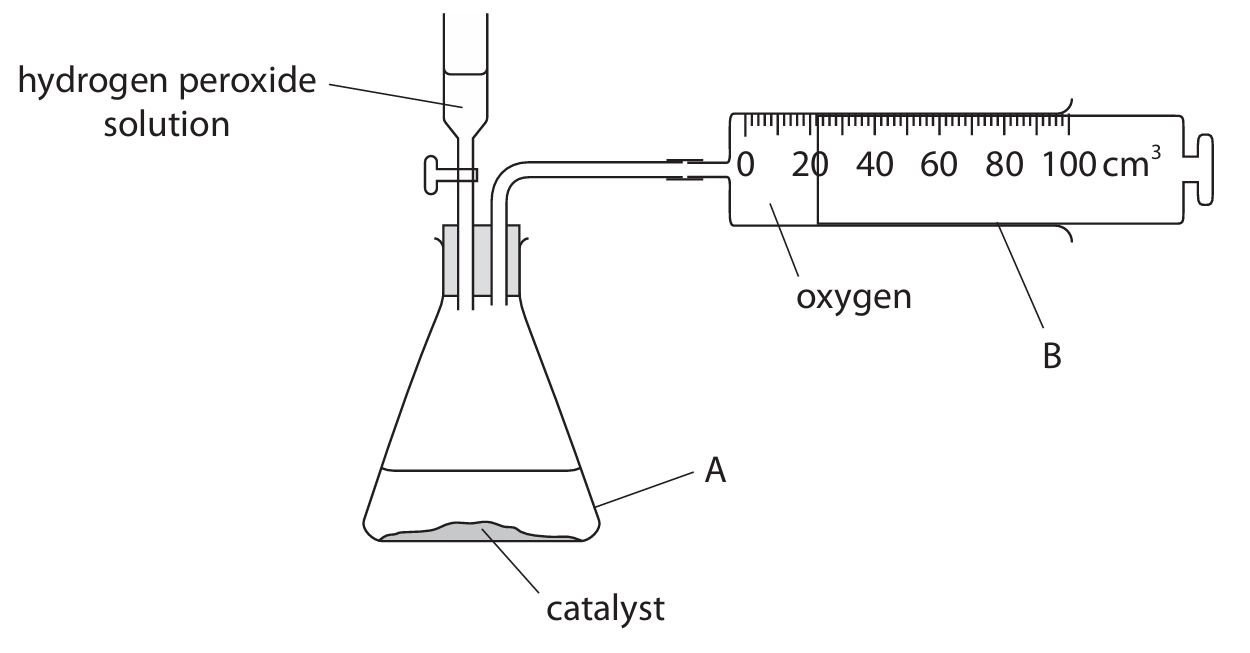
- A: (Conical) flask
- B: (Gas) syringe
(c)(ii)
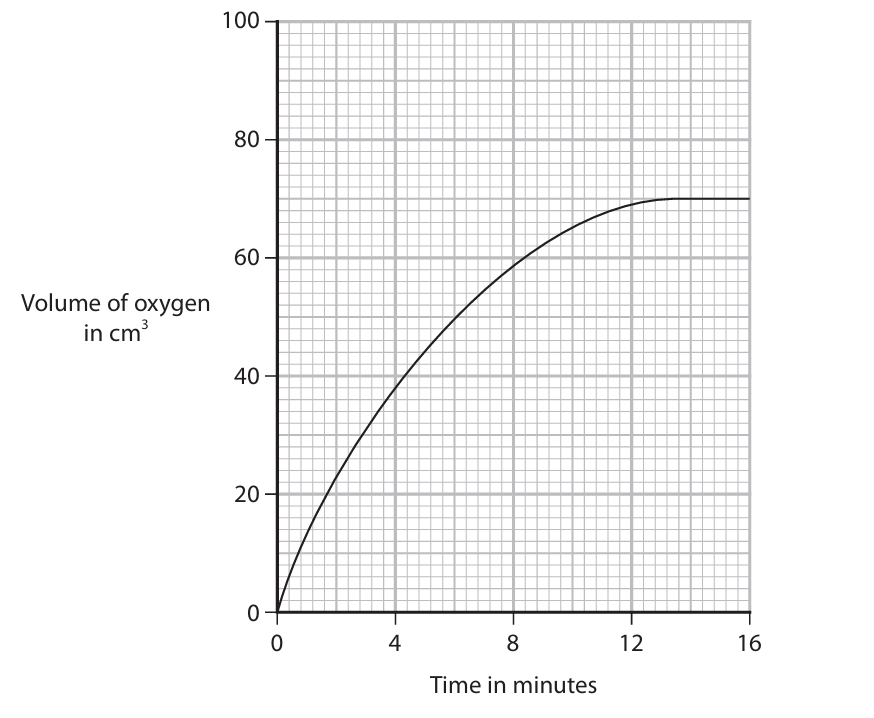
- Draw a vertical line from 4 minutes on the time axis up to the curve. (M1)
- From that point, draw a horizontal line to the volume axis.
- Read the volume: 38 cm\(^3\) (allow 37–39 cm\(^3\)). (M2)
Explanation: The volume of gas produced at a specific time is read directly from the curve on the graph.
(c)(iii)
- Draw a tangent to the curve at the point where time = 8 minutes. The tangent should only touch the curve at that one point. (M1)
- Choose two points far apart on the tangent line and record their coordinates, e.g., (x1, y1) and (x2, y2). (M2)
- Calculate the rate using the formula: \(\text{rate} = \frac{\Delta y}{\Delta x} = \frac{y_2 – y_1}{x_2 – x_1}\).
Example using points (4 min, 20 cm³) and (12 min, 55 cm³) on the tangent:
\(\text{rate} = \frac{55 – 20}{12 – 4} = \frac{35}{8} = 4.375\) (M3) - Rate = 4.4 cm\(^3\)/min (to 2 significant figures). Units: \(\textbf{cm}^3\textbf{/min}\) (or cm³/min, cm³ min⁻¹, cm³/s, cm³ s⁻¹). (M4)
Explanation: The rate of reaction at a specific point is given by the gradient of the tangent to the curve at that point. The gradient represents the change in volume per unit time.

▶️ Answer/Explanation
(a)(i)
• AlCl\(_3\)
• ZnSO\(_4\)
• (NH\(_4\))\(_3\)N
Explanation: The formula is determined by balancing the charges of the ions. For example, Al\(^{3+}\) and Cl\(^-\) combine in a 1:3 ratio to give AlCl\(_3\).
(a)(ii)
• Aluminium sulfate
Explanation: The compound consists of aluminium ions (Al\(^{3+}\)) and sulfate ions (SO\(_4^{2-}\)).
(b)
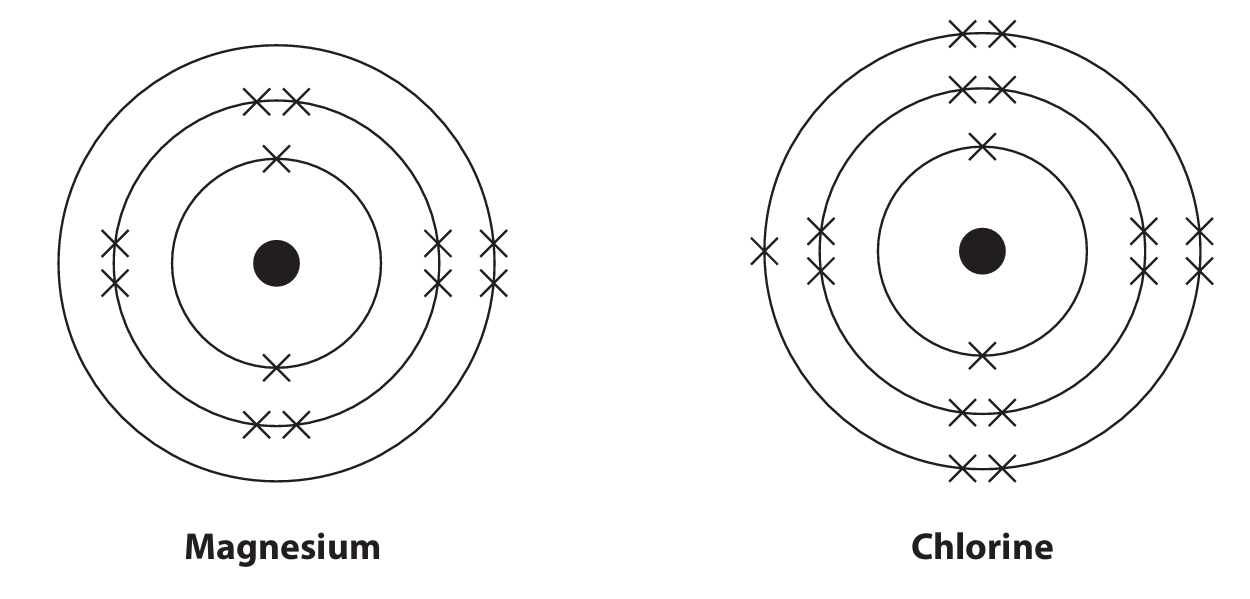
• Magnesium loses electrons.
• Chlorine gains electrons.
• Specifically, each magnesium atom loses two electrons, and two chlorine atoms each gain one electron.
• This results in the formation of Mg\(^{2+}\) and Cl\(^-\) ions, which attract each other to form magnesium chloride (MgCl\(_2\)).
Explanation: Magnesium, a Group 2 metal, readily loses its two outer shell electrons to achieve a stable full outer shell (like a noble gas). Chlorine, a Group 7 non-metal, readily gains one electron to achieve a stable full outer shell. The transfer of electrons creates oppositely charged ions that are held together by strong electrostatic forces (ionic bonding).
(c)(i)
• The dot-and-cross diagram for ammonia (NH\(_3\)) should show:
– A nitrogen atom with five outer shell electrons.
– Three hydrogen atoms, each with one electron.
– Three covalent bonds, each formed by a shared pair of electrons (one from N, one from H) between the nitrogen and each hydrogen.
– A lone pair (two non-bonding electrons) on the nitrogen atom.
Explanation: Nitrogen needs three more electrons to complete its outer shell, which it achieves by sharing electrons with three hydrogen atoms. The lone pair on nitrogen is responsible for ammonia’s basic properties.
(c)(ii)
• The force of attraction in a covalent bond is an electrostatic attraction.
• It acts between the shared pair(s) of electrons and the nuclei of the bonded atoms.
Explanation: The shared electrons are attracted to the positively charged nuclei of both atoms involved in the bond. This mutual attraction holds the atoms together. It is important to distinguish this intramolecular force from intermolecular forces, which are between separate molecules.
▶️ Answer/Explanation
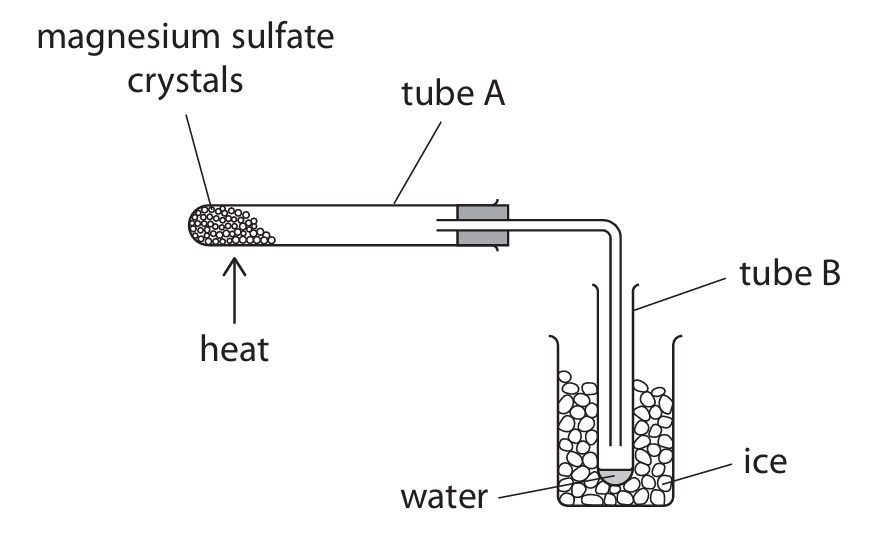
(a)(i) • To condense the water vapour / steam / gas (into liquid).
Explanation: The ice cools tube B, causing the gaseous water released from the crystals to condense back into liquid so it can be collected and measured.
(a)(ii) • When the mass doesn’t change / is constant / stops increasing / (the last) two readings are the same.
Explanation: The mass of tube B increases as water condenses into it. When no more water is being produced from the crystals, the mass stabilizes.
(b) • Add anhydrous / white copper(II) sulfate. (1)
• It turns from white to blue. (1)
Alternative: Add anhydrous cobalt chloride. It turns from blue to pink.
Explanation: These substances are chemical tests for the presence of water. The colour change is a positive result.
(c) Calculation:
- Mass of water collected = Final mass of tube B – Initial mass of tube B = \(22.1 \, \text{g} – 15.8 \, \text{g} = 6.3 \, \text{g}\).
- Moles of \(\text{MgSO}_4\) = \(\frac{\text{mass}}{M_r} = \frac{6.0}{120} = 0.05 \, \text{mol}\).
- Moles of \(\text{H}_2\text{O}\) = \(\frac{6.3}{18} = 0.35 \, \text{mol}\).
- Ratio \(x = \frac{\text{moles of } \text{H}_2\text{O}}{\text{moles of } \text{MgSO}_4} = \frac{0.35}{0.05} = 7\).
Therefore, \(x = 7\).
Explanation: The formula is \(\text{MgSO}_4 \cdot 7\text{H}_2\text{O}\). The calculation uses the mole concept and the given relative formula masses to find the ratio of water to magnesium sulfate.
Mark Scheme Summary (from provided image):
M1: mass of water = 6.3 g (1)
M2: moles of \(\text{MgSO}_4\) = 0.05 (1)
M3: moles of \(\text{H}_2\text{O}\) = 0.35 (1)
M4: \(x = 7\) (1)
Award full marks for answer 7 alone.
▶️ Answer/Explanation
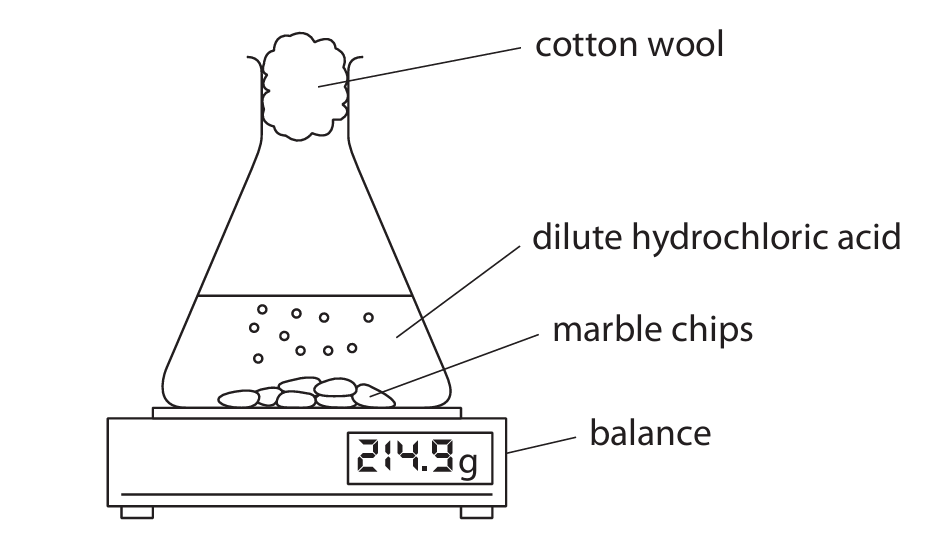
(a) Carbon dioxide (a gas) escapes/is lost/is released through the cotton wool. (1 mark)
Explanation: The product \(\text{CO}_2\) is a gas. As it leaves the flask, the total mass of the flask and its contents decreases, so the balance reading drops.
(b)
M1: The concentration (of hydrochloric acid) is highest at the start. (1 mark)
M2: So there are more collisions per unit time / more frequent collisions. (1 mark)
Explanation: According to collision theory, the rate depends on the frequency of successful collisions. A higher acid concentration means more \(\text{H}^+\) ions are available to collide with the marble chips (\(\text{CaCO}_3\)) surface.
(c) The hydrochloric acid has been used up. (1 mark)
Explanation: Marble chips are in excess. The acid is the limiting reactant. Once all the \(\text{H}^+\) ions have reacted, the reaction cannot continue, even with solid \(\text{CaCO}_3\) remaining.
(d)(i) Any two from: (1 mark each)
1. (Same) mass of marble chips.
2. (Same) surface area/size of marble chips.
3. (Same) concentration of hydrochloric acid.
4. (Same) volume of hydrochloric acid.
Explanation: To fairly investigate the effect of temperature alone, all other factors that affect the rate (concentration, surface area, mass/volume of reactants) must be kept constant.
(d)(ii)
M1: The rate of reaction increases. (1 mark)
M2: Particles have more (kinetic) energy / more particles have energy greater than or equal to the activation energy. (1 mark)
M3: So there are more successful collisions per unit time / more frequent successful collisions. (1 mark)
Explanation: Increasing temperature increases the average kinetic energy of the reactant particles (\(\text{H}^+\) ions and \(\text{CaCO}_3\) surface). A greater proportion of collisions then possess the required activation energy, and the collisions are more energetic, leading to a higher rate.
Total marks: 9
▶️ Answer/Explanation
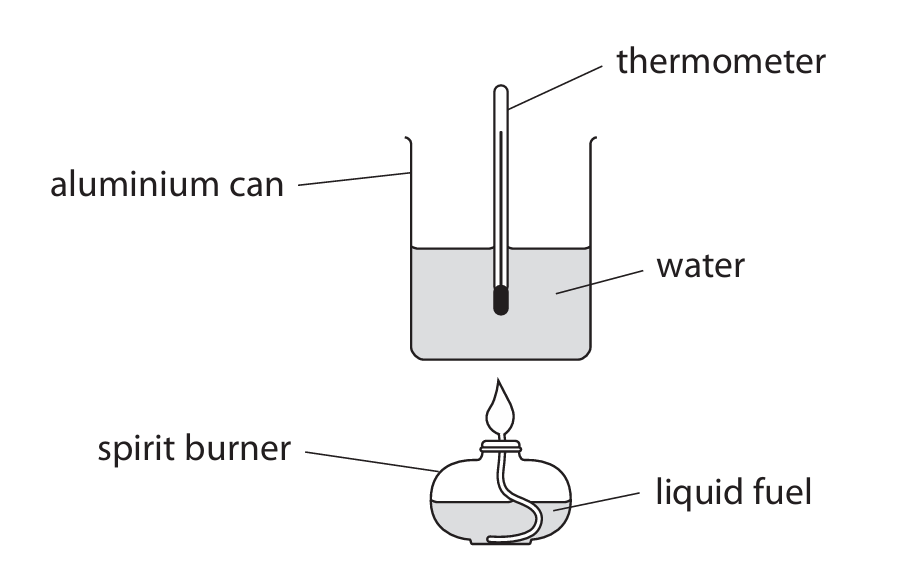
(a) aluminium is a better conductor (of heat) than glass / aluminium has a higher thermal conductivity than glass.
Note: A comparison is needed. Reject answers about insulation.
(b)(i) carbon / soot / C
(b)(ii) incomplete combustion occurs OR the supply of oxygen/air is limited.
(c)(i)
\( Q = mc\Delta T \)
\( Q = 100 \times 4.2 \times 50 \)
\( Q = 21000 \, \text{J} \) (≈ 20000 J)
Note: Full marks are awarded for showing the correct calculation (2 marks). The value 21000 J is accepted as approximately 20000 J.
(c)(ii)
M1: Heat energy \( Q = 21000 \, \text{J} = 21 \, \text{kJ} \)
M2: Moles of ethanol burned: \( \frac{1.84}{46} = 0.04 \, \text{mol} \)
M3: Enthalpy change per mole: \( \frac{21}{0.04} = 525 \, \text{kJ/mol} \)
M4: Since combustion releases heat, \( \Delta H = -525 \, \text{kJ/mol} \)
Note: Using 20 kJ gives \( \Delta H = -500 \, \text{kJ/mol} \), which is also accepted.
(d)(i)
Balanced equation: \( C_4H_9OH(l) + 5O_2(g) \rightarrow 2CO_2(g) + 2CO(g) + 5H_2O(g) \)
Note: Allow multiples if all coefficients are scaled consistently.
(d)(ii)
M1: \( M_r \) of butanol \( (C_4H_9OH) = (4 \times 12) + (9 \times 1) + 16 + 1 = 74 \)
M2: Moles of butanol: \( \frac{3.7}{74} = 0.05 \, \text{mol} \)
M3: From the equation, 1 mole of butanol produces \( 2 + 2 + 5 = 9 \) moles of gas.
Moles of gas from 0.05 mol butanol: \( 0.05 \times 9 = 0.45 \, \text{mol} \)
Answer: amount of gas = \( 0.45 \, \text{mol} \)
▶️ Answer/Explanation
(a)(i) Any one from:
- Ethane is saturated.
- Ethane has no double bonds / only single bonds.
- It cannot add bromine across a double bond.
Explanation: Alkanes like ethane are saturated hydrocarbons, meaning they contain only single C–C bonds. Addition reactions require a double bond (unsaturated) to break and add atoms across it.
(a)(ii) \[ \text{C}_2\text{H}_6 + \text{Br}_2 \rightarrow \text{C}_2\text{H}_5\text{Br} + \text{HBr} \]
Condition: ultraviolet (UV) light / ultraviolet radiation.
Explanation: Alkanes undergo free-radical substitution with halogens in the presence of UV light, which provides the energy to break the Br–Br bond and initiate the chain reaction.
(a)(iii) Orange/yellow/brown to colourless / decolourises.
Explanation: Ethene (an alkene) reacts rapidly with bromine water in an addition reaction, forming colourless 1,2-dibromoethane. This is a standard test for unsaturation.
(b)(i) Any two from:
- They have the same functional group.
- They show a gradation in physical properties (e.g., boiling point increases with chain length).
- They have similar chemical properties.
- Each successive member differs by \( \text{CH}_2 \).
(b)(ii)
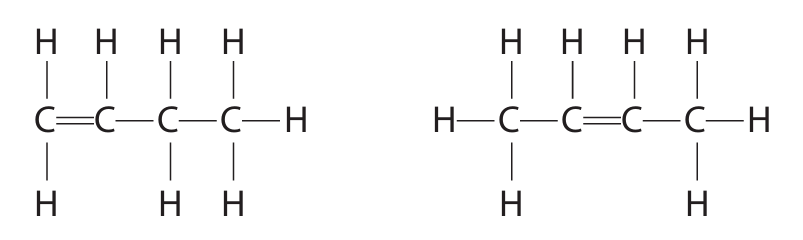
• They have the same molecular formula (\( \text{C}_4\text{H}_8 \)).
• They have different structural / displayed formulae (different arrangement of atoms).
Explanation: Both are alkenes with four carbons and eight hydrogens, but the position of the double bond differs (but-1-ene vs but-2-ene), making them structural isomers.
(b)(iii) Any other alkene with formula \( \text{C}_4\text{H}_8 \), e.g., methylpropene (2-methylprop-1-ene):
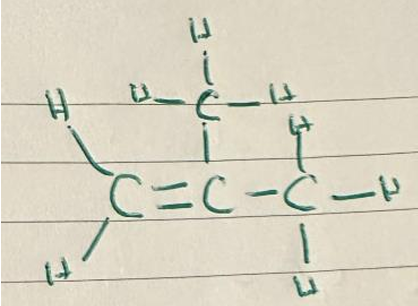
Allow E/trans isomer:
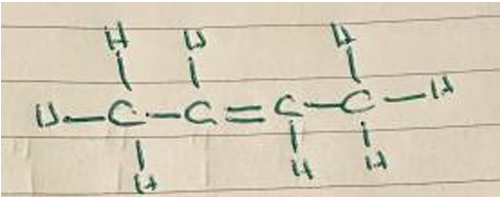
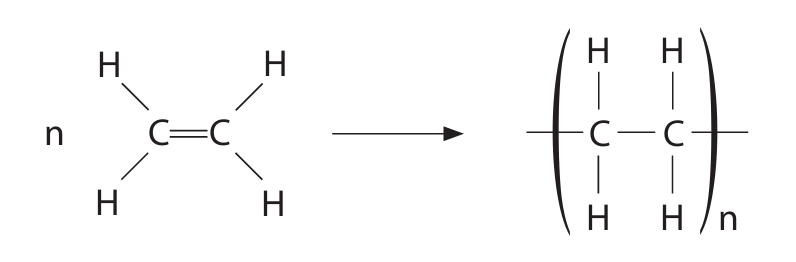
(c) Description covering three points:
- Carbon chain length: The chain length is longer in poly(ethene) / poly(ethene) has a very long chain / many repeating units / polymer chain, whereas ethene is a short-chain monomer.
- Type of bond: The reactant (ethene) contains a C=C double bond / is unsaturated, while the product (poly(ethene)) contains only single (covalent) bonds / is saturated / has no double bond.
- State of matter: Ethene is a gas (at room temperature) and poly(ethene) is a solid.
Explanation: This is an addition polymerisation reaction. Many ethene monomers (small, gaseous, unsaturated molecules with C=C bonds) join together under suitable conditions to form a long-chain saturated solid polymer with only C–C single bonds.
▶️ Answer/Explanation
(a) (i) \( 2\text{PbS} + 3\text{O}_2 \rightarrow 2\text{PbO} + 2\text{SO}_2 \)
Explanation: The correct formulae for oxygen (\(\text{O}_2\)) and sulfur dioxide (\(\text{SO}_2\)) are needed (M1). The equation must then be balanced correctly (M2).
(a) (ii) (Sulfur dioxide causes) acid rain / breathing problems.
Explanation: Accept named breathing problems (e.g., asthma) or other effects of acid rain such as killing fish, damaging stonework, or killing plants.
(a) (iii) 88 tonnes
Working:
M1: Moles of lead(II) oxide = \( \frac{892\,000\,000}{223} = 4\,000\,000 \text{ mol} \)
M2: From the equation \(2\text{PbO} \rightarrow \text{CO}_2\), moles of \(\text{CO}_2\) = \( \frac{4\,000\,000}{2} = 2\,000\,000 \text{ mol} \)
M3: Mass of \(\text{CO}_2\) = \( 2\,000\,000 \times 44 = 88\,000\,000 \text{ g} = 88 \text{ tonnes} \)
Explanation: All steps are dependent. Calculations can be done in megamoles. 88 tonnes scores full marks.
(a) (iv)
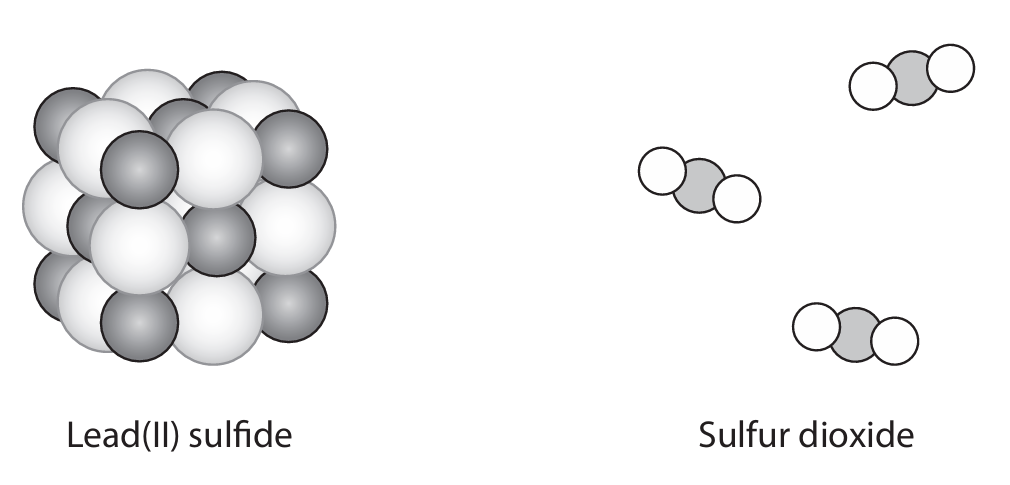
Lead(II) sulfide:
• Giant ionic structure/lattice (M1).
• Strong (ionic) bonds / strong electrostatic forces between oppositely charged ions (M2).
• These bonds/forces take a lot of energy to break/overcome (M3). Do not mention molecules, covalent bonds, or intermolecular forces.
Sulfur dioxide:
• Simple molecular / covalent structure (M4).
• Weak intermolecular forces / weak forces between molecules (M5).
• These forces take little energy to overcome (M6). Do not mention ions or ionic bonds.
Explanation: Award marks for clear comparisons of structure and bonding. M3 depends on M2; M6 depends on M5.
(b) Empirical formula = \(\text{Pb}_3\text{O}_4\)
Working:
M1: Moles of Pb = \( \frac{90.7}{207} \approx 0.438 \)
Moles of O = \( \frac{9.30}{16} \approx 0.581 \)
M2: Ratio of moles \( \text{Pb} : \text{O} = 0.438 : 0.581 \)
M3: Simplify ratio: divide by smallest (\(0.438\)) → \(1 : 1.33\)
M4: Multiply by 3 to get whole numbers → \(3 : 4\) → Empirical formula is \(\text{Pb}_3\text{O}_4\).
Explanation: The answer must be to at least 2 significant figures. Allow ecf (error carried forward) from a consistent ratio to produce a plausible formula.