
Question:
Group 2 metals form alkaline solutions in water.
(a) (i) Write the equation for the reaction of calcium oxide with water. [1]
(ii) Identify the ion that causes an aqueous solution to be alkaline.[1]
(b) The table shows the melting points of some Group 2 metal oxides.
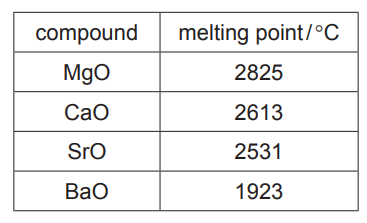
Explain the trend in the melting points of the oxides down Group 2.[2]
(c) Oxygen reacts readily with some metals, but each Group 2 metal requires strong heating to start the reaction with oxygen.
Suggest why strong heating is required to start these reactions.
(d) Beryllium oxide reacts with hydrochloric acid to form molecules of $\mathrm{BeCl}_2$.
Deduce the bond angle in $\mathrm{BeCl}_2$.[1]
(e) Unlike the other oxides of Group 2 metals, beryllium oxide is amphoteric.
(i) Give the meaning of the term amphoteric.[1]
(ii) Beryllium oxide and aluminium oxide have similar chemical properties.
The $\mathrm{Be}(\mathrm{OH})_4{ }^{2-}$ anion is a product of the reaction between beryllium oxide and excess concentrated $\mathrm{OH}^{-}(\mathrm{aq})$.
Construct an equation for this reaction.
[1]
(f) Magnesium oxide reacts reversibly with chlorine according to the following equation.
$
2 \mathrm{MgO}(\mathrm{s})+2 \mathrm{Cl}_2(\mathrm{~g}) \rightleftharpoons 2 \mathrm{MgCl}_2(\mathrm{~s})+\mathrm{O}_2(\mathrm{~g})
$
Under certain conditions, a dynamic equilibrium is established.
(i) State two features of a reaction that is in dynamic equilibrium.
1……………………………………………….
2………………………………………..[3]
(ii) The equilibrium constant, $K_{\mathrm{p}}$, is given by the following expression.
$
K_{\mathrm{p}}=\frac{p_{\mathrm{O}_2}}{p_{\mathrm{Cl}_2}^2}
$
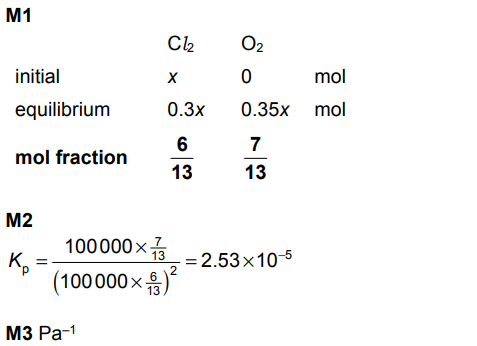
At $1.00 \times 10^5 \mathrm{~Pa}$ and $500 \mathrm{~K}, 70 \%$ of the initial amount of $\mathrm{Cl}_2(\mathrm{~g})$ has reacted.
Calculate $K_{\mathrm{p}}$ and state its units.
$
K_{\mathrm{p}}=
$ units $=$[3]
(g) Magnesium peroxide, $\mathrm{MgO}_2$, is made in the following reaction.
$
\mathrm{MgO}(\mathrm{s})+\mathrm{H}_2 \mathrm{O}_2(\mathrm{l}) \rightarrow \mathrm{MgO}_2(\mathrm{~s})+\mathrm{H}_2 \mathrm{O}(\mathrm{l}) \quad \Delta H=-96 \mathrm{kJmol}^{-1}
$
(i) The peroxide ion is $\mathrm{O}_2^{2-}$.
Deduce the average oxidation number of oxygen in the peroxide ion.[1]
(ii) Define the term enthalpy change of formation.[2]
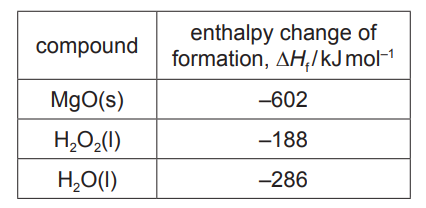
(iii) Use the data given to calculate the enthalpy change of formation of $\mathrm{MgO}_2(\mathrm{~s})$.
(iv) Magnesium peroxide decomposes slowly to form magnesium oxide and oxygen.
$
\mathrm{MgO}_2(\mathrm{~s}) \rightarrow \mathrm{MgO}(\mathrm{s})+\frac{1}{2} \mathrm{O}_2(\mathrm{~g})
$
Use your answer to $\mathbf{( g ) ( i i i ) ~ a n d ~ t h e ~ d a t a ~ i n ~ t h e ~ t a b l e ~ t o ~ c a l c u l a t e ~ t h e ~ e n t h a l p y ~ c h a n g e ~ o f ~}$ this reaction.
If you were unable to obtain an answer to (g)(iii), use the value $\Delta H_{\mathrm{f}}=-550 \mathrm{~kJ} \mathrm{~mol}^{-1}$. This is not the correct answer.
enthalpy change of reaction $=$ $\mathrm{kJmol}^{-1}$ [1] [Total: 19]
▶️Answer/Explanation
Ans:
(a)(i) $\mathrm{CaO}+\mathrm{H}_2 \mathrm{O} \rightarrow \mathrm{Ca}(\mathrm{OH})_2$
(a)(ii) $\mathrm{OH}^{-} /$hydroxide
(b) M1 (decreasing melting point down the group because) lower forces of attraction / weaker bonds (between cations and anions / oxide / $\mathrm{O}^{2-}$ )
M2 larger cations and constant charge
OR decreasing charge density of cation (down group)
(c) high(er) activation energy / heating overcomes activation energy
(d) 180(°)
(e)(i) reacts with / behaves as both acid and base
(e)(ii) $\mathrm{BeO}+2 \mathrm{OH}^{-}+\mathrm{H}_2 \mathrm{O} \rightarrow \mathrm{Be}(\mathrm{OH})_4^{2-}$
(f)(i) M1 equal rates of forward and backward reactions
M2 closed system OR macroscopic properties unchanging
1(f)(ii)
(g)(i) –1
(g)(ii) M1 (enthalpy / energy change) when one mole of a compound / substance is formed
M2 from its elements in their standard states
(g)(iii) $\begin{aligned} & -(-602+-188)+\left(\Delta H_{\mathrm{f}}\left[\mathrm{MgO}_2\right]+-286\right)=-96 \\ & \Delta H_{\mathrm{f}}\left[\mathrm{MgO}_2\right]=-600\left(\mathrm{~kJ} \mathrm{~mol}^{-1}\right)\end{aligned}$
(g)(iv) $-(-600)-(+602)=-2\left(\mathrm{~kJ} \mathrm{~mol}^{-1}\right)$
Question:
The Group 17 elements, chlorine, bromine and iodine, are non-metals that show trends in their physical and chemical properties.
(a) Describe the trend in the colour of the Group 17 elements down the group.[1]
(b) The Group 17 elements can oxidise many metals to form halides.
(i) Describe the relative reactivity of the elements in Group 17 as oxidising agents.[1]
(ii) Chlorine reacts with hot tin metal to form tin(IV) chloride, $\mathrm{SnCl}_4$.
$\mathrm{SnCl}_4$ is a colourless liquid at room temperature that reacts vigorously with water to form an acidic solution.
Suggest the type of structure and bonding shown by $\mathrm{SnCl}_4$. Explain your answer.[2]
(c) The Group 17 elements form soluble halides with sodium.
(i) Describe what is seen when dilute $\mathrm{AgNO}_3(\mathrm{aq})$ is added to $\mathrm{NaBr}(\mathrm{aq})$ followed by aqueous ammonia. [2]
(ii) $\mathrm{NaCl}$ reacts with concentrated $\mathrm{H}_2 \mathrm{SO}_4$ to form $\mathrm{HCl}$ and $\mathrm{NaHSO}_4$.
Explain the difference between the reactions of concentrated $\mathrm{H}_2 \mathrm{SO}_4$ with $\mathrm{NaCl}$ and with NaI. Your answer should refer to the role of the sulfuric acid in each reaction.[3]
(d) The hydrogen halides are useful reagents in organic and inorganic reactions.
(i) Describe and explain the trend in the boiling points of the hydrogen halides, $\mathrm{HCl}, \mathrm{HBr}$ and HI.[2]
(ii) Describe and explain the trend in the thermal stabilities of the hydrogen halides, $\mathrm{HCl}, \mathrm{HBr}$ and $\mathrm{HI}$.
(e) Lucas’s reagent is a mixture of $\mathrm{HCl}$ and $\mathrm{ZnCl}_2$. Primary, secondary and tertiary alcohols can be distinguished by their reaction with Lucas’s reagent.
Alcohols react with the $\mathrm{HC} l$ in Lucas’s reagent to form halogenoalkanes.
$\mathrm{ZnCl}_2$ acts as a homogeneous catalyst for these reactions.
(i) Explain the meaning of the term homogeneous. [1]
(ii) Pentan-3-ol, $\mathrm{C}_2 \mathrm{H}_5 \mathrm{CH}(\mathrm{OH}) \mathrm{C}_2 \mathrm{H}_5$, reacts slowly with $\mathrm{HCl}$ to form a secondary halogenoalkane.
Complete the equation for this reaction using structural formulae.
$\mathrm{C}_2 \mathrm{H}_5 \mathrm{CH}(\mathrm{OH}) \mathrm{C}_2 \mathrm{H}_5+$
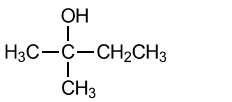
(iii) The fastest reaction shown by Lucas’s reagent is with a tertiary alcohol.
Draw the structure of the tertiary alcohol that is an isomer of pentan-3-ol.[1]
(iv) Tertiary alcohols tend to react with Lucas’s reagent using the same mechanism as in their reaction with $\mathrm{HCl}$.
Suggest the type of reaction shown by tertiary alcohols with Lucas’s reagent.[1][Total: 17]
▶️Answer/Explanation
Ans:
(a) darker / stronger / deeper down the group 1
(b)(i) weaker oxidising agents / (relative reactivity as oxidising agents) decreases down the group 1
(b)(ii) M1 (structure =) simple / molecular, because it has a low melting / boiling point
M2 (bonding =) covalent, because it is hydrolysed
(c)(i) M1 cream ppt / solid
M2 (ppt / solid) partially dissolves in (aqueous) ammonia
(c)(ii) M1 Acid behaviour of $\mathrm{H}_2 \mathrm{SO}_4$ $\mathrm{H}_2 \mathrm{SO}_4$ acts as an acid with $\mathrm{C} l^{-}$ $\mathrm{OR}$ acid / base reaction with $\mathrm{Cl}^{-}$
M2 Oxidising behaviour of $\mathrm{H}_2 \mathrm{SO}_4$ $\mathrm{H}_2 \mathrm{SO}_4$ acts as an oxidising agent with $\mathrm{I}^{-}$ $\mathrm{OR} \mathrm{H}_2 \mathrm{SO}_4$ does not oxidise $\mathrm{Cl}^{-}$
M3
Products formed (for iodide reaction) $\mathrm{I}_2 / \mathrm{S} / \mathrm{SO}_2 / \mathrm{H}_2 \mathrm{~S}$ is formed $\mathrm{OR}$ (for chloride reaction) (only) $\mathrm{HC} l$ is formed OR
Comparison of oxidising strength $\mathrm{H}_2 \mathrm{SO}_4$ not strong enough to / cannot oxidise $\mathrm{Cl}^{-}$(to $\mathrm{Cl}_2$ ) $\mathrm{OR} \mathrm{I}^{-}$more powerful reducing agent than $\mathrm{Cl}^{-}$
(d)(i) M1 increases (down the group) because of increasing VdW
M2 because of increasing number of electrons
(d)(ii) M1 less stable (down the group) / decreases
M2 lower H–Hal bond enthalpy / energy
(e)(i) in the same phase / state
(e)(ii) $\mathrm{C}_2 \mathrm{H}_5 \mathrm{CH}(\mathrm{OH}) \mathrm{C}_2 \mathrm{H}_5+\mathrm{HCl} \rightarrow \mathrm{C}_2 \mathrm{H}_5 \mathrm{CH}(\mathrm{Cl}) \mathrm{C}_2 \mathrm{H}_5+\mathrm{H}_2 \mathrm{O}$
(e)(iii)
(e)(iv) substitution
Question:
Glycerol, $\mathrm{CH}_2(\mathrm{OH}) \mathrm{CH}(\mathrm{OH}) \mathrm{CH}_2 \mathrm{OH}$, is widely used in the food industry and in pharmaceuticals.
(a) A series of reactions starting from glycerol is shown.

(i) Suggest the reagent(s) and conditions for reaction 1.[2]
(ii) Name the reaction mechanism for reaction 2 .[1]
(iii) Give the observation you would make when 2,4-dinitrophenylhydrazine is added to $\mathbf{P}$.[1]
(iv) $\mathbf{Q}$ does not show optical isomerism. Explain why.[1]
(v) When $\mathbf{Q}$ is heated with excess aqueous ethanoic acid in the presence of a catalytic amount of sulfuric acid, two reactions take place to form compound $\mathbf{R}$.
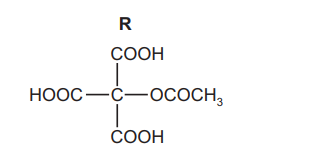
Identify the two types of reaction that occur.
1 …………………………………………………………………………………………………………………………
2 ………………………………………………………………………………………………………………………… [2]
(b) Glycerol can be used as a starting material in the manufacture of nitroglycerine, $\mathrm{C}_3 \mathrm{H}_5 \mathrm{~N}_3 \mathrm{O}_9$. Nitroglycerine decomposes rapidly on heating to form a mixture of gases.
$
4 \mathrm{C}_3 \mathrm{H}_5 \mathrm{~N}_3 \mathrm{O}_9(\mathrm{l}) \rightarrow 12 \mathrm{CO}_2(\mathrm{~g})+10 \mathrm{H}_2 \mathrm{O}(\mathrm{g})+6 \mathrm{~N}_2(\mathrm{~g})+\mathrm{O}_2(\mathrm{~g})
$
A sample of nitroglycerine decomposes, releasing $1.06 \mathrm{dm}^3$ of $\mathrm{O}_2(\mathrm{~g})$ at $850 \mathrm{~K}$ and $1.00 \times 10^5 \mathrm{~Pa}$.
(i) Calculate the mass of nitroglycerine that decomposes.
mass of nitroglycerine $=$
$\mathrm{g}[3]$
(ii) Calculate the total volume of gas released by this decomposition at $850 \mathrm{~K}$ and $1.00 \times 10^5 \mathrm{~Pa}$.
mass of nitroglycerine $=$
$\mathrm{g}[3]$
(ii) Calculate the total volume of gas released by this decomposition at $850 \mathrm{~K}$ and $1.00 \times 10^5 \mathrm{~Pa}$.
total volume of gas $=$ $\mathrm{dm}^3[1]$
(c) Fats are compounds made from glycerol and unsaturated carboxylic acids. 4-pentenoic acid is an example of an unsaturated carboxylic acid.
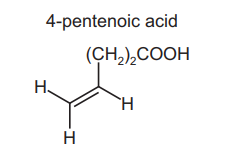
(i) Give the molecular formula of 4-pentenoic acid.
[1]
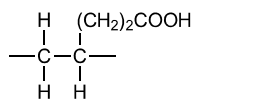
(ii) Draw the repeat unit of the addition polymer that can be formed from 4-pentenoic acid.
[1]
(iii) Unsaturated acids are often brominated before being added to soft drinks.
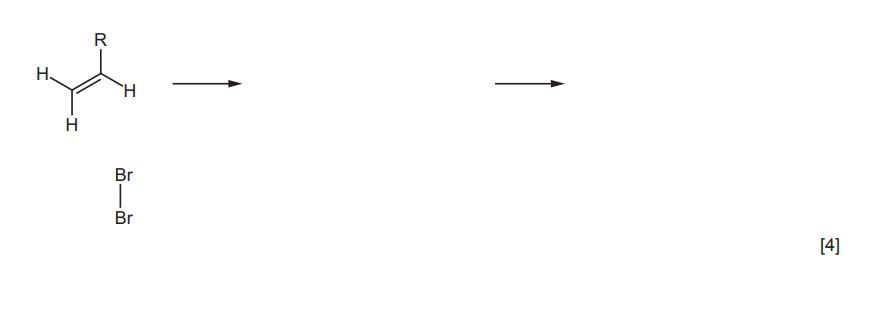
Complete the mechanism for the addition of $\mathrm{Br}_2$ to 4-pentenoic acid.
- Include the structures of the intermediate and the product of the reaction.
- Include all charges, partial charges, lone pairs and curly arrows.
In the mechanism, $\mathrm{R}$ has been used to represent $\left(\mathrm{CH}_2\right)_2 \mathrm{COOH}$.
(d) A reaction of another unsaturated carboxylic acid, T, is shown.
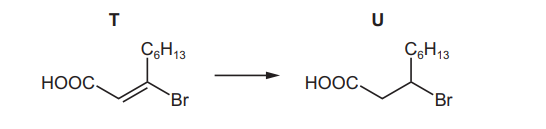
(i) $\mathbf{T}$ is one of a pair of geometrical (cis-trans) isomers.
Draw the other geometrical isomer of $\mathbf{T}$ and explain why the molecules exhibit this form of isomerism.[3]
(ii) Identify the reagent used to convert $\mathbf{T}$ to $\mathbf{U}$. [1]
(iii) The $\mathrm{C}-\mathrm{Br}$ bond has an absorption between $500 \mathrm{~cm}^{-1}$ and $600 \mathrm{~cm}^{-1}$ in an infrared spectrum. The infrared spectra for both $T$ and $U$ have absorptions between $2850 \mathrm{~cm}^{-1}$ and $2950 \mathrm{~cm}^{-1}$. These correspond to $\mathrm{C}-\mathrm{H}$ bonds.
Identify:
- two other absorptions that would be seen in the infrared spectra of both $\mathbf{T}$ and $\mathbf{U}$ – one other absorption that would only be seen in the infrared spectrum of $\mathbf{T}$.
For each absorption, give the range of the absorption and the bonds that correspond to these absorptions.
absorption 1 present in both spectra
absorption 2 present in both spectra
absorption only present in spectrum of $\mathbf{T}$[3] [Total: 24]
▶️Answer/Explanation
Ans:
(a)(i) $\quad$ M1 acidified $/ \mathrm{H}^{+} \mathrm{Cr}_2 \mathrm{O}_7^{2-} /$ (potassium/ sodium) dichromate OR manganate(VII) $/ \mathrm{MnO}_4^{-} / \mathrm{KMnO}_4$
M2 (heat under) reflux
(a)(ii) nucleophilic addition
(a)(iii) yellow / orange / red ppt / solid
(a)(iv) it does not have four different (groups of) atoms attached to (central) carbon OR it does not have a chiral carbon / centre
OR it has two identical / $\mathrm{COOH}$ groups attached to (central) carbon OR mirror image is super(im)posable
(a)(v) M1 hydrolysis
M2 esterification / condensation
(b)(i) $M 1$ no. of $\mathrm{mol} \mathrm{O}_2=\frac{1.00 \times 10^5 \times 1.06 \times 10^{-3}}{(8.31 \times 850)}$
M2 no. of mol of nitroglycerine $=4 \times 0.0150=0.0600(\mathrm{~mol})$
M3 mass of nitroglycerine $=0.0600 \times 227=13.6(2)(\mathrm{q})$
(b)(ii) $\quad 1.06 \times 29=30.7(4) \mathrm{dm}^3$
(c)(i) $\quad \mathrm{C}_5 \mathrm{H}_8 \mathrm{O}_2$
(c)(ii)
(c)(iii)
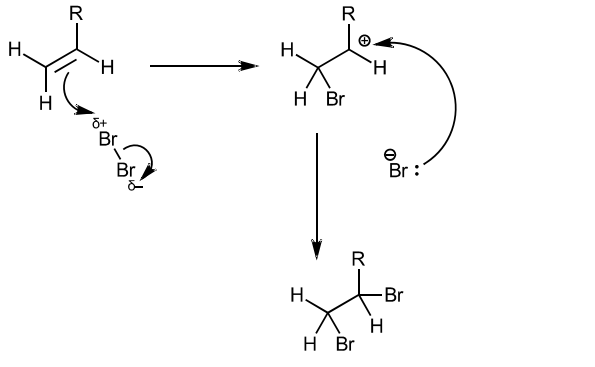
M1 curly arrow from $\mathrm{C}=\mathrm{C}$ double bond to $\mathrm{Br}$ M2 correct dipole in $\mathrm{Br}_2$ AND curly arrow from $\mathrm{Br}-\mathrm{Br}$ to $\mathrm{Br}^{\text {o- }}$ M3 correct intermediate AND curly arrow from lone pair on $\mathrm{Br}^{-}$to $\mathrm{C}^{+}$ M4 correct product
(d)(i)
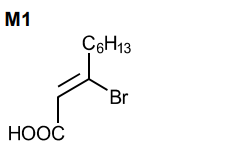
M2 (two) different groups on each C atom in the C=C / end of the C=C double bond
M3 no / restricted rotation about C=C
(d)(ii) H2 / hydrogen
3(d)(iii) M1 I M2 absorptions seen in both spectra (any two):
(same) both show an absorption at $1680-1730\left(\mathrm{~cm}^{-1}\right)$ because of $\mathrm{C}=\mathrm{O}$
(same) both show an absorption at 2500-3000( $\left.\mathrm{cm}^{-1}\right)$ because of $\mathrm{RCO}_2-\mathrm{H} / \mathrm{O}-\mathrm{H}$ in $\mathrm{RCO}_2 \mathrm{H} /$ carboxyl(ic acid)
M3 absorption only seen in spectrum of $\mathrm{T}$ :
(different) T shows an absorption at $1500-1680\left(\mathrm{~cm}^{-1}\right)$ because of $\mathrm{C}=\mathrm{C}$
(different) $\mathbf{T}$ shows an absorption at $3000-3100\left(\mathrm{~cm}^{-1}\right)$ because of $(\mathrm{C}=) \mathrm{C}-\mathrm{H}$