
Question
The rate of chemical reactions is affected by changes in temperature and pressure.
(a) (i) Draw a curve on the axes to show the Boltzmann distribution of energy of particles in a sample of gaseous krypton atoms at a given temperature.
Label the curve T1 and label the axes.
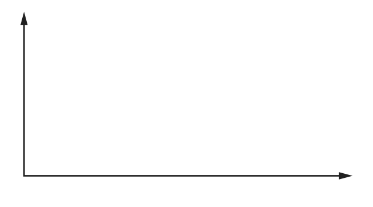
(ii) On the diagram in (a)(i), draw a second curve to show the distribution of energies of the krypton atoms at a higher temperature.
Label the second curve T2.
(b) The Boltzmann distribution assumes that the particles behave as an ideal gas.
(i) State two assumptions of the kinetic theory as applied to an ideal gas.
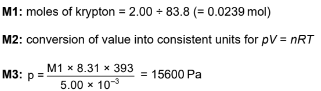
(ii) 2.00g of krypton gas, Kr(g), is placed in a sealed 5.00dm³ container at 120°C.
Calculate the pressure, in Pa, of Kr(g) in the container.Assume Kr(g) behaves as an ideal gas.
Show your working.
(iii) State and explain the conditions at which krypton behaves most like an ideal gas.
(c) Krypton reacts with fluorine in the presence of ultraviolet light to make krypton difluoride, KrF2(g).
\(Kr(g) + F_{2} (g) \rightarrow KrF_{2}(g)\)
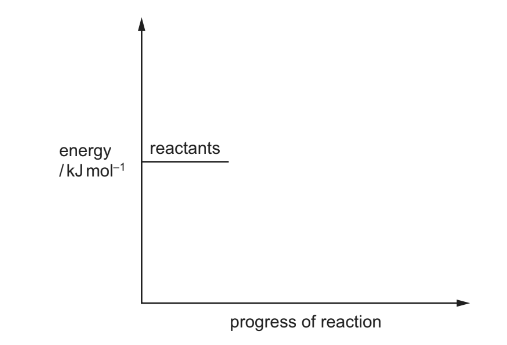
activation energy for the reaction, Ea = +385kJmol-1
enthalpy change of formation of KrF2, ∆Hf = +60.2kJmol-1
(i) Use this information to complete the reaction profile diagram for the formation of KrF2. Label Ea and ∆Hf on the diagram.
Assume the reaction proceeds in one step.
(ii) Explain, in terms of activation energy, Ea, and the collision of particles, how an increase in temperature affects the rate of a chemical reaction.
Answer/Explanation
Answer: (a)(i)
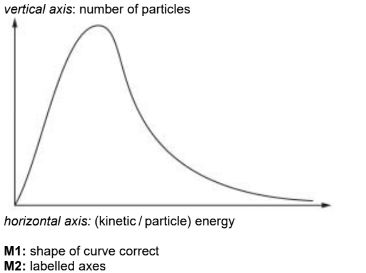
(a)(ii) Labelled line (T2) with lower peak to right of original
(b)(i) Any two from: • no VdW forces present / no forces of attraction between particles
• (ideal gas) particles have no / negligible volume (compared to container)
• collisions between (ideal gas) particles / walls of container are perfectly elastic
• (ideal gas) particles behave as rigid spheres
(b)(ii)
(b)(iii) M1: low pressure AND high temperature
M2: Either of:
• volume of particles is negligible (compared to volume of container)
• VdW forces are insignificant (owing to high kinetic energy of particles)
(c)(i)
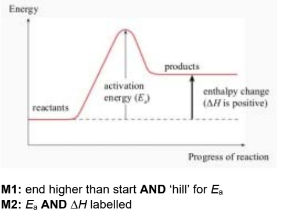
(c)(ii) • rate increases • (increase in temperature means) more particles have energy ⩾ activation energy • frequency of successful collisions increases
Question
Chlorine, Cl2 , is a reactive yellow-green gas. It is a strong oxidising agent.
(a) State how Cl2 is used in water purification.
(b) Chlorine has the highest first ionisation energy of the Period 3 elements Na to Cl.
(i) Construct an equation for the first ionisation energy of chlorine.
Include state symbols.
(ii) Explain the general increase in the first ionisation energies of the Period 3 elements.
(c) The halide ions, X– (where X = Cl, Br, I), show clear trends in their physical and chemical
properties.
(i) State and explain the relative thermal stabilities of the hydrogen halides, HX.
The halide ions react easily with concentrated H2SO4.
The main sulfur-containing product of each reaction is shown in the table.
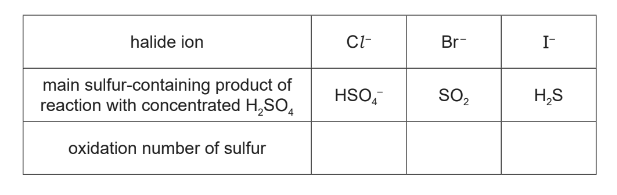
(ii) Complete the table to show the oxidation number of sulfur in each of the sulfur-containing
products.
(iii) Explain why different sulfur-containing products are produced when each of these halide
ions reacts with concentrated H2SO4.
(d) Cl2 reacts with aqueous sodium hydroxide in a disproportionation reaction.
(i) State what is meant by disproportionation.
(ii) Write an equation for the reaction of Cl2 with cold aqueous sodium hydroxide.
(e) Aluminium reacts with chlorine to form aluminium chloride.
Aluminium chloride can exist as the gaseous molecule Al2Cl6(g). This molecule contains
coordinate bonds.
(i) Draw a diagram that clearly shows all the types of bond present in Al2Cl6(g).
solid.
When excess AgNO3(aq) is added to the solution, 11.54g of AgCl(s) forms.
(i) Suggest the type of bonding and structure shown by ZCln.
(ii) Calculate the value of n in ZCln.
(g) Dichloromethane, CH2Cl2, is widely used as an organic solvent.
CH2Cl2 can be prepared by reacting CH3Cl and Cl2 at room temperature.
The reaction proceeds via several steps, as shown.
\(Cl_{2} \xrightarrow[]{initiation} 2Cl\, \dot{}\)
\(Cl\, \dot{} + CH_{3}Cl \xrightarrow[]{propagation\: 1} HCl + \dot{}CH_{2}\)
\(Cl_{2} + \dot{}CH_{2}Cl \xrightarrow[]{propagation\: 2} products\)
\(Cl\dot{} + \dot{}CH_{2}Cl\xrightarrow[]{final step} CH_{2}Cl_{2}\)
(i) Give the name of the mechanism of this reaction.
(ii) State the essential condition required for the initiation step to take place.
(iii) Give the electronic configuration of Cl•.
(iv) Identify the products of the step labelled propagation 2.
(v) Name the type of reaction shown in the final step.
(vi) Suggest the identity of another organic molecule that is a product of the reaction of CH3Cl
and Cl2 under the same conditions.
Answer/Explanation
Answer: 2(a) kills bacteria/microbes/micro-organisms
2(b)(i) Cl(g) – e– → Cl+(g)
2(b)(ii) M1: increasing proton number but similar shielding M2: greater attraction of nucleus (for outer / valence electrons)
2(c)(i) M1: (thermal stability) decreases (down group)
M2: (H—X) bond energy / strength decreases
2(c)(ii) (+)6, (+)4, –2
2(c)(iii) halides are better / stronger / more able reducing agents / are more easily oxidised down group
2(d)(i) when a species is both oxidised and reduced
2(d)(ii) Cl2 + 2NaOH → NaCl + NaClO + H2O
2(e)(i) 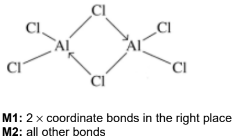
2(e)(ii) M1: • (AlCl3 / solid) disappears
• misty / steamy fumes
• temperature increases
M2: hydrolysis
2(f)(i) simple / molecular AND covalent
2(f)(ii) M1: 11.54 ÷ 143.4 = 0.0805 M2: so ratio Z:Cl is 1:4 / n = 4
2(g)(i) (free-)radical substitution
2(g)(ii) ultraviolet (UV) light / sunlight
2(g)(iii) (1s²) 2s² 2p6 3s² 3p5
2(g)(iv) Cl • AND CH2Cl2
2(g)(v) termination
2(g)(vi) CHCl3 OR (CH2Cl)2
3. Question
Compounds P, Q and R have all been found in the atmosphere of one of Saturn’s moons.
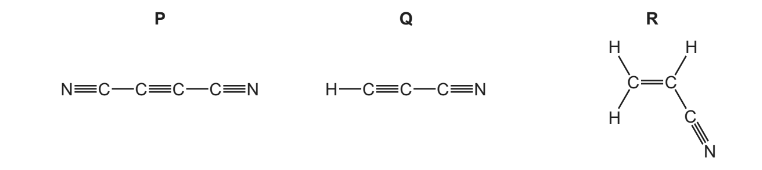
(a) The equation for the complete combustion of P, C4N2(l), is shown.
\(C_{4}N_{2}(l ) + 4O_{2} \rightarrow 4CO_{2}(g) + N_{2}(g)\) ∆H = –2036kJmol-1
(i) The enthalpy change of formation, ∆Hf , of CO2(g) is –384kJmol-1.
Calculate the enthalpy change of formation, ∆Hf , of P, in kJmol-1.
(ii) One of the products of the complete combustion of P is nitrogen gas, N2(g).
Explain the lack of reactivity of nitrogen.
(b) Q forms when HCN reacts with ethyne, H—C≡C—H.
(i) Ethyne, HCN and Q are all weak Brønsted–Lowry acids.
Explain what is meant by the term weak Brønsted–Lowry acid.
(ii) Ethyne, HCN and Q all contain triple bonds between two atoms.
A triple bond consists of one sigma (σ) and two pi (π) bonds.
Draw a labelled diagram to show the formation of one pi (π) bond.
(c) P and Q can be detected in the atmosphere by infrared spectroscopy.
Identify two absorptions, and the bonds that correspond to these absorptions, that will appear
in the infrared spectra of both P and Q.
(d) The flow chart shows some reactions of R.
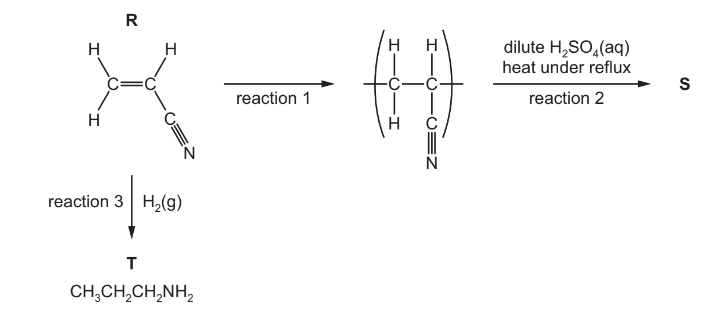
(i) Name the type of reaction shown in reaction 1.
(ii) Draw the structure of S, the organic product of reaction 2.
(iii) Name T.
(iv) T can also be formed by the reaction of CH3CH2CH2Br with ammonia.
State the necessary conditions of this reaction.
Answer/Explanation
Answer: (a)(i) M1: ΔHf + (–2036) = 4 × –384 M2: ΔHf = (+)500
(a)(ii) strong triple bond / high activation energy
(b)(i) M1: proton / H+ donor M2: partially dissociates / does not fully dissociate (in solution)
(b)(ii) 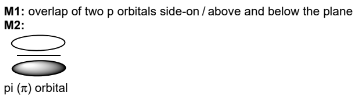
(c) M1: 2150–2250 (cm-1) AND C≡C M2: 2200–2250 (cm-1) AND C≡N
(d)(i) addition polymerisation
(d)(ii) 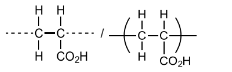
(d)(iii) propan-1-amine / 1-aminopropane
(d)(iv) alcoholic / ethanolic solution AND high pressure / heat in a sealed container
Question
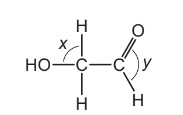
Hydroxyethanal, HOCH2CHO, has been observed in dust clouds near the centre of our galaxy.
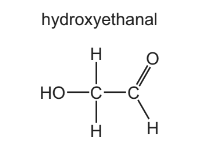
(a) Predict the bond angles labelled x and y in the diagram of hydroxyethanal.
(b) Hydroxyethanal reacts separately with 2,4-dinitrophenylhydrazine (2,4-DNPH) and with Tollens’ reagent.
State what you would observe in each reaction.
reaction with 2,4-DNPH_________________________
reaction with Tollens’ reagent______________
(c) Hydroxyethanal is converted to ethanedioic acid, (CO2H)2, when it reacts with excess acidified dichromate(VI) ions, Cr2O72-.
(i) State the role of acidified Cr2O72- in this reaction.
(ii) State and explain any other necessary conditions for this reaction to be successful.
(d) Hydroxyethanal can be reduced to ethane-1,2-diol, (CH2OH)2, as shown.
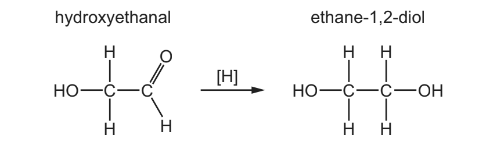
(i) Write an equation for the reduction of hydroxyethanal to (CH2OH)2 .
Use [H] to represent an atom of hydrogen from the reducing agent.
(ii) Identify a reagent for this reduction reaction.
(iii) (CH2OH)2 also forms when an alkene A reacts with cold, dilute, acidified manganate(VII) ions.
Name A.
Answer/Explanation
Answer: (a) M1: x = 108–110°
M2: y = 118 –122°
(b) M1: red / orange / yellow ppt / solid
M2: silver mirror OR silver / grey / black / brown ppt / solid
(c)(i) oxidising agent
(c)(ii) M1: (excess dichromate and) heat under reflux M2: to allow full oxidation (of alcohol and aldehyde groups)
(d)(i) CH2OHCHO + 2[H] → (CH2OH)2
(d)(ii) NaBH4 / LiAlH4
(d)(iii) ethene