
Question
Fig. 1.1 shows how first ionisation energies vary across Period 2.
(a) Construct an equation to represent the first ionisation energy of oxygen. Include state symbols.
(b) (i) State and explain the general trend in first ionisation energies across Period 2.
(ii) Explain why ionisation energy A in Fig. 1.1 does not follow the general trend in first ionisation energies across Period 2.
(c) Element E is in Period 3 of the Periodic Table.
The first eight ionisation energy values of E are shown in Table 1.1.
Deduce the full electronic configuration of E.
Explain your answer.
full electronic configuration of E = ………………………………………………………………………………….
explanation ………………………………………………………………………………………………………………..
Answer/Explanation
Answer:
(a) \(O(g) → O^+(g) + e^–\)
(b) (i) increase across period AND increased nuclear attraction for (valence / outer) electrons
increase in (positive) nuclear charge / number of protons (in the nucleus)
similar shielding (of outer electrons)
(ii) spin-pair repulsion (of electrons) in (2)p orbital
outweighs increased nuclear charge
(c) \(1s_2 2s_2 2p_6 3s_2 3p_1\)
greatest jump between 3rd and 4th ionisations
indicates three electrons in outer shell
Question
Some oxides of elements in Period 3 are shown.
\(Na_2O\) \(Al_2O_3\) \(P_4O_6\) \(P_4O_{10}\) \(SO_2\) \(SO_3\)
(a) Na reacts with \(O_2\) to form \(Na_2O\). Na is the reducing agent in this reaction.
(i) Define reducing agent.
(ii) Write an equation for the reaction of \(Na_2O\) with water.
(b) \(Al_2O_3\) is an amphoteric oxide found in bauxite.
(i) State what is meant by amphoteric.
(ii) \(Al_2O_3\) is purified from bauxite in several steps. The first step involves heating \(Al_2O_3\) with an excess of NaOH(aq). A colourless solution forms.Write an equation for this reaction.
(iii) \(Al_2O_3\) is used as a catalyst in the dehydration of alcohols.
State the effect of using \(Al_2O_3\) as a catalyst in the dehydration of alcohols. Use the Boltzmann distribution in Fig. 2.1 to help explain your answer.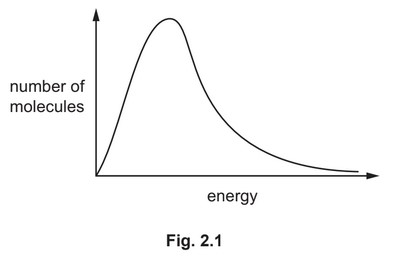
(c) \(P_4O_6\) is a white solid that has a melting point of 24°C. Solid \(P_4O_6\) reacts with water to form \(H_3PO_3\).
(i) Deduce the type of structure and bonding shown by \(P_4O_6\). Explain your answer.
(ii) Determine the oxidation number of P in \(H_3PO_3\).
(iii) When \(P_4O_6(s)\) is heated with oxygen it forms \(P_4O_{10}(s)\).
\(P_4O_6(s) + 2O_2(g) → P_4O_{10}(s)\) \(∆H_r = –1372kJmol^{–1}\)
The enthalpy change of formation, \(∆H_f\) , of \(P_4O_{10}(s)\) is –3012kJ\(mol^{–1}\).
Calculate the enthalpy change of formation, \(∆H_f\) , of \(P_4O_6(s)\).
\(∆H_f\) of \(P_4O_6(s)\) = ………………………… \(kJmol^{–1}\)
(iv) Write an equation for the reaction of \(P_4O_{10}\) with water.
(d) \(SO_2\) and \(SO_3\) are found in the atmosphere.The oxidation of \(SO_2\) to \(SO_3\) in the atmosphere is catalysed by \(NO_2\).The first step of the catalytic oxidation is shown in equation 1.
equation 1 \(SO_2(g) + NO_2(g) \leftrightarrow SO_3(g) + NO(g)\)
(i) Construct an equation to show how \(NO_2\) is regenerated in the catalytic oxidation of \(SO_2\).
(ii) \(NO_2\) can also react with unburned hydrocarbons to form photochemical smog.
State the product of this reaction that contributes to photochemical smog.
(iii) Fig. 2.2 shows how the temperature of the atmosphere varies with height from the ground.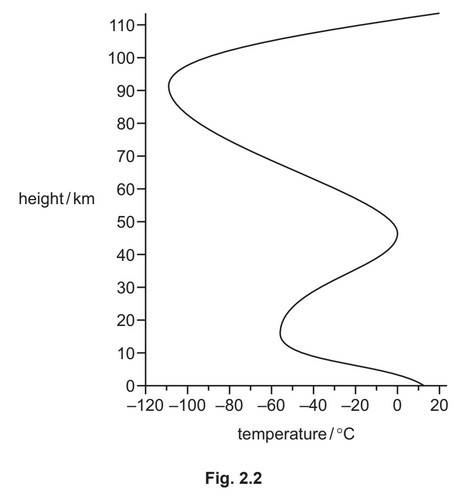
The equilibrium reaction in equation 1 has \(∆H_r = –168kJmol^{–1}\).
Suggest how the position of this equilibrium differs at a height of 20km compared with a height of 50km from the ground. Explain your answer.
Answer/Explanation
Answer:
(a) (i) species that donates electrons
(ii) \(Na_2O + H_2O → 2NaOH\)
(b) (i) reacts with both acids and bases / shows both acidic and basic behaviour
(ii) \(Al_2O_3 + 2NaOH + 3H_2O → 2NaAl(OH)_4\)
(iii) two lines shown on diagram, e.g. \(E_A\) and \(E_A\),cat
greater proportion of molecules with E ⩾ EA
frequency of effective collisions increases
(c) (i) (structure =) simple/molecular, because it has a low melting/boiling point (bonding =) covalent, because it is hydrolysed
(ii) (+)3 / III
(iii) –1640 (kJ \(mol^{–1}\))
(iv) \(P_4O_{10} + 6H_2O → 4H_3PO_4\)
(d) (i) \(NO + 1⁄2O_2 → NO_2\)
(ii) peroxyac(et)ylnitrate / PAN
(iii) position of equilibrium moves / farther to right (at 20 km)
(forward) reaction is exothermic AND temperature colder at 20 km (cf. 50 km)
Question
The hydrogen halides HCl, HBr and HI are all colourless gases at room temperature.
(a) The hydrogen halides can be formed by reacting the halogens with hydrogen.
Describe and explain the relative reactivity of the halogens down the group when they react with hydrogen to form HCl, HBr and HI.
(b) HCl is a product of several different reactions. Some of these are shown in Fig. 3.1.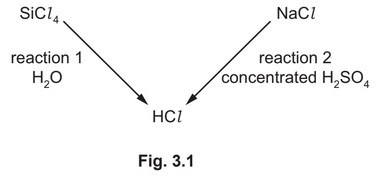
(i) Write an equation for reaction 1.
(ii) In reaction 2, NaCl reacts with concentrated \(H_2SO_4\) to form HCl and \(NaHSO_4\).
When NaBr reacts with concentrated \(H_2SO_4\), the products include \(Br_2\) and \(SO_2\).Identify the type(s) of reaction that occur in each case by completing Table 3.1.
Explain the difference in these reactions.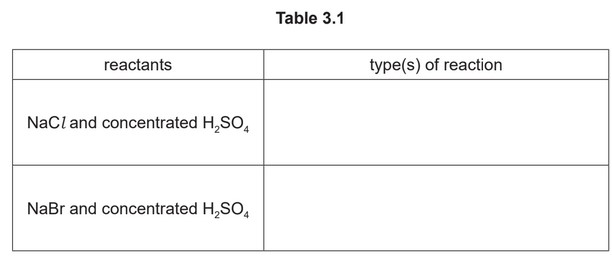
(c) When heated with a Bunsen burner, HCl does not decompose, whereas HI forms \(H_2\) and \(I_2\).
Explain the difference in the effect of heating on HCl and HI.
(d) The hydrogen halides dissolve in water to form strong Brønsted–Lowry acids.
The concentration of a strong acid can be determined by titration.
(i) State what is meant by strong Brønsted–Lowry acid.
(ii) On Fig. 3.2, sketch the pH titration curves produced when:
● \(0.1moldm^{–3}\) NaOH(aq) is added to 25\(cm^3\) of \(0.1moldm^{–3}\) HBr(aq), to excess
● \(0.1moldm^{–3} NH_3(aq)\) is added to \(25cm^3\) of \(0.1moldm^{–3} HBr(aq)\), to excess.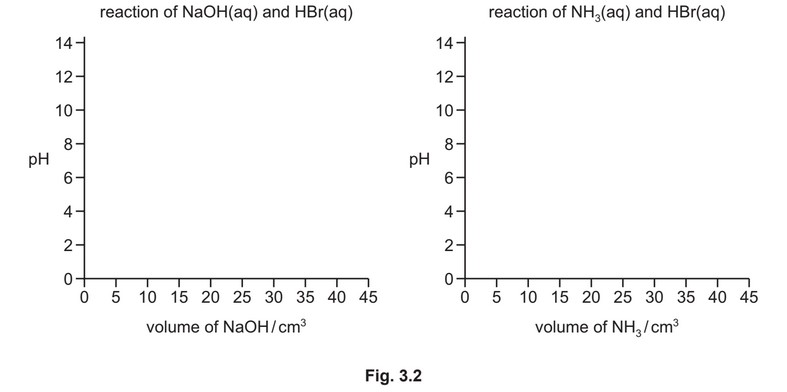
(e) HBr reacts with propene to form two bromoalkanes, \(CH_3CH_2CH_2Br\) and \((CH_3)_2CHBr\).
(i) Complete the diagram to show the mechanism of the reaction of HBr and propene to form the major organic product.Include charges, dipoles, lone pairs of electrons and curly arrows, as appropriate.
Draw the structures of the intermediate and the major organic product.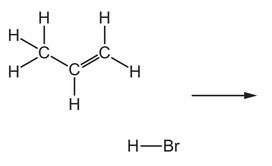
(ii) Explain why the two bromoalkanes are not produced in equal amounts by this reaction.
(iii) The reaction of \(CH_3CH_2CH_2Br\) and NaOH is different depending on whether water or ethanol is used as a solvent.
Complete Table 3.2 to identify the organic and inorganic products of the reaction of \(CH_3CH_2CH_2Br\) and NaOH in each solvent.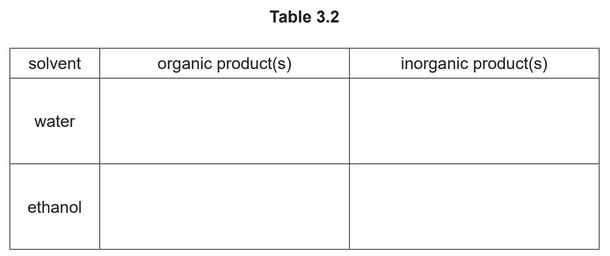
Answer/Explanation
Answer:
(a) M1: reaction less vigorous (down the group)
M2: Any two of the following for one mark:
• electronegativity decreases
• less attractive to e– addition
• weaker oxidising agent
• greater nuclear charge outweighing increased shielding (ENC argument)
(b) (i) \(SiCl_4 + 2H_2O → SiO_2 + 4HCl\)
(ii) M1: All three correct for two marks:
row 1 • acid–base
row 2 • acid–base • redox
M2: explanation
\(H_2SO_4\) is strong enough to oxidise / is an oxidising agent with NaBr / HBr / bromide
(c) H—Cl bond is stronger than H—I / BDE decreases down the group
(d) (i) proton / \(H^+\) donor
fully dissociates (in aqueous solution / water / solvent)
(ii) M1: correct sigmoid shape with vertical section at 25 \(cm^3\) for both
M2: both curves show initial pH ⩽ 2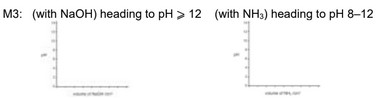
(e) (i) 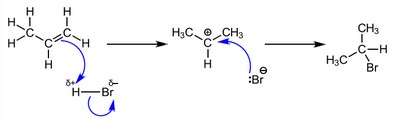
M1: curly arrow from C=C to H of HBr
M2: correct dipole \((^{δ+}H—Br^{δ–})\) AND curly arrow from H—Br to Br
M3: curly arrow from lone pair on :Br– to carbocation
M4: correct intermediate AND product (2-bromopropane)
(ii) 2° carbocation more stable (than 1°) (or reverse argument)
greater positive inductive effect of two methyl groups (cf. one ethyl) (or reverse argument)
(iii) 
Question
Compounds J and K are found in plant oils.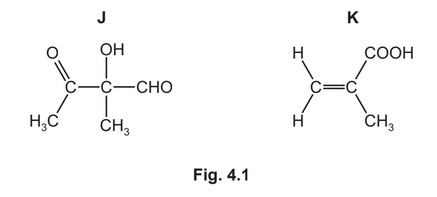
(a) (i) Complete Table 4.1 to state what you would observe when J reacts with the reagents listed.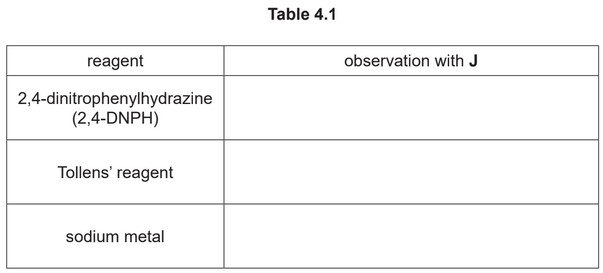
(ii) J has two optical isomers.Draw the three-dimensional structures of the two optical isomers of J.
(b) K is used to make the addition polymer Perspex®. A synthesis of Perspex® is shown in Fig. 4.2.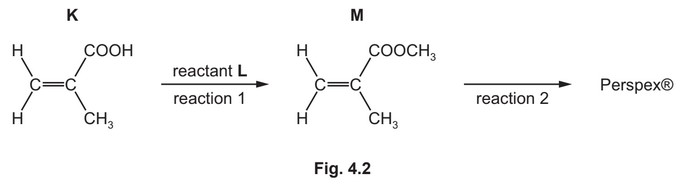
(i) Identify L. State the conditions required for reaction 1.
L =
conditions =
(ii) Draw one repeat unit of the addition polymer Perspex®.
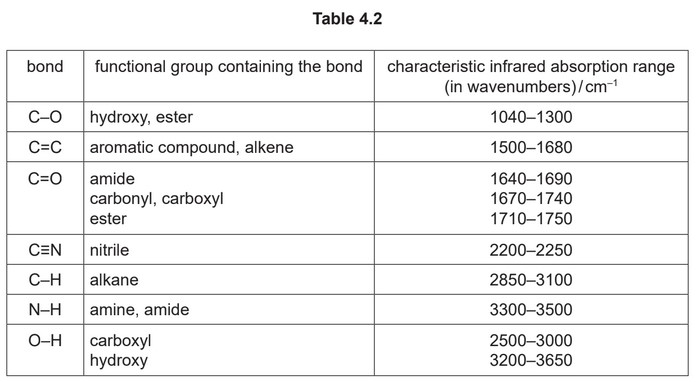
(iii) Use information from Table 4.2 to suggest how the infrared spectra of M and Perspex® would differ. Explain your answer.
(iv) K can be made from propanone in the three-step synthesis shown in Fig. 4.3.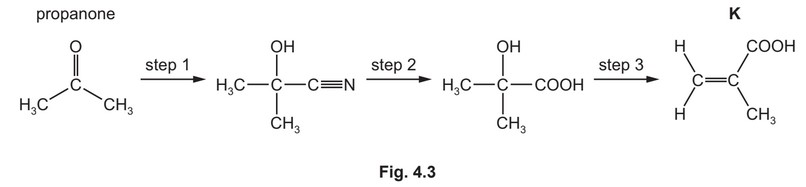
Complete Table 4.3 to identify the reagent(s) used and the type of reaction in each step.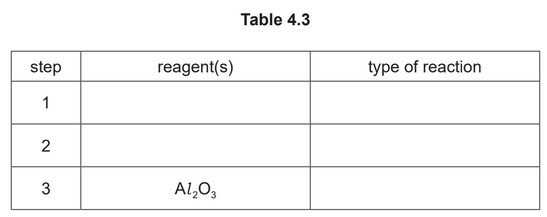
Answer/Explanation
Answer:
(a) (i) red / orange / yellow precipitate / ppt / solid
silver mirror / silver / grey solid / precipitate / ppt
effervescence / bubbling / fizzing
(ii) 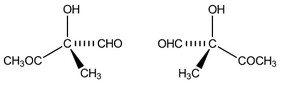
(b) (i) L = \(CH_3OH\) / methanol
conditions = acid(ic) / H+ / \(H_2SO_4\) AND (heat under) reflux
(ii) 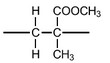
carbon backbone with ‘dangling’ bonds
rest of structure correct
(iii) Perspex® would not have absorption 1500 –1680 cm–1 AND Perspex® does not have C=C
(iv) step 1 KCN / HCN OR NaCN / \(H_2SO_4\) addition
step 2 \(H^+ / H_2SO_4(aq)\) hydrolysis / substitution
step 3 elimination / dehydration