
Question 1
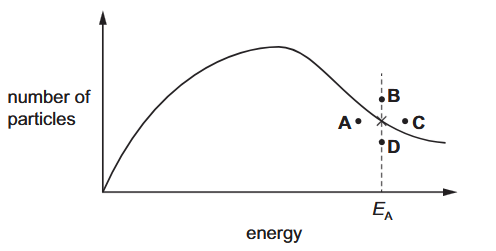
A Boltzmann distribution for a sample of a reacting gas at a constant temperature is shown. The activation energy, \(E_{\mathrm{A}}\), for the reaction is marked.
Point × shows the number of particles whose energy is equal to the activation energy.
The temperature of the sample of gas is decreased. The shape of the distribution curve changes.
Which point could show the number of particles whose energy is the same as the activation energy at the new temperature?
(A) A
(B) B
(C) C
(D) D
▶️ Answer/Explanation
Correct Answer: \( \boxed{\mathrm{D}} \)
Decreasing the temperature reduces the number of particles that have energies greater than or equal to the activation energy.
Since the activation energy, \(E_{\mathrm{A}}\), does not change, the number of particles with energy equal to \(E_{\mathrm{A}}\) decreases.
Therefore, the point must lie on the same vertical line at \(E_{\mathrm{A}}\) but lower than the original point ×. This corresponds to (D).
Question 2
Crystals of copper(II) nitrate are prepared by adding an excess of malachite to nitric acid.
The formula of malachite is \( \mathrm{Cu(OH)_2 \cdot CuCO_3} \). \( \left( M_{\mathrm{r}} = 221.0 \right) \).
\(12.0\,\mathrm{g}\) of malachite is added to \(30.0\,\mathrm{cm^3}\) of \(1.50\,\mathrm{mol\,dm^{-3}}\) nitric acid.
Which mass of malachite is left unreacted when the reaction is complete?
(B) \(2.49\,\mathrm{g}\)
(C) \(7.03\,\mathrm{g}\)
(D) \(9.51\,\mathrm{g}\)
▶️ Answer/Explanation
Correct Answer: \( \boxed{\mathrm{D}} \)
Balanced equation:
\( \mathrm{Cu(OH)_2 \cdot CuCO_3 + 4HNO_3 \rightarrow 2Cu(NO_3)_2 + CO_2 + 3H_2O} \)
Moles of nitric acid:
\(n=\dfrac{30.0}{1000}\times1.50=0.0450\,\mathrm{mol}\)
From the equation, \(4\) mol of \( \mathrm{HNO_3} \) react with \(1\) mol of malachite.
Moles of malachite reacted:
\(n=\dfrac{0.0450}{4}=0.01125\,\mathrm{mol}\)
Mass of malachite reacted:
\(m=0.01125\times221.0=2.49\,\mathrm{g}\)
Mass of malachite left:
\(12.0-2.49=9.51\,\mathrm{g}\)
Therefore, the correct answer is (D).
Question 3
X and Y are elements from the same group of the Periodic Table.
The 5th to 9th ionisation energies for X and Y are shown.
| Ionisation energy / \( \mathrm{kJ\,mol^{-1}} \) | |||||
|---|---|---|---|---|---|
| 5th | 6th | 7th | 8th | 9th | |
| Element X | 11020 | 15160 | 17870 | 92040 | 106437 |
| Element Y | 6540 | 9360 | 11020 | 33360 | 38600 |
Which row identifies elements X and Y?
| Element X | Element Y | |
|---|---|---|
| (A) | argon | neon |
| (B) | chlorine | fluorine |
| (C) | fluorine | chlorine |
| (D) | neon | argon |
▶️ Answer/Explanation
Correct Answer: \( \boxed{\mathrm{C}} \)
Both elements show a large increase between the 7th and 8th ionisation energies. This indicates that each has seven valence electrons, so they belong to Group 17.
Element X has consistently higher ionisation energies than element Y, indicating that X has the smaller atomic radius.
In Group 17, fluorine is smaller than chlorine, so fluorine has the higher ionisation energies.
Therefore, X = fluorine and Y = chlorine. Hence, the correct answer is (C).
Question 4
An ion with a charge of \(2-\) contains \(10\) electrons and \(14\) neutrons.
What is its nucleon number?
(B) \(22\)
(C) \(24\)
(D) \(26\)
▶️ Answer/Explanation
Correct Answer: \( \boxed{\mathrm{B}} \)
A \(2-\) ion has gained \(2\) electrons.
Number of protons \(=10-2=8\).
Nucleon number \(=\) protons \(+\) neutrons.
\(8+14=22\).
Therefore, the nucleon number is \(22\). Hence, the correct answer is (B).
Question 5
The structure of the hormone histamine is shown.
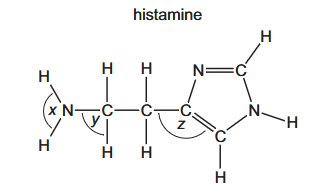
Which row contains the bond angles \(x\), \(y\) and \(z\) in histamine in the correct order from the smallest to the largest?
| Smallest bond angle | Largest bond angle | ||
|---|---|---|---|
| (A) | \(x\) | \(y\) | \(z\) |
| (B) | \(y\) | \(x\) | \(z\) |
| (C) | \(y\) | \(z\) | \(x\) |
| (D) | \(z\) | \(y\) | \(x\) |
▶️ Answer/Explanation
Correct Answer: \( \boxed{\mathrm{A}} \)
Angle \(x\) is around the amine nitrogen, which has three bonding pairs and one lone pair. Lone pair-bond pair repulsion compresses the bond angle to about \(107^\circ\), making it the smallest.
Angle \(y\) is around an \(sp^3\)-hybridised carbon atom, giving a tetrahedral bond angle of approximately \(109.5^\circ\).
Angle \(z\) is around an \(sp^2\)-hybridised carbon in the aromatic ring, giving a trigonal planar bond angle of approximately \(120^\circ\), making it the largest.
Therefore, the correct order from the smallest to the largest bond angle is \(x < y < z\). Hence, the correct answer is (A).
Question 6
When an organic acid reacts with an alcohol, a reversible reaction takes place producing an ester and water.
\(0.40\,\mathrm{mol}\) of an organic acid and \(0.30\,\mathrm{mol}\) of an alcohol are mixed and allowed to stand at \(25^\circ\mathrm{C}\) until equilibrium is reached.
At equilibrium, \(0.20\,\mathrm{mol}\) of ester is produced.
What is the value of the equilibrium constant, \(K_{\mathrm{c}}\), under the conditions used?
(B) \(0.50\)
(C) \(2.0\)
(D) \(10\)
▶️ Answer/Explanation
Correct Answer: \( \boxed{\mathrm{C}} \)
Reaction:
\( \mathrm{Organic\ acid + Alcohol \rightleftharpoons Ester + Water} \)
At equilibrium:
- Organic acid \(=0.40-0.20=0.20\,\mathrm{mol}\)
- Alcohol \(=0.30-0.20=0.10\,\mathrm{mol}\)
- Ester \(=0.20\,\mathrm{mol}\)
- Water \(=0.20\,\mathrm{mol}\)
Using
\(K_{\mathrm{c}}=\dfrac{[\mathrm{ester}][\mathrm{water}]}{[\mathrm{acid}][\mathrm{alcohol}]}\)
Since all species are in the same volume, the volume cancels:
\(K_{\mathrm{c}}=\dfrac{0.20\times0.20}{0.20\times0.10}=2.0\)
Therefore, the correct answer is (C).
Question 7
Information about two substances is given.
| Substance | Electrical conductivity | Effect of adding to water | Melting point / K |
|---|---|---|---|
| P | Good when solid and when molten | Reacts vigorously to produce an alkaline solution | 454 |
| Q | Does not conduct in any state | Reacts vigorously to produce an acidic solution | 317 |
Which row describes the structure and bonding in substances P and Q?
| P | Q | |
|---|---|---|
| (A) | Giant metallic | Simple molecular |
| (B) | Simple molecular | Giant metallic |
| (C) | Giant ionic | Simple molecular |
| (D) | Giant metallic | Giant ionic |
▶️ Answer/Explanation
Correct Answer: \( \boxed{\mathrm{A}} \)
Substance P conducts electricity in both the solid and molten states, indicating the presence of delocalised electrons. It also reacts vigorously with water to form an alkaline solution, a characteristic property of reactive metals. Therefore, P has a giant metallic structure.
Substance Q does not conduct electricity in any state and reacts with water to produce an acidic solution. Its relatively low melting point also indicates a simple molecular substance.
Therefore, the correct answer is (A).
Question 8
An excess of zinc reacts with \(x\,\mathrm{cm^3}\) of \(2.00\,\mathrm{mol\,dm^{-3}}\) hydrochloric acid.
The gas produced is dried and collected.
The gas occupies \(1.534\,\mathrm{dm^3}\) at \(101000\,\mathrm{Pa}\) and \(293\,\mathrm{K}\).
The gas produced behaves as an ideal gas.
What is the value of \(x\)?
(B) \(34.7\,\mathrm{cm^3}\)
(C) \(63.6\,\mathrm{cm^3}\)
(D) \(69.4\,\mathrm{cm^3}\)
▶️ Answer/Explanation
Correct Answer: \( \boxed{\mathrm{C}} \)
Reaction:
\( \mathrm{Zn + 2HCl \rightarrow ZnCl_2 + H_2} \)
Using the ideal gas equation,
\(PV=nRT\)
\(n=\dfrac{101000\times1.534\times10^{-3}}{8.31\times293}=0.0636\,\mathrm{mol}\)
Therefore, moles of \( \mathrm{H_2} = 0.0636\,\mathrm{mol}\).
From the equation,
\(2\) mol of \( \mathrm{HCl} \) produce \(1\) mol of \( \mathrm{H_2} \).
Moles of \( \mathrm{HCl}=2\times0.0636=0.1272\,\mathrm{mol}\).
Volume of \(2.00\,\mathrm{mol\,dm^{-3}}\) HCl required:
\(V=\dfrac{0.1272}{2.00}=0.0636\,\mathrm{dm^3}=63.6\,\mathrm{cm^3}\).
Therefore, the correct answer is (C).
Question 9
An aqueous solution of hydrogen peroxide is placed in a flask and decomposes as shown.
\(2\mathrm{H_2O_2(aq)} \rightarrow 2\mathrm{H_2O(l)} + \mathrm{O_2(g)}\)
The total volume of oxygen gas evolved is \(180\,\mathrm{cm^3}\) after \(90\) seconds, measured under room conditions.
The rate of the reaction is calculated using the equation shown.
\(\mathrm{rate}=\dfrac{\mathrm{change\ in\ moles\ of\ H_2O_2}}{\mathrm{time}}\)
What is the average rate of the reaction, measured in \(\mathrm{mol\,min^{-1}}\), over the duration of the experiment?
(B) \(1.67\times10^{-4}\)
(C) \(0.0050\)
(D) \(0.010\)
▶️ Answer/Explanation
Correct Answer: \( \boxed{\mathrm{D}} \)
At room conditions, \(1\,\mathrm{mol}\) of gas occupies \(24000\,\mathrm{cm^3}\).
Moles of oxygen produced:
\( n(\mathrm{O_2})=\dfrac{180}{24000}=0.0075\,\mathrm{mol} \)
From the equation, \(2\) mol of \(\mathrm{H_2O_2}\) decompose to form \(1\) mol of \(\mathrm{O_2}\).
Moles of \(\mathrm{H_2O_2}\) decomposed:
\( 2\times0.0075=0.0150\,\mathrm{mol} \)
Time \(=90\,\mathrm{s}=1.5\,\mathrm{min}\).
Average rate:
\( \mathrm{Rate}=\dfrac{0.0150}{1.5}=0.010\,\mathrm{mol\,min^{-1}} \)
Therefore, the correct answer is (D).
Question 10
Methanol is manufactured by reacting carbon dioxide and hydrogen together.
\( \mathrm{CO_2(g) + 3H_2(g) \rightleftharpoons CH_3OH(g) + H_2O(g)} \qquad \Delta H = -49\,\mathrm{kJ\,mol^{-1}} \)
What increases the equilibrium yield of methanol in this process?
(B) Adding an excess of steam
(C) Adding a catalyst
(D) Increasing the temperature
▶️ Answer/Explanation
Correct Answer: \( \boxed{\mathrm{A}} \)
There are 4 moles of gas on the left side of the equation and 2 moles of gas on the right.
According to Le Chatelier’s principle, increasing the pressure shifts the equilibrium towards the side with fewer gas molecules, increasing the yield of methanol.
Adding steam shifts the equilibrium to the left, a catalyst does not change the equilibrium position, and increasing the temperature decreases the yield because the forward reaction is exothermic.
Therefore, the correct answer is (A).
Question 11
The equation for a reaction of \( \mathrm{KClO_3} \) is shown.
\(4\mathrm{KClO_3} \rightarrow \mathrm{KCl} + 3\mathrm{KClO_4}\)
Which row is correct?
| Disproportionation reaction | Oxidation number of chlorine in \( \mathrm{KClO_4} \) | |
|---|---|---|
| (A) | Yes | \( +4 \) |
| (B) | Yes | \( +7 \) |
| (C) | No | \( +4 \) |
| (D) | No | \( +7 \) |
▶️ Answer/Explanation
Correct Answer: \( \boxed{\mathrm{B}} \)
In \( \mathrm{KClO_3} \), chlorine has an oxidation number of \(+5\).
In \( \mathrm{KCl} \), chlorine is reduced to \( -1 \).
In \( \mathrm{KClO_4} \), let the oxidation number of chlorine be \(x\):
\(+1+x+4(-2)=0\)
\(x=+7\)
The same element is both oxidised (\(+5 \rightarrow +7\)) and reduced (\(+5 \rightarrow -1\)), so this is a disproportionation reaction.
Therefore, the correct answer is (B).
Question 12
A student mixes \(25.0\,\mathrm{cm^3}\) of \(0.100\,\mathrm{mol\,dm^{-3}}\) sodium hydroxide solution with \(25.0\,\mathrm{cm^3}\) of \(0.100\,\mathrm{mol\,dm^{-3}}\) hydrochloric acid and records a temperature rise of \(2.50^\circ\mathrm{C}\).
What is the enthalpy change of the reaction per mole of \(\mathrm{NaOH}\)?
(B) \(-104.5\,\mathrm{kJ\,mol^{-1}}\)
(C) \(-209\,\mathrm{J\,mol^{-1}}\)
(D) \(-522.5\,\mathrm{J\,mol^{-1}}\)
▶️ Answer/Explanation
Correct Answer: \( \boxed{\mathrm{A}} \)
Assume the density of the solution is \(1.00\,\mathrm{g\,cm^{-3}}\) and the specific heat capacity is \(4.18\,\mathrm{J\,g^{-1}\,K^{-1}}\).
Mass of solution:
\(m=25.0+25.0=50.0\,\mathrm{g}\)
Heat released:
\(q=mc\Delta T=50.0\times4.18\times2.50=522.5\,\mathrm{J}\)
Moles of \(\mathrm{NaOH}\):
\(n=0.100\times\dfrac{25.0}{1000}=0.00250\,\mathrm{mol}\)
Enthalpy change per mole:
\(\Delta H=-\dfrac{522.5}{0.00250}=-209000\,\mathrm{J\,mol^{-1}}=-209\,\mathrm{kJ\,mol^{-1}}\)
The negative sign indicates that the reaction is exothermic. Therefore, the correct answer is (A).
Question 13
Carbon monoxide and methanol can react together to form ethanoic acid.
\( \mathrm{CO(g)+CH_3OH(l)\rightarrow CH_3CO_2H(l)} \qquad \Delta H^\circ_{\mathrm{r}} \)
Standard enthalpy changes of combustion are given in the table.
| Compound | Standard enthalpy change of combustion, \( \Delta H^\circ_{\mathrm{c}} \) |
|---|---|
| CO | \(-283.0\,\mathrm{kJ\,mol^{-1}}\) |
| \( \mathrm{CH_3OH} \) | \(-726.0\,\mathrm{kJ\,mol^{-1}}\) |
| \( \mathrm{CH_3CO_2H} \) | \(-874.1\,\mathrm{kJ\,mol^{-1}}\) |
What is the value of \( \Delta H^\circ_{\mathrm{r}} \) for the reaction between carbon monoxide and methanol?
(B) \(-134.9\,\mathrm{kJ\,mol^{-1}}\)
(C) \(+134.9\,\mathrm{kJ\,mol^{-1}}\)
(D) \(+1883.1\,\mathrm{kJ\,mol^{-1}}\)
▶️ Answer/Explanation
Correct Answer: \( \boxed{\mathrm{B}} \)
Using Hess’s Law,
\( \Delta H^\circ_{\mathrm{r}}=\sum \Delta H^\circ_{\mathrm{c}}(\text{reactants})-\sum \Delta H^\circ_{\mathrm{c}}(\text{products}) \)
Reactants:
\( -283.0+(-726.0)=-1009.0\,\mathrm{kJ\,mol^{-1}} \)
Products:
\( -874.1\,\mathrm{kJ\,mol^{-1}} \)
Therefore,
\( \Delta H^\circ_{\mathrm{r}}=-1009.0-(-874.1)=-134.9\,\mathrm{kJ\,mol^{-1}} \)
Hence, the correct answer is (B).
Question 14
Copper reacts with nitric acid under certain conditions. The products are copper(II) nitrate, water and an oxide of nitrogen.
\(3\,\mathrm{mol}\) of copper reacts with exactly \(8\,\mathrm{mol}\) of nitric acid.
What is the oxidation state of nitrogen in the oxide produced?
(B) \(+2\)
(C) \(+3\)
(D) \(+4\)
▶️ Answer/Explanation
Correct Answer: \( \boxed{\mathrm{B}} \)
Copper is oxidised from oxidation state \(0\) to \(+2\).
For \(3\) mol of Cu, the total increase in oxidation number is:
\(3\times2=6\) electrons lost.
Of the \(8\) nitrogen atoms in nitric acid, \(6\) remain as nitrate ions in \(3\mathrm{Cu(NO_3)_2}\). Therefore, the remaining \(2\) nitrogen atoms form the nitrogen oxide.
The \(6\) electrons released by copper are gained by these \(2\) nitrogen atoms, so each nitrogen gains \(3\) electrons.
Nitrogen changes from \(+5\) in \(\mathrm{HNO_3}\) to \(+2\) in the oxide.
Therefore, the oxidation state of nitrogen is \(+2\). Hence, the correct answer is (B).
Question 15
All the reactants and products of an exothermic reaction are gaseous.
Which statement about this reaction is correct?
(B) The total bond energy of the products is less than the total bond energy of the reactants, and \( \Delta H \) for the reaction is positive.
(C) The total bond energy of the products is more than the total bond energy of the reactants, and \( \Delta H \) for the reaction is negative.
(D) The total bond energy of the products is more than the total bond energy of the reactants, and \( \Delta H \) for the reaction is positive.
▶️ Answer/Explanation
Correct Answer: \( \boxed{\mathrm{C}} \)
For an exothermic reaction, more energy is released when new bonds are formed than is required to break the bonds in the reactants.
This means the bonds in the products are stronger and have a greater total bond energy than those in the reactants.
Since energy is released overall, the enthalpy change is negative:
\( \Delta H < 0 \)
Therefore, the total bond energy of the products is greater than that of the reactants, and \( \Delta H \) is negative. Hence, the correct answer is (C).
Question 16
Propene, hydrogen cyanide and carbon dioxide each contain \( \pi \) bonds.
Which molecules contain two \( \pi \) bonds?
(B) Carbon dioxide and propene
(C) Hydrogen cyanide and propene
(D) Hydrogen cyanide only
▶️ Answer/Explanation
Correct Answer: \( \boxed{\mathrm{A}} \)
A double bond contains one \( \pi \) bond, while a triple bond contains two \( \pi \) bonds.
Propene contains one carbon-carbon double bond, so it has one \( \pi \) bond.
Hydrogen cyanide, \( \mathrm{H-C\equiv N} \), contains a triple bond and therefore has two \( \pi \) bonds.
Carbon dioxide, \( \mathrm{O=C=O} \), contains two double bonds, giving a total of two \( \pi \) bonds.
Therefore, the molecules containing two \( \pi \) bonds are carbon dioxide and hydrogen cyanide. Hence, the correct answer is (A).
Question 17
Q, R and S are consecutive elements in Period 3 of the Periodic Table. Element R has the highest first ionisation energy and the lowest melting point of these three elements.
What are the identities of Q, R and S?
| Q | R | S | |
|---|---|---|---|
| (A) | Na | Mg | Al |
| (B) | Mg | Al | Si |
| (C) | Al | Si | P |
| (D) | Si | P | S |
▶️ Answer/Explanation
Correct Answer: \( \boxed{\mathrm{D}} \)
The consecutive Period 3 elements in option (D) are Si, P and S.
Among these three, phosphorus has the highest first ionisation energy because it has a stable half-filled \(3p^3\) electron configuration.
Phosphorus also has the lowest melting point because it exists as simple molecular \( \mathrm{P_4} \), whereas silicon has a giant covalent structure and sulfur has larger \( \mathrm{S_8} \) molecules with stronger intermolecular forces.
Therefore, \(Q=\mathrm{Si}\), \(R=\mathrm{P}\) and \(S=\mathrm{S}\). Hence, the correct answer is (D).
Question 18
A reaction scheme for a Group 2 metal, \(M\), is shown.
\(M \xrightarrow{\text{reacts with oxygen}} X \xrightarrow{\text{reacts with water}} Y \xrightarrow{\text{reacts with sulfuric acid}} Z\)
Which row is correct as \(M\) descends Group 2 from Mg to Ba?
| Solubility of \(Y\) in water | Solubility of \(Z\) in water | |
|---|---|---|
| (A) | Decreases | Decreases |
| (B) | Decreases | Increases |
| (C) | Increases | Decreases |
| (D) | Increases | Increases |
▶️ Answer/Explanation
Correct Answer: \( \boxed{\mathrm{C}} \)
The reactions are:
\( \mathrm{M + O_2 \rightarrow MO} \)
\( \mathrm{MO + H_2O \rightarrow M(OH)_2} \) (\(Y\) is the hydroxide)
\( \mathrm{M(OH)_2 + H_2SO_4 \rightarrow MSO_4 + 2H_2O} \) (\(Z\) is the sulfate)
Down Group 2, the solubility of the hydroxides increases, while the solubility of the sulfates decreases.
Therefore, the correct row is increases for \(Y\) and decreases for \(Z\). Hence, the correct answer is (C).
Question 19
U, V and W represent different halogens. The table shows the results of nine experiments in which aqueous solutions of \( \mathrm{U_2} \), \( \mathrm{V_2} \) and \( \mathrm{W_2} \) were separately added to separate aqueous solutions containing \( \mathrm{U^-} \), \( \mathrm{V^-} \) and \( \mathrm{W^-} \) ions.
| \( \mathrm{U^-(aq)} \) | \( \mathrm{V^-(aq)} \) | \( \mathrm{W^-(aq)} \) | |
|---|---|---|---|
| \( \mathrm{U_2(aq)} \) | No reaction | No reaction | No reaction |
| \( \mathrm{V_2(aq)} \) | \( \mathrm{U_2} \) formed | No reaction | \( \mathrm{W_2} \) formed |
| \( \mathrm{W_2(aq)} \) | \( \mathrm{U_2} \) formed | No reaction | No reaction |
Which row contains the ions \( \mathrm{U^-} \), \( \mathrm{V^-} \) and \( \mathrm{W^-} \) in order of their decreasing strength as reducing agents?
| Strongest | $\longrightarrow $ | Weakest | |
|---|---|---|---|
| (A) | \( \mathrm{U^-} \) | \( \mathrm{V^-} \) | \( \mathrm{W^-} \) |
| (B) | \( \mathrm{U^-} \) | \( \mathrm{W^-} \) | \( \mathrm{V^-} \) |
| (C) | \( \mathrm{V^-} \) | \( \mathrm{W^-} \) | \( \mathrm{U^-} \) |
| (D) | \( \mathrm{W^-} \) | \( \mathrm{U^-} \) | \( \mathrm{V^-} \) |
▶️ Answer/Explanation
Correct Answer: \( \boxed{\mathrm{B}} \)
A halogen displaces the halide ion of a less reactive halogen.
From the table:
- \( \mathrm{V_2} \) displaces both \( \mathrm{U^-} \) and \( \mathrm{W^-} \), so \( \mathrm{V} \) is the most reactive halogen.
- \( \mathrm{W_2} \) displaces only \( \mathrm{U^-} \), so \( \mathrm{W} \) is more reactive than \( \mathrm{U} \), but less reactive than \( \mathrm{V} \).
- \( \mathrm{U_2} \) displaces none, so \( \mathrm{U} \) is the least reactive halogen.
Therefore, halogen reactivity is:
\( \mathrm{V > W > U} \)
The reducing power of halide ions is the reverse of halogen reactivity:
\( \mathrm{U^- > W^- > V^-} \)
Hence, the correct answer is (B).
Question 20
J is either \( \mathrm{MgCl_2} \) or \( \mathrm{AlCl_3} \).
K is either \( \mathrm{SiO_2} \) or \( \mathrm{SiCl_4} \).
For J:
\( \mathrm{J(aq)\xrightarrow{\;add\ drops\ of\ aqueous\ NaOH\;}white\ precipitate\xrightarrow{\;add\ excess\ aqueous\ NaOH\;}precipitate\ dissolves} \)
For K:
\( \mathrm{K\xrightarrow{\;add\ water\;}misty\ white\ fumes\ and\ a\ white\ precipitate\ in\ a\ solution\ with\ pH<7} \)
Which row is correct?
| Identity of J | Identity of K | |
|---|---|---|
| (A) | \( \mathrm{AlCl_3} \) | \( \mathrm{SiCl_4} \) |
| (B) | \( \mathrm{AlCl_3} \) | \( \mathrm{SiO_2} \) |
| (C) | \( \mathrm{MgCl_2} \) | \( \mathrm{SiCl_4} \) |
| (D) | \( \mathrm{MgCl_2} \) | \( \mathrm{SiO_2} \) |
▶️ Answer/Explanation
Correct Answer: \( \boxed{\mathrm{A}} \)
When aqueous sodium hydroxide is added to \( \mathrm{Al^{3+}} \), a white precipitate of \( \mathrm{Al(OH)_3} \) forms, which dissolves in excess sodium hydroxide because it is amphoteric.
In contrast, \( \mathrm{Mg(OH)_2} \) does not dissolve in excess sodium hydroxide. Therefore, J is \( \mathrm{AlCl_3} \).
\( \mathrm{SiCl_4} \) reacts vigorously with water to produce hydrochloric acid (giving a solution with \( \mathrm{pH<7} \)) and a white precipitate of hydrated silicon dioxide, together with misty white fumes of \( \mathrm{HCl} \).
\( \mathrm{SiO_2} \) does not react with water under these conditions.
Therefore, \(J=\mathrm{AlCl_3}\) and \(K=\mathrm{SiCl_4}\). Hence, the correct answer is (A).
Question 21
River water in an agricultural area contains \( \mathrm{NH_4^+} \), \( \mathrm{CO_3^{2-}} \), \( \mathrm{HCO_3^-} \), \( \mathrm{Cl^-} \) and \( \mathrm{NO_3^-} \) ions. This water is treated by adding a calculated quantity of calcium hydroxide.
What is precipitated from the river water when calcium hydroxide is added?
(B) \( \mathrm{CaCO_3} \)
(C) \( \mathrm{Ca(NO_3)_2} \)
(D) \( \mathrm{NH_4OH} \)
▶️ Answer/Explanation
Correct Answer: \( \boxed{\mathrm{B}} \)
Calcium hydroxide provides \( \mathrm{Ca^{2+}} \) ions, which react with carbonate ions to form insoluble calcium carbonate:
\( \mathrm{Ca^{2+}(aq)+CO_3^{2-}(aq)\rightarrow CaCO_3(s)} \)
Calcium chloride and calcium nitrate are soluble in water, so they do not precipitate.
Ammonium ions react with hydroxide ions to produce ammonia gas and water rather than forming \( \mathrm{NH_4OH} \):
\( \mathrm{NH_4^+(aq)+OH^-(aq)\rightarrow NH_3(g)+H_2O(l)} \)
Therefore, the precipitate formed is \( \mathrm{CaCO_3} \). Hence, the correct answer is (B).
Question 22
Four atmospheric pollutants are listed.
1. Nitrogen oxides
2. Carbon monoxide
3. Unburnt hydrocarbons
4. Sulfur dioxide
Which pair of pollutants react to form peroxyacetyl nitrate (PAN)?
(B) 1 and 4
(C) 2 and 3
(D) 2 and 4
▶️ Answer/Explanation
Correct Answer: \( \boxed{\mathrm{A}} \)
Peroxyacetyl nitrate (PAN) is a component of photochemical smog.
It is formed by photochemical reactions between nitrogen oxides (\(\mathrm{NO_x}\)) and volatile organic compounds (unburnt hydrocarbons) in the presence of sunlight.
Carbon monoxide and sulfur dioxide do not react to form PAN.
Therefore, the correct pair is nitrogen oxides and unburnt hydrocarbons. Hence, the correct answer is (A).
Question 23
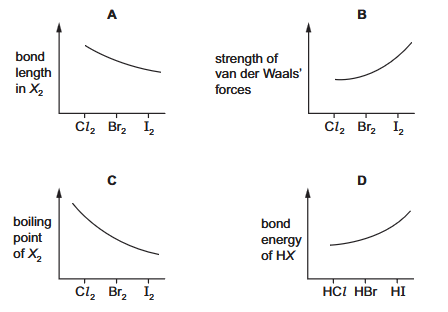
Which graph correctly describes a trend found in Group 17?
[\(X\) represents a halogen atom.]
(B) Strength of van der Waals’ forces
(C) Boiling point of \( \mathrm{X_2} \)
(D) Bond energy of \( \mathrm{HX} \)
▶️ Answer/Explanation
Correct Answer: \( \boxed{\mathrm{B}} \)
As the halogens are descended from \( \mathrm{Cl_2} \) to \( \mathrm{I_2} \), the number of electrons and the size of the electron cloud increase.
This increases the strength of the London (van der Waals’) forces between molecules, so the trend shown in graph B is correct.
The other graphs are incorrect because bond length increases (not decreases), boiling point increases (not decreases), and the bond energy of hydrogen halides decreases from HCl to HI.
Therefore, the correct answer is (B).
Question 24
Gas M is produced when \( \mathrm{NH_4Cl(aq)} \) is heated with \( \mathrm{CaO(s)} \).
Which row is correct?
| Type of reaction | Identity of M | |
|---|---|---|
| (A) | Acid-base | \( \mathrm{N_2} \) |
| (B) | Redox | \( \mathrm{NH_3} \) |
| (C) | Acid-base | \( \mathrm{NH_3} \) |
| (D) | Redox | \( \mathrm{N_2} \) |
▶️ Answer/Explanation
Correct Answer: \( \boxed{\mathrm{C}} \)
Calcium oxide is a basic oxide and reacts with water to produce calcium hydroxide.
The hydroxide ions react with ammonium ions to release ammonia gas:
\( \mathrm{NH_4^+ + OH^- \rightarrow NH_3 + H_2O} \)
Overall:
\( \mathrm{2NH_4Cl + CaO \rightarrow CaCl_2 + 2NH_3 + H_2O} \)
This is an acid-base reaction because the basic oxide (or hydroxide formed) neutralises the acidic ammonium ion. No oxidation numbers change, so it is not a redox reaction.
Therefore, the gas produced is \( \mathrm{NH_3} \), and the correct answer is (C).
Question 25
Two nitrates decompose on heating according to the equations shown.
\(2\mathrm{Pb(NO_3)_2(s)} \rightarrow 2\mathrm{PbO(s)} + 4\mathrm{NO_2(g)} + \mathrm{O_2(g)}\)
\(2\mathrm{NH_4NO_3(s)} \rightarrow 2\mathrm{N_2(g)} + \mathrm{O_2(g)} + 4\mathrm{H_2O(l)}\)
One mole of each nitrate is heated separately. The gas produced in each reaction is bubbled through \( \mathrm{NaOH(aq)} \).
The volume of any gas that does not react with \( \mathrm{NaOH(aq)} \) is then collected and measured.
Which nitrate:
- shows the greater percentage loss in mass
- produces the greater volume of gas collected?
| Greater percentage loss of mass | Greater volume of gas collected | |
|---|---|---|
| (A) | \( \mathrm{NH_4NO_3} \) | \( \mathrm{NH_4NO_3} \) |
| (B) | \( \mathrm{NH_4NO_3} \) | \( \mathrm{Pb(NO_3)_2} \) |
| (C) | \( \mathrm{Pb(NO_3)_2} \) | \( \mathrm{NH_4NO_3} \) |
| (D) | \( \mathrm{Pb(NO_3)_2} \) | \( \mathrm{Pb(NO_3)_2} \) |
▶️ Answer/Explanation
Correct Answer: \( \boxed{\mathrm{A}} \)
For \( \mathrm{Pb(NO_3)_2} \), one mole produces \(2\,\mathrm{mol}\) of \( \mathrm{NO_2} \) and \(0.5\,\mathrm{mol}\) of \( \mathrm{O_2} \).
\( \mathrm{NO_2} \) reacts with aqueous \( \mathrm{NaOH} \), so only \(0.5\,\mathrm{mol}\) of \( \mathrm{O_2} \) is collected.
For \( \mathrm{NH_4NO_3} \), one mole produces \(1\,\mathrm{mol}\) of \( \mathrm{N_2} \) and \(0.5\,\mathrm{mol}\) of \( \mathrm{O_2} \). Neither gas reacts with \( \mathrm{NaOH} \), so \(1.5\,\mathrm{mol}\) of gas is collected.
Also, \( \mathrm{NH_4NO_3} \) decomposes completely into gaseous products (with water condensed as liquid), resulting in a greater percentage loss in mass than \( \mathrm{Pb(NO_3)_2} \), which leaves solid \( \mathrm{PbO} \).
Therefore, \( \mathrm{NH_4NO_3} \) gives both the greater percentage loss in mass and the greater volume of gas collected. Hence, the correct answer is (A).
Question 26
Organic compound X has the empirical formula \( \mathrm{C_2H_4O} \).
Compound X is reduced by \( \mathrm{LiAlH_4} \), but not by \( \mathrm{NaBH_4} \).
What is compound X?
(B) Ethanal
(C) Butan-1-ol
(D) Butanoic acid
▶️ Answer/Explanation
Correct Answer: \( \boxed{\mathrm{D}} \)
\( \mathrm{NaBH_4} \) reduces aldehydes and ketones but does not reduce carboxylic acids.
\( \mathrm{LiAlH_4} \) is a stronger reducing agent and reduces carboxylic acids to primary alcohols.
The empirical formula of butanoic acid, \( \mathrm{C_4H_8O_2} \), is \( \mathrm{C_2H_4O} \), matching the given empirical formula.
Ethanal would also have the empirical formula \( \mathrm{C_2H_4O} \), but it is reduced by both \( \mathrm{LiAlH_4} \) and \( \mathrm{NaBH_4} \).
Therefore, compound X is butanoic acid. Hence, the correct answer is (D).
Question 27
What is the mechanism of the reaction of hydrogen cyanide with propanone?
(B) Electrophilic substitution
(C) Nucleophilic addition
(D) Nucleophilic substitution
▶️ Answer/Explanation
Correct Answer: \( \boxed{\mathrm{C}} \)
Propanone contains a polar carbonyl group, where the carbon atom is electron-deficient.
The cyanide ion, \( \mathrm{CN^-} \), acts as a nucleophile and attacks the carbon atom of the carbonyl group.
The \( \mathrm{C=O} \) double bond opens, and a hydrogen ion then protonates the oxygen atom to form a hydroxynitrile.
Since a nucleophile adds across the carbonyl double bond, the mechanism is nucleophilic addition. Hence, the correct answer is (C).
Question 28
Which compound may be synthesised from an alkene, with formula \( \mathrm{C_4H_8} \), by an addition reaction?
(B) 1,2-Dibromobutane
(C) 1,3-Dibromobutane
(D) 1,3-Dibromomethylpropane
▶️ Answer/Explanation
Correct Answer: \( \boxed{\mathrm{B}} \)
An alkene undergoes an addition reaction with bromine, where one bromine atom adds to each carbon atom of the carbon-carbon double bond.
For an alkene with formula \( \mathrm{C_4H_8} \), addition of \( \mathrm{Br_2} \) produces a vicinal dibromoalkane, such as 1,2-dibromobutane.
Compounds with both bromine atoms on the same carbon (1,1-dibromobutane) or separated by more than one carbon atom (1,3-dibromobutane and 1,3-dibromomethylpropane) are not formed by a simple addition reaction across a double bond.
Therefore, the correct answer is (B).
Question 29
The structure of compound G is shown.
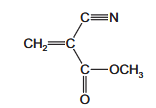
Compound G undergoes addition polymerisation.
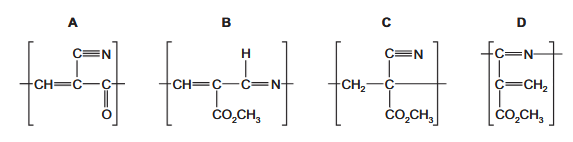
Which diagram shows the repeat unit of the polymer formed?
(B) B
(C) C
(D) D
▶️ Answer/Explanation
Correct Answer: \( \boxed{\mathrm{C}} \)
In addition polymerisation, the carbon-carbon double bond opens to form a saturated polymer backbone.
The substituent groups, \( \mathrm{-CN} \) and \( \mathrm{-CO_2CH_3} \), remain attached to the same carbon atom that originally formed the double bond.
Therefore, the repeat unit is:
\( \mathrm{-CH_2-C(CN)(CO_2CH_3)-} \)
This corresponds to diagram (C). Hence, the correct answer is (C).
Question 30
Compound T is tested with three reagents and gives the results shown.
| Reagent | Result |
|---|---|
| 2,4-DNPH | Orange precipitate |
| Fehling’s solution | No reaction |
| Acidified \( \mathrm{K_2Cr_2O_7} \) | No reaction |
What is compound T?
(B) \( \mathrm{(CH_3)_2CHCH_2OH} \)
(C) \( \mathrm{CH_3CH(OH)COCH_3} \)
(D) \( \mathrm{(CH_3)_2CHCOCH_3} \)
▶️ Answer/Explanation
Correct Answer: \( \boxed{\mathrm{D}} \)
An orange precipitate with 2,4-DNPH indicates that compound T contains a carbonyl group (aldehyde or ketone).
Fehling’s solution gives no reaction, so T is not an aldehyde.
There is also no reaction with acidified \( \mathrm{K_2Cr_2O_7} \), confirming that T is neither an aldehyde nor an oxidisable alcohol.
Among the options, only \( \mathrm{(CH_3)_2CHCOCH_3} \) is a ketone that matches all the test results.
Therefore, the correct answer is (D).
Question 31
Reagent X is added separately to 2-methylbutan-1-ol and 3-methylbutan-2-ol.
The visible results are different.
What is reagent X?
(B) Alkaline \( \mathrm{I_2(aq)} \)
(C) \( \mathrm{PCl_5} \)
(D) Acidified \( \mathrm{KMnO_4} \)
▶️ Answer/Explanation
Correct Answer: \( \boxed{\mathrm{B}} \)
2-Methylbutan-1-ol is a primary alcohol and does not contain the \( \mathrm{CH_3CH(OH)-} \) group required for the iodoform reaction.
3-Methylbutan-2-ol is a secondary alcohol containing the \( \mathrm{CH_3CH(OH)-} \) group, so it gives a positive iodoform test with alkaline \( \mathrm{I_2(aq)} \), producing a yellow precipitate of \( \mathrm{CHI_3} \).
Sodium metal and \( \mathrm{PCl_5} \) react similarly with both alcohols, and acidified \( \mathrm{KMnO_4} \) oxidises both alcohols, so they do not give clearly different visible results.
Therefore, the correct reagent is alkaline \( \mathrm{I_2(aq)} \). Hence, the correct answer is (B).
Question 32
Compound Y is hydrolysed by warm aqueous silver nitrate to form a precipitate that is soluble in dilute aqueous ammonia.
Compound Y undergoes an elimination reaction to form an alkene.
What is the skeletal formula of compound Y?

(B) B
(C) C
(D) D
▶️ Answer/Explanation
Correct Answer: \( \boxed{\mathrm{C}} \)
A precipitate that is soluble in dilute aqueous ammonia is silver chloride, indicating that compound Y is a chloroalkane.
Among the options, only C and D are chloroalkanes.
Compound Y must also undergo an elimination reaction to form an alkene. This requires a hydrogen atom on the carbon adjacent to the carbon bonded to chlorine (\(\beta\)-hydrogen).
Structure C has suitable \(\beta\)-hydrogen atoms and readily undergoes dehydrohalogenation to form an alkene.
Structure D does not have a suitable \(\beta\)-hydrogen on the adjacent carbon, so elimination cannot occur.
Therefore, the correct answer is (C).
Question 33
Propan-2-ol can be converted into 2-chloropropane using reagent M followed by reagent N.
Which row is correct?
| Reagent M | Reagent N | |
|---|---|---|
| (A) | Concentrated \( \mathrm{NaOH} \) | \( \mathrm{Cl_2} \) |
| (B) | Concentrated \( \mathrm{H_2SO_4} \) | \( \mathrm{Cl_2} \) |
| (C) | Concentrated \( \mathrm{H_3PO_4} \) | \( \mathrm{HCl} \) |
| (D) | Concentrated \( \mathrm{NaOH} \) | \( \mathrm{HCl} \) |
▶️ Answer/Explanation
Correct Answer: \( \boxed{\mathrm{C}} \)
The first step is dehydration of propan-2-ol using concentrated \( \mathrm{H_3PO_4} \), producing propene.
\( \mathrm{CH_3CH(OH)CH_3 \xrightarrow[\Delta]{conc.\ H_3PO_4} CH_3CH=CH_2 + H_2O} \)
The second step is electrophilic addition of hydrogen chloride across the double bond.
\( \mathrm{CH_3CH=CH_2 + HCl \rightarrow CH_3CHClCH_3} \)
According to Markovnikov’s rule, the major product formed is 2-chloropropane.
Therefore, the correct sequence of reagents is concentrated \( \mathrm{H_3PO_4} \) followed by \( \mathrm{HCl} \). Hence, the correct answer is (C).
Question 34
Skeletal formulae of four organic compounds are shown.

Which two compounds, when separately heated with dilute sulfuric acid, produce propanoic acid as one of the products?
(B) 1 and 4
(C) 2 and 3
(D) 3 and 4
▶️ Answer/Explanation
Correct Answer: \( \boxed{\mathrm{C}} \)
Compound 2 is an ester. Acid hydrolysis of an ester produces a carboxylic acid and an alcohol. The acyl part of compound 2 is the propanoyl group, so one product is propanoic acid.
Compound 3 is a nitrile. On heating with dilute sulfuric acid, nitriles hydrolyse to the corresponding carboxylic acids:
\( \mathrm{R{-}CN + 2H_2O + H^+ \rightarrow R{-}COOH + NH_4^+} \)
Since compound 3 contains a propyl group attached to the nitrile carbon, hydrolysis forms propanoic acid.
Compound 1 is an aldehyde and compound 4 is an ester that hydrolyses to ethanoic acid, so neither produces propanoic acid.
Therefore, the two compounds are 2 and 3. Hence, the correct answer is (C).
Question 35
1-Chloro-2-methylpropane and 2-bromo-2-methylbutane react separately with aqueous silver nitrate in ethanol.
Both reactions proceed via nucleophilic substitution and a precipitate is formed.
The time taken for 1-chloro-2-methylpropane to form a precipitate is \(T_1\).
The time taken for 2-bromo-2-methylbutane to form a precipitate is \(T_2\).
Which row is correct?
| Compound | Main reaction mechanism | Time taken for precipitate to appear | |
|---|---|---|---|
| (A) | 1-Chloro-2-methylpropane | \( \mathrm{S_N1} \) | \(T_2>T_1\) |
| (B) | 1-Chloro-2-methylpropane | \( \mathrm{S_N2} \) | \(T_1>T_2\) |
| (C) | 2-Bromo-2-methylbutane | \( \mathrm{S_N1} \) | \(T_2>T_1\) |
| (D) | 2-Bromo-2-methylbutane | \( \mathrm{S_N2} \) | \(T_1>T_2\) |
▶️ Answer/Explanation
Correct Answer: \( \boxed{\mathrm{B}} \)
1-Chloro-2-methylpropane is a primary halogenoalkane, so it reacts mainly by the \( \mathrm{S_N2} \) mechanism.
2-Bromo-2-methylbutane is a tertiary halogenoalkane, so it reacts mainly by the \( \mathrm{S_N1} \) mechanism.
Tertiary bromides react much faster than primary chlorides because bromide is a better leaving group than chloride and the tertiary carbocation formed in the \( \mathrm{S_N1} \) mechanism is relatively stable.
Therefore, the precipitate forms more quickly for 2-bromo-2-methylbutane, so:
\(T_2<T_1\), or equivalently \(T_1>T_2\).
Hence, the correct answer is (B).
Question 36
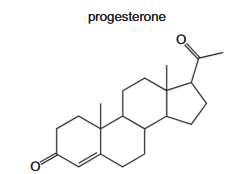
The diagram shows the structure of progesterone.
Which statement about progesterone is correct?
(B) One molecule contains four chiral carbon atoms only; the molecular formula is \( \mathrm{C_{21}H_{30}O_2} \).
(C) One molecule contains six chiral carbon atoms; the molecular formula is \( \mathrm{C_{19}H_{26}O_2} \).
(D) One molecule contains six chiral carbon atoms; the molecular formula is \( \mathrm{C_{21}H_{30}O_2} \).
▶️ Answer/Explanation
Correct Answer: \( \boxed{\mathrm{D}} \)
From the displayed structure, progesterone contains 21 carbon atoms, 30 hydrogen atoms and 2 oxygen atoms, giving the molecular formula:
\( \mathrm{C_{21}H_{30}O_2} \)
A chiral carbon atom is bonded to four different groups. Inspection of the steroid ring system shows that progesterone contains six chiral carbon atoms.
Therefore, the only statement that correctly identifies both the number of chiral carbon atoms and the molecular formula is option (D).
Hence, the correct answer is (D).
Question 37
A molecule of hexane can be cracked in a number of different ways.
Three compounds are listed.
1. \( \mathrm{C_3H_8} \)
2. \( \mathrm{C_4H_8} \)
3. \( \mathrm{C_5H_{12}} \)
Which compounds are found in the mixture of products from the cracking of hexane molecules?
(B) 1 and 2 only
(C) 1 and 3 only
(D) 2 and 3 only
▶️ Answer/Explanation
Correct Answer: \( \boxed{\mathrm{B}} \)
Cracking breaks long-chain alkanes into a mixture of shorter alkanes and alkenes.
Examples of cracking reactions for hexane include:
\( \mathrm{C_6H_{14} \rightarrow C_3H_8 + C_3H_6} \)
\( \mathrm{C_6H_{14} \rightarrow C_4H_8 + C_2H_6} \)
However, \( \mathrm{C_5H_{12}} \) cannot be produced on its own because the remaining one carbon atom would have to form \( \mathrm{CH_2} \), which is not a stable cracking product.
Therefore, only \( \mathrm{C_3H_8} \) and \( \mathrm{C_4H_8} \) are found in the cracking products. Hence, the correct answer is (B).
Question 38
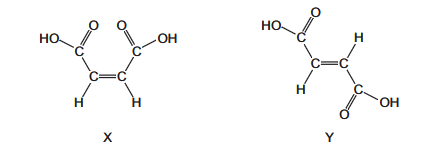
The diagrams show the structures of two isomeric dicarboxylic acids, X and Y.
X can be reduced to compound P with empirical formula \( \mathrm{C_2H_5O} \).
Y can be reduced to compound Q, also with empirical formula \( \mathrm{C_2H_5O} \).
Which statement is correct?
(B) X is a cis isomer; compound P and compound Q are isomers of each other.
(C) X is a trans isomer; compound P and compound Q are identical.
(D) X is a trans isomer; compound P and compound Q are isomers of each other.
▶️ Answer/Explanation
Correct Answer: \( \boxed{\mathrm{A}} \)
In structure X, both \( \mathrm{-COOH} \) groups are on the same side of the carbon-carbon double bond, so X is the cis isomer (maleic acid).
In structure Y, the \( \mathrm{-COOH} \) groups are on opposite sides of the double bond, so Y is the trans isomer (fumaric acid).
Reduction of both dicarboxylic acids converts each \( \mathrm{-COOH} \) group into a \( \mathrm{-CH_2OH} \) group without changing the carbon skeleton, producing the same compound:
\( \mathrm{HOCH_2CH=CHCH_2OH} \)
This product has the empirical formula \( \mathrm{C_2H_5O} \), so compounds P and Q are identical.
Therefore, X is the cis isomer, and compounds P and Q are identical. Hence, the correct answer is (A).
Question 39
What is the total number of \( \mathrm{sp^3} \) hybridised atomic orbitals used in the bonding of but-2-ene?
(B) 4
(C) 6
(D) 8
▶️ Answer/Explanation
Correct Answer: \( \boxed{\mathrm{D}} \)
But-2-ene has the structure:
\( \mathrm{CH_3-CH=CH-CH_3} \)
The two carbon atoms in the double bond are \( \mathrm{sp^2} \)-hybridised.
The two terminal carbon atoms (the \( \mathrm{CH_3} \) groups) are \( \mathrm{sp^3} \)-hybridised. Each \( \mathrm{sp^3} \)-hybridised carbon uses four \( \mathrm{sp^3} \) hybrid orbitals to form four sigma bonds.
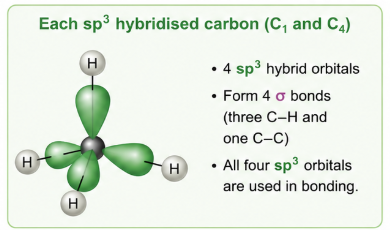
Therefore, the total number of \( \mathrm{sp^3} \) hybrid orbitals used in bonding is:
\(2 \times 4 = 8\)
Hence, the correct answer is (D).
Question 40
Compound L contains carbon atoms. It is analysed in a mass spectrometer.
The table shows the relative abundance of the only two peaks recorded with \(m/e\) greater than 127.
| \(m/e\) | Relative abundance |
|---|---|
| 128 | 50 |
| 129 | 5.5 |
How many carbon atoms are present in one molecule of compound L?
(B) 7
(C) 8
(D) 10
▶️ Answer/Explanation
Correct Answer: \( \boxed{\mathrm{D}} \)
The peak at \(m/e=128\) is the molecular ion (\(M\)), and the peak at \(m/e=129\) is the \(M+1\) peak, mainly due to the presence of \(^{13}\mathrm{C}\).
The percentage abundance of the \(M+1\) peak relative to the molecular ion is:
\[ \frac{5.5}{50}\times100=11\% \]
Each carbon atom contributes approximately 1.1% to the \(M+1\) peak because of the natural abundance of \(^{13}\mathrm{C}\).
Therefore, the number of carbon atoms is:
\[ \frac{11}{1.1}=10 \]
Hence, compound L contains 10 carbon atoms, so the correct answer is (D).