
Question
Gallium is a metal in Group 13 of the Periodic Table.
(a) There are two stable isotopes of gallium, \(^{69}Ga~and~^{71}Ga\)
(i) State, with reference to subatomic particles, how the isotopes \(^{69}Ga~and~^{71}Ga\) differ from each other.
(ii) State what further information is needed to calculate the relative atomic mass of gallium. [1]
(b) Gallium and its compounds show similar properties to aluminium and its compounds. Gallium reacts with excess chlorine to form gallium trichloride.
(i) At $500^{\circ} \mathrm{C}$, gallium trichloride is a gas.
Suggest the type of attraction that exists at $500^{\circ} \mathrm{C}$
- between atoms within a gallium trichloride molecule
- between gallium trichloride molecules. [5]
(ii) When gallium trichloride is cooled a solid, $\mathrm{Ga}_2 \mathrm{Cl}_6$, forms.
Suggest the name of the attraction formed between two gallium trichloride molecules to form $\mathrm{Ga}_2 \mathrm{Cl}_6$. [1]
(c) Gallium metal reacts rapidly when exposed to air. A white solid layer is formed on its surface.
(i) Suggest an equation to describe the reaction occurring when gallium metal is exposed to air. [2]
(ii) The table gives the formula of each gallium-containing product formed when gallium oxide reacts separately with hot aqueous hydrochloric acid and hot aqueous sodium hydroxide.
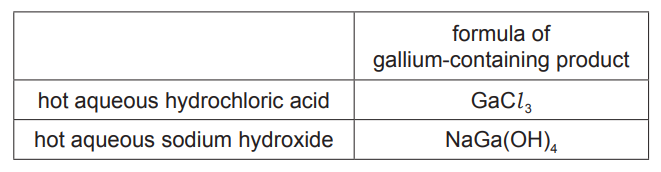
Give the name of the type of behaviour shown by gallium oxide in these reactions [1] [Total: 8]
▶️Answer/Explanation
Ans:
(a)(i) (different) number of neutrons. 1
(a)(ii) the relative abundance / % abundance of (each) the isotopes. 1
(b)(i) M1 attractions between atoms within a gallium trichloride molecule
covalent (bonds)
M2 attractions between gallium trichloride molecules
temporary induced dipoles
(b)(ii) coordinate / dative (covalent)
(c)(i)
$
4 \mathrm{Ga}+3 \mathrm{O}_2 \rightarrow 2 \mathrm{Ga}_2 \mathrm{O}_3
$
M1 correct formula of $\mathrm{Ga}_2 \mathrm{O}_3$
M2 correctly balanced equation based on $\mathrm{Ga}+\mathrm{O}_2$ and formula of gallium oxide in $\mathrm{M} 1$
(c)(ii) amphoteric
Question
(a) The equation shown in (a)(i) describes the reaction which occurs when aqueous potassiumiodide is added to aqueous copper(II) sulfate. A white precipitate of copper(I) iodide forms in a brown solution of iodine and potassium sulfate.
(i) Balance the equation and include state symbols
\(….CuSO_{4}(….)+~…..KI(….)\rightarrow …..CuI(….)+….I_{2}+…..K_{2}SO_{4}(….)\)
The table gives the oxidation numbers of iodine in the different species in the equation.
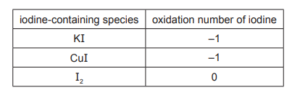
(ii) Deduce the oxidation number of copper in $\mathrm{CuSO}_4$ and CuI.
- oxidation number of copper in $\mathrm{CuSO}_4$
- oxidation number of copper in CuI[1]
(iii) Describe the type of reaction shown by the equation in (a)(i). Explain your answer in terms of electron transfer.[5]
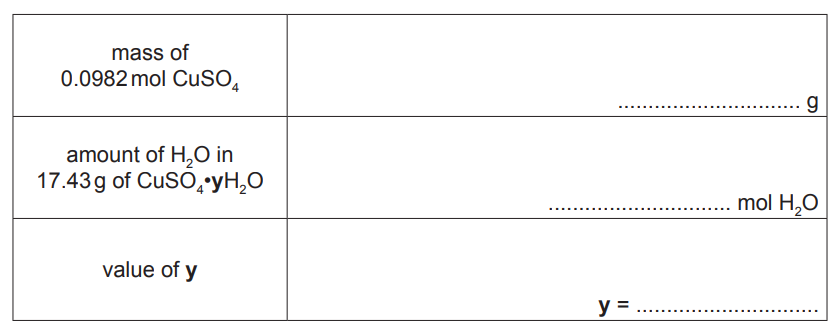
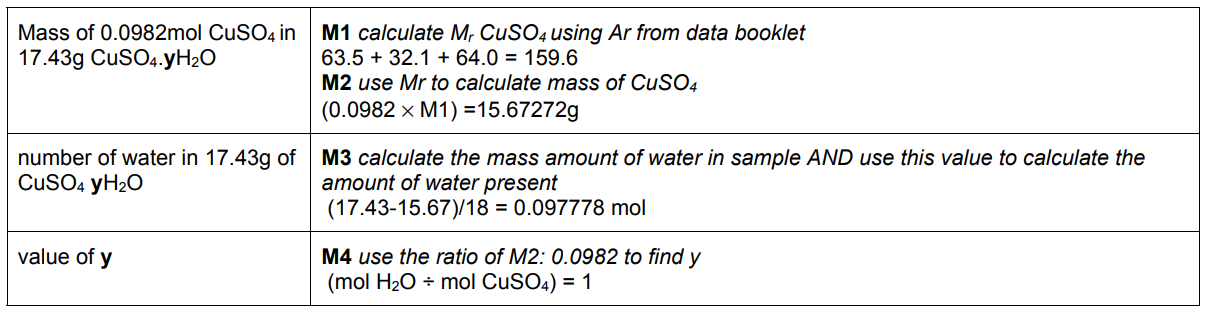
(b) In the reaction described in (a)(i), a student uses $17.43 \mathrm{~g}$ of $\mathrm{CuSO}_4 \cdot \mathrm{yH}_2 \mathrm{O}$. By further titration of the reaction products the student concludes that the total amount of $\mathrm{CuSO}_4$ in the sample is $0.0982 \mathrm{~mol}$.
Use the Data Booklet to complete the table to calculate the value of $\mathbf{y}$, where $\mathbf{y}$ is an integer. Show your working.
▶️Answer/Explanation
Ans:
(a)(i)
$
2 \mathrm{CuSO}_4(\mathrm{aq})+4 \mathrm{KI}(\mathrm{aq}) \rightarrow 2 \mathrm{Cul}(\mathrm{s})+(1) \mathrm{I}_2(\mathrm{aq})+2 \mathrm{~K}_2 \mathrm{SO}_4(\mathrm{aq})
$
M1 correct balancing
M2 correct state symbols
(a)(ii) Oxidation state of copper in $\mathrm{CuSO}_4 \quad(+) 2$ AND Oxidation state of copper in CuI
(a)(iii) M1 redox
M2 iodide ions – lost electron(s) AND copper ions – gained electron(s)
(b)
Question
Nitric acid, \(HNO_{3}\) can be made by reacting nitrogen dioxide with water.
The enthalpy change for the reaction can be measured indirectly using a Hess’ cycle.
$3 \mathrm{NO}_2(\mathrm{~g})+\mathrm{H}_2 \mathrm{O}(\mathrm{l}) \stackrel{\Delta H_{\mathrm{r}}}{\longrightarrow} 2 \mathrm{HNO}_3(\mathrm{l})+\mathrm{NO}(\mathrm{g})$
(a) Explain what is meant by the term enthalpy change of formation.
(b) Complete the Hess’ cycle using the values given in the table and hence calculate the enthalpy change, $\Delta H_r$, for this reaction. Show your working.
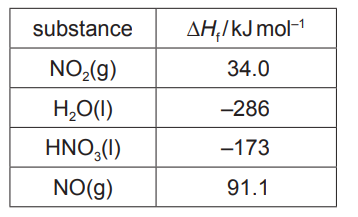
$3 \mathrm{NO}_2(\mathrm{~g})+\mathrm{H}_2 \mathrm{O}(\mathrm{I}) \stackrel{\Delta H_{\mathrm{r}}}{\longrightarrow} 2 \mathrm{HNO}_3(\mathrm{I})+\mathrm{NO}(\mathrm{g})$
$\Delta H_r=$ $\mathrm{kJmol}^{-1}$ [3]
(c) Nitrogen and oxygen do not react at normal atmospheric temperatures. Explain why.[5]
Nitrogen oxides can be formed naturally in the Earth’s atmosphere from nitrogen and oxygen in the air.
(d) State one way that nitrogen oxides are produced naturally.[1]
(e) Nitrogen dioxide, $\mathrm{NO}_2$, acts as a homogeneous catalyst in the oxidation of atmospheric sulfur dioxide.
(i) Explain why $\mathrm{NO}_2$ is described as a homogeneous catalyst. [3]
(ii) Write equations which describe the two reactions occurring when $\mathrm{NO}_2$ acts as a catalyst in the formation of sulfur trioxide from sulfur dioxide. [2] [Total: 13]
▶️Answer/Explanation
Ans:
(a) M1 (enthalpy / energy change) when one mole of a compound/substance is formed
M2 from its elements in their standard states
(b)
M1 use of correct stoichiometry in calculation $3 x \Delta H_f \mathrm{NO}_2 \quad 1 \mathrm{x}-\Delta \mathrm{H}_f \mathrm{H}_2 \mathrm{O} \quad 2 \mathrm{x} \Delta \mathrm{H}_f \mathrm{HNO}_3 \quad 1 \mathrm{x} \Delta \mathrm{H}_f \mathrm{NO}$
M2 correct signs associated with the appropriate $\Delta H_f$ values/terms used for the calculation of $\Delta \mathrm{H}_{\text {reaction }}$ M3 $\Delta \mathrm{H}_{\text {reaction }}=-(102-286)+(-346+91.1)=-70.9 \mathrm{~kJ} \mathrm{~mol}^{-1}$
(c) M1 nitrogen has a triple bond
M2 EITHER
high energy is needed to break the bond
OR
at normal temperatures there is not enough energy to break the bond / to overcome the activation energy
(d) lightning
(e)(i) M1 define homogeneous
(homogeneous catalyst is) in the same phase / state as the reactants
M2 and M3 Define catalyst
All 3 points scores 2 marks. Any 2 points scores 1 mark
increase the rate
AND
lowers the activation energy
AND
without being chemically altered at the end of the reaction / are regenerated at the end of the reaction
(e)(ii)$\begin{aligned} & \text { M1 NO } \mathrm{N}_2+\mathrm{SO}_2 \rightarrow \mathrm{NO}+\mathrm{SO}_3 \\ & \text { M2 NO }+1 / 2 \mathrm{O}_2 \rightarrow \mathrm{NO}_2\end{aligned}$
Question
Calcium nitrate, $\mathrm{Ca}\left(\mathrm{NO}_3\right)_2$, reacts with ammonia, carbon dioxide and water to form a mixture of ammonium nitrate and calcium carbonate.
$
\mathrm{Ca}\left(\mathrm{NO}_3\right)_2+2 \mathrm{NH}_3+\mathrm{CO}_2+\mathrm{H}_2 \mathrm{O} \rightarrow 2 \mathrm{NH}_4 \mathrm{NO}_3+\mathrm{CaCO}_3
$
(a) Explain why ammonia is described as a Brønsted-Lowry base in this reaction.[1]
The product mixture can then be added to soil.
(b) State two reasons why this mixture of products is added to some soils.
1……………………………………………………………………………………………………..
2……………………………………………………………………………………………………[2]
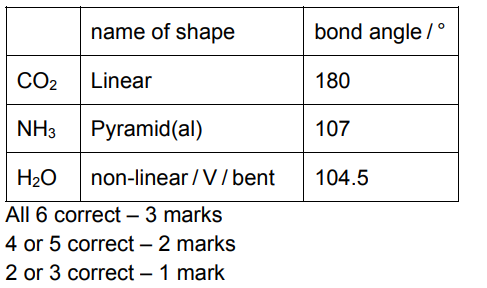
(c) Complete the table to name the shape and give the bond angle of each species.
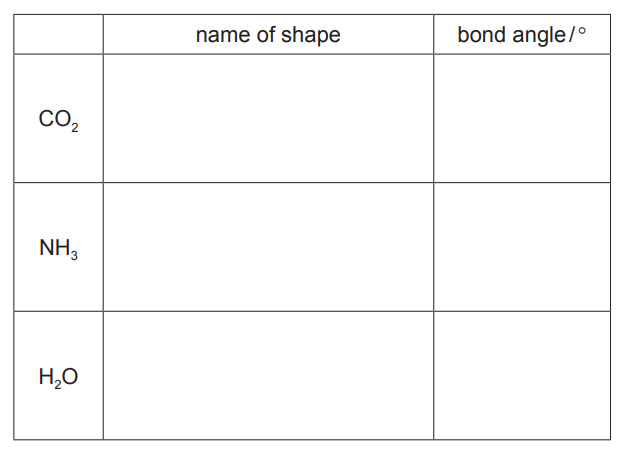
▶️Answer/Explanation
Ans:
Accepts a proton $/ \mathrm{H}^{+}$(ion)
(b) Two reasons why product mixture is added to soil – allow in any order
M1 Acts as a fertiliser / adds nutrients (for plants)
M2 Neutralise acid soils / increases the pH of acid soil
(c)
Question
2-methylbut-1-ene reacts with acidified manganate(VII) ions, under specific conditions, to produce two organic compounds $\mathbf{X}$ and $\mathbf{Y}$.
$\mathbf{X}$ immediately reacts with the acidified manganate(VII) ions to form carbon dioxide and water. $\mathbf{Y}$ has the structural formula $\mathrm{CH}_3 \mathrm{CH}_2 \mathrm{COCH}_3$.
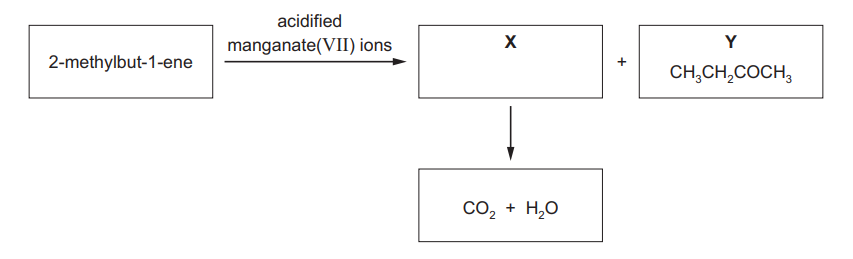
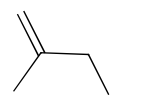
(a) Draw the skeletal formula of 2-methylbut-1-ene.[1]
(b) (i) State the specific conditions required for the acidified manganate(VII) ions to react with 2-methylbut-1-ene in this way.[1]
(ii) Name the type of reaction occurring to the functional group in 2-methylbut-1-ene in the reaction in $\mathbf{( b )}(\mathbf{( i )}$.[1]
(c) Draw the structural formula of $\mathbf{X}$.[1]
(d) Describe a chemical test and the expected observation(s) to confirm the presence of the carbonyl functional group in $\mathbf{Y}$.[5]
(e) The infra-red spectrum of 2-methylbut-1-ene is shown.
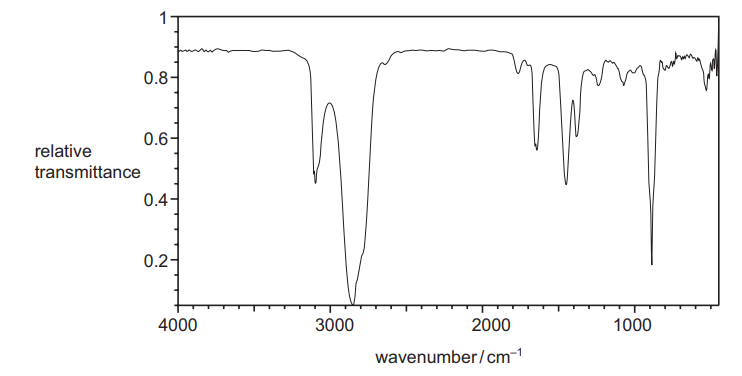
Predict two main differences that would be seen between the spectra of $\mathbf{Y}, \mathrm{CH}_3 \mathrm{CH}_2 \mathrm{COCH}_3$, and of 2-methylbut-1-ene. Give reasons for your predictions.
Your answer should refer only to the region of each spectrum above $1500 \mathrm{~cm}^{-1}$.[2]
(f) Propanoic acid, $\mathrm{CH}_3 \mathrm{CH}_2 \mathrm{CO}_2 \mathrm{H}$, is reduced by $\mathrm{LiAlH}_4$.
(i) Write an equation to show this reaction. Use $[\mathrm{H}]$ to represent an atom of hydrogen from the reducing agent.[1]
(ii) Name the organic product formed in this reaction.[1]
(g) Organic compound W is an ester which is a structural isomer of propanoic acid.
(i) State the molecular formula of W. [1]
(ii) Draw a possible structure of W.
▶️Answer/Explanation
Ans:
6(a)
6(b)(i) hot AND concentrated 1
6(b)(ii) oxidation
6(c)
Structural formula of $\boldsymbol{X}$ : $\mathrm{HCO}_2 \mathrm{H}$ OR HCOOH
6(d) M1 reagent (2,4–) DNPH / (2,4)-dinitrophenylhydrazine
M2 observation yellow / orange / red precipitate
6(e)
Predict two differences, with reasons, between spectra of $\mathbf{Y}, \mathrm{CH}_3 \mathrm{CH}_2 \mathrm{COCH}_3$ and 2-methylbut-1-ene (shown)
first difference
M1 absence of peak/ absorption at $3100\left(\mathrm{~cm}^{-1}\right)$ as no longer any $=\mathrm{C}-\mathrm{H}$ present (in $\mathbf{Y}$ )
second difference
M2 peak at $1650\left(\mathrm{~cm}^{-1}\right)$ moves to the left to any value / range of values between 1670 and 1740) due to disappearance of $\mathrm{C}=\mathrm{C}$ (in $\mathrm{Y})$ and appearance of $\mathrm{C}=\mathrm{O}($ in $\mathrm{Y})$
OR
absence of peak at $1650\left(\mathrm{~cm}^{-1}\right)$ as no longer any $C=C$ present (in $Y$ )
AND
appearance of peak (in $Y$ ) at (any value / range of values) between $1670-1740\left(\mathrm{~cm}^{-1}\right)$ due to $\mathrm{C}=\mathrm{O}$
6(f)(i) $\mathrm{CH}_3 \mathrm{CH}_2 \mathrm{CO}_2 \mathrm{H}+4[\mathrm{H}] \rightarrow \mathrm{CH}_3 \mathrm{CH}_2 \mathrm{CH}_2 \mathrm{OH}+\mathrm{H}_2 \mathrm{O}$
6(f)(ii) propan-1-ol
ALLOW propan-2-ol as error carried forward from 6f(i)
6(g)(i) Molecular formula of $\boldsymbol{W}$ $\mathrm{C}_3 \mathrm{H}_6 \mathrm{O}_2$
6(g)(ii) Possible structure of $\boldsymbol{W}$ $\mathrm{CH}_3 \mathrm{COOCH}_3$ OR $\mathrm{HCOOCH}{ }_2 \mathrm{CH}_3$