
Topic: 9.2
Tellurium is an element in Group 16. The most common isotope of tellurium is \(^{130}\text{Te}\). Its electronic configuration is [Kr] \(4d^{10} 5s^2 5p^4\).
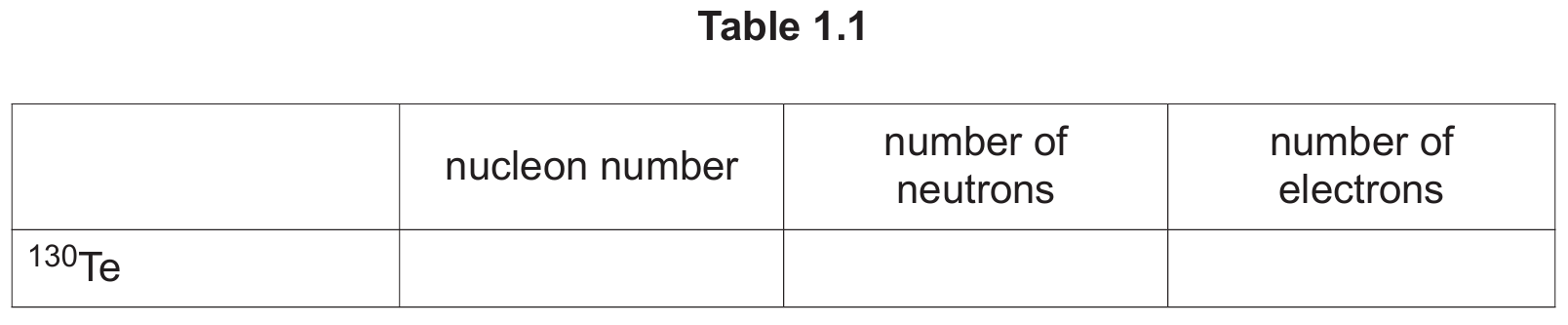
(a) Complete Table 1.1.
(b) Identify the sub-shell in an atom of Te that contains electrons with the lowest energy.
(c) Construct an equation to represent the first ionisation energy of Te.
(d) (i) The radius of Te ions decreases after each successive ionisation.
State two factors that are responsible for the increase in the first six ionisation energies of Te.
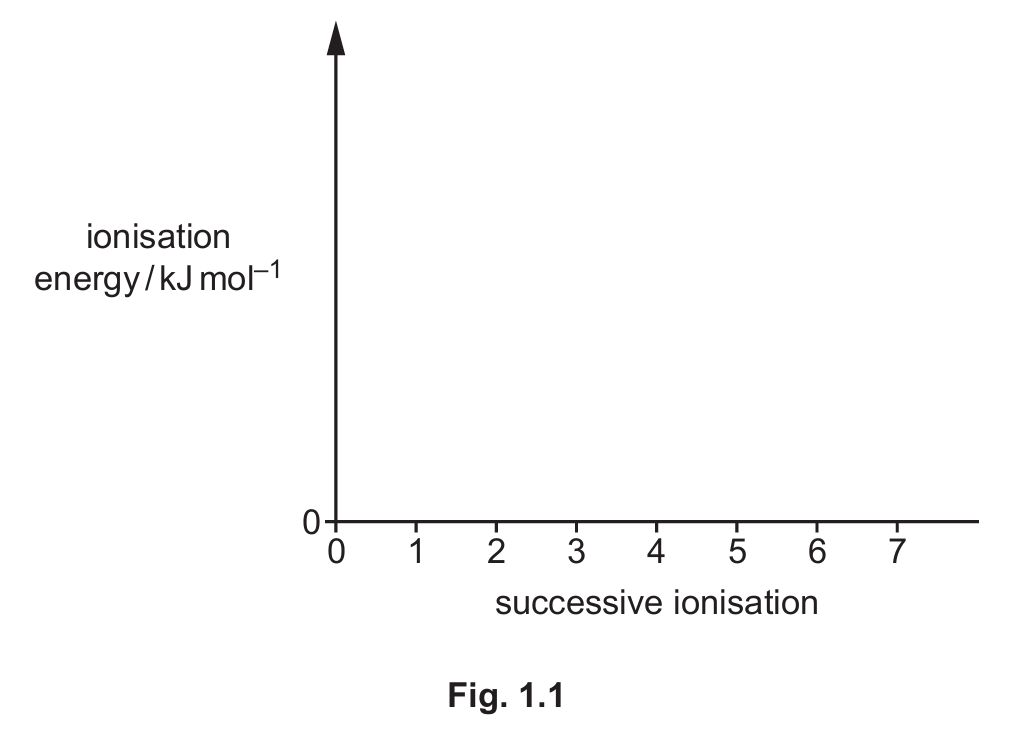
(ii) Sketch a graph in Fig. 1.1 to show the trend in the first seven ionisation energies of Te.
(e) Te reacts with \( F_2 \) at 150 °C to form \( \text{TeF}_x \). Molecules of \( \text{TeF}_x \) are octahedral with bond angles of 90°.
Explain why \( \text{TeF}_x \) is octahedral with bond angles of 90°.
(f) \( \text{TeF}_x \) reacts with water to form tellurium hydroxide and HF. The oxidation number of tellurium does not change during this reaction.
(i) Construct an equation for the reaction of \( \text{TeF}_x \) with water.
(ii) Name the type of reaction that occurs when \( \text{TeF}_x \) reacts with water.
▶️ Answer/Explanation
(a)
Completed Table 1.1:
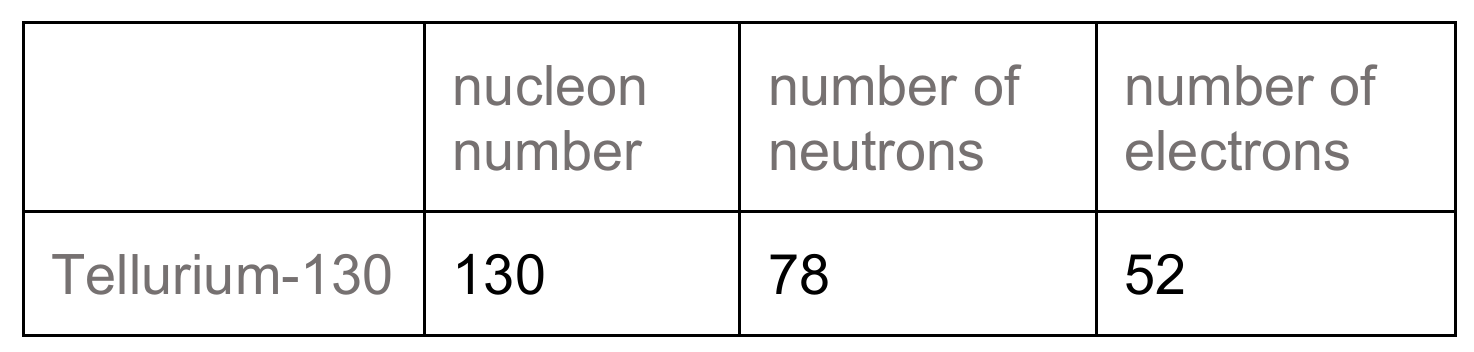
Explanation: The nucleon number (mass number) is given as 130. For a neutral atom, the number of electrons equals the atomic number. Tellurium has an atomic number of 52, so it has 52 electrons. The number of neutrons is calculated as nucleon number minus atomic number: 130 – 52 = 78 neutrons.
(b) 1s
Explanation: In multi-electron atoms, electrons fill orbitals in order of increasing energy. The 1s sub-shell is closest to the nucleus and has the lowest energy according to the Aufbau principle.
(c) \(\text{Te}(g) \rightarrow \text{Te}^+(g) + e^-\)
Explanation: The first ionization energy is the energy required to remove one mole of electrons from one mole of gaseous atoms to form one mole of gaseous 1+ ions. The equation must show the gaseous state of both the atom and the ion formed.
(d)(i) Two factors from:
- (Increased) nuclear attraction / attraction to nucleus
- (Decreased) shielding (by sub-shells) (particularly between IE 4 and 5)
- Spin-pair repulsion (particularly between IE 1 and 2)
Explanation: As electrons are successively removed from an atom, the remaining electrons experience a greater effective nuclear charge because there are fewer electrons to shield the nuclear charge. This increased attraction makes it harder to remove subsequent electrons. Additionally, the removal of electrons from different sub-shells (particularly when moving from a paired to unpaired situation) can cause significant jumps in ionization energy due to reduced electron-electron repulsion.
(d)(ii)

Explanation: The graph should show a general increasing trend with two noticeable jumps: a smaller jump between the 4th and 5th ionization energies, and a larger jump between the 6th and 7th ionization energies. This pattern reflects the electronic structure of tellurium ([Kr] 4d¹⁰ 5s² 5p⁴). The first 4 electrons are relatively easier to remove from the 5p orbital, the 5th electron comes from the 5s orbital (small jump), and the 7th electron would come from the stable 4d¹⁰ configuration (large jump).
(e)
- TeF₆ has 6 bonding pairs of electrons and 0 lone pairs around the central Te atom
- The 6 bonding pairs repel equally, adopting an octahedral geometry with 90° bond angles
Explanation: Tellurium has 6 valence electrons (Group 16) and each fluorine atom contributes 1 electron to form a bond. This results in 6 bonding pairs around the central tellurium atom with no lone pairs. According to VSEPR theory, 6 electron domains with no lone pairs will adopt an octahedral geometry with ideal bond angles of 90°.
(f)(i) \(\text{TeF}_6 + 6\text{H}_2\text{O} \rightarrow \text{Te(OH)}_6 + 6\text{HF}\) OR \(\text{TeF}_x + x\text{H}_2\text{O} \rightarrow \text{Te(OH)}_x + x\text{HF}\)
Explanation: The reaction involves the replacement of fluoride ions with hydroxide ions from water. Since the oxidation number of tellurium doesn’t change, this is not a redox reaction but a substitution reaction where F⁻ ions are replaced by OH⁻ ions.
(f)(ii) Hydrolysis
Explanation: Hydrolysis is a chemical reaction in which water is used to break chemical bonds. In this case, water reacts with TeF₆ to break the Te-F bonds and form Te-OH bonds, with HF as a byproduct.
Topic: 5.1
A neutralisation reaction occurs when NaOH(aq) is added to H2SO4(aq).
equation 1 \[ 2NaOH(aq) + H_2SO_4(aq) \rightarrow Na_2SO_4(aq) + 2H_2O(l) \]
(a) Define enthalpy change of neutralisation, \(\Delta H_{\text{neut}}\).
(b) An experiment is carried out to calculate \(\Delta H_{\text{neut}}\) for the reaction between NaOH(aq) and H2SO4(aq).
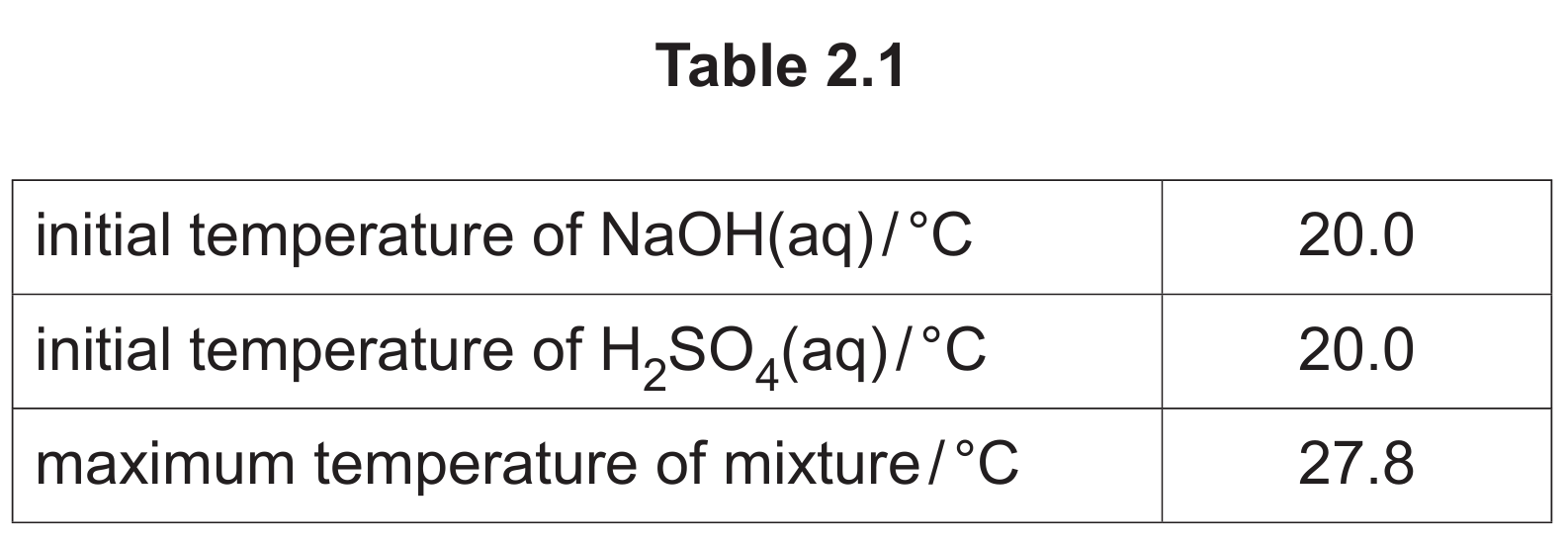
100 cm3 of 1.00 mol dm−3 NaOH(aq) is added to 75 cm3 of 1.00 mol dm−3 H2SO4(aq) in a polystyrene cup and stirred. Results from the experiment are shown in Table 2.1.
(i) Use equation 1 to calculate the amount, in mol, of H2SO4(aq) that is neutralised in the experiment.
(ii) Calculate \(\Delta H_{\text{neut}}\) using the results in Table 2.1. Include units in your answer.
Assume that:
- the specific heat capacity of the final solution is 4.18 J g−1 K−1
- 1.00 cm3 of the final solution has a mass of 1.00 g
- there is no heat loss to the surroundings
- full dissociation of H2SO4(aq) occurs
- the experiment takes place at constant pressure.
Show your working.
(c) (i) Complete the equation for the reaction that occurs when a solution of Ba(OH)2 is added to aqueous sulfuric acid. Include state symbols.
\[ \text{…… H}_2\text{SO}_4(\text{aq}) + \text{…… Ba(OH)}_2(\text{aq}) \rightarrow \text{……} \]
(ii) Suggest why the enthalpy change of neutralisation cannot be determined using the addition of dilute sulfuric acid to aqueous barium hydroxide.
▶️ Answer/Explanation
(a)
The enthalpy change of neutralisation, \(\Delta H_{\text{neut}}\), is defined as the enthalpy change when one mole of water is formed from the reaction between an aqueous acid and an aqueous alkali (or base) under standard conditions.
Explanation: This is a standard definition. Neutralisation involves H+ ions from the acid and OH− ions from the base combining to form water. The definition specifies that the reactants are in their standard aqueous states and the energy change is measured per mole of water produced.
(b)(i)
amount of H2SO4(aq) neutralised = 0.05 mol
Explanation: From the stoichiometry of equation 1, 2 moles of NaOH react with 1 mole of H2SO4.
Volume of NaOH = 100 cm3 = 0.1 dm3
Concentration of NaOH = 1.00 mol dm−3
Moles of NaOH = concentration × volume = 1.00 × 0.1 = 0.1 mol
Moles of H2SO4 neutralised = (moles of NaOH) / 2 = 0.1 / 2 = 0.05 mol
(b)(ii)
\(\Delta H_{\text{neut}} = \mathbf{-57.1 \, kJ \, mol^{-1}}\) (with respect to moles of water formed, or per mole of H2SO4 neutralised, the calculation is consistent with the definition in (a))
Detailed Calculation:
Step 1: Calculate the total volume of the final solution.
Volume = 100 cm3 (NaOH) + 75 cm3 (H2SO4) = 175 cm3
Since 1.00 cm3 has a mass of 1.00 g, the total mass, \(m\) = 175 g
Step 2: Calculate the temperature change, \(\Delta T\).
Initial temperature of both solutions is 20.0 °C.
Final temperature = 27.8 °C
\(\Delta T\) = 27.8 – 20.0 = 7.8 °C (which is equivalent to 7.8 K, as the size of a degree is the same on both scales)
Step 3: Calculate the heat energy evolved, \(q\).
\(q = m c \Delta T\)
\(q = 175 \, \text{g} \times 4.18 \, \text{J g}^{-1} \, \text{K}^{-1} \times 7.8 \, \text{K}\)
\(q = 175 \times 4.18 \times 7.8 = 5705.7 \, \text{J}\)
This energy is released, so \(q = -5705.7 \, \text{J}\) (negative for an exothermic reaction).
Step 4: Relate this heat energy to the moles of water formed to find \(\Delta H_{\text{neut}}\).
From equation 1, when 1 mole of H2SO4 is neutralised, 2 moles of H2O are formed.
We neutralised 0.05 mol of H2SO4, so moles of H2O formed = 2 × 0.05 = 0.1 mol.
\(\Delta H_{\text{neut}}\) is the enthalpy change per mole of water formed.
\(\Delta H_{\text{neut}} = \frac{q}{\text{moles of H}_2\text{O}} = \frac{-5705.7 \, \text{J}}{0.1 \, \text{mol}} = -57057 \, \text{J mol}^{-1}\)
Convert to kJ mol−1: \(-57057 \, \text{J mol}^{-1} = \mathbf{-57.1 \, kJ \, mol^{-1}}\)
Note: The calculation could also be done per mole of H2SO4 neutralised (\(\Delta H = q / 0.05 = -114.1 \, \text{kJ mol}^{-1}\)), but the standard definition and the question’s phrasing in (a) ask for per mole of water, so -57.1 kJ mol-1 is the expected answer.
(c)(i)
\[ \mathbf{H_2SO_4(aq) + Ba(OH)_2(aq) \rightarrow BaSO_4(s) + 2H_2O(l)} \]
Explanation: This is a double displacement reaction. The H+ ions from the acid combine with the OH− ions from the base to form water. The Ba2+ and SO42− ions combine to form the insoluble salt barium sulfate, which precipitates out. The state symbols are crucial: (aq) for the reactants and products in solution, (s) for the precipitate, and (l) for water.
(c)(ii)
The enthalpy change of neutralisation cannot be accurately determined for this reaction because a precipitation reaction (the formation of BaSO4(s)) also occurs, which has its own significant enthalpy change. This additional energy change is not part of the standard neutralisation enthalpy, which is defined solely for the formation of water from H+(aq) and OH−(aq) ions.
Explanation: The standard \(\Delta H_{\text{neut}}\) assumes that the only process is H+(aq) + OH−(aq) → H2O(l). When Ba(OH)2 and H2SO4 react, the lattice energy released when the BaSO4 precipitate forms is a major contributing factor to the overall enthalpy change measured. This means the measured value would be much more exothermic than the true standard enthalpy change of neutralisation, making it an invalid method for determining \(\Delta H_{\text{neut}}\).
Topic: 11.1
Chlorine is a very reactive element.
(a) Chlorine reacts with silicon to form silicon(IV) chloride.
Describe the appearance of silicon(IV) chloride at room temperature and pressure. State its structure and bonding.
(b) Samples of magnesium chloride and phosphorus(V) chloride are added to separate beakers of cold water.
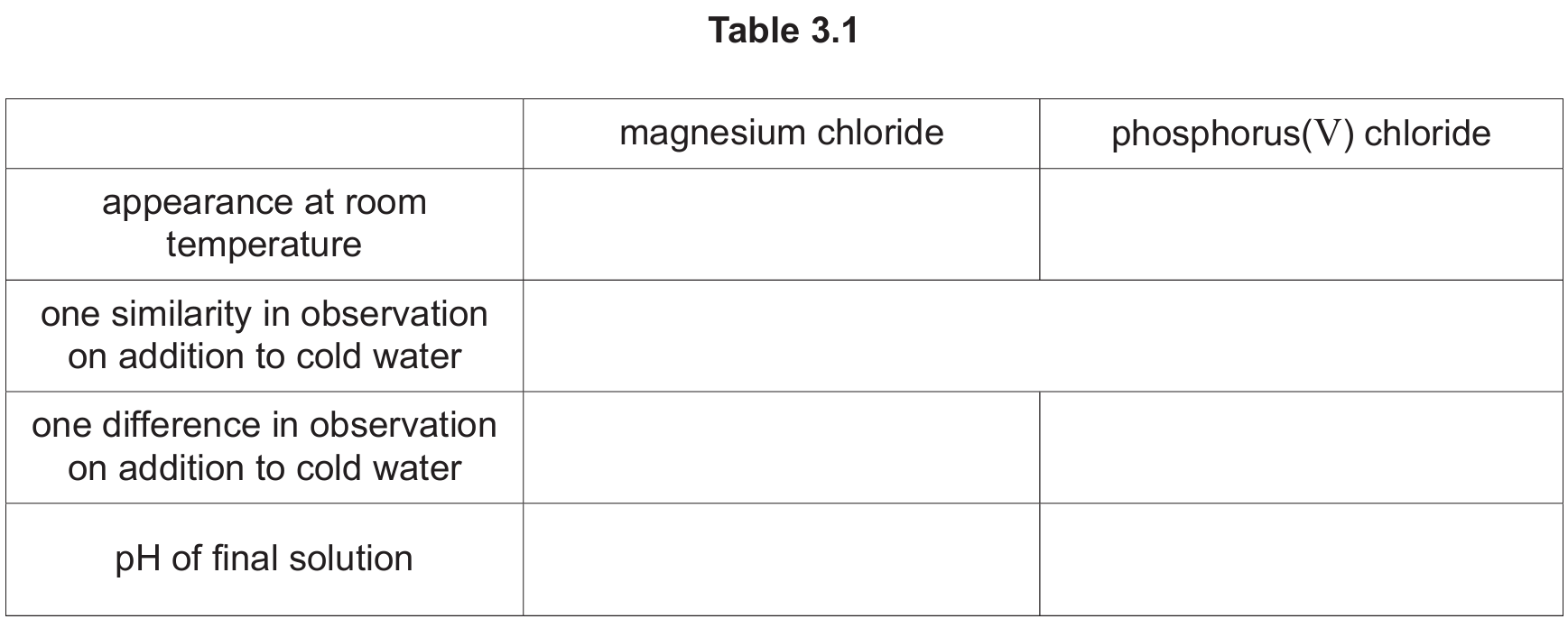
Complete Table 3.1. Ignore temperature changes when considering observations for these reactions.
(c) (i) State the reagent and conditions required for the formation of sodium chlorate(V) from \( \text{Cl}_2(g) \).
(ii) Explain why the reaction in (c)(i) is described as a disproportionation reaction.
Your answer should refer to relevant species and their oxidation numbers.
(d) Chlorine reacts with methane in a series of reactions to produce chloroalkanes.
(i) State the conditions required for chlorine to react with methane.
(ii) One of the products of the reaction is \( \text{CH}_2\text{Cl}_2 \) which reacts further to produce \( \text{CHCl}_3 \).
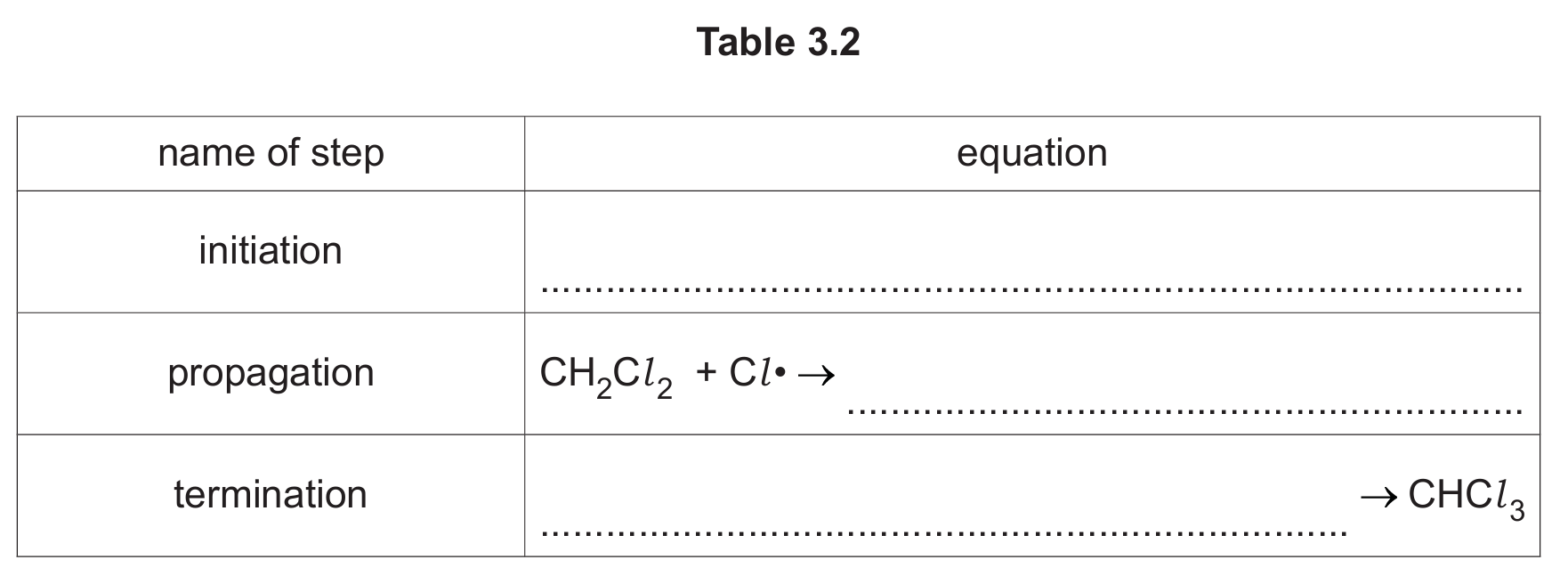
Complete Table 3.2 to show details of the mechanism that forms \( \text{CHCl}_3 \) from \( \text{CH}_2\text{Cl}_2 \).
(e) \( \text{CHCl}_3 \) and HF are used to form \( \text{CHClF}_2 \) in a substitution reaction.
Construct an equation for this reaction.
(f) X is a product of the substitution reaction that occurs when \( \text{CHClF}_2 \) reacts with \( \text{Br}_2 \).
There is only one naturally occurring isotope of fluorine, \( ^{19}\text{F} \).
The mass spectrum of X shows molecular ion peaks at \( m/e = 164, 166 \) and 168.
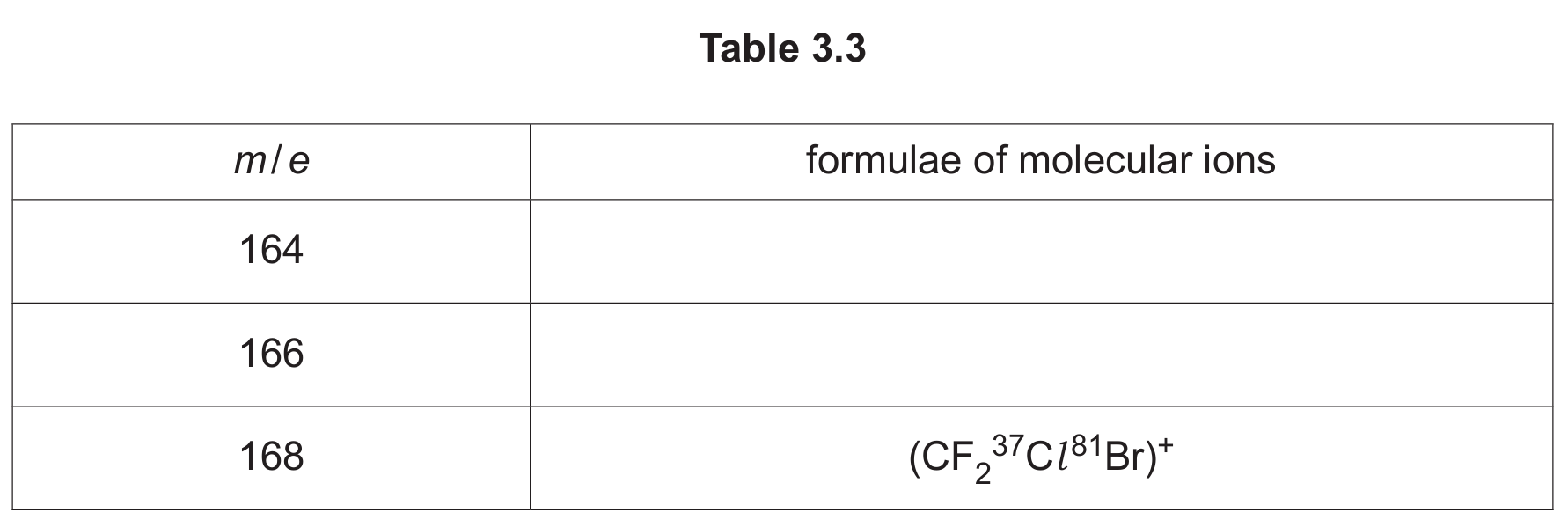
Complete Table 3.3 to show all the molecular ions responsible for each peak.
▶️ Answer/Explanation
(a) Appearance: Colourless or yellow liquid.
Structure and bonding: Simple/molecular and covalent.
Explanation: Silicon(IV) chloride, SiCl₄, is a volatile liquid at room temperature. Its appearance is often described as a colourless or pale yellow fuming liquid. It has a simple molecular structure, meaning its molecules are discrete and not part of a giant lattice. The bonding within each molecule is covalent, as electrons are shared between the silicon and chlorine atoms.
(b) Completed Table 3.1:

Explanation: Magnesium chloride (MgCl₂) is a white crystalline ionic solid. When added to cold water, it simply dissolves to form a neutral to slightly acidic solution (pH ~6.5-7) due to possible slight hydrolysis. No fumes are observed. Phosphorus(V) chloride (PCl₅) is a pale yellow solid. Its reaction with cold water is vigorous and hydrolytic, producing steamy fumes of hydrogen chloride (HCl) gas and resulting in a strongly acidic solution (pH 0-4). The similarity is that both solids dissolve. The key difference is the production of HCl fumes by PCl₅.
(c) (i) Reagent and conditions: Hot aqueous sodium hydroxide / hot NaOH(aq).
Explanation: Sodium chlorate(V), NaClO₃, is formed when chlorine gas is passed through hot, concentrated sodium hydroxide solution.
(ii) It is a disproportionation reaction because the oxidation number of chlorine increases (from 0 to +5 in ClO₃⁻) and decreases (from 0 to -1 in Cl⁻) in the same reaction.
Explanation: The reaction is \( 3Cl_2 + 6NaOH \rightarrow 5NaCl + NaClO_3 + 3H_2O \). In chlorine (Cl₂), the oxidation state is 0. In the chloride ion (Cl⁻) of NaCl, the oxidation state is -1 (a decrease, reduction). In the chlorate(V) ion (ClO₃⁻) of NaClO₃, the oxidation state is +5 (an increase, oxidation). Since the same element (chlorine) is both oxidized and reduced, it is a disproportionation reaction.
(d) (i) Conditions: Ultraviolet light (UV light).
Explanation: The reaction between chlorine and methane is a free radical substitution reaction. UV light provides the energy required to break the Cl-Cl bond homolytically, generating the chlorine free radicals that initiate the chain reaction.
(ii) Completed Table 3.2:

Explanation: The mechanism involves three steps. Initiation: UV light causes the homolytic fission of a Cl₂ molecule to form two chlorine radicals (Cl•). Propagation: A chlorine radical attacks CH₂Cl₂, abstracting a hydrogen atom to form HCl and generating a new radical, •CHCl₂. Termination: Two radicals combine; the •CHCl₂ radical combines with a Cl• radical to form the stable product CHCl₃ (chloroform).
(e) Equation: \( CHCl_3 + 2HF \rightarrow CHClF_2 + 2HCl \)
Explanation: This is a substitution reaction where two fluorine atoms from HF replace two chlorine atoms in chloroform (CHCl₃) to form CHClF₂ (chlorodifluoromethane), with hydrogen chloride (HCl) as the other product.
(f) Completed Table 3.3:
| \( m/e \) | formulae of molecular ions |
|---|---|
| 164 | \( (CF_2^{35}Cl^{79}Br)^+ \) |
| 166 | \( (CF_2^{37}Cl^{79}Br)^+ \) AND \( (CF_2^{35}Cl^{81}Br)^+ \) |
| 168 | \( (CF_2^{37}Cl^{81}Br)^+ \) |
Explanation: The product X from the reaction of CHClF₂ with Br₂ is CF₂ClBr (bromochlorodifluoromethane). The molecular ion is (CF₂ClBr)⁺. Fluorine is only ¹⁹F. Chlorine has two isotopes: ³⁵Cl and ³⁷Cl. Bromine has two isotopes: ⁷⁹Br and ⁸¹Br. The possible combinations and their masses are:
- CF₂³⁵Cl⁷⁹Br: (12 + 2*19 + 35 + 79) = 164
- CF₂³⁷Cl⁷⁹Br: (12 + 2*19 + 37 + 79) = 166
- CF₂³⁵Cl⁸¹Br: (12 + 2*19 + 35 + 81) = 166
- CF₂³⁷Cl⁸¹Br: (12 + 2*19 + 37 + 81) = 168
Therefore, m/e 164 corresponds to the molecule containing ³⁵Cl and ⁷⁹Br. M/e 166 is a doublet peak from molecules containing either (³⁷Cl and ⁷⁹Br) OR (³⁵Cl and ⁸¹Br). M/e 168 corresponds to the molecule containing ³⁷Cl and ⁸¹Br.
Topic: 22.2
V is a colourless liquid.
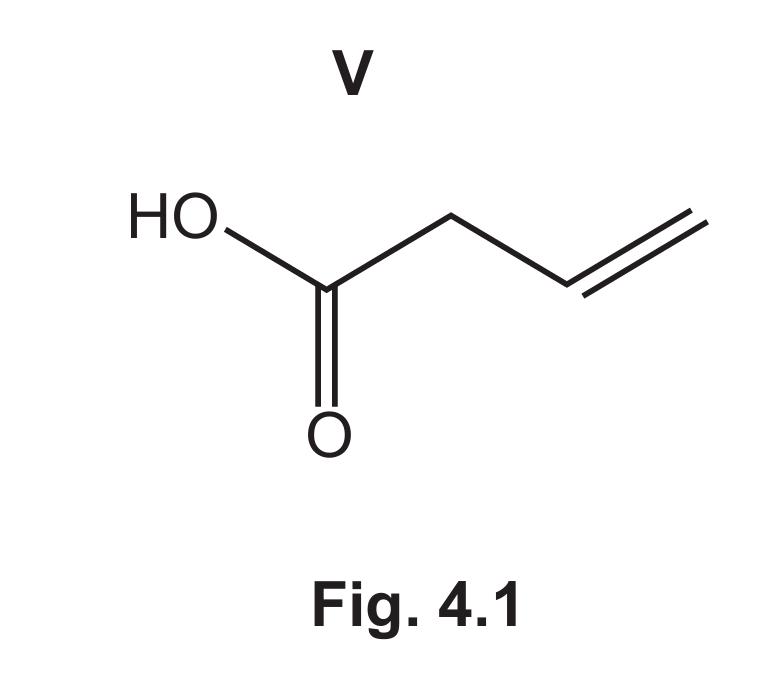
(a) V reacts with an excess of LiAlH₄ to form W.
(i) Draw the structure of W in the box.
(ii) Identify the role of LiAlH₄ in the reaction with V.
(b) V reacts to form Z in a single reaction, as shown in Fig. 4.2.
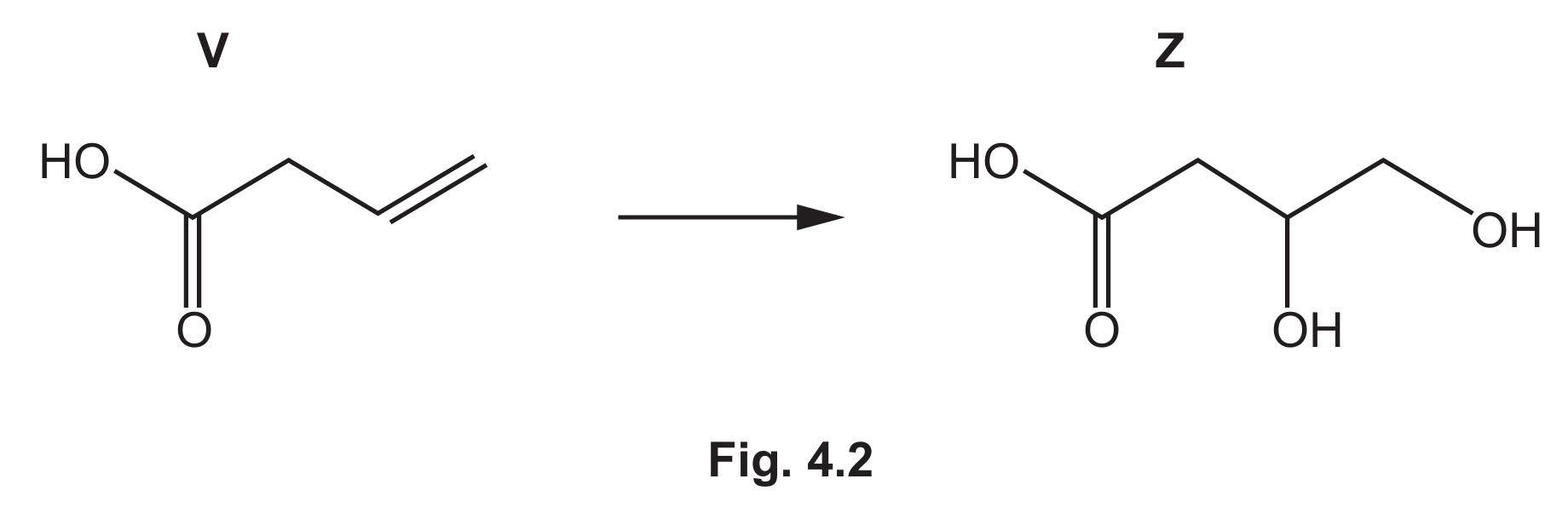
(i) Suggest the reagent and conditions needed to form Z from V.
(ii) Deduce the empirical formula of Z.
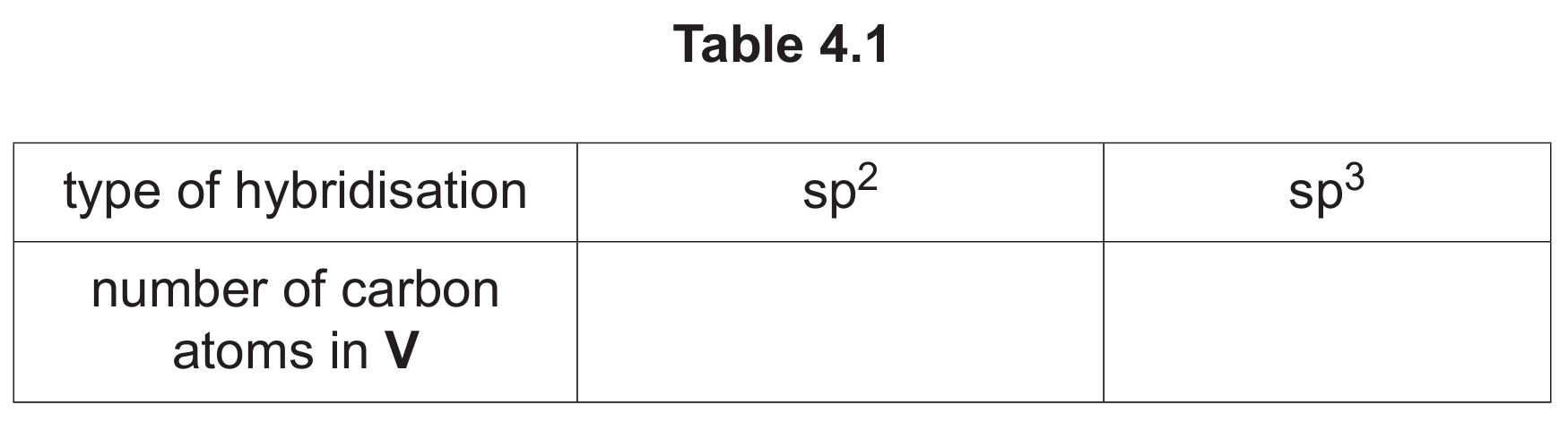
(iii) Complete Table 4.1 to show the number of sp² and sp³ hybridised carbon atoms that are present in a molecule of V.
(c) Q contains the elements carbon, hydrogen and oxygen only. It is a saturated molecule with no branching in its carbon backbone.
Q contains only one functional group.
The relative molecular mass of Q is 88.
No effervescence is seen when Na₂CO₃ is added to Q.
Effervescence is seen when sodium is added to Q.
Q reacts with alkaline I₂(aq) to form a yellow precipitate.
Draw the structure of Q in the box.
▶️ Answer/Explanation
(a)(i) Structure of W:
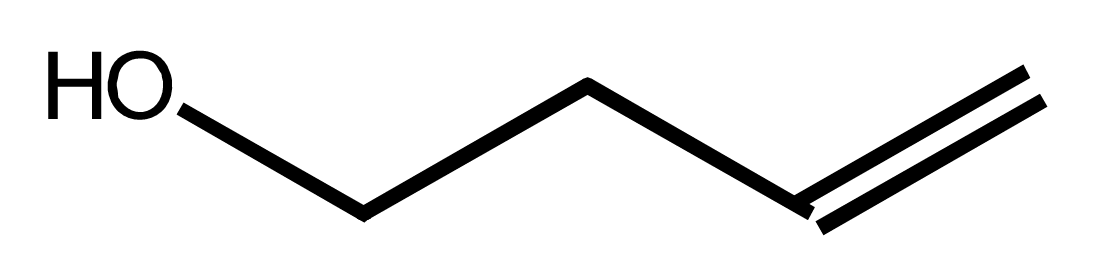
Explanation: V is an ester. Lithium aluminium hydride (LiAlH₄) is a strong reducing agent that reduces esters to primary alcohols. The reduction reaction cleaves the ester bond, converting the carbonyl group (C=O) into a primary alcohol (-CH₂OH). Therefore, W is the diol 1,2-ethanediol (HO-CH₂-CH₂-OH).
(a)(ii) The role of LiAlH₄ is a reducing agent.
Explanation: LiAlH₄ donates hydride ions (H⁻) which act as a nucleophile, attacking the electrophilic carbon in the carbonyl group (C=O) of the ester. This leads to the reduction of the ester group to primary alcohols.
(b)(i) Reagent and conditions: Cold, dilute acidified KMnO₄.
Explanation: V is an unsaturated compound (it contains a C=C double bond, evident from its structure and the product Z being a diol). Cold, dilute, acidified potassium manganate(VII) is used for the syn hydroxylation of alkenes, which adds two OH groups across the double bond to form a diol without breaking the carbon chain.
(b)(ii) The empirical formula of Z is CH₂O.
Explanation: The molecular formula of V (from its structure) is C₃H₄O₂. The reaction with KMnO₄ adds two oxygen atoms and two hydrogen atoms (effectively adding H₂O₂ across the double bond), so the molecular formula of Z becomes C₃H₆O₃. To find the empirical formula, we divide by the greatest common divisor, which is 3. This gives CH₂O.
(b)(iii) Table 4.1:

Explanation: In molecule V:
- The carbon atoms in the C=C double bond and the carbonyl carbon (C=O) of the ester are sp² hybridised. There are three such atoms: the two carbons in the alkene and the carbonyl carbon.
- The carbon atom in the -OCH₃ group is sp³ hybridised (it has four single bonds).
(c) Structure of Q:
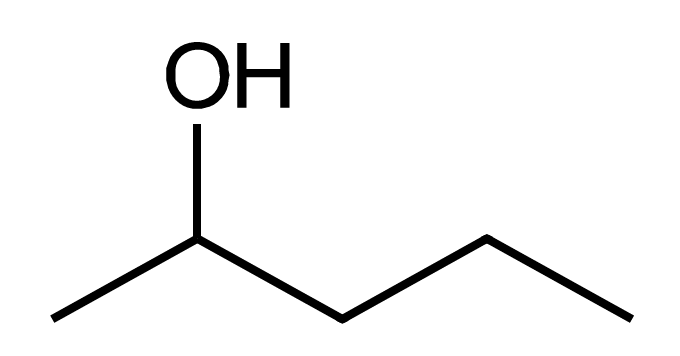
Explanation: Let’s deduce the structure step-by-step using the clues:
- Mr = 88, C,H,O only, saturated, no branching, one functional group: This suggests a straight-chain molecule.
- No effervescence with Na₂CO₃: It is not a carboxylic acid ( carboxylic acids react with carbonates to produce CO₂ effervescence).
- Effervescence with sodium: It is an alcohol ( alcohols react with Na to produce H₂ gas).
- Reacts with alkaline I₂ to form a yellow precipitate: This is the iodoform test, which is positive for compounds containing a CH₃CH(OH)- group (ethanol and secondary alcohols with a methyl group adjacent to the carbon with OH) or compounds containing a CH₃C=O group (methyl ketones). Since it’s an alcohol (from the Na test) and not a ketone (it only has one functional group), it must be a secondary alcohol with the structure CH₃CH(OH)R.
- Let’s find the molecular formula. For a saturated alcohol with formula CₙH₂ₙ₊₂O, Mr = 12n + 1*(2n+2) + 16 = 14n + 18 = 88. Solving: 14n = 70, n = 5. So the molecular formula is C₅H₁₂O.
- The iodoform test specifies a CH₃CH(OH)- group. So the structure must be CH₃CH(OH)CH₂CH₂CH₃ (pentan-2-ol). This is a straight-chain molecule, Mr = 88, it’s an alcohol (reacts with Na), it’s not a carboxylic acid (no reaction with Na₂CO₃), and it gives a positive iodoform test (yellow precipitate of CHI₃).
Therefore, Q is pentan-2-ol.
Topic: 15.1
(a) Molecule M is present in petrol, a fuel used in cars. M is a saturated, non-cyclic hydrocarbon. M contains eight carbon atoms.
(i) Construct an equation for the complete combustion of M.
(ii) Describe how the composition of products differs when incomplete combustion of M occurs.
(b) When petrol is burned in an internal combustion engine, oxides of nitrogen are released into the atmosphere. Oxides of nitrogen are responsible for the formation of acid rain.
(i) Suggest the conditions required for the production of oxides of nitrogen during combustion of M in an internal combustion engine. Use an appropriate equation in your answer.
(ii) Describe how acid rain is formed in the atmosphere in the presence of oxides of nitrogen and SO2. Identify the role of the oxides of nitrogen in this process. Include all relevant equations.
(iii) State one other type of air pollution that is caused by the production of oxides of nitrogen in an internal combustion engine.
(c) Biodiesel T is a fuel made from vegetable oil R. Fig. 5.1 shows the production of T from R in a two-step process.

(i) In step 1 all three ester groups in R react. Suggest a suitable reagent and conditions for step 1.
(ii) Draw the structural formula of J in the box in Fig. 5.1.
(iii) Name the type of reaction that occurs in step 2.
(iv) Name organic reagent G used in step 2.
(v) L is called decanoic acid. Use systematic nomenclature to deduce the name of T.
▶️ Answer/Explanation
(a)(i) The general formula for a saturated, non-cyclic hydrocarbon (an alkane) with n carbon atoms is CnH2n+2. For M, with 8 carbon atoms, the molecular formula is C8H18. The equation for its complete combustion, where it reacts with oxygen to produce only carbon dioxide and water, is:
\[ \ce{C8H18 + 12\tfrac{1}{2}O2 -> 8CO2 + 9H2O} \]
(a)(ii) Incomplete combustion occurs when there is an insufficient supply of oxygen. The composition of the products changes significantly compared to complete combustion. Instead of producing only CO2 and H2O, incomplete combustion produces:
- Carbon (soot) as a solid particulate.
- Carbon monoxide (CO), a toxic gas.
- Unburnt hydrocarbons or partially oxidized hydrocarbon fragments.
- There is significantly less or no carbon dioxide (CO2) produced compared to complete combustion.
The exact mixture depends on the severity of the oxygen deficiency.
(b)(i) The high temperatures and pressures inside an internal combustion engine provide the necessary conditions for the normally unreactive nitrogen gas (N2) in the air to react with oxygen (O2). The relevant equation is:
\[ \ce{N2 + O2 ->[\text{high temp.}] 2NO} \] The nitrogen monoxide (NO) can then be further oxidized in the atmosphere to nitrogen dioxide (NO2).
(b)(ii) Oxides of nitrogen (specifically NO2) play a catalytic role in the formation of acid rain from sulfur dioxide (SO2). The process involves these steps:
- Nitrogen dioxide (NO2) reacts with sulfur dioxide (SO2) to form nitrogen monoxide (NO) and sulfur trioxide (SO3).
\[ \ce{NO2 + SO2 -> NO + SO3} \] - The nitrogen monoxide (NO) is then re-oxidized by oxygen in the air to reform nitrogen dioxide (NO2), which can continue the cycle.
\[ \ce{2NO + O2 -> 2NO2} \]
The sulfur trioxide (SO3) produced in the first step is very reactive and dissolves in atmospheric water (rain) to form sulfuric acid, the main component of this type of acid rain.
\[ \ce{SO3 + H2O -> H2SO4} \] Since the NO2 is regenerated, it acts as a homogeneous catalyst for the conversion of SO2 to H2SO4.
(b)(iii) One other major type of air pollution caused by oxides of nitrogen (NOx) is photochemical smog. This is a brown haze formed in urban areas when NOx and unburnt hydrocarbons react in the presence of sunlight to form secondary pollutants like ozone (O3) and peroxyacetyl nitrate (PAN).
(c)(i) Step 1 involves hydrolyzing all three ester groups in the triglyceride (R). A suitable reagent and condition for this hydrolysis is heat with a dilute (mineral) acid, such as dilute sulfuric acid (H2SO4) or dilute hydrochloric acid (HCl).
(c)(ii) Reagent J is the common product of hydrolyzing any triglyceride, which is propane-1,2,3-triol, more commonly known as glycerol. Its structural formula is:

(c)(iii) Step 2 involves reacting a carboxylic acid (L, decanoic acid) with an alcohol (G) to form an ester (T, biodiesel). This type of reaction is called esterification, which is a specific sub-category of a condensation reaction (as a molecule of water is eliminated).
(c)(iv) The organic reagent G used in step 2 to form the ester is methanol (CH3OH). Biodiesel is typically formed by esterifying fatty acids with methanol to produce fatty acid methyl esters (FAMEs).
(c)(v) L is decanoic acid, which is a 10-carbon straight-chain carboxylic acid (C9H19COOH). In step 2, it reacts with methanol (G). The ester formed is therefore the methyl ester of decanoic acid. Using systematic nomenclature, the name of T is methyl decanoate.