
Question 1
Consider the following statements.
1. Silicon dioxide has a higher melting point than sulfur dioxide.
2. Ammonia has a higher boiling point than phosphine, \( \mathrm{PH_3} \).
Which statements are correct?
(B) Statement 1 only
(C) Statement 2 only
(D) Neither statement 1 nor statement 2
▶️ Answer/Explanation
Correct Answer: \( \boxed{\mathrm{A}} \)
Statement 1: True. Silicon dioxide has a giant covalent structure with many strong \( \mathrm{Si-O} \) bonds, giving it a very high melting point. Sulfur dioxide is a simple molecular substance with weak intermolecular forces, so its melting point is much lower.
Statement 2: True. Ammonia forms intermolecular hydrogen bonds, whereas phosphine does not. Hydrogen bonding makes the boiling point of ammonia higher than that of \( \mathrm{PH_3} \).
Therefore, both statements are correct. Hence, the correct answer is (A).
Question 2
How many neutrons are contained in an atom of iron with a mass number of 60?
(B) 30
(C) 34
(D) 60
▶️ Answer/Explanation
Correct Answer: \( \boxed{\mathrm{C}} \)
The number of neutrons is calculated using:
\( \mathrm{Number\ of\ neutrons = Mass\ number – Atomic\ number} \)
Iron has an atomic number of \( \mathrm{26} \).
Therefore:
\( \mathrm{Number\ of\ neutrons = 60 – 26 = 34} \)
Hence, the correct answer is (C).
Question 3
The diagram shows a Boltzmann distribution of molecular energies for a gaseous reaction at two different temperatures and two different activation energies.
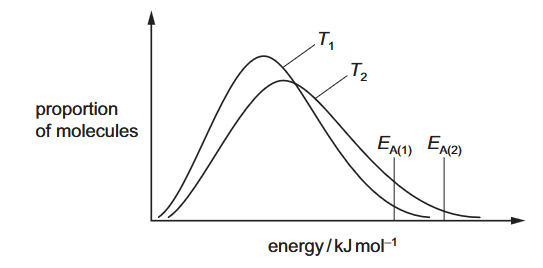
Which combination of temperature and activation energy will give the highest reaction rate?
(B) \( \mathrm{T_1} \) and \( \mathrm{E_{A(2)}} \)
(C) \( \mathrm{T_2} \) and \( \mathrm{E_{A(2)}} \)
(D) \( \mathrm{T_2} \) and \( \mathrm{E_{A(1)}} \)
▶️ Answer/Explanation
Correct Answer: \( \boxed{\mathrm{D}} \)
The reaction rate is greatest when the temperature is highest and the activation energy is lowest.
From the graph:
- \( \mathrm{T_2} \) is the higher temperature because the distribution is broader and shifted towards higher energies.
- \( \mathrm{E_{A(1)}} \) is lower than \( \mathrm{E_{A(2)}} \) because it is positioned further to the left.
This combination gives the largest fraction of molecules with energy greater than or equal to the activation energy, resulting in the fastest reaction.
Reaction rate increases with:
\( \mathrm{Higher\ temperature \;+\; Lower\ activation\ energy \;\Rightarrow\; More\ successful\ collisions} \)
Therefore, the correct answer is (D).
Question 4
The reaction between sulfur dioxide and oxygen has the equation shown.
\( \mathrm{2SO_2(g) + O_2(g) \rightleftharpoons 2SO_3(g)} \qquad \Delta H = -197\,\mathrm{kJ\,mol^{-1}} \)
\(1.0\,\mathrm{mol}\) of \( \mathrm{SO_2} \) and \(1.0\,\mathrm{mol}\) of \( \mathrm{O_2} \) are placed in a closed container and heated to a constant temperature.
At this temperature, \(0.8\,\mathrm{mol}\) of \( \mathrm{SO_3} \) are present in the equilibrium mixture.
Which statement is correct?
(B) \( \mathrm{K_p} \) has units of \( \mathrm{mol\,dm^{-3}} \).
(C) At a lower temperature, the equilibrium amount of \( \mathrm{SO_3} \) is lower than \(0.8\,\mathrm{mol}\).
(D) The mole fraction of \( \mathrm{SO_3} \) is less than \(0.8\).
▶️ Answer/Explanation
Correct Answer: \( \boxed{\mathrm{D}} \)
Let the extent of reaction be \(x\).
\( \mathrm{2SO_2 + O_2 \rightleftharpoons 2SO_3} \)
Since \(0.8\,\mathrm{mol}\) of \( \mathrm{SO_3} \) are formed:
\( \mathrm{2x = 0.8 \;\Rightarrow\; x = 0.4} \)
Equilibrium amounts are:
- \( \mathrm{SO_2 = 1.0 – 0.8 = 0.2\,mol} \)
- \( \mathrm{O_2 = 1.0 – 0.4 = 0.6\,mol} \)
- \( \mathrm{SO_3 = 0.8\,mol} \)
Total moles at equilibrium:
\( \mathrm{0.2 + 0.6 + 0.8 = 1.6\,mol} \)
Therefore, the mole fraction of \( \mathrm{SO_3} \) is:
\( \mathrm{\dfrac{0.8}{1.6}=0.5<0.8} \)
Hence statement D is correct.
Therefore, the correct answer is (D).
Question 5
‘Red lead’ is a red pigment with the formula \( \mathrm{Pb_3O_4} \). Every formula unit of red lead is the same.
Each formula unit contains three lead ions and four oxide ions. Lead has two different oxidation states in ‘red lead’.
What are the oxidation states of lead in ‘red lead’?
(B) \(+1\) and \(+3\)
(C) \(+2\) and \(+4\)
(D) \(+2\) and \(+6\)
▶️ Answer/Explanation
Correct Answer: \( \boxed{\mathrm{C}} \)
Each oxide ion has an oxidation state of \( \mathrm{-2} \).
For \( \mathrm{Pb_3O_4} \):
Total oxidation state of oxygen \( =4\times(-2)=-8 \)
Therefore, the three lead atoms together must have a total oxidation state of \( \mathrm{+8} \).
This is achieved by:
\( \mathrm{2(Pb^{2+})+Pb^{4+}=+8} \)
Thus, red lead can be regarded as \( \mathrm{2PbO\cdot PbO_2} \), containing lead in the \( \mathrm{+2} \) and \( \mathrm{+4} \) oxidation states.
Therefore, the correct answer is (C).
Question 6
Some standard enthalpy of combustion data are given.
Using these data, what is the enthalpy change of formation of methanol?
(B) \( -46\,\mathrm{kJ\,mol^{-1}} \)
(C) \( 46\,\mathrm{kJ\,mol^{-1}} \)
(D) \( 240\,\mathrm{kJ\,mol^{-1}} \)
▶️ Answer/Explanation
Correct Answer: \( \boxed{\mathrm{A}} \)
Apply Hess’ Law.
Formation reaction of methanol:
\( \mathrm{C(s) + 2H_2(g) + \dfrac{1}{2}O_2(g) \rightarrow CH_3OH(l)} \)
Using combustion data:
\( \Delta H_f^\circ = \Delta H_c^\circ(\mathrm{C}) + 2\Delta H_c^\circ(\mathrm{H_2}) – \Delta H_c^\circ(\mathrm{CH_3OH}) \)
Substitute the values:
\( \Delta H_f^\circ = (-394) + 2(-286) – (-726) \)
\( \Delta H_f^\circ = -394 -572 +726 \)
\( \Delta H_f^\circ = -240\,\mathrm{kJ\,mol^{-1}} \)
Therefore, the correct answer is (A).
Question 7
Which row is correct?
| Smallest bond angle | → | Largest bond angle | |
|---|---|---|---|
| (A) | \( \mathrm{H_2O} \) | \( \mathrm{NH_3} \) | \( \mathrm{BF_3} \) |
| (B) | \( \mathrm{BF_3} \) | \( \mathrm{NH_3} \) | \( \mathrm{H_2O} \) |
| (C) | \( \mathrm{NH_3} \) | \( \mathrm{H_2O} \) | \( \mathrm{BF_3} \) |
| (D) | \( \mathrm{H_2O} \) | \( \mathrm{BF_3} \) | \( \mathrm{NH_3} \) |
▶️ Answer/Explanation
Correct Answer: \( \boxed{\mathrm{A}} \)
According to VSEPR theory, lone pairs repel more strongly than bonding pairs, reducing bond angles.
The bond angles are:
- \( \mathrm{H_2O} \): bent shape, two lone pairs, bond angle \( \approx 104.5^\circ \).
- \( \mathrm{NH_3} \): trigonal pyramidal, one lone pair, bond angle \( \approx 107^\circ \).
- \( \mathrm{BF_3} \): trigonal planar, no lone pairs on boron, bond angle \( 120^\circ \).
Therefore, the order from the smallest to the largest bond angle is:
\( \mathrm{H_2O < NH_3 < BF_3} \)
Hence, the correct answer is (A).
Question 8
In the Haber process, the reaction between the two gaseous reactants requires the use of a catalyst that contains a transition element.
What is the metal and in which mole ratio do the gases react?
(B) Fe, \( \mathrm{1:3} \)
(C) V, \( \mathrm{1:2} \)
(D) V, \( \mathrm{1:3} \)
▶️ Answer/Explanation
Correct Answer: \( \boxed{\mathrm{B}} \)
The Haber process uses an iron (\( \mathrm{Fe} \)) catalyst to manufacture ammonia.
The balanced chemical equation is:
\( \mathrm{N_2(g) + 3H_2(g) \rightleftharpoons 2NH_3(g)} \)
Therefore, the gaseous reactants, nitrogen and hydrogen, react in the mole ratio:
\( \mathrm{N_2:H_2 = 1:3} \)
Vanadium(V) oxide is the catalyst used in the Contact process, not the Haber process.
Hence, the correct answer is (B).
Question 9
Aqueous hydrogen peroxide, \( \mathrm{H_2O_2} \), decomposes into water and oxygen in the presence of a suitable catalyst.
\(50\,\mathrm{cm^3}\) of a \(0.50\,\mathrm{mol\,dm^{-3}}\) solution of hydrogen peroxide produced \(120\,\mathrm{cm^3}\) of oxygen in \(2.0\) minutes.
The volume of gas was measured at room conditions.
What is the average rate of decomposition of hydrogen peroxide during this \(2.0\)-minute period?
(B) \(0.00083\,\mathrm{mol\,dm^{-3}\,s^{-1}}\)
(C) \(0.0017\,\mathrm{mol\,dm^{-3}\,s^{-1}}\)
(D) \(0.10\,\mathrm{mol\,dm^{-3}\,s^{-1}}\)
▶️ Answer/Explanation
Correct Answer: \( \boxed{\mathrm{C}} \)
The decomposition reaction is:
\( \mathrm{2H_2O_2(aq) \rightarrow 2H_2O(l) + O_2(g)} \)
At room conditions, \(1\,\mathrm{mol}\) of gas occupies \(24\,000\,\mathrm{cm^3}\).
Moles of \( \mathrm{O_2} \) produced:
\( \mathrm{\dfrac{120}{24000}=0.0050\,mol} \)
From the equation, moles of \( \mathrm{H_2O_2} \) decomposed:
\( \mathrm{2\times0.0050=0.010\,mol} \)
Volume of solution:
\( \mathrm{50\,cm^3=0.050\,dm^3} \)
Decrease in concentration of \( \mathrm{H_2O_2} \):
\( \mathrm{\dfrac{0.010}{0.050}=0.20\,mol\,dm^{-3}} \)
Time taken:
\( \mathrm{2.0\,min=120\,s} \)
Average rate of decomposition:
\( \mathrm{\dfrac{0.20}{120}=1.67\times10^{-3}\,mol\,dm^{-3}\,s^{-1}} \)
Therefore, the correct answer is (C).
Question 10
The average intermolecular forces in water are much stronger than the average intermolecular forces in steam.
The average intermolecular forces in ice are slightly stronger than the average intermolecular forces in water.
Enthalpy changes are associated with the equilibrium processes shown.
\( \mathrm{H_2O(l) \rightleftharpoons H_2O(g)} \qquad \Delta H_b \)
\( \mathrm{H_2O(s) \rightleftharpoons H_2O(l)} \qquad \Delta H_m \)
Which statements are correct?
1. \( \Delta H_b \) and \( \Delta H_m \) are both negative.
2. \( \Delta H_b \) is greater than \( \Delta H_m \).
3. The intermolecular forces in ice and water are of the same type.
(B) 1 and 2 only
(C) 1 and 3 only
(D) 2 and 3 only
▶️ Answer/Explanation
Correct Answer: \( \boxed{\mathrm{D}} \)
Statement 1: False. Both vaporisation and melting require energy to overcome intermolecular forces, so both \( \Delta H_b \) and \( \Delta H_m \) are positive, not negative.
Statement 2: True. Vaporising water requires breaking far more intermolecular attractions than melting ice, so:
\( \mathrm{\Delta H_b > \Delta H_m} \)
Statement 3: True. Both ice and liquid water are held together primarily by hydrogen bonding. The strength and arrangement differ, but the type of intermolecular force is the same.
Therefore, statements 2 and 3 only are correct. Hence, the correct answer is (D).
Question 11
An experiment is carried out to determine the value of \(x\) in hydrated lithium hydroxide, \( \mathrm{LiOH\cdot xH_2O} \). A sample of the solid is heated in a crucible over a Bunsen flame.
Complete dehydration takes place; decomposition does not occur.
Mass of empty crucible \(=Q\)
Mass of crucible with \( \mathrm{LiOH\cdot xH_2O} \) \(=R\)
Mass of crucible and residue after heating \(=S\)
Which equation gives the correct value of \(x\)?
(B) \( \mathrm{\dfrac{R-S}{18}} \)
(C) \( \mathrm{\dfrac{23.9(R-S)}{18(S-Q)}} \)
(D) \( \mathrm{\dfrac{23.9(S-R)}{18(S-Q)}} \)
▶️ Answer/Explanation
Correct Answer: \( \boxed{\mathrm{C}} \)
Mass of hydrated lithium hydroxide:
\( \mathrm{R-Q} \)
Mass of anhydrous \( \mathrm{LiOH} \) remaining after heating:
\( \mathrm{S-Q} \)
Mass of water lost:
\( \mathrm{R-S} \)
Moles of water removed:
\( \mathrm{\dfrac{R-S}{18}} \)
Relative formula mass of \( \mathrm{LiOH} \):
\( \mathrm{6.9+16+1=23.9} \)
Moles of \( \mathrm{LiOH} \):
\( \mathrm{\dfrac{S-Q}{23.9}} \)
Therefore:
\( \mathrm{x=\dfrac{(R-S)/18}{(S-Q)/23.9}=\dfrac{23.9(R-S)}{18(S-Q)}} \)
Hence, the correct answer is (C).
Question 12
A sample of an ideal gas occupies \(240\,\mathrm{cm^3}\) at \(37^\circ\mathrm{C}\) and \(100\,\mathrm{kPa}\).
How many moles of gas are present in the sample?
(B) \(9.32\times10^{-3}\)
(C) \(0.0781\)
(D) \(78.1\)
▶️ Answer/Explanation
Correct Answer: \( \boxed{\mathrm{B}} \)
Use the ideal gas equation:
\( \mathrm{PV=nRT} \)
Convert the given values to SI units:
- \( \mathrm{P=100\,kPa=100\,000\,Pa} \)
- \( \mathrm{V=240\,cm^3=2.40\times10^{-4}\,m^3} \)
- \( \mathrm{T=37+273=310\,K} \)
- \( \mathrm{R=8.31\,J\,mol^{-1}\,K^{-1}} \)
Substitute into the equation:
\( \mathrm{n=\dfrac{PV}{RT} =\dfrac{(100\,000)(2.40\times10^{-4})}{(8.31)(310)} =9.32\times10^{-3}\,mol} \)
Therefore, the correct answer is (B).
Question 13
Under certain conditions, \( \mathrm{CCl_4} \) and \( \mathrm{H_2O} \) react as shown.
\( \mathrm{CCl_4 + 2H_2O \rightarrow CO_2 + 4HCl} \qquad \Delta H=-61.5\,\mathrm{kJ\,mol^{-1}} \)
The activation energy for the reaction is \( \mathrm{+62\,kJ\,mol^{-1}} \).
Which enthalpy profile diagram best fits this reaction?
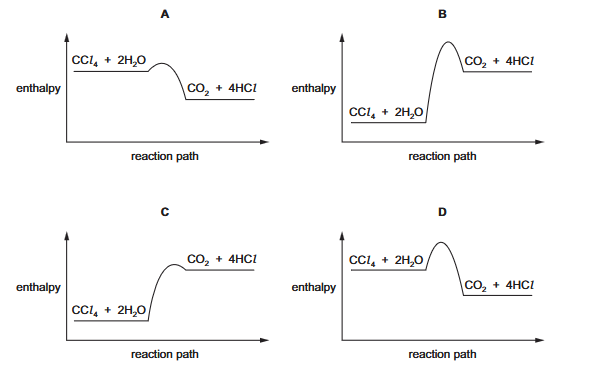
(B) B
(C) C
(D) D
▶️ Answer/Explanation
Correct Answer: \( \boxed{\mathrm{D}} \)
The reaction has a negative enthalpy change:
\( \mathrm{\Delta H=-61.5\,kJ\,mol^{-1}} \)
Therefore, it is exothermic, so the products must be at a lower enthalpy than the reactants.
The activation energy is:
\( \mathrm{E_a=+62\,kJ\,mol^{-1}} \)
Hence, the energy profile must show:
- A peak above the reactants representing the activation energy.
- Products at a lower enthalpy than the reactants because the reaction is exothermic.
Only diagram D satisfies both conditions.
Therefore, the correct answer is (D).
Question 14
A helium ion contains two protons, two neutrons and one electron.
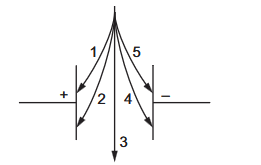
This helium ion and a proton are passed separately through a uniform electric field.
The particles are travelling at the same velocity.
Which arrow describes the path of each particle?
| helium ion | proton | |
|---|---|---|
| A | 1 | 2 |
| B | 2 | 1 |
| C | 4 | 5 |
| D | 5 | 4 |
▶️ Answer/Explanation
Correct Answer: \( \boxed{\mathrm{C}} \)
The helium ion contains two protons and one electron, so its net charge is:
\( \mathrm{+2-1=+1} \)
Both the helium ion and the proton therefore have the same positive charge, so both are deflected toward the negative plate (to the right).
The electric force on each particle is:
\( \mathrm{F=qE} \)
Since both have the same charge, they experience the same force. However, the helium ion has a much greater mass (approximately four times that of a proton), so its acceleration is smaller:
\( \mathrm{a=\dfrac{F}{m}} \)
Therefore:
- The helium ion is deflected less → path 4.
- The proton is deflected more → path 5.
Hence, the correct answer is (C).
Question 15
The skeletal formulae of arginine and lysine are shown.
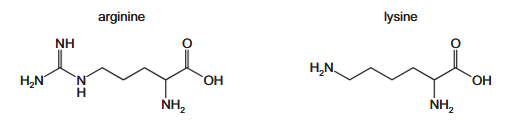
Which row is correct?
| substance | empirical formula | \( \mathrm{M_r} \) | |
|---|---|---|---|
| A | arginine | \( \mathrm{C_3H_7N_2O} \) | 174 |
| B | arginine | \( \mathrm{C_3H_8N_2O} \) | 176 |
| C | lysine | \( \mathrm{C_3H_7NO} \) | 144 |
| D | lysine | \( \mathrm{C_3H_8NO} \) | 146 |
▶️ Answer/Explanation
Correct Answer: \( \boxed{\mathrm{A}} \)
From the skeletal formula, arginine has the molecular formula:
\( \mathrm{C_6H_{14}N_4O_2} \)
Its empirical formula is obtained by dividing all subscripts by 2:
\( \mathrm{C_3H_7N_2O} \)
Its relative molecular mass is:
\( \mathrm{(6\times12)+(14\times1)+(4\times14)+(2\times16)=174} \)
For lysine, the molecular formula is \( \mathrm{C_6H_{14}N_2O_2} \), giving an empirical formula of \( \mathrm{C_3H_7NO} \) and \( M_r=146 \). Therefore, options C and D are incorrect.
Hence, the correct answer is (A).
Question 16
The oxide and chloride of an element X are separately mixed with water. The two resulting solutions have the same effect on litmus.
What could element X be?
(B) Ca
(C) Na
(D) P
▶️ Answer/Explanation
Correct Answer: \( \boxed{\mathrm{D}} \)
Compare the behaviour of the oxide and chloride of each element with water.
| Element | Oxide + water | Chloride + water | Effect on litmus |
|---|---|---|---|
| Al | Little reaction (amphoteric oxide) | Nearly neutral solution | Not the same |
| Ca | Alkaline \( \mathrm{Ca(OH)_2} \) | Neutral \( \mathrm{CaCl_2} \) | Not the same |
| Na | Alkaline \( \mathrm{NaOH} \) | Neutral \( \mathrm{NaCl} \) | Not the same |
| P | Acidic solution | Acidic solution | Same |
For phosphorus:
\( \mathrm{P_4O_{10}+6H_2O\rightarrow4H_3PO_4} \)
\( \mathrm{PCl_3+3H_2O\rightarrow H_3PO_3+3HCl} \)
Both reactions produce acidic solutions, so they have the same effect on litmus.
Therefore, the correct answer is (D).
Question 17
Why do the halogens become less volatile as Group 17 is descended?
(B) The halogen-halogen bond energy increases.
(C) The number of electrons in each molecule increases.
(D) The van der Waals’ forces between molecules become weaker.
▶️ Answer/Explanation
Correct Answer: \( \boxed{\mathrm{C}} \)
As the Group 17 elements are descended, each halogen molecule contains more electrons.
The larger electron cloud is more easily polarised, producing stronger instantaneous dipole-induced dipole (van der Waals’) forces between molecules.
As a result:
- Boiling point increases.
- Volatility decreases.
The halogen-halogen bond energy is not responsible for this trend because volatility depends on intermolecular forces, not the covalent bond within each molecule.
Therefore, the correct explanation is that the number of electrons in each molecule increases, leading to stronger van der Waals’ forces.
Hence, the correct answer is (C).
Question 18
Compound M is a white solid. It is the chloride of a Period 3 element.
Information about some reactions starting with compound M is given in the table.
| Reaction | Observation |
|---|---|
| Compound M + non-polar solvent | Colourless solution |
| Compound M added a little at a time to water | Steamy fumes, Q Colourless solution, R |
| Fumes Q tested with moist blue litmus paper | Paper turns red |
| Solution R + a few drops of \( \mathrm{NaOH(aq)} \) + excess \( \mathrm{NaOH(aq)} \) | White precipitate Precipitate dissolves to give a colourless solution |
What is compound M?
(B) Magnesium chloride
(C) Phosphorus pentachloride
(D) Sodium chloride
▶️ Answer/Explanation
Correct Answer: \( \boxed{\mathrm{A}} \)
The acidic fumes (Q) turn moist blue litmus paper red, indicating the presence of hydrogen chloride:
\( \mathrm{HCl(g)} \)
Adding sodium hydroxide to solution R produces a white precipitate that dissolves in excess \( \mathrm{NaOH} \). This is characteristic of the amphoteric hydroxide:
\( \mathrm{Al^{3+}+3OH^- \rightarrow Al(OH)_3(s)} \)
\( \mathrm{Al(OH)_3(s)+OH^- \rightarrow [Al(OH)_4]^- (aq)} \)
Thus, solution R contains \( \mathrm{Al^{3+}} \) ions, so M is aluminium chloride.
The hydrolysis of aluminium chloride is:
\( \mathrm{AlCl_3 + 3H_2O \rightarrow Al(OH)_3 + 3HCl} \)
Therefore, the correct answer is (A).
Question 19
Which statement about strontium and its compounds is correct?
(B) Strontium sulfate is more soluble than magnesium sulfate.
(C) Strontium nitrate has a lower thermal stability than calcium nitrate.
(D) Strontium is a stronger reducing agent than magnesium.
▶️ Answer/Explanation
Correct Answer: \( \boxed{\mathrm{D}} \)
Option A: Incorrect. The solubility of Group 2 hydroxides increases down the group, so barium hydroxide is more soluble than strontium hydroxide.
Option B: Incorrect. The solubility of Group 2 sulfates decreases down the group. Therefore, magnesium sulfate is more soluble than strontium sulfate.
Option C: Incorrect. The thermal stability of Group 2 nitrates increases down the group because the larger cations have lower polarising power. Thus, strontium nitrate is more thermally stable than calcium nitrate.
Option D: Correct. Reactivity increases down Group 2 as ionisation energy decreases. Strontium loses its outer electrons more readily than magnesium, making it a stronger reducing agent.
Therefore, the correct answer is (D).
Question 20
Sodium bromide is warmed with concentrated sulfuric acid.
Which row describes the change in the oxidation number of the sulfur and the role of the bromide ions in the reaction?
| Change in oxidation number of sulfur | Role of bromide ions | |
|---|---|---|
| A | \(+6\) to \(+4\) | Oxidising agent |
| B | \(+6\) to \(+4\) | Reducing agent |
| C | \(+4\) to \(0\) | Oxidising agent |
| D | \(+4\) to \(0\) | Reducing agent |
▶️ Answer/Explanation
Correct Answer: \( \boxed{\mathrm{B}} \)
Concentrated sulfuric acid acts as an oxidising agent and oxidises bromide ions to bromine.
The sulfur in sulfuric acid is reduced from oxidation number \(+6\) to \(+4\), forming sulfur dioxide.
Since the bromide ions lose electrons, they act as the reducing agent.
Therefore, the correct answer is (B).
Question 21
A reaction occurs when ammonium chloride is added to calcium hydroxide.
What is the role of the ammonium ions in this reaction?
(B) Base
(C) Oxidising agent
(D) Reducing agent
▶️ Answer/Explanation
Correct Answer: \( \boxed{\mathrm{A}} \)
When ammonium chloride reacts with calcium hydroxide, the ammonium ion donates a proton to the hydroxide ion.
The ionic equation is:
\( \mathrm{NH_4^+(aq) + OH^-(aq) \rightarrow NH_3(g) + H_2O(l)} \)
Since the ammonium ion, \( \mathrm{NH_4^+} \), donates a proton, it acts as a Brønsted-Lowry acid.
Therefore, the correct answer is (A).
Question 22
Elements Y and Z are both in Period 3. Element Y has the smallest atomic radius in Period 3.
There are only two elements in Period 3 that have a lower melting point than element Z.
Elements Y and Z react together to form compound R.
Which compound could be R?
(B) \( \mathrm{MgS} \)
(C) \( \mathrm{Na_2S} \)
(D) \( \mathrm{PCl_3} \)
▶️ Answer/Explanation
Correct Answer: \( \boxed{\mathrm{D}} \)
The element with the smallest atomic radius in Period 3 is chlorine, so Y = Cl.
The only Period 3 elements with melting points lower than phosphorus are chlorine and argon. Therefore, Z = phosphorus.
Phosphorus reacts with chlorine to form phosphorus(III) chloride:
\( \mathrm{2P + 3Cl_2 \rightarrow 2PCl_3} \)
Therefore, the compound formed is \( \mathrm{PCl_3} \), so the correct answer is (D).
Question 23
\(1.0\,\mathrm{g}\) of each of four different compounds of Group 2 elements are thermally decomposed. The residue in each decomposition is the oxide of the Group 2 element.
The volume of gas produced from each reaction is measured at room conditions.
Which substance produces the greatest volume of gas?
(B) Calcium nitrate
(C) Strontium carbonate
(D) Strontium nitrate
▶️ Answer/Explanation
Correct Answer: \( \boxed{\mathrm{B}} \)
The decomposition reactions are:
\( \mathrm{MCO_3 \rightarrow MO + CO_2} \)
\( \mathrm{2M(NO_3)_2 \rightarrow 2MO + 4NO_2 + O_2} \)
Each mole of carbonate produces 1 mole of gas, whereas each mole of nitrate produces 2.5 moles of gas.
For the same mass (\(1.0\,\mathrm{g}\)), calcium nitrate has the smallest molar mass among the nitrates listed, giving the greatest number of moles and therefore the largest total volume of gas.
Therefore, the correct answer is (B).
Question 24
Sulfur dioxide in the atmosphere can form acid rain. This occurs in two steps.
1. Oxidation of \( \mathrm{SO_2} \) to \( \mathrm{SO_3} \)
2. Formation of dilute \( \mathrm{H_2SO_4} \)
Which row identifies the atmospheric catalyst for step 1 and the reagent for step 2?
| Catalyst | Reagent | |
|---|---|---|
| A | \( \mathrm{O_2} \) | \( \mathrm{H_2O} \) |
| B | \( \mathrm{O_2} \) | \( \mathrm{O_2} \) |
| C | \( \mathrm{NO_2} \) | \( \mathrm{H_2O} \) |
| D | \( \mathrm{NO_2} \) | \( \mathrm{O_2} \) |
▶️ Answer/Explanation
Correct Answer: \( \boxed{\mathrm{C}} \)
In the atmosphere, nitrogen dioxide, \( \mathrm{NO_2} \), catalyses the oxidation of sulfur dioxide to sulfur trioxide.
The sulfur trioxide then reacts with water to form sulfuric acid:
\( \mathrm{SO_3 + H_2O \rightarrow H_2SO_4} \)
Therefore, the atmospheric catalyst is \( \mathrm{NO_2} \) and the reagent for the second step is \( \mathrm{H_2O} \), so the correct answer is (C).
Question 25
Which statement about the mechanism of an \( \mathrm{S_N1} \) reaction of a halogenoalkane is correct?
(B) One intermediate is formed from two reacting molecules.
(C) The intermediate is stabilised by adjacent alkyl groups.
(D) The intermediate is uncharged.
▶️ Answer/Explanation
Correct Answer: \( \boxed{\mathrm{C}} \)
An \( \mathrm{S_N1} \) reaction proceeds in two steps. First, the halide ion leaves to form a carbocation intermediate.
Adjacent alkyl groups stabilise the positively charged carbocation by electron donation (inductive effect), making tertiary carbocations more stable than secondary or primary carbocations.
The intermediate is therefore positively charged, not uncharged, and only one reactant is involved in the rate-determining step.
Therefore, the correct answer is (C).
Question 26
The repeat unit of a polymer is shown.
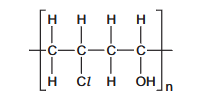
Three statements about this polymer are listed.
1. Its disposal is hazardous because it produces toxic gases when burned.
2. Two different monomers are used to make this polymer.
3. The monomer for this polymer is \( \mathrm{3\text{-}chlorobut\text{-}2\text{-}ene\text{-}1\text{-}ol} \).
Which statements are correct?
(B) 1 and 3
(C) 1 only
(D) 2 only
▶️ Answer/Explanation
Correct Answer: \( \boxed{\mathrm{A}} \)
The polymer contains chlorine atoms. On burning, chlorine-containing polymers can produce toxic gases such as hydrogen chloride, so statement 1 is correct.
The repeat unit contains both chlorine and hydroxyl substituents on different carbon atoms, indicating that the polymer is formed from two different monomers. Therefore, statement 2 is correct.
The structure cannot be obtained from a single monomer, \( \mathrm{3\text{-}chlorobut\text{-}2\text{-}ene\text{-}1\text{-}ol} \), so statement 3 is incorrect.
Therefore, the correct answer is (A).
Question 27
Methanoic acid, \( \mathrm{HCO_2H} \), has acidic properties similar to those of other carboxylic acids. In addition, it can be oxidised by the same oxidising agents that are capable of oxidising aldehydes.
Which pair consists of two compounds that will give the same observations with Fehling’s reagent?
(B) \( \mathrm{HCO_2H} \) and \( \mathrm{CH_3CO_2CH_3} \)
(C) \( \mathrm{HCO_2H} \) and \( \mathrm{CH_3CH_2COCH_3} \)
(D) \( \mathrm{HCO_2H} \) and \( \mathrm{CH_3CH_2CHO} \)
▶️ Answer/Explanation
Correct Answer: \( \boxed{\mathrm{D}} \)
Fehling’s reagent is reduced by aldehydes to give a brick-red precipitate of \( \mathrm{Cu_2O} \).
Methanoic acid is unique among carboxylic acids because it can also reduce Fehling’s reagent, giving the same positive result.
Propanal, \( \mathrm{CH_3CH_2CHO} \), is an aldehyde and also gives a positive Fehling’s test, whereas ethanoic acid, esters, and ketones do not.
Therefore, the correct answer is (D).
Question 28
Which row gives pentanenitrile as one product?
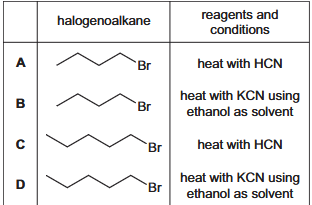
▶️ Answer/Explanation
Correct Answer: \( \boxed{\mathrm{B}} \)
Nitriles are prepared by nucleophilic substitution of a halogenoalkane using \( \mathrm{KCN} \) in ethanol under heating.
Hydrogen cyanide, \( \mathrm{HCN} \), is used for addition reactions with carbonyl compounds and does not convert halogenoalkanes into nitriles.
To obtain pentanenitrile, the starting halogenoalkane must contain four carbon atoms, since the cyanide ion adds one carbon atom to the chain.
Only row B uses a four-carbon halogenoalkane with \( \mathrm{KCN} \) in ethanol, producing pentanenitrile. Therefore, the correct answer is (B).
Question 29
An ester, \( \mathrm{R’CO_2R”} \), is hydrolysed in alkaline conditions. \( \mathrm{R’} \) and \( \mathrm{R”} \) are different alkyl groups.
Which row identifies the two products formed?
| Product 1 | Product 2 | |
|---|---|---|
| A | \( \mathrm{R’CO_2H} \) | \( \mathrm{R”OH} \) |
| B | \( \mathrm{R’CO_2^-} \) | \( \mathrm{R”OH} \) |
| C | \( \mathrm{R’CO_2H} \) | \( \mathrm{R”O^-} \) |
| D | \( \mathrm{R’CO_2^-} \) | \( \mathrm{R”O^-} \) |
▶️ Answer/Explanation
Correct Answer: \( \boxed{\mathrm{B}} \)
Alkaline hydrolysis (saponification) of an ester produces a carboxylate ion and an alcohol.
The reaction is:
\( \mathrm{R’CO_2R” + OH^- \rightarrow R’CO_2^- + R”OH} \)
The carboxylic acid formed initially is immediately neutralised by the alkali to form the carboxylate ion.
Therefore, the products are \( \mathrm{R’CO_2^-} \) and \( \mathrm{R”OH} \), so the correct answer is (B).
Question 30
Which compound cannot be oxidised by acidified potassium dichromate(VI) solution but does react with sodium metal?
(B) \( \mathrm{CH_3COCH_2CH_3} \)
(C) \( \mathrm{CH_3CH_2CH_2CH_2OH} \)
(D) \( \mathrm{CH_3CH_2CH(OH)CH_3} \)
▶️ Answer/Explanation
Correct Answer: \( \boxed{\mathrm{A}} \)
Acidified potassium dichromate(VI) oxidises primary and secondary alcohols, but tertiary alcohols are resistant to oxidation because the carbon bearing the \( \mathrm{-OH} \) group has no hydrogen atom.
Alcohols react with sodium metal to produce hydrogen gas:
\( \mathrm{2ROH + 2Na \rightarrow 2RONa + H_2} \)
Compound (A), \( \mathrm{(CH_3)_3COH} \), is a tertiary alcohol, so it is not oxidised by acidified potassium dichromate(VI) but does react with sodium metal.
Therefore, the correct answer is (A).
Question 31
Butan-2-one reacts with alkaline \( \mathrm{I_2(aq)} \). An excess of dilute sulfuric acid is then added to the reaction mixture.
The organic products of this reaction sequence are triiodomethane and product M.
What is product M?
(B) Ethanoic acid
(C) Propanoate ion
(D) Propanoic acid
▶️ Answer/Explanation
Correct Answer: \( \boxed{\mathrm{D}} \)
Butan-2-one is a methyl ketone and gives a positive iodoform reaction.
The reaction produces triiodomethane, \( \mathrm{CHI_3} \), and the propanoate ion in alkaline solution:
\( \mathrm{CH_3COCH_2CH_3 \xrightarrow{I_2/OH^-} CHI_3 + CH_3CH_2CO_2^-} \)
When excess dilute sulfuric acid is added, the propanoate ion is protonated to form propanoic acid.
Therefore, the correct answer is (D).
Question 32
Four reagents are listed.
1. Aqueous \( \mathrm{KCl} \)
2. Dilute \( \mathrm{HCl} \)
3. Liquid \( \mathrm{SOCl_2} \)
4. Solid \( \mathrm{PCl_5} \)
Which reagents, when added to ethanol, will rapidly produce a gas that turns blue litmus red?
(B) 1 and 3
(C) 2 and 4
(D) 3 and 4
▶️ Answer/Explanation
Correct Answer: \( \boxed{\mathrm{D}} \)
Both thionyl chloride, \( \mathrm{SOCl_2} \), and phosphorus pentachloride, \( \mathrm{PCl_5} \), react readily with alcohols.
These reactions produce hydrogen chloride gas:
\( \mathrm{ROH + SOCl_2 \rightarrow RCl + SO_2 + HCl} \)
\( \mathrm{ROH + PCl_5 \rightarrow RCl + POCl_3 + HCl} \)
Hydrogen chloride is an acidic gas and turns damp blue litmus paper red.
Therefore, the correct answer is (D).
Question 33
Four drops of 1-chlorobutane, 1-bromobutane and 1-iodobutane are put separately into three test-tubes containing \(1.0\,\mathrm{cm^3}\) of aqueous silver nitrate at \(60^\circ\mathrm{C}\). In each case, a hydrolysis reaction occurs.
\( \mathrm{H_2O(l) + R\text{-}X(l) + Ag^+(aq) \rightarrow R\text{-}OH(aq) + AgX(s) + H^+(aq)} \)
R represents \( \mathrm{C_4H_9} \) and X represents the halogen atom.
The rate of formation of cloudiness in the test-tubes is in the order \( \mathrm{RCl < RBr < RI} \).
Why is this?
(B) The first ionisation energy of the halogen decreases from Cl to I.
(C) The solubility of \( \mathrm{AgX(s)} \) decreases from \( \mathrm{AgCl} \) to \( \mathrm{AgI} \).
(D) The \( \mathrm{R\text{-}X} \) bond polarity decreases from \( \mathrm{RCl} \) to \( \mathrm{RI} \).
▶️ Answer/Explanation
Correct Answer: \( \boxed{\mathrm{A}} \)
Hydrolysis of halogenoalkanes requires breaking the carbon-halogen bond.
The strength of the \( \mathrm{C\text{-}X} \) bond decreases in the order:
\( \mathrm{C\text{-}Cl > C\text{-}Br > C\text{-}I} \)
As the bond energy decreases, the bond breaks more easily, so hydrolysis occurs more rapidly. Consequently, the silver halide precipitate forms fastest for iodoalkanes and slowest for chloroalkanes.
Therefore, the correct answer is (A).
Question 34
Propanoic acid reacts with \( \mathrm{LiAlH_4} \) to give organic product P.
Methanoic acid reacts with organic product P, in the presence of a few drops of concentrated sulfuric acid, to give organic product Q.
What are the skeletal formulae of the two organic products?
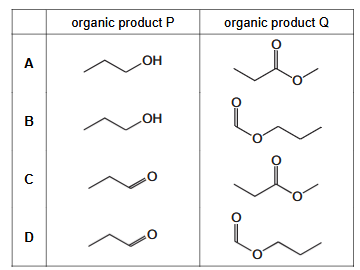
▶️ Answer/Explanation
Correct Answer: \( \boxed{\mathrm{B}} \)
\( \mathrm{LiAlH_4} \) reduces carboxylic acids to primary alcohols.
Therefore, propanoic acid is reduced to propan-1-ol (product P):
\( \mathrm{CH_3CH_2COOH \xrightarrow{LiAlH_4} CH_3CH_2CH_2OH} \)
Propan-1-ol then reacts with methanoic acid in the presence of concentrated sulfuric acid to form the ester propyl methanoate:
\( \mathrm{HCOOH + CH_3CH_2CH_2OH \rightleftharpoons HCOOCH_2CH_2CH_3 + H_2O} \)
Only option B shows propan-1-ol as product P and propyl methanoate as product Q. Therefore, the correct answer is (B).
Question 35
Samples of the gases \( \mathrm{CH_3Cl} \) and \( \mathrm{Cl_2} \) are mixed together and irradiated with ultraviolet light.
Which compound is produced by a termination step in the reaction?
(B) \( \mathrm{CH_2{=}CH_2} \)
(C) \( \mathrm{CH_2ClCH_2Cl} \)
(D) \( \mathrm{H_2} \)
▶️ Answer/Explanation
Correct Answer: \( \boxed{\mathrm{C}} \)
In a free-radical substitution reaction, a termination step occurs when two free radicals combine to form a stable molecule, removing radicals from the reaction mixture.
One possible termination reaction is:
\( \mathrm{\cdot CH_2Cl + \cdot CH_2Cl \rightarrow CH_2ClCH_2Cl} \)
Hydrogen chloride is produced during the propagation stage, while ethene and hydrogen are not formed by termination reactions.
Therefore, the correct answer is (C).
Question 36
Propan-1-ol, \( \mathrm{C_3H_7OH} \), is dehydrated by passing its vapour over hot aluminium oxide to give a hydrocarbon.
Which structural formula represents the product obtained when the hydrocarbon reacts with bromine?
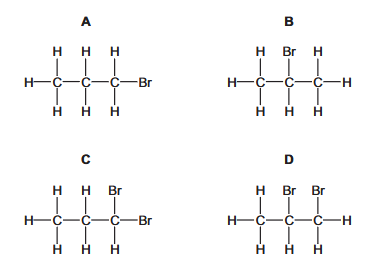
▶️ Answer/Explanation
Correct Answer: \( \boxed{\mathrm{D}} \)
Passing propan-1-ol vapour over hot aluminium oxide causes dehydration, producing propene:
\( \mathrm{CH_3CH_2CH_2OH \xrightarrow{Al_2O_3,\ heat} CH_3CH{=}CH_2 + H_2O} \)
Propene reacts with bromine by electrophilic addition across the carbon-carbon double bond to form 1,2-dibromopropane:
\( \mathrm{CH_3CH{=}CH_2 + Br_2 \rightarrow CH_3CHBrCH_2Br} \)
This structure corresponds to option D.
Therefore, the correct answer is (D).
Question 37
Alkane S has molecular formula \( \mathrm{C_4H_{10}} \).
S reacts with \( \mathrm{Cl_2(g)} \) in the presence of sunlight to produce only two different monochloroalkanes, \( \mathrm{C_4H_9Cl} \). Both of these monochloroalkanes are treated with hot ethanolic \( \mathrm{KOH} \). They both produce the same alkene T, and no other organic products.
What is produced when T is treated with hot concentrated acidified \( \mathrm{KMnO_4} \)?
(B) \( \mathrm{CO_2} \) and \( \mathrm{CH_3COCH_3} \)
(C) \( \mathrm{HCO_2H} \) and \( \mathrm{CH_3COCH_3} \)
(D) \( \mathrm{CH_3CO_2H} \) only
▶️ Answer/Explanation
Correct Answer: \( \boxed{\mathrm{B}} \)
The alkane must be 2-methylpropane, since it forms only two different monochloroalkanes on chlorination.
Both monochloroalkanes undergo elimination with hot ethanolic \( \mathrm{KOH} \) to give the same alkene, 2-methylpropene.
Hot, concentrated acidified \( \mathrm{KMnO_4} \) cleaves the double bond oxidatively:
\( \mathrm{CH_2=C(CH_3)_2 \xrightarrow{KMnO_4/H^+} CO_2 + CH_3COCH_3} \)
Therefore, the products are \( \mathrm{CO_2} \) and \( \mathrm{CH_3COCH_3} \), so the correct answer is (B).
Question 38
Including structural isomers and stereoisomers, how many isomers are there of \( \mathrm{C_2H_2Br_2} \)?
(B) 3
(C) 4
(D) 5
▶️ Answer/Explanation
Correct Answer: \( \boxed{\mathrm{B}} \)
The molecular formula \( \mathrm{C_2H_2Br_2} \) has one degree of unsaturation, so the compounds are dibromoethenes.
The possible isomers are:
- \( \mathrm{1,1\text{-}dibromoethene} \)
- \( \mathrm{cis\text{-}1,2\text{-}dibromoethene} \)
- \( \mathrm{trans\text{-}1,2\text{-}dibromoethene} \)
Thus, there is one structural isomer with both bromine atoms on the same carbon and two stereoisomers (cis and trans) of 1,2-dibromoethene.
Therefore, the total number of isomers is 3, so the correct answer is (B).
Question 39
Which compound exhibits stereoisomerism?
(B) 2,3-Dichloropropene
(C) 1,2-Dichloropropane
(D) 1,3-Dichloropropane
▶️ Answer/Explanation
Correct Answer: \( \boxed{\mathrm{C}} \)
Stereoisomerism includes both geometrical (E/Z) and optical isomerism.
In 1,2-dichloropropane, the second carbon atom is bonded to four different groups:
\( \mathrm{-H,\ -Cl,\ -CH_3,\ and\ -CH_2Cl} \)
This makes carbon-2 a chiral centre, so the compound exists as a pair of optical isomers.
The other compounds do not satisfy the requirements for geometrical or optical isomerism.
Therefore, the correct answer is (C).
Question 40
The mass spectrum of \( \mathrm{CH_3Cl} \) shows a molecular ion peak, \( \mathrm{M^+} \), at the \( \mathrm{m/e} \) value of \(50\) with a relative abundance of \(18.0\%\).
Other peaks are present in the mass spectrum.
What is seen in the mass spectrum at the \( \mathrm{m/e} \) value of \(52\)?
(B) A peak with relative abundance of \(6.0\%\)
(C) A peak with relative abundance of \(18.0\%\)
(D) A peak with relative abundance of \(54.0\%\)
▶️ Answer/Explanation
Correct Answer: \( \boxed{\mathrm{B}} \)
Chlorine has two common isotopes:
- \( \mathrm{^{35}Cl} \): about \(75\%\)
- \( \mathrm{^{37}Cl} \): about \(25\%\)
Therefore, the molecular ion peaks occur in the ratio \(3:1\).
If the \( \mathrm{M^+} \) peak at \( \mathrm{m/e}=50 \) has a relative abundance of \(18.0\%\), then the peak at \( \mathrm{m/e}=52 \) is:
\( \mathrm{18.0 \times \dfrac{1}{3}=6.0\%} \)
Therefore, the correct answer is (B).