
Question 1
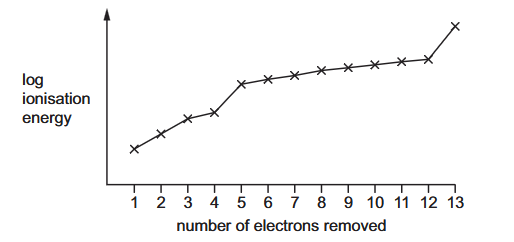
The diagram shows the logarithm of the first 13 ionisation energies of an element.
Which statement is correct?
(B) The element is aluminium.
(C) The element is silicon.
(D) The element has only one outer electron.
▶️ Answer/Explanation
Correct Answer: \( \boxed{\mathrm{C}} \)
A large jump in successive ionisation energies occurs after all the outer-shell electrons have been removed.
The graph shows a large increase between the 4th and 5th ionisation energies, indicating that the atom has 4 outer-shell electrons.
An element in Period 3 with four valence electrons is silicon, with electron configuration:
\( \mathrm{1s^22s^22p^63s^23p^2} \)
Option (A) is incorrect because ionisation removes electrons, not protons. Option (B) is incorrect because aluminium has only three outer electrons. Option (D) is incorrect because the graph indicates four outer electrons.
Therefore, the correct answer is (C).
Question 2
What is the empirical formula of butanoic acid?
(B) \( \mathrm{C_3H_6O} \)
(C) \( \mathrm{C_4H_8O} \)
(D) \( \mathrm{C_5H_{10}O} \)
▶️ Answer/Explanation
Correct Answer: \( \boxed{\mathrm{A}} \)
The molecular formula of butanoic acid is:
\( \mathrm{C_4H_8O_2} \)
The empirical formula is the simplest whole-number ratio of the atoms.
Divide each subscript by 2:
\( \mathrm{C_4H_8O_2 \div 2 = C_2H_4O} \)
Therefore, the empirical formula is \( \mathrm{C_2H_4O} \), so the correct answer is (A).
Question 3
In which pair is the bond angle in the first species smaller than the smallest bond angle in the second species?
(B) \( \mathrm{CO_2} \) and \( \mathrm{BF_3} \)
(C) \( \mathrm{H_2O} \) and \( \mathrm{H_3O^+} \)
(D) \( \mathrm{NH_4^+} \) and \( \mathrm{NH_3} \)
▶️ Answer/Explanation
Correct Answer: \( \boxed{\mathrm{C}} \)
Using VSEPR theory:
- \( \mathrm{CH_4} \): \(109.5^\circ\)
- \( \mathrm{SF_6} \): smallest angle \(=90^\circ\)
- \( \mathrm{CO_2} \): \(180^\circ\)
- \( \mathrm{BF_3} \): \(120^\circ\)
- \( \mathrm{H_2O} \): approximately \(104.5^\circ\)
- \( \mathrm{H_3O^+} \): approximately \(107^\circ\)
- \( \mathrm{NH_4^+} \): \(109.5^\circ\)
- \( \mathrm{NH_3} \): approximately \(107^\circ\)
Only in option C is the bond angle in the first species smaller than the smallest bond angle in the second species:
\(104.5^\circ < 107^\circ\)
Therefore, the correct answer is (C).
Question 4
Two glass vessels, M and N, are connected by a closed valve.
M contains helium at \(20^\circ\mathrm{C}\) at a pressure of \(1.0\times10^5\,\mathrm{Pa}\). N has been evacuated and has three times the volume of M.
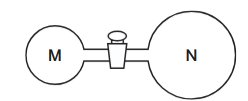
The valve is opened and the temperature of the whole apparatus is raised to \(100^\circ\mathrm{C}\).
What is the final pressure in the system?
(B) \(4.24\times10^4\,\mathrm{Pa}\)
(C) \(1.25\times10^5\,\mathrm{Pa}\)
(D) \(5.09\times10^5\,\mathrm{Pa}\)
▶️ Answer/Explanation
Correct Answer: \( \boxed{\mathrm{A}} \)
Initially:
\(P_1=1.0\times10^5\,\mathrm{Pa}\), \(T_1=293\,\mathrm{K}\).
The total volume after opening the valve is:
\(V_2=V+3V=4V\)
The final temperature is:
\(T_2=373\,\mathrm{K}\)
Using \( \dfrac{PV}{T}=\text{constant} \):
\(P_2=P_1\times\dfrac{V_1}{V_2}\times\dfrac{T_2}{T_1}\)
\(=1.0\times10^5\times\dfrac{1}{4}\times\dfrac{373}{293}\)
\(=3.18\times10^4\,\mathrm{Pa}\)
Therefore, the correct answer is (A).
Question 5
Solid sulfur consists of molecules made up of eight atoms covalently bonded together.
The bonding in sulfur dioxide is \( \mathrm{O=S=O} \).
The following data are given:
- Enthalpy change of combustion of \( \mathrm{S_8(s)} \), \( \Delta H^\circ_{\mathrm{c}} = -2376\,\mathrm{kJ\,mol^{-1}} \)
- Energy required to break \(1.0\,\mathrm{mol}\) of \( \mathrm{S_8(s)} \) into gaseous atoms \(=2232\,\mathrm{kJ\,mol^{-1}} \)
- \( \mathrm{O=O} \) bond enthalpy \(=496\,\mathrm{kJ\,mol^{-1}} \)
Using these data, what is the value of the \( \mathrm{S=O} \) bond enthalpy?
(B) \(257\,\mathrm{kJ\,mol^{-1}}\)
(C) \(319\,\mathrm{kJ\,mol^{-1}}\)
(D) \(536\,\mathrm{kJ\,mol^{-1}}\)
▶️ Answer/Explanation
Correct Answer: \( \boxed{\mathrm{D}} \)
For the combustion reaction:
\( \mathrm{S_8(s) + 8O_2(g) \rightarrow 8SO_2(g)} \)
Using bond enthalpies:
\( \Delta H = \sum(\text{bonds broken})-\sum(\text{bonds formed}) \)
Bonds broken:
- \( \mathrm{S_8(s)\rightarrow 8S(g)} = 2232\,\mathrm{kJ}\)
- \(8\times \mathrm{O=O}=8\times496=3968\,\mathrm{kJ}\)
Total energy to break bonds:
\(2232+3968=6200\,\mathrm{kJ}\)
Let the \( \mathrm{S=O} \) bond enthalpy be \(x\).
Eight \( \mathrm{SO_2} \) molecules contain \(16\) \( \mathrm{S=O} \) bonds.
\(-2376 = 6200 – 16x\)
\(16x = 8576\)
\(x = 536\,\mathrm{kJ\,mol^{-1}}\)
Therefore, the correct answer is (D).
Question 6
In this question, the average oxidation state of sulfur in \( \mathrm{S_2O_3^{2-}} \) and sulfur in \( \mathrm{S_2O_4^{2-}} \) should be used.
In which reaction does the underlined element have the largest increase in oxidation state?
(B) \( \mathrm{2\underline{N}O_2(g)+H_2O(l)\rightarrow HNO_3(aq)+HNO_2(aq)} \)
(C) \( \mathrm{\underline{S}_2O_3^{2-}(aq)+2H^+(aq)\rightarrow S(s)+SO_2(g)+H_2O(l)} \)
(D) \( \mathrm{2\underline{S}_2O_4^{2-}(aq)+H_2O(l)\rightarrow S_2O_3^{2-}(aq)+2HSO_3^{-}(aq)} \)
▶️ Answer/Explanation
Correct Answer: \( \boxed{\mathrm{C}} \)
Determine the oxidation state change of the underlined element in each reaction.
- (A) Chromium changes from \(+3\) in \( \mathrm{CrO_4^{3-}} \) to \(+6\) in \( \mathrm{CrO_4^{2-}} \), an increase of \(+3\).
- (B) Nitrogen changes from \(+4\) in \( \mathrm{NO_2} \) to \(+5\) in \( \mathrm{HNO_3} \) and \(+3\) in \( \mathrm{HNO_2} \). The largest increase is \(+1\).
- (C) The average oxidation state of sulfur in \( \mathrm{S_2O_3^{2-}} \) is \(+2\). Sulfur in \( \mathrm{SO_2} \) is \(+4\), so the oxidation state increases by \(+2\).
- (D) The average oxidation state of sulfur in \( \mathrm{S_2O_4^{2-}} \) is \(+3\). It becomes \(+2\) in \( \mathrm{S_2O_3^{2-}} \) and \(+4\) in \( \mathrm{HSO_3^-} \). The largest increase is \(+1\).
Only reaction (C) gives the required oxidation-state increase.
Therefore, the correct answer is (C).
Question 7
Methanol, \( \mathrm{CH_3OH} \), is made industrially from carbon monoxide and hydrogen in the equilibrium reaction shown.
\( \mathrm{CO(g)+2H_2(g)\rightleftharpoons CH_3OH(g)} \qquad \Delta H=-100\,\mathrm{kJ\,mol^{-1}} \)
Which statement about this equilibrium is correct?
(B) An increase in pressure increases the equilibrium yield of methanol.
(C) An increase in temperature increases the equilibrium yield of methanol.
(D) The addition of an effective catalyst increases the equilibrium yield of methanol.
▶️ Answer/Explanation
Correct Answer: \( \boxed{\mathrm{B}} \)
The reaction is:
\( \mathrm{CO(g)+2H_2(g)\rightleftharpoons CH_3OH(g)} \)
There are 3 moles of gas on the left and 1 mole of gas on the right.
Increasing the pressure shifts the equilibrium towards the side with fewer moles of gas, increasing the yield of methanol.
Option (A) is incorrect because:
\( \displaystyle K_p=\frac{p_{\mathrm{CH_3OH}}}{p_{\mathrm{CO}}\times\left(p_{\mathrm{H_2}}\right)^2} \)
The partial pressure of \( \mathrm{H_2} \) must be squared.
Option (C) is incorrect because the forward reaction is exothermic, so increasing the temperature decreases the equilibrium yield of methanol.
Option (D) is incorrect because a catalyst speeds up both forward and reverse reactions equally and does not change the equilibrium position.
Therefore, the correct answer is (B).
Question 8
The distribution of molecular energies in an ideal gas can be represented in a Boltzmann distribution.
Which change in conditions leads to a larger value for the number of molecules that have the most probable energy?
(B) Keeping the pressure constant but decreasing the temperature
(C) Keeping the temperature constant but increasing the pressure
(D) Keeping the pressure constant but increasing the temperature
▶️ Answer/Explanation
Correct Answer: \( \boxed{\mathrm{B}} \)
The peak of a Maxwell-Boltzmann distribution represents the most probable energy, i.e. the energy possessed by the greatest number of molecules.
When the temperature decreases, the distribution becomes taller and narrower, so a larger number of molecules have energies close to the most probable energy.
Changing the pressure alone does not alter the shape of the Maxwell-Boltzmann energy distribution at a fixed temperature.
Therefore, keeping the pressure constant while decreasing the temperature gives the largest value for the number of molecules at the most probable energy.
Therefore, the correct answer is (B).
Question 9
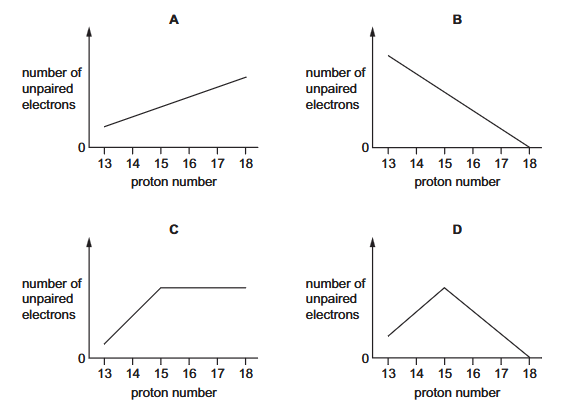
Which graph represents the number of unpaired electrons in the atoms of six elements in Period 3 of the Periodic Table?
(B) B
(C) C
(D) D
▶️ Answer/Explanation
Correct Answer: \( \boxed{\mathrm{D}} \)
The six Period 3 elements with proton numbers \(13\) to \(18\) are:
- \(\mathrm{Al}\): \(3s^23p^1\) → \(1\) unpaired electron
- \(\mathrm{Si}\): \(3s^23p^2\) → \(2\) unpaired electrons
- \(\mathrm{P}\): \(3s^23p^3\) → \(3\) unpaired electrons
- \(\mathrm{S}\): \(3s^23p^4\) → \(2\) unpaired electrons
- \(\mathrm{Cl}\): \(3s^23p^5\) → \(1\) unpaired electron
- \(\mathrm{Ar}\): \(3s^23p^6\) → \(0\) unpaired electrons
The pattern is:
\(1 \rightarrow 2 \rightarrow 3 \rightarrow 2 \rightarrow 1 \rightarrow 0\)
This increases to a maximum at phosphorus and then decreases to zero at argon, matching graph D.
Therefore, the correct answer is (D).
Question 10
A \(69.0\,\mathrm{g}\) sample of nitrogen dioxide is placed in a reaction vessel.
The initial pressure of the nitrogen dioxide is \(P\). An effective catalyst is then added and the nitrogen dioxide begins to decompose into its elements.
After ten minutes, the total pressure is \(1.1P\).
What is the mass of oxygen molecules in the reaction vessel after ten minutes?
(B) \(9.60\,\mathrm{g}\)
(C) \(38.4\,\mathrm{g}\)
(D) \(48.0\,\mathrm{g}\)
▶️ Answer/Explanation
Correct Answer: \( \boxed{\mathrm{B}} \)
The decomposition reaction is:
\( \mathrm{2NO_2(g)\rightarrow N_2(g)+2O_2(g)} \)
Initial moles of \( \mathrm{NO_2} \):
\( \dfrac{69.0}{46.0}=1.50\,\mathrm{mol} \)
Let \(x\) mol of \( \mathrm{NO_2} \) decompose.
Final moles:
- \( \mathrm{NO_2}=1.50-x\)
- \( \mathrm{N_2}=\dfrac{x}{2}\)
- \( \mathrm{O_2}=x\)
Total final moles:
\(1.50+\dfrac{x}{2}\)
Since pressure is proportional to the number of moles:
\(1.50+\dfrac{x}{2}=1.1(1.50)=1.65\)
\(x=0.30\,\mathrm{mol}\)
Mass of \( \mathrm{O_2} \):
\(0.30\times32=9.60\,\mathrm{g}\)
Therefore, the correct answer is (B).
Question 11
Which statement about the molecule \( \mathrm{PF_5} \) is correct?
(B) The central atom in the molecule does not have a lone pair of electrons.
(C) The molecule has an overall dipole moment.
(D) The shape of the molecule is octahedral.
▶️ Answer/Explanation
Correct Answer: \( \boxed{\mathrm{B}} \)
The phosphorus atom in \( \mathrm{PF_5} \) forms five covalent bonds and has no lone pairs of electrons.
According to VSEPR theory, the molecule has a trigonal bipyramidal shape with bond angles of:
- \(90^\circ\) (axial-equatorial)
- \(120^\circ\) (equatorial-equatorial)
- \(180^\circ\) (axial-axial)
Therefore:
- Option (A) is incorrect because not all bond angles are \(90^\circ\).
- Option (C) is incorrect because the symmetrical shape means the bond dipoles cancel, so the molecule has no overall dipole moment.
- Option (D) is incorrect because the shape is trigonal bipyramidal, not octahedral.
Therefore, the correct answer is (B).
Question 12
Which solid compound has both ionic and covalent bonding but not coordinate bonding?
(B) \( \mathrm{CH_3COONa} \)
(C) \( \mathrm{MgCl_2} \)
(D) \( \mathrm{NH_4Cl} \)
▶️ Answer/Explanation
Correct Answer: \( \boxed{\mathrm{B}} \)
Consider the bonding in each compound:
- \( \mathrm{Al_2Cl_6} \) contains covalent bonds and coordinate (dative) bonds between bridging chlorine atoms and aluminium atoms.
- \( \mathrm{CH_3COONa} \) contains ionic bonding between \( \mathrm{Na^+} \) and \( \mathrm{CH_3COO^-} \), and covalent bonds within the ethanoate ion. It contains no coordinate bonds.
- \( \mathrm{MgCl_2} \) is predominantly ionic and does not contain covalent bonding within a polyatomic ion.
- \( \mathrm{NH_4Cl} \) contains ionic bonding between \( \mathrm{NH_4^+} \) and \( \mathrm{Cl^-} \), covalent \( \mathrm{N-H} \) bonds, and the ammonium ion is formed via a coordinate (dative) bond.
Only \( \mathrm{CH_3COONa} \) has both ionic and covalent bonding without coordinate bonding.
Therefore, the correct answer is (B).
Question 13
Which equation represents the standard enthalpy change of formation, \( \Delta H^\circ_{\mathrm{f}} \), for ethanol?
(B) \( \mathrm{2C(s)+2\frac{1}{2}H_2(g)+\frac{1}{2}O_2(g)\rightarrow C_2H_5OH(l)} \)
(C) \( \mathrm{2C(s)+3H_2(g)+\frac{1}{2}O_2(g)\rightarrow C_2H_5OH(g)} \)
(D) \( \mathrm{2C(s)+3H_2(g)+\frac{1}{2}O_2(g)\rightarrow C_2H_5OH(l)} \)
▶️ Answer/Explanation
Correct Answer: \( \boxed{\mathrm{D}} \)
The standard enthalpy of formation is the enthalpy change when 1 mole of a compound is formed from its constituent elements in their standard states under standard conditions.
For ethanol:
- Carbon is graphite, \( \mathrm{C(s)} \).
- Hydrogen is \( \mathrm{H_2(g)} \).
- Oxygen is \( \mathrm{O_2(g)} \).
- Ethanol is a liquid under standard conditions.
The balanced formation equation is:
\( \mathrm{2C(s)+3H_2(g)+\frac{1}{2}O_2(g)\rightarrow C_2H_5OH(l)} \)
Therefore, the correct answer is (D).
Question 14
When \( \mathrm{K_2MnO_4} \) reacts with concentrated hydrochloric acid, the products include chlorine molecules and \( \mathrm{MnCl_2} \). All of the manganese atoms are reduced to \( \mathrm{MnCl_2} \).
Both Mn and Cl change their oxidation numbers during the reaction. No other element is oxidised or reduced.
Using these changes in oxidation number, how many moles of chlorine will be produced when \(1.0\,\mathrm{mol}\) of \( \mathrm{K_2MnO_4} \) reacts with an excess of hydrochloric acid?
(B) \(2.5\,\mathrm{mol}\)
(C) \(3.0\,\mathrm{mol}\)
(D) \(4.0\,\mathrm{mol}\)
▶️ Answer/Explanation
Correct Answer: \( \boxed{\mathrm{A}} \)
Determine the oxidation-state changes.
In \( \mathrm{MnO_4^{2-}} \), manganese has oxidation state:
\(x+4(-2)=-2\)
\(x=+6\)
In \( \mathrm{MnCl_2} \), manganese is \(+2\).
Each Mn atom gains 4 electrons.
For \(1.0\,\mathrm{mol}\) of \( \mathrm{K_2MnO_4} \), the total electrons gained are:
\(4.0\,\mathrm{mol}\,e^-\)
Chloride ions are oxidised:
\( \mathrm{2Cl^- \rightarrow Cl_2 + 2e^-} \)
Each mole of \( \mathrm{Cl_2} \) releases \(2\,\mathrm{mol}\) of electrons.
Therefore, moles of chlorine produced:
\( \dfrac{4.0}{2}=2.0\,\mathrm{mol} \)
Therefore, the correct answer is (A).
Question 15
A nitrogen–hydrogen mixture initially in the mole ratio of \(1:3\) reaches equilibrium with ammonia when \(50\%\) of the nitrogen has reacted.
\( \mathrm{N_2(g)+3H_2(g)\rightleftharpoons2NH_3(g)} \)
The total final pressure is \(p\).
What is the partial pressure of ammonia in the equilibrium mixture?
(B) \( \dfrac{p}{4} \)
(C) \( \dfrac{p}{3} \)
(D) \( \dfrac{p}{2} \)
▶️ Answer/Explanation
Correct Answer: \( \boxed{\mathrm{C}} \)
Assume the initial amounts are:
\( \mathrm{N_2}=1\,\mathrm{mol}, \qquad H_2=3\,\mathrm{mol} \)
Since \(50\%\) of the nitrogen reacts:
\( \mathrm{N_2}\) reacted \(=0.5\,\mathrm{mol}\)
| Species | Initial (mol) | Change (mol) | Equilibrium (mol) |
|---|---|---|---|
| \( \mathrm{N_2} \) | 1.0 | \(-0.5\) | 0.5 |
| \( \mathrm{H_2} \) | 3.0 | \(-1.5\) | 1.5 |
| \( \mathrm{NH_3} \) | 0 | \(+1.0\) | 1.0 |
Total moles at equilibrium:
\(0.5+1.5+1.0=3.0\,\mathrm{mol}\)
Mole fraction of ammonia:
\( \dfrac{1.0}{3.0}=\dfrac{1}{3} \)
Therefore, the partial pressure of ammonia is:
\( \displaystyle p_{\mathrm{NH_3}}=\frac{1}{3}p=\frac{p}{3} \)
Therefore, the correct answer is (C).
Question 16
Propyl methanoate is hydrolysed with \( \mathrm{NaOH(aq)} \) at \(20^\circ\mathrm{C}\) to form two products, X and Y. Product X is an alcohol.
Data from the experiment are shown.
| Time / s | \([X]\) / \(\mathrm{mol\,dm^{-3}}\) |
|---|---|
| 0 | 0.000 |
| 40 | 0.004 |
| 80 | 0.007 |
| 120 | 0.010 |
| 180 | 0.015 |
| 240 | 0.019 |
| 300 | 0.022 |
Which row is correct?
| average rate of reaction between 240 and 300 s | product Y | |
|---|---|---|
| A | \(5.00\times10^{-5}\,\mathrm{mol\,dm^{-3}\,s^{-1}}\) | \(\mathrm{HCOONa}\) |
| B | \(5.00\times10^{-5}\,\mathrm{mol\,dm^{-3}\,s^{-1}}\) | \(\mathrm{HCOOH}\) |
| C | \(7.33\times10^{-5}\,\mathrm{mol\,dm^{-3}\,s^{-1}}\) | \(\mathrm{HCOONa}\) |
| D | \(7.33\times10^{-5}\,\mathrm{mol\,dm^{-3}\,s^{-1}}\) | \(\mathrm{HCOOH}\) |
▶️ Answer/Explanation
Correct Answer: \( \boxed{\mathrm{A}} \)
Alkaline hydrolysis of propyl methanoate is:
\( \mathrm{HCOOCH_2CH_2CH_3 + NaOH \rightarrow HCOONa + CH_3CH_2CH_2OH} \)
Therefore:
- Product X is propan-1-ol.
- Product Y is sodium methanoate, \( \mathrm{HCOONa} \).
Average rate between \(240\) s and \(300\) s:
\( \displaystyle \text{Rate}=\frac{0.022-0.019}{300-240}=\frac{0.003}{60}=5.00\times10^{-5}\,\mathrm{mol\,dm^{-3}\,s^{-1}} \)
Therefore, the correct answer is (A).
Question 17
The table shows the numbers of bond pairs and lone pairs in four different species.
Which row is correct?
| species | total number of bond pairs | total number of lone pairs | |
|---|---|---|---|
| A | nitrogen molecule | 3 | 1 |
| B | ammonia molecule | 4 | 1 |
| C | ammonium ion | 4 | 0 |
| D | hydroxide ion | 1 | 4 |
▶️ Answer/Explanation
Correct Answer: \( \boxed{\mathrm{C}} \)
The correct numbers of bond pairs and lone pairs are:
- \(\mathrm{N_2}\): 3 bond pairs and 2 lone pairs (one on each nitrogen), so A is incorrect.
- \(\mathrm{NH_3}\): 3 bond pairs and 1 lone pair, so B is incorrect.
- \(\mathrm{NH_4^+}\): 4 bond pairs and 0 lone pairs, so C is correct.
- \(\mathrm{OH^-}\): 1 bond pair and 3 lone pairs (all on oxygen), so D is incorrect.
Therefore, the correct answer is (C).
Question 18
Which row is correct?
| property | explanation | |
|---|---|---|
| A | AgI dissolves in aqueous ammonia more readily than AgCl does | AgI reacts with aqueous ammonia |
| B | HCl decomposes more readily than HI does | Cl is more electronegative than I |
| C | \( \mathrm{I_2} \) has a higher melting point than \( \mathrm{Cl_2} \) | \( \mathrm{I_2} \) has stronger van der Waals’ forces than \( \mathrm{Cl_2} \) |
| D | \( \mathrm{I_2} \) is a stronger oxidising agent than \( \mathrm{Cl_2} \) | An I atom loses electrons more readily than a Cl atom |
▶️ Answer/Explanation
Correct Answer: \( \boxed{\mathrm{C}} \)
Examine each row:
- A: Incorrect. AgCl dissolves readily in dilute aqueous ammonia, whereas AgI is insoluble.
- B: Incorrect. HI decomposes more readily than HCl because the H–I bond is weaker.
- C: Correct. \( \mathrm{I_2} \) molecules are larger and contain more electrons than \( \mathrm{Cl_2} \), so they experience stronger van der Waals’ forces. More energy is required to overcome these forces, giving \( \mathrm{I_2} \) a higher melting point.
- D: Incorrect. \( \mathrm{Cl_2} \) is a stronger oxidising agent than \( \mathrm{I_2} \).
Therefore, the correct answer is (C).
Question 19
Substance J reacts with water. A gas is given off and the pH of the solution increases. The solution is then reacted with sulfuric acid and a white precipitate forms.
What could be substance J?
(B) barium oxide
(C) magnesium
(D) magnesium oxide
▶️ Answer/Explanation
Correct Answer: \( \boxed{\mathrm{A}} \)
The substance must:
- React with water to produce a gas.
- Produce an alkaline solution, so the pH increases.
- Form a white precipitate with sulfuric acid.
Option A: Barium
\( \mathrm{Ba + 2H_2O \rightarrow Ba(OH)_2 + H_2} \)
Hydrogen gas is evolved and barium hydroxide makes the solution alkaline.
Adding sulfuric acid gives:
\( \mathrm{Ba(OH)_2 + H_2SO_4 \rightarrow BaSO_4(s) + 2H_2O} \)
\( \mathrm{BaSO_4} \) is an insoluble white precipitate.
Why the others are incorrect:
- B: Barium oxide reacts with water to form \( \mathrm{Ba(OH)_2} \), but no gas is produced.
- C: Magnesium reacts only very slowly with cold water and does not readily produce the required observations.
- D: Magnesium oxide forms \( \mathrm{Mg(OH)_2} \) with water but no gas is evolved.
Therefore, the correct answer is (A).
Question 20
Compound L has empirical formula \( \mathrm{NH} \). It decomposes on gentle heating to produce ammonia and compound M only. An aqueous solution of compound L is a good conductor of electricity.
Which row could be correct?
| identity of M | species present in \( \mathrm{L(aq)} \) | |
|---|---|---|
| A | \( \mathrm{N_2H_4} \) | \( \mathrm{N^{3-}} \) and \( \mathrm{H^+} \) |
| B | \( \mathrm{N_2H_4} \) | \( \mathrm{NH_4^+} \) and \( \mathrm{NH_2^-} \) |
| C | \( \mathrm{HN_3} \) | \( \mathrm{NH_3} \) and \( \mathrm{HN_3} \) |
| D | \( \mathrm{HN_3} \) | \( \mathrm{NH_4^+} \) and \( \mathrm{N_3^-} \) |
▶️ Answer/Explanation
Correct Answer: \( \boxed{\mathrm{D}} \)
Since aqueous \( \mathrm{L} \) is a good conductor of electricity, it must contain ions.
The empirical formula is \( \mathrm{NH} \). Ammonium azide, \( \mathrm{NH_4N_3} \), has:
\( \mathrm{NH_4N_3 \rightarrow NH_4^+ + N_3^-} \)
Its empirical formula is:
\( \mathrm{N_4H_4 \rightarrow NH} \)
On gentle heating:
\( \mathrm{NH_4N_3 \rightarrow NH_3 + HN_3} \)
Thus:
- Product \( \mathrm{M} \) is \( \mathrm{HN_3} \).
- The ions present in aqueous solution are \( \mathrm{NH_4^+} \) and \( \mathrm{N_3^-} \).
Therefore, the correct answer is (D).
Question 21
X, Y and Z are elements in Period 3 of the Periodic Table. The results of some experiments carried out with compounds of these elements are shown.
| element | result of adding the oxide of the element to \( \mathrm{H_2O(l)} \) | result of adding the chloride of the element to \( \mathrm{H_2O(l)} \) | result of adding the oxide of the element to \( \mathrm{HCl(aq)} \) |
|---|---|---|---|
| X | no reaction | hydrolyses | forms chloride salt |
| Y | forms hydroxide | dissolves | forms chloride salt |
| Z | forms acid | hydrolyses | hydrolyses |
Which statement is correct?
(B) Element X is Si and element Y is Na.
(C) Element Y is Al and element Z is P.
(D) Element Y is Na and element Z is Al.
▶️ Answer/Explanation
Correct Answer: \( \boxed{\mathrm{A}} \)
Identify X:
- The oxide does not react with water.
- The chloride hydrolyses in water.
- The oxide reacts with hydrochloric acid to form a chloride.
These properties match aluminium:
\( \mathrm{Al_2O_3} \) does not react with water, \( \mathrm{AlCl_3} \) hydrolyses in water, and \( \mathrm{Al_2O_3} \) reacts with HCl to form \( \mathrm{AlCl_3} \).
Identify Y:
- The oxide forms a hydroxide with water.
- The chloride simply dissolves in water.
- The oxide reacts with HCl to form a chloride salt.
These are the typical properties of magnesium.
Identify Z:
Its oxide forms an acid with water and its chloride hydrolyses, indicating a non-metal such as phosphorus or sulfur. This is consistent with the table but is not needed to choose the correct option.
Therefore, the correct answer is (A).
Question 22
The flow diagram shows two successive reactions starting from element Q. Element Q is either calcium or barium.
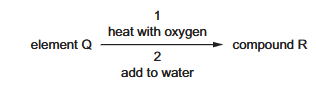
Element Q forms a nitrate that is less thermally stable than strontium nitrate.
What is the identity of compound R?
(B) \( \mathrm{Ca(OH)_2} \)
(C) \( \mathrm{BaO} \)
(D) \( \mathrm{Ba(OH)_2} \)
▶️ Answer/Explanation
Correct Answer: \( \boxed{\mathrm{B}} \)
Thermal stability of Group 2 nitrates increases down the group:
\( \mathrm{Mg(NO_3)_2 < Ca(NO_3)_2 < Sr(NO_3)_2 < Ba(NO_3)_2} \)
Since the nitrate of Q is less thermally stable than strontium nitrate, Q must be calcium.
The reactions are:
1. \( \mathrm{2Ca + O_2 \rightarrow 2CaO} \)
2. \( \mathrm{CaO + H_2O \rightarrow Ca(OH)_2} \)
Therefore, compound R is calcium hydroxide, \( \mathrm{Ca(OH)_2} \).
Therefore, the correct answer is (B).
Question 23
Which anions are formed when chlorine is passed into cold aqueous potassium hydroxide?
(B) \( \mathrm{Cl^-} \) and \( \mathrm{ClO_3^-} \)
(C) \( \mathrm{Cl^-} \) and \( \mathrm{ClO_4^-} \)
(D) \( \mathrm{ClO^-} \) and \( \mathrm{ClO_3^-} \)
▶️ Answer/Explanation
Correct Answer: \( \boxed{\mathrm{A}} \)
In cold, dilute aqueous potassium hydroxide, chlorine undergoes a disproportionation reaction:
\( \mathrm{Cl_2 + 2KOH \rightarrow KCl + KClO + H_2O} \)
The anions produced are:
- \( \mathrm{Cl^-} \) (chloride ion)
- \( \mathrm{ClO^-} \) (chlorate(I) or hypochlorite ion)
If the alkali is hot and concentrated, the reaction instead forms chlorate(V):
\( \mathrm{3Cl_2 + 6KOH \rightarrow 5KCl + KClO_3 + 3H_2O} \)
Therefore, the correct answer is (A).
Question 24
What increases for each successive element in Period 3 from sodium to sulfur?
(B) the melting point of the elements
(C) the number of occupied orbitals in the atom
(D) the pH of the solutions of the chlorides in water
▶️ Answer/Explanation
Correct Answer: \( \boxed{\mathrm{A}} \)
Across Period 3, the highest oxidation number in the oxides increases steadily:
| Element | Highest oxidation state in an oxide |
|---|---|
| Na | \(+1\) |
| Mg | \(+2\) |
| Al | \(+3\) |
| Si | \(+4\) |
| P | \(+5\) |
| S | \(+6\) |
The other options are incorrect because:
- B: Melting point does not increase continuously across Period 3.
- C: The number of occupied orbitals is not a steadily increasing trend.
- D: The pH of chloride solutions generally decreases across the period because the chlorides become more acidic.
Therefore, the correct answer is (A).
Question 25
Which statement about an ammonium ion is correct?
(B) All of the \( \mathrm{H-N-H} \) bond angles in the ion are \(107^\circ\).
(C) The ion contains an \( \mathrm{N-H} \) dative covalent bond which is weaker than the other three \( \mathrm{N-H} \) covalent bonds.
(D) The ion will react with a base as it is a weak acid.
▶️ Answer/Explanation
Correct Answer: \( \boxed{\mathrm{D}} \)
The ammonium ion, \( \mathrm{NH_4^+} \), has a tetrahedral shape with bond angles of approximately \(109.5^\circ\).
Therefore:
- A is incorrect because the bond angles are not \(90^\circ\).
- B is incorrect because the bond angles are \(109.5^\circ\), not \(107^\circ\).
- C is incorrect because although one \( \mathrm{N-H} \) bond is formed by a dative (coordinate) bond, after formation all four \( \mathrm{N-H} \) bonds are identical and have the same strength and length.
- D is correct because \( \mathrm{NH_4^+} \) can donate a proton to a base, so it behaves as a weak Brønsted–Lowry acid.
For example:
\( \mathrm{NH_4^+ + OH^- \rightarrow NH_3 + H_2O} \)
Therefore, the correct answer is (D).
Question 26
An alcohol, U, is reacted with hot acidified \( \mathrm{K_2Cr_2O_7} \) solution. The organic product of the reaction contains 58.8% C, 9.8% H and 31.4% O by mass.
What is the identity of alcohol U?
(B) 3-methylbutan-2-ol
(C) pentan-1-ol
(D) propan-1-ol
▶️ Answer/Explanation
Correct Answer: \( \boxed{\mathrm{C}} \)
Convert the percentage composition into the empirical formula.
| Element | Mass | Moles |
|---|---|---|
| C | 58.8 | \( \dfrac{58.8}{12}=4.90 \) |
| H | 9.8 | \(9.8\) |
| O | 31.4 | \( \dfrac{31.4}{16}=1.96 \) |
Divide by the smallest number of moles:
\( \mathrm{C:H:O}=2.5:5:1 \)
Multiply by 2:
\( \boxed{\mathrm{C_5H_{10}O_2}} \)
The product is therefore a carboxylic acid.
Hot acidified \( \mathrm{K_2Cr_2O_7} \) oxidises a primary alcohol to a carboxylic acid.
Among the options:
- A: Tertiary alcohol – not oxidised.
- B: Secondary alcohol – forms a ketone (\(\mathrm{C_5H_{10}O}\)).
- C: Pentan-1-ol → pentanoic acid (\(\mathrm{C_5H_{10}O_2}\)). ✓
- D: Propan-1-ol → propanoic acid (\(\mathrm{C_3H_6O_2}\)).
Therefore, the correct answer is (C).
Question 27
Which row shows a primary, a secondary and a tertiary alcohol?
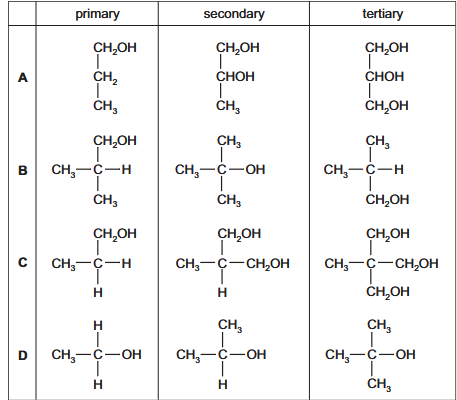
▶️ Answer/Explanation
Correct Answer: \( \boxed{\mathrm{D}} \)
Alcohols are classified according to the number of carbon atoms attached to the carbon bearing the \( \mathrm{-OH} \) group.
| Type of alcohol | Carbon attached to the \( \mathrm{-OH} \) group |
|---|---|
| Primary (\(1^\circ\)) | Attached to one carbon atom |
| Secondary (\(2^\circ\)) | Attached to two carbon atoms |
| Tertiary (\(3^\circ\)) | Attached to three carbon atoms |
In row D:
- The first structure is ethanol, a primary alcohol.
- The second structure is propan-2-ol, a secondary alcohol.
- The third structure is 2-methylpropan-2-ol (tert-butanol), a tertiary alcohol.
Therefore, the correct answer is (D).
Question 28
1-chloro-2-methylbutane reacts with sodium cyanide in a nucleophilic substitution reaction.
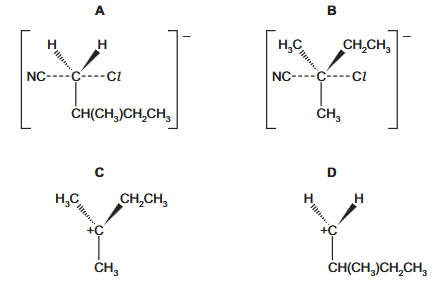
What is the most likely intermediate or transition state in this reaction?
▶️ Answer/Explanation
Correct Answer: \( \boxed{\mathrm{A}} \)
1-Chloro-2-methylbutane is a primary halogenoalkane, so it reacts with \( \mathrm{CN^-} \) by an \(\mathrm{S_N2}\) mechanism.
In an \(\mathrm{S_N2}\) reaction:
- The reaction occurs in a single step.
- There is no carbocation intermediate.
- The nucleophile attacks from the opposite side of the leaving group (back-side attack).
- A transition state is formed in which both the incoming \( \mathrm{CN^-} \) and the leaving \( \mathrm{Cl} \) are partially bonded to the carbon atom.
Option A correctly shows this transition state, with partial bonds to both \( \mathrm{CN} \) and \( \mathrm{Cl} \), enclosed in square brackets and carrying an overall negative charge.
Options C and D show carbocations, which are characteristic of an \(\mathrm{S_N1}\) mechanism and are not formed in this reaction.
Therefore, the correct answer is (A).
Question 29
When \(0.010\,\mathrm{mol}\) of a hydrocarbon X reacts with \(720\,\mathrm{cm^3}\) of hydrogen at room conditions, an alkane is formed.
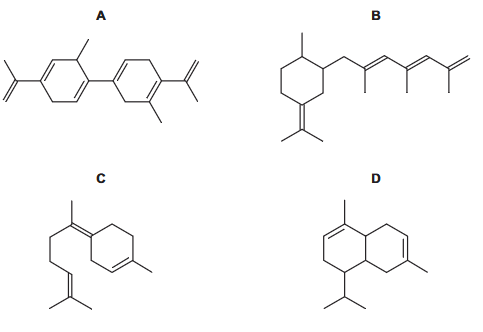
What is hydrocarbon X?
▶️ Answer/Explanation
Correct Answer: \( \boxed{\mathrm{C}} \)
At room conditions, one mole of gas occupies \(24\,000\,\mathrm{cm^3}\).
Moles of hydrogen used:
\( \displaystyle n(\mathrm{H_2})=\frac{720}{24000}=0.030\,\mathrm{mol} \)
Hydrogen required per mole of hydrocarbon:
\( \displaystyle \frac{0.030}{0.010}=3\,\mathrm{mol\ H_2\ per\ mol\ X} \)
Each mole of \( \mathrm{H_2} \) hydrogenates one carbon-carbon double bond.
Therefore, hydrocarbon X must contain three \( \mathrm{C=C} \) bonds.
Among the four structures:
- A: Contains six \( \mathrm{C=C} \) bonds.
- B: Contains four \( \mathrm{C=C} \) bonds.
- C: Contains exactly three \( \mathrm{C=C} \) bonds. ✓
- D: Contains two \( \mathrm{C=C} \) bonds.
Therefore, the correct answer is (C).
Question 30
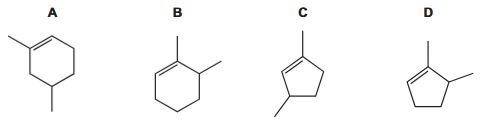
An alkene reacts with hot concentrated acidified \( \mathrm{KMnO_4(aq)} \) to produce a single organic product as shown.
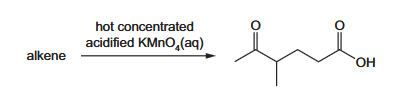
What is the structure of the alkene?
▶️ Answer/Explanation
Correct Answer: \( \boxed{\mathrm{D}} \)
Hot, concentrated acidified \( \mathrm{KMnO_4} \) cleaves the carbon-carbon double bond.
- A carbon of the double bond with no hydrogen atom attached is oxidised to a ketone.
- A carbon of the double bond with one hydrogen atom attached is oxidised to a carboxylic acid.
The product contains one ketone and one carboxylic acid, joined in the same molecule. This indicates that:
- The alkene is cyclic, so oxidative cleavage opens the ring.
- One alkene carbon is substituted (no H), giving the ketone.
- The other alkene carbon bears one H, giving the carboxylic acid.
Only structure D satisfies these conditions and produces the shown open-chain product after oxidative cleavage.
Therefore, the correct answer is (D).
Question 31
Testosterone is an optically active organic molecule.
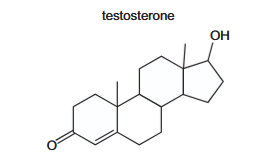
How many chiral centres are there in one molecule of testosterone?
(B) 6
(C) 7
(D) 8
▶️ Answer/Explanation
Correct Answer: \( \boxed{\mathrm{B}} \)
A chiral centre is a tetrahedral carbon atom bonded to four different groups.
In the testosterone structure:
- The carbon atoms involved in the \( \mathrm{C=C} \) double bond and the carbonyl group are not chiral because they are \( \mathrm{sp^2} \)-hybridised.
- The remaining stereogenic carbon atoms occur mainly at the ring junctions and at the carbon bearing the \( \mathrm{-OH} \) group.
Counting these stereogenic centres gives a total of 6 chiral centres.
Therefore, the correct answer is (B).
Question 32
Quinone is an unsaturated molecule.
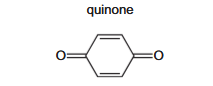
Which statement about quinone is correct?
(B) Quinone is non-planar and does not have an overall dipole moment.
(C) Quinone is planar and has an overall dipole moment.
(D) Quinone is planar and does not have an overall dipole moment.
▶️ Answer/Explanation
Correct Answer: \( \boxed{\mathrm{D}} \)
Quinone consists of a conjugated six-membered ring in which all ring atoms are \(\mathrm{sp^2}\)-hybridised.
Therefore, the molecule is planar.
Although each carbonyl (\(\mathrm{C=O}\)) bond is polar, the molecule is highly symmetrical. The dipole moments of the two carbonyl groups are equal and opposite, so they cancel each other.
Hence, quinone has no overall dipole moment.
Therefore, the correct answer is (D).
Question 33
Which reagent would react with 1-bromopropane to give the highest yield of propene?
(B) aqueous potassium hydroxide
(C) potassium cyanide
(D) ethanolic sodium hydroxide
▶️ Answer/Explanation
Correct Answer: \( \boxed{\mathrm{D}} \)
To produce propene from 1-bromopropane, a hydrogen bromide molecule must be eliminated from adjacent carbon atoms.
This is an elimination (\(\mathrm{E2}\)) reaction:
\( \mathrm{CH_3CH_2CH_2Br + NaOH \xrightarrow[\text{heat}]{\text{ethanol}} CH_3CH=CH_2 + NaBr + H_2O} \)
Consider each reagent:
- A. Ammonia produces propylamine by nucleophilic substitution.
- B. Aqueous potassium hydroxide favours nucleophilic substitution, producing propan-1-ol.
- C. Potassium cyanide produces a nitrile by nucleophilic substitution.
- D. Ethanolic sodium hydroxide favours elimination, giving the highest yield of propene.
Therefore, the correct answer is (D).
Question 34
Acidified potassium dichromate(VI), \( \mathrm{K_2Cr_2O_7} \), is added to propan-1-ol and the mixture is immediately distilled. The distillate is treated with HCN in the presence of KCN.
What is the organic product?
(B) \( \mathrm{CH_3CH_2CH_2CO_2H} \)
(C) \( \mathrm{CH_3CH_2CH(OH)CN} \)
(D) \( \mathrm{CH_3CH_2CH_2CN} \)
▶️ Answer/Explanation
Correct Answer: \( \boxed{\mathrm{C}} \)
Step 1: Controlled oxidation
Immediate distillation prevents further oxidation of the primary alcohol.
\( \mathrm{CH_3CH_2CH_2OH \xrightarrow[\text{distil}]{K_2Cr_2O_7/H^+} CH_3CH_2CHO} \)
The product is propanal.
Step 2: Reaction with HCN/KCN
The aldehyde undergoes nucleophilic addition to form a hydroxynitrile (cyanohydrin):
\( \mathrm{CH_3CH_2CHO + HCN \rightarrow CH_3CH_2CH(OH)CN} \)
Therefore, the final organic product is:
\( \boxed{\mathrm{CH_3CH_2CH(OH)CN}} \)
The other options are incorrect because:
- A is the cyanohydrin of propanone, not propanal.
- B is butanoic acid, formed only after complete oxidation.
- D is a nitrile formed by substitution, not by addition of HCN.
Therefore, the correct answer is (C).
Question 35
Compound Q gives positive results when tested separately with alkaline \( \mathrm{I_2(aq)} \) and with Tollens’ reagent.
What is compound Q?
(B) \( \mathrm{CH_3CH_2COCHO} \)
(C) \( \mathrm{CH_3COCH_2CHO} \)
(D) \( \mathrm{CH_3COCOCH_3} \)
▶️ Answer/Explanation
Correct Answer: \( \boxed{\mathrm{C}} \)
A positive Tollens’ reagent test indicates the presence of an aldehyde (\(\mathrm{-CHO}\)).
A positive iodoform test requires the presence of either:
- a methyl ketone group, \( \mathrm{CH_3CO-} \), or
- an alcohol that can be oxidised to a methyl ketone.
Checking the options:
- A: Contains aldehyde groups only. Tollens’ test is positive, but the iodoform test is negative.
- B: Contains aldehydes only. No methyl ketone is present.
- C: \( \mathrm{CH_3COCH_2CHO} \) contains both a methyl ketone and an aldehyde, so it gives positive results with both reagents.
- D: Contains methyl ketone groups but no aldehyde, so Tollens’ reagent is negative.
Therefore, the correct answer is (C).
Question 36
Structural isomerism and stereoisomerism should be considered when answering this question.
How many isomeric esters of methanoic acid can be made with the molecular formula \( \mathrm{C_5H_{10}O_2} \)?
(B) 3
(C) 4
(D) 5
▶️ Answer/Explanation
Correct Answer: \( \boxed{\mathrm{D}} \)
Esters of methanoic acid have the general structure:
\( \mathrm{HCOOR} \)
Since the molecular formula is \( \mathrm{C_5H_{10}O_2} \), the alkyl group \( \mathrm{R} \) must be a butyl group (\( \mathrm{C_4H_9} \)).
The possible butyl groups are:
- \( \mathrm{CH_3CH_2CH_2CH_2-} \) (butan-1-yl)
- \( \mathrm{CH_3CH_2CH(CH_3)-} \) (butan-2-yl)
- \( \mathrm{(CH_3)_2CHCH_2-} \) (2-methylpropyl)
- \( \mathrm{(CH_3)_3C-} \) (2-methylpropan-2-yl)
The ester containing the butan-2-yl group has one chiral carbon atom and therefore exists as two optical isomers.
Total isomers:
- butan-1-yl methanoate: 1
- butan-2-yl methanoate: 2 (optical isomers)
- 2-methylpropyl methanoate: 1
- 2-methylpropan-2-yl methanoate: 1
Total \(=1+2+1+1=5\).
Therefore, the correct answer is (D).
Question 37
The juice of one lemon reacts completely with \(120\,\mathrm{cm^3}\) of \(0.50\,\mathrm{mol\,dm^{-3}}\) sodium carbonate solution.
The formula of citric acid is:
\( \mathrm{HOOCCH_2C(OH)(COOH)CH_2COOH} \)
No sodium carbonate is left unreacted.
What is the amount of citric acid in one lemon, assuming it is the only acid in the sample?
(B) \(0.04\,\mathrm{mol}\)
(C) \(0.06\,\mathrm{mol}\)
(D) \(0.09\,\mathrm{mol}\)
▶️ Answer/Explanation
Correct Answer: \( \boxed{\mathrm{B}} \)
Citric acid contains three carboxylic acid groups, so it is a triprotic acid.
The neutralisation equation is:
\( \mathrm{2H_3Cit + 3Na_2CO_3 \rightarrow 2Na_3Cit + 3CO_2 + 3H_2O} \)
Moles of sodium carbonate used:
\( \displaystyle n=\frac{120}{1000}\times0.50=0.060\,\mathrm{mol} \)
From the equation:
\( \displaystyle \frac{n(\text{citric acid})}{n(\mathrm{Na_2CO_3})}=\frac{2}{3} \)
Therefore:
\( \displaystyle n(\text{citric acid})=0.060\times\frac{2}{3}=0.040\,\mathrm{mol} \)
Therefore, the correct answer is (B).
Question 38
Separate samples of 1-bromopropane are used in two different reactions.
Reaction 1: 1-bromopropane is converted into compound X by heating it under pressure with ammonia in ethanol.
Reaction 2: 1-bromopropane is converted into compound Y. Compound Y undergoes hydrolysis to form butanoic acid.
Which row identifies compound X and describes the reagents used in reaction 2 to make compound Y?
| identity of compound X | reagents for reaction 2 | |
|---|---|---|
| A | \( \mathrm{CH_3CH_2CH_2NH_2} \) | \( \mathrm{HCN(aq)} \) |
| B | \( \mathrm{CH_3CH_2CH_2NH_2} \) | \( \mathrm{KCN} \) dissolved in ethanol |
| C | \( \mathrm{CH_3CH_2CH_2OH} \) | \( \mathrm{HCN(aq)} \) |
| D | \( \mathrm{CH_3CH_2CH_2OH} \) | \( \mathrm{KCN} \) dissolved in ethanol |
▶️ Answer/Explanation
Correct Answer: \( \boxed{\mathrm{B}} \)
Reaction 1:
Heating a primary halogenoalkane with excess ammonia in ethanol under pressure gives a primary amine by nucleophilic substitution:
\( \mathrm{CH_3CH_2CH_2Br + 2NH_3 \rightarrow CH_3CH_2CH_2NH_2 + NH_4Br} \)
Therefore, compound X is propan-1-amine, \( \mathrm{CH_3CH_2CH_2NH_2} \).
Reaction 2:
Since compound Y hydrolyses to butanoic acid, Y must be butanenitrile:
\( \mathrm{CH_3CH_2CH_2CN \xrightarrow[\text{H^+, heat}]{H_2O} CH_3CH_2CH_2COOH} \)
Butanenitrile is prepared from 1-bromopropane using \( \mathrm{KCN} \) dissolved in ethanol:
\( \mathrm{CH_3CH_2CH_2Br + KCN \rightarrow CH_3CH_2CH_2CN + KBr} \)
Aqueous HCN is not used for this nucleophilic substitution.
Therefore, the correct answer is (B).
Question 39
The diagram shows part of a polymer chain.
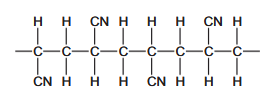
Which monomer would form this polymer?
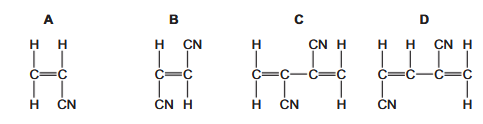
(B) B
(C) C
(D) D
▶️ Answer/Explanation
Correct Answer: \( \boxed{\mathrm{A}} \)
The repeating unit in the polymer is:
\( \mathrm{-CH_2-CH(CN)-} \)
Addition polymers are formed by opening the carbon-carbon double bond of the corresponding alkene.
Reintroducing the double bond gives the monomer:
\( \mathrm{CH_2=CHCN} \)
This compound is propenenitrile (acrylonitrile).
Among the options, only Option A has the structure \( \mathrm{CH_2=CHCN} \).
The other options contain additional \( \mathrm{CN} \) groups or extra carbon-carbon double bonds, which would produce different repeating units.
Therefore, the correct answer is (A).
Question 40
The mass spectrum of element Z is shown.
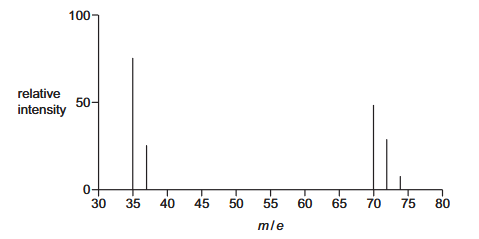
What is element Z?
(B) chlorine
(C) gallium
(D) tungsten
▶️ Answer/Explanation
Correct Answer: \( \boxed{\mathrm{B}} \)
The spectrum shows two major peaks at approximately \(m/e=35\) and \(m/e=37\) in a ratio of about 3:1.
These correspond to the naturally occurring isotopes:
- \( \mathrm{^{35}Cl} \) (about 75%)
- \( \mathrm{^{37}Cl} \) (about 25%)
The additional peaks at \(m/e=70\), 72 and 74 are molecular ion peaks for \( \mathrm{Cl_2^+} \):
- \( \mathrm{^{35}Cl-^{35}Cl^+} \rightarrow m/e=70 \)
- \( \mathrm{^{35}Cl-^{37}Cl^+} \rightarrow m/e=72 \)
- \( \mathrm{^{37}Cl-^{37}Cl^+} \rightarrow m/e=74 \)
This characteristic pattern is unique to chlorine.
Therefore, the correct answer is (B).