Home / 9701_w20_qp_11-bitsham

9701_w20_qp_11-bitsham

Question

 Which statement is correct?

A $\mathrm{C} l$ has a relative isotopic mass of 35.5 .
B $\mathrm{Cl}_2$ has a relative molecular mass of 70 .
C IC $l$ has a relative molecular mass of 162.4 .
D $\mathrm{NaC} l$ has a relative molecular mass of 58.5 .

▶️Answer/Explanation

Ans:C

Question

Strontium metal can be extracted from strontium oxide, $\mathrm{SrO}$, by reduction with aluminium. One of the possible reactions is shown.
$
6 \mathrm{SrO}+2 \mathrm{Al} \rightarrow 3 \mathrm{Sr}+\mathrm{Sr}_3 \mathrm{Al}_2 \mathrm{O}_6
$
What is the maximum mass of strontium metal that can be produced from the reduction of $100 \mathrm{~g}$ of strontium oxide using this reaction?
A $41.3 \mathrm{~g}$
B $42.3 \mathrm{~g}$
C $84.6 \mathrm{~g}$
D $169.2 \mathrm{~g}$

▶️Answer/Explanation

Ans:B

Question

A single ${ }^{32} \mathrm{P}$ nucleus can be produced when a single ${ }^{32} \mathrm{~S}$ nucleus joins with particle $\mathrm{X}$. In the process a proton is emitted.
What is particle $X$ ?
A a deuteron, ${ }_1^2 \mathrm{H}^{+}$
B an electron
C a neutron
D a proton

▶️Answer/Explanation

Ans:C

Question

In which of the following, when in liquid form, are there only intermolecular forces based on temporary dipoles between the particles?
A bromine
B ethanol
C hydrogen chloride
D water

▶️Answer/Explanation

Ans:A

Question

Copper has a high melting point.
What is the reason for the high melting point of copper?
A strong attractive forces between copper atoms only
B strong attractive forces between copper ions and delocalised electrons
C strong attractive forces between copper ions only
D strong attractive forces between copper atoms and delocalised electrons

▶️Answer/Explanation

Ans:B

Question

Which pair of standard enthalpy changes are numerically equal?
A atomisation of $\mathrm{CH}_4(\mathrm{~g})$ and formation of $\mathrm{CH}_4(\mathrm{~g})$
B combustion of $\mathrm{CH}_3 \mathrm{OH}(\mathrm{l})$ and combustion of graphite + 2(combustion of $\mathrm{H}_2(\mathrm{~g})$ )
C combustion of graphite and formation of $\mathrm{CO}_2(\mathrm{~g})$
D neutralisation of $\mathrm{HCl}(\mathrm{aq})$ with $\mathrm{NaOH}(\mathrm{aq})$ and formation of $\mathrm{H}_2 \mathrm{O}(\mathrm{l})$

▶️Answer/Explanation

Ans:C

Question

An energy cycle is drawn for the following reaction.
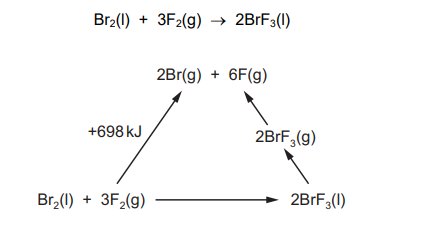
The standard enthalpy of formation of $\mathrm{BrF}_3(\mathrm{l})=-301 \mathrm{~kJ} \mathrm{~mol}^{-1}$.
The enthalpy change of $\mathrm{BrF}_3(\mathrm{l})$ to $\mathrm{BrF}_3(\mathrm{~g})$ is $+44 \mathrm{~kJ} \mathrm{~mol}^{-1}$.
What is the average bond energy of the $\mathrm{Br}-\mathrm{F}$ bond in $\mathrm{BrF}_3$ ?
A $152 \mathrm{~kJ} \mathrm{~mol}^{-1}$
B $202 \mathrm{~kJ} \mathrm{~mol}^{-1}$
C $304 \mathrm{~kJ} \mathrm{~mol}^{-1}$
D $404 \mathrm{~kJ} \mathrm{~mol}^{-1}$

▶️Answer/Explanation

Ans:B

Question

 In which reaction does the greatest change in the oxidation number of sulfur occur?
A $\mathrm{S}(\mathrm{s})+\mathrm{O}_2(\mathrm{~g}) \rightarrow \mathrm{SO}_2(\mathrm{~g})$
B $\mathrm{SO}_2(\mathrm{~g})+\frac{1}{2} \mathrm{O}_2(\mathrm{~g}) \rightleftharpoons \mathrm{SO}_3(\mathrm{~g})$
c $\mathrm{SO}_3(\mathrm{~g})+\mathrm{H}_2 \mathrm{SO}_4(\mathrm{l}) \rightarrow \mathrm{H}_2 \mathrm{~S}_2 \mathrm{O}_7(\mathrm{l})$
D $\mathrm{H}_2 \mathrm{~S}_2 \mathrm{O}_7(\mathrm{I})+\mathrm{H}_2 \mathrm{O}(\mathrm{I}) \rightarrow 2 \mathrm{H}_2 \mathrm{SO}_4(\mathrm{I})$

▶️Answer/Explanation

Ans:A

Question

The first stage in the chloride process for the manufacture of titanium consists of the following reaction.
$
2 \mathrm{TiO}_2+4 \mathrm{Cl}_2+3 \mathrm{C} \rightarrow 2 \mathrm{TiCl}_4+2 \mathrm{CO}+\mathrm{CO}_2
$
What is reduced in this reaction?
A carbon
B chlorine
C oxygen
D titanium

▶️Answer/Explanation

Ans:B

Question

In aqueous solution, sulfuric acid dissociates as shown.
$
\begin{array}{ll}
\mathrm{H}_2 \mathrm{SO}_4 \rightarrow \mathrm{HSO}_4^{-}+\mathrm{H}^{+} & \text {This reaction goes to completion. } \\
\mathrm{HSO}_4^{-} \rightleftharpoons \mathrm{SO}_4^{2-}+\mathrm{H}^{+} & \text {This reaction reaches equilibrium with constant } K_{\mathrm{c}} \text {. }
\end{array}
$
Analysis of a $2.00 \mathrm{moldm}^{-3}$ solution of $\mathrm{H}_2 \mathrm{SO}_4$ found the $\mathrm{HSO}_4^{-}$concentration to be $1.988 \mathrm{~mol} \mathrm{dm}^{-3}$.
What is $K_c$ ?
A $1.381 \times 10^5 \mathrm{dm}^3 \mathrm{~mol}^{-1}$
B $\quad 82.34 \mathrm{dm}^3 \mathrm{~mol}^{-1}$
C $1.214 \times 10^{-2} \mathrm{~mol} \mathrm{dm}^{-3}$
D $7.244 \times 10^{-5} \mathrm{~mol} \mathrm{dm}^{-3}$

▶️Answer/Explanation

Ans:C

Question

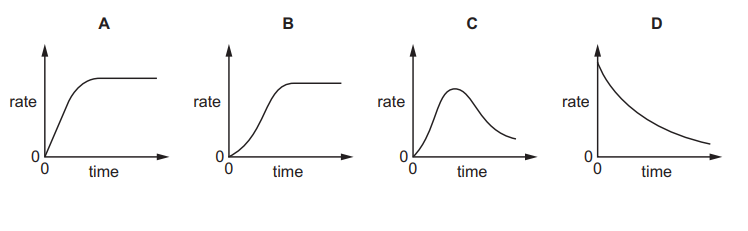
An autocatalytic reaction is a reaction in which one of the products catalyses the reaction.
Which curve would be obtained if the rate of an autocatalytic reaction is plotted against time?
▶️Answer/Explanation

Ans:C

Question

$\mathrm{X}$ and $\mathrm{Y}$ are two elements in Period 3 of the Periodic Table. They combine to form compound $Z$.
$X$ forms a soluble acidic oxide. The oxidation number of $X$ in this oxide is +4 .
$Y$ forms an amphoteric oxide.
What is the formula of compound $Z$ ?
A AlP
B $\mathrm{Al}_2 \mathrm{~S}_3$
C $\mathrm{Si}_2 \mathrm{P}_5$
D $\mathrm{SiS}_2$

▶️Answer/Explanation

Ans:B

Question

 This question is about two elements in Group 2, $Q$ and $R$.
Three of the statements shown are correct for metal Q.
The one remaining statement is correct for metal $R$.
Which statement applies to $\mathrm{R}$ ?
A A saturated solution of the hydroxide of this metal has the higher $\mathrm{pH}$ value.
B This metal has a carbonate that is used in agriculture to reduce the acidity of soil.
C This metal has the greater atomic radius.
D This metal reacts more quickly with cold water.

▶️Answer/Explanation

Ans:B

Question

The electronic arrangement for atoms of four elements is given.
Which element is the strongest oxidising agent?
A $1 s^2 2 s^2 2 p^5$
B $1 s^2 2 s^2 2 p^6 3 s^2$
C $1 s^2 2 s^2 2 p^6 3 s^2 3 p^5$
D $1 s^2 2 s^2 2 p^6 3 s^2 3 p^6 4 s^2$

▶️Answer/Explanation

Ans:A

Question

 A student mixes pairs of chemicals together in separate test-tubes.

  • excess calcium (s) + water (I)
  •  barium chloride $(a q)$ + strontium hydroxide $(a q)$
  • calcium carbonate (s) + excess hydrochloric acid (aq)
  • magnesium sulfate (aq) + barium nitrate (aq)

How many of the mixtures produce a white, solid product?
A 0
B 1
C 2
D 3

▶️Answer/Explanation

Ans:C

Question

With which compound does concentrated sulfuric acid react both as a strong acid and as an oxidising agent?
A magnesium carbonate
B potassium chloride
C sodium bromide
D sulfur trioxide

▶️Answer/Explanation

Ans:C

Question

Ammonia can undergo an acid-base reaction with hydrogen chloride to form ammonium chloride. Which statement is correct?

A The ammonium ion is basic.

B The hydrogen atom from $\mathrm{HCl}$ donates a lone pair of electrons to the nitrogen atom.

C The $\mathrm{H}-\mathrm{N}-\mathrm{H}$ bond angle in ammonia is the same as the $\mathrm{H}-\mathrm{N}-\mathrm{H}$ bond angle in the ammonium ion.

D The $\mathrm{H}-\mathrm{N}-\mathrm{H}$ bond angle in the ammonium ion is the same as the $\mathrm{H}-\mathrm{C}-\mathrm{H}$ bond angle in methane

▶️Answer/Explanation

Ans:D

Question

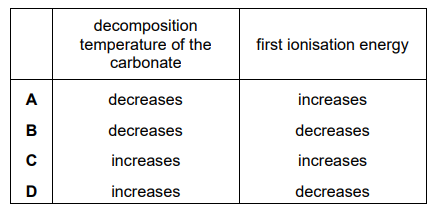
 What are the trends in the stated properties as Group 2 is descended from magnesium to barium?
▶️Answer/Explanation

Ans:D

Question

Sulfur dioxide, $\mathrm{SO}_2$, reacts with calcium hydroxide in aqueous solution.
What is the main product that is first formed?
A $\mathrm{Ca}\left(\mathrm{HSO}_4\right)_2$
B CaS
C $\mathrm{CaSO}_3$
D $\mathrm{CaSO}_4$

▶️Answer/Explanation

Ans:C

Question

 Structural and stereoisomerism should be considered when answering this question. Compounds X, Y and Z are shown.
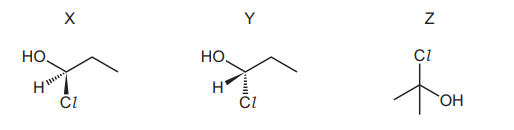
How many other isomers of $\mathrm{C}_3 \mathrm{H}_7 \mathrm{ClO}$ are there that are alcohols?
A 2
B 3
C 4
D 5

▶️Answer/Explanation

Ans:D

Question

 Two students each make a statement about 2-methylbut-1-ene.
Student 1 states that 2-methylbut-1-ene has geometrical isomers.
Student 2 states that 2-methylbut-1-ene reacts with $\mathrm{HBr}$ in an addition reaction to give 1-bromo-2-methylbutane as the main product.
Which students are correct?
A both 1 and 2
B 1 only
C 2 only
D neither 1 nor 2

▶️Answer/Explanation

Ans:D

Question

 Which statement is correct when referring to the complete combustion of PVC?
A A gas is made which contributes to global warming.
B Carbon dioxide and water are the only products.
C If water is used to clean the exhaust gases, the water becomes alkaline.
D There is no need to treat the exhaust gases as the products are non-hazardous.

▶️Answer/Explanation

Ans:A

Question

 lodoethane, $\mathrm{CH}_3 \mathrm{CH}_2 \mathrm{I}$, reacts with aqueous silver nitrate at $50^{\circ} \mathrm{C}$. A precipitate forms during this reaction.
Which row of the table is correct about this reaction?
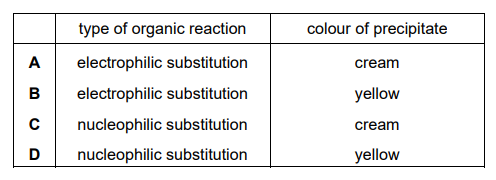
▶️Answer/Explanation

Ans:D

Question

 A student converts 1-iodopropane, $\mathrm{C}_3 \mathrm{H}_7 \mathrm{I}$, into butanoic acid, $\mathrm{C}_3 \mathrm{H}_7 \mathrm{CO}_2 \mathrm{H}$, by a two-stage chemical synthesis.
In the first of the two stages, which reagent is reacted with 1-iodopropane?
A aqueous sodium hydroxide
B ethanolic ammonia
C ethanolic potassium cyanide
D ethanolic sodium hydroxide

▶️Answer/Explanation

Ans:C

Question

 1-chloro-1-methylcyclohexane is hydrolysed by heating with $\mathrm{NaOH}(\mathrm{aq})$.
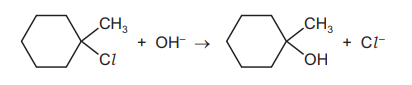
The reaction pathway is shown.
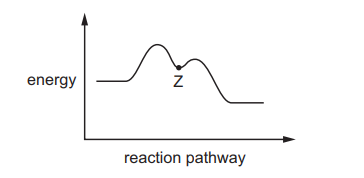
One carbon atom in 1-chloro-1-methylcyclohexane is bonded to three other carbon atoms.
What is the charge on this carbon atom at point $Z$ ?
A $1-$
B $\delta-$
C $\delta^{+}$
D $1+$

▶️Answer/Explanation

Ans:D

Question

An alcohol with the molecular formula $\mathrm{C}_5 \mathrm{H}_{12} \mathrm{O}$ decolourises warm acidified potassium manganate(VII). The alcohol also gives a yellow precipitate with alkaline aqueous iodine.
What could be the identity of the alcohol?
A 2-methylbutan-2-ol
B 3-methylbutan-2-ol
C pentan-1-ol
D pentan-3-ol

▶️Answer/Explanation

Ans:B

Question

Which pair of test results would prove that a substance, X, is a ketone?
A $X$ has no reaction with Tollens’ reagent. $X$ reacts with alkaline aqueous iodine.
B $\mathrm{X}$ is reduced by lithium aluminium hydride. $\mathrm{X}$ is oxidised by acidified dichromate(VI).
C $X$ reacts with 2,4-DNPH reagent. $X$ has no reaction with Fehling’s reagent.
D $\mathrm{X}$ reacts with hydrogen cyanide. $\mathrm{X}$ is reduced by lithium aluminium hydride.

▶️Answer/Explanation

Ans:C

Question

 Carvone is found in spearmint oil.
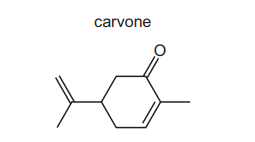
Which product is formed when carvone is reacted with $\mathrm{NaBH}_4$ ?

▶️Answer/Explanation

Ans:A

Question

 Which compound is chiral and reacts with $\mathrm{Na}_2 \mathrm{CO}_3$ to give $\mathrm{CO}_2$ ?
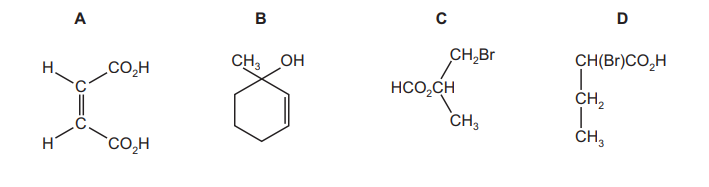
▶️Answer/Explanation

Ans:D

Question

The skeletal formula of compound X is shown.
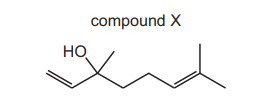
What is the molecular formula of compound X?

A $\mathrm{C}_{10} \mathrm{H}_{18} \mathrm{O}$
B $\mathrm{C}_{10} \mathrm{H}_{20} \mathrm{O}$
c $\mathrm{C}_{11} \mathrm{H}_{22} \mathrm{O}$
D $\mathrm{C}_{11} \mathrm{H}_{24} \mathrm{O}$

▶️Answer/Explanation

Ans:A

Question

 Nitrogen forms a number of oxides. Their enthalpies of formation are given.
$
\begin{aligned}
& \Delta H_{\mathrm{f}}^\theta[\mathrm{NO}(\mathrm{g})]=+90 \mathrm{~kJ} \mathrm{~mol}^{-1} \\
& \Delta H_{\mathrm{f}}^{\mathrm{\theta}}\left[\mathrm{N}_2 \mathrm{O}(\mathrm{g})\right]=+82 \mathrm{~kJ} \mathrm{~mol}^{-1} \\
& \Delta H_{\mathrm{f}}^{\mathrm{i}}\left[\mathrm{NO}_2(\mathrm{~g})\right]=+33 \mathrm{~kJ} \mathrm{~mol}^{-1}
\end{aligned}
$
Which statements are correct?
1 If $\mathrm{N}_2 \mathrm{O}(\mathrm{g})$ is oxidised by $\mathrm{O}_2(\mathrm{~g})$ to $\mathrm{NO}_2(\mathrm{~g}), 16 \mathrm{~kJ}$ is released per mole of $\mathrm{N}_2 \mathrm{O}$.
2 The decomposition of $\mathrm{N}_2 \mathrm{O}(\mathrm{g})$ to $\mathrm{N}_2(\mathrm{~g})$ and $\mathrm{O}_2(\mathrm{~g})$ is exothermic.
3 The reaction between $\mathrm{NO}$ and oxygen is exothermic.
▶️Answer/Explanation

Ans:A

Question

 Which statements are correct?
1 enthalpy of combustion of $\mathrm{H}_2=$ enthalpy of formation of $\mathrm{H}_2 \mathrm{O}$
2 enthalpy of formation of $\mathrm{H}_2=-$ (enthalpy of atomisation of $\mathrm{H}_2$ )
3 enthalpy of solution of $\mathrm{HCl}=$ enthalpy of hydration of $\mathrm{H}^{+}+$enthalpy of hydration of $\mathrm{Cl}^{-}$

▶️Answer/Explanation

Ans:D

Question

The units of $K_{\mathrm{c}}$ for an equilibrium reaction are $\mathrm{mol}^{-1} \mathrm{dm}^3$.
What could be the equation for the equilibrium?
$1 \mathrm{~A}(\mathrm{aq})+\mathrm{B}(\mathrm{aq}) \rightleftharpoons \mathrm{C}(\mathrm{s})+\mathrm{D}(\mathrm{aq})$
$2 \mathrm{P}(\mathrm{aq})+\mathrm{Q}(\mathrm{aq}) \rightleftharpoons \mathrm{R}(\mathrm{aq})$
$3 \mathrm{~W}(\mathrm{aq})+2 \mathrm{X}(\mathrm{aq}) \rightleftharpoons \mathrm{Y}(\mathrm{aq})+\mathrm{Z}(\mathrm{aq})$

▶️Answer/Explanation

Ans:A

Question

 Methanol, $\mathrm{CH}_3 \mathrm{OH}$, can be produced industrially by reacting $\mathrm{CO}$ with $\mathrm{H}_2$.
$
\mathrm{CO}(\mathrm{g})+2 \mathrm{H}_2(\mathrm{~g}) \rightleftharpoons \mathrm{CH}_3 \mathrm{OH}(\mathrm{g}) \quad \Delta \mathrm{H}=-91 \mathrm{kJmol}^{-1}
$
The process can be carried out at $4 \times 10^3 \mathrm{kPa}$ and $1150 \mathrm{~K}$.
Which statements about this reaction are correct?
1 Increasing the temperature will increase the rate of reaction because more effective collisions will occur.
2 Lowering the temperature will reduce the rate of reaction because the forward reaction is exothermic.
3 Increasing the pressure will reduce the rate of reaction because there are a larger number of moles on the left-hand side of the equation.

▶️Answer/Explanation

Ans:D

Question

Which rows correctly show the relative electrical conductivities of the sets of three Period 3 elements?
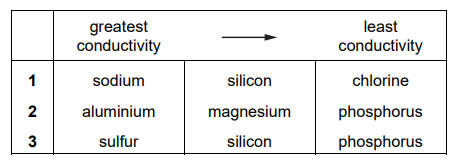
▶️Answer/Explanation

Ans:B

Question

 Three test-tubes, $\mathrm{X}, \mathrm{Y}$ and $\mathrm{Z}$, each contain water.

  • A small amount of $\mathrm{NaC} l$ is added to test-tube $\mathrm{X}$.
  • A small amount of $\mathrm{SiCl}_4$ is added to test-tube $\mathrm{Y}$.
  • $\mathrm{A}$ small amount of $\mathrm{AlC} \mathrm{Cl}_3$ is added to test-tube $Z$.

After a short time, two drops of universal indicator solution are added to each test-tube.
Which statements can be correct?
1 The $\mathrm{pH}$ in test-tube $\mathrm{X}$ is 7 .
2 The $\mathrm{pH}$ in test-tube $Y$ is 2 .
3 The $\mathrm{pH}$ in test-tube $\mathrm{Z}$ is 2 .

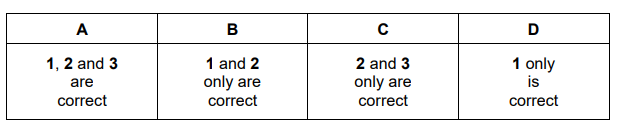
The responses A to D should be selected on the basis of
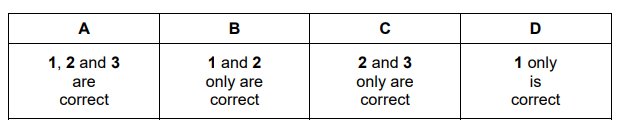
No other combination of statements is used as a correct response.

▶️Answer/Explanation

Ans:A

Question

The structure of compound R is shown.
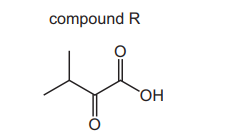
Which statements about compound $\mathrm{R}$ are correct?
1 It has an $M_{\mathrm{r}}$ of 116 .
2 It contains two groups that show strong absorptions between 1640 and $1740 \mathrm{~cm}^{-1}$ in its infrared spectrum.
3 Its only infrared absorption between 2500 and $3000 \mathrm{~cm}^{-1}$ is sharp and strong.

▶️Answer/Explanation

Ans:B

Question

During the bromination of methane, the free radical $\mathrm{CH}_3 \cdot$ is generated. A possible termination step of this reaction is the formation of $\mathrm{C}_2 \mathrm{H}_6$ by the combination of two free radicals.
What could be produced in a termination step during the bromination of propane?
$1 \mathrm{CH}_3 \mathrm{CH}_2 \mathrm{CH}\left(\mathrm{CH}_3\right) \mathrm{CH}_2 \mathrm{CH}_3$
$2 \mathrm{CH}_3 \mathrm{CH}\left(\mathrm{CH}_3\right) \mathrm{CH}\left(\mathrm{CH}_3\right)_2$
$3 \mathrm{CH}_3 \mathrm{CH}_2 \mathrm{CH}_2 \mathrm{CH}\left(\mathrm{CH}_3\right)_2$

▶️Answer/Explanation

Ans:C

Question

 Three reactions of primary alcohols are listed.
Which reactions give water as one of the products?
1 reaction with ethanoic acid
2 reaction with concentrated $\mathrm{HBr}$
3 passing the alcohol vapour over heated $\mathrm{Al}_2 \mathrm{O}_3$

▶️Answer/Explanation

Ans:A

Question

 The diagram shows part of the structure of polymer X.
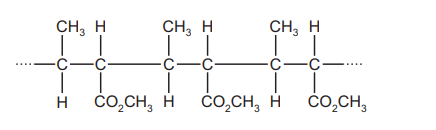
Which reagents react with polymer X?
1 aqueous sulfuric acid
2 aqueous sodium hydroxide
3 sodium

▶️Answer/Explanation

Ans:B

Scroll to Top