
Question
Sulfides are compounds that contain sulfur but not oxygen.
(a) Carbon disulfide, CS2, is a volatile liquid at room temperature and pressure.
(i) State the meaning of volatile.
(ii) Draw a ‘dot-and-cross’ diagram of the CS2 molecule.
(iii) Suggest the bond angle in a molecule of CS2.
(iv) CS2 is a liquid under room conditions, while CO2 is a gas.
Explain what causes the difference in the physical properties between CS2 and CO2.
(b) The enthalpy change of combustion of CS2(l) is represented by the following equation.
\(CS_{2}(I) + 3O_{2}(g) \xrightarrow[]{\Delta H_{C}} CO_{2}(g) + 2SO_{2}(g)\)
(i) Define enthalpy change of combustion.
(ii) The table shows the enthalpy changes of formation of CS2(l), CO2(g) and SO2(g).
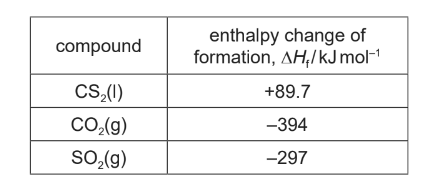
Use the data in the table to calculate the enthalpy change of combustion, ∆HC, of CS2(l), in kJmol-1.
Show your working.
(c) Hydrogen sulfide gas, H2S(g), is slightly soluble in water. It acts as a weak acid in aqueous solution.
(i) State the meaning of weak acid.
(ii) Give the formula of the conjugate base of H2S.
(iii) H2S(aq) reacts slowly with oxygen dissolved in water. The reaction is represented by the following equation.
\(H_{2}S(aq) + \frac{1}{2}O_{2}(aq) \rightarrow H_{2}O(I) + S(s)\)
Explain, with reference to oxidation numbers, why this reaction is a redox reaction.
(d) The compound As2S3 is a common mineral.
When As2S3 is heated strongly in air, it forms a mixture of products, as shown.
\(2As_{2}S_{3}(s) + 9O_{2} \rightarrow As_{4}O_{6}(s) + 6SO_{2}(g)\)
(i) A sample containing 0.198g As2S3 is placed in 0.100dm³ of pure oxygen, an excess, in a reaction chamber connected to a gas syringe at room temperature.
The reactants are heated until no further change is observed. The products are then allowed to cool to room temperature.
Calculate the volume, in dm³, of gas present at the end of the experiment.
The molar volume of gas is 24.0dm³mol-1 under these conditions. Assume that the pressure is constant throughout the experiment.
Show your working.
(ii) State the environmental consequences of releasing SO2(g) into the atmosphere.
(iii) SO2(g) can be removed from the air by reacting it with NaOH(aq). Construct an equation for the reaction of SO2(g) with NaOH(aq). Include state symbols.
Answer/Explanation
Answer: (a)(i) easily vaporised / easily evaporates / turns to gas easily
(a)(ii)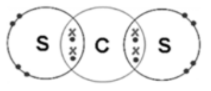
M1 bonding pairs
M2 Correct number of remaining outer electrons
(a)(iii) 180°
(a)(iv) M1 CS2 has more electrons
M2 So stronger induced dipole (forces) (between molecules)
(b)(i) M1 (enthalpy/energy change when) 1 mole of a compound
M2 burns/combusts/reacts in excess oxygen/O2
OR
completely burns/ completely combusts/completely reacts in oxygen/O2
(b)(ii) M1 (394 + 2 (–297) – (+89.7)
M2 = –1080 (kJ mol-1)
(c)(i) weak [acid] partially dissociates/partially ionises (into H+ ions/protons)
(c)(ii) HS–
(c)(iii) M1 S (increases) oxidation number –2 → 0 so oxidation / or is oxidised
M2 O (decreases) O.N. 0 → –2 so reduction / is reduced
(d)(i) M1 moles of As2S3 = 0.198 / 246.1 / 8.05 × 10⁻⁴
M2 moles SO2 (using moles of As2S3 as limiting factor) = 2.41(36) × 10-3 moles (6 / 2× 8.05 × 10-4)
Volume SO2 = 2.41(36) × 10-3 × 24 = 0.0579 dm³
M3 Moles O2 used in reaction = 8.05 × 10-4 × 9 / 2 = 3.62 × 10⁻³ Volume O2 used in reaction = 3.62 × 10-3 × 24 = 0.0869 dm³
M4 Final total volume gas = (0.1 – 0.0869) + 0.0579 = [0.0131 + 0.0579] = 0.071(0) dm³
M4 ONLY award 4th mark if the final answer rounds to 0.071
Answer to minimum of 2 sig figs
MAX 3 for using ecf from M1 to M2 to M3 and M4
Award all 4 marks if final answer rounds to 0.071
(d)(ii) acid rain
(d)(iii) M1 SO2(g) + 2NaOH(aq) → Na2SO3(aq) + H2O(l) AND correct species and balancing
M2 State symbols
Question
The reaction scheme shows some reactions of calcium.
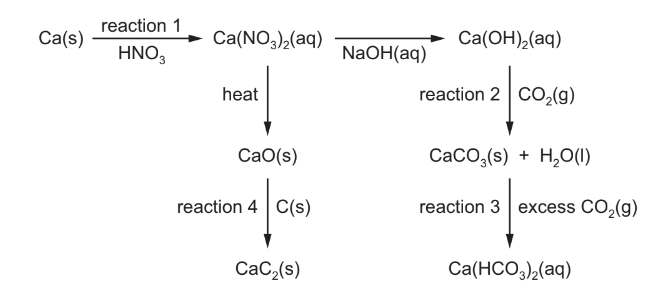
(a) (i) Reaction 1 produces Ca(NO3) 2 and one other product. Identify the other product.
(ii) Construct an equation for the thermal decomposition of Ca(NO3) 2(s).
(iii) State the trend in the thermal stability of the Group 2 nitrates down the group.
(iv) In reaction 3, excess CO2 is bubbled through water containing CaCO3. A solution of Ca(HCO3)2(aq) forms. Construct an equation for reaction 3.
(b) Describe how Ca(OH)2 is used in agriculture.
(c) In reaction 4, calcium carbide, CaC2, is formed from CaO.
CaC2 contains the C22- anion. Each carbon in C22- is sp hybridised.
(i) Describe how sp hybridised orbitals are formed.
(ii) Sketch a diagram to show how two sp hybrid orbitals can form a sigma (σ) bond.
(d) The flowchart shows some reactions of CaC2.(i) Reaction 5 can be used to prepare NH3.
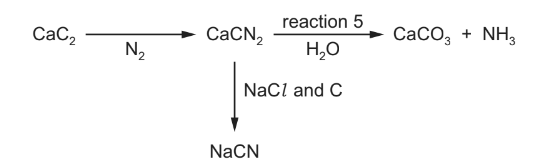
(i) Reaction 5 can be used to prepare NH3.
\(CaCN_{2} + 3H_{2}O \rightarrow CaCO_{3} + 2NH_{3}\)
Calculate the minimum mass, in tonnes, of calcium cyanamide, CaCN2, that is required to
produce 1.50 × 10⁶ tonnes of NH3.
Show your working.
1 tonne = 1.00 × 10⁶ g
(ii) Draw the structure of the organic products formed in the following reactions.
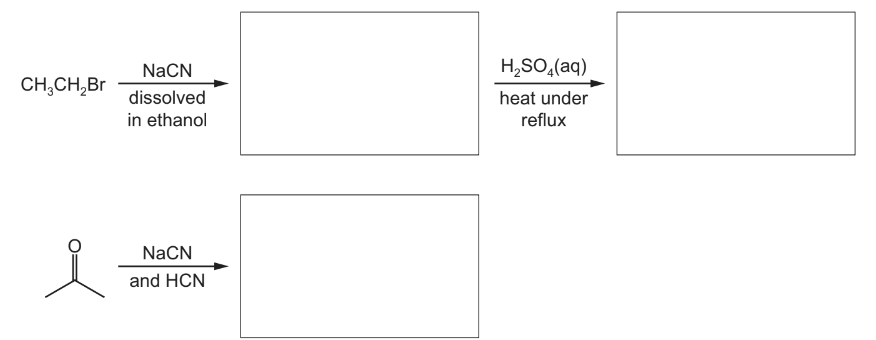
Answer/Explanation
Answer: (a)(i) hydrogen / H2
(a)(ii) Ca(NO3)2 → CaO + 2NO2 + 1⁄2O2
(a)(iii) (thermal stability) increases
(a)(iv) CaCO3 + H2O + CO2→ Ca(HCO3 )2
(b) reduces acidity of soil
(c)(i) Mixing / overlap / combination of one / an s and one / a p orbital
(c)(ii) Sketch a diagram to show HOW two sp hybrid orbitals can form a SIGMA bond
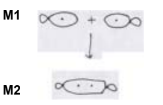
(d)(i) M1 moles of NH3 = 1.50 × 106 × 106 ÷ 17 = 8.82 × 10¹⁰
M2 mass of CaCN2 = 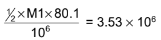
(d) (ii)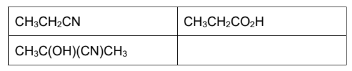
Question
Phosphorus is a reactive Period 3 element.
(a) Phosphorus has several allotropes. Details of two allotropes are given.
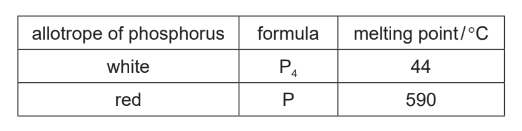
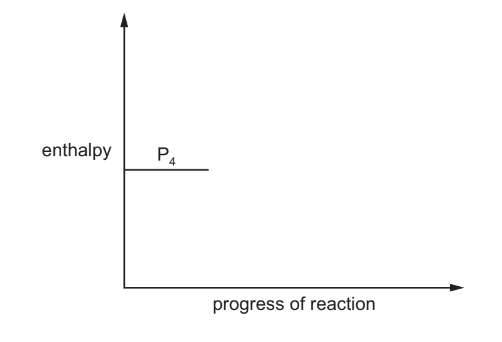
\(\frac{1}{4}P_{4}(s) \rightarrow P(s)\) ∆H = –17.6kJmol–1
white red
Use this information to draw a reaction pathway diagram to show the formation of redphosphorus (P) from white phosphorus (P4).
(b) Some reactions of P4(s) are shown in the reaction scheme.
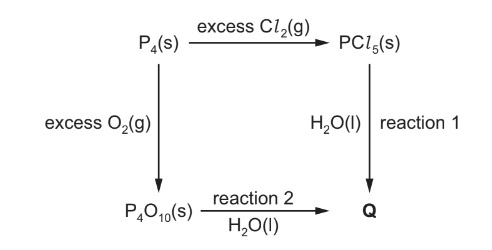
(i) State the oxidation number of phosphorus in P4O10.
(ii) Deduce the identity of Q and hence construct chemical equations for reactions 1 and 2.
reaction 1 \(PCl_{3} + ……H_{2}O \rightarrow\)
reaction 2 \(P_{4}O_{10} + ……H_{2}O \rightarrow\)
(c) Triphenylphosphine is used in a type of reaction known as a Wittig reaction.
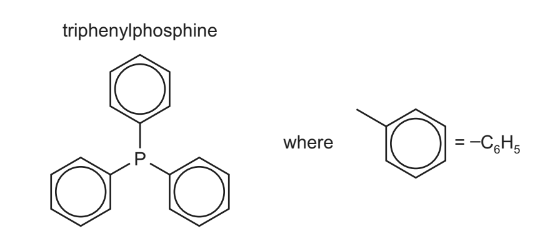
(i) Give the empirical formula of triphenylphosphine.
In a Witting reaction, an aldehyde reacts with a halogenoalkane to form an alkene.The conversion
is shown in the following unbalanced equation.
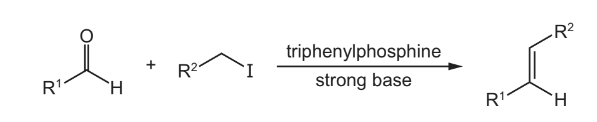
Compound H can be made from propanal, C2H5CHO. Stage 3 in the reaction scheme is a
Wittig reaction.
stage 1 \(C_{2}H_{5}CHO \xrightarrow[]{NaBH_{4}} G\)
stage 2 \(G \xrightarrow[]{red\: phosphorus\: and \: I_{2}} C_{2}H_{5}CH_{2}I\)
stage 3 \(C_{2}H_{5}CH_{2}I + C_{2}H_{5}CHO \xrightarrow[strong\: base]{triphenylphosphine} H\)
(ii) State the types of reaction that occur in stages 1 and 2.
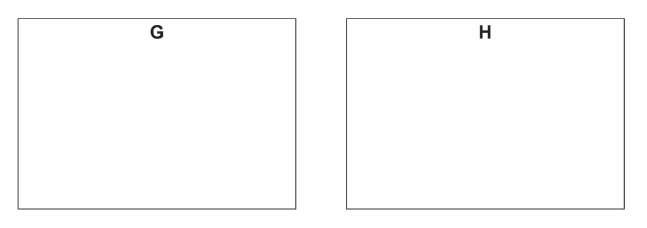
(iii) Draw the structures of G and H in the boxes provided.
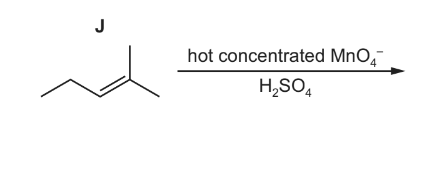
(d) Identify the organic products formed when compound J, shown below, is heated with hot concentrated acidified manganate(VII) ions.
Answer/Explanation
Answer: (a)(i) M1 simple molecular
M2 giant molecular
M3 weak IMFs (overcome) in P4 AND strong (covalent) bonds (broken) in P
(a)(ii) 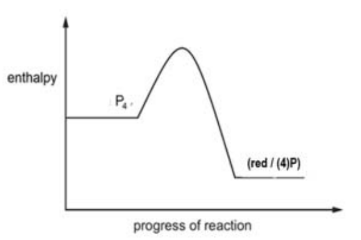
(b)(i) (+)5/V
(b)(ii)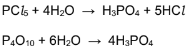
(c)(i) C18 H15 P
(c)(ii) stage 1 = reduction
stage 2 = substitution
(c)(iii) 
(d) 
Question
Compound B is a liquid with a fruity smell.
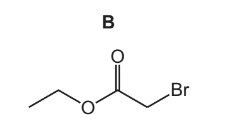
The reaction scheme shows how B can be made from ethanol, C2H5OH.
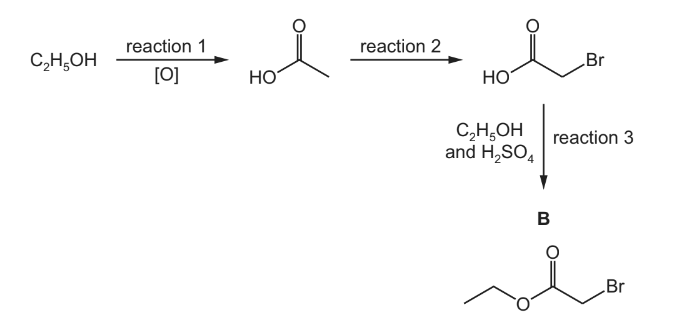
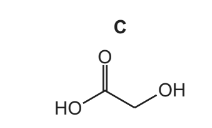
If C is present in the reaction mixture of reaction 3, a different compound, compound D, will
also form. Compound D has two identical functional groups.
The infrared spectrum of D shows strong absorptions at 1100cm-1 and 1720cm-1, but no
absorption due to O–H bonds.
Use the Data Booklet to identify the functional group present in D.
Explain your answer as fully as you can.
(c) Some other reactions of C are shown.
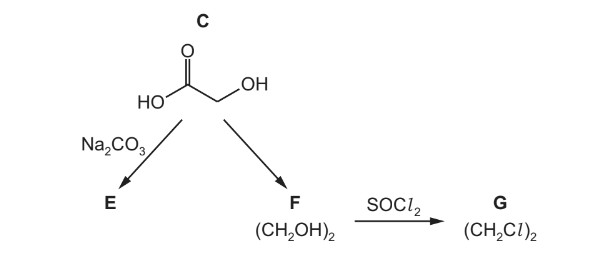
(i) Draw the structure of E.
Explain your answer.
(iii) Construct an equation for the reaction of (CH2OH)2 with SOCl2 to form G, (CH2Cl)2.
(d) Explain why C is very soluble in water.
Answer/Explanation
Answer: (a)(i) potassium/sodium dichromate [(VI)] / K 2Cr2O7 / Na2Cr2O7
acidified AND (heat) under reflux
(a)(ii) C2H5OH + 2[O] → CH3CO2H + H2O
(a)(iii) substitution
(a)(iv) in the same phase / in same state
(b) M1 ester
M2 1100 cm-1 linked to C—O AND 1720 cm-1 linked to C=O
M3 No COOH / carboxylic acid and No OH / alcohol in D (but present in C)
OR
COOH / carboxylic acid and OH / alcohol reacted /lost (in C to form D)
(c)(i) 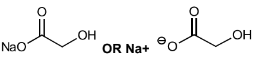
(c)(ii) Not a strong (enough) reducing agent
(c)(iii) Construct an equation
(CH2OH)2 + SOCl2 → (CH2Cl)2+ SO2 + H2O
(d) Forms hydrogen bonds with water