
Question 1
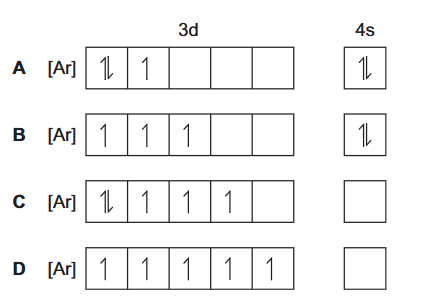
What is the electrons in boxes notation for the \(\mathrm{Fe^{3+}}\) ion?
▶️ Answer/Explanation
Correct Answer: \( \boxed{\mathrm{D}} \)
The electronic configuration of iron is:
\(\mathrm{Fe:[Ar]\,3d^6\,4s^2}\)
When forming \(\mathrm{Fe^{3+}}\), the two electrons are removed from the \(4s\) orbital first, followed by one electron from the \(3d\) subshell:
\(\mathrm{Fe^{3+}:[Ar]\,3d^5}\)
According to Hund’s rule, the five \(3d\) orbitals each contain one unpaired electron and the \(4s\) orbital is empty.
Therefore, the correct answer is (D).
Question 2
Which equation has an energy change that is equal to the first ionisation energy of bromine?
(B) \(\mathrm{Br(g)\rightarrow Br^-(g)-e^-}\)
(C) \(\mathrm{\dfrac{1}{2}Br_2(g)\rightarrow Br^+(g)+e^-}\)
(D) \(\mathrm{\dfrac{1}{2}Br_2(g)\rightarrow Br^-(g)-e^-}\)
▶️ Answer/Explanation
Correct Answer: \( \boxed{\mathrm{A}} \)
The first ionisation energy is the energy required to remove one electron from each atom in one mole of gaseous atoms to form one mole of gaseous \(1+\) ions.
It is represented by:
\(\mathrm{Br(g)\rightarrow Br^+(g)+e^-}\)
Options (C) and (D) begin with bromine molecules rather than gaseous atoms, while option (B) represents electron gain instead of electron removal.
Therefore, the correct answer is (A).
Question 3
The reaction of hydrogen sulfide with sulfur dioxide gives sulfur as one of the products.
The two relevant redox equations are shown.
\(\mathrm{H_2S(aq)\rightleftharpoons S(s)+2H^+(aq)+2e^-}\)
\(\mathrm{SO_2(aq)+4H^+(aq)+4e^-\rightleftharpoons S(s)+2H_2O(l)}\)
How many moles of hydrogen sulfide are needed to react with sulfur dioxide to produce \(1\,\mathrm{mol}\) of sulfur?
(B) \(\dfrac{2}{3}\,\mathrm{mol}\)
(C) \(\dfrac{3}{2}\,\mathrm{mol}\)
(D) \(2\,\mathrm{mol}\)
▶️ Answer/Explanation
Correct Answer: \( \boxed{\mathrm{B}} \)
Multiply the oxidation half-equation by \(2\):
\(\mathrm{2H_2S\rightarrow2S+4H^++4e^-}\)
Adding the reduction half-equation gives:
\(\mathrm{2H_2S+SO_2\rightarrow3S+2H_2O}\)
Therefore, \(2\) moles of \(\mathrm{H_2S}\) produce \(3\) moles of sulfur.
To produce \(1\,\mathrm{mol}\) of sulfur:
\(\dfrac{2}{3}\,\mathrm{mol}\) of \(\mathrm{H_2S}\) is required.
Therefore, the correct answer is (B).
Question 4
Which statement is correct?
(B) The relative molecular mass of \(\mathrm{O_2}\) is \(16.0\).
(C) The relative formula mass of \(\mathrm{CaCO_3}\) is \(100.1\).
(D) The relative isotopic mass of a \(\mathrm{^{24}Mg}\) atom is \(24.3\).
▶️ Answer/Explanation
Correct Answer: \( \boxed{\mathrm{C}} \)
Relative formula mass of calcium carbonate:
\(\mathrm{CaCO_3}=40.1+12.0+3(16.0)=100.1\)
Option (A) is incorrect because \(35.5\) is the average relative atomic mass of chlorine, not the isotopic mass of \(\mathrm{^{35}Cl}\).
Option (B) is incorrect because the relative molecular mass of \(\mathrm{O_2}\) is \(32.0\).
Option (D) is incorrect because the relative isotopic mass of \(\mathrm{^{24}Mg}\) is approximately \(24.0\), not \(24.3\).
Therefore, the correct answer is (C).
Question 5
The bonding between two atoms of nitrogen in an \(\mathrm{N_2}\) molecule involves the hybridisation of atomic orbitals to form sp orbitals.
Which row is correct?
| Formation of the \(\sigma\) bond between the nitrogen atoms in \(\mathrm{N_2}\) | Type of orbital which contains the lone pair of electrons on each nitrogen atom in \(\mathrm{N_2}\) | |
|---|---|---|
| A | an sp orbital from one atom overlaps with an sp orbital of the other atom | p |
| B | an sp orbital from one atom overlaps with an sp orbital of the other atom | sp |
| C | an s orbital from one atom overlaps with a p orbital of the other atom | p |
| D | an s orbital from one atom overlaps with a p orbital of the other atom | sp |
▶️ Answer/Explanation
Correct Answer: \( \boxed{\mathrm{B}} \)
In \(\mathrm{N_2}\), each nitrogen atom is sp hybridised.
The \(\sigma\) bond is formed by overlap of one sp orbital from each nitrogen atom.
The remaining sp orbital on each nitrogen contains the lone pair, while the two unhybridised p orbitals form the two \(\pi\) bonds.
Therefore, the correct answer is (B).
Question 6
Three bond angles are labelled on the molecule shown.
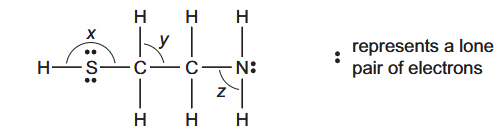
What is the order of decreasing size of the bond angles \(x\), \(y\) and \(z\)?
| Largest | → | Smallest | |
|---|---|---|---|
| A | \(x\) | \(y\) | \(z\) |
| B | \(x\) | \(z\) | \(y\) |
| C | \(y\) | \(z\) | \(x\) |
| D | \(z\) | \(y\) | \(x\) |
▶️ Answer/Explanation
Correct Answer: \( \boxed{\mathrm{C}} \)
Angle \(y\) is around a tetrahedral carbon atom with four bonding pairs, so it is approximately \(109.5^\circ\).
Angle \(z\) is around nitrogen with one lone pair. Lone pair-bond pair repulsion decreases the bond angle to about \(107^\circ\).
Angle \(x\) is around sulfur with two lone pairs. The greater lone pair repulsion decreases the bond angle further, making it the smallest.
Therefore, the order of decreasing bond angle is \(y>z>x\), so the correct answer is (C).
Question 7
X and Y are different elements in Period 3.
Atoms of X and Y each have only one completely filled orbital in their highest occupied energy sub-shell.
Y has a greater first ionisation energy than X.
Which row shows the structure and bonding in X and Y?
| X | Y | |
|---|---|---|
| A | giant metallic | giant metallic |
| B | giant metallic | simple molecular |
| C | giant covalent | simple molecular |
| D | simple molecular | simple molecular |
▶️ Answer/Explanation
Correct Answer: \( \boxed{\mathrm{B}} \)
The Period 3 elements with only one completely filled orbital in their highest occupied sub-shell are magnesium (\(\mathrm{3s^2}\)) and sulfur (\(\mathrm{3p^4}\)).
Sulfur has a higher first ionisation energy than magnesium.
Magnesium has a giant metallic structure, while sulfur exists as simple molecular \(\mathrm{S_8}\) molecules.
Therefore, the correct answer is (B).
Question 8
A pure sample of a gas has a density of \(2.62\,\mathrm{g\,dm^{-3}}\) at \(101000\,\mathrm{Pa}\) and \(25^\circ\mathrm{C}\). The gas behaves ideally under these conditions.
Which expression gives the \(M_r\) of the gas?
(B) \(\dfrac{101000\times0.001}{2.62\times8.31\times298}\)
(C) \(\dfrac{2.62\times8.31\times25}{101000\times0.001}\)
(D) \(\dfrac{2.62\times8.31\times298}{101000\times0.001}\)
▶️ Answer/Explanation
Correct Answer: \( \boxed{\mathrm{D}} \)
For an ideal gas:
\(PV=nRT\)
Using \(n=\dfrac{m}{M_r}\) and density \(=\dfrac{m}{V}\):
\(M_r=\dfrac{\mathrm{density}\times RT}{P}\)
Temperature must be converted to kelvin: \(25^\circ\mathrm{C}=298\,\mathrm{K}\), and \(1\,\mathrm{dm^3}=0.001\,\mathrm{m^3}\).
Therefore, the correct expression is (D).
Question 9
When \(0.47\,\mathrm{g}\) of a hydrocarbon is completely burnt in air, the energy released heats \(200\,\mathrm{g}\) of water from \(23.7^\circ\mathrm{C}\) to \(41.0^\circ\mathrm{C}\).
What is the energy absorbed, in Joules, by the water?
(B) \(0.47\times4.18\times(273+17.3)\)
(C) \(200\times4.18\times17.3\)
(D) \(200\times4.18\times(273+17.3)\)
▶️ Answer/Explanation
Correct Answer: \( \boxed{\mathrm{C}} \)
The energy absorbed by water is calculated using:
\(q=mc\Delta T\)
where:
- \(m=200\,\mathrm{g}\)
- \(c=4.18\,\mathrm{J\,g^{-1}\,^\circ C^{-1}}\)
- \(\Delta T=41.0-23.7=17.3^\circ\mathrm{C}\)
Therefore, \(q=200\times4.18\times17.3\).
Therefore, the correct answer is (C).
Question 10
One commercially available heat pad contains iron, activated carbon and water. The heat pad is activated by air. This causes the pad to get hotter.
Which statement describes the chemical reaction occurring in the heat pad when it is exposed to air?
(B) The reaction is endothermic and iron loses electrons.
(C) The reaction is exothermic and iron gains electrons.
(D) The reaction is exothermic and iron loses electrons.
▶️ Answer/Explanation
Correct Answer: \( \boxed{\mathrm{D}} \)
The heat pad works by the oxidation of iron when exposed to oxygen in air.
Oxidation is the loss of electrons, so iron loses electrons as it forms iron ions.
The oxidation of iron releases heat, making the process exothermic.
Therefore, the correct answer is (D).
Question 11
In which substance is the average oxidation number of sulfur the highest?
(B) \(\mathrm{Na_2S_4O_6}\)
(C) \(\mathrm{Na_2S_2O_3}\)
(D) \(\mathrm{SO_2Cl_2}\)
▶️ Answer/Explanation
Correct Answer: \( \boxed{\mathrm{D}} \)
Calculate the average oxidation number of sulfur in each compound:
- \(\mathrm{S_8}\): \(0\)
- \(\mathrm{Na_2S_4O_6}\): Average sulfur oxidation number \(=\dfrac{+10}{4}=+2.5\)
- \(\mathrm{Na_2S_2O_3}\): Average sulfur oxidation number \(=\dfrac{+4}{2}=+2\)
- \(\mathrm{SO_2Cl_2}\): Sulfur oxidation number \(=+6\)
The highest average oxidation number is \(+6\) in \(\mathrm{SO_2Cl_2}\).
Therefore, the correct answer is (D).
Question 12
An equilibrium can be represented by the equation shown.
\(\mathrm{P(aq)+Q(aq)\rightleftharpoons2R(aq)+S(aq)}\)
In a certain mixture, of volume \(1.0\,\mathrm{dm^3}\), the equilibrium concentration of Q is \(10\,\mathrm{mol\,dm^{-3}}\).
What will be the new equilibrium concentration of Q if \(5.0\,\mathrm{mol}\) of pure Q is completely dissolved in the mixture?
(B) between \(10\,\mathrm{mol\,dm^{-3}}\) and \(15\,\mathrm{mol\,dm^{-3}}\)
(C) \(10\,\mathrm{mol\,dm^{-3}}\)
(D) between \(5.0\,\mathrm{mol\,dm^{-3}}\) and \(10\,\mathrm{mol\,dm^{-3}}\)
▶️ Answer/Explanation
Correct Answer: \( \boxed{\mathrm{B}} \)
Adding \(5.0\,\mathrm{mol}\) of Q to a \(1.0\,\mathrm{dm^3}\) solution initially increases the concentration of Q from \(10\) to \(15\,\mathrm{mol\,dm^{-3}}\).
The equilibrium shifts to the right to oppose the increase in Q, consuming some of the added Q to produce more R and S.
Therefore, the final equilibrium concentration of Q is less than \(15\,\mathrm{mol\,dm^{-3}}\) but greater than the original \(10\,\mathrm{mol\,dm^{-3}}\).
Therefore, the correct answer is (B).
Question 13
In the Contact process, sulfur dioxide and oxygen react to form sulfur trioxide.
In the Haber process, nitrogen and hydrogen react to form ammonia.
Which statement about these processes is correct?
(B) In the Contact process, the value of \(K_p\) falls when pressure is increased at constant \(T\).
(C) The Haber process uses a homogeneous catalyst.
(D) When \(\mathrm{V_2O_5}\) is used in the Contact process, the position of equilibrium is unchanged.
▶️ Answer/Explanation
Correct Answer: \( \boxed{\mathrm{D}} \)
A catalyst increases the rate at which equilibrium is reached but does not change the equilibrium position or the value of the equilibrium constant.
In the Contact process, \(\mathrm{V_2O_5}\) acts as a catalyst, so the equilibrium position remains unchanged.
Option (A) is incorrect because \(K_p\) for the Haber process has units. Option (B) is incorrect because \(K_p\) depends only on temperature. Option (C) is incorrect because the Haber process uses a heterogeneous iron catalyst.
Therefore, the correct answer is (D).
Question 14
\(20.0\,\mathrm{cm^3}\) of hydrogen peroxide decomposes to water and oxygen in the presence of a suitable catalyst.
\(160\,\mathrm{cm^3}\) of oxygen, measured at room conditions, is produced in \(5.00\,\mathrm{minutes}\).
What is the average rate of decomposition of hydrogen peroxide during this reaction period?
(B) \(4.44\times10^{-5}\,\mathrm{mol\,s^{-1}}\)
(C) \(1.76\times10^{-4}\,\mathrm{mol\,s^{-1}}\)
(D) \(2.67\times10^{-3}\,\mathrm{mol\,s^{-1}}\)
▶️ Answer/Explanation
Correct Answer: \( \boxed{\mathrm{B}} \)
The reaction is:
\(\mathrm{2H_2O_2\rightarrow2H_2O+O_2}\)
Moles of oxygen produced:
\(\mathrm{n(O_2)=\dfrac{160}{24000}=6.67\times10^{-3}\,mol}\)
Moles of hydrogen peroxide decomposed:
\(\mathrm{n(H_2O_2)=2\times6.67\times10^{-3}=1.33\times10^{-2}\,mol}\)
Time \(=5.00\,\mathrm{min}=300\,\mathrm{s}\)
Average rate:
\(\mathrm{\dfrac{1.33\times10^{-2}}{300}=4.44\times10^{-5}\,mol\,s^{-1}}\)
Therefore, the correct answer is (B).
Question 15
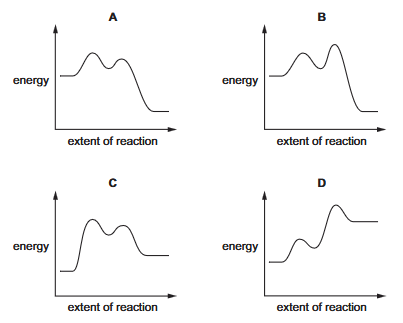
Which reaction pathway diagram shows an endothermic reaction that occurs in two steps and in which the second step of the reaction is likely to be faster than the first?
▶️ Answer/Explanation
Correct Answer: \( \boxed{\mathrm{C}} \)
An endothermic reaction has products at a higher energy level than the reactants.
A two-step reaction has two activation energy peaks.
The second step is faster than the first when its activation energy is lower than that of the first step.
Diagram C shows:
- Products at a higher energy than the reactants (endothermic).
- Two activation energy peaks.
- A lower second activation energy, so the second step is faster.
Therefore, the correct answer is (C).
Question 16
Oxides of nitrogen, \(\mathrm{NO_x}\), are involved in formation of photochemical smog and acid rain.
Which oxides of nitrogen are involved in each of these processes?
| Photochemical smog | Acid rain | |||
|---|---|---|---|---|
| NO | NO2 | NO | NO2 | |
| A | ✓ | ✓ | ✓ | ✓ |
| B | ✗ | ✓ | ✗ | ✓ |
| C | ✓ | ✓ | ✗ | ✓ |
| D | ✗ | ✓ | ✓ | ✓ |
▶️ Answer/Explanation
Correct Answer: \( \boxed{\mathrm{A}} \)
Both nitric oxide (\(\mathrm{NO}\)) and nitrogen dioxide (\(\mathrm{NO_2}\)) are involved in the formation of photochemical smog.
In the atmosphere, both gases are converted into nitrogen dioxide, which reacts with water to form nitric acid, contributing to acid rain.
Therefore, both \(\mathrm{NO}\) and \(\mathrm{NO_2}\) are involved in both processes, so the correct answer is (A).
Question 17
Sodium and sulfur react together to form sodium sulfide, \(\mathrm{Na_2S}\).
How do the atomic radius and ionic radius of sodium compare with those of sulfur?
| Atomic radius | Ionic radius | |
|---|---|---|
| A | sulfur is greater | sodium is greater |
| B | sulfur is greater | sulfur is greater |
| C | sodium is greater | sodium is greater |
| D | sodium is greater | sulfur is greater |
▶️ Answer/Explanation
Correct Answer: \( \boxed{\mathrm{D}} \)
Across Period 3, atomic radius decreases from sodium to sulfur because nuclear charge increases while the number of occupied electron shells remains the same.
Therefore, sodium has the larger atomic radius.
Sodium forms the cation \(\mathrm{Na^+}\), which is much smaller than its atom because it loses its outer shell.
Sulfur forms the anion \(\mathrm{S^{2-}}\), which is larger than its atom because it gains electrons, increasing electron-electron repulsion.
Therefore, sodium has the larger atomic radius, while sulfur has the larger ionic radius, so the correct answer is (D).
Question 18
Compound X is an oxide of a Period 3 element.
Compound X is a white solid at \(25^\circ\mathrm{C}\). It reacts with water to form an acidic solution.
What is compound X?
(B) silicon dioxide
(C) sulfur dioxide
(D) phosphorus(V) oxide
▶️ Answer/Explanation
Correct Answer: \( \boxed{\mathrm{D}} \)
Phosphorus(V) oxide is a white solid that reacts vigorously with water to form phosphoric acid:
\(\mathrm{P_4O_{10}+6H_2O\rightarrow4H_3PO_4}\)
Aluminium oxide is amphoteric, silicon dioxide does not react with water, and sulfur dioxide is a gas at room temperature.
Therefore, the correct answer is (D).
Question 19
When heated, magnesium nitrate decomposes.
Which equation for the thermal decomposition of magnesium nitrate is correct?
(B) \(\mathrm{2Mg(NO_3)_2\rightarrow2MgO+4NO+3O_2}\)
(C) \(\mathrm{2Mg(NO_3)_2\rightarrow2MgO+4NO_2+O_2}\)
(D) \(\mathrm{3Mg(NO_3)_2\rightarrow Mg_2N_3+MgO+3NO+7O_2}\)
▶️ Answer/Explanation
Correct Answer: \( \boxed{\mathrm{C}} \)
Group 2 metal nitrates (except lithium nitrate) decompose on heating to form the metal oxide, nitrogen dioxide and oxygen.
The balanced equation is:
\(\mathrm{2Mg(NO_3)_2\rightarrow2MgO+4NO_2+O_2}\)
Therefore, the correct answer is (C).
Question 20
R is the aqueous solution of an ionic compound.
- A white precipitate is formed when R is added to \(\mathrm{Sr(NO_3)_2(aq)}\).
- No visible reaction is seen when R is added to dilute \(\mathrm{HNO_3(aq)}\).
What is the anion present in compound R?
(B) \(\mathrm{SO_4^{2-}}\)
(C) \(\mathrm{HCO_3^-}\)
(D) \(\mathrm{CO_3^{2-}}\)
▶️ Answer/Explanation
Correct Answer: \( \boxed{\mathrm{B}} \)
A white precipitate with \(\mathrm{Sr^{2+}}\) indicates the possible formation of insoluble \(\mathrm{SrSO_4}\) or \(\mathrm{SrCO_3}\).
Carbonate and hydrogencarbonate ions react with dilute nitric acid to release carbon dioxide gas, giving visible effervescence.
Since no visible reaction occurs with dilute \(\mathrm{HNO_3}\), the anion cannot be \(\mathrm{CO_3^{2-}}\) or \(\mathrm{HCO_3^-}\).
Sulfate ions form insoluble \(\mathrm{SrSO_4}\) but do not react with dilute nitric acid.
Therefore, the correct answer is (B).
Question 21
In an experiment, \(0.600\,\mathrm{mol}\) of chlorine gas, \(\mathrm{Cl_2}\), is reacted with an excess of hot aqueous sodium hydroxide. One of the products is \(\mathrm{NaClO_3}\).
Which mass of \(\mathrm{NaClO_3}\) is formed?
(B) \(44.7\,\mathrm{g}\)
(C) \(63.9\,\mathrm{g}\)
(D) \(128\,\mathrm{g}\)
▶️ Answer/Explanation
Correct Answer: \( \boxed{\mathrm{A}} \)
Hot concentrated sodium hydroxide reacts with chlorine according to:
\(\mathrm{3Cl_2+6NaOH\rightarrow5NaCl+NaClO_3+3H_2O}\)
From the equation:
\(3\,\mathrm{mol}\) of \(\mathrm{Cl_2}\) produce \(1\,\mathrm{mol}\) of \(\mathrm{NaClO_3}\).
Moles of \(\mathrm{NaClO_3}\):
\(\mathrm{\dfrac{0.600}{3}=0.200\,mol}\)
\(M_r(\mathrm{NaClO_3})=23.0+35.5+3(16.0)=106.5\)
Mass:
\(\mathrm{0.200\times106.5=21.3\,g}\)
Therefore, the correct answer is (A).
Question 22
X and Y are sodium salts of Group 17 elements.
When X reacts with concentrated sulfuric acid, hydrogen sulfide, \(\mathrm{H_2S}\), is produced.
When Y reacts with concentrated sulfuric acid, there is no change in the oxidation number of the sulfur.
Which statement is correct?
(B) Aqueous Y reacts with aqueous silver nitrate to give a precipitate which is insoluble in concentrated aqueous ammonia.
(C) X and Y react separately with concentrated sulfuric acid to produce halogens.
(D) When X reacts with concentrated sulfuric acid, six halide ions are needed to reduce one sulfur atom to \(\mathrm{H_2S}\).
▶️ Answer/Explanation
Correct Answer: \( \boxed{\mathrm{A}} \)
X is sodium iodide because iodide ions reduce concentrated sulfuric acid to hydrogen sulfide.
Y is sodium chloride because chloride reacts with concentrated sulfuric acid in an acid-base reaction only, with no change in sulfur oxidation number.
Iodide ions are strong reducing agents and reduce aqueous bromine to bromide ions.
Therefore, the correct answer is (A).
Question 23
Element E is in Period 3. It forms a chloride which reacts with a small amount of water to produce a white precipitate and steamy fumes. This precipitate is soluble in \(\mathrm{NaOH(aq)}\) and in \(\mathrm{HCl(aq)}\).
What is element E?
(B) aluminium
(C) silicon
(D) phosphorus
▶️ Answer/Explanation
Correct Answer: \( \boxed{\mathrm{B}} \)
Aluminium chloride hydrolyses in a small amount of water:
\(\mathrm{AlCl_3+3H_2O\rightarrow Al(OH)_3+3HCl}\)
The white precipitate is \(\mathrm{Al(OH)_3}\), while hydrogen chloride produces steamy fumes.
Aluminium hydroxide is amphoteric, so it dissolves in both aqueous sodium hydroxide and hydrochloric acid.
Therefore, the correct answer is (B).
Question 24
Four reaction mixtures are listed.
1 \(\mathrm{(NH_4)_2SO_4(aq)}\) and \(\mathrm{NaOH}\)
2 \(\mathrm{NH_4Cl(aq)}\) and \(\mathrm{Ba(OH)_2}\)
3 \(\mathrm{NH_4Cl(aq)}\) and \(\mathrm{Na_2O}\)
4 \(\mathrm{(NH_4)_3PO_4(aq)}\) and \(\mathrm{HCl}\)
Which reaction mixtures produce ammonia as a product?
(B) 1 and 2 only
(C) 2 and 3 only
(D) 3 and 4 only
▶️ Answer/Explanation
Correct Answer: \( \boxed{\mathrm{A}} \)
Ammonium ions react with alkalis to produce ammonia:
\(\mathrm{NH_4^+ + OH^- \rightarrow NH_3 + H_2O}\)
Mixtures 1 and 2 contain soluble alkalis, while in mixture 3, \(\mathrm{Na_2O}\) reacts with water to form \(\mathrm{NaOH}\), which also releases ammonia.
Mixture 4 contains hydrochloric acid, which converts ammonia into ammonium ions rather than producing ammonia.
Therefore, the correct answer is (A).
Question 25
Two statements about a molecule of methanal are given.
1 It is planar.
2 It contains three \(\sigma\) bonds.
Which statements are correct?
(B) 1 only
(C) 2 only
(D) neither 1 nor 2
▶️ Answer/Explanation
Correct Answer: \( \boxed{\mathrm{A}} \)
Methanal, \(\mathrm{HCHO}\), has an sp\(^2\)-hybridised carbon atom, giving a trigonal planar arrangement around the carbon atom.
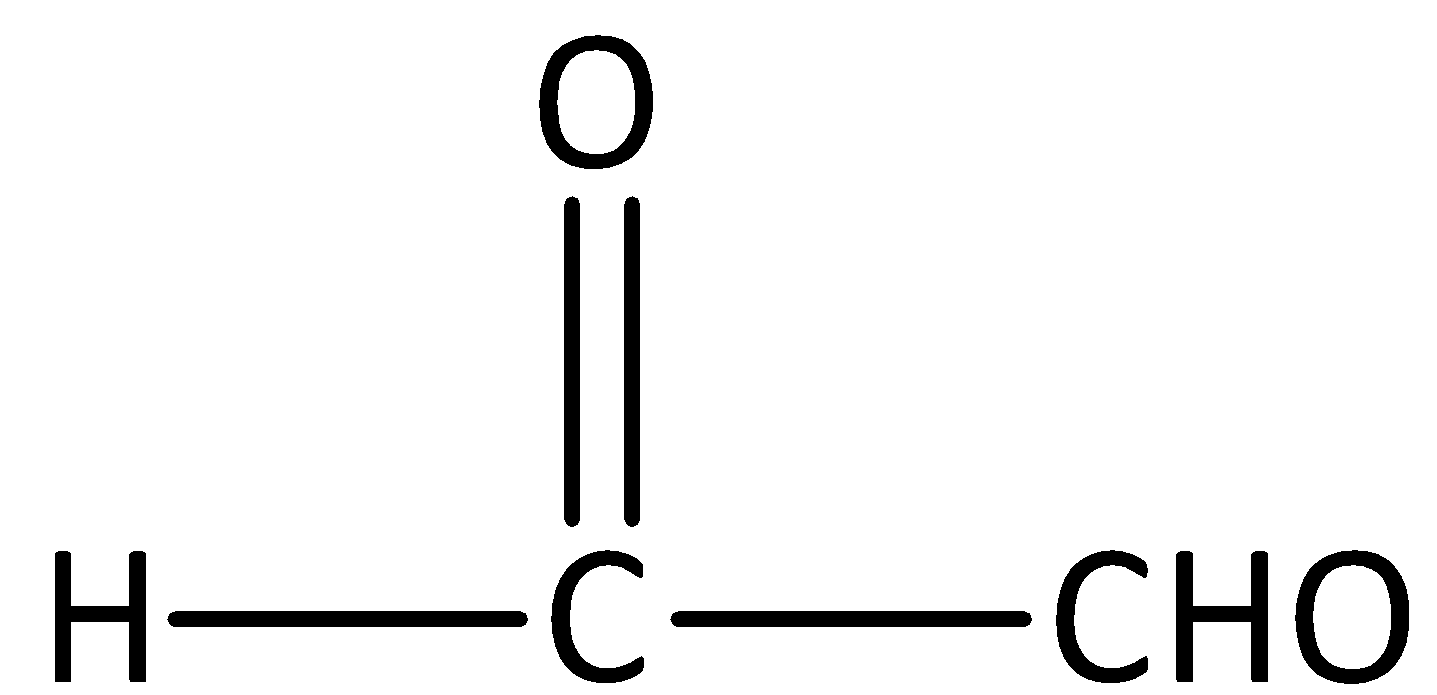
It contains two \(\mathrm{C-H}\) single bonds and one \(\mathrm{C=O}\) double bond.
A double bond consists of one \(\sigma\) bond and one \(\pi\) bond, so methanal contains:
- Two \(\mathrm{C-H}\) \(\sigma\) bonds
- One \(\mathrm{C=O}\) \(\sigma\) bond
Therefore, methanal has three \(\sigma\) bonds and is planar.
Therefore, the correct answer is (A).
Question 26
The structure of disodium cromoglycate is shown.
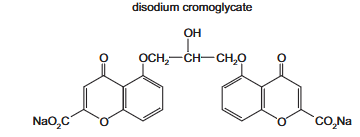
How many chiral centres are there in this molecule?
(B) 1
(C) 2
(D) 3
▶️ Answer/Explanation
Correct Answer: \( \boxed{\mathrm{A}} \)
A chiral centre is a carbon atom bonded to four different groups.
The central carbon is bonded to two identical \(\mathrm{-CH_2O-}\) groups, so it is not chiral.
All other carbon atoms are either part of aromatic rings or carbonyl groups and cannot be chiral centres.
Therefore, the molecule contains no chiral centres, so the correct answer is (A).
Question 27
What is the major product when 2-methylpent-2-ene reacts with hydrogen bromide?
(B) 2-bromo-2-methylpentane
(C) 3-bromo-2-methylpentane
(D) 4-bromo-2-methylpentane
▶️ Answer/Explanation
Correct Answer: \( \boxed{\mathrm{B}} \)
Hydrogen bromide adds across the double bond by electrophilic addition following Markovnikov’s rule.
Protonation forms the more stable tertiary carbocation at carbon-2.
The bromide ion then attacks this carbocation to form:
\(\mathrm{2\text{-}bromo\text{-}2\text{-}methylpentane}\)
Therefore, the correct answer is (B).
Question 28
Pent-2-ene is reacted with cold, dilute, acidified manganate(VII) ions.
What is the major product?
(B) \(\mathrm{CH_3CH_2COCOCH_3}\)
(C) a mixture of \(\mathrm{CH_3CH_2CH(OH)CH_2CH_3}\) and \(\mathrm{CH_3CH_2CH_2CH(OH)CH_3}\)
(D) \(\mathrm{CH_3CH_2COOH}\) and \(\mathrm{CH_3COOH}\)
▶️ Answer/Explanation
Correct Answer: \( \boxed{\mathrm{A}} \)
Cold, dilute, acidified manganate(VII) ions oxidise an alkene by adding two hydroxyl groups across the carbon-carbon double bond.
Pent-2-ene therefore forms the vicinal diol:
\(\mathrm{CH_3CH_2CH(OH)CH(OH)CH_3}\)
Oxidative cleavage to carboxylic acids occurs only under hot, concentrated oxidising conditions.
Therefore, the correct answer is (A).
Question 29
Limonene is an oil formed in the peel of citrus fruits.

Which product is formed when an excess of bromine, \(\mathrm{Br_2(l)}\), reacts with limonene at room temperature in the dark?

▶️ Answer/Explanation
Correct Answer: \( \boxed{\mathrm{D}} \)
Limonene contains two carbon-carbon double bonds.
Bromine reacts with alkenes by electrophilic addition. In the presence of excess bromine at room temperature in the dark, both double bonds undergo addition.
Therefore, four bromine atoms are added across the two double bonds to form the fully saturated tetrabromo product.
Therefore, the correct answer is (D).
Question 30
Which reaction mixture produces a nitrile?
(B) halogenoalkane with \(\mathrm{NH_3}\) in ethanol
(C) ketone with 2,4-DNPH
(D) carboxylic acid with \(\mathrm{NH_3}\) in water
▶️ Answer/Explanation
Correct Answer: \( \boxed{\mathrm{A}} \)
Ethanolic potassium cyanide reacts with halogenoalkanes by nucleophilic substitution:
\(\mathrm{R{-}X+KCN\rightarrow R{-}CN+KX}\)
The product contains the nitrile functional group, \(\mathrm{-C\equiv N}\).
The other reactions produce amines, hydrazones or ammonium salts rather than nitriles.
Therefore, the correct answer is (A).
Question 31
Which reaction is classified as \(\mathrm{S_N1}\)?
(B) the reaction of 1-chloropropane with potassium hydroxide in ethanol
(C) the reaction of 2-chloro-2-methylpropane with potassium cyanide in ethanol
(D) the reaction of 2-chloro-2-methylpropane with potassium hydroxide in ethanol
▶️ Answer/Explanation
Correct Answer: \( \boxed{\mathrm{C}} \)
\(\mathrm{S_N1}\) reactions occur most readily with tertiary halogenoalkanes because they form stable tertiary carbocations.
2-Chloro-2-methylpropane is a tertiary halogenoalkane and reacts with ethanolic potassium cyanide via an \(\mathrm{S_N1}\) mechanism.
Primary halogenoalkanes generally undergo \(\mathrm{S_N2}\) reactions.
Therefore, the correct answer is (C).
Question 32
Which reaction mixture produces a primary alcohol as the major product?
(B) propene with steam in the presence of \(\mathrm{H_3PO_4}\)
(C) butanoic acid with \(\mathrm{LiAlH_4}\)
(D) ethene with hot concentrated acidified \(\mathrm{KMnO_4}\)
▶️ Answer/Explanation
Correct Answer: \( \boxed{\mathrm{C}} \)
Lithium aluminium hydride reduces carboxylic acids to primary alcohols.
The reaction is:
\(\mathrm{CH_3CH_2CH_2COOH \xrightarrow{LiAlH_4} CH_3CH_2CH_2CH_2OH}\)
Option (A) produces a secondary alcohol, option (B) produces a secondary alcohol by Markovnikov addition, and option (D) oxidises ethene rather than producing an alcohol.
Therefore, the correct answer is (C).
Question 33
\(\mathrm{HOCH_2CHO}\) is heated under reflux with an excess of acidified \(\mathrm{K_2Cr_2O_7}\) until there is no further reaction.
What is the final product of this reaction?
(B) \(\mathrm{HOCH_2COOH}\)
(C) \(\mathrm{HOOCCOOH}\)
(D) \(\mathrm{HOOCCH_2COOH}\)
▶️ Answer/Explanation
Correct Answer: \( \boxed{\mathrm{C}} \)
Acidified potassium dichromate oxidises both functional groups present.
- The primary alcohol is oxidised to a carboxylic acid.
- The aldehyde is also oxidised to a carboxylic acid.
The final product is ethanedioic acid:
\(\mathrm{HOCH_2CHO \xrightarrow[\text{reflux}]{K_2Cr_2O_7/H^+} HOOCCOOH}\)
Therefore, the correct answer is (C).
Question 34
An organometallic lithium compound, \(\mathrm{RLi}\), contains the nucleophile \(\mathrm{R^-}\).
\(\mathrm{CH_3CH_2Li}\) reacts with pentan-2-one. The mechanism is nucleophilic addition. The first step produces an anion which is then protonated to form the final product.
Which organic product is formed?

▶️ Answer/Explanation
Correct Answer: \( \boxed{\mathrm{B}} \)
The ethyl group, \(\mathrm{CH_3CH_2^-}\), attacks the carbonyl carbon of pentan-2-one.
After protonation, the carbonyl oxygen becomes a hydroxyl group, producing a tertiary alcohol.
The carbon bearing the \(\mathrm{OH}\) group is attached to:
- a methyl group,
- an ethyl group (from the reagent),
- a propyl group (from pentan-2-one).
This corresponds to the structure shown in B.
Therefore, the correct answer is (B).
Question 35
The structure of a naturally occurring compound, Q, is shown.
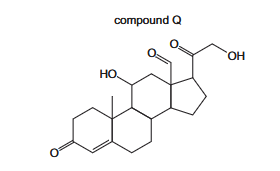
Compound Q is heated under reflux with an excess of acidified \(\mathrm{KMnO_4}\).
Organic product R is formed.
Which row is correct?
| Results of tests with compound Q | Results of tests with organic product R | |
|---|---|---|
| A | orange precipitate with 2,4-DNPH and no reaction with alkaline \(\mathrm{I_2(aq)}\) | yellow precipitate with alkaline \(\mathrm{I_2(aq)}\) and no reaction with Fehling’s reagent |
| B | red precipitate with Fehling’s reagent and no reaction with alkaline \(\mathrm{I_2(aq)}\) | orange precipitate with 2,4-DNPH and no reaction with alkaline \(\mathrm{I_2(aq)}\) |
| C | yellow precipitate with alkaline \(\mathrm{I_2(aq)}\) and orange precipitate with 2,4-DNPH | no reaction with alkaline \(\mathrm{I_2(aq)}\) and no reaction with Fehling’s reagent |
| D | yellow precipitate with alkaline \(\mathrm{I_2(aq)}\) and red precipitate with Fehling’s reagent | yellow precipitate with alkaline \(\mathrm{I_2(aq)}\) and orange precipitate with 2,4-DNPH |
▶️ Answer/Explanation
Correct Answer: \( \boxed{\mathrm{B}} \)
Compound Q contains an aldehyde group, so it gives a positive Fehling’s test, producing a red precipitate.
Q does not contain the \(\mathrm{CH_3CO-}\) or \(\mathrm{CH_3CH(OH)-}\) group required for the iodoform reaction, so it gives no reaction with alkaline iodine.
On heating under reflux with excess acidified \(\mathrm{KMnO_4}\), the aldehyde is oxidised to a carboxylic acid, while the ketone group remains unchanged.
Product R therefore still contains a carbonyl group, giving an orange precipitate with 2,4-DNPH, but it does not react with alkaline iodine.
Therefore, the correct answer is (B).
Question 36
Which organic starting material could be used in a single reaction to produce propanoic acid?
(B) propan-2-ol
(C) propanal
(D) propyl ethanoate
▶️ Answer/Explanation
Correct Answer: \( \boxed{\mathrm{C}} \)
Propanal is an aldehyde and can be oxidised directly to propanoic acid in a single reaction using an oxidising agent such as acidified potassium dichromate(VI) or potassium manganate(VII).
\(\mathrm{CH_3CH_2CHO+[O]\rightarrow CH_3CH_2COOH}\)
Ethanenitrile hydrolyses to ethanoic acid, propan-2-ol oxidises to propanone, and propyl ethanoate hydrolyses to propan-1-ol and ethanoic acid.
Therefore, the correct answer is (C).
Question 37
In four separate reactions, W, X, Y and Z, \(1\,\mathrm{mol}\) of an organic compound reacts with an excess of a reagent.
| Organic compound | Reagent | |
|---|---|---|
| W | \(\mathrm{(CH_2COOH)_2}\) | Na |
| X | \(\mathrm{CH_3CH(OH)CH_2COOH}\) | \(\mathrm{Na_2CO_3}\) |
| Y | \(\mathrm{CH_3CH(OH)CH_2COOH}\) | NaOH |
| Z | \(\mathrm{CH(OH)(COOH)CH_2COOH}\) | Na |
The volume of any gas produced is collected and measured. All gas volumes are measured at the same temperature and pressure.
What is the order of the reactions from greatest total volume of gas collected to least total volume of gas collected?
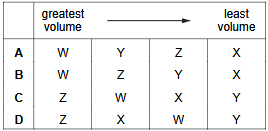
▶️ Answer/Explanation
Correct Answer: \( \boxed{\mathrm{C}} \)
Sodium reacts with both carboxylic acid and alcohol groups to produce hydrogen gas, whereas sodium carbonate reacts only with carboxylic acids to produce carbon dioxide, and sodium hydroxide produces no gas.
- Z: two \(\mathrm{-COOH}\) groups and one \(\mathrm{-OH}\) group react with Na, producing the greatest amount of \(\mathrm{H_2}\).
- W: two \(\mathrm{-COOH}\) groups react with Na.
- X: one \(\mathrm{-COOH}\) group reacts with \(\mathrm{Na_2CO_3}\), producing \(\mathrm{CO_2}\).
- Y: reaction with NaOH is a neutralisation and produces no gas.
Therefore, the correct order is Z, W, X, Y, so the correct answer is (C).
Question 38
Butylamine can be produced by the reaction of butanenitrile with hydrogen in the presence of a suitable catalyst.
Which volume of hydrogen, measured at room conditions, is required to react completely with \(0.500\,\mathrm{g}\) of butanenitrile?
(B) \(174\,\mathrm{cm^3}\)
(C) \(289\,\mathrm{cm^3}\)
(D) \(348\,\mathrm{cm^3}\)
▶️ Answer/Explanation
Correct Answer: \( \boxed{\mathrm{D}} \)
Reduction of a nitrile requires two moles of hydrogen:
\(\mathrm{R{-}CN+2H_2\rightarrow R{-}CH_2NH_2}\)
Molar mass of butanenitrile:
\(\mathrm{C_4H_7N}=4(12)+7(1)+14=69\,\mathrm{g\,mol^{-1}}\)
Moles of butanenitrile:
\(\mathrm{\dfrac{0.500}{69}=7.25\times10^{-3}\,mol}\)
Moles of hydrogen required:
\(\mathrm{2\times7.25\times10^{-3}=1.45\times10^{-2}\,mol}\)
At room conditions, \(1\,\mathrm{mol}\) of gas occupies \(24000\,\mathrm{cm^3}\).
Volume of hydrogen:
\(\mathrm{1.45\times10^{-2}\times24000=348\,\mathrm{cm^3}}\)
Therefore, the correct answer is (D).
Question 39
A section of an addition polymer is shown.
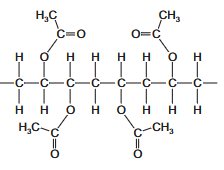
Which monomer is used to make this polymer?
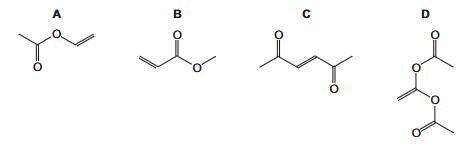
(B) Structure B
(C) Structure C
(D) Structure D
▶️ Answer/Explanation
Correct Answer: \( \boxed{\mathrm{A}} \)
The polymer backbone is formed by addition polymerisation of a carbon-carbon double bond.
Each repeat unit contains an acetate ester group, \(\mathrm{-OCOCH_3}\), attached to alternate carbon atoms of the polymer chain.
This repeat unit is produced from vinyl ethanoate (vinyl acetate), \(\mathrm{CH_2=CHOCOCH_3}\).
Among the structures shown, this corresponds to Structure A.
Therefore, the correct answer is (A).
Question 40
The purity of a compound can be determined using infrared spectroscopy.
The table gives the characteristic infrared absorption frequencies for some selected bonds.
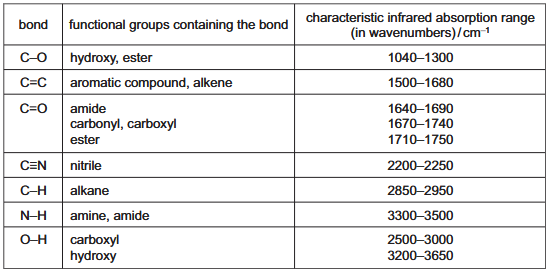
Propan-2-ol is made by hydration of propene. A sample of the product is obtained.
Which feature of the infrared spectrum of the product would show that no propene remains in the product?
(B) strong absorption below \(1000\,\mathrm{cm^{-1}}\)
(C) the lack of absorption at or near \(1250\,\mathrm{cm^{-1}}\)
(D) the lack of absorption at or near \(1550\,\mathrm{cm^{-1}}\)
▶️ Answer/Explanation
Correct Answer: \( \boxed{\mathrm{D}} \)
Propene contains a carbon-carbon double bond, which gives an infrared absorption in the \(\mathrm{C=C}\) stretching region of approximately \(1500\text{–}1680\,\mathrm{cm^{-1}}\).
If no propene remains, this absorption is absent from the spectrum.
The other absorptions are not unique to propene:
- \(\mathrm{C-H}\) bonds absorb near \(2900\,\mathrm{cm^{-1}}\) in both propene and propan-2-ol.
- \(\mathrm{C-O}\) bonds absorb near \(1040\text{–}1300\,\mathrm{cm^{-1}}\), so propan-2-ol shows absorption around \(1250\,\mathrm{cm^{-1}}\).
Therefore, the correct answer is (D).