
Question 1
What is the electronic configuration for the particle \(^{27}_{13}\mathrm{Al}^{+}\)?
(B) \(1\mathrm{s}^2\,2\mathrm{s}^2\,2\mathrm{p}^6\,3\mathrm{s}^2\)
(C) \(1\mathrm{s}^2\,2\mathrm{s}^2\,2\mathrm{p}^6\,3\mathrm{s}^2\,3\mathrm{p}^2\)
(D) \(1\mathrm{s}^2\,2\mathrm{s}^2\,2\mathrm{p}^6\,3\mathrm{s}^2\,3\mathrm{p}^6\,3\mathrm{d}^7\,4\mathrm{s}^1\)
▶️ Answer/Explanation
Correct Answer: \( \boxed{\mathrm{B}} \)
Aluminium has atomic number \(13\), so a neutral aluminium atom has the electronic configuration \(1\mathrm{s}^2\,2\mathrm{s}^2\,2\mathrm{p}^6\,3\mathrm{s}^2\,3\mathrm{p}^1\).
Forming \(\mathrm{Al}^{+}\) removes one electron from the outermost \(3\mathrm{p}\) orbital.
Therefore, the electronic configuration becomes
\(1\mathrm{s}^2\,2\mathrm{s}^2\,2\mathrm{p}^6\,3\mathrm{s}^2\)
Therefore, the correct answer is (B).
Question 2
The data in the table gives the 5th to the 10th ionisation energies of three elements from Period 3 of the Periodic Table.
| Element | Ionisation energy / \(\mathrm{kJ\,mol^{-1}}\) | |||||
|---|---|---|---|---|---|---|
| 5th | 6th | 7th | 8th | 9th | 10th | |
| X | 6274 | 21269 | 25398 | 29855 | 35868 | 40960 |
| Y | 7012 | 8496 | 27107 | 31671 | 36579 | 43140 |
| Z | 6542 | 9362 | 11018 | 33606 | 38601 | 43963 |
What are the correct identities of these three elements?
| Element X | Element Y | Element Z | |
|---|---|---|---|
| A | Na | Mg | Al |
| B | Mg | Al | Si |
| C | P | S | Cl |
| D | S | Cl | Ar |
▶️ Answer/Explanation
Correct Answer: \( \boxed{\mathrm{C}} \)
A large jump in successive ionisation energies occurs when all valence electrons have been removed and an inner-shell electron is removed.
- X: Large jump between the 5th and 6th ionisation energies ⇒ \(5\) valence electrons ⇒ phosphorus (\(\mathrm{P}\)).
- Y: Large jump between the 6th and 7th ionisation energies ⇒ \(6\) valence electrons ⇒ sulfur (\(\mathrm{S}\)).
- Z: Large jump between the 7th and 8th ionisation energies ⇒ \(7\) valence electrons ⇒ chlorine (\(\mathrm{Cl}\)).
Therefore, the correct answer is (C).
Question 3
What contains \(9.03\times10^{23}\) oxygen atoms?
(B) \(0.75\,\mathrm{mol}\) sulfur dioxide
(C) \(1.5\,\mathrm{mol}\) sulfur trioxide
(D) \(3.0\,\mathrm{mol}\) water
▶️ Answer/Explanation
Correct Answer: \( \boxed{\mathrm{B}} \)
\(9.03\times10^{23}\) oxygen atoms correspond to
\( \frac{9.03\times10^{23}}{6.02\times10^{23}}=1.5\,\mathrm{mol} \)
Compare the number of oxygen atoms supplied by each substance:
- \(\mathrm{Al_2O_3}\): \(0.25\times3=0.75\,\mathrm{mol}\) oxygen atoms.
- \(\mathrm{SO_2}\): \(0.75\times2=1.5\,\mathrm{mol}\) oxygen atoms ✔
- \(\mathrm{SO_3}\): \(1.5\times3=4.5\,\mathrm{mol}\) oxygen atoms.
- \(\mathrm{H_2O}\): \(3.0\times1=3.0\,\mathrm{mol}\) oxygen atoms.
Therefore, the correct answer is (B).
Question 4
Methane and steam react to produce hydrogen.
\( \mathrm{CH_4(g)+2H_2O(g)\rightarrow CO_2(g)+4H_2(g)} \)
\(0.80\,\mathrm{g}\) of methane and \(1.35\,\mathrm{g}\) of steam react. One of the reactants is used up.
Which volume of hydrogen, measured at room conditions, will be produced?
(B) \(3.60\,\mathrm{dm^3}\)
(C) \(4.80\,\mathrm{dm^3}\)
(D) \(7.20\,\mathrm{dm^3}\)
▶️ Answer/Explanation
Correct Answer: \( \boxed{\mathrm{B}} \)
Moles of methane:
\(n=\dfrac{0.80}{16}=0.050\,\mathrm{mol}\)
Moles of steam:
\(n=\dfrac{1.35}{18}=0.075\,\mathrm{mol}\)
The reaction requires \(2\,\mathrm{mol}\) of steam for every \(1\,\mathrm{mol}\) of methane.
For \(0.050\,\mathrm{mol}\) methane, \(0.100\,\mathrm{mol}\) steam is needed, but only \(0.075\,\mathrm{mol}\) is available.
Therefore, steam is the limiting reagent.
From the equation,
\(2\,\mathrm{mol}\ \mathrm{H_2O}\rightarrow4\,\mathrm{mol}\ \mathrm{H_2}\)
Hydrogen produced \(=0.075\times2=0.150\,\mathrm{mol}\).
At room conditions, \(1\,\mathrm{mol}=24\,\mathrm{dm^3}\).
Volume of hydrogen \(=0.150\times24=3.60\,\mathrm{dm^3}\).
Therefore, the correct answer is (B).
Question 5
Which statement explains why sodium and potassium have different melting points?
(B) The attraction between cations and anions is stronger in sodium.
(C) The attraction between atoms is stronger in sodium.
(D) The attraction between nuclei and shared electron pairs is stronger in sodium.
▶️ Answer/Explanation
Correct Answer: \( \boxed{\mathrm{A}} \)
Sodium and potassium are metals with metallic bonding.
Metallic bonding is the electrostatic attraction between positive metal ions (cations) and delocalised electrons.
Sodium ions are smaller than potassium ions, so the attraction between the cations and the delocalised electrons is stronger in sodium.
Therefore, sodium has a higher melting point, and the correct answer is (A).
Question 6
\(\mathrm{NH_3}\) and \(\mathrm{HCN}\) react together to form \(\mathrm{NH_4CN}\), an ionic compound.
Which row states the number of coordinate bonds and the number of \(\pi\) bonds in one formula unit of \(\mathrm{NH_4CN}\)?
| Number of coordinate bonds | Number of \(\pi\) bonds | |
|---|---|---|
| A | 0 | 2 |
| B | 1 | 2 |
| C | 0 | 3 |
| D | 1 | 3 |
▶️ Answer/Explanation
Correct Answer: \( \boxed{\mathrm{B}} \)
In \(\mathrm{NH_4CN}\), the ions present are \(\mathrm{NH_4^+}\) and \(\mathrm{CN^-}\).
The ammonium ion, \(\mathrm{NH_4^+}\), contains one coordinate (dative covalent) bond formed when the lone pair on nitrogen is donated to a hydrogen ion.
The cyanide ion, \(\mathrm{CN^-}\), contains a carbon-nitrogen triple bond consisting of one \(\sigma\) bond and two \(\pi\) bonds.
Therefore, one formula unit of \(\mathrm{NH_4CN}\) contains:
- \(1\) coordinate bond
- \(2\) \(\pi\) bonds
Therefore, the correct answer is (B).
Question 7
When \(1.0\,\mathrm{mol}\) of ethanoic acid, \(\mathrm{CH_3COOH}\), in aqueous solution is neutralised by an excess of aqueous sodium hydroxide, \(55\,\mathrm{kJ\,mol^{-1}}\) of energy is released.
Which statement about this reaction is correct?
(B) The reaction is exothermic because only bond forming takes place.
(C) The reaction is exothermic because more energy is given out in breaking bonds than is taken in to form bonds.
(D) The reaction is exothermic because more energy is given out in forming bonds than is taken in to break bonds.
▶️ Answer/Explanation
Correct Answer: \( \boxed{\mathrm{D}} \)
Bond breaking always requires energy, whereas bond formation releases energy.
In an exothermic reaction, the energy released when new bonds form is greater than the energy required to break the original bonds.
Since \(55\,\mathrm{kJ\,mol^{-1}}\) of energy is released during neutralisation, the reaction is exothermic.
Therefore, the correct answer is (D).
Question 8
In an experiment, \(1.60\,\mathrm{g}\) of a fuel is burnt. \(45.0\%\) of the energy released is absorbed by \(200\,\mathrm{g}\) of water. The temperature of the water rises from \(18.0^\circ\mathrm{C}\) to \(66.0^\circ\mathrm{C}\).
What is the total energy released per gram of fuel burnt?
(B) \(55\,700\,\mathrm{J}\)
(C) \(89\,200\,\mathrm{J}\)
(D) \(143\,000\,\mathrm{J}\)
▶️ Answer/Explanation
Correct Answer: \( \boxed{\mathrm{B}} \)
Temperature rise:
\(\Delta T=66.0-18.0=48.0^\circ\mathrm{C}\)
Energy absorbed by the water:
\(q=mc\Delta T=200\times4.18\times48=40\,128\,\mathrm{J}\)
This is \(45.0\%\) of the total energy released.
Total energy released \(=\dfrac{40\,128}{0.45}=89\,173\,\mathrm{J}\)
Energy released per gram of fuel \(=\dfrac{89\,173}{1.60}=55\,733\,\mathrm{J\,g^{-1}}\)
To three significant figures, \(=55\,700\,\mathrm{J\,g^{-1}}\).
Therefore, the correct answer is (B).
Question 9
Sulfite ions, \(\mathrm{SO_3^{2-}}\), react separately with zinc and with manganese dioxide.
\(a,\ b,\ c,\ d,\ w,\ x,\ y\) and \(z\) are all whole numbers.
\(a\mathrm{SO_3^{2-}(aq)}+b\mathrm{H_2O(l)}+\mathrm{Zn(s)}\rightarrow\mathrm{Zn^{2+}(aq)}+c\mathrm{OH^{-}(aq)}+d\mathrm{S_2O_4^{2-}(aq)}\)
\(\mathrm{MnO_2(s)}+w\mathrm{SO_3^{2-}(aq)}+x\mathrm{H^{+}(aq)}\rightarrow\mathrm{Mn^{2+}(aq)}+y\mathrm{S_2O_6^{2-}(aq)}+z\mathrm{H_2O(l)}\)
Which numbers are correct for \(a,\ b,\ w\) and \(x\)?
| \(a\) | \(b\) | \(w\) | \(x\) | |
|---|---|---|---|---|
| A | 1 | 2 | 2 | 4 |
| B | 2 | 2 | 2 | 4 |
| C | 1 | 2 | 4 | 2 |
| D | 2 | 2 | 4 | 2 |
▶️ Answer/Explanation
Correct Answer: \( \boxed{\mathrm{B}} \)
Balance each redox equation using oxidation numbers or the half-equation method.
For the zinc reaction:
\(2\mathrm{SO_3^{2-}}+2\mathrm{H_2O}+\mathrm{Zn}\rightarrow\mathrm{Zn^{2+}}+4\mathrm{OH^-}+\mathrm{S_2O_4^{2-}}\)
Hence, \(a=2\) and \(b=2\).
For the manganese dioxide reaction:
\(\mathrm{MnO_2}+2\mathrm{SO_3^{2-}}+4\mathrm{H^+}\rightarrow\mathrm{Mn^{2+}}+\mathrm{S_2O_6^{2-}}+2\mathrm{H_2O}\)
Hence, \(w=2\) and \(x=4\).
Therefore, the correct answer is (B).
Question 10
Which equation shows hydrogen acting as an oxidising agent?
(B) \(\mathrm{H_2+I_2\rightarrow2HI}\)
(C) \(\mathrm{H_2+Cu_2S+ZnO\rightarrow2Cu+ZnS+H_2O}\)
(D) \(\mathrm{3H_2+N_2\rightarrow2NH_3}\)
▶️ Answer/Explanation
Correct Answer: \( \boxed{\mathrm{A}} \)
An oxidising agent is reduced while causing another substance to be oxidised.
In option (A), hydrogen changes from oxidation state \(0\) in \(\mathrm{H_2}\) to \(-1\) in the hydride ion, \(\mathrm{H^-}\). Therefore, hydrogen is reduced and acts as the oxidising agent.
In the other reactions, hydrogen is oxidised from oxidation state \(0\) to \(+1\), so it acts as a reducing agent.
Therefore, the correct answer is (A).
Question 11
\(1.00\,\mathrm{g}\) of nitrogen gas is stored in a \(2.00\,\mathrm{dm^3}\) vessel at \(40.0^\circ\mathrm{C}\).
What is the pressure in the vessel?
(B) \(11\,900\,\mathrm{Pa}\)
(C) \(46\,400\,\mathrm{Pa}\)
(D) \(92\,900\,\mathrm{Pa}\)
▶️ Answer/Explanation
Correct Answer: \( \boxed{\mathrm{C}} \)
Moles of nitrogen:
\(n=\dfrac{1.00}{28.0}=0.0357\,\mathrm{mol}\)
Convert the volume and temperature:
\(V=2.00\,\mathrm{dm^3}=2.00\times10^{-3}\,\mathrm{m^3}\)
\(T=40.0+273=313\,\mathrm{K}\)
Using the ideal gas equation, \(PV=nRT\).
\(P=\dfrac{nRT}{V}=\dfrac{0.0357\times8.31\times313}{2.00\times10^{-3}}\approx4.64\times10^4\,\mathrm{Pa}\)
Therefore, the correct answer is (C).
Question 12
One molecule of haemoglobin, \(\mathrm{Hb}\), can bind with four molecules of oxygen according to the equation shown.
\(\mathrm{Hb(aq)+4O_2(aq)\rightleftharpoons Hb(O_2)_4(aq)}\)
When the equilibrium concentration of \(\mathrm{O_2}\) is \(7.6\times10^{-6}\,\mathrm{mol\,dm^{-3}}\), the equilibrium concentrations of \(\mathrm{Hb}\) and \(\mathrm{Hb(O_2)_4}\) are equal.
What is the numerical value of \(K_{\mathrm{c}}\) for this equilibrium?
(B) \(1.3\times10^{5}\)
(C) \(7.6\times10^{-6}\)
(D) \(3.3\times10^{-21}\)
▶️ Answer/Explanation
Correct Answer: \( \boxed{\mathrm{A}} \)
The equilibrium expression is
\(K_{\mathrm{c}}=\dfrac{[\mathrm{Hb(O_2)_4}]}{[\mathrm{Hb}][\mathrm{O_2}]^4}\)
Since the equilibrium concentrations of \(\mathrm{Hb}\) and \(\mathrm{Hb(O_2)_4}\) are equal, they cancel.
\(K_{\mathrm{c}}=\dfrac{1}{(7.6\times10^{-6})^4}\)
\(K_{\mathrm{c}}\approx3.0\times10^{20}\)
Therefore, the correct answer is (A).
Question 13
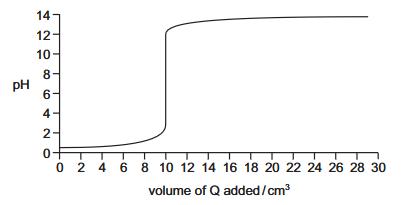
Aqueous acid P and aqueous alkali Q have the same concentration.
\(20\,\mathrm{cm^3}\) of P is added to a conical flask.
Q is slowly added to the flask and the volume of Q and the pH are recorded.
The pH titration curve is shown.
Which row gives the identity of P and Q?
| P | Q | |
|---|---|---|
| A | HCl | NaOH |
| B | \(\mathrm{H_2SO_4}\) | \(\mathrm{NH_3}\) |
| C | HCl | \(\mathrm{Ba(OH)_2}\) |
| D | \(\mathrm{CH_3COOH}\) | \(\mathrm{Sr(OH)_2}\) |
▶️ Answer/Explanation
Correct Answer: \( \boxed{\mathrm{C}} \)
The initial pH is close to \(0\), indicating that P is a strong acid.
The equivalence point occurs after about \(10\,\mathrm{cm^3}\) of alkali has been added, even though \(20\,\mathrm{cm^3}\) of acid was used.
Since both solutions have the same concentration, the alkali must provide twice as many hydroxide ions per mole as the acid provides hydrogen ions.
\(\mathrm{Ba(OH)_2}\) dissociates to give two \(\mathrm{OH^-}\) ions per formula unit, so only half the volume is required for neutralisation.
Therefore, P is \(\mathrm{HCl}\) and Q is \(\mathrm{Ba(OH)_2}\).
Therefore, the correct answer is (C).
Question 14
Photochromic glass, used for sunglasses, darkens when exposed to bright light and becomes more transparent again when the light is less bright. The darkness of the glass is due to the presence of silver atoms.
The following reactions are involved.
Reaction 1 \(\mathrm{Ag^++Cl^-\rightleftharpoons Ag+Cl}\)
Reaction 2 \(\mathrm{Cu^++Cl\rightarrow Cu^{2+}+Cl^-}\)
Reaction 3 \(\mathrm{Cu^{2+}+Ag\rightarrow Cu^++Ag^+}\)
Which statement about these reactions is correct?
(B) \(\mathrm{Cu^+}\) ions act as an oxidising agent in reaction 2.
(C) Reaction 3 increases the darkness of the glass.
(D) Silver atoms are reduced in reaction 3.
▶️ Answer/Explanation
Correct Answer: \( \boxed{\mathrm{A}} \)
In reaction 2, \(\mathrm{Cu^+}\) is oxidised to \(\mathrm{Cu^{2+}}\), while in reaction 3, \(\mathrm{Cu^{2+}}\) is reduced back to \(\mathrm{Cu^+}\).
Since the copper ions are regenerated during the sequence of reactions and are not consumed overall, they act as catalysts.
In reaction 3, silver atoms are oxidised to \(\mathrm{Ag^+}\), so the amount of silver decreases and the glass becomes less dark.
Therefore, the correct answer is (A).
Question 15
The reversible reaction between methanol and ethanoic acid liquids is catalysed by adding a small volume of concentrated sulfuric acid.
Two statements about this reaction are listed.
1 The sulfuric acid is a homogeneous catalyst.
2 The sulfuric acid lowers the activation energy of the reverse reaction.
Which statements are correct?
(B) 1 only
(C) 2 only
(D) neither 1 nor 2
▶️ Answer/Explanation
Correct Answer: \( \boxed{\mathrm{A}} \)
Concentrated sulfuric acid is in the same liquid phase as methanol and ethanoic acid, so it acts as a homogeneous catalyst.
A catalyst provides an alternative reaction pathway with a lower activation energy for both the forward and reverse reactions.
Therefore, both statements are correct, so the correct answer is (A).
Question 16
The atomic radii and ionic radii for three elements in Period 3 are shown.
| Atomic radius / \(\mathrm{nm}\) | Ionic radius / \(\mathrm{nm}\) | |
|---|---|---|
| Element X | 0.118 | 0.053 |
| Element Y | 0.099 | 0.180 |
| Element Z | 0.160 | 0.072 |
Using this data, which statement is correct?
(B) Element Y has a higher melting point than element X.
(C) Element Y and element Z react to form an ionic compound.
(D) Element Z forms ionic compounds by gaining electrons.
▶️ Answer/Explanation
Correct Answer: \( \boxed{\mathrm{C}} \)
Element Y has an ionic radius much larger than its atomic radius, showing that it forms a negative ion by gaining electrons. It is a non-metal.
Elements X and Z have ionic radii smaller than their atomic radii, showing that they form positive ions by losing electrons. They are metals.
Therefore, element Y (a non-metal) and element Z (a metal) react together to form an ionic compound.
Therefore, the correct answer is (C).
Question 17
Three equations are listed. \(x,\ y\) and \(z\) are all whole numbers.
1 \(x\mathrm{Al}+y\mathrm{O_2}\rightarrow z\mathrm{Al_2O_3}\)
2 \(x\mathrm{Mg}+y\mathrm{O_2}\rightarrow z\mathrm{MgO}\)
3 \(x\mathrm{Na}+y\mathrm{O_2}\rightarrow z\mathrm{Na_2O}\)
Which equations can be balanced if \(x=4\) and \(z=2\)?
(B) 1 only
(C) 2 only
(D) 3 only
▶️ Answer/Explanation
Correct Answer: \( \boxed{\mathrm{A}} \)
Substitute \(x=4\) and \(z=2\) into each equation.
- \(4\mathrm{Al}+3\mathrm{O_2}\rightarrow2\mathrm{Al_2O_3}\), so \(y=3\). ✔
- \(4\mathrm{Mg}+2\mathrm{O_2}\rightarrow2\mathrm{MgO}\) is not balanced because there are only \(2\) magnesium atoms on the right. ✘
- \(4\mathrm{Na}+\mathrm{O_2}\rightarrow2\mathrm{Na_2O}\), so \(y=1\). ✔
Therefore, equations 1 and 3 can be balanced, so the correct answer is (A).
Question 18
Which oxide has a simple structure rather than a giant structure?
(B) \(\mathrm{Al_2O_3}\)
(C) \(\mathrm{SiO_2}\)
(D) \(\mathrm{P_4O_{10}}\)
▶️ Answer/Explanation
Correct Answer: \( \boxed{\mathrm{D}} \)
\(\mathrm{MgO}\) and \(\mathrm{Al_2O_3}\) are giant ionic lattices.
\(\mathrm{SiO_2}\) has a giant covalent network structure.
\(\mathrm{P_4O_{10}}\) consists of discrete covalent molecules and therefore has a simple molecular structure.
Therefore, the correct answer is (D).
Question 19
The trends seen in Group 2 can be used to predict the properties of radium and its compounds.
Which statement is correct?
(B) Radium hydroxide is the least soluble of the hydroxides of the elements in Group 2.
(C) Radium carbonate has the lowest thermal stability of the carbonates of the elements in Group 2.
(D) Radium reacts faster with water than the other elements in Group 2.
▶️ Answer/Explanation
Correct Answer: \( \boxed{\mathrm{D}} \)
Down Group 2:
- Ionisation energies decrease.
- Hydroxides become more soluble.
- Carbonates become more thermally stable.
- Reactivity with water increases.
Since radium is below barium in Group 2, it reacts with water more rapidly than the other Group 2 metals.
Therefore, the correct answer is (D).
Question 19
The trends seen in Group 2 can be used to predict the properties of radium and its compounds.
Which statement is correct?
(B) Radium hydroxide is the least soluble of the hydroxides of the elements in Group 2.
(C) Radium carbonate has the lowest thermal stability of the carbonates of the elements in Group 2.
(D) Radium reacts faster with water than the other elements in Group 2.
▶️ Answer/Explanation
Correct Answer: \( \boxed{\mathrm{D}} \)
Down Group 2:
- Ionisation energies decrease.
- Hydroxides become more soluble.
- Carbonates become more thermally stable.
- Reactivity with water increases.
Since radium is below barium in Group 2, it reacts with water more rapidly than the other Group 2 metals.
Therefore, the correct answer is (D).
Question 20
Equal masses of \(\mathrm{CaCO_3}\), \(\mathrm{Ca(NO_3)_2}\), \(\mathrm{BaCO_3}\) and \(\mathrm{Ba(NO_3)_2}\) are thermally decomposed. The volume of gas produced in each experiment is measured under the same conditions.
Which compound will produce the greatest volume of gas?
(B) \(\mathrm{Ca(NO_3)_2}\)
(C) \(\mathrm{BaCO_3}\)
(D) \(\mathrm{Ba(NO_3)_2}\)
▶️ Answer/Explanation
Correct Answer: \( \boxed{\mathrm{B}} \)
Thermal decomposition reactions:
\(\mathrm{CaCO_3\rightarrow CaO+CO_2}\)
\(\mathrm{BaCO_3\rightarrow BaO+CO_2}\)
\(\mathrm{2Ca(NO_3)_2\rightarrow2CaO+4NO_2+O_2}\)
\(\mathrm{2Ba(NO_3)_2\rightarrow2BaO+4NO_2+O_2}\)
For equal masses, the compound with the lowest molar mass produces the greatest number of moles.
Calcium nitrate has a lower molar mass than barium nitrate and produces \(2.5\) moles of gas per mole of nitrate, whereas each carbonate produces only \(1\) mole of gas per mole.
Therefore, the greatest volume of gas is produced by \(\mathrm{Ca(NO_3)_2}\), so the correct answer is (B).
Question 21
Equation 1 and equation 2 show two different reactions of halide ion \(Q^-\) with concentrated sulfuric acid.
Equation 1 \(\mathrm{H_2SO_4+Q^-\rightarrow HSO_4^-+HQ}\)
Equation 2 \(\mathrm{H_2SO_4+2Q^-+2H^+\rightarrow SO_2+Q_2+2H_2O}\)
What is \(Q\)?
(B) \(\mathrm{Br^-}\) or \(\mathrm{I^-}\)
(C) \(\mathrm{Cl^-}\) only
(D) \(\mathrm{I^-}\) only
▶️ Answer/Explanation
Correct Answer: \( \boxed{\mathrm{B}} \)
Equation 1 is an acid-base reaction that occurs with all halide ions.
Equation 2 is a redox reaction in which concentrated sulfuric acid is reduced to \(\mathrm{SO_2}\) and the halide ions are oxidised to halogen molecules.
Bromide and iodide ions are sufficiently strong reducing agents to reduce concentrated sulfuric acid, whereas chloride ions are not.
Therefore, the correct answer is (B).
Question 22
What happens when iodine solution is added to a solution of sodium bromide?
(B) Bromide ions are oxidised; iodine atoms are reduced.
(C) Bromide ions are reduced; iodine atoms are oxidised.
(D) No reaction occurs.
▶️ Answer/Explanation
Correct Answer: \( \boxed{\mathrm{D}} \)
The reactivity of the halogens decreases down Group 17:
\(\mathrm{Cl_2>Br_2>I_2}\)
A more reactive halogen displaces a less reactive halide ion from solution.
Iodine is less reactive than bromine, so iodine cannot oxidise bromide ions.
Therefore, no reaction occurs and the correct answer is (D).
Question 23
Which statement is correct?
(B) Aqueous ammonia contains both \(\mathrm{NH_3(aq)}\) and \(\mathrm{NH_4^+(aq)}\). The \(\mathrm{NH_4^+(aq)}\) ion is a Brønsted-Lowry acid.
(C) High temperatures are needed to supply the energy to break the strong double bonds in nitrogen molecules when they react.
(D) Atmospheric \(\mathrm{SO_2}\) reacts with unburnt hydrocarbons to form a component of photochemical smog.
▶️ Answer/Explanation
Correct Answer: \( \boxed{\mathrm{B}} \)
In aqueous solution, ammonia partially reacts with water:
\(\mathrm{NH_3+H_2O\rightleftharpoons NH_4^++OH^-}\)
Therefore, both \(\mathrm{NH_3}\) and \(\mathrm{NH_4^+}\) are present.
The ammonium ion can donate a proton, so it acts as a Brønsted-Lowry acid.
Option (A) is incorrect because nitrogen molecules contain a strong triple bond, not because of the absence of lone pairs. Option (C) incorrectly refers to a double bond. Option (D) is incorrect because photochemical smog mainly involves nitrogen oxides and hydrocarbons.
Therefore, the correct answer is (B).
Question 24
When dry ammonia and hydrogen chloride gases are mixed, a solid white ionic compound is formed.
Two statements are listed.
1 The formation of the ionic compound is a redox reaction.
2 During the formation of the ionic compound, the H–N–H bond angle increases.
Which statements are correct?
(B) 1 only
(C) 2 only
(D) neither 1 nor 2
▶️ Answer/Explanation
Correct Answer: \( \boxed{\mathrm{C}} \)
The reaction is:
\(\mathrm{NH_3(g)+HCl(g)\rightarrow NH_4Cl(s)}\)
This is an acid-base reaction, not a redox reaction, because the oxidation states of all atoms remain unchanged.
In \(\mathrm{NH_3}\), the nitrogen atom has one lone pair, giving a trigonal pyramidal shape with an H–N–H bond angle of about \(107^\circ\).
When \(\mathrm{NH_4^+}\) forms, the lone pair is used to form a coordinate bond with \(\mathrm{H^+}\). The ion becomes tetrahedral with bond angles of \(109.5^\circ\).
Therefore, the H–N–H bond angle increases during the reaction.
Therefore, only statement 2 is correct, so the correct answer is (C).
Question 25
The diagrams show skeletal formulae of some isomers of \(\mathrm{C_6H_{12}O}\).
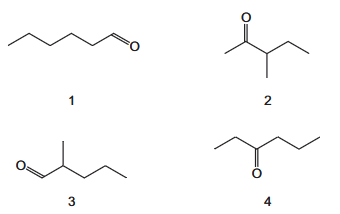
Which statement is correct?
(B) 2 and 3 are functional group isomers of each other and both have a chiral centre.
(C) 1 and 4 are functional group isomers of each other and both have a chiral centre.
(D) 2 and 4 are positional isomers of each other and functional group isomers of each other.
▶️ Answer/Explanation
Correct Answer: \( \boxed{\mathrm{B}} \)
Structure 2 is a ketone, whereas structure 3 is an aldehyde.
Since they have the same molecular formula but different functional groups, they are functional group isomers.
In both structures, one carbon atom is bonded to four different groups, giving each molecule a chiral centre.
The other options are incorrect because:
- Structures 1 and 3 are chain isomers but not positional isomers.
- Structure 1 does not contain a chiral centre.
- Structures 2 and 4 are both ketones, so they are positional isomers rather than functional group isomers.
Therefore, the correct answer is (B).
Question 26
The skeletal formulae of two compounds are shown.
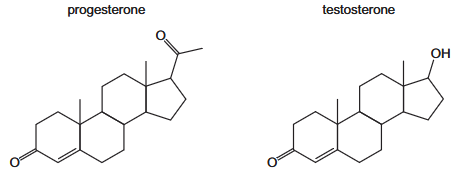
Which statements about progesterone and testosterone are correct?
(B) They have the same molecular formula, and they both have geometrical isomers.
(C) They have the same number of chiral carbons, and they have the same molecular formula.
(D) They have the same number of chiral carbons, and they both contain a ketone group.
▶️ Answer/Explanation
Correct Answer: \( \boxed{\mathrm{D}} \)
Both progesterone and testosterone contain a ketone (\(\mathrm{C=O}\)) functional group.
The carbon-carbon double bond is within the fused ring system, so it does not give rise to geometrical (E/Z) isomerism.
Testosterone contains an alcohol (\(\mathrm{-OH}\)) group, whereas progesterone contains an additional ketone group. Therefore, they do not have the same molecular formula.
The two compounds have the same steroid carbon skeleton and the same number of chiral carbon atoms.
Therefore, the correct answer is (D).
Question 27
Which intermediate ion forms in the greatest amount during the addition of HBr to propene?
(B) \(\mathrm{CH_3CH_2CH_2^+}\)
(C) \(\mathrm{CH_3CH^+CH_2Br}\)
(D) \(\mathrm{CH_3CHBrCH_2^+}\)
▶️ Answer/Explanation
Correct Answer: \( \boxed{\mathrm{A}} \)
The addition of HBr to propene proceeds via an electrophilic addition mechanism.
Protonation of the double bond can produce either a primary or a secondary carbocation.
The secondary carbocation, \(\mathrm{CH_3CH^+CH_3}\), is more stable than the primary carbocation because it is stabilised by two alkyl groups.
Therefore, it is formed in the greatest amount and leads to the major product according to Markovnikov’s rule.
Therefore, the correct answer is (A).
Question 28
Two hydrocarbons, \(\mathrm{R{-}CH_3}\) and \(\mathrm{R'{-}CH_3}\), react separately with bromine in the presence of ultraviolet light. One of these hydrocarbons is unsaturated.
In each case, free radical substitution reactions occur.
\( \mathrm{R} \) is \(\mathrm{CH_3CHC(CH_3)_2}\).
\( \mathrm{R’} \) is \(\mathrm{CH_3CH(CH_3)CH_2}\).
Which row is correct?
| A propagation stage for the saturated hydrocarbon | A termination stage for the unsaturated hydrocarbon | |
|---|---|---|
| A | \(\mathrm{R{-}CH_2^{\bullet}+Br^{\bullet}\rightarrow R{-}CH_2Br}\) | \(\mathrm{R'{-}CH_2^{\bullet}+Br^{\bullet}\rightarrow R'{-}CH_2Br}\) |
| B | \(\mathrm{R{-}CH_2^{\bullet}+Br_2\rightarrow R{-}CH_2Br+Br^{\bullet}}\) | \(\mathrm{R'{-}CH_2^{\bullet}+Br_2\rightarrow R'{-}CH_2Br+Br^{\bullet}}\) |
| C | \(\mathrm{R{-}CH_3+Br^{\bullet}\rightarrow R{-}CH_2^{\bullet}+HBr}\) | \(\mathrm{2R'{-}CH_2^{\bullet}\rightarrow R'{-}CH_2CH_2{-}R’}\) |
| D | \(\mathrm{2R{-}CH_2^{\bullet}\rightarrow R{-}CH_2CH_2{-}R}\) | \(\mathrm{R{-}CH_3+Br^{\bullet}\rightarrow R{-}CH_2^{\bullet}+HBr}\) |
▶️ Answer/Explanation
Correct Answer: \( \boxed{\mathrm{C}} \)
In free radical substitution:
- A propagation step involves a radical reacting with a stable molecule to produce a new radical.
- A termination step involves two radicals combining to form a stable molecule.
The propagation step \(\mathrm{R{-}CH_3+Br^{\bullet}\rightarrow R{-}CH_2^{\bullet}+HBr}\) is correct.
The termination step \(\mathrm{2R'{-}CH_2^{\bullet}\rightarrow R'{-}CH_2CH_2{-}R’}\) correctly shows two radicals combining.
Therefore, the correct answer is (C).
Question 29
The fumes from the exhausts of petrol-burning cars contain the following pollutants.
1 unburnt hydrocarbons
2 nitrogen dioxide
3 carbon monoxide
Which pollutants are removed by oxidation in a catalytic converter?
(B) 1 and 2 only
(C) 1 and 3 only
(D) 2 and 3 only
▶️ Answer/Explanation
Correct Answer: \( \boxed{\mathrm{C}} \)
A catalytic converter removes pollutants by both oxidation and reduction reactions.
Unburnt hydrocarbons are oxidised to \(\mathrm{CO_2}\) and \(\mathrm{H_2O}\), and carbon monoxide is oxidised to \(\mathrm{CO_2}\).
Nitrogen dioxide is not removed by oxidation. Instead, nitrogen oxides are reduced to nitrogen gas.
Therefore, the pollutants removed by oxidation are 1 and 3 only, so the correct answer is (C).
Question 30
Compound X, \(\mathrm{C_7H_{11}ICl_2}\), is dissolved in ethanol and the solution mixed with warm aqueous silver nitrate.
A precipitate is seen immediately.
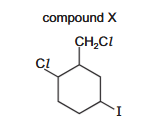
What is the colour of this precipitate and what is the structural formula of the first organic product?
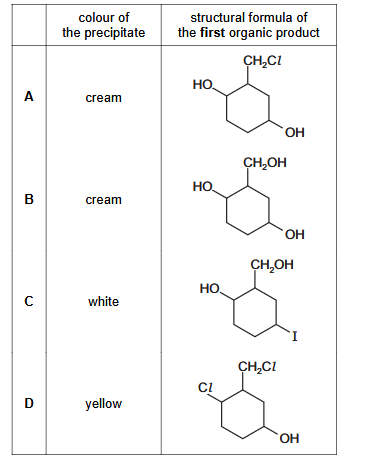
▶️ Answer/Explanation
Correct Answer: \( \boxed{\mathrm{D}} \)
Warm aqueous silver nitrate detects halide ions released by hydrolysis. The halogen atom that leaves most readily is iodine because the C–I bond is weaker than the C–Cl bond.
The iodide ion immediately reacts with silver ions to form yellow silver iodide:
\(\mathrm{Ag^+(aq)+I^-(aq)\rightarrow AgI(s)}\)
The first organic product is therefore formed by substitution of the iodine atom with a hydroxyl group, while both chlorine atoms remain unchanged.
Therefore, the precipitate is yellow and the first organic product is the structure shown in (D).
Question 31
1,4-dibromobutane reacts with an excess of ethanolic sodium hydroxide until no further reaction takes place.
What is the relative formula mass of the major organic product?
(B) \(56\)
(C) \(74\)
(D) \(90\)
▶️ Answer/Explanation
Correct Answer: \( \boxed{\mathrm{A}} \)
Ethanolic sodium hydroxide promotes elimination reactions.
1,4-Dibromobutane undergoes two elimination reactions to form buta-1,3-diene:
\(\mathrm{BrCH_2CH_2CH_2CH_2Br\rightarrow CH_2{=}CHCH{=}CH_2}\)
The molecular formula of buta-1,3-diene is \(\mathrm{C_4H_6}\).
\(M_r=(4\times12)+(6\times1)=48+6=54\)
Therefore, the correct answer is (A).
Question 32
A small section of a polymer produced from two monomers is shown.
\(\mathrm{-CH_2-C(CH_3)_2-CH(CH_3)-CH_2-}\)
What are the two monomers?
(B) but-2-ene and propene
(C) ethene and pent-2-ene
(D) methylpropene and propene
▶️ Answer/Explanation
Correct Answer: \( \boxed{\mathrm{D}} \)
In an addition polymer, each monomer contributes a repeating unit obtained by opening its carbon-carbon double bond.
The fragment \(\mathrm{-CH_2-C(CH_3)_2-}\) is produced from methylpropene, \(\mathrm{CH_2=C(CH_3)_2}\).
The fragment \(\mathrm{-CH(CH_3)-CH_2-}\) is produced from propene, \(\mathrm{CH_2=CHCH_3}\).
Therefore, the two monomers are methylpropene and propene, so the correct answer is (D).
Question 33
The balanced equation for the reaction of X with an excess of acidified \(\mathrm{K_2Cr_2O_7}\) is shown.
\(\mathrm{X+3[O]\rightarrow Y+H_2O}\)
Compound Y is the only organic product of the reaction.
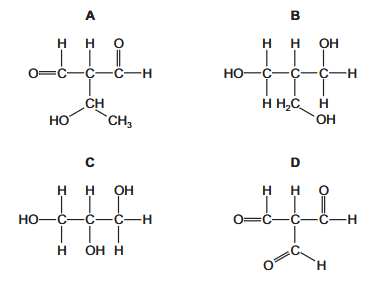
Which compound is X?
(B) Structure B
(C) Structure C
(D) Structure D
▶️ Answer/Explanation
Correct Answer: \( \boxed{\mathrm{A}} \)
Acidified potassium dichromate oxidises primary alcohols to carboxylic acids and aldehydes to carboxylic acids, while secondary alcohols are oxidised to ketones.
Three oxygen atoms are required, indicating that the molecule contains one primary alcohol and one aldehyde group that are both oxidised.
Structure A contains one aldehyde group and one primary alcohol group, giving a single organic product after complete oxidation.
Therefore, the correct answer is (A).
Question 34
Three mixtures are heated under reflux.
Which mixtures will produce sodium propanoate as one product?
1 \(\mathrm{CH_3CH_2CHO+NaBH_4(aq)}\)
2 \(\mathrm{CH_3CH_2CH_2OH+Na(s)}\)
3 \(\mathrm{CH_3CH_2CN+NaOH(aq)}\)
(B) 1 and 2 only
(C) 2 and 3 only
(D) 3 only
▶️ Answer/Explanation
Correct Answer: \( \boxed{\mathrm{D}} \)
Consider each reaction separately.
- \(\mathrm{NaBH_4}\) reduces propanal to propan-1-ol, not sodium propanoate.
- Propan-1-ol reacts with sodium metal to form sodium propoxide, not sodium propanoate.
- Propanenitrile undergoes alkaline hydrolysis on heating under reflux to form sodium propanoate.
The hydrolysis reaction is:
\(\mathrm{CH_3CH_2CN+2H_2O+NaOH\rightarrow CH_3CH_2COONa+NH_3}\)
Therefore, only mixture 3 produces sodium propanoate, so the correct answer is (D).
Question 35
Which compound is a product of the hydrolysis of \(\mathrm{CH_3CO_2CH_2CH_3}\) using aqueous sodium hydroxide?
(B) \(\mathrm{CH_3CO_2H}\)
(C) \(\mathrm{C_2H_5CH_2O^-Na^+}\)
(D) \(\mathrm{C_2H_5CH_2CO_2^-Na^+}\)
▶️ Answer/Explanation
Correct Answer: \( \boxed{\mathrm{A}} \)
Ethyl ethanoate undergoes alkaline hydrolysis (saponification):
\(\mathrm{CH_3CO_2CH_2CH_3+NaOH\rightarrow CH_3CO_2^-Na^++CH_3CH_2OH}\)
The products are sodium ethanoate and ethanol.
Therefore, the correct answer is (A).
Question 36
Compound Q reacts when heated with HCN in the presence of a catalyst to produce compound R.
Molecules of compound R each contain four carbon atoms.
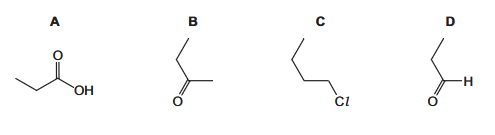
What is compound Q?
(B) Structure B
(C) Structure C
(D) Structure D
▶️ Answer/Explanation
Correct Answer: \( \boxed{\mathrm{D}} \)
Hydrogen cyanide adds across the carbon-oxygen double bond of aldehydes and ketones to form hydroxynitriles.
The cyanide ion contributes one additional carbon atom to the product.
Since compound R contains four carbon atoms, compound Q must contain three carbon atoms.
Structure D is propanal, a three-carbon aldehyde, which reacts with HCN to form a four-carbon hydroxynitrile.
Therefore, the correct answer is (D).
Question 37
The table shows the reagents and products of three reactions.
| Reactants | Products | |
|---|---|---|
| 1 | Ethanoic acid + \(\mathrm{Na_2CO_3}\) | \(\mathrm{CH_3CO_2Na+H_2O+CO_2}\) |
| 2 | Ethanoic acid + Mg | \(\mathrm{(CH_3CO_2)_2Mg+H_2O}\) |
| 3 | Ethanoic acid + \(\mathrm{CH_3OH}\) | \(\mathrm{CH_3CO_2CH_3+H_2O}\) |
Which rows are correct?
(B) 1 and 2 only
(C) 1 and 3 only
(D) 2 and 3 only
▶️ Answer/Explanation
Correct Answer: \( \boxed{\mathrm{C}} \)
Row 1 is correct because acids react with carbonates to produce a salt, water and carbon dioxide.
Row 2 is incorrect because magnesium reacts with ethanoic acid to produce hydrogen gas, not water:
\(\mathrm{2CH_3CO_2H+Mg\rightarrow (CH_3CO_2)_2Mg+H_2}\)
Row 3 is correct because methanol and ethanoic acid undergo esterification to form methyl ethanoate and water.
Therefore, the correct answer is (C).
Question 38
Seven aldehydes and ketones
- contain only one oxygen atom per molecule
- have four or fewer carbon atoms in their structures.
Alkaline \(\mathrm{I_2(aq)}\) is added to each of these carbonyl compounds separately.
How many of these carbonyl compounds produce a yellow precipitate with alkaline \(\mathrm{I_2(aq)}\)?
(B) \(2\)
(C) \(3\)
(D) \(4\)
▶️ Answer/Explanation
Correct Answer: \( \boxed{\mathrm{C}} \)
A positive iodoform test is given by:
- Methyl ketones containing the \(\mathrm{CH_3CO-}\) group.
- Ethanal, the only aldehyde that gives the test.
The seven aldehydes and ketones with four or fewer carbon atoms are:
- Methanal ✘
- Ethanal ✔
- Propanal ✘
- Butanal ✘
- 2-Methylpropanal ✘
- Propanone ✔
- Butan-2-one ✔
Therefore, three of these compounds give a yellow precipitate with alkaline \(\mathrm{I_2(aq)}\).
Therefore, the correct answer is (C).
Question 39
Some properties of compound X are listed.
- \(1.0\,\mathrm{mol}\) of X reacts with exactly \(8.5\,\mathrm{mol}\) oxygen when completely combusted.
- X does not react when heated with acidified \(\mathrm{KMnO_4}\).

What are the possible identities of X?
(B) 2 and 4
(C) 3 only
(D) 4 only
▶️ Answer/Explanation
Correct Answer: \( \boxed{\mathrm{B}} \)
For complete combustion of a compound \(\mathrm{C_xH_yO_z}\),
\(\mathrm{O_2\ required}=x+\dfrac{y}{4}-\dfrac{z}{2}\)
The required oxygen is \(8.5\,\mathrm{mol}\), which matches compounds with the molecular formula \(\mathrm{C_6H_{12}O}\):
\(6+\dfrac{12}{4}-\dfrac{1}{2}=8.5\)
Compound 2 is a tertiary alcohol and compound 4 is a ketone. Neither is oxidised by hot acidified \(\mathrm{KMnO_4}\).
Compound 1 is a primary alcohol and compound 3 is a tertiary alcohol with a different molecular formula, so they do not satisfy both conditions.
Therefore, the possible identities of X are 2 and 4, so the correct answer is (B).
Question 40
A sample of magnesium contains the isotopes \(\mathrm{^{24}Mg}\), \(\mathrm{^{25}Mg}\) and \(\mathrm{^{26}Mg}\) only.
The percentage abundance of \(\mathrm{^{25}Mg}\) and \(\mathrm{^{26}Mg}\) is the same.
The relative atomic mass of magnesium in the sample is \(24.3\).
What is the percentage abundance of \(\mathrm{^{24}Mg}\)?
(B) \(20\%\)
(C) \(60\%\)
(D) \(80\%\)
▶️ Answer/Explanation
Correct Answer: \( \boxed{\mathrm{D}} \)
Let the percentage abundance of \(\mathrm{^{25}Mg}\) and \(\mathrm{^{26}Mg}\) each be \(x\%\).
Then the percentage abundance of \(\mathrm{^{24}Mg}\) is \((100-2x)\%\).
Using the weighted average:
\(\dfrac{24(100-2x)+25x+26x}{100}=24.3\)
Simplifying:
\(\dfrac{2400+3x}{100}=24.3\)
\(2400+3x=2430\)
\(3x=30\)
\(x=10\)
Therefore, \(\mathrm{^{24}Mg}\) has an abundance of \(100-2(10)=80\%\).
Therefore, the correct answer is (D).