
Question 1
Helium forms an ion \(\,^{3}_{2}\mathrm{He}^{+}\).
Three statements about this ion are listed.
1 It contains two protons.
2 It contains three neutrons.
3 It contains one electron.
Which statements are correct?
(B) 1 and 3 only
(C) 2 and 3 only
(D) 2 only
▶️ Answer/Explanation
Correct Answer: \( \boxed{\mathrm{B}} \)
For \(\,^{3}_{2}\mathrm{He}^{+}\):
- Atomic number \(=2\), so it contains 2 protons.
- Mass number \(=3\), so the number of neutrons is \(3-2=1\).
- The \(+\) charge means one electron has been lost, leaving 1 electron.
Therefore, statements 1 and 3 are correct, so the correct answer is (B).
Question 2
The table shows the first five ionisation energies of element X.
| Element | Ionisation energy / \(\mathrm{kJ\,mol^{-1}}\) | ||||
|---|---|---|---|---|---|
| 1st | 2nd | 3rd | 4th | 5th | |
| X | 736 | 1450 | 7740 | 10500 | 13600 |
Element X is in Period 3 of the Periodic Table.
What is element X?
(B) magnesium
(C) silicon
(D) argon
▶️ Answer/Explanation
Correct Answer: \( \boxed{\mathrm{B}} \)
There is a very large increase between the second and third ionisation energies:
\(1450 \rightarrow 7740\,\mathrm{kJ\,mol^{-1}}\)
This shows that two outer-shell electrons are removed easily before an electron from an inner shell is removed.
Therefore, element X has two valence electrons and belongs to Group 2.
The Period 3 Group 2 element is magnesium.
Therefore, the correct answer is (B).
Question 3
Methanethiol, \(\mathrm{CH_3SH}\), burns as shown.
\(\mathrm{CH_3SH+3O_2\rightarrow CO_2+SO_2+2H_2O}\)
A sample of \(10\,\mathrm{cm^3}\) of methanethiol gas was reacted with \(60\,\mathrm{cm^3}\) of oxygen. Both samples were measured at room conditions.
What would be the final volume of the resultant mixture of gases measured at room temperature?
(B) \(30\,\mathrm{cm^3}\)
(C) \(50\,\mathrm{cm^3}\)
(D) \(70\,\mathrm{cm^3}\)
▶️ Answer/Explanation
Correct Answer: \( \boxed{\mathrm{C}} \)
Gas volumes are proportional to the number of moles.
\(10\,\mathrm{cm^3}\) of \(\mathrm{CH_3SH}\) requires:
\(\mathrm{3\times10=30\,cm^3}\) of \(\mathrm{O_2}\).
Oxygen remaining:
\(\mathrm{60-30=30\,cm^3}\)
Products formed:
- \(\mathrm{CO_2}=10\,\mathrm{cm^3}\)
- \(\mathrm{SO_2}=10\,\mathrm{cm^3}\)
- \(\mathrm{H_2O}\) condenses to a liquid at room temperature.
Final gas volume:
\(\mathrm{30+10+10=50\,cm^3}\)
Therefore, the correct answer is (C).
Question 4
A solution containing \(4.4\,\mathrm{g}\) of an organic acid is exactly neutralised by \(25.0\,\mathrm{cm^3}\) of \(2.0\,\mathrm{mol\,dm^{-3}}\) sodium hydroxide. The acid has one \(\mathrm{COOH}\) group in each molecule.
What is the empirical formula of the acid?
(B) \(\mathrm{C_2H_4O}\)
(C) \(\mathrm{C_3H_6O_3}\)
(D) \(\mathrm{C_4H_8O_2}\)
▶️ Answer/Explanation
Correct Answer: \( \boxed{\mathrm{B}} \)
Moles of sodium hydroxide:
\(\mathrm{2.0\times\frac{25.0}{1000}=0.0500\,mol}\)
The acid contains one \(\mathrm{COOH}\) group, so it reacts with sodium hydroxide in a \(1:1\) ratio.
Moles of acid:
\(\mathrm{0.0500\,mol}\)
Molar mass of the acid:
\(\mathrm{\frac{4.4}{0.0500}=88\,g\,mol^{-1}}\)
The molecular formula with \(M_r=88\) is \(\mathrm{C_4H_8O_2}\), whose empirical formula is:
\(\mathrm{C_2H_4O}\)
Therefore, the correct answer is (B).
Question 5
In which set do all the molecules have all their atoms arranged in one plane?
(B) \(\mathrm{AlCl_3}\), \(\mathrm{CO_2}\), \(\mathrm{NH_3}\)
(C) \(\mathrm{BF_3}\), \(\mathrm{C_2H_4}\), \(\mathrm{C_3H_6}\)
(D) \(\mathrm{C_2H_4}\), \(\mathrm{CO_2}\), \(\mathrm{H_2O}\)
▶️ Answer/Explanation
Correct Answer: \( \boxed{\mathrm{D}} \)
Planar molecules include:
- \(\mathrm{C_2H_4}\): all carbon atoms are \(\mathrm{sp^2}\)-hybridised, so the molecule is planar.
- \(\mathrm{CO_2}\): linear molecule.
- \(\mathrm{H_2O}\): although bent, the three atoms lie in one plane.
The other options contain non-planar molecules such as \(\mathrm{PH_3}\), \(\mathrm{NH_3}\), or \(\mathrm{C_3H_6}\).
Therefore, the correct answer is (D).
Question 6
The diagram shows the bonding in a molecule of propyne.
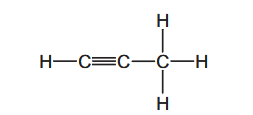
Which types of hybridisation are shown by the carbon atoms in propyne?
(B) \(\mathrm{sp}\) and \(\mathrm{sp^3}\) only
(C) \(\mathrm{sp^2}\) and \(\mathrm{sp^3}\) only
(D) \(\mathrm{sp^2}\) only
▶️ Answer/Explanation
Correct Answer: \( \boxed{\mathrm{B}} \)
Propyne has the structure:
\(\mathrm{CH\equiv CCH_3}\)
- The two carbon atoms joined by the triple bond are \(\mathrm{sp}\)-hybridised.
- The carbon atom in the methyl group forms four single bonds and is \(\mathrm{sp^3}\)-hybridised.
No carbon atom is \(\mathrm{sp^2}\)-hybridised.
Therefore, the correct answer is (B).
Question 7
The boiling point of water, \(\mathrm{H_2O}\), is higher than that of hydrogen sulfide, \(\mathrm{H_2S}\).
Which statement explains this difference in boiling points?
(B) The intermolecular forces in \(\mathrm{H_2O}\) are weaker than the intermolecular forces in \(\mathrm{H_2S}\).
(C) The S–H bond in \(\mathrm{H_2S}\) is longer than the O–H bond in \(\mathrm{H_2O}\).
(D) There is significant intermolecular hydrogen bonding in \(\mathrm{H_2O}\) but not in \(\mathrm{H_2S}\).
▶️ Answer/Explanation
Correct Answer: \( \boxed{\mathrm{D}} \)
Water molecules form extensive intermolecular hydrogen bonds because hydrogen is bonded to the highly electronegative oxygen atom.
Hydrogen sulfide does not form significant hydrogen bonding, so only weaker intermolecular forces act between its molecules.
Stronger intermolecular forces require more energy to overcome, giving water a much higher boiling point.
Therefore, the correct answer is (D).
Question 8
Which row describes silicon dioxide?
| Electrical conductivity in liquid state | Solubility in water | |
|---|---|---|
| A | non-conductor | insoluble |
| B | non-conductor | soluble |
| C | conductor | insoluble |
| D | conductor | soluble |
▶️ Answer/Explanation
Correct Answer: \( \boxed{\mathrm{A}} \)
Silicon dioxide has a giant covalent structure.
- It has no mobile ions or delocalised electrons, so it does not conduct electricity, even when molten.
- Its strong three-dimensional covalent network makes it insoluble in water.
Therefore, the correct answer is (A).
Question 9
The data shown are needed for this question.
\(\Delta H_f^\circ(\mathrm{P_4O_{10}(s)})=-3012\,\mathrm{kJ\,mol^{-1}}\)
\(\Delta H_f^\circ(\mathrm{H_2O(l)})=-286\,\mathrm{kJ\,mol^{-1}}\)
\(\Delta H_f^\circ(\mathrm{H_3PO_4(s)})=-1279\,\mathrm{kJ\,mol^{-1}}\)
What is \(\Delta H^\circ\) for the reaction shown?
\(\mathrm{P_4O_{10}(s)+6H_2O(l)\rightarrow4H_3PO_4(s)}\)
(B) \(-388\,\mathrm{kJ\,mol^{-1}}\)
(C) \(-97\,\mathrm{kJ\,mol^{-1}}\)
(D) \(+2019\,\mathrm{kJ\,mol^{-1}}\)
▶️ Answer/Explanation
Correct Answer: \( \boxed{\mathrm{B}} \)
Use standard enthalpies of formation:
\(\Delta H^\circ=\sum\Delta H_f^\circ(\text{products})-\sum\Delta H_f^\circ(\text{reactants})\)
Products:
\(\mathrm{4(-1279)=-5116\,kJ\,mol^{-1}}\)
Reactants:
\(\mathrm{-3012+6(-286)=-4728\,kJ\,mol^{-1}}\)
Therefore,
\(\mathrm{\Delta H^\circ=-5116-(-4728)=-388\,kJ\,mol^{-1}}\)
Therefore, the correct answer is (B).
Question 10
In an experiment to measure the enthalpy change of neutralisation of hydrochloric acid, \(20\,\mathrm{cm^3}\) of solution containing \(0.04\,\mathrm{mol}\) of HCl is placed in a plastic cup of negligible heat capacity.
A \(20\,\mathrm{cm^3}\) sample of aqueous sodium hydroxide containing \(0.04\,\mathrm{mol}\) of NaOH, at the same initial temperature, is added and the temperature rises by \(15\,\mathrm{K}\).
If the heat capacity per unit volume of the final solution is \(4.2\,\mathrm{J\,K^{-1}\,cm^{-3}}\), what is the enthalpy change of neutralisation of hydrochloric acid?
(B) \(\mathrm{40\times4.2\times15\times0.08\,J\,mol^{-1}}\)
(C) \(\mathrm{\dfrac{40\times4.2\times15}{0.04}\,J\,mol^{-1}}\)
(D) \(\mathrm{\dfrac{20\times4.2\times15}{0.08}\,J\,mol^{-1}}\)
▶️ Answer/Explanation
Correct Answer: \( \boxed{\mathrm{C}} \)
Total volume of solution:
\(\mathrm{20+20=40\,cm^3}\)
Heat released:
\(\mathrm{q=40\times4.2\times15\,J}\)
Moles of water (or HCl) neutralised:
\(\mathrm{0.04\,mol}\)
Therefore, the enthalpy change of neutralisation per mole is:
\(\mathrm{\Delta H=\dfrac{40\times4.2\times15}{0.04}\,J\,mol^{-1}}\)
Therefore, the correct answer is (C).
Question 11
Acidified potassium manganate(VII) reacts with iron(II) ethanedioate, \(\mathrm{FeC_2O_4}\).
The reactions taking place are shown.
\(\mathrm{MnO_4^-+8H^++5e^-\rightarrow Mn^{2+}+4H_2O}\)
\(\mathrm{Fe^{2+}\rightarrow Fe^{3+}+e^-}\)
\(\mathrm{C_2O_4^{2-}\rightarrow2CO_2+2e^-}\)
How many moles of iron(II) ethanedioate react with one mole of potassium manganate(VII)?
(B) \(1.67\)
(C) \(2.50\)
(D) \(5.00\)
▶️ Answer/Explanation
Correct Answer: \( \boxed{\mathrm{B}} \)
One mole of \(\mathrm{MnO_4^-}\) gains 5 electrons.
Each mole of \(\mathrm{FeC_2O_4}\) produces:
- \(\mathrm{Fe^{2+}\rightarrow Fe^{3+}}\): \(1\) electron
- \(\mathrm{C_2O_4^{2-}\rightarrow2CO_2}\): \(2\) electrons
Therefore, one mole of \(\mathrm{FeC_2O_4}\) releases:
\(\mathrm{1+2=3}\) electrons.
Moles of \(\mathrm{FeC_2O_4}\) required:
\(\mathrm{\dfrac{5}{3}=1.67\,mol}\)
Therefore, the correct answer is (B).
Question 12
Nitrogen dioxide decomposes on heating according to the equation shown.
\(\mathrm{2NO_2(g)\rightleftharpoons2NO(g)+O_2(g)}\)
When \(4\,\mathrm{mol}\) of nitrogen dioxide were put into a \(1\,\mathrm{dm^3}\) container and heated to a constant temperature, the equilibrium mixture contained \(0.8\,\mathrm{mol}\) of oxygen.
What is the value of the equilibrium constant, \(K_c\), at the temperature of the experiment?
(B) \(\mathrm{\dfrac{1.6\times0.8}{2.4^2}}\)
(C) \(\mathrm{\dfrac{1.6^2\times0.8}{4^2}}\)
(D) \(\mathrm{\dfrac{1.6^2\times0.8}{2.4^2}}\)
▶️ Answer/Explanation
Correct Answer: \( \boxed{\mathrm{D}} \)
At equilibrium:
- \(\mathrm{O_2}=0.8\,\mathrm{mol}\)
- \(\mathrm{NO}=2\times0.8=1.6\,\mathrm{mol}\)
- \(\mathrm{NO_2}=4-2\times0.8=2.4\,\mathrm{mol}\)
Since the volume is \(1\,\mathrm{dm^3}\), the concentrations are numerically the same as the number of moles.
The equilibrium expression is:
\(\mathrm{K_c=\dfrac{[NO]^2[O_2]}{[NO_2]^2}}\)
Therefore,
\(\mathrm{K_c=\dfrac{1.6^2\times0.8}{2.4^2}}\)
Therefore, the correct answer is (D).
Question 13
One particle of X reacts with one particle of Y in a single-step reaction to produce two particles of Z.
This reaction is exothermic and reversible.
\(\mathrm{X+Y\rightleftharpoons2Z}\)
Three statements about the forward and reverse reactions are listed.
1 The activation energy of the forward reaction is equal to the activation energy of the reverse reaction.
2 At equilibrium, the frequency of collisions between one particle of X and one particle of Y is equal to the frequency of collisions between two particles of Z.
3 At equilibrium, the frequency of effective collisions between one particle of X and one particle of Y is equal to the frequency of effective collisions between two particles of Z.
Which statements are correct?
(B) 2 and 3
(C) 2 only
(D) 3 only
▶️ Answer/Explanation
Correct Answer: \( \boxed{\mathrm{D}} \)
Since the reaction is exothermic, the activation energies of the forward and reverse reactions are not equal, so statement 1 is false.
At equilibrium, the total collision frequencies of reactants and products are not necessarily equal, so statement 2 is false.
Dynamic equilibrium means the rate of the forward reaction equals the rate of the reverse reaction. Therefore, the frequency of effective collisions is the same in both directions.
Hence, only statement 3 is correct, so the correct answer is (D).
Question 14
When two aqueous solutions are mixed, the reaction between them is very slow.
An effective catalyst is added to the mixture without any change in temperature.
Which statement about this catalyst is correct?
(B) It changes the distribution of energies of the reactant particles.
(C) It allows a greater number of reactant particles to react per unit time.
(D) It increases the number of reactant particles with the most probable energy.
▶️ Answer/Explanation
Correct Answer: \( \boxed{\mathrm{C}} \)
A catalyst provides an alternative reaction pathway with a lower activation energy.
Since the temperature is unchanged, the average kinetic energy and the Maxwell-Boltzmann energy distribution remain unchanged.
Lowering the activation energy means a greater proportion of collisions are successful, so more reactant particles react per unit time.
Therefore, the correct answer is (C).
Question 15
A mixture of gases reacts faster as its temperature increases.
Which row explains this?
| The activation energy remains unchanged | More particles have energy equal to or above the activation energy | There is an increase in the rate of successful collisions | |
|---|---|---|---|
| A | false | false | false |
| B | true | true | true |
| C | false | true | true |
| D | true | false | false |
▶️ Answer/Explanation
Correct Answer: \( \boxed{\mathrm{B}} \)
Increasing the temperature does not change the activation energy of the reaction.
However, a greater proportion of particles have kinetic energies equal to or greater than the activation energy.
As a result, the number of successful collisions per unit time increases, so the reaction rate increases.
Therefore, the correct answer is (B).
Question 16
A student investigated the chloride of a Period 3 element. This is what the student wrote down as the observations.
What can be deduced from these observations?
(B) The compound was magnesium chloride, \(\mathrm{MgCl_2}\).
(C) The compound was phosphorus pentachloride, \(\mathrm{PCl_5}\).
(D) The compound was sodium chloride, \(\mathrm{NaCl}\).
▶️ Answer/Explanation
Correct Answer: \( \boxed{\mathrm{A}} \)
The observations are inconsistent with any Period 3 chloride.
- \(\mathrm{NaCl}\) and \(\mathrm{MgCl_2}\) dissolve in water but do not produce a strongly alkaline solution of pH 12.
- \(\mathrm{PCl_5}\) reacts violently with water to form acidic products, not an alkaline solution.
- A solution of pH 12 cannot be obtained from any Period 3 chloride simply by dissolving it in water.
Therefore, at least one of the recorded observations must be incorrect.
Hence, the correct answer is (A).
Question 17
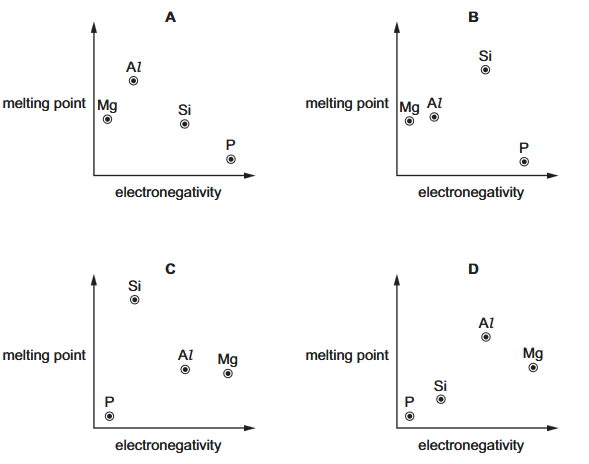
Which graph correctly shows the relative melting points and electronegativities of the Period 3 elements magnesium, aluminium, silicon and phosphorus?
▶️ Answer/Explanation
Correct Answer: \( \boxed{\mathrm{B}} \)
Across Period 3:
- Electronegativity increases from \(\mathrm{Mg}\) to \(\mathrm{P}\).
- Silicon has the highest melting point because it has a giant covalent structure.
- Aluminium has a slightly higher melting point than magnesium due to stronger metallic bonding.
- Phosphorus has a low melting point because it exists as simple molecular \(\mathrm{P_4}\) molecules.
Graph B correctly represents both the melting point trend and the increase in electronegativity across the period.
Therefore, the correct answer is (B).
Question 18
Caesium and barium are in Period 6 of the Periodic Table.
Which row is correct?
| The larger ionic radius | The higher melting point | |
|---|---|---|
| A | \(\mathrm{Ba^{2+}}\) | barium |
| B | \(\mathrm{Ba^{2+}}\) | caesium |
| C | \(\mathrm{Cs^+}\) | barium |
| D | \(\mathrm{Cs^+}\) | caesium |
▶️ Answer/Explanation
Correct Answer: \( \boxed{\mathrm{C}} \)
Both ions are isoelectronic with xenon, but \(\mathrm{Ba^{2+}}\) has a greater nuclear charge than \(\mathrm{Cs^+}\), so \(\mathrm{Ba^{2+}}\) has the smaller ionic radius.
Barium has a much higher melting point than caesium because it contributes two delocalised electrons per atom, giving stronger metallic bonding.
Therefore, the correct answer is (C).
Question 19
Magnesium nitrate, \(\mathrm{Mg(NO_3)_2}\), will decompose when heated to give a white solid and a mixture of gases. One of the gases released is oxygen.
\(29.7\,\mathrm{g}\) of anhydrous magnesium nitrate is heated until no further reaction takes place.
Which mass of oxygen is produced?
(B) \(6.4\,\mathrm{g}\)
(C) \(12.8\,\mathrm{g}\)
(D) \(19.2\,\mathrm{g}\)
▶️ Answer/Explanation
Correct Answer: \( \boxed{\mathrm{A}} \)
Thermal decomposition:
\(\mathrm{2Mg(NO_3)_2\rightarrow2MgO+4NO_2+O_2}\)
Molar mass of \(\mathrm{Mg(NO_3)_2}\):
\(\mathrm{24.3+2(14+3\times16)=148.3\,g\,mol^{-1}}\)
Moles of \(\mathrm{Mg(NO_3)_2}\):
\(\mathrm{\dfrac{29.7}{148.3}\approx0.20\,mol}\)
From the equation, \(2\) mol of nitrate produce \(1\) mol of \(\mathrm{O_2}\).
Moles of \(\mathrm{O_2}=0.20\times\dfrac{1}{2}=0.10\,mol\)
Mass of \(\mathrm{O_2}=0.10\times32=3.2\,\mathrm{g}\)
Therefore, the correct answer is (A).
Question 20
Which row shows the trends in the named properties going down the Group 2 nitrates?
| Thermal stability | Volume of gas produced, measured at room conditions, when \(1.0\,\mathrm{g}\) of anhydrous solid nitrate is thermally decomposed | |
|---|---|---|
| A | increases | increases |
| B | increases | decreases |
| C | decreases | increases |
| D | decreases | decreases |
▶️ Answer/Explanation
Correct Answer: \( \boxed{\mathrm{B}} \)
Down Group 2, the nitrates become more thermally stable because the larger cations have a lower polarising power.
As the relative formula mass increases, \(1.0\,\mathrm{g}\) of nitrate contains fewer moles, so fewer moles (and hence a smaller volume) of gaseous products are produced on decomposition.
Therefore, the correct answer is (B).
Question 21
X, Y and Z are three aqueous solutions. Equal volumes of pairs of the solutions are mixed and observations noted.
X mixed with Y shows no reaction.
X mixed with Z shows an immediate reaction.
Z mixed with Y shows no reaction.
What are X, Y and Z?
| X | Y | Z | |
|---|---|---|---|
| A | \(\mathrm{Br_2(aq)}\) | \(\mathrm{I_2(aq)}\) | \(\mathrm{HBr(aq)}\) |
| B | \(\mathrm{Cl_2(aq)}\) | \(\mathrm{I_2(aq)}\) | \(\mathrm{HBr(aq)}\) |
| C | \(\mathrm{HCl(aq)}\) | \(\mathrm{HI(aq)}\) | \(\mathrm{Br_2(aq)}\) |
| D | \(\mathrm{HCl(aq)}\) | \(\mathrm{Br_2(aq)}\) | \(\mathrm{HBr(aq)}\) |
▶️ Answer/Explanation
Correct Answer: \( \boxed{\mathrm{B}} \)
Chlorine is a stronger oxidising agent than bromine and iodine.
- \(\mathrm{Cl_2(aq)+2Br^-\rightarrow2Cl^-+Br_2}\), so X and Z react immediately.
- \(\mathrm{Cl_2}\) does not react with \(\mathrm{I_2}\).
- \(\mathrm{HBr}\) and \(\mathrm{I_2}\) also show no reaction.
Therefore, the correct answer is (B).
Question 22
An excess of chlorine gas is bubbled into hot potassium hydroxide solution.
Which chlorine-containing species are present in the final solution?
(B) \(\mathrm{Cl^-}\) and \(\mathrm{ClO_3^-}\)
(C) \(\mathrm{ClO^-}\) and \(\mathrm{ClO_3^-}\)
(D) \(\mathrm{ClO_3^-}\) only
▶️ Answer/Explanation
Correct Answer: \( \boxed{\mathrm{B}} \)
Chlorine reacts with hot, concentrated potassium hydroxide by disproportionation:
\(\mathrm{3Cl_2+6OH^-\rightarrow5Cl^-+ClO_3^-+3H_2O}\)
Therefore, the final solution contains chloride ions and chlorate(V) ions.
Hence, the correct answer is (B).
Question 23
The oxides of nitrogen, \(\mathrm{NO}\) and \(\mathrm{NO_2}\), act as pollutants in the Earth’s atmosphere in a number of different ways.
Three statements about the oxides of nitrogen are listed.
1 They react with oxygen and water vapour to form nitric acid, a constituent of acid rain.
2 They react with carbon monoxide to form photochemical smog.
3 They catalyse the oxidation of sulfur dioxide in the formation of sulfuric acid, another constituent of acid rain.
Which statements are correct?
(B) 1 and 2 only
(C) 1 and 3 only
(D) 2 and 3 only
▶️ Answer/Explanation
Correct Answer: \( \boxed{\mathrm{C}} \)
Statement 1 is correct because nitrogen oxides react with oxygen and water to form nitric acid, contributing to acid rain.
Statement 2 is incorrect because photochemical smog is formed mainly when nitrogen oxides react with unburnt hydrocarbons in the presence of sunlight, not carbon monoxide.
Statement 3 is correct because nitrogen oxides catalyse the oxidation of sulfur dioxide to sulfur trioxide, which forms sulfuric acid.
Therefore, the correct answer is (C).
Question 24
Which reagent, when mixed with ammonium sulfate and then heated, liberates ammonia?
(B) dilute hydrochloric acid
(C) aqueous calcium hydroxide
(D) potassium dichromate(VI) in acidic solution
▶️ Answer/Explanation
Correct Answer: \( \boxed{\mathrm{C}} \)
Ammonium salts react with alkalis on warming to release ammonia gas.
\(\mathrm{2NH_4^++Ca(OH)_2\rightarrow2NH_3+2H_2O+Ca^{2+}}\)
Aqueous calcium hydroxide provides the hydroxide ions needed to liberate ammonia.
Therefore, the correct answer is (C).
Question 25
Two hydrocarbons, \(\mathrm{CH_3CHC(CH_3)CH_3}\) and \(\mathrm{CH_3CH(CH_3)CH_2CH_3}\), react separately with chlorine in the presence of ultraviolet light.
In each reaction, free-radical substitution occurs.
Which row is correct?
| Identity of the hydrocarbon that can also undergo electrophilic addition | A termination stage of the free-radical substitution of the saturated hydrocarbon | |
|---|---|---|
| A | \(\mathrm{CH_3CHC(CH_3)CH_3}\) | \(\mathrm{CH_3CH(CH_3)CH_2CH_2\bullet+Cl\bullet\rightarrow CH_3CH(CH_3)CH_2CH_2Cl}\) |
| B | \(\mathrm{CH_3CHC(CH_3)CH_3}\) | \(\mathrm{CH_3CHC(CH_3)CH_2\bullet+Cl\bullet\rightarrow CH_3CHC(CH_3)CH_2Cl}\) |
| C | \(\mathrm{CH_3CH(CH_3)CH_2CH_3}\) | \(\mathrm{CH_3CH(CH_3)CH_2CH_2\bullet+Cl\bullet\rightarrow CH_3CH(CH_3)CH_2CH_2Cl}\) |
| D | \(\mathrm{CH_3CH(CH_3)CH_2CH_3}\) | \(\mathrm{CH_3CHC(CH_3)CH_2\bullet+Cl\bullet\rightarrow CH_2CHC(CH_3)CH_2Cl}\) |
▶️ Answer/Explanation
Correct Answer: \( \boxed{\mathrm{A}} \)
The hydrocarbon \(\mathrm{CH_3CHC(CH_3)CH_3}\) is an alkene, so it can undergo electrophilic addition reactions.
The other hydrocarbon, \(\mathrm{CH_3CH(CH_3)CH_2CH_3}\), is a saturated alkane and undergoes free-radical substitution.
A termination step occurs when two radicals combine to form a stable molecule, for example:
\(\mathrm{CH_3CH(CH_3)CH_2CH_2\bullet+Cl\bullet\rightarrow CH_3CH(CH_3)CH_2CH_2Cl}\)
Therefore, the correct answer is (A).
Question 26
The structure of the compound γ-ionone is shown.
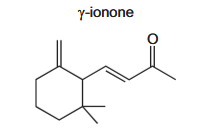
Including γ-ionone, how many stereoisomers exist with this molecular formula?
(B) \(2\)
(C) \(4\)
(D) \(8\)
▶️ Answer/Explanation
Correct Answer: \( \boxed{\mathrm{C}} \)
The molecule contains:
- One carbon-carbon double bond capable of E/Z isomerism.
- One chiral carbon atom, giving a pair of optical isomers.
Therefore, the total number of stereoisomers is:
\(\mathrm{2\times2=4}\)
Therefore, the correct answer is (C).
Question 27
Structural and stereoisomerism should be considered when answering this question.
A mixture of 1-chlorobutane and 2-chlorobutane is heated with an excess of \(\mathrm{NaOH}\) in ethanol.
How many different organic molecules will be produced?
(B) \(2\)
(C) \(3\)
(D) \(4\)
▶️ Answer/Explanation
Correct Answer: \( \boxed{\mathrm{C}} \)
Ethanolic \(\mathrm{NaOH}\) promotes elimination.
- 1-Chlorobutane produces but-1-ene.
- 2-Chlorobutane produces but-1-ene and but-2-ene.
- But-2-ene exists as E and Z stereoisomers.
Therefore, the different organic molecules are:
- but-1-ene
- \(\mathrm{E}\)-but-2-ene
- \(\mathrm{Z}\)-but-2-ene
Total different molecules \(=3\). Therefore, the correct answer is (C).
Question 28
The diagram shows the skeletal formula of the hormone testosterone.
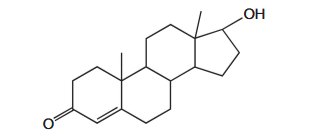
What is the molecular formula of testosterone?
(B) \(\mathrm{C_{17}H_{22}O_2}\)
(C) \(\mathrm{C_{17}H_{24}O_2}\)
(D) \(\mathrm{C_{19}H_{26}O_2}\)
▶️ Answer/Explanation
Correct Answer: \( \boxed{\mathrm{A}} \)
From the skeletal formula:
- There are 19 carbon atoms.
- There are 2 oxygen atoms (one ketone group and one alcohol group).
- Accounting for the four fused rings and the double bond gives a total of 28 hydrogen atoms.
Therefore, the molecular formula is:
\(\mathrm{C_{19}H_{28}O_2}\)
Therefore, the correct answer is (A).
Question 29
Pinenes are unsaturated compounds. The structures of two pinenes are shown.
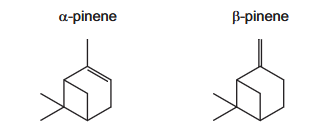
A mixture of these two pinenes reacts with hot concentrated acidified \(\mathrm{KMnO_4}\).
What are the molecular formulae of the organic products?
(B) \(\mathrm{C_9H_{14}O}\) and \(\mathrm{C_{10}H_{14}O_4}\)
(C) \(\mathrm{C_9H_{16}O_2}\) and \(\mathrm{C_{10}H_{16}O_3}\)
(D) \(\mathrm{C_9H_{16}O_2}\) and \(\mathrm{C_{10}H_{14}O_4}\)
▶️ Answer/Explanation
Correct Answer: \( \boxed{\mathrm{A}} \)
Hot, concentrated acidified \(\mathrm{KMnO_4}\) cleaves carbon-carbon double bonds.
- \(\alpha\)-Pinene undergoes oxidative cleavage to form a product with molecular formula \(\mathrm{C_9H_{14}O}\).
- \(\beta\)-Pinene forms an oxygen-containing product with molecular formula \(\mathrm{C_{10}H_{16}O_3}\).
Therefore, the correct answer is (A).
Question 30
An organic ion containing a carbon atom with a negative charge is called a carbanion.
An organic ion containing a carbon atom with a positive charge is called a carbocation.
The reaction between \(\mathrm{NaOH(aq)}\) and 1-bromobutane proceeds by an \(\mathrm{S_N2}\) mechanism.
What is the first step in the mechanism?
(B) heterolytic bond fission followed by attack by an electrophile on a carbanion
(C) heterolytic bond fission followed by attack by a nucleophile on a carbocation
(D) homolytic bond fission followed by attack by a nucleophile on a carbocation
▶️ Answer/Explanation
Correct Answer: \( \boxed{\mathrm{A}} \)
An \(\mathrm{S_N2}\) reaction occurs in a single step.
The hydroxide ion acts as a nucleophile and attacks the carbon atom bonded to bromine, which has a partial positive charge due to the polar \(\mathrm{C-Br}\) bond.
Bond formation and bond breaking occur simultaneously without forming a carbocation intermediate.
Therefore, the correct answer is (A).
Question 31
2-chloropropane and 2-bromopropane react separately with aqueous \(\mathrm{NaOH}\).
Which row is correct?
| Comparison of rates of reaction | Explanation of the difference in reaction rates | |
|---|---|---|
| A | 2-chloropropane reacts faster | chlorine is more reactive than bromine |
| B | 2-chloropropane reacts faster | the \(\mathrm{C-Cl}\) bond is more polar than the \(\mathrm{C-Br}\) bond |
| C | 2-bromopropane reacts faster | the first ionisation energy of bromine is lower than chlorine’s |
| D | 2-bromopropane reacts faster | the \(\mathrm{C-Br}\) bond is weaker than the \(\mathrm{C-Cl}\) bond |
▶️ Answer/Explanation
Correct Answer: \( \boxed{\mathrm{D}} \)
Hydrolysis of halogenoalkanes involves breaking the carbon-halogen bond.
The \(\mathrm{C-Br}\) bond is weaker than the \(\mathrm{C-Cl}\) bond, so it requires less energy to break.
As a result, 2-bromopropane reacts faster with aqueous \(\mathrm{NaOH}\) than 2-chloropropane.
Therefore, the correct answer is (D).
Question 32
The diagram shows the structure of compound X.
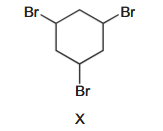
X undergoes hydrolysis to form product Y in which all of the bromine atoms are replaced by hydroxyl groups.
Product Z is formed by oxidation of Y.
Two suggestions are listed.
1 Y is a secondary alcohol.
2 Z is a ketone.
Which suggestions are correct?
(B) 1 only
(C) 2 only
(D) neither 1 nor 2
▶️ Answer/Explanation
Correct Answer: \( \boxed{\mathrm{A}} \)
Hydrolysis replaces each bromine atom with a hydroxyl group. In the cyclohexane ring, each carbon bearing a hydroxyl group is bonded to two other carbon atoms, so every \(\mathrm{-OH}\) group is on a secondary carbon.
On oxidation, secondary alcohols are oxidised to ketones.
Therefore, product Y is a secondary alcohol and product Z contains ketone groups.
Hence, both suggestions are correct and the correct answer is (A).
Question 33
Cyclohexanol is converted to cyclohexane-1,2-diol via a two-step synthesis that proceeds via intermediate Q.
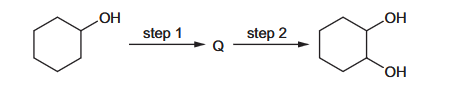
Which row identifies the type of reaction in step 1 and in step 2?
| Step 1 | Step 2 | |
|---|---|---|
| A | dehydration | oxidation |
| B | dehydration | nucleophilic substitution |
| C | reduction | oxidation |
| D | reduction | nucleophilic substitution |
▶️ Answer/Explanation
Correct Answer: \( \boxed{\mathrm{A}} \)
In step 1, cyclohexanol is converted into cyclohexene by eliminating a molecule of water. This is a dehydration reaction.
In step 2, the alkene is converted into cyclohexane-1,2-diol by oxidation with an oxidising agent such as cold, dilute acidified \(\mathrm{KMnO_4}\).
Two hydroxyl groups are added across the carbon-carbon double bond to form the vicinal diol.
Therefore, the correct answer is (A).
Question 34
Three tests were performed on an unknown organic compound.
| Test reagent | Test result |
|---|---|
| 2,4-DNPH reagent | orange ppt |
| Tollens’ reagent | no change |
| alkaline \(\mathrm{I_2(aq)}\) | yellow ppt |
What is the organic compound tested?

▶️ Answer/Explanation
Correct Answer: \( \boxed{\mathrm{B}} \)
The orange precipitate with 2,4-DNPH confirms the presence of a carbonyl group (aldehyde or ketone).
No reaction with Tollens’ reagent shows that the compound is not an aldehyde, so it must be a ketone.
The yellow precipitate with alkaline \(\mathrm{I_2}\) is a positive iodoform test, indicating the presence of a \(\mathrm{CH_3CO-}\) group (a methyl ketone).
Of the four structures, only Structure B contains a methyl ketone group.
Therefore, the correct answer is (B).
Question 35
Butanone, \(\mathrm{CH_3CH_2COCH_3}\), and \(\mathrm{HCN}\) mixed with a little \(\mathrm{KCN}\) react together in a nucleophilic addition reaction.
Which description of the mechanism of this nucleophilic addition reaction is correct?
(B) A \(\pi\) bond pair from \(\mathrm{CN^-}\) attacks the \(\delta^+\) C and \(\mathrm{HCN}\) then donates \(\mathrm{H^+}\) to O.
(C) The lone pair on O accepts \(\mathrm{H^+}\) from \(\mathrm{HCN}\) and then \(\mathrm{CN^-}\) acts as a nucleophile.
(D) A lone pair from \(\mathrm{CN^-}\) attacks the \(\delta^+\) C and then O accepts \(\mathrm{H^+}\) from \(\mathrm{HCN}\).
▶️ Answer/Explanation
Correct Answer: \( \boxed{\mathrm{D}} \)
The cyanide ion acts as the nucleophile using its lone pair to attack the \(\delta^+\) carbon atom of the carbonyl group.
This forms an alkoxide ion, which is then protonated when the oxygen atom accepts \(\mathrm{H^+}\) from \(\mathrm{HCN}\), producing the hydroxynitrile.
Therefore, the correct answer is (D).
Question 36
The structural formula of compound P is \(\mathrm{CH_3CH_2COOCH_2CH_3}\).
P can be formed by reacting together two organic compounds in the presence of a suitable catalyst.
Which pair of compounds could react together to produce P?
(B) ethanoic acid and propan-1-ol
(C) ethanol and propanoic acid
(D) ethanol and propan-1-ol
▶️ Answer/Explanation
Correct Answer: \( \boxed{\mathrm{C}} \)
Compound P is an ester, \(\mathrm{CH_3CH_2COOCH_2CH_3}\), called ethyl propanoate.
It is formed by esterification between:
- ethanol, \(\mathrm{CH_3CH_2OH}\)
- propanoic acid, \(\mathrm{CH_3CH_2COOH}\)
The reaction is:
\(\mathrm{CH_3CH_2COOH+CH_3CH_2OH\rightleftharpoons CH_3CH_2COOCH_2CH_3+H_2O}\)
Therefore, the correct answer is (C).
Question 37
The structures of three organic compounds are shown.
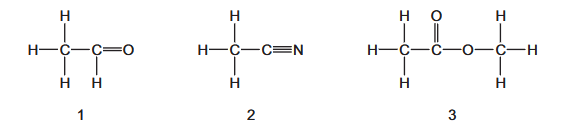
Which compounds produce ethanoic acid when heated with \(\mathrm{HCl(aq)}\)?
(B) 1 and 2 only
(C) 1 and 3 only
(D) 2 and 3 only
▶️ Answer/Explanation
Correct Answer: \( \boxed{\mathrm{D}} \)
Compound 2 is a nitrile, which hydrolyses with aqueous acid to form ethanoic acid:
\(\mathrm{CH_3CN+2H_2O+H^+\rightarrow CH_3COOH+NH_4^+}\)
Compound 3 is an ester (methyl ethanoate), which hydrolyses with aqueous acid to produce ethanoic acid and methanol.
Compound 1 is ethanal, which is not converted to ethanoic acid simply by heating with aqueous hydrochloric acid.
Therefore, the correct answer is (D).
Question 38
When bromoethane, \(\mathrm{C_2H_5Br}\), is heated with \(\mathrm{NaOH}\) in ethanol, which type of reaction occurs?
(B) elimination
(C) nucleophilic substitution, mainly via an \(\mathrm{S_N1}\) mechanism
(D) nucleophilic substitution, mainly via an \(\mathrm{S_N2}\) mechanism
▶️ Answer/Explanation
Correct Answer: \( \boxed{\mathrm{B}} \)
Ethanolic sodium hydroxide favours elimination rather than substitution.
A hydrogen atom and the bromine atom are removed from adjacent carbon atoms to form an alkene:
\(\mathrm{C_2H_5Br+NaOH\rightarrow C_2H_4+NaBr+H_2O}\)
Therefore, the correct answer is (B).
Question 39
PMMA is a rigid polymer. The repeat unit of PMMA is shown.
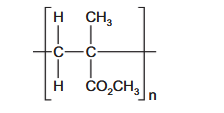
Which monomer is used to make PMMA?

▶️ Answer/Explanation
Correct Answer: \( \boxed{\mathrm{D}} \)
PMMA is formed by addition polymerisation of methyl methacrylate.
The monomer must contain both:
- a carbon-carbon double bond for addition polymerisation, and
- the ester group \(\mathrm{-CO_2CH_3}\).
Only Structure D is methyl methacrylate, \(\mathrm{CH_2=C(CH_3)COOCH_3}\).
Therefore, the correct answer is (D).
Question 40
A sample of gallium contains two isotopes only.
In every \(10\) atoms in the sample, there are \(6\) that have \(38\) neutrons and \(4\) that have \(40\) neutrons.
What is the relative atomic mass, \(A_{\mathrm{r}}\), of the gallium in the sample?
(B) \(69.8\)
(C) \(70.0\)
(D) \(70.2\)
▶️ Answer/Explanation
Correct Answer: \( \boxed{\mathrm{B}} \)
Gallium has atomic number \(31\).
Therefore, the two isotopes have mass numbers:
- \(31+38=69\)
- \(31+40=71\)
The relative atomic mass is:
\(\mathrm{\dfrac{(6\times69)+(4\times71)}{10}=69.8}\)
Therefore, the correct answer is (B).