
Question 1
(a) Explain why the gravitational potential near to a point mass is negative.
(b) A planet may be assumed to be a uniform sphere. It has gravitational potential \(\phi\) at distance \(r\) from the centre of the planet. The variation with \(\frac{1}{r}\) of \(\phi\) is shown in Fig. 1.1.

(i) Show that the mass of the planet is \(8.8\times10^{25}\,\mathrm{kg}\).
(ii) The period of rotation of the planet is \(0.72\) Earth days. A satellite in orbit around the planet remains above the same point on the surface of the planet. Use the mass of the planet in (b)(i) to determine the radius \(R\) of the orbit of the satellite.
(iii) The speed of the satellite in (b)(ii) is \(8400\,\mathrm{m\,s^{-1}}\). The mass of the satellite is \(1200\,\mathrm{kg}\). Determine the additional energy required to move the satellite from its orbit to infinity.
Syllabus Topic Codes (Cambridge International AS & A Level Physics 9702, 2025–2027):
• 13.3: Gravitational field of a point mass — part (b)(i), using the gravitational field relationship and gradient
• 13.4: Gravitational potential — part (a), part (b) graph and part (b)(iii), gravitational potential energy and energy required to reach infinity
▶️ Answer/Explanation
(a)
Gravitational potential is defined to be zero at infinity.
The gravitational force between two masses is attractive, so work must be done on a mass to move it away from another mass and ultimately to infinity.
Therefore, a mass at a finite distance from a point mass has less gravitational potential energy than it has at infinity, making the gravitational potential negative.
Answer: Gravitational potential is zero at infinity and work must be done against the attractive gravitational force to move a mass from the point to infinity, so the potential at the point is negative.
(b)(i)
For a point mass, gravitational potential is
\(\phi=-\frac{GM}{r}\)
Comparing this with the straight-line graph of \(\phi\) against \(\frac{1}{r}\), the magnitude of the gradient is \(GM\).
From the graph,
\(\left|\mathrm{gradient}\right|=1.76\times10^{8}\,\mathrm{J\,m\,kg^{-1}}\)
Hence,
\(M=\frac{1.76\times10^{8}}{6.67\times10^{-11}}\)
\(M=8.8\times10^{25}\,\mathrm{kg}\)
Answer: \( \boxed{8.8\times10^{25}\,\mathrm{kg}} \)
(b)(ii)
For a satellite in a circular orbit, the gravitational force provides the centripetal force:
\(\frac{GMm}{R^2}=mR\omega^2\)
where
\(\omega=\frac{2\pi}{T}\)
The period is
\(T=0.72\times24\times60\times60\,\mathrm{s}\)
Rearranging the centripetal-force equation:
\(R^3=\frac{GMT^2}{4\pi^2}\)
Substituting the values:
\(R^3=\frac{(6.67\times10^{-11})(8.8\times10^{25})(0.72\times24\times60\times60)^2}{4\pi^2}\)
Therefore,
\(R=8.3\times10^{7}\,\mathrm{m}\)
Answer: \( \boxed{8.3\times10^{7}\,\mathrm{m}} \)
(b)(iii)
The satellite has both kinetic energy and gravitational potential energy in its orbit.
The additional energy required to move it from its orbit to infinity is equal to the increase in its total mechanical energy:
\(\Delta E=E_{\infty}-E_{\mathrm{orbit}}\)
At infinity, the gravitational potential energy is zero. Therefore,
\(\Delta E=\frac{GMm}{R}-\frac{1}{2}mv^2\)
Kinetic energy:
\(E_{\mathrm{k}}=\frac{1}{2}(1200)(8400)^2\)
Gravitational potential energy:
\(E_{\mathrm{p}}=-\frac{(6.67\times10^{-11})(8.8\times10^{25})(1200)}{8.3\times10^{7}}\)
Hence,
\(\Delta E=\frac{(6.67\times10^{-11})(8.8\times10^{25})(1200)}{8.3\times10^{7}}-\frac{1}{2}(1200)(8400)^2\)
\(\Delta E\approx4.3\times10^{10}\,\mathrm{J}\)
Answer: \( \boxed{4.3\times10^{10}\,\mathrm{J}} \)
Question 2
(a) By referring to both kinetic energy and potential energy, explain what is meant by the internal energy of an ideal gas.
(b) A fixed mass of an ideal gas at a temperature of \(20^\circ\mathrm{C}\) is sealed in a cylinder by a piston, as shown in Fig. 2.1.
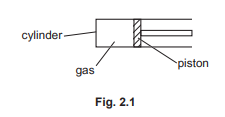
The initial volume of the gas is \(1.24\times10^{-4}\,\mathrm{m^3}\). Thermal energy is supplied to the gas and its volume increases by \(5.20\times10^{-5}\,\mathrm{m^3}\).
(i) The piston is freely moving so that the gas is always at atmospheric pressure. Atmospheric pressure is \(1.01\times10^5\,\mathrm{Pa}\). Calculate the work done by the gas.
(ii) Calculate the final thermodynamic temperature \(T\) of the gas.
(iii) The mass of the gas is \(16\,\mathrm{g}\). For this expansion, there is a net transfer of \(960\,\mathrm{J}\) of thermal energy to the gas. Calculate the specific heat capacity \(c\) of the gas at this pressure.
(c) The gas in (b) is allowed to return to its starting temperature. The piston is now fixed in position. Thermal energy is supplied to increase the temperature to the same final temperature as in (b). Use the first law of thermodynamics to suggest and explain how the specific heat capacity of the gas for this situation compares with the value in (b)(iii).
Syllabus Topic Codes (Cambridge International AS & A Level Physics 9702 Paper 4):
• 16.2: The first law of thermodynamics — parts (b)(i), (b)(iii) and (c), work done, heating and change in internal energy
• 15.2: Equation of state — part (b)(ii), relationship between pressure, volume and thermodynamic temperature for an ideal gas
• 14.3: Specific heat capacity and specific latent heat — part (b)(iii), calculation of specific heat capacity
▶️ Answer/Explanation
(a)
The internal energy of an ideal gas is the total energy associated with the molecules of the gas.
It is the sum of the total kinetic energy due to the random motion of the molecules and the total intermolecular potential energy.
For an ideal gas, intermolecular forces are negligible, so the intermolecular potential energy is taken to be zero. Therefore, the internal energy depends only on the random kinetic energy of the molecules.
Answer: \( \boxed{\text{Internal energy = total random kinetic energy + intermolecular potential energy}} \)
(b)(i)
At constant pressure, the work done by the gas is
\(W=p\Delta V\)
Substituting the values:
\(W=(1.01\times10^5)(5.20\times10^{-5})\)
\(W=5.25\,\mathrm{J}\)
Answer: \( \boxed{5.25\,\mathrm{J}} \)
(b)(ii)
The pressure and amount of gas remain constant, so for an ideal gas
\(\frac{V}{T}=\mathrm{constant}\)
The initial thermodynamic temperature is
\(T_1=20+273=293\,\mathrm{K}\)
The final volume is
\(V_2=1.24\times10^{-4}+5.20\times10^{-5}\)
\(V_2=1.76\times10^{-4}\,\mathrm{m^3}\)
Therefore,
\(\frac{1.24\times10^{-4}}{293}=\frac{1.76\times10^{-4}}{T}\)
Hence,
\(T=416\,\mathrm{K}\)
Answer: \( \boxed{416\,\mathrm{K}} \)
(b)(iii)
Specific heat capacity is given by
\(c=\frac{Q}{m\Delta T}\)
The mass is
\(m=16\,\mathrm{g}=0.016\,\mathrm{kg}\)
The temperature change is
\(\Delta T=416-293=123\,\mathrm{K}\)
Hence,
\(c=\frac{960}{(0.016)(123)}\)
\(c\approx4.88\times10^2\,\mathrm{J\,kg^{-1}\,K^{-1}}\)
Answer: \( \boxed{4.9\times10^2\,\mathrm{J\,kg^{-1}\,K^{-1}}} \)
(c)
When the piston is fixed, the volume of the gas does not change.
Therefore, no work is done by the gas:
\(W=0\)
Using the first law of thermodynamics,
\(\Delta U=Q+W_{\mathrm{on}}\)
Since the volume is constant, \(W_{\mathrm{on}}=0\), so
\(\Delta U=Q\)
The temperature change is the same as in part (b), so the change in internal energy is also the same.
However, during the expansion in (b), some of the thermal energy supplied is used to do work on the surroundings. When the piston is fixed, no energy is used for work, so less thermal energy is required for the same temperature rise.
Since \(c=\frac{Q}{m\Delta T}\), the specific heat capacity is therefore smaller when the piston is fixed.
Answer: \( \boxed{\text{The specific heat capacity is smaller at constant volume.}} \)
Question 3
A small object of mass \(24\,\mathrm{g}\) rests on a platform. The platform is attached to an oscillator, as shown in Fig. 3.1.
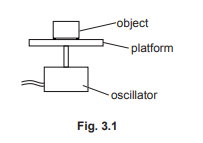
The oscillator moves the platform up and down.
(a) The total energy of the oscillations of the object is \(2.2\times10^{-4}\,\mathrm{J}\). In one oscillation the object travels a total distance of \(14\,\mathrm{mm}\). Calculate the angular frequency \(\omega\) of the oscillations.
(b) The frequency of the oscillator is fixed, and the amplitude of the oscillations is gradually increased.
(i) Calculate the maximum amplitude of the oscillations so the object does not lose contact with the platform.
(ii) The amplitude of the oscillations is increased so it is greater than the value in (b)(i). State and explain the position in an oscillation where the object first loses contact with the platform.
Syllabus Topic Codes (Cambridge International AS & A Level Physics 9702 Paper 4):
• 17.2: Energy in simple harmonic motion — part (a), total energy of an oscillating system
▶️ Answer/Explanation
(a)
For an object undergoing simple harmonic motion, the total energy is
\(E=\frac{1}{2}m\omega^2x_0^2\)
In one complete oscillation, the object travels a total distance of \(4x_0\).
Therefore,
\(x_0=\frac{14\times10^{-3}}{4}=3.50\times10^{-3}\,\mathrm{m}\)
The mass is
\(m=24\times10^{-3}\,\mathrm{kg}\)
Substituting into the energy equation:
\(2.2\times10^{-4}=\frac{1}{2}(24\times10^{-3})(3.50\times10^{-3})^2\omega^2\)
Hence,
\(\omega\approx39\,\mathrm{rad\,s^{-1}}\)
Answer: \( \boxed{39\,\mathrm{rad\,s^{-1}}} \)
(b)(i)
The object remains in contact with the platform provided that the downward acceleration of the platform does not exceed the acceleration due to gravity.
For SHM, the maximum acceleration is
\(a_{\max}=\omega^2x_0\)
At the limiting amplitude,
\(\omega^2x_0=g\)
Therefore,
\(x_0=\frac{g}{\omega^2}\)
\(x_0=\frac{9.81}{39^2}\)
\(x_0=6.4\times10^{-3}\,\mathrm{m}\)
Answer: \( \boxed{6.4\times10^{-3}\,\mathrm{m}} \)
(b)(ii)
The object first loses contact with the platform at the top of the oscillation.
At the top of the oscillation, the platform has its greatest downward acceleration because the acceleration in SHM is directed towards the equilibrium position.
When the amplitude is greater than the limiting value in (b)(i), the maximum downward acceleration exceeds \(g\). The platform would therefore require a downward contact force to provide this acceleration, but the contact force cannot be negative.
Hence, the normal contact force becomes zero and the object loses contact with the platform.
Answer: \( \boxed{\text{At the top of the oscillation, where the downward acceleration is greatest.}} \)
Question 4
(a) Three capacitors are connected as shown in Fig. 4.1.

Determine the total capacitance, in \(\mu\mathrm{F}\), of the network of three capacitors.
(b) A capacitor of capacitance \(45\,\mu\mathrm{F}\) is connected to a variable power supply initially set at \(8.0\,\mathrm{V}\). The output of the power supply increases so that the potential difference (p.d.) across the capacitor increases to \(9.6\,\mathrm{V}\). Calculate the increase in energy \(\Delta E\) stored in the capacitor.
(c) A sinusoidal a.c. power supply is connected to the input of a bridge rectifier. The output of the rectifier is connected to a load resistor.
(i) Complete the circuit in Fig. 4.2 by adding a capacitor to smooth the p.d. across the load resistor.

(ii) The variation with time \(t\) of the p.d. \(V\) of the smoothed output is shown in Fig. 4.3.

Determine the time constant, in ms, of the smoothing circuit.
(d) A sinusoidal a.c. power supply has a maximum power of \(16\,\mathrm{W}\). State the value of the mean power when the output of the power supply is:
(i) full-wave rectified
mean power = ……………….
(ii) half-wave rectified
Syllabus Topic Codes (Cambridge International AS & A Level Physics 9702 Paper 4):
• 19.2: Energy stored in a capacitor — part (b), energy stored in a capacitor
• 19.3: Discharging a capacitor — parts (c)(i) and (c)(ii), smoothing using a capacitor, discharge curve and time constant
• 21.2: Rectification and smoothing — parts (c)(i), (c)(ii) and (d), rectification and smoothing of an a.c. supply
▶️ Answer/Explanation
(a)
The two capacitors connected in parallel have a combined capacitance of
\(C_{\mathrm{parallel}}=15+15=30\,\mu\mathrm{F}\)
This combination is then in series with the \(45\,\mu\mathrm{F}\) capacitor.
For capacitors in series,
\(\frac{1}{C_{\mathrm{total}}}=\frac{1}{45}+\frac{1}{30}\)
Therefore,
\(C_{\mathrm{total}}=\left(\frac{1}{45}+\frac{1}{30}\right)^{-1}\)
\(C_{\mathrm{total}}=18\,\mu\mathrm{F}\)
Answer: \( \boxed{18\,\mu\mathrm{F}} \)
(b)
The energy stored in a capacitor is
\(E=\frac{1}{2}CV^2\)
Hence, the increase in energy is
\(\Delta E=\frac{1}{2}C(V_2^2-V_1^2)\)
Substituting the values:
\(\Delta E=\frac{1}{2}(45\times10^{-6})(9.6^2-8.0^2)\)
\(\Delta E=6.34\times10^{-4}\,\mathrm{J}\)
Answer: \( \boxed{6.3\times10^{-4}\,\mathrm{J}} \)
(c)(i)
The capacitor should be connected in parallel with the load resistor.
The capacitor charges when the rectified voltage rises and then discharges through the load resistor when the rectified voltage falls. This reduces the variation in p.d. across the load.
Answer: \( \boxed{\text{Capacitor connected in parallel across the load resistor.}} \)
(c)(ii)
During discharge, the p.d. across the capacitor is given by
\(V=V_0e^{-t/\tau}\)
From the graph, two suitable points during the same discharge cycle are approximately
\((t_1,V_1)=(5.0\,\mathrm{ms},4.0\,\mathrm{V})\)
and
\((t_2,V_2)=(13.0\,\mathrm{ms},3.2\,\mathrm{V})\)
Therefore, \(\Delta t=8.0\,\mathrm{ms}\), and
\(3.2=4.0e^{-8.0/\tau}\)
Taking natural logarithms:
\(\ln\left(\frac{3.2}{4.0}\right)=-\frac{8.0}{\tau}\)
Hence,
\(\tau=\frac{-8.0}{\ln(3.2/4.0)}\)
\(\tau\approx36\,\mathrm{ms}\)
Answer: \( \boxed{36\,\mathrm{ms}} \)
(d)(i)
For a sinusoidal a.c. supply, the instantaneous power varies as the square of the voltage. The mean power of the original sinusoidal supply is therefore half the maximum power:
\(P_{\mathrm{mean}}=\frac{P_{\max}}{2}\)
\(P_{\mathrm{mean}}=\frac{16}{2}=8.0\,\mathrm{W}\)
Answer: \( \boxed{8.0\,\mathrm{W}} \)
(d)(ii)
For half-wave rectification, the negative half-cycle is removed. Therefore, the mean power is half that of the full-wave rectified output:
\(P_{\mathrm{mean}}=\frac{8.0}{2}=4.0\,\mathrm{W}\)
Answer: \( \boxed{4.0\,\mathrm{W}} \)
Question 5
(a) An object travels in a circle at constant speed. State the names of two quantities that vary during the motion of the object.
(b) A charged particle of mass \(m\) and with charge \(q\) enters a region of uniform magnetic field, perpendicular to the field lines. The magnetic flux density is \(B\). The particle travels in a circle with period \(T\) and radius \(r\).
(i) By considering the magnetic force acting on the particle, show that \(B=\frac{2\pi m}{qT}\).
(ii) The particle is an alpha particle. The period of the circular motion is \(2.5\,\mu\mathrm{s}\). Calculate \(B\).
(iii) A second alpha particle is in the same uniform field. It travels in a circle of radius \(2r\). State and explain how the periods of the motion of the two particles compare.
(iv) The speed of the alpha particle in (b)(ii) is \(1.1\times10^6\,\mathrm{m\,s^{-1}}\). An electric field is applied so that this particle now moves with constant velocity. Use your answer in (b)(ii) to calculate the electric field strength \(E\). Give the unit with your answer.
Syllabus Topic Codes (Cambridge International AS & A Level Physics 9702 Paper 4):
• 20.3: Force on a moving charge — parts (b)(i), (b)(ii) and (b)(iii), magnetic force on a moving charged particle and circular motion in a uniform magnetic field
• 18.2: Uniform electric fields — part (b)(iv), electric force and electric field strength for constant velocity
▶️ Answer/Explanation
(a)
Although the speed is constant, the direction of motion continuously changes. Therefore, quantities such as velocity and acceleration vary during the motion.
Other valid quantities include angular displacement, momentum and resultant force.
Answer: \( \boxed{\text{velocity and acceleration}} \)
(b)(i)
The charged particle moves perpendicular to the magnetic field, so the magnetic force is
\(F=Bqv\)
This magnetic force provides the centripetal force:
\(Bqv=\frac{mv^2}{r}\)
Cancelling \(v\):
\(Bq=\frac{mv}{r}\)
For circular motion,
\(v=\frac{2\pi r}{T}\)
Therefore,
\(Bq=\frac{m}{r}\left(\frac{2\pi r}{T}\right)\)
Hence,
\(B=\frac{2\pi m}{qT}\)
Answer: \( \boxed{B=\frac{2\pi m}{qT}} \)
(b)(ii)
For an alpha particle,
\(m=4(1.66\times10^{-27})\,\mathrm{kg}\)
and
\(q=2(1.60\times10^{-19})\,\mathrm{C}\)
The period is
\(T=2.5\times10^{-6}\,\mathrm{s}\)
Using the result from (b)(i):
\(B=\frac{2\pi(4\times1.66\times10^{-27})}{(2\times1.60\times10^{-19})(2.5\times10^{-6})}\)
\(B=5.2\times10^{-2}\,\mathrm{T}\)
Answer: \( \boxed{0.052\,\mathrm{T}} \)
(b)(iii)
From part (b)(i),
\(B=\frac{2\pi m}{qT}\)
Rearranging gives
\(T=\frac{2\pi m}{qB}\)
The period is therefore independent of the radius of the circular path. Since both particles are alpha particles and are moving in the same magnetic field, \(m\), \(q\) and \(B\) are unchanged.
Answer: \( \boxed{\text{The periods are the same.}} \)
(b)(iv)
For the particle to move with constant velocity, the electric force must balance the magnetic force.
Therefore,
\(qE=Bqv\)
Cancelling \(q\):
\(E=Bv\)
Using \(B=0.052\,\mathrm{T}\) and \(v=1.1\times10^6\,\mathrm{m\,s^{-1}}\):
\(E=(0.052)(1.1\times10^6)\)
\(E=5.7\times10^4\,\mathrm{N\,C^{-1}}\)
Answer: \( \boxed{5.7\times10^4\,\mathrm{N\,C^{-1}}} \)
Question 6
(a) A small coil C has 64 turns and cross-sectional area \(0.71\,\mathrm{cm^2}\). The coil is placed inside a solenoid as shown in Fig. 6.1.
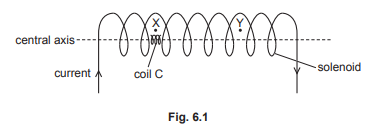
The centre of coil C is on the central axis of the solenoid.
(i) There is a constant current in the solenoid. Coil C is moved through the solenoid from position X to position Y. On Fig. 6.2, sketch a line to show the variation of the magnetic flux linkage in coil C with position as it moves from X to Y.

(ii) Explain the shape of your line in (a)(i).
(iii) Coil C is now held stationary at X. The current in the solenoid varies so that the magnetic flux density \(B\) at X varies from time \(0\) to time \(4t\) as shown in Fig. 6.3.

Calculate the maximum magnetic flux linkage in coil C.
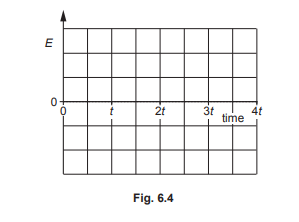
(iv) On Fig. 6.4, sketch a line to show the induced electromotive force (e.m.f.) \(E\) in coil C from time \(0\) to time \(4t\).
(b) A metal spring rests on a smooth table. The turns of the spring are equally spaced. The ends of the spring are connected to a d.c. power supply, as shown in Fig. 6.5.

The spring is connected to the d.c. power supply using flexible leads. The spring is not under tension. With reference to magnetic fields, describe and explain the change in the distance between the turns of the spring when the power supply is first switched on.
Syllabus Topic Codes (Cambridge International AS & A Level Physics 9702 Paper 4):
• 20.5: Electromagnetic induction — parts (a)(i), (a)(ii), (a)(iii) and (a)(iv), magnetic flux, flux linkage, Faraday’s law and induced e.m.f.
▶️ Answer/Explanation
(a)(i)
The magnetic flux linkage is non-zero and constant while coil C is within the uniform magnetic field inside the solenoid.
Therefore, the graph should show a horizontal straight line at a non-zero value from X to Y.
Answer: \( \boxed{\text{A non-zero horizontal straight line from X to Y}} \)
(a)(ii)
The magnetic flux density inside the solenoid is constant.
Magnetic flux linkage is given by
\(N\Phi=NBA\)
Since \(B\), \(A\) and \(N\) are constant, the magnetic flux linkage remains constant while the coil is inside the solenoid.
Answer: \( \boxed{\text{The flux linkage remains constant because }N\Phi=NBA\text{ and }B,\ A,\ N\text{ are constant.}} \)
(a)(iii)
The magnetic flux linkage is
\(N\Phi=NBA\)
The maximum magnetic flux density shown in Fig. 6.3 is \(0.080\,\mathrm{T}\).
The area of coil C is
\(A=0.71\,\mathrm{cm^2}=0.71\times10^{-4}\,\mathrm{m^2}\)
Therefore,
\(N\Phi=(64)(0.080)(0.71\times10^{-4})\)
\(N\Phi=3.6\times10^{-4}\,\mathrm{Wb}\)
Answer: \( \boxed{3.6\times10^{-4}\,\mathrm{Wb}} \)
(a)(iv)
Faraday’s law gives
\(E=-\frac{\Delta(N\Phi)}{\Delta t}\)
From \(0\) to \(t\), the magnetic flux density is constant, so the flux linkage is constant. Therefore,
\(E=0\)
From \(t\) to \(2t\), the magnetic flux density increases at a constant rate, so the induced e.m.f. has a constant non-zero magnitude.
From \(2t\) to \(4t\), the magnetic flux density decreases at a constant rate. The change is in the opposite direction, so the induced e.m.f. has the opposite sign.
Thus the sketch should show:
• \(E=0\) from \(0\) to \(t\)
• constant non-zero \(E\) from \(t\) to \(2t\)
• constant non-zero \(E\) of the opposite sign from \(2t\) to \(4t\)
Answer: \( \boxed{\text{Zero, then constant one-sign e.m.f., then constant opposite-sign e.m.f.}} \)
(b)
When the power supply is switched on, a current flows through the spring. This current produces a magnetic field around each turn of the spring.
The magnetic fields produced by adjacent current-carrying turns interact, producing forces between neighbouring turns.
For adjacent turns carrying current in the same direction, the magnetic force is attractive.
Therefore, the adjacent turns attract one another and move closer together.
Answer: \( \boxed{\text{The distance between the turns decreases because the magnetic force between adjacent current-carrying turns is attractive.}} \)
Question 7
(a) A photon has an energy of \(3.11\times10^{-19}\,\mathrm{J}\). Calculate the momentum of the photon.
(b) A laser beam has a power of \(350\,\mathrm{mW}\). The light from the laser has a wavelength of \(640\,\mathrm{nm}\).
(i) Determine the number of photons emitted by the laser in a time of \(1.0\,\mathrm{s}\).
(ii) The laser beam is incident normally on a surface that absorbs all of the photons. Show that the force \(F\) exerted on the surface by the laser beam is given by \(F=\frac{P}{c}\), where \(P\) is the power of the laser beam and \(c\) is the speed of light.
(c) Light of a single wavelength is incident on the surface of different metals. The work function energy of the metals is given in Table 7.1.

(i) Explain the term threshold wavelength.
(ii) For the metals in Table 7.1, calculate the value of the largest threshold wavelength.
Syllabus Topic Codes (Cambridge International AS & A Level Physics 9702 Paper 4):
• 22.2: Photoelectric effect — parts (c)(i) and (c)(ii), work function and threshold wavelength
▶️ Answer/Explanation
(a)
For a photon, the relationship between energy and momentum is
\(p=\frac{E}{c}\)
Therefore,
\(p=\frac{3.11\times10^{-19}}{3.00\times10^8}\)
\(p=1.04\times10^{-27}\,\mathrm{kg\,m\,s^{-1}}\)
Answer: \( \boxed{1.04\times10^{-27}\,\mathrm{kg\,m\,s^{-1}}} \)
(b)(i)
The energy of one photon is
\(E_{\mathrm{photon}}=hf\)
Since \(c=f\lambda\),
\(E_{\mathrm{photon}}=\frac{hc}{\lambda}\)
The total energy emitted in \(1.0\,\mathrm{s}\) is
\(E_{\mathrm{total}}=Pt=(350\times10^{-3})(1.0)\)
The number of photons is therefore
\(N=\frac{E_{\mathrm{total}}}{E_{\mathrm{photon}}}\)
\(N=\frac{(350\times10^{-3})(1.0)(640\times10^{-9})}{(6.63\times10^{-34})(3.00\times10^8)}\)
\(N=1.12\times10^{18}\)
Answer: \( \boxed{1.1\times10^{18}\text{ photons}} \)
(b)(ii)
The force is the rate of change of momentum:
\(F=\frac{\Delta p}{\Delta t}\)
For a photon,
\(p=\frac{E}{c}\)
The energy transferred by the laser in time \(t\) is
\(E=Pt\)
Hence,
\(F=\frac{E/c}{t}\)
\(F=\frac{Pt}{ct}\)
Therefore,
\(F=\frac{P}{c}\)
Answer: \( \boxed{F=\frac{P}{c}} \)
(c)(i)
The threshold wavelength is the maximum wavelength of electromagnetic radiation that can cause electrons to be emitted from the surface of a metal.
Answer: \( \boxed{\text{The maximum wavelength that causes photoelectric emission.}} \)
(c)(ii)
The largest threshold wavelength corresponds to the smallest work function.
From Table 7.1, the smallest work function is \(2.26\,\mathrm{eV}\).
Converting this to joules:
\(\phi=2.26(1.60\times10^{-19})\)
\(\phi=3.616\times10^{-19}\,\mathrm{J}\)
At the threshold wavelength, the photon energy is equal to the work function:
\(\phi=\frac{hc}{\lambda_0}\)
Therefore,
\(\lambda_0=\frac{hc}{\phi}\)
\(\lambda_0=\frac{(6.63\times10^{-34})(3.00\times10^8)}{3.616\times10^{-19}}\)
\(\lambda_0=5.50\times10^{-7}\,\mathrm{m}\)
Answer: \( \boxed{5.50\times10^{-7}\,\mathrm{m}} \)
Question 8
(a) State what is meant by the binding energy of a nucleus.
(b) A nucleus of uranium-235 absorbs a neutron and becomes unstable. It then undergoes a fission reaction. One possible reaction is

(i) Determine the number of neutrons produced in this fission reaction.
(ii) Data for the binding energies per nucleon for this fission reaction are given in Table 8.1.
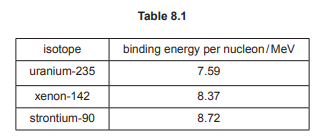
Calculate the energy released, in MeV, from the fission of one nucleus of uranium-235.
(iii) The isotope xenon-142 is unstable. The isotope xenon-132 is stable. Suggest a reason why xenon-142 is unstable.
(iv) Xenon-142 decays into the isotope caesium-142. A sample initially contains only nuclei of xenon-142. After a time equal to \(6.0\,\mathrm{s}\), the ratio \(\frac{\text{number of decayed nuclei of xenon-142}}{\text{number of undecayed nuclei of xenon-142}}\) is equal to \(31\). Calculate the half-life of xenon-142. Show your working.
Syllabus Topic Codes (Cambridge International AS & A Level Physics 9702 Paper 4):
• 23.2: Radioactive decay — parts (b)(iii) and (b)(iv), nuclear stability, radioactive decay and half-life
▶️ Answer/Explanation
(a)
The binding energy of a nucleus is the minimum energy required to separate all the nucleons in the nucleus completely to infinity.
Answer: \( \boxed{\text{The minimum energy required to separate all the nucleons to infinity.}} \)
(b)(i)
The number of neutrons is found by applying conservation of nucleon number to the nuclear equation.
The total nucleon number before the reaction is \(235+1=236\).
The two fission fragments have a total nucleon number of \(142+90=232\).
Therefore, the number of neutrons produced is
\(236-232=4\)
Answer: \( \boxed{4} \)
(b)(ii)
The total binding energy of each nucleus is given by
\(\text{binding energy}=(\text{binding energy per nucleon})(\text{number of nucleons})\)
For the products, the total binding energy is
\((142)(8.37)+(90)(8.72)\)
For the uranium-235 nucleus, the total binding energy is
\((235)(7.59)\)
The energy released is the increase in total binding energy:
\(E=(142)(8.37)+(90)(8.72)-(235)(7.59)\)
\(E\approx190\,\mathrm{MeV}\)
Answer: \( \boxed{190\,\mathrm{MeV}} \)
(b)(iii)
Xenon-142 and xenon-132 have the same number of protons because they are isotopes of the same element.
Xenon-142 therefore has more neutrons than xenon-132. Its neutron-to-proton ratio is too high for the nucleus to be stable.
Answer: \( \boxed{\text{Xenon-142 has too many neutrons, giving it an excessively high neutron-to-proton ratio.}} \)
(b)(iv)
Let the initial number of xenon-142 nuclei be \(N_0\), and let the number remaining after \(6.0\,\mathrm{s}\) be \(N\).
The ratio of decayed to undecayed nuclei is \(31\), so
\(\frac{N_0-N}{N}=31\)
Therefore,
\(N_0-N=31N\)
\(N_0=32N\)
Hence,
\(\frac{N}{N_0}=\frac{1}{32}\)
Using the radioactive decay equation,
\(\frac{N}{N_0}=e^{-\lambda t}\)
Since \(N/N_0=1/32=2^{-5}\), exactly five half-lives have elapsed.
Therefore,
\(5t_{1/2}=6.0\)
\(t_{1/2}=\frac{6.0}{5}=1.2\,\mathrm{s}\)
Answer: \( \boxed{1.2\,\mathrm{s}} \)
Question 9
(a) Electrons in a vacuum are accelerated through a potential difference of \(84\,\mathrm{kV}\). The electrons then strike a metal target and X-rays are produced.
(i) Calculate the minimum wavelength of the X-rays that are produced.
(ii) The melting points of two metals are given in Table 9.1.
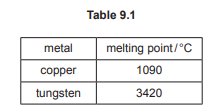
Suggest why the metal target is made from tungsten rather than copper.
(b) An X-ray beam is incident normally on a sample of soft tissue and bone as shown in Fig. 9.1.


The total thickness of soft tissue is \(x\). The total thickness of bone is also \(x\). The incident intensity of the X-ray beam is \(I_0\). The transmitted intensity of the X-ray beam is \(13\%\) of the incident intensity. Determine \(x\), in cm.
(c) (i) Define the specific acoustic impedance of a medium.
(ii) Use data from Table 9.2 to calculate the percentage of the intensity of ultrasound that is transmitted at a boundary between soft tissue and bone.
(iii) The ultrasound is now incident on the sample of soft tissue and bone shown in Fig. 9.1. Suggest two reasons why the transmitted intensity through the sample is less than the answer in (c)(ii).
Syllabus Topic Codes (Cambridge International AS & A Level Physics 9702 Paper 4):
• 24.2: Production and use of X-rays — parts (a)(i), (a)(ii) and (b), minimum X-ray wavelength and attenuation of X-rays in matter
▶️ Answer/Explanation
(a)(i)
The maximum kinetic energy gained by an electron accelerated through a potential difference \(V\) is
\(E=eV\)
The minimum X-ray wavelength occurs when all of this energy is transferred to a single photon:
\(eV=\frac{hc}{\lambda_{\min}}\)
Therefore,
\(\lambda_{\min}=\frac{hc}{eV}\)
\(\lambda_{\min}=\frac{(6.63\times10^{-34})(3.00\times10^8)}{(1.60\times10^{-19})(84\times10^3)}\)
\(\lambda_{\min}=1.48\times10^{-11}\,\mathrm{m}\)
Answer: \( \boxed{1.5\times10^{-11}\,\mathrm{m}} \)
(a)(ii)
When the electrons strike the metal target, some of their kinetic energy is converted into thermal energy, causing the target to become very hot.
Tungsten has a much higher melting point than copper, so it can withstand the high temperatures produced when the electrons strike the target without melting easily.
Answer: \( \boxed{\text{Tungsten has a higher melting point, so the target can withstand the high temperature without melting.}} \)
(b)
The attenuation of X-rays in matter is described by
\(I=I_0e^{-\mu x}\)
The beam passes through soft tissue of total thickness \(x\) and bone of total thickness \(x\).
Using the attenuation coefficients from Table 9.2,
\(0.13=e^{-(3.0x)}e^{-(0.22x)}\)
Therefore,
\(0.13=e^{-3.22x}\)
Taking natural logarithms:
\(\ln(0.13)=-3.22x\)
Hence,
\(x=\frac{-\ln(0.13)}{3.22}\)
\(x=0.63\,\mathrm{cm}\)
Answer: \( \boxed{0.63\,\mathrm{cm}} \)
(c)(i)
The specific acoustic impedance of a medium is defined as the product of the density of the medium and the speed of sound in the medium.
\(Z=\rho c\)
Answer: \( \boxed{Z=\rho c} \)
(c)(ii)
The intensity reflection coefficient at a boundary is
\(\frac{I_R}{I_0}=\left(\frac{Z_1-Z_2}{Z_1+Z_2}\right)^2\)
Using \(Z_{\mathrm{soft}}=1.7\times10^6\,\mathrm{kg\,m^{-2}\,s^{-1}}\) and \(Z_{\mathrm{bone}}=7.8\times10^6\,\mathrm{kg\,m^{-2}\,s^{-1}}\):
\(\frac{I_R}{I_0}=\left(\frac{7.8-1.7}{7.8+1.7}\right)^2\)
\(\frac{I_R}{I_0}=0.41\)
Therefore, the fraction transmitted is
\(\frac{I_T}{I_0}=1.00-0.41=0.59\)
Thus, the percentage transmitted is
\(0.59\times100=59\%\)
Answer: \( \boxed{59\%} \)
(c)(iii)
The value in (c)(ii) considers transmission through only one boundary. In the sample, the ultrasound passes through more than one boundary, so there are additional reflections and less intensity is transmitted.
Also, some of the ultrasound is attenuated as it travels through the soft tissue and bone.
Answer:
• There is more than one boundary, causing additional reflection of ultrasound.
• Some ultrasound is absorbed or attenuated as it travels through the tissues.
Question 10
(a) The Sun has a surface temperature of \(5780\,\mathrm{K}\). The luminosity of the Sun is \(3.85\times10^{26}\,\mathrm{W}\).
(i) Calculate the radius of the Sun.
(ii) The Earth is a distance of \(1.50\times10^{11}\,\mathrm{m}\) from the Sun. Calculate the radiant flux intensity \(F\) of the radiation from the Sun at a distance of \(1.50\times10^{11}\,\mathrm{m}\). Give a unit with your answer.
(iii) The variation with wavelength of the intensity of radiation emitted from the Sun is shown in Fig. 10.1.
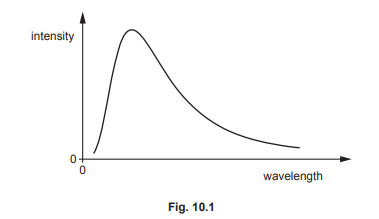
Another star has the same radius as the Sun but has a lower surface temperature. On Fig. 10.1, sketch a line to show the variation with wavelength of the intensity of the radiation emitted for this star.
(b) A galaxy in the constellation Corona Borealis is moving away from the Earth.
(i) The visible emission spectrum for the Sun is shown in Fig. 10.2.
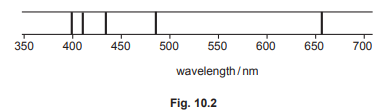
The lines are at wavelengths of \(397\,\mathrm{nm}\), \(410\,\mathrm{nm}\), \(434\,\mathrm{nm}\), \(486\,\mathrm{nm}\) and \(656\,\mathrm{nm}\). The compositions of the Sun and a star in the Corona Borealis galaxy are similar. On Fig. 10.3, sketch the emission spectrum for the star in the Corona Borealis galaxy as observed from the Earth. No calculations are required.

(ii) The galaxy in Corona Borealis is moving away from the Earth at a speed of \(21400\,\mathrm{km\,s^{-1}}\). Use information from (b)(i) to calculate, in nm, the observed wavelength of the lowest visible energy emission for the star in the Corona Borealis galaxy.
(iii) The wavelength in (b)(ii) is used to calculate a value for the surface temperature of the star in the Corona Borealis galaxy. The calculation does not give an accurate value. State and explain whether this value of temperature is too high or too low.
Syllabus Topic Codes (Cambridge International AS & A Level Physics 9702 Paper 4):
• 25.2: Stellar radii — parts (a)(i) and (a)(iii), Stefan–Boltzmann law and Wien’s displacement law
• 25.3: Hubble’s law and the Big Bang theory — parts (b)(i), (b)(ii) and (b)(iii), redshift of spectral lines and interpretation of observed wavelengths
▶️ Answer/Explanation
(a)(i)
The Stefan–Boltzmann law relates the luminosity of a star to its radius and surface temperature:
\(L=4\pi\sigma r^2T^4\)
Rearranging:
\(r=\sqrt{\frac{L}{4\pi\sigma T^4}}\)
Substituting the values:
\(3.85\times10^{26}=4\pi(5.67\times10^{-8})r^2(5780)^4\)
Therefore,
\(r=6.96\times10^8\,\mathrm{m}\)
Answer: \( \boxed{6.96\times10^8\,\mathrm{m}} \)
(a)(ii)
The radiant flux intensity at distance \(d\) from a star is
\(F=\frac{L}{4\pi d^2}\)
Substituting \(L=3.85\times10^{26}\,\mathrm{W}\) and \(d=1.50\times10^{11}\,\mathrm{m}\):
\(F=\frac{3.85\times10^{26}}{4\pi(1.50\times10^{11})^2}\)
\(F=1.36\times10^3\,\mathrm{W\,m^{-2}}\)
Answer: \( \boxed{1.36\times10^3\,\mathrm{W\,m^{-2}}} \)
(a)(iii)
According to Wien’s displacement law,
\(\lambda_{\max}\propto\frac{1}{T}\)
Since the second star has a lower surface temperature, its peak wavelength is greater. Therefore, the peak of its spectrum shifts to the right, towards longer wavelengths.
The star also has the same radius as the Sun. Since
\(L=4\pi\sigma r^2T^4\)
and its temperature is lower while its radius is unchanged, its luminosity and therefore the peak intensity are lower.
Answer: The curve should have the same general shape, but its peak should be at a longer wavelength and have a lower intensity.
(b)(i)
The star has a similar composition to the Sun, so the same emission lines are produced.
Because the galaxy is moving away from the Earth, the light is redshifted. Therefore, all five spectral lines are shifted towards longer wavelengths while maintaining the same pattern and relative spacing.
Answer: Five lines in the same pattern as the Sun’s spectrum, but all shifted towards longer wavelengths.
(b)(ii)
For redshift at relatively low speeds,
\(\frac{\Delta\lambda}{\lambda}=\frac{v}{c}\)
The lowest visible energy emission corresponds to the longest wavelength, \(656\,\mathrm{nm}\).
The speed of the galaxy is
\(v=21400\,\mathrm{km\,s^{-1}}\)
Using \(c=3.00\times10^5\,\mathrm{km\,s^{-1}}\):
\(\Delta\lambda=\frac{21400}{300000}(656)\)
\(\Delta\lambda=46.8\,\mathrm{nm}\)
Therefore, the observed wavelength is
\(\lambda_{\mathrm{observed}}=656+46.8\)
\(\lambda_{\mathrm{observed}}=703\,\mathrm{nm}\)
Answer: \( \boxed{703\,\mathrm{nm}} \)
(b)(iii)
The observed wavelength is increased by the redshift. Therefore, the wavelength used in the temperature calculation is greater than the wavelength that would have been measured in the star’s rest frame.
From Wien’s displacement law,
\(\lambda_{\max}\propto\frac{1}{T}\)
A wavelength that is too large gives a calculated temperature that is too small.
Answer: \( \boxed{\text{The calculated temperature is too low because redshift makes the observed wavelength too large.}} \)