
Question 1
A steel ball is placed on the inside surface of a hollow circular cone. The ball moves in a horizontal circle at constant speed, as shown in Fig. 1.1.
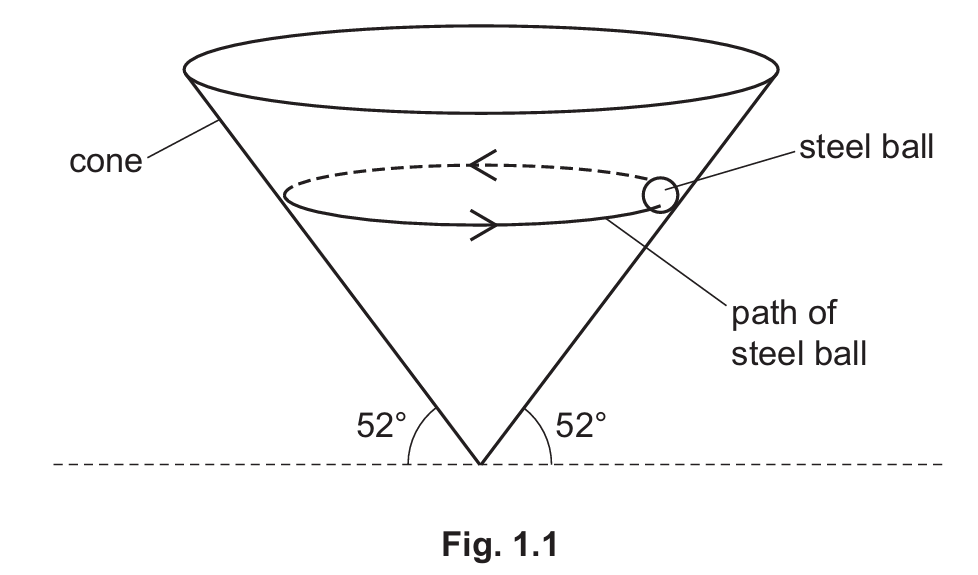
The angle of the side of the cone to the horizontal is \(52^\circ\). There is no friction between the ball and the cone.
(a) Fig. 1.2 shows a cross-section through the cone and the steel ball.
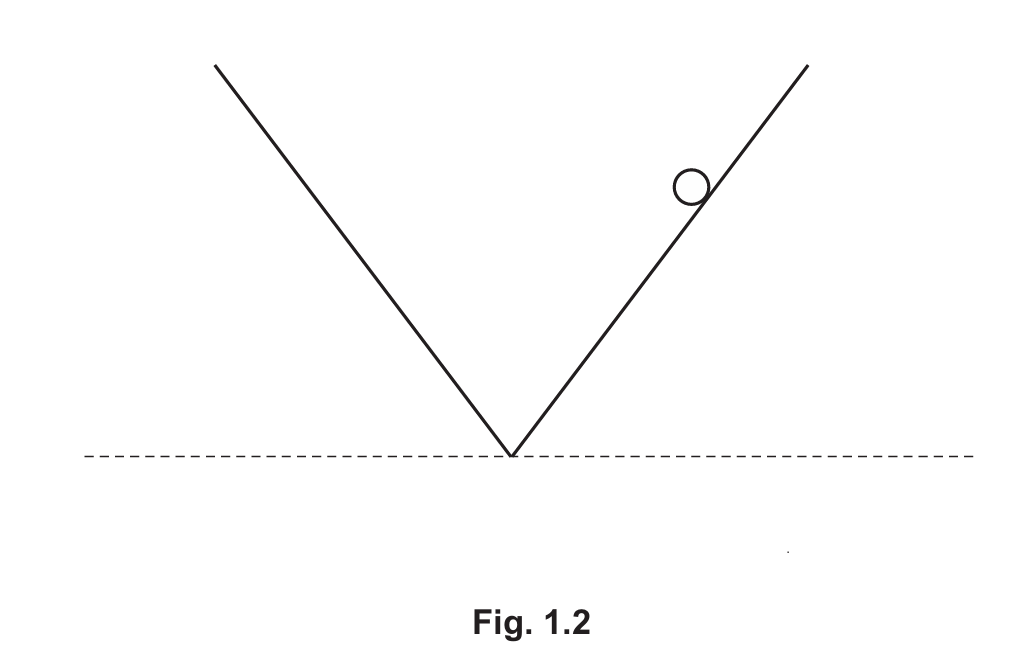
On Fig. 1.2, draw labelled arrows to show the two forces acting on the ball. (1 mark)
______________________________________________
(b) Describe how the forces acting on the ball cause its acceleration to be centripetal. (2 marks)
______________________________________________
______________________________________________
(c) The ball moves in a circle of radius \(0.15\,\mathrm{m}\).
Show that the speed of the ball is \(1.4\,\mathrm{m\,s^{-1}}\). (3 marks)
______________________________________________
______________________________________________
______________________________________________
(d) Calculate the angular speed \(\omega\) of the ball. (2 marks)
\(\omega=\) __________________________ \(\mathrm{rad\,s^{-1}}\)
(e) The speed of the ball is increased.
Explain why the radius of the circular path of the ball increases. (1 mark)
______________________________________________
______________________________________________
______________________________________________
Syllabus Topic Codes (Cambridge International AS & A Level Physics 9702 Paper 4):
• 12.2: Centripetal acceleration – parts (b), (c) and (e)
▶️ Answer/Explanation
(a)
The two forces acting on the ball are:
1. The weight of the ball, \(mg\), acting vertically downwards.
2. The normal contact force, \(N\), from the cone, acting perpendicular to the surface of the cone.
Answer: Weight \(mg\) vertically downwards and normal contact force \(N\) perpendicular to the cone’s surface.
(b)
The vertical component of the normal contact force balances the weight of the ball, so there is no resultant vertical force.
The horizontal component of the normal contact force acts towards the centre of the circular path and provides the centripetal force.
Answer: The horizontal component of the normal contact force provides the resultant force towards the centre, causing centripetal acceleration.
(c)
Let the normal contact force be \(N\).
Resolving vertically:
\(N\cos 52^\circ=mg\)
Resolving horizontally towards the centre of the circle:
\(N\sin 52^\circ=\frac{mv^2}{r}\)
Dividing the second equation by the first:
\(\tan 52^\circ=\frac{v^2}{rg}\)
Therefore,
\(v^2=rg\tan 52^\circ\)
Substituting \(r=0.15\,\mathrm{m}\) and \(g=9.81\,\mathrm{m\,s^{-2}}\):
\(v^2=(0.15)(9.81)\tan52^\circ\)
\(v^2\approx1.96\)
\(v=\sqrt{1.96}\)
\(\boxed{v=1.4\,\mathrm{m\,s^{-1}}}\)
(d)
The relationship between linear speed and angular speed is
\(v=r\omega\)
Therefore,
\(\omega=\frac{v}{r}\)
\(\omega=\frac{1.4}{0.15}\)
\(\boxed{\omega=9.3\,\mathrm{rad\,s^{-1}}}\)
(e)
From the force equations,
\(\tan52^\circ=\frac{v^2}{rg}\)
Since the cone angle and \(g\) are constant,
\(r\propto v^2\)
Therefore, when the speed \(v\) increases, the radius \(r\) of the circular path must also increase.
Answer: Since \(r\propto v^2\) for the fixed cone angle, increasing the speed requires a larger radius.
Question 2
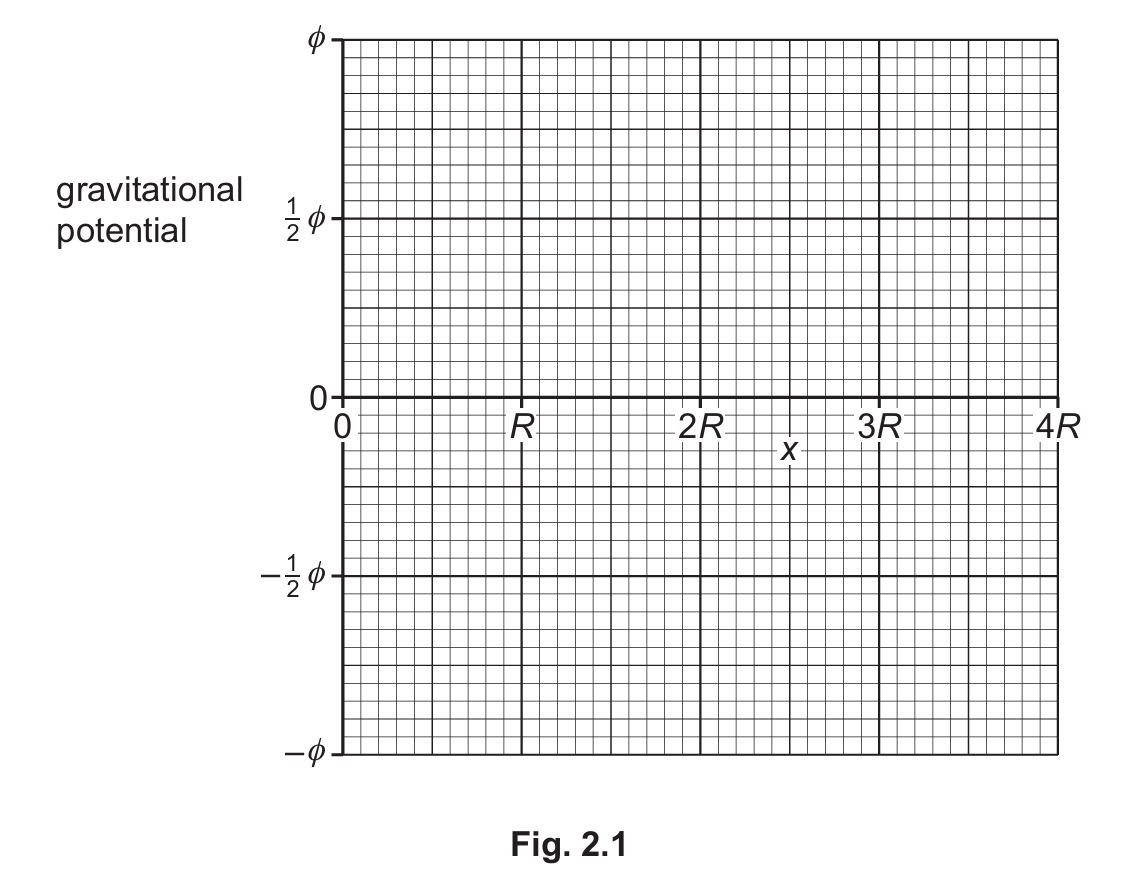
(a) The magnitude of the gravitational potential on the surface of a planet of radius \(R\) is \(\phi\). The planet can be considered to be an isolated sphere.
On Fig. 2.1, sketch the variation of the gravitational potential with distance \(x\) from the centre of the planet for values of \(x\) between \(R\) and \(4R\).
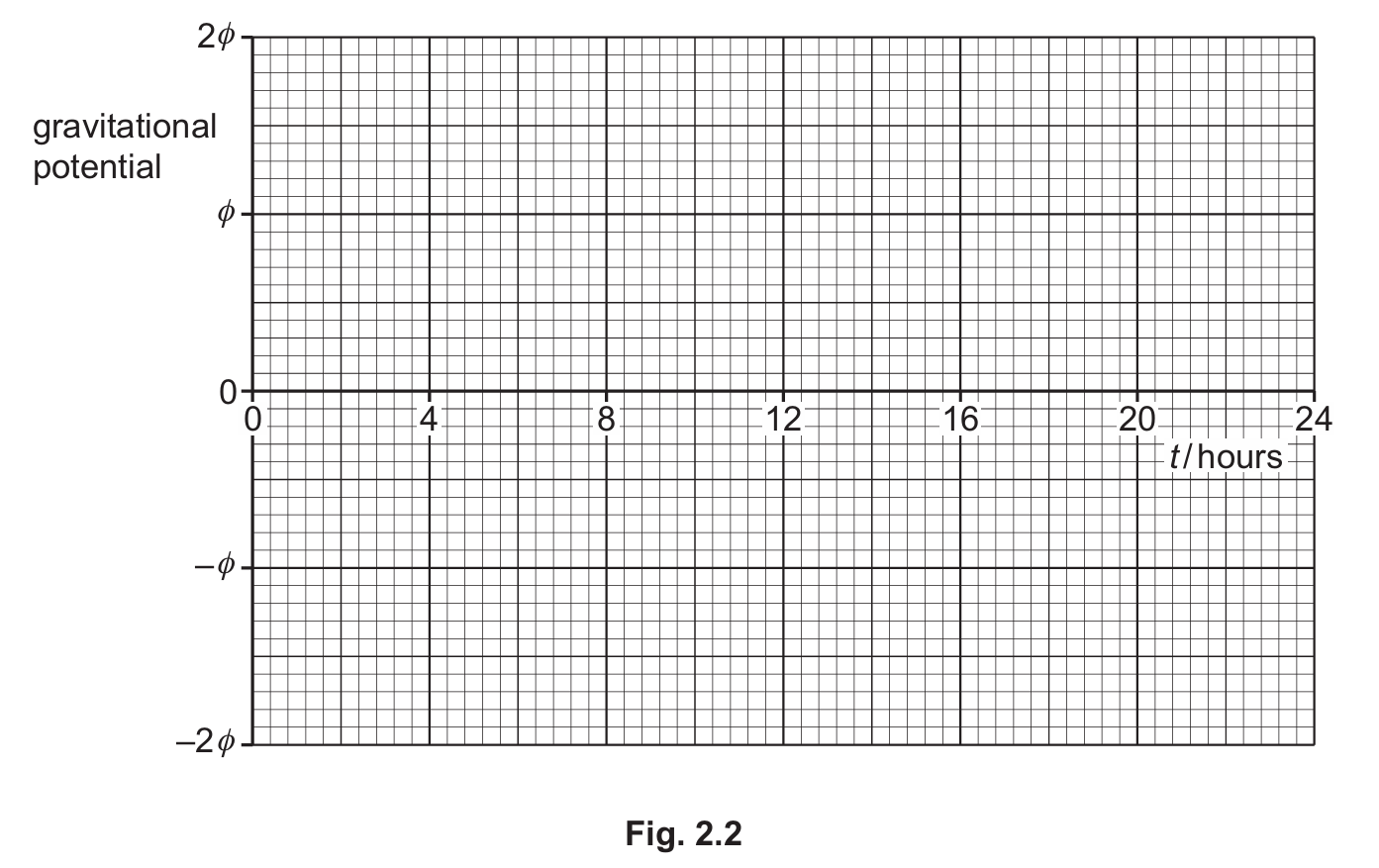
(b) A satellite is in a geostationary orbit above the Earth. At time \(t=0\), the magnitude of the gravitational potential due to the Earth at the location of the satellite is \(\phi\).
On Fig. 2.2, sketch the variation of the gravitational potential due to the Earth at the location of the satellite for values of \(t\) between \(t=0\) and \(t=24\) hours.
(c) The electric potential difference (p.d.) between two parallel plates is \(V\), as shown in Fig. 2.3.
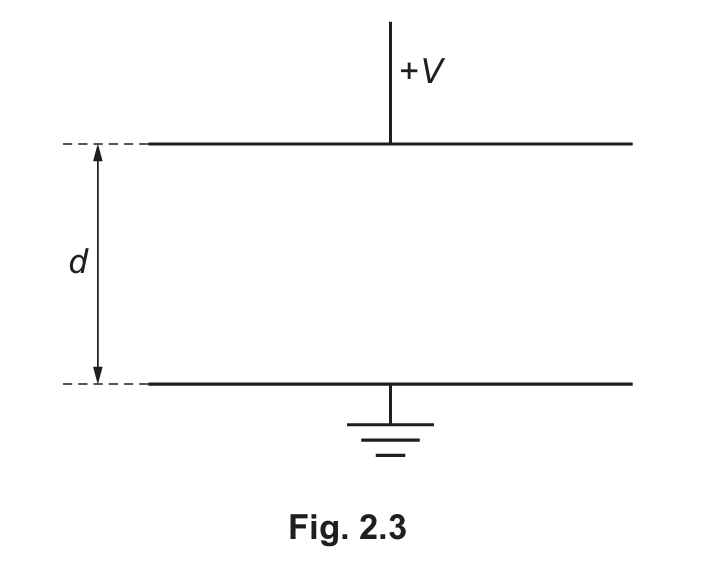
The distance between the plates is \(d\). The region between the plates is a vacuum.
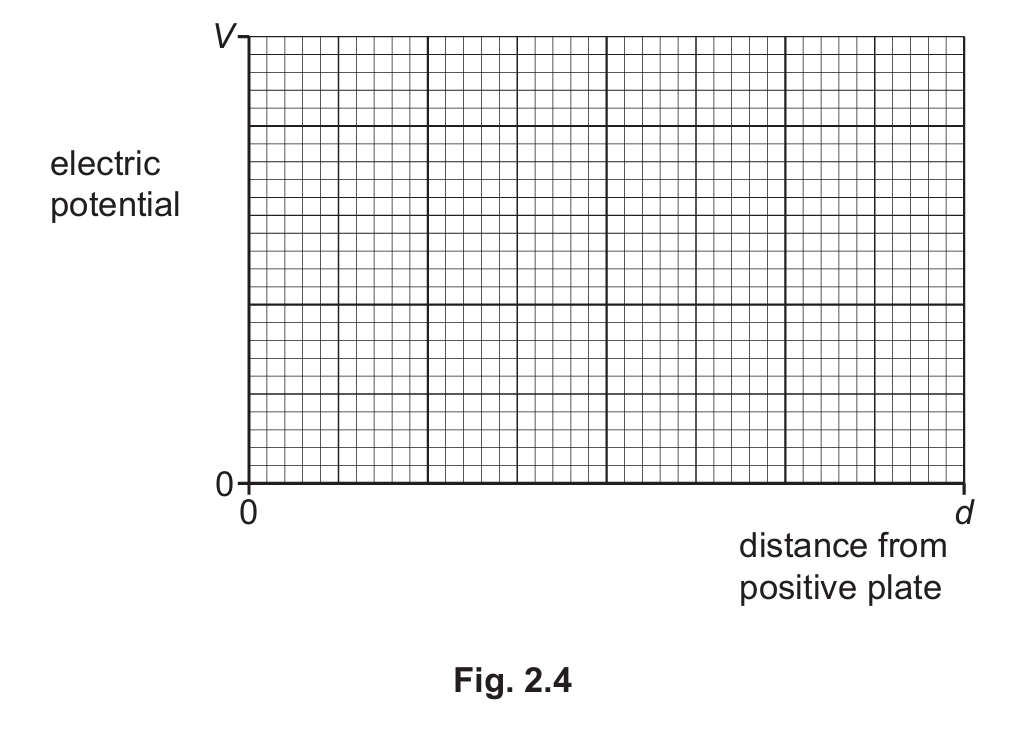
On Fig. 2.4, sketch the variation of the electric potential with distance from the positive plate.
Syllabus Topic Codes (Cambridge International AS & A Level Physics 9702 Paper 4):
• 18.5: Electric potential – part (c)
▶️ Answer/Explanation
(a)
For a point outside a spherical planet, the gravitational potential is
\( \phi_{\mathrm{g}}=-\frac{GM}{x} \)
The magnitude of the potential at the surface \(x=R\) is \(\phi\), so
\( \phi_{\mathrm{g}}=-\phi \quad \text{at } x=R \)
Since \( \phi_{\mathrm{g}}\propto-\frac{1}{x} \), the potential approaches zero from the negative side as \(x\) increases.
Important points for the sketch are:
At \(x=R\), \( \phi_{\mathrm{g}}=-\phi \)
At \(x=2R\), \( \phi_{\mathrm{g}}=-\frac{\phi}{2} \)
At \(x=4R\), \( \phi_{\mathrm{g}}=-\frac{\phi}{4} \)
Answer: Draw a smooth inverse curve starting at \( (R,-\phi) \), passing through \( (2R,-\frac{\phi}{2}) \), and reaching \( (4R,-\frac{\phi}{4}) \). The curve approaches zero but does not reach zero.
(b)
A geostationary satellite remains at a constant distance from the centre of the Earth.
Since gravitational potential depends only on distance from the centre of the Earth, the gravitational potential at the satellite remains constant.
The given magnitude is \(\phi\), so the gravitational potential is
\( \phi_{\mathrm{g}}=-\phi \)
Answer: Draw a horizontal straight line at \( -\phi \) from \(t=0\) to \(t=24\,\mathrm{h}\).
(c)
Between parallel plates, the electric field is uniform.
For a uniform electric field, the potential changes at a constant rate with distance:
\( E=-\frac{\Delta V}{\Delta x} \)
The positive plate is at potential \(+V\), while the grounded plate is at \(0\).
Therefore, the potential decreases linearly from \(V\) at \(x=0\) to \(0\) at \(x=d\).
The relationship is
\( V(x)=V\left(1-\frac{x}{d}\right) \)
Answer: Draw a straight line with negative gradient from \( (0,V) \) to \( (d,0) \).
Question 3
(a) Two metal cuboids P and Q are in thermal contact with each other.
(i) P and Q are in thermal equilibrium.
State what is meant by the term thermal equilibrium. (2 marks)
______________________________________________
______________________________________________
(ii) Data for P and Q are given in Table 3.1.
| P | Q | |
|---|---|---|
| specific heat capacity / \(\mathrm{J\,kg^{-1}\,K^{-1}}\) | 390 | 910 |
| mass / \(\mathrm{kg}\) | 0.54 | 0.37 |
P and Q are initially both at the same temperature.
P is supplied with \(24\,\mathrm{kJ}\) of thermal energy. After some time, P and Q are once again both at the same temperature as each other.
P and Q are perfectly insulated from the surroundings.
Determine the change in temperature \(\Delta T\) of Q. (3 marks)
\(\Delta T=\) __________________________ \(\mathrm{K}\)
(b) Nitrogen may be assumed to be an ideal gas. A fixed amount of nitrogen gas is contained at a constant pressure of \(1.6\times10^5\,\mathrm{Pa}\).
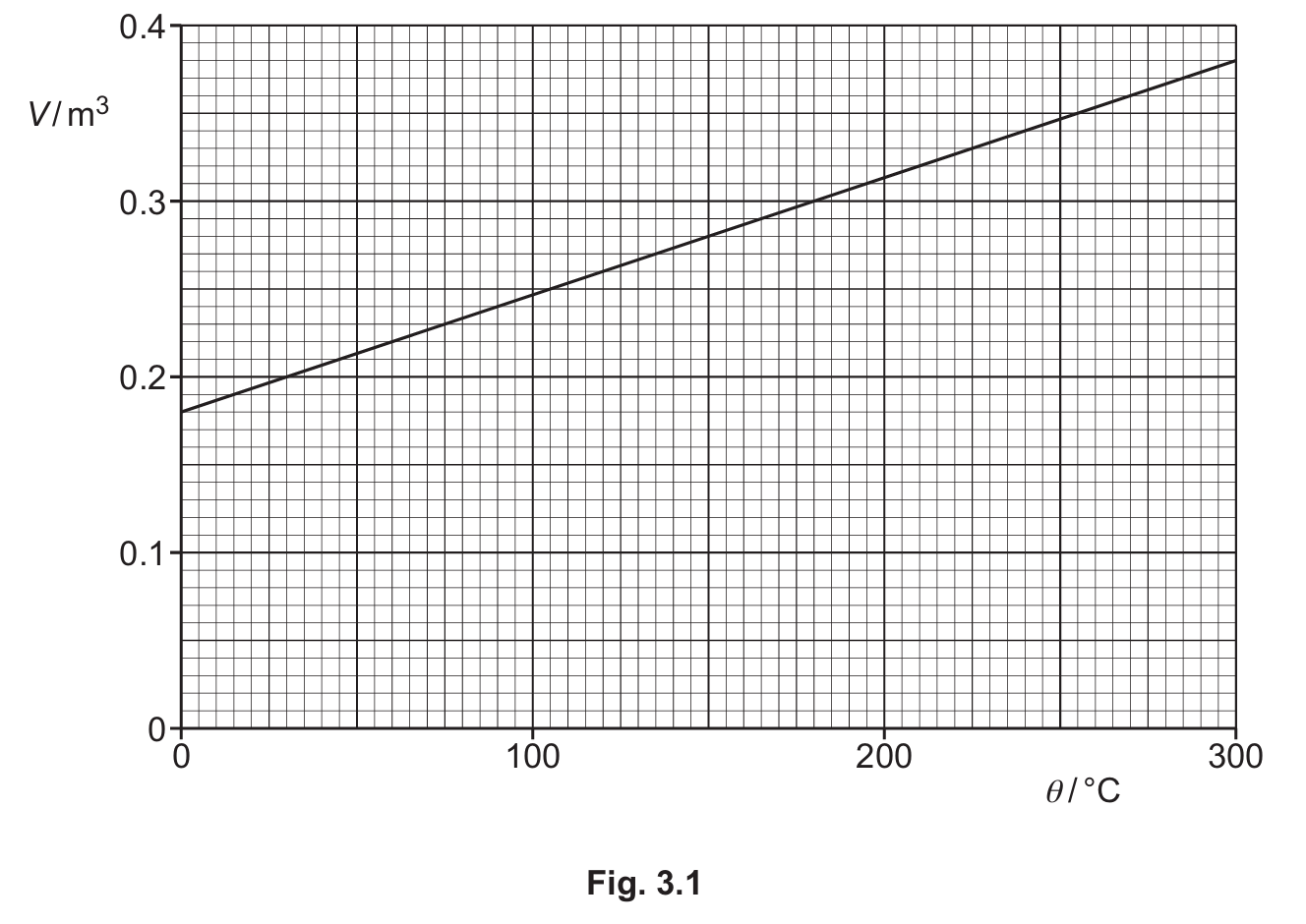
The variation of the volume \(V\) of the gas with the temperature \(\theta\) of the gas is shown in Fig. 3.1.
(i) The temperature of the nitrogen gas is increased from \(0^\circ\mathrm{C}\) to \(210^\circ\mathrm{C}\).
Determine the work done on the gas. (3 marks)
work done \(=\) __________________________ \(\mathrm{J}\)
(ii) Determine the number \(N\) of molecules of nitrogen gas. (2 marks)
\(N=\) __________________________
(iii) The mass of a nitrogen molecule is \(4.7\times10^{-26}\,\mathrm{kg}\).
Calculate the root-mean-square (r.m.s.) speed of a nitrogen molecule at \(210^\circ\mathrm{C}\). (2 marks)
r.m.s. speed \(=\) __________________________ \(\mathrm{m\,s^{-1}}\)
Syllabus Topic Codes (Cambridge International AS & A Level Physics 9702 Paper 4):
• 14.3: Specific heat capacity and specific latent heat – part (a)(ii)
• 15.2: Equation of state – parts (b)(i) and (b)(ii)
• 15.3: Kinetic theory of gases – part (b)(iii)
• 16.2: The first law of thermodynamics – part (b)(i)
▶️ Answer/Explanation
(a)(i)
Thermal equilibrium is the state in which two objects are at the same temperature and there is no net transfer of thermal energy between them.
Answer: Same temperature and no net transfer of thermal energy.
(a)(ii)
Since P and Q are insulated from the surroundings, the \(24\,\mathrm{kJ}\) supplied to P is shared between P and Q.
Using
\(Q=mc\Delta T\)
The final temperature change is the same for both cuboids, so
\(24\,000=(0.54)(390)\Delta T+(0.37)(910)\Delta T\)
\(24\,000=(210.6+336.7)\Delta T\)
\(24\,000=547.3\Delta T\)
\(\Delta T=\frac{24\,000}{547.3}\)
\(\boxed{\Delta T\approx44\,\mathrm{K}}\)
(b)(i)
The pressure is constant, so the work done on the gas is
\(W_{\mathrm{on}}=p(V_{\mathrm{i}}-V_{\mathrm{f}})\)
From Fig. 3.1, at \(0^\circ\mathrm{C}\),
\(V_{\mathrm{i}}\approx0.18\,\mathrm{m^3}\)
At \(210^\circ\mathrm{C}\),
\(V_{\mathrm{f}}\approx0.30\,\mathrm{m^3}\)
Therefore,
\(W_{\mathrm{on}}=(1.6\times10^5)(0.18-0.30)\)
\(W_{\mathrm{on}}=-1.92\times10^4\,\mathrm{J}\)
The negative value means that the gas expands and therefore does work on the surroundings.
\(\boxed{W_{\mathrm{on}}\approx-1.9\times10^4\,\mathrm{J}}\)
(b)(ii)
For an ideal gas,
\(pV=NkT\)
At \(0^\circ\mathrm{C}\), \(T=273\,\mathrm{K}\) and \(V\approx0.18\,\mathrm{m^3}\).
Therefore,
\(N=\frac{pV}{kT}\)
\(N=\frac{(1.6\times10^5)(0.18)}{(1.38\times10^{-23})(273)}\)
\(\boxed{N\approx7.6\times10^{24}}\)
(b)(iii)
From kinetic theory,
\(\frac{1}{2}m v_{\mathrm{rms}}^2=\frac{3}{2}kT\)
Hence,
\(v_{\mathrm{rms}}=\sqrt{\frac{3kT}{m}}\)
At \(210^\circ\mathrm{C}\),
\(T=210+273=483\,\mathrm{K}\)
Therefore,
\(v_{\mathrm{rms}}=\sqrt{\frac{3(1.38\times10^{-23})(483)}{4.7\times10^{-26}}}\)
\(\boxed{v_{\mathrm{rms}}\approx6.5\times10^2\,\mathrm{m\,s^{-1}}}\)
Question 4
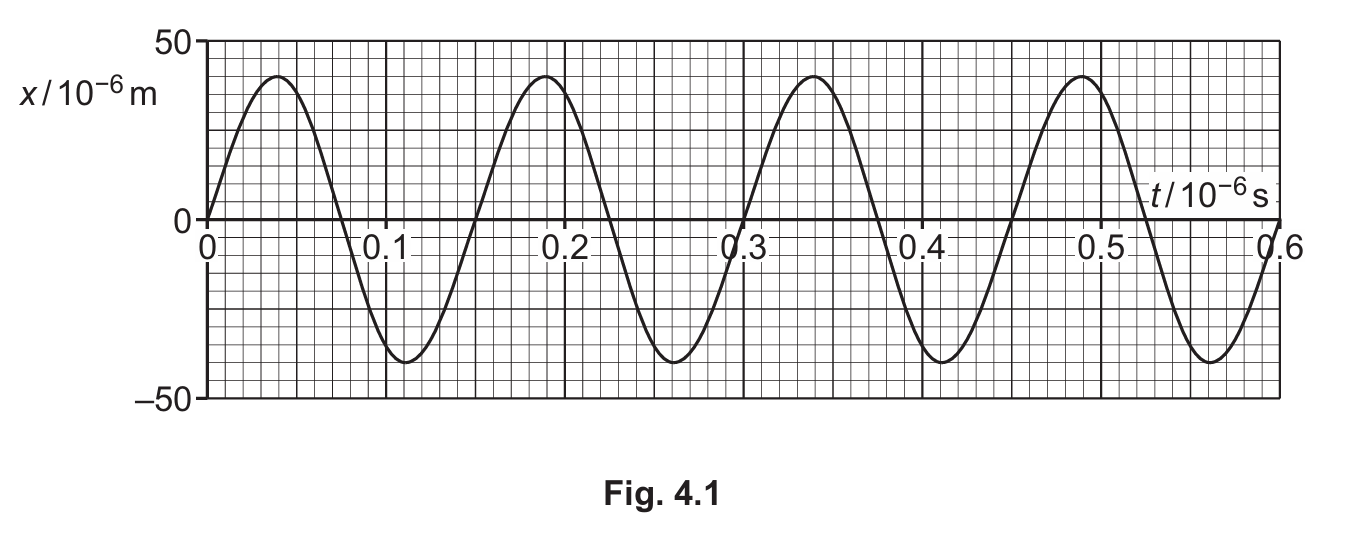
A small crystal is made to vibrate with simple harmonic motion. The variation with time \(t\) of the displacement \(x\) of one surface of the crystal from its equilibrium position is shown in Fig. 4.1.
(a) Show that the angular frequency of the vibration of the surface is \(4.2\times10^7\,\mathrm{rad\,s^{-1}}\). (2 marks)
______________________________________________
______________________________________________
(b) Determine the maximum acceleration \(a_0\) of the vibration of the surface. (2 marks)
\(a_0=\) __________________________ \(\mathrm{m\,s^{-2}}\)
(c) The crystal may be modelled as a single mass of \(2.4\times10^{-4}\,\mathrm{kg}\) that vibrates as shown in Fig. 4.1.
Calculate the total energy \(E\) of the vibrations. (3 marks)
\(E=\) __________________________ \(\mathrm{J}\)
(d) The crystal generates ultrasound waves that are used to obtain diagnostic information about internal structures.
(i) The crystal is made from piezoelectric material.
Explain how the crystal is made to vibrate. (2 marks)
______________________________________________
______________________________________________
(ii) A parallel beam of ultrasound waves is incident on a muscle-bone boundary. Data for muscle and bone are given in Table 4.1.
| material | density / \(\mathrm{kg\,m^{-3}}\) | speed of sound / \(\mathrm{m\,s^{-1}}\) |
|---|---|---|
| muscle | 1100 | 1600 |
| bone | 1900 | 4100 |
Calculate the percentage of the intensity of the ultrasound beam that is transmitted at this boundary. (3 marks)
percentage transmitted \(=\) __________________________ \(\%\)
Syllabus Topic Codes (Cambridge International AS & A Level Physics 9702 Paper 4):
• 17.2: Energy in simple harmonic motion – part (c)
• 24.1: Production and use of ultrasound – parts (d)(i) and (d)(ii)
▶️ Answer/Explanation
(a)
From Fig. 4.1, the time for one complete oscillation is approximately
\(T=0.15\times10^{-6}\,\mathrm{s}\)
The angular frequency is
\(\omega=\frac{2\pi}{T}\)
\(\omega=\frac{2\pi}{0.15\times10^{-6}}\)
\(\boxed{\omega=4.2\times10^7\,\mathrm{rad\,s^{-1}}}\)
(b)
The amplitude from the graph is approximately
\(x_0=40\times10^{-6}\,\mathrm{m}\)
For simple harmonic motion, the maximum acceleration is
\(a_0=\omega^2x_0\)
\(a_0=(4.2\times10^7)^2(40\times10^{-6})\)
\(\boxed{a_0=7.1\times10^{10}\,\mathrm{m\,s^{-2}}}\)
(c)
The total energy of an oscillator in SHM is
\(E=\frac{1}{2}m\omega^2x_0^2\)
Substituting \(m=2.4\times10^{-4}\,\mathrm{kg}\), \(\omega=4.2\times10^7\,\mathrm{rad\,s^{-1}}\) and \(x_0=40\times10^{-6}\,\mathrm{m}\):
\(E=\frac{1}{2}(2.4\times10^{-4})(4.2\times10^7)^2(40\times10^{-6})^2\)
\(E\approx3.39\times10^2\,\mathrm{J}\)
\(\boxed{E\approx3.4\times10^2\,\mathrm{J}}\)
(d)(i)
An alternating potential difference is applied across the piezoelectric crystal.
The alternating electric field causes the crystal to repeatedly deform and return to its original shape, producing mechanical vibrations. The frequency of the applied alternating p.d. determines the frequency of vibration.
Answer: An alternating p.d. causes repeated mechanical deformation of the piezoelectric crystal, making it vibrate.
(d)(ii)
The acoustic impedance is
\(Z=\rho c\)
For muscle,
\(Z_{\mathrm{m}}=(1100)(1600)=1.76\times10^6\,\mathrm{kg\,m^{-2}\,s^{-1}}\)
For bone,
\(Z_{\mathrm{b}}=(1900)(4100)=7.79\times10^6\,\mathrm{kg\,m^{-2}\,s^{-1}}\)
The fraction of intensity reflected at the boundary is
\(\frac{I_{\mathrm{R}}}{I_{\mathrm{I}}}=\left(\frac{Z_{\mathrm{b}}-Z_{\mathrm{m}}}{Z_{\mathrm{b}}+Z_{\mathrm{m}}}\right)^2\)
\(\frac{I_{\mathrm{R}}}{I_{\mathrm{I}}}=\left(\frac{7.79-1.76}{7.79+1.76}\right)^2\)
\(\frac{I_{\mathrm{R}}}{I_{\mathrm{I}}}\approx0.399\)
Therefore, the fraction transmitted is
\(\frac{I_{\mathrm{T}}}{I_{\mathrm{I}}}=1-0.399=0.601\)
Hence,
\(\boxed{\text{percentage transmitted}\approx60\%}\)
Question 5
(a) A capacitor of capacitance \(C_1\) is connected in series with a second capacitor of capacitance \(C_2\).
Show that the combined capacitance \(C\) of the two capacitors is given by
\( \frac{1}{C}=\frac{1}{C_1}+\frac{1}{C_2} \) (2 marks)
______________________________________________
______________________________________________
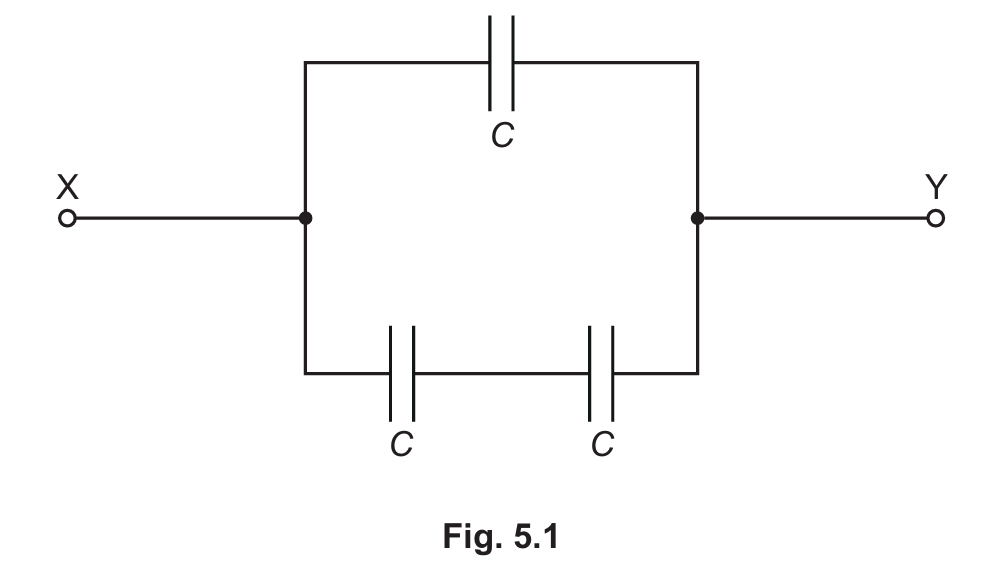
(b) Three identical capacitors, each of capacitance \(C\), are connected in a network as shown in Fig. 5.1.
The variation of the charge \(Q\) with the potential difference (p.d.) \(V\) between the terminals X and Y is shown in Fig. 5.2.
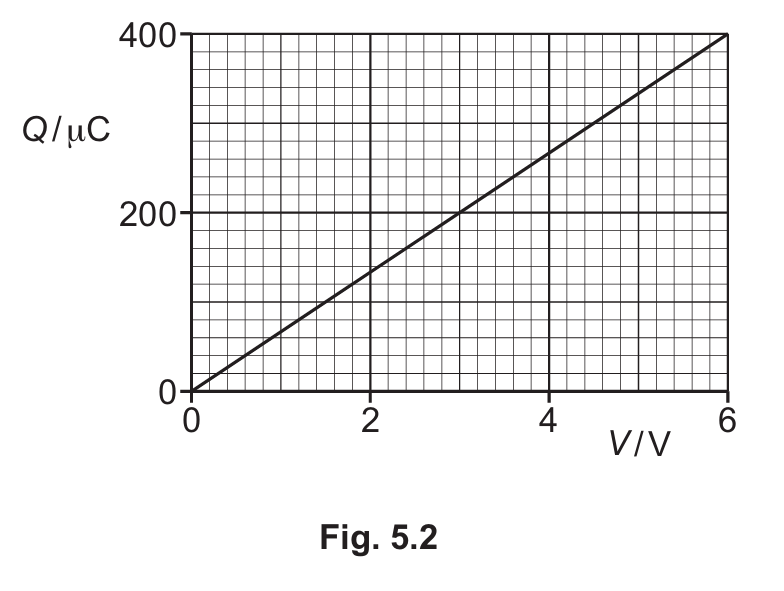
Show that \(C\) is equal to \(44\,\mu\mathrm{F}\). (3 marks)
______________________________________________
______________________________________________
______________________________________________
(c) The capacitor network in Fig. 5.1 is charged and then connected to a resistor of resistance \(54\,\mathrm{k\Omega}\). The capacitor network discharges through the resistor.
(i) Determine the time constant \(\tau\) of the circuit. Give a unit with your answer. (2 marks)
\(\tau=\) __________________________ unit __________________
(ii) Determine the time taken for the discharge current to reduce to \(15\%\) of the initial discharge current. (2 marks)
time \(=\) __________________________ \(\mathrm{s}\)
Syllabus Topic Codes (Cambridge International AS & A Level Physics 9702 Paper 4):
• 19.3: Discharging a capacitor – parts (c)(i) and (c)(ii)
▶️ Answer/Explanation
(a)
For capacitors connected in series, the charge \(Q\) on each capacitor is the same, while the total p.d. is the sum of the p.d.s across the individual capacitors.
Let the p.d.s across \(C_1\) and \(C_2\) be \(V_1\) and \(V_2\).
Then
\(V=V_1+V_2\)
Using \(Q=CV\),
\(V=\frac{Q}{C}\), \(V_1=\frac{Q}{C_1}\), and \(V_2=\frac{Q}{C_2}\)
Therefore,
\(\frac{Q}{C}=\frac{Q}{C_1}+\frac{Q}{C_2}\)
Dividing by \(Q\),
\(\boxed{\frac{1}{C}=\frac{1}{C_1}+\frac{1}{C_2}}\)
(b)
The two capacitors in the lower branch are in series, so their combined capacitance is
\(\frac{1}{C_{\mathrm{s}}}=\frac{1}{C}+\frac{1}{C}\)
Hence,
\(C_{\mathrm{s}}=\frac{C}{2}\)
This combination is in parallel with the upper capacitor \(C\), so
\(C_{\mathrm{total}}=C+\frac{C}{2}=\frac{3C}{2}\)
From the graph, the gradient gives the combined capacitance:
\(C_{\mathrm{total}}=\frac{Q}{V}\)
Using the values from Fig. 5.2,
\(C_{\mathrm{total}}\approx66\,\mu\mathrm{F}\)
Therefore,
\(\frac{3C}{2}=66\,\mu\mathrm{F}\)
\(\boxed{C=44\,\mu\mathrm{F}}\)
(c)(i)
The time constant of an \(RC\) circuit is
\(\tau=RC_{\mathrm{total}}\)
The total capacitance is
\(C_{\mathrm{total}}=\frac{3}{2}(44\,\mu\mathrm{F})=66\,\mu\mathrm{F}\)
Therefore,
\(\tau=(54\times10^3)(66\times10^{-6})\)
\(\boxed{\tau=3.6\,\mathrm{s}}\)
(c)(ii)
The discharge current follows the exponential relationship
\(I=I_0e^{-t/\tau}\)
When \(I=0.15I_0\),
\(0.15=e^{-t/3.6}\)
Taking natural logarithms,
\(\ln(0.15)=-\frac{t}{3.6}\)
Therefore,
\(t=-3.6\ln(0.15)\)
\(\boxed{t\approx6.8\,\mathrm{s}}\)
Question 6
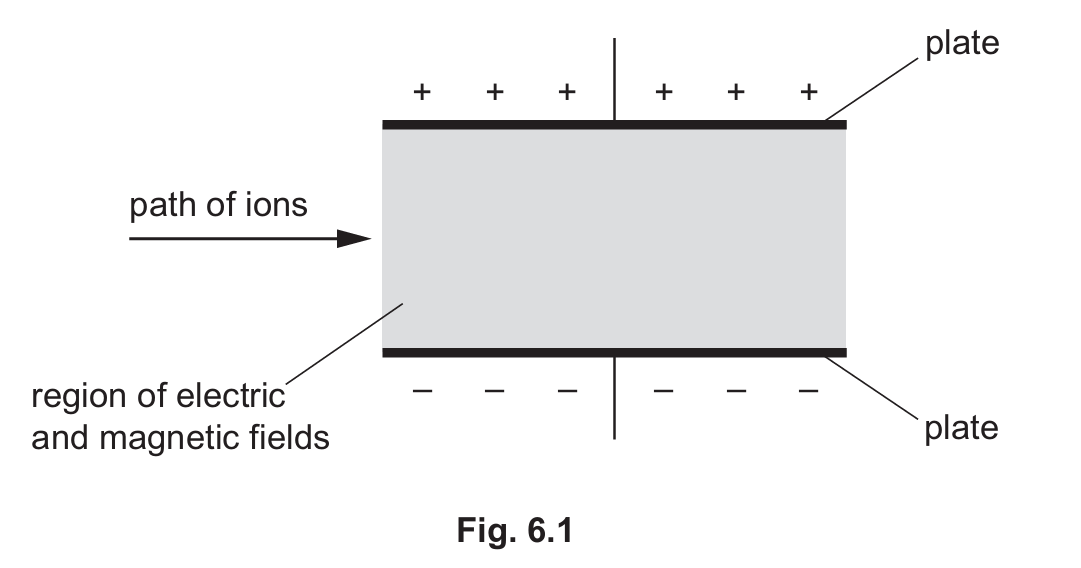
An electric field and a magnetic field are used to form a velocity selector. Charged particles, called ions, pass into a region of uniform electric and magnetic fields that is between parallel plates, as shown in Fig. 6.1.
(a) The potential difference (p.d.) between the plates of the velocity selector is \(V\). The separation of the plates is \(d\) and the magnetic flux density is \(B\).
Show that the speed \(u\) of ions that pass undeviated through the velocity selector is given by
\(u=\frac{V}{Bd}\)
(2 marks)
______________________________________________
______________________________________________
(b) Positive ions with kinetic energy \(4.1\times10^{-17}\,\mathrm{J}\) and mass \(3.2\times10^{-27}\,\mathrm{kg}\) pass undeviated through the velocity selector when \(V\) is equal to \(980\,\mathrm{V}\) and \(d\) is equal to \(3.6\times10^{-2}\,\mathrm{m}\).
Determine \(B\). (3 marks)
\(B=\) __________________________ \(\mathrm{T}\)
(c) A proton passes undeviated through the velocity selector.
An alpha particle enters the velocity selector at the same speed as the proton.
State how the expression in (a) predicts that the alpha particle also passes undeviated through the velocity selector. (1 mark)
______________________________________________
______________________________________________
(d) By reference to Fig. 6.1 and to the forces acting on a positive ion, determine the direction of the magnetic field. Explain your reasoning. (3 marks)
______________________________________________
______________________________________________
______________________________________________
______________________________________________
(e) The positive ions in (b) enter the velocity selector with greater kinetic energy.
On Fig. 6.1, sketch the path of these ions. (2 marks)
______________________________________________
Syllabus Topic Codes (Cambridge International AS & A Level Physics 9702 Paper 4):
• 20.3: Force on a moving charge – parts (a), (b), (d) and (e)
• 20.1: Concept of a magnetic field – part (d)
▶️ Answer/Explanation
(a)
For an ion to pass through the velocity selector undeviated, the electric force and magnetic force must be equal in magnitude and opposite in direction.
The electric force is
\(F_{\mathrm{E}}=qE\)
The electric field between the plates is
\(E=\frac{V}{d}\)
The magnetic force on a charged particle moving perpendicular to the magnetic field is
\(F_{\mathrm{B}}=Bqu\)
For no deflection,
\(qE=Bqu\)
Substituting \(E=\frac{V}{d}\),
\(q\frac{V}{d}=Bqu\)
Cancelling \(q\),
\(\boxed{u=\frac{V}{Bd}}\)
(b)
First determine the speed of the ions using
\(E_{\mathrm{k}}=\frac{1}{2}mv^2\)
Therefore,
\(v=\sqrt{\frac{2E_{\mathrm{k}}}{m}}\)
\(v=\sqrt{\frac{2(4.1\times10^{-17})}{3.2\times10^{-27}}}\)
\(v\approx1.6\times10^5\,\mathrm{m\,s^{-1}}\)
From part (a),
\(B=\frac{V}{vd}\)
\(B=\frac{980}{(1.6\times10^5)(3.6\times10^{-2})}\)
\(\boxed{B\approx0.17\,\mathrm{T}}\)
(c)
The expression
\(u=\frac{V}{Bd}\)
does not depend on the charge or mass of the particle.
Answer: Since the alpha particle has the same speed as the proton, it also satisfies the condition \(u=\frac{V}{Bd}\) and therefore passes undeviated.
(d)
The positive ion moves to the right. The electric field is directed downwards because the upper plate is positive and the lower plate is negative.
Therefore, the electric force on the positive ion acts downwards.
For the ion to pass undeviated, the magnetic force must act upwards to balance the electric force.
Using the direction of the magnetic force for a positive charge, \( \mathbf{F}=q(\mathbf{v}\times\mathbf{B}) \), with the velocity to the right and magnetic force upwards, the magnetic field must be directed into the page.
Answer: The magnetic field is directed into the page.
(e)
The ions now have greater kinetic energy, so their speed is greater.
The electric force remains constant because \(F_{\mathrm{E}}=qE\), but the magnetic force increases because
\(F_{\mathrm{B}}=Bqv\)
Since \(F_{\mathrm{B}}>F_{\mathrm{E}}\), there is a resultant force upwards.
Answer: The ions curve upwards as they pass through the velocity selector.
Question 7
(a) State Faraday’s law of electromagnetic induction. (2 marks)
______________________________________________
______________________________________________
(b) A metal rod is accelerated uniformly from rest in a uniform magnetic field as shown in Fig. 7.1.

The rod has length \(l\) and the flux density of the magnetic field is \(B\).
An electromotive force (e.m.f.) is induced in the rod. The variation with time \(t\) of the induced e.m.f. \(E\) is shown in Fig. 7.2.
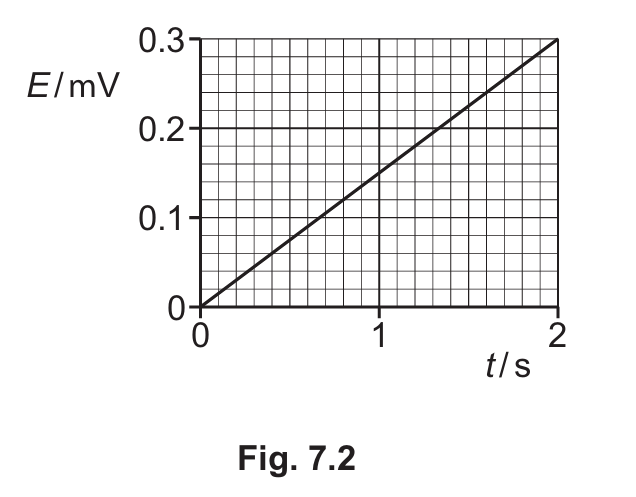
(i) Explain how Fig. 7.2 shows that \(E\) is proportional to the velocity \(v\) of the rod. (2 marks)
______________________________________________
______________________________________________
(ii) Use Faraday’s law to show that the variation of \(E\) with time \(t\) is given by
\(E=Blat\)
where \(a\) is the acceleration of the rod. (3 marks)
______________________________________________
______________________________________________
______________________________________________
(iii) The length of the rod is \(0.45\,\mathrm{m}\). The acceleration \(a\) of the rod is \(7.8\,\mathrm{m\,s^{-2}}\).
Determine the value of \(B\). (2 marks)
\(B=\) __________________________ \(\mathrm{T}\)
Syllabus Topic Codes (Cambridge International AS & A Level Physics 9702 Paper 4):
▶️ Answer/Explanation
(a)
Faraday’s law states that the induced e.m.f. is proportional to the rate of change of magnetic flux linkage.
Answer: The magnitude of the induced e.m.f. is proportional to the rate of change of magnetic flux linkage.
(b)(i)
The graph of \(E\) against \(t\) is a straight line through the origin, so \(E\propto t\).
Since the rod is uniformly accelerated from rest, its velocity is given by
\(v=at\)
Thus \(v\propto t\), and the graph shows that \(E\propto t\). Therefore,
\(\boxed{E\propto v}\)
(b)(ii)
As the rod moves through the magnetic field, it sweeps out an area.
The magnetic flux is
\(\Phi=BA\)
After time \(t\), the distance travelled by the rod from rest is
\(s=\frac{1}{2}at^2\)
The area swept is therefore
\(A=ls=\frac{1}{2}lat^2\)
Hence,
\(\Phi=\frac{1}{2}Blat^2\)
Using Faraday’s law,
\(E=\frac{\mathrm{d}\Phi}{\mathrm{d}t}\)
Therefore,
\(E=\frac{\mathrm{d}}{\mathrm{d}t}\left(\frac{1}{2}Blat^2\right)\)
\(\boxed{E=Blat}\)
(b)(iii)
From Fig. 7.2, the gradient of the \(E\)-against-\(t\) graph is approximately
\(\frac{0.30\times10^{-3}}{2.0}=1.5\times10^{-4}\,\mathrm{V\,s^{-1}}\)
From \(E=Blat\), the gradient is \(Bla\). Hence,
\(B=\frac{\text{gradient}}{la}\)
\(B=\frac{1.5\times10^{-4}}{(0.45)(7.8)}\)
\(\boxed{B=4.3\times10^{-5}\,\mathrm{T}}\)
Question 8
(a) State what is meant by a photon. (2 marks)
______________________________________________
______________________________________________
(b) A laser emits red light of a single wavelength. The light is produced when electrons move from a higher energy level to a lower energy level. The difference in energy between the two levels is \(1.96\,\mathrm{eV}\).
(i) Calculate the wavelength of the light. (3 marks)
wavelength \(=\) __________________________ \(\mathrm{m}\)
(ii) The power of the beam emitted by the laser is \(1.0\times10^{-2}\,\mathrm{W}\).
Calculate the number of photons emitted per unit time by the laser. (1 mark)
number per unit time \(=\) __________________________ \(\mathrm{s^{-1}}\)
(iii) The photons are incident normally on a surface. Half of the number of photons are absorbed by the surface, and half are reflected.
Determine the average force exerted by the beam of photons on the surface. (4 marks)
average force \(=\) __________________________ \(\mathrm{N}\)
Syllabus Topic Codes (Cambridge International AS & A Level Physics 9702 Paper 4):
▶️ Answer/Explanation
(a)
A photon is a quantum, or discrete packet, of electromagnetic radiation.
Answer: A photon is a quantum of energy of electromagnetic radiation.
(b)(i)
The energy difference is
\(E=1.96\times1.60\times10^{-19}\)
\(E=3.14\times10^{-19}\,\mathrm{J}\)
For a photon,
\(E=hf=\frac{hc}{\lambda}\)
Therefore,
\(\lambda=\frac{hc}{E}\)
\(\lambda=\frac{(6.63\times10^{-34})(3.00\times10^8)}{3.14\times10^{-19}}\)
\(\boxed{\lambda=6.34\times10^{-7}\,\mathrm{m}}\)
(b)(ii)
The power is the energy emitted per unit time:
\(P=\frac{NE}{t}\)
Hence, the number of photons emitted per unit time is
\(\frac{N}{t}=\frac{P}{E}\)
\(\frac{N}{t}=\frac{1.0\times10^{-2}}{3.14\times10^{-19}}\)
\(\boxed{\frac{N}{t}=3.2\times10^{16}\,\mathrm{s^{-1}}}\)
(b)(iii)
The momentum of one photon is
\(p=\frac{E}{c}\)
For an absorbed photon, the change in momentum is \(p\).
For a reflected photon, the direction of momentum reverses, so the change in momentum is \(2p\).
Since half the photons are absorbed and half are reflected, the average momentum change per photon is
\(\frac{p+2p}{2}=\frac{3p}{2}\)
Therefore,
\(F=\frac{3}{2}\left(\frac{N}{t}\right)p\)
Using \(p=\frac{E}{c}\) and \(P=\left(\frac{N}{t}\right)E\),
\(F=\frac{3P}{2c}\)
\(F=\frac{3(1.0\times10^{-2})}{2(3.00\times10^8)}\)
\(\boxed{F=5.0\times10^{-11}\,\mathrm{N}}\)
Question 9
Polonium-193 \( \left(^{193}_{84}\mathrm{Po}\right) \) is an unstable nuclide. A nucleus of polonium-193 decays to a nucleus of lead-189 \( \left(^{189}_{82}\mathrm{Pb}\right) \) by emitting an alpha-particle.
(a) Radioactive decay is both random and spontaneous.
State what is meant by:
(i) random. (1 mark)
______________________________________________
______________________________________________
(ii) spontaneous. (1 mark)
______________________________________________
______________________________________________
(b) Define half-life. (1 mark)
______________________________________________
______________________________________________
(c) Data for the binding energy per nucleon of the particles involved in the decay of a nucleus of polonium-193 are given in Table 9.1.
| particle | binding energy per nucleon / eV |
|---|---|
| \(^{193}_{84}\mathrm{Po}\) | 7.774 |
| \(^{189}_{82}\mathrm{Pb}\) | 7.826 |
| \(^{4}_{2}\alpha\) | 7.074 |
Determine the energy, in eV, released when a nucleus of polonium-193 decays into a nucleus of lead-189. (2 marks)
energy \(=\) __________________________ \(\mathrm{eV}\)
(d) A pure sample of polonium-193 contains \(N_0\) nuclei. After a time \(t\) the sample contains \(N\) nuclei of polonium-193. The variation of \(\ln(N/N_0)\) with \(t\) is shown in Fig. 9.1.
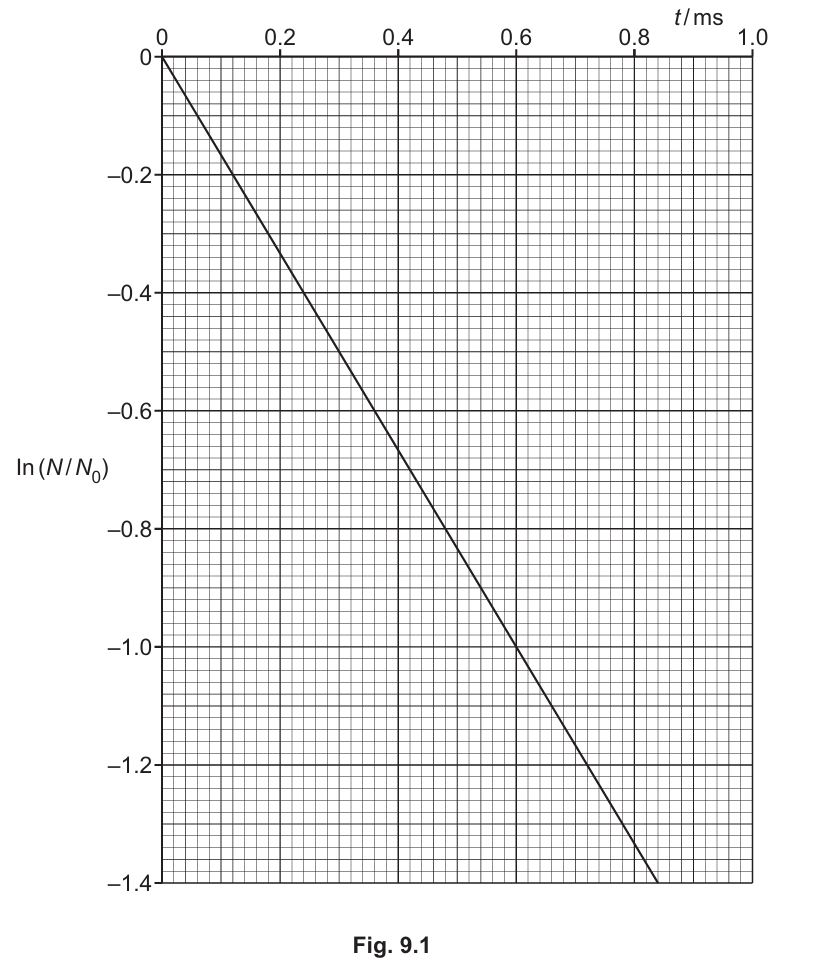
(i) State the name of the quantity that is represented by the magnitude of the gradient of the line in Fig. 9.1. (1 mark)
______________________________________________
(ii) Use Fig. 9.1 to determine the half-life, in ms, of polonium-193. (2 marks)
half-life \(=\) __________________________ \(\mathrm{ms}\)
(e) Positron emission tomography (PET scanning) uses a radioactive tracer.
(i) State what happens to the positrons emitted by the tracer. (1 mark)
______________________________________________
______________________________________________
(ii) Explain why a tracer with a half-life of approximately 2 hours is a suitable tracer to use. (1 mark)
______________________________________________
______________________________________________
Syllabus Topic Codes (Cambridge International AS & A Level Physics 9702 Paper 4):
• 23.2: Radioactive decay – parts (a), (b) and (d)
• 24.3: PET scanning – part (e)
▶️ Answer/Explanation
(a)(i)
Random means that it is not possible to predict which particular nucleus will decay or exactly when a particular nucleus will decay.
Answer: The decay of an individual nucleus cannot be predicted.
(a)(ii)
Spontaneous means that radioactive decay occurs without being triggered by an external factor and is unaffected by external conditions.
Answer: The decay is unaffected by external factors.
(b)
Half-life is the time taken for the number of undecayed radioactive nuclei in a sample to decrease to half its initial value.
Answer: The time taken for half the radioactive nuclei in a sample to decay.
(c)
The nuclear decay is
\(^{193}_{84}\mathrm{Po}\rightarrow{}^{189}_{82}\mathrm{Pb}+{}^{4}_{2}\alpha\)
The total binding energy of the initial nucleus is
\(E_{\mathrm{Po}}=193(7.774)\)
\(E_{\mathrm{Po}}=1500.382\,\mathrm{eV}\)
The total binding energy of the products is
\(E_{\mathrm{products}}=189(7.826)+4(7.074)\)
\(E_{\mathrm{products}}=1507.410\,\mathrm{eV}\)
Therefore, the energy released is
\(E=1507.410-1500.382\)
\(\boxed{E=7.03\,\mathrm{eV}}\)
(d)(i)
The radioactive decay equation is
\(N=N_0e^{-\lambda t}\)
Taking logarithms gives
\(\ln\left(\frac{N}{N_0}\right)=-\lambda t\)
Therefore, the magnitude of the gradient of the graph is the decay constant \(\lambda\).
Answer: decay constant, \(\lambda\)
(d)(ii)
Using two points on the best-fit line, approximately \((0,0)\) and \((0.84,-1.40)\,\mathrm{ms}\),
\(\lambda=\frac{1.40}{0.84}=1.67\,\mathrm{ms^{-1}}\)
The relationship between decay constant and half-life is
\(\lambda=\frac{\ln 2}{t_{1/2}}\)
Hence,
\(t_{1/2}=\frac{0.693}{1.67}\)
\(\boxed{t_{1/2}\approx0.42\,\mathrm{ms}}\)
(e)(i)
The positrons emitted by the tracer interact with electrons in the tissue.
The positron and electron annihilate, producing two gamma-ray photons travelling in opposite directions.
Answer: The positrons annihilate with electrons, producing two gamma-ray photons travelling in opposite directions.
(e)(ii)
A half-life of approximately 2 hours is long enough for the tracer to remain active during the medical scan.
It is also short enough for the activity to decrease relatively quickly after the scan, reducing the radiation dose received by the patient.
Answer: It remains active long enough for imaging but decays sufficiently quickly afterwards to limit radiation exposure.
Question 10
(a) (i) State what is meant by the luminosity of a star. (1 mark)
______________________________________________
______________________________________________
(ii) Explain how standard candles are used to determine the distance to a galaxy. (3 marks)
______________________________________________
______________________________________________
______________________________________________
______________________________________________
(b) The Sun rotates on its axis. Points X, Y and Z are on the equator of the Sun as shown in Fig. 10.1.
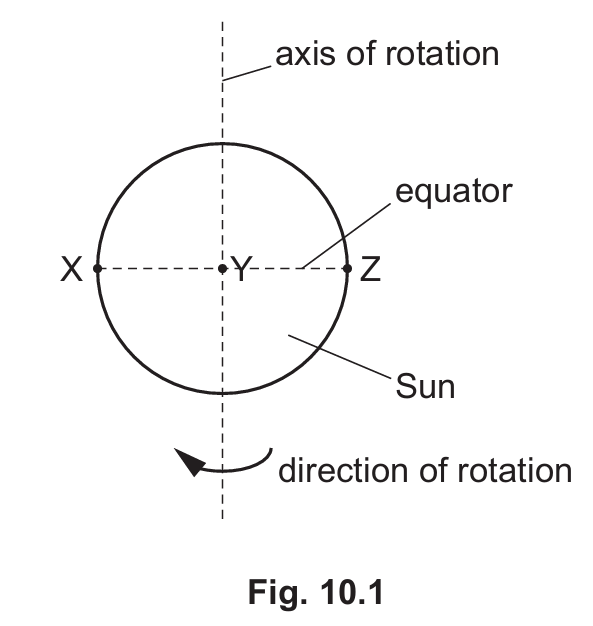
The wavelengths of light from points X and Y are observed and recorded in Table 10.1.
| observed wavelength from X / nm | observed wavelength from Y / nm |
|---|---|
| 656.2877 | 656.2831 |
(i) The Sun rotates with a period of \(2.07\times10^6\,\mathrm{s}\).
Show that the radius of the Sun is \(6.93\times10^8\,\mathrm{m}\). (3 marks)
______________________________________________
______________________________________________
______________________________________________
(ii) State and explain how the expected wavelength of the light observed from Z compares with the emitted wavelength. (2 marks)
______________________________________________
______________________________________________
______________________________________________
(iii) The luminosity of the Sun is \(3.8\times10^{26}\,\mathrm{W}\).
Use the information in (b)(i) to calculate the surface temperature of the Sun. (2 marks)
temperature \(=\) __________________________ \(\mathrm{K}\)
Syllabus Topic Codes (Cambridge International AS & A Level Physics 9702 Paper 4):
• 25.2: Stellar radii – parts (b)(i) and (b)(iii)
• 25.3: Hubble’s law and the Big Bang theory – parts (b)(i) and (b)(ii), for the Doppler/redshift relationship
▶️ Answer/Explanation
(a)(i)
Luminosity is the total power of radiation emitted by a star.
Answer: \(\boxed{\text{Luminosity is the total power of radiation emitted by a star.}}\)
(a)(ii)
A standard candle is an astronomical object whose luminosity is known.
The radiant flux intensity \(F\) received from the object is measured.
Using the inverse-square law,
\(F=\frac{L}{4\pi d^2}\)
where \(L\) is the known luminosity and \(d\) is the distance to the object.
Answer: Measure \(F\), use the known \(L\) of the standard candle, and calculate \(d\) using \(F=\frac{L}{4\pi d^2}\).
(b)(i)
Point Y is at the centre of the visible equator, so its rotational velocity towards or away from the observer is effectively zero. Therefore, the wavelength observed from Y can be taken as the emitted wavelength.
The wavelength difference between X and Y is
\(\Delta\lambda=656.2877-656.2831=0.0046\,\mathrm{nm}\)
Using the Doppler relationship for small velocities,
\(\frac{\Delta\lambda}{\lambda}=\frac{v}{c}\)
Therefore,
\(v=c\frac{\Delta\lambda}{\lambda}\)
\(v=(3.00\times10^8)\frac{0.0046}{656.2831}\)
\(v\approx2.10\times10^3\,\mathrm{m\,s^{-1}}\)
For rotational motion,
\(v=\frac{2\pi R}{T}\)
Hence,
\(R=\frac{vT}{2\pi}\)
\(R=\frac{(2.10\times10^3)(2.07\times10^6)}{2\pi}\)
\(\boxed{R=6.93\times10^8\,\mathrm{m}}\)
(b)(ii)
Point X is moving away from the observer, as indicated by its observed wavelength being greater than the wavelength from Y.
Point Z is moving in the opposite direction to X, so it is moving towards the observer.
Therefore, the light from Z will be blueshifted.
Answer: The observed wavelength from Z is shorter than the emitted wavelength because Z is moving towards the observer.
(b)(iii)
The Stefan-Boltzmann law is
\(L=4\pi R^2\sigma T^4\)
Rearranging,
\(T=\left(\frac{L}{4\pi R^2\sigma}\right)^{\frac{1}{4}}\)
Using \(L=3.8\times10^{26}\,\mathrm{W}\), \(R=6.93\times10^8\,\mathrm{m}\) and \(\sigma=5.67\times10^{-8}\,\mathrm{W\,m^{-2}\,K^{-4}}\),
\(T=\left[\frac{3.8\times10^{26}}{4\pi(6.93\times10^8)^2(5.67\times10^{-8})}\right]^{\frac14}\)
\(\boxed{T\approx5.8\times10^3\,\mathrm{K}}\)