
Question 1
(a)
(i) Define gravitational field. [1 mark]
………………………………………………………………………………………………………………………….
(ii) Define electric field. [1 mark]
………………………………………………………………………………………………………………………….
(iii) State one similarity and one difference between the gravitational potential due to a point mass and the electric potential due to a point charge. [2 marks]
similarity: ……………………………………………………………………………………………………………………
………………………………………………………………………………………………………………………….
difference: …………………………………………………………………………………………………………………..
………………………………………………………………………………………………………………………….
(b) An isolated uniform conducting sphere has mass \(M\) and charge \(Q\).
The gravitational field strength at the surface of the sphere is \(g\).
The electric field strength at the surface of the sphere is \(E\).
(i) Show that
\(\frac{M}{Q}=\alpha\frac{g}{E}\)
where \(\alpha\) is a constant. [3 marks]
………………………………………………………………………………………………………………………….
(ii) Show that the numerical value of \(\alpha\) is \(1.35\times10^{20}\,\mathrm{kg^2\,C^{-2}}\). [1 mark]
………………………………………………………………………………………………………………………….
(c) Assume that the Earth is a uniform conducting sphere of mass \(5.98\times10^{24}\,\mathrm{kg}\).
The surface of the Earth carries a charge of \(-4.80\times10^5\,\mathrm{C}\) that is evenly distributed.
(i) Use the information in (b) to determine the electric field strength at the surface of the Earth. Give a unit with your answer. [2 marks]
electric field strength = ……………………………. unit ……………
(ii) State how the direction of the electric field at the surface of the Earth compares with the direction of the gravitational field. [1 mark]
………………………………………………………………………………………………………………………….
Syllabus Topic Codes (Cambridge International AS & A Level Physics 9702 Paper 4):
• 18.1: Electric fields and field lines – part (a)(ii)
• 13.4: Gravitational potential – part (a)(iii)
• 18.5: Electric potential – part (a)(iii)
• 13.3: Gravitational field of a point mass – parts (b)(i), (b)(ii), (c)(i) and (c)(ii)
• 18.4: Electric field of a point charge – parts (b)(i), (b)(ii), (c)(i) and (c)(ii)
▶️ Answer/Explanation
(a)(i) Gravitational field [1 mark]
A gravitational field is a region in which a mass experiences a gravitational force.
The gravitational field strength is defined as the gravitational force per unit mass:
\(g=\frac{F}{m}\)
Answer: \(\boxed{\text{gravitational force per unit mass}}\)
(a)(ii) Electric field [1 mark]
An electric field is a region in which an electric charge experiences an electric force.
The electric field strength is defined as the force per unit positive charge:
\(E=\frac{F}{Q}\)
Answer: \(\boxed{\text{force per unit positive charge}}\)
(a)(iii) Similarity and difference [2 marks]
Similarity: Both potentials decrease in magnitude with increasing distance from the point source and are zero at infinity.
Difference: Gravitational potential is always negative, whereas electric potential may be positive or negative depending on the sign of the point charge.
Answer: \(\boxed{\text{Gravitational potential is always negative, while electric potential can be positive or negative.}}\)
(b)(i) Relationship between \(M/Q\) and \(g/E\) [3 marks]
For the gravitational field at the surface of a sphere,
\(g=\frac{GM}{r^2}\)
For the electric field at the surface of the sphere,
\(E=\frac{Q}{4\pi\varepsilon_0r^2}\)
Rearranging the first equation,
\(M=\frac{gr^2}{G}\)
and from the second equation,
\(Q=4\pi\varepsilon_0Er^2\)
Therefore,
\(\frac{M}{Q}=\frac{gr^2/G}{4\pi\varepsilon_0Er^2}\)
\(\frac{M}{Q}=\frac{1}{4\pi G\varepsilon_0}\frac{g}{E}\)
Comparing with \(\frac{M}{Q}=\alpha\frac{g}{E}\),
Answer: \(\boxed{\alpha=\frac{1}{4\pi G\varepsilon_0}}\)
(b)(ii) Numerical value of \(\alpha\) [1 mark]
Using \(G=6.67\times10^{-11}\,\mathrm{N\,m^2\,kg^{-2}}\) and \(\varepsilon_0=8.85\times10^{-12}\,\mathrm{F\,m^{-1}}\),
\(\alpha=\frac{1}{4\pi(6.67\times10^{-11})(8.85\times10^{-12})}\)
\(\alpha=1.35\times10^{20}\,\mathrm{kg^2\,C^{-2}}\)
Answer: \(\boxed{1.35\times10^{20}\,\mathrm{kg^2\,C^{-2}}}\)
(c)(i) Electric field strength at the Earth’s surface [2 marks]
From part (b),
\(\frac{M}{Q}=\alpha\frac{g}{E}\)
Therefore,
\(E=\frac{\alpha gQ}{M}\)
Using the magnitude of the charge, \(Q=4.80\times10^5\,\mathrm{C}\),
\(E=\frac{(1.35\times10^{20})(9.81)(4.80\times10^5)}{5.98\times10^{24}}\)
\(E=1.06\times10^2\,\mathrm{N\,C^{-1}}\)
Answer: \(\boxed{106\,\mathrm{N\,C^{-1}}}\)
(c)(ii) Direction of the fields [1 mark]
The gravitational field is directed towards the Earth because gravity is attractive.
The Earth’s charge is negative, so the electric field is also directed towards the Earth.
Answer: \(\boxed{\text{The electric field and gravitational field are in the same direction.}}\)
Question 2
A steel sphere of mass \(0.29\,\mathrm{kg}\) is suspended in equilibrium from a vertical spring. The centre of the sphere is \(8.5\,\mathrm{cm}\) from the top of the spring, as shown in Fig. 2.1.

The sphere is now set in motion so that it is moving in a horizontal circle at constant speed, as shown in Fig. 2.2.

The distance from the centre of the sphere to the top of the spring is now \(10.8\,\mathrm{cm}\).
(a) Explain, with reference to the forces acting on the sphere, why the length of the spring in Fig. 2.2 is greater than in Fig. 2.1. [3 marks]
………………………………………………………………………………………………………………………….
(b) The angle between the linear axis of the spring and the vertical is \(27^\circ\).
(i) Show that the radius \(r\) of the circle is \(4.9\,\mathrm{cm}\). [1 mark]
________________________________
(ii) Show that the tension in the spring is \(3.2\,\mathrm{N}\). [2 marks]
________________________________
(iii) The spring obeys Hooke’s law.
Calculate the spring constant, in \(\mathrm{N\,cm^{-1}}\), of the spring.
spring constant = ……………………………………… \(\mathrm{N\,cm^{-1}}\) [2 marks]
(c)
(i) Use the information in (b) to determine the centripetal acceleration of the sphere.
centripetal acceleration = ………………………………………… \(\mathrm{m\,s^{-2}}\) [2 marks]
(ii) Calculate the period of the circular motion of the sphere.
period = ……………………………………………… \(\mathrm{s}\) [2 marks]
Syllabus Topic Codes (Cambridge International AS & A Level Physics 9702 Paper 4):
• 6.1: Stress and strain – part (b)(iii)
• 12.1: Kinematics of uniform circular motion – part (c)(ii)
▶️ Answer/Explanation
(a) [3 marks]
When the sphere is stationary, the tension in the spring balances the weight:
\(T=mg\)
When the sphere moves in a horizontal circle, the tension in the spring has both vertical and horizontal components.
The vertical component of tension balances the weight, while the horizontal component provides the centripetal force needed for circular motion.
Therefore,
\(T\cos27^\circ=mg\)
so \(T>mg\).
The greater tension produces a greater extension of the spring, so the spring is longer in Fig. 2.2.
Answer: \(\boxed{\text{horizontal component provides centripetal force, so tension is greater and the spring extends further}}\)
(b)(i) Radius of the circle [1 mark]
From the geometry of Fig. 2.2,
\(r=10.8\sin27^\circ\)
\(r=4.9\,\mathrm{cm}\)
Answer: \(\boxed{4.9\,\mathrm{cm}}\)
(b)(ii) Tension in the spring [2 marks]
The vertical component of the tension balances the weight:
\(T\cos27^\circ=mg\)
Therefore,
\(T=\frac{mg}{\cos27^\circ}\)
\(T=\frac{(0.29)(9.81)}{\cos27^\circ}\)
\(T=3.2\,\mathrm{N}\)
Answer: \(\boxed{3.2\,\mathrm{N}}\)
(b)(iii) Spring constant [2 marks]
In the initial equilibrium position,
\(T_1=mg=(0.29)(9.81)=2.84\,\mathrm{N}\)
The change in extension is
\(\Delta x=10.8-8.5=2.3\,\mathrm{cm}\)
Using Hooke’s law,
\(k=\frac{\Delta T}{\Delta x}\)
\(k=\frac{3.2-2.84}{2.3}\)
\(k=0.15\,\mathrm{N\,cm^{-1}}\)
Answer: \(\boxed{0.15\,\mathrm{N\,cm^{-1}}}\)
(c)(i) Centripetal acceleration [2 marks]
The horizontal component of the tension provides the centripetal force:
\(ma=T\sin27^\circ\)
Therefore,
\(a=\frac{T\sin27^\circ}{m}\)
\(a=\frac{(3.2)\sin27^\circ}{0.29}\)
\(a=5.0\,\mathrm{m\,s^{-2}}\)
Answer: \(\boxed{5.0\,\mathrm{m\,s^{-2}}}\)
(c)(ii) Period of circular motion [2 marks]
For circular motion,
\(a=r\omega^2\)
and
\(\omega=\frac{2\pi}{T}\)
Hence,
\(a=r\left(\frac{2\pi}{T}\right)^2\)
Rearranging,
\(T=2\pi\sqrt{\frac{r}{a}}\)
Using \(r=4.9\,\mathrm{cm}=0.049\,\mathrm{m}\) and \(a=5.0\,\mathrm{m\,s^{-2}}\):
\(T=2\pi\sqrt{\frac{0.049}{5.0}}\)
\(T=0.62\,\mathrm{s}\)
Answer: \(\boxed{0.62\,\mathrm{s}}\)
Question 3
(a) State the reason why two objects that are at the same temperature are described as being in thermal equilibrium. [1 mark]
………………………………………………………………………………………………………………………….
(b) Fig. 3.1 shows the variations with temperature of the densities of mercury and of water between \(0^\circ\mathrm{C}\) and \(100^\circ\mathrm{C}\).
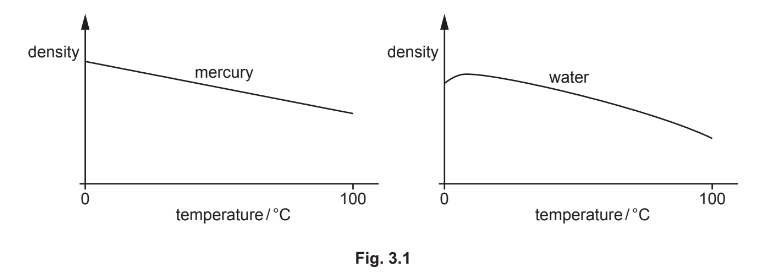
Temperature may be measured using the variation with temperature of the density of a liquid.
Suggest why, for measuring temperature over this temperature range:
(i) mercury is a suitable liquid. [1 mark]
………………………………………………………………………………………………………………………….
(ii) water is not a suitable liquid. [2 marks]
………………………………………………………………………………………………………………………….
(c) A beaker contains a liquid of mass \(120\,\mathrm{g}\). The liquid is supplied with thermal energy at a rate of \(810\,\mathrm{W}\). The beaker has a mass of \(42\,\mathrm{g}\) and a specific heat capacity of \(0.84\,\mathrm{J\,g^{-1}\,K^{-1}}\). The beaker and the liquid are in thermal equilibrium with each other at all times and are insulated from the surroundings.
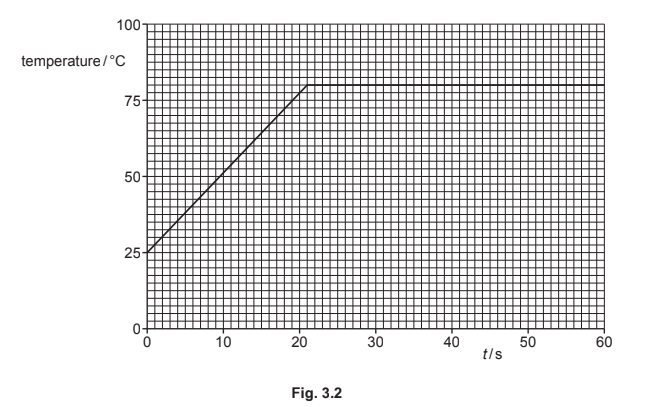
Fig. 3.2 shows the variation with time \(t\) of the temperature of the liquid.
(i) State the boiling temperature, in \(^\circ\mathrm{C}\), of the liquid. [1 mark]
temperature = ……………………………………………. \(^\circ\mathrm{C}\)
(ii) Determine the specific heat capacity, in \(\mathrm{J\,g^{-1}\,K^{-1}}\), of the liquid. [4 marks]
specific heat capacity = ……………………………………. \(\mathrm{J\,g^{-1}\,K^{-1}}\)
(d) The experiment in (c) is repeated using water instead of the liquid in (c). The mass of liquid used, the power supplied, and the initial temperature are all unchanged.
The specific heat capacity of water is approximately twice that of the liquid in (c).
The boiling temperature of water is \(100^\circ\mathrm{C}\).
On Fig. 3.2, sketch the variation with time \(t\) of the temperature of the water between \(t=0\) and \(t=60\,\mathrm{s}\). Numerical calculations are not required. [2 marks]
Syllabus Topic Codes (Cambridge International AS & A Level Physics 9702 Paper 4):
• 14.2: Temperature scales – part (b)
• 14.3: Specific heat capacity and specific latent heat – parts (c) and (d)
▶️ Answer/Explanation
(a) Thermal equilibrium [1 mark]
When two objects are at the same temperature, there is no net transfer of thermal energy between them.
Answer: \(\boxed{\text{There is no net thermal energy transfer between the objects.}}\)
(b)(i) Mercury [1 mark]
The density of mercury varies approximately linearly with temperature over the range \(0^\circ\mathrm{C}\) to \(100^\circ\mathrm{C}\).
Answer: \(\boxed{\text{Its density varies approximately linearly with temperature.}}\)
(b)(ii) Water [2 marks]
The density of water does not vary linearly with temperature.
Also, there is a region where different temperatures correspond to the same density, so the density would not give a unique value of temperature.
Answer: \(\boxed{\text{The variation is not linear and some temperatures have the same density.}}\)
(c)(i) Boiling temperature [1 mark]
From Fig. 3.2, the temperature reaches a constant value at \(80^\circ\mathrm{C}\).
Answer: \(\boxed{80^\circ\mathrm{C}}\)
(c)(ii) Specific heat capacity [4 marks]
From the graph, the temperature increases from \(25^\circ\mathrm{C}\) to \(80^\circ\mathrm{C}\) in \(21\,\mathrm{s}\).
The thermal energy supplied is
\(Q=Pt\)
\(Q=(810)(21)=17010\,\mathrm{J}\)
The temperature change is
\(\Delta\theta=80-25=55\,\mathrm{K}\)
Some of the thermal energy is absorbed by the beaker:
\(Q_{\mathrm{beaker}}=mc\Delta\theta\)
\(Q_{\mathrm{beaker}}=(42)(0.84)(55)=1940\,\mathrm{J}\)
Therefore, the thermal energy absorbed by the liquid is
\(Q_{\mathrm{liquid}}=17010-1940=15070\,\mathrm{J}\)
Using \(Q=mc\Delta\theta\),
\(c=\frac{Q_{\mathrm{liquid}}}{m\Delta\theta}\)
\(c=\frac{15070}{(120)(55)}\)
\(c=2.28\,\mathrm{J\,g^{-1}\,K^{-1}}\)
Answer: \(\boxed{2.3\,\mathrm{J\,g^{-1}\,K^{-1}}}\)
(d) Heating curve for water [2 marks]
The specific heat capacity of water is approximately twice that of the original liquid.
For the same mass and power, the rate of temperature rise is therefore approximately half as large.
The graph should start at \(25^\circ\mathrm{C}\), have a straight-line gradient approximately half that of the original line, and eventually become horizontal at \(100^\circ\mathrm{C}\).
Answer: \(\boxed{\text{A straight line from }25^\circ\mathrm{C}\text{ with about half the original gradient, followed by a horizontal section at }100^\circ\mathrm{C}.}\)
Question 4
(a) State two of the basic assumptions of the kinetic theory of gases. [2 marks]
1 ………………………………………………………………………………………………………………………………
2 ………………………………………………………………………………………………………………………………
(b) An ideal gas has amount of substance \(n\).
The gas is initially in state X, with pressure \(2p\) and volume \(V\).
The gas is cooled at constant volume to state Y, with pressure \(p\).
The gas is then heated at constant pressure to state Z, with volume \(2V\).
Finally, the gas returns at constant temperature to state X.
(i) Determine an expression for the temperature \(T\) of the gas in state X, in terms of \(n\), \(p\) and \(V\). [2 marks]
Identify any other symbols that you use.
\(T=\) …………………………………………………………………………………………………………….
(ii) On Fig. 4.1, sketch the variation with volume of pressure for the gas as the gas undergoes the three changes. The state X is labelled. Label states Y and Z. [3 marks]

(iii) During the change of state from Y to Z, the increase in internal energy of the gas is \(U\).
During the change of state from Z to X, the work done on the gas is \(W\).
Complete Table 4.1 to indicate, for each of the three changes of state, the increase in internal energy of the gas, the thermal energy transferred to the gas and the work done on the gas, in terms of \(p\), \(V\), \(U\) and \(W\). [5 marks]

Syllabus Topic Codes (Cambridge International AS & A Level Physics 9702 Paper 4):
• 15.3: Kinetic theory of gases – part (a)
• 16.1: Internal energy – part (b)(iii)
• 16.2: The first law of thermodynamics – part (b)(iii)
▶️ Answer/Explanation
(a) [2 marks]
Any two of the following:
• Gas particles are in continuous random motion.
• The particles have negligible volume compared with the volume of the gas.
• There are negligible forces between particles except during collisions.
• Collisions between particles and with the container walls are perfectly elastic.
• The time of a collision is negligible compared with the time between collisions.
(b)(i) [2 marks]
Use the ideal-gas equation:
\(pV=nRT\)
At state X, the pressure is \(2p\) and the volume is \(V\), so
\(2pV=nRT\)
Therefore,
\(\boxed{T=\frac{2pV}{nR}}\)
where \(R\) is the molar gas constant.
(b)(ii) [3 marks]
For \(X\rightarrow Y\), the volume remains constant while pressure decreases from \(2p\) to \(p\). Therefore, draw a vertical line from \(X(V,2p)\) to \(Y(V,p)\).
For \(Y\rightarrow Z\), the pressure remains constant at \(p\) while the volume increases from \(V\) to \(2V\). Therefore, draw a horizontal line from \(Y(V,p)\) to \(Z(2V,p)\).
For \(Z\rightarrow X\), the temperature is constant. Hence \(pV=\text{constant}\), so the graph is an isothermal curve from \(Z(2V,p)\) to \(X(V,2p)\).
Required graph: vertical \(XY\), horizontal \(YZ\), and an isothermal curve \(ZX\).
(b)(iii) [5 marks]
The first law is
\(\Delta U=q+W\)
where \(W\) is the work done on the gas.
For \(X\rightarrow Y\):
The volume is constant, so the work done on the gas is
\(\boxed{W_{XY}=0}\)
Since \(Y\rightarrow Z\) has an increase in internal energy of \(+U\), and the temperature at X is twice that at Y, the change \(X\rightarrow Y\) has an internal-energy change of \(-U\).
Thus, from \(\Delta U=q+W\),
\(\boxed{q_{XY}=-U}\)
For \(Y\rightarrow Z\):
The pressure is constant at \(p\), while the volume increases from \(V\) to \(2V\).
Work done by the gas \(=p\Delta V=pV\).
Therefore, work done on the gas is
\(\boxed{W_{YZ}=-pV}\)
Given that the increase in internal energy is \(+U\),
\(U=q_{YZ}-pV\)
so
\(\boxed{q_{YZ}=U+pV}\)
For \(Z\rightarrow X\):
The change is at constant temperature, so the internal energy does not change:
\(\boxed{\Delta U_{ZX}=0}\)
The work done on the gas is given as \(+W\).
Therefore,
\(0=q_{ZX}+W\)
so
\(\boxed{q_{ZX}=-W}\)
Completed table:
| Change | Increase in internal energy | Thermal energy transferred to gas | Work done on gas |
|---|---|---|---|
| \(X\rightarrow Y\) | \(-U\) | \(-U\) | \(0\) |
| \(Y\rightarrow Z\) | \(+U\) | \(U+pV\) | \(-pV\) |
| \(Z\rightarrow X\) | \(0\) | \(-W\) | \(+W\) |
Question 5
Part of an electric circuit is shown in Fig. 5.1.
The circuit is used to produce half-wave rectification of an alternating voltage of potential difference (p.d.) \(V_{\mathrm{IN}}\).
The output p.d. across the \(14\,\mathrm{k\Omega}\) resistor is \(V_{\mathrm{OUT}}\).
(a)
(i) A component is missing from the circuit of Fig. 5.1.
Complete the circuit diagram in Fig. 5.1 by adding the circuit symbol for the missing component, correctly connected. [1 mark]
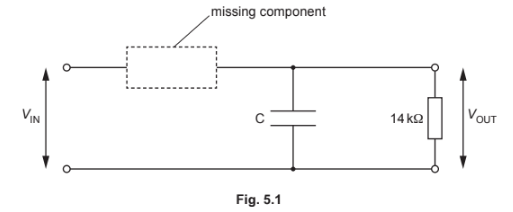
(ii) A capacitor \(C\) is shown in the circuit of Fig. 5.1.
State the effect on \(V_{\mathrm{OUT}}\) of including the capacitor in the circuit. [1 mark]
………………………………………………………………………………………………………………………….
(b) Fig. 5.2 shows the variation with time \(t\) of \(V_{\mathrm{IN}}\).
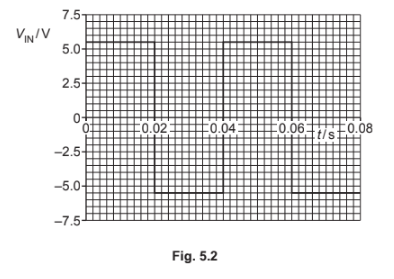
Fig. 5.3 shows the variation with \(t\) of \(V_{\mathrm{OUT}}\).
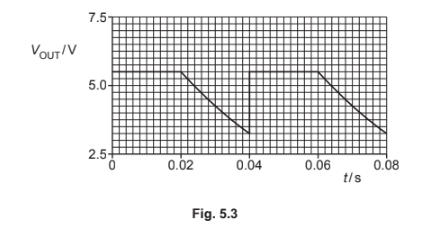
(i) Determine the frequency of \(V_{\mathrm{IN}}\).
frequency = ……………………………………………. \(\mathrm{Hz}\) [1 mark]
(ii) Show that the time constant \(\tau\) for the discharge of the capacitor through the resistor is \(0.038\,\mathrm{s}\). [2 marks]
………………………………………………………………………………………………………………………….
(iii) Calculate the capacitance of \(C\). Give a unit with your answer.
capacitance = ……………………………. unit …………… [2 marks]
(c) The circuit of Fig. 5.1 is modified so that it produces full-wave rectification of an input voltage.
Suggest, with a reason, how \(V_{\mathrm{OUT}}\) now varies with time when \(V_{\mathrm{IN}}\) is as shown in Fig. 5.2. [2 marks]
………………………………………………………………………………………………………………………….
Syllabus Topic Codes (Cambridge International AS & A Level Physics 9702 Paper 4):
• 21.1: Characteristics of alternating currents – part (b)(i)
▶️ Answer/Explanation
(a)(i) Missing component [1 mark]
The missing component is a diode connected in series with the circuit.
Answer: \(\boxed{\text{diode}}\)
(a)(ii) Effect of capacitor [1 mark]
The capacitor smooths the output voltage.
Answer: \(\boxed{V_{\mathrm{OUT}}\text{ is smoothed}}\)
(b)(i) Frequency [1 mark]
From Fig. 5.2, the period is \(T=0.04\,\mathrm{s}\).
Using
\(f=\frac{1}{T}\)
\(f=\frac{1}{0.04}\)
Answer: \(\boxed{25\,\mathrm{Hz}}\)
(b)(ii) Time constant [2 marks]
For capacitor discharge,
\(V=V_0\exp\left(-\frac{t}{RC}\right)\)
The time constant is
\(\tau=RC\)
From Fig. 5.3, \(V_0=5.50\,\mathrm{V}\), \(V=3.25\,\mathrm{V}\), and \(t=0.020\,\mathrm{s}\).
Therefore,
\(3.25=5.50\exp\left(-\frac{0.020}{\tau}\right)\)
Rearranging gives
Answer: \(\boxed{\tau=0.038\,\mathrm{s}}\)
(b)(iii) Capacitance [2 marks]
Using
\(\tau=RC\)
\(C=\frac{\tau}{R}\)
\(C=\frac{0.038}{14000}\)
\(C=2.7\times10^{-6}\,\mathrm{F}\)
Answer: \(\boxed{2.7\times10^{-6}\,\mathrm{F}}\)
(c) Full-wave rectification [2 marks]
With full-wave rectification, the negative half-cycles are also rectified so that the output has the same polarity.
Thus, the output is produced from both the positive and negative half-cycles of \(V_{\mathrm{IN}}\), giving a higher frequency of variation than for half-wave rectification.
Answer: \(\boxed{\text{both half-cycles contribute to }V_{\mathrm{OUT}}\text{, so the output varies at twice the input frequency}}\)
Question 6
(a) State what is meant by a magnetic field. [2 marks]
(b) A long, straight wire P carries a current into the page, as shown in Fig. 6.1.
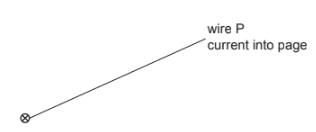
On Fig. 6.1, draw four field lines to represent the magnetic field around wire P due to the current in the wire. [3 marks]
(c) A second long, straight wire Q, carrying a current of \(5.0\,\mathrm{A}\) out of the page, is placed parallel to wire P, as shown in Fig. 6.2.
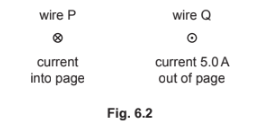
The flux density of the magnetic field at wire Q due to the current in wire P is \(2.6\,\mathrm{mT}\).
(i) Calculate the magnetic force per unit length exerted on wire Q by wire P. [2 marks]
force per unit length = ……………………………………….. \(\mathrm{N\,m^{-1}}\)
(ii) State the direction of the force exerted on wire Q by wire P. [1 mark]
…………………………………………………………………………………………………………………….
(iii) The flux density of the magnetic field at wire P due to the current in wire Q is \(1.5\,\mathrm{mT}\).
Determine the magnitude of the current in wire P. Explain your reasoning. [2 marks]
current = ……………………………………………… \(\mathrm{A}\)
Syllabus Topic Code (Cambridge International AS & A Level Physics 9702 Paper 4):
20.1 Concept of a magnetic field – part (a)
20.2 Force on a current-carrying conductor – parts (c)(i) and (c)(ii)
20.4 Magnetic fields due to currents – parts (b) and (c)(iii)
▶️ Answer/Explanation
(a) Magnetic field [2 marks]
A magnetic field is a region where a force acts on:
• a current-carrying conductor, or
• a moving charge, or
• a magnetic material or magnetic pole.
(b) Magnetic field around wire P [3 marks]
The magnetic field lines are concentric circles centred on wire P.
The spacing between the field lines increases with distance from the wire because the magnetic flux density decreases with distance.
Using the right-hand grip rule, a current into the page produces a clockwise magnetic field.
Answer: concentric circles with clockwise arrows.
(c)(i) Magnetic force per unit length [2 marks]
For a current-carrying conductor in a magnetic field,
\(F=BIL\)
Therefore,
\(\frac{F}{L}=BI\)
\(\frac{F}{L}=(2.6\times10^{-3})(5.0)\)
\(\frac{F}{L}=0.013\,\mathrm{N\,m^{-1}}\)
Answer: \(\boxed{1.3\times10^{-2}\,\mathrm{N\,m^{-1}}}\)
(c)(ii) Direction of force [1 mark]
The currents in P and Q are in opposite directions, so the parallel wires repel each other.
Answer: \(\boxed{\text{to the right}}\)
(c)(iii) Current in wire P [2 marks]
By Newton’s third law, the force per unit length exerted on P by Q has the same magnitude as that exerted on Q by P.
Hence,
\(0.013=(1.5\times10^{-3})I\)
\(I=\frac{0.013}{1.5\times10^{-3}}\)
\(I=8.7\,\mathrm{A}\)
Answer: \(\boxed{8.7\,\mathrm{A}}\)
Question 7
(a) State what is meant by the de Broglie wavelength. [1 mark]
(b) Fig. 7.1 shows a glass tube in which electrons are accelerated through a high p.d. to form a beam that is incident on a thin graphite crystal.
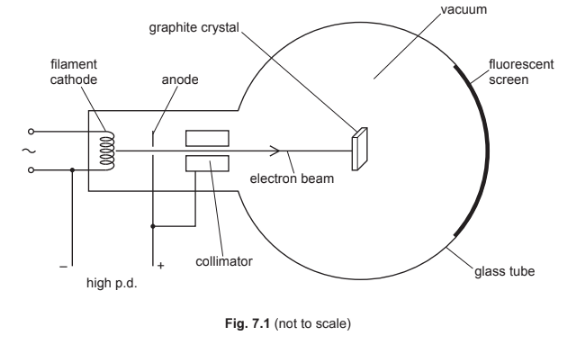
After passing through the graphite crystal, the electrons reach the fluorescent screen. The screen glows where the electrons strike it.
Fig. 7.2 shows the fluorescent screen viewed end-on, from the right-hand side of Fig. 7.1.

(i) State the name of the phenomenon demonstrated by the pattern shown in Fig. 7.2. [1 mark]
(ii) Explain what can be concluded from the pattern in Fig. 7.2 about the nature of electrons. [2 marks]
(c) The electrons in (b) are now accelerated through a greater potential difference between the cathode and the anode.
(i) On Fig. 7.3, sketch the pattern that is now seen on the fluorescent screen in Fig. 7.1. [2 marks]
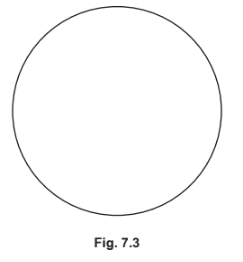
(ii) Explain, with reference to de Broglie wavelength, the change in the pattern on the fluorescent screen. [3 marks]
Syllabus Topic Code (Cambridge International AS & A Level Physics 9702 Paper 4):
• 22.3: Wave-particle duality – parts (a), (b)(i), (b)(ii), (c)(i) and (c)(ii)
▶️ Answer/Explanation
(a) De Broglie wavelength [1 mark]
The de Broglie wavelength is the wavelength associated with a moving particle.
It is given by
\(\lambda=\frac{h}{p}\)
(b)(i) Phenomenon demonstrated [1 mark]
The phenomenon is electron diffraction.
Answer: \(\boxed{\text{diffraction}}\)
(b)(ii) Nature of electrons [2 marks]
The beam spreads out, indicating diffraction.
The light and dark regions form an interference pattern.
Therefore, the electrons are behaving as waves.
(c)(i) New diffraction pattern [2 marks]
The pattern should consist of a central bright region and concentric rings.
The rings should be closer together than in Fig. 7.2.
(c)(ii) Effect of increasing the accelerating p.d. [3 marks]
A greater accelerating p.d. gives the electrons greater kinetic energy and hence greater momentum.
From the de Broglie equation,
\(\lambda=\frac{h}{p}\)
so greater momentum gives a smaller de Broglie wavelength.
For the same crystal spacing, the smaller wavelength produces a smaller diffraction angle.
Therefore, the intensity maxima occur at smaller angles and the rings in the diffraction pattern are closer together.
Answer: \(\boxed{\text{greater p.d.}\rightarrow\text{greater momentum}\rightarrow\text{smaller }\lambda\rightarrow\text{smaller diffraction angle}}\)
Question 8
(a) Table 8.1 shows some data relating to the properties of air, gel and body tissue. The data are given to three significant figures.
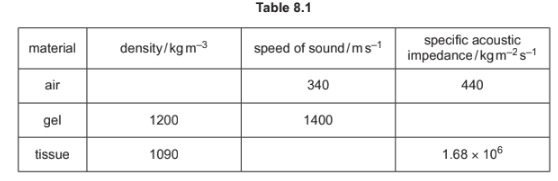
(i) Show that the specific acoustic impedance of gel is \(1.68\times10^{6}\,\mathrm{kg\,m^{-2}\,s^{-1}}\). [1 mark]
(ii) Complete Table 8.1 by calculating the missing values to three significant figures. Use the space below for any working that you need. [2 marks]
(b) Use the information in (a) to calculate the intensity reflection coefficient for:
(i) an air–tissue boundary [2 marks]
intensity reflection coefficient = …………………………………………………
(ii) a gel–tissue boundary [1 mark]
intensity reflection coefficient = …………………………………………………
(c) Use your answers in (b) to explain why gel is applied to the skin during ultrasound scanning. [2 marks]
Syllabus Topic Codes (Cambridge International AS & A Level Physics 9702 Paper 4):
▶️ Answer/Explanation
(a)(i) Specific acoustic impedance [1 mark]
The specific acoustic impedance is given by
\(Z=\rho c\)
For the gel,
\(Z=(1200)(1400)\)
\(Z=1.68\times10^{6}\,\mathrm{kg\,m^{-2}\,s^{-1}}\)
Answer: \(\boxed{1.68\times10^{6}\,\mathrm{kg\,m^{-2}\,s^{-1}}}\)
(a)(ii) Completing Table 8.1 [2 marks]
For air,
\(\rho=\frac{Z}{c}\)
\(\rho=\frac{440}{340}=1.29\,\mathrm{kg\,m^{-3}}\)
For tissue,
\(c=\frac{Z}{\rho}\)
\(c=\frac{1.68\times10^{6}}{1090}\)
\(c=1540\,\mathrm{m\,s^{-1}}\)
Answers: air density \(=\boxed{1.29\,\mathrm{kg\,m^{-3}}}\), tissue speed of sound \(=\boxed{1540\,\mathrm{m\,s^{-1}}}\)
(b)(i) Air–tissue boundary [2 marks]
The intensity reflection coefficient is
\(\frac{I_{\mathrm{R}}}{I_0}=\left(\frac{Z_1-Z_2}{Z_1+Z_2}\right)^2\)
For an air–tissue boundary, \(Z_1=440\,\mathrm{kg\,m^{-2}\,s^{-1}}\) and \(Z_2=1.68\times10^{6}\,\mathrm{kg\,m^{-2}\,s^{-1}}\).
\(\frac{I_{\mathrm{R}}}{I_0}=\left(\frac{1.68\times10^{6}-440}{1.68\times10^{6}+440}\right)^2\)
\(\frac{I_{\mathrm{R}}}{I_0}=0.999\)
Answer: \(\boxed{0.999}\)
(b)(ii) Gel–tissue boundary [1 mark]
For gel and tissue, both media have the same specific acoustic impedance:
\(Z_{\mathrm{gel}}=Z_{\mathrm{tissue}}=1.68\times10^{6}\,\mathrm{kg\,m^{-2}\,s^{-1}}\)
Therefore,
\(\frac{I_{\mathrm{R}}}{I_0}=\left(\frac{Z_1-Z_2}{Z_1+Z_2}\right)^2=0\)
Answer: \(\boxed{0}\)
(c) Use of gel during ultrasound scanning [2 marks]
Without gel, there is a very large difference in specific acoustic impedance between air and body tissue, giving an intensity reflection coefficient of approximately \(0.999\).
Therefore, almost all of the incident ultrasound would be reflected at the air–skin boundary.
The gel has a specific acoustic impedance close to that of body tissue, giving an intensity reflection coefficient of approximately zero.
Thus, much more of the ultrasound is transmitted into the body, allowing effective ultrasound scanning.
Answer: \(\boxed{\text{gel reduces reflection at the skin and increases transmission of ultrasound into the body}}\)
Question 9
Carbon-11 is radioactive and decays by \(\beta^{+}\) emission to form boron-11. Carbon-11 has a half-life of 20 minutes. Boron-11 is stable.
(a) Define half-life. [1 mark]
(b) A sample contains \(N_0\) nuclei of carbon-11 and no other nuclei at time \(t=0\).
On Fig. 9.1, sketch the variation with \(t\) of the number of nuclei of boron-11 in the sample.[3 marks]
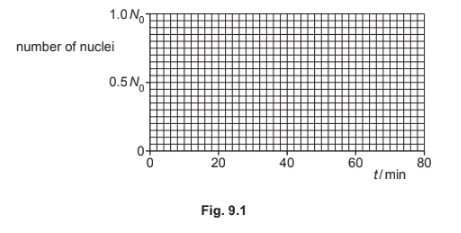
(c) (i) Explain, with reference to the random nature of radioactive decay, why the activity of the carbon-11 sample in (b) decreases with time. [2 marks]
(ii) State, with reasons, whether a radiation detector placed near to the sample of carbon-11 indicates a measured count rate from the sample that is less than, the same as or greater than the activity of the sample. [3 marks]
Syllabus Topic Code (Cambridge International AS & A Level Physics 9702 Paper 4):
Topic 23: Nuclear physics → 23.2 Radioactive decay
▶️ Answer/Explanation
(a) Define half-life [1 mark]
Half-life is the time taken for the activity of a radioactive sample to halve.
Answer: time for the activity of the sample to halve.
(b) Number of boron-11 nuclei [3 marks]
Initially, there are no boron-11 nuclei, so the graph starts at \(N_{\mathrm{B}}=0\) when \(t=0\).
As carbon-11 decays, boron-11 nuclei are produced. Since the carbon-11 decay is exponential, the rate at which boron-11 is produced decreases with time.
The curve therefore has a positive gradient that steadily decreases in magnitude and approaches \(N_0\).
Important points are:
\(t=0:\quad N_{\mathrm{B}}=0\)
\(t=20\,\mathrm{min}:\quad N_{\mathrm{B}}=0.5N_0\)
\(t=40\,\mathrm{min}:\quad N_{\mathrm{B}}=0.75N_0\)
The curve continues towards \(N_0\) as \(t\) increases.
Graph: increasing exponential curve starting at \((0,0)\), passing through \((20,0.5N_0)\) and \((40,0.75N_0)\), with decreasing gradient.
(c)(i) Activity decreases with time [2 marks]
Every undecayed carbon-11 nucleus has the same probability of decaying in a given time interval.
As time increases, fewer undecayed carbon-11 nuclei remain, so fewer nuclei decay per unit time.
Since activity is the number of decays per unit time, \(A=\lambda N\), the activity decreases with time.
(c)(ii) Measured count rate [3 marks]
The measured count rate is less than the activity.
This is because the sample emits radiation in all directions, but the detector only detects particles travelling towards it.
In addition, some emissions may be absorbed or scattered before reaching the detector.
Therefore, not every decay in the sample produces a count in the detector.
Answer: measured count rate < activity.
Question 10
(a) State Hubble’s law. Identify any symbols that you use. [2 marks]
………………………………………………………………………………………………………………………….
(b) A star of luminosity \(3.8\times10^{31}\,\mathrm{W}\) is a distance of \(1.8\times10^{24}\,\mathrm{m}\) from the Earth.
Calculate the radiant flux intensity at the Earth of the radiation emitted by the star. [2 marks]
radiant flux intensity = ………………………………………… \( \mathrm{W\,m^{-2}} \)
(c) The star in (b) is in a distant galaxy. A spectral line in the light from this galaxy is known to have a wavelength of \(486\,\mathrm{nm}\). This spectral line in the light from the galaxy observed on the Earth has a wavelength of \(492\,\mathrm{nm}\).
(i) Explain why the wavelength observed on the Earth is different from the wavelength that the galaxy is known to have emitted. [2 marks]
………………………………………………………………………………………………………………………….
(ii) Determine a value for the Hubble constant \(H_0\). [3 marks]
\(H_0\) = ………………………………………… \( \mathrm{s^{-1}} \)
Syllabus Topic Codes (Cambridge International AS & A Level Physics 9702 Paper 4):
• 25.3: Hubble’s law and the Big Bang theory – parts (a), (c)(i) and (c)(ii)
▶️ Answer/Explanation
(a) Hubble’s law [2 marks]
Hubble’s law states that the recession speed \(v\) of a galaxy is directly proportional to its distance \(d\) from the observer.
\(v=H_0d\)
where \(v\) is the recession speed of the galaxy, \(d\) is its distance from the observer and \(H_0\) is the Hubble constant.
Answer: \(\boxed{v=H_0d}\)
(b) Radiant flux intensity [2 marks]
The radiant flux intensity is given by the inverse square law:
\(F=\frac{L}{4\pi d^2}\)
Substituting \(L=3.8\times10^{31}\,\mathrm{W}\) and \(d=1.8\times10^{24}\,\mathrm{m}\):
\(F=\frac{3.8\times10^{31}}{4\pi(1.8\times10^{24})^2}\)
\(F=9.3\times10^{-19}\,\mathrm{W\,m^{-2}}\)
Answer: \(\boxed{9.3\times10^{-19}\,\mathrm{W\,m^{-2}}}\)
(c)(i) Difference in wavelength [2 marks]
The galaxy is moving away from the Earth.
The wavelength of the light is increased due to the Doppler effect, producing a redshift.
Answer: \(\boxed{\text{the galaxy is receding, so its emitted light is redshifted}}\)
(c)(ii) Hubble constant [3 marks]
For redshift at relatively small speeds,
\(\frac{\Delta\lambda}{\lambda}=\frac{v}{c}\)
Hence,
\(v=\frac{(492-486)(3.00\times10^8)}{486}\)
\(v=3.7\times10^6\,\mathrm{m\,s^{-1}}\)
Using Hubble’s law,
\(H_0=\frac{v}{d}\)
\(H_0=\frac{3.7\times10^6}{1.8\times10^{24}}\)
\(H_0=2.1\times10^{-18}\,\mathrm{s^{-1}}\)
Answer: \(\boxed{2.1\times10^{-18}\,\mathrm{s^{-1}}}\)