
Question 1
The drag force \(F_{\mathrm{D}}\) acting on an object falling through air is given by
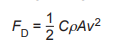
where \(A\) is the cross-sectional area of the object,
\(v\) is the velocity of the object in the air,
\(\rho\) is the density of the air and
\(C\) is a constant called the drag coefficient.
(a) Use SI base units to show that the drag coefficient has no units. (3 marks)
____________________________________________________________
____________________________________________________________
____________________________________________________________
(b) Fig. 1.1 shows a sphere falling at terminal velocity in air.
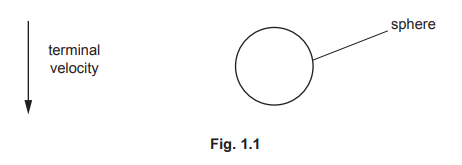
Assume that the upthrust on the sphere is negligible.
On Fig. 1.1, draw and label arrows to show the directions of the two forces acting on the sphere. (2 marks)
____________________________________________________________
(c) The mass of the sphere is \(49\,\mathrm{g}\).
Calculate the drag force \(F_{\mathrm{D}}\) acting on the sphere. (2 marks)
\(F_{\mathrm{D}}=\) ________________________________________________ \( \mathrm{N} \)
(d) The sphere is falling in air at a terminal velocity of \(25\) in SI base units. The density of the air is \(1.2\) in SI base units. The diameter of the sphere is \(0.060\) in SI base units.
Use your answer in (c) to calculate the drag coefficient \(C\) for the sphere. (3 marks)
\(C=\) ________________________________________________
Syllabus Topic Codes (Cambridge International AS & A Level Physics 9702):
• 3.1: Momentum and Newton’s laws of motion — parts (b) and (c)
• 3.2: Non-uniform motion — parts (b), (c) and (d)
▶️ Answer/Explanation
(a) Showing that the drag coefficient has no units [3 marks]
The drag force is given by:
\( F_{\mathrm{D}}=\frac{1}{2}C\rho Av^2 \)
The SI base units of force are:
\( [F_{\mathrm{D}}]=\mathrm{kg\,m\,s^{-2}} \)
The SI base units of density are:
\( [\rho]=\mathrm{kg\,m^{-3}} \)
The SI base units of area are:
\( [A]=\mathrm{m^2} \)
The SI base units of \(v^2\) are:
\( [v^2]=\mathrm{m^2\,s^{-2}} \)
Therefore:
\( \mathrm{kg\,m\,s^{-2}}=C(\mathrm{kg\,m^{-3}})(\mathrm{m^2})(\mathrm{m^2\,s^{-2}}) \)
The units on the right simplify to:
\( C\,\mathrm{kg\,m\,s^{-2}} \)
Hence \(C\) must have no units.
Answer: \( \boxed{C\text{ has no units}} \)
(b) Forces acting on the sphere [2 marks]
The sphere is falling downwards at terminal velocity. The two forces acting on it are:
• Weight, acting vertically downwards.
• Drag force, acting vertically upwards, opposing the downward motion.
Answer: Weight vertically downward and drag force \(F_{\mathrm{D}}\) vertically upward.
(c) Drag force at terminal velocity [2 marks]
At terminal velocity, the acceleration is zero, so the resultant force is zero.
Therefore, the drag force is equal in magnitude to the weight:
\( F_{\mathrm{D}}=mg \)
The mass is:
\( m=49\,\mathrm{g}=0.049\,\mathrm{kg} \)
Hence:
\( F_{\mathrm{D}}=(0.049)(9.81) \)
\( F_{\mathrm{D}}=0.481\,\mathrm{N} \)
\( F_{\mathrm{D}\approx0.48\,\mathrm{N} \)
Answer: \( \boxed{0.48\,\mathrm{N}} \)
(d) Drag coefficient \(C\) [3 marks]
The diameter of the sphere is \(0.060\,\mathrm{m}\), so its radius is:
\( r=\frac{0.060}{2}=0.030\,\mathrm{m} \)
The cross-sectional area is:
\( A=\pi r^2 \)
\( A=\pi(0.030)^2 \)
Using:
\( F_{\mathrm{D}}=\frac{1}{2}C\rho Av^2 \)
Substituting \(F_{\mathrm{D}}=0.48\,\mathrm{N}\), \(\rho=1.2\,\mathrm{kg\,m^{-3}}\), \(A=\pi(0.030)^2\) and \(v=25\,\mathrm{m\,s^{-1}}\):
\( 0.48=\frac{1}{2}C(1.2)\pi(0.030)^2(25)^2 \)
Rearranging:
\( C=\frac{0.48}{\frac{1}{2}(1.2)\pi(0.030)^2(25)^2} \)
\( C=0.453 \)
Answer: \( \boxed{C=0.45} \)
Question 2
(a) Define velocity. (1 mark)
____________________________________________________________
____________________________________________________________
(b) A student throws a ball over a vertical wall of height \(h\), as shown in Fig. 2.1.

The ball leaves the hand of the student at a height of \(1.2\,\mathrm{m}\) above the horizontal ground. The ball has an initial velocity of \(22\,\mathrm{m\,s^{-1}}\) at an angle of \(40^\circ\) to the horizontal. The wall is a horizontal distance of \(36\,\mathrm{m}\) from where the student releases the ball.
Air resistance is negligible.
(i) Determine the time taken for the ball to reach the wall. (2 marks)
time taken = ________________________________________________ \( \mathrm{s} \)
(ii) Calculate the vertical component \(u\) of the initial velocity of the ball. (1 mark)
\(u=\) ________________________________________________ \( \mathrm{m\,s^{-1}} \)
(iii) The ball just goes over the wall.
Calculate the height \(h\) of the wall. (3 marks)
\(h=\) ________________________________________________ \( \mathrm{m} \)
Syllabus Topic Codes (Cambridge International AS & A Level Physics 9702):
• 2.1: Equations of motion — parts (b)(i), (b)(ii) and (b)(iii)
▶️ Answer/Explanation
(a) Definition of velocity [1 mark]
Velocity is the rate of change of displacement.
\( v=\frac{\Delta s}{\Delta t} \)
Answer: \( \boxed{\text{rate of change of displacement}} \)
(b)(i) Time taken to reach the wall [2 marks]
The horizontal component of the initial velocity is:
\( v_x=22\cos40^\circ \)
\( v_x=16.85\,\mathrm{m\,s^{-1}} \)
There is no horizontal acceleration, so:
\( s_x=v_xt \)
Therefore:
\( t=\frac{36}{22\cos40^\circ} \)
\( t=2.14\,\mathrm{s} \)
Answer: \( \boxed{2.1\,\mathrm{s}} \)
(b)(ii) Vertical component of initial velocity [1 mark]
The vertical component is:
\( u=22\sin40^\circ \)
\( u=14.14\,\mathrm{m\,s^{-1}} \)
Answer: \( \boxed{14\,\mathrm{m\,s^{-1}}} \)
(b)(iii) Height of the wall [3 marks]
Taking upwards as positive, the vertical displacement of the ball above its release point is given by:
\( s=ut+\frac{1}{2}at^2 \)
Using \(u=14\,\mathrm{m\,s^{-1}}\), \(t=2.1\,\mathrm{s}\) and \(a=-9.81\,\mathrm{m\,s^{-2}}\):
\( s=(14)(2.1)+\frac{1}{2}(-9.81)(2.1)^2 \)
\( s=29.4-21.63 \)
\( s=7.77\,\mathrm{m} \)
The ball was initially \(1.2\,\mathrm{m}\) above the ground, so the height of the wall is:
\( h=7.77+1.2 \)
\( h=8.97\,\mathrm{m} \)
\( h\approx9.0\,\mathrm{m} \)
Answer: \( \boxed{9.0\,\mathrm{m}} \)
Question 3
(a) State the principle of conservation of momentum. (2 marks)
____________________________________________________________
____________________________________________________________
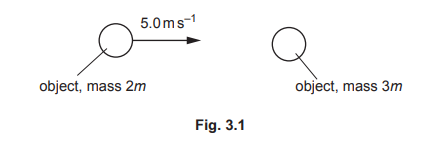
(b) An object of mass \(2m\) is travelling at a speed of \(5.0\,\mathrm{m\,s^{-1}}\) in a straight line. It collides with an object of mass \(3m\) which is initially stationary, as shown in Fig. 3.1.
After the collision, the object of mass \(2m\) moves with velocity \(v\) at an angle of \(30^\circ\) to its original direction of motion. The object of mass \(3m\) moves with velocity \(w\) also at an angle of \(30^\circ\), as shown in Fig. 3.2.
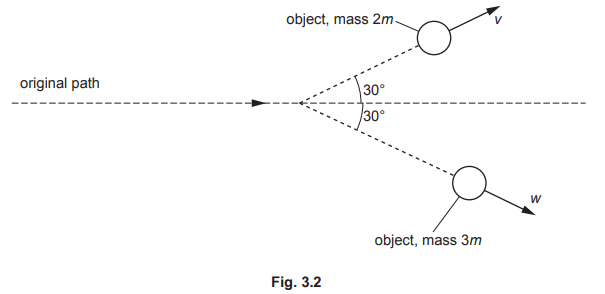
By considering the conservation of momentum in two dimensions, calculate the magnitudes of \(v\) and \(w\). (4 marks)
\(v=\) ________________________________________________ \( \mathrm{m\,s^{-1}} \)
\(w=\) ________________________________________________ \( \mathrm{m\,s^{-1}} \)
(c) An object of mass \(4.2\,\mathrm{kg}\) is travelling in a straight line at a speed of \(6.0\,\mathrm{m\,s^{-1}}\). The object is brought to rest in a distance of \(0.050\,\mathrm{m}\) by a constant force.
Calculate the magnitude of this force. (3 marks)
force = ________________________________________________ \( \mathrm{N} \)
Syllabus Topic Codes (Cambridge International AS & A Level Physics 9702):
• 5.2: Gravitational potential energy and kinetic energy — part (c)
▶️ Answer/Explanation
(a) Principle of conservation of momentum [2 marks]
For an isolated system, where there is no resultant external force, the total momentum remains constant.
Therefore:
\( \text{total momentum before}=\text{total momentum after} \)
Answer: The total momentum of an isolated system remains constant.
(b) Conservation of momentum in two dimensions [4 marks]
The initial momentum is entirely in the horizontal direction:
\( p_{\mathrm{initial}}=(2m)(5.0)=10m \)
Horizontal direction:
The horizontal components of the final momenta must equal the initial momentum:
\( 10m=2mv\cos30^\circ+3mw\cos30^\circ \)
Dividing by \(m\):
\( 10=2v\cos30^\circ+3w\cos30^\circ \)
Vertical direction:
The initial vertical momentum is zero. Therefore, the upward and downward components of momentum must cancel:
\( 2mv\sin30^\circ=3mw\sin30^\circ \)
Hence:
\( 2v=3w \)
\( v=\frac{3w}{2} \)
Substituting into the horizontal equation:
\( 10=2\left(\frac{3w}{2}\right)\cos30^\circ+3w\cos30^\circ \)
\( 10=6w\cos30^\circ \)
\( w=1.92\,\mathrm{m\,s^{-1}} \)
Therefore:
\( v=\frac{3}{2}(1.92) \)
\( v=2.88\,\mathrm{m\,s^{-1}} \)
To two significant figures:
\( v=2.9\,\mathrm{m\,s^{-1}} \)
\( w=1.9\,\mathrm{m\,s^{-1}} \)
Answers: \( \boxed{v=2.9\,\mathrm{m\,s^{-1}}} \), \( \boxed{w=1.9\,\mathrm{m\,s^{-1}}} \)
(c) Magnitude of the stopping force [3 marks]
The initial kinetic energy of the object is:
\( E_{\mathrm{K}}=\frac{1}{2}mv^2 \)
\( E_{\mathrm{K}}=\frac{1}{2}(4.2)(6.0)^2 \)
\( E_{\mathrm{K}}=75.6\,\mathrm{J} \)
The object is brought to rest, so the work done by the stopping force is equal to the initial kinetic energy:
\( W=Fs \)
Therefore:
\( F=\frac{W}{s} \)
\( F=\frac{75.6}{0.050} \)
\( F=1512\,\mathrm{N} \)
To two significant figures:
Answer: \( \boxed{1.5\times10^3\,\mathrm{N}} \)
Question 4
(a) Define strain. (1 mark)
____________________________________________________________
(b) A copper wire of length \(4.0\,\mathrm{m}\) has a uniform cross-sectional area of \(4.5\times10^{-7}\,\mathrm{m^2}\). A tensile force of \(18\,\mathrm{N}\) is applied to the wire. This causes the wire to extend by \(1.4\,\mathrm{mm}\) up to its limit of proportionality.
(i) Calculate the Young modulus of the wire. (3 marks)
Young modulus = ________________________________________________ \( \mathrm{Pa} \)
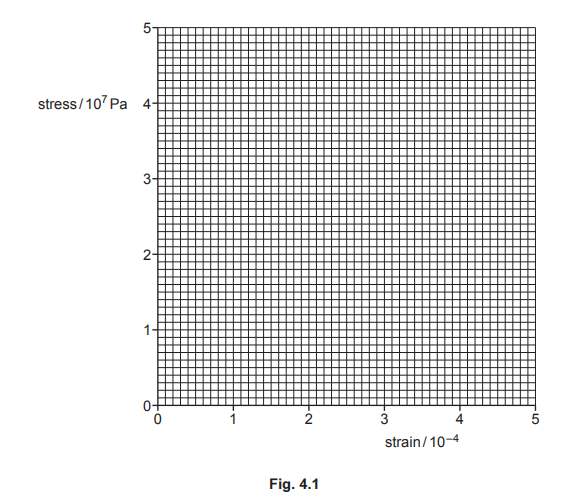
(ii) On Fig. 4.1, draw a line to show how the stress varies with the strain for the wire up to its limit of proportionality.(2 marks)
(c) A second copper wire has the same length as the wire in (b) but a larger diameter. Both wires are subjected to a tensile force of \(18\,\mathrm{N}\).
By placing a tick (✓) in each row, complete Table 4.1 to compare the stress and strain of the two wires. (2 marks)

Syllabus Topic Codes (Cambridge International AS & A Level Physics 9702):
▶️ Answer/Explanation
(a) Definition of strain [1 mark]
Strain is the ratio of the extension of a material to its original length.
\( \mathrm{strain}=\frac{\mathrm{extension}}{\mathrm{original\ length}} \)
Answer: \( \boxed{\frac{\mathrm{extension}}{\mathrm{original\ length}}} \)
(b)(i) Young modulus of the wire [3 marks]
Young modulus is defined as:
\( E=\frac{\mathrm{stress}}{\mathrm{strain}} \)
The stress is:
\( \mathrm{stress}=\frac{F}{A} \)
\( \mathrm{stress}=\frac{18}{4.5\times10^{-7}} \)
\( \mathrm{stress}=4.0\times10^7\,\mathrm{Pa} \)
The extension is \(1.4\,\mathrm{mm}=1.4\times10^{-3}\,\mathrm{m}\).
Therefore, the strain is:
\( \mathrm{strain}=\frac{1.4\times10^{-3}}{4.0} \)
\( \mathrm{strain}=3.5\times10^{-4} \)
Hence:
\( E=\frac{4.0\times10^7}{3.5\times10^{-4}} \)
\( E=1.14\times10^{11}\,\mathrm{Pa} \)
To two significant figures:
Answer: \( \boxed{1.1\times10^{11}\,\mathrm{Pa}} \)
(b)(ii) Stress-strain graph [2 marks]
Up to the limit of proportionality, stress is directly proportional to strain.
Therefore, the graph should be a straight line through the origin.
The strain at the limit of proportionality is:
\( \mathrm{strain}=\frac{1.4\times10^{-3}}{4.0}=3.5\times10^{-4} \)
The stress at this point is:
\( \mathrm{stress}=4.0\times10^7\,\mathrm{Pa} \)
On the given axes, this corresponds to the point \((3.5,\,4.0)\).
Answer: Draw a straight line from the origin to the point \((3.5,4.0)\) on the graph.
(c) Comparison of stress and strain [2 marks]
The second wire has a larger diameter, so it has a larger cross-sectional area.
Since both wires experience the same force:
\( \mathrm{stress}=\frac{F}{A} \)
A larger area gives a smaller stress in the second wire.
Both wires are copper, so they have the same Young modulus. Since:
\( E=\frac{\mathrm{stress}}{\mathrm{strain}} \)
a smaller stress for the same Young modulus gives a smaller strain.
Table 4.1:
• Stress: ✓ in less in second wire
• Strain: ✓ in less in second wire
Answer: Both stress and strain are \( \boxed{\text{less in the second wire}} \).
Question 5
A stretched string PQ has length \(1.2\,\mathrm{m}\). One end of the string is attached to a vibration generator and the other end is attached to a wall, as shown in Fig. 5.1.
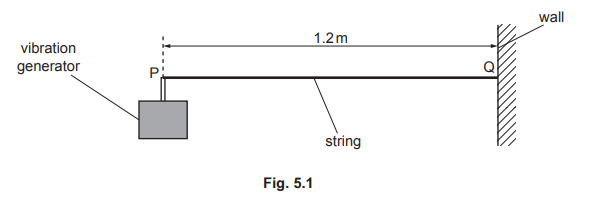
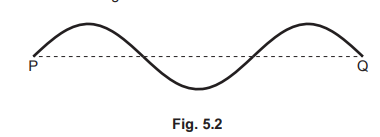
The vibration generator is switched on and a stationary wave is formed on the string. The string is shown at one instant of time in Fig. 5.2.
(a) Explain how a stationary wave is formed between the vibration generator and the wall. (2 marks)
____________________________________________________________
____________________________________________________________
____________________________________________________________
(b) Calculate the wavelength of the stationary wave shown in Fig. 5.2. (1 mark)
wavelength = ________________________________________________ \( \mathrm{m} \)
(c) Fig. 5.3 shows the stationary wave at time \(t=0\) when all points on the wave are at their maximum displacements.
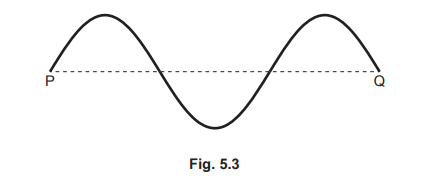
The period of the wave is \(0.16\,\mathrm{s}\).
On Fig. 5.3, sketch the shape of the stationary wave at time \(t=0.24\,\mathrm{s}\). (2 marks)
____________________________________________________________
(d) Points R and T on the string are a horizontal distance of \(0.30\,\mathrm{m}\) apart and in the positions shown in Fig. 5.4.
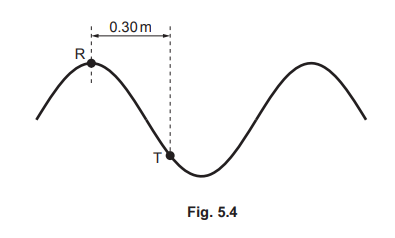
State the phase difference between the oscillations of points R and T. (1 mark)
phase difference = ________________________________________________ \( ^\circ \)
(e) Calculate the speed of the progressive waves on the stretched string. (2 marks)
speed = ________________________________________________ \( \mathrm{m\,s^{-1}} \)
Syllabus Topic Codes (Cambridge International AS & A Level Physics 9702):
▶️ Answer/Explanation
(a) Formation of a stationary wave [2 marks]
A wave travels along the string and is reflected at the fixed end or wall.
The incident and reflected waves travel in opposite directions and superpose, producing a stationary wave with nodes and antinodes.
Answer: A progressive wave is reflected at the fixed end and the incident and reflected waves superpose to form a stationary wave.
(b) Wavelength of the stationary wave [1 mark]
The string has length \(1.2\,\mathrm{m}\). From Fig. 5.2, the length contains \(1.5\) wavelengths:
\( 1.2=\frac{3}{2}\lambda \)
Therefore:
\( \lambda=\frac{2(1.2)}{3} \)
\( \lambda=0.80\,\mathrm{m} \)
Answer: \( \boxed{0.80\,\mathrm{m}} \)
(c) Shape of the stationary wave at \(t=0.24\,\mathrm{s}\) [2 marks]
The period is \(T=0.16\,\mathrm{s}\).
The time \(0.24\,\mathrm{s}\) corresponds to:
\( 0.24=1.5T \)
After \(1.5\) periods, the displacement of every point is opposite to its displacement at \(t=0\).
Therefore, the required sketch has the same wavelength and amplitude as Fig. 5.3, but is reflected in the mean-position line.
Answer: Draw the same stationary-wave shape as Fig. 5.3, inverted about the dashed mean-position line.
(d) Phase difference between R and T [1 mark]
Points in adjacent loops of a stationary wave oscillate in antiphase.
Therefore:
Answer: \( \boxed{180^\circ} \)
(e) Speed of the progressive waves [2 marks]
The wave speed is given by:
\( v=f\lambda \)
Since \(f=\frac{1}{T}\):
\( v=\frac{\lambda}{T} \)
Substituting \(\lambda=0.80\,\mathrm{m}\) and \(T=0.16\,\mathrm{s}\):
\( v=\frac{0.80}{0.16} \)
\( v=5.0\,\mathrm{m\,s^{-1}} \)
Answer: \( \boxed{5.0\,\mathrm{m\,s^{-1}}} \)
Question 6
(a) State Kirchhoff’s first law. (1 mark)
____________________________________________________________
(b) A cell with internal resistance \(r\) is connected to two resistors of resistances \(R_1\) and \(R_2\) as shown in Fig. 6.1.
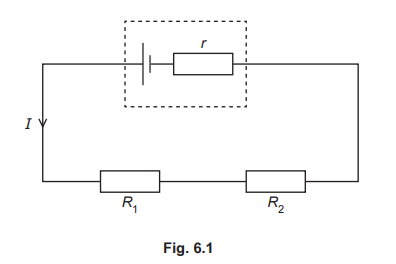
The potential differences (p.d.s) across \(R_1\) and \(R_2\) are \(V_1\) and \(V_2\) respectively. The terminal p.d. across the cell is \(V\). The current in the circuit is \(I\).
Use Kirchhoff’s laws to show that the total resistance \(R_T\) of the external circuit is given by \(R_T=R_1+R_2\) (2 marks)
(c) The electromotive force (e.m.f.) of the cell in Fig. 6.1 is \(1.50\,\mathrm{V}\). The values of \(R_1\) and \(R_2\) are \(10\,\Omega\) and \(15\,\Omega\) respectively. The terminal p.d. of the cell is \(1.35\,\mathrm{V}\).
Calculate the internal resistance \(r\) of the cell. (3 marks)
\(r=\) ________________________________________________ \( \Omega \)
(d) A resistor of resistance \(R_3\) is added to the circuit in Fig. 6.1, so that the circuit is as shown in Fig. 6.2.

State and explain the effect, if any, of this change on:
(i) the current in the cell (2 marks)
____________________________________________________________
____________________________________________________________
(ii) the terminal p.d. of the cell (2 marks)
____________________________________________________________
____________________________________________________________
Syllabus Topic Codes (Cambridge International AS & A Level Physics 9702):
▶️ Answer/Explanation
(a) Kirchhoff’s first law [1 mark]
The sum of the currents entering a junction is equal to the sum of the currents leaving the junction.
Answer: \( \boxed{\text{sum of currents entering a junction}=\text{sum of currents leaving}} \)
(b) Total resistance of the external circuit [2 marks]
Applying Kirchhoff’s second law to the circuit:
\(V=V_1+V_2\)
Using \(V=IR\):
\(IR_T=IR_1+IR_2\)
Cancelling \(I\):
\(R_T=R_1+R_2\)
Answer: \( \boxed{R_T=R_1+R_2} \)
(c) Internal resistance of the cell [3 marks]
First, calculate the total external resistance:
\(R_T=R_1+R_2\)
\(R_T=10+15=25\,\Omega\)
The terminal p.d. is \(1.35\,\mathrm{V}\), so:
\(V=IR_T\)
\(1.35=I(25)\)
\(I=0.054\,\mathrm{A}\)
For a cell with internal resistance:
\(\mathcal{E}=I(R_T+r)\)
Therefore:
\(1.50=0.054(25+r)\)
\(25+r=\frac{1.50}{0.054}\)
\(r=27.78-25\)
\(r=2.78\,\Omega\)
Answer: \( \boxed{2.8\,\Omega} \)
(d)(i) Effect on the current in the cell [2 marks]
The resistor \(R_3\) is connected in parallel with the combination of \(R_1\) and \(R_2\).
Adding a parallel branch causes the total external resistance of the circuit to decrease.
The e.m.f. of the cell is unchanged, so a decrease in total resistance causes the current in the cell to increase.
Answer: \( \boxed{\text{The current increases}} \), because the total resistance decreases.
(d)(ii) Effect on the terminal p.d. of the cell [2 marks]
The increased current produces a larger p.d. across the internal resistance:
\(V_{\mathrm{internal}}=Ir\)
Therefore, the lost volts across the internal resistance increase.
Since:
\(V_{\mathrm{terminal}}=\mathcal{E}-Ir\)
the terminal p.d. decreases.
Answer: \( \boxed{\text{The terminal p.d. decreases}} \), because the larger current causes a larger voltage drop across the internal resistance.
Question 7
Nuclei of an isotope of copper (Cu) each have 29 protons and 37 neutrons. This isotope is a \(\beta^-\) emitter.
(a) State the nuclide notation in the form \(\mathrm{^{A}_{Z}X}\) for this nucleus of copper. (1 mark)
____________________________________________________________
(b) The energy spectrum of the \(\beta^-\) radiation emitted by a sample of this isotope is shown in Fig. 7.1.

(i) Use Fig. 7.1 to explain why other particles apart from the \(\beta^-\) particles must be emitted during this decay. (3 marks)
____________________________________________________________
____________________________________________________________
____________________________________________________________
(ii) State the name of the other particle emitted during the decay of this isotope. (1 mark)
____________________________________________________________
(iii) The copper isotope decays to an isotope of zinc (Zn).
Give the radioactive decay equation for this decay. Include the nucleon and proton numbers of all the particles involved. (3 marks)
____________________________________________________________
Syllabus Topic Codes (Cambridge International AS & A Level Physics 9702):
▶️ Answer/Explanation
(a) Nuclide notation [1 mark]
The proton number is \(29\), so \(Z=29\).
The nucleon number is the total number of protons and neutrons:
\(A=29+37=66\)
Answer: \( \boxed{\mathrm{^{66}_{29}Cu}} \)
(b)(i) Explanation of the continuous energy spectrum [3 marks]
The energy released in the decay is fixed or constant.
However, the kinetic energies of the \(\beta^-\) particles have a continuous range of values, rather than one fixed value.
Therefore, another particle must carry away the remaining energy, with the amount depending on the kinetic energy of the \(\beta^-\) particle.
Answer: The decay energy is fixed, but the \(\beta^-\) particles have a continuous range of kinetic energies. An additional particle must therefore carry away the remaining energy.
(b)(ii) Other particle emitted [1 mark]
In \(\beta^-\) decay, the additional particle is an electron antineutrino.
Answer: \( \boxed{\text{electron antineutrino}} \)
(b)(iii) Radioactive decay equation [3 marks]
In \(\beta^-\) decay, a neutron changes into a proton, so the nucleon number remains unchanged while the proton number increases by one.
Copper has \(Z=29\) and \(A=66\), while zinc therefore has \(Z=30\) and \(A=66\).
The complete decay equation is:
\( \mathrm{^{66}_{29}Cu\rightarrow{}^{66}_{30}Zn+{}^{0}_{-1}\beta^-+{}^{0}_{0}\overline{\nu}_e} \)
Answer: \( \boxed{\mathrm{^{66}_{29}Cu\rightarrow{}^{66}_{30}Zn+{}^{0}_{-1}\beta^-+{}^{0}_{0}\overline{\nu}_e}} \)