
Question 1
(a) The list below shows some SI quantities.
Underline the quantity that is not an SI base quantity.
charge current length time (1 mark)
(b) A square solar panel with sides of length \(1300\,\mathrm{mm}\) is shown in Fig. 1.1.
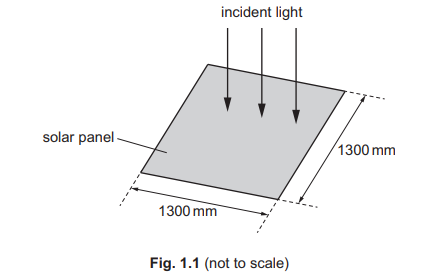
Light is incident normally on the solar panel.
(i) The power of the light incident on the solar panel is \(750\,\mathrm{W}\). Calculate the intensity of the light. (3 marks)
intensity = ________________________________________________ \( \mathrm{W\,m^{-2}} \)
(ii) The percentage uncertainty in the incident power is \(\pm3\%\). The uncertainty in the length of each side is \(\pm5\,\mathrm{mm}\). Calculate the percentage uncertainty in the intensity of the light. (2 marks)
percentage uncertainty = ________________________________________________ \( \% \)
(iii) The useful power output of the solar panel is \(160\,\mathrm{W}\). Calculate the percentage efficiency of the solar panel. (1 mark)
efficiency = ________________________________________________ \( \% \)
(iv) Another square solar panel is placed so that light of the same intensity is incident normally on it. The new panel has shorter sides than the original panel. The new panel has the same power output as the original panel.
State and explain whether the efficiency of the new panel is greater than, less than or the same as the efficiency of the original panel. (3 marks)
____________________________________________________________
Syllabus Topic Codes (Cambridge International AS & A Level Physics 9702):
• 9.2: Potential difference and power — parts (b)(i), (b)(ii), (b)(iii) and (b)(iv)
▶️ Answer/Explanation
(a) SI base quantities [1 mark]
Charge is a derived quantity, since its SI unit is the coulomb, \( \mathrm{C} \), which can be expressed in base units as \( \mathrm{A\,s} \).
Answer: \( \boxed{\text{charge}} \)
(b)(i) Intensity of the incident light [3 marks]
The intensity of radiation is given by:
\( I=\frac{P}{A} \)
The side length is:
\(1300\,\mathrm{mm}=1300\times10^{-3}\,\mathrm{m}=1.30\,\mathrm{m}\)
Since the panel is square:
\( A=(1.30)^2=1.69\,\mathrm{m^2} \)
Therefore:
\( I=\frac{750}{1.69} \)
\( I=4.44\times10^2\,\mathrm{W\,m^{-2}} \)
Answer: \( \boxed{440\,\mathrm{W\,m^{-2}}} \)
(b)(ii) Percentage uncertainty in intensity [2 marks]
Since:
\( I=\frac{P}{L^2} \)
the percentage uncertainty in \(L^2\) is twice the percentage uncertainty in \(L\).
Percentage uncertainty in the length:
\( \frac{5}{1300}\times100=0.38\% \)
Therefore:
\( \text{percentage uncertainty}=3+2(0.38) \)
\( =3.76\% \)
Answer: \( \boxed{\pm4\%} \)
(b)(iii) Percentage efficiency [1 mark]
Efficiency is:
\( \text{efficiency}=\frac{\text{useful output power}}{\text{total input power}}\times100 \)
\( \text{efficiency}=\frac{160}{750}\times100 \)
\( \text{efficiency}=21.3\% \)
Answer: \( \boxed{21\%} \)
(b)(iv) Efficiency of the new panel [3 marks]
The new panel has shorter sides, so its area is smaller.
Since the intensity of the incident light is unchanged:
\( P_{\mathrm{in}}=IA \)
A smaller area therefore gives a smaller input power.
The useful output power is unchanged, so:
\( \text{efficiency}=\frac{P_{\mathrm{out}}}{P_{\mathrm{in}}}\times100 \)
With the same output power but a smaller input power, the efficiency is greater.
Answer: \( \boxed{\text{The efficiency is greater}} \), because the smaller panel receives less input power at the same intensity while its useful output power remains unchanged.
Question 2
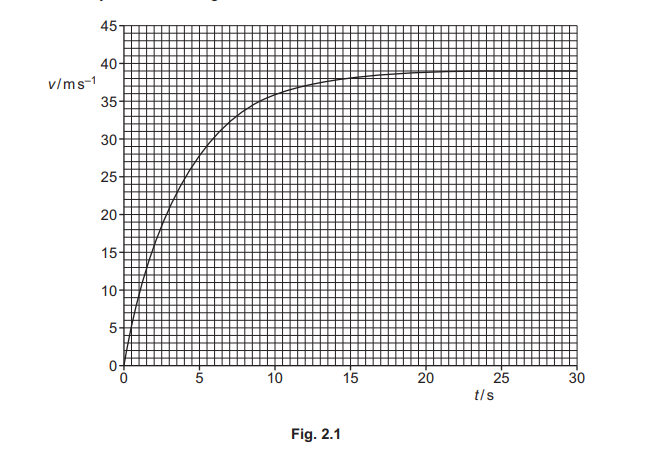
A skydiver jumps from an aircraft at time \(t=0\) and falls vertically downwards. The variation with \(t\) of her velocity \(v\) is shown in Fig. 2.1.
(a)
(i) Using Fig. 2.1, state the terminal velocity of the skydiver. (1 mark)
terminal velocity = ________________________________________________ \( \mathrm{m\,s^{-1}} \)
(ii) By drawing a suitable line on Fig. 2.1, determine the acceleration of the skydiver at time \(t=9.0\,\mathrm{s}\). (2 marks)
acceleration = ________________________________________________ \( \mathrm{m\,s^{-2}} \)
(b) The mass of the skydiver and her equipment is \(68\,\mathrm{kg}\). The upthrust on the skydiver is negligible.
After reaching terminal velocity, the skydiver opens her parachute at time \(t_1\). A total drag force of \(1800\,\mathrm{N}\) acts on the skydiver.
Determine the magnitude and direction of the acceleration of the skydiver at time \(t_1\). (3 marks)
acceleration = ________________________________________________ \( \mathrm{m\,s^{-2}} \)
direction = ________________________________________________
(c) The parachute is fully open at time \(t_2\). At a later time \(t_3\) the skydiver reaches a constant velocity of \(5.7\,\mathrm{m\,s^{-1}}\).
(i) Describe and explain the variation with time of the magnitude of her acceleration between time \(t_2\) and time \(t_3\). (2 marks)
____________________________________________________________
____________________________________________________________
____________________________________________________________
(ii) Calculate the change in momentum of the skydiver between time \(t_1\) and time \(t_3\). (2 marks)
change in momentum = ________________________________________________ \( \mathrm{N\,s} \)
Syllabus Topic Codes (Cambridge International AS & A Level Physics 9702):
• 3.1: Momentum and Newton’s laws of motion — part (b)
• 3.3: Linear momentum and its conservation — part (c)(ii)
▶️ Answer/Explanation
(a)(i) Terminal velocity [1 mark]
Terminal velocity is the constant velocity reached when the resultant force on the skydiver is zero.
From Fig. 2.1, the velocity approaches approximately \(39\,\mathrm{m\,s^{-1}}\).
Answer: \( \boxed{39\,\mathrm{m\,s^{-1}}} \)
(a)(ii) Acceleration at \(t=9.0\,\mathrm{s}\) [2 marks]
Acceleration is the gradient of a velocity-time graph:
\( a=\frac{\Delta v}{\Delta t} \)
A tangent is drawn to the curve at \(t=9.0\,\mathrm{s}\).
Using two suitable points on the tangent gives a gradient of approximately:
\( a\approx2.5\,\mathrm{m\,s^{-2}} \)
Answer: \( \boxed{2.5\,\mathrm{m\,s^{-2}}} \)
(b) Acceleration when the parachute opens [3 marks]
The weight of the skydiver is:
\( W=mg \)
\( W=68\times9.81 \)
\( W=667\,\mathrm{N} \)
The drag force is \(1800\,\mathrm{N}\) upwards, while the weight acts downwards.
Therefore, the resultant force is:
\( F=1800-667 \)
\( F=1133\,\mathrm{N} \)
Using \(F=ma\):
\( a=\frac{1133}{68} \)
\( a=16.7\,\mathrm{m\,s^{-2}} \)
The resultant force is upwards, so the acceleration is upwards.
Answer: \( \boxed{17\,\mathrm{m\,s^{-2}}} \) upwards
(c)(i) Variation of acceleration [2 marks]
Between \(t_2\) and \(t_3\), the magnitude of the acceleration decreases and eventually becomes zero.
As the skydiver’s speed decreases, the drag force decreases. Therefore, the resultant upward force decreases until the drag force balances the weight at \(t_3\).
Answer: The acceleration decreases to zero because the drag force decreases as the skydiver’s speed decreases, until the forces become balanced.
(c)(ii) Change in momentum [2 marks]
The velocity at \(t_1\) is the terminal velocity:
\( v_1=39\,\mathrm{m\,s^{-1}} \)
The velocity at \(t_3\) is:
\( v_3=5.7\,\mathrm{m\,s^{-1}} \)
Taking downward as positive:
\( \Delta p=m(v_3-v_1) \)
\( \Delta p=68(5.7-39) \)
\( \Delta p=-2264\,\mathrm{N\,s} \)
The negative sign indicates that the change in momentum is upwards.
Answer: \( \boxed{2.3\times10^3\,\mathrm{N\,s}} \) upwards
Question 3
Lightning occurs when charge builds up in the atmosphere, creating a potential difference between the ground and the atmosphere.
During a lightning strike there is an average current of \(3.3\times10^{4}\,\mathrm{A}\) for a time of \(2.6\times10^{-5}\,\mathrm{s}\).
(a) Calculate the charge transferred during the lightning strike. (2 marks)
charge = ________________________________________________ \( \mathrm{C} \)
(b) The potential difference between the ground and the atmosphere is \(3.0\times10^{7}\,\mathrm{V}\).
Calculate the average power, in GW, transferred during the lightning strike. (2 marks)
power = ________________________________________________ \( \mathrm{GW} \)
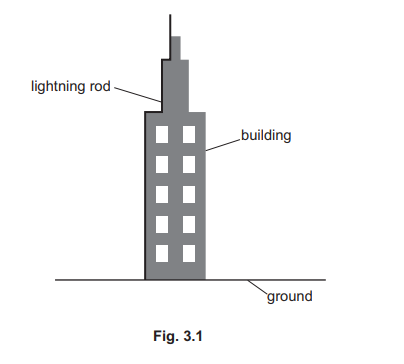
(c) A lightning rod is attached to a tall building to conduct charge safely to the ground. The lightning rod is modelled as a uniform cylindrical copper cable of total length \(95\,\mathrm{m}\) that runs from the ground to the top of the building, as shown in Fig. 3.1.
(i) The resistance of the lightning rod is \(9.6\,\Omega\). The resistivity of copper is \(1.7\times10^{-8}\,\Omega\,\mathrm{m}\).
Determine the radius of the lightning rod. (3 marks)
radius = ________________________________________________ \( \mathrm{m} \)
(ii) The radius of the copper lightning rod is doubled with no change to its length.
State the effect of this change on the resistance of the lightning rod. (1 mark)
____________________________________________________________
(d) A section of the lightning rod of length \(0.12\,\mathrm{m}\) is removed for testing. A tensile stress of \(1.9\times10^{6}\,\mathrm{Pa}\) is applied, as shown in Fig. 3.2.
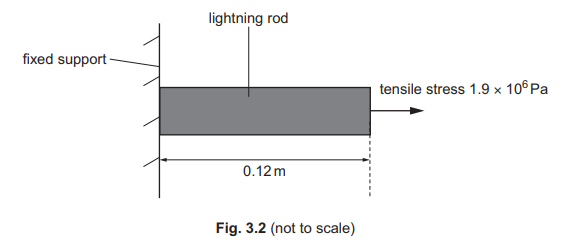
The section of the rod obeys Hooke’s law. The Young modulus of copper is \(1.3\times10^{11}\,\mathrm{Pa}\).
Calculate the extension of the section. (3 marks)
extension = ________________________________________________ \( \mathrm{m} \)
Syllabus Topic Codes (Cambridge International AS & A Level Physics 9702):
• 6.1: Resistance and resistivity — parts (c)(i) and (c)(ii)
• 6.1: Deformation of solids — part (d)
▶️ Answer/Explanation
(a) Charge transferred [2 marks]
The charge transferred is given by:
\( Q=It \)
\( Q=(3.3\times10^{4})(2.6\times10^{-5}) \)
\( Q=0.858\,\mathrm{C} \)
Answer: \( \boxed{0.86\,\mathrm{C}} \)
(b) Average power transferred [2 marks]
Electrical power is given by:
\( P=VI \)
\( P=(3.0\times10^{7})(3.3\times10^{4}) \)
\( P=9.9\times10^{11}\,\mathrm{W} \)
Since \(1\,\mathrm{GW}=10^{9}\,\mathrm{W}\):
\( P=\frac{9.9\times10^{11}}{10^{9}} \)
Answer: \( \boxed{990\,\mathrm{GW}} \)
(c)(i) Radius of the lightning rod [3 marks]
For a cylindrical conductor:
\( R=\frac{\rho L}{A} \)
The cross-sectional area is:
\( A=\pi r^2 \)
Therefore:
\( 9.6=\frac{(1.7\times10^{-8})(95)}{\pi r^2} \)
Rearranging:
\( r=\sqrt{\frac{(1.7\times10^{-8})(95)}{9.6\pi}} \)
\( r=2.3\times10^{-4}\,\mathrm{m} \)
Answer: \( \boxed{2.3\times10^{-4}\,\mathrm{m}} \)
(c)(ii) Effect of doubling the radius [1 mark]
Since:
\( R=\frac{\rho L}{\pi r^2} \)
Resistance is inversely proportional to the square of the radius:
\( R\propto\frac{1}{r^2} \)
If the radius is doubled, the cross-sectional area becomes four times larger. Therefore, the resistance decreases by a factor of four.
Answer: \( \boxed{\text{Resistance decreases by a factor of 4.}} \)
(d) Extension of the section [3 marks]
Young modulus is defined by:
\( E=\frac{\sigma}{\varepsilon} \)
Therefore:
\( \varepsilon=\frac{\sigma}{E} \)
Using \( \varepsilon=\frac{x}{L} \):
\( x=\frac{\sigma L}{E} \)
\( x=\frac{(1.9\times10^{6})(0.12)}{1.3\times10^{11}} \)
\( x=1.75\times10^{-6}\,\mathrm{m} \)
Answer: \( \boxed{1.8\times10^{-6}\,\mathrm{m}} \)
Question 4
A pinball machine uses a spring to launch a small metal ball of mass \(4.5\times10^{-2}\,\mathrm{kg}\) up a ramp. The spring is compressed by \(8.0\times10^{-2}\,\mathrm{m}\) and held in equilibrium, as shown in Fig. 4.1.
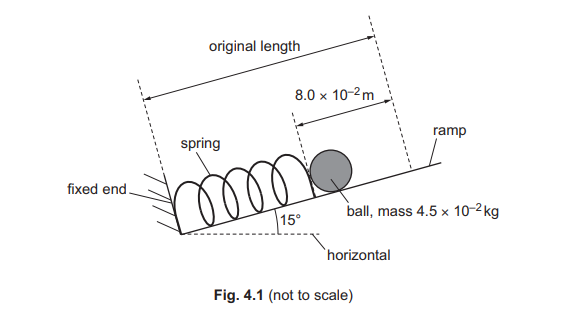
The ramp is at an angle of \(15^\circ\) to the horizontal.
(a) The spring obeys Hooke’s law and has a spring constant of \(29\,\mathrm{N\,m^{-1}}\). Calculate the elastic potential energy in the compressed spring. (2 marks)
elastic potential energy = ________________________________________________ \( \mathrm{J} \)
(b) The spring is released and expands quickly back to its original length.
(i) Calculate the increase in gravitational potential energy of the ball when the spring returns to its original length. (3 marks)
increase in gravitational potential energy = ________________________________________________ \( \mathrm{J} \)
(ii) The ball leaves the spring when the spring reaches its original length. Assume that all the elastic potential energy of the spring is transferred to the ball.
Calculate the speed of the ball as it leaves the spring. (3 marks)
speed = ________________________________________________ \( \mathrm{m\,s^{-1}} \)
(c) The ball comes to rest on a horizontal trapdoor of negligible mass at a distance \(d\) from its pivot. A force \(F\) acts vertically downwards at a distance of \(2.0\,\mathrm{cm}\) from the pivot, as shown in Fig. 4.2.
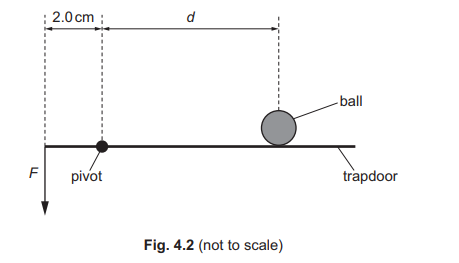
(i) The trapdoor is in equilibrium when \(F\) is \(1.7\,\mathrm{N}\). Calculate \(d\). (2 marks)
\(d=\) ________________________________________________ \( \mathrm{m} \)
(ii) Force \(F\) is decreased from \(1.7\,\mathrm{N}\).
State the direction of the resultant moment about the pivot on the trapdoor. (1 mark)
____________________________________________________________
Syllabus Topic Codes (Cambridge International AS & A Level Physics 9702):
• 4.1: Forces and moments — parts (c)(i) and (c)(ii)
▶️ Answer/Explanation
(a) Elastic potential energy [2 marks]
The elastic potential energy stored in a spring is:
\( E_{\mathrm{P}}=\frac{1}{2}kx^2 \)
\( E_{\mathrm{P}}=\frac{1}{2}(29)(8.0\times10^{-2})^2 \)
\( E_{\mathrm{P}}=9.28\times10^{-2}\,\mathrm{J} \)
Answer: \( \boxed{0.093\,\mathrm{J}} \)
(b)(i) Increase in gravitational potential energy [3 marks]
When the spring expands by \(8.0\times10^{-2}\,\mathrm{m}\) along a ramp inclined at \(15^\circ\), the vertical increase in height is:
\( \Delta h=(8.0\times10^{-2})\sin15^\circ \)
\( \Delta h=2.07\times10^{-2}\,\mathrm{m} \)
The increase in gravitational potential energy is:
\( \Delta E_{\mathrm{P}}=mg\Delta h \)
\( \Delta E_{\mathrm{P}}=(4.5\times10^{-2})(9.81)(2.07\times10^{-2}) \)
\( \Delta E_{\mathrm{P}}=9.14\times10^{-3}\,\mathrm{J} \)
Answer: \( \boxed{9.1\times10^{-3}\,\mathrm{J}} \)
(b)(ii) Speed of the ball [3 marks]
The elastic potential energy is transferred into gravitational potential energy and kinetic energy:
\( E_{\mathrm{elastic}}=\Delta E_{\mathrm{P}}+E_{\mathrm{K}} \)
Therefore:
\( E_{\mathrm{K}}=0.0928-0.00914 \)
\( E_{\mathrm{K}}=0.0837\,\mathrm{J} \)
Using \(E_{\mathrm{K}}=\frac{1}{2}mv^2\):
\( \frac{1}{2}(4.5\times10^{-2})v^2=0.0837 \)
\( v=\sqrt{\frac{2(0.0837)}{4.5\times10^{-2}}} \)
\( v=1.93\,\mathrm{m\,s^{-1}} \)
Answer: \( \boxed{1.9\,\mathrm{m\,s^{-1}}} \)
(c)(i) Distance \(d\) [2 marks]
The ball is in equilibrium, so the clockwise and anticlockwise moments about the pivot are equal.
The downward force \(F\) produces an anticlockwise moment, while the weight of the ball produces a clockwise moment.
\( F(0.020)=mgd \)
\( 1.7(0.020)=(4.5\times10^{-2})(9.81)d \)
\( d=\frac{1.7(0.020)}{(4.5\times10^{-2})(9.81)} \)
\( d=7.70\times10^{-2}\,\mathrm{m} \)
Answer: \( \boxed{7.7\times10^{-2}\,\mathrm{m}} \)
(c)(ii) Direction of resultant moment [1 mark]
When \(F\) is decreased, its anticlockwise moment becomes smaller, while the clockwise moment due to the weight of the ball remains unchanged.
Therefore, the resultant moment is clockwise.
Answer: \( \boxed{\text{clockwise}} \)
Question 5
(a) State Kirchhoff’s second law. (1 mark)
________________________________________
(b) A battery of electromotive force (e.m.f.) 9.0 V and negligible internal resistance is connected in series with a variable resistor X and a thermistor Y as shown in Fig. 5.1.
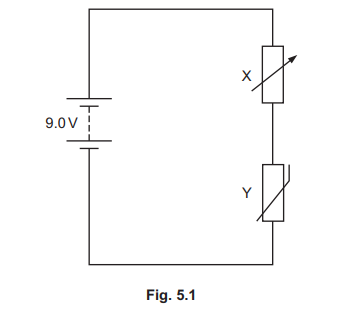
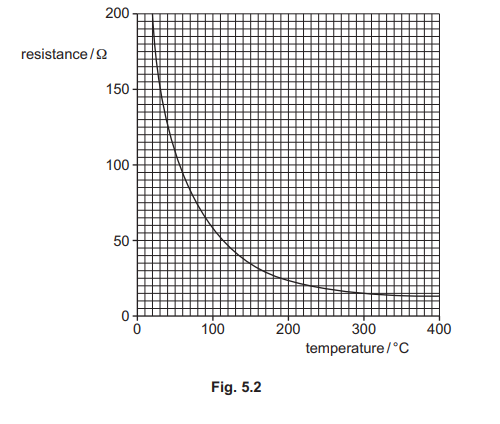
Fig. 5.2 shows the relationship between temperature and resistance for the thermistor.
(i) The current in the circuit is \(1.1\times10^{-2}\,\mathrm{A}\). The potential difference across Y is 4.0 V. Calculate the resistance of X. (2 marks)
resistance = ______________________________ \( \Omega \)
(ii) The temperature of Y is changed to 190 °C. The resistance of X remains unchanged. Determine the new potential difference across Y. (3 marks)
potential difference = ______________________________ \( \mathrm{V} \)
(iii) The resistance of X is increased. The temperature of Y remains at 190 °C. By reference to the current in the circuit, state and explain the effect of this change, if any, on the potential difference across Y. (3 marks)
____________________________________________________________
____________________________________________________________
____________________________________________________________
____________________________________________________________
Syllabus Topic Codes (Cambridge International AS & A Level Physics 9702):
▶️ Answer/Explanation
(a) Kirchhoff’s second law [1 mark]
Kirchhoff’s second law states that the sum of the electromotive forces is equal to the sum of the potential differences around a closed loop.
Answer: \( \boxed{\text{sum of e.m.f.s = sum of p.d.s around a closed loop}} \)
(b)(i) Resistance of X [2 marks]
The total potential difference across the two series components is 9.0 V. The potential difference across Y is 4.0 V, so the potential difference across X is
\( V_X=9.0-4.0=5.0\,\mathrm{V} \)
Using \( R=\frac{V}{I} \):
\( R_X=\frac{5.0}{1.1\times10^{-2}} \)
\( R_X=4.55\times10^2\,\Omega \)
Answer: \( \boxed{450\,\Omega} \)
(b)(ii) New potential difference across Y [3 marks]
From the resistance-temperature graph, when the temperature is 190 °C, the resistance of thermistor Y is approximately
\( R_Y=25\,\Omega \)
The resistance of X remains \(450\,\Omega\). Therefore, the total resistance is
\( R_{\mathrm{total}}=450+25=475\,\Omega \)
The current in the circuit is
\( I=\frac{E}{R_{\mathrm{total}}}=\frac{9.0}{475} \)
\( I=1.89\times10^{-2}\,\mathrm{A} \)
The potential difference across Y is
\( V_Y=IR_Y \)
\( V_Y=(1.89\times10^{-2})(25) \)
\( V_Y=0.47\,\mathrm{V} \)
Answer: \( \boxed{0.47\,\mathrm{V}} \)
(b)(iii) Effect of increasing the resistance of X [3 marks]
The resistance of X is increased while the resistance of Y remains constant because its temperature remains at 190 °C.
Therefore, the total resistance of the series circuit increases.
From \( I=\frac{E}{R_{\mathrm{total}}} \), an increase in total resistance causes the current in the circuit to decrease.
Since the resistance of Y remains constant, using \( V_Y=IR_Y \), the decrease in current causes the potential difference across Y to decrease.
Answer: \( \boxed{\text{The potential difference across Y decreases.}} \)
Question 6
Light of a single frequency is incident normally on a diffraction grating. An interference pattern of bright and dark fringes forms on the semicircular screen shown in Fig. 6.1.
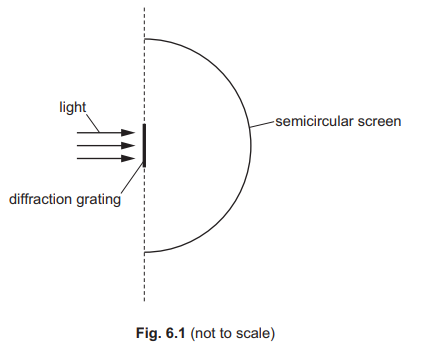
The light has wavelength 520 nm. The separation of the lines in the grating is \(3.8\times10^{-6}\,\mathrm{m}\).
(a) Determine the total number of bright fringes formed on the screen. (3 marks)
number of bright fringes = ______________________________
(b) The light is replaced with red light of a single frequency.
(i) State whether the frequency of the red light is greater than, less than or the same as the frequency of the original light. (1 mark)
________________________________________
(ii) State and explain the effect of this change on the number of bright fringes formed on the screen. A calculation is not required. (2 marks)
____________________________________________________________
____________________________________________________________
____________________________________________________________
Syllabus Topic Codes (Cambridge International AS & A Level Physics 9702):
▶️ Answer/Explanation
(a) Total number of bright fringes [3 marks]
For a diffraction grating, the condition for a bright fringe is
\( n\lambda=d\sin\theta \)
The greatest possible order occurs when \( \sin\theta=1 \), so
\( n_{\mathrm{max}}=\frac{d}{\lambda} \)
\( n_{\mathrm{max}}=\frac{3.8\times10^{-6}}{520\times10^{-9}} \)
\( n_{\mathrm{max}}=7.3 \)
Since the order must be an integer, the highest observable order is \( n=7 \).
There are seven bright fringes on each side of the central bright fringe, plus the central bright fringe itself.
\( N=2(7)+1 \)
\( N=15 \)
Answer: \( \boxed{15} \)
(b)(i) Frequency of the red light [1 mark]
Red light has a longer wavelength than the original light. Since the wave speed in air is approximately constant and
\( c=f\lambda \)
a longer wavelength corresponds to a lower frequency.
Answer: \( \boxed{\text{less than the frequency of the original light}} \)
(b)(ii) Effect on the number of bright fringes [2 marks]
Red light has a longer wavelength than the original light.
From \( n\lambda=d\sin\theta \), increasing \( \lambda \) decreases the maximum possible value of \( n \), since \( d \) remains unchanged.
Therefore, fewer orders can occur and hence fewer bright fringes are formed.
Answer: \( \boxed{\text{Fewer bright fringes are formed because red light has a longer wavelength.}} \)
Question 7
A particle Q and a particle R are each composed of one quark and one antiquark.
(a) State the name of the class (group) of particles that includes Q and R. (1 mark)
________________________________________
(b) Q has a charge of \(-1e\), where \(e\) is the elementary charge. R has a charge of 0.
Complete Table 7.1 to show a possible second quark in each of Q and R. (2 marks)
| charge | first quark | second quark | |
|---|---|---|---|
| Q | \(-1e\) | strange | ________________ |
| R | 0 | anti-up | ________________ |
Syllabus Topic Codes (Cambridge International AS & A Level Physics 9702):
▶️ Answer/Explanation
(a) Class of particles [1 mark]
A particle composed of one quark and one antiquark is a meson. Mesons are also members of the hadron group.
Answer: \( \boxed{\text{meson}} \)
(b) Possible second quarks [2 marks]
For Q, the first quark is strange, with charge \(-\frac{1}{3}e\). To obtain a total charge of \(-1e\), a possible second quark is an anti-up quark, with charge \(-\frac{2}{3}e\).
\( -\frac{1}{3}e-\frac{2}{3}e=-1e \)
For R, the first quark is anti-up, with charge \(-\frac{2}{3}e\). To obtain a total charge of 0, a possible second quark is an up quark, with charge \(+\frac{2}{3}e\).
\( -\frac{2}{3}e+\frac{2}{3}e=0 \)
Answer:
| Particle | Second quark |
|---|---|
| Q | anti-up |
| R | up |
Other valid possibilities for Q include anti-charm or anti-top, and other valid possibilities for R include charm or top.