
Question 1
The drag force \(F_{\mathrm{D}}\) acting on a sphere falling through a liquid is given by
\(F_{\mathrm{D}}=6\pi\eta rv\)
where \(r\) is the radius of the sphere,
\(v\) is the speed of the sphere in the liquid and
\(\eta\) is a property of the liquid called the viscosity.
(a) Show that the SI base units of viscosity are \( \mathrm{kg\,m^{-1}\,s^{-1}} \). [2 marks]
(b) The sphere has a radius of \(3.0\,\mathrm{cm}\) and is falling vertically downwards at a terminal velocity of \(2.0\,\mathrm{m\,s^{-1}}\) through the liquid. The drag force acting on the sphere is \(0.096\,\mathrm{N}\).
Calculate the viscosity of the liquid.
viscosity = ____________________ \( \mathrm{kg\,m^{-1}\,s^{-1}} \) [2 marks]
(c) The sphere is shown in Fig. 1.1.
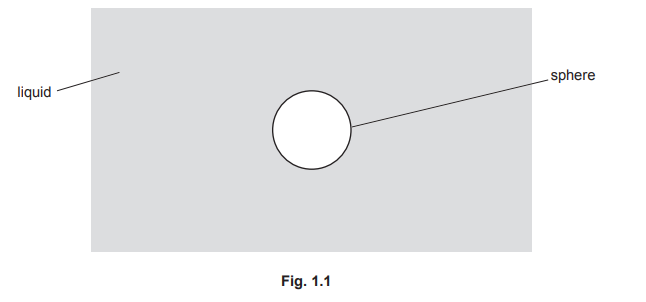
On Fig. 1.1, draw and label arrows to represent the directions of the three forces acting on the sphere as it falls at terminal velocity through the liquid. [2 marks]
(d)(i) The density of the liquid is \(920\,\mathrm{kg\,m^{-3}}\).
Show that the upthrust acting on the sphere is \(1.0\,\mathrm{N}\). [2 marks]
(ii) Calculate the mass of the sphere.
mass = ____________________ \( \mathrm{kg} \) [2 marks]
Syllabus Topic Codes (Cambridge International AS & A Level Physics 9702):
• 3.2: Non-uniform motion — part (b), terminal velocity
• 4.2: Equilibrium of forces — parts (c) and (d)(ii)
• 4.3: Density and pressure — part (d)(i)
▶️ Answer/Explanation
(a) SI base units of viscosity [2 marks]
From
\(F_{\mathrm{D}}=6\pi\eta rv\)
The SI base units of force are
\(\mathrm{kg\,m\,s^{-2}}\)
The SI base units of \(r\) are \(\mathrm{m}\), and the SI base units of \(v\) are \(\mathrm{m\,s^{-1}}\).
Therefore,
\(\mathrm{units\ of\ }\eta=\frac{\mathrm{kg\,m\,s^{-2}}}{\mathrm{m}\times\mathrm{m\,s^{-1}}}\)
\(\mathrm{units\ of\ }\eta=\mathrm{kg\,m^{-1}\,s^{-1}}\)
Answer: \(\boxed{\mathrm{kg\,m^{-1}\,s^{-1}}}\)
(b) Viscosity of the liquid [2 marks]
Rearranging \(F_{\mathrm{D}}=6\pi\eta rv\):
\(\eta=\frac{F_{\mathrm{D}}}{6\pi rv}\)
Convert the radius to metres:
\(r=3.0\,\mathrm{cm}=0.030\,\mathrm{m}\)
Substituting the values:
\(\eta=\frac{0.096}{6\pi(0.030)(2.0)}\)
\(\eta=0.0849\,\mathrm{kg\,m^{-1}\,s^{-1}}\)
Answer: \(\boxed{0.085\,\mathrm{kg\,m^{-1}\,s^{-1}}}\)
(c) Forces acting on the sphere at terminal velocity [2 marks]
At terminal velocity, the sphere moves at constant velocity, so the resultant force is zero.
The three forces are:
• Weight \(W\), acting vertically downwards.
• Upthrust \(U\), acting vertically upwards.
• Drag force \(F_{\mathrm{D}}\), acting vertically upwards because the sphere is moving downwards.
Answer: One downward arrow labelled weight \(W\), and two upward arrows labelled upthrust \(U\) and drag force \(F_{\mathrm{D}}\).
(d)(i) Upthrust on the sphere [2 marks]
The volume of the sphere is
\(V=\frac{4}{3}\pi r^3\)
The upthrust is given by
\(U=\rho Vg\)
Using \(\rho=920\,\mathrm{kg\,m^{-3}}\), \(r=0.030\,\mathrm{m}\) and \(g=9.81\,\mathrm{m\,s^{-2}}\):
\(U=920\times\frac{4}{3}\pi(0.030)^3\times9.81\)
\(U=1.03\,\mathrm{N}\)
To the appropriate number of significant figures,
Answer: \(\boxed{1.0\,\mathrm{N}}\)
(d)(ii) Mass of the sphere [2 marks]
Since the sphere is falling at terminal velocity, the forces are in equilibrium.
Therefore,
\(W=U+F_{\mathrm{D}}\)
\(W=1.0+0.096\)
\(W=1.096\,\mathrm{N}\)
Since \(W=mg\),
\(m=\frac{W}{g}\)
\(m=\frac{1.096}{9.81}\)
\(m=0.112\,\mathrm{kg}\)
Answer: \(\boxed{0.11\,\mathrm{kg}}\)
Question 2
(a) Define displacement from a point. [1 mark]
____________________________________________
(b) An object is projected horizontally at a speed of \(6.0\,\mathrm{m\,s^{-1}}\) from a slope, as shown in Fig. 2.1.
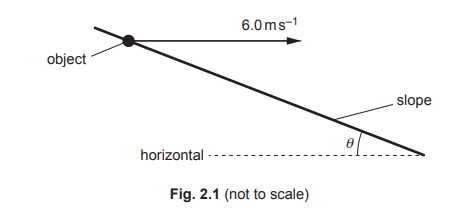
The slope is at an angle \(\theta\) to the horizontal. Air resistance is negligible.
The object lands on the slope a time of \(0.71\,\mathrm{s}\) later and stops without rolling or bouncing.
(i) Determine the horizontal distance travelled by the object. [1 mark]
distance = ____________________ \( \mathrm{m} \)
(ii) Determine the vertical distance travelled by the object. [2 marks]
distance = ____________________ \( \mathrm{m} \)
(iii) Use your answers in (b)(i) and (b)(ii) to calculate \(\theta\). [2 marks]
\(\theta\) = ____________________ \(^{\circ}\)
(iv) Determine the magnitude of the displacement of the object from its original position. [2 marks]
displacement = ____________________ \( \mathrm{m} \)
(v) By considering energy, calculate the speed of the object just before it lands. [3 marks]
speed = ____________________ \( \mathrm{m\,s^{-1}} \)
Syllabus Topic Codes (Cambridge International AS & A Level Physics 9702):
• 2.1: Equations of motion — parts (b)(i) and (b)(ii)
• 5.2: Gravitational potential energy and kinetic energy — part (b)(v)
▶️ Answer/Explanation
(a) Definition of displacement [1 mark]
Displacement is the distance from the original point in a straight line in a specified direction.
Answer: \(\boxed{\text{distance from the point in a straight line in a given direction}}\)
(b)(i) Horizontal distance travelled [1 mark]
There is no horizontal acceleration because air resistance is negligible. Therefore, the horizontal velocity remains constant.
Using
\(s=vt\)
\(s=6.0\times0.71\)
\(s=4.26\,\mathrm{m}\)
To 2 significant figures,
Answer: \(\boxed{4.3\,\mathrm{m}}\)
(b)(ii) Vertical distance travelled [2 marks]
The object is projected horizontally, so its initial vertical velocity is zero.
Using
\(s=ut+\frac{1}{2}at^2\)
\(u=0\) and \(a=g=9.81\,\mathrm{m\,s^{-2}}\).
Therefore,
\(s=\frac{1}{2}(9.81)(0.71)^2\)
\(s=2.474\,\mathrm{m}\)
To 2 significant figures,
Answer: \(\boxed{2.5\,\mathrm{m}}\)
(b)(iii) Angle of the slope [2 marks]
The horizontal and vertical distances form a right-angled triangle.
Therefore,
\(\tan\theta=\frac{\text{vertical distance}}{\text{horizontal distance}}\)
\(\tan\theta=\frac{2.5}{4.3}\)
\(\theta=\tan^{-1}\left(\frac{2.5}{4.3}\right)\)
\(\theta=30.2^{\circ}\)
Answer: \(\boxed{30^{\circ}}\)
(b)(iv) Magnitude of displacement [2 marks]
The displacement is the straight-line distance from the original position to the landing point.
Using Pythagoras’ theorem,
\(\text{displacement}=\sqrt{(4.3)^2+(2.5)^2}\)
\(\text{displacement}=\sqrt{18.49+6.25}\)
\(\text{displacement}=4.97\,\mathrm{m}\)
Answer: \(\boxed{5.0\,\mathrm{m}}\)
(b)(v) Speed just before landing [3 marks]
Consider conservation of mechanical energy. The initial kinetic energy plus the loss in gravitational potential energy equals the final kinetic energy.
\(\frac{1}{2}m(6.0)^2+mgh=\frac{1}{2}mv^2\)
The mass cancels from both sides:
\(\frac{1}{2}(6.0)^2+(9.81)(2.5)=\frac{1}{2}v^2\)
\(18+24.525=\frac{1}{2}v^2\)
\(v^2=85.05\)
\(v=9.22\,\mathrm{m\,s^{-1}}\)
Answer: \(\boxed{9.2\,\mathrm{m\,s^{-1}}}\)
Question 3
(a) State Hooke’s law. [1 mark]
___________________
(b) The variation of the applied force with the extension for a sample of a material is shown in Fig. 3.1.
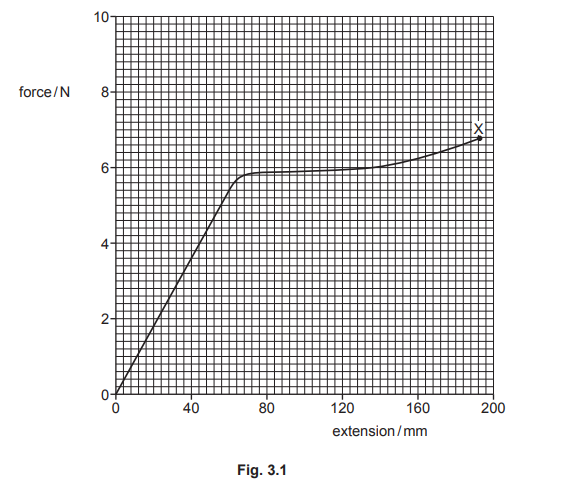
The sample behaves elastically up to an extension of \(80\,\mathrm{mm}\) and breaks at point X.
(i) On the line in Fig. 3.1, draw a cross (×) to show the limit of proportionality. Label this cross with the letter P. [1 mark]
(ii) On the line in Fig. 3.1, draw a cross (×) to show the elastic limit. Label this cross with the letter E. [1 mark]
(c) The sample in (b) has a cross-sectional area of \(0.40\,\mathrm{mm^2}\) and an initial length of \(3.2\,\mathrm{m}\).
For deformations within the limit of proportionality of the sample, determine:
(i) the spring constant of the sample. [2 marks]
spring constant = ____________________ \( \mathrm{N\,m^{-1}} \)
(ii) the Young modulus of the material from which the sample is made. [3 marks]
Young modulus = ____________________ \( \mathrm{Pa} \)
(d) Determine an estimate of the work done on the sample as it is extended from zero extension to its breaking point. Explain your reasoning. [2 marks]
work done = ____________________ \( \mathrm{J} \)
(e) A second sample of the same material has a larger cross-sectional area than the original sample but the same initial length. The two samples are each deformed within the limit of proportionality.
State and explain qualitatively how the spring constant of the second sample compares with that of the original sample.
__________________________________
Syllabus Topic Codes (Cambridge International AS & A Level Physics 9702):
• 6.1: Stress and strain — part (c)(ii)
• 5.1: Energy conservation — part (d)
▶️ Answer/Explanation
(a) Hooke’s law [1 mark]
Hooke’s law states that the extension of a material is proportional to the applied force, provided the limit of proportionality is not exceeded.
Answer: \(\boxed{\text{extension is proportional to applied force, up to the limit of proportionality}}\)
(b)(i) Limit of proportionality [1 mark]
The limit of proportionality is the point where the force-extension graph first stops being a straight line.
From the graph, this occurs at approximately \(60\,\mathrm{mm}\) extension and \(5.4\,\mathrm{N}\).
Answer: \(\boxed{P\text{ at approximately }(60\,\mathrm{mm},\,5.4\,\mathrm{N})}\)
(b)(ii) Elastic limit [1 mark]
The sample behaves elastically up to an extension of \(80\,\mathrm{mm}\). Therefore, the elastic limit is at approximately \(80\,\mathrm{mm}\) extension and \(5.9\,\mathrm{N}\).
Answer: \(\boxed{E\text{ at approximately }(80\,\mathrm{mm},\,5.9\,\mathrm{N})}\)
(c)(i) Spring constant [2 marks]
Within the limit of proportionality, the graph is a straight line. The spring constant is the gradient of the force-extension graph:
\(k=\frac{F}{x}\)
Using a point on the straight-line section, \(F=5.4\,\mathrm{N}\) and \(x=60\,\mathrm{mm}=0.060\,\mathrm{m}\):
\(k=\frac{5.4}{0.060}\)
\(k=90\,\mathrm{N\,m^{-1}}\)
Answer: \(\boxed{90\,\mathrm{N\,m^{-1}}}\)
(c)(ii) Young modulus [3 marks]
Young modulus is given by
\(E=\frac{\text{stress}}{\text{strain}}\)
Therefore,
\(E=\frac{FL}{Ax}\)
Convert the cross-sectional area to \(\mathrm{m^2}\):
\(A=0.40\,\mathrm{mm^2}=4.0\times10^{-7}\,\mathrm{m^2}\)
Using \(F=5.4\,\mathrm{N}\), \(L=3.2\,\mathrm{m}\) and \(x=0.060\,\mathrm{m}\):
\(E=\frac{(5.4)(3.2)}{(4.0\times10^{-7})(0.060)}\)
\(E=7.2\times10^8\,\mathrm{Pa}\)
Answer: \(\boxed{7.2\times10^8\,\mathrm{Pa}}\)
(d) Work done on the sample [2 marks]
The work done in stretching the sample is equal to the area under the force-extension graph.
The graph is not a simple triangle, so the area can be estimated by dividing it into strips or approximate geometric shapes.
From the graph, the estimated area is approximately \(1.0\,\mathrm{J}\).
Answer: \(\boxed{1.0\pm0.2\,\mathrm{J}}\)
(e) Spring constant of the second sample [2 marks]
For a sample within the limit of proportionality,
\(E=\frac{kL}{A}\)
Rearranging,
\(k=\frac{EA}{L}\)
The two samples have the same material, so \(E\) is the same, and they have the same initial length \(L\). The second sample has a larger cross-sectional area \(A\).
Therefore, its spring constant is greater.
Answer: \(\boxed{\text{The second sample has a greater spring constant.}}\)
A larger cross-sectional area means a greater force is required to produce the same extension, so \(k\) increases.
Question 4
A progressive transverse wave travelling from left to right is shown at an instant in time in Fig. 4.1.
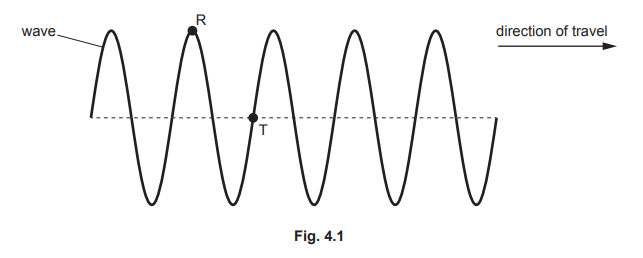
R and T are points on the wave.
(a) State the phase difference between the points R and T. [1 mark]
phase difference = ____________________ \(^{\circ}\)
(b) On Fig. 4.1, draw an arrow at point T to show the direction of movement of point T at the instant shown. [1 mark]
(c) The horizontal distance between R and T is \(0.62\,\mathrm{cm}\), as shown in Fig. 4.2.
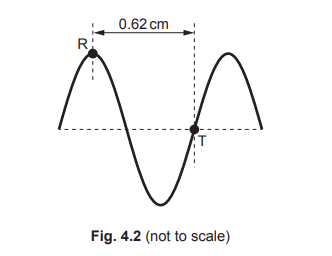
The speed of the wave is \(0.27\,\mathrm{m\,s^{-1}}\).
Calculate the frequency of the wave. [3 marks]
frequency = ____________________ \( \mathrm{Hz} \)
(d) The wave is a water wave produced by a dipper \(S_1\) attached to a vibrator in a ripple tank. An identical dipper \(S_2\) is attached to the same vibrator. The two dippers produce an interference pattern on the water in the tank, as shown in Fig. 4.3.
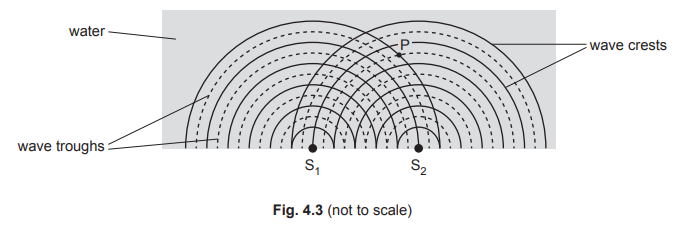
The wave crests from each source are represented by solid lines on Fig. 4.3 and the wave troughs are represented by dashed lines.
At point P in Fig. 4.3, the wave from \(S_1\) has the same amplitude \(A\) as the wave from \(S_2\).
Describe and explain the amplitude of the resultant wave at point P. [3 marks]
____________________________________________________________________________
____________________________________________________________________________
____________________________________________________________________________
Syllabus Topic Codes (Cambridge International AS & A Level Physics 9702):
• 8.3: Interference — part (d)
▶️ Answer/Explanation
(a) Phase difference between R and T [1 mark]
Point R is at a crest and point T is at a zero displacement position on the upward section of the wave.
The horizontal separation corresponds to \(\frac{3}{4}\) of a wavelength.
Therefore,
\(\text{phase difference}=\frac{3}{4}\times360^{\circ}\)
\(\text{phase difference}=270^{\circ}\)
Answer: \(\boxed{270^{\circ}}\)
(b) Direction of movement of point T [1 mark]
The wave is travelling from left to right. At point T, the wave profile has a positive gradient. For a wave travelling to the right, a point on the wave with a positive gradient is moving downwards at that instant.
Answer: \(\boxed{\text{vertically downwards}}\)
(c) Frequency of the wave [3 marks]
The wave equation is
\(v=f\lambda\)
The distance between R and T represents \(\frac{3}{4}\lambda\).
Therefore,
\(0.62\times10^{-2}=\frac{3}{4}\lambda\)
\(\lambda=\frac{0.62\times10^{-2}}{3/4}\)
\(\lambda=0.83\times10^{-2}\,\mathrm{m}\)
Using \(v=f\lambda\),
\(f=\frac{v}{\lambda}\)
\(f=\frac{0.27}{0.83\times10^{-2}}\)
\(f=32.5\,\mathrm{Hz}\)
To an appropriate number of significant figures,
Answer: \(\boxed{33\,\mathrm{Hz}}\)
(d) Resultant amplitude at P [3 marks]
The resultant displacement at P is the sum of the displacements of the waves from \(S_1\) and \(S_2\). The waves therefore superpose at P.
At P, a crest from one source coincides with a trough from the other source. The waves are therefore in antiphase, with a phase difference of \(180^{\circ}\).
The path difference is an odd number of half-wavelengths, so destructive interference occurs.
Since both waves have the same amplitude \(A\), their displacements cancel at P:
\(A-A=0\)
Therefore, the amplitude of the resultant wave is zero at P.
Answer: \(\boxed{0}\)
The waves undergo complete destructive interference at P because they are in antiphase and have equal amplitudes.
Question 5
(a)(i) State Kirchhoff’s second law. [1 mark]
____________________________________________
(ii) State the conservation law that gives rise to Kirchhoff’s second law. [1 mark]
____________________________________________
(b) A circuit contains a cell of internal resistance \(r\) and two resistors of resistances \(R_1\) and \(R_2\), as shown in Fig. 5.1.
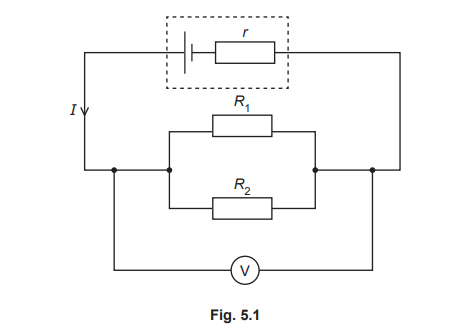
The potential difference (p.d.) across the two resistors is \(V\).
The current in the cell is \(I\).
(i) Use Kirchhoff’s laws to show that the total resistance \(R_{\mathrm{T}}\) of the external circuit is given by
\(\frac{1}{R_{\mathrm{T}}}=\frac{1}{R_1}+\frac{1}{R_2}\) [2 marks]
(ii) The electromotive force (e.m.f.) of the cell is \(1.50\,\mathrm{V}\).
When the values of \(R_1\) and \(R_2\) are \(10\,\Omega\) and \(15\,\Omega\) respectively, the p.d. measured by the voltmeter is \(1.38\,\mathrm{V}\).
Calculate the internal resistance \(r\) of the cell.
\(r\) = ____________________ \( \Omega \) [3 marks]
(c) A third resistor is added in parallel with \(R_1\) and \(R_2\) in the circuit in Fig. 5.1.
State and explain the effect, if any, of this change on:
(i) the current in the cell. [2 marks]
______________________________
(ii) the p.d. measured by the voltmeter. [2 marks]
________________________________
Syllabus Topic Codes (Cambridge International AS & A Level Physics 9702):
• 10.1: Practical circuits — parts (b)(ii), (c)(i) and (c)(ii)
▶️ Answer/Explanation
(a)(i) Kirchhoff’s second law [1 mark]
Kirchhoff’s second law states that the algebraic sum of the e.m.f.s and p.d.s around any closed loop is zero.
Equivalently, the sum of the e.m.f.s is equal to the sum of the p.d.s around a closed loop.
Answer: \(\boxed{\text{sum of e.m.f.s = sum of p.d.s around a closed loop}}\)
(a)(ii) Conservation law [1 mark]
Kirchhoff’s second law follows from the law of conservation of energy.
Answer: \(\boxed{\text{conservation of energy}}\)
(b)(i) Total resistance of the parallel combination [2 marks]
Using Kirchhoff’s first law at the junction,
\(I=I_1+I_2\)
For the parallel resistors, the p.d. across each resistor is \(V\), so
\(I=\frac{V}{R_{\mathrm{T}}}\), \(I_1=\frac{V}{R_1}\), and \(I_2=\frac{V}{R_2}\)
Therefore,
\(\frac{V}{R_{\mathrm{T}}}=\frac{V}{R_1}+\frac{V}{R_2}\)
Dividing by \(V\),
\(\frac{1}{R_{\mathrm{T}}}=\frac{1}{R_1}+\frac{1}{R_2}\)
Answer: \(\boxed{\frac{1}{R_{\mathrm{T}}}=\frac{1}{R_1}+\frac{1}{R_2}}\)
(b)(ii) Internal resistance of the cell [3 marks]
First calculate the resistance of the parallel combination:
\(R_{\mathrm{T}}=\frac{R_1R_2}{R_1+R_2}\)
\(R_{\mathrm{T}}=\frac{(10)(15)}{10+15}\)
\(R_{\mathrm{T}}=6.0\,\Omega\)
The current in the cell is
\(I=\frac{V}{R_{\mathrm{T}}}\)
\(I=\frac{1.38}{6.0}\)
\(I=0.23\,\mathrm{A}\)
The terminal p.d. is related to the e.m.f. by
\(V=E-Ir\)
Therefore,
\(r=\frac{E-V}{I}\)
\(r=\frac{1.50-1.38}{0.23}\)
\(r=0.52\,\Omega\)
Answer: \(\boxed{0.52\,\Omega}\)
(c)(i) Effect on the current in the cell [2 marks]
Adding another resistor in parallel provides an additional path for current.
Therefore, the total external resistance decreases.
Since the e.m.f. of the cell is unchanged and the total resistance of the circuit decreases, the current in the cell increases.
Answer: \(\boxed{\text{The current increases because the total resistance decreases.}}\)
(c)(ii) Effect on the p.d. measured by the voltmeter [2 marks]
The increased current produces a greater p.d. drop across the internal resistance \(r\).
Since
\(V=E-Ir\)
an increase in \(I\) causes the terminal p.d. \(V\) to decrease.
Answer: \(\boxed{\text{The voltmeter reading decreases because the p.d. drop across }r\text{ increases.}}\)
Question 6
Nuclei of an isotope of samarium (Sm) each contain 62 protons and 85 neutrons.
(a) State the nuclide notation in the form \( {}_{Z}^{A}\mathrm{X} \) for this isotope of samarium. [1 mark]
____________________________________________
(b) This isotope of samarium is radioactive and decays by emitting particles. Gamma-radiation is not emitted. The energy spectrum of the emitted particles is shown in Fig. 6.1.
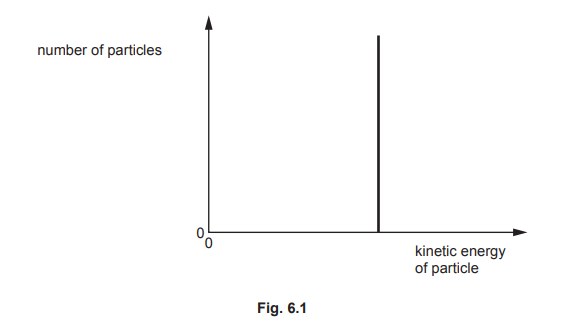
(i) Explain how Fig. 6.1 shows that this isotope of samarium emits \(\alpha\)-particles and does not emit \(\beta\)-particles. [2 marks]
____________________________________________________________________________
____________________________________________________________________________
____________________________________________________________________________
(ii) This isotope of samarium decays to an isotope of neodymium (Nd).
Give the radioactive decay equation for this decay. Include the nucleon and proton numbers of all the particles involved. [2 marks]
____________________________________________________________________________
(c) A baryon is composed of three quarks which all have different flavours. The baryon has a charge of \(0\).
Two of the quarks in the baryon are an up quark and a bottom quark.
(i) Determine, in terms of the elementary charge \(e\), the charge on the third quark in the baryon. [2 marks]
charge = ____________________ \(e\)
(ii) State a possible flavour for the third quark in the baryon. [1 mark]
____________________________________________
Syllabus Topic Codes (Cambridge International AS & A Level Physics 9702):
• 11.2: Fundamental particles — parts (c)(i) and (c)(ii)
▶️ Answer/Explanation
(a) Nuclide notation [1 mark]
The proton number is \(Z=62\).
The nucleon number is the total number of protons and neutrons:
\(A=62+85=147\)
Answer: \(\boxed{{}_{62}^{147}\mathrm{Sm}}\)
(b)(i) Identifying the emitted particles [2 marks]
The energy spectrum shows that the emitted particles have a discrete kinetic energy, with particles having only one particular energy.
Alpha particles are emitted with discrete kinetic energies, whereas beta particles have a continuous range of kinetic energies.
Therefore, the spectrum shows that the isotope emits \(\alpha\)-particles and does not emit \(\beta\)-particles.
Answer: \(\boxed{\text{The particles have one discrete kinetic energy, indicating }\alpha\text{-particles. Beta particles would have a continuous energy spectrum.}}\)
(b)(ii) Radioactive decay equation [2 marks]
An alpha particle has nucleon number \(4\) and proton number \(2\).
In alpha decay, the nucleon number decreases by \(4\) and the proton number decreases by \(2\).
Therefore,
\(A_{\mathrm{Nd}}=147-4=143\)
\(Z_{\mathrm{Nd}}=62-2=60\)
Hence the decay equation is
\({}_{82}^{147}\mathrm{Sm}\rightarrow{}_{60}^{143}\mathrm{Nd}+{}_{2}^{4}\alpha\)
Answer: \(\boxed{{}_{82}^{147}\mathrm{Sm}\rightarrow{}_{60}^{143}\mathrm{Nd}+{}_{2}^{4}\alpha}\)
(c)(i) Charge of the third quark [2 marks]
The charge of an up quark is \(+\frac{2}{3}e\), while the charge of a bottom quark is \(-\frac{1}{3}e\).
Let the charge of the third quark be \(q\).
Since the total charge of the baryon is zero,
\(0=+\frac{2}{3}e-\frac{1}{3}e+q\)
\(q=-\frac{1}{3}e\)
Answer: \(\boxed{-\frac{1}{3}e}\)
(c)(ii) Possible flavour of the third quark [1 mark]
A quark with charge \(-\frac{1}{3}e\) can be a down quark or a strange quark.
Answer: \(\boxed{\text{down or strange}}\)