
Question 1
(a) Define the radian.
(b) A circular metal disc spins horizontally about a vertical axis, as shown in Fig. 1.1.
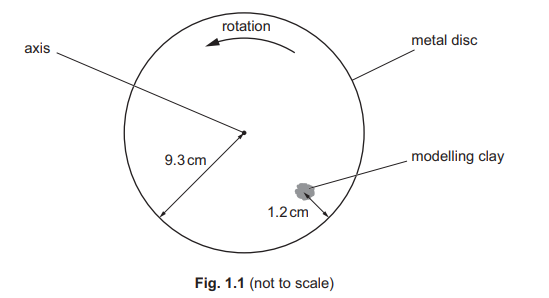
A piece of modelling clay is attached to the disc. For the instant when the piece of modelling clay is in the position shown, draw on Fig. 1.1:
(i) an arrow, labelled V, showing the direction of the velocity of the modelling clay
(ii) an arrow, labelled A, showing the direction of the acceleration of the modelling clay.
(c) The metal disc in Fig. 1.1 has a radius of \(9.3\,\mathrm{cm}\). The centre of gravity of the modelling clay is \(1.2\,\mathrm{cm}\) from the rim of the disc and moves with a speed of \(0.68\,\mathrm{m\,s^{-1}}\).
(i) Calculate the angular speed \(\omega\) of the disc.
(ii) Calculate the acceleration \(a\) of the centre of gravity of the modelling clay.
(d) A second piece of modelling clay is attached to the disc in the position shown in Fig. 1.2.
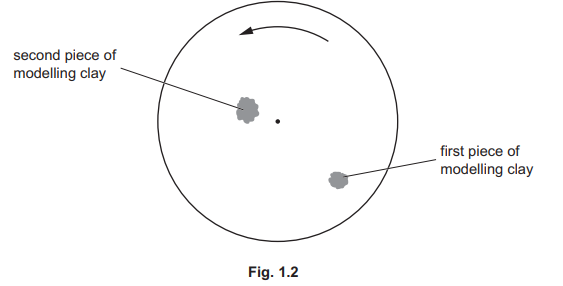
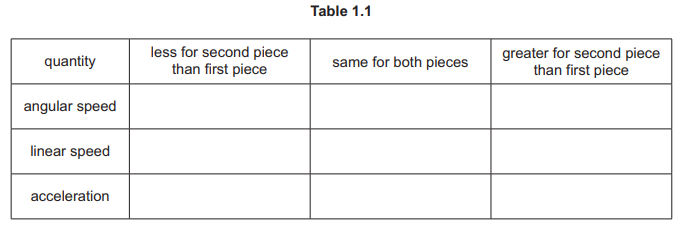
The second piece of modelling clay has a larger mass than the first piece. By placing one tick (3) in each row, complete Table 1.1 to show how the quantities indicated compare for the two pieces of modelling clay.
Syllabus Topic Code (Cambridge International AS & A Level Physics 9702 Paper 4):
• 12.2: Centripetal acceleration — part (c)(ii), acceleration directed towards the centre of the circular path
▶️ Answer/Explanation
(a)
A radian is the angle subtended at the centre of a circle by an arc whose length is equal to the radius of the circle.
Answer: \( \boxed{\text{The angle subtended at the centre when the arc length is equal to the radius.}} \)
(b)(i)
For uniform circular motion, the instantaneous velocity is always tangential to the circular path.
Answer: Draw the arrow \(V\) tangential to the circle in the north-east direction shown in Fig. 1.1.
(b)(ii)
The centripetal acceleration is always directed towards the centre of the circular path.
Answer: Draw the arrow \(A\) towards the centre of the circle, in the north-west direction shown in Fig. 1.1.
(c)(i)
The radius of the circular path of the centre of gravity is
\(r=9.3\,\mathrm{cm}-1.2\,\mathrm{cm}=8.1\,\mathrm{cm}=0.081\,\mathrm{m}\)
For uniform circular motion,
\(v=r\omega\)
Therefore,
\(\omega=\frac{v}{r}\)
\(\omega=\frac{0.68}{0.081}\)
\(\omega=8.4\,\mathrm{rad\,s^{-1}}\)
Answer: \( \boxed{8.4\,\mathrm{rad\,s^{-1}}} \)
(c)(ii)
The centripetal acceleration is
\(a=\frac{v^2}{r}\)
Therefore,
\(a=\frac{(0.68)^2}{0.081}\)
\(a=5.71\,\mathrm{m\,s^{-2}}\)
Alternatively, using \(a=r\omega^2\):
\(a=(0.081)(8.4)^2\)
Answer: \( \boxed{5.7\,\mathrm{m\,s^{-2}}} \)
(d)
Both pieces of modelling clay are attached to the same rotating disc, so they have the same angular speed.
The second piece is closer to the centre, so its radius is smaller. Since
\(v=r\omega\)
the second piece has a smaller linear speed.
Also, since
\(a=r\omega^2\)
the second piece has a smaller centripetal acceleration.
Answer:
• Angular speed: same for both pieces.
• Linear speed: less for the second piece.
• Acceleration: less for the second piece.
Question 2
(a) With reference to thermal energy, state what is meant by two objects being in thermal equilibrium.
(b) Two cylinders X and Y each contain a sample of an ideal gas. The samples are in thermal equilibrium with each other. X has a volume of \(0.0260\,\mathrm{m^3}\) and contains \(0.740\,\mathrm{mol}\) of gas at a pressure of \(1.20\times10^5\,\mathrm{Pa}\). Y has a volume of \(0.0430\,\mathrm{m^3}\) and contains gas at a pressure of \(2.90\times10^5\,\mathrm{Pa}\). Data for the two cylinders are shown in Fig. 2.1.
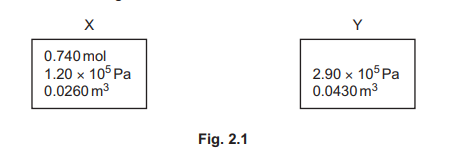
(i) Show that the temperature of the gas in X is \(234\,^\circ\mathrm{C}\).
(ii) Determine the number \(N\) of molecules of the gas in Y. Explain your reasoning.
(iii) The gas in X consists of molecules that each have a mass that is four times the mass of a molecule of the gas in Y. Explain how the root-mean-square (r.m.s.) speed of the molecules in X compares with the r.m.s. speed of the molecules in Y.
Syllabus Topic Codes (Cambridge International AS & A Level Physics 9702 Paper 4):
• 15.1: The mole — part (b)(i), using the molar form of the ideal gas equation
• 15.2: Equation of state — parts (b)(i) and (b)(ii), ideal gas equation
• 15.3: Kinetic theory of gases — part (b)(iii), molecular kinetic energy and r.m.s. speed
▶️ Answer/Explanation
(a)
Two objects are in thermal equilibrium when, if they are in thermal contact, there is no net transfer of thermal energy between them.
Answer: \( \boxed{\text{There is no net transfer of thermal energy between the objects when they are in thermal contact.}} \)
(b)(i)
Using the ideal gas equation in molar form,
\(pV=nRT\)
Rearranging for temperature:
\(T=\frac{pV}{nR}\)
Substituting the values:
\(T=\frac{(1.20\times10^5)(0.0260)}{(0.740)(8.31)}\)
\(T=507\,\mathrm{K}\)
Converting to degrees Celsius:
\(T=507-273=234\,^\circ\mathrm{C}\)
Answer: \( \boxed{234\,^\circ\mathrm{C}} \)
(b)(ii)
Since the gases are in thermal equilibrium, they have the same thermodynamic temperature.
Thus, for gas Y,
\(T_Y=507\,\mathrm{K}\)
Using
\(pV=NkT\)
we obtain
\(N=\frac{pV}{kT}\)
\(N=\frac{(2.90\times10^5)(0.0430)}{(1.38\times10^{-23})(507)}\)
\(N=1.78\times10^{24}\)
Answer: \( \boxed{1.78\times10^{24}} \) molecules
(b)(iii)
The average translational kinetic energy of a molecule is related to temperature by
\(E_K=\frac{3}{2}kT\)
Since the two gases are at the same temperature, their molecules have the same average translational kinetic energy.
Also,
\(E_K=\frac{1}{2}mv_{\mathrm{rms}}^2\)
Therefore, at the same temperature,
\(v_{\mathrm{rms}}\propto\frac{1}{\sqrt{m}}\)
The molecules in X have four times the mass of those in Y:
\(m_X=4m_Y\)
Hence,
\(\frac{v_X}{v_Y}=\sqrt{\frac{m_Y}{m_X}}=\sqrt{\frac{1}{4}}=\frac{1}{2}\)
Answer: \( \boxed{v_X=\frac{1}{2}v_Y} \)
Question 3
(a) State what is meant by the internal energy of a system.
(b) With reference to molecular kinetic and potential energies, describe and explain how the internal energy of the system changes when:
(i) a gas is heated at constant volume so that its temperature increases
(ii) a wire is stretched within its elastic limit at constant temperature.
Syllabus Topic Code (Cambridge International AS & A Level Physics 9702 Paper 4):
▶️ Answer/Explanation
(a)
The internal energy of a system is the sum of the random kinetic energies and intermolecular potential energies of its particles.
Answer: \( \boxed{\text{The sum of the random kinetic and potential energies of the particles in the system.}} \)
(b)(i)
The gas is heated at constant volume, so the separation between the molecules does not change significantly.
Therefore, there is no change in the molecular potential energy.
The temperature increases, so the average kinetic energy of the molecules increases.
Since the kinetic energy increases while the potential energy remains unchanged, the internal energy of the gas increases.
Answer: \( \boxed{\text{Kinetic energy increases, potential energy is unchanged, so internal energy increases.}} \)
(b)(ii)
The wire is stretched at constant temperature, so the molecular kinetic energy remains unchanged.
Stretching increases the separation between the particles, so the molecular potential energy increases.
Therefore, the potential energy increases while the kinetic energy remains unchanged.
Answer: \( \boxed{\text{Potential energy increases, kinetic energy is unchanged, so internal energy increases.}} \)
Question 4
A block of mass \(m\) oscillates vertically on a spring, as shown in Fig. 4.1.
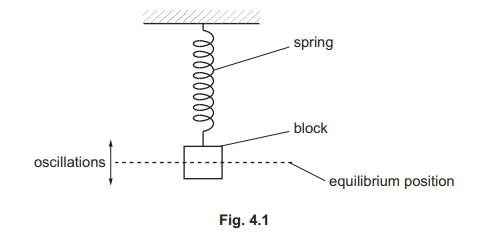
The acceleration \(a\) of the block varies with displacement \(x\) from its equilibrium position, as shown in Fig. 4.2.
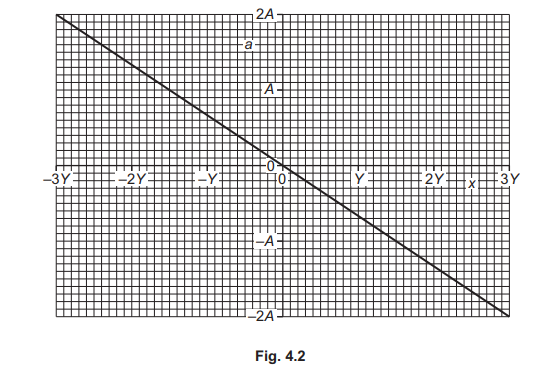
The amplitude of the oscillations is \(3Y\) and the maximum acceleration is \(2A\).
(a) Explain how Fig. 4.2 shows that the oscillations of the block are simple harmonic.
(b) Deduce expressions, in terms of some or all of \(m\), \(A\) and \(Y\), for:
(i) the angular frequency \(\omega\) of the oscillations
(ii) the maximum speed \(v_0\) of the oscillations
(iii) the energy \(E\) of the oscillations.
(c) The period of the oscillations is \(0.75\,\mathrm{s}\) and the value of \(3Y\) is \(1.8\,\mathrm{cm}\). Determine an expression for \(x\) in terms of time \(t\), where \(x\) is in cm and \(t\) is in seconds.
Syllabus Topic Codes (Cambridge International AS & A Level Physics 9702 Paper 4):
• 17.2: Energy in simple harmonic motion — part (b)(iii), total energy of the oscillations
▶️ Answer/Explanation
(a)
For simple harmonic motion, the acceleration is proportional to the displacement and is always directed towards the equilibrium position.
Fig. 4.2 shows a straight line through the origin, so the magnitude of \(a\) is proportional to the magnitude of \(x\).
The gradient is negative, showing that \(a\) and \(x\) are always in opposite directions.
Thus,
\(a=-\omega^2x\)
Answer: \( \boxed{\text{The graph is a straight line through the origin with negative gradient, so }a\propto-x.} \)
(b)(i)
From Fig. 4.2, when \(x=3Y\), the magnitude of the acceleration is \(2A\).
Using
\(a=\omega^2x\)
gives
\(2A=\omega^2(3Y)\)
Therefore,
\(\omega^2=\frac{2A}{3Y}\)
\(\omega=\sqrt{\frac{2A}{3Y}}\)
Answer: \( \boxed{\omega=\sqrt{\frac{2A}{3Y}}} \)
(b)(ii)
The amplitude of the oscillation is \(3Y\).
For SHM, the maximum speed is
\(v_0=\omega x_0\)
where \(x_0=3Y\).
Therefore,
\(v_0=3Y\sqrt{\frac{2A}{3Y}}\)
\(v_0=\sqrt{6AY}\)
Answer: \( \boxed{v_0=\sqrt{6AY}} \)
(b)(iii)
The total energy of an SHM oscillator is
\(E=\frac{1}{2}m\omega^2x_0^2\)
Using \(x_0=3Y\) and \(\omega^2=\frac{2A}{3Y}\),
\(E=\frac{1}{2}m\left(\frac{2A}{3Y}\right)(3Y)^2\)
\(E=3mAY\)
Answer: \( \boxed{E=3mAY} \)
(c)
The amplitude is
\(x_0=3Y=1.8\,\mathrm{cm}\)
The angular frequency is related to the period by
\(\omega=\frac{2\pi}{T}\)
Therefore,
\(\omega=\frac{2\pi}{0.75}=8.38\,\mathrm{rad\,s^{-1}}\)
The general displacement equation is
\(x=x_0\cos(\omega t+\phi)\)
If the intended initial condition is that the block is at maximum positive displacement when \(t=0\), then \(\phi=0\).
Hence,
\(x=1.8\cos(8.38t)\)
where \(x\) is in cm and \(t\) is in seconds.
Answer: \( \boxed{x=1.8\cos(8.38t)\,\mathrm{cm}} \)
Note: The supplied question text does not explicitly state the initial displacement or velocity at \(t=0\). Therefore, the phase constant cannot be uniquely determined from the information provided. The expression above assumes maximum positive displacement at \(t=0\).
Question 5
(a) Define electric potential at a point.
(b) Two isolated charged metal spheres X and Y are near to each other in a vacuum. The centres of the spheres are \(1.2\,\mathrm{m}\) apart, as shown in Fig. 5.1.

Point P is on the line joining the centres of spheres X and Y and is at a variable distance \(x\) from the centre of X. Fig. 5.2 shows the variation with \(x\) of the total electric potential \(V\) due to the two spheres.

State three conclusions that may be drawn about the spheres from Fig. 5.2. The conclusions may be qualitative or quantitative.
(c) A proton is held at rest on the line joining the centres of the spheres in (b) at the position where \(x=0.60\,\mathrm{m}\). The proton is released. Describe and explain, without calculation, the subsequent motion of the proton.
Syllabus Topic Code (Cambridge International AS & A Level Physics 9702 Paper 4):
▶️ Answer/Explanation
(a)
Electric potential at a point is the work done per unit positive charge in bringing a small positive test charge from infinity to that point.
Answer: \( \boxed{\text{Work done per unit positive charge in bringing a charge from infinity to the point.}} \)
(b)
From the graph, the positions at which the potential changes behaviour indicate the radii of the two conducting spheres.
For sphere X, the radius is approximately
\(r_X=0.30\,\mathrm{m}\)
For sphere Y, the radius is approximately
\(r_Y=0.10\,\mathrm{m}\)
Thus,
\(r_X=3r_Y\)
The potential is positive around both spheres, so both spheres carry positive charge.
The magnitudes of the charges on the two spheres are equal, as indicated by the corresponding potential behaviour.
Three valid conclusions include:
• Sphere X has radius \(0.30\,\mathrm{m}\).
• Sphere Y has radius \(0.10\,\mathrm{m}\).
• Sphere X has three times the radius of sphere Y.
• Sphere X is positively charged.
• Sphere Y is positively charged.
• The two spheres carry charges of the same sign.
• The magnitudes of the charges on the spheres are equal.
(c)
At \(x=0.60\,\mathrm{m}\), the proton is at the position corresponding to the minimum electric potential shown in Fig. 5.2.
The proton has positive charge, so its electric potential energy is
\(E_{\mathrm{P}}=qV\)
Since \(V\) is at a minimum at this position, the proton’s electric potential energy is also at a minimum.
Therefore, there is no resultant electric force on the proton at this point. The electric forces due to the two spheres are equal in magnitude and opposite in direction.
When released from rest, the proton therefore remains at rest at \(x=0.60\,\mathrm{m}\).
Answer: \( \boxed{\text{The proton remains at rest because the resultant electric force is zero and its potential energy is at a minimum.}} \)
Question 6
(a) Two capacitors X and Y are connected in series to a power supply of voltage \(V\), as shown in Fig. 6.1.
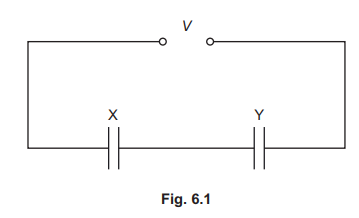
The capacitance of X is \(C_X\) and the capacitance of Y is \(C_Y\). Derive an expression, in terms of \(C_X\) and \(C_Y\), for the combined capacitance \(C_T\) of the capacitors in this circuit. Explain your reasoning.
(b) Two capacitors P and Q are connected in parallel to a power supply of voltage \(V\). The capacitance of P is \(200\,\mu\mathrm{F}\). The capacitance \(C_Q\) of Q can be varied between 0 and \(400\,\mu\mathrm{F}\). When \(C_Q=0\), the total energy stored in the capacitors is \(2.5\,\mathrm{mJ}\).
(i) Show that the supply voltage \(V\) is \(5.0\,\mathrm{V}\).
(ii) Calculate the total energy, in mJ, stored in the capacitors when \(C_Q\) has its maximum value.
(iii) On Fig. 6.2, sketch the variation of the total energy \(E\) stored in the capacitors with \(C_Q\), as \(C_Q\) varies from \(0\) to \(400\,\mu\mathrm{F}\).
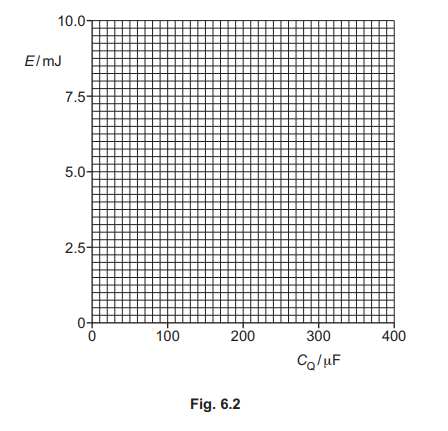
Syllabus Topic Codes (Cambridge International AS & A Level Physics 9702 Paper 4):
• 19.2: Energy stored in a capacitor — parts (b)(i), (b)(ii) and (b)(iii), energy stored in capacitors
▶️ Answer/Explanation
(a)
For capacitors connected in series, the charge \(Q\) on each capacitor is the same.
The potential difference across each capacitor is
\(V_X=\frac{Q}{C_X}\)
and
\(V_Y=\frac{Q}{C_Y}\)
The supply voltage is the sum of the two potential differences:
\(V=V_X+V_Y\)
Therefore,
\(V=\frac{Q}{C_X}+\frac{Q}{C_Y}\)
\(V=Q\left(\frac{1}{C_X}+\frac{1}{C_Y}\right)\)
Since \(C_T=\frac{Q}{V}\),
\(\frac{1}{C_T}=\frac{1}{C_X}+\frac{1}{C_Y}\)
Hence,
\(\boxed{C_T=\frac{C_XC_Y}{C_X+C_Y}}\)
Answer: \( \boxed{C_T=\frac{C_XC_Y}{C_X+C_Y}} \)
(b)(i)
When \(C_Q=0\), only capacitor P is present, so
\(E=\frac{1}{2}CV^2\)
Substituting \(E=2.5\times10^{-3}\,\mathrm{J}\) and \(C=200\times10^{-6}\,\mathrm{F}\):
\(2.5\times10^{-3}=\frac{1}{2}(200\times10^{-6})V^2\)
\(V^2=25\)
\(V=5.0\,\mathrm{V}\)
Answer: \( \boxed{5.0\,\mathrm{V}} \)
(b)(ii)
For capacitors in parallel, the capacitances add:
\(C_T=C_P+C_Q\)
At the maximum value \(C_Q=400\,\mu\mathrm{F}\),
\(C_T=200+400=600\,\mu\mathrm{F}\)
The total energy stored is
\(E=\frac{1}{2}C_TV^2\)
\(E=\frac{1}{2}(600\times10^{-6})(5.0)^2\)
\(E=7.5\times10^{-3}\,\mathrm{J}\)
\(E=7.5\,\mathrm{mJ}\)
Answer: \( \boxed{7.5\,\mathrm{mJ}} \)
(b)(iii)
Since
\(E=\frac{1}{2}(C_P+C_Q)V^2\)
and \(C_P\) and \(V\) are constant, \(E\) varies linearly with \(C_Q\).
The graph therefore starts at \(E=2.5\,\mathrm{mJ}\) when \(C_Q=0\) and increases as a straight line to \(E=7.5\,\mathrm{mJ}\) when \(C_Q=400\,\mu\mathrm{F}\).
Answer: A straight line with positive gradient joining the points \((0,2.5)\) and \((400,7.5)\), where \(C_Q\) is in \(\mu\mathrm{F}\) and \(E\) is in mJ.
Question 7
(a) State Faraday’s law of electromagnetic induction.
(b) Fig. 7.1 shows a coil at rest in a uniform magnetic field that is parallel to the axis of the coil.
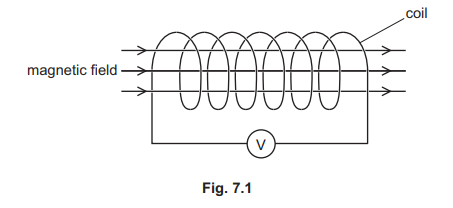
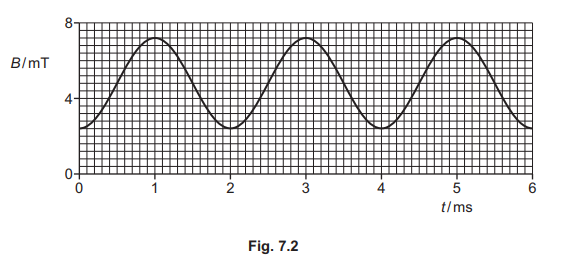
The coil is connected to a centre-zero voltmeter. The flux density \(B\) of the uniform magnetic field varies with time \(t\) as shown in Fig. 7.2.
The coil consists of 340 turns, each of cross-sectional area \(3.2\times10^{-4}\,\mathrm{m^2}\).
(i) Calculate the maximum magnetic flux through one turn of the coil.
(ii) Determine the maximum rate of change of magnetic flux linkage in the coil.
(iii) State the maximum electromotive force (e.m.f.) \(V_0\) induced across the coil.
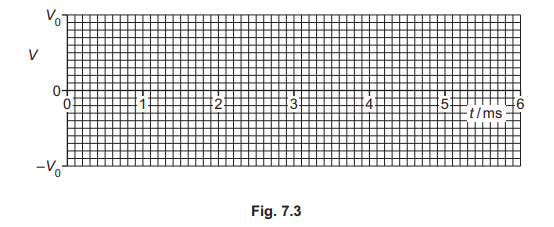
(iv) On Fig. 7.3, sketch the variation of the e.m.f. \(V\) induced across the coil with \(t\) from \(t=0\) to \(t=6.0\,\mathrm{ms}\).
(v) The variation of \(V\) with \(t\) can be described by \(V=A\sin Bt\), where \(A\) and \(B\) are constants. Determine the values of \(A\) and \(B\). Give units with your answers.
Syllabus Topic Code (Cambridge International AS & A Level Physics 9702 Paper 4):
▶️ Answer/Explanation
(a)
Faraday’s law states that the induced e.m.f. is directly proportional to the rate of change of magnetic flux linkage.
In equation form,
\(V=-\frac{\mathrm{d}(N\phi)}{\mathrm{d}t}\)
Answer: \( \boxed{\text{Induced e.m.f. is proportional to the rate of change of magnetic flux linkage.}} \)
(b)(i)
The magnetic field is parallel to the axis of the coil, so the field is perpendicular to the plane of the coil.
Therefore,
\(\phi=BA\)
Using \(B_{\max}=7.2\times10^{-3}\,\mathrm{T}\),
\(\phi_{\max}=(7.2\times10^{-3})(3.2\times10^{-4})\)
\(\phi_{\max}=2.30\times10^{-6}\,\mathrm{Wb}\)
Answer: \( \boxed{2.3\times10^{-6}\,\mathrm{Wb}} \)
(b)(ii)
The maximum rate of change of magnetic flux is obtained from the steepest tangent to the \(B\)-against-\(t\) graph.
Since the coil has \(N=340\) turns, the rate of change of flux linkage is
\(\frac{\mathrm{d}(N\phi)}{\mathrm{d}t}=N A\frac{\mathrm{d}B}{\mathrm{d}t}\)
Using the maximum gradient from Fig. 7.2 gives
\(\left|\frac{\mathrm{d}(N\phi)}{\mathrm{d}t}\right|_{\max}=0.82\,\mathrm{Wb\,s^{-1}}\)
Answer: \( \boxed{0.82\,\mathrm{Wb\,s^{-1}}} \)
(b)(iii)
From Faraday’s law, the magnitude of the induced e.m.f. equals the maximum rate of change of flux linkage.
Therefore,
\(V_0=0.82\,\mathrm{V}\)
Answer: \( \boxed{0.82\,\mathrm{V}} \)
(b)(iv)
The induced e.m.f. varies sinusoidally.
The period is \(2.0\,\mathrm{ms}\), so from \(t=0\) to \(t=6.0\,\mathrm{ms}\) there are three complete cycles.
The graph should:
• have amplitude \(0.82\,\mathrm{V}\),
• have period \(2.0\,\mathrm{ms}\),
• cross \(V=0\) at \(t=0,\ 1.0,\ 2.0,\ 3.0,\ 4.0,\ 5.0,\) and \(6.0\,\mathrm{ms}\),
• reach \(+0.82\,\mathrm{V}\) and \(-0.82\,\mathrm{V}\) at alternate quarter-period positions.
Answer: A sinusoidal curve of period \(2.0\,\mathrm{ms}\), with maximum \(+0.82\,\mathrm{V}\) and minimum \(-0.82\,\mathrm{V}\).
(b)(v)
The equation is
\(V=A\sin Bt\)
The amplitude is equal to the maximum e.m.f., so
\(A=0.82\,\mathrm{V}\)
For a sinusoidal wave,
\(B=\frac{2\pi}{T}\)
Using \(T=2.0\times10^{-3}\,\mathrm{s}\),
\(B=\frac{2\pi}{2.0\times10^{-3}}\)
\(B=3.14\times10^3\,\mathrm{rad\,s^{-1}}\)
Answer: \( \boxed{A=0.82\,\mathrm{V}} \) and \( \boxed{B=3.1\times10^3\,\mathrm{rad\,s^{-1}}} \)
Question 8
Fig. 8.1 shows part of the emission spectrum of visible radiation emitted by hydrogen gas in a star in a distant galaxy.
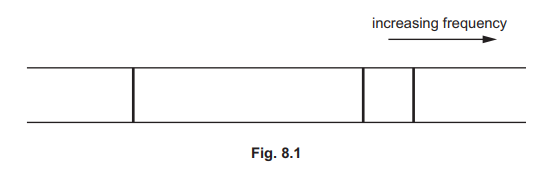
The galaxy is moving away from the Earth at a speed of \(6.2\times10^6\,\mathrm{m\,s^{-1}}\).
(a)
(i) Explain how the positions of the lines in the emission spectrum seen by an observer on the Earth differ from the positions shown in Fig. 8.1.
(ii) On Fig. 8.1, draw the three lines in possible positions in the spectrum seen by the observer.
(b) The lines in Fig. 8.1 correspond to electron transitions down to the energy level \(-3.40\,\mathrm{eV}\). One of the lines represents emitted radiation of wavelength \(488\,\mathrm{nm}\).
(i) Calculate the energy of a photon of this radiation.
(ii) Determine the energy, in eV, of the energy level from which the electron transition originates to cause the emission of this radiation.
(iii) Determine the wavelength, in nm, of this radiation as detected by the observer on the Earth.
(c) A value for the Hubble constant is \(2.3\times10^{-18}\,\mathrm{s^{-1}}\). Determine the distance of the galaxy from the Earth.
Syllabus Topic Codes (Cambridge International AS & A Level Physics 9702 Paper 4):
• 25.3: Hubble’s law and the Big Bang theory — parts (a), (b)(iii) and (c), redshift and Hubble’s law
▶️ Answer/Explanation
(a)(i)
The galaxy is moving away from the Earth, so the observed radiation is redshifted.
The movement of the galaxy causes the observed frequency to decrease and the observed wavelength to increase.
Answer: \( \boxed{\text{The lines are shifted towards longer wavelengths.}} \)
(a)(ii)
All three lines should be shifted to the right of their original positions because the galaxy is moving away from the Earth.
Answer: Draw the three lines to the right of the corresponding printed lines, with approximately the same displacement for each line.
(b)(i)
The energy of a photon is
\(E=hf=\frac{hc}{\lambda}\)
Using \(\lambda=488\times10^{-9}\,\mathrm{m}\),
\(E=\frac{(6.63\times10^{-34})(3.00\times10^8)}{488\times10^{-9}}\)
\(E=4.08\times10^{-19}\,\mathrm{J}\)
Answer: \( \boxed{4.08\times10^{-19}\,\mathrm{J}} \)
(b)(ii)
Convert the photon energy into eV:
\(E=\frac{4.08\times10^{-19}}{1.60\times10^{-19}}\)
\(E=2.55\,\mathrm{eV}\)
The electron falls to the energy level \(-3.40\,\mathrm{eV}\), releasing \(2.55\,\mathrm{eV}\).
Therefore,
\(E_{\mathrm{initial}}-(-3.40)=2.55\)
\(E_{\mathrm{initial}}=-3.40+2.55\)
\(E_{\mathrm{initial}}=-0.85\,\mathrm{eV}\)
Answer: \( \boxed{-0.85\,\mathrm{eV}} \)
(b)(iii)
For a source moving away from the observer, the wavelength is increased.
Using the Doppler relation for a receding source,
\(\frac{\Delta\lambda}{\lambda}=\frac{v}{c}\)
Hence,
\(\Delta\lambda=\frac{6.2\times10^6}{3.00\times10^8}\times488\)
\(\Delta\lambda=10.1\,\mathrm{nm}\)
Therefore,
\(\lambda_{\mathrm{observed}}=488+10.1\)
\(\lambda_{\mathrm{observed}}=498\,\mathrm{nm}\)
Answer: \( \boxed{498\,\mathrm{nm}} \)
(c)
Hubble’s law is
\(v=H_0d\)
Therefore,
\(d=\frac{v}{H_0}\)
\(d=\frac{6.2\times10^6}{2.3\times10^{-18}}\)
\(d=2.70\times10^{24}\,\mathrm{m}\)
Answer: \( \boxed{2.7\times10^{24}\,\mathrm{m}} \)
Question 9
(a) State what is meant by the binding energy of a nucleus.
(b) Table 9.1 shows the masses of two sub-atomic particles and a polonium-212 \(\left({}^{212}_{84}\mathrm{Po}\right)\) nucleus.
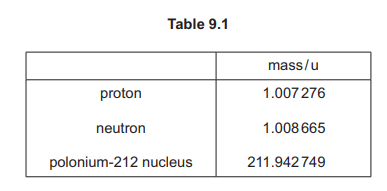
For the polonium-212 nucleus, determine:
(i) the mass defect \(\Delta m\), in kg
(ii) the binding energy
(iii) the binding energy per nucleon.
(c)
(i) On Fig. 9.1, sketch the variation with nucleon number \(A\) of binding energy per nucleon for values of \(A\) from 1 to 250.
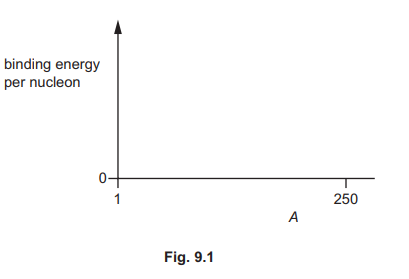
(ii) On your line in Fig. 9.1, draw an X to show the approximate position of polonium-212.
(iii) Polonium-212 is radioactive and undergoes alpha-decay. Suggest and explain, with reference to Fig. 9.1, why the alpha-decay of polonium-212 results in a release of energy.
Syllabus Topic Code (Cambridge International AS & A Level Physics 9702 Paper 4):
• 23.2: Radioactive decay — alpha-decay referred to in part (c)(iii)
▶️ Answer/Explanation
(a)
The binding energy of a nucleus is the energy required to separate all the nucleons in the nucleus completely to infinity.
Answer: \( \boxed{\text{Energy required to separate all the nucleons to infinity.}} \)
(b)(i)
A polonium-212 nucleus contains 84 protons and
\(212-84=128\)
neutrons.
The mass defect is
\(\Delta m=\left[(84\times1.007276)+(128\times1.008665)-211.942749\right]\,\mathrm{u}\)
\(\Delta m=1.778\,\mathrm{u}\)
Using \(1\,\mathrm{u}=1.66\times10^{-27}\,\mathrm{kg}\),
\(\Delta m=1.778\times1.66\times10^{-27}\)
\(\Delta m=2.95\times10^{-27}\,\mathrm{kg}\)
Answer: \( \boxed{2.95\times10^{-27}\,\mathrm{kg}} \)
(b)(ii)
The binding energy is given by
\(E=\Delta mc^2\)
Therefore,
\(E=(2.95\times10^{-27})(3.00\times10^8)^2\)
\(E=2.66\times10^{-10}\,\mathrm{J}\)
Answer: \( \boxed{2.66\times10^{-10}\,\mathrm{J}} \)
(b)(iii)
Binding energy per nucleon is
\(\frac{E}{A}=\frac{2.66\times10^{-10}}{212}\)
\(\frac{E}{A}=1.25\times10^{-12}\,\mathrm{J}\)
Answer: \( \boxed{1.25\times10^{-12}\,\mathrm{J\ per\ nucleon}} \)
(c)(i)
The graph should show binding energy per nucleon initially increasing rapidly with \(A\), reaching a maximum for nuclei with nucleon numbers around \(A\approx50\) to \(60\), and then decreasing gradually as \(A\) increases towards 250.
The left-hand section therefore has a steep positive gradient, while the right-hand section has a shallower negative gradient.
Answer: A curve rising steeply to a single maximum and then gradually decreasing towards \(A=250\).
(c)(ii)
Polonium-212 has nucleon number
\(A=212\)
so the X should be placed on the decreasing section of the curve, at approximately \(A=212\).
Answer: X at approximately \(A=212\) on the descending part of the curve.
(c)(iii)
During alpha-decay, the original nucleus changes into a nucleus with a lower nucleon number.
For polonium-212, the daughter nucleus is lead-208.
The daughter nucleus has a greater binding energy per nucleon, as it is further towards the region of greater stability on the graph.
Therefore, the total binding energy increases and the mass of the products is lower than the mass of the original nucleus. The mass difference is released as energy.
Answer: \( \boxed{\text{The daughter nucleus has greater binding energy per nucleon, so the total binding energy increases and energy is released.}} \)
Question 10
(a) Describe how reflected ultrasound pulses may be used to obtain diagnostic information about internal structures.
(b)
(i) Define specific acoustic impedance of a medium.
(ii) Table 10.1 shows some data for water and for glass.
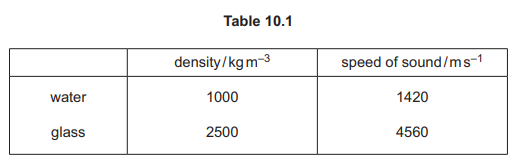
Determine the intensity reflection coefficient for ultrasound that is incident on a water–glass boundary.
Syllabus Topic Code (Cambridge International AS & A Level Physics 9702 Paper 4):
▶️ Answer/Explanation
(a)
A pulse of ultrasound is sent into the body and reflected when it reaches a boundary between different tissues or structures.
The time taken for the reflected pulse to return gives information about the depth of the boundary because
\(d=\frac{vt}{2}\)
where \(v\) is the speed of ultrasound in the tissue and \(t\) is the measured round-trip time.
The intensity of the reflected pulse gives information about the nature of the boundary, since different materials have different acoustic impedances and therefore produce different amounts of reflection.
Answer: \( \boxed{\text{Time gives information about depth, while reflected intensity gives information about the nature of the boundary.}} \)
(b)(i)
Specific acoustic impedance \(Z\) is the product of the density \(\rho\) of the medium and the speed \(v\) of ultrasound in the medium.
\(Z=\rho v\)
Answer: \( \boxed{Z=\rho v} \)
(b)(ii)
First calculate the acoustic impedance of each medium:
\(Z_{\mathrm{water}}=\rho_{\mathrm{water}}v_{\mathrm{water}}\)
\(Z_{\mathrm{glass}}=\rho_{\mathrm{glass}}v_{\mathrm{glass}}\)
The intensity reflection coefficient at a boundary is
\(R=\left(\frac{Z_{\mathrm{glass}}-Z_{\mathrm{water}}}{Z_{\mathrm{glass}}+Z_{\mathrm{water}}}\right)^2\)
Using the values from Table 10.1 gives
\(R\approx0.42\)
Answer: \( \boxed{R\approx0.42} \)
Thus, approximately \(42\%\) of the incident ultrasound intensity is reflected at the water-glass boundary.