
Question 1
(a) Define gravitational potential at a point.
(b) A satellite X, of mass \(M\), orbits a planet at a constant distance \(4R\) from the centre of the planet, as shown in Fig. 1.1.
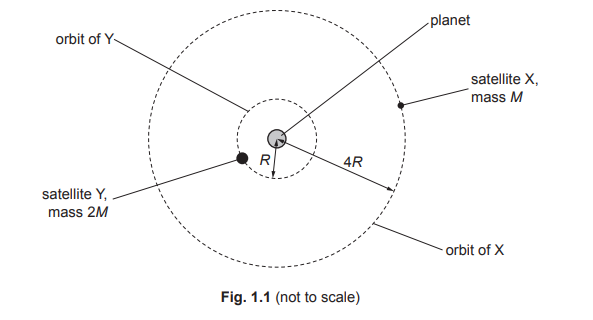
A second satellite Y, of mass \(2M\), orbits the planet with orbital radius \(R\). The gravitational potential at X due to the planet is \(-\Phi\). The planet is a uniform sphere.
(i) Explain why the gravitational potential at X is negative.
(ii) State an expression, in terms of \(\Phi\), for the gravitational potential at Y due to the planet.
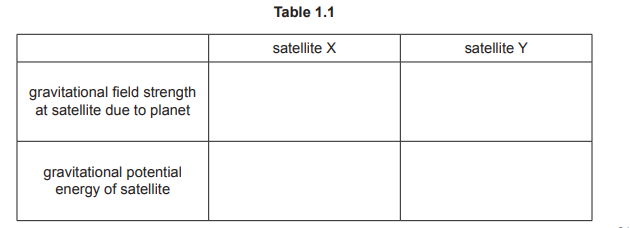
(iii) Complete Table 1.1 by giving expressions, in terms of some or all of \(M\), \(R\) and \(\Phi\), for the quantities indicated for each of the satellites X and Y.
Syllabus Topic Codes (Cambridge International AS & A Level Physics 9702 Paper 4):
• 13.4: Gravitational potential — parts (a), (b)(i), (b)(ii) and (b)(iii), gravitational potential and gravitational potential energy
▶️ Answer/Explanation
(a)
Gravitational potential at a point is defined as the work done per unit mass in bringing a small test mass from infinity to that point.
Therefore,
\(\phi=\frac{W}{m}\)
Answer: \( \boxed{\text{Work done per unit mass in bringing a small test mass from infinity to the point.}} \)
(b)(i)
Gravitational potential is defined to be zero at infinity.
The gravitational force is attractive, so work must be done on a mass to move it from a point near the planet to infinity.
Therefore, the gravitational potential at a finite distance from the planet is less than zero.
Hence, the potential at X is negative:
\(\phi_X=-\Phi\)
Answer: \( \boxed{\text{The potential is negative because the potential is zero at infinity and the gravitational force is attractive.}} \)
(b)(ii)
For a point mass, gravitational potential is
\(\phi=-\frac{GM}{r}\)
At X, the distance is \(4R\), so
\(-\Phi=-\frac{GM}{4R}\)
Therefore,
\(\frac{GM}{R}=4\Phi\)
At Y, the distance is \(R\), so
\(\phi_Y=-\frac{GM}{R}\)
Hence,
\(\phi_Y=-4\Phi\)
Answer: \( \boxed{-4\Phi} \)
(b)(iii)
The gravitational field strength due to a point mass is
\(g=\frac{GM}{r^2}\)
From part (b)(ii),
\(\frac{GM}{R}=4\Phi\)
At X, where \(r=4R\):
\(g_X=\frac{GM}{(4R)^2}\)
\(g_X=\frac{GM}{16R^2}\)
Using \(GM=4\Phi R\):
\(g_X=\frac{4\Phi R}{16R^2}=\frac{\Phi}{4R}\)
At Y, where \(r=R\):
\(g_Y=\frac{GM}{R^2}=\frac{4\Phi}{R}\)
Gravitational field strength:
\(g_X=\frac{\Phi}{4R}\)
\(g_Y=\frac{4\Phi}{R}\)
Gravitational potential energy is
\(E_P=m\phi\)
For satellite X:
\(E_{P,X}=M(-\Phi)=-M\Phi\)
For satellite Y, the mass is \(2M\) and its potential is \(-4\Phi\):
\(E_{P,Y}=(2M)(-4\Phi)=-8M\Phi\)
Answers:
\( \boxed{g_X=\frac{\Phi}{4R}} \)
\( \boxed{g_Y=\frac{4\Phi}{R}} \)
\( \boxed{E_{P,X}=-M\Phi} \)
\( \boxed{E_{P,Y}=-8M\Phi} \)
Question 2
(a)(i) State the magnitude and unit of absolute zero on the thermodynamic temperature scale.
(ii) Explain why temperature measured using a laboratory liquid-in-glass thermometer does not give a measurement of thermodynamic temperature.
(b) Fig. 2.1 shows a simplified diagram of a type of thermometer called a platinum resistance thermometer.
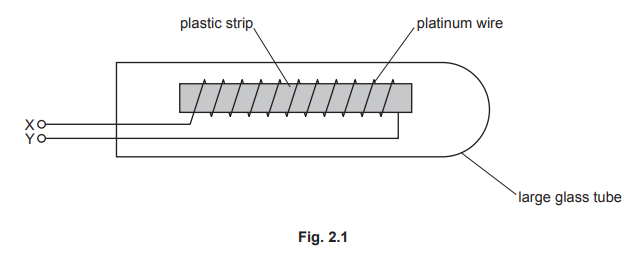
The glass tube is immersed in the environment for which the temperature is to be determined. The resistance between the terminals X and Y is measured. Fig. 2.2 shows the variation of the resistivity \(\rho\) of platinum with thermodynamic temperature \(T\).
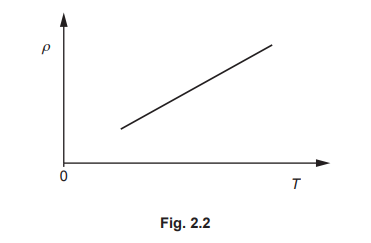
(i) Explain how Fig. 2.2 shows that platinum is a suitable metal for use in a resistance thermometer.
(ii) Suggest a reason why a platinum resistance thermometer is not suitable for measuring a rapidly changing temperature.
(iii) Suggest a type of thermometer that is suitable for measuring a rapidly changing temperature.
(c) A negative temperature coefficient thermistor may be used as a type of resistance thermometer. State one way in which the variation with temperature of the resistance of a thermistor differs from that of a platinum wire.
Syllabus Topic Codes (Cambridge International AS & A Level Physics 9702 Paper 4):
▶️ Answer/Explanation
(a)(i)
Absolute zero is the lowest possible temperature on the thermodynamic temperature scale.
Its value is
\(T=0\,\mathrm{K}\)
Answer: \( \boxed{0\,\mathrm{K}} \)
(a)(ii)
A liquid-in-glass thermometer measures temperature using a physical property of a particular substance, such as the expansion and volume of the liquid.
Therefore, the temperature indicated depends on the properties and behaviour of the liquid. The thermodynamic temperature scale, however, does not depend on the properties of any particular substance.
Answer: \( \boxed{\text{The reading depends on the temperature-dependent properties of the liquid, whereas thermodynamic temperature is independent of any particular substance.}} \)
(b)(i)
A suitable temperature-measuring property should change predictably with temperature.
From Fig. 2.2, the resistivity of platinum changes with temperature and the relationship is approximately linear over the range shown.
Therefore, each temperature corresponds to a particular value of resistivity, allowing the temperature to be determined from a measured resistance.
Answer: \( \boxed{\text{The resistivity varies predictably and approximately linearly with temperature, giving a unique resistance for each temperature.}} \)
(b)(ii)
The thermometer has thermal mass and therefore requires energy transfer to reach the temperature of the environment.
Consequently, it takes a finite time to reach the correct temperature. If the temperature is changing rapidly, the thermometer cannot respond quickly enough.
Answer: \( \boxed{\text{It takes time to reach thermal equilibrium with the environment.}} \)
(b)(iii)
A thermocouple is suitable for measuring rapidly changing temperatures because it has a small thermal mass and responds quickly to temperature changes.
Answer: \( \boxed{\text{Thermocouple}} \)
(c)
A negative temperature coefficient thermistor has a resistance that decreases as temperature increases.
In contrast, the resistance of a platinum wire increases approximately linearly as temperature increases.
Answer: \( \boxed{\text{The thermistor has an inverse, non-linear variation of resistance with temperature.}} \)
Question 3
(a)(i) State what is meant by an ideal gas.
(ii) Use one of the basic assumptions of the kinetic theory to explain what can be deduced about the potential energy associated with the random motion of molecules in an ideal gas.
(b) A sample of \(0.26\,\mathrm{m^3}\) of an ideal gas is at pressure \(2.0\times10^5\,\mathrm{Pa}\) and temperature \(290\,\mathrm{K}\). Determine:
(i) the number \(N\) of molecules of the gas
(ii) the average translational kinetic energy \(E_K\) of one molecule of the gas
(iii) the internal energy of the gas. Explain your reasoning.
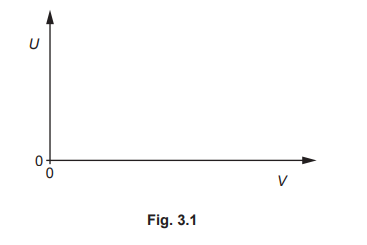
(c) The volume \(V\) of the gas in (b) is now varied, keeping its pressure constant. On Fig. 3.1, sketch the variation with \(V\) of the internal energy \(U\) of the gas.
Syllabus Topic Codes (Cambridge International AS & A Level Physics 9702 Paper 4):
▶️ Answer/Explanation
(a)(i)
An ideal gas is a gas that obeys the equation
\(pV=NkT\)
where \(p\) is pressure, \(V\) is volume, \(N\) is the number of molecules, \(k\) is the Boltzmann constant and \(T\) is thermodynamic temperature.
Answer: \( \boxed{\text{A gas that obeys }pV=NkT\text{ at all temperatures and pressures.}} \)
(a)(ii)
One assumption of the kinetic theory of an ideal gas is that there are negligible intermolecular forces between the molecules.
Therefore, there is negligible intermolecular potential energy, so the potential energy associated with the random motion of the molecules is taken to be zero.
Answer: \( \boxed{\text{There are negligible intermolecular forces, so the intermolecular potential energy is zero.}} \)
(b)(i)
For an ideal gas,
\(pV=NkT\)
Rearranging:
\(N=\frac{pV}{kT}\)
Substituting the values:
\(N=\frac{(2.0\times10^5)(0.26)}{(1.38\times10^{-23})(290)}\)
\(N=1.30\times10^{25}\)
Answer: \( \boxed{1.3\times10^{25}} \) molecules
(b)(ii)
The average translational kinetic energy of one molecule of an ideal gas is
\(E_K=\frac{3}{2}kT\)
Therefore,
\(E_K=\frac{3}{2}(1.38\times10^{-23})(290)\)
\(E_K=6.00\times10^{-21}\,\mathrm{J}\)
Answer: \( \boxed{6.0\times10^{-21}\,\mathrm{J}} \)
(b)(iii)
The internal energy of a gas is the total kinetic energy plus the total potential energy of its molecules.
For an ideal gas, the intermolecular potential energy is zero. Therefore, the internal energy is equal to the total kinetic energy of all the molecules.
Hence,
\(U=NE_K\)
\(U=(1.30\times10^{25})(6.00\times10^{-21})\)
\(U=7.80\times10^4\,\mathrm{J}\)
Answer: \( \boxed{7.8\times10^4\,\mathrm{J}} \)
(c)
The pressure is kept constant and the amount of gas is fixed.
From the ideal gas equation,
\(pV=NkT\)
Since \(p\) and \(N\) are constant,
\(V\propto T\)
For an ideal gas, internal energy depends only on temperature. Therefore,
\(U\propto T\)
Hence,
\(U\propto V\)
The graph of \(U\) against \(V\) is therefore a straight line with a positive gradient passing through the origin.
Answer: \( \boxed{\text{A straight line with positive gradient passing through the origin.}} \)
Question 4
(a) State what is meant by resonance.
(b) A small ball is held in place using a stretched string. One end of the string is fixed to a wall and the other end is attached to a vibration generator, as shown in Fig. 4.1.
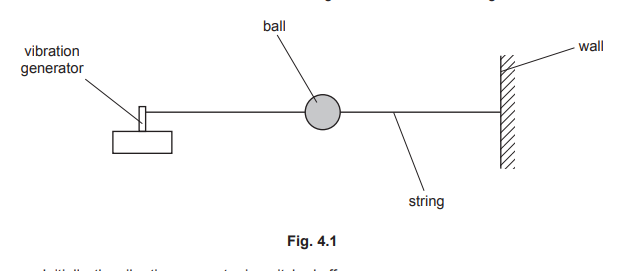
Initially, the vibration generator is switched off. A student displaces the ball vertically and then releases it. Fig. 4.2 shows the variation of the displacement of the ball with time after it is released.
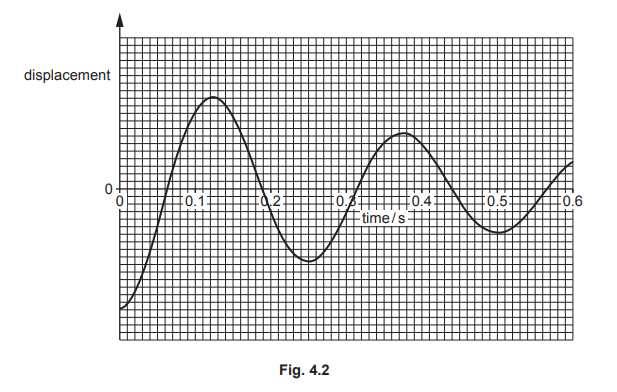
(i) State the name of the phenomenon illustrated by the decrease in the amplitude of the oscillations in Fig. 4.2.
(ii) Explain the decrease with time of the amplitude of the oscillations of the ball.
(iii) Determine the frequency of the oscillations of the ball.
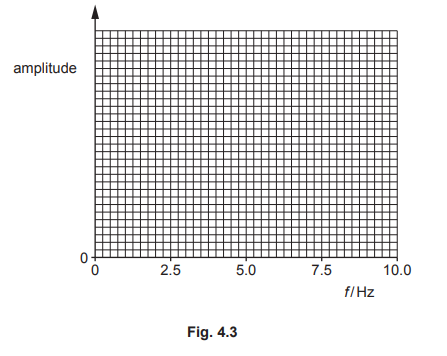
(c) The vibration generator in (b) is switched on and its frequency \(f\) of vibration is gradually increased from \(0\) to \(10\,\mathrm{Hz}\). On Fig. 4.3, sketch the variation with \(f\) of the amplitude of the oscillations of the ball.
Syllabus Topic Code (Cambridge International AS & A Level Physics 9702 Paper 4):
▶️ Answer/Explanation
(a)
Resonance occurs when a system oscillates at maximum amplitude because the frequency of the driving force is equal to the natural frequency of the system.
Answer: \( \boxed{\text{Resonance occurs when the driving frequency equals the natural frequency, producing maximum amplitude.}} \)
(b)(i)
The gradual decrease in amplitude is called damping. Since the amplitude decreases relatively slowly, this represents light damping.
Answer: \( \boxed{\text{Light damping}} \)
(b)(ii)
The ball loses energy as it oscillates because resistive forces act on the ball.
The energy transferred away by these resistive forces causes the amplitude of the oscillations to decrease with time.
Answer: \( \boxed{\text{The oscillations lose energy due to resistive forces, so the amplitude decreases with time.}} \)
(b)(iii)
From Fig. 4.2, the time period is approximately
\(T=0.25\,\mathrm{s}\)
The frequency is
\(f=\frac{1}{T}\)
\(f=\frac{1}{0.25}=4.0\,\mathrm{Hz}\)
Answer: \( \boxed{4.0\,\mathrm{Hz}} \)
(c)
The ball undergoes forced oscillations when driven by the vibration generator.
The amplitude becomes maximum when the driving frequency equals the natural frequency of the ball.
From part (b)(iii), the natural frequency is \(4.0\,\mathrm{Hz}\).
Therefore, the graph should show a single maximum at \(f=4.0\,\mathrm{Hz}\), with the amplitude decreasing on either side of this frequency.
Answer: \( \boxed{\text{A resonance curve with a maximum amplitude at }4.0\,\mathrm{Hz}} \)
Question 5
(a) Define electric field.
(b) Fig. 5.1 shows two parallel conducting plates that are in a vacuum. The plates are separated by a distance of \(6.7\,\mathrm{cm}\) and have a potential difference (p.d.) of \(430\,\mathrm{V}\) between them.
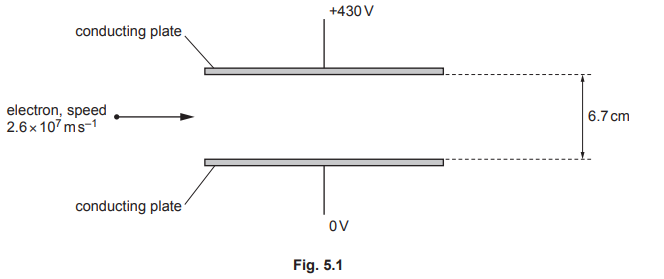
(i) On Fig. 5.1, draw four field lines to represent the electric field between the plates.
(ii) Determine the strength \(E\) of the electric field between the plates.
(iii) An electron travels at a speed of \(2.6\times10^7\,\mathrm{m\,s^{-1}}\) towards the region between the plates, as shown in Fig. 5.1. On Fig. 5.1, draw the path of the electron as it moves between and beyond the plates.
(c) A uniform magnetic field is now applied in the region of the electric field in Fig. 5.1, so that the electron in (b)(iii) travels undeviated through the region.
(i) Determine the direction of the uniform magnetic field.
(ii) Explain, with reference to the forces exerted by the two fields on the electron, why the path of the electron is undeviated.
(iii) Determine the flux density \(B\) of the uniform magnetic field. Give a unit with your answer.
Syllabus Topic Codes (Cambridge International AS & A Level Physics 9702 Paper 4):
• 18.2: Uniform electric fields — parts (b)(ii) and (b)(iii), electric field strength between parallel plates and motion of a charged particle in a uniform electric field
• 20.3: Force on a moving charge — parts (c)(i), (c)(ii) and (c)(iii), magnetic force on a moving charged particle and crossed electric and magnetic fields
▶️ Answer/Explanation
(a)
An electric field is a region in which a charged particle experiences an electric force.
The electric field strength is defined as the force per unit positive charge:
\(E=\frac{F}{q}\)
Answer: \( \boxed{\text{Force per unit positive charge at a point.}} \)
(b)(i)
Between parallel conducting plates, the electric field is uniform. Therefore, the field should be represented by four straight, parallel and approximately equally spaced lines.
The arrows point from the positive plate towards the negative plate, as shown in Fig. 5.1.
Answer: Four straight, parallel, equally spaced vertical field lines with arrows directed downwards.
(b)(ii)
For a uniform electric field between parallel plates,
\(E=\frac{V}{d}\)
The plate separation is
\(d=6.7\,\mathrm{cm}=0.067\,\mathrm{m}\)
Therefore,
\(E=\frac{430}{0.067}\)
\(E=6.42\times10^3\,\mathrm{N\,C^{-1}}\)
Answer: \( \boxed{6.4\times10^3\,\mathrm{N\,C^{-1}}} \)
(b)(iii)
The electron has negative charge, so the electric force on it is opposite to the direction of the electric field.
As the electron moves between the plates, it experiences a constant force in the upward direction. Hence, it has a constant upward acceleration.
Its path between the plates is therefore a smooth curved, approximately parabolic path. Once it leaves the region between the plates, there is no electric force, so it continues in a straight line in the direction of its velocity at that point.
Answer: A smooth curve deflecting upwards between the plates, followed by a straight-line path beyond the plates.
(c)(i)
The electric force on the electron is upward. For the electron to travel undeviated, the magnetic force must act downward.
Using Fleming’s left-hand rule for a negative charge, the required magnetic field is directed into the page.
Answer: \( \boxed{\text{Into the page}} \)
(c)(ii)
The electron experiences two forces:
Electric force: \(F_E=Eq\)
Magnetic force: \(F_B=Bqv\)
These forces act in opposite directions.
The electron travels undeviated when the magnitudes of the two forces are equal:
\(F_E=F_B\)
Answer: \( \boxed{\text{The electric and magnetic forces are equal in magnitude and opposite in direction.}} \)
(c)(iii)
For an undeviated particle,
\(Eq=Bqv\)
Cancelling \(q\):
\(E=Bv\)
Therefore,
\(B=\frac{E}{v}\)
\(B=\frac{6.4\times10^3}{2.6\times10^7}\)
\(B=2.46\times10^{-4}\,\mathrm{T}\)
Answer: \( \boxed{2.5\times10^{-4}\,\mathrm{T}} \)
Question 6
Fig. 6.1 shows a capacitor of capacitance \(C\) connected in series with a resistor of resistance \(R\).
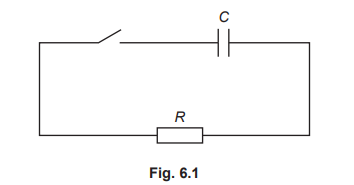
Initially the switch is open and there is a p.d. of \(12\,\mathrm{V}\) across the capacitor. At time \(t=0\), the switch is closed so that there is a current \(I\) in the resistor. Fig. 6.2 shows the variation of \(I\) with \(t\).
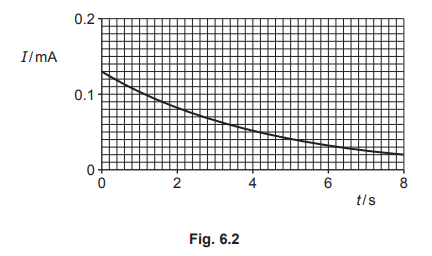
(a) Explain the shape of the line in Fig. 6.2.
(b) Use Fig. 6.2 to determine:
(i) resistance \(R\)
(ii) the time constant \(\tau\) of the circuit in Fig. 6.1.
(c) Use your answers in (b) to determine capacitance \(C\).
Syllabus Topic Code (Cambridge International AS & A Level Physics 9702 Paper 4):
▶️ Answer/Explanation
(a)
The p.d. across a capacitor is proportional to the charge \(Q\) stored on it:
\(V_C=\frac{Q}{C}\)
During discharge, the p.d. across the capacitor is equal in magnitude to the p.d. across the resistor.
For the resistor,
\(V_R=IR\)
Therefore, the current is proportional to the charge remaining on the capacitor.
As the capacitor discharges, the charge decreases, so the current also decreases. The rate at which the current decreases becomes smaller as the current becomes smaller.
Hence, the current decreases exponentially with time.
Answer: \( \boxed{\text{The current decreases exponentially because the charge and hence the p.d. across the capacitor decrease continuously during discharge.}} \)
(b)(i)
At \(t=0\), the capacitor has a p.d. of \(12\,\mathrm{V}\), so this is also the initial p.d. across the resistor.
From Fig. 6.2, the initial current is approximately
\(I_0=0.13\,\mathrm{mA}=0.13\times10^{-3}\,\mathrm{A}\)
Using Ohm’s law,
\(R=\frac{V}{I}\)
\(R=\frac{12}{0.13\times10^{-3}}\)
\(R=9.23\times10^4\,\Omega\)
Answer: \( \boxed{9.2\times10^4\,\Omega} \)
(b)(ii)
The current during discharge is given by
\(I=I_0e^{-t/\tau}\)
From Fig. 6.2, when \(I=0.048\,\mathrm{mA}\), the corresponding time is approximately \(t=4.3\,\mathrm{s}\).
Thus,
\(0.048=0.13e^{-4.3/\tau}\)
Solving gives
\(\tau\approx4.3\,\mathrm{s}\)
Answer: \( \boxed{4.3\,\mathrm{s}} \)
(c)
For a discharging capacitor, the time constant is
\(\tau=RC\)
Therefore,
\(C=\frac{\tau}{R}\)
\(C=\frac{4.3}{9.2\times10^4}\)
\(C=4.67\times10^{-5}\,\mathrm{F}\)
Answer: \( \boxed{4.7\times10^{-5}\,\mathrm{F}} \)
Question 7
A circuit contains a power supply that provides a sinusoidal alternating input voltage \(V_{IN}\). There is an output voltage \(V_{OUT}\) across a load resistor \(R\), as shown in Fig. 7.1.
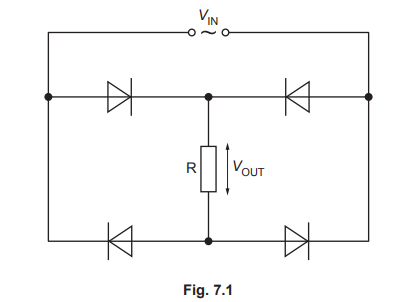
(a) State the purpose of the circuit in Fig. 7.1.
(b) Fig. 7.2 shows the variation of \(V_{OUT}\) with time \(t\).
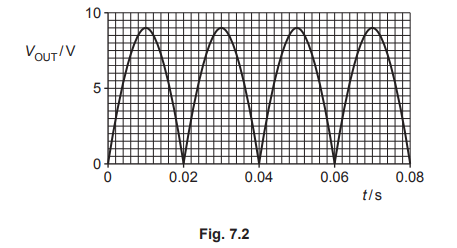
(i) The load resistor \(R\) has a resistance of \(370\,\Omega\). Show that the maximum power dissipated in \(R\) is \(0.22\,\mathrm{W}\).
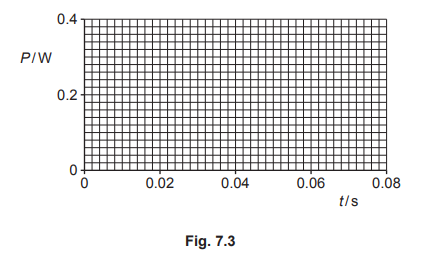
(ii) On Fig. 7.3, sketch the variation with \(t\) of the power \(P\) dissipated in \(R\).
(iii) Calculate the mean power dissipated in \(R\).
(c) The circuit of Fig. 7.1 is disconnected, and \(R\) is connected directly across the power supply. Explain, without calculation, how the mean power now dissipated in \(R\) compares with the answer in (b)(iii).
Syllabus Topic Code (Cambridge International AS & A Level Physics 9702 Paper 4):
▶️ Answer/Explanation
(a)
The circuit is used for rectification of the sinusoidal alternating voltage.
The output shown is full-wave rectified, so both half-cycles of the input voltage produce an output of the same polarity.
Answer: \( \boxed{\text{Full-wave rectification}} \)
(b)(i)
The maximum output voltage from Fig. 7.2 is approximately
\(V_{\max}=9.0\,\mathrm{V}\)
The power dissipated by a resistor is
\(P=\frac{V^2}{R}\)
Therefore, the maximum power is
\(P_{\max}=\frac{(9.0)^2}{370}\)
\(P_{\max}=0.219\,\mathrm{W}\)
Answer: \( \boxed{0.22\,\mathrm{W}} \)
(b)(ii)
Since
\(P=\frac{V^2}{R}\)
the power is proportional to \(V^2\).
The voltage is full-wave rectified, so the power has the same positive sinusoidal-squared shape for every half-cycle. The power is zero whenever \(V=0\), and reaches \(0.22\,\mathrm{W}\) at each voltage maximum.
The minima occur at \(t=0,\ 0.02,\ 0.04,\ 0.06,\ 0.08\,\mathrm{s}\), while the maxima occur at \(t=0.01,\ 0.03,\ 0.05,\ 0.07\,\mathrm{s}\).
Answer: A repeated sinusoidal-squared curve with minima on the time axis and all maxima at \(0.22\,\mathrm{W}\).
(b)(iii)
For a sinusoidal voltage, the mean value of \(V^2\) is half its maximum value. Therefore, the mean power is half the maximum power:
\(P_{\mathrm{mean}}=\frac{P_{\max}}{2}\)
\(P_{\mathrm{mean}}=\frac{0.22}{2}\)
\(P_{\mathrm{mean}}=0.11\,\mathrm{W}\)
Answer: \( \boxed{0.11\,\mathrm{W}} \)
(c)
Connecting \(R\) directly across the sinusoidal power supply produces an alternating voltage across the resistor.
However, the power dissipated is
\(P=\frac{V^2}{R}\)
Since squaring the voltage removes the sign, the power-time graph is identical to that for the full-wave rectified output.
Answer: \( \boxed{\text{The mean power is the same, }0.11\,\mathrm{W}.} \)
Question 8
(a) State what is meant by a photon.
(b) Fig. 8.1 shows a tube in which X-rays are produced at a metal target.
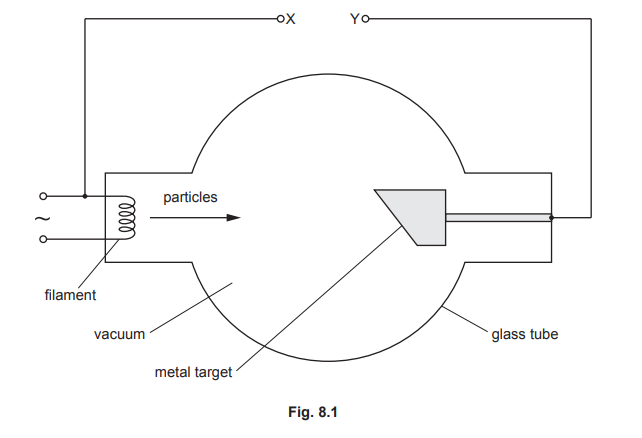
Particles are accelerated from the filament to the target by a constant high voltage applied across the terminals X and Y.
(i) State the name of the particles.
(ii) On Fig. 8.1, use + and – signs to label terminals X and Y to indicate the polarity of the high voltage.
(c) For an accelerating voltage of \(32\,\mathrm{kV}\) in Fig. 8.1, determine:
(i) the maximum energy, in MeV, of an X-ray photon produced at the target
(ii) the maximum momentum of an X-ray photon produced at the target
(iii) the minimum wavelength of X-rays produced at the target.
(d) Explain why X-rays can be used to produce images of internal body structures that have good contrast.
Syllabus Topic Codes (Cambridge International AS & A Level Physics 9702 Paper 4):
• 24.2: Production and use of X-rays — parts (b), (c)(i), (c)(iii) and (d)
▶️ Answer/Explanation
(a)
A photon is a quantum, or discrete packet, of energy of electromagnetic radiation.
The energy of a photon is given by
\(E=hf\)
Answer: \( \boxed{\text{A quantum (packet) of energy of electromagnetic radiation.}} \)
(b)(i)
The particles emitted from the heated filament and accelerated towards the metal target are electrons.
Answer: \( \boxed{\text{Electrons}} \)
(b)(ii)
Electrons have negative charge, so the terminal from which they are accelerated must be negative. The target is positive so that the electrons are attracted towards it.
Answer: \( \boxed{\mathrm{X}=-,\quad \mathrm{Y}=+} \)
(c)(i)
The maximum kinetic energy gained by an electron accelerated through a potential difference \(V\) is
\(E=eV\)
For \(V=32\,\mathrm{kV}\),
\(E=(1.60\times10^{-19})(32\times10^3)\)
\(E=5.12\times10^{-15}\,\mathrm{J}\)
Since \(1\,\mathrm{eV}=1.60\times10^{-19}\,\mathrm{J}\),
\(E=32\,\mathrm{keV}=0.032\,\mathrm{MeV}\)
Answer: \( \boxed{0.032\,\mathrm{MeV}} \)
(c)(ii)
For a photon,
\(E=pc\)
Therefore,
\(p=\frac{E}{c}\)
Using \(E=0.032\,\mathrm{MeV}=0.032\times1.60\times10^{-13}\,\mathrm{J}\),
\(p=\frac{0.032\times1.60\times10^{-13}}{3.00\times10^8}\)
\(p=1.71\times10^{-23}\,\mathrm{N\,s}\)
Answer: \( \boxed{1.7\times10^{-23}\,\mathrm{N\,s}} \)
(c)(iii)
For electromagnetic radiation,
\(E=hf\)
and
\(c=f\lambda\)
Therefore,
\(\lambda=\frac{hc}{E}\)
\(\lambda=\frac{(6.63\times10^{-34})(3.00\times10^8)}{(0.032)(1.60\times10^{-13})}\)
\(\lambda=3.89\times10^{-11}\,\mathrm{m}\)
Answer: \( \boxed{3.9\times10^{-11}\,\mathrm{m}} \)
(d)
X-rays are absorbed differently by different materials in the body.
Bone and soft tissue have different attenuation coefficients, so they absorb and transmit X-rays by different amounts.
Consequently, the transmitted intensities through bone and soft tissue are significantly different, producing good contrast between different internal structures in the image.
Answer: \( \boxed{\text{Bone and soft tissue attenuate X-rays by different amounts, producing different transmitted intensities and hence good image contrast.}} \)
Question 9
(a) Define half-life of a radioactive isotope.
(b) Radioactive isotope X decays to isotope Y. A sample contains only nuclei of X at time \(t=0\). Fig. 9.1 shows the variation with \(t\) of the numbers of nuclei of X and of Y as the sample decays.
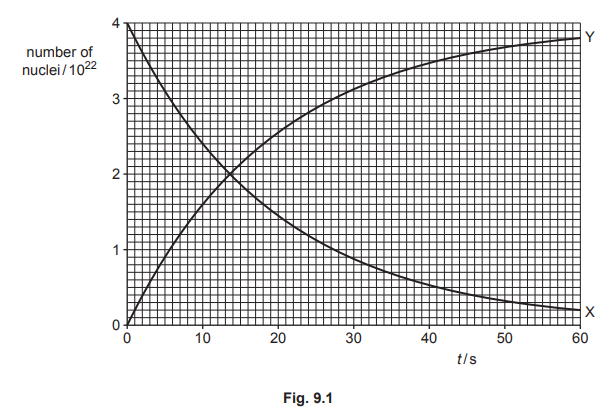
(i) State the name of the quantity represented by the magnitude of the gradient of line X in Fig. 9.1.
(ii) State three conclusions about X or Y that may be drawn from Fig. 9.1. The conclusions may be qualitative or quantitative. Use the space below for any working that you need.
(c) The mass of radioactive isotope X in the sample in (b) is \(7.3\times10^{-4}\,\mathrm{kg}\) at time \(t=0\). Determine the nucleon number of isotope X.
Syllabus Topic Code (Cambridge International AS & A Level Physics 9702 Paper 4):
▶️ Answer/Explanation
(a)
The half-life of a radioactive isotope is the time taken for the activity of a sample to decrease to half its initial value.
Equivalently, it is the time taken for the number of undecayed nuclei to decrease to half its initial value.
Answer: \( \boxed{\text{The time taken for the activity, or number of undecayed nuclei, to halve.}} \)
(b)(i)
The gradient of a graph of the number of radioactive nuclei \(N\) against time \(t\) represents the rate of change of the number of nuclei.
For isotope X, the number of nuclei decreases with time, so the magnitude of the gradient represents the activity:
\(A=-\frac{\mathrm{d}N}{\mathrm{d}t}\)
Answer: \( \boxed{\text{Activity of isotope X}} \)
(b)(ii)
Three valid conclusions from Fig. 9.1 are:
• \(Y\) is a stable isotope.
• The total number of nuclei of \(X+Y\) remains constant.
• The half-life of \(X\) is approximately \(13.6\,\mathrm{s}\).
Other valid conclusions include:
• The decay constant of \(X\) is approximately \(0.051\,\mathrm{s^{-1}}\).
• The initial amount of \(X\) is approximately \(0.066\,\mathrm{mol}\).
• The initial activity of \(X\) is approximately \(2.0\times10^{21}\,\mathrm{Bq}\).
Answer: Any three of the valid conclusions above.
(c)
From Fig. 9.1, the initial number of nuclei of \(X\) is approximately
\(N_0=4.0\times10^{22}\)
Therefore, the mass of one nucleus is
\(m_{\mathrm{nucleus}}=\frac{7.3\times10^{-4}}{4.0\times10^{22}}\)
The mass of one nucleon is approximately \(1.66\times10^{-27}\,\mathrm{kg}\).
Hence, the nucleon number \(A\) is
\(A=\frac{m_{\mathrm{nucleus}}}{1.66\times10^{-27}}\)
\(A=\frac{7.3\times10^{-4}}{(4.0\times10^{22})(1.66\times10^{-27})}\)
\(A\approx11\)
Answer: \( \boxed{11} \)
Question 10
(a)(i) State what is meant by the luminosity of a star.
(ii) Explain how a standard candle in a distant galaxy can be used to determine the distance of the galaxy from an observer.
(b) The Sun has a radius of \(6.96\times10^8\,\mathrm{m}\) and a surface temperature of \(5780\,\mathrm{K}\). Light from the Sun is observed to have a peak intensity at a wavelength of \(501\,\mathrm{nm}\).
(i) Calculate the luminosity of the Sun. Give a unit with your answer.
(ii) Another star emits radiation that has a peak intensity at a wavelength of \(624\,\mathrm{nm}\). Determine the surface temperature of this star.
Syllabus Topic Codes (Cambridge International AS & A Level Physics 9702 Paper 4):
• 25.2: Stellar radii — parts (b)(i) and (b)(ii), luminosity, stellar temperature and peak wavelength
▶️ Answer/Explanation
(a)(i)
Luminosity is the total power radiated by a star in all directions.
Answer: \( \boxed{\text{The total power radiated by a star.}} \)
(a)(ii)
A standard candle is an astronomical object whose luminosity is known.
The radiant flux intensity \(F\) received by an observer is measured. The distance \(d\) can then be calculated using
\(F=\frac{L}{4\pi d^2}\)
Rearranging gives
\(d=\sqrt{\frac{L}{4\pi F}}\)
Answer: \( \boxed{\text{Use the known luminosity and measured radiant flux intensity to calculate the distance.}} \)
(b)(i)
The luminosity of a star is given by the Stefan-Boltzmann law:
\(L=4\pi\sigma r^2T^4\)
Substituting the values:
\(L=4\pi(5.67\times10^{-8})(6.96\times10^8)^2(5780)^4\)
\(L=3.85\times10^{26}\,\mathrm{W}\)
Answer: \( \boxed{3.85\times10^{26}\,\mathrm{W}} \)
(b)(ii)
Wien’s displacement law gives
\(\lambda_{\max}T=\text{constant}\)
Therefore, for the Sun and the second star,
\(\lambda_{\mathrm{Sun}}T_{\mathrm{Sun}}=\lambda_{\mathrm{star}}T_{\mathrm{star}}\)
Hence,
\(T_{\mathrm{star}}=\frac{5780\times501}{624}\)
\(T_{\mathrm{star}}=4640\,\mathrm{K}\)
Answer: \( \boxed{4640\,\mathrm{K}} \)