
Question 1
Topic: 1.4 Scalars and vectors.png)
Which quantity is a vector?
(B) temperature
(C) weight
(D) work
▶️ Answer/Explanation
Correct Answer: \( \boxed{\mathrm{C}} \)
A vector quantity has both magnitude and direction.
Weight is the gravitational force acting on an object and always acts toward the centre of the Earth, so it has both magnitude and direction.
Pressure, temperature, and work are scalar quantities because they have magnitude only.
Therefore, the correct answer is (C).
Question 2
Topic: 1.3 Errors and uncertainties
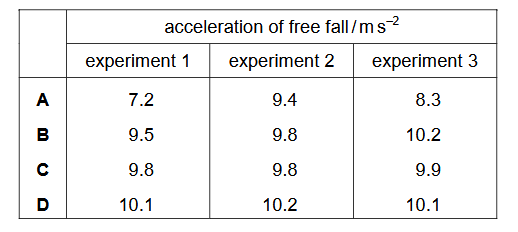
Four students, A, B, C and D, have completed an experiment to determine the acceleration of free fall, \(g\). Each student repeated the experiment three times. The determined values of \(g\) are shown in the table.
Which set of results has a high precision and a low accuracy?
(B) Student B
(C) Student C
(D) Student D
▶️ Answer/Explanation
Correct Answer: \( \boxed{\mathrm{D}} \)
Precision refers to how closely repeated measurements agree with one another, while accuracy refers to how close the measurements are to the true value of \(g \approx 9.81\,\mathrm{m\,s^{-2}}\).
Student D’s results (\(10.1,\ 10.2,\ 10.1\)) are very close to each other, indicating high precision. However, they are consistently higher than the accepted value of \(g\), indicating low accuracy due to a systematic error.
Student C has both high precision and high accuracy, Student B has moderate precision, and Student A has poor precision.
Therefore, the correct answer is (D).
Question 3
Topic: 1.3 Errors and uncertainties
The diameter of a ball is measured as \( (5.26 \pm 0.02)\,\mathrm{cm} \).
What is the absolute uncertainty in the volume of the ball?
(B) \(0.87\,\mathrm{cm^3}\)
(C) \(1.1\,\mathrm{cm^3}\)
(D) \(7.0\,\mathrm{cm^3}\)
▶️ Answer/Explanation
Correct Answer: \( \boxed{\mathrm{B}} \)
The volume of a sphere is
\( V=\dfrac{\pi d^3}{6} \)
For a quantity raised to a power, the percentage uncertainty is multiplied by the power.
Percentage uncertainty in the diameter:
\( \dfrac{0.02}{5.26}\times100\% \approx 0.38\% \)
Percentage uncertainty in the volume:
\( 3 \times 0.38\% \approx 1.14\% \)
The volume of the ball is
\( V=\dfrac{\pi(5.26)^3}{6}\approx 76.4\,\mathrm{cm^3} \)
Absolute uncertainty:
\( \Delta V=0.0114 \times 76.4 \approx 0.87\,\mathrm{cm^3} \)
Therefore, the correct answer is (B).
Question 4
Topic: 1.4 Scalars and vectors.png)
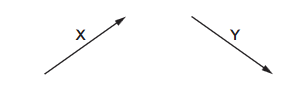
Two vectors, X and Y, are shown.
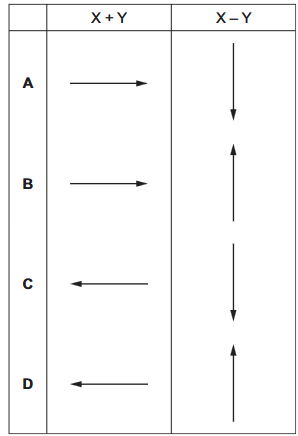
What are the directions of \(X+Y\) and \(X-Y\)?
▶️ Answer/Explanation
Correct Answer: \( \boxed{\mathrm{B}} \)
Vector X is directed up and to the right, while vector Y is directed down and to the right.
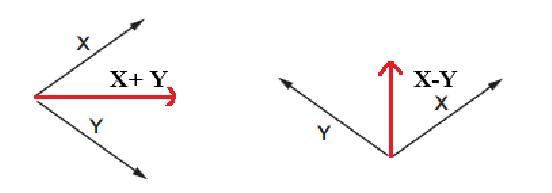
For \(X+Y\), the vertical components cancel because they are equal and opposite, while the horizontal components add together. Hence, \(X+Y\) points horizontally to the right.
For \(X-Y=X+(-Y)\), reversing \(Y\) gives a vector directed up and to the left. Adding this to \(X\) causes the horizontal components to cancel while the vertical components add, giving a vector directed upward.
Therefore, the correct answer is (B).
Question 5
Topic: 2.1 Equations of motion
A ball is projected vertically downwards with an initial velocity of \(20\,\mathrm{m\,s^{-1}}\). Air resistance is negligible.
What is the displacement from its initial position of the ball after a time of \(1.5\,\mathrm{s}\)?
(B) \(19\,\mathrm{m}\)
(C) \(37\,\mathrm{m}\)
(D) \(41\,\mathrm{m}\)
▶️ Answer/Explanation
Correct Answer: \( \boxed{\mathrm{D}} \)
Using the equation of motion,
\( s=ut+\dfrac{1}{2}at^2 \)
where \(u=20\,\mathrm{m\,s^{-1}}\), \(a=g\approx9.8\,\mathrm{m\,s^{-2}}\), and \(t=1.5\,\mathrm{s}\).
\( s=(20)(1.5)+\dfrac{1}{2}(9.8)(1.5)^2 \)
\( s=30+11.025\approx41\,\mathrm{m} \)
Hence, the displacement after \(1.5\,\mathrm{s}\) is approximately \(41\,\mathrm{m}\).
Therefore, the correct answer is (D).
Question 6
Topic: 7.4 Electromagnetic spectrum
A surveyor’s device emits a pulse of light. The light is reflected from a wall \(150\,\mathrm{m}\) away.
What is the total time taken for the pulse to travel from the device to the wall and then back to the device?
(B) \(0.10\,\mathrm{ns}\)
(C) \(0.50\,\mathrm{\mu s}\)
(D) \(1.0\,\mathrm{\mu s}\)
▶️ Answer/Explanation
Correct Answer: \( \boxed{\mathrm{D}} \)
The light travels to the wall and back, so the total distance travelled is
\( d=2\times150=300\,\mathrm{m} \)
Using the speed of light, \(c=3.0\times10^8\,\mathrm{m\,s^{-1}}\),
\( t=\dfrac{d}{c}=\dfrac{300}{3.0\times10^8}=1.0\times10^{-6}\,\mathrm{s} \)
\( 1.0\times10^{-6}\,\mathrm{s}=1.0\,\mathrm{\mu s} \)
Therefore, the correct answer is (D).
Question 7
Topic: 2.1 Equations of motion.png)
Which equation of uniformly accelerated motion can be derived using only the gradient of a velocity–time graph?
(B) \( s=ut+\dfrac{1}{2}at^2 \)
(C) \( v=u+at \)
(D) \( v^2=u^2+2as \)
▶️ Answer/Explanation
Correct Answer: \( \boxed{\mathrm{C}} \)
The gradient of a velocity–time graph gives the acceleration:
\( a=\dfrac{v-u}{t} \)
Rearranging gives
\( v=u+at \)
The other equations require using the area under the velocity–time graph or combining multiple equations of motion.
Therefore, the correct answer is (C).
Question 8
Topic: 2.1 Equations of motion
An object is projected horizontally from a table at time \(t=0\). The object falls in a uniform gravitational field. Air resistance is negligible.
Graphs \(P\), \(Q\), \(R\), and \(S\) are velocity–time graphs.
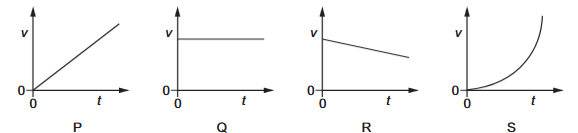
Which graphs represent the horizontal and vertical components of the velocity of the object?
(B) Horizontal: \(Q\), Vertical: \(S\)
(C) Horizontal: \(R\), Vertical: \(P\)
(D) Horizontal: \(R\), Vertical: \(S\)
▶️ Answer/Explanation
Correct Answer: \( \boxed{\mathrm{A}} \)
With negligible air resistance, there is no horizontal acceleration, so the horizontal component of velocity remains constant. This is represented by graph \(Q\).
The vertical component starts from zero and increases linearly with time because the object experiences a constant downward acceleration \(g\).
Using \(v=u+at\), with \(u=0\),
\( v=gt \)
This corresponds to graph \(P\).
Therefore, the correct answer is (A).
Question 9
Topic: 3.3 Linear momentum and its conservation.
What is always conserved in elastic collisions?
(B) Total kinetic energy: yes Total velocity: no
(C) Total kinetic energy: no Total velocity: yes
(D) Total kinetic energy: no Total velocity: no
▶️ Answer/Explanation
Correct Answer: \( \boxed{\mathrm{B}} \)
In an elastic collision, both linear momentum and total kinetic energy are conserved.
However, the total velocity of the objects is not conserved because individual velocities generally change during the collision.
The conservation of momentum is expressed as
\( \sum \vec{p}_{\mathrm{before}}=\sum \vec{p}_{\mathrm{after}} \)
and kinetic energy is conserved only for elastic collisions.
Therefore, the correct answer is (B).
Question 10
Topic: 3.1 Momentum and Newton’s laws of motion.png)
A firework travels vertically upwards in air. Gases are pushed vertically downwards from the firework.
Several forces that act on the firework and gases are shown.
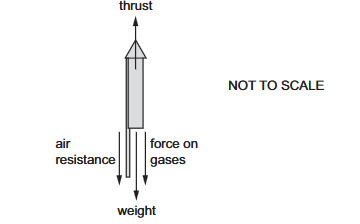
Which forces are a Newton’s third law pair?
(B) air resistance and thrust
(C) force on gases and thrust
(D) thrust and weight
▶️ Answer/Explanation
Correct Answer: \( \boxed{\mathrm{C}} \)
According to Newton’s third law, forces occur in equal and opposite pairs acting on different objects.
The firework exerts a downward force on the gases, labelled force on gases. In response, the gases exert an equal upward force on the firework, labelled thrust.
These two forces act on different bodies and are equal in magnitude but opposite in direction, making them a Newton’s third law pair.
Air resistance and weight do not form third-law pairs with thrust because they arise from different interactions.
Therefore, the correct answer is (C).
Question 11
Topic: 3.3 Linear momentum and its conservation
Two blocks \(K\) and \(L\) slide towards each other along a horizontal frictionless surface. The diagram shows the momentum of the two blocks just before they collide.
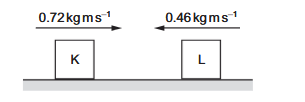
During the collision, the blocks are in contact with each other for a time of \(0.084\,\mathrm{s}\).
After the collision, the blocks separate and block \(L\) moves back along its original path with a momentum of \(0.12\,\mathrm{kg\,m\,s^{-1}}\).
What is the magnitude of the average force exerted on block \(L\) by block \(K\) during the collision?
(B) \(4.0\,\mathrm{N}\)
(C) \(6.9\,\mathrm{N}\)
(D) \(7.1\,\mathrm{N}\)
▶️ Answer/Explanation
Correct Answer: \( \boxed{\mathrm{C}} \)
Take the initial direction of block \(L\) as negative.
Initial momentum of block \(L\):
\( p_i=-0.46\,\mathrm{kg\,m\,s^{-1}} \)
Final momentum of block \(L\):
\( p_f=+0.12\,\mathrm{kg\,m\,s^{-1}} \)
The change in momentum is
\( \Delta p=p_f-p_i=0.12-(-0.46)=0.58\,\mathrm{kg\,m\,s^{-1}} \)
Using the impulse equation,
\( F_{\mathrm{avg}}=\dfrac{\Delta p}{\Delta t}=\dfrac{0.58}{0.084}\approx6.9\,\mathrm{N} \)
Therefore, the correct answer is (C).
Question 12
Topic: 5.2 Gravitational potential energy and kinetic energy.png)
Leonardo da Vinci proposed a flying machine that would work like a screw to lift the pilot into the air. The ‘screw’ is rotated by the pilot.
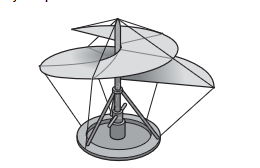
The machine and the pilot together have a total mass of \(120\,\mathrm{kg}\).
Which useful output power must the pilot provide to move vertically upwards at a constant speed of \(2.5\,\mathrm{m\,s^{-1}}\)?
(B) \(300\,\mathrm{W}\)
(C) \(470\,\mathrm{W}\)
(D) \(2900\,\mathrm{W}\)
▶️ Answer/Explanation
Correct Answer: \( \boxed{\mathrm{D}} \)
At constant speed, the upward thrust equals the weight of the machine and pilot.
Useful output power is
\( P=Fv=mgv \)
Substituting \(m=120\,\mathrm{kg}\), \(g=9.8\,\mathrm{m\,s^{-2}}\), and \(v=2.5\,\mathrm{m\,s^{-1}}\):
\( P=120\times9.8\times2.5=2940\,\mathrm{W}\approx2900\,\mathrm{W} \)
Therefore, the correct answer is (D).
Question 13
Topic: 4.1 Turning effects of forces
Which row describes a pair of forces that forms a couple?
| Direction of the forces | Magnitude of the forces | |
|---|---|---|
| A | opposite | different |
| B | opposite | equal |
| C | same | different |
| D | same | equal |
▶️ Answer/Explanation
Correct Answer: \( \boxed{\mathrm{B}} \)
A couple consists of two forces that:
• have equal magnitudes,
• act in opposite directions, and
• act along parallel but different lines of action.
The forces produce a turning effect (moment) without causing any resultant force.
Therefore, the correct answer is (B).
Question 14
Topic: 4.3 Density and pressure.png)
A uniform cylinder of weight \(25.0\,\mathrm{N}\) is suspended from a newton meter.
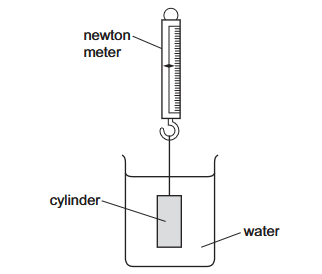
The cylinder is fully submerged in water, as shown. The reading on the newton meter is \(10.0\,\mathrm{N}\).
The water is replaced by a liquid with a density \(10\%\) greater than the density of water. The cylinder remains fully submerged.
What is the new reading on the newton meter?
(B) \(9.0\,\mathrm{N}\)
(C) \(11.0\,\mathrm{N}\)
(D) \(11.5\,\mathrm{N}\)
▶️ Answer/Explanation
Correct Answer: \( \boxed{\mathrm{B}} \)
The apparent weight is
\( W_{\mathrm{apparent}}=W-F_{\mathrm{b}} \)
Initially, the buoyant force is
\( F_{\mathrm{b}}=25.0-10.0=15.0\,\mathrm{N} \)
Since buoyant force is proportional to the liquid density, increasing the density by \(10\%\) increases the buoyant force to
\( F_{\mathrm{b,new}}=1.10\times15.0=16.5\,\mathrm{N} \)
The new newton meter reading is
\( W_{\mathrm{apparent}}=25.0-16.5=8.5\,\mathrm{N} \)
Therefore, the correct answer is (A).
Question 15
Topic: 4.1 Turning effects of forces
A student balances a \(30\,\mathrm{cm}\) ruler on a fulcrum set at the \(15\,\mathrm{cm}\) mark. The student then places a \(50\,\mathrm{g}\) mass on the \(23\,\mathrm{cm}\) mark and a \(20\,\mathrm{g}\) mass on the \(11\,\mathrm{cm}\) mark, as shown.

Which mass should she place on the \(7\,\mathrm{cm}\) mark to restore the balance?
(B) \(40\,\mathrm{g}\)
(C) \(47\,\mathrm{g}\)
(D) \(133\,\mathrm{g}\)
▶️ Answer/Explanation
Correct Answer: \( \boxed{\mathrm{B}} \)
For equilibrium, the clockwise and anticlockwise moments about the fulcrum must be equal.
Clockwise moment:
\(50\times(23-15)=400\,\mathrm{g\,cm}\)
Anticlockwise moment due to the \(20\,\mathrm{g}\) mass:
\(20\times(15-11)=80\,\mathrm{g\,cm}\)
Let the required mass be \(m\).
\(80+8m=400\)
\(m=40\,\mathrm{g}\)
Therefore, the correct answer is (B).
Question 16
Topic: 4.3 Density and pressure
A submarine is at a depth of \(130\,\mathrm{m}\) below the surface of the sea.
The pressure on the submarine due to the sea water is \(p\).
The submarine sinks to a depth of \(260\,\mathrm{m}\) below the surface. Assume that the density of sea water is constant.
What is the difference between the pressures on the submarine due to the sea water at the two depths?
(B) \(0.5p\)
(C) \(p\)
(D) \(2p\)
▶️ Answer/Explanation
Correct Answer: \( \boxed{\mathrm{C}} \)
Pressure due to a liquid is given by
\( p=\rho gh \)
Since pressure is directly proportional to depth, doubling the depth from \(130\,\mathrm{m}\) to \(260\,\mathrm{m}\) doubles the pressure.
Initial pressure: \(p\)
Final pressure: \(2p\)
Difference in pressure:
\(2p-p=p\)
Therefore, the correct answer is (C).
Question 17
Topic: 5.2 Gravitational potential energy and kinetic energy.png)
An object is falling in a uniform gravitational field.
Which two quantities are sufficient to calculate the change in gravitational potential energy?
(B) mass and change in vertical displacement
(C) weight and acceleration of free fall
(D) weight and change in vertical displacement
▶️ Answer/Explanation
Correct Answer: \( \boxed{\mathrm{D}} \)
The change in gravitational potential energy is given by
\( \Delta E_{\mathrm{p}}=mg\Delta h \)
Since the weight of the object is \(W=mg\), the equation can be written as
\( \Delta E_{\mathrm{p}}=W\Delta h \)
Therefore, knowing the weight and the change in vertical displacement is sufficient to calculate the change in gravitational potential energy.
Therefore, the correct answer is (D).
Question 18
Topic: 5.1 Energy conservation
The points \(X\), \(Y\) and \(Z\) are on a rough, horizontal surface.
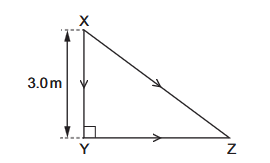
A box \(P\) is pushed across the surface from \(X\) to \(Y\) and then from \(Y\) to \(Z\).
The distance from \(X\) to \(Y\) is \(3.0\,\mathrm{m}\). The work done against the frictional force in moving the box from \(X\) to \(Y\) is \(150\,\mathrm{J}\).
The work done against the frictional force in moving the box from \(Y\) to \(Z\) is \(200\,\mathrm{J}\).
An identical box \(Q\) is pushed in a straight line from \(X\) to \(Z\).
The magnitude of the frictional force between the boxes and the surface is constant.
How much extra work is done against the frictional force in moving \(P\) than \(Q\)?
(B) \(250\,\mathrm{J}\)
(C) \(350\,\mathrm{J}\)
(D) \(600\,\mathrm{J}\)
▶️ Answer/Explanation
Correct Answer: \( \boxed{\mathrm{A}} \)
Since the frictional force is constant, the work done against friction is proportional to the distance travelled.
From \(X\) to \(Y\):
\(F=\dfrac{150}{3.0}=50\,\mathrm{N}\)
From \(Y\) to \(Z\):
\(YZ=\dfrac{200}{50}=4.0\,\mathrm{m}\)
The straight-line distance from \(X\) to \(Z\) is
\(XZ=\sqrt{3^2+4^2}=5.0\,\mathrm{m}\)
Work done in moving box \(Q\):
\(W_Q=50\times5=250\,\mathrm{J}\)
Work done in moving box \(P\):
\(W_P=150+200=350\,\mathrm{J}\)
Extra work:
\(350-250=100\,\mathrm{J}\)
Therefore, the correct answer is (A).
Question 19
Topic: 5.2 Gravitational potential energy and kinetic energy
The momentum of a car of mass \(m\) increases from \(p_1\) to \(p_2\).
What is the increase in kinetic energy of the car?
(B) \( \dfrac{(p_2-p_1)^2}{2m} \)
(C) \( \dfrac{p_2-p_1}{2m} \)
(D) \( \dfrac{p_1-p_2}{2m} \)
▶️ Answer/Explanation
Correct Answer: \( \boxed{\mathrm{A}} \)
The kinetic energy of a particle in terms of momentum is
\( E_{\mathrm{k}}=\dfrac{p^2}{2m} \)
Hence, the increase in kinetic energy is
\( \Delta E_{\mathrm{k}}=\dfrac{p_2^2}{2m}-\dfrac{p_1^2}{2m}=\dfrac{p_2^2-p_1^2}{2m} \)
Therefore, the correct answer is (A).
Question 20
Topic: 5.1 Energy conservation.png)
A parachutist is falling at constant (terminal) velocity.
Which statement is not correct?
(B) Gravitational potential energy is converted into kinetic energy of the parachutist.
(C) Gravitational potential energy is converted into thermal energy of the air.
(D) Gravitational potential energy is converted into thermal energy of the parachutist.
▶️ Answer/Explanation
Correct Answer: \( \boxed{\mathrm{B}} \)
At terminal velocity, the parachutist moves with constant speed, so the kinetic energy of the parachutist does not change.
The gravitational potential energy lost is mainly converted into thermal energy of the air and the parachutist due to air resistance, and some kinetic energy is transferred to the surrounding air.
Since the parachutist’s kinetic energy remains constant, it is not being increased by the loss of gravitational potential energy.
Therefore, the correct answer is (B).
Question 21
Topic: 6.1 Stress and strain.png)
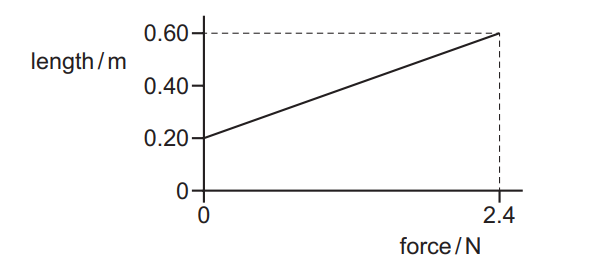
A student investigates a spring. The variation of the length of the spring with the force applied to the spring is shown.
What is the spring constant of the spring?
(B) \(0.25\,\mathrm{N\,m^{-1}}\)
(C) \(4.0\,\mathrm{N\,m^{-1}}\)
(D) \(6.0\,\mathrm{N\,m^{-1}}\)
▶️ Answer/Explanation
Correct Answer: \( \boxed{\mathrm{D}} \)
Using Hooke’s law,
\( F=kx \)
The original length of the spring is \(0.20\,\mathrm{m}\), and the final length is \(0.60\,\mathrm{m}\).
Extension:
\( x=0.60-0.20=0.40\,\mathrm{m} \)
With an applied force of \(2.4\,\mathrm{N}\),
\( k=\dfrac{F}{x}=\dfrac{2.4}{0.40}=6.0\,\mathrm{N\,m^{-1}} \)
Therefore, the correct answer is (D).
Question 22
Topic: 6.2 Elastic and plastic behaviour
The graph shows the variation with force of the extension of a wire.
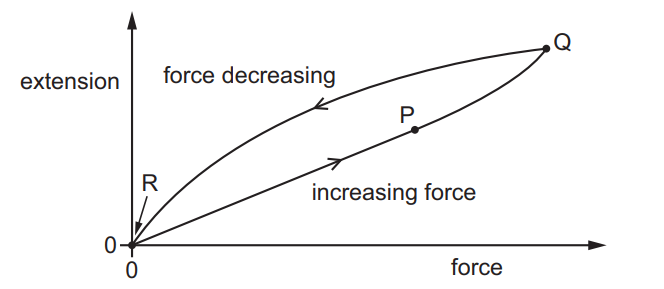
The force is gradually increased to a maximum at \(Q\) and then gradually decreased to zero at \(R\).
Which statement is correct?
(B) Along the line \(RP\), the spring constant is equal to \( \dfrac{\text{extension}}{\text{force}} \).
(C) The wire has elastic deformation at point \(Q\).
(D) The work done in stretching the wire to \(P\) is equal to \( (\text{force} \times \text{extension}) \) at point \(P\).
▶️ Answer/Explanation
Correct Answer: \( \boxed{\mathrm{C}} \)
At point \(Q\), the wire is still able to return towards its original shape when the force is removed, although unloading follows a different path due to hysteresis. This indicates elastic behaviour.
Option (A) is incorrect because the section \(PQ\) is not a straight line, so the wire does not obey Hooke’s law there.
Option (B) is incorrect because the spring constant is
\( k=\dfrac{\text{force}}{\text{extension}} \), not \( \dfrac{\text{extension}}{\text{force}} \).
Option (D) is incorrect because the work done is the area under the force–extension graph, not simply \( \text{force} \times \text{extension} \).
Therefore, the correct answer is (C).
Question 23
Topic: 6.1 Stress and strain.png)
A uniform metal wire of length \(L\) and diameter \(d\) has spring constant \(k\).
What is the Young modulus of the metal?
(B) \( \dfrac{\pi d^2}{kL} \)
(C) \( \dfrac{kL}{\pi d^2} \)
(D) \( \dfrac{4kL}{\pi d^2} \)
▶️ Answer/Explanation
Correct Answer: \( \boxed{\mathrm{D}} \)
For a wire, the spring constant is related to Young modulus by
\( k=\dfrac{YA}{L} \)
where the cross-sectional area is
\( A=\dfrac{\pi d^2}{4} \)
Hence,
\( Y=\dfrac{kL}{A}=\dfrac{kL}{\pi d^2/4}=\dfrac{4kL}{\pi d^2} \)
Therefore, the correct answer is (D).
Question 24
Topic: 7.3 Doppler effect for sound waves
An aircraft produces a sound at a frequency of \(30.0\,\mathrm{Hz}\).
The speed of sound in air is \(330\,\mathrm{m\,s^{-1}}\).
The aircraft is directly in front of the stationary observer and travels in a straight line towards or away from the observer.
The observer hears the sound from the aircraft at a frequency of \(20.0\,\mathrm{Hz}\).
What is the speed and direction of the aircraft?
| Speed / \( \mathrm{m\,s^{-1}} \) | Direction | |
|---|---|---|
| A | 110 | away from observer |
| B | 110 | towards observer |
| C | 165 | away from observer |
| D | 165 | towards observer |
▶️ Answer/Explanation
Correct Answer: \( \boxed{\mathrm{C}} \)
Since the observed frequency is lower than the emitted frequency, the aircraft is moving away from the observer.
For a moving source and stationary observer,
\( f’ = f \left( \dfrac{v}{v+v_s} \right) \)
Substituting the values:
\( 20 = 30\left(\dfrac{330}{330+v_s}\right) \)
\( \dfrac{2}{3}=\dfrac{330}{330+v_s} \)
\( 330+v_s=495 \)
\( v_s=165\,\mathrm{m\,s^{-1}} \)
Therefore, the aircraft is travelling at \(165\,\mathrm{m\,s^{-1}}\) away from the observer.
Therefore, the correct answer is (C).
Question 25
Topic: 7.1 Progressive waves
Which statement about longitudinal and transverse wave motion for a progressive wave is correct?
(B) All transverse waves travel at the same speed, but longitudinal waves can travel at different speeds.
(C) In both transverse waves and longitudinal waves, a particle with zero displacement has a maximum speed.
(D) In a longitudinal wave there is a net movement of particles in the direction of travel of the wave, but there is no net movement of particles in a transverse wave.
▶️ Answer/Explanation
Correct Answer: \( \boxed{\mathrm{C}} \)
In a progressive wave, particles execute simple harmonic motion. A particle has its maximum speed as it passes through its equilibrium position, where its displacement is zero.
This is true for both transverse and longitudinal waves.
Option (A) is incorrect because electromagnetic waves are transverse waves that do not require a medium.
Option (B) is incorrect because wave speed depends on the medium, not on whether the wave is transverse or longitudinal.
Option (D) is incorrect because particles oscillate about their equilibrium positions in both types of waves; there is no net movement of particles.
Therefore, the correct answer is (C).
Question 26
Topic: 7.1 Progressive waves
The diagram shows a progressive transverse wave on a stretched string at one instant in time.
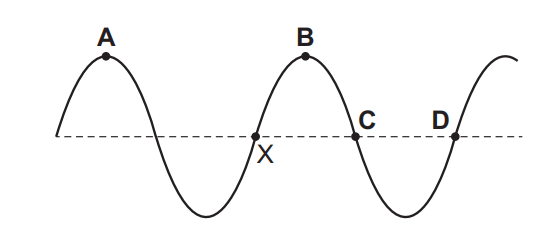
One point on the string is labelled \(X\).
Which point on the string is \(270^\circ\) out of phase with \(X\)?
(B) B
(C) C
(D) D
▶️ Answer/Explanation
Correct Answer: \( \boxed{\mathrm{A}} \)
The phase difference between two points on a progressive wave is proportional to their separation along the wave.
A phase difference of \(270^\circ\) corresponds to a separation of
\( \dfrac{270^\circ}{360^\circ}\lambda=\dfrac{3}{4}\lambda \)
Point \(A\) is located three-quarters of a wavelength from point \(X\), so it is \(270^\circ\) out of phase with \(X\).
Therefore, the correct answer is (A).
Question 27
Topic: 7.4 Electromagnetic spectrum.png)
Which wavelength of electromagnetic radiation in free space could be green light?
(B) \(6.6\times10^{-9}\,\mathrm{m}\)
(C) \(5.5\times10^{-7}\,\mathrm{m}\)
(D) \(8.6\times10^{-7}\,\mathrm{m}\)
▶️ Answer/Explanation
Correct Answer: \( \boxed{\mathrm{C}} \)
Visible light has wavelengths approximately between \(4.0\times10^{-7}\,\mathrm{m}\) and \(7.0\times10^{-7}\,\mathrm{m}\).
Green light lies roughly in the range \(5.0\times10^{-7}\,\mathrm{m}\) to \(5.7\times10^{-7}\,\mathrm{m}\).
Among the given options, \(5.5\times10^{-7}\,\mathrm{m}\) corresponds to green light.
Therefore, the correct answer is (C).
Question 28
Topic: 7.5 Polarisation
Which group contains only waves that can be polarised?
(B) visible light waves, microwaves, radio waves
(C) visible light waves, radio waves, sound waves
(D) microwaves, visible light waves, sound waves
▶️ Answer/Explanation
Correct Answer: \( \boxed{\mathrm{B}} \)
Only transverse waves can be polarised.
Visible light, microwaves, and radio waves are all electromagnetic waves and are transverse, so they can be polarised.
Sound waves are longitudinal waves and cannot be polarised.
Therefore, the correct answer is (B).
Question 29
Topic: 8.3 Interference
One wave has an amplitude of \(2A\). A second wave has an amplitude of \( \dfrac{A}{2} \). The waves are otherwise identical.
The two waves travel in opposite directions and overlap.
What is the ratio \( \dfrac{\text{maximum amplitude of combined wave}}{\text{minimum amplitude of combined wave}} \)?
(B) \( \dfrac{5}{3} \)
(C) \( \dfrac{5}{2} \)
(D) \(4\)
▶️ Answer/Explanation
Correct Answer: \( \boxed{\mathrm{B}} \)
The maximum amplitude occurs during constructive interference:
\( A_{\max}=2A+\dfrac{A}{2}=\dfrac{5A}{2} \)
The minimum amplitude occurs during destructive interference:
\( A_{\min}=2A-\dfrac{A}{2}=\dfrac{3A}{2} \)
Hence,
\( \dfrac{A_{\max}}{A_{\min}}=\dfrac{\frac{5A}{2}}{\frac{3A}{2}}=\dfrac{5}{3} \)
Therefore, the correct answer is (B).
Question 30
Topic: 8.4 The diffraction grating
Light of wavelength \(680\,\mathrm{nm}\) is incident normally on a diffraction grating with \(450\) lines \(\mathrm{mm^{-1}}\).
What is the angle of diffraction of the second-order maximum in the diffraction pattern that is produced?
(B) \(3.5^\circ\)
(C) \(18^\circ\)
(D) \(38^\circ\)
▶️ Answer/Explanation
Correct Answer: \( \boxed{\mathrm{D}} \)
For a diffraction grating,
\( d\sin\theta=n\lambda \)
The grating spacing is
\( d=\dfrac{1}{450\times10^3}=2.22\times10^{-6}\,\mathrm{m} \)
Using \(n=2\) and \( \lambda=680\times10^{-9}\,\mathrm{m} \),
\( \sin\theta=\dfrac{2(680\times10^{-9})}{2.22\times10^{-6}}\approx0.612 \)
\( \theta=\sin^{-1}(0.612)\approx37.8^\circ\approx38^\circ \)
Therefore, the correct answer is (D).
Question 31
Topic: 8.1 Stationary waves
A hollow tube is closed at one end and open at the other.
A stationary sound wave of the lowest possible frequency, \(820\,\mathrm{Hz}\), is produced in the tube.
The speed of sound in air is \(330\,\mathrm{m\,s^{-1}}\).
What is the length of the tube?
(B) \(20\,\mathrm{cm}\)
(C) \(40\,\mathrm{cm}\)
(D) \(160\,\mathrm{cm}\)
▶️ Answer/Explanation
Correct Answer: \( \boxed{\mathrm{A}} \)
For a tube closed at one end, the fundamental frequency is given by
\( f=\dfrac{v}{4L} \)
Rearranging,
\( L=\dfrac{v}{4f}=\dfrac{330}{4\times820}=0.1006\,\mathrm{m} \)
\( L\approx0.10\,\mathrm{m}=10\,\mathrm{cm} \)
Therefore, the correct answer is (A).
Question 32
Topic: 9.3 Resistance and resistivity
Which expression gives the definition of resistance?
(B) current multiplied by potential difference
(C) potential difference divided by current
(D) resistivity multiplied by length
▶️ Answer/Explanation
Correct Answer: \( \boxed{\mathrm{C}} \)
Resistance is defined by Ohm’s law:
\( R=\dfrac{V}{I} \)
where \(R\) is the resistance, \(V\) is the potential difference across the conductor, and \(I\) is the current through it.
Option (A) gives the reciprocal of resistance, option (B) gives electrical power, and option (D) is incomplete because \(R=\dfrac{\rho L}{A}\).
Therefore, the correct answer is (C).
Question 33
Topic: 9.2 Current–potential difference characteristics.png)
The graph shows the \(I\)–\(V\) characteristic of an electrical component.
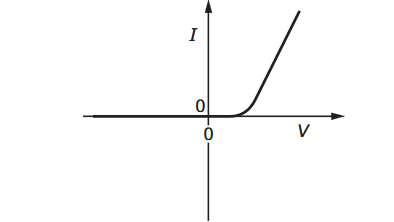
What is the component?
(B) a metallic conductor at constant temperature
(C) a resistor
(D) a semiconductor diode
▶️ Answer/Explanation
Correct Answer: \( \boxed{\mathrm{D}} \)
A semiconductor diode allows very little current to flow until the forward voltage reaches a threshold value. Beyond this point, the current increases rapidly.
The graph shows negligible current for small positive voltages followed by a steep rise, which is the characteristic \(I\)–\(V\) curve of a diode.
Therefore, the correct answer is (D).
Question 34
Topic: 9.5 Practical circuits
The diagram shows six identical resistors connected in a circuit.
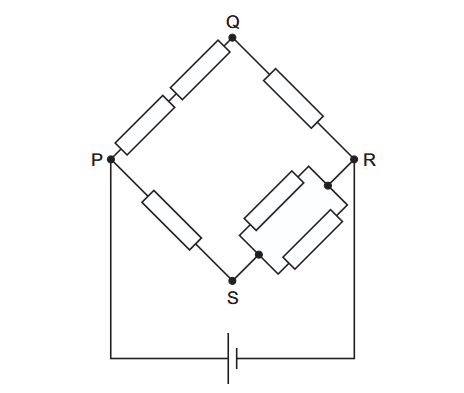
In which branch of the circuit is the most power dissipated?
(B) \(QR\)
(C) \(RS\)
(D) \(SP\)
▶️ Answer/Explanation
Correct Answer: \( \boxed{\mathrm{D}} \)
Each resistor has resistance \(R\).
Branch \(PQ\) contains two resistors in series \((2R)\), branch \(QR\) contains one resistor \((R)\), branch \(RS\) contains two resistors in parallel \(\left(\dfrac{R}{2}\right)\), and branch \(SP\) contains one resistor \((R)\).
Since branch \(SP\) has the full branch current flowing through a single resistor, it dissipates more power than the other branches. Using \(P=I^{2}R\), the power in branch \(SP\) is the greatest.
Therefore, the correct answer is (D).
Question 35
Topic: 9.2 Current–potential difference characteristics.png)
The diagram shows a circuit containing a thermistor, a fixed resistor and a battery.
The graph shows the \(I\)–\(V\) characteristics of both components.
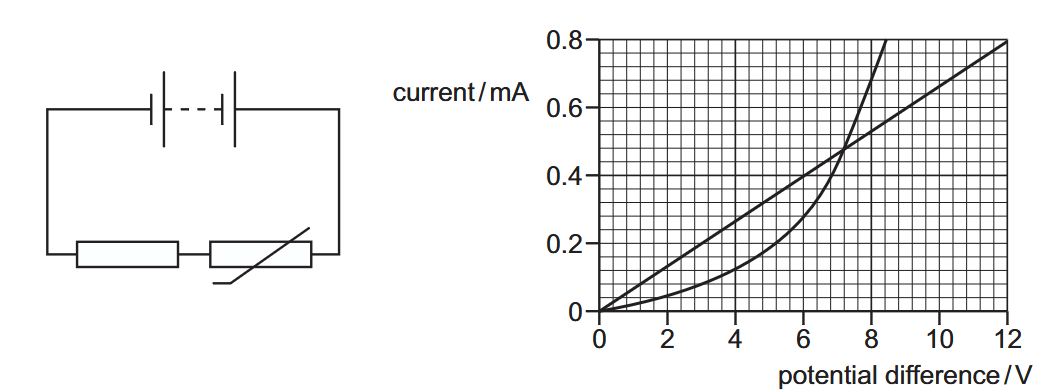
The battery has an e.m.f. of \(12\,\mathrm{V}\) and negligible internal resistance.
What is the current in the fixed resistor?
(B) \(0.40\,\mathrm{mA}\)
(C) \(0.48\,\mathrm{mA}\)
(D) \(0.80\,\mathrm{mA}\)
▶️ Answer/Explanation
Correct Answer: \( \boxed{\mathrm{A}} \)
The resistor and thermistor are in series with the battery, so two conditions apply: the same current \(I\) flows through both, and their voltages must add up to the e.m.f.:
\(V_{resistor} + V_{thermistor} = 12\,\mathrm{V}\)
The straight line on the graph is the fixed resistor (linear \(I\)–\(V\)), passing through \((12\,\mathrm{V}, 0.8\,\mathrm{mA})\), giving:
\(R = \dfrac{V}{I} = \dfrac{12}{0.8\times10^{-3}} = 15\,\mathrm{k}\Omega\), so \(V_{resistor} = 15I\) (V in volts, I in mA).
Substituting into the series condition: \(V_{thermistor} = 12 – 15I\). The operating point is where this line matches the thermistor’s actual \(I\)–\(V\) curve — not where the two curves simply cross each other (that point only satisfies equal voltage and current, not the 12 V sum condition).
Testing points along the thermistor curve against \(V = 12-15I\) gives a match at approximately \(I \approx 0.36\,\mathrm{mA}\), where \(V_{resistor} \approx 5.4\,\mathrm{V}\) and \(V_{thermistor} \approx 6.6\,\mathrm{V}\), summing to \(12\,\mathrm{V}\).
Therefore, the current in the fixed resistor is \(0.36\,\mathrm{mA}\).
Question 36
Topic: 9.5 Practical circuits
Two resistors of resistances \(R_1\) and \(R_2\) are connected in parallel.
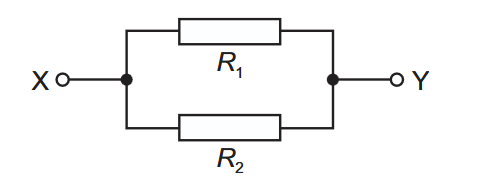
What is the combined resistance between \(X\) and \(Y\)?
(B) \( \dfrac{R_1R_2}{R_1+R_2} \)
(C) \( \dfrac{R_1+R_2}{R_1R_2} \)
(D) \( \dfrac{R_1}{R_2} \)
▶️ Answer/Explanation
Correct Answer: \( \boxed{\mathrm{B}} \)
For two resistors connected in parallel,
\( \dfrac{1}{R}=\dfrac{1}{R_1}+\dfrac{1}{R_2} \)
Rearranging gives
\( R=\dfrac{R_1R_2}{R_1+R_2} \)
This equivalent resistance is always less than either individual resistance.
Therefore, the correct answer is (B).
Question 37
Topic: 9.4 Electromotive force and internal resistance.png)
A cell is connected in series with an ammeter and a variable resistor. A voltmeter is used to measure the p.d. across the variable resistor. The resistance of the variable resistor is varied, and the p.d. and the current are recorded.
The graph shows the variation of current with the p.d. across the variable resistor.
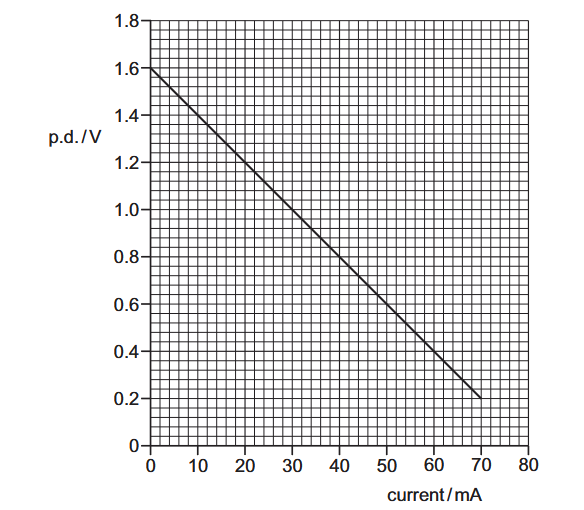
What is the internal resistance of the cell?
(B) \(1.6\,\Omega\)
(C) \(20\,\Omega\)
(D) \(23\,\Omega\)
▶️ Answer/Explanation
Correct Answer: \( \boxed{\mathrm{C}} \)
For a cell,
\( V=\mathcal{E}-Ir \)
The gradient of the graph of terminal p.d. against current is equal to \(-r\).
Using the intercepts,
\( \Delta V=1.6-0.2=1.4\,\mathrm{V} \)
\( \Delta I=70\,\mathrm{mA}=0.070\,\mathrm{A} \)
\( r=\dfrac{1.4}{0.070}=20\,\Omega \)
Therefore, the internal resistance of the cell is \(20\,\Omega\).
Question 38
Topic: 10.1 The atom and fundamental particles
Which list contains only fundamental particles?
(B) mesons, electrons, neutrinos, protons
(C) positrons, quarks, hadrons, protons
(D) quarks, positrons, neutrinos, leptons
▶️ Answer/Explanation
Correct Answer: \( \boxed{\mathrm{D}} \)
Fundamental particles are particles with no known internal structure.
Quarks and leptons are fundamental particles. Positrons are anti-electrons and belong to the lepton family, while neutrinos are also leptons.
Baryons, mesons, hadrons, protons and neutrons are composite particles made of quarks.
Therefore, the correct answer is (D).
Question 39
Topic: 10.4 Radioactive decay.png)
Which statement explains why alpha-particles have discrete energies, but beta-particles have a continuous range of energies?
(B) Only alpha-particles experience repulsion from the nucleus which is dependent on the number of protons in the nucleus.
(C) Only beta-particles are emitted with another lepton and some energy is transferred to the other lepton.
(D) Only the energy of alpha-particles is discrete because the composition of alpha-particles is always the same.
▶️ Answer/Explanation
Correct Answer: \( \boxed{\mathrm{C}} \)
In beta decay, an electron (or positron) is emitted together with a neutrino (or antineutrino).
The available decay energy is shared between these particles, so the beta-particle can emerge with a continuous range of energies.
In alpha decay, the energy is shared mainly between the alpha-particle and the recoiling nucleus, giving the alpha-particle a discrete energy.
Therefore, the correct answer is (C).
Question 40
Topic: 10.2 Hadrons and leptons
A hadron consists of antiquarks that are all identical.
What is a possible value, in terms of the elementary charge \(e\), for the charge on the hadron?
(B) \(+1e\)
(C) \(+2e\)
(D) \(+3e\)
▶️ Answer/Explanation
Correct Answer: \( \boxed{\mathrm{B}} \)
A hadron made entirely of identical antiquarks must be a baryon containing three identical antiquarks.
The possible antiquark charges are:
\( \bar{u}=-\dfrac{2}{3}e,\quad \bar{d}=+\dfrac{1}{3}e,\quad \bar{s}=+\dfrac{1}{3}e \)
Three identical anti-down or anti-strange quarks give
\( 3\times\left(+\dfrac{1}{3}e\right)=+1e \)
Therefore, a possible charge on the hadron is \(+1e\), so the correct answer is (B).