
Question 1
Topic: 1.1 Physical quantities .png)
What must all physical quantities have?
(B) a direction and a unit
(C) a magnitude and a prefix
(D) a magnitude and a unit
▶️ Answer/Explanation
Correct Answer: \( \boxed{\mathrm{D}} \)
A physical quantity is any measurable quantity in physics.
Every physical quantity must have:
\( \bullet \) a numerical value (magnitude), and
\( \bullet \) an appropriate unit.
A direction is only required for vector quantities, not for all physical quantities.
Therefore, the correct answer is (D).
Question 2
Topic: 1.2 SI units
What is \(0.25\,\mathrm{kN\,mm^{-2}}\) expressed in \(\mathrm{N\,m^{-2}}\)?
(B) \(0.25\,\mathrm{N\,m^{-2}}\)
(C) \(250\,000\,\mathrm{N\,m^{-2}}\)
(D) \(250\,000\,000\,\mathrm{N\,m^{-2}}\)
▶️ Answer/Explanation
Correct Answer: \( \boxed{\mathrm{D}} \)
Convert the units separately.
\(1\,\mathrm{kN}=10^3\,\mathrm{N}\)
\(1\,\mathrm{mm^2}=(10^{-3}\,\mathrm{m})^2=10^{-6}\,\mathrm{m^2}\)
Hence,
\(1\,\mathrm{kN\,mm^{-2}}=\dfrac{10^3\,\mathrm{N}}{10^{-6}\,\mathrm{m^2}}=10^9\,\mathrm{N\,m^{-2}}\)
Therefore,
\(0.25\,\mathrm{kN\,mm^{-2}}=0.25\times10^9=2.5\times10^8\,\mathrm{N\,m^{-2}}\)
\(=250\,000\,000\,\mathrm{N\,m^{-2}}\)
Therefore, the correct answer is (D).
Question 3
Topic: 1.3 Errors and uncertainties
A student calculates the density of a solid steel cube in an experiment.
The measured mass is \(975\,\mathrm{g}\pm10\,\mathrm{g}\) and the measured length of side is \(50\,\mathrm{mm}\pm1\,\mathrm{mm}\).
What is the density of the steel?
(B) \(7.8\,\mathrm{g\,cm^{-3}}\pm7.0\%\)
(C) \(7.8\,\mathrm{g\,cm^{-3}}\pm11\%\)
(D) \(7.8\,\mathrm{g\,cm^{-3}}\pm13\%\)
▶️ Answer/Explanation
Correct Answer: \( \boxed{\mathrm{B}} \)
Density is given by
\( \rho=\dfrac{m}{V}=\dfrac{m}{l^3} \)
The percentage uncertainty in the mass is
\( \dfrac{10}{975}\times100\%\approx1.0\% \)
The percentage uncertainty in the length is
\( \dfrac{1}{50}\times100\%=2.0\% \)
Since the volume depends on \(l^3\),
Percentage uncertainty in volume \(=3\times2.0\%=6.0\%\).
For division, percentage uncertainties are added:
\(1.0\%+6.0\%=7.0\%\).
Hence the density is \(7.8\,\mathrm{g\,cm^{-3}}\pm7.0\%\).
Therefore, the correct answer is (B).
Question 4
Topic: 1.1 Physical quantities
The time period \(T\) of a pendulum is given by
\(T=2\pi\left(\dfrac{L}{g}\right)^n\)
where \(L\) is the length of the pendulum and \(g\) is the acceleration of free fall.
The equation is homogeneous.
What is the value of \(n\)?
(B) \(-\dfrac{1}{2}\)
(C) \(\dfrac{1}{2}\)
(D) \(2\)
▶️ Answer/Explanation
Correct Answer: \( \boxed{\mathrm{C}} \)
Since the equation is homogeneous, both sides must have the same dimensions.
The dimensions are
\( [L]=\mathrm{L} \)
\( [g]=\mathrm{LT^{-2}} \)
Therefore,
\( \left[\dfrac{L}{g}\right]=\dfrac{\mathrm{L}}{\mathrm{LT^{-2}}}=\mathrm{T^2} \)
Hence,
\( \left(\dfrac{L}{g}\right)^n=\mathrm{T^{2n}} \)
Since the left-hand side has dimensions of time,
\( \mathrm{T}=\mathrm{T^{2n}} \)
Equating powers of \(T\),
\(2n=1\)
\(n=\dfrac{1}{2}\)
Therefore, the correct answer is (C).
Question 5
Topic: 2.1 Equations of motion .png)
Radio waves can be used to measure the distance between Earth and the planet Jupiter.
A pulse of radio waves is emitted from the surface of Earth. The pulse reflects from the surface of Jupiter and is detected again on Earth.
The time between emitting and receiving the pulse is \(3960\,\mathrm{s}\).
What is the distance between Earth and Jupiter?
(B) \(1.19\times10^9\,\mathrm{km}\)
(C) \(5.94\times10^{11}\,\mathrm{km}\)
(D) \(1.19\times10^{12}\,\mathrm{km}\)
▶️ Answer/Explanation
Correct Answer: \( \boxed{\mathrm{A}} \)
Radio waves travel at the speed of light,
\(c=3.0\times10^8\,\mathrm{m\,s^{-1}}\).
The measured time is for the round trip, so the one-way time is
\(\dfrac{3960}{2}=1980\,\mathrm{s}\).
Hence,
\(d=ct=(3.0\times10^8)(1980)=5.94\times10^{11}\,\mathrm{m}\).
Converting to kilometres,
\(d=5.94\times10^8\,\mathrm{km}\).
Therefore, the correct answer is (A).
Question 6
Topic: 2.1 Equations of motion
The graph shows the variation with time of the velocity of a car.
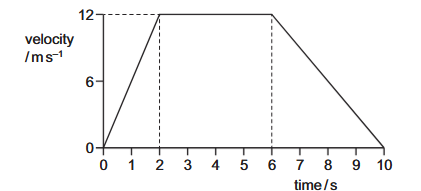
Which statement is correct?
(B) The car accelerates at \(12\,\mathrm{m\,s^{-2}}\) for \(2\,\mathrm{s}\).
(C) The car travels a distance of \(36\,\mathrm{m}\) in the first \(4\,\mathrm{s}\).
(D) The car travels a distance of \(48\,\mathrm{m}\) in the last \(4\,\mathrm{s}\).
▶️ Answer/Explanation
Correct Answer: \( \boxed{\mathrm{C}} \)
The distance travelled is the area under the velocity-time graph.
From \(0\) to \(2\,\mathrm{s}\):
Triangle area \(=\dfrac{1}{2}\times2\times12=12\,\mathrm{m}\).
From \(2\) to \(4\,\mathrm{s}\):
Rectangle area \(=2\times12=24\,\mathrm{m}\).
Total distance in the first \(4\,\mathrm{s}\):
\(12+24=36\,\mathrm{m}\).
Hence statement (C) is correct.
Therefore, the correct answer is (C).
Question 7
Topic: 3.2 Non-uniform motion
A solid object of mass \(1.0\,\mathrm{kg}\) falls vertically downwards in a vacuum.
When the speed of the object is \(60\,\mathrm{m\,s^{-1}}\), an additional constant force of \(50\,\mathrm{N}\) suddenly starts to act vertically upwards on the object.
What is the speed of the object \(2.0\,\mathrm{s}\) after the additional force starts to act?
(B) \(40\,\mathrm{m\,s^{-1}}\)
(C) \(80\,\mathrm{m\,s^{-1}}\)
(D) \(100\,\mathrm{m\,s^{-1}}\)
▶️ Answer/Explanation
Correct Answer: \( \boxed{\mathrm{A}} \)
Take the downward direction as positive.
Weight acting downward:
\(W=mg=1.0\times10=10\,\mathrm{N}\).
The additional upward force is \(50\,\mathrm{N}\).
Hence the resultant force is
\(F=10-50=-40\,\mathrm{N}\).
Therefore, the acceleration is
\(a=\dfrac{F}{m}=\dfrac{-40}{1.0}=-40\,\mathrm{m\,s^{-2}}\).
Using \(v=u+at\),
\(v=60+(-40)(2)= -20\,\mathrm{m\,s^{-1}}\).
The negative sign indicates the object is moving upwards. Its speed is
\(20\,\mathrm{m\,s^{-1}}\).
Therefore, the correct answer is (A).
Question 8
Topic: 3.2 Non-uniform motion .png)
A stone is thrown upwards and follows a curved path.
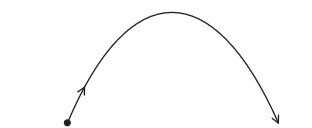
Air resistance is negligible.
Why does the path have this shape?
(B) The stone has a constant horizontal velocity and constant vertical acceleration.
(C) The stone has a constant upward acceleration followed by a constant downward acceleration.
(D) The stone has a constant upward velocity followed by a constant downward velocity.
▶️ Answer/Explanation
Correct Answer: \( \boxed{\mathrm{B}} \)
With negligible air resistance, there is no horizontal force acting on the stone.
Hence, the horizontal velocity remains constant.
The only force acting is gravity, which produces a constant downward acceleration of
\(g\approx9.8\,\mathrm{m\,s^{-2}}\).
The vertical component of velocity changes uniformly due to this constant acceleration, producing the curved projectile path.
Therefore, the correct answer is (B).
Question 9
Topic: 3.1 Momentum and Newton’s laws of motion
A rocket engine ejects \(90\,\mathrm{kg}\) of exhaust gas per second at a velocity of \(190\,\mathrm{m\,s^{-1}}\) relative to the rocket.
What is the force acting on the rocket due to the ejected gas?
(B) \(17\,\mathrm{kN}\)
(C) \(18\,\mathrm{kN}\)
(D) \(162\,\mathrm{kN}\)
▶️ Answer/Explanation
Correct Answer: \( \boxed{\mathrm{B}} \)
The thrust on the rocket equals the rate of change of momentum of the exhaust gases.
\(F=\dot{m}v\)
where
\(\dot{m}=90\,\mathrm{kg\,s^{-1}}\) and \(v=190\,\mathrm{m\,s^{-1}}\).
Hence,
\(F=90\times190=17100\,\mathrm{N}\)
\(=17.1\,\mathrm{kN}\approx17\,\mathrm{kN}\).
Therefore, the correct answer is (B).
Question 10
Topic: 3.3 Linear momentum and its conservation
Which statement does not describe an elastic collision between two objects?
(B) The total kinetic energy of the objects is conserved.
(C) The total kinetic energy of the objects is reduced.
(D) The total linear momentum of the objects is conserved.
▶️ Answer/Explanation
Correct Answer: \( \boxed{\mathrm{C}} \)
In an elastic collision:
\( \bullet \) Total linear momentum is conserved.
\( \bullet \) Total kinetic energy is also conserved.
\( \bullet \) The relative speed of approach equals the relative speed of separation.
If the total kinetic energy is reduced, the collision is inelastic, not elastic.
Therefore, the correct answer is (C).
Question 11
Topic: 3.1 Momentum and Newton’s laws of motion
A cyclist is riding at a constant speed on a level road.
According to Newton’s third law of motion, what is equal and opposite to the backward push of the back wheel on the road?
(B) the forward push of the road on the back wheel
(C) the tension in the cycle chain
(D) the total air resistance and friction force
▶️ Answer/Explanation
Correct Answer: \( \boxed{\mathrm{B}} \)
Newton’s third law states that forces occur in equal and opposite pairs acting on different bodies.
The back wheel pushes the road backward.
In response, the road exerts an equal and opposite force that pushes the back wheel forward.
These two forces act on different objects and form a Newton’s third-law pair.
Therefore, the correct answer is (B).
Question 12
Topic: 3.2 Non-uniform motion .png)
A stone is released from rest and falls a long distance in air.
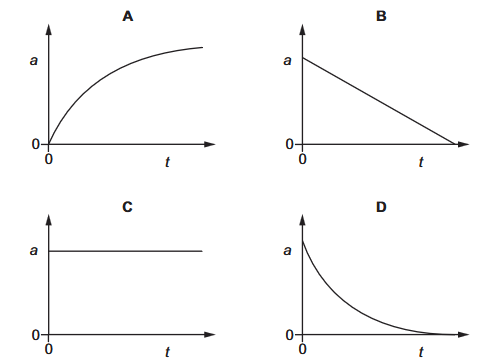
Which graph could show the variation with time \(t\) of the acceleration \(a\) of the stone?
(B) Graph B
(C) Graph C
(D) Graph D
▶️ Answer/Explanation
Correct Answer: \( \boxed{\mathrm{D}} \)
Initially, the stone accelerates downward at approximately \(g\) because air resistance is negligible.
As the speed increases, air resistance increases, reducing the resultant downward force.
Hence the acceleration decreases continuously and approaches zero as the stone approaches terminal velocity.
Only graph D shows the acceleration starting near \(g\) and decreasing asymptotically towards zero.
Therefore, the correct answer is (D).
Question 13
Topic: 3.3 Linear momentum and its conservation
An empty cart is moving along a horizontal track at a constant velocity.
Resistive forces acting on the cart are negligible.
A heavy rock is dropped vertically into the cart.
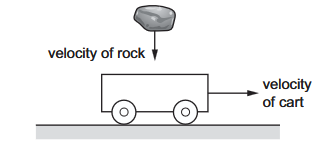
The cart continues to move horizontally with the rock inside.
How does the momentum and kinetic energy of the cart with the rock inside compare with the momentum and kinetic energy of the empty cart?
(B) The cart with the rock inside has a smaller momentum and the same kinetic energy.
(C) The cart with the rock inside has the same momentum and a smaller kinetic energy.
(D) The cart with the rock inside has the same momentum and the same kinetic energy.
▶️ Answer/Explanation
Correct Answer: \( \boxed{\mathrm{C}} \)
There is no external horizontal force acting on the cart-rock system, so horizontal momentum is conserved.
Therefore, the horizontal momentum of the cart with the rock inside is the same as that of the empty cart before the rock landed.
The rock sticking in the cart is a perfectly inelastic collision.
In a perfectly inelastic collision, kinetic energy is not conserved, so some kinetic energy is transformed into heat, sound and deformation.
Hence the kinetic energy after the collision is smaller.
Therefore, the correct answer is (C).
Question 14
Topic: 4.3 Density and pressure .png)
A wooden block is held stationary in a container of water using a string that is attached to both the wooden block and the bottom of the container.
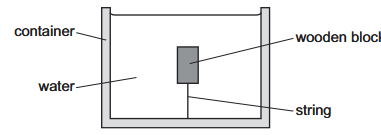
The wooden block has mass \(m\) and volume \(V\). The water has density \(\rho\). The acceleration due to free fall is \(g\).
What is the magnitude of the force acting on the block due to the tension in the string?
(B) \(mg+\rho gV\)
(C) \(mg\)
(D) \(\rho gV-mg\)
▶️ Answer/Explanation
Correct Answer: \( \boxed{\mathrm{D}} \)
The forces acting on the block are:
\( \bullet \) Upthrust \(=\rho gV\) (upward)
\( \bullet \) Weight \(=mg\) (downward)
\( \bullet \) Tension \(=T\) (downward)
Since the block is in equilibrium,
\(\rho gV=mg+T\)
Hence,
\(T=\rho gV-mg\)
Therefore, the correct answer is (D).
Question 15
Topic: 4.1 Turning effects of forces
A square shop sign of uniform density has mass \(2.4\,\mathrm{kg}\) and sides of length \(0.86\,\mathrm{m}\).
The sign is supported by a hinge along its top edge.
There is friction in the hinge so that the sign hangs from it in equilibrium at an angle of \(15^\circ\) to the vertical, as shown.
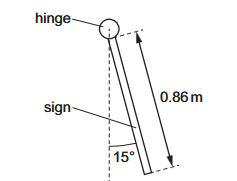
What is the moment about the hinge of the weight of the sign?
(B) \(4.0\,\mathrm{N\,m}\)
(C) \(5.2\,\mathrm{N\,m}\)
(D) \(9.8\,\mathrm{N\,m}\)
▶️ Answer/Explanation
Correct Answer: \( \boxed{\mathrm{A}} \)
The weight acts through the centre of the square.
Distance from the hinge to the centre of mass:
\(r=\dfrac{0.86}{2}=0.43\,\mathrm{m}\).
The perpendicular distance from the hinge to the line of action of the weight is
\(d=r\sin15^\circ=0.43\sin15^\circ=0.111\,\mathrm{m}\).
Weight of the sign:
\(W=mg=2.4\times9.8=23.5\,\mathrm{N}\).
Moment about the hinge:
\(\tau=Wd=23.5\times0.111\approx2.6\,\mathrm{N\,m}\).
Therefore, the correct answer is (A).
Question 16
Topic: 4.3 Density and pressure 
A block is submerged vertically in a liquid. The four diagrams show the block viewed from the side.
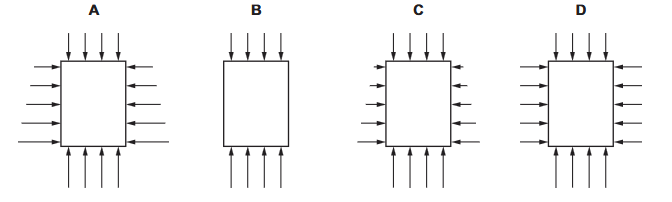
Which diagram shows, to scale, the forces exerted on equal areas of the block by the liquid?
(B) Diagram B
(C) Diagram C
(D) Diagram D
▶️ Answer/Explanation
Correct Answer: \( \boxed{\mathrm{A}} \)
Liquid pressure increases with depth according to
\(p=\rho gh\).
Therefore, the force on equal areas is greater at greater depths.
The pressure on the top surface is less than on the bottom surface, while the pressure on the vertical sides increases with depth.
Only diagram A correctly shows these force magnitudes to scale.
Therefore, the correct answer is (A).
Question 17
Topic: 4.1 Turning effects of forces
The diagram shows a couple.
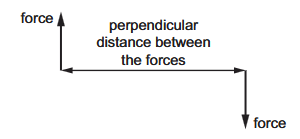
How is the torque of the couple calculated?
(B) perpendicular distance between the forces \(\times\) magnitude of one of the forces
(C) perpendicular distance between the forces \(\times\) magnitude of the sum of the forces
(D) \(2\times\) perpendicular distance between the forces \(\times\) magnitude of one of the forces
▶️ Answer/Explanation
Correct Answer: \( \boxed{\mathrm{B}} \)
The torque (moment) of a couple is given by
\(\tau=Fd\)
where \(F\) is the magnitude of one of the forces and \(d\) is the perpendicular distance between their lines of action.
The forces are equal and opposite, so only one force is used in the calculation.
Therefore, the correct answer is (B).
Question 18
Topic: 5.2 Gravitational potential energy and kinetic energy
A ball of mass \(1.2\,\mathrm{kg}\) travels horizontally at a speed of \(3.0\,\mathrm{m\,s^{-1}}\).
The ball hits a cushion and comes to rest over a horizontal distance of \(0.020\,\mathrm{m}\).
What is the work done by the cushion on the ball to bring it to rest?
(B) \(1.8\,\mathrm{J}\)
(C) \(5.4\,\mathrm{J}\)
(D) \(11\,\mathrm{J}\)
▶️ Answer/Explanation
Correct Answer: \( \boxed{\mathrm{C}} \)
The work done by the cushion equals the loss in kinetic energy of the ball.
Initial kinetic energy:
\(KE=\dfrac{1}{2}mv^2=\dfrac{1}{2}\times1.2\times3.0^2\)
\(=0.6\times9=5.4\,\mathrm{J}\).
Since the ball comes to rest, the final kinetic energy is zero.
Hence, the work done by the cushion is
\(W=5.4\,\mathrm{J}\).
Therefore, the correct answer is (C).
Question 19
Topic: 5.1 Energy conservation .png)
A box of mass \(4.9\,\mathrm{kg}\) is pushed at a constant velocity from point \(P\) at the bottom of an inclined plane to point \(Q\) at the top.
The box is pushed by a force of \(64\,\mathrm{N}\) acting parallel to the slope.
The slope is inclined at an angle of \(20^\circ\) to the horizontal and the box moves through a vertical height of \(5.8\,\mathrm{m}\).
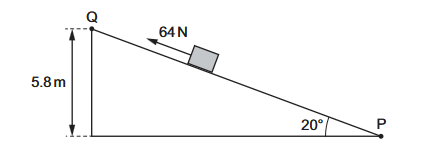
What is the work done against the frictional force acting on the block between \(P\) and \(Q\)?
(B) \(810\,\mathrm{J}\)
(C) \(960\,\mathrm{J}\)
(D) \(1100\,\mathrm{J}\)
▶️ Answer/Explanation
Correct Answer: \( \boxed{\mathrm{B}} \)
Distance travelled along the slope:
\(s=\dfrac{5.8}{\sin20^\circ}\approx16.96\,\mathrm{m}\).
Work done by the applied force:
\(W=Fs=64\times16.96\approx1085\,\mathrm{J}\).
Gain in gravitational potential energy:
\(\Delta U=mgh=4.9\times9.8\times5.8\approx279\,\mathrm{J}\).
Since the box moves at constant velocity, there is no change in kinetic energy.
Therefore, the work done against friction is
\(1085-279\approx806\,\mathrm{J}\approx810\,\mathrm{J}\).
Therefore, the correct answer is (B).
Question 20
Topic: 5.1 Energy conservation
Which expression gives the efficiency of a system?
(B) \(\dfrac{\text{useful energy output}+\text{wasted energy output}}{\text{total energy input}}\)
(C) \(\dfrac{\text{useful energy output}}{\text{total energy input}}\)
(D) \(\dfrac{\text{wasted energy output}}{\text{total energy input}}\)
▶️ Answer/Explanation
Correct Answer: \( \boxed{\mathrm{C}} \)
The efficiency of a system is defined as
\(\text{Efficiency}=\dfrac{\text{useful energy output}}{\text{total energy input}}\)
It is often expressed as a percentage:
\(\text{Efficiency}=\dfrac{\text{useful energy output}}{\text{total energy input}}\times100\%\).
Therefore, the correct answer is (C).
Question 21
Topic: 6.1 Stress and strain .png)
A student has a copper wire and a steel wire with equal lengths and cross-sectional areas.
The student hangs identical loads on the two wires.
The extensions of the two wires are different.
The student calculates the stress, strain and Young modulus of each wire.
Which row identifies with a tick (\(\checkmark\)) the calculated values that are equal for both wires?
| Stress | Strain | Young modulus | |
|---|---|---|---|
| (A) | \(\checkmark\) | ||
| (B) | \(\checkmark\) | ||
| (C) | \(\checkmark\) | \(\checkmark\) | |
| (D) | \(\checkmark\) | \(\checkmark\) |
▶️ Answer/Explanation
Correct Answer: \( \boxed{\mathrm{A}} \)
Stress is given by
\( \mathrm{Stress}=\dfrac{F}{A} \).
Since the two wires have the same cross-sectional area and carry identical loads, they experience the same stress.
The extensions are different, so the strains are different because
\( \mathrm{Strain}=\dfrac{\Delta L}{L} \).
Young modulus is
\( E=\dfrac{\mathrm{Stress}}{\mathrm{Strain}} \).
Since the strains are different while the stresses are the same, the Young moduli are also different.
Therefore, the only quantity that is equal for both wires is the stress.
Therefore, the correct answer is (A).
Question 22
Topic: 6.2 Elastic and plastic behaviour .png)
Two springs X and Y stretch elastically. The graphs show the variation with extension \(x\) of the force \(F\) applied to each spring.
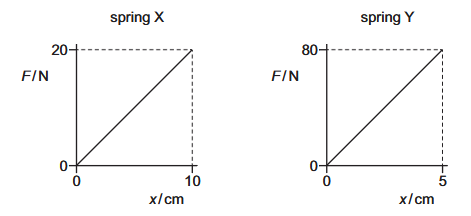
Which statement is correct?
(B) When each spring is given the same extension, the energy stored in Y is 8 times the energy stored in X.
(C) When the same force is applied to each spring, the energy stored in Y is 4 times the energy stored in X.
(D) When the same force is applied to each spring, the energy stored in Y is 8 times the energy stored in X.
▶️ Answer/Explanation
Correct Answer: \( \boxed{\mathrm{B}} \)
The spring constant is the gradient of the force-extension graph.
For spring X:
\(k_X=\dfrac{20}{10}=2\,\mathrm{N\,cm^{-1}}\).
For spring Y:
\(k_Y=\dfrac{80}{5}=16\,\mathrm{N\,cm^{-1}}\).
Hence,
\(k_Y=8k_X\).
The elastic potential energy stored is
\(E=\dfrac{1}{2}kx^2\).
For the same extension, the energy stored is directly proportional to \(k\).
Therefore, spring Y stores \(8\) times as much energy as spring X.
Therefore, the correct answer is (B).
Question 23
Topic: 6.2 Elastic and plastic behaviour
Which phrase describes the strain at the elastic limit on a stress-strain graph?
(B) the maximum strain below which the deformation is plastic
(C) the minimum strain above which Hooke’s law is obeyed
(D) the minimum strain above which the deformation is plastic
▶️ Answer/Explanation
Correct Answer: \( \boxed{\mathrm{D}} \)
The elastic limit is the greatest strain for which a material returns to its original shape when the load is removed.
Beyond the elastic limit, the material undergoes permanent (plastic) deformation.
Therefore, the elastic limit corresponds to the minimum strain above which the deformation is plastic.
Therefore, the correct answer is (D).
Question 24
Topic: 8.1 Stationary waves .png)
A teacher removes the turntable from a microwave oven and places a bar of chocolate in the oven. She then switches the oven on for a short time.
A stationary wave is formed in the oven.
When the chocolate is removed, the teacher observes that there are two small sections of melted chocolate \(6.0\,\mathrm{cm}\) apart with unmelted chocolate in between.
Each section of melted chocolate is located at an antinode.
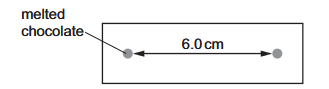
Assume that the speed of the microwaves is \(3.0\times10^8\,\mathrm{m\,s^{-1}}\).
What is the frequency of microwaves emitted by the oven?
(B) \(50\,\mathrm{MHz}\)
(C) \(2.5\,\mathrm{GHz}\)
(D) \(5.0\,\mathrm{GHz}\)
▶️ Answer/Explanation
Correct Answer: \( \boxed{\mathrm{C}} \)
Adjacent antinodes are separated by half a wavelength.
Hence,
\(\dfrac{\lambda}{2}=6.0\,\mathrm{cm}\)
\(\lambda=12.0\,\mathrm{cm}=0.12\,\mathrm{m}\).
Using
\(v=f\lambda\),
\(f=\dfrac{v}{\lambda}=\dfrac{3.0\times10^8}{0.12}=2.5\times10^9\,\mathrm{Hz}\)
\(=2.5\,\mathrm{GHz}\).
Therefore, the correct answer is (C).
Question 25
Topic: 7.2 Transverse and longitudinal waves
A sound wave travels from the left to the right.
The graph shows the variation of the displacement to the right of particles in the sound wave with distance, at one instant.
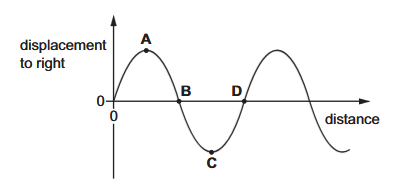
Which letter represents the centre of a compression?
(B) B
(C) C
(D) D
▶️ Answer/Explanation
Correct Answer: \( \boxed{\mathrm{B}} \)
In a longitudinal wave, a compression occurs where particles are closest together.
Particle separation is related to the gradient of the displacement-distance graph.
A compression occurs where the gradient is most negative, because neighbouring particles are displaced towards each other.
Point B is the zero-displacement point with the maximum negative gradient.
Therefore, the centre of a compression is at B.
Therefore, the correct answer is (B).
Question 26
Topic: 7.3 Doppler effect for sound waves .png)
A buzzer emitting sound of frequency \(846\,\mathrm{Hz}\) is attached to a string and rotated in a horizontal circle. The linear speed of the buzzer is \(25.0\,\mathrm{m\,s^{-1}}\).
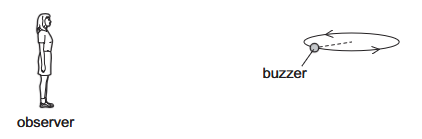
The speed of sound is \(340\,\mathrm{m\,s^{-1}}\).
What is the maximum frequency heard by the observer?
(B) \(788\,\mathrm{Hz}\)
(C) \(908\,\mathrm{Hz}\)
(D) \(913\,\mathrm{Hz}\)
▶️ Answer/Explanation
Correct Answer: \( \boxed{\mathrm{D}} \)
The maximum frequency is heard when the source moves directly towards the observer.
For a moving source,
\(f’=\dfrac{v}{v-v_s}f\)
Substituting the values,
\(f’=\dfrac{340}{340-25}\times846=\dfrac{340}{315}\times846\approx913\,\mathrm{Hz}\).
Therefore, the correct answer is (D).
Question 27
Topic: 7.5 Polarisation
Vertically polarised light of intensity \(I_0\) is incident normally on a polarising filter.
The transmission axis of the filter is at an angle \(\theta\) to the plane of polarisation of the light.
The intensity of the light after passing through the filter is \(\dfrac{I_0}{3}\).
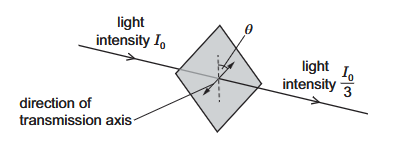
What is \(\theta\)?
(B) \(55^\circ\)
(C) \(71^\circ\)
(D) \(84^\circ\)
▶️ Answer/Explanation
Correct Answer: \( \boxed{\mathrm{B}} \)
Malus’ law states
\(I=I_0\cos^2\theta\).
Given
\(\dfrac{I_0}{3}=I_0\cos^2\theta\).
Hence,
\(\cos^2\theta=\dfrac{1}{3}\).
\(\cos\theta=\dfrac{1}{\sqrt3}\).
\(\theta=\cos^{-1}\!\left(\dfrac{1}{\sqrt3}\right)\approx54.7^\circ\).
\(\theta\approx55^\circ\).
Therefore, the correct answer is (B).
Question 28
Topic: 7.2 Transverse and longitudinal waves
Which statement compares the behaviour of transverse and longitudinal waves?
(B) Only longitudinal waves can travel in free space.
(C) Only transverse waves can be coherent.
(D) Only transverse waves can be polarised.
▶️ Answer/Explanation
Correct Answer: \( \boxed{\mathrm{D}} \)
Polarisation is the restriction of oscillations to one plane.
Only transverse waves have oscillations perpendicular to the direction of propagation and can therefore be polarised.
Longitudinal waves oscillate parallel to the direction of propagation, so they cannot be polarised.
Therefore, the correct answer is (D).
Question 29
Topic: 8.4 The diffraction grating .png)
A student uses a diffraction grating to determine the wavelength of visible light from a source.
The diffraction grating has \(300\) lines per mm. The student measures the angle \(\theta\) of each order \(n\) of the intensity maxima. A graph of \(n\) against \(\sin\theta\) is plotted. The line of best fit for the plotted points has gradient \(G\).
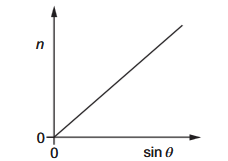
Which expression represents the wavelength, in m, of the visible light in terms of \(G\)?
(B) \(3.3\times10^{-6}G\)
(C) \(\dfrac{3.3\times10^{-6}}{G}\)
(D) \(\dfrac{300}{G}\)
▶️ Answer/Explanation
Correct Answer: \( \boxed{\mathrm{C}} \)
For a diffraction grating,
\(n\lambda=d\sin\theta\).
Hence,
\(n=\dfrac{d}{\lambda}\sin\theta\).
Therefore, the gradient of the graph is
\(G=\dfrac{d}{\lambda}\).
The grating spacing is
\(d=\dfrac{1}{300\times10^3}=3.3\times10^{-6}\,\mathrm{m}\).
Thus,
\(\lambda=\dfrac{d}{G}=\dfrac{3.3\times10^{-6}}{G}\).
Therefore, the correct answer is (C).
Question 30
Topic: 8.1 Stationary waves
Two waves meet.
What is not a necessary condition for the waves to produce a stationary wave?
(B) They must have the same period.
(C) They must have the same wavelength.
(D) They must travel in the same direction.
▶️ Answer/Explanation
Correct Answer: \( \boxed{\mathrm{D}} \)
A stationary wave is formed by the superposition of two waves that:
\( \bullet \) are of the same type,
\( \bullet \) have the same frequency (or period),
\( \bullet \) have the same wavelength (and speed),
\( \bullet \) have similar amplitudes, and
\( \bullet \) travel in opposite directions.
Therefore, travelling in the same direction is not a necessary condition.
Therefore, the correct answer is (D).
Question 31
Topic: 8.3 Interference .png)
Light of a single wavelength is incident normally on a double slit. Interference fringes are observed on a screen.
The distance from the double slit to the screen is \(0.60\,\mathrm{m}\) and the fringe separation is \(1.8\,\mathrm{mm}\).
The distance from the double slit to the screen increases by \(0.90\,\mathrm{m}\).
What is the new fringe separation?
(B) \(2.7\,\mathrm{mm}\)
(C) \(4.5\,\mathrm{mm}\)
(D) \(5.4\,\mathrm{mm}\)
▶️ Answer/Explanation
Correct Answer: \( \boxed{\mathrm{C}} \)
Fringe separation is given by
\(w=\dfrac{\lambda D}{d}\).
Since \(\lambda\) and \(d\) are unchanged,
\(w\propto D\).
The new screen distance is
\(D_2=0.60+0.90=1.50\,\mathrm{m}\).
Hence,
\(w_2=1.8\times\dfrac{1.50}{0.60}=1.8\times2.5=4.5\,\mathrm{mm}\).
Therefore, the correct answer is (C).
Question 32
Topic: 9.3 Resistance and resistivity
A wire is made from a metal of constant resistivity. There is a constant current in the wire.
Which statement about the potential difference across the wire is correct?
(B) It is inversely proportional to the length of the wire.
(C) It is directly proportional to the diameter of the wire.
(D) It is inversely proportional to the diameter of the wire.
▶️ Answer/Explanation
Correct Answer: \( \boxed{\mathrm{A}} \)
The resistance of a wire is
\(R=\dfrac{\rho L}{A}\),
where \(\rho\) is the resistivity, \(L\) is the length and \(A\) is the cross-sectional area.
Using Ohm’s law,
\(V=IR\).
Since the current \(I\), resistivity \(\rho\) and cross-sectional area \(A\) are constant,
\(V\propto R\propto L\).
Therefore, the potential difference is directly proportional to the length of the wire.
Therefore, the correct answer is (A).
Question 33
Topic: 9.3 Resistance and resistivity .png)
The \(I\)-\(V\) characteristics for three electrical components are shown.
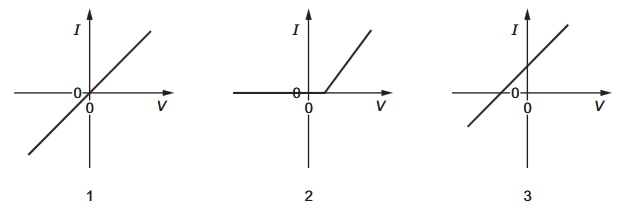
Which components obey Ohm’s law?
(B) 1 and 2 only
(C) 1 and 3 only
(D) 1 only
▶️ Answer/Explanation
Correct Answer: \( \boxed{\mathrm{D}} \)
A component obeys Ohm’s law if the current is directly proportional to the potential difference, giving a straight-line \(I\)-\(V\) graph that passes through the origin.
Component 1 satisfies this condition.
Component 2 does not pass through the origin.
Component 3 also does not pass through the origin.
Therefore, only component 1 obeys Ohm’s law.
Therefore, the correct answer is (D).
Question 34
Topic: 9.1 Electric current
A resistor of resistance \(200\,\Omega\) is connected to a supply that has a p.d. of \(4.00\,\mathrm{V}\).
How many electrons enter the resistor in \(4.00\,\mathrm{s}\)?
(B) \(1.25\times10^{17}\)
(C) \(5.00\times10^{17}\)
(D) \(1.25\times10^{21}\)
▶️ Answer/Explanation
Correct Answer: \( \boxed{\mathrm{C}} \)
Using Ohm’s law,
\(I=\dfrac{V}{R}=\dfrac{4.00}{200}=0.020\,\mathrm{A}\).
The charge passing in \(4.00\,\mathrm{s}\) is
\(Q=It=0.020\times4.00=0.080\,\mathrm{C}\).
The number of electrons is
\(N=\dfrac{Q}{e}=\dfrac{0.080}{1.60\times10^{-19}}=5.00\times10^{17}\).
Therefore, the correct answer is (C).
Question 35
Topic: 10.1 Practical circuits .png)
The diagram shows a cell of internal resistance \(1.0R\) connected to a variable resistor.
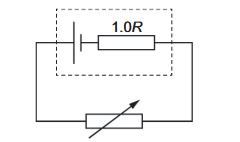
When the variable resistor has an initial resistance of \(2.0R\), the current in the cell is \(I_1\) and the terminal potential difference (p.d.) across the cell is \(V_1\).
The variable resistor is now adjusted to a new resistance of \(4.0R\).
What is the new current in the cell and the new terminal p.d. across the cell?
| Current | Terminal p.d. | |
|---|---|---|
| (A) | \(0.50I_1\) | \(1.0V_1\) |
| (B) | \(0.50I_1\) | \(1.2V_1\) |
| (C) | \(0.60I_1\) | \(1.0V_1\) |
| (D) | \(0.60I_1\) | \(1.2V_1\) |
▶️ Answer/Explanation
Correct Answer: \( \boxed{\mathrm{D}} \)
Let the emf of the cell be \(E\).
Initially, the total resistance is
\(R_{\text{total}}=2R+R=3R\).
Hence,
\(I_1=\dfrac{E}{3R}\).
After increasing the variable resistor to \(4R\), the total resistance becomes
\(R_{\text{total}}=4R+R=5R\).
The new current is
\(I_2=\dfrac{E}{5R}=\dfrac{3}{5}I_1=0.60I_1\).
The terminal p.d. is \(V=IR_{\text{external}}\).
Initially,
\(V_1=I_1(2R)\).
Finally,
\(V_2=I_2(4R)=0.60I_1\times4R=2.4I_1R\).
Therefore,
\(\dfrac{V_2}{V_1}=\dfrac{2.4I_1R}{2I_1R}=1.2\).
Hence,
\(V_2=1.2V_1\).
Therefore, the correct answer is (D).
Question 36
Topic: 10.1 Practical circuits .png)
The diagram shows a four-terminal box connected to a battery and two ammeters.
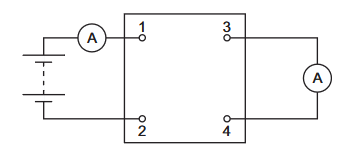
The currents in the two ammeters are identical.
Which circuit, within the box, gives this result?
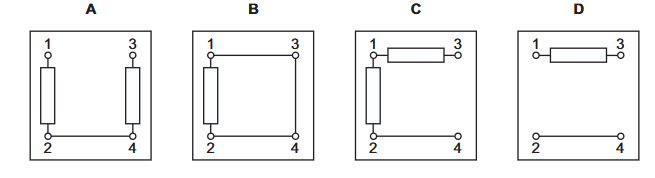
(B) Circuit B
(C) Circuit C
(D) Circuit D
▶️ Answer/Explanation
Correct Answer: \( \boxed{\mathrm{D}} \)
The two ammeters will read the same current only if the current has a single path through both ammeters.
In circuit D, the internal connections form one continuous series path between terminals \(1\), \(3\), \(4\) and \(2\).
No current splits into parallel branches, so the same current flows through both ammeters.
The other circuits either contain branches or do not provide the required series current path.
Therefore, the correct answer is (D).
Question 37
Topic: 10.2 Kirchhoff’s laws
Each of Kirchhoff’s two laws presumes that some quantity is conserved.
Which row states Kirchhoff’s first law and names the quantity that is conserved?
| Statement | Quantity | |
|---|---|---|
| (A) | The algebraic sum of currents at a junction is zero. | Charge |
| (B) | The algebraic sum of currents at a junction is zero. | Energy |
| (C) | The e.m.f. in a loop is equal to the algebraic sum of the product of current and resistance round the loop. | Charge |
| (D) | The e.m.f. in a loop is equal to the algebraic sum of the product of current and resistance round the loop. | Energy |
▶️ Answer/Explanation
Correct Answer: \( \boxed{\mathrm{A}} \)
Kirchhoff’s first law states that the algebraic sum of currents at any junction is zero.
This law follows from the conservation of charge, meaning charge cannot accumulate at a junction.
Kirchhoff’s second law is based on the conservation of energy around a closed loop.
Therefore, the correct answer is (A).
Question 38
Topic: 11.2 Isotopes and nuclear structure .png)
Two neutral atoms are isotopes of the same element.
Which statement about the atoms is correct?
(B) They have a different number of neutrons and the same number of protons.
(C) They have the same number of neutrons and a different number of electrons.
(D) They have the same number of neutrons and the same number of protons.
▶️ Answer/Explanation
Correct Answer: \( \boxed{\mathrm{B}} \)
Isotopes are atoms of the same element.
They have the same number of protons but a different number of neutrons.
Since the atoms are neutral, they also have the same number of electrons as protons.
Therefore, the correct answer is (B).
Question 39
Topic: 11.3 Quarks and leptons
What is the composition of a meson?
(B) 1 quark and 2 antiquarks
(C) 2 quarks and 1 antiquark
(D) 3 quarks
▶️ Answer/Explanation
Correct Answer: \( \boxed{\mathrm{A}} \)
A meson is a hadron consisting of
\(1\) quark and \(1\) antiquark.
Examples include the pion \((\pi)\) and kaon \((K)\).
Baryons, such as protons and neutrons, are composed of three quarks.
Therefore, the correct answer is (A).
Question 40
Topic: 11.4 Radioactive decay
A nucleus of carbon-11 contains \(6\) protons and \(5\) neutrons.
The nucleus of carbon-11 decays by \(\beta^{+}\) emission.
What is the total number of up and down quarks in the product of the decay of this nucleus?
| Up quarks | Down quarks | |
|---|---|---|
| (A) | 15 | 18 |
| (B) | 16 | 17 |
| (C) | 17 | 16 |
| (D) | 18 | 15 |
▶️ Answer/Explanation
Correct Answer: \( \boxed{\mathrm{B}} \)
In \(\beta^{+}\) decay, a proton changes into a neutron:
\(p \rightarrow n + e^{+} + \nu_e\).
The daughter nucleus therefore contains \(5\) protons and \(6\) neutrons.
A proton has quark composition \(uud\).
A neutron has quark composition \(udd\).
Total up quarks:
\(5\times2+6\times1=16\).
Total down quarks:
\(5\times1+6\times2=17\).
Therefore, the correct answer is (B).