
Question 1
Topic: 1.1 Physical quantities.png)
The number of atoms in a mobile phone handset may be estimated by dividing the approximate volume of the handset by the approximate volume of an atom.
What is a reasonable estimate of the number of atoms in a mobile phone handset?
(B) \(10^{26}\)
(C) \(10^{32}\)
(D) \(10^{37}\)
▶️ Answer/Explanation
Correct Answer: \( \boxed{\mathrm{B}} \)
A typical mobile phone has a volume of about \(10^{-4}\,\mathrm{m^{3}}\), while an atom occupies roughly \(10^{-30}\,\mathrm{m^{3}}\).
Hence,
\( \dfrac{10^{-4}}{10^{-30}} = 10^{26} \)
Therefore, the estimated number of atoms in a mobile phone handset is approximately \(10^{26}\).
Therefore, the correct answer is (B).
Question 2
Topic: 5.1 Energy conservation
Which unit is not equivalent to a unit of energy?
(B) \( \mathrm{V\,C} \)
(C) \( \mathrm{W\,s} \)
(D) \( \mathrm{kg\,m\,s^{-2}} \)
▶️ Answer/Explanation
Correct Answer: \( \boxed{\mathrm{D}} \)
The SI unit of energy is the joule, \( \mathrm{J} \).
Equivalent units are:
\( 1\,\mathrm{J}=1\,\mathrm{N\,m}=1\,\mathrm{V\,C}=1\,\mathrm{W\,s} \)
However,
\( \mathrm{kg\,m\,s^{-2}}=\mathrm{N} \)
which is the SI unit of force, not energy.
Therefore, the correct answer is (D).
Question 3
Topic: 1.3 Errors and uncertainties
Callipers are used to determine the thickness of the wall of a glass tube.
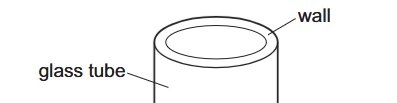
The following measurements are made.
Internal diameter of the tube \(=\left(10.0 \pm 0.1\right)\,\mathrm{mm}\)
External diameter of the tube \(=\left(12.0 \pm 0.1\right)\,\mathrm{mm}\)
What is the thickness of the wall of the tube?
(B) \(\left(1.0 \pm 0.2\right)\,\mathrm{mm}\)
(C) \(\left(2.0 \pm 0.1\right)\,\mathrm{mm}\)
(D) \(\left(2.0 \pm 0.2\right)\,\mathrm{mm}\)
▶️ Answer/Explanation
Correct Answer: \( \boxed{\mathrm{A}} \)
The wall thickness is half the difference between the external and internal diameters.
\( t=\dfrac{12.0-10.0}{2}=1.0\,\mathrm{mm} \)
For subtraction, the absolute uncertainties are added.
Difference \(=2.0\pm0.2\,\mathrm{mm}\)
Dividing by the exact number \(2\) also divides the uncertainty by \(2\).
\( t=\left(1.0\pm0.1\right)\,\mathrm{mm} \)
Therefore, the correct answer is (A).
Question 4
Topic: 4.1 Turning effects of forces.png)
The diagram shows two fixed pins, Y and Z. A length of elastic is stretched between Y and Z and around pin X, which is attached to a trolley.
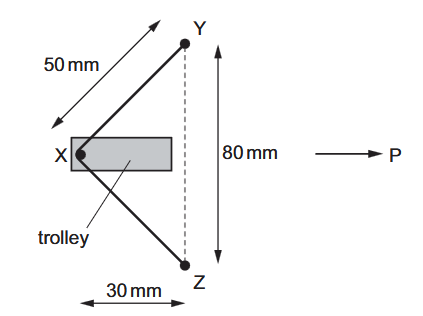
X is at the centre of the elastic and the trolley is to be propelled in the direction P at right angles to YZ. The tension in the elastic is \(4.0\,\mathrm{N}\).
What is the force accelerating the trolley in the direction P when the trolley is released?
(B) \(3.2\,\mathrm{N}\)
(C) \(4.8\,\mathrm{N}\)
(D) \(6.4\,\mathrm{N}\)
▶️ Answer/Explanation
Correct Answer: \( \boxed{\mathrm{C}} \)
Each side of the elastic exerts a tension of \(4.0\,\mathrm{N}\).
From the geometry, the horizontal component of each tension is
\( 4.0 \times \dfrac{30}{50}=2.4\,\mathrm{N} \)
The vertical components are equal and opposite, so they cancel.
Hence, the resultant force in the direction \(P\) is
\( F=2\times2.4=4.8\,\mathrm{N} \)
Therefore, the correct answer is (C).
Question 5
Topic: 2.1 Equations of motion
A student cycles uphill from home to a shop, taking \(10\) minutes. The student then spends \(5\) minutes in the shop before cycling home downhill at twice the initial speed.
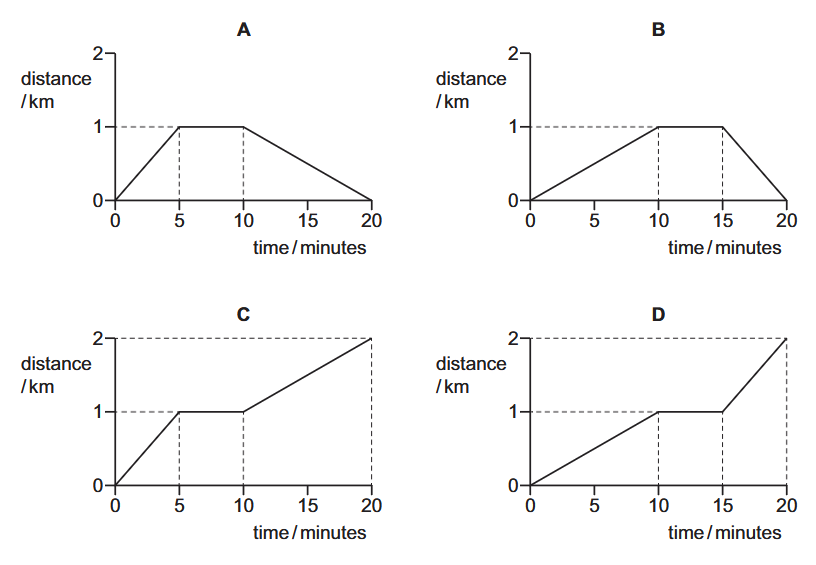
Which graph could show the variation with time of the distance travelled by the student?
(B) Graph B
(C) Graph C
(D) Graph D
▶️ Answer/Explanation
Correct Answer: \( \boxed{\mathrm{D}} \)
The student takes \(10\) minutes to reach the shop, so the graph rises steadily from \(0\) to \(10\) minutes.
The student remains in the shop for \(5\) minutes, so the graph is horizontal from \(10\) to \(15\) minutes.
The journey home is at twice the initial speed, so it takes half the time, namely \(5\) minutes. Since distance travelled is cumulative, the graph continues to increase with a steeper gradient from \(15\) to \(20\) minutes.
Only Graph D matches this behaviour.
Therefore, the correct answer is (D).
Question 6
Topic: 2.1 Equations of motion.png)
A ball is released from rest from a window at a height of \(12\,\mathrm{m}\) above the ground. Air resistance is negligible.
What is the time taken after release for the ball to reach the ground?
(B) \(1.2\,\mathrm{s}\)
(C) \(1.6\,\mathrm{s}\)
(D) \(2.4\,\mathrm{s}\)
▶️ Answer/Explanation
Correct Answer: \( \boxed{\mathrm{C}} \)
For a body released from rest,
\( s=\dfrac{1}{2}gt^{2} \)
\( 12=\dfrac{1}{2}\times9.8\times t^{2} \)
\( t=\sqrt{\dfrac{24}{9.8}}\approx1.56\,\mathrm{s}\approx1.6\,\mathrm{s} \)
Therefore, the correct answer is (C).
Question 7
Topic: 3.1 Momentum and Newton’s laws of motion
Which word equation is not correct?
(B) force \(=\) mass \(\times\) acceleration
(C) force \(=\dfrac{\text{moment}}{\text{perpendicular distance from the pivot}}\)
(D) force \(=\dfrac{\text{work done}}{\text{displacement in the direction of the force}}\)
▶️ Answer/Explanation
Correct Answer: \( \boxed{\mathrm{A}} \)
Newton’s second law states that force is the rate of change of momentum, not simply the change of momentum.
\( F=\dfrac{\Delta p}{\Delta t} \)
The remaining equations are correct:
\( F=ma \)
\( \text{moment}=F\times\text{perpendicular distance} \)
\( \text{work done}=F\times\text{displacement} \)
Therefore, the correct answer is (A).
Question 8
Topic: 3.2 Non-uniform motion
A skydiver is falling vertically with terminal velocity when their parachute opens fully.
Which statement describes the motion of the skydiver for the first few seconds after the parachute opens fully?
(B) falling with non-uniform acceleration and decreasing speed
(C) falling with uniform acceleration and increasing speed
(D) falling with uniform acceleration and decreasing speed
▶️ Answer/Explanation
Correct Answer: \( \boxed{\mathrm{B}} \)
When the parachute opens, the air resistance suddenly becomes much greater than the weight of the skydiver, producing a large upward resultant force.
As the skydiver’s speed decreases, the air resistance also decreases, so the resultant force and acceleration are not constant.
Therefore, the skydiver continues to fall but with a decreasing speed and non-uniform acceleration until a new, lower terminal velocity is reached.
Therefore, the correct answer is (B).
Question 9
Topic: 3.3 Linear momentum and its conservation.png)
Two gliders are travelling towards each other on a horizontal air track. Glider P has mass \(0.30\,\mathrm{kg}\) and is moving with a constant speed of \(1.2\,\mathrm{m\,s^{-1}}\). Glider Q has mass \(0.60\,\mathrm{kg}\) and is moving with a constant speed of \(1.8\,\mathrm{m\,s^{-1}}\).
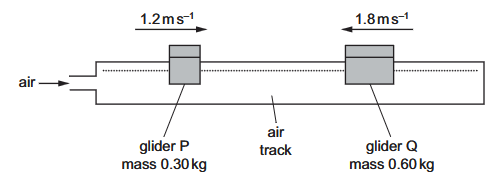
The gliders have a perfectly elastic collision.
What are the speeds of the two gliders after the collision?
| Speed of P \( \mathrm{m\,s^{-1}} \) | Speed of Q \( \mathrm{m\,s^{-1}} \) | |
|---|---|---|
| (A) | 1.2 | 0.6 |
| (B) | 2.0 | 1.4 |
| (C) | 2.8 | 0.2 |
| (D) | 3.6 | 0.6 |
▶️ Answer/Explanation
Correct Answer: \( \boxed{\mathrm{C}} \)
Take the positive direction to the right.
\(m_P=0.30\,\mathrm{kg},\quad m_Q=0.60\,\mathrm{kg}\)
Initial velocities: \(u_P=+1.2\,\mathrm{m\,s^{-1}}\), \(u_Q=-1.8\,\mathrm{m\,s^{-1}}\).
For a one-dimensional perfectly elastic collision,
\( v_P=\frac{m_P-m_Q}{m_P+m_Q}u_P+\frac{2m_Q}{m_P+m_Q}u_Q \)
\( =\frac{0.30-0.60}{0.90}(1.2)+\frac{2(0.60)}{0.90}(-1.8) =-2.8\,\mathrm{m\,s^{-1}} \)
\( v_Q=\frac{2m_P}{m_P+m_Q}u_P+\frac{m_Q-m_P}{m_P+m_Q}u_Q \)
\( =\frac{2(0.30)}{0.90}(1.2)+\frac{0.60-0.30}{0.90}(-1.8) =0.2\,\mathrm{m\,s^{-1}} \)
The question asks for speeds, so
Speed of P \(=2.8\,\mathrm{m\,s^{-1}}\)
Speed of Q \(=0.2\,\mathrm{m\,s^{-1}}\)
Therefore, the correct answer is \((\mathrm{C})\).
Question 10
Topic: 4.1 Turning effects of forces
Which statement about a couple is correct?
(B) It acts to produce rotation only.
(C) It acts to produce translational motion only.
(D) It acts to produce neither rotation nor translational motion.
▶️ Answer/Explanation
Correct Answer: \( \boxed{\mathrm{B}} \)
A couple consists of two equal and opposite parallel forces acting at different points on a body.
The resultant force is zero, so there is no translational motion.
However, the two forces produce a non-zero moment, causing the body to rotate.
Therefore, a couple produces rotation only.
Therefore, the correct answer is (B).
Question 11
Topic: 4.2 Equilibrium of forces.png)
A picture frame hangs from a string. The string is supported by a pin. The frame is in equilibrium.
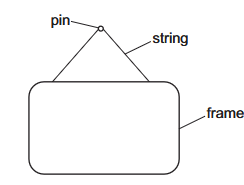
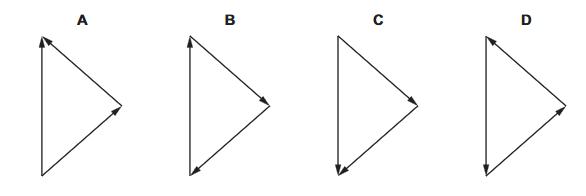
Which diagram shows the vector triangle of forces acting on the picture frame?
(B) Diagram B
(C) Diagram C
(D) Diagram D
▶️ Answer/Explanation
Correct Answer: \( \boxed{\mathrm{D}} \)
The picture frame is in equilibrium, so the vector sum of all forces is zero.
The forces acting are the two tensions in the string and the weight of the frame.
These three forces form a closed vector triangle when drawn head-to-tail.
Only Diagram D shows the correct arrangement and directions of the three force vectors.
Therefore, the correct answer is (D).
Question 12
Topic: 4.3 Density and pressure
A solid metal cuboid of density \(2700\,\mathrm{kg\,m^{-3}}\) has sides of lengths \(1.0\,\mathrm{m}\), \(2.0\,\mathrm{m}\) and \(4.0\,\mathrm{m}\).
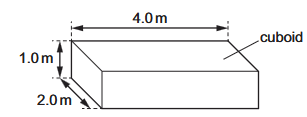
The cuboid can be placed on a horizontal surface so that it rests on any one of its six faces.
What is the largest pressure that the cuboid can exert on the surface due to its weight when it rests on one of its six faces?
(B) \(26\,\mathrm{kPa}\)
(C) \(53\,\mathrm{kPa}\)
(D) \(110\,\mathrm{kPa}\)
▶️ Answer/Explanation
Correct Answer: \( \boxed{\mathrm{D}} \)
The greatest pressure occurs when the cuboid rests on its smallest face.
Smallest area \(=1.0\times2.0=2.0\,\mathrm{m^{2}}\).
Volume \(=1.0\times2.0\times4.0=8.0\,\mathrm{m^{3}}\).
Mass \(=\rho V=2700\times8.0=21600\,\mathrm{kg}\).
Weight \(=mg=21600\times9.8\approx2.12\times10^{5}\,\mathrm{N}\).
\( P=\dfrac{F}{A}=\dfrac{2.12\times10^{5}}{2.0}\approx1.06\times10^{5}\,\mathrm{Pa}=106\,\mathrm{kPa}\approx110\,\mathrm{kPa} \)
Therefore, the correct answer is (D).
Question 13
Topic: 4.3 Density and pressure.png)
A cylindrical iceberg of height \(H\) floats in sea water. The top of the iceberg is at height \(h\) above the surface of the water.
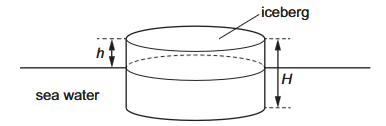
The density of ice is \( \rho_i \) and the density of sea water is \( \rho_w \).
What is the height \(h\) of the iceberg above the sea water?
(B) \( \left(\dfrac{\rho_i}{\rho_w}-1\right)H \)
(C) \( \dfrac{\rho_w}{\rho_i}H \)
(D) \( \dfrac{\rho_i}{\rho_w}H \)
▶️ Answer/Explanation
Correct Answer: \( \boxed{\mathrm{A}} \)
For a floating object, the weight equals the upthrust.
\( \rho_i AHg=\rho_w A(H-h)g \)
Cancelling \(A\) and \(g\),
\( \rho_i H=\rho_w(H-h) \)
Rearranging,
\( h=\left(1-\dfrac{\rho_i}{\rho_w}\right)H \)
Therefore, the correct answer is (A).
Question 14
Topic: 5.1 Energy conservation
In which situation is work done on an object?
(B) A person holds the object at arm’s length and at a fixed height above the ground.
(C) A person pushes the object up a frictionless ramp.
(D) The stationary object floats partially submerged in water.
▶️ Answer/Explanation
Correct Answer: \( \boxed{\mathrm{C}} \)
Work is done when a force causes a displacement in the direction of the force.
\( W=Fs\cos\theta \)
In option (C), the applied force moves the object up the ramp, so positive work is done on the object.
In options (A), (B), and (D), there is either no resultant force causing displacement or no displacement at all, so no work is done on the object.
Therefore, the correct answer is (C).
Question 15
Topic: 5.2 Gravitational potential energy and kinetic energy
An electric motor operating a lift has an output power of \(20\,\mathrm{kW}\).
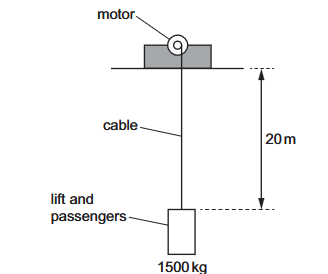
The lift and passengers have a combined mass of \(1500\,\mathrm{kg}\). The motor raises the lift at constant speed through a distance of \(20\,\mathrm{m}\).
How long does it take?
(B) \(15\,\mathrm{s}\)
(C) \(30\,\mathrm{s}\)
(D) \(60\,\mathrm{s}\)
▶️ Answer/Explanation
Correct Answer: \( \boxed{\mathrm{B}} \)
At constant speed, the work done equals the gain in gravitational potential energy.
\( W=mgh=1500\times9.8\times20=2.94\times10^{5}\,\mathrm{J} \)
Using
\( P=\dfrac{W}{t} \)
\( t=\dfrac{W}{P}=\dfrac{2.94\times10^{5}}{2.0\times10^{4}}=14.7\,\mathrm{s}\approx15\,\mathrm{s} \)
Therefore, the correct answer is (B).
Question 16
Topic: 5.1 Energy conservation.png)
In which situation is the least amount of energy transferred?
(B) A student of mass \(50\,\mathrm{kg}\) falls a vertical distance of \(2.0\,\mathrm{m}\).
(C) A student pushes a car with a horizontal force of \(70\,\mathrm{N}\) for a horizontal distance of \(2.0\,\mathrm{m}\).
(D) A student switches on a \(70\,\mathrm{W}\) lamp for \(20\,\mathrm{s}\).
▶️ Answer/Explanation
Correct Answer: \( \boxed{\mathrm{C}} \)
Calculate the energy transferred in each case.
(A) \( \Delta E=\dfrac{1}{2}mv^{2}=\dfrac{1}{2}\times80\times2.0^{2}=160\,\mathrm{J} \)
(B) \( \Delta E=mgh=50\times9.8\times2.0=980\,\mathrm{J} \)
(C) \( W=Fs=70\times2.0=140\,\mathrm{J} \)
(D) \( E=Pt=70\times20=1400\,\mathrm{J} \)
The smallest energy transfer is \(140\,\mathrm{J}\).
Therefore, the correct answer is (C).
Question 17
Topic: 6.1 Stress and strain
What is the definition of strain?
(B) extension per unit original length
(C) force per unit cross-sectional area
(D) force per unit extension
▶️ Answer/Explanation
Correct Answer: \( \boxed{\mathrm{B}} \)
Strain is the ratio of the extension of a material to its original length.
\( \text{strain}=\dfrac{\text{extension}}{\text{original length}}=\dfrac{\Delta L}{L} \)
Strain is a dimensionless quantity because it is the ratio of two lengths.
Option (C) is the definition of stress.
Therefore, the correct answer is (B).
Question 18
Topic: 6.1 Stress and strain
A spring of unstretched length \(0.10\,\mathrm{m}\) is suspended vertically from a support.
A weight of \(2.0\,\mathrm{N}\) is attached to the bottom of the spring and its length increases to \(0.15\,\mathrm{m}\).
An additional weight of \(4.0\,\mathrm{N}\) is then added to the bottom of the spring.
The spring obeys Hooke’s law.
How much extra elastic potential energy is stored in the spring due to the addition of the \(4.0\,\mathrm{N}\) weight?
(B) \(0.13\,\mathrm{J}\)
(C) \(0.20\,\mathrm{J}\)
(D) \(0.40\,\mathrm{J}\)
▶️ Answer/Explanation
Correct Answer: \( \boxed{\mathrm{D}} \)
With a \(2.0\,\mathrm{N}\) load, the extension is
\( x_1=0.15-0.10=0.05\,\mathrm{m} \)
From Hooke’s law,
\( k=\dfrac{F}{x}=\dfrac{2.0}{0.05}=40\,\mathrm{N\,m^{-1}} \)
After adding \(4.0\,\mathrm{N}\), the total force is \(6.0\,\mathrm{N}\), so
\( x_2=\dfrac{6.0}{40}=0.15\,\mathrm{m} \)
The extra elastic potential energy stored is
\( \Delta E=\dfrac{1}{2}k\left(x_2^2-x_1^2\right)=\dfrac{1}{2}\times40\times\left(0.15^2-0.05^2\right)=0.40\,\mathrm{J} \)
Therefore, the correct answer is (D).
Question 19
Topic: 8.3 Interference.png)
Two progressive waves meet at a fixed point \(P\). The variation with time of the displacement of each wave at point \(P\) is shown in the graph.
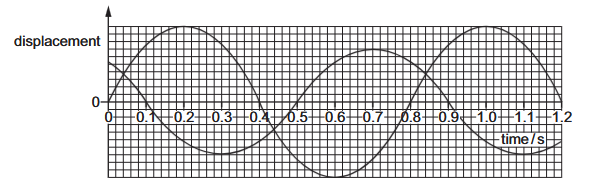
What is the phase difference between the two waves at point \(P\)?
(B) \(90^\circ\)
(C) \(135^\circ\)
(D) \(180^\circ\)
▶️ Answer/Explanation
Correct Answer: \( \boxed{\mathrm{C}} \)
From the graph, both waves have the same period of approximately \(0.80\,\mathrm{s}\).
The time shift between corresponding points on the two waves is approximately \(0.30\,\mathrm{s}\).
The phase difference is
\( \phi=\dfrac{\Delta t}{T}\times360^\circ=\dfrac{0.30}{0.80}\times360^\circ=135^\circ \)
Therefore, the correct answer is (C).
Question 20
Topic: 7.1 Progressive waves.png)
A microphone is connected to a cathode-ray oscilloscope (CRO). The diagram shows the waveform on the display of the CRO when the microphone detects a sound.
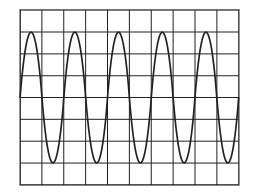
The \(y\)-gain is set to \(1\,\mathrm{V\,div^{-1}}\). The time-base is set to \(2.0\,\mathrm{ms\,div^{-1}}\).
Which row gives the amplitude and frequency of the waveform?
| Amplitude / \( \mathrm{V} \) | Frequency / \( \mathrm{Hz} \) | |
|---|---|---|
| (A) | 3 | 125 |
| (B) | 3 | 250 |
| (C) | 6 | 125 |
| (D) | 6 | 250 |
▶️ Answer/Explanation
Correct Answer: \( \boxed{\mathrm{B}} \)
The amplitude is the maximum displacement from the centre line. From the CRO display, the peak is \(3\) divisions above the centre.
Amplitude \(=3\times1\,\mathrm{V}=3\,\mathrm{V}\).
One complete cycle occupies \(2\) horizontal divisions.
Period \(=2\times2.0\,\mathrm{ms}=4.0\,\mathrm{ms}=4.0\times10^{-3}\,\mathrm{s}\).
\( f=\dfrac{1}{T}=\dfrac{1}{4.0\times10^{-3}}=250\,\mathrm{Hz} \)
Therefore, the correct answer is (B).
Question 21
Topic: 7.1 Progressive waves.png)
A progressive longitudinal wave is travelling horizontally from left to right.
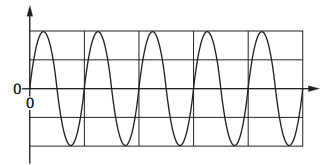
A graphical representation of the wave at one instant in time is shown.
Which row could give the correct labels for the \(x\)-axis and \(y\)-axis of this graph?
| \(x\)-axis | \(y\)-axis | |
|---|---|---|
| (A) | distance | displacement of particles to the right |
| (B) | distance | displacement of particles upwards |
| (C) | time | displacement of particles to the right |
| (D) | time | displacement of particles upwards |
▶️ Answer/Explanation
Correct Answer: \( \boxed{\mathrm{A}} \)
The graph is a snapshot of the wave at one instant, so the horizontal axis represents distance, not time.
Since the wave is longitudinal and travels horizontally, the particles oscillate parallel to the direction of travel.
Therefore, the vertical axis represents the displacement of particles to the right (or left), not upwards.
Therefore, the correct answer is (A).
Question 22
Topic: 7.3 Doppler effect for sound waves
A vehicle is moving at a speed of \(30.0\,\mathrm{m\,s^{-1}}\) directly towards a stationary observer. The horn of the vehicle emits sound of frequency \(440\,\mathrm{Hz}\). The speed of sound in air is \(340\,\mathrm{m\,s^{-1}}\).
What is the frequency of the sound heard by the observer?
(B) \(404\,\mathrm{Hz}\)
(C) \(479\,\mathrm{Hz}\)
(D) \(483\,\mathrm{Hz}\)
▶️ Answer/Explanation
Correct Answer: \( \boxed{\mathrm{D}} \)
For a source moving towards a stationary observer, the Doppler effect equation is
\( f’=\dfrac{v}{v-v_s}f \)
Substituting the values,
\( f’=\dfrac{340}{340-30}\times440=\dfrac{340}{310}\times440\approx482.6\,\mathrm{Hz} \)
\( f’\approx483\,\mathrm{Hz} \)
Therefore, the correct answer is (D).
Question 23
Topic: 7.4 Electromagnetic spectrum
Which row could describe electromagnetic waves?
| Type of wave | Speed in free space | |
|---|---|---|
| (A) | longitudinal | faster for shorter wavelengths |
| (B) | longitudinal | the same for all wavelengths |
| (C) | transverse | faster for shorter wavelengths |
| (D) | transverse | the same for all wavelengths |
▶️ Answer/Explanation
Correct Answer: \( \boxed{\mathrm{D}} \)
Electromagnetic waves are transverse waves.
In free space, all electromagnetic waves travel at the same speed, regardless of their wavelength or frequency.
\( c=3.0\times10^{8}\,\mathrm{m\,s^{-1}} \)
Therefore, electromagnetic waves are transverse and have the same speed in free space for all wavelengths.
Therefore, the correct answer is (D).
Question 24
Topic: 7.5 Polarisation.png)
A horizontal beam of light is incident normally on a polarising filter. The incident light is vertically polarised and has an intensity of \(24\,\mathrm{W\,m^{-2}}\). The direction of the transmission axis of the filter is at an angle of \(30^\circ\) to the vertical.
What is the intensity of the light in the transmitted beam?
(B) \(21\,\mathrm{W\,m^{-2}}\)
(C) \(28\,\mathrm{W\,m^{-2}}\)
(D) \(32\,\mathrm{W\,m^{-2}}\)
▶️ Answer/Explanation
Correct Answer: \( \boxed{\mathrm{A}} \)
For plane-polarised light passing through a polariser, Malus’ law applies.
\( I=I_0\cos^2\theta \)
\( I=24\cos^2 30^\circ=24\times\left(\dfrac{\sqrt{3}}{2}\right)^2=24\times\dfrac{3}{4}=18\,\mathrm{W\,m^{-2}} \)
Therefore, the correct answer is (A).
Question 25
Topic: 8.1 Stationary waves
A pipe of length \(100\,\mathrm{cm}\) is open at both ends. A loudspeaker situated at one end of the pipe can emit sound of different wavelengths.
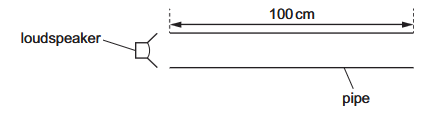
Which wavelength can produce a stationary wave in the pipe?
(B) \(75\,\mathrm{cm}\)
(C) \(150\,\mathrm{cm}\)
(D) \(300\,\mathrm{cm}\)
▶️ Answer/Explanation
Correct Answer: \( \boxed{\mathrm{A}} \)
For a pipe open at both ends, the allowed wavelengths satisfy
\( L=\dfrac{n\lambda}{2} \), where \(n=1,2,3,\ldots\)
With \(L=100\,\mathrm{cm}\),
\( \lambda=\dfrac{2L}{n}=\dfrac{200}{n}\,\mathrm{cm} \)
Testing the options, only \( \lambda=50\,\mathrm{cm} \) corresponds to \(n=4\), an integer.
Therefore, the correct answer is (A).
Question 26
Topic: 8.2 Diffraction
A student makes a sound at point \(R\) near a building. A second student, standing at point \(S\) around the corner of the building, hears the sound. The building is a solid structure and there are no other structures nearby.
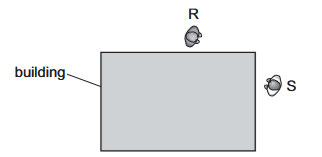
Which effect best explains how the student at point \(S\) is able to hear the student at point \(R\)?
(B) interference
(C) polarisation
(D) reflection
▶️ Answer/Explanation
Correct Answer: \( \boxed{\mathrm{A}} \)
Sound waves spread out when they pass the edge of an obstacle or through an opening. This phenomenon is called diffraction.
Diffraction allows sound to bend around the corner of the building so that it can be heard at point \(S\), even though there is no direct line of sight.
Interference involves overlapping waves, polarisation only applies to transverse waves, and reflection is not possible because there are no other nearby structures.
Therefore, the correct answer is (A).
Question 27
Topic: 8.3 Interference.png)
Red light of a single wavelength from a laser is incident on a double slit.
A pattern of interference fringes is observed on a flat screen that is placed parallel to the double slit.
Which change increases the separation of the interference fringes on the screen?
(B) Decrease the separation of the slits.
(C) Replace the red light with blue light.
(D) Replace the red light with green light.
▶️ Answer/Explanation
Correct Answer: \( \boxed{\mathrm{B}} \)
The fringe spacing in Young’s double-slit experiment is
\( w=\dfrac{\lambda D}{d} \)
where \( \lambda \) is the wavelength, \(D\) is the screen distance, and \(d\) is the slit separation.
Decreasing the slit separation \(d\) increases the fringe spacing.
Decreasing the screen distance or using blue/green light (shorter wavelengths than red) decreases the fringe spacing.
Therefore, the correct answer is (B).
Question 28
Topic: 8.4 The diffraction grating
An electromagnetic wave is incident normally on a diffraction grating.
A second-order maximum is produced at an angle of \(30^\circ\) to the direction of the incident light.
The grating has \(5000\) lines per \(\mathrm{cm}\).
What is the wavelength of the wave?
(B) \(5.0\times10^{-7}\,\mathrm{m}\)
(C) \(1.0\times10^{-6}\,\mathrm{m}\)
(D) \(5.0\times10^{-5}\,\mathrm{m}\)
▶️ Answer/Explanation
Correct Answer: \( \boxed{\mathrm{B}} \)
The diffraction grating equation is
\( n\lambda=d\sin\theta \)
The grating spacing is
\( d=\dfrac{1}{5000\times100}=2.0\times10^{-6}\,\mathrm{m} \)
Substituting \(n=2\) and \(\theta=30^\circ\),
\( \lambda=\dfrac{d\sin30^\circ}{2}=\dfrac{2.0\times10^{-6}\times0.5}{2}=5.0\times10^{-7}\,\mathrm{m} \)
Therefore, the correct answer is (B).
Question 29
Topic: 9.1 Electric current
The resistance of a lamp is \(10\,\Omega\) and the potential difference across it is \(6.0\,\mathrm{V}\).
How many electrons pass through the lamp in a time of \(24\) hours?
(B) \(9.0\times10^{19}\)
(C) \(5.4\times10^{21}\)
(D) \(3.2\times10^{23}\)
▶️ Answer/Explanation
Correct Answer: \( \boxed{\mathrm{D}} \)
Using Ohm’s law,
\( I=\dfrac{V}{R}=\dfrac{6.0}{10}=0.60\,\mathrm{A} \)
The time is
\( t=24\times3600=86400\,\mathrm{s} \)
The total charge is
\( Q=It=0.60\times86400=51840\,\mathrm{C} \)
The number of electrons is
\( N=\dfrac{Q}{e}=\dfrac{51840}{1.60\times10^{-19}}\approx3.24\times10^{23} \)
Therefore, the correct answer is (D).
Question 30
Topic: 9.2 Potential difference and power
What is equivalent to one volt?
(B) one joule per coulomb
(C) one joule per second
(D) one joule second per coulomb squared
▶️ Answer/Explanation
Correct Answer: \( \boxed{\mathrm{B}} \)
Potential difference is defined as the work done or energy transferred per unit charge.
\( V=\dfrac{W}{Q} \)
Hence,
\( 1\,\mathrm{V}=1\,\mathrm{J\,C^{-1}} \)
Option (A) is the unit of current, \(1\,\mathrm{A}=1\,\mathrm{C\,s^{-1}}\).
Option (C) is the unit of power, \(1\,\mathrm{W}=1\,\mathrm{J\,s^{-1}}\).
Therefore, the correct answer is (B).
Question 31
Topic: 9.3 Resistance and resistivity
The resistance of some electrical components may change with changing conditions.
Which component’s resistance increases?
(B) a light-dependent resistor (LDR) as the intensity of the light incident on it increases
(C) a metallic conductor at constant temperature as the current through it increases
(D) a thermistor as its temperature increases
▶️ Answer/Explanation
Correct Answer: \( \boxed{\mathrm{A}} \)
As the potential difference across a filament lamp increases, the filament becomes hotter.
The higher temperature causes the resistance of the filament to increase.
An LDR has a lower resistance when light intensity increases, a metallic conductor at constant temperature has a constant resistance, and a typical NTC thermistor has a lower resistance as its temperature increases.
Therefore, the correct answer is (A).
Question 32
Topic: 9.3 Resistance and resistivity.png)
Gold is sometimes used to make very small connecting wires in electronic circuits.
A particular gold wire has length \(2.50\times10^{-3}\,\mathrm{m}\) and cross-sectional area \(6.25\times10^{-8}\,\mathrm{m^2}\). Gold has resistivity \(2.3\times10^{-8}\,\Omega\,\mathrm{m}\).
What is the resistance of the wire?
(B) \(5.8\times10^{-13}\,\Omega\)
(C) \(9.2\times10^{-4}\,\Omega\)
(D) \(6.8\times10^{-3}\,\Omega\)
▶️ Answer/Explanation
Correct Answer: \( \boxed{\mathrm{C}} \)
The resistance of a wire is given by
\( R=\dfrac{\rho L}{A} \)
Substituting the values,
\( R=\dfrac{(2.3\times10^{-8})(2.50\times10^{-3})}{6.25\times10^{-8}} \)
\( R=9.2\times10^{-4}\,\Omega \)
Therefore, the correct answer is (C).
Question 33
Topic: 10.1 Practical circuits
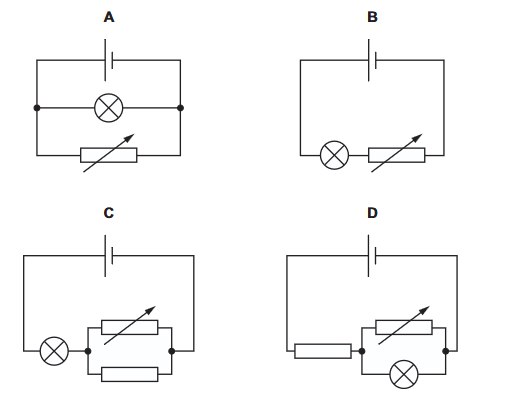
A cell of constant electromotive force (e.m.f.) and negligible internal resistance is separately connected into four different circuits.
In which circuit does the power dissipated by the lamp stay the same as the variable resistor is adjusted?
(B) Circuit B
(C) Circuit C
(D) Circuit D
▶️ Answer/Explanation
Correct Answer: \( \boxed{\mathrm{A}} \)
In Circuit A, the lamp is connected directly across the cell, so the potential difference across the lamp is always equal to the cell’s e.m.f.
Since the supply voltage across the lamp remains constant,
\( P=\dfrac{V^2}{R} \)
and the lamp’s power remains unchanged as the variable resistor is adjusted in the separate parallel branch.
In the other circuits, adjusting the variable resistor changes either the current through or the potential difference across the lamp, so its power changes.
Therefore, the correct answer is (A).
Question 34
Topic: 10.2 Kirchhoff’s laws.png)
The sum of the electrical currents into a point in a circuit is equal to the sum of the currents out of the point.
Which statement is correct?
(B) This is Kirchhoff’s first law, which results from the conservation of energy.
(C) This is Kirchhoff’s second law, which results from the conservation of charge.
(D) This is Kirchhoff’s second law, which results from the conservation of energy.
▶️ Answer/Explanation
Correct Answer: \( \boxed{\mathrm{A}} \)
Kirchhoff’s first law states that the total current entering a junction equals the total current leaving the junction.
\( \sum I_{\text{in}}=\sum I_{\text{out}} \)
This law follows from the conservation of charge, since charge cannot accumulate at a junction.
Therefore, the correct answer is (A).
Question 35
Topic: 10.2 Kirchhoff’s laws
A battery of electromotive force (e.m.f.) \(6.0\,\mathrm{V}\) and negligible internal resistance is connected to three resistors, as shown.
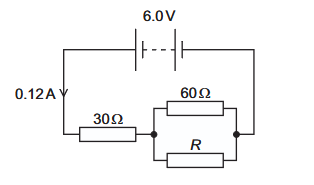
The current in the battery is \(0.12\,\mathrm{A}\).
What is resistance \(R\)?
(B) \(30\,\Omega\)
(C) \(50\,\Omega\)
(D) \(60\,\Omega\)
▶️ Answer/Explanation
Correct Answer: \( \boxed{\mathrm{B}} \)
The total resistance of the circuit is
\( R_{\text{total}}=\dfrac{V}{I}=\dfrac{6.0}{0.12}=50\,\Omega \)
The \(30\,\Omega\) resistor is in series with the parallel combination of \(60\,\Omega\) and \(R\).
Hence, the equivalent resistance of the parallel section is
\( R_{\text{parallel}}=50-30=20\,\Omega \)
Using the parallel resistance formula,
\( \dfrac{1}{20}=\dfrac{1}{60}+\dfrac{1}{R} \)
\( \dfrac{1}{R}=\dfrac{1}{20}-\dfrac{1}{60}=\dfrac{1}{30} \)
\( R=30\,\Omega \)
Therefore, the correct answer is (B).
Question 36
Topic: 10.3 Potential dividers.png)
A potentiometer circuit may be used to determine the unknown electromotive force (e.m.f.) \(E\) of a cell. The circuit diagrams shown include a battery of known e.m.f. and negligible internal resistance, a uniform resistance wire \(XY\) and a galvanometer.
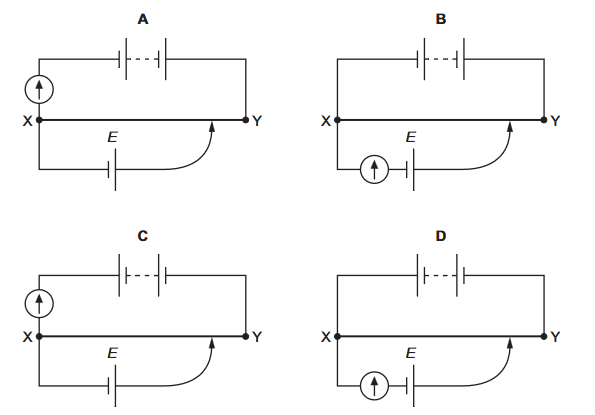
Which circuit diagram shows a suitable arrangement for determining \(E\)?
(B) Circuit B
(C) Circuit C
(D) Circuit D
▶️ Answer/Explanation
Correct Answer: \( \boxed{\mathrm{B}} \)
In a potentiometer, the known battery is connected across the uniform resistance wire \(XY\) to produce a steady potential gradient.
The unknown cell and the galvanometer must be connected in series between one end of the wire and a sliding contact on the wire.
At the balance point, the galvanometer shows zero current, so the potential difference along the selected length of wire equals the unknown e.m.f.
Only Circuit B has the correct arrangement of the driving battery, potentiometer wire, galvanometer and unknown cell.
Therefore, the correct answer is (B).
Question 37
Topic: 11.1 Atoms, nuclei and radiation
A uranium atom with a charge of \(+2e\) has a nucleon number of \(235\) and a proton number of \(92\).
\(e\) is the elementary charge.
What is the total number of protons, neutrons and electrons in this charged atom?
(B) \(325\)
(C) \(327\)
(D) \(329\)
▶️ Answer/Explanation
Correct Answer: \( \boxed{\mathrm{B}} \)
Number of protons \(=92\).
Number of neutrons \(=235-92=143\).
A charge of \(+2e\) means the atom has lost two electrons, so
Number of electrons \(=92-2=90\).
Total number of protons, neutrons and electrons
\( =92+143+90=325 \)
Therefore, the correct answer is (B).
Question 38
Topic: 11.1 Atoms, nuclei and radiation
A nucleus \(W\) of a radioactive isotope emits a \( \beta^- \) particle and forms nucleus \(X\).
Nucleus \(X\) emits an \( \alpha \)-particle to form nucleus \(Y\).
Nucleus \(Y\) emits a \( \beta^- \) particle to form nucleus \(Z\).
Which statement about \(Z\) is correct?
(B) \(Z\) is a nucleus of a different element from \(W\) and has a lower nucleon number.
(C) \(Z\) is a nucleus of the same element as \(W\) and has a higher nucleon number.
(D) \(Z\) is a nucleus of the same element as \(W\) and has a lower nucleon number.
▶️ Answer/Explanation
Correct Answer: \( \boxed{\mathrm{D}} \)
A \( \beta^- \) decay increases the proton number by \(1\) but leaves the nucleon number unchanged.
An \( \alpha \)-decay decreases the proton number by \(2\) and the nucleon number by \(4\).
Starting from nucleus \(W\):
After the first \( \beta^- \)-decay: proton number \(+1\), nucleon number unchanged.
After the \( \alpha \)-decay: proton number \(-2\), nucleon number \(-4\).
After the second \( \beta^- \)-decay: proton number \(+1\), nucleon number unchanged.
The overall change is zero in proton number and \(-4\) in nucleon number, so \(Z\) is the same element as \(W\) but has a lower nucleon number.
Therefore, the correct answer is (D).
Question 39
Topic: 11.2 Fundamental particles.png)
Which particle is not a lepton?
(B) neutrino
(C) neutron
(D) positron
▶️ Answer/Explanation
Correct Answer: \( \boxed{\mathrm{C}} \)
Electrons, positrons and neutrinos are all members of the lepton family.
A neutron is a baryon, composed of three quarks \((udd)\), and is therefore not a lepton.
Therefore, the correct answer is (C).
Question 40
Topic: 11.2 Fundamental particles
How many flavours (types) of antiquark are there?
(B) \(4\)
(C) \(5\)
(D) \(6\)
▶️ Answer/Explanation
Correct Answer: \( \boxed{\mathrm{D}} \)
Each quark flavour has a corresponding antiquark.
The six quark flavours are:
up \((u)\), down \((d)\), strange \((s)\), charm \((c)\), bottom \((b)\), and top \((t)\).
Therefore, there are also six antiquark flavours:
\( \bar{u},\ \bar{d},\ \bar{s},\ \bar{c},\ \bar{b},\ \bar{t} \)
Therefore, the correct answer is (D).