
Question 1
(a) Define acceleration. (1 mark)
____________________________________________________________
(b) In an experiment, two objects A and B are released from the side of a building, as shown in Fig. 1.1.
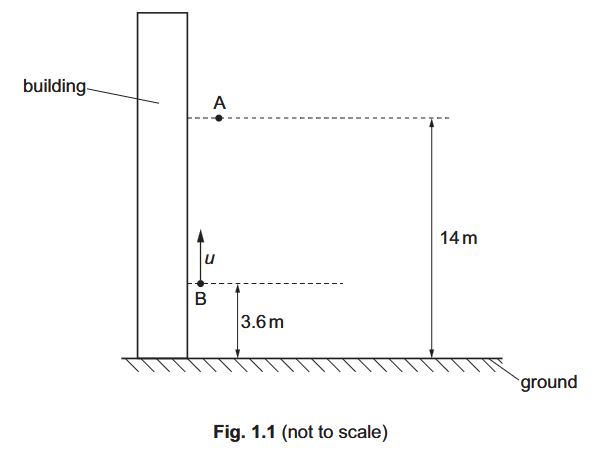
Object A is released from rest at a height of \(14\,\mathrm{m}\) above the horizontal ground.
Object B is released with an initial upwards vertical velocity \(u\) at a height of \(3.6\,\mathrm{m}\) above the ground.
Both objects take the same time to reach the ground and they do not collide with each other.
Air resistance is negligible.
(i) Calculate the time taken for object A to reach the ground. (2 marks)
time = ____________________ \(\mathrm{s}\)
(ii) Use your answer in (b)(i) to calculate \(u\). (2 marks)
\(u=\) ____________________ \(\mathrm{m\,s^{-1}}\)
(c) In a second experiment, object B is released from the same height and given the same initial speed as in (b) but at a release angle \(\theta\) to the vertical, as shown in Fig. 1.2.
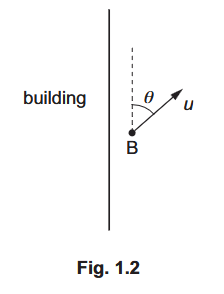
(i) State and explain whether the time taken for object B to reach the ground is less than, the same as or greater than the time in (b)(i). (2 marks)
____________________________________________________________
(ii) By considering energy, state and explain the effect of the change in release angle on the speed at which B reaches the ground. (2 marks)
____________________________________________________________
Syllabus Topic Codes (Cambridge International AS & A Level Physics 9702):
• 5.1: Energy conservation — part (c)(ii)
▶️ Answer/Explanation
(a) Definition of acceleration [1 mark]
Acceleration is the rate of change of velocity.
(b)(i) Time taken by object A [2 marks]
Object A is released from rest, so \(u=0\).
Using
\(s=ut+\dfrac{1}{2}at^2\)
\(14=\dfrac{1}{2}\times9.81\times t^2\)
\(t=\sqrt{\dfrac{2\times14}{9.81}}\)
\(t=1.69\,\mathrm{s}\)
Answer: \( \boxed{1.7\,\mathrm{s}} \)
(b)(ii) Initial velocity \(u\) of object B [2 marks]
Object B travels from \(3.6\,\mathrm{m}\) above the ground to the ground in the same time, \(1.7\,\mathrm{s}\).
Taking upward as positive, \(a=-9.81\,\mathrm{m\,s^{-2}}\) and \(s=-3.6\,\mathrm{m}\).
Using
\(s=ut+\dfrac{1}{2}at^2\)
\(-3.6=1.7u-\dfrac{1}{2}\times9.81\times1.7^2\)
\(u=6.2\,\mathrm{m\,s^{-1}}\)
Answer: \( \boxed{6.2\,\mathrm{m\,s^{-1}}\text{ upwards}} \)
(c)(i) Effect of changing the release angle [2 marks]
The initial speed remains \(u\), but when the object is released at an angle to the vertical, its initial vertical component is
\(u_y=u\cos\theta\)
Since \(\cos\theta<1\), the initial vertical component is smaller than in part (b).
The object therefore reaches the lower height of the ground in less time.
Answer: \( \boxed{\text{Less time}} \)
(c)(ii) Effect on final speed [2 marks]
The initial speed is unchanged, so the initial kinetic energy is the same as in part (b).
The initial height is also unchanged, so the initial gravitational potential energy is the same.
Therefore, the total initial mechanical energy is the same. The change in gravitational potential energy is also the same because the object starts at the same height and reaches the same ground level.
Hence, the kinetic energy and therefore the speed at the ground are unchanged.
Answer: \( \boxed{\text{The speed at the ground is the same.}} \)
Question 2
(a) State the principle of moments. (2 marks)
____________________________________________________________
(b) Three objects A, B and C are placed on a horizontal beam. The beam is in equilibrium, as shown in Fig. 2.1.
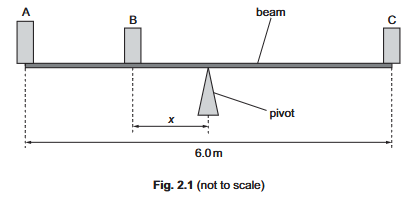
The beam is uniform and has length \(6.0\,\mathrm{m}\).
The pivot is at the midpoint of the beam.
Object A has mass \(60\,\mathrm{kg}\) and is at one end of the beam.
Object B has mass \(45\,\mathrm{kg}\) and is at a distance \(x\) from the pivot.
Object C has mass \(80\,\mathrm{kg}\) and is at the other end of the beam.
Calculate \(x\). (3 marks)
\(x=\) ____________________ \(\mathrm{m}\)
(c) The beam is \(0.80\,\mathrm{m}\) above horizontal ground.
Object A is removed and replaced by a spring connected to the ground and the beam, as shown in Fig. 2.2.
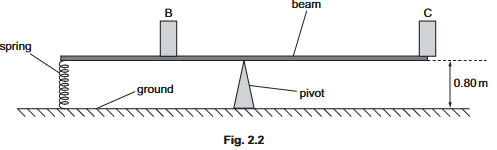
After the change, the beam is again horizontal and in equilibrium. The positions of B and C are unchanged.
The spring has an unstretched length of \(0.59\,\mathrm{m}\) and obeys Hooke’s law.
(i) Calculate the spring constant of the spring. (3 marks)
spring constant = ____________________ \(\mathrm{N\,m^{-1}}\)
(ii) Calculate the elastic potential energy of the spring. (2 marks)
elastic potential energy = ____________________ \(\mathrm{J}\)
Syllabus Topic Codes (Cambridge International AS & A Level Physics 9702):
• 6.1: Deformation of solids — part (c)(i)
• 6.2: Elastic and plastic behaviour — part (c)(ii)
▶️ Answer/Explanation
(a) Principle of moments [2 marks]
For a body in rotational equilibrium, the sum of the clockwise moments about any point is equal to the sum of the anticlockwise moments about the same point.
(b) Calculation of \(x\) [3 marks]
The beam is uniform and its weight acts at its midpoint, which is the position of the pivot. Therefore, the weight of the beam produces no moment about the pivot.
Taking moments about the pivot:
\(80\times9.81\times3=60\times9.81\times3+45\times9.81\times x\)
Cancel \(9.81\):
\(80\times3=60\times3+45x\)
\(240=180+45x\)
\(x=\dfrac{60}{45}\)
\(x=1.33\,\mathrm{m}\)
Answer: \( \boxed{1.3\,\mathrm{m}} \)
(c)(i) Spring constant [3 marks]
The spring replaces object A, so the upward force exerted by the spring is equal to the weight of object A:
\(F=60\times9.81=588.6\,\mathrm{N}\)
The beam is \(0.80\,\mathrm{m}\) above the ground and the spring has an unstretched length of \(0.59\,\mathrm{m}\).
Therefore, the extension is
\(x=0.80-0.59=0.21\,\mathrm{m}\)
Using Hooke’s law,
\(F=kx\)
\(k=\dfrac{F}{x}\)
\(k=\dfrac{60\times9.81}{0.21}\)
\(k=2803\,\mathrm{N\,m^{-1}}\)
Answer: \( \boxed{2.8\times10^3\,\mathrm{N\,m^{-1}}} \)
(c)(ii) Elastic potential energy [2 marks]
For a spring obeying Hooke’s law,
\(E_{\mathrm{P}}=\dfrac{1}{2}kx^2\)
\(E_{\mathrm{P}}=\dfrac{1}{2}\times2800\times0.21^2\)
\(E_{\mathrm{P}}=61.7\,\mathrm{J}\)
Answer: \( \boxed{62\,\mathrm{J}} \)
Question 3
(a) Define power. (1 marks)
(b) An electric car is powered by a motor. The car is travelling at a constant speed of \(35\,\mathrm{m\,s^{-1}}\) along a straight horizontal road, as shown in Fig. 3.1.
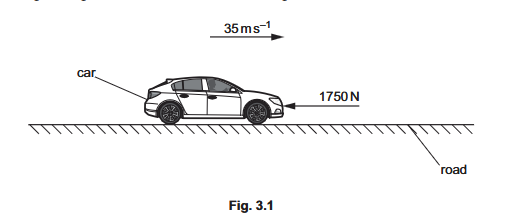
There is a total resistive force of \(1750\,\mathrm{N}\) acting on the car.
(i) Calculate the power transmitted to the wheels of the car by the motor. (2 marks)
power = ______________________________ \(\mathrm{W}\)
(ii) Calculate the useful work done by the motor when the car travels a distance of \(17\,\mathrm{km}\). (2 marks)
work done = ______________________________ \(\mathrm{J}\)
(iii) The potential difference (p.d.) across the motor has a constant value of \(600\,\mathrm{V}\) and the motor has an efficiency of \(85\%\).
Calculate the current in the motor. (3 marks)
current = ______________________________ \(\mathrm{A}\)
(c) The car in (b) now reaches a slope, as shown in Fig. 3.2.
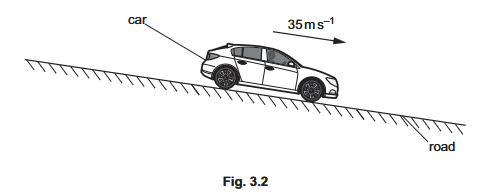
The car continues down the slope at the same speed as in (b).
(i) State and explain the effect, if any, of the slope on the air resistance acting on the car. (1 marks)
(ii) State and explain the effect, if any, of the slope on the current in the motor. (1 marks)
Syllabus Topic Codes (Cambridge International AS & A Level Physics 9702):
5.1 Energy conservation – work, efficiency and power, including \(P=\frac{W}{t}\) and \(P=Fv\).
▶️ Answer/Explanation
(a) Power [1 mark]
Power is the work done per unit time.
\(P=\frac{W}{t}\)
(b)(i) Power transmitted to the wheels [2 marks]
Since the car travels at constant speed, the driving force is equal in magnitude to the resistive force:
\(F=1750\,\mathrm{N}\)
Using \(P=Fv\):
\(P=1750\times35\)
\(P=61250\,\mathrm{W}\)
Answer: \(P=6.1\times10^4\,\mathrm{W}\)
(b)(ii) Useful work done [2 marks]
Convert the distance:
\(17\,\mathrm{km}=17000\,\mathrm{m}\)
Using \(W=Fs\):
\(W=1750\times17000\)
\(W=2.975\times10^7\,\mathrm{J}\)
Answer: \(W=3.0\times10^7\,\mathrm{J}\)
(b)(iii) Current in the motor [3 marks]
The useful output power is
\(P_{\mathrm{out}}=6.1\times10^4\,\mathrm{W}\)
The electrical input power is
\(P_{\mathrm{in}}=VI=600I\)
Using
\(\text{efficiency}=\frac{\text{useful power output}}{\text{total power input}}\)
\(0.85=\frac{6.1\times10^4}{600I}\)
\(I=\frac{6.1\times10^4}{0.85\times600}\)
\(I\approx120\,\mathrm{A}\)
Answer: \(I=120\,\mathrm{A}\)
(c)(i) Air resistance [1 mark]
The air resistance is the same because the speed of the car is unchanged.
(c)(ii) Current in the motor [1 mark]
The current is smaller because the car is travelling downhill, so gravitational potential energy is being converted into other forms of energy. Therefore, the motor needs to provide less power to maintain the same speed.
Question 4
(a) State the principle of superposition. (2 marks)
____________________________________________________________
(b) Light of wavelength \(7.2\times10^{-7}\,\mathrm{m}\) is incident normally on a double slit, as shown in Fig. 4.1.

A screen is at a distance \(D\) from the double slit. The double slit and the screen are parallel.
The separation of the slits in the double-slit arrangement is \(0.16\,\mathrm{mm}\). The resulting interference pattern on the screen contains nine dark fringes, as shown in Fig. 4.2.
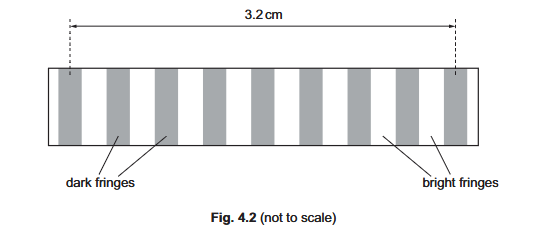
The distance between the centres of the first and ninth dark fringes is \(3.2\,\mathrm{cm}\).
(i) Calculate \(D\). (3 marks)
\(D=\) ____________________ \(\mathrm{m}\)
(ii) The slit separation is now gradually decreased from \(0.16\,\mathrm{mm}\) to \(0.04\,\mathrm{mm}\). The distance between the centres of adjacent dark fringes is \(x\).
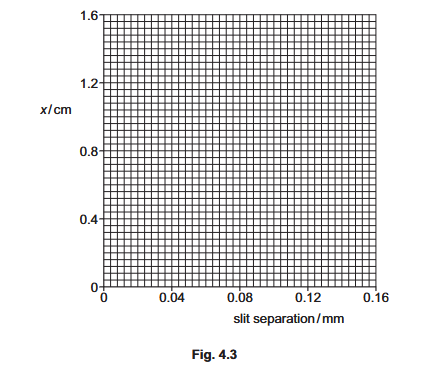
On Fig. 4.3, sketch the variation of \(x\) with slit separation. (3 marks)
Syllabus Topic Codes (Cambridge International AS & A Level Physics 9702):
• 8.3: Interference — parts (b)(i) and (b)(ii)
▶️ Answer/Explanation
(a) Principle of superposition [2 marks]
When two or more waves meet or overlap at a point, the resultant displacement is equal to the sum of the individual displacements.
(b)(i) Distance \(D\) [3 marks]
There are nine dark fringes, so the distance between the centres of the first and ninth dark fringes contains \(8\) fringe spacings.
Therefore, the fringe width is
\(x=\dfrac{3.2\times10^{-2}}{8}\)
\(x=4.0\times10^{-3}\,\mathrm{m}\)
For double-slit interference,
\(x=\dfrac{\lambda D}{a}\)
Rearranging,
\(D=\dfrac{ax}{\lambda}\)
The slit separation is
\(a=0.16\,\mathrm{mm}=0.16\times10^{-3}\,\mathrm{m}\)
Hence,
\(D=\dfrac{(0.16\times10^{-3})(4.0\times10^{-3})}{7.2\times10^{-7}}\)
\(D=0.889\,\mathrm{m}\)
Answer: \( \boxed{0.89\,\mathrm{m}} \)
(b)(ii) Variation of fringe spacing with slit separation [3 marks]
From
\(x=\dfrac{\lambda D}{a}\)
the fringe spacing \(x\) is inversely proportional to the slit separation \(a\).
Therefore, the graph should be a curved line with a negative gradient, with the magnitude of the gradient decreasing as the slit separation increases.
The curve should pass through the points approximately
\((0.04,\,1.6)\)
and
\((0.16,\,0.4)\)
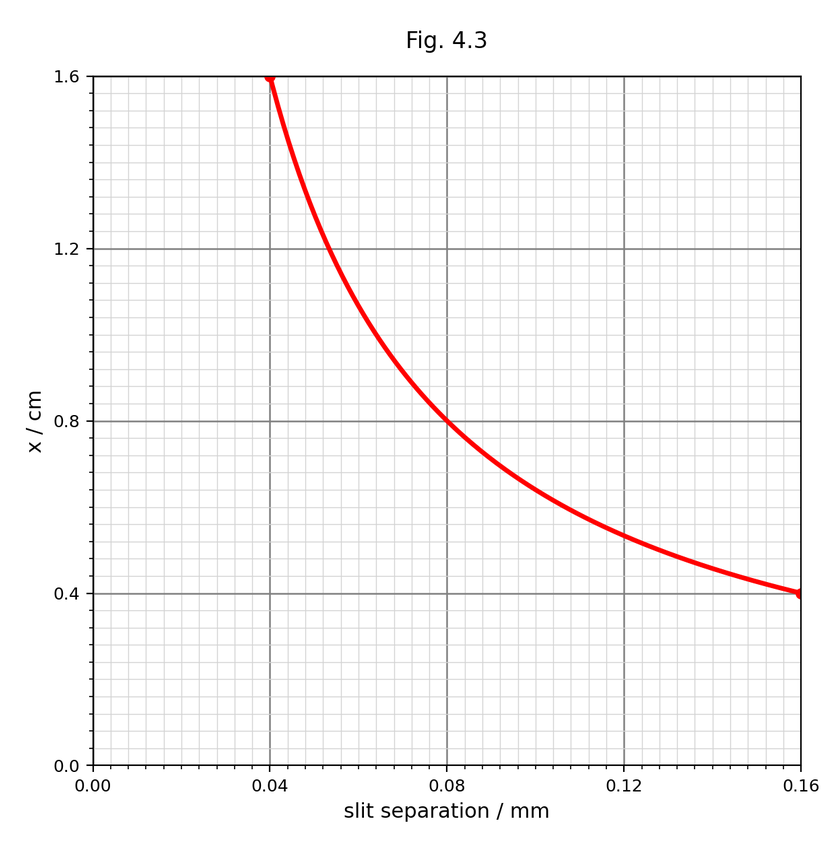
Graph: a decreasing inverse-type curve from approximately \((0.04,1.6)\) to \((0.16,0.4)\).
Question 5
(a) Use the definitions of speed \(v\), frequency \(f\) and wavelength \(\lambda\) to derive the wave equation
\(v=f\lambda\) (2 marks)
(b) A source of sound waves of frequency \(236\,\mathrm{Hz}\) is travelling at a constant velocity of \(20\,\mathrm{m\,s^{-1}}\).
A stationary observer has a microphone connected to a cathode-ray oscilloscope (CRO). The microphone detects the sound waves as the source moves directly towards the observer.
The resulting trace on the CRO is shown in Fig. 5.1.
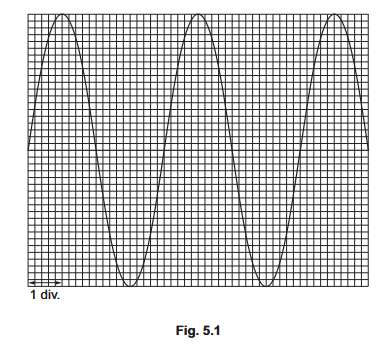
The time-base on the CRO is set to \(1.0\,\mathrm{ms\,div^{-1}}\).
(i) Calculate the frequency of the sound waves detected by the microphone. (2 marks)
frequency = ______________________________ \( \mathrm{Hz} \)
(ii) Determine the speed of the sound in air. (2 marks)
speed of sound = ______________________________ \( \mathrm{m\,s^{-1}} \)
Syllabus Topic Codes (Cambridge International AS & A Level Physics 9702):
• 7.3: Doppler effect for sound waves — part (b)(ii)
▶️ Answer/Explanation
(a) Derivation of the wave equation [2 marks]
The wavelength \(\lambda\) is the distance travelled by a wave during one complete oscillation.
The time for one complete oscillation is the period \(T\), where
\(T=\dfrac{1}{f}\)
Using the definition of speed,
\(v=\dfrac{\text{distance}}{\text{time}}\)
For one complete oscillation, the distance travelled is \(\lambda\), so
\(v=\dfrac{\lambda}{T}\)
Since \(T=\dfrac{1}{f}\),
\(v=\dfrac{\lambda}{1/f}\)
Answer: \( \boxed{v=f\lambda} \)
(b)(i) Frequency detected by the microphone [2 marks]
From the CRO trace, one complete cycle occupies \(4\) divisions.
Each division represents \(1.0\,\mathrm{ms}\), so the period is
\(T=4\times1.0\,\mathrm{ms}=4.0\times10^{-3}\,\mathrm{s}\)
Using \(f=\dfrac{1}{T}\),
\(f=\dfrac{1}{4.0\times10^{-3}}\)
\(f=250\,\mathrm{Hz}\)
Answer: \( \boxed{250\,\mathrm{Hz}} \)
(b)(ii) Speed of sound in air [2 marks]
The source is moving towards the stationary observer, so the observed frequency is greater than the source frequency.
For a source moving towards a stationary observer, the Doppler equation is
\(f_{\mathrm{o}}=f_{\mathrm{s}}\dfrac{v}{v-v_{\mathrm{s}}}\)
Substituting \(f_{\mathrm{o}}=250\,\mathrm{Hz}\), \(f_{\mathrm{s}}=236\,\mathrm{Hz}\) and \(v_{\mathrm{s}}=20\,\mathrm{m\,s^{-1}}\),
\(250=236\dfrac{v}{v-20}\)
\(250(v-20)=236v\)
\(250v-5000=236v\)
\(14v=5000\)
\(v=\dfrac{5000}{14}\)
\(v=357.1\,\mathrm{m\,s^{-1}}\)
Answer: \( \boxed{360\,\mathrm{m\,s^{-1}}} \)
Question 6
A nichrome wire X of length \(45\,\mathrm{cm}\) and cross-sectional area \(4.7\times10^{-7}\,\mathrm{m^2}\) is connected into the circuit shown in Fig. 6.1.
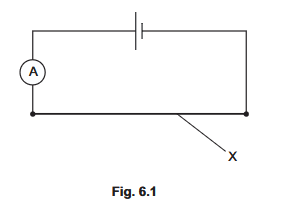
The resistance of X is \(1.1\,\Omega\). The cell has electromotive force (e.m.f.) \(1.3\,\mathrm{V}\) and negligible internal resistance.
(a)(i) Calculate the current in X. (1 mark)
current = ______________________________ \(\mathrm{A}\)
(ii) The number density of charge carriers (electrons) in nichrome is \(8.5\times10^{28}\,\mathrm{m^{-3}}\).
Calculate the average drift speed of the charge carriers in X. (2 marks)
average drift speed = ______________________________ \(\mathrm{m\,s^{-1}}\)
(iii) Calculate the resistivity of the nichrome. (3 marks)
resistivity = ______________________________ \(\Omega\,\mathrm{m}\)
(b) Wire Y is identical to wire X. Wire Y is added to the circuit in parallel with wire X, as shown in Fig. 6.2.
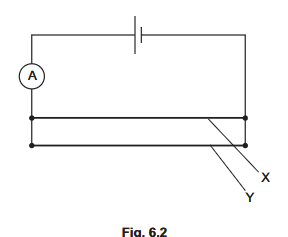
State and explain the effect, if any, this change has on:
(i) the reading on the ammeter (2 marks)
________________________________________________________________________________
________________________________________________________________________________
(ii) the average drift speed of the charge carriers in X. (1 mark)
________________________________________________________________________________
Syllabus Topic Codes (Cambridge International AS & A Level Physics 9702):
• 9.3: Resistance and resistivity — part (a)(i) and (a)(iii)
• 10.1: Practical circuits — part (b)(i)
▶️ Answer/Explanation
(a)(i) Current in X [1 mark]
The internal resistance of the cell is negligible, so the potential difference across X is \(1.3\,\mathrm{V}\).
Using Ohm’s law,
\(I=\dfrac{V}{R}\)
\(I=\dfrac{1.3}{1.1}\)
\(I=1.18\,\mathrm{A}\)
Answer: \( \boxed{1.2\,\mathrm{A}} \)
(a)(ii) Average drift speed [2 marks]
The current is related to the drift speed by
\(I=nqAv_{\mathrm{d}}\)
Therefore,
\(v_{\mathrm{d}}=\dfrac{I}{nqA}\)
Substituting \(I=1.2\,\mathrm{A}\), \(n=8.5\times10^{28}\,\mathrm{m^{-3}}\), \(q=1.60\times10^{-19}\,\mathrm{C}\) and \(A=4.7\times10^{-7}\,\mathrm{m^2}\),
\(v_{\mathrm{d}}=\dfrac{1.2}{(8.5\times10^{28})(1.60\times10^{-19})(4.7\times10^{-7})}\)
\(v_{\mathrm{d}}=1.9\times10^{-4}\,\mathrm{m\,s^{-1}}\)
Answer: \( \boxed{1.9\times10^{-4}\,\mathrm{m\,s^{-1}}} \)
(a)(iii) Resistivity of nichrome [3 marks]
The resistance of a wire is related to its resistivity by
\(R=\dfrac{\rho L}{A}\)
Rearranging,
\(\rho=\dfrac{RA}{L}\)
The length is \(45\,\mathrm{cm}=0.45\,\mathrm{m}\).
\(\rho=\dfrac{(1.1)(4.7\times10^{-7})}{0.45}\)
\(\rho=1.15\times10^{-6}\,\Omega\,\mathrm{m}\)
Answer: \( \boxed{1.1\times10^{-6}\,\Omega\,\mathrm{m}} \)
(b)(i) Effect on the ammeter reading [2 marks]
Adding wire Y in parallel provides an additional path for current.
Therefore, the total resistance of the circuit decreases.
The cell has negligible internal resistance, so the potential difference across the parallel combination remains the same.
Using \(I=\dfrac{V}{R}\), a decrease in total resistance causes the total current supplied by the cell to increase.
Answer: \( \boxed{\text{The ammeter reading increases.}} \)
(b)(ii) Effect on average drift speed in X [1 mark]
Wire X remains connected directly across the cell, so its potential difference and resistance are unchanged.
Hence, the current in X remains unchanged.
Since \(v_{\mathrm{d}}=\dfrac{I}{nqA}\), the average drift speed of the charge carriers in X also remains unchanged.
Answer: \( \boxed{\text{The average drift speed remains the same.}} \)
Question 7
(a) Nitrogen-12 \(\left({}^{12}_{7}\mathrm{N}\right)\) is an unstable isotope of nitrogen that decays by the emission of radiation to carbon-12 \(\left({}^{12}_{6}\mathrm{C}\right)\).
Complete the full nuclear equation for the decay, including all the particles involved.
\({}^{12}_{7}\mathrm{N}\rightarrow\) ______________________________ (3 marks)
(b) Hydrogen-1 \(\left({}^{1}_{1}\mathrm{H}\right)\) is an isotope of hydrogen. An atom of hydrogen-1 comprises a proton with an orbiting electron.
An antiparticle equivalent of hydrogen-1 comprises an antiproton with an orbiting positron.
The antiquarks in the antiproton are the antiparticles of the quarks in a proton.
(i) State the charge on the positron in terms of the elementary charge \(e\). (1 mark)
charge = ______________________________ \(e\)
(ii) State the group (class) of fundamental particle to which the positron belongs. (1 mark)
________________________________________________________________________________
(iii) In Table 7.1, state the flavour and charge of the three antiquarks that comprise the antiproton. (3 marks)
Table 7.1
| flavour | charge/\(e\) |
Syllabus Topic Codes (Cambridge International AS & A Level Physics 9702):
• 11.2: Fundamental particles — parts (b)(i), (b)(ii) and (b)(iii)
▶️ Answer/Explanation
(a) Nuclear equation for nitrogen-12 decay [3 marks]
The nucleus changes from nitrogen with proton number \(7\) to carbon with proton number \(6\). Therefore, the proton number decreases by \(1\), indicating \(\beta^+\) decay.
In \(\beta^+\) decay, a positron and a neutrino are emitted.
The complete nuclear equation is
\({}^{12}_{7}\mathrm{N}\rightarrow{}^{12}_{6}\mathrm{C}+{}^{0}_{+1}\mathrm{e}+{}^{0}_{0}\nu\)
Answer: \( \boxed{{}^{12}_{7}\mathrm{N}\rightarrow{}^{12}_{6}\mathrm{C}+{}^{0}_{+1}\mathrm{e}+{}^{0}_{0}\nu} \)
(b)(i) Charge on the positron [1 mark]
A positron is the antiparticle of the electron and has equal magnitude but opposite charge.
Answer: \( \boxed{+1} \)
(b)(ii) Group of fundamental particle [1 mark]
The positron is the antiparticle of the electron. The electron belongs to the lepton group.
Answer: \( \boxed{\text{Lepton}} \)
(b)(iii) Antiquarks in the antiproton [3 marks]
A proton consists of two up quarks and one down quark:
\(p=uud\)
Therefore, an antiproton consists of two anti-up quarks and one anti-down quark:
\(\overline{p}=\overline{u}\,\overline{u}\,\overline{d}\)
| flavour | charge/\(e\) |
| anti-up \(\left(\overline{u}\right)\) | \(-\dfrac{2}{3}\) |
| anti-up \(\left(\overline{u}\right)\) | \(-\dfrac{2}{3}\) |
| anti-down \(\left(\overline{d}\right)\) | \(+\dfrac{1}{3}\) |
Answer: the three antiquarks are two anti-up quarks with charge \(-\dfrac{2}{3}e\) each and one anti-down quark with charge \(+\dfrac{1}{3}e\).