
Question 1
(a) Table 1.1 lists some physical quantities. Identify with ticks (✓) which quantities are vectors and which are scalars.
Table 1.1
| quantity | scalar | vector |
| acceleration | ||
| displacement | ||
| gravitational potential energy | ||
| speed | ||
| temperature |
(2 marks)
(b) A constant resultant force \(F\) acts on a car of mass \(m\). The car moves from rest with constant acceleration \(a\) along a horizontal ground. When the car has displacement \(s\), the speed of the car is \(v\).
(i) Using the concept of work done on the car, show that the kinetic energy \(E_{\mathrm{K}}\) of the car is given by the equation
\(E_{\mathrm{K}}=\dfrac{1}{2}mv^2\) (3 marks)
(ii) The mass of the car is \(920\,\mathrm{kg}\). At time \(t=0\), the car is at rest. At time \(t=5.8\,\mathrm{s}\), its velocity is \(17\,\mathrm{m\,s^{-1}}\).
Calculate the kinetic energy of the car at time \(t=5.8\,\mathrm{s}\).
kinetic energy = ______________________________ \(\mathrm{J}\) (1 mark)
(iii) Between time \(t=0\) and time \(t=5.8\,\mathrm{s}\), the work done against resistive forces is \(4.7\times10^4\,\mathrm{J}\).
Determine the average output power of the car during this time.
power = ______________________________ \(\mathrm{W}\) (3 marks)
(iv) At time \(t=5.8\,\mathrm{s}\), the speed of the car becomes constant.
State and explain whether the output power of the car is greater than, less than or the same as the output power just before \(t=5.8\,\mathrm{s}\).
________________________________________________________________________________
________________________________________________________________________________ (1 mark)
Syllabus Topic Codes (Cambridge International AS & A Level Physics 9702):
• 5.1: Energy conservation — parts (b)(i), (b)(iii) and (b)(iv)
• 5.2: Gravitational potential energy and kinetic energy — part (b)(ii)
▶️ Answer/Explanation
(a) Scalars and vectors [2 marks]
| quantity | scalar | vector |
| acceleration | ✓ | |
| displacement | ✓ | |
| gravitational potential energy | ✓ | |
| speed | ✓ | |
| temperature | ✓ |
Answer: acceleration and displacement are vectors. Gravitational potential energy, speed and temperature are scalars.
(b)(i) Derivation of kinetic energy [3 marks]
The work done by the resultant force is
\(W=Fs\)
Using Newton’s second law, \(F=ma\), so
\(W=mas\)
The car starts from rest, so \(u=0\). Using the equation of motion
\(v^2=u^2+2as\)
\(v^2=2as\)
Therefore,
\(as=\dfrac{v^2}{2}\)
Substituting into the work equation,
\(W=m\dfrac{v^2}{2}\)
The work done on the car becomes its kinetic energy, so
Answer: \( \boxed{E_{\mathrm{K}}=\dfrac{1}{2}mv^2} \)
(b)(ii) Kinetic energy at \(t=5.8\,\mathrm{s}\) [1 mark]
Using
\(E_{\mathrm{K}}=\dfrac{1}{2}mv^2\)
\(E_{\mathrm{K}}=\dfrac{1}{2}\times920\times17^2\)
\(E_{\mathrm{K}}=133\,060\,\mathrm{J}\)
\(E_{\mathrm{K}}\approx1.3\times10^5\,\mathrm{J}\)
Answer: \( \boxed{1.3\times10^5\,\mathrm{J}} \)
(b)(iii) Average output power [3 marks]
The output work is the work used to increase the kinetic energy plus the work done against resistive forces.
Therefore,
\(W=4.7\times10^4+1.3\times10^5\)
\(W=1.77\times10^5\,\mathrm{J}\)
Average power is
\(P=\dfrac{W}{t}\)
\(P=\dfrac{4.7\times10^4+1.3\times10^5}{5.8}\)
\(P=3.1\times10^4\,\mathrm{W}\)
Answer: \( \boxed{3.1\times10^4\,\mathrm{W}} \)
(b)(iv) Output power when speed becomes constant [1 mark]
When the speed becomes constant, the kinetic energy of the car no longer increases.
Therefore, no further work is required to accelerate the car. The output power is then only required to overcome the resistive forces.
Just before \(t=5.8\,\mathrm{s}\), some of the output power was also being used to increase the kinetic energy.
Answer: \( \boxed{\text{The output power is less.}} \)
Question 2
(a) Define the moment of a force about a point. (1 mark)
________________________________________________________________________________
(b) A tree of mass \(270\,\mathrm{kg}\) grows out of sloping ground and is supported by a post, as shown in Fig. 2.1.
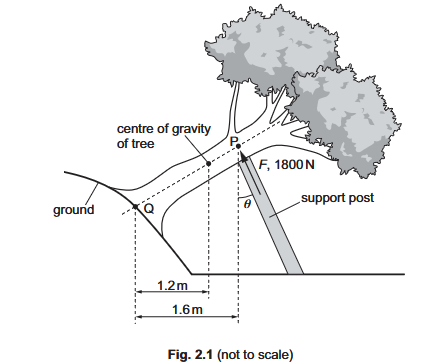
The ground applies a total force \(R\) on the tree at point Q.
The centre of gravity of the tree is a horizontal distance of \(1.2\,\mathrm{m}\) from Q.
The post applies a force \(F\) of \(1800\,\mathrm{N}\) perpendicular to the line PQ. The line of action of \(F\) passes through point P at an angle \(\theta\) to the vertical. P is a horizontal distance of \(1.6\,\mathrm{m}\) from Q.
The tree is in equilibrium and all forces act on the tree in the same plane.
(i) By taking moments about point Q, show that \(\theta\) is \(25^\circ\). (3 marks)
________________________________________________________________________________
________________________________________________________________________________
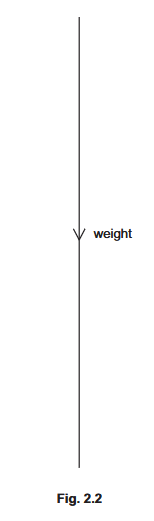
(ii) On Fig. 2.2, draw a large scale vector triangle to represent the forces acting on the tree. The weight of the tree has been drawn to scale. (2 marks)
(iii) The tree exerts a pressure of \(150\,\mathrm{kPa}\) on the top of the post.
Determine the surface area of the tree in contact with the post. (2 marks)
area = ______________________________ \(\mathrm{m^2}\)
Syllabus Topic Codes (Cambridge International AS & A Level Physics 9702):
• 4.2: Equilibrium of forces — part (b)(ii)
• 4.3: Density and pressure — part (b)(iii)
▶️ Answer/Explanation
(a) Moment of a force [1 mark]
The moment of a force about a point is the product of the force and the perpendicular distance from the point to the line of action of the force.
Answer: \( \boxed{\text{moment}=\text{force}\times\text{perpendicular distance}} \)
(b)(i) Taking moments about Q [3 marks]
The weight of the tree is
\(W=mg\)
\(W=270\times9.81\)
The moment due to the weight about Q is therefore
\(M_W=1.2\times270\times9.81\)
Since \(F\) is perpendicular to PQ, its moment about Q is
\(M_F=1800\times\left(\dfrac{1.6}{\cos\theta}\right)\)
For equilibrium, the clockwise and anticlockwise moments are equal:
\(1.2\times270\times9.81=1800\times\left(\dfrac{1.6}{\cos\theta}\right)\)
Solving for \(\theta\),
\(\cos\theta=\dfrac{1800\times1.6}{1.2\times270\times9.81}\)
\(\theta\approx25^\circ\)
Answer: \( \boxed{\theta=25^\circ} \)
(b)(ii) Vector triangle of forces [2 marks]
The tree is in equilibrium, so the vector sum of the three forces is zero.
The three forces are the weight, the force \(F\) from the post, and the resultant force \(R\) from the ground.
The vectors must therefore form a closed tip-to-tail triangle.
The force \(F\) is at \(25^\circ\) anticlockwise from the vertical.
The resultant force \(R\) is at approximately \(37^\circ\) clockwise from the vertical.
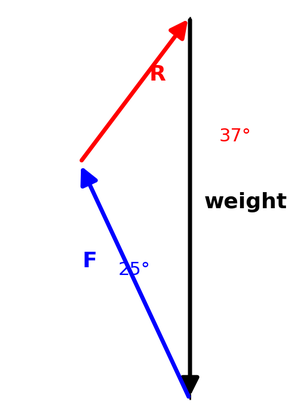
Answer: A closed tip-to-tail vector triangle with \(F\) at \(25^\circ\) anticlockwise from the vertical and \(R\) at \(37^\circ\) clockwise from the vertical.
(b)(iii) Surface area in contact with the post [2 marks]
Pressure is given by
\(p=\dfrac{F}{A}\)
Therefore,
\(A=\dfrac{F}{p}\)
The force exerted by the tree on the post is \(1800\,\mathrm{N}\), and the pressure is \(150\,\mathrm{kPa}=150\times10^3\,\mathrm{Pa}\).
\(A=\dfrac{1800}{150\times10^3}\)
\(A=0.012\,\mathrm{m^2}\)
Answer: \( \boxed{0.012\,\mathrm{m^2}} \)
Question 3
Two progressive water waves X and Y travel along a straight line from point A to point B. The variation of displacement of the waves with distance from A at an instant in time is shown in Fig. 3.1.
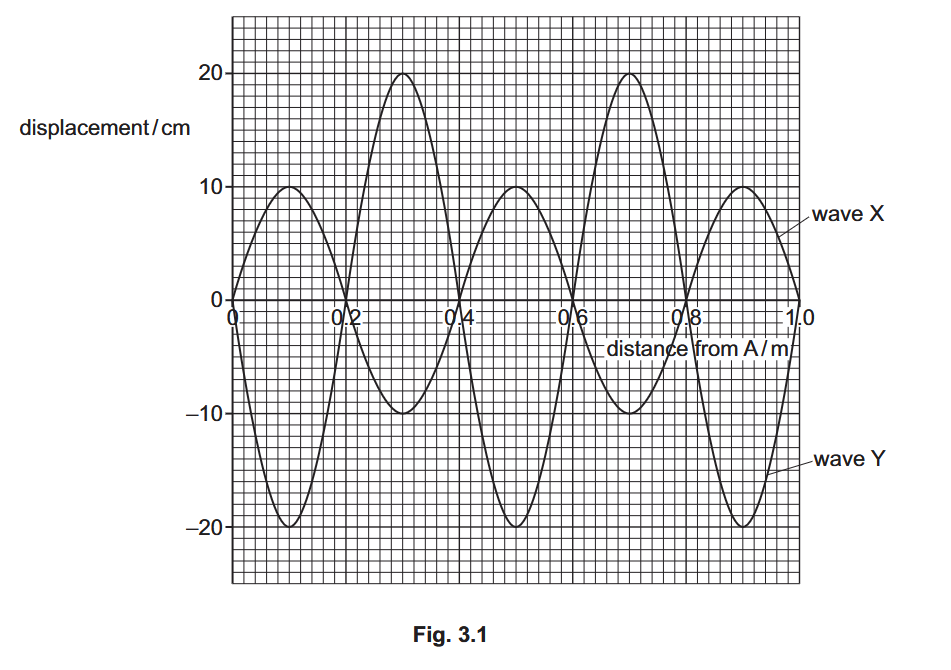
(a) State the amplitude of wave X. (1 mark)
amplitude = ______________________________ \(\mathrm{cm}\)
(b) Both waves have frequency \(16\,\mathrm{Hz}\).
(i) Determine the speed of wave X. (2 marks)
speed = ______________________________ \(\mathrm{m\,s^{-1}}\)
(ii) State and explain whether X and Y are coherent. (1 mark)
________________________________________________________________________________
________________________________________________________________________________
(c) Wave X and wave Y superpose to form a resultant wave.
On Fig. 3.2, sketch the variation of displacement of the resultant wave with distance from A at the instant of time shown in Fig. 3.1.
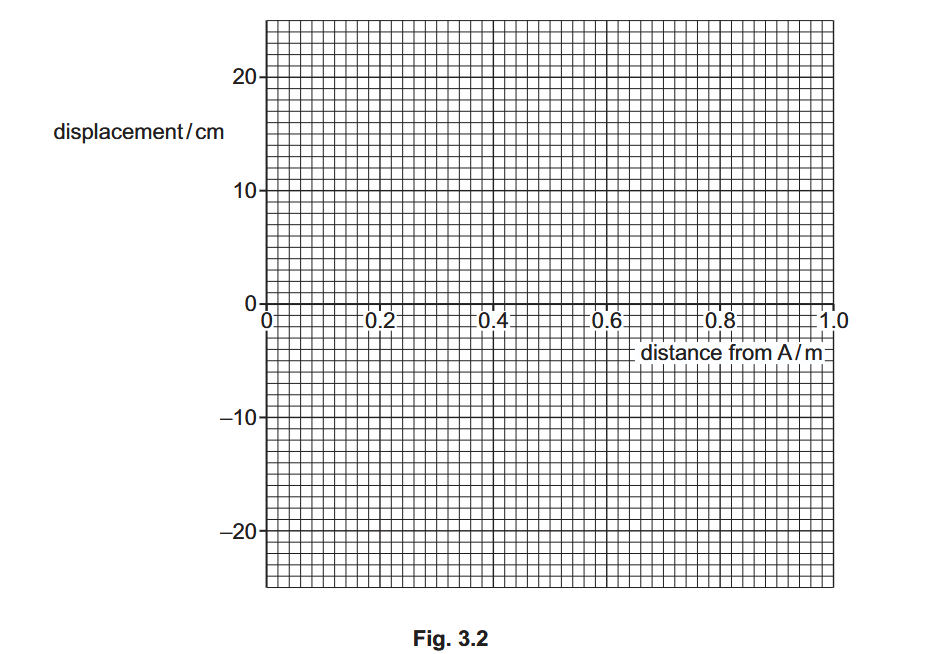
(2 marks)
(d) The intensity of wave X is \(I_{\mathrm{X}}\). The intensity of wave Y is \(I_{\mathrm{Y}}\).
Use Fig. 3.1 to determine the ratio \(\dfrac{I_{\mathrm{X}}}{I_{\mathrm{Y}}}\).
ratio = ______________________________ (2 marks)
Syllabus Topic Codes (Cambridge International AS & A Level Physics 9702):
• 8.3: Interference — parts (c) and (d)
▶️ Answer/Explanation
(a) Amplitude of wave X [1 mark]
The amplitude is the maximum displacement from the equilibrium position.
From Fig. 3.1, wave X has a maximum displacement of \(10.0\,\mathrm{cm}\).
Answer: \( \boxed{10.0\,\mathrm{cm}} \)
(b)(i) Speed of wave X [2 marks]
From Fig. 3.1, the wavelength of wave X is \(0.40\,\mathrm{m}\).
Using the wave equation,
\(v=f\lambda\)
\(v=16\times0.40\)
\(v=6.4\,\mathrm{m\,s^{-1}}\)
Answer: \( \boxed{6.4\,\mathrm{m\,s^{-1}}} \)
(b)(ii) Coherence of waves X and Y [1 mark]
The two waves have a constant phase difference of \(180^\circ\).
A constant phase difference means that the waves are coherent.
Answer: \( \boxed{\text{X and Y are coherent.}} \)
(c) Resultant wave by superposition [2 marks]
At every position, the resultant displacement is the algebraic sum of the displacements of waves X and Y.
The amplitudes are \(10.0\,\mathrm{cm}\) for wave X and \(20.0\,\mathrm{cm}\) for wave Y, and the waves have a phase difference of \(180^\circ\).
Therefore, the resultant wave has amplitude
\(20.0-10.0=10.0\,\mathrm{cm}\)
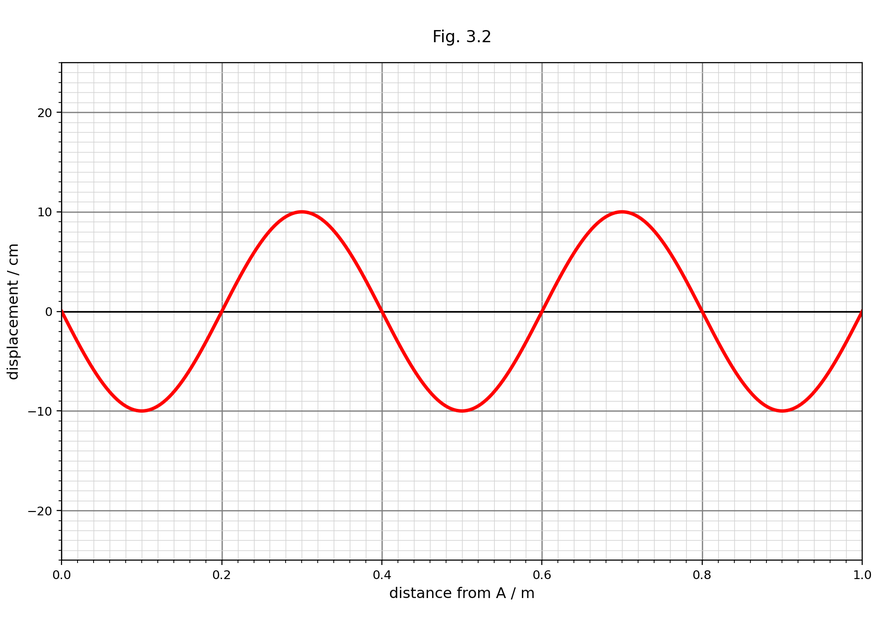
Since the larger wave is wave Y, the resultant is a negative sine wave with the same wavelength of \(0.40\,\mathrm{m}\).
Answer: Draw a single negative sine wave of amplitude \(10.0\,\mathrm{cm}\) and wavelength \(0.40\,\mathrm{m}\).
(d) Intensity ratio [2 marks]
For waves of the same type, intensity is proportional to the square of amplitude:
\(I\propto A^2\)
From Fig. 3.1,
\(A_{\mathrm{X}}=10\,\mathrm{cm}\)
and
\(A_{\mathrm{Y}}=20\,\mathrm{cm}\)
Therefore,
\(\dfrac{I_{\mathrm{X}}}{I_{\mathrm{Y}}}=\dfrac{A_{\mathrm{X}}^2}{A_{\mathrm{Y}}^2}\)
\(\dfrac{I_{\mathrm{X}}}{I_{\mathrm{Y}}}=\dfrac{10^2}{20^2}\)
\(\dfrac{I_{\mathrm{X}}}{I_{\mathrm{Y}}}=\dfrac{1}{4}=0.25\)
Answer: \( \boxed{0.25} \)
Question 4
A small ball is dropped from rest from height \(h_1\) above the ground and falls vertically downwards. The ball collides with the ground and bounces back vertically upwards, reaching a maximum height \(h_2\). Fig. 4.1 shows the ball just before and after hitting the ground.
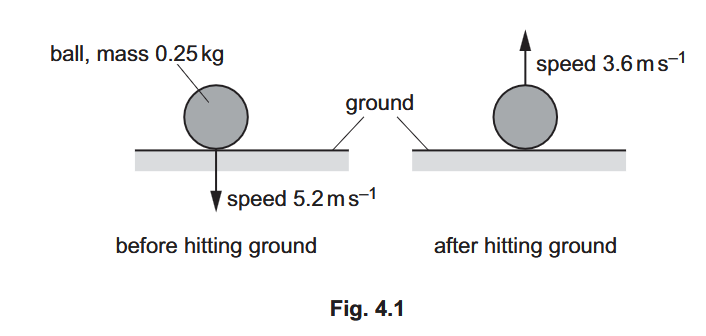
The ball has mass \(0.25\,\mathrm{kg}\) and is in contact with the ground for a time of \(0.18\,\mathrm{s}\).
Just before it hits the ground, it has speed \(5.2\,\mathrm{m\,s^{-1}}\). Just after it leaves the ground, it has speed \(3.6\,\mathrm{m\,s^{-1}}\).
Air resistance acting on the ball is negligible.
(a) State and explain whether the collision is elastic or inelastic. (1 mark)
________________________________________________________________________________
________________________________________________________________________________
(b)(i) Calculate the change in momentum of the ball during the collision with the ground. (2 marks)
change in momentum = ______________________________ \(\mathrm{kg\,m\,s^{-1}}\)
(ii) Determine the average force on the ball during the collision with the ground. (2 marks)
force = ______________________________ \(\mathrm{N}\)
(c) Calculate the ratio \(\dfrac{h_2}{h_1}\). (3 marks)
ratio = ______________________________
Syllabus Topic Codes (Cambridge International AS & A Level Physics 9702):
• 5.1: Energy conservation — parts (a) and (c)
• 5.2: Gravitational potential energy and kinetic energy — part (c)
▶️ Answer/Explanation
(a) Nature of the collision [1 mark]
For an elastic collision, the total kinetic energy is conserved.
Here, the speed of the ball decreases from \(5.2\,\mathrm{m\,s^{-1}}\) before the collision to \(3.6\,\mathrm{m\,s^{-1}}\) after the collision. Therefore, the kinetic energy changes and is not conserved.
Answer: \( \boxed{\text{The collision is inelastic.}} \)
(b)(i) Change in momentum [2 marks]
Take upward as positive.
Before the collision, the velocity is \(-5.2\,\mathrm{m\,s^{-1}}\), while after the collision it is \(+3.6\,\mathrm{m\,s^{-1}}\).
Using \(p=mv\),
\(\Delta p=m(v-u)\)
\(\Delta p=0.25[3.6-(-5.2)]\)
\(\Delta p=0.25(8.8)\)
\(\Delta p=2.2\,\mathrm{kg\,m\,s^{-1}}\)
Answer: \( \boxed{2.2\,\mathrm{kg\,m\,s^{-1}}} \)
(b)(ii) Average force during the collision [2 marks]
Average force is related to the change in momentum by
\(F=\dfrac{\Delta p}{\Delta t}\)
Substituting \(\Delta p=2.2\,\mathrm{kg\,m\,s^{-1}}\) and \(\Delta t=0.18\,\mathrm{s}\),
\(F=\dfrac{2.2}{0.18}\)
\(F=12.2\,\mathrm{N}\)
Answer: \( \boxed{12\,\mathrm{N}} \)
(c) Ratio of heights [3 marks]
As the ball falls from height \(h_1\), its gravitational potential energy is converted into kinetic energy. Therefore,
\(\dfrac{1}{2}mv^2=mg h_1\)
Using the speed just before impact, \(v=5.2\,\mathrm{m\,s^{-1}}\),
\(\dfrac{1}{2}\times0.25\times5.2^2=0.25\times g\times h_1\)
\(h_1=\dfrac{5.2^2}{2g}=1.38\,\mathrm{m}\)
After the collision, the kinetic energy is converted into gravitational potential energy as the ball rises to height \(h_2\).
\(\dfrac{1}{2}mv^2=mg h_2\)
Using \(v=3.6\,\mathrm{m\,s^{-1}}\),
\(\dfrac{1}{2}\times0.25\times3.6^2=0.25\times g\times h_2\)
\(h_2=\dfrac{3.6^2}{2g}=0.66\,\mathrm{m}\)
Therefore,
\(\dfrac{h_2}{h_1}=\dfrac{0.66}{1.38}\)
\(\dfrac{h_2}{h_1}=0.48\)
Answer: \( \boxed{0.48} \)
Question 5
(a) Define the Young modulus. (1 mark)
___________________________
(b) A wire of unstretched length \(0.81\,\mathrm{m}\) is made of a metal with Young modulus \(95\,\mathrm{GPa}\). The wire obeys Hooke’s law and has a constant cross-sectional area. Fig. 5.1 shows the force-extension graph for the wire.
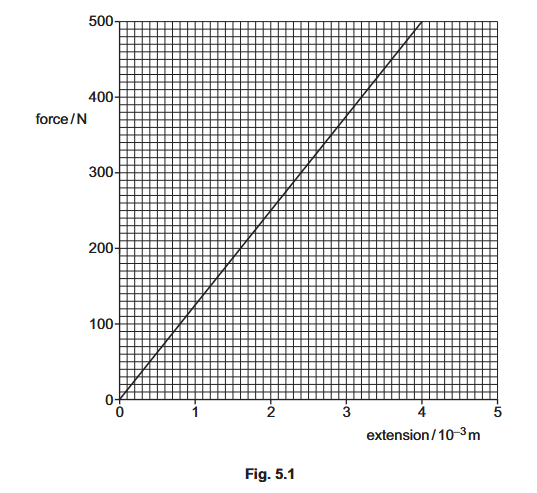
(i) Determine the cross-sectional area of the wire. (3 marks)
area = ______________________________ \(\mathrm{m^2}\)
(ii) The extension of the wire is initially \(2.0\times10^{-3}\,\mathrm{m}\).
Determine the work done to increase the extension of the wire to \(3.0\times10^{-3}\,\mathrm{m}\). (3 marks)
work done = ______________________________ \(\mathrm{J}\)
Syllabus Topic Codes (Cambridge International AS & A Level Physics 9702):
• 6.2: Elastic and plastic behaviour — part (b)(ii)
▶️ Answer/Explanation
(a) Young modulus [1 mark]
The Young modulus is the ratio of tensile stress to tensile strain.
Answer: \( \boxed{\text{Young modulus}=\dfrac{\text{stress}}{\text{strain}}} \)
(b)(i) Cross-sectional area of the wire [3 marks]
The Young modulus is
\(E=\dfrac{\text{stress}}{\text{strain}}\)
Since
\(\text{stress}=\dfrac{F}{A}\)
and
\(\text{strain}=\dfrac{x}{L}\)
we have
\(E=\dfrac{F/A}{x/L}\)
Therefore,
\(A=\dfrac{FL}{Ex}\)
From Fig. 5.1, when \(x=4.0\times10^{-3}\,\mathrm{m}\), \(F=500\,\mathrm{N}\).
\(E=95\times10^9\,\mathrm{Pa}\)
\(A=\dfrac{500\times0.81}{(95\times10^9)(4.0\times10^{-3})}\)
\(A=1.07\times10^{-6}\,\mathrm{m^2}\)
Answer: \( \boxed{1.1\times10^{-6}\,\mathrm{m^2}} \)
(b)(ii) Work done in increasing the extension [3 marks]
The work done is equal to the area under the force-extension graph between \(2.0\times10^{-3}\,\mathrm{m}\) and \(3.0\times10^{-3}\,\mathrm{m}\).
From the straight-line graph:
At \(x=2.0\times10^{-3}\,\mathrm{m}\), \(F=250\,\mathrm{N}\).
At \(x=3.0\times10^{-3}\,\mathrm{m}\), \(F=375\,\mathrm{N}\).
The area is a trapezium, so
\(W=\dfrac{1}{2}(250+375)(3.0\times10^{-3}-2.0\times10^{-3})\)
\(W=\dfrac{1}{2}(625)(1.0\times10^{-3})\)
\(W=0.3125\,\mathrm{J}\)
Answer: \( \boxed{0.31\,\mathrm{J}} \)
Question 6
(a) Define electric potential difference across a component. (1 mark)
________________________________
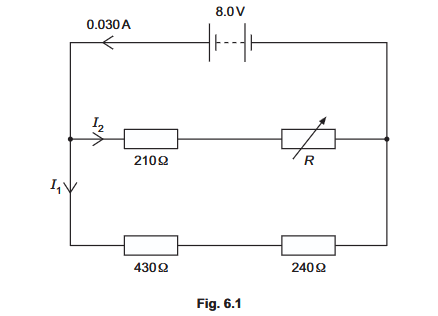
(b) A circuit contains four resistors and a battery of electromotive force (e.m.f.) \(8.0\,\mathrm{V}\) and negligible internal resistance. When the variable resistor has resistance \(R\), the currents in the circuit are \(0.030\,\mathrm{A}\), \(I_1\) and \(I_2\), as shown in Fig. 6.1.
(i) Determine the charge passing through the battery in a time of \(4.0\,\mathrm{minutes}\). (2 marks)
charge = ______________________________ \(\mathrm{C}\)
(ii) Calculate \(I_1\). (2 marks)
\(I_1=\) ______________________________ \(\mathrm{A}\)
(iii) Calculate \(I_2\). (1 mark)
\(I_2=\) ______________________________ \(\mathrm{A}\)
(iv) Determine \(R\). (2 marks)
\(R=\) ______________________________ \(\Omega\)
(c) The variable resistor in (b) is fitted with a scale so that its resistance can be accurately determined.
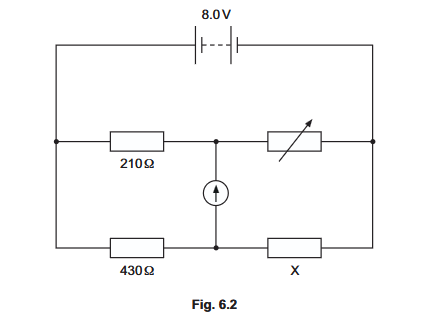
The resistor of resistance \(240\,\Omega\) is now replaced by a new resistor X of unknown resistance. A galvanometer is connected as shown in Fig. 6.2.
With reference to ratios of resistances, explain how this circuit can be used to determine the resistance of X. (2 marks)
________________________________________________________________________________
Syllabus Topic Codes (Cambridge International AS & A Level Physics 9702):
• 9.2: Potential difference and power — part (a)
• 9.3: Resistance and resistivity — part (b)(iv)
• 10.1: Practical circuits — parts (b)(iv) and (c)
▶️ Answer/Explanation
(a) Electric potential difference [1 mark]
Electric potential difference is the energy transferred to a component per unit charge passing through the component.
Answer: \( \boxed{\text{energy transferred per unit charge}} \)
(b)(i) Charge passing through the battery [2 marks]
Using
\(Q=It\)
The time is \(4.0\,\mathrm{min}=4.0\times60=240\,\mathrm{s}\).
\(Q=0.030\times240\)
\(Q=7.2\,\mathrm{C}\)
Answer: \( \boxed{7.2\,\mathrm{C}} \)
(b)(ii) Calculate \(I_1\) [2 marks]
The lower branch contains \(430\,\Omega\) and \(240\,\Omega\) in series, so its total resistance is
\(R_{\mathrm{lower}}=430+240=670\,\Omega\)
Using \(I=\dfrac{V}{R}\),
\(I_1=\dfrac{8.0}{430+240}\)
\(I_1=0.0119\,\mathrm{A}\)
Answer: \( \boxed{0.012\,\mathrm{A}} \)
(b)(iii) Calculate \(I_2\) [1 mark]
At the junction, the total current is \(0.030\,\mathrm{A}\), which splits into \(I_1\) and \(I_2\).
\(I_2=0.030-I_1\)
\(I_2=0.030-0.012\)
\(I_2=0.018\,\mathrm{A}\)
Answer: \( \boxed{0.018\,\mathrm{A}} \)
(b)(iv) Determine \(R\) [2 marks]
The top branch contains \(210\,\Omega\) and \(R\) in series. The potential difference across this branch is \(8.0\,\mathrm{V}\).
Using \(V=IR\),
\(8.0=0.018(210+R)\)
Therefore,
\(210+R=\dfrac{8.0}{0.018}\)
\(R=444.4-210\)
\(R\approx230\,\Omega\)
Answer: \( \boxed{230\,\Omega} \)
(c) Determining the resistance of X [2 marks]
The galvanometer is used to identify the balance condition. The variable resistor is adjusted until the galvanometer reads zero, meaning there is no potential difference between the two junctions.
At this condition, the ratio of the resistances in the top branch is equal to the ratio of the resistances in the bottom branch.
Therefore,
\(\dfrac{210}{R}=\dfrac{430}{X}\)
Rearranging gives
\(X=\dfrac{430R}{210}\)
Since \(R\) can be read accurately from its calibrated scale, \(X\) can be calculated from this resistance ratio.
Answer: \( \boxed{\text{Adjust }R\text{ until the galvanometer reads zero, then use the resistance ratio to calculate }X.} \)
Question 7
(a) State what is meant by a fundamental particle. (1 mark)
______________________________________
(b) A nucleus X has 14 nucleons and \(p\) protons. The ratio of charge to mass for nucleus X is \(4.1\times10^7\,\mathrm{C\,kg^{-1}}\).
(i) Determine \(p\). (3 marks)
\(p=\) ______________________________
(ii) Nucleus X undergoes \(\beta^-\) decay to form nucleus Z.
Complete the equation representing this decay. (3 marks)
\({}^{14}_{\phantom{0} }\mathrm{X}\rightarrow{}^{14}_{\phantom{0}}\mathrm{Z}+\) __________________ \(+\) __________________
(c) A sample of a radioactive substance emits particles that are positively charged and have a continuous range of kinetic energies.
State and explain whether the nuclei in the sample are undergoing \(\alpha\)-decay, \(\beta^+\) decay or \(\beta^-\) decay. (2 marks)
________________________________________________________________________________
Syllabus Topic Codes (Cambridge International AS & A Level Physics 9702):
• 11.1: Atoms, nuclei and radiation — parts (b)(i) and (c)
▶️ Answer/Explanation
(a) Fundamental particle [1 mark]
A fundamental particle is a particle that cannot be divided or subdivided into smaller particles.
Answer: \( \boxed{\text{A particle that cannot be divided into smaller particles.}} \)
(b)(i) Number of protons [3 marks]
The charge on the nucleus is \(pe\), where \(e=1.60\times10^{-19}\,\mathrm{C}\).
The mass of the nucleus is approximately the number of nucleons multiplied by the nucleon mass:
\(m=14\times1.66\times10^{-27}\,\mathrm{kg}\)
Using the given charge-to-mass ratio,
\(\dfrac{pe}{14\times1.66\times10^{-27}}=4.1\times10^7\)
Therefore,
\(p=\dfrac{(4.1\times10^7)(14\times1.66\times10^{-27})}{1.60\times10^{-19}}\)
\(p=5.94\)
The number of protons must be an integer, so
Answer: \( \boxed{p=6} \)
(b)(ii) \(\beta^-\) decay [3 marks]
In \(\beta^-\) decay, a neutron changes into a proton and an electron and an electron antineutrino are emitted.
The nucleon number remains unchanged, while the proton number increases by \(1\).
Since \(X\) has \(6\) protons, the daughter nucleus \(Z\) has \(7\) protons.
The complete nuclear equation is
\({}^{14}_{6}\mathrm{X}\rightarrow{}^{14}_{7}\mathrm{Z}+{}^{0}_{-1}\mathrm{e}+{}^{0}_{0}\overline{\nu}_{\mathrm{e}}\)
Answer: \( \boxed{{}^{14}_{6}\mathrm{X}\rightarrow{}^{14}_{7}\mathrm{Z}+{}^{0}_{-1}\mathrm{e}+{}^{0}_{0}\overline{\nu}_{\mathrm{e}}} \)
(c) Identifying the type of decay [2 marks]
The emitted particles are positively charged, so the decay cannot be \(\beta^-\) decay because \(\beta^-\) particles are electrons and have negative charge.
The particles have a continuous range of kinetic energies. Beta particles have a continuous range of energies, whereas alpha particles have discrete energies.
A positively charged beta particle is a positron, so the decay is \(\beta^+\) decay.
Answer: \( \boxed{\beta^+\text{ decay}} \)