
Question 1
(a) Define velocity. (1 mark)
__________________
(b) In an experiment, two objects A and B are released from the side of a building, as shown in Fig. 1.1.
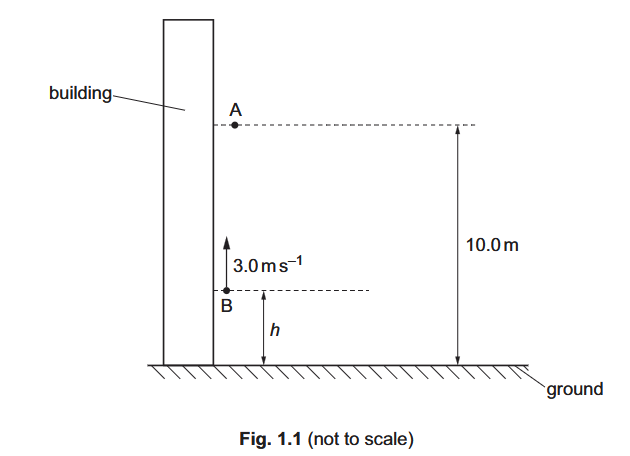
Object A is released from rest at a height of \(10.0\,\mathrm{m}\) above horizontal ground.
Object B is released with an initial upward velocity of \(3.0\,\mathrm{m\,s^{-1}}\) at a height \(h\) above the ground.
Both objects take the same time to reach the ground and they do not collide with each other.
Air resistance is negligible.
Calculate \(h\). (3 marks)
\(h=\) ______________________________ \(\mathrm{m}\)
(c) In a second experiment, object B is released from the same height as in (b) but with a speed of \(6.0\,\mathrm{m\,s^{-1}}\) at an angle of \(60^\circ\) to the vertical, as shown in Fig. 1.2.
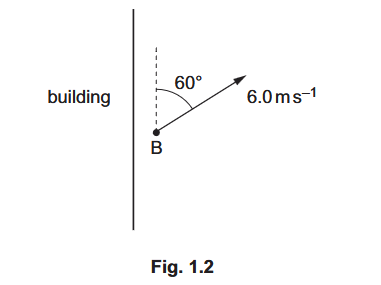
(i) State and explain whether the time taken for object B to reach the ground is less than, the same as, or greater than the time taken in the first experiment. (2 marks)
________________________________________________________________________________
________________________________________________________________________________
(ii) By considering energy, state and explain whether the speed at which object B reaches the ground is less than, the same as, or greater than in the first experiment. (2 marks)
________________________________________________________________________________
Syllabus Topic Codes (Cambridge International AS & A Level Physics 9702):
• 5.1: Energy conservation — part (c)(ii)
▶️ Answer/Explanation
(a) Definition of velocity [1 mark]
Velocity is the rate of change of displacement.
Answer: \( \boxed{\text{rate of change of displacement}} \)
(b) Height \(h\) of object B [3 marks]
For object A:
Object A is released from rest, so \(u=0\).
Using
\(s=ut+\dfrac{1}{2}at^2\)
\(10=\dfrac{1}{2}\times9.81\times t^2\)
\(t=\sqrt{\dfrac{2\times10}{9.81}}\)
\(t=1.43\,\mathrm{s}\approx1.4\,\mathrm{s}\)
For object B:
The time taken is the same, so \(t=1.4\,\mathrm{s}\).
Taking upward as positive, \(u=3.0\,\mathrm{m\,s^{-1}}\) and \(a=-9.81\,\mathrm{m\,s^{-2}}\).
The displacement of B from its release point to the ground is \(-h\).
Using
\(s=ut+\dfrac{1}{2}at^2\)
\(-h=(3.0)(1.4)-\dfrac{1}{2}(9.81)(1.4)^2\)
\(-h=4.2-9.61\)
\(h=5.4\,\mathrm{m}\)
Using the unrounded time gives \(h\approx5.7\,\mathrm{m}\).
Answer: \( \boxed{5.7\,\mathrm{m}} \)
(c)(i) Effect on time taken [2 marks]
The initial vertical component of velocity in the second experiment is
\(u_y=6.0\cos60^\circ\)
\(u_y=3.0\,\mathrm{m\,s^{-1}}\)
This is the same as the initial upward velocity of object B in the first experiment.
The initial height and vertical motion are therefore unchanged.
Answer: \( \boxed{\text{The time taken is the same.}} \)
(c)(ii) Effect on speed at the ground [2 marks]
The initial speed in the second experiment is \(6.0\,\mathrm{m\,s^{-1}}\), which is greater than the initial speed of \(3.0\,\mathrm{m\,s^{-1}}\) in the first experiment.
Therefore, the initial kinetic energy is greater in the second experiment.
The object starts from the same height in both experiments, so the change in gravitational potential energy is the same.
Hence, the object has greater kinetic energy at the ground and therefore a greater speed.
Answer: \( \boxed{\text{The speed is greater.}} \)
Question 2
(a) Define the moment of a force about a pivot. (1 mark)
_________________________________
(b) Three objects A, B and C are placed on a horizontal beam. The beam is in equilibrium, as shown in Fig. 2.1.
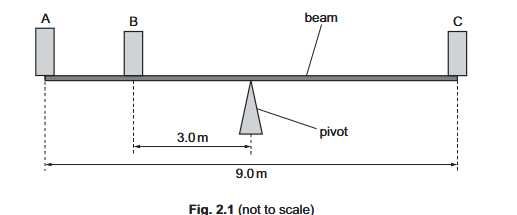
The beam is uniform and has length \(9.0\,\mathrm{m}\).
A pivot is at the midpoint of the beam.
Object A has mass \(90\,\mathrm{kg}\) and is at one end of the beam.
Object B has mass \(m\) and is a distance of \(3.0\,\mathrm{m}\) from the pivot.
Object C has mass \(150\,\mathrm{kg}\) and is at the other end of the beam.
(i) Calculate \(m\). (3 marks)
\(m=\) ______________________________ \(\mathrm{kg}\)
(ii) Object A is removed and replaced by a wire fixed to the end of the beam and to the ground, as shown in Fig. 2.2.
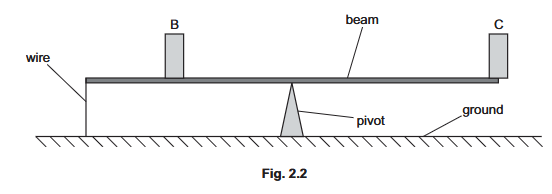
After the change, the beam is again horizontal and in equilibrium. The positions of B and C are unchanged.
The wire has a diameter of \(1.8\times10^{-3}\,\mathrm{m}\) and has a strain of \(1.2\times10^{-3}\).
The wire is not extended beyond its limit of proportionality.
Calculate the Young modulus of the wire. (3 marks)
Young modulus = ______________________________ \(\mathrm{Pa}\)
(iii) Object B is now moved to a new position closer to the pivot without passing it. The beam is again horizontal and in equilibrium.
State and explain the effect, if any, that this has on the strain in the wire. (2 marks)
_________________________________________
Syllabus Topic Codes (Cambridge International AS & A Level Physics 9702):
• 4.2: Equilibrium of forces — part (b)(i)
• 6.1: Stress and strain — parts (b)(ii) and (b)(iii)
▶️ Answer/Explanation
(a) Moment of a force [1 mark]
The moment of a force about a pivot is the product of the force and the perpendicular distance from the pivot to the line of action of the force.
\(\mathrm{moment}=F\times d\)
Answer: \( \boxed{\text{force}\times\text{perpendicular distance from the pivot}} \)
(b)(i) Mass of object B [3 marks]
The beam is in equilibrium, so the sum of clockwise moments about the pivot equals the sum of anticlockwise moments.
The distance from the pivot to each end of the \(9.0\,\mathrm{m}\) beam is
\(\dfrac{9.0}{2}=4.5\,\mathrm{m}\)
The uniform beam has its weight acting at the pivot, so its weight produces no moment about the pivot.
Taking moments about the pivot,
\(150\times9.81\times4.5=(90\times9.81\times4.5)+(m\times9.81\times3.0)\)
Cancel \(9.81\):
\(150\times4.5=90\times4.5+3.0m\)
\(675=405+3m\)
\(m=90\,\mathrm{kg}\)
Answer: \( \boxed{90\,\mathrm{kg}} \)
(b)(ii) Young modulus of the wire [3 marks]
Young modulus is given by
\(E=\dfrac{\text{stress}}{\text{strain}}\)
Since \(\text{stress}=\dfrac{F}{A}\),
\(E=\dfrac{F}{A\varepsilon}\)
The cross-sectional area of the wire is
\(A=\pi\left(\dfrac{1.8\times10^{-3}}{2}\right)^2\)
\(A=2.5\times10^{-6}\,\mathrm{m^2}\)
Using the force in the wire \(F=90\times9.81\,\mathrm{N}\) and strain \(1.2\times10^{-3}\),
\(E=\dfrac{90\times9.81}{(2.5\times10^{-6})(1.2\times10^{-3})}\)
\(E=2.9\times10^{11}\,\mathrm{Pa}\)
Answer: \( \boxed{2.9\times10^{11}\,\mathrm{Pa}} \)
(b)(iii) Effect on strain in the wire [2 marks]
Moving B closer to the pivot decreases the moment provided by B.
To maintain equilibrium, the moment provided by the wire must therefore increase.
Hence, the force or tension in the wire increases. Since the Young modulus and cross-sectional area of the wire remain constant, the strain increases.
Answer: \( \boxed{\text{The strain in the wire increases.}} \)
Question 3
A car of mass \(1500\,\mathrm{kg}\) is travelling along a straight horizontal road at constant velocity \(v\). The car is subject to a total resistive force \(F\), as shown in Fig. 3.1.
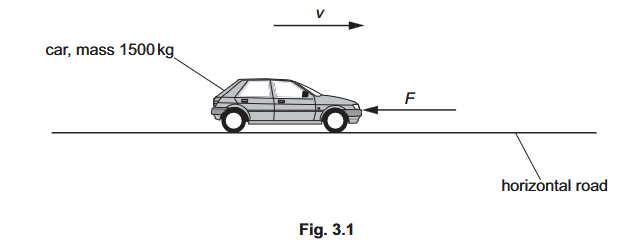
(a) Show that the power \(P\) developed by the engine in overcoming the total resistive force is given by the equation
\(P=Fv\) (2 marks)
(b) The car now moves up a slope at a constant speed of \(30\,\mathrm{m\,s^{-1}}\). The slope is at an angle of \(6.0^\circ\) to the horizontal as shown in Fig. 3.2.
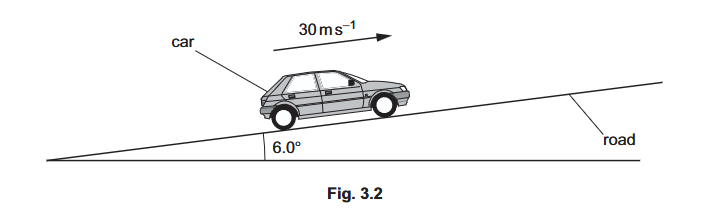
The total resistive force acting on the car is \(1600\,\mathrm{N}\).
(i) Show that the increase in gravitational potential energy of the car in a time of \(1.0\,\mathrm{s}\) is \(46000\,\mathrm{J}\). (2 marks)
________________________________________________________________________________
(ii) Use the information in (b)(i) to determine the power developed by the engine to move the car up the slope. (2 marks)
power = ______________________________ \(\mathrm{W}\)
(c) The car picks up a passenger and then continues up the slope at the same speed as in (b).
(i) State and explain the effect, if any, that the passenger has on the air resistance acting on the car. (1 mark)
_______________________________________________________
(ii) State and explain the effect, if any, that the passenger has on the power developed by the engine. (1 mark)
________________________________________________________
Syllabus Topic Codes (Cambridge International AS & A Level Physics 9702):
• 5.2: Gravitational potential energy and kinetic energy — part (b)(i)
• 5.3: Power — parts (a), (b)(ii) and (c)(ii)
▶️ Answer/Explanation
(a) Power developed by the engine [2 marks]
The work done in overcoming a force \(F\) through a distance \(d\) is
\(W=Fd\)
Power is the rate of doing work:
\(P=\dfrac{W}{t}\)
Therefore,
\(P=\dfrac{Fd}{t}\)
Since \(v=\dfrac{d}{t}\),
\(P=Fv\)
Answer: \( \boxed{P=Fv} \)
(b)(i) Increase in gravitational potential energy [2 marks]
In \(1.0\,\mathrm{s}\), the car travels \(30\,\mathrm{m}\) along the slope.
The vertical height gained is
\(\Delta h=30\sin6.0^\circ\)
The increase in gravitational potential energy is
\(\Delta E_{\mathrm{p}}=mg\Delta h\)
\(\Delta E_{\mathrm{p}}=1500\times9.81\times30\sin6.0^\circ\)
\(\Delta E_{\mathrm{p}}\approx4.6\times10^4\,\mathrm{J}\)
Answer: \( \boxed{46000\,\mathrm{J}} \)
(b)(ii) Power developed by the engine [2 marks]
The engine must provide power to increase the gravitational potential energy and to overcome the resistive force.
Power required to overcome the resistive force is
\(P_{\mathrm{resistive}}=Fv\)
\(P_{\mathrm{resistive}}=1600\times30\)
\(P_{\mathrm{resistive}}=48000\,\mathrm{W}\)
The power required to increase gravitational potential energy is
\(P_{\mathrm{GPE}}=\dfrac{46000}{1.0}=46000\,\mathrm{W}\)
Therefore,
\(P=48000+46000\)
\(P=94000\,\mathrm{W}\)
Answer: \( \boxed{9.4\times10^4\,\mathrm{W}} \)
(c)(i) Effect on air resistance [1 mark]
The speed of the car remains the same. Therefore, the air resistance remains the same.
Answer: \( \boxed{\text{Air resistance is unchanged.}} \)
(c)(ii) Effect on power developed by the engine [1 mark]
The passenger increases the total mass of the car.
Therefore, the component of the car’s weight acting down the slope increases. The engine must provide more power to move the heavier car up the slope at the same speed.
Answer: \( \boxed{\text{The power developed by the engine increases.}} \)
Question 4
(a) State the principle of conservation of momentum. (2 marks)
_________________________________
(b) An object A of mass \(4.0\,\mathrm{kg}\) travels at a velocity of \(6.0\,\mathrm{m\,s^{-1}}\) to the right on a horizontal frictionless surface. It moves towards a second object B of mass \(2.0\,\mathrm{kg}\) that is moving at a velocity of \(3.0\,\mathrm{m\,s^{-1}}\) in the same direction as A, as shown in Fig. 4.1.
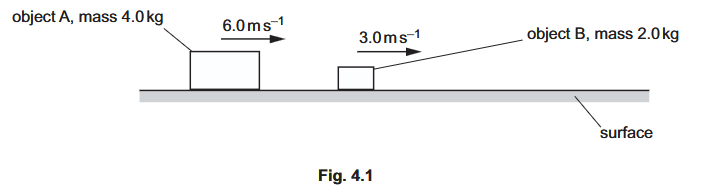
Object A collides with object B. The two objects join and move off together with velocity \(v\).
Calculate:
(i) velocity \(v\). (2 marks)
\(v=\) ______________________________ \(\mathrm{m\,s^{-1}}\)
(ii) the percentage of the total initial kinetic energy of the two objects that is transferred to other forms of energy during the collision. (2 marks)
percentage = ______________________________ \(\%\)
Syllabus Topic Codes (Cambridge International AS & A Level Physics 9702):
▶️ Answer/Explanation
(a) Principle of conservation of momentum [2 marks]
The total momentum of a system remains constant provided that no resultant external force acts on the system.
Equivalently,
\(\text{total momentum before}=\text{total momentum after}\)
Answer: \( \boxed{\text{Total momentum is conserved in an isolated system.}} \)
(b)(i) Velocity after the collision [2 marks]
The two objects join together, so their combined mass is
\(m_{\mathrm{total}}=4.0+2.0=6.0\,\mathrm{kg}\)
Using conservation of momentum,
\(4.0\times6.0+2.0\times3.0=6.0v\)
\(24+6=6v\)
\(v=5.0\,\mathrm{m\,s^{-1}}\)
Answer: \( \boxed{5.0\,\mathrm{m\,s^{-1}}} \)
(b)(ii) Percentage of kinetic energy transferred [2 marks]
The initial kinetic energy of object A is
\(E_{\mathrm{K,A}}=\dfrac{1}{2}\times4.0\times6.0^2\)
\(E_{\mathrm{K,A}}=72\,\mathrm{J}\)
The initial kinetic energy of object B is
\(E_{\mathrm{K,B}}=\dfrac{1}{2}\times2.0\times3.0^2\)
\(E_{\mathrm{K,B}}=9\,\mathrm{J}\)
Therefore,
\(E_{\mathrm{K,before}}=72+9=81\,\mathrm{J}\)
After the collision, the combined mass is \(6.0\,\mathrm{kg}\) and the velocity is \(5.0\,\mathrm{m\,s^{-1}}\).
\(E_{\mathrm{K,after}}=\dfrac{1}{2}\times6.0\times5.0^2\)
\(E_{\mathrm{K,after}}=75\,\mathrm{J}\)
The kinetic energy transferred to other forms is
\(\Delta E_{\mathrm{K}}=81-75=6\,\mathrm{J}\)
Percentage transferred is
\(\text{percentage}=\dfrac{81-75}{81}\times100\)
\(\text{percentage}=7.4\%\)
Answer: \( \boxed{7\%} \)
Question 5
(a) State why sound waves cannot be polarised. (1 mark)
________________________________
(b) A plane-polarised light wave is incident on a polarising filter as shown in Fig. 5.1.
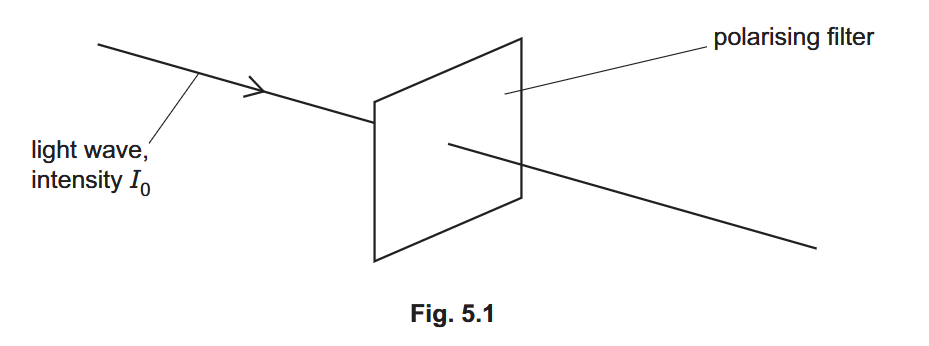
The intensity of the light incident on the filter is \(I_0\).
The light is incident normally on the filter and the transmission axis of the filter is initially perpendicular to the plane of polarisation of the light.
The filter is now rotated through \(360^\circ\) about the direction of travel of the light wave.
(i) On Fig. 5.2, sketch the variation of the intensity \(I\) of the transmitted light with the angle of rotation \(\alpha\) as the filter is rotated through \(360^\circ\) from its initial position. (3 marks)
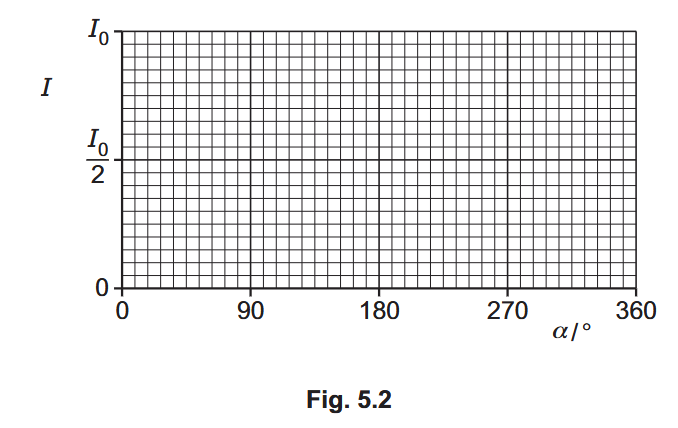
(ii) The amplitude of the incident light wave is \(A_0\) when the intensity of the wave is \(I_0\).
Use Malus’ law to determine, in terms of \(A_0\), the amplitude of the transmitted wave when \(\alpha=20^\circ\). (4 marks)
amplitude = ______________________________ \(A_0\)
Syllabus Topic Codes (Cambridge International AS & A Level Physics 9702):
• 7.5: Polarisation — parts (b)(i) and (b)(ii)
▶️ Answer/Explanation
(a) Why sound waves cannot be polarised [1 mark]
Sound waves are longitudinal waves. Polarisation is a phenomenon associated with transverse waves, so sound waves cannot be polarised.
Answer: \( \boxed{\text{Sound waves are longitudinal, not transverse.}} \)
(b)(i) Variation of intensity with rotation angle [3 marks]
Malus’ law gives
\(I=I_0\cos^2\theta\)
The graph is therefore a smooth, continuous \(\cos^2\alpha\) curve.
Since the transmission axis is initially perpendicular to the plane of polarisation, the transmitted intensity is zero at \(\alpha=0^\circ\).
The intensity reaches a maximum of \(I_0\) at \(\alpha=90^\circ\) and \(270^\circ\).
The intensity is zero at \(\alpha=0^\circ\), \(180^\circ\) and \(360^\circ\).
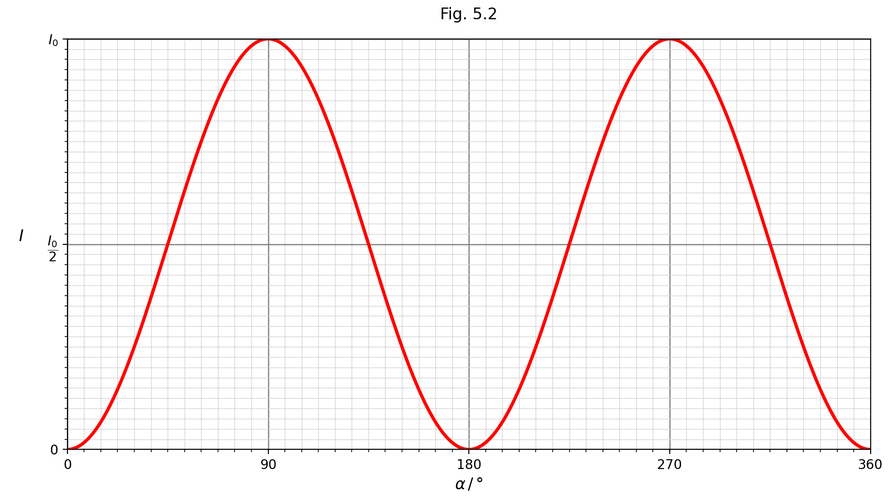
Answer: \( \boxed{\text{A smooth } \cos^2\alpha \text{ curve with maxima at }90^\circ\text{ and }270^\circ} \)
(b)(ii) Amplitude of the transmitted wave [4 marks]
For a progressive wave, intensity is proportional to the square of amplitude:
\(I\propto A^2\)
Therefore,
\(\dfrac{I}{I_0}=\dfrac{A^2}{A_0^2}\)
Using Malus’ law,
\(I=I_0\cos^2\theta\)
When \(\alpha=20^\circ\), the angle between the planes of polarisation of the incident light and the transmission axis is
\(\theta=90^\circ-20^\circ=70^\circ\)
Hence,
\(I=I_0\cos^2 70^\circ\)
Therefore,
\(\dfrac{A^2}{A_0^2}=\cos^2 70^\circ\)
\(\dfrac{A}{A_0}=\cos70^\circ\)
\(A=0.342A_0\)
Answer: \( \boxed{0.34A_0} \)
Question 6
(a) State what is meant by diffraction. (1 mark)
_________________________________
(b) Light of wavelength \(720\,\mathrm{nm}\) in a vacuum is incident normally on a diffraction grating as shown in Fig. 6.1.
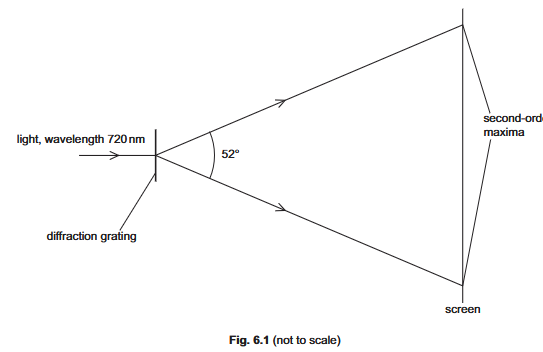
A screen is parallel to the grating. An interference pattern is seen on the screen and the angle between the second-order maxima is \(52^\circ\).
(i) Calculate the frequency of the light. (2 marks)
frequency = ______________________________ \(\mathrm{Hz}\)
(ii) Calculate the number of lines per unit length in the diffraction grating. (3 marks)
number per unit length = ______________________________ \(\mathrm{m^{-1}}\)
(iii) The light in Fig. 6.1 is now replaced with light of a different wavelength \(\lambda\). It is observed that the third-order maxima of this light are at the same positions as the second-order maxima of the light in Fig. 6.1.
Calculate, in nm, the wavelength \(\lambda\). (2 marks)
\(\lambda=\) ______________________________ \(\mathrm{nm}\)
Syllabus Topic Codes (Cambridge International AS & A Level Physics 9702):
• 8.4: The diffraction grating — parts (a), (b)(ii) and (b)(iii)
• 7.2: Wave equation — part (b)(i)
▶️ Answer/Explanation
(a) Definition of diffraction [1 mark]
Diffraction is the spreading of a wave as it passes through an aperture or around an edge.
Answer: \( \boxed{\text{spreading of a wave through an aperture or around an edge}} \)
(b)(i) Frequency of the light [2 marks]
Using the wave equation,
\(v=f\lambda\)
For light in a vacuum, \(v=c=3.00\times10^8\,\mathrm{m\,s^{-1}}\).
\(\lambda=720\,\mathrm{nm}=720\times10^{-9}\,\mathrm{m}\)
Therefore,
\(f=\dfrac{3.00\times10^8}{720\times10^{-9}}\)
\(f=4.17\times10^{14}\,\mathrm{Hz}\)
Answer: \( \boxed{4.2\times10^{14}\,\mathrm{Hz}} \)
(b)(ii) Number of lines per unit length [3 marks]
The angle between the two second-order maxima is \(52^\circ\), so the angle from the central maximum is
\(\theta=\dfrac{52^\circ}{2}=26^\circ\)
For a diffraction grating,
\(d\sin\theta=n\lambda\)
For the second-order maximum, \(n=2\).
\(d=\dfrac{n\lambda}{\sin\theta}\)
\(d=\dfrac{2(720\times10^{-9})}{\sin26^\circ}\)
\(d=3.3\times10^{-6}\,\mathrm{m}\)
The number of lines per metre is
\(N=\dfrac{1}{d}\)
\(N=\dfrac{1}{3.3\times10^{-6}}\)
\(N=3.0\times10^5\,\mathrm{m^{-1}}\)
Answer: \( \boxed{3.0\times10^5\,\mathrm{m^{-1}}} \)
(b)(iii) New wavelength [2 marks]
The third-order maximum of the new light occurs at the same angle as the second-order maximum of the original light.
Since \(d\) and \(\theta\) are unchanged,
\(n\lambda=\text{constant}\)
Therefore,
\(3\lambda=2(720)\)
\(\lambda=\dfrac{1440}{3}\)
\(\lambda=480\,\mathrm{nm}\)
Answer: \( \boxed{480\,\mathrm{nm}} \)
Question 7
A nichrome resistance wire has length \(150\,\mathrm{cm}\), cross-sectional area \(2.45\times10^{-7}\,\mathrm{m^2}\) and resistivity \(1.12\times10^{-6}\,\Omega\mathrm{m}\).
(a) Calculate, to three significant figures, the resistance of the wire. (3 marks)
resistance = ______________________________ \(\Omega\)
(b) The nichrome wire forms part of a potentiometer circuit together with a cell of electromotive force (e.m.f.) \(1.2\,\mathrm{V}\) and negligible internal resistance, as shown in Fig. 7.1.
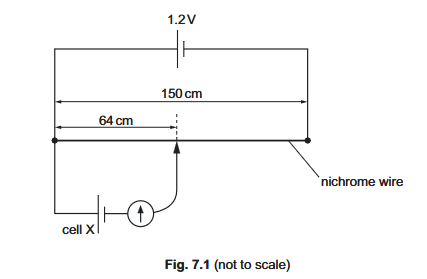
The circuit is used to determine the e.m.f. of cell X.
The galvanometer is used in a null method to find the null point \(64\,\mathrm{cm}\) from the left-hand end of the nichrome wire.
(i) Explain what is meant by a null method. (1 mark)
___________________________________
(ii) Calculate the e.m.f. of cell X. (2 marks)
e.m.f. = ______________________________ \(\mathrm{V}\)
(iii) The cell of e.m.f. \(1.2\,\mathrm{V}\) is replaced by a new cell with the same e.m.f. but with an internal resistance that is not negligible.
State and explain the effect, if any, of the internal resistance of the new cell on the position of the null point. (2 marks)
__________________________________________
Syllabus Topic Codes (Cambridge International AS & A Level Physics 9702):
• 10.3: Potential dividers — parts (b)(i) and (b)(ii)
• 10.1: Practical circuits — part (b)(iii)
▶️ Answer/Explanation
(a) Resistance of the nichrome wire [3 marks]
The resistance of a wire is given by
\(R=\dfrac{\rho L}{A}\)
Convert the length to metres:
\(L=150\,\mathrm{cm}=1.50\,\mathrm{m}\)
Therefore,
\(R=\dfrac{(1.12\times10^{-6})(1.50)}{2.45\times10^{-7}}\)
\(R=6.86\,\Omega\)
Answer: \( \boxed{6.86\,\Omega} \)
(b)(i) Null method [1 mark]
A null method is a method in which the galvanometer reading is zero at the balance or null point.
Answer: \( \boxed{\text{The galvanometer reading is zero.}} \)
(b)(ii) E.m.f. of cell X [2 marks]
For a uniform potentiometer wire, the potential difference is proportional to the length of wire.
Hence,
\(\dfrac{\text{e.m.f. of X}}{1.2}=\dfrac{64}{150}\)
Therefore,
\(\text{e.m.f. of X}=\dfrac{64}{150}\times1.2\)
\(\text{e.m.f. of X}=0.512\,\mathrm{V}\)
Answer: \( \boxed{0.51\,\mathrm{V}} \)
(b)(iii) Effect of internal resistance on the null point [2 marks]
The new cell has internal resistance, so some of its e.m.f. is lost inside the cell. Therefore, the terminal potential difference across the potentiometer wire is lower than \(1.2\,\mathrm{V}\).
The potential gradient along the wire therefore decreases.
To obtain the same balancing potential difference for cell X, a greater length of wire is required.
Answer: \( \boxed{\text{The null point moves to the right.}} \)
Question 8
(a) An antiparticle equivalent of the neutron is called the antineutron. The quarks in the antineutron are the antiparticles of the quarks in a neutron.
The elementary charge is \(e\).
In Table 8.1, state the flavour and charge of the three antiquarks that comprise the antineutron. (3 marks)
Table 8.1
| flavour | charge/e |
(b) In \(\beta^-\) decay, a neutron decays to form a proton.
Theory predicts that an antineutron should decay to form an antiproton. A particle and an antiparticle should also be observed.
Suggest the names of the particle and the antiparticle.
particle: ____________________
antiparticle: _________________
Syllabus Topic Codes (Cambridge International AS & A Level Physics 9702):
• 11.1: Atoms, nuclei and radiation — part (b)
▶️ Answer/Explanation
(a) Antiquarks in an antineutron [3 marks]
A neutron has the quark composition \(udd\).
The antineutron therefore consists of the corresponding antiquarks:
\(\overline{u}\,\overline{d}\,\overline{d}\)
The up quark has charge \(+\dfrac{2}{3}e\), so the anti-up quark has charge \(-\dfrac{2}{3}e\).
The down quark has charge \(-\dfrac{1}{3}e\), so the anti-down quark has charge \(+\dfrac{1}{3}e\).
| flavour | charge/e |
| anti-up / \(\overline{u}\) | \(-\dfrac{2}{3}\) |
| anti-down / \(\overline{d}\) | \(+\dfrac{1}{3}\) |
| anti-down / \(\overline{d}\) | \(+\dfrac{1}{3}\) |
Answer: \( \boxed{\overline{u},\ \overline{d},\ \overline{d}} \), with charges \( \boxed{-\dfrac{2}{3}e,\ +\dfrac{1}{3}e,\ +\dfrac{1}{3}e} \)
(b) Particle and antiparticle [2 marks]
In \(\beta^-\) decay, a neutron produces a proton, an electron and an electron antineutrino.
The corresponding antiparticle process involves an antineutron forming an antiproton, a positron and an electron neutrino.
Therefore:
Particle: electron neutrino
Antiparticle: positron
Answer: \( \boxed{\text{electron neutrino}} \), \( \boxed{\text{positron}} \)