
Question 1
(a) Define the moment of a force. (1 mark)
____________________________
(b) A trapdoor has a hinge at end A, as shown in Fig. 1.1.
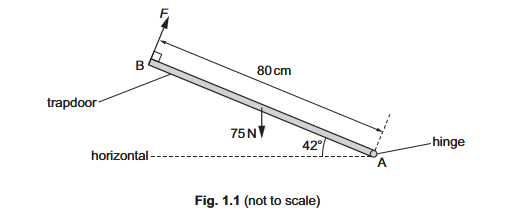
The trapdoor has length \(80\,\mathrm{cm}\) and weight \(75\,\mathrm{N}\). The mass of the trapdoor is uniformly distributed along its length.
A force \(F\) acts at right angles to the trapdoor at end B so that the trapdoor is held in equilibrium at an angle of \(42^\circ\) to the horizontal.
(i) State the principle of moments. (2 marks)
________________________________
(ii) Calculate the component of the weight that is perpendicular to the trapdoor. (1 mark)
component of weight = ______________________________ \(\mathrm{N}\)
(iii) Calculate the magnitude of the force \(F\). (2 marks)
\(F=\) ______________________________ \(\mathrm{N}\)
Syllabus Topic Codes (Cambridge International AS & A Level Physics 9702):
• 4.2: Equilibrium of forces — parts (b)(i) and (b)(iii)
▶️ Answer/Explanation
(a) Definition of the moment of a force [1 mark]
The moment of a force about a point is the product of the force and the perpendicular distance from the line of action of the force to the point.
\(\mathrm{Moment}=F\times d_\perp\)
Answer: \( \boxed{\text{force}\times\text{perpendicular distance}} \)
(b)(i) Principle of moments [2 marks]
The trapdoor is in rotational equilibrium.
Therefore, the sum of the clockwise moments about a point is equal to the sum of the anticlockwise moments about the same point.
\(\sum \mathrm{clockwise\ moments}=\sum \mathrm{anticlockwise\ moments}\)
(b)(ii) Component of weight perpendicular to the trapdoor [1 mark]
The weight acts vertically downward. The trapdoor is at \(42^\circ\) to the horizontal, so the angle between the weight and the perpendicular direction to the trapdoor gives
\(\text{component of weight}=75\cos42^\circ\)
\(\text{component of weight}=55.7\,\mathrm{N}\)
Answer: \( \boxed{56\,\mathrm{N}} \)
(b)(iii) Magnitude of force \(F\) [2 marks]
Take moments about the hinge at A.
The force \(F\) acts at right angles to the trapdoor, so its perpendicular distance from A is \(80\,\mathrm{cm}\).
The trapdoor is uniform, so its weight acts at its centre, \(40\,\mathrm{cm}\) from A.
Using the component of weight perpendicular to the trapdoor:
\(F\times80=56\times40\)
\(F=\dfrac{56\times40}{80}\)
\(F=28\,\mathrm{N}\)
Answer: \( \boxed{28\,\mathrm{N}} \)
Question 2
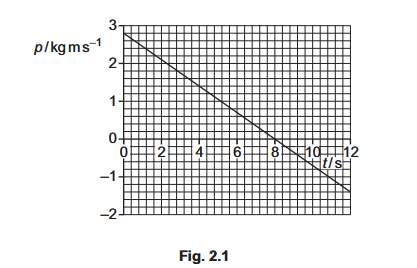
An object of constant mass moves in a straight line. The variation with time \(t\) of the momentum \(p\) of the object is shown in Fig. 2.1.
(a) Define momentum. (1 mark)
________________________________
(b) Calculate the change in momentum of the object from time \(t=0\) to \(t=12\,\mathrm{s}\). (1 mark)
change in momentum = ______________________________ \(\mathrm{kg\,m\,s^{-1}}\)
(c) Calculate the magnitude of the resultant force acting on the object. (2 marks)
force = ______________________________ \(\mathrm{N}\)
(d) Describe the variation of the speed of the object from time \(t=0\) to \(t=8.0\,\mathrm{s}\). (1 mark)
________________________________________________________________________________
(e) By reference to Fig. 2.1, explain why the resultant force acting on the object during the first \(8.0\,\mathrm{s}\) of its motion cannot be due to air resistance. (2 marks)
________________________________________________________________________________
________________________________________________________________________________
(f) At time \(t=0\) the displacement of the object is zero.
On Fig. 2.2, sketch the variation of \(d\) with time \(t\) from \(t=0\) to \(t=12\,\mathrm{s}\).
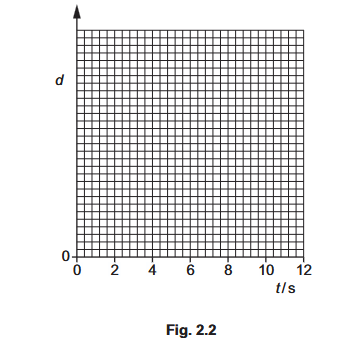
Numerical values of \(d\) are not required. (3 marks)
___________________________
Syllabus Topic Codes (Cambridge International AS & A Level Physics 9702):
• 3.2: Non-uniform motion — parts (d) and (e)
• 2.1: Equations of motion — part (f)
▶️ Answer/Explanation
(a) Definition of momentum [1 mark]
Momentum is the product of the mass of an object and its velocity.
\(p=mv\)
Answer: \( \boxed{\text{momentum}=\text{mass}\times\text{velocity}} \)
(b) Change in momentum [1 mark]
From Fig. 2.1:
Initial momentum at \(t=0\): \(p_i=+2.8\,\mathrm{kg\,m\,s^{-1}}\)
Final momentum at \(t=12\,\mathrm{s}\): \(p_f=-1.4\,\mathrm{kg\,m\,s^{-1}}\)
Therefore,
\(\Delta p=p_f-p_i\)
\(\Delta p=(-1.4)-(+2.8)\)
\(\Delta p=-4.2\,\mathrm{kg\,m\,s^{-1}}\)
Answer: \( \boxed{-4.2\,\mathrm{kg\,m\,s^{-1}}} \)
(c) Resultant force [2 marks]
Force is the rate of change of momentum:
\(F=\dfrac{\Delta p}{\Delta t}\)
The magnitude of the force is
\(F=\dfrac{4.2}{12}\)
\(F=0.35\,\mathrm{N}\)
Answer: \( \boxed{0.35\,\mathrm{N}} \)
(d) Variation of speed [1 mark]
Since the mass is constant, the magnitude of momentum is proportional to speed.
The magnitude of momentum decreases linearly from its initial value to zero at \(t=8.0\,\mathrm{s}\).
Answer: \( \boxed{\text{The speed decreases uniformly to zero.}} \)
(e) Air resistance [2 marks]
The gradient of the momentum-time graph is constant, so the resultant force is constant during the first \(8.0\,\mathrm{s}\).
Air resistance would vary as the speed changes and therefore would not remain constant. Also, at \(t=8.0\,\mathrm{s}\), the speed is zero but the resultant force is still non-zero.
Answer: \( \boxed{\text{The force is constant even though the speed changes, so it cannot be due to air resistance.}} \)
(f) Displacement-time graph [3 marks]
The gradient of a displacement-time graph represents velocity.
From \(t=0\) to \(t=8.0\,\mathrm{s}\), the object has positive velocity which decreases uniformly to zero. Therefore, \(d\) increases from the origin with a decreasing positive gradient.
At \(t=8.0\,\mathrm{s}\), the velocity is zero, so the displacement-time graph has a horizontal tangent.
After \(t=8.0\,\mathrm{s}\), the momentum and velocity are negative. The gradient therefore becomes negative and its magnitude increases as the speed increases. The displacement remains positive at \(t=12\,\mathrm{s}\).
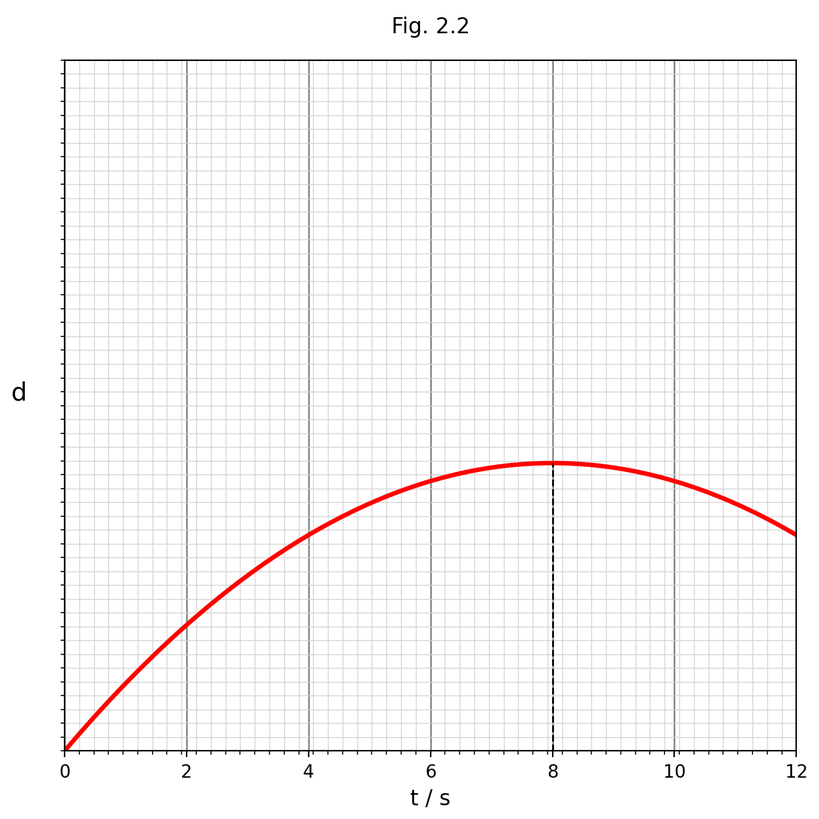
Required sketch: \( \boxed{\text{A curve from the origin with decreasing positive gradient, horizontal at }8.0\,\mathrm{s},\text{ then negative gradient of increasing magnitude.}} \)
Question 3
The lower end of a vertical spring is fixed to a horizontal surface, as shown in Fig. 3.1.
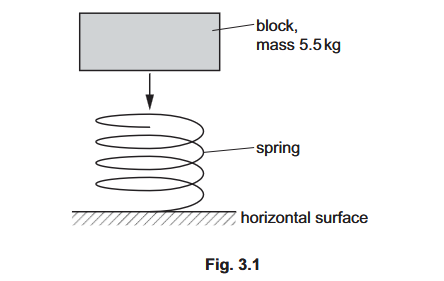
The mass of the spring is negligible. A block of mass \(5.5\,\mathrm{kg}\) drops vertically onto the spring and is brought to rest as the spring is compressed.
(a) The block has kinetic energy \(110\,\mathrm{J}\) as it makes contact with the spring.
Calculate the speed of the block as it makes contact with the spring. (2 marks)
speed = ______________________________ \(\mathrm{m\,s^{-1}}\)
(b) The gravitational potential energy of the block decreases by \(20\,\mathrm{J}\) as the spring is compressed to its maximum compression \(x_0\).
Show that \(x_0\) is \(0.37\,\mathrm{m}\). (2 marks)
________________________________________________________________________________
(c) Assume that, as the spring compresses, all of the energy lost by the block is converted into elastic potential energy of the spring.
Use the data from (a) and (b) to determine the maximum elastic potential energy of the spring. Show your working. (1 mark)
maximum elastic potential energy = ______________________________ \(\mathrm{J}\)
(d) The variation of the force \(F\) acting on the spring with the compression of the spring is shown in Fig. 3.2.
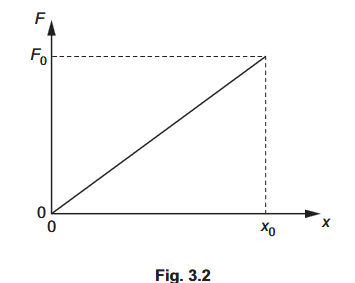
Use the information in (b) and your answer in (c) to show that the maximum force \(F_0\) exerted on the spring by the block is \(700\,\mathrm{N}\). (2 marks)
______________________________________________
(e) Use the information in (d) to determine, for the instant that the block is first brought to rest by the spring:
(i) the resultant force acting on the block. (2 marks)
resultant force = ______________________________ \(\mathrm{N}\)
(ii) the acceleration of the block. (2 marks)
acceleration = ______________________________ \(\mathrm{m\,s^{-2}}\)
Syllabus Topic Codes (Cambridge International AS & A Level Physics 9702):
• 6.1: Stress and strain — part (d), force-extension relationship
• 6.2: Elastic and plastic behaviour — part (c) and part (d), elastic potential energy from area under a force-extension graph
• 3.1: Momentum and Newton’s laws of motion — part (e)
▶️ Answer/Explanation
(a) Speed of the block [2 marks]
The kinetic energy of the block is
\(E_{\mathrm{K}}=\dfrac{1}{2}mv^2\)
\(110=\dfrac{1}{2}\times5.5\times v^2\)
\(v=\sqrt{\dfrac{2\times110}{5.5}}\)
\(v=6.32\,\mathrm{m\,s^{-1}}\)
Answer: \( \boxed{6.3\,\mathrm{m\,s^{-1}}} \)
(b) Maximum compression of the spring [2 marks]
The decrease in gravitational potential energy is
\(\Delta E_{\mathrm{P}}=mgx_0\)
Given that the decrease is \(20\,\mathrm{J}\),
\(20=5.5\times9.81\times x_0\)
\(x_0=\dfrac{20}{5.5\times9.81}\)
\(x_0=0.370\,\mathrm{m}\)
Answer: \( \boxed{x_0=0.37\,\mathrm{m}} \)
(c) Maximum elastic potential energy [1 mark]
At maximum compression, the block is momentarily at rest. Its initial kinetic energy and the decrease in gravitational potential energy are converted into elastic potential energy.
\(E_{\mathrm{P,max}}=110+20\)
\(E_{\mathrm{P,max}}=130\,\mathrm{J}\)
Answer: \( \boxed{130\,\mathrm{J}} \)
(d) Maximum force exerted by the block [2 marks]
The elastic potential energy is equal to the area under the force-compression graph.
The graph is a triangle, so
\(E_{\mathrm{P,max}}=\dfrac{1}{2}F_0x_0\)
\(130=\dfrac{1}{2}F_0(0.37)\)
\(F_0=\dfrac{2\times130}{0.37}\)
\(F_0=703\,\mathrm{N}\)
Answer: \( \boxed{700\,\mathrm{N}} \)
(e)(i) Resultant force on the block [2 marks]
At maximum compression, the spring force is approximately \(700\,\mathrm{N}\) upwards.
The weight of the block is
\(W=mg=5.5\times9.81=53.96\,\mathrm{N}\)
Taking upwards as positive,
\(F_{\mathrm{resultant}}=700-53.96\)
\(F_{\mathrm{resultant}}\approx650\,\mathrm{N}\)
Answer: \( \boxed{650\,\mathrm{N}} \) upwards
(e)(ii) Acceleration of the block [2 marks]
Using Newton’s second law,
\(F=ma\)
\(650=5.5a\)
\(a=\dfrac{650}{5.5}\)
\(a\approx118\,\mathrm{m\,s^{-2}}\)
Answer: \( \boxed{120\,\mathrm{m\,s^{-2}}} \) upwards
Question 4
A source oscillates with frequency \(f\) to produce a progressive wave of wavelength \(\lambda\). The source takes time \(t\) to produce \(n\) complete oscillations.
(a)(i) State what is meant by a progressive wave. [1]
________________________________________________________________________________
(ii) State expressions, in terms of some or all of \(f\), \(\lambda\) and \(n\), for:
- the distance moved by a wavefront in time \(t\)
- time \(t\)
distance = ______________________________
time \(t\) = ______________________________ [2]
(iii) Use your answers in (ii) to determine an expression for the speed \(v\) of the wave in terms of \(f\) and \(\lambda\). [1]
\(v=\) ______________________________
(b) Two identical microwave sources X and Y emit waves in phase. The sources are separated by a distance of \(30\,\mathrm{cm}\), as shown in Fig. 4.1.
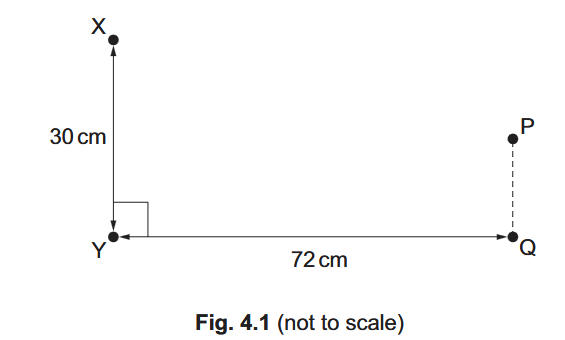
The intensity of the microwaves is to be investigated at points P and Q. Line PQ is parallel to line XY. Distance XP is equal to distance YP. Distance YQ is \(72\,\mathrm{cm}\) and angle \(XYQ\) is \(90^\circ\).
The wavelength of the microwaves is \(4.0\,\mathrm{cm}\).
(i) Calculate the frequency, in GHz, of the microwaves. [2]
frequency = ______________________________ \(\mathrm{GHz}\)
(ii) Show that the difference between the path lengths XQ and YQ is \(6\,\mathrm{cm}\). [1]
____________________________________
(iii) State and explain what may be deduced about the intensity of the microwaves at point Q. [3]
_____________________________________
(iv) A microwave detector is positioned at P and connected to a cathode-ray oscilloscope (CRO). The controls of the CRO are adjusted so that a waveform is shown on the screen.
Describe the changes to the amplitude of the waveform as the detector is moved from P to Q. [2]
____________________________________
Syllabus Topic Codes (Cambridge International AS & A Level Physics 9702):
• 7.1 Progressive waves – wave motion, wavelength, frequency, speed, energy transfer and \(v=f\lambda\).
• 8.3 Interference – coherence, two-source interference, path difference and intensity maxima/minima.
▶️ Answer/Explanation
(a)(i) Progressive wave [1 mark]
A progressive wave is a wave that transfers or propagates energy.
(a)(ii) Expressions [2 marks]
In \(n\) complete oscillations, the wavefront travels through \(n\) wavelengths:
\(\mathrm{distance}=n\lambda\)
The frequency is the number of oscillations per unit time:
\(f=\dfrac{n}{t}\)
Therefore,
\(t=\dfrac{n}{f}\)
(a)(iii) Wave speed [1 mark]
Using \(v=\dfrac{\mathrm{distance}}{\mathrm{time}}\),
\(v=\dfrac{n\lambda}{n/f}\)
\(\boxed{v=f\lambda}\)
(b)(i) Frequency [2 marks]
\(v=f\lambda\)
\(f=\dfrac{v}{\lambda}\)
\(f=\dfrac{3.00\times10^8}{4.0\times10^{-2}}\)
\(f=7.5\times10^9\,\mathrm{Hz}\)
\(\boxed{f=7.5\,\mathrm{GHz}}\)
(b)(ii) Path difference [1 mark]
Triangle \(XYQ\) is right-angled at \(Y\).
\(XQ=\sqrt{72^2+30^2}\)
\(XQ=78\,\mathrm{cm}\)
Therefore,
\(\mathrm{path\ difference}=XQ-YQ=78-72\)
\(\boxed{6\,\mathrm{cm}}\)
(b)(iii) Intensity at Q [3 marks]
The path difference is \(6\,\mathrm{cm}\), while
\(\lambda=4\,\mathrm{cm}\)
Hence,
\(\dfrac{\mathrm{path\ difference}}{\lambda}=\dfrac{6}{4}=1.5\lambda\)
A path difference of \(1.5\lambda\) corresponds to a phase difference of \(540^\circ\), which is equivalent to \(180^\circ\).
The waves therefore arrive at Q in antiphase and undergo destructive interference.
\(\boxed{\text{The intensity at Q is a minimum.}}\)
(b)(iv) CRO amplitude [2 marks]
At P, the waves interfere constructively, so the amplitude is maximum.
As the detector moves from P to Q, the amplitude changes from maximum to minimum, then maximum, then minimum again at Q.
\(\boxed{\text{maximum} \rightarrow \text{minimum} \rightarrow \text{maximum} \rightarrow \text{minimum}}\)
Question 5
(a)(i) State and explain the effect, if any, on the resistance of a filament wire in a lamp as the current in the wire decreases. (1 mark)
______________________________________
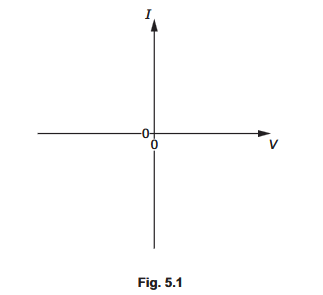
(ii) On Fig. 5.1, sketch the \(I\)-\(V\) characteristic of a filament lamp. (2 marks)
(b) A battery of electromotive force (e.m.f.) \(E\) and negligible internal resistance is connected in parallel with two filament lamps A and B, as shown in Fig. 5.2.
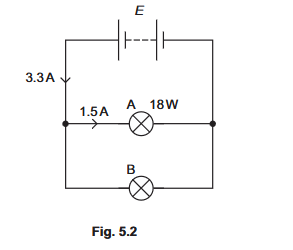
The current in the battery is \(3.3\,\mathrm{A}\) and the current in lamp A is \(1.5\,\mathrm{A}\). The power dissipated in lamp A is \(18\,\mathrm{W}\).
(i) Calculate the e.m.f. \(E\) of the battery. (2 marks)
\(E=\) ______________________________ \(\mathrm{V}\)
(ii) The filament wire of lamp B has a cross-sectional area of \(1.4\times10^{-9}\,\mathrm{m^2}\). The number density of free (conduction) electrons per unit volume of the metal of the filament wire is \(3.4\times10^{28}\,\mathrm{m^{-3}}\).
Calculate the average drift speed of the free electrons in the filament wire of lamp B. (3 marks)
average drift speed = ______________________________ \(\mathrm{m\,s^{-1}}\)
Syllabus Topic Codes (Cambridge International AS & A Level Physics 9702):
• 9.2: Potential difference and power — part (b)(i)
• 9.1: Electric current — part (b)(ii)
• 10.2: Kirchhoff’s laws — part (b)(ii), current division in the parallel circuit
▶️ Answer/Explanation
(a)(i) Effect on resistance [1 mark]
As the current decreases, the temperature of the filament decreases.
Therefore, the resistance of the filament decreases.
Answer: \(\boxed{\text{Resistance decreases}}\)
(a)(ii) \(I\)-\(V\) characteristic [2 marks]
The \(I\)-\(V\) characteristic passes through the origin.
As the voltage and current increase, the filament temperature increases and its resistance increases.
Since \(R=\dfrac{V}{I}\), an increasing resistance means that the gradient \(\dfrac{\Delta I}{\Delta V}\) decreases.
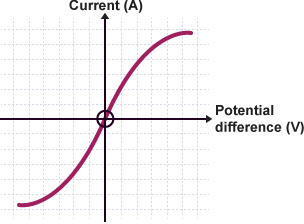
Therefore, the curve starts relatively steep near the origin and becomes progressively less steep as \(V\) increases. A similar curve appears in the third quadrant.
Required sketch: a symmetrical non-linear curve through the origin with decreasing gradient in the first and third quadrants.
(b)(i) E.m.f. of the battery [2 marks]
For lamp A,
\(P=VI\)
Since the lamps are connected in parallel, the potential difference across lamp A is equal to the e.m.f. of the battery because the battery has negligible internal resistance.
\(E=\dfrac{P}{I}\)
\(E=\dfrac{18}{1.5}\)
\(E=12\,\mathrm{V}\)
Answer: \(\boxed{12\,\mathrm{V}}\)
(b)(ii) Average drift speed of electrons [3 marks]
The total current divides between the two parallel branches.
Therefore, the current in lamp B is
\(I_B=3.3-1.5\)
\(I_B=1.8\,\mathrm{A}\)
For a current-carrying conductor,
\(I=Anvq\)
where \(A\) is the cross-sectional area, \(n\) is the number density of charge carriers, \(v\) is the average drift speed and \(q\) is the charge of an electron.
Rearranging,
\(v=\dfrac{I}{Anq}\)
\(v=\dfrac{1.8}{(1.4\times10^{-9})(3.4\times10^{28})(1.60\times10^{-19})}\)
\(v=0.24\,\mathrm{m\,s^{-1}}\)
Answer: \(\boxed{0.24\,\mathrm{m\,s^{-1}}}\)
Question 6
(a) A battery of electromotive force (e.m.f.) \(6.0\,\mathrm{V}\) and negligible internal resistance is connected in series with a variable resistor and a uniform resistance wire XY, as shown in Fig. 6.1.
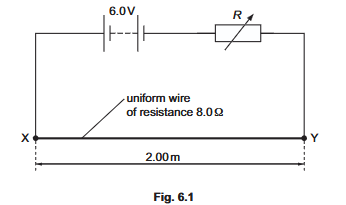
Wire XY has length \(2.00\,\mathrm{m}\) and resistance \(8.0\,\Omega\). The resistance \(R\) of the variable resistor is adjusted so that the potential difference across wire XY is \(2.4\,\mathrm{V}\).
(a) Determine \(R\). (2 marks)
\(R=\) ______________________________ \(\Omega\)
(b) Explain why the potential difference \(V\) between any two points on wire XY is proportional to the distance \(L\) between those points. (2 marks)
_____________________________________
(c) A cell of e.m.f. \(E\) and internal resistance \(r\) is connected to the circuit, as shown in Fig. 6.2.
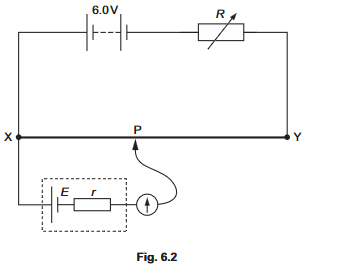
Resistance \(R\) is unchanged.
The movable connection P is positioned on wire XY so that the galvanometer reading is zero. Distance XP is \(1.24\,\mathrm{m}\).
(i) Calculate \(E\). (2 marks)
\(E=\) ______________________________ \(\mathrm{V}\)
(ii) The value of \(R\) is now decreased.
State and explain the change that must be made to the position of P on wire XY so that the galvanometer reads zero again. (2 marks)
_________________________________
Syllabus Topic Codes (Cambridge International AS & A Level Physics 9702):
• 10.3: Potential dividers – part (c): potentiometer principle, potential comparison and galvanometer null method.
▶️ Answer/Explanation
(a) Resistance of the variable resistor [2 marks]
The current is the same through the series combination of \(R\) and the \(8.0\,\Omega\) wire.
Using the potential-divider relationship,
\(\dfrac{2.4}{6.0}=\dfrac{8.0}{R+8.0}\)
\(\dfrac{2.4}{6.0}=0.40\)
\(0.40=\dfrac{8.0}{R+8.0}\)
\(R+8.0=20\)
\(R=12\,\Omega\)
Answer: \(\boxed{12\,\Omega}\)
(b) Potential difference and distance along a uniform wire [2 marks]
For a uniform wire,
\(R=\dfrac{\rho L}{A}\)
The resistivity \(\rho\), cross-sectional area \(A\), and current \(I\) are constant along the wire.
Therefore, \(R\propto L\).
Using \(V=IR\), with \(I\) constant,
\(V\propto R\)
Hence,
\(\boxed{V\propto L}\)
(c)(i) E.m.f. of cell [2 marks]
At the null point, the galvanometer reads zero, so the p.d. across \(XP\) is equal to the e.m.f. \(E\) of the cell.
Since the wire is uniform,
\(\dfrac{V_{XP}}{V_{XY}}=\dfrac{L_{XP}}{L_{XY}}\)
\(\dfrac{E}{2.4}=\dfrac{1.24}{2.00}\)
\(E=2.4\times\dfrac{1.24}{2.00}\)
\(E=1.488\,\mathrm{V}\)
Answer: \(\boxed{1.5\,\mathrm{V}}\)
(c)(ii) Effect of decreasing \(R\) [2 marks]
When \(R\) is decreased, the total resistance of the circuit decreases.
Therefore, the current in the circuit increases.
Since the wire XY has constant resistance, the potential difference across XY increases.
The potential gradient along XY therefore increases. To obtain the same p.d. \(E\) at the new null point, a shorter length of wire is required.
Hence P must move towards X, away from Y.
Answer: \(\boxed{\text{P moves towards X}}\)
Question 7
(a) State the names of two different leptons. (2 marks)
1. ______________________________
2. ______________________________
(b) In the following list, underline all the particles that are hadrons. (1 mark)
antineutrino beta-plus meson neutron
(c) By reference to quark composition, show that the charge of a proton is \(+1.6\times10^{-19}\,\mathrm{C}\). (2 marks)
____________________________________________
Syllabus Topic Codes (Cambridge International AS & A Level Physics 9702, 2025–2027):
• 11.2.4: Hadrons – part (b)
• 11.2.6: Leptons – part (a)
• 11.2.2–11.2.3: Quark charges and quark composition of protons – part (c)
▶️ Answer/Explanation
(a) Leptons [2 marks]
Any two different leptons are acceptable. For example:
\(\boxed{\text{electron}}\)
\(\boxed{\text{electron neutrino}}\)
Other acceptable answers include the positron and electron antineutrino.
(b) Hadrons [1 mark]
A hadron is a composite particle made from quarks. Baryons consist of three quarks, while mesons consist of a quark and an antiquark.
Therefore, the hadrons in the list are:
\(\boxed{\text{meson and neutron}}\)
(c) Charge of a proton [2 marks]
A proton has the quark composition \(uud\).
The charge of an up quark is \(+\dfrac{2}{3}e\), while the charge of a down quark is \(-\dfrac{1}{3}e\).
Therefore,
\(Q=\dfrac{2}{3}e+\dfrac{2}{3}e-\dfrac{1}{3}e\)
\(Q=\left(\dfrac{4}{3}-\dfrac{1}{3}\right)e\)
\(Q=e\)
Using \(e=1.60\times10^{-19}\,\mathrm{C}\),
\(Q=+1.60\times10^{-19}\,\mathrm{C}\)
Answer: \(\boxed{+1.6\times10^{-19}\,\mathrm{C}}\)