
Question 1
What is a reasonable estimate of the cross-sectional area of the wire in a paper clip?
(B) \(8\times10^{-5}\,\mathrm{m^2}\)
(C) \(8\times10^{-7}\,\mathrm{m^2}\)
(D) \(1\times10^{-9}\,\mathrm{m^2}\)
▶️ Answer/Explanation
Correct Answer: \( \boxed{\mathrm{C}} \)
A typical paper clip wire has a diameter of about \(1\,\mathrm{mm}\).
Its cross-sectional area is approximately
\(A=\pi\left(\dfrac{0.001}{2}\right)^2\approx7.9\times10^{-7}\,\mathrm{m^2}\)
Therefore, the closest estimate is (C).
Question 2
Which quantity is not an SI base quantity?
(B) Mass
(C) Temperature
(D) Time
▶️ Answer/Explanation
Correct Answer: \( \boxed{\mathrm{A}} \)
The SI base quantities include mass, time, length, electric current, thermodynamic temperature, amount of substance, and luminous intensity.
Electric charge is a derived quantity given by
\(Q=It\)
Therefore, the correct answer is (A).
Question 3
A student determines the acceleration of free fall by using a small metal ball, as shown.
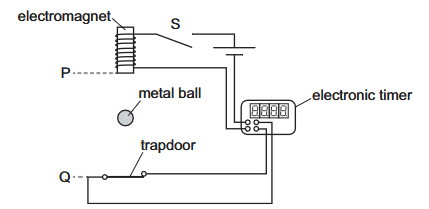
When switch S is opened, the ball is released from an electromagnet and an electronic timer is started. The ball then falls vertically downwards. The timer stops when the ball hits a trapdoor.
The student measures the distance PQ between the electromagnet and the trapdoor. This distance and the reading on the timer are then used to calculate the acceleration of free fall.
Which statement about errors in the experiment is correct?
(B) The random error can be reduced by subtracting the diameter of the ball from the distance PQ.
(C) The systematic error can be reduced by adding the diameter of the ball to the distance PQ.
(D) The systematic error can be reduced by subtracting the diameter of the ball from the distance PQ.
▶️ Answer/Explanation
Correct Answer: \( \boxed{\mathrm{D}} \)
The ball falls until its bottom surface touches the trapdoor, but the measured distance PQ is to the trapdoor surface.
The centre of the ball travels a distance equal to \(PQ-d\), where \(d\) is the diameter of the ball.
Using \(PQ\) instead of \(PQ-d\) introduces a systematic error. This error is reduced by subtracting the ball’s diameter from the measured distance.
Therefore, the correct answer is (D).
Question 4
The diagram shows two coplanar forces, \(P\) and \(Q\), drawn to scale.
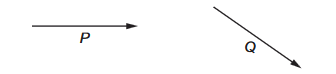
Force \(R\) is given by \(R=Q-P\).

Which diagram represents \(R\)?
(B) B
(C) C
(D) D
▶️ Answer/Explanation
Correct Answer: \( \boxed{\mathrm{C}} \)
Since
\(R=Q-P=Q+(-P)\)
the vector \(-P\) has the same magnitude as \(P\) but acts in the opposite direction.
Adding \(-P\) to \(Q\) gives a resultant directed downwards and to the left, with a relatively small magnitude.
Therefore, the correct answer is (C).
Question 5
A parachutist falls from a stationary balloon at time \(t=0\). The velocity-time graph for the parachutist from time \(t=0\) until the time when he is just above the ground is shown.
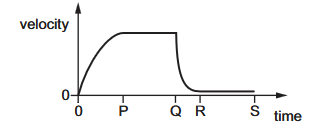
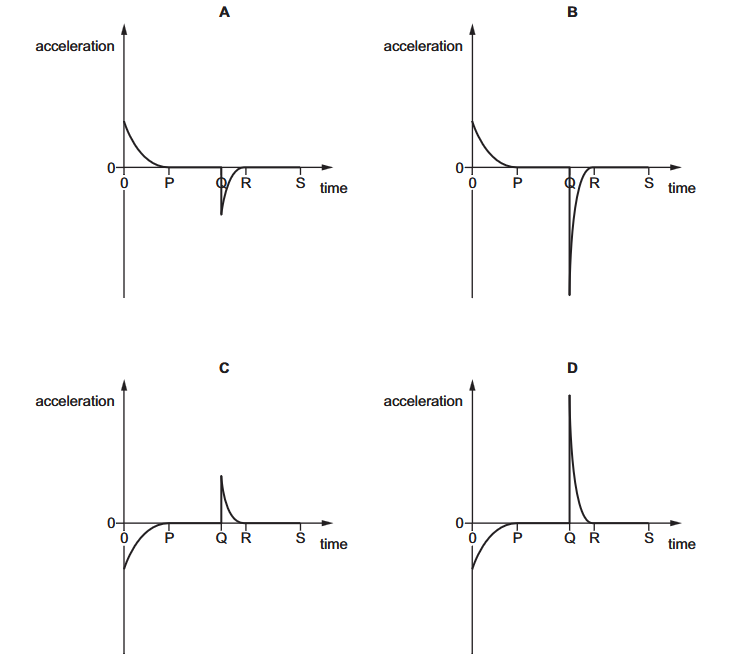
Which graph best shows the variation with time of the acceleration of the parachutist?
(B) B
(C) C
(D) D
▶️ Answer/Explanation
Correct Answer: \( \boxed{\mathrm{B}} \)
Acceleration is the gradient of the velocity-time graph.
Initially, the parachutist accelerates downward with acceleration close to \(g\), but as air resistance increases, the acceleration decreases to zero when terminal velocity is reached.
When the parachute opens at \(Q\), the velocity decreases rapidly, giving a large negative acceleration. As the new lower terminal velocity is reached, the acceleration again approaches zero.
Therefore, the correct answer is (B).
Question 6
A projectile is fired from point \(P\) with velocity \(V\) at an angle \(\theta\) to the horizontal. It lands at point \(Q\), a horizontal distance \(R\) from \(P\), after time \(T\).
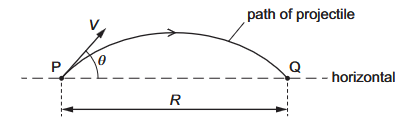
The acceleration of free fall is \(g\). Air resistance is negligible.
Which equation is correct?
(B) \(R=VT\sin\theta\)
(C) \(R=VT\cos\theta-\dfrac{1}{2}gT^2\)
(D) \(R=VT\sin\theta-\dfrac{1}{2}gT^2\)
▶️ Answer/Explanation
Correct Answer: \( \boxed{\mathrm{A}} \)
The horizontal component of the velocity is constant because there is no horizontal acceleration.
Horizontal distance travelled is
\(R=(V\cos\theta)T\)
Therefore, the correct answer is (A).
Question 7
A man stands in a lift that is accelerating vertically downwards, as shown.
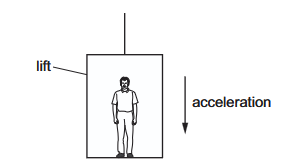
Which statement describes the force exerted by the man on the floor?
(B) It is greater than the force exerted by the floor on the man.
(C) It is less than the force exerted by the floor on the man.
(D) It is less than the weight of the man.
▶️ Answer/Explanation
Correct Answer: \( \boxed{\mathrm{D}} \)
The normal reaction \(N\) satisfies
\(mg-N=ma\)
so
\(N=m(g-a)\)
Since the lift accelerates downward, \(a>0\), giving \(N<mg\).
By Newton’s third law, the force exerted by the man on the floor equals the normal reaction.
Therefore, the correct answer is (D).
Question 8
A ball of mass \(200\,\mathrm{g}\) is thrown horizontally with a speed of \(20\,\mathrm{m\,s^{-1}}\) against a vertical wall.
The ball is in contact with the wall for a time of \(0.10\,\mathrm{s}\) before rebounding back along its original path with a speed of \(10\,\mathrm{m\,s^{-1}}\).
What is the average force exerted by the wall on the ball during the collision?
(B) \(60\,\mathrm{N}\)
(C) \(20\,\mathrm{kN}\)
(D) \(60\,\mathrm{kN}\)
▶️ Answer/Explanation
Correct Answer: \( \boxed{\mathrm{B}} \)
Take the direction towards the wall as positive.
\(m=0.20\,\mathrm{kg},\quad u=20\,\mathrm{m\,s^{-1}},\quad v=-10\,\mathrm{m\,s^{-1}}\)
Change in momentum:
\(\Delta p=m(v-u)=0.20(-10-20)=-6.0\,\mathrm{kg\,m\,s^{-1}}\)
Average force:
\(F=\dfrac{|\Delta p|}{\Delta t}=\dfrac{6.0}{0.10}=60\,\mathrm{N}\)
Therefore, the correct answer is (B).
Question 9
In an experiment, a metal ball is dropped into a viscous liquid. The terminal velocity of the ball in the liquid is measured.
The experiment is repeated four times. For each repeat, a change is made to one of the following.
1. The density of the metal of the ball
2. The height from which the ball is dropped
3. The density of the liquid
4. The depth of the liquid
Which two changes separately affect the terminal velocity of the ball in the liquid?
(B) 1 and 3
(C) 2 and 4
(D) 3 and 4
▶️ Answer/Explanation
Correct Answer: \( \boxed{\mathrm{B}} \)
Terminal velocity depends on the balance between the weight, upthrust, and viscous drag.
Changing the density of the ball changes its weight, and changing the density of the liquid changes the upthrust.
The height from which the ball is dropped and the depth of the liquid do not change the value of the terminal velocity.
Therefore, the correct answer is (B).
Question 10
Two objects move towards each other along the same straight line.
After colliding, the two objects stick together and are stationary.

Which statement must be correct?
(B) The total momentum of the two objects before the collision is zero.
(C) The two objects have equal mass.
(D) The two objects have the same speed before the collision.
▶️ Answer/Explanation
Correct Answer: \( \boxed{\mathrm{B}} \)
Momentum is conserved during the collision.
Since the objects stick together and are stationary after the collision, the final momentum is zero.
Therefore, the total momentum before the collision must also have been zero.
Therefore, the correct answer is (B).
Question 11
A minimum torque of \(20\,\mathrm{N\,m}\) must be applied to the lid of a jar for it to open. The radius of the lid is \(4.0\,\mathrm{cm}\).
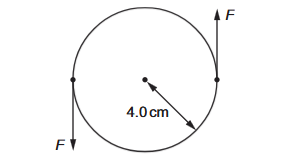
What is the minimum force \(F\) that must act on each side of the lid in order to open it?
(B) \(5.0\,\mathrm{N}\)
(C) \(250\,\mathrm{N}\)
(D) \(500\,\mathrm{N}\)
▶️ Answer/Explanation
Correct Answer: \( \boxed{\mathrm{C}} \)
The two equal and opposite forces form a couple.
The perpendicular distance between their lines of action is the diameter of the lid:
\(d=2r=2(0.040)=0.080\,\mathrm{m}\)
The moment of a couple is
\(\tau=Fd\)
Hence,
\(F=\dfrac{20}{0.080}=250\,\mathrm{N}\)
Therefore, the correct answer is (C).
Question 12
A uniform bar of length \(L\) and weight \(W\) rests horizontally on two supports X and Y.
Support X exerts a vertical force \(R_X\) at a distance of \(\dfrac{L}{6}\) from one end of the bar.
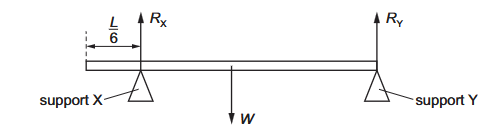
Support Y exerts a vertical force \(R_Y\) at the other end of the bar.
The bar is in equilibrium.
What is the ratio \(\dfrac{R_X}{R_Y}\)?
(B) \(\dfrac{2}{3}\)
(C) \(\dfrac{3}{5}\)
(D) \(\dfrac{2}{5}\)
▶️ Answer/Explanation
Correct Answer: \( \boxed{\mathrm{A}} \)
Taking moments about support X,
\(R_Y\left(\dfrac{5L}{6}\right)=W\left(\dfrac{L}{3}\right)\)
Hence,
\(R_Y=\dfrac{2W}{5}\)
Using vertical equilibrium,
\(R_X+R_Y=W\)
\(R_X=W-\dfrac{2W}{5}=\dfrac{3W}{5}\)
Therefore,
\(\dfrac{R_X}{R_Y}=\dfrac{3W/5}{2W/5}=\dfrac{3}{2}\)
Therefore, the correct answer is (A).
Question 13
A type of firework is made by connecting two rockets, facing in opposite directions, to a rod, as shown.
The rod is attached to a frictionless pivot so that the firework can rotate in a vertical plane.
The firework has weight \(W\). The pivot exerts a force \(R\) on the rod that is equal and opposite to \(W\).
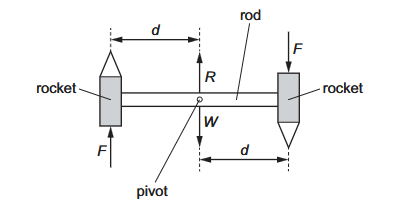
Each rocket exerts a force of magnitude \(F\) on the rod at a perpendicular distance \(d\) from the pivot. The forces exerted by the rockets are always in opposite directions.
Air resistance is negligible.
Which statement is correct?
(B) The firework is in equilibrium because the resultant torque acting on it is zero.
(C) The firework is not in equilibrium because the resultant force acting on it is not zero.
(D) The firework is not in equilibrium because the resultant torque acting on it is not zero.
▶️ Answer/Explanation
Correct Answer: \( \boxed{\mathrm{D}} \)
The pivot force \(R\) balances the weight \(W\), so the resultant force on the firework is zero.
However, the two rocket forces are equal, opposite, and act at different points, forming a couple.
The resultant moment of the couple is
\(\tau=2Fd\)
Since the resultant torque is not zero, the firework rotates and is not in equilibrium.
Therefore, the correct answer is (D).
Question 14
An object of weight \(W\) is suspended from a newton meter. When the object is completely immersed in water, the newton meter reads \(P\). When the object is completely immersed in oil, the newton meter reads \(Q\).
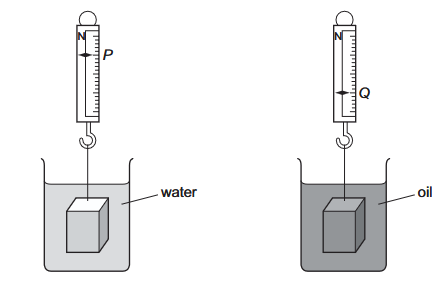
What is the ratio
\(\dfrac{\text{density of oil}}{\text{density of water}}\) ?
(B) \(\dfrac{Q-P}{W-P}\)
(C) \(\dfrac{W-P}{W-Q}\)
(D) \(\dfrac{W-Q}{W-P}\)
▶️ Answer/Explanation
Correct Answer: \( \boxed{\mathrm{D}} \)
The upthrust equals the loss in apparent weight.
In water:
\(U_{\mathrm{water}}=W-P\)
In oil:
\(U_{\mathrm{oil}}=W-Q\)
Since upthrust is proportional to fluid density for the same immersed volume,
\(\dfrac{\rho_{\mathrm{oil}}}{\rho_{\mathrm{water}}}=\dfrac{W-Q}{W-P}\)
Therefore, the correct answer is (D).
Question 15
A crate of mass \(50\,\mathrm{kg}\) is pushed a distance of \(6.0\,\mathrm{m}\) along a horizontal surface against a constant resistive force of \(70\,\mathrm{N}\). The crate moves at a constant speed. It is then lifted, at a constant speed, through a vertical distance of \(1.20\,\mathrm{m}\) onto the back of a lorry.
What is the total work done in this process?
(B) \(480\,\mathrm{J}\)
(C) \(590\,\mathrm{J}\)
(D) \(1000\,\mathrm{J}\)
▶️ Answer/Explanation
Correct Answer: \( \boxed{\mathrm{D}} \)
Work done against the resistive force:
\(W_1=Fs=70\times6.0=420\,\mathrm{J}\)
Work done in lifting the crate:
\(W_2=mgh=50\times9.8\times1.20\approx588\,\mathrm{J}\)
Total work:
\(W=W_1+W_2\approx420+588\approx1008\,\mathrm{J}\approx1000\,\mathrm{J}\)
Therefore, the correct answer is (D).
Question 16
The input power to a television is \(P_{\mathrm{in}}\). The useful sound and light power emitted by the television is \(P_{\mathrm{out}}\).
What is the efficiency of the television?
(B) \(\dfrac{P_{\mathrm{in}}-P_{\mathrm{out}}}{P_{\mathrm{in}}}\)
(C) \(\dfrac{P_{\mathrm{in}}}{P_{\mathrm{out}}}\)
(D) \(\dfrac{P_{\mathrm{out}}}{P_{\mathrm{in}}-P_{\mathrm{out}}}\)
▶️ Answer/Explanation
Correct Answer: \( \boxed{\mathrm{A}} \)
Efficiency is defined as the ratio of useful output power to input power.
\(\eta=\dfrac{P_{\mathrm{out}}}{P_{\mathrm{in}}}\)
Therefore, the correct answer is (A).
Question 17
A builder holding a brick of mass \(3000\,\mathrm{g}\) drops the brick on his foot.
What is a reasonable estimate of the change in gravitational potential energy of the brick?
(B) \(300\,\mathrm{J}\)
(C) \(3000\,\mathrm{J}\)
(D) \(30000\,\mathrm{J}\)
▶️ Answer/Explanation
Correct Answer: \( \boxed{\mathrm{A}} \)
The brick has mass
\(m=3000\,\mathrm{g}=3.0\,\mathrm{kg}\)
A reasonable drop height is about \(1\,\mathrm{m}\).
\(\Delta E_{\mathrm{p}}=mgh\approx3.0\times9.8\times1\approx30\,\mathrm{J}\)
Therefore, the correct answer is (A).
Question 18
An elastic cord of unstretched total length \(16.0\,\mathrm{cm}\) and cross-sectional area \(2.0\times10^{-6}\,\mathrm{m^2}\) is held horizontally by two smooth pins \(8.0\,\mathrm{cm}\) apart.
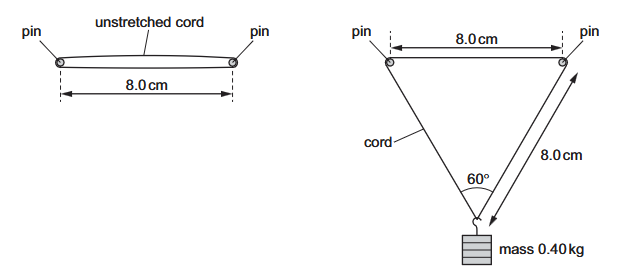
The cord obeys Hooke’s law. A load of mass \(0.40\,\mathrm{kg}\) is suspended centrally on the cord. The angle between the two sides of the cord supporting the load is \(60^\circ\).
What is the Young modulus of the cord material?
(B) \(1.1\times10^6\,\mathrm{Pa}\)
(C) \(2.3\times10^6\,\mathrm{Pa}\)
(D) \(3.9\times10^6\,\mathrm{Pa}\)
▶️ Answer/Explanation
Correct Answer: \( \boxed{\mathrm{C}} \)
Each side of the cord makes an angle of \(30^\circ\) with the vertical. Resolving forces vertically,
\(2T\cos30^\circ=mg\)
\( T=\dfrac{0.40\times9.8}{2\cos30^\circ} \approx2.26\,\mathrm{N} \)
Each half of the stretched cord has length
\( \frac{4.0}{\sin30^\circ}=8.0\,\mathrm{cm}. \)
The horizontal projection of the stretched cord is
\( 2(8.0\cos30^\circ) =16\cos30^\circ =13.86\,\mathrm{cm}. \)
Hence, the extension used is
\( \Delta L =16.0-13.86 =2.14\,\mathrm{cm} =2.14\times10^{-2}\,\mathrm{m}. \)
Using Young’s modulus,
\( E=\dfrac{FL}{A\Delta L} \)
\( E= \dfrac{2.26\times0.160} {(2.0\times10^{-6})(2.14\times10^{-2})} \approx2.3\times10^6\,\mathrm{Pa}. \)
Therefore, the correct answer is (C).
Question 19
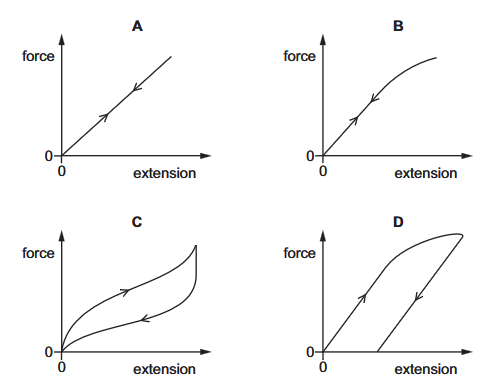
Which force-extension graph shows plastic deformation of a sample of material?
(B) B
(C) C
(D) D
▶️ Answer/Explanation
Correct Answer: \( \boxed{\mathrm{D}} \)
Plastic deformation occurs when a material does not return to its original length after the force is removed.
The unloading curve intersects the extension axis at a positive value, indicating a permanent extension (permanent set).
Only graph D shows this permanent deformation.
Therefore, the correct answer is (D).
Question 20
Two waves pass through a point \(P\). The graph shows the variation with time \(t\) of the displacement \(s\) of the two waves at point \(P\).
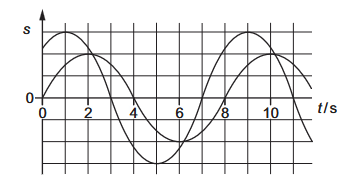
What is the phase difference between the two waves at point \(P\)?
(B) \(45^\circ\)
(C) \(90^\circ\)
(D) \(180^\circ\)
▶️ Answer/Explanation
Correct Answer: \( \boxed{\mathrm{B}} \)
From the graph, one complete cycle takes approximately \(8\,\mathrm{s}\).
The two waves are shifted by about \(1\,\mathrm{s}\).
Hence, the phase difference is
\(\phi=\dfrac{1}{8}\times360^\circ=45^\circ\)
Therefore, the correct answer is (B).
Question 21
Which row is correct for both progressive transverse waves and progressive longitudinal waves?
| Transverse waves | Longitudinal waves | |
|---|---|---|
| (A) | Contain compressions and rarefactions | Some can travel in a vacuum |
| (B) | Can be polarised | Contain compressions and rarefactions |
| (C) | Vibrations are perpendicular to the direction of travel of the wave energy | Can be polarised |
| (D) | Some can travel in a vacuum | Vibrations are perpendicular to the direction of travel of the wave energy |
▶️ Answer/Explanation
Correct Answer: \( \boxed{\mathrm{B}} \)
Transverse waves can be polarised because their vibrations are perpendicular to the direction of wave travel.
Longitudinal waves consist of alternating compressions and rarefactions and cannot be polarised.
Therefore, the correct answer is (B).
Question 22
A toy drone emits a sound of constant frequency \(800\,\mathrm{Hz}\). The speed of sound in air is \(330\,\mathrm{m\,s^{-1}}\).
The drone moves along a straight path directly towards an observer and then continues in a straight line directly away from the observer. The speed of the drone is constant.
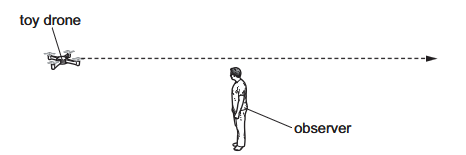
What is the velocity of the drone when the frequency of the sound heard by the observer is \(850\,\mathrm{Hz}\)?
| Magnitude of velocity / \(\mathrm{m\,s^{-1}}\) | Direction of velocity | |
|---|---|---|
| (A) | 19 | Away from the observer |
| (B) | 21 | Away from the observer |
| (C) | 19 | Towards the observer |
| (D) | 21 | Towards the observer |
▶️ Answer/Explanation
Correct Answer: \( \boxed{\mathrm{C}} \)
Since the observed frequency is greater than the emitted frequency, the drone is moving towards the observer.
For a moving source,
\(f’=\dfrac{v}{v-v_s}f\)
\(850=\dfrac{330}{330-v_s}\times800\)
\(v_s\approx19\,\mathrm{m\,s^{-1}}\)
Therefore, the correct answer is (C).
Question 23
Which statement about electromagnetic waves in a vacuum is correct?
(B) Microwaves have longer wavelengths than radio waves.
(C) Ultraviolet waves have higher frequencies than visible light waves.
(D) \(\gamma\)-rays have lower frequencies than X-rays.
▶️ Answer/Explanation
Correct Answer: \( \boxed{\mathrm{C}} \)
In the electromagnetic spectrum, frequency increases in the order:
Radio \(<\) Microwaves \(<\) Infrared \(<\) Visible \(<\) Ultraviolet \(<\) X-rays \(<\) \(\gamma\)-rays.
Hence, ultraviolet waves have higher frequencies than visible light waves.
Therefore, the correct answer is (C).
Question 24
Vertically polarised microwaves are emitted from a source. The microwaves are detected by a receiver that is connected to a cathode-ray oscilloscope (CRO). The waveform displayed on the screen of the CRO has an amplitude of \(2.6\,\mathrm{cm}\).
A metal wire grid that acts as a polarising filter is now placed between the source and the receiver. The filter is orientated so that the plane of polarisation of the transmitted wave is at an angle of \(20^\circ\) to the vertical.
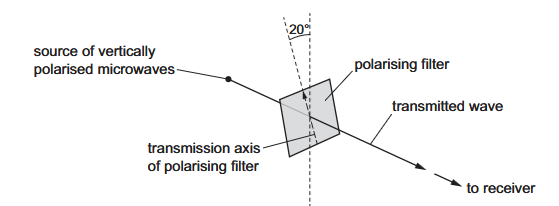
The distance between the source and receiver is unchanged. The settings on the CRO are also unchanged.
What is now the amplitude of the waveform displayed on the screen of the CRO?
(B) \(0.89\,\mathrm{cm}\)
(C) \(2.3\,\mathrm{cm}\)
(D) \(2.4\,\mathrm{cm}\)
▶️ Answer/Explanation
Correct Answer: \( \boxed{\mathrm{D}} \)
The transmitted amplitude is given by
\(A=A_0\cos\theta\)
where \(\theta=20^\circ\).
\(A=2.6\cos20^\circ\approx2.44\,\mathrm{cm}\)
\(\therefore A\approx2.4\,\mathrm{cm}\)
Therefore, the correct answer is (D).
Question 25
In an experiment, a stationary wave is formed on a string stretched horizontally between two fixed points.
Which statement about the experiment is correct?
(B) Each point on the string between two antinodes has an oscillation of the same amplitude.
(C) The number of nodes is equal to the number of antinodes.
(D) Two adjacent antinodes oscillate in phase.
▶️ Answer/Explanation
Correct Answer: \( \boxed{\mathrm{A}} \)
In a stationary wave, all particles pass through the equilibrium position simultaneously.
At these instants, every point between two adjacent nodes has zero displacement, so that section of the string is horizontal.
Adjacent antinodes oscillate in antiphase, and the amplitude varies continuously between a node and an antinode.
Therefore, the correct answer is (A).
Question 26
A musical organ produces notes by blowing air into a set of pipes that are open at one end and closed at the other.
The speed of sound in the air in the pipes is \(320\,\mathrm{m\,s^{-1}}\).
What is the lowest frequency of sound produced by a pipe of length \(10\,\mathrm{m}\)?
(B) \(8\,\mathrm{Hz}\)
(C) \(16\,\mathrm{Hz}\)
(D) \(32\,\mathrm{Hz}\)
▶️ Answer/Explanation
Correct Answer: \( \boxed{\mathrm{B}} \)
For a pipe closed at one end, the fundamental wavelength is
\(\lambda=4L\)
Hence,
\(f=\dfrac{v}{4L}=\dfrac{320}{4\times10}=8\,\mathrm{Hz}\)
Therefore, the correct answer is (B).
Question 27
In an experiment, water waves in a ripple tank are incident on a gap, as shown.
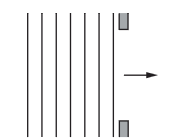
Some diffraction of the water waves is observed.
Which change to the experiment would provide a better demonstration of diffraction?
(B) Increase the frequency of the waves.
(C) Increase the wavelength of the waves.
(D) Increase the width of the gap.
▶️ Answer/Explanation
Correct Answer: \( \boxed{\mathrm{C}} \)
Diffraction is greatest when the wavelength is comparable to the width of the gap.
Increasing the wavelength increases the spreading of the waves after passing through the gap.
Therefore, the correct answer is (C).
Question 28
Light of wavelength \(\lambda\) is emitted from two point sources \(R\) and \(S\) and falls on a distant screen.
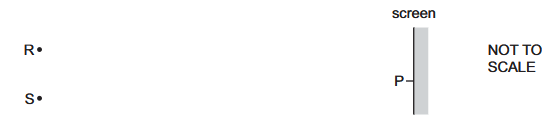
At point \(P\) on the screen, the light intensity is zero.
What could explain the zero intensity at \(P\)?
(B) Light from the two sources is emitted in phase and the path difference to \(P\) is \(\lambda\).
(C) Light from the two sources is emitted \(90^\circ\) out of phase and the path difference to \(P\) is \(\lambda\).
(D) Light from the two sources is emitted in phase and the path difference to \(P\) is \(\dfrac{1}{2}\lambda\).
▶️ Answer/Explanation
Correct Answer: \( \boxed{\mathrm{D}} \)
For complete destructive interference, the waves must arrive \(180^\circ\) out of phase.
If the sources are initially in phase, a path difference of
\(\dfrac{1}{2}\lambda\)
produces a phase difference of \(180^\circ\), giving zero intensity.
Therefore, the correct answer is (D).
Question 29
A beam of red light of wavelength \(720\,\mathrm{nm}\) is incident normally on a diffraction grating and produces a diffraction pattern on a screen placed parallel to the grating.
The beam of red light is replaced with a beam of electromagnetic radiation of wavelength \(X\), which is incident normally on the same diffraction grating.
The third-order maximum for the electromagnetic radiation of wavelength \(X\) is at the same position on the screen as the second-order maximum for the red light.
What is wavelength \(X\)?
(B) \(540\,\mathrm{nm}\)
(C) \(960\,\mathrm{nm}\)
(D) \(1100\,\mathrm{nm}\)
▶️ Answer/Explanation
Correct Answer: \( \boxed{\mathrm{A}} \)
For the same diffraction angle,
\(n\lambda=\text{constant}\)
Hence,
\(3X=2(720\,\mathrm{nm})\)
\(X=\dfrac{1440}{3}=480\,\mathrm{nm}\)
Therefore, the correct answer is (A).
Question 30
The current \(I\) in a conductor is given by the equation
\(I=Anvq\)
What does the letter \(n\) represent in this equation?
(B) Number of charge carriers per unit area
(C) Number of charge carriers per unit volume
(D) Total mass of charge carriers per unit volume
▶️ Answer/Explanation
Correct Answer: \( \boxed{\mathrm{C}} \)
The equation for electric current due to moving charge carriers is
\(I=Anvq\)
where \(A\) is the cross-sectional area, \(v\) is the drift velocity, \(q\) is the charge on each carrier, and \(n\) is the number of charge carriers per unit volume.
Therefore, the correct answer is (C).
Question 31
In the circuit shown, the battery has an electromotive force (e.m.f.) of \(6.0\,\mathrm{V}\) and negligible internal resistance.
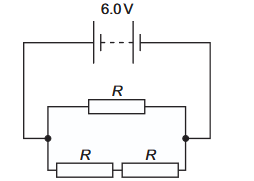
The three resistors each have resistance \(R\).
The total power dissipated in the resistor network is \(24\,\mathrm{W}\).
What is the value of \(R\)?
(B) \(1.0\,\Omega\)
(C) \(1.5\,\Omega\)
(D) \(2.3\,\Omega\)
▶️ Answer/Explanation
Correct Answer: \( \boxed{\mathrm{D}} \)
The equivalent resistance is
\(R_{\mathrm{eq}}=R\parallel 2R=\dfrac{R(2R)}{R+2R}=\dfrac{2R}{3}\)
Using the power relation,
\(P=\dfrac{V^2}{R_{\mathrm{eq}}}\)
\(24=\dfrac{6.0^2}{R_{\mathrm{eq}}}\)
\(R_{\mathrm{eq}}=\dfrac{36}{24}=1.5\,\Omega\)
Hence,
\(\dfrac{2R}{3}=1.5\)
\(R=2.25\,\Omega\approx2.3\,\Omega\)
Therefore, the correct answer is (D).
Question 32
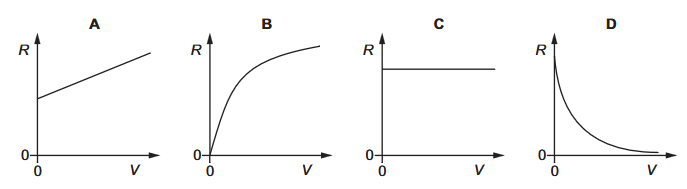
Which graph could show how the resistance \(R\) of a filament lamp varies with the applied potential difference (p.d.) \(V\), as \(V\) is increased to the normal operating p.d.?
(B) Graph B
(C) Graph C
(D) Graph D
▶️ Answer/Explanation
Correct Answer: \( \boxed{\mathrm{A}} \)
As the potential difference increases, the filament becomes hotter.
For a metal filament, resistance increases with temperature because lattice vibrations increase, causing more collisions for the charge carriers.
Therefore, the resistance increases as the applied p.d. increases, as shown by graph A.
Therefore, the correct answer is (A).
Question 33
A piece of conducting putty is in the shape of a cylinder of length \(60\,\mathrm{mm}\) and diameter \(20\,\mathrm{mm}\).
The resistance between the ends of the cylinder is \(20\,\Omega\).
What is the resistivity of the putty?
(B) \(0.10\,\Omega\,\mathrm{m}\)
(C) \(0.42\,\Omega\,\mathrm{m}\)
(D) \(5.2\,\Omega\,\mathrm{m}\)
▶️ Answer/Explanation
Correct Answer: \( \boxed{\mathrm{B}} \)
Resistivity is given by
\(\rho=\dfrac{RA}{L}\)
where
\(L=60\,\mathrm{mm}=0.060\,\mathrm{m}\)
\(r=10\,\mathrm{mm}=0.010\,\mathrm{m}\)
\(A=\pi r^2=\pi(0.010)^2=3.14\times10^{-4}\,\mathrm{m^2}\)
Hence,
\(\rho=\dfrac{20\times3.14\times10^{-4}}{0.060}\approx1.05\times10^{-1}\,\Omega\,\mathrm{m}\approx0.10\,\Omega\,\mathrm{m}\)
Therefore, the correct answer is (B).
Question 34
Which statement about the electromotive force (e.m.f.) of a cell is always correct?
(B) The e.m.f. is the energy provided by the cell per unit charge passing through it.
(C) The e.m.f. is the potential difference across the internal resistance of the cell.
(D) The e.m.f. is the potential difference across the terminals of the cell.
▶️ Answer/Explanation
Correct Answer: \( \boxed{\mathrm{B}} \)
Electromotive force (e.m.f.) is defined as the energy supplied by the source per unit charge.
\(E=\dfrac{W}{Q}\)
The terminal potential difference equals the e.m.f. only when no current is drawn.
Therefore, the correct answer is (B).
Question 35
Kirchhoff’s first and second laws are a consequence of the conservation of which quantities?
(B) Charge and resistance
(C) Mass and energy
(D) Mass and resistance
▶️ Answer/Explanation
Correct Answer: \( \boxed{\mathrm{A}} \)
Kirchhoff’s first law (current law) follows from the conservation of charge.
Kirchhoff’s second law (voltage law) follows from the conservation of energy.
Therefore, the correct answer is (A).
Question 36
A circuit contains a cell of electromotive force \(E\) and internal resistance \(r\) connected to a resistor of resistance \(R\). The current in the circuit is \(I\).
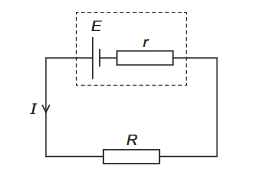
Which equation is correct?
(B) \(E=Ir-IR\)
(C) \(E+Ir=IR\)
(D) \(E=IR\)
▶️ Answer/Explanation
Correct Answer: \( \boxed{\mathrm{A}} \)
The terminal potential difference across the external resistor is
\(V=E-Ir\)
Using Ohm’s law for the external resistor,
\(V=IR\)
Hence,
\(E-Ir=IR\)
Therefore, the correct answer is (A).
Question 37
A potential divider consists of two resistors of resistances \(R_1\) and \(R_2\) connected in series across a source of potential difference (p.d.) \(V_{\mathrm{in}}\). The p.d. across \(R_1\) is \(V_{\mathrm{out}}\).
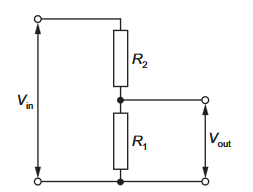
Which changes to \(R_1\) and \(R_2\) will increase the value of \(V_{\mathrm{out}}\)?
| \(R_1\) | \(R_2\) | |
|---|---|---|
| (A) | Doubled | Doubled |
| (B) | Doubled | Halved |
| (C) | Halved | Doubled |
| (D) | Halved | Halved |
▶️ Answer/Explanation
Correct Answer: \( \boxed{\mathrm{B}} \)
For a potential divider,
\(V_{\mathrm{out}}=V_{\mathrm{in}}\dfrac{R_1}{R_1+R_2}\)
Doubling \(R_1\) increases the numerator, while halving \(R_2\) decreases the denominator.
This gives the largest increase in the fraction \(\dfrac{R_1}{R_1+R_2}\).
Therefore, the correct answer is (B).
Question 38
Two alpha-particles with the same kinetic energy are moving towards, and are then deflected by, a gold nucleus.
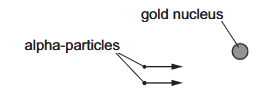
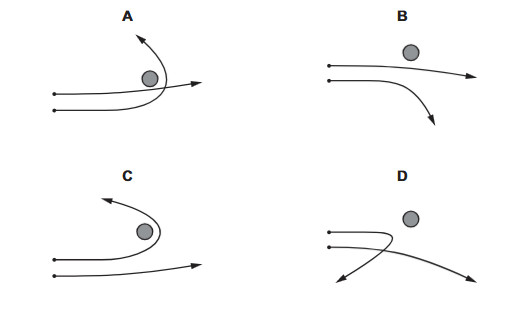
Which diagram could show the paths of the two alpha-particles?
(B) B
(C) C
(D) D
▶️ Answer/Explanation
Correct Answer: \( \boxed{\mathrm{D}} \)
Both the alpha-particles and the gold nucleus are positively charged, so the alpha-particles are repelled.
The particle passing closer to the nucleus experiences a larger electrostatic force and is deflected through a greater angle.
The particle farther from the nucleus experiences a smaller force and is only slightly deflected.
Therefore, the correct answer is (D).
Question 39
Which nuclide is formed when \(^{10}_{6}\mathrm{C}\) undergoes \(\beta^{+}\) decay?
(B) \(^{9}_{6}\mathrm{C}\)
(C) \(^{10}_{5}\mathrm{B}\)
(D) \(^{10}_{7}\mathrm{N}\)
▶️ Answer/Explanation
Correct Answer: \( \boxed{\mathrm{C}} \)
In \(\beta^{+}\) decay, a proton changes into a neutron, emitting a positron and a neutrino.
The mass number remains unchanged, while the proton number decreases by one.
Hence,
\(^{10}_{6}\mathrm{C}\rightarrow{}^{10}_{5}\mathrm{B}+\beta^{+}+\nu\)
Therefore, the correct answer is (C).
Question 40
A particular hadron is composed of three quarks and has zero charge.
What is a possible quark composition of the hadron?
(B) up, down, strange
(C) up, up, down
(D) up, up, strange
▶️ Answer/Explanation
Correct Answer: \( \boxed{\mathrm{B}} \)
The quark charges are
Up: \(+\dfrac{2}{3}e\)
Down: \(-\dfrac{1}{3}e\)
Strange: \(-\dfrac{1}{3}e\)
For option B,
\(+\dfrac{2}{3}-\dfrac{1}{3}-\dfrac{1}{3}=0\)
Therefore, the correct answer is (B).