
Question 1
A student estimates the maximum speed of some different moving objects.
Which maximum speed is not a reasonable estimate?
(B) Olympic sprinter: \(0.1\,\mathrm{km\,s^{-1}}\)
(C) racing car: \(9000\,\mathrm{cm\,s^{-1}}\)
(D) snail: \(0.01\,\mathrm{km\,h^{-1}}\)
▶️ Answer/Explanation
Correct Answer: \( \boxed{\mathrm{B}} \)
Convert each speed into familiar values.
Olympic sprinter:
\(0.1\,\mathrm{km\,s^{-1}}=100\,\mathrm{m\,s^{-1}}\)
This is about \(360\,\mathrm{km\,h^{-1}}\), which is far greater than the speed of any human runner.
The other estimates are reasonable for the objects listed.
Therefore, the correct answer is (B).
Question 2
Which quantity is an SI base quantity?
(B) newton
(C) second
(D) time
▶️ Answer/Explanation
Correct Answer: \( \boxed{\mathrm{D}} \)
The SI base quantities are length, mass, time, electric current, thermodynamic temperature, amount of substance, and luminous intensity.
Force is a derived quantity, while the newton is a derived SI unit.
The second is the SI base unit for the base quantity time.
Therefore, the correct answer is (D).
Question 3
A student takes measurements to determine the constant acceleration of a model car moving from rest in a straight line. The measured values with their absolute uncertainties are shown.
| Quantity | Measured Value | Uncertainty |
|---|---|---|
| displacement | \(16.5\,\mathrm{m}\) | \(\pm 0.1\,\mathrm{m}\) |
| time | \(15.0\,\mathrm{s}\) | \(\pm 1.0\,\mathrm{s}\) |
The student uses the equation \(s=\dfrac{1}{2}at^{2}\) to calculate the acceleration of the car.
What is the acceleration and its absolute uncertainty?
(B) \(\left(0.11\pm0.02\right)\,\mathrm{m\,s^{-2}}\)
(C) \(\left(0.15\pm0.01\right)\,\mathrm{m\,s^{-2}}\)
(D) \(\left(0.15\pm0.02\right)\,\mathrm{m\,s^{-2}}\)
▶️ Answer/Explanation
Correct Answer: \( \boxed{\mathrm{D}} \)
Using \(s=\dfrac{1}{2}at^{2}\),
\(a=\dfrac{2s}{t^{2}}=\dfrac{2(16.5)}{15.0^{2}}=\dfrac{33}{225}=0.147\,\mathrm{m\,s^{-2}}\approx0.15\,\mathrm{m\,s^{-2}}\)
For multiplication, division and powers, percentage uncertainties are added.
Percentage uncertainty in displacement:
\(\dfrac{0.1}{16.5}\times100=0.61\%\)
Percentage uncertainty in \(t^{2}\):
\(2\times\dfrac{1.0}{15.0}\times100=13.3\%\)
Total percentage uncertainty:
\(0.61+13.3=13.9\%\)
Absolute uncertainty:
\(0.139\times0.147=0.020\,\mathrm{m\,s^{-2}}\approx0.02\,\mathrm{m\,s^{-2}}\)
Therefore, the correct answer is (D).
Question 4
An aeroplane is moving at a constant speed in a straight line at an angle \(\theta\) to the horizontal.
Four forces act on the aeroplane: thrust force \(T\), weight \(W\), lift force \(L\) and resistive force \(R\).
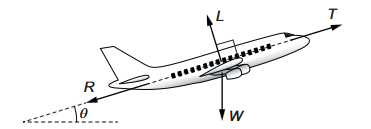
Which two equations must be correct?
(B) \(L=W\sin\theta\) and \(T=R+W\cos\theta\)
(C) \(L=W\cos\theta\) and \(T=R-W\sin\theta\)
(D) \(L=W\sin\theta\) and \(T=R-W\cos\theta\)
▶️ Answer/Explanation
Correct Answer: \( \boxed{\mathrm{A}} \)
Since the aeroplane moves at constant speed in a straight line, its acceleration is zero. Therefore, the resultant force is zero in every direction.
Resolving perpendicular to the flight path:
\(L=W\cos\theta\)
Resolving parallel to the flight path:
\(T=R+W\sin\theta\)
Therefore, the correct answer is (A).
Question 5
What is the definition of acceleration?
(B) the rate of change of kinetic energy
(C) the rate of change of momentum
(D) the rate of change of velocity
▶️ Answer/Explanation
Correct Answer: \( \boxed{\mathrm{D}} \)
Acceleration is defined as the rate of change of velocity with respect to time.
Mathematically,
\(a=\dfrac{\Delta v}{\Delta t}\)
Displacement changes with time to give velocity, while the rate of change of momentum gives the resultant force according to Newton’s second law.
Therefore, the correct answer is (D).
Question 6
An astronaut on the Moon, where there is no air resistance, throws a ball. The ball’s initial velocity has a vertical component of \(8.00\,\mathrm{m\,s^{-1}}\) and a horizontal component of \(4.00\,\mathrm{m\,s^{-1}}\), as shown.
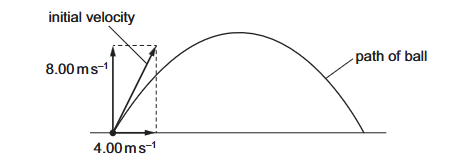
The acceleration of free fall on the Moon is \(1.62\,\mathrm{m\,s^{-2}}\).
What is the speed of the ball \(9.00\,\mathrm{s}\) after being thrown?
(B) \(7.70\,\mathrm{m\,s^{-1}}\)
(C) \(10.6\,\mathrm{m\,s^{-1}}\)
(D) \(14.6\,\mathrm{m\,s^{-1}}\)
▶️ Answer/Explanation
Correct Answer: \( \boxed{\mathrm{B}} \)
The horizontal velocity remains constant because there is no air resistance.
\(v_x=4.00\,\mathrm{m\,s^{-1}}\)
The vertical velocity after \(9.00\,\mathrm{s}\) is
\(v_y=u_y-gt=8.00-(1.62)(9.00)=-6.58\,\mathrm{m\,s^{-1}}\)
The speed is the magnitude of the velocity:
\(v=\sqrt{v_x^2+v_y^2}=\sqrt{4.00^2+(-6.58)^2}=\sqrt{59.30}=7.70\,\mathrm{m\,s^{-1}}\)
Therefore, the correct answer is (B).
Question 7
Two blocks, of mass \(0.20\,\mathrm{kg}\) and \(0.50\,\mathrm{kg}\), are connected by a light inextensible string that passes over a frictionless pulley.
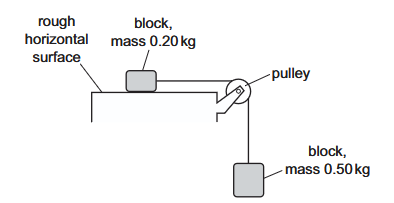
The blocks are initially held stationary. The block of mass \(0.20\,\mathrm{kg}\) rests on a rough horizontal surface.
The block of mass \(0.50\,\mathrm{kg}\) is suspended in air. Air resistance is negligible.
When the blocks are released, they have an acceleration of magnitude \(2.0\,\mathrm{m\,s^{-2}}\).
What is the magnitude of the frictional force between the block of mass \(0.20\,\mathrm{kg}\) and the rough surface?
(B) \(3.9\,\mathrm{N}\)
(C) \(4.5\,\mathrm{N}\)
(D) \(6.3\,\mathrm{N}\)
▶️ Answer/Explanation
Correct Answer: \( \boxed{\mathrm{A}} \)
For the hanging \(0.50\,\mathrm{kg}\) block:
\(mg-T=ma\)
\(T=0.50(9.81)-0.50(2.0)=3.905\,\mathrm{N}\)
For the \(0.20\,\mathrm{kg}\) block on the table:
\(T-f=ma\)
\(f=T-0.20(2.0)=3.905-0.40=3.505\,\mathrm{N}\approx3.5\,\mathrm{N}\)
Therefore, the correct answer is (A).
Question 8
A resultant force causes an object to accelerate.
What is equal to the resultant force?
(B) the change in kinetic energy of the object per unit time
(C) the change in momentum of the object per unit time
(D) the change in velocity of the object per unit time
▶️ Answer/Explanation
Correct Answer: \( \boxed{\mathrm{C}} \)
According to Newton’s second law, the resultant force acting on an object is equal to the rate of change of its momentum.
Mathematically,
\(F=\dfrac{\Delta p}{\Delta t}\)
The rate of change of velocity is acceleration, while the rate of change of kinetic energy is power.
Therefore, the correct answer is (C).
Question 9
An object falls from a stationary helicopter and reaches terminal velocity.
What happens to the acceleration of the object between leaving the helicopter and reaching terminal velocity?
(B) It decreases to zero.
(C) It increases to \(9.81\,\mathrm{m\,s^{-2}}\).
(D) It remains constant at \(9.81\,\mathrm{m\,s^{-2}}\).
▶️ Answer/Explanation
Correct Answer: \( \boxed{\mathrm{B}} \)
When the object is first released, the only significant force is its weight, so its acceleration is approximately \(g=9.81\,\mathrm{m\,s^{-2}}\) downward.
As the object speeds up, air resistance increases, reducing the resultant downward force.
At terminal velocity, the air resistance equals the weight, so the resultant force is zero.
By Newton’s second law, zero resultant force means zero acceleration.
Therefore, the correct answer is (B).
Question 10
Two balls, of masses \(m\) and \(2m\), travelling in a vacuum with initial velocities \(2v\) and \(v\) respectively, collide with each other head-on, as shown.
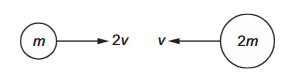
After the collision, the ball of mass \(m\) rebounds to the left with velocity \(v\).
What is the loss of kinetic energy in the collision?
(B) \(\dfrac{3}{2}mv^{2}\)
(C) \(\dfrac{9}{4}mv^{2}\)
(D) \(\dfrac{9}{2}mv^{2}\)
▶️ Answer/Explanation
Correct Answer: \( \boxed{\mathrm{C}} \)
Take motion to the right as positive.
Initial momentum:
\(m(2v)+2m(-v)=0\)
Hence the final momentum is also zero.
After the collision, the ball of mass \(m\) has velocity \(-v\). Let the velocity of the \(2m\) ball be \(u\).
\(-mv+2mu=0 \Rightarrow u=\dfrac{v}{2}\)
Initial kinetic energy:
\(KE_i=\dfrac{1}{2}m(2v)^2+\dfrac{1}{2}(2m)v^2=3mv^2\)
Final kinetic energy:
\(KE_f=\dfrac{1}{2}mv^2+\dfrac{1}{2}(2m)\left(\dfrac{v}{2}\right)^2=\dfrac{3}{4}mv^2\)
Loss of kinetic energy:
\(KE_i-KE_f=3mv^2-\dfrac{3}{4}mv^2=\dfrac{9}{4}mv^2\)
Therefore, the correct answer is (C).
Question 11
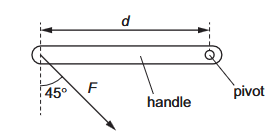
A force \(F\) is applied at an angle of \(45^\circ\) to a door handle at a distance \(d\) from the pivot of the handle, as shown.
What is the moment of the force about the pivot?
(B) \(Fd\)
(C) \(Fd\sqrt{2}\)
(D) \(2Fd\)
▶️ Answer/Explanation
Correct Answer: \( \boxed{\mathrm{A}} \)
The moment of a force about a pivot is given by
\(\tau=Fd\sin\theta\)
where \(\theta\) is the angle between the force and the handle (the lever arm).
The force makes an angle of \(45^\circ\) with the vertical, so it also makes an angle of \(45^\circ\) with the horizontal handle.
Hence,
\(\tau=Fd\sin45^\circ=Fd\left(\dfrac{1}{\sqrt{2}}\right)=\dfrac{Fd}{\sqrt{2}}\)
Therefore, the correct answer is (A).
Question 12
A couple consists of two forces, each of magnitude \(F\), that act in opposite directions in the same plane.
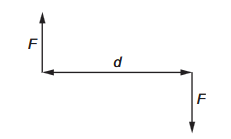
The perpendicular distance between the two forces is \(d\).
What is the torque of the couple?
(B) \(\dfrac{F}{d}\)
(C) \(Fd\)
(D) \(2Fd\)
▶️ Answer/Explanation
Correct Answer: \( \boxed{\mathrm{C}} \)
A couple consists of two equal and opposite parallel forces separated by a perpendicular distance.
The torque (moment) of a couple is given by
\(\tau=Fd\)
where \(F\) is the magnitude of one of the forces and \(d\) is the perpendicular distance between their lines of action.
The torque of a couple is independent of the choice of pivot.
Therefore, the correct answer is (C).
Question 13
The diagram shows an experiment to determine the force exerted on a ball by a horizontal air flow.
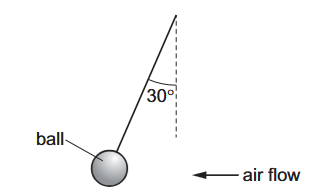
The ball is suspended by a light string and weighs \(0.15\,\mathrm{N}\).
The deflection of the string from the vertical is \(30^\circ\). The ball is in equilibrium.
What is the force on the ball from the air flow?
(B) \(0.087\,\mathrm{N}\)
(C) \(0.26\,\mathrm{N}\)
(D) \(0.30\,\mathrm{N}\)
▶️ Answer/Explanation
Correct Answer: \( \boxed{\mathrm{B}} \)
Since the ball is in equilibrium, resolve the tension into vertical and horizontal components.
Vertically,
\(T\cos30^\circ=0.15\)
Horizontally, the air force is
\(F=T\sin30^\circ\)
Using \(\tan30^\circ=\dfrac{F}{0.15}\),
\(F=0.15\tan30^\circ=0.15\times0.577=0.0866\,\mathrm{N}\approx0.087\,\mathrm{N}\)
Therefore, the correct answer is (B).
Question 14
Two solid cylindrical objects \(X\) and \(Y\) are held fully submerged in a liquid, as shown.
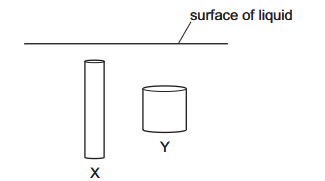
The objects have the same volume. The density of the material of \(Y\) is twice the density of the material of \(X\). Both objects are stationary.
Which statement is correct?
(B) The pressure difference due to the liquid between the top and bottom surfaces of \(X\) is the same as that for \(Y\).
(C) The upthrust acting on \(X\) is the same as the upthrust acting on \(Y\).
(D) The weight of \(X\) is the same as the weight of \(Y\).
▶️ Answer/Explanation
Correct Answer: \( \boxed{\mathrm{C}} \)
The upthrust on a submerged object is equal to the weight of the displaced liquid.
Since both objects are fully submerged in the same liquid and have the same volume, they displace the same volume of liquid.
Therefore, both objects experience the same upthrust:
\(U=\rho_{\mathrm{liquid}}Vg\)
The weights of the objects are different because object \(Y\) has twice the density of object \(X\).
Therefore, the correct answer is (C).
Question 15
An electric car travels at a constant speed of \(70\,\mathrm{km\,h^{-1}}\) for \(80\,\mathrm{km}\) on a straight horizontal road and uses energy \(E\) from its battery.
The total resistive force acting on the car is proportional to \((\text{speed})^2\). Assume that the electric motor is \(100\%\) efficient.
How much energy is used from the battery when the car travels at a constant speed of \(60\,\mathrm{km\,h^{-1}}\) for \(80\,\mathrm{km}\) on the straight horizontal road?
(B) \(0.86E\)
(C) \(1.2E\)
(D) \(1.4E\)
▶️ Answer/Explanation
Correct Answer: \( \boxed{\mathrm{A}} \)
The work done equals the resistive force multiplied by the distance travelled.
Since the distance is the same in both cases,
\(E\propto F\)
Given that \(F\propto v^2\),
\(\dfrac{E_2}{E_1}=\left(\dfrac{60}{70}\right)^2=\dfrac{36}{49}\approx0.735\)
Hence,
\(E_2\approx0.73E\)
Therefore, the correct answer is (A).
Question 16
What is meant by the efficiency of a system?
(B) the useful energy output from the system divided by the energy wasted by the system
(C) the useful energy output from the system divided by the total energy input to the system
(D) the energy wasted by the system divided by the total energy input to the system
▶️ Answer/Explanation
Correct Answer: \( \boxed{\mathrm{C}} \)
Efficiency is the fraction of the input energy that is converted into useful output energy.
It is defined as
\(\mathrm{Efficiency}=\dfrac{\text{Useful energy output}}{\text{Total energy input}}\)
Efficiency is often expressed as a percentage by multiplying the above ratio by \(100\%\).
Therefore, the correct answer is (C).
Question 17
When an object of mass \(m\) is raised through a vertical height \(\Delta h\), the gain of its gravitational potential energy is \(\Delta E_{\mathrm{P}}\).
\(\Delta E_{\mathrm{P}}\) and \(\Delta h\) are related by the equation
\(\Delta E_{\mathrm{P}}=mg\Delta h\),
where \(g\) is the acceleration of free fall.
The definition of which physical quantity is needed to derive this equation?
(B) momentum
(C) power
(D) work done
▶️ Answer/Explanation
Correct Answer: \( \boxed{\mathrm{D}} \)
The gain in gravitational potential energy is equal to the work done against the gravitational force.
Work done is defined as
\(W=Fs\)
For lifting an object vertically at constant speed, the force is its weight:
\(F=mg\)
Hence,
\(W=mg\Delta h\)
Since the work done equals the gain in gravitational potential energy,
\(\Delta E_{\mathrm{P}}=mg\Delta h\)
Therefore, the correct answer is (D).
Question 18
Three identical springs, each with the same spring constant, are connected together in four different arrangements, as shown.
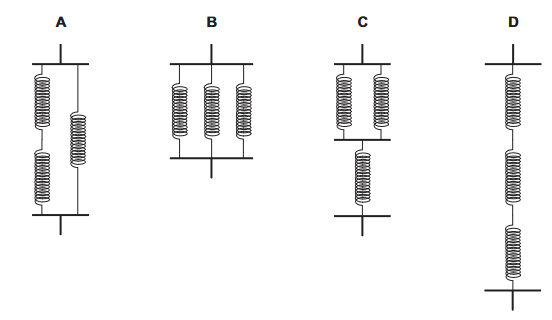
Which arrangement has the largest combined spring constant?
(B) Arrangement B
(C) Arrangement C
(D) Arrangement D
▶️ Answer/Explanation
Correct Answer: \( \boxed{\mathrm{B}} \)
For identical springs of spring constant \(k\):
Springs in parallel have an equivalent spring constant equal to the sum of their spring constants.
Springs in series have an equivalent spring constant smaller than the spring constant of a single spring.
Arrangement B has all three springs connected in parallel, giving
\(k_{\mathrm{eq}}=k+k+k=3k\)
This is greater than the equivalent spring constant of the other arrangements.
Therefore, the correct answer is (B).
Question 19
The force-extension graph for a wire is shown.
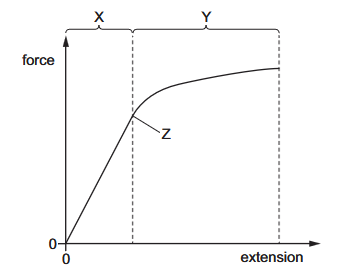
Which row could identify the labels \(X\), \(Y\) and \(Z\)?
| Option | Limit of Proportionality | Region of Elastic Deformation | Region of Plastic Deformation |
|---|---|---|---|
| (A) | \(X\) | \(Y\) | \(Z\) |
| (B) | \(Z\) | \(Y\) | \(X\) |
| (C) | \(Y\) | \(Z\) | \(X\) |
| (D) | \(Z\) | \(X\) | \(Y\) |
▶️ Answer/Explanation
Correct Answer: \( \boxed{\mathrm{D}} \)
The straight-line portion of the graph obeys Hooke’s law, where force is directly proportional to extension.
The point marked \(Z\) is where the graph first begins to deviate from a straight line, so it represents the limit of proportionality.
Region \(X\) is before this point, where the wire behaves elastically and obeys Hooke’s law.
Region \(Y\) is beyond the limit of proportionality, where permanent (plastic) deformation can occur.
Therefore, the correct answer is (D).
Question 20
\(X\) and \(Y\) are two points on the surface of water in a ripple tank. A source of constant frequency generates a wave which travels past \(X\) and \(Y\), causing them to oscillate vertically.

What is the phase difference between \(X\) and \(Y\)?
(B) \(135^\circ\)
(C) \(180^\circ\)
(D) \(270^\circ\)
▶️ Answer/Explanation
Correct Answer: \( \boxed{\mathrm{D}} \)
The phase difference between two points on a wave is proportional to their separation as a fraction of the wavelength.
From the diagram, the separation between \(X\) and \(Y\) is \(\dfrac{3}{4}\lambda\).
Hence,
\(\text{Phase difference}=\dfrac{3}{4}\times360^\circ=270^\circ\)
Therefore, the correct answer is (D).
Question 21
A transverse wave on a rope has wavelength \(\lambda\) and period \(T\).
The graph shows the variation of the displacement of the particles of the rope with distance in the direction of travel of the wave at time \(t=0\).
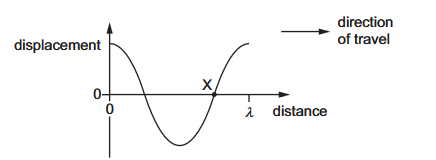
A particle \(X\) is labelled.
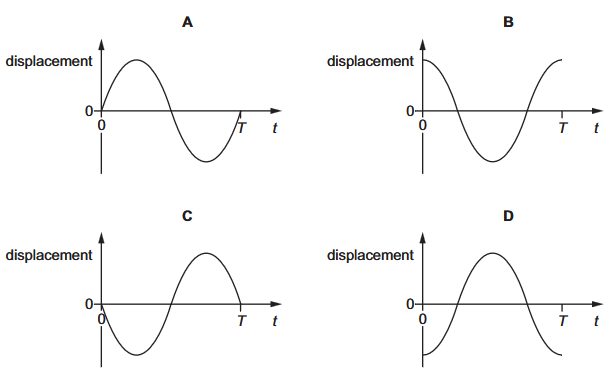
Which graph shows the variation of the displacement of particle \(X\) with time \(t\)?
(B) Graph B
(C) Graph C
(D) Graph D
▶️ Answer/Explanation
Correct Answer: \( \boxed{\mathrm{C}} \)
At \(t=0\), particle \(X\) is at zero displacement.
The wave is travelling to the right, so particle \(X\) will move according to the shape of the wave approaching it from the left.
Immediately after \(t=0\), the displacement of \(X\) becomes negative before reaching a minimum, then returns through zero and becomes positive.
Only Graph C starts at zero displacement with an initial downward motion and completes one full oscillation in one period \(T\).
Therefore, the correct answer is (C).
Question 22
A source of sound waves is moving at a constant speed directly towards a stationary observer.
The sound waves have a speed of \(340\,\mathrm{m\,s^{-1}}\) and a frequency of \(480\,\mathrm{Hz}\). The observer hears sound waves of frequency \(650\,\mathrm{Hz}\).
What is the speed of the source?
(B) \(120\,\mathrm{m\,s^{-1}}\)
(C) \(250\,\mathrm{m\,s^{-1}}\)
(D) \(340\,\mathrm{m\,s^{-1}}\)
▶️ Answer/Explanation
Correct Answer: \( \boxed{\mathrm{A}} \)
For a source moving towards a stationary observer, the Doppler equation is
\(f’ = f\left(\dfrac{v}{v-v_s}\right)\)
Substituting the given values,
\(650=480\left(\dfrac{340}{340-v_s}\right)\)
\(340-v_s=\dfrac{480\times340}{650}=251.1\)
\(v_s=340-251.1=88.9\,\mathrm{m\,s^{-1}}\approx89\,\mathrm{m\,s^{-1}}\)
Therefore, the correct answer is (A).
Question 23
A student is investigating two electromagnetic waves, \(X\) and \(Y\), in a vacuum.
Wave \(X\) has a wavelength of \(5.2\times10^{-7}\,\mathrm{m}\). Wave \(Y\) has a frequency of \(9.4\,\mathrm{GHz}\).
Which principal regions of the electromagnetic spectrum contain waves \(X\) and \(Y\)?
| Option | \(X\) | \(Y\) |
|---|---|---|
| (A) | radio wave | ultraviolet |
| (B) | ultraviolet | visible |
| (C) | visible | microwave |
| (D) | microwave | radio wave |
▶️ Answer/Explanation
Correct Answer: \( \boxed{\mathrm{C}} \)
Wave \(X\) has wavelength
\(\lambda=5.2\times10^{-7}\,\mathrm{m}=520\,\mathrm{nm}\)
A wavelength of approximately \(520\,\mathrm{nm}\) lies in the visible region of the electromagnetic spectrum.
Wave \(Y\) has frequency
\(f=9.4\,\mathrm{GHz}=9.4\times10^{9}\,\mathrm{Hz}\)
Frequencies in the gigahertz range belong to the microwave region.
Therefore, the correct answer is (C).
Question 24
A plane polarised light wave of intensity \(I_0\) is incident normally on a polarising filter. The initial intensity of the transmitted wave is \(0\).
A second polarising filter is inserted between the source and the first filter. Its transmission axis is at \(45^\circ\) to the transmission axis of the first filter, as shown.
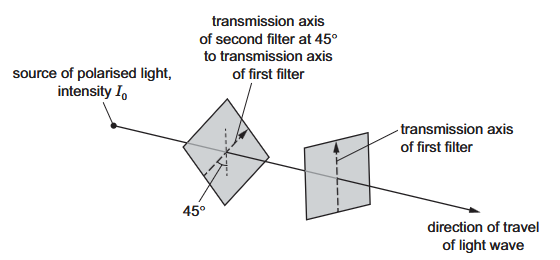
What is the intensity of the transmitted wave from the filter combination?
(B) \(\dfrac{I_0}{8}\)
(C) \(\dfrac{I_0}{4}\)
(D) \(\dfrac{I_0}{2}\)
▶️ Answer/Explanation
Correct Answer: \( \boxed{\mathrm{C}} \)
Initially, the two polarising filters are crossed, so no light is transmitted.
When a third polarising filter is inserted at \(45^\circ\):
After the middle filter, by Malus’ law,
\(I_1=I_0\cos^2 45^\circ=\dfrac{I_0}{2}\)
The light then passes through the final filter, which is also at \(45^\circ\) to the middle filter:
\(I_2=I_1\cos^2 45^\circ=\dfrac{I_0}{2}\times\dfrac{1}{2}=\dfrac{I_0}{4}\)
Therefore, the correct answer is (C).
Question 25
What can explain how stationary waves are formed from progressive waves?
(B) polarisation
(C) superposition
(D) the Doppler effect
▶️ Answer/Explanation
Correct Answer: \( \boxed{\mathrm{C}} \)
Stationary waves are formed when two progressive waves of the same frequency, wavelength and amplitude travel in opposite directions and overlap.
This occurs because of the principle of superposition, where the displacements of the two waves combine to produce nodes and antinodes.
Therefore, the correct answer is (C).
Question 26
A pipe has a length of \(2.0\,\mathrm{m}\). It is open at one end and closed at the other end.
A stationary sound wave is set up within the pipe. There are four nodes (\(N\)) and four antinodes (\(A\)) within the length of the pipe.
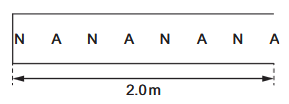
What is the wavelength of the sound wave?
(B) \(1.1\,\mathrm{m}\)
(C) \(1.3\,\mathrm{m}\)
(D) \(1.6\,\mathrm{m}\)
▶️ Answer/Explanation
Correct Answer: \( \boxed{\mathrm{B}} \)
The distance between a node and the next antinode is \(\dfrac{\lambda}{4}\).
The pattern \(N\,A\,N\,A\,N\,A\,N\,A\) contains seven intervals, each of length \(\dfrac{\lambda}{4}\).
Hence,
\(2.0=\dfrac{7\lambda}{4}\)
\(\lambda=\dfrac{4\times2.0}{7}=1.14\,\mathrm{m}\)
\(\lambda\approx1.1\,\mathrm{m}\)
Therefore, the correct answer is (B).
Question 27
A teacher is explaining diffraction to a group of students.
Which piece of apparatus is most appropriate for the teacher to use to demonstrate diffraction?
(B) a ripple tank
(C) a rope
(D) a stretched string
▶️ Answer/Explanation
Correct Answer: \( \boxed{\mathrm{B}} \)
Diffraction is the spreading of waves as they pass through a gap or around an obstacle.
A ripple tank is the most suitable apparatus because it allows water waves to pass through adjustable gaps and around obstacles, making diffraction patterns clearly visible.
A rope, stretched string, or long spring can demonstrate wave motion, but they are not well suited for demonstrating two-dimensional diffraction.
Therefore, the correct answer is (B).
Question 28
Coherent light of constant wavelength is incident normally on a double slit. Interference fringes are formed on a screen that is a fixed distance from the double slit. The screen is parallel to the double slit.
The separation of the slits is varied.
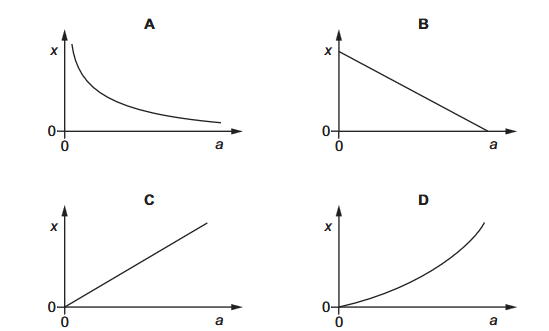
Which graph best shows the variation with slit separation \(a\) of the spacing \(x\) of the interference fringes?
(B) Graph B
(C) Graph C
(D) Graph D
▶️ Answer/Explanation
Correct Answer: \( \boxed{\mathrm{A}} \)
The fringe spacing in a double-slit experiment is given by
\(x=\dfrac{\lambda D}{a}\)
where \(\lambda\) is the wavelength of the light, \(D\) is the distance from the slits to the screen, and \(a\) is the slit separation.
Since \(\lambda\) and \(D\) are constant, the fringe spacing is inversely proportional to the slit separation:
\(x\propto\dfrac{1}{a}\)
Therefore, the graph is a decreasing hyperbola.
Therefore, the correct answer is (A).
Question 29
Light of wavelength \(690\,\mathrm{nm}\) passes through a diffraction grating with \(300\) lines per \(\mathrm{mm}\), producing a series of bright spots (maxima) on a screen.
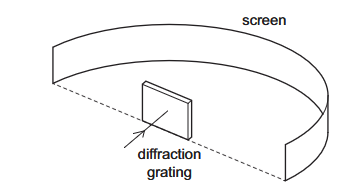
What is the total number of bright spots that are produced?
(B) \(5\)
(C) \(8\)
(D) \(9\)
▶️ Answer/Explanation
Correct Answer: \( \boxed{\mathrm{D}} \)
The diffraction grating equation is
\(d\sin\theta=n\lambda\)
The grating spacing is
\(d=\dfrac{1}{300\times10^{3}}=3.33\times10^{-6}\,\mathrm{m}\)
The maximum possible order satisfies
\(n_{\max}=\left\lfloor\dfrac{d}{\lambda}\right\rfloor=\left\lfloor\dfrac{3.33\times10^{-6}}{690\times10^{-9}}\right\rfloor=\left\lfloor4.83\right\rfloor=4\)
Thus, the observable orders are \(0,\pm1,\pm2,\pm3,\pm4\).
Total number of bright spots:
\(2n_{\max}+1=2(4)+1=9\)
Therefore, the correct answer is (D).
Question 30
A fine mist of oil droplets is sprayed into air. As the oil droplets leave the nozzle of the spraying device they can become electrically charged.
What is not a possible value for the charge on an oil droplet?
(B) \(1.0\times10^{-19}\,\mathrm{C}\)
(C) \(4.8\times10^{-19}\,\mathrm{C}\)
(D) \(8.0\times10^{-19}\,\mathrm{C}\)
▶️ Answer/Explanation
Correct Answer: \( \boxed{\mathrm{B}} \)
Electric charge is quantised, so any charge on an object must be an integer multiple of the elementary charge:
\(q=ne\)
where \(e=1.6\times10^{-19}\,\mathrm{C}\) and \(n\) is an integer.
Checking the options:
\(0=0e\) ✓
\(4.8\times10^{-19}\,\mathrm{C}=3e\) ✓
\(8.0\times10^{-19}\,\mathrm{C}=5e\) ✓
\(1.0\times10^{-19}\,\mathrm{C}=0.625e\) ✗ (not an integer multiple of \(e\))
Therefore, the correct answer is (B).
Question 31
In the circuit shown, a fixed resistor \(X\) is connected in series with a battery and a variable resistor.
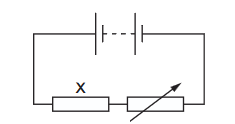
The power dissipated in resistor \(X\) is \(7.2\,\mathrm{W}\) when a current of \(3.0\,\mathrm{A}\) passes through it.
The variable resistor is adjusted so that the power dissipated in \(X\) increases by \(50\%\).
What is the new current in the circuit?
(B) \(3.7\,\mathrm{A}\)
(C) \(4.5\,\mathrm{A}\)
(D) \(14\,\mathrm{A}\)
▶️ Answer/Explanation
Correct Answer: \( \boxed{\mathrm{B}} \)
For the fixed resistor,
\(P=I^{2}R\)
Initially,
\(7.2=(3.0)^2R\)
\(R=\dfrac{7.2}{9}=0.80\,\Omega\)
The new power is increased by \(50\%\):
\(P_{\text{new}}=1.5\times7.2=10.8\,\mathrm{W}\)
Using \(P=I^2R\),
\(I=\sqrt{\dfrac{10.8}{0.80}}=\sqrt{13.5}=3.67\,\mathrm{A}\approx3.7\,\mathrm{A}\)
Therefore, the correct answer is (B).
Question 32
The potential difference across a metal wire is kept constant. The length \(l\) and the diameter \(d\) of the wire are both varied. The type of metal is kept the same.
How is the current in the wire related to \(l\) and \(d\)?
(B) It is directly proportional to \(l\) and inversely proportional to \(d^2\).
(C) It is inversely proportional to \(l\) and directly proportional to \(d\).
(D) It is inversely proportional to \(l\) and directly proportional to \(d^2\).
▶️ Answer/Explanation
Correct Answer: \( \boxed{\mathrm{D}} \)
The resistance of a wire is given by
\(R=\rho\dfrac{l}{A}\)
where \(A=\dfrac{\pi d^2}{4}\).
Hence,
\(R\propto\dfrac{l}{d^2}\)
Since the potential difference is constant, Ohm’s law gives
\(I=\dfrac{V}{R}\)
Therefore,
\(I\propto\dfrac{d^2}{l}\)
Therefore, the correct answer is (D).
Question 33
A student sets up a circuit. The circuit diagram shows how the positive and negative terminals of a voltmeter are connected to the circuit. The voltmeter has an initial reading that is positive.
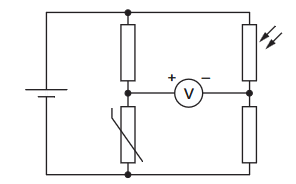
Which changes, if any, in temperature and light intensity would cause the voltmeter reading to decrease?
| Option | Temperature | Light Intensity |
|---|---|---|
| (A) | increase | increase |
| (B) | no change | decrease |
| (C) | decrease | no change |
| (D) | decrease | decrease |
▶️ Answer/Explanation
Correct Answer: \( \boxed{\mathrm{A}} \)
The left branch contains a thermistor, and the right branch contains a light-dependent resistor (LDR), forming two potential dividers.
For an NTC thermistor, increasing the temperature decreases its resistance, reducing the potential at the voltmeter’s positive terminal.
For an LDR, increasing the light intensity decreases its resistance, increasing the potential at the voltmeter’s negative terminal.
Both effects reduce the potential difference measured by the voltmeter.
Therefore, the correct answer is (A).
Question 34
Some resistors and a battery of electromotive force (e.m.f.) \(E\) and negligible internal resistance are connected in series, as shown.
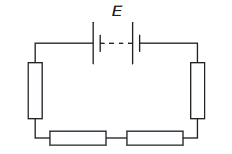
Which statement is correct?
(B) The potential difference across each resistor equals the e.m.f. \(E\) of the battery.
(C) The sum of the e.m.f.s across the resistors equals the potential difference across the battery.
(D) The sum of the potential differences across the resistors equals the e.m.f. \(E\) of the battery.
▶️ Answer/Explanation
Correct Answer: \( \boxed{\mathrm{D}} \)
According to Kirchhoff’s loop law, the total potential difference around a closed circuit is zero.
For a battery with negligible internal resistance, the battery provides an e.m.f. \(E\), and the sum of the potential differences across all the resistors in series equals this e.m.f.
Hence,
\(V_1+V_2+V_3+\cdots=E\)
Each individual resistor has only a fraction of the total potential difference, so options (A), (B), and (C) are incorrect.
Therefore, the correct answer is (D).
Question 35
Kirchhoff’s first law is a consequence of the conservation of which physical quantity?
(B) energy
(C) linear momentum
(D) potential difference
▶️ Answer/Explanation
Correct Answer: \( \boxed{\mathrm{A}} \)
Kirchhoff’s first law states that the total current entering a junction is equal to the total current leaving the junction.
Mathematically,
\(\sum I_{\mathrm{in}}=\sum I_{\mathrm{out}}\)
This law follows directly from the conservation of electric charge. Charge cannot accumulate at a junction, so the rate at which charge enters a junction must equal the rate at which it leaves.
Therefore, the correct answer is (A).
Question 36
The diagram shows a network of resistors. Each resistor has a resistance of \(6.0\,\Omega\).
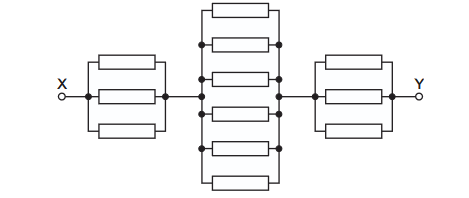
What is the total resistance of the network between points \(X\) and \(Y\)?
(B) \(5.0\,\Omega\)
(C) \(7.2\,\Omega\)
(D) \(18\,\Omega\)
▶️ Answer/Explanation
Correct Answer: \( \boxed{\mathrm{B}} \)
The network consists of three parallel groups connected in series.
Left group: three \(6.0\,\Omega\) resistors in parallel,
\(R_1=\dfrac{6.0}{3}=2.0\,\Omega\)
Middle group: six \(6.0\,\Omega\) resistors in parallel,
\(R_2=\dfrac{6.0}{6}=1.0\,\Omega\)
Right group: three \(6.0\,\Omega\) resistors in parallel,
\(R_3=\dfrac{6.0}{3}=2.0\,\Omega\)
Since these three equivalent resistances are connected in series,
\(R_{\mathrm{total}}=R_1+R_2+R_3=2.0+1.0+2.0=5.0\,\Omega\)
Therefore, the correct answer is (B).
Question 37
In the circuit shown, a battery of negligible internal resistance is connected in series with a pair of fixed resistors \(R_1\) and \(R_2\).
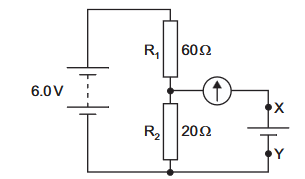
The circuit is to be used to test whether the electromotive force (e.m.f.) of a particular cell is \(1.5\,\mathrm{V}\).
The cell is connected between terminals \(X\) and \(Y\) in parallel with \(R_2\) and in series with a galvanometer.
Which statement about the test is correct?
(B) The battery does not need to have an e.m.f. of \(6.0\,\mathrm{V}\).
(C) The cell may be connected either way round between \(X\) and \(Y\).
(D) The galvanometer does not need a scale calibrated in amperes.
▶️ Answer/Explanation
Correct Answer: \( \boxed{\mathrm{D}} \)
The circuit acts as a potentiometer comparison.
When the potential difference across \(R_2\) equals the e.m.f. of the test cell, no current flows through the galvanometer.
The galvanometer is therefore used only to detect whether the current is zero (the null point), not to measure its magnitude.
Hence, it does not require a scale calibrated in amperes; a centre-zero galvanometer is sufficient.
Therefore, the correct answer is (D).
Question 38
Two nuclides are different isotopes of the same element.
Which statement about the nuclides is correct?
(B) Nuclei of the nuclides have different numbers of protons.
(C) Nuclei of the nuclides have the same number of nucleons.
(D) Nuclei of the nuclides have the same number of neutrons.
▶️ Answer/Explanation
Correct Answer: \( \boxed{\mathrm{A}} \)
Isotopes are atoms of the same element with the same number of protons but different numbers of neutrons.
Since neutral atoms have equal numbers of protons and electrons, neutral atoms of isotopes have the same number of electrons.
Their mass numbers (number of nucleons) are different because they contain different numbers of neutrons.
Therefore, the correct answer is (A).
Question 39
The charge-to-mass ratio \(r\) of a particle is given by the equation
\(r=\dfrac{\text{charge on particle}}{\text{mass of particle}}\)
The value of \(r\) is determined for an \(\alpha\)-particle, a \(\beta^{+}\) particle and a proton \(p\).
Which list shows the particles in order of increasing magnitude of \(r\) from left to right?
(B) \(\alpha \rightarrow p \rightarrow \beta^{+}\)
(C) \(p \rightarrow \alpha \rightarrow \beta^{+}\)
(D) \(p \rightarrow \beta^{+} \rightarrow \alpha\)
▶️ Answer/Explanation
Correct Answer: \( \boxed{\mathrm{B}} \)
Compare the magnitude of the charge-to-mass ratio for each particle.
For an \(\alpha\)-particle,
\(r=\dfrac{2e}{4m_p}=\dfrac{e}{2m_p}\)
For a proton,
\(r=\dfrac{e}{m_p}\)
For a \(\beta^{+}\) particle (positron),
\(r=\dfrac{e}{m_e}\)
Since \(m_e \ll m_p\), the positron has by far the largest charge-to-mass ratio. Also,
\(\dfrac{e}{2m_p}<\dfrac{e}{m_p}<\dfrac{e}{m_e}\)
Therefore, the correct answer is (B).
Question 40
Which combination of up (\(u\)) and down (\(d\)) quarks forms a neutron?
(B) \(uud\)
(C) \(udd\)
(D) \(ddd\)
▶️ Answer/Explanation
Correct Answer: \( \boxed{\mathrm{C}} \)
A neutron is a baryon composed of one up quark and two down quarks.
Its quark composition is
\(\mathrm{udd}\)
The total charge is
\(\dfrac{2}{3}e-\dfrac{1}{3}e-\dfrac{1}{3}e=0\)
For comparison, a proton consists of quarks \(\mathrm{uud}\).
Therefore, the correct answer is (C).