
Question 1
What is the best estimate of the wavelength of green light?
(B) \(540\,\mathrm{nm}\)
(C) \(780\,\mathrm{nm}\)
(D) \(920\,\mathrm{nm}\)
▶️ Answer/Explanation
Correct Answer: \( \boxed{\mathrm{B}} \)
Visible light has wavelengths approximately in the range
\(400\,\mathrm{nm}\) to \(700\,\mathrm{nm}\).
Green light typically has a wavelength between about \(495\,\mathrm{nm}\) and \(570\,\mathrm{nm}\).
Among the options, \(540\,\mathrm{nm}\) is the best estimate for green light.
Therefore, the correct answer is (B).
Question 2
In an electric circuit, an ammeter reads \(2\,\mathrm{\mu A}\).
In a second circuit, the ammeter reads \(1\,\mathrm{mA}\).
How many times larger is the current in the second circuit compared with the current in the first circuit?
(B) \(5000\)
(C) \(500\,000\)
(D) \(5\,000\,000\)
▶️ Answer/Explanation
Correct Answer: \( \boxed{\mathrm{A}} \)
Convert both currents to the same unit.
\(1\,\mathrm{mA}=1000\,\mathrm{\mu A}\)
The ratio of the currents is
\(\dfrac{1000}{2}=500\)
Hence, the current in the second circuit is \(500\) times larger than the current in the first circuit.
Therefore, the correct answer is (A).
Question 3
A set of repeated measurements is made of a fixed quantity. An average of these measurements is calculated.
What is the effect of averaging on the random error and the systematic error in the measurements?
(B) Random error and systematic error are both unaffected.
(C) Random error is reduced but systematic error is unaffected.
(D) Random error is unaffected but systematic error is reduced.
▶️ Answer/Explanation
Correct Answer: \( \boxed{\mathrm{C}} \)
Random errors cause measurements to scatter above and below the true value. Taking repeated measurements and calculating the average reduces the effect of these random variations.
Systematic errors are caused by consistent biases, such as a miscalibrated instrument. Averaging repeated measurements does not remove this bias.
Hence, averaging reduces random error but leaves systematic error unchanged.
Therefore, the correct answer is (C).
Question 4
A boat is crossing a river in which the water is moving at a speed of \(4.0\,\mathrm{m\,s^{-1}}\) from left to right.
In still water, the speed of the boat is \(6.0\,\mathrm{m\,s^{-1}}\). The boat is directed at an angle \(\theta\) to a line perpendicular to the river banks. The resultant velocity \(v\) of the boat is in a direction perpendicular to the river banks.
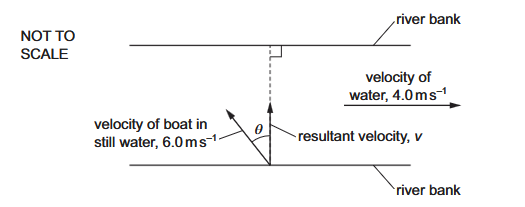
What are the values of \(\theta\) and \(v\)?
| Option | \(\theta/^\circ\) | \(v/\mathrm{m\,s^{-1}}\) |
|---|---|---|
| (A) | 42 | 4.5 |
| (B) | 42 | 7.2 |
| (C) | 48 | 4.5 |
| (D) | 48 | 7.2 |
▶️ Answer/Explanation
Correct Answer: \( \boxed{\mathrm{A}} \)
For the boat to travel perpendicular to the river banks, its horizontal component must exactly cancel the river current.
Horizontal component:
\(6\sin\theta=4\)
\(\sin\theta=\dfrac{2}{3}\)
\(\theta=\sin^{-1}\!\left(\dfrac{2}{3}\right)\approx41.8^\circ\approx42^\circ\)
The resultant speed across the river is the vertical component of the boat’s velocity:
\(v=6\cos42^\circ=\sqrt{6^2-4^2}=\sqrt{20}=4.47\,\mathrm{m\,s^{-1}}\approx4.5\,\mathrm{m\,s^{-1}}\)
Therefore, the correct answer is (A).
Question 5
A student walks at a constant speed for a distance of \(50\,\mathrm{m}\) in a time of \(40\,\mathrm{s}\). The student rests for a time of \(10\,\mathrm{s}\) and then walks back to the starting point at a constant speed in a time of \(30\,\mathrm{s}\).
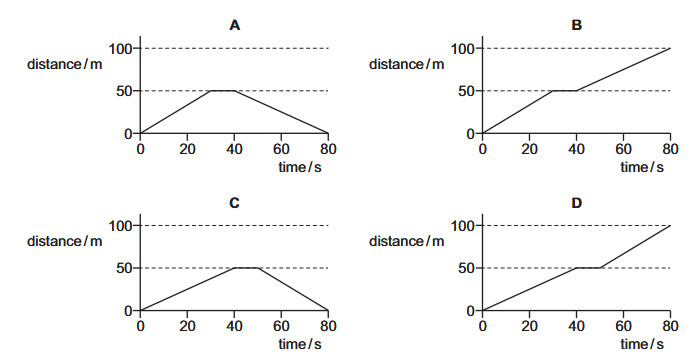
What is the distance-time graph for the motion of the student?
(B) Graph B
(C) Graph C
(D) Graph D
▶️ Answer/Explanation
Correct Answer: \( \boxed{\mathrm{D}} \)
The motion consists of three stages:
From \(0\) to \(40\,\mathrm{s}\), the distance increases uniformly from \(0\) to \(50\,\mathrm{m}\).
From \(40\) to \(50\,\mathrm{s}\), the student is at rest, so the graph is horizontal at \(50\,\mathrm{m}\).
From \(50\) to \(80\,\mathrm{s}\), the student walks another \(50\,\mathrm{m}\), so the total distance travelled increases from \(50\,\mathrm{m}\) to \(100\,\mathrm{m}\).
Since a distance-time graph shows total distance travelled, the graph never decreases.
Therefore, the correct answer is (D).
Question 6
The time taken for an object to fall from rest through a certain distance on Mars is \(T_{\mathrm{M}}\). The time taken for the same object to fall from rest through the same distance on Earth is \(T_{\mathrm{E}}\).
Assume that air resistance is negligible on both Earth and Mars.
The acceleration of free fall on Mars is \(3.71\,\mathrm{m\,s^{-2}}\).
What is the ratio \(\dfrac{T_{\mathrm{M}}}{T_{\mathrm{E}}}\)?
(B) \(0.615\)
(C) \(1.63\)
(D) \(2.64\)
▶️ Answer/Explanation
Correct Answer: \( \boxed{\mathrm{C}} \)
For an object falling from rest,
\(s=\dfrac{1}{2}gt^2\)
Hence,
\(t=\sqrt{\dfrac{2s}{g}}\)
Since the distance \(s\) is the same on both planets,
\(\dfrac{T_{\mathrm{M}}}{T_{\mathrm{E}}}=\sqrt{\dfrac{g_{\mathrm{E}}}{g_{\mathrm{M}}}}=\sqrt{\dfrac{9.81}{3.71}}=1.63\)
Therefore, the correct answer is (C).
Question 7
Which statement about mass is correct?
(B) Mass resists changes in motion.
(C) The greater the mass of an object, the greater its acceleration when falling in a vacuum.
(D) The mass of an object depends on its location.
▶️ Answer/Explanation
Correct Answer: \( \boxed{\mathrm{B}} \)
Mass is a scalar quantity that measures an object’s inertia, which is its resistance to changes in motion.
In a vacuum, all objects fall with the same acceleration regardless of their mass.
Unlike weight, mass does not depend on location because it is an intrinsic property of the object.
Therefore, the correct answer is (B).
Question 8
A snooker ball has a mass of \(200\,\mathrm{g}\). It hits the cushion of a snooker table and rebounds along its original path.
The ball arrives at the cushion with a speed of \(14.0\,\mathrm{m\,s^{-1}}\) and then leaves it with a speed of \(7.0\,\mathrm{m\,s^{-1}}\). The ball and the cushion are in contact for a time of \(0.60\,\mathrm{s}\).
What is the average force exerted on the ball by the cushion?
(B) \(2.3\,\mathrm{N}\)
(C) \(4.2\,\mathrm{N}\)
(D) \(7.0\,\mathrm{N}\)
▶️ Answer/Explanation
Correct Answer: \( \boxed{\mathrm{D}} \)
Convert the mass to SI units:
\(m=200\,\mathrm{g}=0.20\,\mathrm{kg}\)
Take the initial direction as positive.
Initial velocity:
\(u=+14.0\,\mathrm{m\,s^{-1}}\)
Final velocity:
\(v=-7.0\,\mathrm{m\,s^{-1}}\)
Change in momentum:
\(\Delta p=m(v-u)=0.20(-7-14)=-4.2\,\mathrm{kg\,m\,s^{-1}}\)
Average force:
\(F=\dfrac{|\Delta p|}{\Delta t}=\dfrac{4.2}{0.60}=7.0\,\mathrm{N}\)
Therefore, the correct answer is (D).
Question 9
A ball falls from rest through air and eventually reaches a constant velocity.
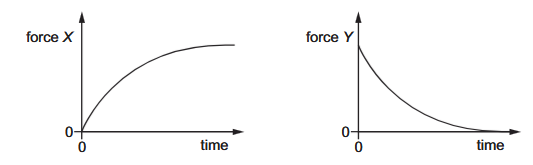
For this fall, forces \(X\) and \(Y\) vary with time as shown.
What could be forces \(X\) and \(Y\)?
| Option | Force X | Force Y |
|---|---|---|
| (A) | air resistance | resultant force |
| (B) | air resistance | weight |
| (C) | upthrust | resultant force |
| (D) | upthrust | weight |
▶️ Answer/Explanation
Correct Answer: \( \boxed{\mathrm{A}} \)
When the ball starts falling, its speed is zero, so the air resistance is initially zero.
As the speed increases, the air resistance increases until it becomes equal to the weight at terminal velocity.
The resultant force is initially equal to the weight and then decreases as the air resistance increases. At terminal velocity, the resultant force becomes zero.
Hence, force \(X\) is the air resistance, and force \(Y\) is the resultant force.
Therefore, the correct answer is (A).
Question 10
An object \(X\) of mass \(0.30\,\mathrm{kg}\) is travelling in a straight line at a constant velocity of \(3.0\,\mathrm{m\,s^{-1}}\) on a horizontal frictionless surface. Object \(X\) collides with a stationary object \(Y\) of mass \(0.50\,\mathrm{kg}\).
After the collision, \(X\) moves with a velocity of \(2.0\,\mathrm{m\,s^{-1}}\) at an angle of \(60^\circ\) to its direction before the collision. Object \(Y\) moves with a velocity \(v\) at an angle of \(41^\circ\) to the direction of \(X\) before the collision, as shown.
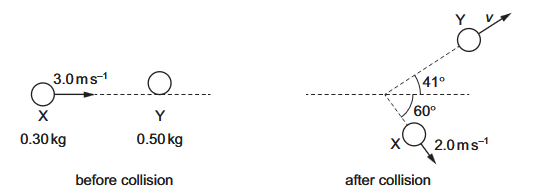
What is the value of \(v\)?
(B) \(1.2\,\mathrm{m\,s^{-1}}\)
(C) \(1.6\,\mathrm{m\,s^{-1}}\)
(D) \(1.8\,\mathrm{m\,s^{-1}}\)
▶️ Answer/Explanation
Correct Answer: \( \boxed{\mathrm{C}} \)
Conservation of momentum applies in both the horizontal and vertical directions.
Using the vertical components of momentum (initially zero):
\(0.50v\sin41^\circ=0.30\times2.0\times\sin60^\circ\)
\(0.50v(0.656)=0.60(0.866)\)
\(0.328v=0.520\)
\(v=1.59\,\mathrm{m\,s^{-1}}\approx1.6\,\mathrm{m\,s^{-1}}\)
This value also satisfies conservation of horizontal momentum.
Therefore, the correct answer is (C).
Question 11
A uniform rigid beam of length \(3.2\,\mathrm{m}\) is pivoted at its centre. Two children sit at the opposite ends of the beam, as shown.
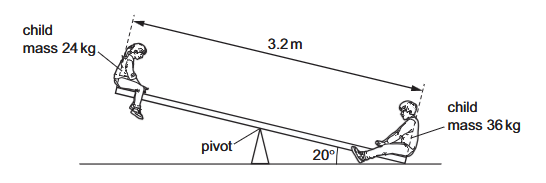
One child has a mass of \(24\,\mathrm{kg}\). The other child has a mass of \(36\,\mathrm{kg}\). The heavier child causes one end of the beam to permanently rest on the ground, so that the beam makes an angle of \(20^\circ\) to the horizontal ground.
What is the moment of the weight of the \(24\,\mathrm{kg}\) child about the pivot?
(B) \(130\,\mathrm{N\,m}\)
(C) \(350\,\mathrm{N\,m}\)
(D) \(380\,\mathrm{N\,m}\)
▶️ Answer/Explanation
Correct Answer: \( \boxed{\mathrm{C}} \)
The perpendicular distance from the pivot to the line of action of the child’s weight is
\(d=\dfrac{3.2}{2}\cos20^\circ=1.6\cos20^\circ=1.50\,\mathrm{m}\)
The child’s weight is
\(W=mg=24\times9.81=235\,\mathrm{N}\)
Hence, the moment about the pivot is
\(\tau=Wd=235\times1.50\approx353\,\mathrm{N\,m}\)
\(\tau\approx350\,\mathrm{N\,m}\)
Therefore, the correct answer is (C).
Question 12
Two parts of a sailing boat are the mast and the boom. The mast is a vertical rigid beam and the boom is a horizontal rigid beam. One end of the boom is attached to the mast by a pivot. The other end of the boom is connected to the mast by a rope, as shown.
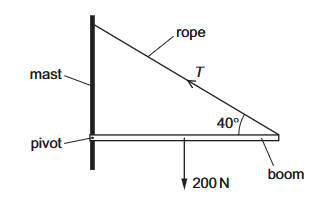
The rope is at an angle of \(40^\circ\) to the horizontal and exerts a tension force \(T\) on the boom. The weight of the boom is \(200\,\mathrm{N}\). The mass of the boom is uniformly distributed along its length. The boom is in equilibrium.
What is the magnitude of \(T\)?
(B) \(160\,\mathrm{N}\)
(C) \(260\,\mathrm{N}\)
(D) \(310\,\mathrm{N}\)
▶️ Answer/Explanation
Correct Answer: \( \boxed{\mathrm{B}} \)
Take moments about the pivot.
Only the vertical component of the tension produces a moment:
\(T\sin40^\circ\times L=200\times\dfrac{L}{2}\)
Cancelling \(L\),
\(T\sin40^\circ=100\)
\(T=\dfrac{100}{\sin40^\circ}=155.6\,\mathrm{N}\)
\(T\approx160\,\mathrm{N}\)
Therefore, the correct answer is (B).
Question 13
Full-fat milk is made up of fat-free milk mixed with fat.
A volume of \(1.000\times10^{-3}\,\mathrm{m^3}\) of full-fat milk has a mass of \(1.035\,\mathrm{kg}\). It contains \(4.00\%\) fat by volume.
The density of fat-free milk is \(1.040\times10^{3}\,\mathrm{kg\,m^{-3}}\).
What is the density of fat?
(B) \(9.15\times10^{2}\,\mathrm{kg\,m^{-3}}\)
(C) \(9.28\times10^{2}\,\mathrm{kg\,m^{-3}}\)
(D) \(1.16\times10^{3}\,\mathrm{kg\,m^{-3}}\)
▶️ Answer/Explanation
Correct Answer: \( \boxed{\mathrm{B}} \)
Total volume:
\(V=1.000\times10^{-3}\,\mathrm{m^3}\)
Fat volume:
\(V_f=0.04V=4.0\times10^{-5}\,\mathrm{m^3}\)
Fat-free milk volume:
\(V_m=0.96V=9.6\times10^{-4}\,\mathrm{m^3}\)
Mass of fat-free milk:
\(m_m=\rho V=(1.040\times10^{3})(9.6\times10^{-4})=0.9984\,\mathrm{kg}\)
Mass of fat:
\(m_f=1.035-0.9984=0.0366\,\mathrm{kg}\)
Density of fat:
\(\rho_f=\dfrac{m_f}{V_f}=\dfrac{0.0366}{4.0\times10^{-5}}=9.15\times10^{2}\,\mathrm{kg\,m^{-3}}\)
Therefore, the correct answer is (B).
Question 14
Which expression for pressure is correct?
(B) mass per unit area
(C) mass per unit volume
(D) weight per unit volume
▶️ Answer/Explanation
Correct Answer: \( \boxed{\mathrm{A}} \)
Pressure is defined as the normal force acting per unit area.
The expression for pressure is
\(P=\dfrac{F}{A}\)
where \(F\) is the force acting perpendicular to the surface and \(A\) is the area over which the force acts.
Mass per unit volume is the definition of density, and the other expressions do not represent pressure.
Therefore, the correct answer is (A).
Question 15
A wooden cylinder floats partially submerged in a bath of water. A force \(F\) is applied to the cylinder until it is just fully submerged.
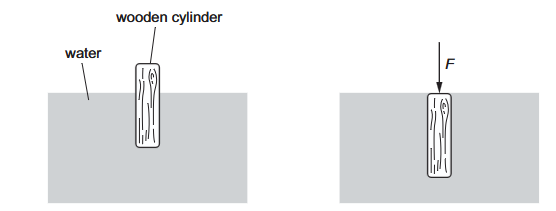
Which statement is not correct?
(B) The cylinder loses gravitational potential energy.
(C) Work is done by force \(F\) on the cylinder.
(D) Work is done by the upthrust on the cylinder.
▶️ Answer/Explanation
Correct Answer: \( \boxed{\mathrm{D}} \)
As the cylinder is pushed downward, it loses gravitational potential energy while the surrounding water is displaced upward, so some of the water gains gravitational potential energy.
The applied force \(F\) acts in the same direction as the cylinder’s displacement, so it does positive work on the cylinder.
The upthrust acts upward while the cylinder moves downward. Since the force and displacement are in opposite directions, the work done by the upthrust on the cylinder is negative rather than positive.
Hence the statement that “Work is done by the upthrust on the cylinder” is not correct.
Therefore, the correct answer is (D).
Question 16
A system has a useful power output of \(4.0\,\mathrm{W}\) and a wasted power of \(16\,\mathrm{W}\).
What is the efficiency of the system?
(B) \(20\%\)
(C) \(25\%\)
(D) \(80\%\)
▶️ Answer/Explanation
Correct Answer: \( \boxed{\mathrm{B}} \)
Efficiency is defined as
\(\eta=\dfrac{\text{useful power output}}{\text{total power input}}\)
The total power input is
\(P_{\mathrm{in}}=4.0+16=20\,\mathrm{W}\)
Hence,
\(\eta=\dfrac{4.0}{20}=0.20=20\%\)
Therefore, the correct answer is (B).
Question 17
A parachutist is falling towards the ground at a constant speed \(v\). The rate at which she is losing gravitational potential energy is \(R\).
The acceleration of free fall is \(g\).
What is the mass of the parachutist?
(B) \(\dfrac{R}{gv}\)
(C) \(\dfrac{2R}{v^2}\)
(D) \(\dfrac{v^2}{2R}\)
▶️ Answer/Explanation
Correct Answer: \( \boxed{\mathrm{B}} \)
The rate of loss of gravitational potential energy is equal to the power:
\(P=\dfrac{\Delta E_p}{\Delta t}=mgv\)
Since the rate of loss of gravitational potential energy is \(R\),
\(R=mgv\)
Rearranging for the mass,
\(m=\dfrac{R}{gv}\)
Therefore, the correct answer is (B).
Question 18
A copper wire of diameter \(1.6\,\mathrm{mm}\) is stretched within its limit of proportionality by a tensile force of \(430\,\mathrm{N}\).
The Young modulus of copper is \(130\,\mathrm{GPa}\).
What is the strain in the wire?
(B) \(1.3\times10^{-3}\)
(C) \(1.6\times10^{-3}\)
(D) \(5.2\times10^{-3}\)
▶️ Answer/Explanation
Correct Answer: \( \boxed{\mathrm{C}} \)
Young modulus is defined as
\(E=\dfrac{\text{stress}}{\text{strain}}\)
The cross-sectional area of the wire is
\(A=\pi\left(\dfrac{1.6\times10^{-3}}{2}\right)^2=2.01\times10^{-6}\,\mathrm{m^2}\)
The stress is
\(\sigma=\dfrac{F}{A}=\dfrac{430}{2.01\times10^{-6}}=2.14\times10^{8}\,\mathrm{Pa}\)
Hence, the strain is
\(\varepsilon=\dfrac{\sigma}{E}=\dfrac{2.14\times10^{8}}{130\times10^{9}}=1.65\times10^{-3}\)
\(\varepsilon\approx1.6\times10^{-3}\)
Therefore, the correct answer is (C).
Question 19
Compressive forces are applied normally to the end faces of a cylinder of initial length \(L\). The cylinder is compressed by the forces so that its length decreases to \(0.6L\). After the compressive forces are removed, the cylinder’s length increases to \(0.8L\).
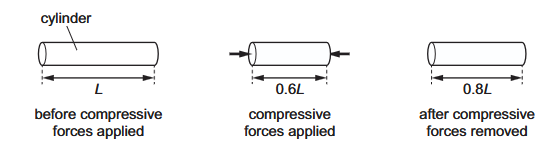
What describes the deformation of the cylinder when its length was \(0.6L\)?
(B) elastic only
(C) plastic only
(D) neither elastic nor plastic
▶️ Answer/Explanation
Correct Answer: \( \boxed{\mathrm{A}} \)
Elastic deformation is recovered when the force is removed, whereas plastic deformation is permanent.
The cylinder is compressed from \(L\) to \(0.6L\), giving a total deformation of
\(L-0.6L=0.4L\)
After the force is removed, the length becomes \(0.8L\), so it recovers
\(0.8L-0.6L=0.2L\)
This recovered part is elastic deformation. The remaining permanent shortening is
\(L-0.8L=0.2L\)
This is plastic deformation.
Therefore, the deformation at \(0.6L\) consisted of both elastic and plastic components, so the correct answer is (A).
Question 20
When sound travels through air, the air particles vibrate. A graph of displacement against time for a single air particle is shown.
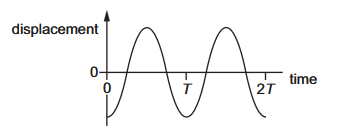
Which graph shows how the kinetic energy of the air particle varies with time?
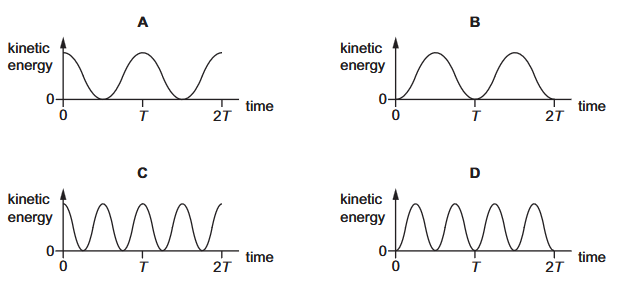
(B) Graph B
(C) Graph C
(D) Graph D
▶️ Answer/Explanation
Correct Answer: \( \boxed{\mathrm{D}} \)
The air particle executes simple harmonic motion (SHM).
Its kinetic energy is
\(K=\dfrac{1}{2}mv^2\)
In SHM, the particle speed is maximum at the equilibrium position and zero at the extreme positions.
Since kinetic energy depends on \(v^2\), it is always positive and reaches two maxima during each complete oscillation.
Thus, over the interval from \(0\) to \(2T\), there are four equally spaced peaks in the kinetic energy graph.
Therefore, the correct answer is (D).
Question 21
A wave travels on the surface of water. \(P\), \(Q\), \(R\) and \(S\) are four particles of water on the surface.
The diagram shows the positions of the particles at one instant. The direction of travel of the wave is from left to right.
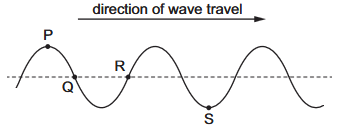
Which two particles are about to move upwards?
(B) \(P\) and \(S\)
(C) \(R\) and \(S\)
(D) \(Q\) and \(S\)
▶️ Answer/Explanation
Correct Answer: \( \boxed{\mathrm{D}} \)
For a wave travelling to the right, particles move upwards where the wave profile has a negative slope (falling from left to right), because the waveform moves to the right while the particles oscillate vertically.
Particle \(Q\) is on a downward slope, so it is about to move upwards.
Particle \(S\) is at a trough. It has zero vertical velocity at that instant and is about to move upwards.
Particle \(P\) is at a crest and is about to move downwards, while particle \(R\) is on an upward slope and is moving downwards.
Therefore, the correct answer is (D).
Question 22
A loudspeaker emits sound of frequency \(f_s\). The loudspeaker is attached to a car that moves with increasing speed directly towards a stationary observer.
Which statement describes the frequency of the sound heard by the observer?
(B) a frequency greater than \(f_s\) but decreasing
(C) a frequency less than \(f_s\) and decreasing
(D) a frequency less than \(f_s\) but increasing
▶️ Answer/Explanation
Correct Answer: \( \boxed{\mathrm{A}} \)
This is an example of the Doppler effect.
When a sound source moves towards a stationary observer, the observed frequency is
\(f=\dfrac{v}{v-v_s}f_s\)
where \(v\) is the speed of sound and \(v_s\) is the speed of the source.
As the car’s speed increases, the denominator \((v-v_s)\) becomes smaller, so the observed frequency increases further.
Hence, the observer hears a frequency that is greater than \(f_s\) and continuously increasing.
Therefore, the correct answer is (A).
Question 23
Which statement about electromagnetic waves in a vacuum is correct?
(B) Frequency is inversely proportional to wavelength.
(C) Intensity is proportional to amplitude.
(D) Velocity is proportional to wavelength.
▶️ Answer/Explanation
Correct Answer: \( \boxed{\mathrm{B}} \)
Electromagnetic waves in a vacuum obey the wave equation
\(c=f\lambda\)
where \(c\) is the speed of light in a vacuum, \(f\) is the frequency, and \(\lambda\) is the wavelength.
Since \(c\) is constant in a vacuum,
\(f=\dfrac{c}{\lambda}\)
Thus, the frequency is inversely proportional to the wavelength.
Also, the intensity of an electromagnetic wave is proportional to the square of its amplitude, not the amplitude itself.
Therefore, the correct answer is (B).
Question 24
A vertically polarised electromagnetic wave of intensity \(I_0\) is incident normally on a polarising filter. The transmission axis of the filter is at an angle of \(30^\circ\) to the vertical.
The transmitted wave from the first filter is then incident normally on a second polarising filter. The transmission axis of this filter is at an angle of \(90^\circ\) to the vertical.
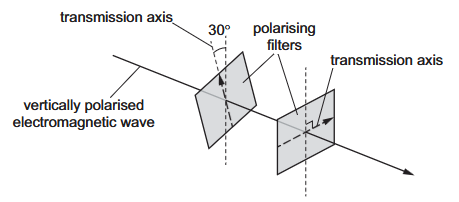
What is the intensity of the wave after passing through the second filter?
(B) \(0.063I_0\)
(C) \(0.19I_0\)
(D) \(0.56I_0\)
▶️ Answer/Explanation
Correct Answer: \( \boxed{\mathrm{C}} \)
Apply Malus’ law at each polarising filter:
After the first filter,
\(I_1=I_0\cos^2 30^\circ=\dfrac{3}{4}I_0\)
The angle between the two transmission axes is
\(90^\circ-30^\circ=60^\circ\)
After the second filter,
\(I_2=I_1\cos^2 60^\circ=\left(\dfrac{3}{4}I_0\right)\left(\dfrac{1}{4}\right)=\dfrac{3}{16}I_0\)
\(I_2=0.1875I_0\approx0.19I_0\)
Therefore, the correct answer is (C).
Question 25
Which statement concerning a stationary wave is correct?
(B) The amplitude of the stationary wave is equal to the amplitude of one of the waves creating it.
(C) The wavelength of the stationary wave is equal to the separation of two adjacent nodes.
(D) There is no displacement of a particle at an antinode at any time.
▶️ Answer/Explanation
Correct Answer: \( \boxed{\mathrm{A}} \)
In a stationary wave, all particles between two adjacent nodes oscillate in phase. Particles in adjacent sections separated by a node oscillate in antiphase.
The maximum amplitude at an antinode is twice the amplitude of each progressive wave, so option (B) is incorrect.
The distance between adjacent nodes is \(\dfrac{\lambda}{2}\), not \(\lambda\), so option (C) is incorrect.
An antinode has the maximum displacement amplitude, whereas a node has zero displacement, so option (D) is incorrect.
Therefore, the correct answer is (A).
Question 26
Stationary sound waves can be formed in the air columns of pipes. One type of pipe is closed at one end and open at the other end. Another type of pipe is open at both ends.
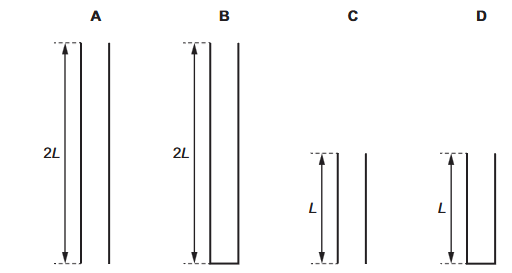
Which pipe can form a stationary sound wave with the lowest frequency?
(B) Pipe B
(C) Pipe C
(D) Pipe D
▶️ Answer/Explanation
Correct Answer: \( \boxed{\mathrm{B}} \)
The fundamental frequency of an open pipe is
\(f=\dfrac{v}{2L}\)
The fundamental frequency of a pipe closed at one end is
\(f=\dfrac{v}{4L}\)
A longer pipe produces a lower fundamental frequency, and for the same length, a closed pipe has half the fundamental frequency of an open pipe.
Pipe B is the longest pipe (\(2L\)) and is closed at one end, giving
\(f=\dfrac{v}{4(2L)}=\dfrac{v}{8L}\)
This is the lowest frequency among the four pipes.
Therefore, the correct answer is (B).
Question 27
Water waves in a ripple tank are made to pass through a small gap, as shown.
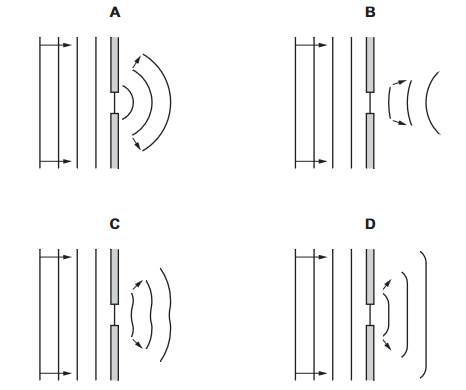
Which diagram shows the waves after they have passed through the gap?
(B) Diagram B
(C) Diagram C
(D) Diagram D
▶️ Answer/Explanation
Correct Answer: \( \boxed{\mathrm{A}} \)
When plane water waves pass through a gap whose width is comparable to the wavelength, diffraction occurs.
The waves spread out from the gap as semicircular wavefronts while maintaining the same wavelength.
Diagram A correctly shows circular wavefronts emerging from the narrow gap.
The other diagrams either show incorrect wavefront shapes or incorrect spreading after the gap.
Therefore, the correct answer is (A).
Question 28
Light of a single wavelength is incident normally on a double slit. The slit separation can be varied.
A screen is placed a fixed distance away from the double slit. The screen and double slit are parallel. A pattern of bright interference fringes is observed on the screen.
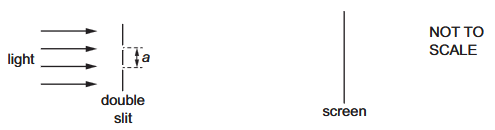
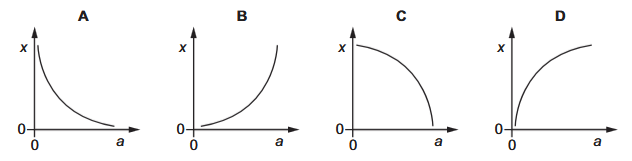
Which graph best shows the variation of the separation \(x\) of the bright interference fringes with the slit separation \(a\)?
(B) Graph B
(C) Graph C
(D) Graph D
▶️ Answer/Explanation
Correct Answer: \( \boxed{\mathrm{A}} \)
The fringe spacing in Young’s double-slit experiment is
\(x=\dfrac{\lambda D}{a}\)
where
\(\lambda\) is the wavelength of the light,
\(D\) is the distance from the slits to the screen, and
\(a\) is the slit separation.
Since \(\lambda\) and \(D\) are constant,
\(x\propto\dfrac{1}{a}\)
Therefore, the graph is a decreasing inverse relationship (rectangular hyperbola), which corresponds to Graph A.
Therefore, the correct answer is (A).
Question 29
A diffraction grating is used to measure the wavelength of light.
The spacing of the slits in the grating is \(1.15\times10^{-6}\,\mathrm{m}\). The angle between the first-order diffraction maxima is \(60.0^\circ\), as shown.
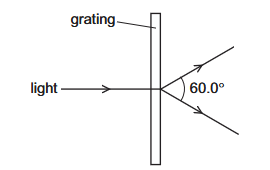
What is the wavelength of the light?
(B) \(498\,\mathrm{nm}\)
(C) \(575\,\mathrm{nm}\)
(D) \(996\,\mathrm{nm}\)
▶️ Answer/Explanation
Correct Answer: \( \boxed{\mathrm{C}} \)
The angle between the first-order maxima is \(60.0^\circ\), so each first-order maximum is at
\(\theta=30.0^\circ\)
Using the diffraction grating equation,
\(d\sin\theta=n\lambda\)
For first order, \(n=1\):
\(\lambda=(1.15\times10^{-6})\sin30^\circ\)
\(\lambda=(1.15\times10^{-6})(0.5)=5.75\times10^{-7}\,\mathrm{m}\)
\(\lambda=575\,\mathrm{nm}\)
Therefore, the correct answer is (C).
Question 30
What could not be used to create an electric current?
(B) beta-particles
(C) neutrons
(D) protons
▶️ Answer/Explanation
Correct Answer: \( \boxed{\mathrm{C}} \)
An electric current is the flow of electric charge.
Alpha-particles carry a charge of \(+2e\), beta-particles carry a charge of \(-e\) (or \(+e\) for positrons), and protons carry a charge of \(+e\). All of these can produce an electric current when they move.
Neutrons have no electric charge, so their motion does not constitute an electric current.
Therefore, neutrons cannot be used to create an electric current.
Therefore, the correct answer is (C).
Question 31
What is the definition of the potential difference (p.d.) across a component?
(B) the energy transferred per unit current
(C) the power transferred per unit charge
(D) the power transferred per unit current
▶️ Answer/Explanation
Correct Answer: \( \boxed{\mathrm{A}} \)
Potential difference is defined as the energy transferred (or work done) per unit charge as charge passes through a component.
Mathematically,
\(V=\dfrac{W}{Q}\)
where \(V\) is the potential difference, \(W\) is the energy transferred (or work done), and \(Q\) is the charge.
The SI unit of potential difference is the volt (\(\mathrm{V}\)), where
\(1\,\mathrm{V}=1\,\mathrm{J\,C^{-1}}\)
Therefore, the correct answer is (A).
Question 32
The resistance of a filament lamp increases as the current in it increases.
What is the reason for this?
(B) The potential difference across the filament decreases.
(C) The power dissipated by the filament decreases.
(D) The temperature of the filament increases.
▶️ Answer/Explanation
Correct Answer: \( \boxed{\mathrm{D}} \)
As the current through the filament increases, the electrical power dissipated in the filament also increases, causing its temperature to rise.
At higher temperatures, the metal ions in the filament vibrate more strongly, leading to more frequent collisions with the conduction electrons.
These increased collisions make it more difficult for electrons to move through the filament, so the resistance increases.
This is why a filament lamp is a non-ohmic conductor, with resistance that increases as its temperature rises.
Therefore, the correct answer is (D).
Question 33
A battery of electromotive force (e.m.f.) \(12\,\mathrm{V}\) and negligible internal resistance is connected to a fixed resistor of resistance \(40\,\Omega\) and a thermistor of resistance \(R_T\), as shown.
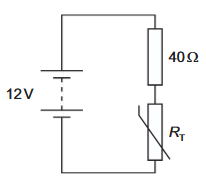
Initially, the temperature of the thermistor is \(15^\circ\mathrm{C}\) and the current in the circuit is \(0.10\,\mathrm{A}\).
The temperature of the thermistor then changes, which causes the current to increase to \(0.12\,\mathrm{A}\).
How does the temperature of the thermistor change and what is \(R_T\) at the new temperature?
| Option | Temperature of thermistor | \(R_T\) at new temperature / \(\Omega\) |
|---|---|---|
| (A) | increases | 60 |
| (B) | decreases | 60 |
| (C) | increases | 100 |
| (D) | decreases | 100 |
▶️ Answer/Explanation
Correct Answer: \( \boxed{\mathrm{A}} \)
Initially, the total resistance is
\(R=\dfrac{V}{I}=\dfrac{12}{0.10}=120\,\Omega\)
Hence, the initial thermistor resistance is
\(R_T=120-40=80\,\Omega\)
When the current increases to \(0.12\,\mathrm{A}\), the total resistance becomes
\(R=\dfrac{12}{0.12}=100\,\Omega\)
The new thermistor resistance is
\(R_T=100-40=60\,\Omega\)
Since the resistance of an NTC thermistor decreases as its temperature increases, the increase in current indicates that the thermistor’s temperature has increased.
Therefore, the correct answer is (A).
Question 34
A cell of electromotive force (e.m.f.) \(3.0\,\mathrm{V}\) and internal resistance \(0.50\,\Omega\) is connected to a variable resistor, a voltmeter and an ammeter, as shown. The resistance of the variable resistor is varied.
The reading on the ammeter \(I\) and the reading on the voltmeter \(V\) are recorded.
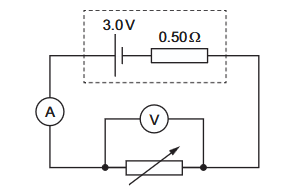
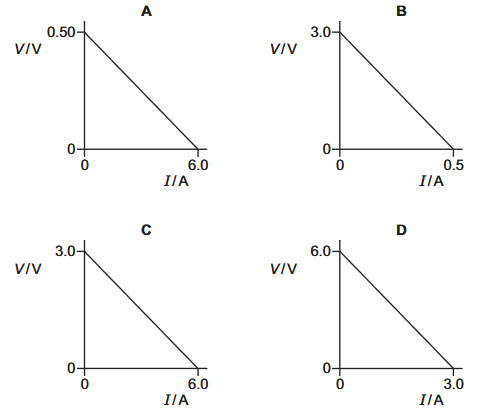
Which graph shows how \(V\) varies with \(I\)?
(B) Graph B
(C) Graph C
(D) Graph D
▶️ Answer/Explanation
Correct Answer: \( \boxed{\mathrm{C}} \)
The terminal potential difference of a cell is given by
\(V=\mathcal{E}-Ir\)
where
\(\mathcal{E}=3.0\,\mathrm{V}\) and \(r=0.50\,\Omega\).
Hence,
\(V=3.0-0.50I\)
This is a straight-line graph with:
\(V\)-intercept \(=3.0\,\mathrm{V}\)
Gradient \(=-0.50\,\mathrm{V\,A^{-1}}\)
The graph reaches \(V=0\) when
\(I=\dfrac{3.0}{0.50}=6.0\,\mathrm{A}\)
Therefore, the correct answer is (C).
Question 35
Three resistors, \(R_1\), \(R_2\) and \(R_3\), are connected in parallel to a cell. The currents in the resistors are \(I_1\), \(I_2\) and \(I_3\). The potential differences across the resistors are \(V_1\), \(V_2\) and \(V_3\). The current in the cell is \(I_0\). The potential difference across the cell is \(V_0\), as shown.
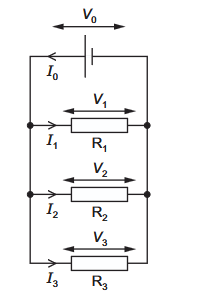
Which equation can be obtained by applying Kirchhoff’s second law to the circuit?
(B) \(I_0=I_1+I_2+I_3\)
(C) \(V_0=V_1=V_2=V_3\)
(D) \(V_0=V_1+V_2+V_3\)
▶️ Answer/Explanation
Correct Answer: \( \boxed{\mathrm{C}} \)
Kirchhoff’s second law states that the algebraic sum of the potential differences around any closed loop is zero.
Each resistor is connected directly across the same two terminals of the cell because they are in parallel.
Therefore, the potential difference across every resistor is equal to the terminal potential difference of the cell:
\(V_0=V_1=V_2=V_3\)
Option (B) is obtained from Kirchhoff’s first law (current law), not the second law.
Therefore, the correct answer is (C).
Question 36
Three resistors, each of resistance \(R\), are connected in a network, as shown.
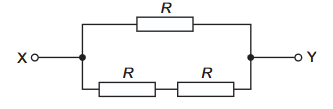
The total resistance between points \(X\) and \(Y\) is \(8.0\,\Omega\).
What is the value of \(R\)?
(B) \(4.0\,\Omega\)
(C) \(5.3\,\Omega\)
(D) \(12\,\Omega\)
▶️ Answer/Explanation
Correct Answer: \( \boxed{\mathrm{D}} \)
The top branch contains a single resistor of resistance \(R\).
The bottom branch contains two resistors in series, giving a resistance of
\(2R\)
These two branches are connected in parallel, so the equivalent resistance is
\( R_{\mathrm{eq}}=\frac{R(2R)}{R+2R}=\frac{2R}{3} \)
Given that
\(\dfrac{2R}{3}=8.0\,\Omega\)
\( R=\frac{3}{2}\times8.0=12\,\Omega \)
Therefore, the correct answer is (D).
Question 37
A potentiometer and a driver cell of electromotive force (e.m.f.) \(E\) are used to measure the e.m.f. of a new cell.
A sliding contact at \(P\) is moved along a resistance wire \(QR\) until the reading on the galvanometer is zero.
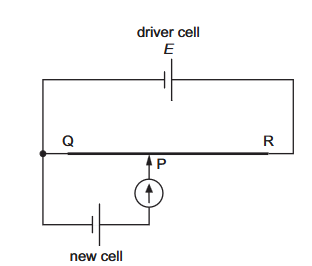
What is an essential requirement for the e.m.f. of the new cell to be measured accurately?
(B) The galvanometer must have a large resistance.
(C) The internal resistance of the new cell must be zero.
(D) The resistance per unit length of the wire \(QR\) must be constant.
▶️ Answer/Explanation
Correct Answer: \( \boxed{\mathrm{D}} \)
In a potentiometer, the potential difference along the wire must vary uniformly with distance.
This requires the resistance per unit length of the wire to be constant so that the potential gradient is constant.
At the balance point (zero galvanometer reading),
\(\text{e.m.f. of new cell}=(\text{potential gradient})\times(\text{balance length})\)
If the resistance per unit length were not constant, the potential gradient would vary along the wire and the measured e.m.f. would be inaccurate.
Therefore, the correct answer is (D).
Question 38
The table shows the number of nucleons and the total number of particles (protons, neutrons and electrons) in neutral atoms of four nuclides \(W\), \(X\), \(Y\) and \(Z\).
| Nuclide | Number of nucleons | Total number of particles |
|---|---|---|
| W | 19 | 30 |
| X | 19 | 31 |
| Y | 21 | 32 |
| Z | 22 | 31 |
Which two nuclides are isotopes of each other?
(B) \(W\) and \(Y\)
(C) \(X\) and \(Z\)
(D) \(Y\) and \(Z\)
▶️ Answer/Explanation
Correct Answer: \( \boxed{\mathrm{B}} \)
For a neutral atom,
\(\text{total particles}=p+n+e=A+Z\)
where \(A\) is the nucleon number and \(Z\) is the proton number.
Hence,
For \(W\): \(Z=30-19=11\)
For \(X\): \(Z=31-19=12\)
For \(Y\): \(Z=32-21=11\)
For \(Z\): \(Z=31-22=9\)
Isotopes have the same proton number but different nucleon numbers. Nuclides \(W\) and \(Y\) both have \(Z=11\), but their nucleon numbers are \(19\) and \(21\), respectively.
Therefore, the correct answer is (B).
Question 39
When a sample of a radioactive isotope decays by \(\alpha\)-particle emission, the \(\alpha\)-particles emitted have a single discrete energy.
When a sample of a radioactive isotope decays by \(\beta^{-}\)-particle emission, the \(\beta^{-}\) particles emitted have a continuous range of energies.
What is the explanation for this?
(B) An antineutrino is emitted with an \(\alpha\)-particle but not with a \(\beta^{-}\) particle.
(C) The \(\alpha\)-particles have much more energy than the \(\beta^{-}\) particles.
(D) The \(\beta^{-}\) particles have much more energy than the \(\alpha\)-particles.
▶️ Answer/Explanation
Correct Answer: \( \boxed{\mathrm{A}} \)
In \(\alpha\)-decay, the energy released is shared only between the \(\alpha\)-particle and the recoiling nucleus, giving the emitted \(\alpha\)-particle a fixed (discrete) energy.
In \(\beta^{-}\)-decay, an electron antineutrino is emitted together with the \(\beta^{-}\) particle.
The available decay energy is shared between the \(\beta^{-}\) particle, the antineutrino and the recoiling nucleus, so the \(\beta^{-}\) particle can have a continuous range of energies.
Therefore, the correct answer is (A).
Question 40
Some particles are a combination of three quarks.
Which combination of quarks does not result in a particle with a charge of either \(+1.6\times10^{-19}\,\mathrm{C}\) or zero?
(B) up, strange, strange
(C) up, up, down
(D) up, up, up
▶️ Answer/Explanation
Correct Answer: \( \boxed{\mathrm{D}} \)
The quark charges are:
Up quark: \(+\dfrac{2}{3}e\)
Down quark: \(-\dfrac{1}{3}e\)
Strange quark: \(-\dfrac{1}{3}e\)
Calculate the total charge for each combination:
(A) \(+\dfrac{2}{3}e-\dfrac{1}{3}e-\dfrac{1}{3}e=0\)
(B) \(+\dfrac{2}{3}e-\dfrac{1}{3}e-\dfrac{1}{3}e=0\)
(C) \(+\dfrac{2}{3}e+\dfrac{2}{3}e-\dfrac{1}{3}e=+e\)
(D) \(+\dfrac{2}{3}e+\dfrac{2}{3}e+\dfrac{2}{3}e=+2e\)
Only option (D) gives a charge of \(+2e\), which is neither \(0\) nor \(+e\) (\(+1.6\times10^{-19}\,\mathrm{C}\)).
Therefore, the correct answer is (D).