
Question 1
(a) Compare scalar and vector quantities. (2 marks)
______________________________
(b) The radius of a small sphere is determined from a measurement of the volume of the sphere. The sphere is submerged in water, displacing some of the water into a measuring cylinder as shown in Fig. 1.1.
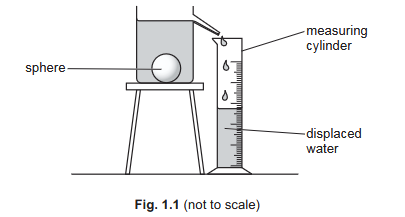
The measured volume of displaced water is \((28.0 \pm 0.5)\,\mathrm{cm^3}\).
Calculate:
(i) the radius, in cm, of the sphere. (1 mark)
radius = __________________________________________ \(\mathrm{cm}\)
(ii) the percentage uncertainty in the radius of the sphere. (2 marks)
percentage uncertainty = __________________________ \(\%\)
Syllabus Topic Codes (Cambridge International AS & A Level Physics 9702):
• 1.1: Physical quantities — part (b)(i)
• 1.3: Errors and uncertainties — part (b)(ii)
▶️ Answer/Explanation
(a) [2 marks]
A scalar quantity has magnitude only.
A vector quantity has both magnitude and direction.
Answer: \( \boxed{\text{scalar: magnitude only; vector: magnitude and direction}} \)
(b)(i) Radius of the sphere [1 mark]
The volume of a sphere is
\( V=\frac{4}{3}\pi r^3 \)
Rearranging for \(r\):
\( r=\left(\frac{3V}{4\pi}\right)^{1/3} \)
Using \(V=28.0\,\mathrm{cm^3}\):
\( r=\left(\frac{3(28.0)}{4\pi}\right)^{1/3} \)
\( r\approx1.88\,\mathrm{cm} \)
Answer: \( \boxed{1.9\,\mathrm{cm}} \)
(b)(ii) Percentage uncertainty in radius [2 marks]
First, calculate the percentage uncertainty in the measured volume:
\( \text{percentage uncertainty in }V=\frac{0.5}{28.0}\times100 \)
\( =1.79\% \)
Since \(V\propto r^3\), the percentage uncertainty in \(r\) is one-third of the percentage uncertainty in \(V\):
\( \text{percentage uncertainty in }r=\frac{1.79}{3} \)
\( \approx0.60\% \)
Answer: \( \boxed{0.6\%} \)
Question 2
A hot-air balloon floats just above the ground. The balloon is stationary and is held in place by a vertical rope, as shown in Fig. 2.1.
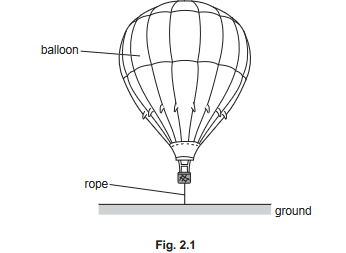
The balloon has a weight \(W\) of \(3.39\times10^4\,\mathrm{N}\). The tension \(T\) in the rope is \(4.00\times10^2\,\mathrm{N}\). Upthrust \(U\) acts on the balloon.
The density of the surrounding air is \(1.23\,\mathrm{kg\,m^{-3}}\).
(a)
(i) On Fig. 2.1, draw labelled arrows to show the directions of the three forces acting on the balloon. (2 marks)
(ii) Calculate the volume, to three significant figures, of the balloon. (3 marks)
volume = __________________________________________ \(\mathrm{m^3}\)
(iii) The balloon is released from the rope.
Calculate the initial acceleration of the balloon. (3 marks)
acceleration = _____________________________________ \(\mathrm{m\,s^{-2}}\)
(b) The balloon is stationary at a height of \(500\,\mathrm{m}\) above the ground. A tennis ball is released from rest and falls vertically from the balloon.
A passenger in the balloon uses the equation \(v^2=u^2+2as\) to calculate that the ball will be travelling at a speed of approximately \(100\,\mathrm{m\,s^{-1}}\) when it hits the ground.
Explain why the actual speed of the ball will be much lower than \(100\,\mathrm{m\,s^{-1}}\) when it hits the ground. (3 marks)
________________________________________________________________________________
(c) Before the balloon is released, the rope holding the balloon has a strain of \(2.4\times10^{-5}\). The rope has an unstretched length of \(2.5\,\mathrm{m}\). The rope obeys Hooke’s law.
(i) Show that the extension of the rope is \(6.0\times10^{-5}\,\mathrm{m}\). (1 mark)
(ii) Calculate the elastic potential energy \(E_{\mathrm{P}}\) of the rope. (2 marks)
\(E_{\mathrm{P}}\) = __________________________________________ \(\mathrm{J}\)
(iii) The rope holding the balloon is replaced with a new one of the same original length and cross-sectional area. The tension is unchanged and the new rope also obeys Hooke’s law.
The new rope is made from a material of a lower Young modulus.
State and explain the effect of the lower Young modulus on the elastic potential energy of the rope. (2 marks)
________________________________________________________________________________
Syllabus Topic Codes (Cambridge International AS & A Level Physics 9702):
• 4.3: Density and pressure — part (a)(ii)
• 3.1: Momentum and Newton’s laws of motion — part (a)(iii)
• 3.2: Non-uniform motion — part (b)
• 6.1: Stress and strain — part (c)(i)
• 6.2: Elastic and plastic behaviour — parts (c)(ii) and (c)(iii)
▶️ Answer/Explanation
(a)(i) [2 marks]
The three forces acting on the stationary balloon are:
• Upthrust \(U\) acting vertically upwards.
• Weight \(W\) acting vertically downwards.
• Tension \(T\) in the rope acting vertically downwards.
Answer: \( \boxed{U\text{ upward},\quad W\text{ downward},\quad T\text{ downward}} \)
(a)(ii) Volume of the balloon [3 marks]
Since the balloon is stationary, the resultant force is zero:
\( U=T+W \)
The upthrust on the balloon is
\( U=\rho Vg \)
Therefore,
\( \rho Vg=T+W \)
Rearranging:
\( V=\frac{T+W}{\rho g} \)
\( V=\frac{4.00\times10^2+3.39\times10^4}{(1.23)(9.81)} \)
\( V=2.84\times10^3\,\mathrm{m^3} \)
Answer: \( \boxed{2.84\times10^3\,\mathrm{m^3}} \)
(a)(iii) Initial acceleration [3 marks]
When the rope is released, the tension becomes zero. The resultant upward force is therefore
\( F=U-W \)
The mass of the balloon is
\( m=\frac{W}{g} \)
Using \(F=ma\):
\( a=\frac{F}{m}=\frac{U-W}{W/g} \)
Since \(U=W+T\) while the balloon was stationary,
\( U-W=T \)
Therefore,
\( a=\frac{4.00\times10^2}{(3.39\times10^4)/9.81} \)
\( a\approx0.12\,\mathrm{m\,s^{-2}} \)
Answer: \( \boxed{0.12\,\mathrm{m\,s^{-2}}} \)
(b) [3 marks]
There is air resistance acting on the tennis ball. The air resistance increases as the speed of the ball increases.
Therefore, the resultant downward force becomes less than the weight of the ball.
The acceleration is therefore less than \(g\), so the final speed is less than the value calculated using \(a=g\).
Answer: \( \boxed{\text{air resistance reduces the resultant force and hence the acceleration}} \)
(c)(i) Extension of the rope [1 mark]
Strain is given by
\( \text{strain}=\frac{\text{extension}}{\text{original length}} \)
Therefore,
\( \text{extension}=(2.4\times10^{-5})(2.5) \)
\( \text{extension}=6.0\times10^{-5}\,\mathrm{m} \)
Answer: \( \boxed{6.0\times10^{-5}\,\mathrm{m}} \)
(c)(ii) Elastic potential energy [2 marks]
For a Hooke’s law material,
\( E_{\mathrm{P}}=\frac{1}{2}Fx \)
where \(F\) is the tension and \(x\) is the extension.
Therefore,
\( E_{\mathrm{P}}=\frac{1}{2}(4.00\times10^2)(6.0\times10^{-5}) \)
\( E_{\mathrm{P}}=0.012\,\mathrm{J} \)
Answer: \( \boxed{0.012\,\mathrm{J}} \)
(c)(iii) Effect of lower Young modulus [2 marks]
For the same tension, a lower Young modulus means that the rope undergoes a larger extension.
Since
\( E_{\mathrm{P}}=\frac{1}{2}Fx \)
and the tension \(F\) is unchanged, the greater extension \(x\) means that the elastic potential energy is greater.
Answer: \( \boxed{\text{lower Young modulus}\rightarrow\text{greater extension}\rightarrow\text{greater elastic potential energy}} \)
Question 3
A trolley A moves along a horizontal surface at a constant velocity towards another trolley B which is moving at a lower constant speed in the same direction. Fig. 3.1 shows the trolleys at time \(t=0\).
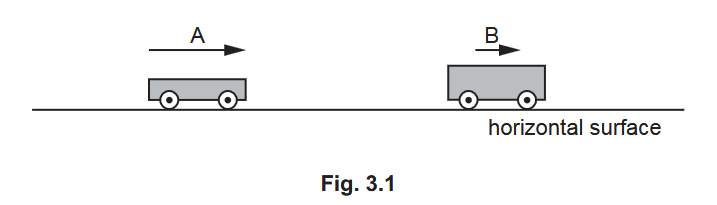
Table 3.1 shows data for the trolleys.
Table 3.1
| trolley | mass / kg | initial speed / \(\mathrm{m\,s^{-1}}\) |
|---|---|---|
| A | 0.25 | 0.48 |
| B | 0.75 | 0.12 |
The two trolleys collide elastically and then separate. Resistive forces are negligible.
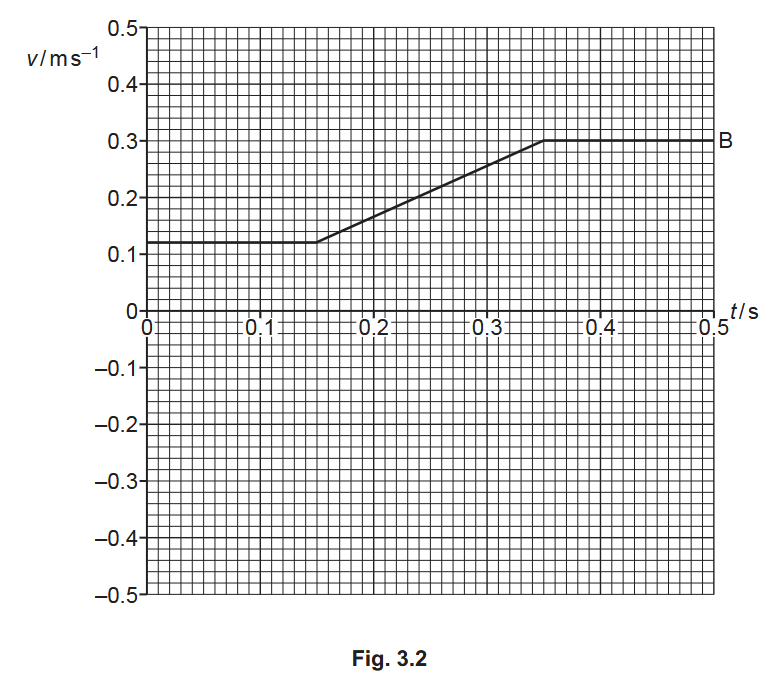
Fig. 3.2 shows the variation with time \(t\) of the velocity \(v\) for trolley B.
(a) State what is represented by the area under a velocity-time graph. (1 mark)
______________________________
(b) Use Table 3.1 and Fig. 3.2 to determine:
(i) the acceleration of trolley B during the collision. (2 marks)
acceleration of B = ______________________________ \(\mathrm{m\,s^{-2}}\)
(ii) the magnitude and direction of the final velocity of trolley A. (3 marks)
magnitude = ____________________________________ \(\mathrm{m\,s^{-1}}\)
direction = ______________________________________
(c) On Fig. 3.2, sketch the variation of the velocity of trolley A with time from \(t=0\) to \(t=0.50\,\mathrm{s}\). (3 marks)
Syllabus Topic Codes (Cambridge International AS & A Level Physics 9702):
• 3.3: Linear momentum and its conservation — part (b)(ii)
▶️ Answer/Explanation
(a) [1 mark]
The area under a velocity-time graph represents displacement.
Answer: \( \boxed{\text{displacement}} \)
(b)(i) Acceleration of trolley B [2 marks]
Acceleration is the gradient of a velocity-time graph:
\( a=\frac{\Delta v}{\Delta t} \)
From Fig. 3.2, during the collision the velocity of B changes from \(0.12\,\mathrm{m\,s^{-1}}\) at \(t=0.15\,\mathrm{s}\) to \(0.30\,\mathrm{m\,s^{-1}}\) at \(t=0.35\,\mathrm{s}\).
Therefore,
\( a=\frac{0.30-0.12}{0.35-0.15} \)
\( a=0.90\,\mathrm{m\,s^{-2}} \)
Answer: \( \boxed{0.90\,\mathrm{m\,s^{-2}}} \)
(b)(ii) Final velocity of trolley A [3 marks]
Take the original direction of motion as positive. Since the collision is elastic, momentum is conserved.
Initial momentum = final momentum:
\( (0.25)(0.48)+(0.75)(0.12)=(0.25)v+(0.75)(0.30) \)
Therefore,
\( 0.12+0.09=0.25v+0.225 \)
\( 0.21=0.25v+0.225 \)
\( v=-0.060\,\mathrm{m\,s^{-1}} \)
The negative sign shows that trolley A moves in the direction opposite to its initial velocity.
Answer: \( \boxed{0.060\,\mathrm{m\,s^{-1}}} \)
Direction: \( \boxed{\text{to the left, opposite to its initial direction}} \)
(c) Velocity-time graph for trolley A [3 marks]
Trolley A has a constant velocity of \(0.48\,\mathrm{m\,s^{-1}}\) before the collision.
Therefore, draw a horizontal line from
\( (0,0.48) \) to \( (0.15,0.48) \).
During the collision, its velocity changes uniformly from \(0.48\,\mathrm{m\,s^{-1}}\) to \(-0.060\,\mathrm{m\,s^{-1}}\), so draw a straight line from
\( (0.15,0.48) \) to \( (0.35,-0.060) \).
After the collision, trolley A has a constant velocity of \(-0.060\,\mathrm{m\,s^{-1}}\), so draw a horizontal line from
\( (0.35,-0.060) \) to \( (0.50,-0.060) \).
Answer: \( \boxed{\text{horizontal }0.48\text{ line} \rightarrow \text{straight-line decrease} \rightarrow \text{horizontal }-0.060\text{ line}} \)
Question 4
(a) State the principle of superposition. (2 marks)
______________________________
(b) Coherent light is incident normally on two identical slits X and Y. The diffracted light emerging from the slits superposes to produce an interference pattern on a screen positioned at a distance of \(1.9\,\mathrm{m}\) from the slits.
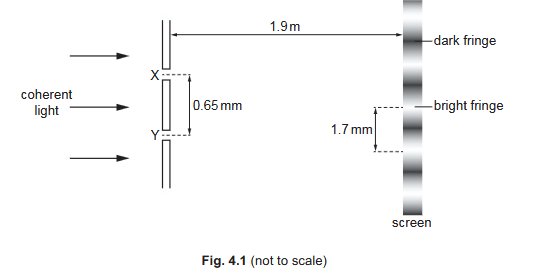
Fig. 4.1 shows the arrangement and the central part of the interference pattern of bright and dark fringes formed on the screen.
The separation of the slits is \(0.65\,\mathrm{mm}\). The distance between the centres of adjacent bright fringes is \(1.7\,\mathrm{mm}\).
Calculate the wavelength \(\lambda\) of the light. (3 marks)
\(\lambda\) = __________________________________________ \(\mathrm{m}\)
(c) Light waves from slits X and Y in (b) arrive at a point between adjacent bright fringes on the screen. Fig. 4.2 shows the variation of displacement with time for the waves arriving at the point where they meet.
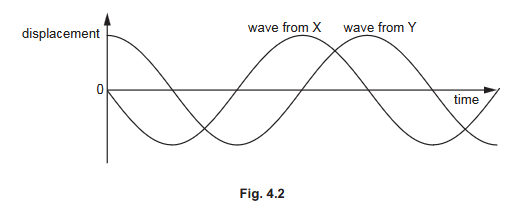
A student makes two statements about the waves at this point:
Statement 1: “The phase difference between the waves is \(90^\circ\).”
Statement 2: “The amplitude of the resultant wave is zero.”
(i) Explain how statement 1 is correct. (1 mark)
______________________________
(ii) State and explain whether statement 2 is correct. (1 mark)
______________________________
(d) The width of each slit in (b) is decreased by the same amount. There is no change to the separation of the slits.
Describe and explain the effect, if any, of this change on the appearance of the interference pattern. (2 marks)
______________________________
Syllabus Topic Codes (Cambridge International AS & A Level Physics 9702):
• 8.3: Interference — parts (b), (c)(i) and (c)(ii)
• 8.2: Diffraction — part (d)
▶️ Answer/Explanation
(a) [2 marks]
The principle of superposition states that when two or more waves meet or overlap at a point, the resultant displacement is the sum of the individual displacements.
Answer: \( \boxed{\text{resultant displacement}=\text{sum of individual displacements}} \)
(b) Wavelength of the light [3 marks]
For double-slit interference, the fringe spacing is given by
\( x=\frac{\lambda D}{a} \)
Therefore,
\( \lambda=\frac{ax}{D} \)
where \(a=0.65\times10^{-3}\,\mathrm{m}\), \(x=1.7\times10^{-3}\,\mathrm{m}\) and \(D=1.9\,\mathrm{m}\).
\( \lambda=\frac{(0.65\times10^{-3})(1.7\times10^{-3})}{1.9} \)
\( \lambda=5.8\times10^{-7}\,\mathrm{m} \)
Answer: \( \boxed{5.8\times10^{-7}\,\mathrm{m}} \)
(c)(i) Phase difference [1 mark]
The waves are displaced in phase by one quarter of a cycle, or one quarter of a period.
Since one complete cycle corresponds to \(360^\circ\),
\( \text{phase difference}=\frac{360^\circ}{4}=90^\circ \)
Answer: \( \boxed{90^\circ} \)
(c)(ii) Resultant amplitude [1 mark]
Statement 2 is not correct.
The waves are not \(180^\circ\) out of phase, so they are not in antiphase. One wave has some displacement when the other has zero displacement.
Therefore, the displacements are not always equal and opposite, so the resultant amplitude is not zero.
Answer: \( \boxed{\text{Statement 2 is incorrect}} \)
(d) Effect of decreasing slit width [2 marks]
Decreasing the width of each slit causes more diffraction, so the light from each slit spreads out more.
The light from the slits therefore has a lower intensity, so the bright fringes are less bright or dimmer.
The separation of the interference fringes is unchanged because the slit separation has not changed.
Answer: \( \boxed{\text{more diffraction and dimmer fringes; fringe spacing unchanged}} \)
Question 5
A train travels at a constant high speed along a straight horizontal track towards an observer standing adjacent to the track, as shown in Fig. 5.1.
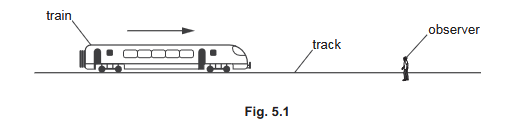
The train sounds its horn continuously as it approaches the observer from time \(t=0\) until it is well past the observer at time \(t=t_2\). The train passes the observer at time \(t=t_1\).
The horn emits a sound wave of constant frequency \(f_{\mathrm{s}}\).
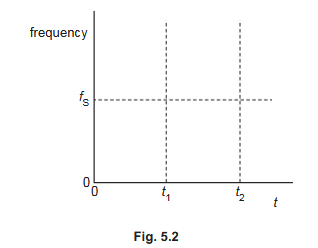
(a) On Fig. 5.2, sketch the variation of the frequency of sound heard by the observer with time \(t\), from time \(t=0\) to \(t=t_2\). (1 mark)
(b) At a particular time, the sound waves at the observer have an intensity of \(4.7\times10^{-3}\,\mathrm{W\,m^{-2}}\). The waves at the observer are incident at right angles on a circular detector of radius \(2.8\,\mathrm{cm}\).
Calculate the power \(P\) of the waves incident on the detector. (3 marks)
\(P\) = __________________________________________ \(\mathrm{W}\)
Syllabus Topic Codes (Cambridge International AS & A Level Physics 9702):
• 7.1: Progressive waves — part (b)
▶️ Answer/Explanation
(a) [1 mark]
As the train approaches the observer, the source is moving towards the observer, so the observed frequency is greater than \(f_{\mathrm{s}}\).
When the train passes the observer at \(t=t_1\), the observed frequency changes suddenly.
After the train has passed, the source is moving away from the observer, so the observed frequency is less than \(f_{\mathrm{s}}\).
Therefore, the sketch consists of an approximately horizontal line above \(f_{\mathrm{s}}\) from \(t=0\) to \(t=t_1\), followed by an approximately horizontal line below \(f_{\mathrm{s}}\) from \(t=t_1\) to \(t=t_2\).
Answer: \( \boxed{f>f_{\mathrm{s}}\text{ before }t_1,\quad f<f_{\mathrm{s}}\text{ after }t_1} \)
(b) Power incident on the detector [3 marks]
Intensity is power per unit area:
\( I=\frac{P}{A} \)
Therefore,
\( P=IA \)
The detector is circular, so its area is
\( A=\pi r^2 \)
The radius is \(2.8\,\mathrm{cm}=0.028\,\mathrm{m}\).
\( A=\pi(0.028)^2 \)
\( A=2.46\times10^{-3}\,\mathrm{m^2} \)
Hence,
\( P=(4.7\times10^{-3})(2.46\times10^{-3}) \)
\( P=1.16\times10^{-5}\,\mathrm{W} \)
Answer: \( \boxed{1.2\times10^{-5}\,\mathrm{W}} \)
Question 6
A battery is connected in a circuit with a light-dependent resistor (LDR), two fixed resistors and a voltmeter, as shown in Fig. 6.1.
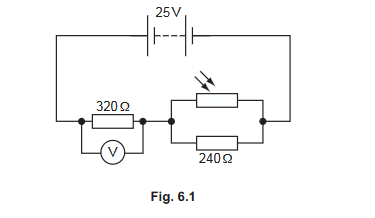
The battery has an electromotive force (e.m.f.) of \(25\,\mathrm{V}\) and negligible internal resistance. The resistors have resistances of \(320\,\Omega\) and \(240\,\Omega\).
(a) The voltmeter displays a reading of \(16\,\mathrm{V}\).
(i) Show that the current in the battery is \(0.050\,\mathrm{A}\). (1 mark)
(ii) Calculate the resistance of the LDR. (3 marks)
resistance = __________________________________________ \(\Omega\)
(iii) Determine the ratio
\(\displaystyle \frac{\text{power dissipated in the LDR}}{\text{power dissipated in the }240\,\Omega\text{ resistor}}\)
ratio = ______________________________________________
(b) The intensity of the light incident on the LDR increases.
State and explain what happens to the voltmeter reading. (3 marks)
____________________________________
Syllabus Topic Codes (Cambridge International AS & A Level Physics 9702):
• 9.3: Resistance and resistivity — part (a)(ii) and part (b)
• 10.1: Practical circuits — part (b)
▶️ Answer/Explanation
(a)(i) Current in the battery [1 mark]
The voltmeter measures the potential difference across the \(320\,\Omega\) resistor.
Using \(V=IR\):
\( I=\frac{V}{R} \)
\( I=\frac{16}{320} \)
\( I=0.050\,\mathrm{A} \)
Answer: \( \boxed{0.050\,\mathrm{A}} \)
(a)(ii) Resistance of the LDR [3 marks]
The potential difference across the parallel combination of the LDR and \(240\,\Omega\) resistor is
\( V_{\parallel}=25-16=9.0\,\mathrm{V} \)
The equivalent resistance of the parallel combination is
\( R=\frac{V}{I}=\frac{9.0}{0.050}=180\,\Omega \)
For the parallel combination,
\( \frac{1}{R}=\frac{1}{R_{\mathrm{LDR}}}+\frac{1}{240} \)
Therefore,
\( \frac{1}{R_{\mathrm{LDR}}}=\frac{1}{180}-\frac{1}{240} \)
\( R_{\mathrm{LDR}}=\left(\frac{1}{180}-\frac{1}{240}\right)^{-1} \)
\( R_{\mathrm{LDR}}=720\,\Omega \)
Answer: \( \boxed{720\,\Omega} \)
(a)(iii) Ratio of powers [2 marks]
Power can be calculated using
\( P=\frac{V^2}{R} \)
Both the LDR and \(240\,\Omega\) resistor have the same potential difference of \(9.0\,\mathrm{V}\).
Therefore,
\( \text{ratio}=\frac{9^2/720}{9^2/240} \)
\( \text{ratio}=\frac{240}{720} \)
\( \text{ratio}=0.33 \)
Answer: \( \boxed{0.33} \)
(b) Effect of increased light intensity [3 marks]
As the intensity of light incident on the LDR increases, the resistance of the LDR decreases.
The resistance of the parallel combination therefore decreases, so the total resistance of the circuit decreases.
The current through the \(320\,\Omega\) resistor consequently increases.
Since the voltmeter measures the potential difference across the \(320\,\Omega\) resistor, the voltmeter reading increases.
Answer: \( \boxed{\text{voltmeter reading increases}} \)
Question 7
(a) The results of the \(\alpha\)-particle scattering experiment led to the development of the nuclear model of the atom.
State the results that suggested that most of the mass of the atom is concentrated in a very small region and most of the atom is empty space. (2 marks)
______________________________
(b) State the composition of \(\gamma\)-radiation. (1 mark)
______________________________
(c) Table 7.1 lists the names of three particles and possible classifications for them.
Table 7.1
| particle name | classification | ||
|---|---|---|---|
| baryon | hadron | lepton | |
| neutrino | |||
| neutron | |||
| positron | |||
Complete Table 7.1 by placing ticks (\(\checkmark\)) in the boxes to indicate the classifications that apply to each particle. (2 marks)
(d) The discovery of a particle with an unusual charge was an important step in the development of the theory of quarks. The particle is a hadron with a mass of \(2.19\times10^{-27}\,\mathrm{kg}\) and a charge of \(+2e\), where \(e\) is the elementary charge.
(i) Calculate the mass, in u, of the particle. Give your answer to three significant figures. (1 mark)
mass = __________________________________________ \(\mathrm{u}\)
(ii) Determine a possible quark composition of a hadron with a charge of \(+2e\). Explain your reasoning. (2 marks)
______________________________
Syllabus Topic Codes (Cambridge International AS & A Level Physics 9702):
▶️ Answer/Explanation
(a) [2 marks]
A very small proportion of the \(\alpha\)-particles are deflected through large angles, including angles greater than \(90^\circ\).
A large proportion of the \(\alpha\)-particles pass straight through the atom or are deflected through only small angles.
Answer: \( \boxed{\text{most }\alpha\text{-particles pass through with little deflection, while a very small number are deflected through large angles}} \)
(b) [1 mark]
\(\gamma\)-radiation is an electromagnetic wave.
Answer: \( \boxed{\text{electromagnetic radiation}} \)
(c) [2 marks]
A neutrino is a lepton only.
A positron is a lepton only.
A neutron is both a baryon and a hadron, but is not a lepton.
| particle | baryon | hadron | lepton |
|---|---|---|---|
| neutrino | \(\checkmark\) | ||
| neutron | \(\checkmark\) | \(\checkmark\) | |
| positron | \(\checkmark\) |
(d)(i) [1 mark]
Using \(1\,\mathrm{u}\approx1.66\times10^{-27}\,\mathrm{kg}\):
\( \text{mass}=\frac{2.19\times10^{-27}}{1.66\times10^{-27}} \)
\( \text{mass}=1.32\,\mathrm{u} \)
Answer: \( \boxed{1.32\,\mathrm{u}} \)
(d)(ii) [2 marks]
A hadron is composed of three quarks in this type of baryon composition. Each quark has a charge of either \(+\frac{2}{3}e\) or \(-\frac{1}{3}e\).
To obtain a total charge of \(+2e\), three quarks with charge \(+\frac{2}{3}e\) can be combined:
\( +\frac{2}{3}e+\frac{2}{3}e+\frac{2}{3}e=+2e \)
Thus, a possible composition is \(uuu\), \(ccc\), or \(ttt\), since \(u\), \(c\), and \(t\) each have charge \(+\frac{2}{3}e\).
Answer: \( \boxed{uuu\text{ (or another combination of three }+\frac{2}{3}e\text{ quarks)}} \)